Finding Your Treasure Map

July 27, 2020

17th Sunday in Ordinary Time

“The Kingdom of Heaven is like a treasure buried in a field, which a person finds and hides again, and out of joy goes and sells all that he has and buys that field. Again, the Kingdom of Heaven is like a merchant searching for fine pearls. When he finds a pearl of great price, he goes and sells all that he has and buys it.”

Jesus gives us few details but I imagine his first story like this. A traveler is walking a dusty road he has gone down many times before, but today as he looks out at a field nearby he notices a sunlit glint coming from the dirt. Now curious, he investigates and discovers a broken wooden crate full of gold and silver coins, apparently uncovered by recent plowing and rain. (Reportedly, in the turbulent conditions of the Holy Land in that era, it was not unusual to safeguard valuables by burying them in the ground.) Shoving the coins back inside, the man reburies the treasure on the spot with handfuls of dirt and then joyfully goes off to sell all he has in order to buy the entire field with the treasure in it. But why doesn’t he simply carry the treasure away? Who would ever know? Because that would be stealing, and in the words of our psalm the commands of God are “more precious (to him) than thousands of gold and silver pieces.” True happiness is not to be gained through evil, and one cannot come to possess the riches of God’s Kingdom using wicked means.

In Jesus’ second story today, a pearl merchant comes across a high-priced pearl for sale. Its price, let’s say, is a hundred thousand dollars. Others may have beheld this beautiful jewel before, but this pearl merchant has a discerning, expert eye. He recognizes that this pearl’s worth is significantly more than its cost and shrewdly sells everything he owns to possess it. To onlookers, he seems crazy. “Selling everything you own just for one pearl?” But the man knows what he’s about and that he will profit from this transaction.

Obviously, these two parables are similar. In both stories, men find things of great value and sell everything that they have to possess them. In this, both the traveler and the merchant display courage; courage against others’ judgments, and courage against their own natural fears. Onlookers might tell them, “What are you doing? Are you nuts? You’re giving up everything just for that?” And because we all have an incredible ability to doubt ourselves, the traveler and merchant might wonder, “What if I’m mistaken and the thing I found is a worthless fake? Or what if sell all I own and return to find the thing has disappeared?” These men will only possess the treasure or the pearl (and the profit which come from them) if they do not give in to their own unfounded fears or the misplaced criticisms of others.

We can also learn from these two stories’ differences. The fact that Jesus gives us two parables instead of just one suggests he’s teaching through their unique details. For instance, both the traveler and the merchant find valuable things, but the pearl merchant knows and actively seeks out what he’s looking for in market after market, while the traveler stumbles upon his treasure. As Jesus says, both of these parable stories describe aspects of the Kingdom of Heaven. “The Kingdom of Heaven is like…” he says.

Humanity seeks after Jesus and his Kingdom; some knowingly, but many without knowing. Some seek him everywhere and rejoice to find him. Others love truth, beauty, and goodness, and are surprised to find these in Christ in his Church. His parables tell us that when we find Jesus, he expects of us a total commitment, an all-in investment; that we would love and serve him more than all else, and that we would love everyone and everything in light of him. We do this especially by embracing and living out our vocation.

The word “vocation” comes from the Latin word “vocare,” which means “to call.” Your vocation is your life’s calling from God. Your vocation is the means by which he intends for you to become holy and a great blessing. Some people find their vocation like the traveler on the road – stumbling upon it without having sought it. I think this is often true for marriages. A man and woman can be drawn to each other, fall in love, delight in each other, and decide to spend their lives together with or without much discerning God’s purpose for their lives. Yet, since “we know that all things work for good for those who love God, who are called according to his purpose,” as St. Paul says in our second reading, leading us to where he wants us even despite ourselves. If you are in the sacrament of marriage, your vocation is clear: your primary mission in life is to be the best spouse and parent you can be and to help lead your spouse and children to Heaven. There will be other works to do and people to bless through your life, but your treasure is not to be found in different fields or shops; your means to holiness is already in your midst and in your grasp.

On the other hand, some people are still searching for their vocation, like the merchant for his pearl. One does not become a priest, a religious sister or brother, or a holy celibate person in the world without a firm commitment to live one’s life for God. To others, such a choice may seem crazy: “You won’t be happy! You’re throwing your life away! We want grandchildren!” And within ourselves, it’s possible to feel cold feet and doubts toward any real commitment in this life. (“What if… what if… what if?”) But when God calls us to our vocations, we will only possess the treasure or the pearl and the profit which come from them if we do not give in to their own unfounded fears or the misplaced criticisms of others. To find and embrace your vocation requires prayerful discernment, courage, and desire for what’s truly valuable, for what ever endures.

In today’s first reading, the Lord appears to Solomon in a dream and tells him, “Ask something of me and I will give it to you.” Solomon the new, young king, feels overwhelmed by his high office, and says, “I am a mere youth, not knowing at all how to act. I serve you in the midst of the people whom you have chosen, a people so vast that it cannot be numbered or counted. Give your servant, therefore, an understanding heart to judge your people and to distinguish right from wrong.” Solomon’s request of wisdom for the benefit of the kingdom of God pleased the Lord, so God granted him great wisdom and all the gifts he had not asked for as well. Likewise, Jesus says, “Seek first the Kingdom of God and his righteousness, and all these things will be given you besides.

Pray to God for the wisdom to find your vocation and, having found it, to joyfully embrace it (like the traveler and the merchant) with the investment of everything you have. In this way, you will come to possess treasure and the pearl of great price – Jesus Christ and his Kingdom.

Meet St. Paul’s Newest Teacher

July 20, 2020

Rachael Butek is a Cooks Valley native and graduate of Christendom College. She will be teaching English and Religion at St. Paul’s Catholic School this fall.

Why did you choose to teach at St. Paul’s?
Because to me teaching is a mission, not just a job, and as a member of St. John’s for the past 15 years I desired to give back to the community which has done so much for me.

What do you love about English?
Everything! I love the intricacy of our language, and delving into its origins in order to better understand how we communicate today. I also enjoy exploring the way that good literature can communicate Truth and Beauty to us.

What are ten other things you like?
In no particular order: Anglo-Saxon England, gardening, calligraphy, wild turkeys, book binding, singing, bugs, dancing, long walks, and good conversation. Feel free to ask me about any of them!

What do you wish to become patron saint of someday?
Good communication. I think about 90% of the worlds problems could be improved by better communication skills!

To learn more about enrolling into St. Paul’s Catholic School call our principal, Jackie Peterson, at 715-568-3233.

Prophetic Parables

July 19, 2020

16th Sunday in Ordinary Time

Why does Jesus speak in parables? Why does he use symbolic stories to teach about our salvation and the Kingdom of God? One reason Jesus employs parables is revealed by the story arc of Matthew’s Gospel.

After being baptized by St. John the Baptist and spending forty days in the desert, Jesus begins preaching and calling his first disciples. Then he proclaims his famous Sermon on the Mount through chapters 5, 6, and 7. As with parables, Jesus’ teachings in that sermon employ images – such as putting a lamp under a bushel basket, or serving two masters at once – but Jesus tends to explain his symbolisms there pretty clearly: your good deeds must shine before others, and you cannot serve both God and wealth. After his great sermon, Jesus works amazing miracles, healings, and exorcisms for two chapters, increasing his renown. Next Jesus commissions and sends forth his twelve apostles but warns them of coming persecutions. His disciples must be courageous; division and sacrifice will be inevitable, but they are promised great rewards. And then, Jesus faces doubters, answering John the Baptist’s disciples, chastising the disbelief in the familiar towns of Chorazin, Bethsaida, and Capernaum, and finally (in chapter 12) the Pharisees appear in force.

The Pharisees were those whom St. John the Baptist had called a “brood of vipers,” that is, a family of poisonous snakes; cunning predators, quick and deadly. They see Jesus’ hungry disciples picking and eating grains and complain, “Your disciples are doing what is unlawful to do on the sabbath.” They see a man with a withered hand in the synagogue and question Jesus, “Is it lawful to cure on the sabbath,” so that they might accuse him. And after Jesus performs an exorcism, the Pharisees denounce him, “This man drives out demons only by the power of Beelzebul, the prince of demons.” It is in Matthew chapter 12 that the Pharisees first take counsel against Jesus to put him to death. When Jesus realizes this he withdraws from that place and begins to teach in parables without explaining them to the crowds.

Today’s gospel says, “He spoke to them only in parables.” When his disciples asked him last Sunday, “Why do you speak to (the crowds) in parables,” Jesus’ response might have confused us: “This is why I speak to them in parables, because they look but do not see and hear but do not listen or understand.” Doesn’t Jesus want to be understood? Yes, by any of good will. Those who approach him with love, or at least an open mind, can ponder his parables and gain from them, while those who hate him will ignore his stories as being (in their eyes) irrelevant nonsense. As Jesus says, “To anyone who has, more will be given and he will grow rich; from anyone who has not, even what he has will be taken away.” If Jesus had come out and announced “I am the Christ, and I am not only the Messiah but also God incarnate in your midst,” his earthly ministry would not have lasted three Passovers. His parables allow the humble to become enlightened while providing his haters no ammunition against him. In Jesus Christ (and St. Paul after him in the Acts of the Apostles) we see that we should be shrewd against opponents in the midst of doing good, while recognizing that conflict with the mob may ultimately prove impossible for us to avoid.

Another reason Jesus preaches with parables is because we human beings love stories. Stories stick with us better than bare teaching alone. And the images Jesus uses are relatable for all generations – sowing and harvesting, wheat and weeds, bushes and birds, and making bread. All these things are very likely to exist until Jesus comes again, even if that proves to be thousands of years from now.

Yet today, some sixty-six generations after Jesus preached, one might wonder during moments of discouragement whether the promises Jesus makes in his parables will ever come to be. We see good and evil growing side by side. Will the Son of Man ever come with his angels to gather the good and confront the wicked? Will those who cause others to sin and all evildoers ever be compelled to stop and the righteous be blessed to shine like the sun in the Kingdom of their Father forever? If that feels improbable now, consider how impossible Jesus’ prophetic parables must have seemed in the era when he first preached them.

The Kingdom of Heaven,” Jesus said, “is like a mustard seed that a person took and sowed in a field. It is the smallest of all the seeds (that any passing bird might gobble up), yet when fully-grown it is the largest of plants. It becomes a large bush, and the birds of the sky come and dwell in its branches.” Jesus is a mustard seed buried in the earth – who would have imagined anything more to come of him after he died? His Church is also a mustard seed, threatened to be consumed by the nations from the beginning. Yet today the Church of him who rose from the dead has members that dwell in her from every nation.

The Kingdom of Heaven,” Jesus said, “is like yeast that a woman took and mixed with three measures of wheat flour until the whole batch was leavened.” Three measures of wheat flour weighs about fifty pounds, yet the admixture of a little yeast can change and raise up the entire batch of dough. So it has been with Christianity mixed into this world by the Bride of Christ, the Church. To take one example, slavery was ubiquitous in Jesus’ time, but today it is condemned around the world today because of the influence of Christianity. Wicked human traffickers still exists in our day, the Chinese government is operating concentration camps with slave laborers right now, and that is unacceptable. But these perpetrators must hide their deeds from the world only because Jesus Christ and his Church have changed and raised up the world’s understanding of human dignity.

Jesus’ prophetic parables have been proven true. His words have been fulfilled in history despite every earthly expectation. Whoever has ears ought to hear. Whoever has eyes ought to see. And whoever has an open mind can accept that Jesus Christ will come again with judgment on this world and salvation for his people.

Virtuous Thomas

July 14, 2020

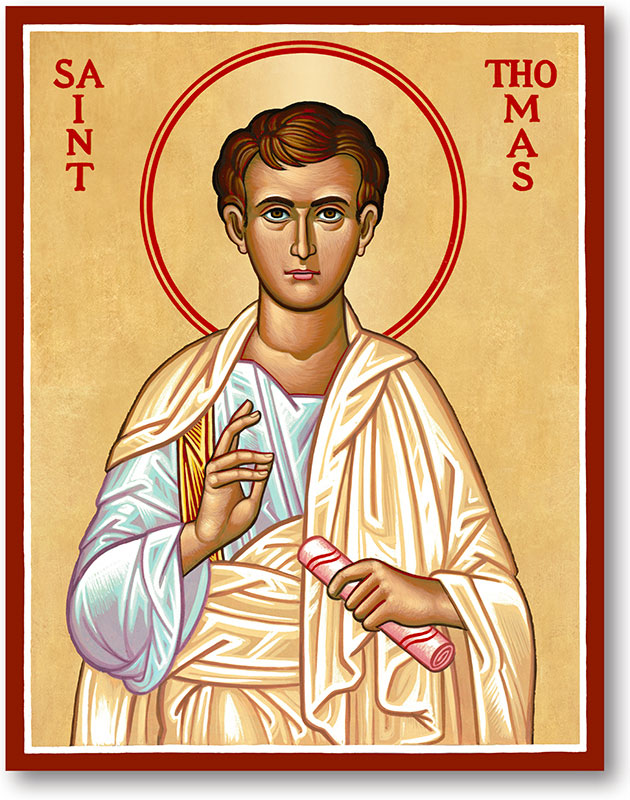
Doubting Thomas — That is how the apostle is remembered since he said, “Unless I see the mark of the nails in his hands and put my finger into the nailmarks and put my hand into his side, I will not believe.” Upon seeing Jesus alive he professed, “My Lord and my God,” but the ignoble nickname endures. St. Thomas has just four quotes in the gospels, all of them found in John; his two other quotes reveal more of his character.

After Lazarus had died, Jesus said, “Let us go back to Judea,” and the disciples objected, “Rabbi, the Jews were just trying to stone you and you want to go back there?” When Jesus insists on going, Thomas says to his fellow disciples, “Let us also go to die with him.” Then later, Jesus says at the Last Supper, “Where I am going you know the way.” And Thomas relies, “Master, we do not know where you are going; how can we know the way?

From his four quotes we glimpse Thomas’ weakness and his strengths. He should have believed his friends’ testimony that they had indeed seen and touched and spoken with Jesus resurrected (especially after having witnessed Lazarus risen from the dead) but Thomas was lacking in trust. Yet at the same time, Thomas possesses great loyalty and courage.

Where is Thomas one week after Easter Sunday? The disciples are gathered in the upper room, hiding behind locked doors for fear of those who murdered Jesus, and Thomas is right there with them. He could have chosen to retreat to someplace safer but he is loyal and brave and these virtues lead him to encounter the risen Christ.

We typically focus on our faults and flaws, on the vices and sins that hinder us. However we each possess virtues as well, areas where God has had success in us. Know and acknowledge these virtues, give thanks to God for them, and utilize them to grow. Pray for grace and use your strengths to lead you to perfect holiness like St. Thomas’ virtues led him to glory with Jesus Christ.

“As Nothing Compared with the Glory”

July 11, 2020

15th Sunday in Ordinary Time

Cardinal Timothy Dolan, the current archbishop of New York, tells a story from his first Lent as a newly ordained associate priest in a small Missouri parish. The president of their church’s men’s group told him unenthusiastically, “Father, you’re supposed to give us an evening of recollection in Lent.” So Fr. Tim, on fire to share the treasures of our Faith, worked earnestly for weeks preparing spiritual reflections about characters appearing in the Stations of the Cross. The big night for his men’s talk came. He opened the church doors early for all those who would be coming — and just two guys showed up. Fr. Tim gave his talk anyway, of course, but the young priest was crestfallen, crushed. When he returned to the rectory, his pastor said, “Oh, I should have told you those never work.” All of his devoted time and effort seemed wasted.

Twelve years later, the same Fr. Timothy Dolan was visiting a woman in the parish who was dying of Lou Gehrig’s disease. He was amazed at how tenderly her elderly husband was taking care of her, staying by her side and helping her with everything. As he was being walked to the door to leave, Father told the husband how much he admired his devotion to his wife. The man replied “Oh, Father, I’m just trying to be that Simon of Cyrene you talked about.” Father Dolan looked at him confused. “Remember that Lenten evening of recollection when you told us that just as Simon of Cyrene helped our Lord carry His cross, we do the same every time we help somebody else carry theirs? I’m just trying to help Ramona carry hers.

I first read about this story as a seminarian and it has stuck with me ever since. It’s a story of suffering. Granted, the young priest’s suffering was not so great as having a terminal disease or accompanying a dying loved one, but it was an experience of suffering whose value — though invisible at the time — was later wonderfully revealed. What Fr. Dolan had sown in painful labor and imagined to have been worthless toil proved beautifully precious and important. As one of the psalms say:

They go out, they go out, full of tears,
carrying seed for the sowing:
they come back, they come back, full of song,
carrying their [harvest] sheaves.

All suffering is painful, but any sort of suffering is worse when we think it has no meaning and all suffering is made easier when we know that it has worth. I speak of all this because of St. Paul’s words to the Romans in our second reading today: “I consider that the sufferings of this present time are as nothing compared with the glory to be revealed for us.” The sufferings of this present time are as nothing compared with the glory to be revealed for us.

Nobody likes suffering, but we all experience it in various ways regardless. We suffer from uncertainties and misunderstandings, from tribulations and persecutions, from worldly anxieties and temptations, but the saints tell us trials of suffering are rich soil which bear fruit manyfold for ourselves and others. St. Vincent de Paul declares, “If we only knew the precious treasure hidden in infirmities, we would receive them with the same joy with which we receive the greatest benefits, and we would bear them without ever complaining or showing signs of weariness.” In light of divine justice, St. Mary Magdalen de’Pazzi assures us, “You will be consoled according to the greatness of your sorrow and affliction; the greater the suffering, the greater will be the reward.” And St. Teresa of Avila encourages us, “Suffering is a great favor. Remember that everything soon comes to an end… and take courage. Think of how our gain is eternal.”

Sometimes God permits or sends sufferings for correction, that sinners may repent and be saved. But other times, sufferings are given in order to further purify, perfect, and glorify his friends. As St. Ignatius Loyola says, “If God sends you many sufferings, it is a sign that He has great plans for you and certainly wants to make you a saint.” St. Faustina Kowalska notes, “Suffering is a great grace; [for] through suffering the soul becomes like the Savior; in suffering love becomes crystallised; the greater the suffering, the purer the love.” And St. Augustine of Hippo observes truly, “God had one son on earth without sin, but never one without suffering.”

It was through the innocent suffering of his Passion that Jesus offered the sacrifice which converts hearts, forgives sins, and achieves Christ’s greatest earthly glory. Do you believe in the power of the Cross to save you? Then believe in the power of your own sufferings — lovingly endured and patiently offered up — to perfect you, save souls, and achieve your greatest glory.

False Paths to Paradise

July 9, 2020

Early in the Book of Genesis we read about a great flood wiping out humanity (sparing only Noah, his three sons, and their wives) and then about people building a great city and high tower until God confounds their efforts. These two inspired tales hold important lessons for every society in history, including our’s today.

When God saw how wicked the human race was he decided to pour down judgment on the earth and start over. So he told Noah, the best of men, to build an ark for his family to survive. Once the floodwaters had receded, “God blessed Noah and his sons and said to them: Be fertile and multiply and fill the earth.” This was to be Eden anew. But when Noah drank wine to excess and became drunk he was somehow violated by his son while laying naked inside his tent. The flood was meant to cleanse the earth of sin, but sin stowed away upon the ark.

Then, after detailing Noah’s descendants, Genesis tells how people said, “Come, let us build ourselves a city and a tower with its top in the sky, and so make a name for ourselves!” The Lord said, “If now, while they are one people and all have the same language, they have started to do this, nothing they presume to do will be out of their reach.” God confused their language so that they stopped building the city and scattered across the earth. Why did God react this way? That city is called Babel because God made them babblers but also likely in reference to ancient Babylon, the enemies of God’s people who had high towers called zigguratts on which they worshiped false gods and offered human sacrifices. God thwarts Babel to limit the evils they can accomplish.

The tales of the Great Flood and the Tower of Babel reflect two ineffective strategies for eradicating evil: purging all the wicked and uniting everyone apart from God. Our world seeks scapegoats, persons and groups to blame for our problems. “If only it were all so simple,” writes Aleksandr Solzhenitsyn. “If only there were evil people somewhere insidiously committing evil deeds, and it were necessary only to separate them from the rest of us and destroy them. But the line dividing good and evil cuts through the heart of every human being. And who is willing to destroy a piece of his own heart?” Our world also clamors for greater unity in one leader or party, nation or race, economic system or secular ideology. We must not ignore politics, realizing that a movement detached from God and sufficiently empowered will lead people to physical and spiritual deaths.

God’s desire is to unite all peoples in Christ, undoing Babel with Pentecost. The Church, Christ in his members, is sent to save our world through conversion rather than destruction “for God did not send his Son into the world to condemn the world but that the world might be saved through him.” Sin and sinners must be opposed but not without the love which we ourselves have received as sinners reconciled to God. Take courage today by recalling the conversions of Saul and the Romans Empire, Christianity’s early enemies – by grace and virtue the Church can win over even her worst persecutors.

“Take My Yoke (Instead)”

July 5, 2020

14th Sunday in Ordinary Time

“Take my yoke upon you and learn from me…
For my yoke is easy, and my burden light.”

What is Jesus telling us? For starters, what’s a yoke? A yoke is made of wood or metal and lays around the necks or shoulders of beasts of burden in order to pull something behind them, such as a plow or a wagon. Though there exists single yokes for animals working alone, yokes are typically designed for pairs of animals to work side-by-side, together. A wise farmer might pair a mature animal with a less experienced animal to help guide and train the junior one. Looking down from above, a yoke that connects two animals and the attached tongue beam connected to the implement behind them bears a likeness to the Cross.

“Take my yoke upon you and learn from me…
I am meek and humble of heart.”

Jesus criticized the proud and learned Pharisees for (in his words) tying up heavy burdens hard to carry and laying them on people’s shoulders without lifting a finger to help them. Do not imagine that Jesus is asking you to bear a yoke by yourself. Instead, Jesus asks us to share his yoke with him, to share in his labors and learn from his example.

“I give praise to you, Father, Lord of heaven and earth,
for although you have hidden these things
from the wise and the learned
you have revealed them to little ones.”

Jesus’ invitation to bear his yoke will seem unattractive to us if we mistakenly imagine ourselves being presently unyoked, totally free and unencumbered. But no one’s neck or shoulders are unyoked — everyone bears a burden. Some are yoked to serious sins. As St. Paul says, those who sin are slaves to sin. Other people yoke themselves by trying to do lots of good things which the Lord is not asking of them and they find it overwhelming. Both of these yokes are heavy and hard and chafe against us because they are not God’s will for us. Is the yoke you now carry Jesus’ yoke for you or one of your own fashioning? Perhaps bring that question to prayer to find relief.

“Come to me, all you who labor and are burdened,
and I will give you rest.
Take my yoke upon you and learn from me…
and you will find rest for yourselves.
For my yoke is easy, and my burden light.”

When animals’ shoulders are yoked together as a team, their work is the same. They plow through the same field or walk along the same road. Jesus wants you, wherever you are, to share in his labors. Jesus desires you to work alongside him with your family, with your friends, at your job, in all that you do. Ask the Lord to put you to salvific use, then be open and see what opportunities and encounters he sets before you. Ask Jesus that you may share in his works.

When two animals’ necks are yoked, facing forward together, their perspectives are the same. Jesus wants us, wherever we are, to share perspective, his outlook. To look up, and see the Father as Jesus sees him. To look out, and see other people and the world as he sees them. To look within, and see ourselves as Jesus sees us. “No one knows the Father except the Son and anyone to whom the Son wishes to reveal him.” And no one sees you and the rest of humanity more clearly and truly than Jesus Christ—and he loves us. Ask Jesus that you may share his sight.

So in conclusion, if you labor and feel burdened, go to Jesus and he will give you rest. Wear his yoke and learn from him, he’s a meek and humble partner. And you will find rest for yourself, for his yoke is easier and his burden is lighter.

A Prophet’s Reward

June 27, 2020

13th Sunday in Ordinary Time

Jesus says, “Whoever receives a prophet because he is a prophet will receive a prophet’s reward.” So what is a prophet’s reward? Being a prophet in this world is a kind of a mixed bag.

On the positive side, a prophets’ words and deeds and their role in working miracles can give great blessings and yield joyful fruits for both the preacher and the people. For instance, the Shunammite woman in our first reading repeatedly received the prophet Elisha into her home and to her table, and he was pleased to be so warmly welcomed. First, she was graced by the holy man’s words and presence, then she was blessed through the miracle he announced: “This time next year you will be fondling a baby son.” She was overjoyed at the birth of a son, and Elisha surely shared that joy. Those who heed the word of God are blessed to see its fruits.

On the other hand, on the negative side of the ledger, the prophets and their words were not always welcomed and received. In fact, they were usually met with hostility. The Letter to the Hebrews recalls how some of the prophets “endured mockery, scourging, even chains and imprisonment. They were stoned, sawed in two, put to death at sword’s point; they went about in skins of sheep or goats, needy, afflicted, tormented.” Knowing this, is it worth it for a prophet to answer God’s call?

Well, consider what else belongs to the prophet’s reward: Consider the value of living a holy life with a clear conscience. There is a great peace in doing what is right that is unlike the spiritual disquiet of sin. Consider the value of a life doing good with holy purpose, helping to save others’ souls. A selfish life lacks deeper, greater meaning, and its emptiness is a terrible taste of what Hell is like forever. Consider the value of a life that will be remembered. Remembered by people on earth? Maybe, maybe not, beyond the people whose lives you bless— but certainly remembered by God, who will reward his faithful ones with the joy of Heaven, an everlasting reward beyond our imagining. And all along this way to Heaven, you will share in the personal, intimate, friendship of God.

Now Jesus says, “Whoever receives a prophet because he is a prophet will receive a prophet’s reward” and “whoever receives a righteous man because he is a righteous man will receive a righteous man’s reward.” But where can we today find a prophet and righteous man to share in his reward? Long ago, Moses said, “A prophet like me will the Lord, your God, raise up for you from among your own kinsmen; to him you shall listen in all that he may say to you. Everyone who does not listen to that prophet will be cut off from the people.” Remembering this, when the crowds saw Jesus perform the miracle of the multiplication the loaves they said, “This is truly the Prophet who is to come into the world.” On one occasion, Jesus stated that the men of Nineveh “repented at the preaching of (the Prophet) Jonah; and there is something greater than Jonah here.” Then, after Jesus’ Ascension, St. Stephen the first martyr preached that the prophets had “previously announced the coming of the Righteous One…” and St. Ananias announced to Saul, who had encountered the Lord Jesus on the road to Damascus, “The God of our fathers has appointed you to know His will and to see the Righteous One.” Thus, the one who receives Jesus Christ will receive a prophet’s and righteous man’s reward. “And whoever gives only a cup of cold water to one of these little ones to drink because the little one is a disciple —amen, I say to you, he will surely not lose his reward,” for Jesus says, “whatever you did for one of these least brothers of mine you did it for me.

How can we receive the Lord? First of all, through the sacraments. Are you unaware that in baptism you were baptized into Christ? To quote St. Paul, “all of you who were baptized into Christ have clothed yourselves with Christ.” And your baptism has led you here today, to receive him anew in the supreme gift of the Holy Eucharist, the Most Blessed Sacrament. (For some of you, you are blessed to be about to receive Jesus in this way for the very first time, and we’re all very happy for you.) In this sacrament Jesus Christ comes to visit and dine with you with you: “Behold, I stand at the door and knock. If anyone hears my voice and opens the door, I will enter his house and dine with him, and he with me.” And if we have prepared a place for him and welcome him to dwell, Jesus stays and remains with us. The good Shunammite woman prepared room for Elisha in the highest place of her home, upon the cool rooftop, and furnished it for him with a bed, table, chair, and lamp, so that he could comfortably stay. She converted and reorganized her house for her holy guest. Jesus expects the same of us; the conversion and dedication of our lives, our souls, our homes; for Jesus wishes to dwell with us.

Receiving Jesus Christ in the Eucharist is not a one and done event. Even returning to encounter him here again at Mass every Sunday – as we are rightly commanded to do – is not all that he desires of us or for us. Jesus says, “Whoever does not take up his cross and follow after me is not worthy of me.” Following Jesus requires us to die to sin and offer loving sacrifices like himself. It’s often hard to live for Christ. Knowing this, is it worth it to answer his call?

Consider the value of living a holy life with a clear conscience, with the peace that come from doing what is right. Consider the value of a life doing good with holy purpose, helping to save others’ souls. Consider the value of a life that will be remembered by God and those whose lives you bless forever. And consider how Christ will reward you with Heaven, an unending joy beyond imagining, and share his personal, intimate, friendship with you all along your way there. Jesus says, “Whoever finds his life will lose it,” but “whoever loses his life for my sake will find it.” And whoever truly receives our Lord Jesus Christ will receive the Christ’s reward.

A Man for our Seasons

June 22, 2020

12th Sunday in Ordinary Time

June 22nd is the feast day of St. Thomas More, one of my favorite saints. Back in 1929, the great Catholic writer G.K. Chesterton wrote: “Thomas More is more important at this moment than at any moment since his death, even perhaps the great moment of his dying; but he is not quite so important as he will be in about a hundred years’ time.” This prediction’s one hundred year anniversary arrives this decade. So who is St. Thomas More, what made him a martyr, and what lessons does he have for us today?

In 1509, the new eighteen-year-old Catholic King of England, Henry VIII, married a smart and extremely beautiful Spanish princess, Catherine of Aragon. Seventeen years later, King Henry, without a male heir, with his affections now shifted toward a mistress, began citing a passage from the Old Testament book of Leviticus to argue that his marriage to Catherine was invalid and he asked the pope to annul his marriage. What happened thereafter is a story retold in my favorite movie, 1966’s Best Picture Winning film, A Man for All Seasons. That remarkable man for all seasons – adept in all circumstances – was St. Sir Thomas More.

A successful attorney, judge, diplomat, and statesman, Thomas More served in many official roles, including as Speaker of the British House of Commons. His brilliance is reflected by his witty quotes and writings. Four hundred ten English words have their invention (or at least their first-known appearances) from him, including the word “Utopia,” the title of his most famous book. A deeply devout Catholic, Thomas More had seriously considered becoming a monk, but instead discerned a call to marriage, family, and a career in public life. All these traits combined made him a great asset to the King. For instance, More once helped Henry VIII write a treatise in “Defense of the the Seven Sacraments” against Martin Luther’s errors for which the pope bestowed upon the king the title “Defender of the Faith.” The king trusted and admired Thomas More for years and appointed him to be the Lord Chancellor of England, a very high office. Then a season of great evil came to that land.

When King Henry asked Pope Clement VII to annul his marriage the pope refused. What Henry sought would have been a divorce, and Jesus said, “Whoever divorces his wife and marries another commits adultery.” Henry continued petitioning, but the Holy Father’s refusal was steadfast against this king spurning his queen. In response, Henry divorced and remarried anyway and went on to assert his supremacy over and against the pope, declaring himself to be the leader of the Catholic Church throughout his realm. Henry then used the power of the state to make all his subjects fall into line. It became a crime to agree with the pope against the king and all public figures were required to swear oaths affirming the king’s supreme headship over the Church in England. Those who denied the king’s claims would be executed.

Thomas had resigned his office and withdrawn from public life because of and prior to the king’s illegitimate remarriage and Thomas did not attend the wedding ceremony. Thomas was not going to endorse, by his words or actions what he did not believe. The king’s remarriage was wrong, but Thomas hoped that by maintaining public silence he and his family would be left alone. However, the compelled oath affirming the king’s supremacy would no longer tolerate Thomas’ neutrality. The oath was evil. Jesus, from his own lips while on this earth, had entrusted the role of supreme governance of the Church to St. Peter and his successors, the popes. Thomas was absolutely resolved not to swear a false oath, for Jesus warns us, “Whoever denies me before others, I will deny before my heavenly Father.”

When Thomas would not take the oath, he was imprisoned in the Tower of London and was charged with high treason. Thomas, the brilliant expert of law and debate, put up a sound defense that under the law they had no grounds to punish him, but following evidently false testimony from an ambitious acquaintance who betrayed him, Thomas More, under this pretext, was found guilty. The condemned man then spoke out against the unchristian oath and the injustice being done, yet in closing he said this to his judges: “More have I not to say, my lords, but that like as the blessed apostle Saint Paul, as we read in the Acts of the Apostles, was present and consented to the death of St. Stephen, and kept their clothes that stoned him to death, and yet be they now [both] holy saints in heaven and shall continue there friends forever: so I verily trust and shall therefore right heartily pray, that though your lordships have now in earth been judges to my condemnation, we may yet hereafter in Heaven merrily all meet together to our everlasting salvation.” At his beheading for being condemned as a traitor, at his martyrdom for being faithful to Christ and his Church, St. Thomas More spoke these words: “I die the king’s good servant and God’s first.”

Today, like willful King Henry VIII, much of our prevailing culture also wants things contrary to God’s will and Christ’s teachings. They declare that all who do not fully agree with them are evil and should be expelled, cancelled from society. And the powers of government, our courts and leaders, seem to be taking their side. Jesus said:

“Have you not read that from the beginning the Creator ‘made them male and female’ and said, ‘For this reason a man shall leave his father and mother and be joined to his wife, and the two shall become one flesh’? So they are no longer two, but one flesh. Therefore, what God has joined together, no human being must separate.”

God made us male and female, he created marriage, all peoples and races share a common origin and dignity from him, and Christ was sent to save us all. Thus, marriage is a lifelong union between one man and one woman, an adult female is a woman and an adult male is a man, no one should be judged for the color of their skin, and Jesus Christ is the only way to the Father. These beliefs are not always popular, but ignoring these truths leads to pain and loss. The story of St. Thomas More shows us that public silence and private disagreement may not be tolerated by this world. Sooner or later, it may be demanded that you too either submit or suffer. At that time, and all times, remember: do not lie, never ever lie, and do not be a party to a lie.

Jesus says, “Blessed are they who are persecuted for the sake of righteousness… thus they persecuted the prophets who were before you.” In years past, this passage made me think of suffering Christians in the distant mission lands of Asia or Africa, where they are the vulnerable minority, or of how the Roman pagans persecuted the early Church. But who was Jesus referring to when he said “they persecuted the prophets who were before you”? Who persecuted the Jewish prophets in the Old Testament? It wasn’t so much the unbelieving pagans as the prophets’ own leaders and neighbors they were sent to, the people of God. Likewise, a Christian can easily become a betrayer or a passive party to evil if he or she does not resolve like St. Thomas More to live in the truth and stand with Christ no matter what.

Though Thomas More was clearly innocent, it took his twelve jurors only fifteen minutes to find him guilty. They were afraid. There were fifteen judges at his trial, many of whom had been his friends, but none of them were willing to defend him. They were all afraid too. The saint might have been saved if only one had stood firm instead of just standing by. The Church in England might not have collapsed if there had been more upright men like St. Thomas More. What we do in the time that is given us matters. Stand with him and the Lord will strengthen you like he did the Prophet Jeremiah. You may feel alone, but you won’t be, and Jesus Christ will be proud of you.

This stand may cost you dearly. Will it be worth it? Jesus tells us, “Blessed are you when they insult you and persecute you and utter every kind of evil against you falsely because of me. Rejoice and be glad, for your reward will be great in Heaven.” So do not be afraid. Jesus says, “Fear no one.” Remember there is only One whose opinion ultimately matters. “Do not be afraid of those who kill the body but cannot kill the soul; rather, be afraid of the one who can destroy both soul and body in Gehenna. Everyone who acknowledges me before others I will acknowledge before my heavenly Father.” St. Thomas More said, “I do not care very much what men say of me, provided that God approves of me.”

Last Friday evening, a statue of St. Junipero Serra, the Franciscan missionary to California, was pulled down and desecrated by about one hundred people in San Francisco. The police did nothing to stop them. Those people who did this probably believed false and horrible things about the saint, and that would be some encouragement except that many people believe false and terrible things about our Church today. Along this path it’s not hard to imagine Catholic churches being firebombed sooner or later. But remember, even if this happens, whatever may come, whatever persecution we may face, Jesus says, “love your enemies and pray for those who persecute you.” Love God and everyone because it’s Christian love that saves. This is what Jesus Christ, St. Thomas More, and all the martyrs showed in their courageous words and actions. Let’s learn from them and imitate them in whatever seasons await us, and so come to share in the eternal reward of the Just in Christ’s Kingdom.


Called & Led into His Friendship & Community

June 17, 2020

Elena Feick at 2007’s Easter Vigil where she received the Sacraments of Initiation

How does a 15-year-old unbaptized Canadian girl, a practicing Wiccan with SSA, come to find a relationship with Jesus in his Catholic Church? For Elena Feick, her journey began when she sought to join a coven.

Elena used to meditate by herself, worshiping the five elements and a pagan goddess, but she longed for more community. A particular coven, before they would admit her, asked that she research another religion besides Wicca first. Elena chose to read Christianity’s Gospels thinking she would be able to easily dismiss them. However, to her surprise, “I just… believed them. I didn’t want to. But when I got to Luke 11:9 (“And I tell you, ask and you will receive; seek and you will find; knock and the door will be opened to you”), I realised I did believe. But I didn’t like how the Christian God wasn’t willing to share me with other ‘gods’ so I resisted for a long time.” She still wanted to practice Wicca and worship a goddess yet she couldn’t say she didn’t believe in Christianity. So, instead of joining a coven, she joined the Unitarian Universalists (a creedless religious movement founded in 1961).

Elena’s journey to God was then helped by another unlikely source: “Sex and the City.” That was her favorite TV show as a teenager and her favorite character on it was Charlotte (played by Kristin Davis). In one episode, Charlotte converted to a new religion in hopes that her Jewish boyfriend would marry her. Elena was very disappointed in Charlotte, convinced that she had the ordering of things all wrong. “One’s relationship with God should come before even romantic relationships,” she thought. That’s when Elena decided not to date anyone seriously until she figured out for sure what she believed. She went on to explore lots of religions. Eventually, against her will, she ended up at a Catholic Mass.

The Mass was held at her new Catholic school and she was very afraid to attend. She thought the priest might supernaturally read her soul and denounce her as a witch. But when he gave her a blessing at Communion time something happened. In a way she couldn’t explain or put a finger on, she felt different and overwhelmed. “I can still sometimes feel his thumb tracing a cross on my forehead. It was the first time I really experienced the feeling of the love of God.” A few weeks later she decided to ask the priest about the experience and that was her inroad to the Church. A year later, she joined the local RCIA program to become Catholic. “It took quite a few conversations before I would agree to stop practicing Wicca though! But I did, just before I started RCIA.

Elena beside a reliquary of St. Therese of Lisieux in Scotland in the fall of 2019

When her RCIA teachers instructed the class about the Real Presence of Jesus in the Holy Eucharist, Elena was skeptical. “Ok, so they’re crazy,” she thought. But at the encouragement of the now-trusted priest who had blessed her (Fr. Terence Runstedler of Ontario) she began going to the perpetual adoration chapel every day and recognized its graces. “[I] realised that things I had prayed over at home that made no sense made perfect sense if I prayed over them in the chapel. …Every time I went to Adoration, Jesus spoke to me in some way. Every time. I couldn’t ignore it. … The Eucharist is the reason I didn’t completely ignore Church teaching on SSA [same-sex attraction] and find myself a girlfriend.

Elena had been in denial about her attractions growing up. After discovering Catholicism, she prayed for these feelings to go away but they wouldn’t. She decided that maybe the Church was wrong and started going to LGBT support groups. Her mind changed back again at her grandmother’s funeral. It was a non-Catholic service and everyone was invited to come forward and receive their communion, “but I just knew so powerfully that I couldn’t because it wasn’t *Him*. It was lacking the Real Presence. Which meant I still believed in the Eucharist. Which meant the Church has to be right. So I changed my whole life again even though I didn’t understand the teachings on chastity.”

In 2007, at the age of 19, Elena was baptized, confirmed, and received her First Communion at the Easter Vigil. “Right up to the night, I was still partially afraid that God would strike me down when the baptismal waters touched me. I wanted so much to belong to Him but half thought that maybe He didn’t want me… I thought if He wanted me in the Church, why didn’t He have me born in a Catholic family? But then I received Him for the first time and I just *knew*. I could hear Him (not like a voice but like thoughts that you know come from Him) saying that I always belonged to Him and always would.” Elena notes that some people have deeply intellectual reasons for converting but her reasons were more relational. “[The Lord] just kept inviting me and pulling me along and putting things in my path I couldn’t ignore. He kept introducing me to Himself, over and over, until I finally recognised it was Him I was longing for.

Elena at The March for Life UK in London, May 2019

Today, Elena is 32 years old, lives in Scotland, and prior to the pandemic she worked as a personal support healthcare worker. (I myself made her acquaintance and learned her story this year through the social media website Twitter.) In her spare time, Elena enjoys writing songs and making rosaries and is a member of both Courage International and Eden Invitation, two groups which support those with same-sex attractions in living chaste and saintly lives. Through Catholic faith and community, she says, “I started to learn my identity as belonging to Christ and as a daughter to the Father.” Elena hopes to help other LGBT-identifying persons to also discover a deeper self-identity in God. Even in the discouraging modern culture we live in, Elena’s story encourages us that Jesus Christ is still powerfully, lovingly, calling and leading people into his friendship and community.

Jesus’ Longing for You

June 14, 2020

Corpus Christi Sunday—Year A

After the suspension in March, our parish went eleven weekends without the public celebration of Sunday Masses. Throughout Salvation History, the number forty symbolizes times of purification, preparation, and longing. For most people, being away meant about eighty days (forty twice over) without physically receiving our Eucharistic Lord. For many, their yearning for Jesus in the Eucharist has never been greater. Feast of Corpus Christi homily usually focus (quite fittingly) upon the Real Presence, the beautiful truth that Jesus Christ is truly present, body and blood, soul and divinity, alive in the Holy Eucharist. As St. Paul says in our second reading, “The cup of blessing that we bless, is it not a participation in the Blood of Christ? The bread that we break, is it not a participation in the Body of Christ?” You are probably well-informed about this already; that’s why you have been longing for Him in the Eucharist. Today I feel moved to speak about Jesus Christ’s Eucharistic longing for you.

Jesus Christ’s desire for us is foreshadowed in the Old Testament; for instance, in The Song of Songs. There the beloved says of her spouse: “My lover speaks and says to me, ‘Arise, my friend, my beautiful one, and come! Let me see your face, let me hear your voice, for your voice is sweet, and your face is lovely.’” Later this same man, prefiguring Christ, declares: “I have come to my garden, my sister, my bride; … I eat my honeycomb with my honey, I drink my wine with my milk. Eat, friends; [and] drink!

In the Book of Proverbs, God’s personified wisdom speaks: “Let whoever is naive turn in here; to any who lack sense I say, Come, eat of my food, and drink of the wine I have mixed! Forsake foolishness that you may live; advance in the way of understanding.” The foolishness we must forsake is our sins, for what is freely-chosen sin if not harmful foolishness? Jesus seeks to bring about sinners’ salvation, in part, through drawing them to his meal, to share his presence, his food and drink. Jesus once responded to criticisms of his ministry saying: “The Son of Man came eating and drinking, and they say, `Behold, a glutton and a drunkard, a friend of tax collectors and sinners!’ Yet wisdom is vindicated by her deeds.

A Samaritan woman with many sins once asked Jesus, “How can you, a Jew, ask me, a Samaritan woman, for a drink?” He answered her, “If you knew the gift of God and who is saying to you, ‘Give me a drink,’ you would have asked him and he would have given you living water.” Later, on the last and greatest day of a Jewish feast, Jesus stood up in the temple area and exclaimed: “Let anyone who thirsts come to me and drink.” Before his miraculous multiplication of loaves of bread, Jesus called his disciples to himself and said, “I feel compassion for the people, because they have remained with me now three days and have nothing to eat; and I do not want to send them away hungry, for they might faint on the way.” Jesus wants to feed us (we who have remained with him) as well, to strengthen us on our way. The food and drink Jesus desires you and I to receive are not mere objects for bodily sustenance — it is his very self. “I am the living bread that came down from Heaven; whoever eats this bread will live forever… For my flesh is true food, and my blood is true drink. Whoever eats my flesh and drinks my blood remains in me and I in him.

At the Last Supper, which was the first Mass, Jesus told his disciples, “I have earnestly desired to eat this Passover with you… Take this, all of you, and eat of it, for this is my body, which will be given up for you.” Jesus earnestly desires to share his feast, this Mass, to unite with us today. “Behold, I stand at the door and knock. If anyone hears my voice and opens the door, I will enter his house and dine with him and he with me.” Jesus is divine, but he’s also human. He dwells in Heaven, but he has human desires for you and me and our world. If you have yearned for Jesus in the Eucharist, if you have desired to receive him these past months, consider how much more Jesus Christ longs and desires for you.

Virtue in Obedience

June 11, 2020

According to likely tradition, St. Ignatius the bishop of Antioch learned about our Faith from St. John the Apostle. Around the year 110 A.D., St. Ignatius was brought by Roman guards from Syria to Rome for his martyrdom. On this long journey, he wrote seven famous letters which provide insight into the teachings and beliefs of the Early Church. In his letter to the Christians in Smyrna, he wrote:

See that you all follow the bishop even as Jesus Christ does the Father, and the presbytery [priests] as you would the apostles; and reverence the deacons as being the institution of God. Let no man do anything connected with the Church without the bishop. Let that be deemed a proper Eucharist which is administered either by the bishop or by one to whom he has entrusted it. Wherever the bishop shall appear, there let the multitude of the people also be; even as wherever Jesus Christ is, there is the Catholic Church.”

Catholic priests at ordination promise obedience to their bishop and his successors, but religious submission to one’s bishop-shepherd (in things which are not sinful) is Christ’s will for all the faithful. “Whoever hears you, hears me,” Jesus said, and “whatever you shall bind on earth shall be bound in Heaven, and whatever you shall loose on earth shall be loosed in Heaven.” “Let us be careful, then, not to set ourselves in opposition to the bishop,” St. Ignatius wrote to the Ephesians, “in order that we may be subject to God.” Before he lost the kingdom, King Saul was told by the Prophet Samuel, “Obedience is better than sacrifice; to listen, better than the fat of rams.” The Lord delighted in obedience to his will more than in burnt offerings and animal sacrifices because holy obedience is a sacrifice of one’s own self.

Even the yoke of Christ remains a yoke. It’s natural to feel frustration at our gradual return to normal, towards the careful procedures our bishop has promulgated throughout our diocese to help protect against a still-deadly pandemic. These policies may prove overly cautious in retrospect—and I hope that is the case rather than seeing our safeguards prove tragically inadequate—but the will of Christ for you and I is to obey our God-ordained successor to the apostles. Blessed is that servant whom the Lord on his arrival finds doing so.

Watch “The Chosen”

June 8, 2020

The Chosen” is a truly excellent dramatized series about Jesus’ early ministry. I highly recommend it. They flesh-out characters and scenes from the Gospel texts in creative but faithful ways. The depiction of Jesus is particularly compelling. You can see the first season’s episodes on YouTube or through this free app.


The Unity of the Trinity

June 8, 2020

Trinity Sunday—Year A

My favorite professor at seminary was a young, married, Catholic layman named Dr. Perry Cahall. He taught us several courses but his Church History class stands out in my mind. I took away two big insights from Church History.

First, in every age, century after century, it seemed like the Catholic Church was circling the drain, about to go down the tubes for good. There were Roman persecutions, Gnostic and Arian Heresies, barbarian invasions, Islamic conquests, Protestant rebellions, atheist revolutions, fascist and communist totalitarianisms. And yet, the Church endures because God is with her. Remembering this has been a reassuring consolation for me in the past, in our present circumstances, and will be in the future.

The second major insight was how heresies clarify the Church’s teachings. When some sect or movement would arise teaching some new heresy this would prompt a Church Council to more clearly define what we believe as Christians. Error prompts the profession of truth. This was especially so in our profession of the Holy Trinity.

Dr. Cahall is a pretty mild guy, so one of his most memorable lectures stands out in my mind. He said, “Gentlemen, if some day you are ordained and on Trinity Sunday you get into the pulpit and say, ‘The Trinity is a mystery and there’s nothing we can really say about it,’ I’ll hunt you down like the dogs you are.” Why? Because as the Catechism says, “The mystery of the Most Holy Trinity is the central mystery of Christian faith and life. It is the mystery of God in himself. It is therefore the source of all the other mysteries of faith, the light that enlightens them. It is the most fundamental and essential teaching in the hierarchy of the truths of faith. The whole history of salvation is identical with the history of the way and the means by which the one true God, Father, Son and Holy Spirit, reveals himself to men and reconciles and unites with himself those who turn away from sin.” Well, I don’t want to be a dog, so I’m not going to just going to tell you “it’s a mystery.

So what are some of the things we can we say with certainty about the Most Holy Trinity? In the words of the Athanasian Creed, this is what the Catholic Faith teaches:

We worship one God in the Trinity and the Trinity in unity.
Neither confounding the Persons, nor dividing the substance.
For there is one person of the Father, another of the Son, another of the Holy Spirit.
But the Father and the Son and the Holy Spirit have one divinity, equal glory, and co-eternal majesty.
What the Father is, the Son is, and the Holy Spirit is.
The Father is uncreated, the Son is uncreated, and the Holy Spirit is uncreated.
The Father is boundless, the Son is boundless, and the Holy Spirit is boundless.
The Father is eternal, the Son is eternal, and the Holy Spirit is eternal.
Nevertheless, there are not three eternal beings, but one eternal being.
So there are not three uncreated beings, nor three boundless beings, but one uncreated being and one boundless being.
Likewise, the Father is omnipotent (that is, all-powerful), the Son is omnipotent, the Holy Spirit is omnipotent.
Yet there are not three omnipotent beings, but one omnipotent being.
Thus the Father is God, the Son is God, and the Holy Spirit is God.
However, there are not three gods, but one God.
The Father is Lord, the Son is Lord, and the Holy Spirit is Lord.
However, there are not three lords, but one Lord.
For as we are obliged by Christian truth to acknowledge every Person singly to be God and Lord, so too are we forbidden by the Catholic religion to say that there are three Gods or Lords.
The Father was not made, nor created, nor generated by anyone.
The Son is not made, nor created, but begotten by the Father alone.
The Holy Spirit is not made, nor created, nor generated, but proceeds from the Father and the Son.
There is, then, one Father, not three Fathers; one Son, not three sons; one Holy Spirit, not three holy spirits.
In this Trinity, there is nothing before or after, nothing greater or less. The entire three Persons are co-eternal and coequal with one another.
So that in all things… the Unity is to be worshiped in Trinity and the Trinity in Unity.

How does the Church come to know such things? We learned them through Jesus Christ. “God so loved the world that he gave his only Son, so that everyone who believes in him might not perish but might have eternal life.” Jesus teaches there is one God, and that the Father and he are one, and that whoever has seen Jesus himself has seen the Father. He accepts Doubting Thomas declaring him “My Lord and my God,” and yet relates to his Father God as another person. When Jesus prays aloud in the Garden of Gethsemane, “My Father, if it is possible, let this cup pass from me,” he is not talking to himself, he’s not pretending or putting on a show for the apostles. The Lord Jesus is the Father’s only-begotten Son and reveals the mystery of the Trinity to us.

God is not a solitary individual, but a loving communion of persons – less like a hermit and more like a family. God is three who know, three who love, three who will and act. The divine persons each work uniquely and together, yet the Father did not die on the Cross, the Holy Spirit did not become man, and the Son did not descend as a dove or tongues of fire. However, each divine person’s works are done in harmonious concert with the others’. We have one “Father from whom all things are, and one Lord Jesus Christ through whom all things are, and one Holy Spirit in whom all things are.” We are made in the image and likeness of God not merely because we posses existence, intellect, freewill, and lordship over creation, but because we live to our fullest in loving communion with others.

St. Paul writes to “brothers and sisters, rejoice. Mend your ways, encourage one another, agree with one another, live in peace, and the God of love and peace will be with you. Greet one another with a holy kiss.” I am pleased that we are beginning the (likely gradual) return to fully gathering at Sunday Mass. Though we can do good apart, it is best for us to be together. I am also praying for our larger society’s coming together as a community of communities. Strife, violence, and destruction are not the path to unity. If Almighty God had wanted to destroy us all he could have, but “God did not send his Son into the world to condemn the world, but that the world might be saved through him.” True unity will come in the likeness of the Trinity. This is the life of Heaven that holy community can begin to know on earth. All of us are called to share in the life of the Holy Trinity, here and now into forever.

Seeing the Light — Funeral for Allen Prince, 74

June 5, 2020

Allen grew up on a farm less than a mile down the road from St. John the Baptist Catholic Church, where he was a lifelong parishioner. Today his body will be buried in that earth to await the Resurrection, and we are now gathered here [at St. Paul’s Church] to pray for his soul. No brief funeral homily can capture the fullness of a Christian life, but Allen’s sons told me a number of interesting anecdotes about his life.

They spoke of his intense work ethic. A farmer for almost 20 years and a semi-truck driver for 30, Allen never retired. Even into his 70’s he was still working hard in his shed, particularly with his welder, joining pieces to one another. Reportedly, he could fix just about anything, repairing what was broken and building things new. Allen spent many hours a week driving trailer loads back and forth across the country. That gave him lots of opportunity to call up people on his cellphone and enjoy their conversation. He also had plenty of time to listen to his musical playlist. Good friends and good songs are great company on the road.

I have also heard that Allen may have once come back from the dead. When one of his lower internal organs burst he became septic, was hospitalized, and was put into a medically-induced coma. That’s when Allen had a surreal experience in which he believed he had died and saw something of a vision involving (according to one son’s recollection) him driving truck out West. Allen was so happy there that when he regained consciousness in the hospital again he was upset to be back because he so much liked where he had been. Though he did not hasten death (he was dreaming to live to be 120) I’m informed that for the rest of his life, as a result of this experience, Allen was no longer afraid of dying. He believed he would be going to a good place.

A homily cannot capture a complete Christian life, but aspects of a Christian’s life will reflect the life and person of Jesus Christ. Jesus came among us not as a pampered prince but as a hardworking laborer, a carpenter or craftsman. As a focused perfectionist, Jesus repairs what was broken and builds things new, welding heavenly things to things of earth, joining God and peoples together as one. Jesus wasn’t eager to suffer and die, but he did not fear what would come after his death. Jesus had seen and experienced that place of joyful peace before, and believed that he would be raised again.

Throughout the Gospels, we see Jesus almost always doing one of two things: either talking with other people or praying to his heavenly Father in solitude. We see him seeking close friendship with everyone while maintaining an intimate relationship with God. Jesus calls us and he wants us to check-in with him daily, using the relationship and intimacy-building communication device called prayer. He wants us to reach out to him every day on our long drive, our long-haul, to Heaven. Jesus’ Beatitudes (“blessed are the merciful, blessed are the meek, blessed are those who mourn…”) describe the Christian disciples as they become more and more like Christ himself. Wherever we are now, the Lord wants us to call him to be our traveling companion; through life, through death, and into life beyond.

Amongst Allen’s driving music playlist, one of his apparently favorite songs shows up seven times performed by different bands or artists, a song famously written and sung by Hank Williams, Sr.: “I Saw The Light.” The words of this song must have personally spoken to Allen:

I wandered so aimless life filed with sin
I wouldn’t let my dear savior in
Then Jesus came like a stranger in the night
Praise the Lord I saw the light

Just like a blind man I wandered along
Worries and fears I claimed for my own
Then like the blind man that God gave back his sight
Praise the Lord I saw the light

I was a fool to wander and stray
Straight is the gate and narrow’s the way
Now I have traded the wrong for the right
Praise the Lord I saw the light

I saw the light, I saw the light
No more darkness, no more night
Now I’m so happy no sorrow in sight
Praise the Lord I saw the light

Let us all turn toward Jesus Christ, the Light from Light, the light of the world, our world’s only hope, to pray that the song and longing of Allen’s heart may be everlastingly fulfilled for him and for us all.