The St. Wenceslaus parish bulletin for February 21st, 2016.
Feb 21st Parish Bulletin
February 16, 2016Our Lady of Champion
February 12, 2016 In 2010, on the Feast of the Immaculate Conception at the Shrine of Our Lady of Good Help (about sixteen miles northeast of Green Bay, Wisconsin) Bishop David Ricken formally endorsed our country’s first Church-approved Marian apparition:
“I declare with moral certainty and in accord with the norms of the Church that the events, apparitions and locutions given to Adele Brise in October of 1859 do exhibit the substance of supernatural character, and I do hereby approve these apparitions as worthy of belief (although not obligatory) by the Christian faithful.”
This is the account of that Marian apparition according to Sr. Pauline LaPlant, to whom Adele Brise often told her story:
She was going to the grist mill about four miles from here [Champion, WI] with a sack of wheat on her head … As Adele came near the place, she saw a lady all in white standing between two trees, one a maple, the other a hemlock. Adele was frightened and stood still. The vision slowly disappeared, leaving a white cloud after it. Adele continued on her errand and returned home without seeing anything more. She told her parents what had happened, and they wondered what it could be—maybe a poor soul who needed prayers?
On the following Sunday, she had to pass here again on her way to Mass at Bay Settlement, about eleven miles from her home … This time, she was not alone, but was accompanied by her sister Isabel and a neighbor woman. When they came near the trees, the same lady in white was at the place where Adele had seen her before. Adele was again frightened and said, almost in a tone of reproach, “Oh, there is that lady again.”
Adele had not the courage to go on. The other two did not see anything, but they could tell by Adele’s look that she was afraid. They thought, too, that it might be a poor soul that needed prayers. They waited a few minutes, and Adele told them it was gone. It had disappeared as the first time, and all she could see was a little mist or white cloud. After Mass, Adele went to confession and told her confessor how she had been frightened at the sight of a lady in white. He bade her not to fear, and to speak to him of this outside of the confessional. Father Verhoef told her that if it were a heavenly messenger, she would see it again, and it would not harm her, but to ask in God’s name who it was and what it desired of her. After that, Adele had more courage. She started home with her two companions, and a man who was clearing land for the Holy Cross Fathers at Bay Settlement accompanied them.
As they approached the hallowed spot, Adele could see the beautiful lady, clothed in dazzling white, with a yellow sash around her waist. Her dress fell to her feet in graceful folds. She had a crown of stars around her head, and her long, golden, wavy hair fell loosely around her shoulders. Such a heavenly light shone around her that Adele could hardly look back at her sweet face. Overcome by this heavenly light and the beauty of her amiable visitor, Adele fell on her knees. “In God’s name, who are you and what do you want of me?” asked Adele, as she had been directed.
“I am the Queen of Heaven, who prays for the conversion of sinners, and I wish you to do the same. You received Holy Communion this morning, and that is well. But you must do more. Make a general confession, and offer Communion for the conversion of sinners. If they do not convert and do penance, my Son will be obliged to punish them.”
“Adele, who is it?” said one of the women. “O why can’t we see her as you do?” said another weeping.
“Kneel,” said Adele, “the Lady says she is the Queen of Heaven.” Our Blessed Lady turned, looked kindly at them, and said, “Blessed are they that believe without seeing. What are you doing here in idleness…while your companions are working in the vineyard of my Son?”
“What more can I do, dear Lady?” said Adele, weeping.
“Gather the children in this wild country and teach them what they should know for salvation.”
“But how shall I teach them who know so little myself?” replied Adele.
“Teach them,” replied her radiant visitor, “their catechism, how to sign themselves with the sign of the Cross, and how to approach the sacraments; that is what I wish you to do. Go and fear nothing. I will help you.”
The manifestation of Our Lady then lifted her hands, as though beseeching a blessing for those at her feet, and slowly vanished, leaving Adele overwhelmed and prostrate on the ground.
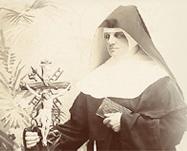 When word spread about Adele Brise’s vision of the Blessed Virgin some believed the account with astonishment, while others judged it a demented delusion. Adele, however, considered it a commission to catechize the children and admonish the sinners of the Bay Settlement. Adele’s father erected a makeshift chapel near the spot of Adele’s vision.

Twelve years later, on October 8th, 1871, disaster came. The Great Peshtigo Fire remains the largest and deadliest forest fire in U.S. history. Between 1,200 and 2,400 lives were lost in Green Bay region. Hundreds fled to the shrine for refuge, beseeching Mary’s help. They lifted a statue of Mary and carried it around the grounds. When the wind and fire threatened suffocation in one direction, they turned in another direction to pray. Hours later, rain began to extinguish the raging fire. The shrine grounds were a green island in an ocean of smoldering ashes in every direction, and all those who fled to Mary’s shrine were saved.
Feb 14th Parish Bulletin
February 11, 2016The St. Wenceslaus parish bulletin for February 14th, 2016.
5th Week in Ordinary Time—Year II Meditations & Homily Builder
February 7, 2016Monday, 5th Week in Ordinary Time—Year II
- The ark held God’s words written in stone, while Jesus is the Word of God enfleshed.
- God’s ark was too holy to safely touch, but the Incarnation allows Jesus’ healing touch.
- The temple’s glory was great but passing, as this life’s joys and pains will be surpassed.
Petitions: Loving Reverence, Hope, The Sick
Tuesday, 5th Week in Ordinary Time—Year II
- It is good to dedicate buildings and possessions to God, but he loves true hearts more.
- The Lord who provides homes for the swallows wishes the elderly to be lovingly cared for.
- Those who hate God attack Christ’s Church and his disciples.
Petitions: The Parish, Moms and Dads, Right Priorities
Wednesday, 5th Week in Ordinary Time—Year II
- Solomon did not reject the Queen of Sheba as unclean in his sight, but dined with her.
- Sheba’s Queen notes seven glories of Solomon, while Jesus notes thirteen evils of man.
- Solomon’s greatest possession, his inner wisdom, was God’s gift. (1 Kings 3)
Petitions: Wisdom, Strangers and Guests, Pure Hearts
Thursday, 5th Week in Ordinary Time—Year II
- The Lord distained the nations, for “they sacrificed their sons and their daughters to demons.”
- A woman’s love can lead a man’s heart to do good (as with Jesus) or evil (like Solomon.)
- Our Lord always keeps his word and promises, “for he cannot deny himself.” (2 Timothy 2:12-13)
Petitions: Christian Fidelity, Unconverted Nations, Pro-Life
Friday, 5th Week in Ordinary Time—Year II
- Jesus and Ahijah led their charges aside to open their ears with God’s effective word.
- Both used tangible signs (in addition to words) to help others “walk in [God’s] ways.”
- Is seems that Jeroboam did not keep his secret either, for Solomon sought his life. (1 Kings 11:40)
Petitions: Christian Reunion, Sacraments, Keeping Confidences
Questions & Answers About Lent
February 5, 2016What is Lent?
 Lent is the liturgical season in which we prepare for Easter through prayer, penance, and fasting.
How long is Lent?
Lent runs from Ash Wednesday to Easter Vigil. It is actually 46 days long: 40 days of penance, plus six Sundays not considered days of penance.
Why is it called “Lent”?
The word “Lent” comes to us from old German and English words for “springtime.”
Why do we get marked with ashes?
The ancient Jews would put ashes atop their heads in repentance, mourning, and/or self-debasement. The ash crosses on our foreheads signify our desire to return or draw nearer to the Lord Jesus.
Who abstains and fasts in Lent?
Catholics who are at least 14-years-old are to abstain from meat on Ash Wednesday, Fridays in Lent, and Good Friday. Until at least their 59th birthday, Catholics who are at least 18-years-old are to fast on Ash Wednesday and Good Friday.
What is “fasting”?
Lenten fasting is eating just one full meal. Two additional smaller meals (less than one full meal put together) are allowed if necessary, but not eating solid foods between meals. (The physically, mentally, or chronically ill, as well as pregnant or nursing women, are excused from fasting and abstinence.)
Why the ages 18 to 59?
These ages consider the nutritional needs of the young & elderly, and the symbolic forty (years) between them reflects other periods of penance & preparation in the Bible (the Flood, the Exodus, Moses on Mt. Sinai, Jesus in the Desert, etc.)
Why isn’t fish considered “meat?”
In times past, fish was considered a food of the poor. It took multiple pounds of grain to raise one pound of livestock, but fish were simply caught. Eating fish instead of land-based meats conserved grain and was a penance in solidarity with the poor.
What can I do for Lent?
Add to your spiritual exercises, such as time for prayer, daily Mass, and the Stations of the Cross. Attend a penance service and go to confession. Go on pilgrimage to Sacred Heart Church, or to the cathedral or the shrine in La Crosse. Deny yourself occasions of sins and offer up sacrifices of self-denial; such as fasting, almsgiving, and good works.
Feb 7th Parish Bulletin
February 5, 2016The St. Wenceslaus parish bulletin for February 7th, 2016.
4th Week in Ordinary Time—Year II Meditations & Homily Builder
January 31, 2016Monday, 4th Week in Ordinary Time—Year II
- Absalom, Shimei, and the demoniac harass and seek to cast out God’s servants and holy ones.
- David and Jesus both retreat to the Mount of Olives, but Jesus returns to Jerusalem to do “battle.”
- In their own ways, both David and Jesus saved Jerusalem and her people.
Petitions: Church & World Leaders, The Jewish People, Our Critics
Tuesday, 4th Week in Ordinary Time—Year II
- Those from the synagogue official’s house lack the Cushite’s messenger’s tact.
- A son’s death turns victory to mourning, a daughter’s resurrection turns mourning into joy.
- Absalom’s pride was his loss, Jairus and the woman’s humility and faith restored them.
Petitions: Humility, Sons and Daughters, Mourners
Wednesday, 4th Week in Ordinary Time—Year II
- God prohibited census-taking lest it prompt leaders to arrogantly spurn him.
- Loss of food, loss of power, and loss of health parallel Satan’s three desert temptations.
- Unlike the Nazoraeans, David accepts his prophet’s unwelcome message.
Petitions: Receptivity, Relatives, The Suffering
Thursday, 4th Week in Ordinary Time—Year II
- Be present to life in this a house we dwell until we leave, going the way of all flesh.
- Are we prepared to depart and to dust of this world from our feet?
- Whether we’re accepted or rejected, Jesus and David stress obedience to God’s will.
Petitions: Faithfulness, Presence of Mind, The Near Death
Friday, 4th Week in Ordinary Time—Year II
- Two Kings of Israel: David the Good King, Herod the Wicked
- Both sinned from adulterously taking other men’s wives.
- David repented and was forgiven, but Herod handed over John and Jesus without apology.
Petitions: Marriages, Political Leaders, Holy Leisure
Jan 31st Parish Bulletin
January 30, 2016The St. Wenceslaus parish bulletin for January 31st, 2016.
2016: Save the Dates
January 30, 2016Feb 10 – Ash Wednesday
Mar 13 – Time Change (ahead 1 hour)
Mar 27 – Easter Sunday
Apr 3 – First Communion at SH
Apr 5 – Wisconsin Primary Election Day
Apr 9 – Marriage Prep Day at St. W
Apr 13 – Confirmation, 6:30pm at Seneca
May 1 – First Communion at St. W
Jun 30 – End of the 2015-16 Annual Appeal
Sep 4 – Picnic & Homecoming at St. W
Oct 23 – Smorgasbord at SH
Nov 1 – All Saints Day (Holy Day of Obligation)
Nov 6 – Time Change (back 1 hour)
Nov 8 – Election Day
Dec 8 – Immaculate Conception (Holy Day of Obligation)
The Precepts of the Church
January 28, 2016(Catechism of the Catholic Church #2041-2043)
The precepts of the Church are set in the context of a moral life bound to and nourished by liturgical life. The obligatory character of these positive laws decreed by the pastoral authorities is meant to guarantee to the faithful the indispensable minimum in the spirit of prayer and moral effort, in the growth in love of God and neighbor:
The first precept (“You shall attend Mass on Sundays & holy days of obligation.”) requires the faithful to participate in the Eucharistic celebration when the Christian community gathers together on the day commemorating the Resurrection of the Lord.
The second precept (“You shall confess your sins at least once a year.”) ensures preparation for the Eucharist by the reception of the sacrament of reconciliation, which continues Baptism’s work of conversion and forgiveness.
The third precept (“You shall humbly receive your Creator in Holy Communion at least during the Easter season.”) guarantees as a minimum the reception of the Lord’s Body and Blood in connection with the Paschal feasts, the origin and center of the Christian liturgy.
The fourth precept (“You shall keep holy the holy days of obligation.”) completes the Sunday observance by participation in the principal liturgical feasts which honor the mysteries of the Lord, the Virgin Mary, and the saints.
The fifth precept (“You shall observe the prescribed days of fasting & abstinence.”) ensures the times of ascesis [self-discipline] and penance which prepare us for the liturgical feasts; they help us acquire mastery over our instincts and freedom of heart.
The faithful also have the duty of providing for the material needs of the Church, each according to his abilities.
Our Lord as Love
January 27, 2016“Thomas answered and said to [Jesus], ‘My Lord and my God!’”
—Gospel of John 20:28
“Whoever is without love does not know God, for God is love.”
—1st Letter of John 4:8
“Brothers and sisters: Strive eagerly for the greatest spiritual gifts. But I shall show you a still more excellent way.
If I speak in human and angelic tongues, but do not have [Jesus], I am a resounding gong or a clashing cymbal. And if I have the gift of prophecy, and comprehend all mysteries and all knowledge; if I have all faith so as to move mountains, but do not have [Jesus], I am nothing. If I give away everything I own, and if I hand my body over so that I may boast, but do not have [Jesus], I gain nothing.
[Jesus] is patient, [Jesus] is kind. [He] is not jealous, [he] is not pompous, [he] is not inflated, [he] is not rude, [he] does not seek [his] own interests, [he] is not quick-tempered, [he] does not brood over injury, [he] does not rejoice over wrongdoing but rejoices with the truth. [He] bears all things, believes all things, hopes all things, endures all things. [Jesus] never fails.”
—1st Letter of Paul to the Corinthians 12:31-13:8
Remedial Kant
January 26, 2016I produced this seminary skit in 2009. It’s not only funny, it’s (a little) educational, too.
Our philosophy teacher (of Spanish origins) had never heard the Mahna Mahna song before, so it took some clever editing to get her to “just say ‘phenomena.'”
3rd Week in Ordinary Time—Year II Meditations & Homily Builder
January 24, 2016Monday, 3rd Week in Ordinary Time—Year II
- Jesus and David were powerful, “for the LORD of hosts was with” them.
- Jesus began ministry about 30, lived to 33, now leads to Promised Land.
- “The blind and the lame” welcomed Jesus, and the enemy’s kingdom fell.
Petitions: Church Unity, Against Demons, Against Rash Judgment
Tuesday, 3rd Week in Ordinary Time—Year II
- David’s procession leads to Jesus’ circle.
- The New and Old Davids provide a rich feast for their people.
- Mary is the New Ark of the Covenant because she did the will of God.
Petitions: Marian Devotion, The Hungry, Holy Joy
Wednesday, 3rd Week in Ordinary Time—Year II
- God found “rich soil” in David, who eagerly and fruitfully received His word.
- The Lord begins his Kingdom among humble shepherds and sowers.
- We prepare and plant but there is no building or growth without the Lord.
Petitions: Missionaries, Farmers, Good Counsel
Thursday, 3rd Week in Ordinary Time—Year II
- David served God and received all, had much and merited more. (CCC #2010)
- God enlighten us about worship (David,) work (baskets), and rest (beds.)
- Mother Mary is revealed as New Zion, Jesus’ Davidic dwelling and literal throne.
Petitions: Christian Generosity, Balance in Life, Fire Safety
Friday, 3rd Week in Ordinary Time—Year II
- A seed out of place is gobbled easily; David was lounging, not on campaign.
- Like a planting a tiny seed, flirting with temptation yields death. (James 1:15)
- This, David’s worst episode, led him to pen Psalm 51 in repentance.
Petitions: Diligence to Duty, Modesty & Chasity, Conversion
Why?
January 22, 2016As [Jesus] passed by he saw a man blind from birth. His disciples asked him, “Rabbi, who sinned, this man or his parents, that he was born blind?” Jesus answered, “Neither he nor his parents sinned; it is so that the works of God might be made visible through him. [Jesus cures the man’s blindness, leading to his giving glory to God and salvation in Christ.]
—The Gospel of John, chapter 9
The question of Jesus’ disciples reflects an ancient assumption: that bad things happen to people as a punishment for their sins. In perhaps the oldest Old Testament book, the friends of Job insist that his great suffering must be his fault somehow. Before throwing out the man born blind, the Pharisees tell him, “You were born totally in sin, and are you trying to teach us?” While our own personal sins can carry with them their own punishments, innocent suffering also exists. Job was innocent. Jesus Christ was sinless, and his mother Mary, too. Yet each one suffered greatly through no fault of their own.
Why does God (who is all-good, all-knowing, and all-powerful) allow the innocent to suffer? God certainly does not work evil, yet he clearly permits evils to occur. Why? St. Paul wrote, “We know that in everything, God works for good for those who love him.” (Romans 8:28) And St. Augustine rightly concludes, “God would never allow any evil if he could not cause good to emerge from it.” Like Jesus answered his disciples in regards to the man born blind, “Neither he nor his parents sinned; it is so that the works of God might be made visible through him.”
It is natural to question the plans of God in times of tragedy. But we Christians have reassurance even in the face of suffering and death. At the heart of our faith is the too-all-eyes senseless death of Jesus Christ, murdered on a cross. Yet from this evil God raised up great good for his Son, for us, and for the whole world. Like Christ’s first disciples, we do not always readily know the why’s and purposes of God, but in all things we have hope.
Jan 24th Parish Bulletin
January 22, 2016The St. Wenceslaus parish bulletin for January 24th, 2016.

