“I have no intention of explaining how the correspondence
which I now offer to the public fell into my hands.”
—C.S. Lewis, in his preface to The Screwtape Letters
(A great book you should certainly read.)
“I have no intention of explaining how the correspondence
which I now offer to the public fell into my hands.”
—C.S. Lewis, in his preface to The Screwtape Letters
(A great book you should certainly read.)
1st Sunday Advent, Year B (Nov 30, 2014)
2nd Sunday Advent, Year B (Dec 7, 2014)
Immaculate Conception, Year B (Dec 8, 2014)
3rd Sunday Advent, Year B (Dec 14, 2014)
4th Sunday Advent, Year B (Dec 21, 2014)
Christmas, Year B (Dec 25, 2014)
Holy Family, Year B (Dec 28, 2014)
Mary, Mother of God, Year B (Jan 1, 2015)
Epiphany, Year B (Jan 4, 2015)
Baptism of the Lord, Year B (Jan 11, 2015)
2nd Sunday Ordinary Time, Year B (Jan 18, 2015)
3rd Sunday Ordinary Time, Year B (Jan 25, 2015)
4th Sunday Ordinary Time, Year B (Feb 1, 2015)
5th Sunday Ordinary Time, Year B (Feb 8, 2015)
6th Sunday Ordinary Time, Year B (Feb 15, 2015)
Ash Wednesday (Feb 18, 2015)
1st Sunday Lent, Year B (Feb 22, 2015)
2nd Sunday Lent, Year B (Mar 1, 2015)
3rd Sunday Lent, Year B (Mar 8, 2015)
4th Sunday Lent, Year B (Mar 15, 2015)
5th Sunday Lent, Year B (Mar 22, 2015)
Palm Sunday, Year B (Mar 29, 2015)
Holy Thursday, Year B (Apr 2, 2015)
Easter Vigil, Year B (Apr 4, 2015)
Easter Sunday, Year B (Apr 5, 2015)
Divine Mercy Sunday, Year B (Apr 12, 2015)
3rd Sunday of Easter, Year B (April 19, 2015)
4th Sunday of Easter, Year B (Apr 26, 2015)
5th Sunday of Easter, Year B (May 3, 2015)
6th Sunday of Easter, Year B (May 10, 2015)
7th Sunday of Easter, Year B (May 17, 2015)
Pentecost (May 24, 2015)
Most Holy Trinity, Year B (May 31, 2015)
Corpus Christi, Year B (June 7, 2015)
11th Sunday Ordinary Time, Year B (June 14, 2015)
12th Sunday Ordinary Time, Year B (June 21, 2015)
13th Sunday Ordinary Time, Year B (June 28, 2015)
14th Sunday Ordinary Time, Year B (July 5, 2015)
15th Sunday Ordinary Time, Year B (July 12, 2015)
16th Sunday Ordinary Time, Year B (July 19, 2015)
17th Sunday Ordinary Time, Year B (July 26, 2015)
18th Sunday Ordinary Time, Year B (Aug 2, 2015)
19th Sunday Ordinary Time, Year B (Aug 9, 2015)
19th Sunday Ordinary Time TV Mass, Year B (Aug 9, 2015)
Solemnity of the Assumption, Year B (Aug 15, 2015)
20th Sunday Ordinary Time, Year B (Aug 16, 2015)
21st Sunday Ordinary Time, Year B (Aug 23, 2015)
22nd Sunday Ordinary Time, Year B (Aug 30, 2015)
23rd Sunday Ordinary Time, Year B (Sept 6, 2015)
Feast of the Holy Cross, Year B (Sept 13, 2015)
25th Sunday Ordinary Time, Year B (Sept 20, 2015)
26th Sunday Ordinary Time, Year B (Sept 27, 2015)
27th Sunday Ordinary Time, Year B (Oct 4, 2015)
28th Sunday Ordinary Time, Year B (Oct 11, 2015)
29th Sunday Ordinary Time, Year B (Oct 18, 2015)
30th Sunday Ordinary Time, Year B (Oct 25, 2015)
Solemnity of All Saints, Year B (Nov 1, 2015)
32th Sunday Ordinary Time, Year B (Nov 8, 2015)
33rd Sunday Ordinary Time, Year B (Nov 15, 2015)
Solemnity of Christ the King (Nov 22, 2015)
Let me open with a joke:
The pastor of a big-city parish answered his rectory door to find a man wearing a face of great anxiety and concern. “Father, there’s a local family in dire need that could really use the church’s help.” The priest invited him inside and listened to the details. “The mother is a young widow with ten kids who lost her job last month. She’s been looking for work, but they’re barely keeping food on the table. Worst of all, unless they can scrape together $300 for rent by this Friday, they’ll be evicted and thrown out into the street.” The priest replied, “That’s a terrible and difficult situation. By the way, how do you know the family?” The man wiped a tear from the corner of his eye and said, “Oh… well, I happen to be their landlord.”
Hypocrisy is the pretense of holding beliefs, standards, behaviors, or virtues that one does not truly hold. Not many good things are usually said about hypocrisy, but I can say one. Usually, hypocrisy acknowledges (however insincerely) what is really true and truly good. Even a corrupt politician speaks the truth when he or she says that government should be transparent, politicians should be honest, and campaign promises should be kept. A wedding ring is a visible sign that proclaims marriage to be a sacred and lifelong bond even on the hand of an adulterer. Hypocrisy is the homage, the respect, that vice shows to virtue.
 In today’s gospel, Jesus talks about the scribes and a poor widow. He praises her, but criticizes them. Jesus saw her at one of the Temple’s thirteen contribution trumpets in the court of the women. These were donation chests topped as with tall road cones, but made of metal, with an opening at the top for dropping in coins. The coins of large contributions would make a large racket, like how a slot machine pays out in a casino. But the poor widow’s two coins fell in with quiet: *click* *click*
Jesus called his disciples to himself to point her out to them. (Perhaps he saw in her an image of himself, the one who trusts in God and is willing to give everything to him.) After criticizing scribes who “devour the houses of widows” as those who “will receive a very severe condemnation,” he praises this poor widow’s gift.
Most homilies preached around the world today will be about the poor widow’s trusting generosity. (You may have noticed that our lectionary gives the option of omitting the scribes from this reading entirely, making a brief gospel reading even shorter.) But today I will be preaching about the scribes and from an angle that I would bet you’ve never heard before: what we have to learn from what the scribes were doing right.

Jesus condemns the scribes for their hypocrisy, and rightly so, but at least they acted like God and true religion were the most important things in their lives. Do our acquaintances at work or school have reason to think that God comes first in our lives? If it were illegal in this country to be a Catholic Christian, would there be enough public evidence to convict you? Our words and actions should reflect our faith in Jesus and his Church.
The scribes took seats of honor in synagogues, but at least they were faithfully there each week. God commands us to keep his days holy—every Sunday and Holy Day of Obligation. He commands this because he deserves our praise and thanks, but also because he knows how much we need this.
The scribes liked to go around in long robes, but at least they dressed up in a God-honoring way. Our clothing should always be modest and dignified, but especially at church. How would you dress for your boss at work, for an meeting with the president, or an audience with the pope? How much more then should we dress well to come before God at Mass.
The scribes accepted greetings in marketplaces and places of honor at banquets, but at least they were active and known in their community. We should not be mere homebodies, but involved in our own community.
The scribes recited lengthy prayers for show, but at least they were not afraid to acknowledge God before others. Do you pray before meals at restaurants? Do you talk about Jesus or your faith with anyone? When someone shares their burdens with you, do you offer to pray with them? (Try it sometime. They will probably be more receptive than you think.) We should not be afraid.
Why did Jesus say the scribes deserved a severe condemnation? Because they focused on externals and disregarded what was within. They cared about fancy clothes, and prayers and deeds that others would notice, but did not care whether widows became destitute. It’s fine to desire friendship—it’s one of life’s great blessings—but we must desire God’s friendship more. We naturally care what others think of us—no one wants to be hated—but we should care more about what God thinks about us. The scribes were attentive to appearances, but neglected the truth and love.
After the poor widow put her coins into the treasury, the gospel says that Jesus called his disciples to himself. He summoned his followers to physically draw nearer in order to teach them and highlight her deed. But in a deeper sense, Jesus was calling them to his very self, that they would come to resemble him like the widow did. Jesus is the man of integrity whose exterior words and actions perfectly align with his inner-self. He wants all of us to be like himself. Jesus wills that our secret selves would be as noble and admirable as our public personas, and that our interior faith would be reflected through all of our external words and actions. Like the landlord in the opening joke, whether or not Jesus is welcome to dwell and live with us as he desires, increasing our likeness to his, is entirely up to us.
I would like to share with you the most interesting Scripture interpretation that I have come across in some time. This theory proposes that St. Mary of Bethany, the beloved sister of Martha and Lazarus, had some form of cognitive disability, perhaps from a genetic disorder. While we cannot prove this speculation (short of DNA testing her first-class relics) this theory fits with the Gospels and illuminates familiar stories and figures.
Martha’s Toil & Mary’s Rest (Luke 10)
 Jesus and his disciples journeyed to Bethany where a woman named Martha welcomed him. Martha’s sister, Mary, lived with her because (as per this theory) Mary was unmarried and could not live on her own. While Martha was burdened with much serving, Mary sat beside Jesus at his feet, listening to him speak. Mary was oblivious to the social expectation that she should not assume the place of a disciple like a man, yet Jesus showed no signs of disapproval.
Martha, frustrated and knowing that Mary would not heed a quiet cue, called upon Jesus to redirect her, “Lord, do you not care that my sister has left me by myself to do the serving? Tell her to help me.” Jesus said to her in reply, “Martha, Martha, you are anxious and worried about many things. There is need of only one thing. Mary has chosen the better part and it will not be taken from her.” Mary was not accustomed to her decisions being praised and she smiled broadly as she got to remain close to Jesus.
The Mourning of Lazarus (John 11)
Jesus loved Martha and Mary and their brother Lazarus, and they each believed in him. So the sisters were heartbroken when Jesus did not come in time to save Lazarus on his deathbed. When Martha heard that Jesus had finally arrived she went to meet him outside the village while Mary sat at home. Martha said to Jesus, “Lord, if you had been here, my brother would not have died. But even now I know that whatever you ask of God, God will give you.” The two spoke for a time and then Martha went to secretly call her sister. Martha was so discrete because the village of Bethany was just two miles from Jerusalem and she knew that Jesus’ enemies were out to get him.
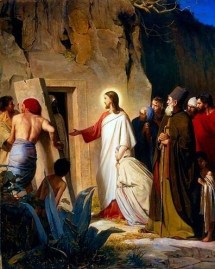 Martha went into the house and whispered to Mary, “The teacher is here and is asking for you.” As soon as Mary heard this, she rose quickly (without caution or subtlety) and went single-mindedly to Jesus. Many Jews had come to Martha and Mary to comfort them about their brother, so when the Jews who were with Mary in the house comforting her saw Mary get up quickly and go out, they followed her, presuming that she was going to the tomb to weep there. (They had not previously followed Martha out, but they felt it prudent to accompany Mary and make sure that she would be safe and alright.)
When Mary came to where Jesus was and saw him, she fell at his feet and tearfully repeated the same lament that she had heard her sister saying over the past four days: “Lord, if you had been here, my brother would not have died.” (These are the only words of St. Mary of Bethany recorded in the Gospels.) Imagine her unrestrained joy when she soon saw her brother Lazarus alive once again.
Mary’s Anointing of Jesus (John 12, Matthew 26, Mark 14)
[Although these three persons have sometimes been conflated, we assume here that that Mary of Bethany is neither Mary of Magdala (also known as Mary Magdalene) nor the penitent woman who anoints Jesus in Luke’s Gospel.]
Jesus’ Passion was near and he came with his disciples to a supper in Bethany. Lazarus was there, reclining at table with Jesus, while Martha served. Mary was also present, holding a stone, alabaster flask containing a liter of very expensive ointment. (It was made from genuine aromatic nard, an oil derived from a plant in the Himalayas.) Perhaps Mary borrowed the perfume from her sister, or perhaps she had inherited it when their mother died. Regardless, although Mary treasured this perfume and loved to smell it from time to time, she was resolved to make a gift of it to Jesus. She approached him, anointed his head and feet, and dried his feet with her hair. The house was filled with the fragrance of the oil.
Mary loved Jesus very much and was delighted to do something extra special for him. But the other guests at table became indignant: “Why was this ointment wasted? Why was it not sold for three hundred days wages and given to the poor?” Mary began to cry, but Jesus defended her. “Let her alone; why do you trouble her? She has done a beautiful thing for me. For you will always have the poor with you… but you will not always have me. … In pouring this ointment on my body she has done it prepare me for burial. And truly, I say to you wherever this gospel is preached in the whole world, what she has done will be told in memory of her.” Indeed, Jesus’ prophesy is fulfilled in your sight.

Mary of Bethany, One of Jesus’ Simple & Beloved Little Ones
Jesus said, “Amen, I say to you, unless you turn and become like children, you will not enter the kingdom of heaven. Whoever humbles himself like this child is the greatest in the kingdom of heaven. And whoever receives one child such as this in my name receives me.” (Matthew 18:3-5)
In a world with little welcome or regard for the mentally or physically flawed, the acceptance and love that Jesus showed St. Mary of Bethany are an important and powerful statement. Her openness, generosity, and childlike devotion to Jesus made her truly great. She is now celebrated in Heaven and throughout the whole world, wherever the Gospel is proclaimed, and perhaps we know her better than we ever have before.
Jesus, our Lord, we gather to remember and to celebrate Bridget, your sister and friend. Though gone forth from us, she is not parted from you, for to you all are alive.
Lord Jesus, your word reminds us that ‘We are surrounded by a great a cloud of witnesses like Bridget… who urge us to persevere in running the race that lies before us, while keeping our eyes fixed on you, the leader and perfecter of our faith.’
Lord Jesus, it is written that they who hope in the you ‘will renew their strength, they will soar on eagles’ wings; They will run and not grow weary, walk and not grow faint.’
Lord Jesus, one day, when we reach the end of our earthly lives, may it be said: ‘We have competed well; we have finished the race; we have kept the faith.’
Jesus, please grant that this may be a safe and joyful event. Please bless Bridget and each of us. Amen.
 How could we possibly celebrate the Holy Mass without the chalice? Without the chalice, how would we adore the Precious Blood? The chalice holds the Lord and it gives form to his presence. He is not lifted up in sacrifice without its close collaboration. Perhaps our Lord could have chosen another means but this is the one He chose. The chalice at Mass is not divine, but when our Lord is adored it shares in His glory.
The chalice at Mass is an icon of a person. The chalice of Jesus Christ is the Blessed Virgin Mary. She held the Lord within her and from her He received his human form. He was not lifted up in sacrifice without her close collaboration. Perhaps our Lord could have chosen another means, but she is the one He chose. Mary is not divine, but when our Lord is adored she shares in His glory.

We do well to closely heed all that our Lord Jesus says, but we must also carefully understand what the Word of God Incarnate is really telling us. Using Scripture to interpret Scripture, let us consider two examples where some modern-day Christians misinterpret Jesus’ teaching by taking him too literally.
Jesus declares, “You have heard that it was said to your ancestors, ‘Do not take a false oath, but make good to the Lord all that you vow.’ But I say to you, do not swear at all; not by heaven, for it is God’s throne; nor by the earth, for it is his footstool; nor by Jerusalem, for it is the city of the great King. Do not swear by your head, for you cannot make a single hair white or black. Let your ‘Yes’ mean ‘Yes,’ and your ‘No’ mean ‘No.’ Anything more is from the evil one.” (Matthew 5:33-37)
Swearing an oath or vow invokes God as one’s witness to a claim or a promise and invites God’s just punishments if his name is taken in vain. It seems that people in Jesus’ day were trying to steal credibility without fearing divine retribution by swearing by lesser holy things. But Jesus warns that all good things belong to God, and condemns clever manipulations of the truth as coming from the devil. Instead, Jesus says, “do not swear at all,” but “let your ‘Yes’ mean ‘Yes.’”
So do any appropriate times and places remain for swearing oaths or vows in the New Covenant? God reveals that such exist through St. Paul. In Galatians 1:20 and 2nd Corinthians 1:23, God himself inspires St. Paul to swear oaths (for example, “I call upon God as witness, on my life, that it is to spare you that I have not yet gone to Corinth.“) And in Acts 18:18, we read that St. Paul “had taken a vow.” Thus, in rare, righteous, and serious situations a Christian may solemnly swear to things before God.
Jesus tells us, “Call no one on earth your father; you have but one Father in heaven.” (Matthew 23:9) Does this mean that we should not call priests (or our even own dads) “Father?” This is not how the first Christians understood Jesus’ words.
St. Stephen calls the Jewish leaders “fathers” in Acts 7:2, and St. Paul does similarly in Acts 22:1. God prompted St. John to address Christian community elders as “fathers.” (1st John 2:13-14) God also willed St. Paul to write of “our father Isaac” and to call Abraham “the father of us all.” (Romans 9:10, 4:16-17) God inspired St. Paul to regard and describe himself as a father to his spiritual children. (1st Corinthians 4:14-15, 1st Timothy 1:2, Titus 1:4, Philemon 10) Therefore, the true concern of our Lord is not with the label of “father,” but that our greatest devotion and love always be directed toward “our Father who art in Heaven.”
Pope Francis, during his visit to our country this week, elevated one figure from American history to sainthood, and spotlighted two other Catholics in his speech to the U.S. Congress. Who are they and what do they have to show and teach us?
 St. Junípero Serra (1713–1784)
This missionary was a Spanish Franciscan friar who founded nine missions for evangelizing the native people from San Diego to San Francisco in what is today California. In his homily for St. Junípero’s canonization on Wednesday, Pope Francis said of him:
“He was the embodiment of ‘a Church which goes forth,’ a Church which sets out to bring everywhere the reconciling tenderness of God. Junípero Serra left his native land and its way of life. He was excited about blazing trails, going forth to meet many people, learning and valuing their particular customs and ways of life. He learned how to bring to birth and nurture God’s life in the faces of everyone he met; he made them his brothers and sisters. Junípero sought to defend the dignity of the native community, to protect it from those who had mistreated and abused it. Mistreatment and wrongs which today still trouble us, especially because of the hurt which they cause in the lives of many people.
Father Serra had a motto which inspired his life and work, a saying he lived his life by: ‘Siempre adelante! Keep moving forward!’ For him, this was the way to continue experiencing the joy of the Gospel, to keep his heart from growing numb, from being anesthetized. He kept moving forward, because the Lord was waiting. He kept going, because his brothers and sisters were waiting. He kept going forward to the end of his life. Today, like him, may we be able to say: Forward! Let’s keep moving forward!”
 Servant of God Dorothy Day
(1897–1980)
This Catholic social activist was an agnostic American journalist who converted and established the Catholic Worker Movement, Houses, and Newspaper. These advanced Catholic social teachings and provided direct aid for the poor and homeless. As a young woman, prior to her conversion, Day had an abortion and later gave birth to her daughter, though she never married. (A patron for repentance from sins like these seems much needed in our time.) The cause for her canonization has been opened by the New York Archdiocese since 2000, bestowing her the title “Servant of God.” In his (first of its kind) speech before Congress on Thursday, Pope Francis said, “Her social activism, her passion for justice and for the cause of the oppressed, were inspired by the Gospel, her faith, and the example of the saints.”
Dorothy Day’s own famous quotes include, “The greatest challenge of the day is: how to bring about a revolution of the heart, a revolution which has to start with each one of us?” Of herself, in life she said, “Don’t call me a saint. I don’t want to be dismissed so easily.” And of Catholicism she said, “Our faith is stronger than death, our philosophy is firmer than flesh, and the spread of the Kingdom of God upon the earth is more sublime and more compelling.”
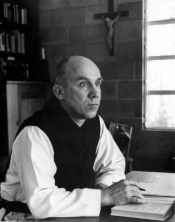 Thomas Merton (1915–1968)
This monk lived a life as checked as Day’s prior his conversion to Catholicism during college in his mid-twenties. In December 1941, he joined the Trappist monetary in Gethsemani, Kentucky. Seven years later, he published an autobiography about his converion and spiritual journey called “The Seven Storey Mountain.” Though Merton wrote more than 70 books, this work spoke to his generation more than any other, inspiring many monastic vocations.
In his speech before Congress, Pope Francis said of Merton:
“He remains a source of spiritual inspiration and a guide for many people. In his autobiography he wrote: ‘I came into the world. Free by nature, in the image of God, I was nevertheless the prisoner of my own violence and my own selfishness, in the image of the world into which I was born. That world was the picture of Hell, full of men like myself, loving God, and yet hating him; born to love him, living instead in fear of hopeless self-contradictory hungers.’ Merton was above all a man of prayer, a thinker who challenged the certitudes of his time and opened new horizons for souls and for the Church. He was also a man of dialogue, a promoter of peace between peoples and religions.”
Thomas Merton own quotes include: “Pride makes us artificial and humility makes us real.” “We are not at peace with others because we are not at peace with ourselves, and we are not at peace with ourselves because we are not at peace with God.” “The beginning of love is to let those we love be perfectly themselves, and not to twist them to fit our own image.” And, “Faith is the total surrender to Christ, which places all our hope in Him and expects all strength and sanctity from his merciful love.”
The more prosperous nations are obliged, to the extent they are able, to welcome the foreigner in search of the security and the means of livelihood which he cannot find in his country of origin. Public authorities should see to it that the natural right is respected that places a guest under the protection of those who receive him.
Political authorities, for the sake of the common good for which they are responsible, may make the exercise of the right to immigrate subject to various juridical conditions, especially with regard to the immigrants’ duties toward their country of adoption. Immigrants are obliged to respect with gratitude the material and spiritual heritage of the country that receives them, to obey its laws and to assist in carrying civic burdens.

While studying for the priesthood, I spent a summer at our diocese’s mission in Bolivia. There I learned that South America’s poorest country has a death rate from tuberculosis 222-times higher than here. I was told the Bolivian government offers free TB medicine, but that many who take the pills start to feel better and quit before they’ve finished the prescription. Tragically, this allows the disease to resurge, and the patients are lost. Their half-measured approach to what would save them invites their death.
As our children soon return to CCD, I wish to emphasize the obvious truth that CCD alone is not enough to form a child into a mature Christian adult. Religious education must be paired with daily family prayer (beyond simply before meals) and family Mass attendance each week. Without these, children learn from their parents’ silent instruction that their Catholic faith may be carelessly discarded once their “last hoop” of Confirmation is cleared. This must not be so!
If you are already attending Mass and sharing family prayers, please keep it up. If not, please follow this powerful prescription of prayer and Sunday worship. Embrace it for your children’s sake and for your own. Our Catholic faith is not mere “fire insurance.” It is the path to abundant life for this life and the next. As Jesus says, “I came so that they might have life and have it more abundantly.” (John 10:10)
These five liturgical practices may seem unorthodox, but the Roman Catholic Church officially allows for each of them:
1. Receiving the Blessed Sacrament Twice in the Same Day
The Church limits the number of communions the faithful may receive in a day, lest people misguidedly pursue sanctity by filling their days with numerous communions, and to keep the reception of this most sacred gift from feeling common by receiving too-frequently. According to the Code of Canon Law (which governs Church practices) the faithful may receive Our Eucharistic Lord twice daily. And, unless someone is in danger of death, the second time must be while participating at Holy Mass. (Canons 917 & 921)
 2. A Priest Eating Between His Sunday Masses
Ordinarily, a person who is going to receive Our Lord in the Most Holy Eucharist is to abstain from all food and drink (besides water or medicine) for at least one hour before holy communion. This is done to prepare oneself to worthily receive this most precious food (though the elderly, the infirm, and those caring for them are exempted from the fast.) The Church, recognizing that a priest could have difficulty finding time for needed nourishment, allows priests who celebrate the Eucharist two or three times in the same day to take something between their Masses, even if there is less than one hour between them. (Canon 919)
3. Offering Mass for the Soul of a Notorious Person
May a priest offer a Mass for the soul of Osama Bin Laden, Adolf Hitler, or Judas Iscariot? Pastoral prudence may advise him against doing so publicly but the Code of Canon law affirms, “A priest is entitled to offer Mass for anyone, living or dead.” (Canon 901) While the Church has declared many saints and blesseds to be now in Heaven, she has never declared any particular human being to be presently in Hell. Since Jesus warns us so strongly and frequently about damnation, and we know that the devil and ‘one third’ of the angels are eternally consigned to Hell, it seems very unlikely that all people will be saved. (Revelation 12:4 & 9, Matthew 25:41, Catechism of the Catholic Church #393) However, even if hoping against hope, we may still offer our prayers (capable of transcending space and time) for the salvation of any and all human souls.
4. A Wedding Couple Processing into Church Behind the Priest
At weddings in the United States, the groom typically takes his place near the altar to await his bride’s walk down the aisle. But the Catholic Rite of Marriage, while allowing for local custom, presents a different entrance as the norm: “If there is a procession to the altar, the ministers go first, followed by the priest, and then the bride and the bridegroom.” (Rite of Marriage, no. 20) The ministers of the sacrament of marriage are actually the bride and groom themselves — the priest (or deacon) simply presides as the Church’s official witness. (Catechism #1623) Thus, it is fitting that the couple enter the church on their wedding day side-by-side in liturgical procession.
5. A Priest Dipping Hosts Into the Precious Blood at the Distribution of Communion
 A minister of the Holy Eucharist who steeps the Host into the Precious Blood before placing it upon a communicant’s tongue is distributing by “intinction.” The General Instruction of the Roman Missal (or GIRM, which governs liturgical practices for Holy Mass) states, “The Blood of the Lord may be consumed either by drinking from the chalice directly, or by intinction, or by means of a tube or a spoon.” (GIRM, no. 245) While noting that “distribution of the Precious Blood by a spoon or through a straw is not customary in the Latin dioceses of the United States of America,” the U.S. Conference of Catholic Bishops reiterates that a bishop may allow distribution by intinction in his diocese. (Norms, no. 48 & 24, citing GIRM no. 283)
As the GIRM describes it, “If Communion from the chalice is carried out by intinction, each communicant, holding a Communion-plate under the mouth, approaches the Priest who holds a vessel with the sacred particles, with a minister standing at his side and holding the chalice. The Priest takes a host, intincts it partly in the chalice and, showing it, says, The Body and Blood of Christ. The communicant replies, Amen, receives the Sacrament in the mouth from the Priest, and then withdraws.” (GIRM, no. 287) The U.S. Bishops further emphasize that the faithful, including extraordinary ministers of the Eucharist, are never to self-communicate by intinction. (Norms, no. 50) May an extraordinary minister of the Eucharist distribute by intinction? The GIRM passage above speaks of “the Priest,” but I would refer people to their local bishop’s norms on the distribution of Communion for a judgment on this question.
My hometown friend, pro-life speaker Katie Stelter, spoke at our parish’s youth group this evening. Her story was made into this powerful docudrama, Metamorphosis:
 Name the Apostle that the Catholic Church has not declared a saint.
Answers: [highlight to reveal]
A Family Feast, a Blackout Night, a Generosity Party, and a Big Bed Lifeboat. Enjoyable and memorable family activities for growing together in faith, virtue, and love.
A Family Feast
For a Family Feast, each member of the household prepares a dish for the meal. Whether it is making finger sandwiches, or opening and warming a can of veggies, or melting cheese over nachos, everyone can bring something to the table. Mom and Dad should provide the kids with many pre-approved courses to choose from to prepare. With coaching, even the little ones can play a part. Lead the dinner prayer thanking God for each person and their gift. All will feel a sense of accomplishment and a closer connection through helping to serve and feed one another.
 A Blackout Night
For one evening, collect and hide all of the cell phones, turn off all the lights, flip the circuit breaker, and bring out the flashlights, candles, or lanterns for a Blackout Night together. Let everyone know well in advance what is coming. Set out glasses of water for use in washing hands and brushing teeth later. Then, once darkness falls, turn off all the lights, cut the power, and gather the family in the living room. Play a card games together on the floor, read a Bible story (like the calling of young Gideon and his nighttime raid in Judges 6 & 7), or share familiar tales of your own. After bed time prayers and tucking-in the kids, turn the power back on for use in the morning. The experience will help your kids to appreciate the blessings we take for granted and it will be a night together that they will always remember.
A Generosity Party
Choose a charity, such as St. Vincent de Paul or Goodwill, lay out a blanket, and throw a Generosity Party. The clothes you did not wear last year probably won’t be worn this year. The toys we never play with are no longer any fun. But these clothes and toys and other things can still be a blessing to others. Explain how and why you are helping those in need, and encourage everyone in the house to bring the possessions they no longer want or need to the blanket “without sadness or compulsion, for God loves a cheerful giver.” (2nd Corinthians 9:6-7) The poor will benefit from your charitable giving, and you will all grow together in compassion, detachment, and generosity.
 A Big Bed Lifeboat
Get everyone aboard your bedroom’s Big Bed Lifeboat and set the scene: “After a violent storm, our ship sank and now we’re in this lifeboat. There is nothing but sea and sky as far as the eye can see.” (Make sure everyone goes potty before you embark.) While you sit adrift, you can sing songs together (like “Row, Row, Row Your Boat,” “Gilligan’s Island,” or “We’re the Pirates That Don’t do Anything.”) You can bounce together when a group of big waves come by. And you can hope and dream about being rescued. Ask them, “What is the biggest reason you want to get back to shore? What do you miss the most?” Listen to their answers, and then confide that your greatest treasures are with you in this boat. Once you flag down the rescue ship that suddenly appears on the horizon, lead a prayer of thanks to God for the gift of your lives and for the countless good things in them.
Give one of these unique family festivities a try and let us know how it goes in the comments.
So the FOX network plans to launch this new show in 2016:
They say you can’t judge a book by its cover, but previews for movies and TV shows these days tell us plenty about what to expect. Based on this trailer and its synopsis, I’d like to share my first thoughts about FOX’s Lucifer.
What “Lucifer” Gets Right
Giving Their Devil His Due
Our first encounter with FOX’s Lucifer is in a form such as we should expect him to appear. No horns, tail, or pitchfork. Nothing in his appearance to make us flee from him in horror. He’s attractive, wealthy, well dressed, and speaks with sophistication. He drives through the night self-satisfied, solitary, and yet pleased to have others serve him and line up eagerly at his door. His popular club is named “Lux” (Latin for “Light.”) “And no wonder, for even Satan masquerades as an angel of light.” (2 Corinthians 11:14) He draws many to himself by means of human sensuality.
His name, “Lucifer Morningstar,” is drawn from Isaiah 14:12.
Church Fathers wrote that “Lucifer” was never the devil’s proper (or “God-given”) name but that it signifies the glorious state from which he fell. However, I give the show creators credit for a pretty good name choice.
FOX’s Lucifer is a denouncer, reviling “this human stain” and “your corrupt little organization.” This is in keeping with him being ‘the accuser of the brethren, who night and day accuses them before God’ (Revelation 12:10) as he did with righteous Job. (Job 1:9-11, 2:4-5) In fact, his most well-known titles highlight this trait: “Devil” comes from the Greek word for “Slanderer,” while “Satan” is Hebrew for “Adversary” or “Accuser.”
Lucifer is willing to transgress laws whenever it benefits him. Perhaps this is why FOX’s Lucifer will premiere in 2016 driving with expired tags on his license plate (but it’s more likely just a production mistake.)
What “Lucifer” Gets Wrong
The Devil They Know is Better
Than the Devil They Don’t
If there were people in the entertainment world who didn’t believe that Adolf Hitler really existed, I could imagine someone reenvisioning him to be some TV drama’s charismatic hero. Many people would be understandably offended and concerned about what evils could flow from presenting the leader of the Third Reich — a spreader of hate and murderer of millions — as primetime television’s next charming protagonist. Ordinarily, aware of Godwin’s Law, I would avoid drawing comparisons to Hitler. Yet as bad as Hitler was, the devil is much worse. The worst thing the show’s creators will get wrong about the devil is that he is certainly not, and will never be, ‘a demon with a heart of gold.’
When a young, dispirited pop star returns to Lucifer he counsels her, “Pull yourself together,” and comforts her. Following her sudden death, he looks on her lifeless body with shock and concern. He asks of the LAPD homicide detective, “What is your corrupt little organization going to do about this?” Later, he tells a female confidante, “Someone out there needs to be punished!” She replies, “Stop caring, you’re the devil.” Indeed, this does not fit with his true character. Unable to strike out at the Almighty, the devil attacks the human race God loves. The devil would not mourn the death of a young woman lost in her sins, he would desire her unhappy end and encourage it, as he did the suicide of Judas Iscariot. The devil hates us all.
Lucifer meets the police detective again and offers his assistance: “We should be out there punishing those responsible. Come on, I’ll help you.” However, the real devil does not accuse sinners and will their damnation out of a devotion to truth or justice. He tempts and condemns out of envy, to prove that others are no better than himself. “[B]y the envy of the devil, death entered the world…” (Wisdom 2:24) Jesus said of him, “He was a murderer from the beginning and does not stand in truth, because there is no truth in him. When he tells a lie, he speaks in character, because he is a liar and the father of lies.” (John 8:44)
If you want to see something of what the devil is like, I suggest Heath Ledger’s Oscar-winning performance as the Joker in The Dark Knight. (*) Heath Ledger described the Joker as “an absolute sociopath, a cold-blooded, mass-murdering clown,” and his portrayal of evil will be long remembered. However, I doubt the same will be true for FOX’s Lucifer.
Why I Doubt “Lucifer” Will Last
The Devil Has No New Tricks
What type of show is Lucifer? It’s a sometimes light-hearted police procedural with supernatural themes and a “will-they-or-won’t-they” romantic subplot. FOX’s Lucifer is basically like The X-Files with angels instead of aliens. However, I’ll be surprised if it survives beyond its first season. I am dubious about how original and well-written the show will be since it borrows so much from previous works:
— We saw charming, talented eccentrics tagging along with cops to solve crimes in The Mentalist, Castle, and Monk.
— We saw snarky jerks growing in their humanity in Community, House, and Sherlock.
— We saw a fallen angel embracing human life and love in Los Angeles in Nicholas Cage’s City of Angels.
— We saw a brazen angel in human form magically attracting women in John Travolta’s Michael.
— We saw a female love interest be uniquely impervious to a dangerous hunk’s powers with Bella and Edward in Twilight.
— We even saw a demonic vanity license plate (“BAD 1″) in Brendan Fraser and Elizabeth Hurley’s Bedazzled.
— At least FOX’s Lucifer plays piano instead of a mean fiddle.
Will these recycled elements gel into a successful hit? Will solving crimes, landing insults, exposing hypocrites, titillating women, and facing-down CGI angels and demons be a long-winning formula? I’m skeptical, but either way, I don’t plan to be watching.
How We Should Respond
Resist the Devil and He Will Flee
In the preface to his spiritually insightful and quite funny book about demonic temptation, The Screwtape Letters, C.S. Lewis wrote:
“There are two equal and opposite errors into which our race can fall about the devils. One is to disbelieve in their existence. The other is to believe, and to feel an excessive and unhealthy interest in them. They themselves are equally pleased by both errors and hail a materialist or a magician with the same delight.”
As it is with devils, so I think for this show. In the coming year, I expect it to attract more heat and noise of controversy, and I suspect the show’s creators will welcome the free publicity. We may be told that everyone must watch the series in order to form an opinion — as if forms of entertainment were somehow entitled to our time and focus. On one hand, we do not want to lend this show inordinate attention. On the other hand, ignoring its existence would be a mistake. We should respond to FOX’s Lucifer with both true teaching and prayer.
 Just like with the inaccurate history of Dan Brown’s
The Da Vinci Code, this regrettable new TV show will bring with it
opportunities for catechesis; to teach about angels and demons, temptation and discernment, and the war that is fought for every human soul. (Teaching can be as easy as sharing an article like this one.) We can discourage others from tuning-in but, whether we like it or not, questions will come our way and we should be well-prepared to answer with the truth.
We must also pray. In 2012, an 24-year-old gunman with red-dyed hair, reportedly self-identifying as “the Joker,” killed 12 people and injured 70 in an Aurora, Colorado movie theater showing the third film of the Batman trilogy. On the human level, the responsibility for this crime lies with its perpetrator, but just as a movie can inspire an unstable person to imitate a villain, so a show about the devil can both lead the unwary into exploring the occult or subtly persuade others that the devil’s just a myth. Against such evils we should pray; not only for the impressionable viewers among the audience of millions, but for the creators of such art itself.
Spiritual connections are mysterious and rarely certain, but dabbling with satanic things can open doors to evil and burn us. Six months after the release of The Dark Knight, Heath Ledger, the actor who had immersed himself into the persona of the demonic Joker, was dead from a drug overdose. At one infamous concert in 1969, during which an audience member was later killed by “Hell’s Angels” working security, The Rolling Stones’ performance of “Sympathy for the Devil” was interrupted by a fight and the song had to be restarted. At the time, Mick Jagger remarked onstage, “We’re always having—something very funny happens when we start that number.”
For the good of everyone involved, I will be praying that the cast and crew of FOX’s Lucifer may soon find themselves safely employed in other work and, if Lucifer ever comes to air, that its harm may be minimal and a better show may quickly take its place. I invite you to join me in praying for the same by invoking the help of St. Michael, who fought the devil and the demons out of Heaven. (Revelation 12:7-9)
Saint Michael the Archangel, defend us
in battle, be our protection against the wickedness and snares of the devil.
May God rebuke him we humbly pray;
and may you, O Prince of the Heavenly host, by the power of God, thrust into hell Satan and all evil spirits who wander through the world seeking the ruin of souls. Amen.

(*) — Like the devil, the Joker in The Dark Knight is a liar, telling incompatible tales about his scars. He loves fire, chaos, violence, and death. Alfred the butler says of him, “Some men aren’t looking for anything logical, like money. They can’t be bought, bullied, reasoned or negotiated with. Some men just want to watch the world burn.” The Joker is an accuser of all: “See, their morals, their ‘code’…it’s a bad joke, dropped at the first sign of trouble. They’re only as good as the world allows them to be. I’ll show you, when the chips are down, these — ah — ‘civilized people?’ They’ll eat each other. See, I’m not a monster. I’m just ahead of the curve.” In the Joker’s climactic final scene, he is angered that those on neither ferry have blown the other up. Batman asks him, “What were you trying to prove? That deep down, everyone’s as ugly as you?!” The Joker tells Batman that they have been locked in “a battle for Gotham’s soul” while the camera films him, from an inverted perspective, having the likeness of one in an everlasting fall.

