We’re in a Hurry — 16th Sunday in Ordinary Time—Year C

July 18, 2010

The other day I was thinking about this homily when I heard the words of some modern poets on my radio. They said:

I’m in a hurry to get things done,
Oh, I rush and rush until life’s no fun.
All I really gotta do is live and die,
But, I’m in a hurry and don’t know why.

This goes to show that we still have a Martha problem today. The group Alabama said that they didn’t know why we get in a hurry, even though we’re not having fun, but I think I know the answer. The reason is that our loves and good desires are mixed with fears. If we would take that fear away, we would find peace.

Martha loved the Lord and wanted to serve Him well, but she had fears mixed in. She was the one who invited Him to the house and He probably had His apostles and other disciples with Him. She was busy serving them all, perhaps making the biggest meal she had ever made, and she was full of worries. “What if I’m a poor host and Jesus is disappointed with me? What if there’s not enough food for everyone to eat?”

We are often the same way. We fear that our lives are on the edge of disaster if our own plans and efforts should fail. We worry about bad things happening to ourselves and the people we love. We are anxiety about how Jesus feels about us.

Martha had a great desire to do good, but Martha’s fear tempted her to do harm. Her sister, Mary, was sitting at Jesus’ feet, listening to His words. (The Greek word for disciple actually means “one who sits at the feet of.”) Martha tries to take Jesus’ disciple away from Him.

Similiar thing can happen in our live on account of fear mixed with love. A husband and father can obsess about his work, out of a love for his family and a desire to provide, but his family can be left feeling like they come second in his life. A wife and mother can be so concerned that her loved ones will be safe and happy that she tries to control everything, making her family less happy because of it. Martha’s problem and ours is not that we work–work is a part of life–but in how we go about it.

Jesus says to Martha, and to us, “Martha, Martha, you are anxious and worried about many things. There is need of only one thing.” What is this one thing we need? We need the peace of Christ. What is the peace of Christ? It is several things.

It is the awareness that God is near and guiding us. In the first reading, three heavenly visitors approach outside of Abraham’s tent. Now, the Holy Spirit dwells within our tents, Jesus is at our side, and we have a Father above. We are never left on our own.

With the peace of Christ we recognize that whatever may happen to us or those we love, it is for our good. As St. Paul observes in the second reading, even his sufferings are a cause for rejoicing for they advance the salvation of the whole Church with Christ.

With the peace of Christ we recognize that misery is not just around the corner, nor is happiness out of reach. Happiness is at head, in the knowledge that Jesus loves us, likes us, cares about us, and cares for us. Living in the peace of Christ means there is no reason for us to be unhappy.

Let us continue to do works of love for God, ourselves, and others, but let us do them always in the peace of Christ.

Augustine on Humility — Thursday, 15th Week in Ordinary Time—Year II

July 18, 2010

A Thought on Humility from St. Augustine:

‘You are to “take my yoke upon you, and learn from me.” You are not learning from me how to refashion the fabric of the world, nor to create all things visible and invisible, nor to work miracles and raise the dead. Rather, you are simply learning of me: “that I am meek and lowly in heart.” If you wish to reach high, then begin at the lowest level. If you are trying to construct some mighty edifice in height, you will begin with the lowest foundation. This is humility. However great the mass of the building you may wish to design or erect, the taller the building is to be, the deeper you will dig the foundation. The building in the course of its erection rises up high, but he who digs its foundation must first go down very low. So then, you see even a building is low before it is high and the tower is raised only after humiliation.

We’re Inn-Keepers — 15th Sunday in Ordinary Time—Year C

July 18, 2010

The “Good Samaritan” is a very familiar parable, but there remains much for us to learn from it. Today I will present the history, the context, behind it; the symbolic meaning contained within it; and the challenge to ourselves that comes out of it.

Jesus’ story begins, “A man fell victim to robbers as he went down from Jerusalem to Jericho.” From this we might think that Jericho is south of Jerusalem because we put the South at the bottom of our maps. Yet, Jericho is actually some twenty miles to northeast of Jerusalem. The reason why the man went down from Jerusalem is that Jerusalem is situated 2,550 feet above sea level, while Jericho is about 1,200 feet below sea level, near the Dead Sea, which is the lowest place on the surface of the earth.

Jerusalem was the city of the temple, the place of God’s dwelling. Jericho, you may remember, was the city which Joshua and the Hebrews marched around for seven days, before blowing their horns and shouting, causing the walls to fall down. They conquered the city because it was in rebellion with God.

“The [robbers] stripped and beat [the man] and went off leaving him half-dead. A priest happened to be going down that road,
but when he saw him, he passed by on the opposite side. Likewise a Levite came to the place, and when he saw him, he passed by on the opposite side.”

You know what a priest is. He is one who offers sacrifice. What is a Levite? They were like acolytes or altar servers; they helped the priest offer the sacrifices at the temple. Why did they both pass by ‘on the opposite side?’ Maybe that they thought the man was already dead and wanted to avoid ritual impurity. The Mosaic Law taught that contact with a dead body made one ritually impure and ritual purity was necessary to worship at the temple. Whether this was their reason, or whether they just did not care enough to be bothered, another comes along who is both willing and able to help.

“…A Samaritan traveler who came upon him and was moved with compassion at the sight.” Who are these Samaritans? We hear about them in the Gospels and we know they didn’t get along with the Jews. For instance, the woman at the well that Jesus meets in John was a Samaritan. Where do they come from?

Some five hundred years before the coming of Christ the Babylonians were the superpower of the ancient world. When the king in Jerusalem decided he was not going to pay tribute to Babylon anymore, the king of Babylon was not pleased. He sieged Jerusalem, conquered it, and carried the region’s inhabitants into what is called the Babylonian Exile. Not everyone was taken though; some of the poor, the farmers and the vine-dressers, were left behind. To ensure that the people did not rebel again, and to make sure that the land did not go to waste, the Babylonians settled five pagan nations in the land.

Seventy years later, after the Babylonians had been conquered by the Persians, the new king gave the Jews permission to return to their homeland. When they got there they found that the people who had remained behind had intermarried with the pagans, in both their families and religion. The Jews regarded these people, these Samaritans, as unfaithful to the Lord. It is no coincidence that the Samaritan woman at the well had had five husbands.

Jesus chooses a Samaritan as the protagonist, the hero, of his story. He does this to show us an example we are to follow. The Samaritan was not Jewish victim’s neighbor geography, for he was only a traveler to the region, nor was he related to him by blood, nor by prior friendship. In the same way, our neighbors are not to be only those who are close to us in distance, are in our family, or who have shown kindness to us. Everyone is to be our neighbor. Such is the meaning of the parable in its historical context, but contained within this story there is Christian symbolism, as well.

The man who fell to the robbers is you and I, this man represents all mankind. Traveling from Jerusalem to Jericho, we were descending from the height of communion with God to the depths of rebellion. We fell to robbers, to evil spirits and evil desire. These stripped us naked, depriving of our original honor and glory. They beat us and left us half-dead; biologically we still lived, but spiritually we were dead. No one could or would help us. But then the Good Samaritan came. This man is Jesus Christ.

He looked upon us and was moved with compassion. Jesus approached to us and poured His blood on us, like wine, to cleanse the wounds of our sin. He poured the Holy Spirit on us like oil to make us strong again. Jesus gave us his teachings and commandments as bandages for our wounds. These disciplines bind us, yet they free us through the health they provide. Jesus lifted us up on his own animal.  This beast of burden was his own flesh. He took us to the inn, which is the Church, and here He continues to care and provide for us in it until the time of His return.

Even though the man who fell to the robbers is meant to symbolize each one of us, I don’t think he is the character in this story with whom we can most identify ourselves. The character I have in mind is one everyone overlooks. I don’t mean the Good Samaritan, nor the priest or the Levite. The character I’m thinking of is the inn-keeper, who is only mentioned in passing.

Here’s all that Jesus tells us about the inn-keeper: “The next day [the Good Samaritan] took out two silver coins and gave them to the innkeeper with the instruction, ‘Take care of him. If you spend more than what I have given you, I shall repay you on my way back.’”

Most of us here entered into the Catholic Church when we were baptized as infants. So we don’t remember being brought into the Church, half-dead.  For us, it feels like this inn has always been our home. This is where we have lived and worked for as long as we can remember. So I think we may identify more with the inn-keeper, more then the victim who has been gratefully saved. With this comes a challenge for our lives.

We are like the inn-keeper.  We are comfortably at home, and business is good. The Samaritan brings in this guy like a sack of potatoes, buys a room and takes care of him. That’s fine with us, but this Samaritan guy comes along and instructs us to take care of this friend of His. Now he is shifting that job onto us. Sure he’s given us some coin for doing it, two silver denarii, the sum of two day’s wages, and he says that if we spend more than what he has given he will repay us on his way back, but do I really want this hassle?

Besides, is that Samaritan fellow really coming back?  If not, then the more I give caring for this invalid the less I’ll have left for myself. If I’m stuck with the bill for this guy and his friend, them I’ll feel like a fool. On the other hand, if I just toss the guy out of my inn, or just ignore him while he’s here, that’s two day’s profit for me guaranteed. If I just pretend that I never heard that Samaritan’s instructions, if I can just quiet my conscience, I’ll get along just fine.

I’m busy enough as it is already. Is playing nurse to this crime statistic really worth my time? Do I trust that Samaritan? Do I believe he is he truly good?  Do I believe he is really coming back? Jesus is the Good Samaritan, and he brings many people to our lives and asks us to take care of them in our inn. Are you living as though Jesus is really coming back to repay each of us according to our deeds, or are you just minding your own business?

Everything you have comes from Jesus, and everything you have belongs to Him.  He is entitled to your time, talents, and treasure and He wants you to share them with your neighbors. Do not fear, don’t be afraid. The truth is that you can never spend more than what He has given you. Act with confidence that He will repay you an amount far greater than you give, not only at the end of your life, but even by the end of the day.

Jesus Christ’s command which He “enjoin[s] on you today is not too mysterious and remote for you. …No, it is something very near to you, already in your mouths and in your hearts; you have only to carry it out.” You shall love your neighbor as yourself.

Humbly Rising High — July 15 — St. Bonaventure

July 18, 2010

St. Bonaventure became the master-general of the Franciscans 31 years after St. Francis of Assisi himself. He was renowned for his learning and later named a Doctor (or great teacher) of the Church, yet he was also humble. When the pope sent his representatives to inform Bonaventure that he had been named a bishop and cardinal they found Bonaventure washing the dishes. The saint told them to hang the red hat on a tree and to wait in the garden until he had finished the task.

St. Bonaventure reassures us, that whatever our gifts, holiness is within our daily reach. “A constant fidelity in small things,” he once wrote, “is a great and heroic virtue.”

In today’s gospel, Jesus invites us to take his yoke. This burden is restful, easy and light, yet we must be humble; we cannot carry it without Christ by our side. Beatitude (true happiness) is within everyone’s reach, but we cannot possess it without God.

As St. Bonaventure says:

No one can be made happy unless he rise above himself, not by an assent of the body, but of the heart. But we cannot rise above ourselves unless a higher power lifts us up. And divine aid is available to those who seek it from their hearts, humbly and devoutly.

Checkout Catholic Movies

July 14, 2010

Did you know the St. Vincent DePaul Society just two blocks from St. John’s (location) has a library of Christian movies, books, and CD’s free for checkout? Pick up the films below for a spiritually edifying and entertaining evening:

The Ten Commandments (1956, VHS, 219 min)
Moses faces Pharoah demanding “Let my people go!”
+ Charleton Heston, Yul Brynner, and a cast of thousands
+ Regarded as the greatest Biblical epic of all-time
+ In *Technicolor*!

For another film about a great shepherd of God’s people, I recommend…

John Paul II (2005, DVD, 180 min)
A dramatic biography about Karol Wojtyla, Pope John Paul II
+ Regarded as the best drama about the Great Pope
+ Cary Elwes (The Princess Bride) plays the young Wojtyla
+ Jon Voight stars as Pope John Paul II
— The latter half is better; I suggest skipping to the conclave

For another film about a character who becomes a new man midway into the film, I recommend…

Becket (1964, VHS,  150 min)
St. Thomas Becket’s conversion makes him King Henry II’s enemy
+ Good dialogue, verbal sparring
+ A great excommunication scene
+ Teaches that personal conversion is possible

For another film with another English Thomas crossing with another King Henry, I most highly recommend…

A Man for All Seasons (1966, DVD, 120 min)
St. Thomas More’s conviction makes him King Henry VIII’s enemy
+ Won Best Picture, Actor, Director, Cinematography
— This title can be mistaken for another starring Charlton Heston
+ Brilliant dialogue, drawn from More’s own words
+ My all-time favorite film, it’s almost perfect…
— Gives More a pride at heart inconsistent with his character
+ Teaches the awesomeness and the attractiveness of virtue

For another film about religious conviction not bowing to the politics of the age, I recommend…

Sophie Scholl: The Final Days (2005, DVD, 117 min)
A German girl is arrested for writing against the Nazis during WWII
— Subtitled
+ The lead actress is captivating
+ Great verbal combat throughout the interrogation and trial
— Ends sadly, like A Man for All Seasons
+ Shows times can cloud truth, but that conscience still speaks

For another film about another Christian who heroically resisted the Nazis, I suggest…

Maximilian: Saint of Auschwitz (1995, VHS, 76 min)
St. Maximilian Kolbe is a knight for Mary in a darkened age
+ All roles are interestingly played by one man, Leonardo Defilippis
— The recurring theme music is not bad, but overplayed
+ Satan’s speeches are enjoyable in a Screwtape Letters way
— A tad too preachy by way of the masonic, communist, Nazi foes
+ Presents the value and power of Marian devotion

For another film by Defilippis about a saint whose faith was a spiritual romance, I suggest…

John of the Cross (1997, VHS, 60 min)
A Spanish mystic seeks God and reform with St. Teresa of Avila
+ Leonardo and Patti Defilippis play all of the major roles
+ Gives a taste of John’s spirituality, quoting his Spiritual Canticle

For another film by Defilippis about a Carmalite Doctor of the Church, I suggest…

Therese (2004, DVD 96 min)
Thérèse of Lisieux’s story, the most popular saint of modern times.
+ Anyone with a fondness for her will gain from this movie
+ The lead actress, whom Providence led to this production, shines
— Criticized for not being as good as it should have been
— One gets no clear sense of her simple, “Little Way” spirituality
+ This film increases one’s love for this great, little saint

For another film about a holy nun’s experiences in the convent, I recommend…

Faustina (1994, DVD, 75 min)
Jesus tells a Polish nun, St. Faustina, to proclaim Divine Mercy
— Subtitled
+ A work of art of profound depth
+ Her love for Jesus and message of mercy are communicated well
+ Teaches that Jesus’ Mercy embraces all willing to receive it

For another film about supernatural phenomena and the value of suffering, I recommend…

Padre Pio: Miracle Man (2000, DVD, 214 min)
St. Padre Pio bears Christ’s wounds, reads souls, & battles Satan
— Subtitled; English is optional but its voices and dialogue are poor
— Long, 3 hours and 34 minutes, presented in two halfs.
+ Great scenes, like the actresses’ confession and His spiritual battles
+ Teaches, among other lessons, that holiness is manly

For another film about a Franciscan priest with amazing spiritual gifts, I recommend…

The Reluctant Saint: The Story of St. Joseph of Cupertino (1962, VHS, 104 min)
An unintelligent man rises to the heights of sanctity
— Black and white
+ Joseph is played handsomely and enduringly
+ Rather funny, if you are in a fun mood
— Runs about fifteen minutes longer than it needs to
+ Shows a little of the old ritual for exorcism, which is interesting
+ Teaches that God takes the weak and makes them strong

For another film about a simple mystic who was doubted in their day, I recommend…

The Song of Bernadette (1943, DVD or VHS 158 min)
St. Bernadette Soubirous’ sees Mary appear in Lourdes, France
— Black and white
+ Jennifer Jones, at her most innocent, in a Best Actress role
+ Vincent Price (Thriller) plays the skeptic
+ Teaches that God is still real and found among the small

For another film about the life of the Visionary of Lourdes, I recommend…

The Passion of Bernadette (1989, VHS, 106 min)
St. Bernadette Soubirous’ life after entering the convent
+ Sydney Penny reprises her role as Bernadette
+ Shows that humility is beautiful

For another film about a great French saint, I recommend…

Monsieur Vincent (1947, DVD, 114 min)
St. Vincent DePaul grows in his understanding and care of the poor
— Subtitled
— Black and white
+ Gritty, yet beautiful
+ Well crafted characters
+ Teaches us to love our neighbor as ourself

For another film about charity and our resposibility to the poor, I highly recommend…

Entertaining Angels: The Dorthy Day Story (1996, VHS, 112 min)
Dorthy Day’s journey from communist to Catholic humanitarian
+ Stars Moira Kelly (The Cutting Edge) and Martin Sheen
+ Heather Graham (Austin Powers 2) does surprisingly good acting
— Contains an historical, non-graphic nor explicit abortion subplot
+ Teaches that life’s meaning is in committed personal life

For another film with an American, pro-life message, I highly recommend…

Bella (2006, DVD, 91 min)
A man with emotional scars helps a friend through a crisis
— Not a true story
+ Rich characters
+ Shows that life is beautiful, in every sense of the word

For another film about escaping prisons of the heart, I recommend…

The Count of Monte Cristo (2002, VHS, 131 min)
A falsely-condemned Frenchmen escapes prison and plots revenge
— Not a true story
+ Stars Jim Caviezel (The Passion of the Christ) charmingly
+ Richard Harris (Harry Potter) portrays a good Christian
+ In a great scene, a fight to the death has a surprising end
+ Explores the Problem of Evil vs. Providence in a powerful way

For another film about an imposter who gradually becomes a real hero, I recommend……

Meet John Doe (1941, DVD, 122 min)
A feel good movie about American values and the little guy
+ This film is in the public domain; click above to watch it now
— Black and white
— Not a true story
+ Directed by Frank Capra (It’s A Wonderful Life)
+ Teaches about the enduring strength of the little guy
Gospel Movies

July 1, 2010

Below are five original shorts drawn from the Scriptures. Click the images to watch them.

Teddy Bear Annunciation


The Annunciation of the Archangel Gabriel to the Blessed Virgin Mary; the Gospel of Luke, chapter 1, with teddy bears.

Robot Jesus at the Watering Hole

 
Jesus meets the woman at the well; the Gosple of John, chapter 4, starring robots.

The Rich Young Rapper

 
A rich young rapper questions Jesus on the subway; a remix of Matthew, chapter 19 and Mark, chapter 10.  

Doubting Thomas

 The resurrected Christ appears to a skeptical disciple in the Gospel of John, chapter 20.

The Importance of the Resurrection


From St. Paul’s 1st Letter to the Corinthians, chapter 15.

St. John the Baptist Parish Patronal Feast Vespers

July 1, 2010

John answered and said… “You yourselves can testify that I said (that) I am not the Messiah, but that I was sent before him. The one who has the bride is the bridegroom; the best man, who stands and listens for him, rejoices greatly at the bridegroom’s voice. So this joy of mine has been made complete. He must increase; I must decrease.” (John 3:27-30)

Have you ever realized that Jesus could have done His saving work without involving anybody else, but didn’t? He included others, like John the Baptist, to prepare His way. John taught the Gospel, ministered in love, and suffered with Christ. Of him Jesus said, “…Among those born of women there has been none greater than John the Baptist; yet,” He added,”the least in the kingdom of heaven is greater than he.” (Matthew 11:11)

John was priviledged to share in the saving work of Christ, and so are we.

Our parish can be ranked among the greatest in our diocese.  It is both one of the largest and most beautiful. Yet, like our namesake, this Church’s greatness is not for the sake of our own glory, but for Christ’s, the Bridegroom, who loves us as His bride.

As St. John the Baptist’s parish, let us live up to our name. Let us rejoice greatly not in ourselves, but that the Bridegroom is among us, in the Eucharist and in our souls. We hear His voice, in the Scriptures and in our prayers. Let us rejoice in His increase and that He has given us the priviledge to share in His work of salvation.

Pushing Boulders — 13th Sunday in Ordinary Time—Year C

July 1, 2010

Once upon a time, there was a hermit who lived in a cabin in the woods.  Each day, he would spend a good deal of time in prayer. One day at prayer he quieted himself, opened himself receptively to God, and heard Jesus speak to him. It’s wasn’t that he heard Jesus externally, speaking from across the room, but within his own thoughts. The hermit knew from experience that the Lord sometimes sends us an image, a memory, a song, or words in times of prayer to communicate with us.

The Lord said, “Go outside to the large boulder in your yard.” The man got up and went. Then the Lord said, “I want you to push this boulder for at least 30 minutes every day.” The man went about pushing the boulder every day, exerting his body in every way, but even months later he could not discern having moved the stone a single inch.

The man thought to himself, “Am I doing something wrong? Am I failing because of my sins or my lack of faith? The Gospels say that if I had faith the size of a mustard seed I could move mountains, but I can’t even move this stupid boulder.  Am I failing because this isn’t really God’s will? Did the Lord really tell me to do this, or did I just imagine it myself? No I heard Him, as surely as the other times when I heard Him speak. But why does He give me a task that He knows I can’t do? Does He want me to fail?” At this the man became very angry and (wisely) took his frustration to God. 

The man heard the Lord speak to Him, “Do you have reason to be angry? I told you to push the boulder, but I never told you to move it. Look at your arms, look at your legs, you have become strong because of your faithfulness and now you are ready for my next mission for you. You thought you were failing, but you succeeded in doing my will.”

In today’s gospel, Jesus turns resolutely toward His final journey to Jerusalem. He sends out advance teams to visit the towns ahead of Him and prepare His way. One of these villages is a Samaritan town and when they learn that Jesus’ destination is Jerusalem they refuse to welcome Him. James and John see this and ask, “Lord, do you want us to call down fire from heaven to consume them, like Elijah did back in the day?” Jesus turns and rebukes them; the fire of the Holy Spirit is meant for the salvation of people, not their destruction.

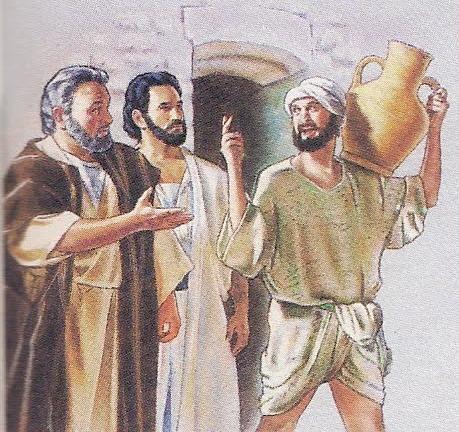
Why did Jesus send His disciples to that Samaritan town, instead of just instructing them to pass it by? Jesus knew what was going to happen when they went to that village–He knew by His divine insight that they wouldn’t accept Him. Remember when Jesus needed a donkey to ride on into Jerusalem? He sends two disciples to find and untie a donkey who had never been ridden before and He tells them what to say if anyone asks what they are doing. They go into the city and find everything as Jesus had described. Remember when Jesus needed a place to celebrate the Last Supper? He tells Peter and John to go into the city and to follow a man they will see carrying a jar of water, when they come to the house he leads them to, they are to ask if there is a place for the master to celebrate the Passover. They go and find everything a Jesus described, including an upper room already prepared for a Passover. Jesus knew that the Samaritan town would not welcome Him, so why did He send disciples there?

The mission may have seemed like a failure, but Jesus’ plan succeeded. Jesus knew that His Apostles would soon be preaching the Gospel to the whole world and He knew that not everyone would welcome them or their message. Jesus wanted to give them some experience in rejection to teach them how to respond; not with anger and violence, but with patience and peace. James and John learn a lesson about divine mercy. They may have thought their mission to the Samaritan town was a total failure, but the Lord was successfully achieving His goals in them.

So what does all this have to do with us? In our lives we often experience weakness, setbacks and apparent failures. In response, we often blame ourselves, even when we are innocent, or we conclude that we must not have been doing God’s will, or we get angry with God for frustrating or not helping our efforts. Yet, as long as we are faithfully following Christ, nothing we attempt is ever truly a failure.

The only true failure in the Christian life is sin, but if we repent of our past sins even these can be used to benefit God’s great plan. Scripture says, “God works all things for the good of those who love Him,” this even includes our repented sins. We are obsessed with success, but as Blessed Mother Teresa reminds us, “God does not ask us to be successful; He asks us to be faithful.”

Sometimes you will feel like you are failing, or that your efforts have been useless, but by your faithfulness you will be succeeding in doing God’s will. Let us remember that at the center of our faith is a man nailed to a cross; an appearent failure who was actually succeeding in saving the world. Jesus rolls away stones in ways we wouldn’t expect.

Catechetical Mass Reflections — Nativity of St. John the Baptist

June 30, 2010

Before Mass

If you just sit around before Mass waiting, you are wasting your time. Prepare for Mass with prayer.

Ask Jesus to help you to be a fully present as He is present at this Mass.

Ask Him to help you be open to receiving everything He wants to give you at this Mass.

Form a Mass intention; that is, choose a person, group, or need you would like the graces of your participation in this sacrifice to be applied to.

After the Openning Prayer / Before the Readings

Shouldn’t we expect to find the incarnate the Word of God in the Word of God we proclaim at Mass? Look for Jesus shinng brilliantly in today’s first reading from Isaiah.

Millions of people purchased and “studied” the DaVinci Code even though it gave no real insights into Christ. Imagine if there were a book out which reputable archeologists claimed contained the actual prayers of Jesus and Mary? Would you read this book? Would you incorporate its prayers into your own devotions? This book really does exist… it is the Book of Psalms, which pious Jews in the time of Jesus and Mary knew by heart. Today we will be praying one of these psalms of Jesus and Mary and I invite you to unite your prayer to theirs.

In the second reading we will hear the preaching of St. Paul and in today’s gospel, the words written by St. Luke. Let us not think that they words are merely adressed to ancient Christians.  When the quill was put to papyrus to pen these words, the Holy Spirit saw you here. If you listen and are open to the Spirit, He will speak to you through these words.

After the Gospel / Before the Creed

Have you ever written or received a love letter? I believe it was St. Catherine of Siena (one of the three female doctors of the Church) who taught that we should say the creed like a love letter, as either one we are sending or one we have received. A love letter reflects the feeling of the lover and contains truths about the beloved. Let us call this to mind when we say the Gloria, too.

After the Presentation of the Gifts / Before the Eucharistic Prayer

During the Eucharistic prayer, don’t spectate, actively participate. You have not come to watch the priest pray for you, but to unite your prayer to His. When he prays for the Church, pray for the Church within yourself. When he prayes for the dead, pray for the dead, too.  The priest is the head and you are the body. Every member of the body should make the prayers of the mouth their own.

During Mass, look at the person you are praying to. Most of the prayers at Mass are addressed to the Father, while a few are addressed to the Son. When we are praying to the Father, raise your eyes up to Him in Heaven or close your eyes to address the He who cannot be seen. When Jesus is on the altar, look at Him with attentive love.

Put yourself and those you care for in the chalice, to be transformed like the wine and offered with Christ.

After Communion / Before the Closing Prayer

Take this moment to tell Jesus “thank you” for giving you so awesome a gift. It’s the least we can do.

Father’s Day Homily

June 19, 2010

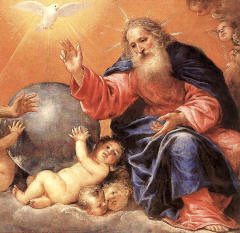
“See what love the Father has bestowed on us that we may be called the children of God. Yet so we are.” (1 John 3:1) As St. Paul says in the second reading, “Through faith [and baptism] you are all children of God in Christ Jesus.” (Galatians 3:26-27) God is our Father who lives and reigns in Heaven. What is the fatherhood of God the Father like? What can we say about His fatherhood. I offer these insights:

The Father’s love begets life.
We see this in His Son, who is eternally begotten from the Father. And begetting is not a merely an action which the Father had done and then walked away from. The Son is eternally begotten from the Father in love.  And, as the Prologue of John’s Gospel says, “All things came to be through [this Son], and …. what came to be through him was life…” The Father’s love begets life.

The Father labors in love.
God the Father labors to fashion and sustain creation; heaven and earth and every creature, seen and unseen. He makes them in love and preserves them in love. As the prophet in the book of Wisdom observes, “[Lord,] you love all things that are and loathe nothing that you have made; for what you hated, you would not have fashioned. And how could a thing remain, unless you willed it; or be preserved, had it not been called forth by you? But you spare all things, because they are yours, O LORD and lover of souls, for your imperishable spirit is in all things!” (Wisdom 11:24-12:1)  The Father labors in love.

The Father guides His family.
The world became dark though sin, so the Father enlightened it. The people became lost without Him, so the Father guided them. The Father enlightens and guides His children by speaking His word to them. Jesus Christ is the Father’s word. The Father guides His family.

The Father is easily pleased by those who are His own, yet He calls them ever higher.
At Jesus’ baptism, the Father spoke from the heavens, “You are my beloved Son; with you I am well pleased.” Yet, as today’s gospel recalls, the Father also called His beloved Son to take up the cross. Four days before His Passion, Jesus said, “I am troubled now. Yet what should I say? ‘Father, save me from this hour’? But it was for this purpose that I came to this hour. Father, glorify your name.” Then a voice came from heaven, “I have glorified it and will glorify it again.” (John 12:27-28) On the cross, Jesus was not just lifted up, but exalted. The Father is easily pleased by those who are His own, yet He calls them ever higher.

The Father is just like the Son.
Some people find it difficult to relate to the Father, but the Father is just like His Son. At the Last Supper, Philip said to Jesus, “Master, show us the Father, and that will be enough for us.” Jesus said to him, “Have I been with you for so long a time and you still do not know me, Philip? Whoever has seen me has seen the Father. How can you say, ‘Show us the Father’?  Do you not believe that I am in the Father and the Father is in me? The words that I speak to you I do not speak on my own. The Father who dwells in me is doing his works.” (John 14:8-10)  The Father is just like the Son.

The Father transcends human fatherhood, but He is the origin and standard of all fatherhood.
God transcends the human distinction between the sexes. The Father is neither man nor woman: He is God. Although the Father is the origin of all fatherhood, He transcends human fatherhood. No one is father as God is Father. Yet, we who are earthly fathers, who have natural or spiritual families and children of our own, must take our Father in Heaven as our standard and model. Each of the insights I have given for God the Father have application for our fatherhood.

Your fatherhood should beget life.
Now the begetting of life is not merely biological, if it were then priests would not be fathers. There are some biological fathers who beget life and leave. These men fall very far short being true fathers. True fathers give life and nurture that life forever, like God the Father who begets His Son eternally. If you are a mother or father, even if even if your children should die, even if you should die, you are a mother or father forever.

Your natural fatherhood should be fruitful. More than just biologically, but biologically, too. What would you think of a priest who was both capable and called to work to beget more spiritual children by sharing the gospel, but who refused to do so for self-centered reasons. What if he were to say, “I’m happy with the number of parishioners I have already.” Your fatherhood should beget life.

Your fatherhood should be a labor in love.
Always remember whom you are working for and work for love of them. Beware of an ambitious careerism, which is all about you. What would you think of a priest whose primary ambition was to become a cardinal, instead of those entrusted to him. 

At home or at the workplace, labor in love for your family. And take time to rest and enjoy them. Even God the Father rested after His labors to enjoy how “very good” it was.

Your fatherhood should guide your family.
You are called to be a leader, guide, and teacher for your family. Your wife will not begrudge your lead if you love her and lead her as Jesus loves and leads the Church. Remember, Jesus died for His family and bride.

As parents, you are the primary educators of your children. Sometimes we think of education as only what happens at school. But the most important lessons in life are not taught in the schools, but in the home. The home is the domestic Church and the school of love.

In your fatherhood, let your children know your pleasure in them and always call them ever higher, to all they can be.
Always show them your pleasure, that with them you are well-pleased. But like God, love them too much to let us remain as we are.  Grow them to their full potential.

In your fatherhood, take the Father in heaven as your standard and model.
If you’re ever unsure of how to image the Father, look at His son, for Jesus is the perfect image of the Father. The Father is just like the Son.

May God bless all our Fathers, living or dead, and may help we who are fathers to be better ones.

4 Truths of Human Nature

June 18, 2010

Who We Are Before God

In relating to God (especially in prayer) it is important to know who and what we are. In short, each one of us is Loved, Limited, Sinful, and Good. These are four truths of  our human nature.


1st Truth:  You are Loved

The Denial:  “God doesn’t love me.”
This Denial’s Consequences:  Sadness, Anxiety, Resentment
The Truth:  God created you in love and holds you in love. Jesus loves you, and Mary, angels, and saints (on earth and in heaven) love you, too.
The Fruit of Living in this Truth:  Peace, Trust, Love

[Lord,] you love all things that are and loathe nothing that you have made; for what you hated, you would not have fashioned. And how could a thing remain, unless you willed it; or be preserved, had it not been called forth by you? But you spare all things, because they are yours, O LORD and lover of souls, for your imperishable spirit is in all things! (Wisdom 11:24-12:1)

God proves his love for us in that while we were still sinners Christ died for us. (Romans 5:9)

This is my commandment: love one another as I love you. (John 15:12)


2nd Truth:  You are Limited

The Denial:  “I don’t need God. I can do anything, if I just believe in myself.”
This Denial’s Consequences:  Pride, Frustration, Folly
The Truth:  You are, and will always be, God’s limited, finite, and dependent creature.
The Fruit of Living in this Truth:  Humility, Patience, Communion

When I see the heavens, the work of your hands, the moon and the stars which you arranged, what are we that you should keep us in mind, mortal man that you care for him? (Psalm 8:4-5)

If the Lord does not build the house, in vain do its builders labor; if the Lord does not watch over the city, in vain does the watchman keep vigil. In vain is your earlier rising, your going later to rest, you who toil for the bread you eat: when he pours gifts on his beloved while they slumber. (Psalm 127:1-2)

I am the vine, you are the branches. Whoever remains in me and I in him will bear much fruit, because without me you can do nothing. (John 15:5)


3rd Truth:  You are Sinful

The Denial:  “I don’t have any real sins.”
This Denial’s Consequences:  Impenitence, Corruption, Sin
The Truth:  Even after baptism,
concupiscence remains, inclining you to sin.
The Fruit of Living in this Truth:  Contrition, Conversion, Sanctification

No one is good but God alone. (Mark 10:18)

…All have sinned and are deprived of the glory of God. (Romans 3:23)

If we say, “We are without sin,” we deceive ourselves, and the truth is not in us. If we acknowledge our sins, he is faithful and just and will forgive our sins and cleanse us from every wrongdoing. If we say, “We have not sinned,” we make him a liar, and his word is not in us. (1 John 5:8-10)  


4th Truth:  
You are Good

The Denial:  “I’m worthless.”
This Consequence:  Sadness, Shame, Despair
The Truth:  Your human nature remains good, despite wounds and weakness.
The Fruit of Living in this Truth:  Joy, Hope, Fruitfulness

Then God said: “Let us make man in our image, after our likeness. … God looked at everything he had made, and he found it very good.” (Genesis 1:26,31)

[The Gentiles] show that the demands of the law are written in their hearts, while their conscience also bears witness and their conflicting thoughts accuse or even defend them on the day when, according to my gospel, God will judge people’s hidden works through Christ Jesus. (Romans 2:14-16)


Finally,
some true and helpful things to remember about God’s attitude towards you: 

  • God not only loves you, He likes you, too.
  • God works all things for the good of those who love him (Romans 8:28); including every evil that befalls you and your own past sins.
  • God is easily pleased, and hard to satisfy.  

An Incomplete Lord’s Prayer — Thursday, 11th Week in Ordinary Time—Year II

June 18, 2010

Sometime in the past, I realized that I didn’t pray the Lord’s Prayer right.  It’s not that I was actually changing the words Jesus taught us to say, but I realized my focus was not fully what Jesus had in mind. My subjective, firsthand experience of praying the prayer went something like this: 

God, who art in heaven…
     [<Here I get distracted for several seconds>]
…give me this day my daily bread,
and forgive me my trespasses,
as I forgive those who trespass against me,
and lead me not into temptation,
but deliver me from evil.

Did you notice anything different?

First, Jesus taught us to pray to “Our Father” because we are not praying to anonymous force, but a person, a divine person who is imaged in a special way by natural and spiritual fathers on earth. Earthly fatherhood is a diminished image of Him. Biological fatherhood teaches us about our heavenly Father’s transcendence, while devoted fathers teach us about His love. (“The respective ‘perfections’ of [both] man and woman reflect something of the infinite perfection of God,” as the Catechism teaches, but “Our Father” is significant.)

Second, the prayer’s early petitions, “hallowed be thy name. Thy kingdom come. Thy will be done on earth as it is in heaven,” are every bit as important as the later petitions ‘about us.’ God is justly entitled to glory, His kingdom and reign.  Remember that all these are essential and conducive to our own greatest happiness.

Third, the Lord’s Prayer is not meant to be prayed just for yourself or myself, but for all of our Father’s family, for the whole Church, for even the whole world. The Our Father is not only a petitionary prayer, but an intercessory prayer.

So when we prayer the Our Father, the perfect prayer which Jesus taught us, let us pray it in its completeness, with a presence of mind and fullness of heart.

Not If, But When — Wednesday, 11th Week in Ordinary Time—Year II

June 16, 2010

Notice that in today’s gospel, Jesus does not teach saying, “If you give alms…” or “If you pray…” or “If you fast….”

Jesus says, “When you give alms… when you pray…. [and] when you fast….”

Prayer, fasting, and alms giving are assumed for the follower of Christ. If we do not have all three of these as a regular part of our lives, we need to put them there. And when we do, our Father, who sees all, will repay us.

Getting Slapped — Monday, 11th Week in Ordinary Time—Year II

June 16, 2010

Jesus taught:

“…Offer no resistance to one who is evil. When someone strikes you on your right cheek, turn the other one to him as well. If anyone wants to go to law with you over your tunic, hand him your cloak as well. Should anyone press you into service for one mile, go with him for two miles.”

Should we always offer no resistance to those who would do evil against us?

Notice that each of the examples Jesus gives are of injustices that do no real lasting harm. If you are slapped on the cheek, it stings awhile, but in a few minutes you’re fine. Even Jesus’ disciples owned spare clothes–we know because He told them to leave their second tunics behind when He sent them two by two. There is no lasting harm until your last tunic or cloak is taken. (cf. Exodus 22:25-26) In those days, Roman soldiers could force Jews to carry their gear for up to a mile down a road. Jesus teaches that one should go the extra mile for these enemies and occupiers.

In each example Jesus gives of offering no resistance to evil-doers, the affliction is felt in one’s pride more than anywhere else. Jesus is teaching us to be humble when people wrong us in small ways, so that they will be struck by our magnanimous patience and strength and be converted.

But what if the evil someone would do to us would do us grave and lasting harm? Should we offer no resistance then? Two incidents for Jesus’ life come to mind. When the money changers and animal sellers were doing business in the temple’s court of the Gentiles, profaning it and impeding the nations’ worship of the One True God, Jesus resisted. He made a whip out of cords and drove out the people who were doing what was evil. On the other hand, in the Passion, Jesus offered no resistence. He let His enemies slap Him, strip Him, and force Him to carry a cross.

It seems that there are times when we are called to resist evils for the sake of the common good, and times when we are called to accept evils, even grave injustices against us, in the pattern Jesus Christ. Let us trust the Holy Spirit to guide us to know when is the time for which.

Christ in the Sacraments — 11th Sunday in Ordinary Time—Year C

June 15, 2010

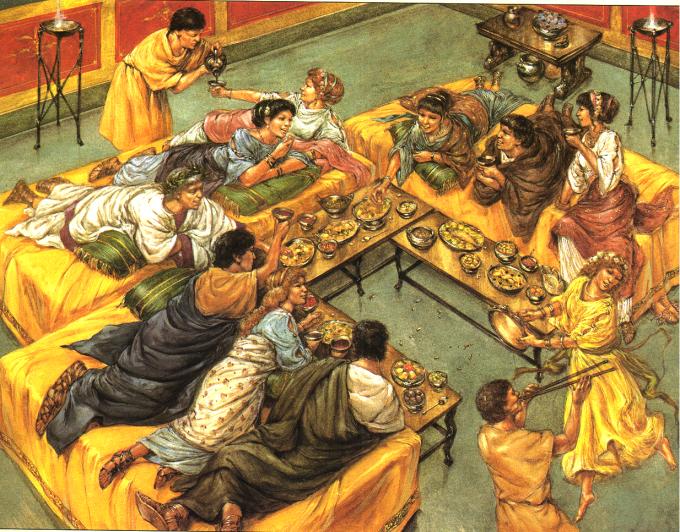
To understand today’s gospel, it helps to know a little about the Jewish culture of Jesus’ day.  For example, when the Jews would sit down to eat dinner they would not sit at all–they “reclined at table,” on beds that came up the edge of the table. You would have a cushion under your chest or under your side, as you ate with your free hand, with your legs laid out behind you. This clarifies how the beautiful, penitent woman was able to access to Jesus’ feet. This also explains how John was able to lay his head upon Jesus’ chest at the Last Supper to ask Him who would betray Him. The Beloved Disciple was not a contortionist–he was laying beside Jesus at table.

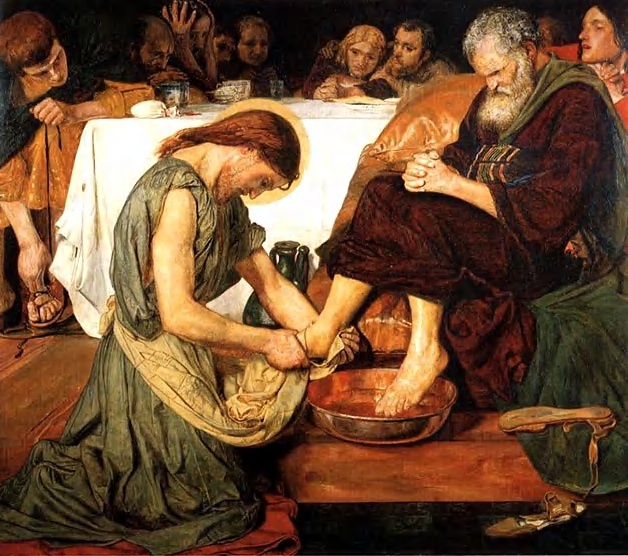
A second important thing to know about the Jewish culture of Jesus’ day to appreciate this gospel is to understand how they felt about feet. The Jews considered feet to be among the dirtiest, humblest, and lowliest parts of the human body. This is why our parish’s patron, St. John the Baptist, said, “[There is] one who is coming after me, whose sandal strap I am not worthy to untie.” In that Jewish culture, servants could not be commanded to wash the feet of others; it was considered even beneigth the dignity of a slave. Now we can understand the significance of the woman washing Jesus’ feet, and how much it means that Jesus later washed His disciples’ feet at the Last Supper.

But what was this woman thinking? Had she forgotten to bring a towel and a bowl of water at home? Was she so dumbstruck that her lips were unable to form the simple words, “I’m sorry and I want to return to God?” No, she knew what she was doing when she used her tears to cleanse, her hair to wipe, and her lips to kiss Jesus’ feet. When she heard that Jesus was going to be eating at the house of Simon the Pharisee I doubt she was holding that alabaster jar of ointment in her hands. No, she had to go and get it, and as she did she thought about exactly how she was going to approach Jesus.

What was Simon the Pharisee thinking? Had he forgotten about the customary curtesies in welcoming guests to one’s house in that culture: water for washing their own feet, oil for anointing one’s head against the harshness of the desert, a kiss in greeting at the door? Maybe he thought these were just optional, dispensible rituals. Regardless, Jesus put his finger on one major contributing factor: Simon the Pharisee loved Jesus little, while the beautiful penient woman loved Him greatly.

Simon gave Jesus an external gift, a meal in his home, but in addition to her ointment, the woman gave a gift of her very self; her tears, her hair, her kisses. As she had sinned with her body, she now sought to honor God though her body.

How does all of this apply to us? When we consider this beautiful, penitant woman and Simon the Pharisee relate to Jesus, we see two approaches the sacraments. For some, in the manner of Simon the Pharisee, the sacraments are just rituals, traditional customs, liturgical hoops the Church has us jump through. But for others, those with the heart of the woman who loved much, every sacrament is a personal encounter with Jesus Christ. If you onlt remember one thing from this homily, remember this: every sacrament is a personal encounter with Jesus Christ.

Consider the sacrament of marriage. Today, some people say, “As long as we love each other, what difference does a ceremony in a church and a piece of paper make?” But these people do not realize that the sacrament of marriage actually makes present the love between Christ and his Church. The love between husband and wife not only resembles the love between Christ and his Church–like all the sacraments, marriage actually makes present. If your marriage is sacramental, and you and your spouse do not put up obstacles in the way, you can experience firsthand to love with which Jesus loves His bride, the Church, and how the bride receives her Lord. You experience the intimacy between the two and you can tap and draw on their love and the power in your marriage. marriage is a personal encounter with Jesus Christ.

Today, some people say, “I don’t really have any sins, but if I did, why should I have to go tell my sins to a priest to have my sins forgiven? God can hears my prayers. Won’t he’ll forgive me anyway.” Imagine if the penitent woman had stayed away from Simon’s dinner party that night in the gospel and prayed to God at home. Would she have been forgiven? Perhaps, but she would not have had her life-transforming encounter with Jesus Christ. When you go to confession, you are personally encountering Jesus through the priest. If the priest does not put up obstacles in the way you will hear the words of Christ to you. And even if the priest does get in the way, you will hear that words that Jesus wants you to hear, just as He had said to the beautiful penitent woman: “Your sins are forgiven, go in peace.” The sacrament of reconciliation is a personal encounter with Jesus Christ.

These days some people say, “There’s a lot of Sundays in the summertime and a lot of things to enjoy on the weekend. Is it really that important that we come to Mass every Sunday?” To ask this about the most Blessed Sacrament is to be like Simon the Pharisee. Had Jesus not come as his guest that night, Simon would not have missed Him much; Simon would not have been that disappointed. And even after receiving Jesus under his roof, I can imagine Simon being left unchanged. But the beautiful penitent woman, who took Jesus’ flesh to her lips, was forgiven her sins and was filled with grace by the encounter.

In the celebration of this sacrament, and at every sacrament, let us appraoch Jesus with her humility, reverence, and love.