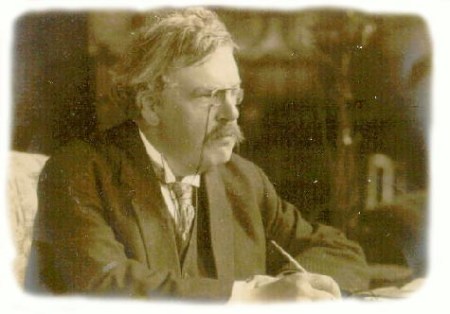
G.K. Chesterton, the British Catholic writer, lived one hundred years ago, but his writings are still witty, insightful, and relevant today. Once he wrote in answer to the question, “Why I am a Catholic.” Chesterton explained, “The difficulty of explaining ‘why I am a Catholic’ is that there are ten thousand reasons all amounting to one reason: that Catholicism is true. I could fill all my space with separate sentences each beginning with the words, ‘It is the only thing that…’” One of the examples of this he gave was that Catholicism “is the only thing that frees a man from the degrading slavery of being a child of his age.”
Why is it that after so many centuries we remain divided, three against two and two against three, on so many important matters? We may be far more technologically advanced than they were in Jesus’ time, but every generation seems to repeat falling into the same, or slightly differing, forms of foolishness. While science and technology is cumulative, part of every generation thinks they have to rediscover wisdom from scratch. That’s why we still have ethical debates about questions that Jesus has settled.
Can we do evil in the hopes that good will come of it? [This is Ethics 101. St. Paul teaches about this to the Romans, “And why not say—as we are accused and as some claim we say—that we should do evil that good may come of it? Their penalty is what they deserve.”] What if we’re [almost] certain that really good things will come from the evil we do? [Even if the evil does result in some good, what does freely-choosing evil make us?] Should we let the progress of science be bogged down by questions of morality? Should morality and private conscience have a place in politics and public life? [If not, then what will science, public life and policy be guided by beyond base desires and power?] Is it really always wrong to intentionally kill the innocent? What if intentionally killing 100,000 civilians will end a war?
If this is how things are when the wood is green in our country, then what will it be like when the wood is brown, dry, and dead, as it may well be in years ahead? What is the Christian to do? Remain closely rooted to Christ, the source of our wisdom and waters of life. To borrow the words from the psalmist today:
The Christian “is like a tree
planted near running water,
That yields its fruit in due season,
and whose leaves never fade.
Whatever he does, prospers.”
Even if he is martyred, whatever the faithful Christian does prospers; for he is not a child and a slave of his age, but a child of the age to come.


