Archive for February, 2010

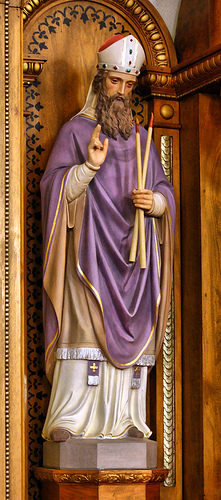
By the Throat — February 3 — St. Blaise

February 3, 2010

I began going to daily Mass in the fall semester of 2001. In college I had always gone to Sunday Mass, but after September 11th I felt that if the world was going to change for the better, it would require that people present themselves to God and offer Him more opportunity to work His grace in them. And so, two years later and seven years ago today, I was at daily Mass on the feast day of St. Blaise for the first time in my life.

At the end of Mass, Father Mark offered an opportunity for a special blessing of throats by means of two crossed candles and the intercession of St. Blaise. A line formed of the faithful, but I stayed in my pew. I felt a tug of conscience to go up there too, but I was really embarrassed by the oddness of it. “Who gets ailments of the throat anyways,” I justified to myself, and headed out the door.

With noon Mass behind me, I walked to the dining hall for lunch. I remember that I was passing an empty salad bar on my left when I got stopped in my tracks. It was like my throat suddenly got completely dry. I recognized I wasn’t choking, so I wasn’t frightened, but it took me a good minute or two get right again.

Now my best natural explanation for what happened to me is that I inhaled dust kicked up by some unseen kitchen sweeper which got blown in by a fan through the open door on my right. But it didn’t take me long to remember St. Blaise and to recognize in this providential incident God’s gentle correction.  The message: “Don’t refuse a holy blessing.”

We Catholics should not feel ashamed of our traditional blessings and sacramentals. Things like holy water, miraculous medals, and house blessings make a difference; for with these things we make an act of presenting ourselves to God and offer Him more opportunity to work His grace in us.
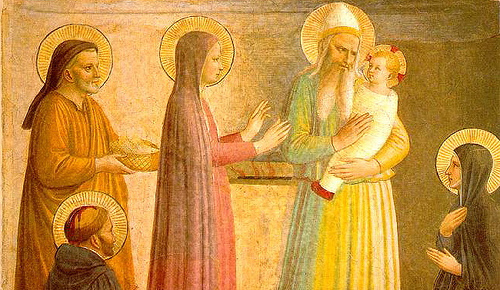
Our World’s Salvation — February 2 — Presentation of the Lord

February 2, 2010

Simeon’s eyes looked upon a baby and foresaw our salvation in Him. When we look back today, at the centuries past, we can see that Jesus Christ has indeed been a light for all the nations.

Even if one were to look at Jesus of Nazareth without the eyes of faith, any fair assessment of history must name Him and the Church that He founded as the greatest cause for good in human history. Jesus Christ came and was the light for a darkened world.

For example, in the ancient world, women’s status ranked near that of slaves, but Jesus showed a reverence towards all women, even intimately involving them in His ministry. Christianity noted His example and began to acknowledge women’s dignity and equality as persons.

While the ancient world wielded total dominance over slaves, Christianity professed slaves’ equality as persons before Christ. (In fact, several early popes were former slaves themselves.) Christianity told masters that they would be held accountable at the Judgment for the good or bad treatment of their slaves, for Jesus had said, “Whatever you do to the least of my brothers you do to me.” The abolishment of slavery came gradually, but it finally came as the result of Christians’ efforts in light of Christ.

Infanticide was common in the ancient world. Sometimes the unwanted little one was physically disabled, or female, or merely inconvenient. But Jesus treasured all children, and He said, “Whoever receives one child such as this in my name receives me.” So Christianity renounced infanticide and would later establish orphanages and promote child adoption.

Jesus showed concern for sick persons and healed them. Jesus also feed hungry crowds. So Christianity has established hospitals and soup kitchens. Today, as throughout the centuries, the Catholic Church is the largest charitable organization on earth.

An eye for an eye was the ancient law, and hating one’s enemies comes naturally, but Jesus did not seek revenge.  Jesus said, “Love your enemies,” and He prayed for His enemies from the cross. Many Christians have followed His example, promoting peace and reconciliation.

Jesus taught his wisdom to great crowds of men and women, the poor and rich, the young and old, so Christianity established schools and universities. Today the Catholic Church educates more children than any other scholarly or religious institution and you are a part of this number.

Our Marshfield area Catholic schools exist today because of Jesus Christ, the greatest person who has ever lived. The public schools have Jesus to thank for their schools, too, but they are not allowed to speak His name. But we can speak His name, and we can thank Him like Simeon here today, for coming into our darkened world and shining His saving light.

(Recommended viewing:  “Epic” produced by Catholics Come Home )

Absalom and Satan — Monday, 4th Week in Ordinary Time—Year II

February 1, 2010

Absalom was one of David’s very own, but Absalom would betray him. Absalom’s name means “Father of Peace,” but he far closer resembles the “Father of Lies.”

In almost our earliest story about him, Absalom arranged his brother’s murder. He’s a murderer from the beginning.

We read that Absalom, like Satan, had a radiant beauty. “In all Israel there was not a man who could so be praised for his beauty as Absalom, who was without blemish from the sole of his foot to the crown of his head.”

Like the devil, Absalom’s glory was equaled by his vanity. At the end of every year, when his long hair grew too heavy, he would have it shaved and weighed it according to the royal standard.

Absalom was willing do havoc to attract another’s attention, as when he set fire to the field of a person ignoring him.

Like the serpent, Absalom was cunning and he would readily lie to serve his purposes. Absalom would sit at the city gates, listen to peoples’ (legal) grievances, and assure each one that they were right and entitled. Then he would manipulatively muse on how much better their lives would be if only he had the power.

Finally, Absalom sought to overthrow and kill his king. Absalom’s best advisor would counsel him, ‘Please let me choose twelve thousand men, and be off in pursuit of David tonight. When all the people with him flee, I shall strike down the king alone. It is the death of only one man you are seeking; then all the people will be at peace.’ This plan was agreeable to Absalom and to all the elders of Israel.

In our first reading we see David weeping on the Mount of Olives as he flees from Absalom. 1,000 years later, a descendant of David would be troubled in spirit on that same hill overlooking Jerusalem. Unlike David, Jesus did not flee His pursuers and was dead within a day. Jesus and the Sanhedrin agreed on this: it was better that one man should die, so that the whole nation may not perish.

David would flee and survive, but Absalom would die, thrust through with spears, hanging from a tree, entangled by his long, glorious hair.  But after this comes an episode which is a window into God’s incredible love for us. When news of the villainous betrayer’s death reaches King David, he mourns inconsolably at the loss of his beloved.

Likewise, and amazingly, despite Satan’s great and intractable wickedness; his betrayals, violence, and lies; the Lord still loves him. As the Book of Wisdom affirms, “[Lord,] you love all things that are and loathe nothing that you have made; for what you hated, you would not have fashioned. And how could a thing remain, unless you willed it; or be preserved, had it not been called forth by you?

There is a great encouragement in this for each one of us. If the Lord loves Satan, like David loved Absalom, then how could we ever doubt that the Lord will always love us, or imagine that He rejects us whenever we turn to Him?