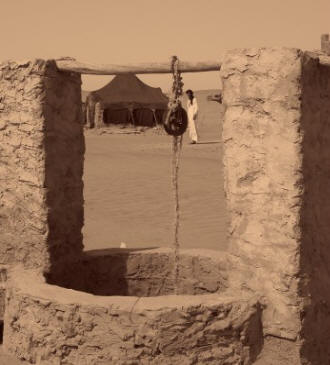
 Nicodemus and the woman at the well could hardly be more opposite–but for the fact that in neighboring chapters of John’s Gospel they both encountered Jesus. He was a Pharisee and a member of the Sanhedrin. She was a simple Samaritan peasant. He was an educated “teacher of Israel.” She was, according to the Jews, a member of a heretical sect. He was at the center of the religious center. While she, as we will see, was an outcast among outcasts.
He came to Jesus at night, but she “about noon.” Both are odd times. Why wasn’t he traveling by the ease and safety of daylight, and why wasn’t she fetching water at a cooler time, before sunrise or after sunset? He feared the Jews who hated Jesus and so came under cover of darkness, while she was avoiding the townspeople who despised and judged her. While Nicodemus sought out Jesus to have his questions answered, the woman at the well had never heard of him. Rather, it was Jesus who sought her out to propose a relationship, meeting her (appropriately) at a well, like where many of the patriarchs first encountered their beloveds.
Jesus told Nicodemus that we “must be born of water and Spirit” and told the woman that we “must worship in Spirit and truth.” These are the components of the Christian life: sacraments and discipleship. We can tell that being “born [again] water and Spirit” is sacramental because, after the dialogue with Nicodemus, Jesus supervises his apostles baptizing in the Jordan. And we can see that Jesus is calling the woman to discipleship because Jesus spoke to her at the well seated, the posture of ancient teachers. The Christian life consists of sacraments and discipleship. Just going to church is not enough–our daily lives must be his, and if we try to be Christians without the power of the sacraments, we will find ourselves enfeebled and failing.
Amazingly, while Nicodemus left Jesus as discretely as he came, the Samaritan woman left convinced about Jesus and simply had to tell others, even those who disliked her. “Come see a man who told me everything I have done. Could he possibly be the Christ?” Nicodemus comes around slowly, first critiquing his Pharisaic peers who revile Jesus, “Does our law condemn a man before it first hears him and finds out what he is doing?” Then, after the death of Jesus, Nicodemus comes to full courage, “bringing a mixture of myrrh and aloes weighing about one hundred pounds” to prepare his body for burial. It is as if Nicodemus said, “I don’t care what anyone else says, this is good, and right, and true; Jesus was sent by God.” Nicodemus was at the center of the religious center while she was an outcast among outcasts, yet she responded more readily to Christ.
We can see Nicodemus as a natural audience for Jesus, but she would tend to make us question Jesus, “Why are you talking to her?” She was a sinner, yet so was Nicodemus, and so are we. Notice how Jesus does not ignore her sin but does not allow it to get in the way of her seeing that he loves her. “You are right in saying, ‘I do not have a husband.’ For you have had five husbands, and the one you have now is not your husband. What you have said is true.” Instead of condemning her for her sins, he compliments her for her honesty! “For,” as Jesus told Nicodemus, “God did not send his Son into the world to condemn the world, but that the world might be saved through him.”
Who is longing for God? Deep down, all people are. As St. Augustine wrote, “You have made us for yourself, O Lord, and our hearts are restless until the rest in you.” But who will be receptive to the Gospel when we share it? If we never try, we’ll never know. “I tell you, look up” Jesus says, “and see the fields ripe for the harvest.” Ask the Holy Spirit to give you opportunities to evangelize, to talk about the cause for your joy, and then bravely follow his promptings. “If today you hear his voice, harden not your hearts.”
Why is the Dead Sea dead? Nothing lives in it because of all the salt, but there’s another of explaining this. Living water flows from the Sea of Galilee, down the Jordan River, and into the Dead Sea constantly, day and night, yet it is dead because nothing ever flows out. So we must allow living waters to flow through as well. Everyone wants the truth like Nicodemus. Everyone thirsts for life-giving waters like the woman at the well. Everyone is looking for Jesus, and Jesus is asking you to help in the introductions.

