Archive for November, 2014

Questions & Answers About Advent

November 26, 2014

What is an “advent?”

An “advent” is a coming or arrival, especially of something extremely important. It comes from the Latin word for “arrival.”

What does Advent season prepare for?

The coming of Jesus Christ at Christmas and at the end of the world.

How many years ago was Jesus born?

About 2,014 years ago. That event is fittingly the basis our calendar, for Jesus’ Incarnation is the center of history.

When will Jesus come again in glory?

We do not know precisely, so we must always be ready and prepared for Him.

Why do Isaiah & St. John the Baptist feature in our Sunday readings?

These two prophets preached the coming of the Jewish Messiah and the Kingdom of God He would establish.

What does purple symbolize?

Purple is an ancient symbol for royalty. Jesus will come to us as the King of kings.

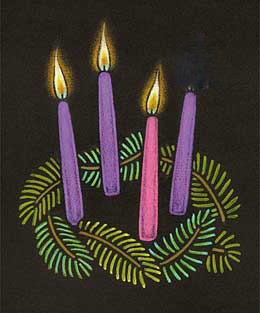
Gaudete Sunday Advent CandlesWhy an Advent wreath?

The evergreen branches woven into a circle symbolize eternity and everlasting life.

Why four Advent candles?

They count the four Sundays that precede Christmas.

Why is one candle different?

One candle is rose-colored to mark the 3rd Sunday of Advent.

What is special about the 3rd Sunday?

It marks (more or less) the halfway point on our journey to Christmas. It is called Gaudete Sunday.

What does “Gaudete” mean?

Gaudete means “rejoice” in Latin.

“Long Live Christ the King!”

November 22, 2014

     We tend to think of Mexico as one of the most Catholic countries around, but for a time in 1920’s it was illegal to celebrate the Mass there. That did not stop priests like Blessed Miguel Pro, S.J. from ministering to people clandestinely. After many close calls, Fr. Pro was captured by the police and sentenced to death on false charges that he was somehow connected to a bombing assassination plot.

Blessed Miguel Pro before the firing squad, November 23, 1927.

     When he was led out for his execution by firing squad, Fr. Pro blessed the soldiers, knelt and quietly prayed for a time. He declined a blindfold and faced his executioners with a crucifix in one hand and a rosary in the other. He held out his arms in imitation of the crucified Christ and shouted, “May God have mercy on you! May God bless you! Lord, you know that I am innocent! With all my heart I forgive my enemies!” Just before the firing squad was ordered to shoot, he proclaimed, “Viva Cristo Rey!” (“Long live Christ the King!”) When the initial shots failed to kill him, a soldier shot him point-blank. The anti-Catholic government had a photographer on hand to capture these moments for propaganda purposes, but soon after the images were published their possession was made illegal; seeing the Catholic priest, dying bravely and faithfully, was an inspiration to the oppressed people.

Acknowledging Christ As Our King

November 22, 2014

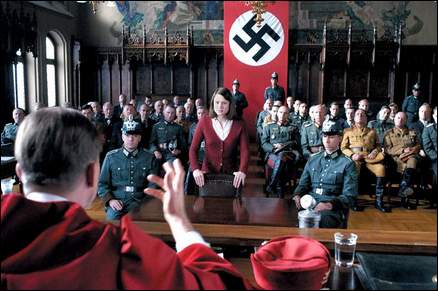
Sophie Scholl Arrest     Imagine if the United States of America had no protections for religious freedom. Imagine if on your way to Mass today you were pulled over by secret police and put under arrest. When you ask, “What have I done,” they reply, “You’re accused of being a believing Catholic Christian.” The police have had you under intense surveillance for several weeks; wire-tapping your phone, monitoring your computer, searching your personal belongings, and recording your movements and activities. Imagine yourself in this situation and consider this question: when all of the evidence is presented against you at trial, will there be enough evidence to find you guilty of being a believing Catholic Christian?

Could their informants testify that you observe Fridays as a day of penance and Sundays as a day of rest, that you faithfully go to Mass and frequent the sacrament of reconciliation? Could anyone testify that they heard you say positive things about Jesus Christ or speak up for the Catholic faith when it was mocked or criticized in your presence? Could they put into evidence some rosary, Bible, or other Catholic book marked with your fresh fingertips? Would they have hidden-camera footage of you praying before meals at a restaurant? Would they have grainy night-vision footage of you praying before going to bed, or first thing in the morning, making the tell-tale sign of the cross.

Sophie Scholl TrialThe judge, looking down from his bench, says, “It is alleged that you were picked up on your way to Mass. We realize that people get mixed-up with these hateful superstitions for different reasons. Maybe you went there unthinkingly, out of custom or habit. Perhaps you felt pressured by your relatives or neighbors. The punishment for being found guilty of being a believing Catholic is grave, but if you would simply acknowledge your mistake and renounce Jesus Christ we will let you go.”

How would you answer? Our Lord Jesus Christ tells us:

Everyone who acknowledges me before others I will acknowledge before my heavenly Father. But whoever denies me before others, I will deny before my heavenly Father.” (Matthew 10:32-33)

We may never face red martyrdom, but we decide whether or not to acknowledge Jesus Christ as our King in many little ways. As Jesus says:

The person who is faithful in very small matters is also faithful in great ones; and the person who is dishonest in very small matters is also dishonest in great ones.” (Luke 16:10)

Prayers of the Faithful / Petitions / Intercessions (Year A)

November 22, 2014

1st Sunday Advent, Year A (Dec 1, 2013)

3rd Sunday Advent, Year A (Dec 15, 2013)

4th Sunday Advent, Year A (Dec 22, 2013)

Christmas, Year A (Dec 25, 2013)

Feast of the Holy Family, Year A (Dec 29, 2013)

Solemnity of Mary, Mother of God, Year A (Jan 1, 2014)

Solemnity of the Epiphany, Year A (Jan 5, 2014)

Feast of the Baptism of the Lord, Year A (Jan 12, 2014)

3rd Sunday Ordinary Time, Year A (Jan 26, 2014)

Feast of the Presentation of the Lord, Year A (Feb 2, 2014)

5th Sunday Ordinary Time, Year A (Feb 9, 2014)

6th Sunday Ordinary Time, Year A (Feb 16, 2014)

7th Sunday Ordinary Time, Year A (Feb 23, 2014)

8th Sunday Ordinary Time, Year A (Mar 2, 2014)

1st Sunday Lent, Year A (Mar 9, 2014)

2nd Sunday Lent, Year A (Mar 16, 2014)

3rd Sunday Lent, Year A (Mar 23, 2014)

4th Sunday Lent, Year A (Mar 30, 2014)

5th Sunday Lent, Year A (Apr 6, 2014)

Palm Sunday, Year A (Apr 13, 2014)

Holy Thursday, Year A (April 17, 2014)

Easter Sunday, Year A (Apr 20, 2014)

Divine Mercy Sunday, Year A (Apr 27, 2014)

3rd Sunday of Easter, Year A (May 4, 2014)

4th Sunday of Easter, Year A (May 11, 2014)

5th Sunday of Easter, Year A (May 18, 2014)

6th Sunday of Easter, Year A (May 25, 2014)

7th Sunday of Easter, Year A (June 1, 2014)

Pentecost Sunday, Year A (June 8, 2014)

Solemnity of the Most Holy Trinity (June 15, 2014)

Solemnity of Corpus Christi (June 22, 2014)

Solemnity of Saints Peter & Paul (June 29, 2014)

14th Sunday Ordinary Time, Year A (July 6, 2014)

15th Sunday Ordinary Time, Year A (July 13, 2014)

16th Sunday Ordinary Time, Year A (July 20, 2014)

17th Sunday Ordinary Time, Year A (July 27, 2014)

18th Sunday Ordinary Time, Year A (Aug 3, 2014)

19th Sunday Ordinary Time, Year A (Aug 10, 2014)

Solemnity of the Assumption, Year A (Aug 15, 2014)

20th Sunday Ordinary Time, Year A (Aug 17, 2014)

21st Sunday Ordinary Time, Year A (Aug 24, 2014)

22nd Sunday Ordinary Time, Year A (Aug 31, 2014)

23rd Sunday Ordinary Time, Year A (Sept 7, 2014)

Feast of the Holy Cross, Year A (Sept 14, 2014)

25th Sunday Ordinary Time, Year A (Sept 21, 2014)

26th Sunday Ordinary Time, Year A (Sept 28, 2014)

27th Sunday Ordinary Time, Year A (Oct 5, 2014)

28th Sunday Ordinary Time, Year A (Oct 12, 2014)

29th Sunday Ordinary Time, Year A (Oct 19, 2014)

30th Sunday Ordinary Time, Year A (Oct 26, 2014)

Solemnity of All Saints, Year A (Nov 1, 2014)

Feast of All Souls, Year A (Nov 2, 2014)

Feast of the Dedication of St. John Lateran (Nov 9, 2014)

33rd Sunday Ordinary Time, Year A (Nov 16, 2014)

Solemnity of Christ the King (Nov 23, 2014)

Was the Book of Revelation Written for Us?

November 17, 2014

Monday, 33rd Week in Ordinary Time—Year II
Readings: Revelation 1, Luke 18:35-43

     The revelation of Jesus Christ, which God gave to him, to show his servants what must happen soon. He made it known by sending his angel to his servant John, who gives witness to the word of God and to the testimony of Jesus Christ by reporting what he saw. Blessed is the one who reads aloud and blessed are those who listen to this prophetic message and heed what is written in it, for the appointed time is near.

Revelation’s island of Patmos and its seven churches in Asia Minor (or modern-day Turkey)

        So begins the most misunderstood book of the Bible. The Book of Revelation speaks of “what must happen soon” and of an appointed time which is “near,” but to whom is it speaking? Some answer this question historical-critically; it is addressing seven particular churches in Asia Minor during the first or second century. Others answer eschatologically; it is describing the wonders and travails awaiting the generation which will immediately precede Jesus’ return. But what about the many generations who come and go between those two bookend-eras of Christian history? Was the Book of Revelation addressed or applicable to them? In what sense was its prophetic message truly “near” or “soon” for all that time?

        The Book of Revelation involves specific historical contexts in the past and describes a historical climax (apparently) still to come, but it also speaks to Christians of every age. Consider today’s gospel: Jesus heals a blind man and declares the saving power of his faith or faithfulness (“pistis” in the Greek.) How narrowly should we interpret this gospel? Are the miracles and message of Jesus Christ intended only for the people of His time and place? Is the Gospel of Luke meant only for the first century Christians to whom it was written? Rather, the whole of Sacred Scripture, co-authored and inspired by the Holy Spirit who sees all of history simultaneously, speaks to the life and times of every Christian. Corruptions of the world, persecutions of the Church, manifestations of God’s power, and triumphs of His people belong to every age. The Book of Revelation truly tells “[God’s] servants what must happen soon” because these realities are always “near.”

Three Crosses Line Break

The Dying Words of Jesus & His Saints

November 14, 2014

Each November, when the dark nights lengthen and trees become bare skeletons, we especially pray for the souls of those who have gone before us in death. This is also a fitting time of year to remember and consider the certainty of our own mortality. How did Jesus and his holy ones face the end of their lives? Their dying words can both instruct and inspire us:

“Father, into your hands I commend my spirit.”

—Our Lord Jesus Christ, c. 33 AD

“Lord Jesus, receive my spirit. Lord, do not hold this sin against them.”

—St. Stephen, martyr, c. 34 AD

“Glory to God for all things!”

—St. John Chrysostom, 407 AD

“Your will be done. Come, Lord Jesus!”

—St. Augustine, 430 AD

“May God forgive you, brother.”

—St. Wenceslaus, martyr, 935 AD

“I have loved justice and hated iniquity. Therefore I die in exile.”

—Pope St. Gregory VII, 1085 AD

“If all the swords in England were pointed against my head, your threats would not move me. I am ready to die for my Lord, that in my blood the Church may obtain liberty and peace.”

—St. Thomas Becket, martyr, 1170 AD

“When you see that I am brought to my last moments, place me naked upon the ground just as you saw me the day before yesterday; and let me lie there after I am dead for the length of time it takes one to walk a mile unhurriedly.”

—St. Francis of Assisi, 1226 AD

“Be assured that he who shall always walk faithfully in God’s presence, always ready to give him an account of all his actions, shall never be separated from him by consenting to sin.”

—St. Thomas Aquinas, 1274 AD

“Leave the doors open, so that everyone may enter and see how a pope dies.”

—Bl. Pope Urban V, 1370 AD

“Into your hands, O Lord, I commend my spirit.”

—St. Bridget of Sweden, 1373 AD

“Blood! Blood! Father, into your hands I commend my spirit.”

—St. Catherine of Siena, 1380 AD

“Jesus, Jesus, Jesus!”

—St. Joan of Arc, martyr, 1431 AD

“I die the king’s good servant, but God’s first.”

—St. Thomas More, martyr, 1535 AD

“O, my God!”

—St. Ignatius of Loyola, 1556 AD

“After all I die as a child of the Church. My Lord, it is time to move on. Well then, may your will be done. O my Lord and my spouse, the hour that I have longed for has come. It is time for us to meet one another.”

—St. Teresa of Avila, 1582 AD

“Jesus, I love you.”

—St. Kateri Tekakwitha, 1680 AD

“In all things I adore the will of God in my regard.”

—St. Jean Baptiste de la Salle, 1719 AD

“Be children of the Church.”

—St. Elizabeth Ann Seton, 1821 AD

“My immortal life is on the point of beginning. Become Christians if you wish to be happy after death, because God has eternal chastisements in store for those who have refused to know Him.”

—St. Andrew Kim Taegon, martyr, 1846 AD

“Holy Mary, pray for me, a poor sinner.”

—St. Bernadette Soubirous, 1879 AD

“I have reached the point of not being able to suffer any more, because all suffering is sweet to me. My God, I love you.”

—St. Therese of Lisieux, 1897 AD

“To restore all things in Christ.”

—Pope St. Pius X, 1914 AD

“Long live Christ the King!”

—Bl. Miguel Pro, S.J., martyr, 1927 AD

“Jesus. Maria.”

—St. Pio of Pietrelcina, 1968 AD

“Jesus, I love you. Jesus, I love you.”

—Bl. Mother Teresa of Calcutta, 1997 AD

“Let me go to the house of the Father.”

—St. John Paul the Great, 2005 AD

What do you want to be your dying words?