Archive for January, 2018

A Parable on Pushing Boulders

January 24, 2018

Once upon a time, a Christian hermit lived in a cabin on a wooded mountainside, devoting himself to prayer. One morning, as he quieted himself and opened himself receptively to God, he sensed Jesus speaking to him – hearing him not with his ears but in his mind. The Lord said, “Go to that large boulder outside your house.” The man got up and went. Then the Lord said, “I want you to push this boulder for a half-hour every day.” The man obeyed, daily exerting his body in every manner against the smooth, massive stone, yet even after months of pushing the boulder remained completely unmoved.

The man asked himself, “Why am I failing? What am I doing wrong? The Gospels say that faith the size of a mustard seed can move mountains, but I can’t even budge this boulder an inch. Why does God demand this of me when he knows I can’t do it?” At this, the man became quite angry and (wisely) voiced his frustration, confusion, and hurt to the Lord.

The man heard Jesus reply, “Do you have reason to be angry? I told you to push the boulder, but I never asked you to move it. Look at your arms, look at your legs – by your faithfulness to me you have become strong. Now you are prepared for my next task for you. Though you thought you were failing, you were succeeding in fulfilling my will.”

Recent Popes on the Culture of Life

January 17, 2018

“The promotion of the culture of life should be the highest priority in our societies… If the right to life is not defended decisively as a condition for all other rights of the person, all other references to human rights remain deceitful and illusory.”

— Pope St. John Paul the Great

“The fundamental human right, the presupposition of every other right, is the right to life itself. This is true of life from the moment of  conception until its natural end. Abortion, consequently, cannot be a human right—it is the very opposite. It is a deep wound in society.”

— Pope Emeritus Benedict XVI

“All life has inestimable value even the weakest and most vulnerable, the sick, the old, the unborn and the poor, are masterpieces of God’s creation, made in his own image, destined to live forever, and deserving of the utmost reverence and respect.”

— Pope Francis

“That is the dignity of America, the reason she exists, the condition of her survival, yes, the ultimate test of her greatness: to respect every human person, especially the weak and most defenseless ones, those as yet unborn.”

— Pope St. John Paul the Great

How Early Christians Celebrated the Holy Mass

January 9, 2018

Around 155 A.D., St. Justin Martyr wrote a legal petition to the emperor, Antoninus Pius. In it, he urges the Roman State to stop persecuting Christians merely for the act of professing to be Christians. “The First Apology (or reasoned defense) of Justin Martyr” answers the false rumors being spread about Christians in those days (including charges of cannibalism, orgies, incest, and sedition) by presenting Christians’ true beliefs and practices.

This ancient text gives us today a window into the Catholic identity of Early Christianity, including how they celebrated the Holy Mass. In the excerpts below, I have made note of the Catholic beliefs and practices on display using [Bold Captions].

“Sunday is the day on which we all hold our common assembly, because it is the first day on which God, having wrought a change in the darkness and matter, made the world; and Jesus Christ our Savior on the same day rose from the dead. [Sunday as the Lord’s Day and New Sabbath] For He was crucified on the day before that of Saturn (Saturday); and on the day after that of Saturn, which is the day of the Sun (Sunday), having appeared to His apostles and disciples, He taught them these things, which we have submitted to you also for your consideration. [Apostolic/Sacred Tradition]

“…After we have thus washed him who has been convinced and has assented to our teaching [Baptism], we bring him to the place where those who are called brethren are assembled, [Communal Worship] in order that we may offer hearty prayers in common for ourselves and for the illuminated person, and for all others in every place [Prayers of the Faithful], that we may be counted worthy, now that we have learned the truth, by our works also to be found good citizens and keepers of the commandments, so that we may be saved with an everlasting salvation. [Belief that Christian Salvation is not by “Faith Alone,” but by Faith and Sacrament and Holiness of Life]

“Having ended the prayers, we salute one another with a kiss. [The Sign of Peace] There is then brought to the president of the brethren bread and a cup of wine mixed with water; and he taking them, gives praise and glory to the Father of the universe, through the name of the Son and of the Holy Ghost, and offers thanks at considerable length for our being counted worthy to receive these things at His hands. [The Eucharistic Preface and Prayers] And when he has concluded the prayers and thanksgivings, all the people present express their assent by saying “Amen.” [The Great Amen]

“…And this food is called among us the Eucharist, of which no one is allowed to partake but the man who believes that the things which we teach are true, and who has been washed with the washing that is for the remission of sins, and unto regeneration, and who is so living as Christ has enjoined. [Closed Communion] For not as common bread and common drink do we receive these; but in like manner as Jesus Christ our Savior, having been made flesh by the Word of God, had both flesh and blood for our salvation, so likewise have we been taught that the food which is blessed by the prayer of His word, [The Words of Consecration] in order to nourish and transform our flesh and blood, is the flesh and blood of that Jesus who was made flesh. [The Real Presence of Jesus in the Eucharist] For the apostles, in the memoirs composed by them, which are called Gospels, have thus delivered unto us what was enjoined upon them; that Jesus took bread, and when He had given thanks, said, This do in remembrance of Me, this is My body; and that, after the same manner, having taken the cup and given thanks, He said, This is My blood; and gave it to them alone.

“…On the day called Sunday, all who live in cities or in the country gather together to one place, and the memoirs of the apostles or the writings of the prophets are read, as long as time permits; [The Liturgy of the Word] then, when the reader has ceased, the president verbally instructs, and exhorts to the imitation of these good things. [Preaching] Then we all rise together and pray, and, as we before said, when our prayer is ended, bread and wine and water are brought, and the president in like manner offers prayers and thanksgivings, according to his ability, and the people assent, saying “Amen;” and there is a distribution to each, and a participation of that over which thanks have been given, and to those who are absent a portion is sent by the deacons. [Deacons, Communion to the Sick or Homebound, and the Enduring Real Presence of the Eucharist] And they who are well to do, and willing, give what each thinks fit; and what is collected is deposited with the president, [The Collection] who succors the orphans and widows and those who, through sickness or any other cause, are in want, and those who are in bonds and the strangers sojourning among us, and in a word takes care of all who are in need.”

The Name of Jesus

January 3, 2018

In Greek, the name “Jesus” is spelled “ΙΗΣΟΥΣ.” These first three Greek letters were Latinized into “IHS,” forming a symbol for the Holy Name of Jesus.

There is something surprising you probably don’t know about the name of Jesus. To set the stage, let us recount how Jesus’ Church developed and how different languages were incorporated into her worship of God and her proclamation of the Gospel.

The Church began in the Holy Land, Israel, where our Lord was born and lived, died and rose. Jesus probably ordinarily spoke Aramaic, a language related to Hebrew. Mark’s Gospel records Jesus calling God “Abba,” the Aramaic word for “Father.”

Christianity soon spread from there into Turkey and Greece. We see St. Paul ministering and writing to young Christian communities in these lands (including Ephesus, Colossae, Galatia, Corinth, Thessalonica, and Philippi.) Their language, like that of all the New Testament books, was Greek. Some vestiges of this era perdure in our liturgy: “Kyrie eleison… Christe eleison” means “Lord have mercy… Christ have mercy” in Greek.

Eventually, after years of terrible Roman persecution, Christianity prevailed. First officially tolerated in 313 A.D., Christianity then became the state religion of the Roman Empire in 380. Latin remains the official language of the Roman Catholic Church to this day – many of her most important documents are promulgated in Latin with all translations into other tongues being based upon those.

The Christian Faith has now come to every nation on earth, including our own. Today the Holy Mass is typically celebrated in the vernacular, that is, the local language of the faithful. For us, this is English.

Now we arrive at the surprising thing about the name chosen by God and communicated to Mary and Joseph by angelic messages to be given to the incarnate Son. “Jesus” is the Greek form of that name, but that’s probably not what his mother and foster-father called him around the house. In Hebrew/Aramaic, his name was “Yeshua.” (The English form of this being “Joshua.”) Jesus/Yeshua shares his name with the Old Testament’s most famous Joshua; which is fitting, for both men lead God’s people into (greater or lesser) Promised Lands. The name Yeshua/Jesus means “God saves,” and he would indeed “save his people from their sins.” (Matthew 1:21)

What is the value and power of a name? A relationship usually begins by knowing another person’s name. That name allows you to call upon them and to speak about them. Being on a first name basis with someone can develop an intimacy that gives you access to opportunities and good things you otherwise would not possess. So it is with Jesus’ name in whatever form it takes, “the name which is above every name” in power and glory. (Philippians 2:9)

You may have heard before of the four modes of prayer under the acronym of S.A.L.T.: Sorrow, Asking, Loving, and Thanking. Sometimes we might be too strained or suffering in body or spirit to compose long prayers to the Lord. At these and other moments, we may simply say, “Jesus, I’m Sorry,” “Jesus, Please,” “Jesus, I love you,” or “Jesus, thank you.” Even invoking the mighty, holy, and saving name of “Jesus” alone calls him to your side with a perfect knowledge of your heart. Such is the great gift of knowing the name of Jesus.

The Holy Family and Yours

January 1, 2018

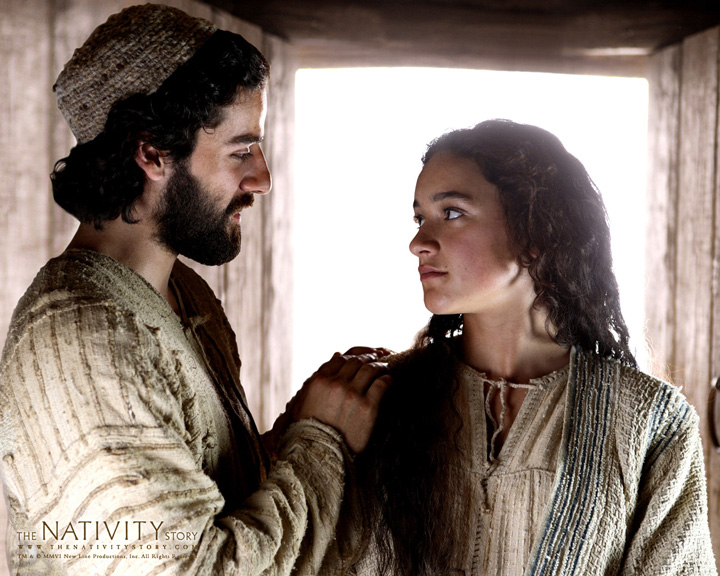
Every year, Holy Mother Church presents the Holy Family for our contemplation and imitation. Some imagine life in the home of Jesus, Mary, and Joseph in the soft, pastel colors of a Christmas card; so holy, so flawless, so unobtainable. We wonder, “Can the Holy Family and my family really relate to one another?” At least two out of the three members of the Holy Family never sinned in their entire lives together. We, meanwhile, could jokingly refer to the Feast of the Holy Family as “Elbow-Nudge Sunday.” Throughout the world this day, wives and husbands, parents and children, take turns gently nudging one another as they listen to God’s words about marriage and family life. The Holy Family was holy, but that doesn’t mean their lives were easy or smooth.

I’ve previously written about the stresses and difficulties of the holy couple leading up to the first Christmas: about Mary’s crisis pregnancy, about Joseph grappling with his wife telling him the child within her is the Son of God and Joseph contemplating a divorce, about their giving birth to that holy child in an animal stable. And their trials together continued after Jesus’ birth.

Imagine being Mary and hearing Simeon prophesy, “Behold, this child is destined … to be a sign that will be contradicted — and you yourself a sword will pierce…” How would that make you feel about the future for you and your child? Picture being Mary as her husband awakes and says “our boy is being hunted, we need to leave tonight.” Consider Joseph, the servant-leader of his family, having to pack-up quickly and leave so much behind to take his family into hiding in Egypt. Later, an angel tells Joseph to bring his family back into Israel. So Joseph returns with Jesus and Mary, but he’s afraid to resettle in the south because the son of Herod the Great now rules Judea. With the help of another dream, Joseph decides to resettle in the north, in Nazareth of Galilee.

I mention all this because St. Joseph, the just and holy man, feared an earthly king even as he trusted God. St. Mary at the Annunciation did not know all the details of her future, but she trusted in God by saying, “Let it be done to me according to your word.” Our Lord Jesus, sweating blood from stress the night before he died, trusted God to say, “Not my will but yours be done.” Their holy lives were often difficult, but God always rewarded their trust, bringing about good for them in the end.

In Genesis, Abram (whose name later got changed to Abraham) was promised a son by the Lord. But the childless Abraham looks at the old age of his wife and himself and asks, ‘Will my steward, Eliezer, be my heir?‘ God answers, ‘No, not him; your own flesh and blood son shall be your heir.’ Then the Lord took Abraham outside and said, “Look up at the sky and count the stars, if you can. Just so,” he added, “shall your descendants be.” And Abraham put his faith in the Lord.

When I first heard this story (and maybe when you heard it too) I assumed this event happened at night. But the message is even more powerful if God told him to “look up at the sky and count the stars, if you can,” during the daytime. Where do the stars go during the day? We know they’re still there, even though the Sun’s brightness the sky’s blueness prevent us from seeing them. Abraham trusted in the Lord’s unwavering goodwill towards him and beheld God’s word fulfilled in the birth of Isaac. Through that son, Abraham received glory and the whole world was blessed.

One of the things Jesus says in the Gospels more than anything else is, “Be not afraid.” Sacrifice your fears. Imagine taking those obsessive worrying thoughts from your mind, placing them upon the altar, and lighting them afire like a sacrifice of old to God. “Let the peace of Christ control your heart…” Trust that “God works all things for the good of those who love him” and then “the peace of God, which surpasses all understanding will guard your hearts and minds in Christ Jesus.”

God not only wants peace within us, but peace among us as well. In our homes there is always room for improvement. The household of the Holy Family may have been a sinless one, but mistakes and miscommunications surely happened. Joseph probably broke or misplaced tools. Mary probably burnt an occasional loaf of bread. From the Gospels we know they both thought they knew where their 12-year-old boy was as they left Jerusalem for home; several hours passed before they realized he was missing. Even when we deeply love one another, we must learn and practice how to love and serve each other better.

We love each other in many ways, and the best modes by which we experience love can vary from person to person. The book “The Five Love Languages” lays out five major ways that we give and receive love, namely:

Gift Giving
Acts of Service
Affectionate Touch
Words of Affirmation
Quality Time

What are your top-two love languages? Can you guess the preferred languages of your spouse and children? Sometimes we try to love others as ourselves by loving them exactly as ourselves and we unfortunately miss our mark. For example, imagine a spouse complaining, “Why don’t you let me know that you love me,” when they really mean “why don’t you get me surprises anymore” (gift giving) or “why don’t you tell me that I delight you and you’re pleased with me” (words of affirmation.) At this, their spouse might reply, “What do you mean? I’m loving you all the time,” when they’re really saying “I take care of the kids and do housework” (acts of service) and “We eat and sit in the living room together every evening” (quality time.) These two loving spouses are loving past each other.

Learn the preferred love languages of your family members, and don’t expect others read your mind, sabotaging our own happiness. Tell them how to delight you. They love you and they want to make you happy. Don’t attack and criticize (“You always this” or “You never that”) but invite them to bless you. And pray together, as a couple and a family. The Holy Family surely did and its one of the most valuable things I can recommend. Some married couples, who have shared a bed for years, have never revealed their personal prayer requests to each other. Pray together, and then even whenever frictions arise, you will remember that you are on the same team, together on the same side with God.

Your home will never be perfect – not even the Holy Family’s was perfect. Life’s circumstances will go awry, and there will be sins we have to apologize for and forgive one another. But with trust in God and a daily commitment to loving and serving each other better, you too can live in the peace and joy of the Holy Family.