Archive for March, 2019

When Was Easter?

March 30, 2019

Easter Sunday is April 21st this year, but other years it can fall anywhere between March 21st and April 25th. The date of Easter moves around the calendar because we celebrate it on the first Sunday, after the first full moon, on or after our first day of spring. In this, the Church echoes how the ancient, Jewish feast day of Passover was determined. Which raises a question: what’s the historical date of the very first Easter?

By pairing the four Gospels with other historical records we can narrow down the first Easter’s exact date. Jesus began his ministry after John the Baptist’s, which Luke reports began “in the fifteenth year of the reign of [the Roman Emperor] Tiberius Caesar,” or 29 AD. The Roman governor Pontius Pilate who condemned Jesus to death ruled Judea from 26 to 36 AD. We also know Jesus was crucified on a Friday the day before a Passover. There were only two such dates between 29 and 36 AD (namely, in 30 and 33 AD.) Finally, John’s Gospel notes three distinct Passovers (a timespan of at least two years) during the ministry of Jesus, which rules out 30 AD as too early to be Easter. Therefore, we can precisely pinpoint several of Christianity’s most important historic dates:

  • Holy Thursday – April 2nd, 33 AD – The Last Supper & beginning of the Passion
  • Good Friday – April 3rd, 33 AD – Jesus Passion, Crucifixion at noon, & Death at 3 p.m.
  • Easter Sunday – April 5th, 33 AD – Jesus’ Resurrection in early morning
  • Pentecost Sunday – May 24th, 33 AD – Descent of the Holy Spirit at 9 a.m.

Our Catholic Faith, our Christian religion, cannot be dismissed as a misty myth from “once upon a time.” Jesus of Nazareth was born of the Virgin Mary and crucified under Pontius Pilate. He suffered and died, was buried and rose in actual history. As Pope Benedict XVI famously wrote in his first encyclical, “Being Christian is not the result of an ethical choice or a lofty idea, but the encounter with an event, a person, which gives life a new horizon and a decisive direction.” Jesus Christ is a real person who once lived and still lives today.

Mary in History: Our Lady of Lourdes

March 25, 2019

March 25, 1858 – Lourdes, France

This was now the sixteenth time St. Bernadette Soubirous had encountered the Lady at the grotto. Bernadette had reported seeing “a young girl, sixteen, or seventeen years old. She wore a white dress drawn in at the waist by a blue ribbon whose ends hung down. On her head she wore a long white veil so as almost to cover her hair. Her feet were bare but nearly covered by the folds of her dress, except at the tip where a yellow rose shone on each. On her right arm she carried a Rosary of white beads on a golden chain, shining like the roses on her feet.” The local pastor, Fr. Dominique Peyramale, had prudently and persistently urged Bernadette to ask and discover the name of this strange visitor.

“She was there,” Bernadette recounts. “I asked her to forgive me for coming late. Always kind and gracious, she made a sign to me with her head to tell me that I need not make excuses. Then I spoke to her of all my love, all my reverence and the happiness I had in seeing her again. After having poured out my heart to her, I took up my Rosary. While I was praying, the thought of asking her name came before my mind with such persistence that I could think of nothing else. I feared to be presumptuous in repeating a question she had always refused to answer and yet something compelled me to speak.”

“At last, under an irresistible impulse, the words fell from my mouth, and I begged the Lady to tell me who she was. The Lady did as she had always done before; she bowed her head and smiled but she did not reply. I cannot say why, but I felt bolder and asked her again to be so kind as to tell me her name; however, she only bowed and smiled as before, still keeping silence. Then once more, for the third time, clasping my hands and acknowledging myself unworthy of the favor I was seeking of her, I again made my request.”

“The Lady was standing above the rosebush, in a position very similar to that shown in the Miraculous Medal. At my third request, her face became very serious and she seemed to bow down in an attitude of humility. Then she joined her hands and raised them to her breast… She looked up to Heaven… then slowly opening her hands and leaning forward towards me, she said to me in a voice vibrating with emotion, ‘I am the Immaculate Conception.'”

Bernadette, the simple and uneducated girl, did not understand what the Lady’s words meant but she repeated them over and over to herself (lest she forget them) as she walked to inform her parish priest. Only once the statement’s meaning was explained to her did St. Bernadette realize that her “Lady” was indeed the Blessed Virgin Mary. The apparition of Our Lady at Lourdes represents a heavenly confirmation of the Dogma of the Immaculate Conception which Pope Pius IX had solemnly and infallibly proclaimed and affirmed a few years before in 1854.

Returning to Dust & Rising From the Ashes

March 11, 2019

Funeral Homily for Daniel G. Zwiefelhofer
by Fr. Victor Feltes on March 7, 2019

The Fall of Mankind and Expulsion from Paradise
by Michelangelo on the ceiling of the Sistine Chapel

Remember that you are dust, and to dust you shall return.” These words were heard many times yesterday on Ash Wednesday as ashes were applied to foreheads. There is another phrase the ash-bestowing minister can say, but “remember that you are dust, and to dust you shall return” is the classic option. Where does this phrase come from? It’s from the story of Genesis, following the Original Sin, the Fall of Man.

When Adam and Eve sinned in the Garden, punishments were placed on them and their descendants. To the woman God said, “I will intensify your toil in childbearing; in pain you shall bring forth children.” And to the man God said, “In toil you shall eat the ground’s yield all the days of your life. Thorns and thistles it shall bear for you, and you shall eat the plants of the field. By the sweat of your brow you shall eat bread, until you return to the ground, from which you were taken; for you are dust, and to dust you shall return.” And God announced a punishment upon the wicked serpent too: “I will put enmity between you and the woman, and between your offspring and hers; he will strike at your head, while you strike at his heel.”

We still feel the consequences of sin and observe of the brokenness of our world. Birthing babies is painful and raising children is challenging. Daniel learned these truths firsthand alongside Marion. And, as a lifelong farmer, Daniel experienced firsthand that farming is hard work. Growing food, from beasts or fields, demands the sweat of one’s brow. And today, after eighty-one years of life on this earth, we gather for Daniel’s funeral; for we are dust, and to dust we return. If these things were all that we saw and knew we would be left in sad despair, but this is not the end of the story; for Genesis, for Daniel, or for us.

I mentioned earlier that there’s another phrase option for ash-distributors to say on Ash Wednesday: “Repent and believe in the Gospel.” The Gospel is a message of living hope and it was proclaimed from the beginning. The Church teaches that the Protoevangelium, or “First Gospel” promising salvation was announced in the Garden of Eden. Recall how God said to the serpent, in the presence of Adam and Eve: “I will put enmity between you and the woman, and between your offspring and hers; he will strike at your head, while you strike at his heel.” This is speaking to more than the natural hatred between humans and deadly snakes – it’s a prophesy. That “he,” the offspring of the woman, was to be Jesus. The ancient serpent, the devil, struck out at Jesus’ lowly flesh (as at Jesus’ heel) in the Passion. But Jesus the New Adam, triumphed through his Passion, death, and resurrection, crushing the enemy’s head.

Jesus is the New Adam. Tempted in a garden (the Garden of Gethsemane) Jesus did not falter. Called to lay down his wife for his bride (the Church) Jesus did not balk. And by the sweat of his brow (even sweating blood) he has provided her bread, in the Most Holy Eucharist, which is himself. He accepted a crown of thorns from a world turned against him, but by his toil of carrying his Cross Jesus has produced a fruitful yield on earth. Jesus was placed into the dust of the earth — entombed at death, but Jesus was not abandoned to the dustbin of history. The New Adam triumphs over death.

And the New Eve, his bride the Church, continues (with toil and pains, but also with joy) to bear forth children who live and die with faith in Christ, like Daniel. And, as Daniel’s prophetic namesake says in our first reading, “Those who sleep in the dust of the earth shall awake; and some shall live forever…” Likewise, in our second reading, St. Paul proclaims to the Thessalonians: “We do not want you to be unaware, brothers and sisters, about those who have fallen asleep, so that you may not grieve like the rest, who have no hope. For if we believe that Jesus died and rose, so too will God, through Jesus, bring with him those who have fallen asleep.” The first Adam, by sinning, and gave death to all his descendants. But Jesus Christ, the new faithful Adam, offers life to all who follow him.

On Ash Wednesday and at any funeral, we are reminded that are dust and to dust we shall return. But we must also remember to repent and believe in the Good News of the Gospel. As night lead to dawn and sleep to arising; as winter leads to spring and Lent leads to Easter, so the dying of friends of Jesus leads to joyful resurrection.

Mary in History: A Mystical Marriage

March 9, 2019

March 9, 1368 – Siena, Italy

Catherine Benincasa was born the youngest of twenty-five children in Siena, Italy. She was so joyful as a child that they nicknamed her “Eu-phro-sy-ne,” from the Greek word for “merriment.” At age six, while walking home with her brother, she stopped in her tracks. When she did not respond to his calls, he walked back to her and shook her, as from a dream. She burst into tears, having beheld in the sky a vision of Jesus seated in glory with the Apostles Peter, Paul, and John. A year later, she made a secret vow to give her whole life to God.

In her teenage years, Catherine’s parents began pressuring her to enter marriage, but she voiced with her intention not to. When her parents persisted, she cut short her beautiful golden-brown hair. As punishment, they made her do menial work in the household and, knowing she craved prayerful solitude, never allowed her to be alone. She bore all this with patient sweetness, later writing that God showed her how to build within her soul a private chamber where no tribulation could enter.

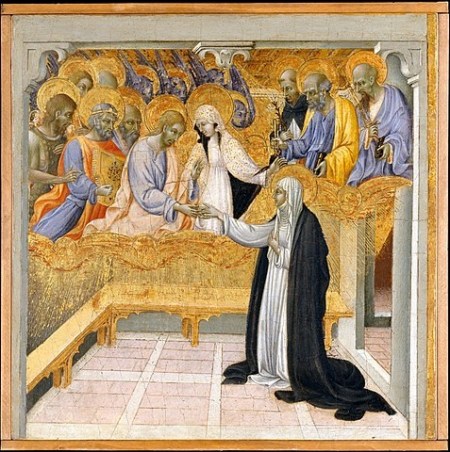
On Fat (or Shrove) Tuesday, while the people of Siena were celebrating carnival, the 21-year-old Catherine was praying in her room. A vision of Jesus appeared, with by Mary and the heavenly angels. Our Lady took Catherine’s hand and held it up to Christ, who placed a ring upon it and mystically married her to himself. Though invisible to others, this ring of St. Catherine of Siena was always visible to her.

Some misunderstand the meaning and purpose of celibacy in the Church. Jesus Christ, St. Paul, St. Catherine, and others have encouraged and lived this way of life not because human connection or natural marriage are bad, but because celibacy allows for a higher and broader intimacy. Every person is called to marriage, be it natural or spiritual; and everyone one is called to have children, be they biological or spiritual.