Archive for March, 2021

The Film Trailer of our Lives

March 28, 2021

Palm Sunday Homily
By Deacon Dick Kostner

Grand Lake Movie Theater Hall

It’s been said that when we leave this life that there will be displayed to us a film of our life here on earth before God enters eternal judgment on us. After listening to Fr. Victor’s homily on Ash Wednesday I came to the realization that we are able to view a trailer on a yearly basis of what that film will reveal before our final judgment is entered. Our story will begin on a happy note, a Palm Sunday view of our life. High points in our life, our birth into the Kingdom of God when we were baptized and adopted into the Holy Family. A time of happiness, a time where we feel the oneness of family love, peace, and brotherhood. A time when palms are waived because of our presence and our contributions of goodness we have delivered to those we have helped move to a higher level of existence.

Then the movie will continue. We will then witness times in our life when we were afraid and unsure of our mission in life because it has carried within us failures that are a part of human existence. Times when we were unsuccessful in accomplishing goals we had set up for our life plan and times when we were tempted to follow evil and destructive paths within our lives. Times when we listened to mentors who were not truthful in their instruction, and things just kept getting worse, and we started crying for help and instruction and went off to a place by ourselves to pray for divine intervention.

The story continues with some good times that keep us going. Times when we gathered with friends and family to share a meal and tell stories about our happy times looking for a return to Palm Sunday celebrations and support from our family and friends. Here we again pray together for wisdom and deliverance from the fear of death of the happy times of Palm Sunday. The story continues. We enter a time when our friends appear to abandon us. We feel alone and helpless. Even our heavenly Father seems to not hear our prayers for help and yes we are asked to have faith even when death cannot be avoided and we cry out, “Father into your hands I commend my spirit,” and the darkness of death settles in and we feel the abandonment of body. But we realize that it is not over, for our spirit is still present and we realize that we still have an existence even in the darkness of the death experience. Our bodies have been reduced to ashes but there still exists within those ashes the spirit of life, friendship, and love.

We wait patiently to once again see the light of a new day, a new Palm Sunday where we will see our friends, and Holy Family. A time when Palms will once again be waived at us in joy and friendship. And then it happens. We hear something. Something big is being moved and we see the first rays of Easter Sunday light peaking through, as the rock of darkness is rolled away and the Sun of God shines at us and waves at us to come out of darkness and join Him for our birthday celebration of everlasting life. And yes we are promised that our body ashes will be reconstituted and join our spirit in completeness at the end of time. It is Holy Week that reveals our destiny. It is the Way of the Cross.

Let us pray, reflecting upon these words:

Ashes to ashes, dust to dust
All that is not of God must die
All that is crushed will be restored
All that is lost will be made new
God may we repent of ways that do not serve you
And admit to the tensions that tell us where we need to change
Christ is coming walking towards the cross
God may we see him clearly
Pouring out love
Pouring out mercy
Pouring out peace
May we kneel before him in humble adoration
May we take up our cross and follow
And walk with Christ into the ways of life.
And our mind tells us:
REPENT AND BELIEVE IN THE GOSPEL, AMEN!

Wishing all of you a blessed Holy Week and a joy-filled Easter Sunday!

Recreating the Way of the Cross

March 21, 2021

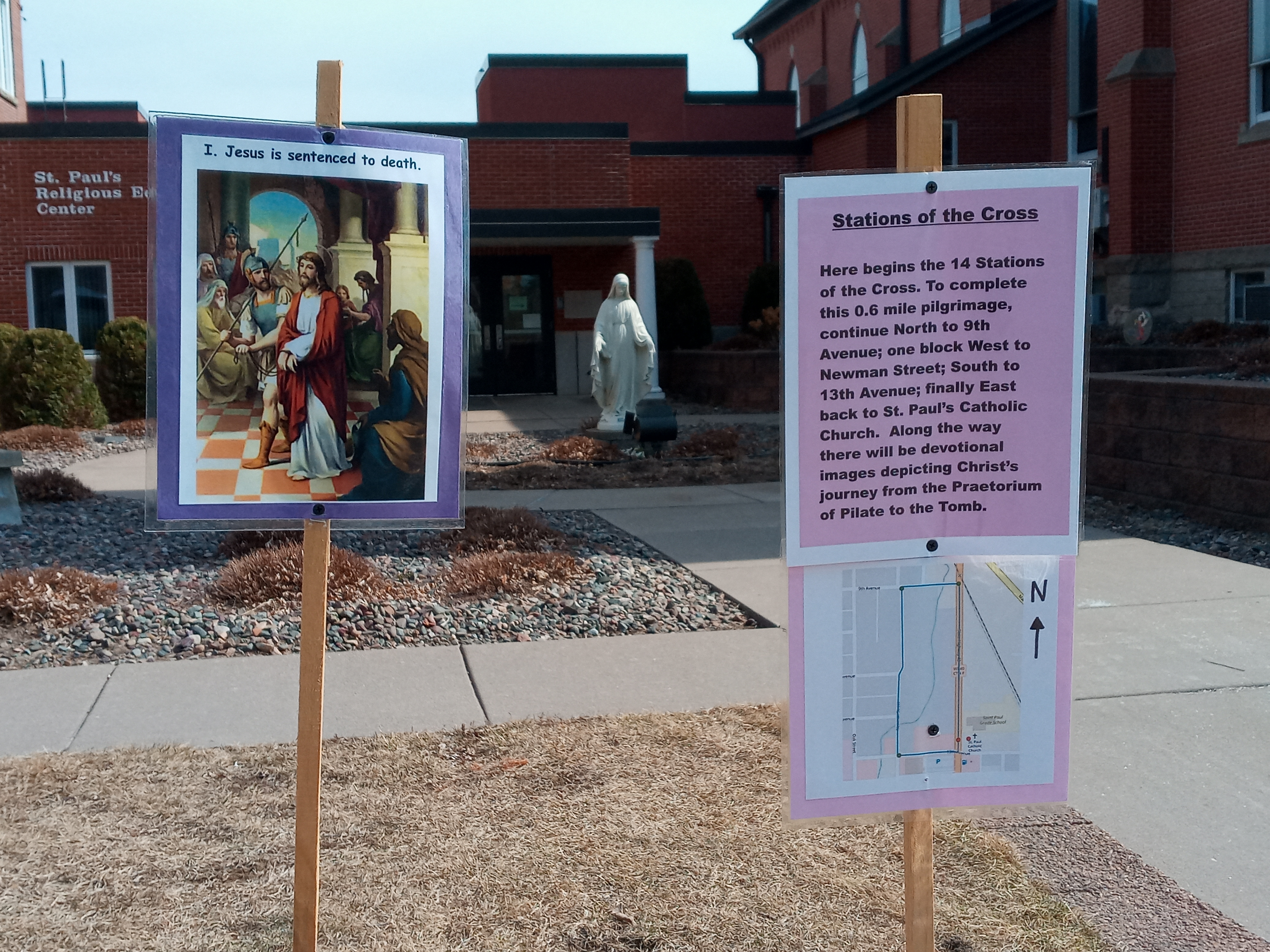
Our 1st Station, with an introduction and a map of our Way of the Cross

The experience of visiting the Holy Land (as I did in 2016) gives a person lasting impressions. One is a deepened sense that the Gospel stories were not “once upon a time” but events of a real time and place. Another takeaway is a better sense of the region’s scale – which is smaller than what you would think. The size of the nation of Israel is less than New Jersey, and the area enclosed by the walls of Jerusalem’s Old City (0.35 square miles) is that of only one-and-a-half Vatican City’s. The Way of the Cross, from where Governor Pilate sentenced Jesus to death to the place of Christ’s death and burial, is about 600 meters or 2,000 feet, less than half a mile.

Remember in the film “The Passion of the Christ,” when Jesus falls and Mary rushes to him? This is my photo of the 3rd and 4th Stations in Jerusalem.

In the Holy Land I also learned that Christian tradition not only preserves details about Jesus’ Passion (such as his three falls and St. Veronica’s veil) but also commemorates the locations at which these sad moments occurred. These fourteen Stations of the Cross are still venerated and prayerfully walked by pilgrims in Jerusalem today. It is a powerful, beautiful experience which I wanted to recreate in the streets of my community, and which you might wish to offer yours.

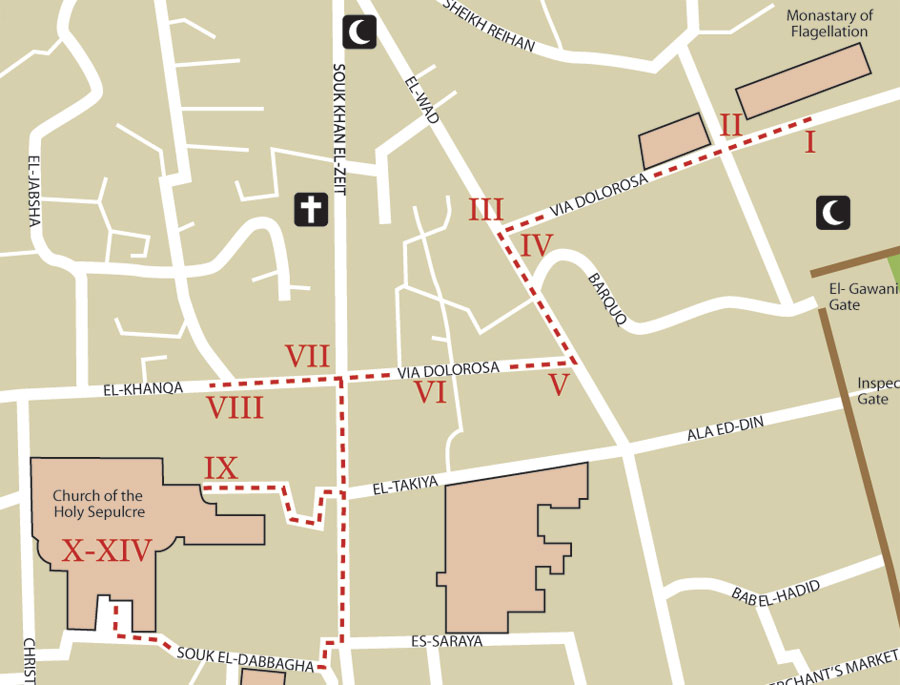
A present-day map of the fourteen Stations on Way of the Cross in Jerusalem

This Lent, we’ve created an outdoor Way of the Cross. It begins in front of our church and school and loops one time around the city block opposite them. After measuring maps and receiving permission from the various landowners, we posted the traditional fourteen Stations along a path which approximates the actual Way of the Cross, both in its length and its distances between the Stations. Walking it takes about twelve minutes (if one does not pause to pray) and we plan to keep the Stations up until Easter Sunday. Our small-town, local newspaper even ran a story about them.

The final five Stations, commemorating Jesus’ crucifixion and burial, are grouped closely together near the end. This is because the locations of Jesus’ Cross and Tomb were situated only about 150 feet away from each other. Both sites are now housed within the Church of the Holy Sepulchre. On Good Friday, the Roman soldiers led Jesus west outside the walls of Jerusalem to a white limestone quarry. St. John’s Gospel records that many people read the sign posted above our Lord’s head on the Cross indicating the “crime” for which he was condemned (“Jesus the Nazorean, the King of the Jews”) because the place where he was crucified was near the city. It was also apparently alongside a road, since St. Matthew notes “those who passed by hurled insults at him.” Christ was crucified atop a rock formation there called Golgotha in Hebrew and Calvary in Latin, which laborers had cut around and left behind. As Psalm 118:22 had foretold, “the stone which the builders rejected has become the cornerstone.”

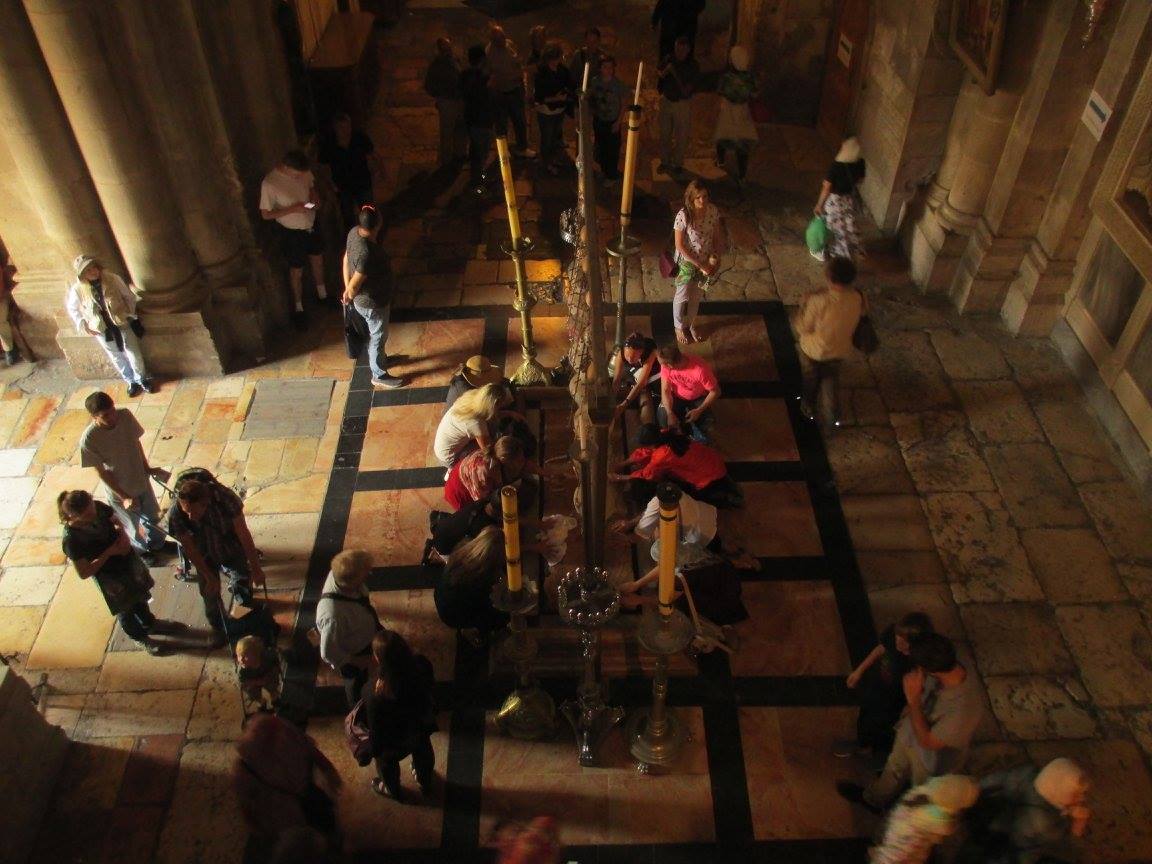
A view from Calvary of the Stone of Unction in The Church of the Holy Sepulchre

The new tomb which St. Joseph of Arimathea gave to Jesus had been cut into a rock face amidst a garden nearby. Midway between these two places, the Church of the Holy Sepulchre now displays a stone venerated as the slab upon which Jesus’ body was prepared for burial by his mother and his friends. In whatever ways you accompany Christ through his sufferings this Lent, may you come to share more greatly in the graces and joys of his Easter Resurrection.

A Homily Series on The Apostles’ Creed for Lent (Year B)

March 21, 2021

I believe in God,
the Father almighty,
creator of heaven and earth.

I believe in Jesus Christ, his only Son, our Lord,
He was conceived by the power of the Holy Spirit
and born of the virgin Mary.

He suffered under Pontius Pilate,
was crucified, died and was buried,
he descended into hell,
on the third day he rose again from the dead,

He ascended into heaven,
and is seated at the right hand of God the Father Almighty
from there He will come to judge the living and the dead.

I believe in the Holy Spirit,
the Holy Catholic Church,
the communion of Saints,
the forgiveness of sins,
the resurrection of the body,
and life everlasting. Amen.

If you enjoy these Lenten reflections, I recommend The Catechism of the Catholic Church, whose discussion of The Apostles’ Creed was the primary source for my homilies here.

The Spirit’s Blessings Through God’s Church

March 20, 2021

5th Sunday of Lent

Right before ascending into heaven to sit at his Father’s right hand, Jesus gave his disciples these final instructions: “I am sending the promise of my Father upon you; but stay in the city until you are clothed with power from on high. …You will receive power when the Holy Spirit comes upon you.” After seeing Jesus ascend, the disciples returned to Jerusalem rejoicing. There in the Upper Room, the apostles, the Blessed Virgin Mary, and other Christians (a group of about one hundred twenty persons) devoted themselves with one accord to prayer. After nine days of prayer—the first Christian novena—the Holy Spirit descended upon them on Pentecost.

The apostles had received this eternal, divine Person before. On Easter Sunday evening, Jesus appeared in the Upper Room and breathed upon them saying, “Receive the Holy Spirit. Whose sins you forgive are forgiven them, and whose sins you retain are retained.” You and I first received the Holy Spirit at our baptisms, when we were “born again / born from above…of water and Spirit,” and made temples of the Holy Spirit. But just as the Spirit came down on Pentecost and filled the disciples in a new way, inspiring and empowering them to announce, make present, and spread Christ’s Church in the world, so we receive the Holy Spirit anew for mission in the Sacrament of Confirmation.

When God the Father sends his Word he also sends his Breath, and the mission of the Holy Spirit is united to the Son’s. Our faith in Jesus leads to our belief in the Spirit and in the good things which flow from both. These blessings are brought to completion through God’s Holy Catholic Church. As the Apostles’ Creed proclaims:

I believe in the Holy Spirit,
the Holy Catholic Church,
the communion of Saints,
the forgiveness of sins,
the resurrection of the body,
and life everlasting. Amen.

As Jesus Christ is the Church’s body, we being his members, so the Holy Spirit is the Church’s soul, our animating Spirit. The Holy Spirit inspires the Church’s Sacred Scriptures, he safeguards her Sacred Tradition and Magisterium from error, he is the Spirit of her liturgies, he empowers her sacraments, he intercedes in her prayers, he builds her up by charisms and ministries, and he manifests holiness in her by each vocation and every saint. As the early Church Fathers said, the Church is the place “where the Spirit flourishes.” The Holy Spirit gives his people gifts of wisdom, understanding, counsel, fortitude, knowledge, piety, and fear of the Lord; and his fruits of love, joy, peace, patience, kindness, goodness, faithfulness, gentleness, and self-control are seen in us. Jesus Christ and the Holy Spirit form the Church and make her holy. At the Last Supper, Jesus prayed for the holy unity of his Church. He said, “Holy Father, I pray not only for [these apostles of mine,] but also for those who will believe in me through their word, so that they may all be one, as you, Father, are in me and I in you, that they also may be in us, that the world may believe that you sent me.” This loving unity is reflected in the communion of the Saints.

In today’s Gospel, some Greeks who had come to worship at the Passover Feast approach the Philip the Apostle and ask him, “Sir, we would like to see Jesus.” Philip goes and tells Andrew the Apostle; then Andrew and Philip go and tell Jesus. Jesus answers them, “The hour has come for the Son of Man to be glorified.” Jesus’ salvific mission is catholic (that is, “universal”). He has come to unite every people and nation in himself. and he sees in this overture from the visiting Greeks a sign that his moment has come. Jesus says, “When I am lifted up from the earth, I will draw everyone to myself.” Jesus gathers them into communion with the one Church he founded, a hierarchical Church (with Christ its Head ordaining that apostles and priests to be her servant leaders) but a Church which is first and foremost interpersonal, communal. No one can baptize themselves; it requires another person. And not even a priest can absolve his own sins. Just so, we are not saved alone, but in communion with others. In the words of Pope St. Paul VI, “We believe in the communion of all the faithful of Christ, those who are pilgrims on earth, the dead who are being purified, and the blessed in heaven, all together forming one Church; and we believe that in this communion, the merciful love of God and his saints is always attentive to our prayer.” As Sts. Andrew and Philip helped those Greeks in reaching out to Jesus, so we lovingly aid one another, by our prayers, penances, and sacrifices, by sharing our material and spiritual goods, helping each other on the way to heaven. But entry into heaven is impossible without the forgiveness of sins.

We believe in the forgiveness of sins. Through Jesus Christ, God’s promises spoken through the Prophet Jeremiah in our first reading are fulfilled: “I will make a new covenant with the house of Israel… I will forgive their evildoing and remember their sin no more.” What was the Risen Christ’s first order of business for his Church when he appeared to his apostles in the Upper Room on Easter? After assuring them that it was really him and that he wished them peace, he gave his apostles the power and authority to forgive sins (as we noted before). Baptism into Christ washes away our past sins, but what if we grievously sin after baptism? We cannot be baptized twice. Since Christ has given his Church the power to forgive sins, then baptism cannot be her only means of forgiveness. The Sacrament of Penance is necessary for salvation for those who have fallen after Baptism, just as Baptism is necessary for salvation for those who have not yet been reborn in Christ.

There is no offense, however serious, that the Church cannot forgive. There is no one, however wicked or guilty, who may not confidently hope for forgiveness, provided their repentance is sincere. Christ, who died for all men, desires that the gates of forgiveness in his Church should be open to anyone who turns away from sin. If you could use a good Confession, mark your calendars to come here to St. Paul’s next Sunday, on Palm Sunday afternoon. Apart from making another appointment, it might be your last chance for a Lenten Reconciliation with God.

But what good would God’s forgiveness be if death were the end of us? We believe in the resurrection of the body. Jesus tells Philip and Andrew, “Amen, amen, I say to you, unless a grain of wheat falls to the ground and dies, it remains just a grain of wheat; but if it dies, it produces much fruit.” Here, as elsewhere, Jesus foretells of his resurrection, for the buried seed which dies then rises from the earth. Jesus then goes on to say, “Whoever serves me must follow me, and where I am, there also will my servant be.” This is not only a call to discipleship but a promise of resurrection: ‘Whoever serves me must follow after me, from the tomb of death to the resurrection of life, and where I am (whether in heaven or in the New Creation to come) there also will my servant be with me.’ Jesus says, “Whoever loves his life loses it, and whoever hates his life in this world will preserve it for eternal life.

We believe in life everlasting. And this new life doesn’t begin only once we die, or after God raises up our bodies “on the last day.” We can already taste eternal life now. From your worst sins you have had small glimpses of hell, and in Jesus Christ you have already experienced small glimpses of heaven. But our eyes have not seen, and our ears have not heard, and our hearts have not conceived the fullness of what God has prepared for those who love him. Scripture speaks of it in images: of life, light, peace, wine, a wedding feast, the Father’s house, the heavenly Jerusalem, paradise. God will wipe away every tear from our eyes and death will be no more, neither will there be any more mourning or crying or pain, for these things will have passed away. And when we enter this perfect, unending life with the Most Holy Trinity and all the saints, it will be the ultimate fulfillment of our deepest human longings; supreme and definitive happiness.

In conclusion, The Apostles’ Creed ends with the same final word as the last book of the Bible, the word at the end of the Church’s many prayers: “Amen.” In Hebrew, “amen” comes from the same root as the word “believe,” expressing solidity, trustworthiness, and faithfulness. In saying “Amen” we are professing both God’s faithfulness towards us and our trust in him. The Creed’s last word “Amen” repeats and confirms its first words, “I believe,” and everything in between. As St. Augustine preached, “May your Creed be for you as a mirror. Look at yourself in it, to see if you believe everything you say you believe, and rejoice in your faith each day.” This is our Faith. This is the Faith of the Church. We are proud to profess it in Christ Jesus our Lord. Amen

St. Patrick, the Moses of Ireland

March 17, 2021

Wednesday of the 4th Week of Lent

St. Patrick, the Apostle to Ireland, and Moses from the Exodus have a lot in common. Moses was targeted by the wicked as a baby; Pharaoh ordered that all newborn Hebrew boys be tossed into the Nile River to die. Patrick was also targeted by the wicked. Raiders kidnapped him from Roman Britain at the age of sixteen. Moses was separated from his family, growing up in Pharaoh’s palace. Patrick was separated from his family as a slave in Ireland for six years. Moses escaped Pharaoh and Patrick escaped his captors, and neither of them planned to ever go back again. But then, Moses had a vision at the Burning Bush calling him to return to Egypt. And Patrick had a vision in his sleep in which he heard the people of Ireland call out to him, “We appeal to you, holy servant boy, to come and walk among us!” Both men had worked as shepherds during their exiles, and this experience helped spiritually prepare them to become shepherds of men.

Moses was sent by God to free the Hebrews from slavery. Patrick was sent by God to free the Irish from their errors and sins. “Saying to the prisoners: Come out!” But the Egyptian and Irish leaders resisted. Pharaoh’s Egyptian gods and the druids’ Celtic gods were quite different from the Lord. Pharaoh thought killing babies in the river would please the god of the Nile while solving his problems, and the druids offered their gods many human sacrifices hoping that good things would come from them. By proclaiming mighty messages and performing mighty miracles, Moses and Patrick defeated these foes and freed the people. Both men are rightly celebrated for leading many people to God.

The Hebrews who left in Egypt and the Irish who lived in Ireland were introduced to a different and better way of life with the Lord our God. Yet amazingly, once they had been set free, the Hebrews often complained against Moses and said they wanted to return to Egypt and slavery. Today, after some 1,500 years of the True Faith in Ireland, more and more people there live as if Catholic in name only; not believing, not praying, not practicing. For example, in 2018 the people of Ireland voted 2-to-1 in a referendum to legalize more abortion. And in 2019, the first year under the new laws, Ireland’s Department of Health recorded exactly 6,666 abortions. “Can a mother forget her infant, be without tenderness for the child of her womb?” Isaiah suggests this as unthinkable thing – but that is how far we have wandered. Yet even if she should forget, God never forgets us. Even if we give up on God, he will not give up on us. “The Lord is gracious and merciful.” But you are free and you can choose to leave him.

Moses cared about the Hebrews, Patrick cared about the Irish, and I care about you, and we do not want any of you to be lost. But life in the desert is hard, and this world is seductive, and it is easy to be lost. Will you choose to follow the Lord, the God of Moses and St. Patrick, or not?

“Amen, amen, I say to you, whoever hears my word
and believes in the one who sent me
has eternal life and will not come to condemnation,
but has passed from death to life.”

As Moses said, “This day I call the heavens and the earth as witnesses… that I have set before you life and death, blessings and curses. So choose life, that you and your children may live.

At the Father’s Right Hand

March 13, 2021

4th Sunday of Lent

Jesus tells Nicodemus, “Just as Moses lifted up the serpent in the desert, so must the Son of Man be lifted up, so that everyone who believes in him may have eternal life.” First, Jesus is raised up on the Cross. Next, he is raised up from the tomb. And finally, he is raised up to heaven. As this week’s section of The Apostles’ Creed proclaims:

He ascended into heaven,
and is seated at the right hand of God the Father Almighty
from there He will come to judge the living and the dead.

Jesus’ body was glorified at the moment of his Resurrection on Easter. Then he visited his disciples in his body over more than a month, appearing and vanishing, conversing and teaching, eating and drinking, and showing painless wounds in his hands, side, and feet. (Jesus keeps these wounds from his Passion as trophies of his victory.) And then, on the fortieth day, Jesus led his Apostles and disciples a short ways east out of Jerusalem, past the Garden of Gethsemane where he had agonized, and up the Mount of Olives which looks down over the Holy City. He raised his hands and blessed them, and as he blessed them he parted from them and was taken up to heaven. He was lifted up as they looked on and a cloud took him from their sight. They did him homage and returned to Jerusalem rejoicing. Of course, one cannot fly an airplane or ride a rocket to enter God’s presence (unless the flight ends very badly). Heaven is not a place here or there, but another dimension of reality, distinct from us but not far distant. Jesus ascends in his disciples’ sight to manifest the invisible, his entry into heaven in fulfillment of what King David had foretold about the Christ, one thousand years before, in the 110th Psalm:

The Lord [God] says to my Lord [the Christ]:
“Sit at my right hand until I put your enemies under your feet. Yours is princely power from the day of your birth. In holy splendor, before the daystar, like the dew, I have begotten you.” The Lord [God] has sworn an oath he will not change: “You are a priest forever…” At your right hand is [Christ] the Lord, who will crush kings on the day of his great wrath, who judges nations…

From ancient times the right hand has been considered the favored spot, the seat of honor for your right-hand man. Being at the right hand means closeness, allowing for intimacy and confidence. You and I have a great friend in high places who “always lives to make intercession” for “those who draw near to God through him.” Jesus, the high priest of the new and eternal Covenant, has “entered, not into a sanctuary made by human hands… but into heaven itself, now to appear in the presence of God on our behalf.” Jesus Christ is not only humanity’s priest and advocate in Heaven, before ‘his Father and our Father, his God and our God,‘ he also sits enthroned as our king. As the Prophet Daniel once foresaw concerning Christ in a vision:

“To him was given dominion and glory and kingdom, that all peoples, nations, and languages should serve him; his dominion is an everlasting dominion which shall not pass away, and his kingdom one that shall not be destroyed.”

Jesus Christ is King, the Lord of the cosmos and of history, who dwells in his Church where his Kingdom is now present in mystery. The Catholic Church is the seed and beginning of the Kingdom come on earth as it is in heaven. We now await Christ’s Second Coming in fully-unveiled glory, such that he can no longer be dismissed or ignored by anyone. Jesus will return as ruler of all and come to judge the living and the dead. “‘As I live, says the Lord, every knee shall bend before me, and every tongue shall give praise to God.’ … Then each of us shall give an account of himself to God.” The conduct of each person and the secrets of every heart will be brought to light before his throne. Then the wicked “will go away into eternal punishment, but the righteous into eternal life.”

It is very important that we take God and personal conversion seriously. Our first reading chronicles how God’s people had “added infidelity to infidelity, practicing all the abominations of the nations.” The Lord had sent them his messengers, early and often, for he had compassion on his people, “but they mocked the messengers of God, despised his warnings, and scoffed at his prophets.” God’s anger became so inflamed that he permitted them to be conquered by the Babylonian Empire six hundred years before Christ. Those who escaped the sword were carried off into Babylon captivity to be unhappily subjugated there. As today’s psalm recalls, “by the streams of Babylon we sat and wept.” Many never knew true freedom and peace for the rest of their days. But eventually, the Babylonians were conquered by the Persians, and the Lord inspired King Cyrus of Persia to issue a proclamation throughout his empire encouraging the Jews to return to Jerusalem, rebuild the Temple, and worship God there. Notice how the king made this possible but didn’t force anyone to go. They were free to choose; to either return home or stay far away. Wickedness has grave consequences, in this life and hereafter, yet we do not earn our salvation by doing good deeds. As St. Paul tells us, “by grace you have been saved — [God] raised us up with [Jesus] and seated us with him in the heavens… By grace you have been saved through faith, and this is not from you; it is the gift of God; it is not from works, so no one may boast.” Salvation comes from accepting God’s invitation to come home to him.

On the Last Day, Jesus will come again as our Judge, yet “God did not send his Son into the world to condemn the world, but that the world might be saved through him.” “For God so loved the world that he gave his only Son, so that everyone who believes in him might not perish but might have eternal life.” In Christ “the light came into the world, but people preferred darkness to light, because their works were evil. For everyone who does wicked things hates the light and does not come toward the light, so that his works might not be exposed. But whoever lives the truth comes to the light, so that his works may be clearly seen as done in God.” A very powerful way to shed the darkness of sin and come into the light is through Jesus’ Sacrament of Reconciliation.

Here is another divine invitation to freedom and peace: I will be hearing Confessions in St. Paul’s Main Sacristy this Thursday, from 8 AM to 6 PM, at the start of every hour until all are heard. If those times won’t work let me know and we’ll set up something else. Maybe it’s been a long time since your last Confession? Maybe you’re nervous? You don’t need to be. I’ll help you through it. Know that when you come out you will feel absolutely wonderful. And Jesus Christ, seated at the right hand of our Father above, will look upon you and smile.

Christ Was Lifted Up

March 7, 2021

3rd Sunday of Lent

People would pilgrimage to the Temple in Jerusalem from across the known world to worship, often bringing money to purchase oxen, sheep, or doves for sacrifices to God. So vendors had set up shop in the Temple’s outermost court exchanging foreign currencies into Hebrew coins for a percentage fee and selling animals for a healthy profit. God, however, had designated that large, marble-paved court as the Court of the Gentiles where non-Jews (that is, the Gentiles) could come to worship him at his Temple. The Father willed his Temple to be “a house of prayer for all the nations,” but the moneychangers and animal sellers were making it a noisy, smelly “marketplace.” And by charging unlawful interest and demanding excessive prices even of the poor, they were also “making it a den of thieves.

A place intended to be free for holy worship and communion with God had become unclean, profaned by sin. So Jesus personally comes to Jerusalem at the time of Passover and does something dramatic. He zealously cleanses the Temple, conquering evil, achieving justice, restoring relationship between God and man, drawing people to himself, and indeed sacrificing himself; for when the chief priests and scribes heard of this incident they began seeking a way to put him to death. Their plotting would lead to the Pascal Mystery at the heart of The Apostles’ Creed:

He suffered under Pontius Pilate,
was crucified, died and was buried,
he descended into hell,
on the third day he rose again from the dead,
he ascended into heaven,
and is seated at the right hand of God the Father Almighty.

Why does Jesus Christ do these things? Because sin had caused the human race to fall far from God and paradise. Suffering, dying, and being barred from Heaven were our human lot. We had become slaves to sin and the Evil One, held hostage against our will. Our offenses against the All-Holy One required an incalculable repayment. And our separation from God had made us doubtful of his goodness and love for us. It was a slavery we could not escape, a debt of justice we could not repay, and a broken relationship we could not heal. But God had a plan to save us. He would aid humanity with his divinity by fashioning a remedy for us out of our weakness and suffering and mortality, that from fallout of our downfall would come the means to our salvation. By his Incarnation, the Son of God enters our sinful world as one of us and by his Pascal Mystery sets us free, cleansing us, for holy worship and communion with God. First, Jesus assumes our nature, and then he offers a perfect sacrifice.

As the Letter to the Hebrews says, since we “share in blood and Flesh, Jesus likewise shared in them, that through death he might destroy the one who has the power of death, that is, the Devil, and free those who through fear of death had been subject to slavery all their life.” Jesus said that he came “to give his life as a ransom for many.” And lest it be unclear, St. Paul proclaims that the Lord “gave himself as a ransom for all.” Christ’s death frees the slaves and ransoms the captives, and now saints and angels sing to Jesus, the Lamb of God, in Heaven: “Worthy are you… for you were slain and with your blood you purchased for God those from every tribe and tongue, people and nation.

To some, the idea of Almighty God dying on a cross seems impossible, unbecoming foolishness. Yet Christ crucified is the power and wisdom of God. “The foolishness of God is wiser than human wisdom, and the weakness of God is stronger than human strength.” This mysterious, hidden, wisdom, planned by God before the ages for our glory, was not understood by the devil and his demons; “for if they had known it, they would not have crucified the Lord of glory.” In sinning God, Adam had handed himself and his descendants into the devil’s clutches, but in crucifying Christ (the sinless New Adam) the serpent overplays his hand and loses big. St. Augustine uses the image of a mousetrap in which Jesus is the bait. The devil takes this bait in putting Jesus on the Cross, but by shedding Christ’s innocent blood the devil is forced to release his claims on those who are joined to Christ. The trap snapped down and crushed the serpent.

Jesus’ sacrifice was also able to pay the incredible debt of human sins before God. All sin is wrong, but consider which sin is worse: to lie to a stranger or to betray a friend; to slap your enemy or to slap your mother? The greater the generous goodness and love that a person has shown us, the greater is the offense of our trespasses against them. So how great a crime then are our sins against God, whose love created us and from whom all good things come? How very great a debt of justice must then be satisfied? Our sins caused a debt no sinner could repay. God had commanded his Old Covenant people to offer animal sacrifices for their sins, the idea being that the creature was dying in the place of the sinner whose sins had merited death. However, as the Letter to the Hebrews says, “it is impossible that the blood of bulls and goats take away sins. For this reason, when [Jesus] came into the world, he said: ‘Sacrifice and offering you did not desire, but a body you prepared for me; holocausts and sin offerings you took no delight in. Then I said, as is written of me in the scroll, “Behold, I come to do your will, O God.”’

Jesus Christ, God become man, perfectly fulfills the Law, keeping the commandments and doing his Father’s will. He lives for God without sin, honoring his Father and mother, proclaiming the Kingdom of God without idolatry or blasphemy, without murder or adultery, without thievery or lying or coveting, but with abundant love. And in his death, Christ obediently offers the perfect, acceptable sacrifice we were incapable of on our own; a divinely-perfected offering of humanity to God. By his Incarnation, Jesus has in a certain way united himself with every human person, inviting them to become one with him. Through his sacraments, we are more perfectly joined to Jesus to share in his life and enjoy the benefits of what he has accomplished. Christ is the Victor over sin and death, over the tomb and the underworld, over the world and the devil, and he invites us to partake in his victory.

In the beginning, though the Holy Trinity did not desire humanity to sin and fall, our freely-chosen rebellion did not come as a surprise. Before Creation, the eternal, all-knowing Trinity foreknew what it would cost to save us. And God still said Yes, “Let there be light.” Jesus Christ was freely delivered up crucifixion by lawless men according to the set plan and foreknowledge of God, as foreshadowed by the Old Testament Scriptures. But could God, if he had wished, before Creation or in the course of time, have ordained a manner for the Son’s saving sacrifice other than dying upon a Roman Cross? If so, if there were other unchosen options, then the Cross of Christ was chosen as a most effective and compelling sign for us. A less painful, less ignoble, less public, less striking death — if such a death could have saved us — would not speak to us so clearly as a powerful sign of God’s love for us as this. Jesus makes himself so vulnerable and so lowly so as to awaken a response of love in our hearts. He extends his arms on the Cross in hopes that the whole world will be drawn to his embrace. As Jesus said, “When I am lifted up from the earth, I will draw all people to myself.”

After Jesus died, the Apostles’ Creed says, “he descended into hell.” What are we to make of this? Death is the separation of one’s soul from one’s body. On Holy Saturday, while Jesus’ dead body laid in his sealed tomb keeping a perfect Sabbath rest, Jesus’ soul visited the souls of those in the realm of the dead. Our creed translates this abode of the dead (called “Sheol” in Hebrew or “Hades” in Greek) as “hell” because all souls there, whether righteous or unrighteous, were deprived of the vision of God. But this does not mean that the situations of the Just and Unjust there were identical. Jesus’ Parable of the Rich Man and Lazarus describes the afterlife before the gates of Heaven had opened, showing Lazarus comforted in the bosom of Father Abraham while the uncaring, anonymous rich man (whose name is not written in the Book of Life) suffers torment in the flames.

Jesus descends to hell as Savior, proclaiming the Good News to the souls imprisoned there. He does not descend into hell to deliver the damned, nor to destroy the hell of damnation, but to free the souls of the Just. Jesus had said, “Amen, amen, I say to you, the hour is coming and is now here when the dead will hear the voice of the Son of God, and those who hear will live.” By proclaiming the Gospel in the underworld and inviting souls to Heaven, Jesus extends his saving victory to all the faithful people who had preceded him in death.

On the third day he rose again from the dead,
he ascended into heaven,
and is seated at the right hand of God the Father Almighty.

I do not have the time to speak much about these lines this Sunday, but in closing, note what St. Paul beautifully observes about Christ in his Letter to the Philippians:

Though he was in the form of God, Jesus did not deem equality with God something to be grasped at. Rather, he emptied himself and took the form of a slave, Being born in the likeness of men, …it was thus that he humbled himself, obediently accepting even death, death on a cross!

Because of this, God highly exalted him and bestowed on him the name that is above every other name, so that at Jesus’ name every knee must bend in the heavens, on the earth, and under the earth, and every tongue proclaim to the glory of God the Father: Jesus Christ is Lord!

Jesus empties himself in his Incarnation, humbles himself in his holy obedience, submits himself to his Passion and death, descends to the depths of the underworld, lower and lower and then Jesus is raised up from there, higher and higher, to life and rewards, glory and honor and power, enthroned at the favored righthand of God the Father. St. Paul says to “have among yourselves the same attitude” as this in your Christian life, for as Jesus teaches, “Whoever exalts himself will be humbled; but whoever humbles himself will be exalted.