Archive for October, 2021

Associated Priests

October 30, 2021

31st Sunday in Ordinary Time

For the past four weeks, our second reading has come from the Letter to the Hebrews. This New Testament book shows Jesus Christ as our great, faithful, and merciful high priest: holy, innocent, and undefiled, yet patient and compassionate. He is able to personally sympathize with us in our weaknesses because, though sinless, he shares in our humanity and struggle. Jesus Christ is a priest forever offering his one perfect sacrifice to God the Father in a priesthood which does not pass away.

As the Catechism teaches, the redemptive sacrifice of Christ is unique, accomplished once for all; but this sacrifice is made present for us at Mass. The same is true of the one priesthood of Christ; Jesus’ priesthood is unique, but it is made present for us through the ministerial priesthood which he founded at the Last Supper. Jesus commands his apostles, “Do this in memory of me,” ordaining them priests of his New Covenant. Yet only Christ is the true priest, while they are merely his ministers.

Besides the unique priesthood of Jesus Christ and the ministerial priesthood of his ordained bishops and priests, there is the common priesthood (that is to say, an equally-shared priesthood) of all the faithful, which is ours through baptism. Sharing in Christ’s identity as priest, prophet, and king, each of us have holy sacrifices to offer, each of us have holy truth to proclaim, and each of us have holy power to wield. The Second Vatican Council noted, pastors “know that they themselves were not meant by Christ to shoulder alone the entire saving mission of the Church toward the world.” The ministerial priesthood is at the service of your priesthood, so that you — sanctified, strengthened, enlightened, and formed — can be as Jesus Christ and his saints for this place and time.

The scribe in today’s gospel approaches Jesus and asks: “Which is the first of all the commandments?” Jesus answers that the first in importance is this: “You shall love the Lord your God with all your heart, with all your soul, with all your mind, and with all your strength.” And the second is this: “‘You shall love your neighbor as yourself.’ There is no other commandment greater than these.” We must be entirely devoted to God, lovingly serving his kingdom according to our personal gifts and callings. And yet, even when we’re giving our all, we remain limited creatures. For instance, time spent doing one thing cannot be spent doing something else. And we are not pure, angelic spirits but physically embodied creatures, beset by weakness and fatigue.

I have experienced this these past four years as your pastor, having two parishes and a school, celebrating thirteen or fourteen Masses a week, with usually five Masses to offer on the weekends. Plus there’s confessions, funerals, anointings, and weddings; school activities and CCD; answering correspondence and completing paperwork; writing for the bulletins and the Sunday homily; and meetings or appointments on most weeknights. I mention this not to brag or complain, but to show why this is grinding and draining and why I do not do more — there is only one of me. I would like to do more than these things I do, but I feel I can’t – not without some help or relief. That’s why I have been working with our parish councils for several months seeking a good solution.

Today, I can announce good news: St. Paul’s and St. John the Baptist’s parishes will soon have an additional priest. This associate priest will assist me, your pastor, in serving you. His name is Fr. Chinnappan, a priest from India, who presently happens to be Fr. John Potaczek’s associate in Mauston. Fr. Potaczek will have a new associate, but Fr. Chinnappan will officially begin ministry here with us, with lodging at St. John’s rectory, on December 1st of this year.

This means that our current weekend Mass schedule will not need to change next year. We’ll have more flexibility in scheduling funerals and more opportunities for confession. Weekday Masses will become Communion Services much less often than before. And visiting priests will no longer be needed for helpouts. Fr. Chinnappan is excited to teach a religion class at St. Paul’s School next semester, and now there will typically be at least one priest around at both parishes for each night of CCD.

I look forward to the unique gifts and perspective Fr. Chinnappan will bring to St. Paul’s and St. John the Baptist’s. I trust that you will make him welcome, and be patient with us who serve you. For myself, I am most excited to have more opportunities to engage, teach, and evangelize, drawing souls more closely and profoundly to Christ here at our church and school. I have some new ideas in mind, and I want to hear your ideas and any offers to help. Jesus wills for you and I to be one hundred percent devoted, with all our heart and mind, soul and strength. Let us serve Jesus Christ, our priest and king, as saints for this parish according to our own unique gifts and callings.

What do you Wish?

October 23, 2021

30th Sunday in Ordinary Time

John the Baptist was once with two of his disciples and as he watched Jesus walk by he declared, “Behold, the Lamb of God!” Hearing this, the two disciples began tailing Jesus. Jesus turned, saw them, and asked them a question: “What are you looking for?” Last week, we heard how James and John, the sons of Zebedee, approached Jesus saying, “Teacher, we want you to do for us whatever we ask of you.” Jesus began by asking them a question: “What do you wish me to do for you?” This Sunday, a blind beggar, Bartimaeus the son of Timaeus, calls out to Jesus from the roadside. Jesus summons the man and once he comes near Jesus asks him a question: “What do you want me to do for you?

Why does Jesus pose these questions? Surely he already knows the answers. “Jesus immediately knew in his mind what they were thinking to themselves,” either from his divinity, or by reading their souls (as some saints have been known to do), or through his profound knowledge of human nature. Jesus “did not need anyone to testify about human nature. He himself understood it well.” So why does Jesus ask, “What are you looking for, what do you wish, what do you want me to do for you?

Jesus knows us through and through but how well do we know ourselves? To answer Jesus’ questions we must consider and articulate what we truly desire: “What do I really want? How could life be better?” Forming the answers helps us know ourselves. Sometimes we neglect or avoid such self-reflection. We assume or despair that the unsatisfying status quo is the best we can expect. But to name our wishes and longings and present these to Jesus is an act of faith, and hope, and trust in him.

When Jesus turned on the two disciples of John the Baptist (one of whom was St. Andrew) and asked “What are you looking for?” they answered, “Rabbi (Teacher), where are you staying?” And Jesus said to them, “Come, and you will see.” What they desired was to know Jesus better, and Jesus gave them what they asked for. Last week, James and John said what they wanted was to sit at Jesus’ right and left in his glory. What they desired was not chairs but a greater share in Christ’s glory, and Jesus gave them what they asked for. Today, Jesus asks Bartimaeus, “What do you want me to do for you?” The blind man answers, “Master, I want to see.” What he desires is deliverance, for his blindness has kept him a beggar, and Jesus gives him what he asks for.

Today, you have come before Jesus and approach him here. What are you looking for? What do you want him to do for you? What do you wish for him to do? In St. Matthew’s Gospel, Jesus says, “Whatever you ask for in prayer with faith, you will receive.” Jesus says, “Ask and you shall receive.” So I dare you to take courage, discern your desires, and present your requests to Jesus with faith, that he may give you what you ask for.

The Cup Jesus Drank

October 17, 2021

29th Sunday in Ordinary Time

James and John, the sons of Zebedee, approach Jesus asking for a favor: “Grant that in your glory we may sit one at your right and the other at your left.” Jesus says to them, “You do not know what you are asking. Can you drink the cup that I drink…?” They respond, “We can!” Jesus answers them, “The cup that I drink, you will drink… but to sit at my right or at my left is not mine to give but is for those for whom it has been prepared.

Jesus told James and John, “You do not know what you are asking,” but how well do we understand what Jesus is saying here? What was the cup that Jesus would drink? How would Jesus be enthroned in glory? And who got those places at his right and his left? The answers are found in the gospel accounts of the Passion.

Jesus, the night before he died, prayed in the Garden of Gethsemane: “My Father, if it is possible, let this cup pass from me; yet, not as I will, but as you will.” And again, “My Father, if it is not possible that this cup pass without my drinking it, your will be done!” Earlier that same evening, at the Last Supper, Jesus told his disciples, “from this time on I shall not drink of the fruit of the vine until the kingdom of God comes. … Amen, I say to you, I shall not drink again the fruit of the vine until the day when I drink it new in the kingdom of God.” So when is the next time we see Jesus drink “the fruit of the vine”? All four gospels record that Jesus was given wine on his Cross. In his suffering, Jesus said, “I thirst.” Someone soaked a sponge in a vessel filled with sour wine and put it up to his mouth. Once Jesus had taken the wine, he said, “It is finished,” and then he died.

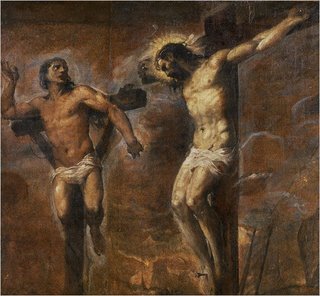
Alongside the cross of Jesus a pair of guilty criminals were also crucified; one on his right and the other on his left. Both of them had mocked Jesus at first, but then one of them repented. Acknowledging Christ’s innocence and lordship, he asked: “Jesus, remember me when you come into your kingdom.” And Jesus replied to him, “Amen, I say to you, today you will be with me in Paradise.

So what is the cup which Jesus drank? His cup is a cup of suffering. When and where was Jesus first enthroned in the kingdom of God? He is enthroned in glory upon his Cross. And who received the places at his right and left? Those places close to Jesus went first to two crucified criminals. Indeed, James and John in today’s gospel did not know what they were asking. Yet these apostles would go on to be glorified through their own shares in Christ’s sufferings: including martyrdom for St. James and exile for St. John “the Beloved Disciple.”

Many people struggle to reconcile the reality of suffering with the power and love of God. Some Christians even mistakenly preach a “Prosperity Gospel,” saying that if you believe in God and love him, he will bless you so that bad things never happen to you. But this view is incomplete. There are true blessings which flow from following Jesus Christ and his Gospel, but the worldview of the “Prosperity Gospel” sets believers up for a fall. When painful hardship or tragedy eventually come, those Christians will either blame themselves for not having had enough faith or blame God for seeming to fail them. This latter group wonders, “If God is not dependable, why should I keep faith in him?” And then, feeling wounded, confused, and abandoned, they abandon God.

We do not completely understand the mystery of evils in our world; why a devastating earthquake happens to some particular city, why a particular healthy adult gets cancer, or why a particular young person perishes in a car wreck. We do know that God’s thoughts are higher than our thoughts, that his plans see farther than our sight. And we know that God, who is the highest good, would not permit evils to exist unless his omnipotence and goodness were such as to bring good even out of evil. In Jesus Christ we see that God intimately knows and deeply cares about all the things we suffer. So what is the Lord up to?

It’s no coincidence that all four gospels mention how Jesus is crucified between two criminals, one on his right and the other on his left, with one who repents and one who appears not to repent. All of humanity is similarly suffering as a result of our original or personal sin. We too begin as guilty rebels condemned. But on the Cross, Jesus Christ the Son of God, though divine and innocent, joins us in our suffering.

The Letter to the Hebrews observes that in him “we do not have a high priest who is unable to sympathize with our weaknesses, but one who has similarly been tested in every way…” This divine plan for Christ to be a suffering servant was foretold through the Prophet Isaiah centuries before: “If he gives his life as an offering for sin… the will of the Lord shall be accomplished through him. …Through his suffering, my servant shall justify many, and their guilt he shall bear.

This Good Shepherd intimately understands the sufferings of the flock. He comes down from his high mountain into our dark valley and calls us to himself. We can respond to him with faith, acknowledging his goodness and lordship as sheep on his right. Or we can remain as faithless goats on his left, unrepentant for our sins and rejecting Christ forever. Realize that Jesus Christ desires not merely to forgive our sins, but that you and I would become children of God the Father just like himself.

Why do evils and sufferings continue to afflict those who follow Christ? As I said before, we do not know the answer to every painful question. (I believe we will understand God’s plan and purposes far better in heaven when he ‘wipes away every tear from our eyes.’) But we do know that Jesus Christ wants us to share in his own greatness and glory.

In today’s gospel, Jesus tries to help his disciples see that the path to true greatness and glory are not what they imagine. “Those who are recognized as rulers over the Gentiles,” Jesus notes, “lord it over them, and their great ones make their authority over them felt. But it shall not be so among you. Rather, whoever wishes to be great among you will be your servant; whoever wishes to be first among you will be the slave of all. For the Son of Man did not come to be served but to serve and to give his life as a ransom for many.

In our loving service and in our faithful suffering, we become more like Jesus. With Jesus, our sacrifices and sufferings are redemptive, helping to make us saints while helping to save the world. This is the precious, challenging, saving cup our Lord offers us. But can we drink it? With the grace and love of Jesus Christ strengthening us, we can!

Mentors & the Gift of Wisdom

October 9, 2021

28th Sunday in Ordinary Time
By Deacon Dick Kostner

What makes me successful, what wealth can I take with me into the next life? Bottom line: What will make me happy both in this life and in the next? Where can I acquire the knowledge to answer these very important questions? The answer lies within this weekend’s Scripture readings. The Father and Jesus share with us the answers to these very important life questions.

Very shortly after I had passed the Bar Exam I sat down one day and drew up what I thought would be my plan for success and happiness. The answer I had was to make my Fathers Law firm increase its profits by and through my participation and thus I would make my Father and my family proud of me. Feeling very proud of my great plan I sat down one day with my Father to share my plans of success and happiness for not only myself but for the firm by earning more money and wealth.

Much to my dismay, and after pouring me a cup of coffee and sitting down with me, his response to what I thought was a great plan, was: “Why do you want to waste your life on making more money all at the expense of happiness and enjoyment of family and friends in this life? Make enough money to care for your family and then enjoy life!” What he was saying to me was that money will not make me successful and happy and will only waste what little time I have here on earth to accomplish real wealth that I will be able to not only enjoy now but also take with me into the next life.

Dad loved to help others. He enjoyed people and spent his time here on earth making their lives easier. I remember many Friday evenings he would spend time with some of my sister’s high school friends playing Sheepshead into the early morning and then moving on to helping them with understanding and completing calculus assignments for their school classes. Dad did not let money control his life but rather used the money he made to help others enjoy their life. I remember one of those young people he played cards with coming up to me at his funeral and telling me that if it were not for my dad he and his wife would not have been able to purchase their home as they were unable to get a loan at the bank and dad loaned them the money to purchase it.

Our First Reading from the Book of Wisdom instructs us to seek mentors who will gift us with Wisdom. With this gift we are told, “Yet all good things together came to me in her company, and countless riches at her hands.” Jesus the ultimate Mentor tells us in our Gospel that the wealth we should seek is not money but rather the wealth and happiness we acquire by serving God and our neighbor.

Wisdom is not intelligence per say, it is rather a gift of understanding that can only come from our Creator. Jesus tells us to seek out those who have been gifted with wisdom for they know truth and they will lead us to the Father’s house. I have had many mentors during my life all of whom I spent much time with listening to their instructions on how to live a happy life. Many I would not have encountered if I would not have listened to my dad’s wisdom lessons.

I will share with you one more mentor story about a person many of you knew. His name was Ed Hassemer better known as “Gabby” Hassemer. He was a sheet metal worker by trade but he was also gifted with much wisdom. He had earned a living and spent his time not so much for himself but rather for his family, friends and even strangers. He owned several rental properties in Bloomer. His typical tenants were marginal people with limited resources but were able to find good housing that they could afford because of this person. He had a big heart and helped out many who just needed some help. I watched and listened to his wisdom and Barb and I followed his lead in acquiring rentals to supplement our income and provide housing for others.

Gabby was always helping out others. He heated his basement with a wood stove and would spend time during the summer cutting and splitting wood to burn in the stove for winter. One day while we were heading out to the woods to go hunting he was shaking his head and I asked him what was wrong. He said that one of his friends had come over to his house and said he was in trouble because he had no wood to burn and could not acquire any for a month or so. I suspected this was not true, as I knew his friend and I suspected he was just trying to take advantage of his friendship to save some money. In any case Gabby gave him the wood he had cut for the winter on the promise that before it got real cold, the friend would supply and pay him back for the wood he was gifted with. This never happened and Gab went without wood for most of that winter. I offered to go after his so-called friend but his response was “No, he needed it more than I did.”

Gabby had a lot of wealth but it was not something he earned by working but rather by giving of himself for others. He had the kind of wealth that he could take with him into the next life. About a year before he died he gifted me with wisdom I had heard before. He said, “Kostner, some day soon you will be standing over me looking at me lying in a casket. You will hear people talking about me and how I lived my life. But one thing you won’t hear them say about me is: #1, That man worked himself to death; and #2, He never took the time to go fishing!

Today’s Scripture readings tell us that happiness cannot be purchased—it is a gift from God for living out and obeying His two greatest commandments to love God and neighbor as ourselves. Next month I will try and explain to you what I think God would like to see you do with the gifts you have left over after your death.. I have an assignment for you folks. I would ask that sometime you sit down and make a list of events in your life that gave you the most happiness. I did this and I found out that my happiest times in life were when I was conversing with God and helping others either celebrating their life or helping them get through tough times. I believe this was not by chance. Our Catechism teaches us that we were created to know, love, and serve God. To know love and serve God is to be of service to God and our neighbor as Jesus lived out His life. This is not by chance but rather part of our very being. This is how God wired us at our creation. This will gift us with happiness because it makes us whole.

Our Gospel this week has Jesus, our mentor, instructing us that wealth is not bad and will bring us happiness and eternal life, if we but share it with God, family, and our neighbors.

Repairing Shoes & Souls — Funeral Homily for Gerald “Casey” Franz, 92

October 4, 2021

Sixty-eight years ago, Gerald married Wanda here in St. Paul’s Catholic Church. On Sundays, they brought their children here to see Jesus and worship. In their later years, Gerald and his wife became daily Mass-goers. Even when confined to home, he would watch Mass on TV, and during his days at Dove Nursing Home he was delighted to attend its celebration. Today, we gather here once more to offer our greatest prayer to God, the Holy Mass, for Gerald’s soul and for the good of all who love him. Gerald’s past occupations are not nearly as important as his faith, family, or friends, but Gerald’s all-time favorite job stands out for being rather rare.

Alongside Wanda, and then up until the end of last year, Gerald worked as one of our modern world’s last cobblers; not an apple, peach, or cherry cobbler, but a cobbler who works with shoes. Shoes are our lowest article of clothing, walking upon the earth. We see them everywhere we go; covering our lowly, vulnerable, and sometimes embarrassing feet. Some people say they “love shoes” but how much are we really willing to sacrifice for them? In this era of cheap mass production and consumerism, when a pair of shoes is somehow flawed or broken people typically toss them in the trash. But working out of his home shop, Gerald’s affordable rates and friendly face kept customers coming to his door.

I’m told that Gerald’s sharp and witty mind seemed to know every person’s face and name in Bloomer and Tilden; along with the names of their parents and siblings, whom they married and where they lived. Gerald would fix what was broken, patch what was torn, and through orthopedics enable people to walk. What might be considered worthless garbage to some, he restored. In this, Gerald bears a likeness to another.

Today, there are more people upon the surface of the earth than ever before. We human beings are lowly, vulnerable, and sometimes embarrassing. And when we are flawed or broken, this utilitarian world would often discard us. Some people say they “love humanity” but how much are they really willing to sacrifice for others? In our modern, consumeristic age some doubt whether God and his Church are needed anymore. But Christ and our Catholic faith are not antiquated professions, we need them now as much as ever.

Jesus Christ knows your name. He knows your face and your story. Our loving Lord knows absolutely everything about you. He who enabled the crippled to walk would fix what is broken in you and patch what was torn about you. The sacrifice of the Mass you are about to behold is Jesus’ sign of love for you. The Eucharist which Gerald has so loved is Jesus’ gift of love to you. I am confident that Gerald will be grateful for your prayers today, but I believe that the greatest wish of this cobbler of shoes is that you would always walk with the healer of souls.

Marriage is for Life

October 3, 2021

27th Sunday in Ordinary Time


In “the beginning of creation, God made them male and female. For this reason a man shall leave his father and mother and be joined to his wife, and the two shall become one flesh.” They are no longer two but one flesh. “Therefore,” Jesus says, “what God has joined together, no human being must separate.” Jesus teaches, “Whoever divorces his wife and marries another commits adultery against her; and if she divorces her husband and marries another, she commits adultery.

Now Christ’s Church does believe and teach that there can be situations where it is prudent and right for a person to physically or legally separate from their spouse. Perhaps there’s physical or emotional abuse in the marriage; destructive, unchecked addictions; or obstinate infidelity. And after the marriage falls apart the Church can investigate whether something essential to that marriage being a binding, sacramental bond before God was missing from the start.

It is possible for Catholic brides and grooms to fail to marry sacramentally in many ways. For instance, the couple might get invalidly married outside the Church; inside a courtroom, on a beach, or in a barn. The bride might feel forced to marry such that her consent is not free. The groom might lack the psychological or physical capacity for marriage. Or one of them might say the vows without not really meaning them. There are many ways a marriage can be sacramentally invalid and non-binding. And where the Church finds sufficient proof for this she will grant an annulment, permitting the man or woman to remarry. So as I said before, being divorced is not necessarily a sin; it does not automatically bar you from receiving Communion. However, to abandon one’s spouse without cause, or to remarry when you are not free to remarry, are sins that require repentance.

What God has joined together, no human being must separate.” Jesus said this in response to a question about divorce, but what other things of human sexuality has God joined from the beginning which no human being should separate? God joined sexual relations to the covenant of marriage. He joined love-making to the possibility of life-making. And he joined one’s biological sex to one’s identity. God created them male and female, one man and one woman, not identical sexes—but physically and spiritually complimentary mates, and made God them man and wife in a covenant for life.

God’s first commandment in the Garden was “be fruitful and multiply,” and today we hear Jesus tell us “Let the children come to me.” His wish is to bring “many children to glory,” as our second reading says. God’s Word in the Bible celebrates having many children as a blessing, not a curse. Today’s psalm proclaims this blessing

Your wife shall be like a fruitful vine
  in the recesses of your home;
  your children like olive plants around your table…
  May you see your children’s children.

Indeed, being surrounded by the love of many offspring is among the greatest blessings for the aged. But human beings separating sexuality from an openness to life distorts God’s plan and the society around us.

Contraception is not something new. It existed in ancient times. Genesis relates how a man named Onan repeatedly “wasted his seed on the ground” during intercourse to avoid conceiving children. “What he did greatly offended the Lord, and the Lord took his life…” Egyptian scrolls dating to 1850 B.C. describe other methods and the pagans practiced contraceptive techniques in the Roman Empire in the days of Christ and the Early Church. The Church Fathers, such as St. Clement of Alexandria, St. Augustine, and St. John Chrysostom condemned acts of contraception or sterilization. Even the first Protestants denounced contraception, too. Martin Luther the founder of Lutheranism, John Calvin the founder of Calvinism, and John Wesley the co-founder of Methodism all wrote against it.

All Christian groups were agreed on this less than a century ago. That is until the Anglicans in 1930 became the first Protestants to officially approve artificial contraception use for hard cases. (Thirteen years before, in 1917, the same group had declared contraception “demoralizing to character and hostile to national welfare.”) As is the way of such errors, the exception became the norm and the Protestant denominations changed their teachings. By 1961, the National Council of Churches could pronounce that “most of the Protestant churches hold contraception… to be morally right when the motives are right.” The Catholic Church, however, stood firm and stood alone against the spirit of the age.

At the end of 1930 and again in 1968, the popes wrote encyclical letters reaffirming the constant teaching of Christ’s Church about the nature, purpose, and goodness of marriage and the marital act; and repeating the consistent and ancient rejection of all directly-willed acts of contraception, sterilization, and abortion. In 1968, St. Pope Paul VI predicted in his encyclical Humanae Vitae that the widespread use of contraception would broadly lower morality, increase marital infidelity, lessen respect towards women, be coercively imposed by governments, and promote the self-harming belief that we have unlimited dominion over our bodies and human life in general.

According to its advocates, contraception was supposed to strengthen marriages, prevent unplanned pregnancies, improve women’s happiness, and reduce abortions. After decades of cheap and widespread contraceptive use, half of all pregnancies are unplanned, half of all marriages end in divorce, women report lower and lower levels of happiness throughout the decades since the 1970’s, and about one-in-five U.S. pregnancies end in abortion, with more than 60 million killed since Roe vs. Wade in 1973. When persons and societies decouple and oppose human sexuality to its life-creating purpose, many harmful errors follow. You can trace the path of one error leading to the next. We are now to the point that many people cannot even define what a woman or a man is.

I would be remiss here if I did not mention that the Church teaches that there can be holy reasons and virtuous means to avoid conceiving more children. Natural Family Planning (also known as NFP) uses signs from a woman’s body to identify the days in her cycle when she can conceive. Equipped with this knowledge, for serious reasons a couple may virtuously abstain from the marital embrace to avoid a pregnancy, while respecting God’s design and the dual meaning of the marital act.

Couples who practice NFP report growing in communication, self-control, and intimacy. They are more open to discerning and embracing God’s plan for their families and are statistically less likely to divorce. Not only is NFP completely natural, the information it tracks about a woman’s body commonly leads to the diagnosis, treatment, and cure of health disorders, from infertility to life-threatening illnesses. Unlike common chemical contraceptives, NFP does not cause increased risks for breast, liver, or cervical cancer; nausea, vomiting, stomach problems, or diarrhea; depression, mood swings, or lowered libido; and it does not cause spontaneous abortions (by preventing implantation of newly conceived children into the uterine wall).

Realize that NFP is not the Rhythm Method. The old Rhythm Method simply counted how many days had passed since the woman’s last cycle and was a moral but rather ineffective approach. Faithfully-followed NFP techniques have a 99% effectiveness rate, comparable to illicit methods of artificial contraception. If you would like to learn more about NFP, visit the Diocese of La Crosse’s website and search for “NFP”. There you can investigate NFP techniques, their science and their benefits, and register for on-line courses.

Whether or not you are married, whether or not you are past the age for children, I hope that you will recognize that in the chaotic, constantly-changing, errant stream of human history, is our stable rock for truth is Christ’s Church. The Bride of Christ, our mother the Church, calls us to follow her teachings from Christ as faithful, trusting, loyal sons and daughters. Jesus says, “Amen, I say to you, whoever does not accept the kingdom of God like a child will not enter it.” Do not miss out on blessedness, in this life or the next.