Archive for November, 2021

A Martyr Preaches: “Banish the Fear of Death”

November 27, 2021

1st Sunday of Advent

This Sunday’s celebration comes in a moment of two overlapping times. This is a Sunday in November, the month in which we particularly remember, celebrate, and pray for the dead. This Sunday is also the beginning of Advent, a season in which we prepare for the coming of Christ. Through Advent we prepare not only for Christmas, the first coming of Christ, but also for Jesus’ Second Coming one day. Here and now at this Sunday Mass, our past and our future, the living and the dead, this world and the next, meet together.

When we hear Jesus’ words in today’s gospel about the Last Days we may feel apprehensive. Jesus tells us “people will die of fright in anticipation of what is coming upon the world.” And even if you or I do not belong to that final generation, we may fear to contemplate the coming sure reality of our own earthly deaths. But across time and space, an ancient saint and martyr urges us: “Let us shut out the fear of death and meditate upon immortality.

This is what St. Cyprian preached in the mid-third century A.D. as the bishop of Carthage, a North African city on the Mediterranean coast. God wills us to be good stewards of his gift of life, not recklessly pursuing self-harm or death, and yet not dreading the approach of death with mortal terror either. Listen to these words of St. Cyprian of Carthage as if he stood here before you preaching to you today:

“Our obligation is to do God’s will, and not our own. We must remember this if the prayer that our Lord commanded us to say daily (that is, the “Our Father”) is to have any meaning on our lips. How unreasonable it is to pray that God’s will be done, and then not promptly obey it when he calls us from this world! Instead we struggle and resist like self-willed (servants) and are brought into the Lord’s presence with sorrow and lamentation, not freely consenting to our departure, but constrained by necessity. And yet we expect to be rewarded with heavenly honors by him to whom we come against our will! Why then do we pray for the Kingdom of Heaven to come if this earthly bondage pleases us? What is the point of praying so often for its early arrival if we would rather serve the devil here than reign with Christ?

The world hates Christians, so why give your love to it instead of following Christ, who loves you and has redeemed you? John is most urgent in his (first New Testament letter) when he tells us not to love the world by yielding to sensual desires. Never give your love to the world, he warns, or to anything in it. A man cannot love the Father and love the world at the same time. All that the world offers is the lust of the flesh, the lust of the eyes and earthly ambition. The world and its allurements will pass away, but the man who has done the will of God shall live forever. Our part, my dear brethren, is to be single-minded, firm in faith, and steadfast in courage, ready for God’s will, whatever it may be. Banish the fear of death and think of the eternal life that follows it. That will show people that we really live our faith.

We ought never to forget, beloved, that we have renounced the world. We are living here now as aliens and only for a time. When the day of our homecoming puts an end to our exile, frees us from the bonds of the world, and restores us to paradise and to a kingdom, we should welcome it. What man, stationed in a foreign land, would not want to return to his own country as soon as possible? Well, we look upon paradise as our country, and a great crowd of our loved ones awaits us there, a countless throng of parents, (brothers and sisters), and children longs for us to join them. Assured though they are of their own salvation, they are still concerned about ours. What joy both for them and for us to see one another and embrace! O the delight of that heavenly kingdom where there is no fear of death! O the supreme and endless bliss of everlasting life!

There is the glorious band of apostles, there the exultant assembly of prophets, there the innumerable host of martyrs, crowned for their glorious victory in combat and in death. There in triumph are the virgins who subdued their passions by the strength of (chastity). There the merciful are rewarded, those who fulfilled the demands of justice by providing for the poor. In obedience to the Lord’s command, they turned their earthly inheritance into heavenly treasure.”

And so brothers and sisters, these are St. Cyprian’s lessons for us today. Love and obey Christ over and against this sinful world. Do not fear Jesus’ Second Coming. The Bible concludes with the prayer, “Come, Lord Jesus,” because his return is Good News for his friends. And do not dread your last days, but look forward to going to paradise. Jesus Christ and his holy saints, who love us, cheer us, and intercede for us, await the day we’ll join them in the fullness of joy.

Why the Catholic Church is Always so Behind the Times

November 20, 2021

Solemnity of Christ the King

A teenager recently asked me, “Why does the Catholic Church have ideas so behind the times?” It was a written question submitted alongside other students’ “Questions for Father.” The question reflected the young person’s doubts and I’m glad that it was asked, because after some reflection and with the help of grace I gave what I believe was an inspired answer.

I began with a review of some late modern history. In 1789, the leaders of the French Revolution took power in France. They rejected faith and wished to entirely replace Catholicism with their own invented “Cult of Reason.” They redefined the number of days in a week from seven to ten to deconsecrate Sunday – the Lord’s Day. They killed or exiled Catholic clergy and converted churches into “Temples of Reason.” They confiscated the convents and monasteries and expelled or martyred the monks and nuns, ending charitable ministries all across France. In their Reign of Terror they executed thousands and then turned on one another. Their revolution ended after ten years with a military coup which gave France a dictator who would crown himself their emperor: Napoleon Bonaparte.

In the early 1930’s, when Hitler rose to power in Germany, he was opposed by Catholics there. In fact, a map of the regional vote shares that the Nazi Party received across Germany looks like the photographic negative of the percentages of Catholic populations in place to place. The dark places of one map were the light places on the other. The Catholic Church proclaims universal human dignity, the preciousness of every human person, but the anti-Catholic Nazis believed in racial supremacy. They claimed the modern science of eugenics proved Germans to be the master race and showed Jews, Slavs, the disabled, and others to be lesser human beings. The Nazis arrested, deported, and murdered millions in concentration camps (including Catholic clergy, religious, and activists) and started a world war which killed millions more. Hitler’s “thousand year Reich” died with him after twelve terrible years.

The 1917 Russian Revolution and the Chinese Revolution of 1949 were violent, atheistic, communist movements. They heralded divisive class warfare as the path to utopia, denouncing and persecuting religion as the “opiate of the Masses.” The governments of the Soviet Union and Communist China, thoroughly corrupt with unchecked power, trampling human rights and freedom, are responsible for tens of millions of deaths over the past one hundred years.

I concluded my answer to that anonymous student’s question by asking the class to consider: if we had lived in France, or Germany, or Russia, or China during those times of social change would we have gone along with the spirits of the age? What would have prevented us from being swept up by and falling for their seductive errors? Our best protection against them, what would have preserved us, would be our firm conviction in our Catholic Christian Faith. The teachings of the Catholic Church will always seem to be “behind the times” because the world is always finding new ways of going gravely wrong. But timeless truth never changes. As the Letter to the Hebrews says, “Jesus Christ is the same yesterday, today, and forever.” Christ is the King “who is and who was and who is to come,” and our allegiance to him is our salvation.

For the feast of Passover, the 1st century Roman Governor of Judea, Pontius Pilate, was accustomed to release for the Jews one of his prisoners. So when the crowds assembled on Good Friday, Pilate asked them, “Which one do you want me to release to you, Jesus Barabbas or Jesus called Christ?” Barabbas was a notorious prisoner imprisoned for a rebellion which had taken place in Jerusalem and for murder. The name Barabbas means “son of the father.” So the crowd had a choice: which savior, which son of the father, which king did they prefer? Many Jews expected the Christ, their Messiah, to be a military leader who would forcefully drive out the Romans and rule an earthly kingdom like David’s or Solomon’s. Most of the crowd chose Barabbas over and against the Lord.

Pilate asked Jesus, “Are you the King of the Jews? …[So] you are a king?” Jesus’ responses to him mean, ‘Yes, but not like you imagine. If my kingdom were like the other kingdoms you know, my followers would be fighting an armed revolt right now.’ Christ’s Kingdom is in our world but not of this world. Jesus called and sent his twelve apostles to proclaim the Kingdom of God and upon the “Rock” of Peter he built his Church to teach and heal, sanctify and save. The Church continues her work with Christ to this day. She is the seed and the beginning of his kingdom. She is “the reign of Christ already present in mystery.

It can be easy to get discouraged by the evils and errors of today. As faith declines within our culture, challenging times are ahead for our Church and her mission. But there always remains reason for hope. Even amid the great evils of Good Friday, Jesus was still advancing his saving mission. Always remember: if Jesus could achieve his saving work on that most wicked day then he can surely accomplish his saving work in our day as well.

Jesus on our Life’s Course — Funeral Homily for Helen Kellen, 97

November 19, 2021

Helen has been close to St. Paul’s Parish her whole life. She was born in our community, educated in our school, married in our church, and became a daily Mass-goer who lived across the street from here for many years. Today, St. Paul’s Parish is honored to offer our most powerful prayer, the Holy Mass, for the perfection of Helen’s soul and for the peace of all of you who love her. Her family has told me a number of things about her life. Certainly not the most important detail, but one which stood out to me, was Helen’s intense desire to win the family golf tournament. Her parents, Frank and Mary Seibel, began an annual family reunion which still gathers here in Bloomer. For more than 30 years, a part of these festivities has been a golf scramble at the local 18 holes. More than a dozen teams of four compete to have their names immortalized on the coveted family trophy.

If you’re not familiar with what a golf scramble tournament is like, everyone on a team tees off, then they choose the best hit ball among them. Each player on the team takes their next shot from that new spot, and so on and so on, hopefully getting closer to that flag on the green until they can sink a ball into the cup. The teams do this for every hole and whichever team has the fewest best swings at the end of the day, wins. The great thing about playing on a golf scramble team is even if you’re not that good your teammates can carry you, and you can occasionally positively contribute as well. Maybe it was growing up around eight siblings, but for whatever reason Helen was fiercely competitive and she very much wanted to get her name on that two-foot, family tournament trophy.

Here’s a theological question for reflection: did Jesus Christ ever golf? History’s earliest reference to the sport only dates back to 1457. That’s when King James II of Scotland banned the popular pastime in his realm, preferring his subjects practice archery instead to be better prepared for times of war. So Jesus of Nazareth, living more than a millennium before, almost certainly never played the links growing up in the Holy Land. But what if Jesus were to play golf now, how good a golfer would he be?

I suspect, if he were to play golf today, Jesus might be the greatest golfer of all time. He possesses an advantage no professional golfer has ever had: his human nature is raised to glory. Jesus’ soul wields perfect control over his glorified body so he could hit each swing exactly as he wished. Par 5? The risen Christ could get it on the green in one. When Jesus resurrects the holy dead on the Last Day “the victor will inherit these gifts” as well, as the Book of Revelation says. But what if Jesus would have played golf during his lifetime before his Passion, death, and Resurrection? How good would he have been then?

In those days, though he was divine, Jesus emptied himself, limiting his almighty power in accord with the Father’s will and their shared plan to save humanity. He had the ability to work miracles but he usually did not use them. When he was tired, he took naps. When he hungered, he ate meals. And when he suffered, he wept. So Jesus knows what it’s like to be one of us. He knows how we struggle. Even the best pro-golfers in this world usually miss their shots.

Being a Christian is like having Jesus Christ on your golf scramble team. The fearsome foursome opposing us is darkness, sin, condemnation, and death, and they would always beat us if Jesus were not on our side. When we miss our shots due to our weakness or our own chosen faults, Jesus can carry us. And sometimes our efforts actually do positively contribute to the mission we share, which is the salvation of the world. Jesus and his friends are the best companions for us to walk with along life’s course. And if we remain on his team without wandering off, or return to his team before reaching the clubhouse, Jesus Christ will lead us to victory with himself.

Eventually, Helen and her teammates did finally win the family reunion golf tournament and her name shares in the minor glory of being immortalized on the family trophy. But for Helen and ourselves, let us pray that our names may attain the surpassing glory of being written in God’s Book of Life forever.

Preparing for that Final Trip Back Home

November 13, 2021

33rd Sunday in Ordinary Time
By Deacon Dick Kostner

As we wind down on Cycle B our readings talk about the end of time. Our Gospel tells us that only the Father knows the exact date and time of this event but there will be warnings sent to help us prepare for the end. We know it will happen eventually but not the exact time. The point is we must prepare for the end of our earthly life.

Last month I left you with the mission to seek out wise mentors to keep you on the correct road to eternal life. I used one example I had received from one of my mentors who was preparing for his departure from this life, his name was Gabby Hassemer. I will use him again to steer us into planning for our own departure from this world. A couple of years before Gabby died he was given warnings that the end was coming. His feet and legs could not take much walking anymore, and his lungs were failing because of age. He continued to deer hunt with us but we kept an eye on him and we appointed him to stand close to our warming shack and keep the fire burning.

Deer hunting is just around the corner so I will share with you a true Gabby Hunting story. I remember one day while we were on the road to go hunting he blurted out that he was planning for his departure. Then he said: “ If I should go down while hunting promise me that you guys won’t stop hunting for the day. Just throw me in the box of your pickup until you are done for the day and then deliver me back home. I don’t want to ruin every ones day of hunting.” I started to laugh at his remark until I saw on his face that he was serious. I got rid of the smile and told him I would share his instructions with the other hunters. Gabby was planning his departure. Getting his bags packed so to speak.

As we get older we receive signs from above for us to start making travel plans. Age creeps up on us and then one day we realize that our bodies are breaking down and a red flag should go up that we need to start planning so as to have an easy transition to the next life. Let’s look also at our master mentor, Jesus. Look what he did before his death. He sat down with his friends, shared a meal and then gifted them and us with the gift of himself when he instituted the Sacraments which allow us to receive support and comfort from him as we prepare for our departure on the trip to eternity.

Several years ago our Parish was gifted to hear from a speaker from Lacrosse who talked to us about Stewardship. He told the story of how one evening he and his family went out for supper only to return to a yard full of firetrucks and people trying to put out a fire that destroyed his home and all contents including the family dog. He said it made him think about what is important in ones life which he concluded was God, family, and friends. If you think about it this is very true. Material objects we get to use during our lives and then they go to someone else to use and ultimately to help build the kingdom of God. As I reflected upon his observation I went on to conclude that God, family and friends are really talking about one entity and that is Members of the Holy Family of God. The Speaker went on to say that we need to include in our list of beneficiaries of our estate not only our blood or adopted children but also the people we have been celebrating with us and supporting us during our lifetime. We need to include those Holy Family Members who have supported us and been with us through all the struggles of life including illness and death, and who have been with us celebrating our Sunday Masses, marriages, birthday’s, and anniversaries.

It was because of two of our parishioners who died this year, that St. Paul’s is now debt free. It is because of gifts from parishioners that our Church is kept up. It is because of the wisdom and gifts of parishioners that we have a Pavilion which has been generating enough income so that our Parish Budget can stay in the Black. This folks is the Stewardship our visiting speaker was talking about.
What are ways this can happen. During your lives gifts can be given in kind or money to the Holy Family. In kind I would suggest treasures that have appreciated in value can be gifted and then sold by the Church. The result is that gross return equals net return because if you sell the asset 20%to 40% gets surrendered to pay the taxes, while if the Church sells the asset no taxes need be paid because its a charity, plus you get to deduct a charitable contribution equal to its present selling price not your cost. I did this with a collectors gun I owned. The Church acquired title and sold it and kept the proceeds with no expenses or taxes due. I received a personal deduction resulting in a savings of $9,000.00 as a reduction on my taxes by virtue of my gift.

Most of you who are 70 or older and have qualified retirement plans know that the tax laws require you to take a minimum withdrawal each year based on your life expectancy. Many don’t need the money to live on but are still required to take some out and pay taxes on it. What many do not know is that you can make your Parish contribution directly to the Parish if you are at least 70.5 years of age and not pay taxes on that contribution. The transfer must go directly from where you have the retirement account to the Church. I do this quarterly and am allowed to not pay taxes on that contribution. There is a limit of $100,000. per year that can be done but most don’t and won’t exceed that limitation. If you do this you need to let your tax person know as the 1099 that is sent to you and given to your tax person does not disclose it went directly to the Church or charity so it can be adjusted and bingo no tax due on that direct transfer. As to death transfers be sure that you give the Church assets from retirement accounts because they too will escape being taxed as the Church is exempt from paying taxes. It you give those accounts to your children they must pay tax on them.

There are many ways to make death transfers which you can discuss in detail with your lawyer or tax planner. Don’t kick the can down the road. Do as Gabby did and make financial and other plans for when you make that final trip back home. Bottom line is that you will be remembered as a quality member of the Holy Family who left the items they could not take with them to God, family and friends to use and benefit from.

Our Shared Roots — Funeral Homily for Maxine Zwiefelhofer, 90

November 12, 2021

In her first ninety years of life, Maxine has been a daughter, a sister, a wife and a mother; an aunt, a grandma, a great grandma, and a great-great grandma; a talented nurse, a good friend, and a devoted Catholic. Among her many traits and experiences, on this day of her funeral I would like to highlight one hobby of hers which has been a blessing to our community and a point of pride for her family.

Maxine has been a hobbyist in history. She wrote “The History of St. John the Baptist Catholic Church” in Cooks Valley, which detailed more than one hundred years of this parish from 1885 to 1995. Maxine spent many days researching genealogy at the Chippewa County Historical Society, and even traveled with family to Scandinavia and Denmark to explore their ancestral roots. She wrote books of family history, recounting the lineages of the Toppers, the Olsons, the Zwiefelhofers, and the Bleskaceks.

Here’s an interesting bit of trivia: the U.S. Census Bureau says there are more than 150,000 different last names in our country today, with some 5,000 last names in common use. Have you ever noticed, that with the whole forest of humanity to choose from, most people prefer to research those family trees which have branches which reach themselves? For instance, Topper was the family name of Maxine’s father, Ernest; Olson was the maiden name of her mother, Elizabeth; and Zwiefelhofer was the last name of her husband, David. Here’s another statistic: there are more than 20,000 Catholic churches in America. Of all the churches in all the towns in all the land, why did she write a history about this one?

You know the answer. Maxine explored the genealogies of those particular families and recounted the history of this particular parish because she belonged to them and they belonged to her. Our past provides us with our identity. If we were to lose all of our memories but could still think and walk and talk, we would wonder about who we are. Our family and community, our origins and past, inform us about who we are. As Christians we know our family, community, origins, and past are more than merely natural.

Who was Jesus describing in the gospel we just heard? Who is merciful and meek? Who are peacemakers, clean of heart? Who hungers and thirsts for righteousness and unjustly suffers for what is right? Who do these Beatitudes refer to? The Beatitudes describe the blessed saints, but first and foremost they describe Jesus Christ himself. You and I as Christians you are their siblings, brothers and sisters within the family, the community, the communion, of God’s Church. Our origin is that we were created by God in love. That is your origin. Our past is that Jesus Christ came and died and rose for us. That is your past. And rooted in this true identity, our future is full of hope.

St. Paul’s Letter to the Romans declares “that we who were baptized into Christ Jesus were baptized into his death,” and if “we have died with Christ… we shall also live with him.” As foretold through the Prophet Daniel, one day, “those who sleep in the dust of the earth shall awake,” some to everlasting disgrace and others to eternal life. Then “the wise shall shine brightly… and those who lead the many to justice shall be like the stars forever.

Let us pray today for Maxine’s soul and renew our true identity in Jesus Christ, so that she and we with him may be one holy family, one holy Church dwelling in the house of the Lord forever.

Her Last Rites — Funeral Homily for Jeanette “Ginny” Kelly, 92

November 8, 2021

All of you who know Jeanette have a sense of the great woman she is. Perhaps you know her as a wonderful mother, who, when asked by any one of her eight children “Do you love me better than everybody else?” would honestly and beautifully reply, “I love you in a special way, just like all your siblings.” Or perhaps you know her as a faithful aunt, grandmother, great grandmother, or friend, whose joy and optimism always shone forth, and who, when she spoke to you, regarded you as if you were the most important person in the world.

She’s the kind of woman who some fifty years ago, when a petition went around her Connecticut neighborhood trying to run minority households out of town, refused to sign based upon firm Christian conviction, strongly rebuked the very idea, and befriended black families to help them feel more welcome there. She’s the kind of woman who felt very sad after her beloved husband Richard’s death in 1998 but, rather than turning-in on herself, intentionally looked around for others in need, volunteering and mentoring. I would bet that each of us here who knows Jeanette has a story about her, and I hope that you would recount them to one another. Today, I would like to share with you a story of mine about something God did for her less than twenty-four hours before she passed.

Ordinarily, on Tuesday afternoons, I visit Dove Nursing Home, where Jeanette has lived in recent years. But before last Tuesday, I had not been there for eight weeks. The facility had been on lockdown due to Covid and November 2nd was my first time back to celebrate Mass for the residents. After Mass, by providence, I was tipped off that Jeanette could use a room visit. I had previously given her the sacrament of the Anointing of the Sick, but I was informed her condition had declined since then. After seeing her, praying for her, and blessing her, I realized that it was now time for Jeanette to receive Last Rites. I fetched my ritual book and holy oil from my car and returned to her that hour. Jeanette knew that I was there because once I began she made a feeble Sign of the Cross and weakly said, “Amen.” The highlights of the Last Rites feature the Apostolic Pardon, the Anointing, the Litany of the Saints, and the Final Commendation.

First, I pronounced over Jeanette the Apostolic Pardon:

“Through the holy mysteries of our redemption may almighty God release you from all punishments in this life and in the life to come. May he open to you the gates of paradise and welcome you to everlasting joy. … By the authority which the Apostolic See has given me, I grant you a full pardon and the remission of all your sins in the name of the Father, and of the Son, and of the Holy Spirit.”

On the first Easter Sunday evening, the Risen Jesus appeared to his apostles in the Upper Room saying, “Peace be with you… Peace be with you.” Then he breathed on them and said, “Receive the holy Spirit. Whose sins you forgive are forgiven them, and whose sins you retain are retained.” Jesus did this that his apostles may be witnesses to the Resurrection and ministers of the forgiveness of sins after baptism.

Next, I anointed her head and hands with blessed olive oil, saying:

“Through this holy anointing, may the Lord in His love and mercy help you with the grace of the Holy Spirit. May the Lord who frees you from sin save you and raise you up.”

In our bodies we suffer and in our bodies, when connected with Christ, we are sanctified. Unless Jesus returns first, in these bodies we shall die and in these bodies we shall rise.

With the Litany of the Saints we call upon our holy friends in heaven, for the dead in Christ are not truly dead. As Jesus told Martha mourning at the death of her brother, Lazarus, “I am the resurrection and the life; whoever believes in me, even if he dies, will live and everyone who lives and believes in me will never die.” “He is not the God of the dead but of the living,” so they are ‘all are alive in him.’ With this hope, we pray for the purification, perfection, and peace of our dearly departed and ask the saints in heaven to pray for us.

And last of all, came Jeanette’s Final Commendation. I said:

“I commend you, my dear sister, to almighty God, and entrust you to your Creator. May you return to Him who formed you from the dust of the earth. May holy Mary, the angels, and all the saints come to meet you as you go forth from this life. May Christ who was crucified for you bring you freedom and peace. May Christ who died for you admit you into his garden of paradise. May Christ, the true Shepherd, acknowledge you as one of his flock. May He forgive all your sins, and set you among those He has chosen. May you see your Redeemer face to face, and enjoy the vision of God for ever. Amen.”

I hope that I am graced to hear these words and receive these holy rites myself someday. After these blessed sacraments, prayers, and benedictions, I suspect Jeanette was very grateful and felt ready and well-prepared to go to meet our Lord. She passed away the next morning.

On November 1st, we in the Church celebrated All Saints. On November 2nd, we celebrated All Souls. And on November 3rd, Jeanette followed after them. This is not the end of all stories about Jeanette, but the beginning of new stories; stories which she will joyfully share with us one day, if you and I faithfully follow Jesus Christ like her.

Widows’ Gifts

November 6, 2021

32nd Sunday in Ordinary Time

In today’s gospel, Jesus says, “Beware of the scribes… They devour the houses of widows and, as a pretext, recite lengthy prayers. They will receive a very severe condemnation.” Jesus denounced those scribes for their greedy hypocrisy. In recent decades, some televangelists and megachurches’ prosperity preachers have told believers ‘give your money to our ministry and God will bless you back with even more,‘ and then used the meager wealth of many widows to purchase mansions or private jets. This of course, gives scandal, leading many to think faith is just a grift and alienating people from Christ. Is it wrong for preachers to be paid? St. Paul defends the right of ministers to receive compensation, “for scripture says, ‘The laborer deserves his wages,’” but our holy work is not meant to be about getting rich.

The presence of unworthy motives among some Christian ministers is nothing new. St. Paul writes to the church at Corinth, “We are not like so many others who trade on the word of God for profit.” Such men were a problem in Paul’s day, too. So it might seem that poor widows should never be asked to give and that poor widows should never donate. That answer would be simple, yet God’s truth is not that simple.

In today’s first reading, the Prophet Elijah meets the widow of Zarephath during a time of great drought. He asks her for a cup of water and a bit of bread. She replies, “There is only a handful of flour in my jar and a little oil in my jug. Just now I was collecting a couple of sticks, to go in and prepare something for myself and my son; when we have eaten it, we shall die.” (She is preparing their last meal.) But Elijah says, “Do not be afraid. Go and do as you propose. But first make me a little cake and bring it to me. Then you can prepare something for yourself and your son. For the Lord, the God of Israel, says, ‘The jar of flour shall not go empty, nor the jug of oil run dry, until the day when the Lord sends rain upon the earth.’” She left and did as Elijah had said. And the poor widow, her fatherless child, and God’s prophet were all able to eat for a year. The jar of flour did not go empty, and the jug of oil did not run dry, as the Lord had foretold through Elijah. As today’s psalm tells, “The Lord keeps faith forever… The fatherless and the widow he sustains.

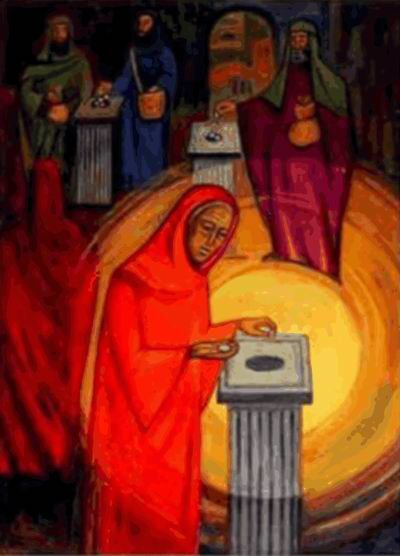
And in our gospel today, when Jesus sees a poor widow putting into the Temple treasury two small coins, which is all she has and her whole livelihood, what does he do? He does not try to stop her. He does not criticize her for being foolish. He calls his disciples to himself, he points her out to them, and he glorifies her trust in God in having given more than all the others. Her deed is still remembered to this day. Would it have been better if she had not given her gift?

I do not have a one-size-fits-all answer for how much poor widows should give. The Catechism teaches that the Church’s precept, “’You shall help to provide for the needs of the Church,’ means that the faithful are obliged to assist with the material needs of the Church, each according to his own ability,” so there’s recognition that some people have greater or lesser ability than others to materially assist the Church’s mission in this world. But if even poor widows are sometimes called to give, to trust in the Lord and give him the chance to prove himself their faithful provider, how much more so are the rest of us called to be generous?

We live in the wealthiest country in all of human history, and yet most of us only give a tiny fraction of our income to church and charity to support the good works they do. What accounts for this? Some of it is from the love of money and some of it is from fear. The Book of Ecclesiastes says, “He who loves money is never satisfied by money, and he who loves wealth is never satisfied by income.” Some are slaves to their greed, and some are shackled to their anxiety.

As an early teen, I felt reluctance at giving any money away for anything. I thought, “Who knows what my future holds? What if I need that money later? Every dollar I give away now is another dollar I’m exposed to future, unseen danger.” My mindset wasn’t informed by the Gospel, but when I finally read the Gospels myself I encountered Jesus’ teaching there. He says: “Do not worry and say, ‘What are we to eat?’ or ‘What are we to drink?’ or ‘What are we to wear?’ All these things the pagans seek. Your heavenly Father knows that you need them all. But seek first the Kingdom of God and his righteousness, and all these things will be given you besides. … Give and gifts will be given to you; a good measure, packed together, shaken down, and overflowing, will be poured into your lap.” The Lord was calling me beyond my comfort zone and into a deeper relationship with him.

I remember standing in St. Paul, Minnesota’s awe-inspiring cathedral. It was my first time there and I saw near the south exit a donation box labeled “For The Poor.” The largest bill in my wallet was a ten or a twenty, and I both wanted and very much did not want to give it, yet I knew what I should do. Once I had done it, I walked out smiling. It was a small donation, but even then I knew it was a big moment, and it changed the rest of my life.

I recall the story of one married couple. They used to pay their bills and then give to God if there was something left —and sometime there was nothing left. But God put it on their hearts to tithe consistently, so they began setting aside their gift to him first before paying their bills. And when they approached their giving in this way they discovered there was providentially always enough for both God and the bills.

God commands, “You shall not put the Lord, your God, to the test,” yet in his Old Testament Book of Malachi he says to test him in this: “Bring the whole tithe into the storehouse, that there may be food in my house. Put me to the test, says the Lord of hosts, and see if I do not open the floodgates of heaven for you, and pour down upon you blessing without measure!

And so, without embarrassment, I ask you to be generous in giving, not only so that our church may put your gifts to good use, but for the sake of deepening your personal relationship with our good and faithful God.