Archive for the ‘Chrisitian Virtues’ Category

Tips for Raising Faith-Filled Children

April 13, 2016
  • Tell your children every day that you love them and that God loves them too.
  • Listen attentively and respectfully to what your child says.
  • Forgive frequently. Ask forgiveness when you have done wrong. Look for the humor in stressful situations and hug often.
  • Ask children to consider “what if…” when dealing  with challenging situations. Help them find creative, peaceful, and moral responses.
  • Tell your child that you pray for them every day and DO it. Thank God for the gifts they are.
  • Share your faith beliefs so your child can understand your hopes. Also share your doubts so they understand that doubts do not overwhelm faith.
  • Bless your child before bedtime by tracing the Sign of the Cross on their foreheads and saying: “God love you and keep you safe” or some other blessing. Teach your child to respond. “Amen.”
  • Encourage your child to value others for who they are – not what they have. Help them to develop Christian virtues and to treat others kindly and with respect.
  • Once a week, have a family night when you “unplug” to play board games, do crafts, read stories, or take time to talk together.
  • Honor family  dinner. The benefits are amazing and establish a sacred time to share the joys and trials of life with each other.
  • Pray before meals, before bed, during holidays and family celebrations, and any time when one needs guidance or comfort.
  • Have a family Bible and read the Gospel passages before Church.
  • Decorate your house for the liturgical seasons with an Advent wreath, purple during Lent, and a prominently placed crucifix.
  • Take time to ponder the beauty of creation with your child. Easter is a wonderful time to appreciate the new life of springtime.
  • During the fall and spring, help your child sort through their clothes and toys to donate to a shelter. Bring the child with you when you drop off your donations.
  • Select a patron saint to watch over your children when they become involved in a sporting activity. Pray to that saint every time they are at a practice or event.
  • Participate in the Catholic Relief  Services Rice Bowl program: read the prayers during Lent, look up the featured countries, and donate coins in the box provided.
  • Introduce your child to older people or those with disabilities in your neighborhood. Find out if they need assistance with chores or shopping.
  • When you can’t physically help someone, pray for them.
  • Choose sporting events that do not conflict with your Sunday Mass attendance.
  • Encourage “secret” good deeds.
  • Contribute to a food bank. Ask your child to help you with the collection and delivery.
  • Watch TV with your child and explain during commercials or afterward what you found to be good, wholesome, and valuable. If you find a program objectionable explain why when changing the channel.
  • Encourage your child to use their God-given talents to serve others.
  • Help your child find ways to participate in the of the parish, such as being an altar server, choir member, greeter, or reader.
  • Invite your parish priest over for dinner.
  • Volunteer in your child’s religious education program or Catholic school.
  • Have the sporting equipment your child uses get blessed.
  • Read stories from the Bible and biographies of saints to your child. Several great videos can also be found online.
  • Ask grandparents, godparents, and extended family to share stories about the family their faith lives.
  • On the anniversaries of your children’s Baptism, light their Baptismal candles and tell stories about that special day.
  • Display religious items in your home, such as a cross, artwork, or a picture of your child’s patron saint. Talk to your child about them.
  • By the way you live, let your child know that life is good, that your values and faith guide your decisions and how you interact with others, and that the happiness you experience is a direct result of your personal relationship with God.

Adapted from the pamphlet “Raising Your Child With Faith” by Cecilia P. Regan.

Jesus Asks, “Do You Love Me?”

April 9, 2016

Christ Handing the Keys to St. Peter by Pietro Perugino (detail)In St. Peter along the shore of Galilee, Jesus is asking this question of us: “Do you love me?” We each have a choice to make in how we respond.
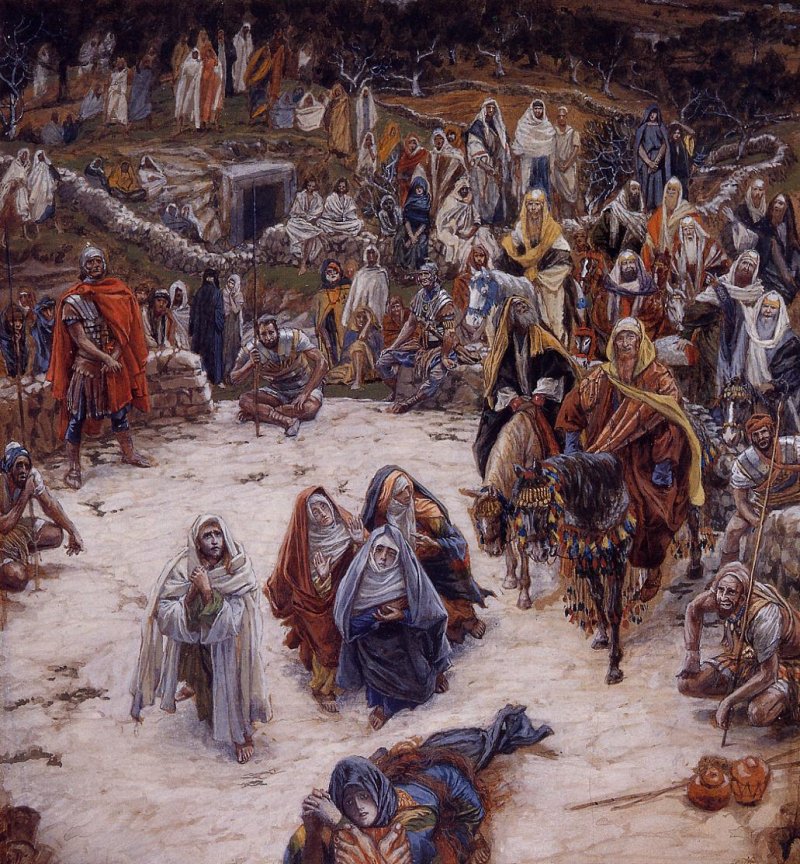
You can answer like Simon Peter in the high priest’s courtyard, with blasphemous denials and lingering regret. Or you can answer like St. Peter the Rock, who said, “Yes Lord, you know that I love you,” and then lived a life which proved that love.  How are you going to answer?

I do not know the particulars of Christ’s will and plan for you, but I know it consists at least in this: to pray every day, to attend Mass every week, and to strive to do His will for the rest of your days.

Jesus Washed Their Feet

March 10, 2016

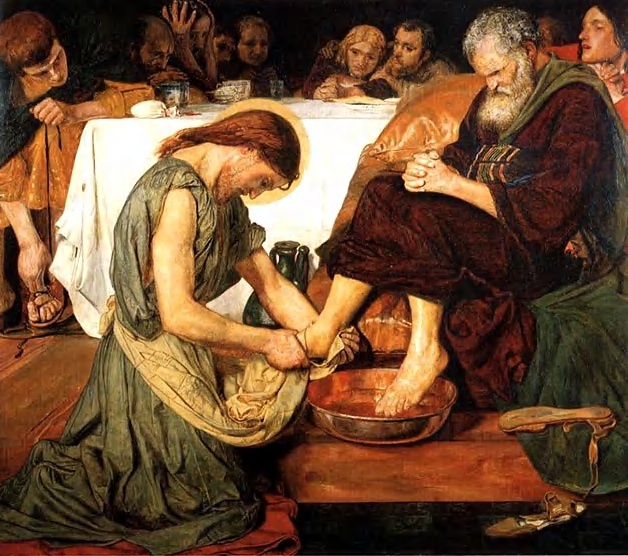
Jesus Washing Peter's Feet by Ford Maddox Brown, 1852-6.[Jesus] loved his own in the world and he loved them to the end. … So, [during the Last Supper,] he rose from supper and took off his outer garments. He took a towel and tied it around his waist. Then he poured water into a basin and began to wash the disciples’ feet and dry them with the towel around his waist. … So when he had washed their feet and put his garments back on and reclined at table again, he said to them, “Do you realize what I have done for you? You call me ‘teacher’ and ‘master,’ and rightly so, for indeed I am. If I, therefore, the master and teacher, have washed your feet, you ought to wash one another’s feet. I have given you a model to follow, so that as I have done for you, you should also do. Amen, amen, I say to you, no slave is greater than his master nor any messenger greater than the one who sent him. If you understand this, blessed are you if you do it.

—The Gospel of John, chapter 13

In 1955, Pope Pius XII inserted an optional washing of the feet rite into the Mass of Holy Thursday, the liturgy which commemorates the events of the night before Jesus died. This foot-washing rite is called the Mandatum (from the Latin for “the Mandate”) for Jesus said, “as I have done for you, you should also do.

Though the rubrics (that is, the rules for the liturgy) required no specific number of persons to have their feet washed in this optional rite, they indicated that the participants were to be men. This year, this rite which recalls Christ’s humble gesture of service and charity has been revised by a decree promulgated by Pope Francis. Where this rite is celebrated, pastors are to “select a small group of the faithful to represent the variety and the unity of each part of the people of God. Such small groups can be made up of men and women, and it is appropriate that they consist of people young and old, healthy and sick, clerics, consecrated men and women and laity.”

In past years, it has often been difficult to find people to humbly “bear their soles” on Holy Thursday but perhaps it may be a little easier this year. If you would volunteer to take a seat in this year’s washing of the feet, please contact Father so that he may create a representative group of our faithful.

Our Lord as Love

January 27, 2016

Thomas answered and said to [Jesus], ‘My Lord and my God!’”

—Gospel of John 20:28

Whoever is without love does not know God, for God is love.”

—1st Letter of John 4:8

“Brothers and sisters: Strive eagerly for the greatest spiritual gifts. But I shall show you a still more excellent way.

If I speak in human and angelic tongues, but do not have [Jesus], I am a resounding gong or a clashing cymbal. And if I have the gift of prophecy, and comprehend all mysteries and all knowledge; if I have all faith so as to move mountains, but do not have [Jesus], I am nothing. If I give away everything I own, and if I hand my body over so that I may boast, but do not have [Jesus], I gain nothing.

[Jesus] is patient, [Jesus] is kind. [He] is not jealous, [he] is not pompous, [he] is not inflated, [he] is not rude, [he] does not seek [his] own interests, [he] is not quick-tempered, [he] does not brood over injury, [he] does not rejoice over wrongdoing but rejoices with the truth. [He] bears all things, believes all things, hopes all things, endures all things. [Jesus] never fails.”

—1st Letter of Paul to the Corinthians 12:31-13:8

The Value of Humility: Living in the Truth Before God

December 14, 2015

“Some [spiritual beginners] make little of their faults, and at other times become over-sad when they see themselves fall into them, thinking themselves to have been saints already; and thus they become angry and impatient with themselves, which is another imperfection. Often they beseech God, with great yearnings, that He will take from them their imperfections and faults, but they do this that they may find themselves at peace, and may not be troubled by them, rather than for God’s sake; not realizing that, if He should take their imperfections from them, they would probably become prouder An Ancient-Style Oil Lampand more presumptuous still. They dislike praising others and love to be praised themselves; sometimes they seek out such praise. Herein they are like the foolish virgins, who, when their lamps could not be lit, sought oil from others.”

—St. John of the Cross in The Dark Night of the Soul

Taking Jesus Too Literally

September 30, 2015

Jesus Facepalm

We do well to closely heed all that our Lord Jesus says, but we must also carefully understand what the Word of God Incarnate is really telling us. Using Scripture to interpret Scripture, let us consider two examples where some modern-day Christians misinterpret Jesus’ teaching by taking him too literally.


“Do not swear at all”

Jesus declares, “You have heard that it was said to your ancestors, ‘Do not take a false oath, but make good to the Lord all that you vow.’ But I say to you, do not swear at all; not by heaven, for it is God’s throne; nor by the earth, for it is his footstool; nor by Jerusalem, for it is the city of the great King. Do not swear by your head, for you cannot make a single hair white or black. Let your ‘Yes’ mean ‘Yes,’ and your ‘No’ mean ‘No.’ Anything more is from the evil one.” (Matthew 5:33-37)

Swearing an oath or vow invokes God as one’s witness to a claim or a promise and invites God’s just punishments if his name is taken in vain. It seems that people in Jesus’ day were trying to steal credibility without fearing divine retribution by swearing by lesser holy things. But Jesus warns that all good things belong to God, and condemns clever manipulations of the truth as coming from the devil. Instead, Jesus says, “do not swear at all,” but “let your ‘Yes’ mean ‘Yes.’”

So do any appropriate times and places remain for swearing oaths or vows in the New Covenant? God reveals that such exist through St. Paul. In Galatians 1:20 and 2nd Corinthians 1:23, God himself inspires St. Paul to swear oaths (for example, “I call upon God as witness, on my life, that it is to spare you that I have not yet gone to Corinth.“) And in Acts 18:18, we read that St. Paul “had taken a vow.” Thus, in rare, righteous, and serious situations a Christian may solemnly swear to things before God.


“Call no one on earth your father”

Jesus tells us, “Call no one on earth your father; you have but one Father in heaven.” (Matthew 23:9) Does this mean that we should not call priests (or our even own dads) “Father?” This is not how the first Christians understood Jesus’ words.

St. Stephen calls the Jewish leaders “fathers” in Acts 7:2, and St. Paul does similarly in Acts 22:1. God prompted St. John to address Christian community elders as “fathers.” (1st John 2:13-14) God also willed St. Paul to write of “our father Isaac” and to call Abraham “the father of us all.” (Romans 9:10, 4:16-17) God inspired St. Paul to regard and describe himself as a father to his spiritual children. (1st Corinthians 4:14-15, 1st Timothy 1:2, Titus 1:4, Philemon 10) Therefore, the true concern of our Lord is not with the label of “father,” but that our greatest devotion and love always be directed toward “our Father who art in Heaven.”

Moral Principles & Just War

July 23, 2015

St. Paul providentially wrote,

“[W]hy not say — as we are accused and as some claim we say — that we should do evil that good may come of it? Their penalty is what they deserve.” (Romans 3:8)

In this passage, the Holy Spirit led St. Paul to denounce the idea that having a good goal in mind can ever justify using immoral means to achieve it. God’s most basic commandment is heard in every human conscience: “Do good, avoid evil.” We must never do evil in hopes that good may result. If we do, there is no guarantee that our hoped for goal will come to pass, but we will have surely allied ourselves (in some measure) with evil by opposing God’s will.

A second moral principle (which frees us as it binds) is this: we must never intentionally kill the innocent, for this is murder. All human life is sacred and precious, which makes any decision to wage war a most serious one. Catholic Just War doctrine teaches that all of the following conditions must hold for a war to be morally just:

  1. The damage inflicted by the aggressor on the nation or community of nations must be lasting, grave, and certain.
  2. All other means of putting an end to it must have been shown to be impractical or ineffective.
  3. There must be serious prospects of success.
  4. The use of arms must not produce evils and disorders graver than the evil to be eliminated.
    (See The Catechism of the Catholic Church, #2309)

B-24 BomberEven if all of these conditions are met and a country goes justly off to battle, enemy civilians must not be targeted. It is inevitable that some innocents will die in the chaos of war; sometimes bombs dropped over a military target will accidentally hit homes nearby. But it is something very different to intentionally aim for the civilians in hopes of killing as many as possible. This is a war crime. It is murder. “But what if murdering civilians will end the war faster and save more lives in the end?” (*) This is the tempter’s promise, but God’s commandment remains without exception: ‘You shall not become a murderer.’

I do not share these moral principles to condemn any previous wartime generation. God knows it is hard do what is right in times of stress and fear; and only He can judge hearts. I share these teachings because history shows that even in peacetime we stand between wars. When the next conflict threatens we must judge aright whether it must be fought, and if so, guard that the war does not make casualties our souls.

Three Crosses Line Break

( * – Some may claim that if enemy civilians are working, paying taxes, and not in rebellion against their government, then they are legitimate military targets, since they are aiding the enemy. Such thinking abandons the distinctions between combatants and non-combatants, condoning all sorts of evils. A similar case could be made for summarily-executing enemy prisoners of war, since their captivity aids the enemy by diverting our wartime resources. )

My Five Most Common Bits of Advice in Confession

July 17, 2015
Peter Swims to Jesus on the Shore in John 21

Peter was not afraid to approach the Lord whom he had denied, leading to his tripartite reconciliation. We can encounter Jesus likewise in the Sacrament of Confession.

Of the seven sacraments, Confession is my second favorite (after the Holy Eucharist.) This holds whether I am the one absolving or the one being absolved. It feels good to have that joy of a fresh beginning, or to know that I have helped another come nearer to the Lord. Having our sins forgiven does us incredible good — exorcists say a good confession is more powerful than an exorcism — but the priest in the confessional usually also offers some advice to help us cooperate with God’s grace, sin no more, and live daily life with peace.

Priests tend to hear certain sins or fears more often than others in confession, and in response to these a priest will tend to give similar advice. At risk of making my priestly counsel stale, but in hopes of spreading these helpful lessons for the benefit of many, I have detailed below the five most frequent pieces of advice that I share in confession.

Being Tempted Is Not The Same As Sinning

No priest should say that a sin is not a sin, but priests do right to free troubled consciences from guilt about things which are not sinful. Guilt from experiencing temptation is one example. Temptation, in and of itself, is not a sin. A temptation becomes a sin when we welcome its presence and give it our “yes.”

Sometimes people confess having bad thoughts or desires. I ask them whether they welcomed or entertained these temptations or if they resisted them. This matters because thoughts, feelings, and desires will often come our way without our willing them, but it is what we choose that is important. Only when our will chooses do we act in a saintly or sinful way. For instance, choosing to resist a temptation by praying or distracting ourselves is a holy deed. A saint is not someone who never knows temptation—he or she will likely understand temptation better than most—a saint is someone who consistently chooses love and the Lord even amidst temptation.

Good & Bad Reasons For Missing Mass

Our Sunday obligation flows from the commandment to keep the Lord’s Day holy. Whenever someone confesses missing Holy Mass I ask whether it was by their own choice. (Again, what we do not choose is not our sin.) Sickness, hazardous travel conditions, or the need to care for others are all serious reasons that justly excuse us from attending Mass. However, deliberate, willful absence (such as on a family vacation) is a sin to be avoided. Using the internet and a telephone we can plan ahead to find and celebrate the Lord’s Sacrifice wherever our travels take us.

Forgiving May Not Be What You Think

Sometimes anguished persons confess that they just cannot forgive someone, even though they want to. Usually, this turmoil is due to thinking that forgiveness means something it does not. For example, without a bout of amnesia, we cannot literally “forgive and forget.” And trying to agree that past sins done to us were not actually wrong is a lie against the truth. Sometimes sins break relationships and circumstances such that things cannot go back to same way they were before. Or, perhaps we may still feel the pain inflicted—for some wounds cannot be healed merely by our willing it, but only with grace and time. However, none of these realities prevent us from forgiving. In fact, the person who desires to forgive already has everything they need to begin.

Forgiveness means loving someone despite past wrongs. Jesus calls us to love everyone, which means that we must forgive everyone. If you fear that there is someone whom you hate or whom you have not forgiven, simply pray for them. It is impossible to both will the eternal good of another (as we do in prayer) and to hate them at the same time. If you are praying for them, you are loving and forgiving them. The Holy Spirit may prompt you to take further steps in forgiveness down the road, but your prayer begins to open you both to the transforming power of God.

Training Yourself Not To Misuse Holy Names

Crude language is bad, but swearing by misusing the holy name of God or his saints is worse. Our love and respect for someone should be reflected, not negated, by our words. Whenever someone confesses the habitual sin of taking the Lord’s name in vain I suggest a new habit: The next time you misuse a holy name, as soon as you realize it, follow it with a praise (such as “I love you, Lord,” or a “Glory Be…’) This will do three things: it will help undo the wrong with a good (getting you back on the horse,) it will help drive out the bad habit with a good one, and it will present a Christian witness to anyone who may have overheard your profanity.

Apologizing To Your Children

When parents confess to yelling in (uncontrolled) anger at their kids, I ask them whether they apologized to their children. This is a good and beautiful thing for a parent to do because it models true Christian behavior for the children: “I needed to discipline you because you were doing something wrong, but I shouldn’t have yelled at you. I’m sorry.” If we want our children to repent of wrongdoings and seek forgiveness, we must walk the talk and show them how it looks. Authority is most respected when it manifests integrity.

The Meaning of Life

June 9, 2015

Homer Simpson once had this exchange with “God”:

HomerGod, I’ve gotta ask you something.
What’s the meaning of life?

God:      Homer, I can’t tell you that.
HomerC’mon!
God:      You’ll find out when you die.
HomerI can’t wait that long!
God:      You can’t wait six months?
HomerNo, tell me now!
God:      Well, OK. The meaning of life is…

[The theme song and ending credits interrupt before we hear the answer.]

So what is the meaning of life? Why are we here, for what purpose do we exist?

Philosophers and TV writers may balk at the answer, but for Christians this is not an unanswerable riddle. Jesus Christ tells us what we are meant to do on earth (and likewise, in Heaven): first, to “love the Lord, your God, with all your heart, with all your soul, with all your strength, and with all your mind,” and second, to “love your neighbor as yourself.” (Matthew 22:37-40, Mark 12:30-31, & Luke 10:27-28)

Nothing is more important than this. This is what the Law, the Gospels, the prophets, and the saints are all about. Loving relationship with God and each other is the meaning of our lives. Of what enduring value is anything else if separated from this?

Blessed with knowing this precious knowledge, how are you going to live?

Fallaciously Faithless — Monday, 10th Week in Ordinary Time—Year I

June 8, 2015

Reading: 2nd Corinthians 1:1-7

St. Paul writes to the Christians at Corinth:

Blessed be the God and Father of our Lord Jesus Christ, the Father of compassion and the God of all encouragement,  who encourages us in our every affliction, so that we may be able to encourage those who are in any affliction with the encouragement with which we ourselves are encouraged by God.

When I was in college, there was a span of a couple of weeks when I stopped receiving the Holy Eucharist. I kept going to Mass, but I hesitated to approach for Communion. I refrained because I feared that I did not have enough faith in the Lord to receive Him worthily.

pondering-at-a-question-markI shared my concerns with our Newman Center parish priest. Father Mark did not provide me with any specific answers, but I remember him saying, “Perhaps God is allowing you to experience this so that someday you can help other people who are going through the same thing.” Inside, I felt like saying, “Thanks for nothing, Father.”

I kept praying and pondering for several days until this realization finally came to me: “People who don’t believe in God don’t spend time worrying about whether or not they believe in God—that’s something only a believer would do.” If I was worried about whether I had faith, then there was no reason to worry. Freed from my fear and greatly relieved, I returned to Holy Communion.

If you know someone trapped in the same spot I was, please feel free to pass this helpful insight along. Father Mark and St. Paul were right. God encourages us in our every affliction so that we may encourage others with the same encouragement we receive from Him.

Shalom x 3

April 11, 2015

Isaiah saw Seraphim in the temple before God crying out to each other, “Holy, holy, holy is the LORD of hosts! All the earth is filled with his glory!” (Isaiah 6:3) God is indeed the most holy.

The charge nailed to the cross above Jesus’ head reads three times: “Jesus of Nazareth, King of the Jews” (written in Hebrew, Greek, & Latin.) Jesus is the greatest king.

After his resurrection, Jesus appears twice in the upper room and says the same thing three times: “Peace be with you.” He offers us the profoundest peace.

A Game of Monopoly & the Rich Man

March 10, 2015

Lazarus at the Rich Man's DoorGospel: Luke 16:19-31
Thursday, 2nd Week of Lent

    A UC-Berkley psychology professor sets two people down for an experiment: the pair will play a game of Monopoly with modified rules. One player will get the Rolls Royce while the other will be the old shoe. The player with the car will start with $2,000 and play by standard Monopoly rules, while the old shoe’s player gets $1,000, rolls just one die (making doubles impossible,) and collects only $100 for passing “Go.” Who gets which is decided by a fateful coin-flip. At the end of the game, the professor asks the winner (invariably the Rolls Royce player) whether they feel like they deserved to win the game. And the winner always says ‘yes.’

    I can understand the winner’s perspective. At the beginning of the game both players had a fair chance of winning (for either could have ended up with the car,) but the winner won that coin flip, played by the rules, and did what was necessary to arrive at victory. If the winner had cheated the loser, stealing cash or refusing rents, then that victory would feel undeserved.

Abraham, Lazarus, and the Rich Man    The Rich Man who showed no concern for poor Lazarus may have felt like one of those Rolls Royce players. He “dressed in purple garments and fine linen and dined sumptuously each day,” but nothing in the text indicates that he had defrauded or exploited anyone to obtain his wealth. Maybe he looked at poor people like Lazarus and shrugged, “Some receive what is good in their lifetimes while others receive what is bad,” words that Father Abraham would throw back in his face. Perhaps the Rich Man had not so much perpetrated evils, but rather (ignoring the Scriptures) felt no responsibility to help the less fortunate outside his door.

    May the one who reads this—a winner in the coin-toss of life—not be condemned for failing to give alms.

Generosity & Envy — 25th Sunday in Ordinary Time—Year A

September 21, 2014

Readings: Isaiah 22:6-9; Philippians 1:20c-24, 27a; Matthew 20:1-16a

DenariusHe woke up while it was still dark and kissed his wife while she slept.

He dressed and left home quietly, so as not to wake up the children across the room.

He walked into town and came to the large market square, where the venders were already setting up shop, and day laborers like himself were congregating.

At dawn, landowners came to hire men to harvest their vineyards and fields.

He was left behind, yet he did not leave.

Hopefully, someone would hire him at noon for at least a half-day’s work.

Three o’clock came, and he was still standing there unemployed, refusing to go home. How could he go home… empty-handed?

Around five o’clock, a landowner found him and asked, “Why do you stand here idle all day?”

Speaking for those standing with him he answered, “Because no one has hired us.”

The landowner said to them, “You too go into my vineyard.”

When it was evening, the vineyard owner had his foreman summon the harvesters and pay them—in this he was abiding by the command in the book of Leviticus, “You shall not withhold overnight the wages of your laborer.”

When he received his pay, the man thought there had been some mistake.

Though he worked only an hour, he had been given a silver denarius coin, the standard pay for a full day’s work.

He badly wanted to leave with it, but he was a righteous man, and quietly approached the foreman.

But the foreman reassured him—there had been no mistake!

Oh, the joy he felt! For tonight and tomorrow, his family would not be hungry.

*  *  *  *  *

Was the landowner unfair in the treatment of his workers? At the beginning of the day, the Greek text says the landowner achieved ‘harmonious agreement’ with the labors regarding the usual daily wage. This was not fraud nor exploitation, but a just wage for an honest day’s work. Were the later workers been idle due to laziness? No, they honestly say, but “because no one has hired us.”

Let us revisit the landowner’s arguments in his own defense: he said to one of the grumblers in reply, “My friend, I am not cheating you. Did you not agree with me for the usual daily wage? Take what is yours and go. What if I wish to give this last one the same as you? Or am I not free to do as I wish with my own money? Are you envious because I am generous?” The landowner was not being unfair, he was being generous. He kept the precept of Leviticus, which ensured that poor laborers would not be deprived of their daily bread overnight, but he also kept the command which comes in Leviticus five verses later: “You shall love your neighbor as yourself.”

Would the grumblers have been happier if the coins were taken back from the hands of all of the one hour workers? Yes, and no. For the envious person is not happy until everyone is unhappy like himself. And even then, he is still unhappy. What if the grumblers had had perfect hearts? Then they would have been concerned about those unchosen workers, as impoverished as themselves, that were left behind in the marketplace, and upon seeing those latecomers receive a full daily wage they would be happy and relieved for them. But these grumblers’ thoughts were not God’s thoughts, and their ways were not his ways.

Saint Augustine in his Study by Botticelli, 1480Beware of envy. Envy is sadness at the sight of another’s blessings and the immoderate desire to acquire them for oneself. The Catechism of the Catholic Church teaches, when envy wishes grave harm to a neighbor, it is a mortal sin. St. Augustine rightly called envy “the diabolical sin,” for the book of Wisdom tells us that “by the envy of the devil, death entered the world.” St. Augustine observed, “From envy are born hatred, detraction, slander, joy caused by the misfortune of a neighbor, and displeasure caused by his prosperity.”

What is envy’s antidote or preventative vaccine? A good will towards all people, and rejoicing in their blessings and happiness as much as your own. Do you feel envious out of fear or resentment that there may not enough good things for you? Remember that the landowner in today’s parable, who ensures that his laborers receive their daily bread, represents God, who provides for the needs of those who serve him. As the psalmist says, “The Lord is near to all who call upon him.”

In Jesus’ parable, the landowner represents God, the laborers are those who faithfully serve him, and the equal pay they receive is salvation, eternal life, the reward of Heaven. Does this mean that all who serve God receive an equal reward? Once again, the answer is yes, and no. Each is given Heaven, but not all souls enjoy the same glory there. In our second reading, St. Paul says, “If I go on living in the flesh, that means fruitful labor for me.” He is not sure if he would rather live or die (“I do not know which I shall choose”) because death means peaceful rest with Christ, while more labor in life means a greater reward.

St. ThereseWhen St. Therese of Lisieux was a little girl, she was rather put out to learn that not all souls enjoy the same glory in heaven. For the young, fairness means simple sameness. Her older sister, Pauline, told her to fetch a thimble and her father’s water tumbler and to fill both of them to the top with water. Pauline then asked her which one was fuller. St. Therese saw that every soul in heaven is filled to its brim and can hold no more; each being full of God and completely happy. In Heaven, there is enough love, glory, and happiness for everyone, even if we grow and develop different capacities for these while on earth.

So who will have the largest capacity in Heaven? Who will hold the most glory? I believe, as Jesus says, “the last will be first, and the first will be last.” The greatest glory will not go to those who are focused on who is first and greatest, but to those interested in promoting in the greater glory of all.

God’s angels have different degrees of glory and power, yet they find delight in one another. They have labored for the Lord since the beginning of time, yet they rejoice that God has been generous with us latecomers and included us in his work. Let us be like our angels, who happily pray for us and aid us, so that we might attain a glory greater than their own. Let us pray that others might become holier than us, provided we become as holy as we ought.

Jesus in the Storm — 19th Sunday in Ordinary Time—Year A

August 11, 2014

walking-on-water-by-aivazovsky-1890I do not think that the apostles wanted to get into that boat. Jesus made them do it.

After he had fed the people, Jesus made the disciples get into a boat and precede him to the other side, while he dismissed the crowds.

Why would they not want to go? Peter, Andrew, James, and John were previously fishermen working on this Sea of Galilee. They could recognize an approaching storm. The apostles did not want to be on the sea that night, but they obediently went.

[After sending away the apostles and the crowds, Jesus] went up on the mountain by himself to pray. When it was evening he was there alone. Meanwhile the boat, already a few miles offshore, was being tossed about by the waves, for the wind was against it.

Why did Jesus dismiss them without himself? Jesus wanted to be alone to pray after hearing about the killing of his relative and friend, John the Baptist. (Even Jesus needed dedicated times for prayer.) But there was another reason: Jesus wanted the apostles to experience one of the most memorable, most difficult, most amazing nights of their lives. After battling against the winds and waves from evening through the hours before dawn, the apostles were exhausted physically and emotionally. Then…

During the fourth watch of the night, he came toward them walking on the sea. When the disciples saw him walking on the sea they were terrified. “It is a ghost,” they said, and they cried out in fear. At once Jesus spoke to them, “Take courage, it is I; do not be afraid.”

The apostles have been casting out demons with Jesus for a long time. Perhaps they fear that this angry storm has been the work of a demon who is coming toward them in visible form on the water to finally kill them. In fact, the source of their greatest fear is actually their salvation. Jesus says, “Take courage, it is I; do not be afraid.” Jesus says, “Be not afraid,” more frequently than anything else. And it is not a suggestion, it is a command. When it feels like a the hurricane blows above, and an earthquake shakes below, and fire surrounds you, it can be difficult to hear God’s tiny whispering sound. However, the Lord is always close. People are afraid of many things: Loss and poverty, loneliness and suffering, disease and pain, dying to ourselves and dying from this life. What are you most afraid of?

After [Jesus and Peter] got into the boat, the wind died down.

Jesus says, “Take courage, it is I; do not be afraid.” Like the Apostles, if any distress comes to you, the Lord has permitted this for your good. “Be not afraid.” Jesus comes to meet us in the storm. He does this because meeting Jesus in the storm is among the most memorable, most amazing, and most powerful experiences of our lives. As we see with Saint Peter, these difficult experiences make us more like Jesus. In everything, Jesus is near and telling us, “Be not afraid.”

Three Crosses Line Break

No creo que los apóstoles querían entrar en ese barco. Jesús les hizo hacerlo.

En aquel tiempo, inmediatamente después de la multiplicación de los panes, Jesús hizo que sus discípulos subieran a la barca y se dirigieran a la otra orilla, mientras Él despedía a la gente.

¿Por qué ellos no quieran ir? Pedro, Andrés, Santiago y Juan eran anteriormente los pescadores que trabajan en este mar de Galilea. Podían reconocer una tormenta que se aproxima. Los apóstoles no quieren estar en el mar esa noche, pero obedientemente se fueron.

Después de despedirla, [Jesús] subió al monte a solas para orar. Llegada la noche, estaba él solo allí. Entre tanto, la barca iba ya muy lejos de la costa y las olas la sacudían, porque el viento era contrario.

¿Por qué Jesús despedirlos sin él? Jesús quería estar a solas para orar después de enterarse de el asesinato de su pariente y amigo, Juan el Bautista. (Incluso Jesús necesitaba tiempos dedicados para la oración.) Pero había otra razón: Jesús quería que los apóstoles de experimentar una de las más memorables, más difíciles, más increíbles noches de sus vidas. Después de luchar contra los vientos y las olas de la noche a través de las horas antes del amanecer, los apóstoles estaban exhaustos física y emocionalmente. Entonces…

A la madrugada, Jesús fue hacia ellos, caminando sobre el agua. Los discípulos, al verlo andar sobre el agua, se espantaron y decían: “¡Es un fantasma!” Y daban gritos de terror. Pero Jesús les dijo enseguida: “Tranquilícense y no teman. Soy yo”.

Los apóstoles han sido echando fuera demonios con Jesús durante mucho tiempo. Tal vez tienen miedo de que esta tormenta enojado ha sido obra de un demonio que ahora viene hacia ellos en forma visible en el agua para finalmente matarlos.  De hecho, la fuente de su miedo más grande es en realidad su salvación. Jesús dice: “Tranquilícense y no teman. Soy yo”.

Jesús dice: “No temas,” con más frecuencia que cualquier otra cosa. Y no es una sugerencia, es una orden.  Cuando parece que un huracán sopla encima, y un terremoto sacude a continuación, y el fuego le rodea, puede ser difícil de oír el murmullo de una bias suave. Sin embargo, el Señor siempre está cerca. La gente tiene miedo de muchas cosas: la pérdida y la pobreza, la soledad y el sufrimiento, la enfermedad y el dolor, muriendo a nosotros mismos y muriendo algún día. ¿Qué es lo que más miedo?

En cuanto [Jesús y Pedro] subieron a la barca, el viento se calmó.

Jesús viene para encontrarnos en la tormenta. Él hace esto porque un encuentro con Jesús en la tormenta es una de las experiencias más sorprendentes, más memorables y más poderosos de nuestras vidas.  Como vemos con San Pedro, estas experiencias difíciles nos hacen más como Jesús. En todo, Jesús está cerca, y nos diciendo, “Tranquilícense y no teman.”

Theological Gifts & Obligations — Tuesday, 15th Week of Ordinary Time

July 15, 2014

Gospel: Matthew 11:20-24

Jesus began to reproach the towns where most of his mighty deeds had been done, since they had not repented. “Woe to you, Chorazin! Woe to you, Bethsaida! … For if the mighty deeds done in your midst had been done in Sodom, it would have remained until this day. But I tell you, it will be more tolerable for the land of Sodom on the day of judgment than for you.”

In the visitation of Jesus Christ, Chorazin and Bethsaida had advantages that no people before them had ever enjoyed. The Word of God was before them, but they did not accept him. Incarnate love was among them, but they did not embrace him. The hope of the world was in their midst, but they did not change their ways.

Consider how much more understanding we have of Christ and his teachings than they, how much we have experienced the love of Christ and his people, how many prophesies of Christ we have seen fulfilled. How much more cause do we have to respond to him with faith, hope, and love; how much more of an obligation. As St. Bonaventure said:

“Three things are necessary to everyone regardless of status, sex, or age, i.e., truth of faith which brings understanding; love of Christ which brings compassion; endurance of hope which brings perseverance. No adult is in the state of salvation unless he has faithful understanding in his mind, loving compassion in his heart, and enduring perseverance in his actions.”