Archive for the ‘Chrisitian Virtues’ Category

Generosity & Envy — 25th Sunday in Ordinary Time—Year A

September 21, 2014

Readings: Isaiah 22:6-9; Philippians 1:20c-24, 27a; Matthew 20:1-16a

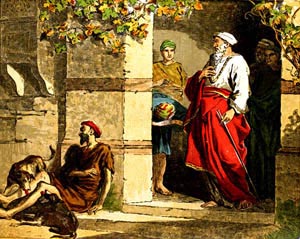
DenariusHe woke up while it was still dark and kissed his wife while she slept.

He dressed and left home quietly, so as not to wake up the children across the room.

He walked into town and came to the large market square, where the venders were already setting up shop, and day laborers like himself were congregating.

At dawn, landowners came to hire men to harvest their vineyards and fields.

He was left behind, yet he did not leave.

Hopefully, someone would hire him at noon for at least a half-day’s work.

Three o’clock came, and he was still standing there unemployed, refusing to go home. How could he go home… empty-handed?

Around five o’clock, a landowner found him and asked, “Why do you stand here idle all day?”

Speaking for those standing with him he answered, “Because no one has hired us.”

The landowner said to them, “You too go into my vineyard.”

When it was evening, the vineyard owner had his foreman summon the harvesters and pay them—in this he was abiding by the command in the book of Leviticus, “You shall not withhold overnight the wages of your laborer.”

When he received his pay, the man thought there had been some mistake.

Though he worked only an hour, he had been given a silver denarius coin, the standard pay for a full day’s work.

He badly wanted to leave with it, but he was a righteous man, and quietly approached the foreman.

But the foreman reassured him—there had been no mistake!

Oh, the joy he felt! For tonight and tomorrow, his family would not be hungry.

*  *  *  *  *

Was the landowner unfair in the treatment of his workers? At the beginning of the day, the Greek text says the landowner achieved ‘harmonious agreement’ with the labors regarding the usual daily wage. This was not fraud nor exploitation, but a just wage for an honest day’s work. Were the later workers been idle due to laziness? No, they honestly say, but “because no one has hired us.”

Let us revisit the landowner’s arguments in his own defense: he said to one of the grumblers in reply, “My friend, I am not cheating you. Did you not agree with me for the usual daily wage? Take what is yours and go. What if I wish to give this last one the same as you? Or am I not free to do as I wish with my own money? Are you envious because I am generous?” The landowner was not being unfair, he was being generous. He kept the precept of Leviticus, which ensured that poor laborers would not be deprived of their daily bread overnight, but he also kept the command which comes in Leviticus five verses later: “You shall love your neighbor as yourself.”

Would the grumblers have been happier if the coins were taken back from the hands of all of the one hour workers? Yes, and no. For the envious person is not happy until everyone is unhappy like himself. And even then, he is still unhappy. What if the grumblers had had perfect hearts? Then they would have been concerned about those unchosen workers, as impoverished as themselves, that were left behind in the marketplace, and upon seeing those latecomers receive a full daily wage they would be happy and relieved for them. But these grumblers’ thoughts were not God’s thoughts, and their ways were not his ways.

Saint Augustine in his Study by Botticelli, 1480Beware of envy. Envy is sadness at the sight of another’s blessings and the immoderate desire to acquire them for oneself. The Catechism of the Catholic Church teaches, when envy wishes grave harm to a neighbor, it is a mortal sin. St. Augustine rightly called envy “the diabolical sin,” for the book of Wisdom tells us that “by the envy of the devil, death entered the world.” St. Augustine observed, “From envy are born hatred, detraction, slander, joy caused by the misfortune of a neighbor, and displeasure caused by his prosperity.”

What is envy’s antidote or preventative vaccine? A good will towards all people, and rejoicing in their blessings and happiness as much as your own. Do you feel envious out of fear or resentment that there may not enough good things for you? Remember that the landowner in today’s parable, who ensures that his laborers receive their daily bread, represents God, who provides for the needs of those who serve him. As the psalmist says, “The Lord is near to all who call upon him.”

In Jesus’ parable, the landowner represents God, the laborers are those who faithfully serve him, and the equal pay they receive is salvation, eternal life, the reward of Heaven. Does this mean that all who serve God receive an equal reward? Once again, the answer is yes, and no. Each is given Heaven, but not all souls enjoy the same glory there. In our second reading, St. Paul says, “If I go on living in the flesh, that means fruitful labor for me.” He is not sure if he would rather live or die (“I do not know which I shall choose”) because death means peaceful rest with Christ, while more labor in life means a greater reward.

St. ThereseWhen St. Therese of Lisieux was a little girl, she was rather put out to learn that not all souls enjoy the same glory in heaven. For the young, fairness means simple sameness. Her older sister, Pauline, told her to fetch a thimble and her father’s water tumbler and to fill both of them to the top with water. Pauline then asked her which one was fuller. St. Therese saw that every soul in heaven is filled to its brim and can hold no more; each being full of God and completely happy. In Heaven, there is enough love, glory, and happiness for everyone, even if we grow and develop different capacities for these while on earth.

So who will have the largest capacity in Heaven? Who will hold the most glory? I believe, as Jesus says, “the last will be first, and the first will be last.” The greatest glory will not go to those who are focused on who is first and greatest, but to those interested in promoting in the greater glory of all.

God’s angels have different degrees of glory and power, yet they find delight in one another. They have labored for the Lord since the beginning of time, yet they rejoice that God has been generous with us latecomers and included us in his work. Let us be like our angels, who happily pray for us and aid us, so that we might attain a glory greater than their own. Let us pray that others might become holier than us, provided we become as holy as we ought.
Jesus in the Storm — 19th Sunday in Ordinary Time—Year A

August 11, 2014

walking-on-water-by-aivazovsky-1890I do not think that the apostles wanted to get into that boat. Jesus made them do it.

After he had fed the people, Jesus made the disciples get into a boat and precede him to the other side, while he dismissed the crowds.

Why would they not want to go? Peter, Andrew, James, and John were previously fishermen working on this Sea of Galilee. They could recognize an approaching storm. The apostles did not want to be on the sea that night, but they obediently went.

[After sending away the apostles and the crowds, Jesus] went up on the mountain by himself to pray. When it was evening he was there alone. Meanwhile the boat, already a few miles offshore, was being tossed about by the waves, for the wind was against it.

Why did Jesus dismiss them without himself? Jesus wanted to be alone to pray after hearing about the killing of his relative and friend, John the Baptist. (Even Jesus needed dedicated times for prayer.) But there was another reason: Jesus wanted the apostles to experience one of the most memorable, most difficult, most amazing nights of their lives. After battling against the winds and waves from evening through the hours before dawn, the apostles were exhausted physically and emotionally. Then…

During the fourth watch of the night, he came toward them walking on the sea. When the disciples saw him walking on the sea they were terrified. “It is a ghost,” they said, and they cried out in fear. At once Jesus spoke to them, “Take courage, it is I; do not be afraid.”

The apostles have been casting out demons with Jesus for a long time. Perhaps they fear that this angry storm has been the work of a demon who is coming toward them in visible form on the water to finally kill them. In fact, the source of their greatest fear is actually their salvation. Jesus says, “Take courage, it is I; do not be afraid.” Jesus says, “Be not afraid,” more frequently than anything else. And it is not a suggestion, it is a command. When it feels like a the hurricane blows above, and an earthquake shakes below, and fire surrounds you, it can be difficult to hear God’s tiny whispering sound. However, the Lord is always close. People are afraid of many things: Loss and poverty, loneliness and suffering, disease and pain, dying to ourselves and dying from this life. What are you most afraid of?

After [Jesus and Peter] got into the boat, the wind died down.

Jesus says, “Take courage, it is I; do not be afraid.” Like the Apostles, if any distress comes to you, the Lord has permitted this for your good. “Be not afraid.” Jesus comes to meet us in the storm. He does this because meeting Jesus in the storm is among the most memorable, most amazing, and most powerful experiences of our lives. As we see with Saint Peter, these difficult experiences make us more like Jesus. In everything, Jesus is near and telling us, “Be not afraid.”

Three Crosses Line Break

No creo que los apóstoles querían entrar en ese barco. Jesús les hizo hacerlo.

En aquel tiempo, inmediatamente después de la multiplicación de los panes, Jesús hizo que sus discípulos subieran a la barca y se dirigieran a la otra orilla, mientras Él despedía a la gente.

¿Por qué ellos no quieran ir? Pedro, Andrés, Santiago y Juan eran anteriormente los pescadores que trabajan en este mar de Galilea. Podían reconocer una tormenta que se aproxima. Los apóstoles no quieren estar en el mar esa noche, pero obedientemente se fueron.

Después de despedirla, [Jesús] subió al monte a solas para orar. Llegada la noche, estaba él solo allí. Entre tanto, la barca iba ya muy lejos de la costa y las olas la sacudían, porque el viento era contrario.

¿Por qué Jesús despedirlos sin él? Jesús quería estar a solas para orar después de enterarse de el asesinato de su pariente y amigo, Juan el Bautista. (Incluso Jesús necesitaba tiempos dedicados para la oración.) Pero había otra razón: Jesús quería que los apóstoles de experimentar una de las más memorables, más difíciles, más increíbles noches de sus vidas. Después de luchar contra los vientos y las olas de la noche a través de las horas antes del amanecer, los apóstoles estaban exhaustos física y emocionalmente. Entonces…

A la madrugada, Jesús fue hacia ellos, caminando sobre el agua. Los discípulos, al verlo andar sobre el agua, se espantaron y decían: “¡Es un fantasma!” Y daban gritos de terror. Pero Jesús les dijo enseguida: “Tranquilícense y no teman. Soy yo”.

Los apóstoles han sido echando fuera demonios con Jesús durante mucho tiempo. Tal vez tienen miedo de que esta tormenta enojado ha sido obra de un demonio que ahora viene hacia ellos en forma visible en el agua para finalmente matarlos.  De hecho, la fuente de su miedo más grande es en realidad su salvación. Jesús dice: “Tranquilícense y no teman. Soy yo”.

Jesús dice: “No temas,” con más frecuencia que cualquier otra cosa. Y no es una sugerencia, es una orden.  Cuando parece que un huracán sopla encima, y un terremoto sacude a continuación, y el fuego le rodea, puede ser difícil de oír el murmullo de una bias suave. Sin embargo, el Señor siempre está cerca. La gente tiene miedo de muchas cosas: la pérdida y la pobreza, la soledad y el sufrimiento, la enfermedad y el dolor, muriendo a nosotros mismos y muriendo algún día. ¿Qué es lo que más miedo?

En cuanto [Jesús y Pedro] subieron a la barca, el viento se calmó.

Jesús viene para encontrarnos en la tormenta. Él hace esto porque un encuentro con Jesús en la tormenta es una de las experiencias más sorprendentes, más memorables y más poderosos de nuestras vidas.  Como vemos con San Pedro, estas experiencias difíciles nos hacen más como Jesús. En todo, Jesús está cerca, y nos diciendo, “Tranquilícense y no teman.”

Theological Gifts & Obligations — Tuesday, 15th Week of Ordinary Time

July 15, 2014

Gospel: Matthew 11:20-24

Jesus began to reproach the towns where most of his mighty deeds had been done, since they had not repented. “Woe to you, Chorazin! Woe to you, Bethsaida! … For if the mighty deeds done in your midst had been done in Sodom, it would have remained until this day. But I tell you, it will be more tolerable for the land of Sodom on the day of judgment than for you.”

In the visitation of Jesus Christ, Chorazin and Bethsaida had advantages that no people before them had ever enjoyed. The Word of God was before them, but they did not accept him. Incarnate love was among them, but they did not embrace him. The hope of the world was in their midst, but they did not change their ways.

Consider how much more understanding we have of Christ and his teachings than they, how much we have experienced the love of Christ and his people, how many prophesies of Christ we have seen fulfilled. How much more cause do we have to respond to him with faith, hope, and love; how much more of an obligation. As St. Bonaventure said:

“Three things are necessary to everyone regardless of status, sex, or age, i.e., truth of faith which brings understanding; love of Christ which brings compassion; endurance of hope which brings perseverance. No adult is in the state of salvation unless he has faithful understanding in his mind, loving compassion in his heart, and enduring perseverance in his actions.”

Peter & Judas — Wednesday, 14th Week of Ordinary Time—Year II

July 11, 2014

Judas Iscariot and the chief priests and elders at the temple, their money on the floor.Readings: Hosea 10, Matthew 10:1-7

The names of the Twelve Apostles are these: first, Simon called Peter,  … and Judas Iscariot who betrayed Jesus.

What was the difference between Peter and Judas? Both were full-fledged apostles (although the Gospels always list the twelve apostles with Peter first and Judas last, much like how the Lord’s Prayer begins with “our Father” and ends with “the Evil One/evil.”) Was the difference that Peter believed Jesus was a good man and Judas did not? No, for Judas said after betraying Jesus, “I have sinned in betraying innocent blood.” Was the difference that Judas was a sinner and Peter was not? No, for at one of their first encounters, Peter “fell at the knees of Jesus and said, ‘Depart from me, Lord, for I am a sinful man.'” In the Passion, Judas betrayed Jesus and while Peter denied him three times beside the charcoal fire in the high priest’s courtyard. The vital difference between Peter and Judas was in their ultimate responses to their sins.

Judas fled and fell into utter despair. Like those in our first reading who “cry out to the mountains, ‘Cover us!’ and to the hills, ‘Fall upon us,’ Judas welcomed dark oblivion. After the resurrection, when Peter was fishing in his boat, Jesus appeared on the shore. Though Peter was lightly clad, he did not run and hide like Adam and Eve in shame, but swam to Jesus enthusiastically. At that second charcoal fire, Peter professed three times that he loved Jesus.

Let us follow Peter’s example rather than that of Judas and encounter Jesus in the confessional. For those who love Christ, hope in Christ, seek Christ, and run to Christ, will find his mercy.

Heeding Our Earthly Mother & Heavenly Father — 14th Sunday in Ordinary Time—Year A

July 5, 2014

Readings: Zechariah 9:9-10; Romans 8:9,11-13; Matthew 11:25-30

A Wall Across the Road

Imagine an wall built across a road which has stood for as long as anyone can remember. The Catholic writer G.K. Chesterton suggested that when confronted by such a peculiar sight:

The more modern type of reformer goes gaily up to it and says, “I don’t see the use of this; let us clear it away.” To which the more intelligent type of reformer will do well to answer: “If you don’t see the use of it, I certainly won’t let you clear it away. Go away and think. Then, when you can come back and tell me that you do see the use of it, I may allow you to destroy it.”

It is said that human history has been constantly repeating two phases, summed up in two concise phrases:

First, “What could it hurt?
And second, “How were we supposed to know?

All of us are children of the same holy Mother, the Church. And she is united with God, our loving Father. Moms and dads sometimes tell us, “Don’t touch that–it will hurt. I know it glows enticingly, but it will burn you. We’re not saying this in order to control you or to make you miserable, but because we love you. We want you to be safe and happy.

Red_Hot_Coiled_Stove_Burner_3_by_FantasyStockWe then have three options in how we respond: Either we can touch the forbidden thing for ourselves and experience the pain firsthand. Or we can observe others who have touched the thing and learn from them (though they sometimes hide their pain and tears, even from themselves.) Or, and this is the best response, we can trust in the words of our Mother and Father and never get burned.

Sometimes the wise and the learned of this world refuse to see the truth, but to the little ones, to the childlike, the truth is revealed and they welcome it. In our first reading from Zechariah we find a prophesy about the Messiah. The Savior is not coming on a warhorse, but on a donkey—not as a conqueror imposing his will upon the earth by force, but meekly, inviting us to trust in him and freely embrace his will.

“Come to me, all you who labor and are burdened, and I will give you rest. Take my yoke upon you and learn from me, for I am meek and humble of heart; and you will find rest for yourselves. For my yoke is easy, and my burden light.”

This week’s Supreme Court’s verdict in the Hobby Lobby case comes as good news for religious liberty. However, we must keep praying. Though the five-to-four decision is a positive sign, religiously affiliated non-profit groups are not safely out of the legal woods yet. Many people of goodwill support Catholic institutions in their conscientious refusal to facilitate things they consider gravely immoral, but I wonder how many observers understand why Catholics have any objection to contraception and sterilization to begin with?

People fail to realize that contraception is not something new. For thousands of years, people have used various barriers, chemicals, and techniques to prevent the marital embrace from being fruitful. And most have never heard that before 1930 all Protestant denominations agreed with the Catholic Church’s teaching in condemning contraception as sinful. Most people have not realized what could be wrong with putting asunder what God has joined in the marital act; separating love-making from an openness to life. And though few recognize the harmful impact that contraception has on families and society, its consequences were not entirely unforeseen.

Pope Paul VI

In 1968, in the midst of a sexual revolution made possible by the birth control pill, some believed the Catholic Church would “update” its consistent teaching on contraception. (“What could it hurt?”) Instead, Pope Paul VI shocked the world with orthodoxy. His encyclical, Humanae Vitae or “Of Human Life,” was one of the most controversial documents of the twentieth century, yet the pope’s four predictions of what would happen if contraceptives gained widespread use have proven true:

  1. A general lowering of moral standards throughout society.
  2. A rise in infidelity.
  3. A lessening of respect for women by men.
  4. The coercive use of reproductive technologies by governments.

What is more, a contraceptive mentality has so pervaded our culture that healthy fertility is treated like a disease and conceived children are treated like a cancer. Because of procured abortion, in any room of people under 40 years old, there is on average one person missing for every three people you see. This is the fruit of a contraceptive mentality. (“How were we supposed to know?”)

Whether the Catholic Church teaches on indecent images, fornication, cohabitation, same-sex relations, divorce and remarriage without annulment, in-vitro fertilization, abortion, drug use and drunkenness, euthanasia or suicide; for every “no” in her teachings the Church proclaims a greater, more foundational “Yes” to love and life and true happiness. As St. Paul tells us:

“Brothers and sisters, we are not debtors to the flesh, to live according to the flesh. For if you live according to the flesh, you will die, but if by the Spirit you put to death the deeds of the body, you will live.”

Will we be childlike enough to listen to our Father in heaven and our Mother on earth? Learn from Christ and take his yoke upon you, for according to his promise you will receive rest. His ways require sacrifice, yet compared to the yoke of sin and death which comes with the ways of the world, Jesus’ yoke is easy and his burden is light.

First Things First — Divine Mercy Sunday—2nd Sunday of Easter

April 28, 2014

Gospel: John 20:19-31

[Though the doors were locked, where the disciples were,] Jesus came and stood in their midst and said to them, “Peace be with you.” When he had said this, he showed them his hands and his side.

What was Jesus’ first order of business on the first Easter Sunday? Demonstrating to his disciples the fact of his resurrection.

What was the next most important thing on Jesus’ list? Commissioning his Church to impart his Divine Mercy to world.

Jesus said to them again, “Peace be with you. As the Father has sent me, so I send you.” And when he had said this, he breathed on them and said to them, “Receive the Holy Spirit. Whose sins you forgive are forgiven them, and whose sins you retain are retained.”

Some Sacramental Clarifications

April 5, 2014

● A funeral Mass is not celebrated as an honor, but as a mercy. A funeral Mass does not canonize, but offers Christ’s sacrifice for graces upon the deceased and the assembled mourners. “This saying is trustworthy and deserves full acceptance: Christ Jesus came into the world to save sinners.” (1 Timothy 1:15) If the deceased has been condemned, the offered funeral Mass will only help the family (perhaps to be converted and saved,) but if the departed is in purgatory, the Holy Mass is the greatest prayer we can offer on his or her behalf. Apart from notorious and unrepentant apostates, heretics, and schismatics, we want to error on the side of mercy, as we have been shown mercy.

● Though all should contribute to the work of the Church, no Catholic parish is a private club that requires up-to-date dues in order to be welcomed. All Catholics are members of the world-wide body of Christ—the Church.

● No one will be refused sacraments in our parish because of an inability to pay parish fees or stipends.

● Everyone is welcome at our parish Masses; however, those not in full communion with the Catholic Church, or those aware of having committed grave sin who have not obtained absolution in the sacrament of Confession, should not present themselves to receive the Holy Eucharist—these may receive a blessing instead by approaching with crossed arms.

● Any child, for whom there is a well-founded hope of being raised Catholic and whose guardians have completed a baptismal preparation program here or at another parish, may be baptized in our parish.

● If you have any additional sacramental questions regarding our parish community, please contact Father, your priest, directly.

The Two Mountains — Wednesday, 3rd Week of Lent

March 26, 2014

Readings: Deuteronomy 4:5-9, Matthew 5:17-19

[W]hat great nation is there that has gods so close to it as the LORD, our God, is to us whenever we call upon him? Or what great nation has statutes and decrees that are as just as this whole law which I am setting before you today?

The greatness of Israel among the nations consisted not merely in their moral law but in their intimacy with God. As C.S. Lewis once observed, “The road to the promised land runs past Sinai.” The morality of Mount Sinai is essential to the journey, but our goal is to worship on Mount Zion.

Immediately following today’s Gospel about fulfilling the Law, Jesus declares, “I tell you, unless your righteousness surpasses that of the scribes and Pharisees, you will not enter into the kingdom of heaven.” The Pharisees and scribes kept the commandments pretty well but they were often far from God.

This Lent, let us not only focus on growing in our moral practices, but also on our love and intimacy with the Lord.

Q&A on Indulgences

March 22, 2014

What is an indulgence?

An indulgence cancels before God the temporal punishment due for forgiven sins.

Forgiven sins can have punishments?

The forgiveness of sin absolves its eternal punishment; that is, restores our friendship with God and saves us from Hell. However, “temporal punishment” remains for sin for the purpose of the soul’s rehabilitation and to satisfy justice. This is why the priest in the confessional gives you a penance to do after you leave with all your sins absolved. Recall what Nathan told King David after the Lord forgave him (2 Samuel 12:9-14.) Even after forgiveness, there may be punishments to be paid.

What is the difference between a “plenary” & “partial” indulgence?

A plenary indulgence remits all temporal punishment due to sin, while a partial indulgence remits some of it. Note that sin’s temporal punishments are not synonymous with all of sin’s consequences. For instance, even after a plenary indulgence, we all still experience in our flesh the primeval consequence of sin: physical death.

How can the Church offer to do this?

The Church has authority from Christ to loosen and to bind, on earth and in Heaven. (Matthew 18:18) Thus, after sins are forgiven, she can satisfy remaining debts by drawing on and applying before God the superabundant merits won by Christ and his saints.

So the Church still grants indulgences?

In the 1500’s, some indulgences were granted for performing the charitable act of donating to the Church. The way some used the “sale” of indulgences as a fund-raising strategy scandalized many (including Martin Luther.) The Church abolished this means of gaining indulgences, but other means remain available.

How do I gain a plenary indulgence?

All plenary indulgences require the following:

  1. Go to confession.
  2. Receive the Holy Eucharist.
  3. Pray for the pope’s intentions (e.g., an Our Father & a Hail Mary)
  4. Do the indulgenced act in a state of grace and intending to gain the indulgence.
  5. And have no intention to sin again, even venially.

      (Note: One confession can be utilized for indulgences twenty days before or after, but each indulgence requires a distinct holy communion.)

What acts carry a plenary indulgence?

They include, among others:

  1. Visit the Most Blessed Sacrament for at least 30 minutes.
  2. Read the Bible for at least 30 minutes.
  3. Pray the Stations of the Cross.
  4. Pray one Rosary (five decades) in a church or as a family group.
  5. Pray the “Prayer Before a Crucifix” on a Friday in Lent after communion.
  6. Adore the crucifix liturgically on Good Friday.
  7. Visit a cemetery and pray for the dead on any day between November 1st and 8th.
  8. Worship at a First Communion Mass.
  9. Worship at a priest’s Mass of Thanksgiving (aka, “First Mass”)
  10. Hear sermons at a parish mission and be present for its solemn close.

Many other acts can also gain partial indulgences.

How often & for whom can I gain an indulgence?

One plenary indulgence can be gained daily and applied to oneself or to a deceased person. There is no limit for how many partial indulgences you can gain for yourself or a deceased person, and this type does not require the conditions of confession, communion, or prayers for the pope’s intentions. (Thanks to Pussywillowpress for the clarifying note below.)

Measures of Mercy — Monday, 2nd Week of Lent

March 17, 2014

Gospel: Luke 6:36-38

Last year, a teenage posted a photo on the internet of an unrolled tape measure along side the 11-inch “footlong” sandwich he had bought. The corporate response was not one of the great moments in public relations history; they said that “footlong” was a trademark term, rather than a measurement of length. The negative consumer backlash to this went viral and the corporation pledged that every foot-long would henceforth be 12-inches.

In 12th century England, there were strict laws to punish bakers who sold undersized loaves. In response, the bakers would throw in an additional loaf with every dozen to safeguard their liberty.  The baker’s dozen (of 13) was born and their customers were happy. It is wiser to error on the side of generosity with others, in both the world of business and the realm mercy.

Commerce has been linked to mercy by the Lord in both Testaments. In Old Testament Israel, merchants would use cups and weights to measure out their products to customers. Sometimes, to increase their profits, unscrupulous sellers would manipulate these measures to their advantage, as the Lord describes through the prophet Amos:

“When will the new moon be over,” you ask, “that we may sell our grain, And the sabbath, that we may open the grain-bins? We will diminish the ephah, add to the shekel, and fix our scales for cheating! We will buy the destitute for silver, and the poor for a pair of sandals; even the worthless grain we will sell!”

Such cheating was especially abhorrent to the Lord because it most exploited the poor and vulnerable. Today, Jesus tells his disciples that they should be generous with their measurements of mercy if they do not wish to be condemned:

“Be merciful, just as your Father is merciful. Stop judging and you will not be judged. Stop condemning and you will not be condemned. Forgive and you will be forgiven. Give and gifts will be given to you; a good measure, packed together, shaken down, and overflowing, will be poured into your lap. For the measure with which you measure will in return be measured out to you.”

Without rejecting the truth, or declaring evil to be good, we need to be patient and forgiving with others if we wish to be shown mercy. As St. James says, “judgment is merciless to one who has not shown mercy; [but] mercy triumphs over judgment.”

The Seven Deadly Sins & Seven Lively Virtues

March 6, 2014

Pride is lowered by Humility

Envy is opposed by Admiration

Wrath is tamed by Forgiveness

Sloth is stopped by Zeal

Greed is relinquished by Generosity

Gluttony is moderated by Asceticism

Lust is controlled by Chastity

Which lively virtue will you focus on growing?


Magnanimous, Not Petty — 7th Sunday in Ordinary Time—Year A

February 23, 2014

“Petty” comes from the French word for “small” (“petit.“) “Magnanimous” comes from the Latin words for “great” and “soul” (“magna” and “anima.“) We are not called to be small, but of great soul in our interactions with others.

Four Cheeks Turned — 7th Sunday in Ordinary Time—Year A

February 22, 2014

Gospel: Matthew 5:38-48

When attacked, our natural response is “fight or flight,” but Jesus suggests a  supernatural response: “When someone strikes you on your right cheek, turn the other one as well.” Since the Jews regarded the left hand as unclean, they would reflexively strike with the right hand. If the right cheek were hit, then one had been backhanded with contempt. Responding by turning the other cheek neither attacks not retreats, but insists on being regarded as an equal, whom one must strike (if at all) with an open hand. Jesus wants us to stand our ground in the face of injustice, assertively but lovingly, in hopes that the offender will reconsider his ways. Jesus modeled this response when he was struck during his trial before Annas:

The high priest questioned Jesus about his disciples and about his doctrine. Jesus answered him, “I have spoken publicly to the world. I have always taught in a synagogue or in the temple area where all the Jews gather, and in secret I have said nothing. Why ask me? Ask those who heard me what I said to them. They know what I said.” When he had said this, one of the temple guards standing there struck Jesus and said, “Is this the way you answer the high priest?” Jesus answered him, “If I have spoken wrongly, testify to the wrong; but if I have spoken rightly, why do you strike me?” (John 18:19-24)

Another saintly example was shown by Blessed Mother Teresa of Calcutta. Though reports vary, Mother Teresa was once begging bread from a baker for her orphanage. When the baker responded by spitting into her hand, she replied to effect, ‘I will keep this for me, but please give something for my children.’

In Victor Hugo’s Les Miserables, a bishop welcomes an impoverished convict to join his table and sleep at his home. However, that night, Jean Valjean steals his host’s silverware and goes away. The police catch him and take him to the bishop. Looking at Jean Valjean, the good bishop exclaims, “Ah! here you are! I am glad to see you. Well, but how is this? I gave you the candlesticks too, which are of silver like the rest, and for which you can certainly get two hundred francs. Why did you not carry them away with your forks and spoons?” Jean Valjean opens his eyes wide and stares at the venerable Bishop “with an expression which no human tongue can render any account of.” The bishop’s turn of the cheek spares the thief’s freedom and saves his soul.

And finally, a true story from a modern marriage: A woman’s husband had a terrible temper and every time it flared she would say, “That’s just like you to lose your temper!” But then, following a stroke of insight, she began responding differently. The next time he began to fly of the handle she told him, “That’s not like you to lose your temper,” and he nearly fell out of his chair. Even the kids looked at her funny, but she stuck with her new resolution. Months later, while at a restaurant together, he became irritated by the slow service. He started to fume about it, but then he suddenly stopped, turned to her, and said, “That’s not like me to lose my temper, is it?” This time, it is said, she nearly fell on the floor.

Was it true the first time the woman declared that it was not like her husband to lose his temper? The claim did not match his previous behavior, but perhaps he changed because she revealed to him that his uncontrolled anger was quite unlike the father, husband, and Christian man he truly and deeply wanted to be. This is the sort of realization and conversion we are to hope for in turning the other cheek.

Plus, a fifth story: “If a teen mugs you for your wallet…

Refusing Signs — Monday, 6th Week of Ordinary Time—Year II

February 17, 2014

Readings: James 1:1-11, Mark 8:11-13

The Pharisees came forward and began to argue with Jesus, seeking from him a sign from heaven to test him. He sighed from the depth of his spirit and said, “Why does this generation seek a sign? Amen, I say to you, no sign will be given to this generation.

Yet, soon before this scene in Mark’s Gospel, Jesus took seven loaves and a few fish and miraculously fed about 4,000 people with them. That is a sign as surely as his resurrection will be, so how can Jesus say “no sign will be given to this generation”? Perhaps because there was no sign that his critics would accept.

The Pharisees sought “a sign from heaven.” If Jesus had performed some meteorological sign for them they may well have judged him as more evil than they had thought, in union with the demons of the air, just as they had condemned his manifest power to cast out demons. (Mark 3:21-30) They asked for proof but refused to accept evidence in his favor–they were of people of two minds, like St. James describes in the first reading:

But if any of you lacks wisdom, he should ask God who gives to all generously and ungrudgingly, and he will be given it. But he should ask in faith, not doubting, for the one who doubts is like a wave of the sea that is driven and tossed about by the wind. For that person must not suppose that he will receive anything from the Lord, since he is a man of two minds, unstable in all his ways.

Let us pray for those who do not believe; for the sincere, that they may be given sufficient evidence to change their minds, and for the obstinate, that their hardened hearts may be opened. And let us who believe in God (as even the Pharisees did) not cause Jesus to “[sigh] from the depth of his spirit.” Let us be trusting and docile in following him.

Increasing Intimacy in your Marriage & Home

February 13, 2014

Physical intimacy is an important aspect of marriage, but it is certainly not the only kind of intimacy. A marriage in which the intimacy shared is exclusively physical will not endure. The acronym “SPICE” contains five modes of sharing intimacy: Spiritual, Physical, Intellectual, Creative, and Emotional. Sharing your prayers, touches, ideas, projects, and feelings are all important elements to keeping your marriage strong.

Another issue in relationships between spouses and within households comes in how love is expressed and received. Gary Chapman’s 1995 book, “The Five Love Languages: How to Express Heartfelt Commitment to Your Mate,” suggests that people prefer to receive love in different ways. Chapman describes five main ways, or languages, by which love is experienced: Gifts, Quality Time, Acts of Service, Words of Affirmation, and Physical Touch. Some people feel love most deeply when their spouses help around the house and with the kids (Acts of Service) but feel little thrill from receiving gifts, such as golf clubs or jewelry.

A problem arises when people understandably, but mistakenly, assume that the significant others in their lives receive love best through the same love language as themselves. They try to love their neighbor just like themselves without realizing that their love languages differ. For instance, people whose main love language is Quality Time may feel neglected or even abandoned, despite their spouses’ tender caresses and sincere compliments, if not enough time is shared together between them at home. Knowing another’s love language allows you to love them in the manner they most want to be loved.

  • What are your top-two favorite Love Languages?
  • Can you guess what your spouse and children’s top Love Languages are?
  • Share your answers with each other—you may discover something new.
  • How can you add more SPICE, more Spiritual, Physical, Intellectual, Creative, and Emotional Intimacy, into your marriage and your home?