Archive for the ‘Chrisitian Virtues’ Category

The Catechism on Current Events

June 19, 2016

On June 12, 2016, a gunman murdered 49 persons at a gay nightclub in Orlando. Discussions of terrorism and new gun control laws have followed. Below are teachings from The Catechism of the Catholic Church:

On Murder & Terrorism (CCC 2268, 2297)

The fifth commandment forbids direct and intentional killing as gravely sinful. The murderer and those who cooperate voluntarily in murder commit a sin that cries out to heaven for vengeance.

Terrorism threatens, wounds, and kills indiscriminately; it is gravely against justice and charity.

On Persons with Same-Sex Attractions (CCC 2357-2359)

Homosexuality refers to relations between men or between women who experience an exclusive or predominant sexual attraction toward persons of the same sex. It has taken a great variety of forms through the centuries and in different cultures. Its psychological genesis remains largely unexplained. Basing itself on Sacred Scripture, which presents homosexual acts as acts of grave depravity, tradition has always declared that “homosexual acts are intrinsically disordered.” They are contrary to the natural law. They close the sexual act to the gift of life. They do not proceed from a genuine affective and sexual complementarity. Under no circumstances can they be approved.

The number of men and women who have deep-seated homosexual tendencies is not negligible. This inclination, which is objectively disordered, constitutes for most of them a trial. They must be accepted with respect, compassion, and sensitivity. Every sign of unjust discrimination in their regard should be avoided. These persons are called to fulfill God’s will in their lives and, if they are Christians, to unite to the sacrifice of the Lord’s Cross the difficulties they may encounter from their condition.

Homosexual persons are called to chastity. By the virtues of self-mastery that teach them inner freedom, at times by the support of disinterested friendship, by prayer and sacramental grace, they can and should gradually and resolutely approach Christian perfection.

On Government Authority (See CCC 1897-1927)

Every human community needs an authority to govern it. … Its role is to ensure as far as possible the Common Good of the society. The authority required by the moral order derives from God… (see Romans 13:1-2.) [Authority] must not behave in a despotic manner, but must act for the Common Good as a moral force based on freedom and a sense of responsibility. A human law has the character of law to the extent that it accords with right reason, and thus derives from the eternal law. … If rulers were to enact unjust laws or take measures contrary to the moral order, such arrangements would not be binding in conscience. In such a case, “authority breaks down completely and results in shameful abuse.” (Pope St. John XXIII) The Common Good consists of three essential elements: respect and promotion of the fundamental rights of the person; development of the spiritual & temporal goods of society; and the peace & security of society and its members.

On Legitimate Self-Defense (CCC 2263-2264)

The legitimate defense of persons and societies is not an exception to the prohibition against the murder of the innocent that constitutes intentional killing. “The act of self-defense can have a double effect: the preservation of one’s own life; and the killing of the aggressor. … The one is intended, the other is not.” (St. Thomas Aquinas)

Love toward oneself remains a fundamental principle of morality. Therefore it is legitimate to insist on respect for one’s own right to life. Someone who defends his life is not guilty of murder even if he is forced to deal his aggressor a lethal blow: “If a man in self-defense uses more than necessary violence, it will be unlawful: whereas if he repels force with moderation, his defense will be lawful. … Nor is it necessary for salvation that a man omit the act of moderate self-defense to avoid killing the other man, since one is bound to take more care of one’s own life than of another’s.” (St. Thomas Aquinas)

The Eight Beatitudes at the Movies

May 2, 2016

At the start of his Sermon on the Mount (in Matthew 5) Jesus lists qualities which describe the blessed in his Kingdom. These eight Beatitudes are models for living our lives. On the silver screen, the fictional characters in these eight classic films manifest the Beatitudes:

Phil Connors in Groundhog Day: Blessed are the poor in spirit, for theirs is the kingdom of heaven. The arrogant self-sufficiency of Bill Murray’s character must be humbled before he can turn the corner towards living the perfect life by loving truly.

+  +  +  +  +  +  +  +

Most characters in The Sixth Sense: Blessed are they who mourn, for they will be comforted. In this film, both the living and the dead suffer great losses, but they ultimately receive their peace.

+  +  +  +  +  +  +  +

George Bailey in It’s a Wonderful Life:Blessed are the meek, for they will inherit the land.” Jimmy Stewart’s character repeatedly sacrifices his big dreams (of college, of riches & fame, of an around-the-world honeymoon) to save the little Building & Loan of Bedford Falls. By the end of the story, George realizes that he is truly “the richest man in town.”

+  +  +  +  +  +  +  +

“Juror 8” in 12 Angry Men: “Blessed are those who hunger and thirst for righteousness: for they will be filled. The eighth juror (played by Henry Fonda) shows how a principled advocacy for the truth can change minds and bring about true justice.

+  +  +  +  +  +  +  +

Jean Valjean in Les Misérables: “Blessed are the merciful, for they will be shown mercy.” Having received mercy, the former criminal Jean Valjean practices mercy, and so is saved.

+  +  +  +  +  +  +  +

Forrest in Forrest Gump: “Blessed are the clean of heart, for they will see God.” Forrest is “not a smart man, but [he] knows what love is.” His simple virtue and true devotion toward his friends blesses their lives together.

+  +  +  +  +  +  +  +

Mary & Bert in Mary Poppins: “Blessed are the peacemakers, for they will be called children of God. Julie Andrews’ Mary (with assistance from Dick Van Dyke’s Bert) delights in serious play to help heal the Banks Family.

+  +  +  +  +  +  +  +

Terry Malloy & Fr. Barry in On the Waterfront:  “Blessed are they who hunger and thirst for righteousness, for they will be satisfied.”  The courageous actions of Marlon Brando and Karl Malden’s characters prevail against the mob and manifest that ‘Jesus Christ is here on this waterfront.’

+  +  +  +  +  +  +  +

Islam Cross Examined

April 26, 2016

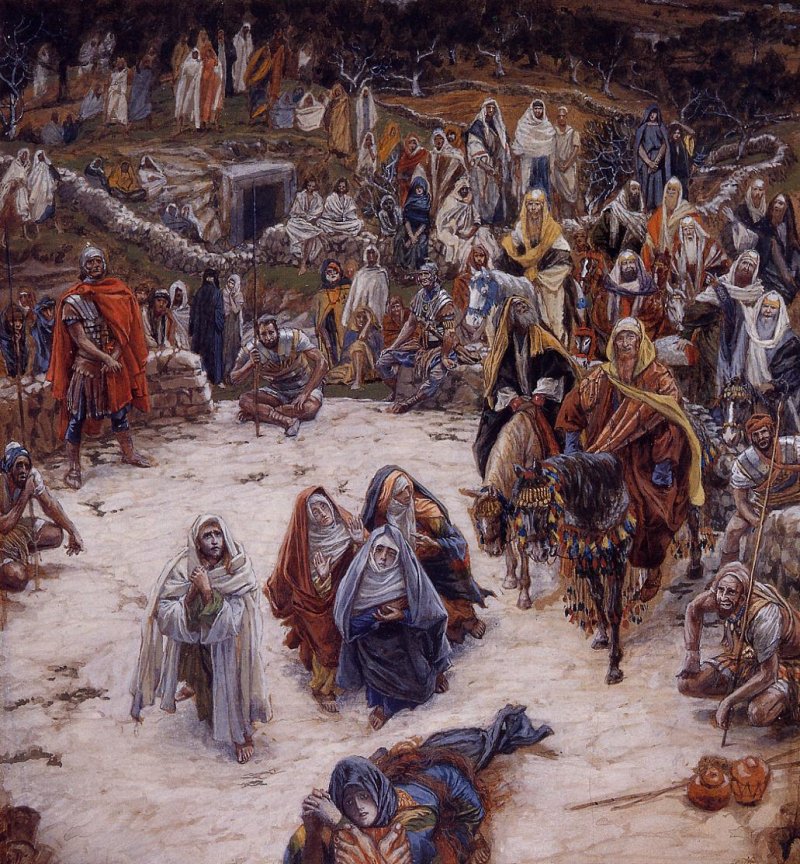
View From the Cross by TissotOnce, at a picnic in college, I learned from a Muslim professor about what Islam teaches regarding Jesus — that he is not the divine Son of God but a prophet of Allah. Of course, my own Christian beliefs differed but I sat patiently listening — until he told me something about ‘Jesus (peace be upon him)’ which left me manifestly incredulous. He said Jesus was never crucified; Allah only made it appear as if he suffered and died. Reportedly, most Muslims (like this professor) believe that Allah gave someone else Jesus’ physical appearance to die on the Cross instead.

The relevant portion of the Quran [4:157] says:

That they said (in boast), ‘We killed Christ Jesus the son of Mary, the Messenger of Allah’; but they killed him not, nor crucified him, but so it was made to appear to them, and those who differ therein are full of doubts, with no (certain) knowledge, but only conjecture to follow, for of a surety they killed him not…

I began asking the professor clarifying questions on this point to make sure that I understood and after a while he asked me why. I replied that if the eyewitnesses to the Crucifixion were not merely mistaken but actively deceived by Allah, then Allah is the author of a lie. God is Truth and “can neither deceive nor be deceived.” (CCC #156-157) So how could Islam’s doppelganger explanation for denying the Crucifixion of Jesus be true? (Similarly, creationists may argue that evolutionists are misinterpreting the ancient fossil record, but they may not say that God has planted false evidence to test our faith.) The now-ruffled Muslim professor retorted that Christianity’s belief in ‘the three gods of the Trinity’ did not make any sense, and we let our interfaith picnic dialogue end there.

But what if Allah can lie? If Allah acts against Truth then his omnipotence would be unlimited in every sense, transcending beyond both logic and goodness. But if Allah transcends good and evil, if God is not absolute goodness in a way that human beings can recognize, then what is our motive to worship him besides submission before his power? C.S. Lewis wrote in opposition to Calvinism’s doctrine of mankind’s “Total Depravity” with words which are just as applicable here:

[I]f God’s moral judgment differs from ours so that our ‘black’ may be His ‘white,’ we can mean nothing by calling Him good; for to say ‘God is good,’ while asserting that His goodness is wholly other than ours, is really only to say ‘God is we know not what.’ … If He is not (in our sense) ‘good’ we shall obey, if at all, only through fear – and should be equally ready to obey an omnipotent Fiend.”

In Plato’s Euthyphro, Socrates asks the title character, “Is the pious loved by the gods because it is pious, or is it pious because it is loved by the gods?” Or, put another way: “Is morality right simply because God declares it so, or does God acknowledge it as right because it is right independently of Himself?” Christianity answers that Euthyphro’s dilemma is a false choice. Goodness comes from God’s eternal nature; nothing could exist without Him. God’s word calls forth the good from Himself. He creates good things, sustains them, and sees that they are good. This is the good God we know; the true God “who does not lie” (Titus 1:2); the God who is supremely revealed by the death on the Cross of our Lord Jesus Christ for all people.

Tips for Raising Faith-Filled Children

April 13, 2016
  • Tell your children every day that you love them and that God loves them too.
  • Listen attentively and respectfully to what your child says.
  • Forgive frequently. Ask forgiveness when you have done wrong. Look for the humor in stressful situations and hug often.
  • Ask children to consider “what if…” when dealing  with challenging situations. Help them find creative, peaceful, and moral responses.
  • Tell your child that you pray for them every day and DO it. Thank God for the gifts they are.
  • Share your faith beliefs so your child can understand your hopes. Also share your doubts so they understand that doubts do not overwhelm faith.
  • Bless your child before bedtime by tracing the Sign of the Cross on their foreheads and saying: “God love you and keep you safe” or some other blessing. Teach your child to respond. “Amen.”
  • Encourage your child to value others for who they are – not what they have. Help them to develop Christian virtues and to treat others kindly and with respect.
  • Once a week, have a family night when you “unplug” to play board games, do crafts, read stories, or take time to talk together.
  • Honor family  dinner. The benefits are amazing and establish a sacred time to share the joys and trials of life with each other.
  • Pray before meals, before bed, during holidays and family celebrations, and any time when one needs guidance or comfort.
  • Have a family Bible and read the Gospel passages before Church.
  • Decorate your house for the liturgical seasons with an Advent wreath, purple during Lent, and a prominently placed crucifix.
  • Take time to ponder the beauty of creation with your child. Easter is a wonderful time to appreciate the new life of springtime.
  • During the fall and spring, help your child sort through their clothes and toys to donate to a shelter. Bring the child with you when you drop off your donations.
  • Select a patron saint to watch over your children when they become involved in a sporting activity. Pray to that saint every time they are at a practice or event.
  • Participate in the Catholic Relief  Services Rice Bowl program: read the prayers during Lent, look up the featured countries, and donate coins in the box provided.
  • Introduce your child to older people or those with disabilities in your neighborhood. Find out if they need assistance with chores or shopping.
  • When you can’t physically help someone, pray for them.
  • Choose sporting events that do not conflict with your Sunday Mass attendance.
  • Encourage “secret” good deeds.
  • Contribute to a food bank. Ask your child to help you with the collection and delivery.
  • Watch TV with your child and explain during commercials or afterward what you found to be good, wholesome, and valuable. If you find a program objectionable explain why when changing the channel.
  • Encourage your child to use their God-given talents to serve others.
  • Help your child find ways to participate in the of the parish, such as being an altar server, choir member, greeter, or reader.
  • Invite your parish priest over for dinner.
  • Volunteer in your child’s religious education program or Catholic school.
  • Have the sporting equipment your child uses get blessed.
  • Read stories from the Bible and biographies of saints to your child. Several great videos can also be found online.
  • Ask grandparents, godparents, and extended family to share stories about the family their faith lives.
  • On the anniversaries of your children’s Baptism, light their Baptismal candles and tell stories about that special day.
  • Display religious items in your home, such as a cross, artwork, or a picture of your child’s patron saint. Talk to your child about them.
  • By the way you live, let your child know that life is good, that your values and faith guide your decisions and how you interact with others, and that the happiness you experience is a direct result of your personal relationship with God.

Adapted from the pamphlet “Raising Your Child With Faith” by Cecilia P. Regan.

Jesus Asks, “Do You Love Me?”

April 9, 2016

Christ Handing the Keys to St. Peter by Pietro Perugino (detail)In St. Peter along the shore of Galilee, Jesus is asking this question of us: “Do you love me?” We each have a choice to make in how we respond.
You can answer like Simon Peter in the high priest’s courtyard, with blasphemous denials and lingering regret. Or you can answer like St. Peter the Rock, who said, “Yes Lord, you know that I love you,” and then lived a life which proved that love.  How are you going to answer?

I do not know the particulars of Christ’s will and plan for you, but I know it consists at least in this: to pray every day, to attend Mass every week, and to strive to do His will for the rest of your days.

Jesus Washed Their Feet

March 10, 2016

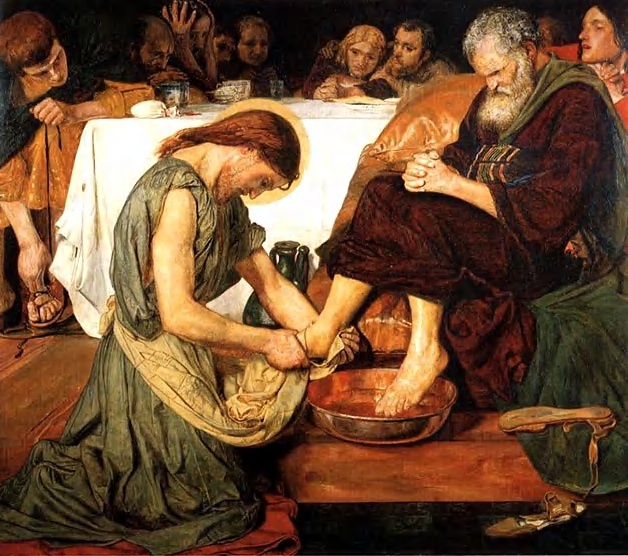
Jesus Washing Peter's Feet by Ford Maddox Brown, 1852-6.[Jesus] loved his own in the world and he loved them to the end. … So, [during the Last Supper,] he rose from supper and took off his outer garments. He took a towel and tied it around his waist. Then he poured water into a basin and began to wash the disciples’ feet and dry them with the towel around his waist. … So when he had washed their feet and put his garments back on and reclined at table again, he said to them, “Do you realize what I have done for you? You call me ‘teacher’ and ‘master,’ and rightly so, for indeed I am. If I, therefore, the master and teacher, have washed your feet, you ought to wash one another’s feet. I have given you a model to follow, so that as I have done for you, you should also do. Amen, amen, I say to you, no slave is greater than his master nor any messenger greater than the one who sent him. If you understand this, blessed are you if you do it.

—The Gospel of John, chapter 13

In 1955, Pope Pius XII inserted an optional washing of the feet rite into the Mass of Holy Thursday, the liturgy which commemorates the events of the night before Jesus died. This foot-washing rite is called the Mandatum (from the Latin for “the Mandate”) for Jesus said, “as I have done for you, you should also do.

Though the rubrics (that is, the rules for the liturgy) required no specific number of persons to have their feet washed in this optional rite, they indicated that the participants were to be men. This year, this rite which recalls Christ’s humble gesture of service and charity has been revised by a decree promulgated by Pope Francis. Where this rite is celebrated, pastors are to “select a small group of the faithful to represent the variety and the unity of each part of the people of God. Such small groups can be made up of men and women, and it is appropriate that they consist of people young and old, healthy and sick, clerics, consecrated men and women and laity.”

In past years, it has often been difficult to find people to humbly “bear their soles” on Holy Thursday but perhaps it may be a little easier this year. If you would volunteer to take a seat in this year’s washing of the feet, please contact Father so that he may create a representative group of our faithful.

Our Lord as Love

January 27, 2016

Thomas answered and said to [Jesus], ‘My Lord and my God!’”

—Gospel of John 20:28

Whoever is without love does not know God, for God is love.”

—1st Letter of John 4:8

“Brothers and sisters: Strive eagerly for the greatest spiritual gifts. But I shall show you a still more excellent way.

If I speak in human and angelic tongues, but do not have [Jesus], I am a resounding gong or a clashing cymbal. And if I have the gift of prophecy, and comprehend all mysteries and all knowledge; if I have all faith so as to move mountains, but do not have [Jesus], I am nothing. If I give away everything I own, and if I hand my body over so that I may boast, but do not have [Jesus], I gain nothing.

[Jesus] is patient, [Jesus] is kind. [He] is not jealous, [he] is not pompous, [he] is not inflated, [he] is not rude, [he] does not seek [his] own interests, [he] is not quick-tempered, [he] does not brood over injury, [he] does not rejoice over wrongdoing but rejoices with the truth. [He] bears all things, believes all things, hopes all things, endures all things. [Jesus] never fails.”

—1st Letter of Paul to the Corinthians 12:31-13:8

The Value of Humility: Living in the Truth Before God

December 14, 2015

“Some [spiritual beginners] make little of their faults, and at other times become over-sad when they see themselves fall into them, thinking themselves to have been saints already; and thus they become angry and impatient with themselves, which is another imperfection. Often they beseech God, with great yearnings, that He will take from them their imperfections and faults, but they do this that they may find themselves at peace, and may not be troubled by them, rather than for God’s sake; not realizing that, if He should take their imperfections from them, they would probably become prouder An Ancient-Style Oil Lampand more presumptuous still. They dislike praising others and love to be praised themselves; sometimes they seek out such praise. Herein they are like the foolish virgins, who, when their lamps could not be lit, sought oil from others.”

—St. John of the Cross in The Dark Night of the Soul

Taking Jesus Too Literally

September 30, 2015

Jesus Facepalm

We do well to closely heed all that our Lord Jesus says, but we must also carefully understand what the Word of God Incarnate is really telling us. Using Scripture to interpret Scripture, let us consider two examples where some modern-day Christians misinterpret Jesus’ teaching by taking him too literally.


“Do not swear at all”

Jesus declares, “You have heard that it was said to your ancestors, ‘Do not take a false oath, but make good to the Lord all that you vow.’ But I say to you, do not swear at all; not by heaven, for it is God’s throne; nor by the earth, for it is his footstool; nor by Jerusalem, for it is the city of the great King. Do not swear by your head, for you cannot make a single hair white or black. Let your ‘Yes’ mean ‘Yes,’ and your ‘No’ mean ‘No.’ Anything more is from the evil one.” (Matthew 5:33-37)

Swearing an oath or vow invokes God as one’s witness to a claim or a promise and invites God’s just punishments if his name is taken in vain. It seems that people in Jesus’ day were trying to steal credibility without fearing divine retribution by swearing by lesser holy things. But Jesus warns that all good things belong to God, and condemns clever manipulations of the truth as coming from the devil. Instead, Jesus says, “do not swear at all,” but “let your ‘Yes’ mean ‘Yes.’”

So do any appropriate times and places remain for swearing oaths or vows in the New Covenant? God reveals that such exist through St. Paul. In Galatians 1:20 and 2nd Corinthians 1:23, God himself inspires St. Paul to swear oaths (for example, “I call upon God as witness, on my life, that it is to spare you that I have not yet gone to Corinth.“) And in Acts 18:18, we read that St. Paul “had taken a vow.” Thus, in rare, righteous, and serious situations a Christian may solemnly swear to things before God.


“Call no one on earth your father”

Jesus tells us, “Call no one on earth your father; you have but one Father in heaven.” (Matthew 23:9) Does this mean that we should not call priests (or our even own dads) “Father?” This is not how the first Christians understood Jesus’ words.

St. Stephen calls the Jewish leaders “fathers” in Acts 7:2, and St. Paul does similarly in Acts 22:1. God prompted St. John to address Christian community elders as “fathers.” (1st John 2:13-14) God also willed St. Paul to write of “our father Isaac” and to call Abraham “the father of us all.” (Romans 9:10, 4:16-17) God inspired St. Paul to regard and describe himself as a father to his spiritual children. (1st Corinthians 4:14-15, 1st Timothy 1:2, Titus 1:4, Philemon 10) Therefore, the true concern of our Lord is not with the label of “father,” but that our greatest devotion and love always be directed toward “our Father who art in Heaven.”

Moral Principles & Just War

July 23, 2015

St. Paul providentially wrote,

“[W]hy not say — as we are accused and as some claim we say — that we should do evil that good may come of it? Their penalty is what they deserve.” (Romans 3:8)

In this passage, the Holy Spirit led St. Paul to denounce the idea that having a good goal in mind can ever justify using immoral means to achieve it. God’s most basic commandment is heard in every human conscience: “Do good, avoid evil.” We must never do evil in hopes that good may result. If we do, there is no guarantee that our hoped for goal will come to pass, but we will have surely allied ourselves (in some measure) with evil by opposing God’s will.

A second moral principle (which frees us as it binds) is this: we must never intentionally kill the innocent, for this is murder. All human life is sacred and precious, which makes any decision to wage war a most serious one. Catholic Just War doctrine teaches that all of the following conditions must hold for a war to be morally just:

  1. The damage inflicted by the aggressor on the nation or community of nations must be lasting, grave, and certain.
  2. All other means of putting an end to it must have been shown to be impractical or ineffective.
  3. There must be serious prospects of success.
  4. The use of arms must not produce evils and disorders graver than the evil to be eliminated.
    (See The Catechism of the Catholic Church, #2309)

B-24 BomberEven if all of these conditions are met and a country goes justly off to battle, enemy civilians must not be targeted. It is inevitable that some innocents will die in the chaos of war; sometimes bombs dropped over a military target will accidentally hit homes nearby. But it is something very different to intentionally aim for the civilians in hopes of killing as many as possible. This is a war crime. It is murder. “But what if murdering civilians will end the war faster and save more lives in the end?” (*) This is the tempter’s promise, but God’s commandment remains without exception: ‘You shall not become a murderer.’

I do not share these moral principles to condemn any previous wartime generation. God knows it is hard do what is right in times of stress and fear; and only He can judge hearts. I share these teachings because history shows that even in peacetime we stand between wars. When the next conflict threatens we must judge aright whether it must be fought, and if so, guard that the war does not make casualties our souls.

Three Crosses Line Break

( * – Some may claim that if enemy civilians are working, paying taxes, and not in rebellion against their government, then they are legitimate military targets, since they are aiding the enemy. Such thinking abandons the distinctions between combatants and non-combatants, condoning all sorts of evils. A similar case could be made for summarily-executing enemy prisoners of war, since their captivity aids the enemy by diverting our wartime resources. )

My Five Most Common Bits of Advice in Confession

July 17, 2015
Peter Swims to Jesus on the Shore in John 21

Peter was not afraid to approach the Lord whom he had denied, leading to his tripartite reconciliation. We can encounter Jesus likewise in the Sacrament of Confession.

Of the seven sacraments, Confession is my second favorite (after the Holy Eucharist.) This holds whether I am the one absolving or the one being absolved. It feels good to have that joy of a fresh beginning, or to know that I have helped another come nearer to the Lord. Having our sins forgiven does us incredible good — exorcists say a good confession is more powerful than an exorcism — but the priest in the confessional usually also offers some advice to help us cooperate with God’s grace, sin no more, and live daily life with peace.

Priests tend to hear certain sins or fears more often than others in confession, and in response to these a priest will tend to give similar advice. At risk of making my priestly counsel stale, but in hopes of spreading these helpful lessons for the benefit of many, I have detailed below the five most frequent pieces of advice that I share in confession.

Being Tempted Is Not The Same As Sinning

No priest should say that a sin is not a sin, but priests do right to free troubled consciences from guilt about things which are not sinful. Guilt from experiencing temptation is one example. Temptation, in and of itself, is not a sin. A temptation becomes a sin when we welcome its presence and give it our “yes.”

Sometimes people confess having bad thoughts or desires. I ask them whether they welcomed or entertained these temptations or if they resisted them. This matters because thoughts, feelings, and desires will often come our way without our willing them, but it is what we choose that is important. Only when our will chooses do we act in a saintly or sinful way. For instance, choosing to resist a temptation by praying or distracting ourselves is a holy deed. A saint is not someone who never knows temptation—he or she will likely understand temptation better than most—a saint is someone who consistently chooses love and the Lord even amidst temptation.

Good & Bad Reasons For Missing Mass

Our Sunday obligation flows from the commandment to keep the Lord’s Day holy. Whenever someone confesses missing Holy Mass I ask whether it was by their own choice. (Again, what we do not choose is not our sin.) Sickness, hazardous travel conditions, or the need to care for others are all serious reasons that justly excuse us from attending Mass. However, deliberate, willful absence (such as on a family vacation) is a sin to be avoided. Using the internet and a telephone we can plan ahead to find and celebrate the Lord’s Sacrifice wherever our travels take us.

Forgiving May Not Be What You Think

Sometimes anguished persons confess that they just cannot forgive someone, even though they want to. Usually, this turmoil is due to thinking that forgiveness means something it does not. For example, without a bout of amnesia, we cannot literally “forgive and forget.” And trying to agree that past sins done to us were not actually wrong is a lie against the truth. Sometimes sins break relationships and circumstances such that things cannot go back to same way they were before. Or, perhaps we may still feel the pain inflicted—for some wounds cannot be healed merely by our willing it, but only with grace and time. However, none of these realities prevent us from forgiving. In fact, the person who desires to forgive already has everything they need to begin.

Forgiveness means loving someone despite past wrongs. Jesus calls us to love everyone, which means that we must forgive everyone. If you fear that there is someone whom you hate or whom you have not forgiven, simply pray for them. It is impossible to both will the eternal good of another (as we do in prayer) and to hate them at the same time. If you are praying for them, you are loving and forgiving them. The Holy Spirit may prompt you to take further steps in forgiveness down the road, but your prayer begins to open you both to the transforming power of God.

Training Yourself Not To Misuse Holy Names

Crude language is bad, but swearing by misusing the holy name of God or his saints is worse. Our love and respect for someone should be reflected, not negated, by our words. Whenever someone confesses the habitual sin of taking the Lord’s name in vain I suggest a new habit: The next time you misuse a holy name, as soon as you realize it, follow it with a praise (such as “I love you, Lord,” or a “Glory Be…’) This will do three things: it will help undo the wrong with a good (getting you back on the horse,) it will help drive out the bad habit with a good one, and it will present a Christian witness to anyone who may have overheard your profanity.

Apologizing To Your Children

When parents confess to yelling in (uncontrolled) anger at their kids, I ask them whether they apologized to their children. This is a good and beautiful thing for a parent to do because it models true Christian behavior for the children: “I needed to discipline you because you were doing something wrong, but I shouldn’t have yelled at you. I’m sorry.” If we want our children to repent of wrongdoings and seek forgiveness, we must walk the talk and show them how it looks. Authority is most respected when it manifests integrity.

The Meaning of Life

June 9, 2015

Homer Simpson once had this exchange with “God”:

HomerGod, I’ve gotta ask you something.
What’s the meaning of life?

God:      Homer, I can’t tell you that.
HomerC’mon!
God:      You’ll find out when you die.
HomerI can’t wait that long!
God:      You can’t wait six months?
HomerNo, tell me now!
God:      Well, OK. The meaning of life is…

[The theme song and ending credits interrupt before we hear the answer.]

So what is the meaning of life? Why are we here, for what purpose do we exist?

Philosophers and TV writers may balk at the answer, but for Christians this is not an unanswerable riddle. Jesus Christ tells us what we are meant to do on earth (and likewise, in Heaven): first, to “love the Lord, your God, with all your heart, with all your soul, with all your strength, and with all your mind,” and second, to “love your neighbor as yourself.” (Matthew 22:37-40, Mark 12:30-31, & Luke 10:27-28)

Nothing is more important than this. This is what the Law, the Gospels, the prophets, and the saints are all about. Loving relationship with God and each other is the meaning of our lives. Of what enduring value is anything else if separated from this?

Blessed with knowing this precious knowledge, how are you going to live?

Fallaciously Faithless — Monday, 10th Week in Ordinary Time—Year I

June 8, 2015

Reading: 2nd Corinthians 1:1-7

St. Paul writes to the Christians at Corinth:

Blessed be the God and Father of our Lord Jesus Christ, the Father of compassion and the God of all encouragement,  who encourages us in our every affliction, so that we may be able to encourage those who are in any affliction with the encouragement with which we ourselves are encouraged by God.

When I was in college, there was a span of a couple of weeks when I stopped receiving the Holy Eucharist. I kept going to Mass, but I hesitated to approach for Communion. I refrained because I feared that I did not have enough faith in the Lord to receive Him worthily.

pondering-at-a-question-markI shared my concerns with our Newman Center parish priest. Father Mark did not provide me with any specific answers, but I remember him saying, “Perhaps God is allowing you to experience this so that someday you can help other people who are going through the same thing.” Inside, I felt like saying, “Thanks for nothing, Father.”

I kept praying and pondering for several days until this realization finally came to me: “People who don’t believe in God don’t spend time worrying about whether or not they believe in God—that’s something only a believer would do.” If I was worried about whether I had faith, then there was no reason to worry. Freed from my fear and greatly relieved, I returned to Holy Communion.

If you know someone trapped in the same spot I was, please feel free to pass this helpful insight along. Father Mark and St. Paul were right. God encourages us in our every affliction so that we may encourage others with the same encouragement we receive from Him.

Shalom x 3

April 11, 2015

Isaiah saw Seraphim in the temple before God crying out to each other, “Holy, holy, holy is the LORD of hosts! All the earth is filled with his glory!” (Isaiah 6:3) God is indeed the most holy.

The charge nailed to the cross above Jesus’ head reads three times: “Jesus of Nazareth, King of the Jews” (written in Hebrew, Greek, & Latin.) Jesus is the greatest king.

After his resurrection, Jesus appears twice in the upper room and says the same thing three times: “Peace be with you.” He offers us the profoundest peace.

A Game of Monopoly & the Rich Man

March 10, 2015

Lazarus at the Rich Man's DoorGospel: Luke 16:19-31
Thursday, 2nd Week of Lent

    A UC-Berkley psychology professor sets two people down for an experiment: the pair will play a game of Monopoly with modified rules. One player will get the Rolls Royce while the other will be the old shoe. The player with the car will start with $2,000 and play by standard Monopoly rules, while the old shoe’s player gets $1,000, rolls just one die (making doubles impossible,) and collects only $100 for passing “Go.” Who gets which is decided by a fateful coin-flip. At the end of the game, the professor asks the winner (invariably the Rolls Royce player) whether they feel like they deserved to win the game. And the winner always says ‘yes.’

    I can understand the winner’s perspective. At the beginning of the game both players had a fair chance of winning (for either could have ended up with the car,) but the winner won that coin flip, played by the rules, and did what was necessary to arrive at victory. If the winner had cheated the loser, stealing cash or refusing rents, then that victory would feel undeserved.

Abraham, Lazarus, and the Rich Man    The Rich Man who showed no concern for poor Lazarus may have felt like one of those Rolls Royce players. He “dressed in purple garments and fine linen and dined sumptuously each day,” but nothing in the text indicates that he had defrauded or exploited anyone to obtain his wealth. Maybe he looked at poor people like Lazarus and shrugged, “Some receive what is good in their lifetimes while others receive what is bad,” words that Father Abraham would throw back in his face. Perhaps the Rich Man had not so much perpetrated evils, but rather (ignoring the Scriptures) felt no responsibility to help the less fortunate outside his door.

    May the one who reads this—a winner in the coin-toss of life—not be condemned for failing to give alms.