Archive for the ‘Chrisitian Virtues’ Category

Marriage is for Life

October 3, 2021

27th Sunday in Ordinary Time


In “the beginning of creation, God made them male and female. For this reason a man shall leave his father and mother and be joined to his wife, and the two shall become one flesh.” They are no longer two but one flesh. “Therefore,” Jesus says, “what God has joined together, no human being must separate.” Jesus teaches, “Whoever divorces his wife and marries another commits adultery against her; and if she divorces her husband and marries another, she commits adultery.

Now Christ’s Church does believe and teach that there can be situations where it is prudent and right for a person to physically or legally separate from their spouse. Perhaps there’s physical or emotional abuse in the marriage; destructive, unchecked addictions; or obstinate infidelity. And after the marriage falls apart the Church can investigate whether something essential to that marriage being a binding, sacramental bond before God was missing from the start.

It is possible for Catholic brides and grooms to fail to marry sacramentally in many ways. For instance, the couple might get invalidly married outside the Church; inside a courtroom, on a beach, or in a barn. The bride might feel forced to marry such that her consent is not free. The groom might lack the psychological or physical capacity for marriage. Or one of them might say the vows without not really meaning them. There are many ways a marriage can be sacramentally invalid and non-binding. And where the Church finds sufficient proof for this she will grant an annulment, permitting the man or woman to remarry. So as I said before, being divorced is not necessarily a sin; it does not automatically bar you from receiving Communion. However, to abandon one’s spouse without cause, or to remarry when you are not free to remarry, are sins that require repentance.

What God has joined together, no human being must separate.” Jesus said this in response to a question about divorce, but what other things of human sexuality has God joined from the beginning which no human being should separate? God joined sexual relations to the covenant of marriage. He joined love-making to the possibility of life-making. And he joined one’s biological sex to one’s identity. God created them male and female, one man and one woman, not identical sexes—but physically and spiritually complimentary mates, and made God them man and wife in a covenant for life.

God’s first commandment in the Garden was “be fruitful and multiply,” and today we hear Jesus tell us “Let the children come to me.” His wish is to bring “many children to glory,” as our second reading says. God’s Word in the Bible celebrates having many children as a blessing, not a curse. Today’s psalm proclaims this blessing

Your wife shall be like a fruitful vine
  in the recesses of your home;
  your children like olive plants around your table…
  May you see your children’s children.

Indeed, being surrounded by the love of many offspring is among the greatest blessings for the aged. But human beings separating sexuality from an openness to life distorts God’s plan and the society around us.

Contraception is not something new. It existed in ancient times. Genesis relates how a man named Onan repeatedly “wasted his seed on the ground” during intercourse to avoid conceiving children. “What he did greatly offended the Lord, and the Lord took his life…” Egyptian scrolls dating to 1850 B.C. describe other methods and the pagans practiced contraceptive techniques in the Roman Empire in the days of Christ and the Early Church. The Church Fathers, such as St. Clement of Alexandria, St. Augustine, and St. John Chrysostom condemned acts of contraception or sterilization. Even the first Protestants denounced contraception, too. Martin Luther the founder of Lutheranism, John Calvin the founder of Calvinism, and John Wesley the co-founder of Methodism all wrote against it.

All Christian groups were agreed on this less than a century ago. That is until the Anglicans in 1930 became the first Protestants to officially approve artificial contraception use for hard cases. (Thirteen years before, in 1917, the same group had declared contraception “demoralizing to character and hostile to national welfare.”) As is the way of such errors, the exception became the norm and the Protestant denominations changed their teachings. By 1961, the National Council of Churches could pronounce that “most of the Protestant churches hold contraception… to be morally right when the motives are right.” The Catholic Church, however, stood firm and stood alone against the spirit of the age.

At the end of 1930 and again in 1968, the popes wrote encyclical letters reaffirming the constant teaching of Christ’s Church about the nature, purpose, and goodness of marriage and the marital act; and repeating the consistent and ancient rejection of all directly-willed acts of contraception, sterilization, and abortion. In 1968, St. Pope Paul VI predicted in his encyclical Humanae Vitae that the widespread use of contraception would broadly lower morality, increase marital infidelity, lessen respect towards women, be coercively imposed by governments, and promote the self-harming belief that we have unlimited dominion over our bodies and human life in general.

According to its advocates, contraception was supposed to strengthen marriages, prevent unplanned pregnancies, improve women’s happiness, and reduce abortions. After decades of cheap and widespread contraceptive use, half of all pregnancies are unplanned, half of all marriages end in divorce, women report lower and lower levels of happiness throughout the decades since the 1970’s, and about one-in-five U.S. pregnancies end in abortion, with more than 60 million killed since Roe vs. Wade in 1973. When persons and societies decouple and oppose human sexuality to its life-creating purpose, many harmful errors follow. You can trace the path of one error leading to the next. We are now to the point that many people cannot even define what a woman or a man is.

I would be remiss here if I did not mention that the Church teaches that there can be holy reasons and virtuous means to avoid conceiving more children. Natural Family Planning (also known as NFP) uses signs from a woman’s body to identify the days in her cycle when she can conceive. Equipped with this knowledge, for serious reasons a couple may virtuously abstain from the marital embrace to avoid a pregnancy, while respecting God’s design and the dual meaning of the marital act.

Couples who practice NFP report growing in communication, self-control, and intimacy. They are more open to discerning and embracing God’s plan for their families and are statistically less likely to divorce. Not only is NFP completely natural, the information it tracks about a woman’s body commonly leads to the diagnosis, treatment, and cure of health disorders, from infertility to life-threatening illnesses. Unlike common chemical contraceptives, NFP does not cause increased risks for breast, liver, or cervical cancer; nausea, vomiting, stomach problems, or diarrhea; depression, mood swings, or lowered libido; and it does not cause spontaneous abortions (by preventing implantation of newly conceived children into the uterine wall).

Realize that NFP is not the Rhythm Method. The old Rhythm Method simply counted how many days had passed since the woman’s last cycle and was a moral but rather ineffective approach. Faithfully-followed NFP techniques have a 99% effectiveness rate, comparable to illicit methods of artificial contraception. If you would like to learn more about NFP, visit the Diocese of La Crosse’s website and search for “NFP”. There you can investigate NFP techniques, their science and their benefits, and register for on-line courses.

Whether or not you are married, whether or not you are past the age for children, I hope that you will recognize that in the chaotic, constantly-changing, errant stream of human history, is our stable rock for truth is Christ’s Church. The Bride of Christ, our mother the Church, calls us to follow her teachings from Christ as faithful, trusting, loyal sons and daughters. Jesus says, “Amen, I say to you, whoever does not accept the kingdom of God like a child will not enter it.” Do not miss out on blessedness, in this life or the next.

Longing to go Home — Funeral Homily for Donetta Bowe, 90

September 27, 2021

You may or may not have known it, but Donetta wrote poetry. She wrote these words during her retirement:

“I want to go home
  Not to the house in town
  But back to the farm.”

In the following lines she went on to fondly recall the farm’s many sights and sounds, the cardinals and chickadees, the wild turkeys and pheasants, “the humming birds by the flowers,” the deer crossing through the fields, and the barn cats she left behind.

“But it’s not the same anymore,” she wrote,
“I need to find another way
  To satisfy those feelings now.”

In her later years, Donetta felt the fading of her flesh, and lamented at not being able to do all that she could do before.

“Only in my spirit,” she wrote,
“Only in my spirit
  can I run up a green grassy hill.
Only in my spirit
  can I skip along a shady park path.
Only in my spirit
  can I still run up the stairs.”

Over time, our lives accumulate losses. We painfully lose people and places and bodily powers. If this were only natural, why doesn’t it sit more naturally with us? Why do we desire the infinite? Where is the fulfillment of our insatiable longings to be found?

As Martha mourned the death of her brother Lazarus, Jesus assured her this was not her loved one’s end. She replied to him, “I know he will rise, in the resurrection on the last day.” Jesus told her, “Whoever believes in me, even if he dies, will live… Do you believe this?” She answered him, “Yes, Lord,” and Martha saw his words proven true sooner that she had expected.

Therefore,” as St. Paul told the Christians of Corinth, Greece, “we are not discouraged… Although our outer self is wasting away, our inner self is being renewed day by day… This momentary light affliction is producing for us an eternal weight of glory… We look not to what is seen but to what is unseen; for what is seen is passing, but what is unseen is eternal.

Despite looking back, Donetta looked ahead, to the ultimate fulfillment of her longings through our Lord, Jesus Christ. Here are the words of a final Donetta poem, as it appears on her funeral card:

“My time has come for me to go
  and say goodbye to the ones I know.
My body is tired my mind is weak
  it’s difficult for me to speak.
And now I’m waiting by the gate
  so as I go don’t be sad
  for I am grateful for all I had.
Embrace the day and smile for me
  for I am going where I want to go.”

A Labor of Love — Funeral Homily for Alice Karr, 91

August 31, 2021

No funeral homily can present the complete fullness of a Christian’s life. At best, I think a funeral homily can focus on aspects of a person’s life, and through this, help reveal the beautiful, saving mysteries of God. In the brief, less than 200-word obituary which Alice wrote for herself, she noted that she taught and was the principal of schools in Gary, Indiana; Milwaukee, Marshfield, and Eau Claire, Wisconsin; and in Littleton and Denver, Colorado. Today, I would like to reflect upon these years of Alice as an educator/administrator.

In 1984, she became principal of Good Shepherd Catholic School in Denver, Colorado. The school’s prospects at the time were very bleak, having a registered enrollment of just 34 students. But “during her first two years on the job, [she] put herself on a 78-hour week, organized a recruitment program, showed maintenance men how to clean bathrooms and mop floors, opened the first middle school in the Archdiocese, organized many elective classes, and involved parents in maintenance.” Her pastor at the time praised her “exceptional leadership and organizational abilities” and observed how her “relationship with faculty, students, and parents has been unusually successful; and all are supportive of her administration.” By her third year on the job, the total student enrollment was 280 and still growing. As one parent recalled, Alice “made a personal commitment to each child by providing the best possible educational environment … I remember the dire warnings we all received about the lack of future our school faced. Without [her] loving, dedicated, and wise guidance—not to mention the 12-hour days she puts in—we would be without our school. She is truly a remarkable person.” This story of Alice’s faithful fruitfulness was featured in a 1987 article of Today’s Catholic Teacher Magazine when they named her their November “principal of the month.”

This was not this first time Alice had made the press. She was also profiled in the summer of 1970, within the pages of The School Sisters of Notre Dame Magazine, in a piece entitled “Educator for the Special Child.” It describes her work at the Lorenz Institute, a private, non-sectarian, residential treatment center in Eau Claire for emotionally-disturbed children. When Alice accepted the invitation to become the principal at a facility such as this, the article recalls “she knew what she could expect—anything, at any time.” The author notes how “hours of duress, frustration, and Excedrin strain [would take] their toll” on Alice and her teaching staff, but Alice would buoy them with her seemingly constant smile, ready humor, and practical wisdom. One man interviewed said he saw Alice’s work with the staff as even more valuable than that with the children. She was a dynamo of productive energy back in those days, too. The staff affectionately dubbed her “the black and white tornado.” Why did Alice labor so incessantly? 12-hour days, six-and-a-half days a week, quite possibly until she had eventually burnt herself out. Why did she so dedicate herself to her work like this? The answer, the reason, is love.

At The Lorenz Institute, the magazine author records, the staff didn’t know what to make of Alice at first, but “evidence of [her] concern for the boys and girls unfolded day by day.” For example, “An upset boy expecting a scolding was taken off guard by the firm hand [she] laid on his shoulder, by the penetrating gaze of her steady eyes, and—once the lad’s defenses were lowered—a teasing word and/or serious directive reached its mark.” The article includes a photo of one corner of her office at that facility. The caption describes “a unique conference setting: a plain folding chair for her, a brightly decorated milk-can stool for the child. This arrangement puts the child higher than the adult, and, immeasurably, the child grows.” Alice believed love to be the very best behavior modifier. “It is not enough to teach children how to read and write,” she said, “we must show them how to live with each other.” Alice believed we must teach others to love through loving them, by loving them like God loves us.

Jesus has a great love for children. Once, calling a child over and putting his arms around it, he said, “Whoever humbles himself like this child is the greatest in the Kingdom of Heaven.” “Whoever receives one child such as this in my name receives me.” “See that you do not despise one of these little ones, for I say to you that their angels in heaven always look upon the face of my heavenly Father.” “It is not the will of your heavenly Father that one of these little ones be lost.” When children in the Gospels knew Jesus’ love towards them they were being shown God the Father’s love as well. And when children experienced Alice’s love for them they were being shown a partial reflection of God’s love for them.

Let the children come to me, and do not prevent them,” Jesus says, “for the Kingdom of Heaven belongs to such as these.” “Unless you turn and become like children, you will not enter the Kingdom of Heaven.” Brothers and sisters in Christ, realize that we are God’s children now. The Father has adopted us as his own sons and daughters because he loves us. Today we pray for Alice’s soul, as is right and just, for who among us is perfect? But if you have ever witnessed Alice’s love for you, then realize that you have seen a small reflection of God’s love for you.

Many Good Gifts

August 28, 2021

22nd Sunday in Ordinary Time

Dear brothers and sisters, as St. James tells us in our second reading: “All good giving and every perfect gift is from above, coming down from the Father of lights.” We at St. Paul’s and St. John the Baptist’s Parishes have lately been blessed with many good gifts. Our churches are open for the celebration of the sacraments and parishioners are returning to Mass. We have COVID vaccines which appear to be very effective in preventing hospitalizations and deaths among the vaccinated, and are helping get lives back to normal.

Our local RCIA classes, for any adults interested in getting baptized, for any Christians interested in becoming Catholic, and for any Catholic adults who desire the Sacrament of Confirmation, will begin at St. Paul’s on September 16th with the largest class we’ve had in years. And for our children, Bloomer’s Catholic school will be open for classes, returning to safe, in-person instruction this week with over one hundred students enrolled. St. Paul’s School had multiples gaps to fill in our faculty and staff this year, but God’s Providence provided us with great new hires, a mixture of new and familiar faces.

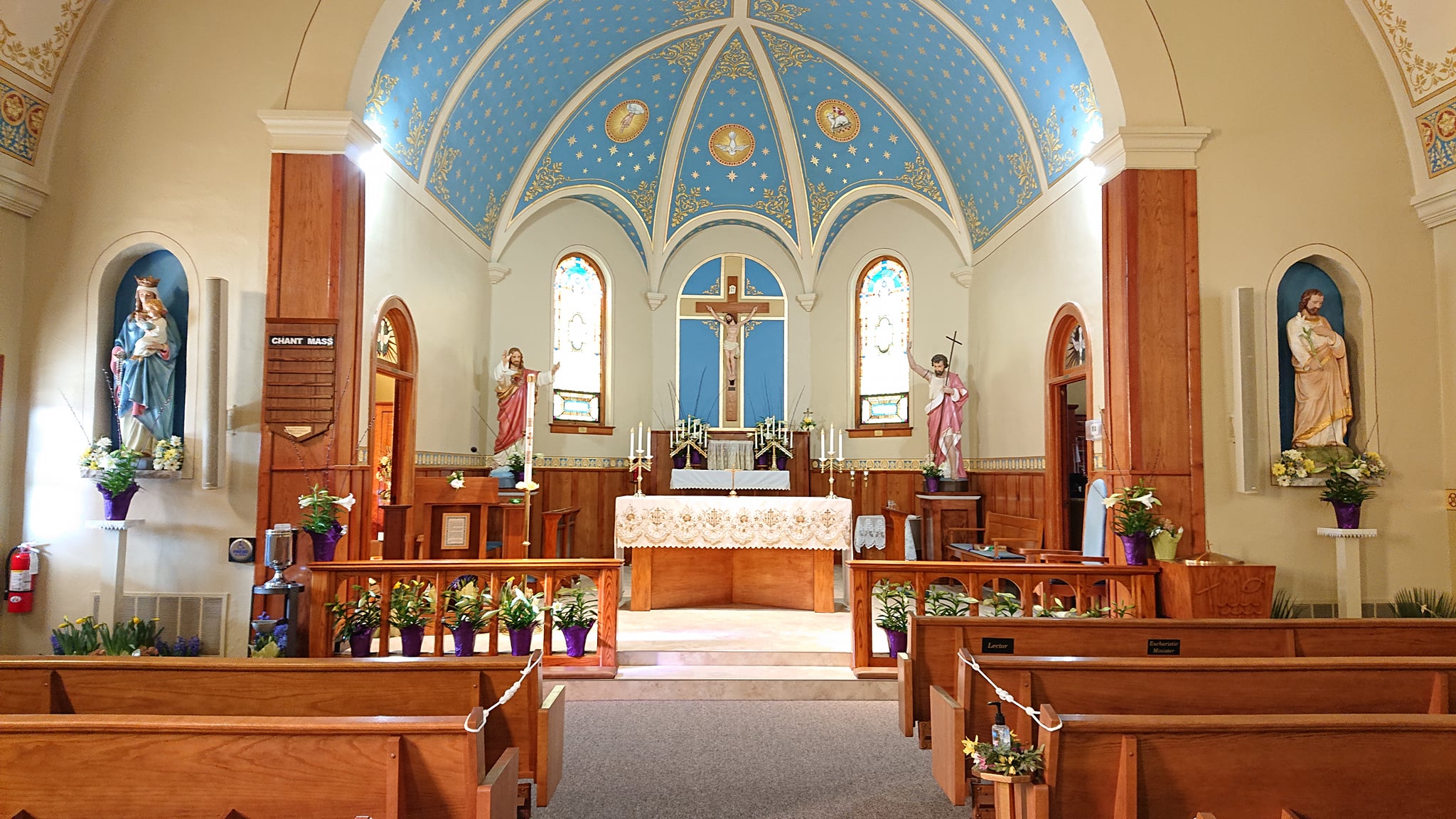
St. John the Baptist’s church interior renovation project is complete. And the widespread consensus is that it turned out absolutely beautifully. If you haven’t already, check it out in two weeks, during St. John’s Fall Festival on Sunday, September 12th. And today, St. John the Baptist Parish is completely free of long-term debt.

St. Paul’s Parish has wonderful news regarding its finances as well. St. Paul’s has been paying down a long-term debt which at times over the past ten years has exceeded $160,000. Parishioners’ generous giving towards the school roof and parish debt fundraising campaign (which ends at the end of August), plus a $100,000 gift from the estate of Sylvan Prill and a very recent $25,000 gift from the estate of Alta Beranek, will allow St. Paul’s to pay off all of our long-term debts next month. (Alta also graciously left a $25,000 gift to St. John the Baptist Parish.) Please consider remembering your parish in your will as well.

Both parishes being debt-free is a excellent thing, but please, please do not give up on or reduce your tithing. St. Paul’s, in years past, has come out of and back into debt before. If people stop giving, new debt will surely follow. Your generosity carried us successfully through the pandemic lockdown, and by the end of September both St. Paul’s and St. John’s will be completely debt free. That is something to celebrate and a hopeful sign for the future.

The faithfulness of the Thrift Sale’s many volunteers and customers is generating one of its best years ever, and St. Paul’s September 26th Fall Festival is just around the corner. Both parishes’ Finance Councils have happily adopted balanced budgets for the current fiscal year; but the outcome of these budgets, of course, depends upon your continued giving.

We are more blessed than we realize. Recent, terrible news from abroad reminds us that not all places on earth have the peace and freedom we enjoy. We all have much to be thankful for. “All good giving and every perfect gift is from above, coming down from the Father of lights.” So, echoing the words of the opening prayer of today’s Mass, with a deepening sense of reverence and love in our hearts for God’s name, let us give thanks to our God of might, the giver of every good gift.

Drawn to Jesus by God’s Grace

August 8, 2021

19th Sunday in Ordinary Time
By Deacon Matthew Bowe

There are many things that we are drawn to. I am drawn to delicious food, as you can tell. I am also drawn to playing golf, watching the Olympics, and spending time with friends and family. I have noticed that we can easily talk about the tangible and physical things that we are drawn to, whether it be sports, fishing, hunting, outdoor activities, card-playing, work, or any other thing. Curiously, I wondered how do we tell others about the spiritual things that we are drawn to? Examples include praying, going to Mass, charitable works, retreats, and any other sort of thing. Do we not tell people because we are not drawn to spiritual things, or do physical things attract us more than the spiritual things?

Currently, we are in the middle of the Bread of Life discourse from the Gospel of John. Two weeks ago, it was the reading about the multiplication of the loaves. Jesus fed five thousand people with just five barley loaves and two fish. In that story, the power of Jesus can do a lot with the little that we can give Him. Last week, the crowds pursued Jesus seeking to have this bread always, and the reading concluded with Jesus saying that he was the bread of life. Whoever comes to Him will never hunger, and whoever believes in Him will never thirst. In his writings, the evangelist John never uses the word “miracle.” Rather, he writes about the signs that Jesus worked. A sign points toward something. A stop sign signifies that it is the law to stop at this intersection. In this Gospel, the physical signs point to a spiritual reality. In this Bread of Life discourse, the physical sign is the bread, and the spiritual reality is that Jesus is the bread of life. This is one reason John wrote the Gospel – to show that Jesus was not only fully human but also fully divine.

Now, we turn to today’s Gospel reading. The Jews are murmuring and struggling that Jesus said that He is the bread that came down from heaven. The crowd could see the physical reality, or the humanity, of Jesus. They knew that Jesus was the son of Joseph and of Mary. However, they were spiritually blind. Despite the wonders and the signs that Jesus worked, they saw not the divinity of Jesus, the true bread that came down from heaven. Our culture today disbelieves the spiritual reality of the created world and idolizes the physical world. It is a culture that espouses that “science is everything,” “follow the science,” and “do whatever makes you happy,” yet the culture fails to recognize that the created world is more than just the physical and the pleasurable. That is not to say that the Church is anti-science. The Church promotes and espouses the arts and the sciences. Science leads us to a deeper understanding of the created world and thus of our Creator. Science serves to deepen our knowledge of God. The culture says that it is unreasonable to believe in God, but I say that is unreasonable to not believe in God and the spiritual reality of Creation.

Then, Jesus sternly answers the murmurs of the crowd. There is a lot here, most of which I will leave for your spiritual meditation. In each of our lives, God always makes the first move. When we pray, it is because He first drew us to pray. When we give charitably, it is because He first gave us the grace to do so. Everyone is capable of being drawn by the Father, but not everyone responds to that invitation. The early Church Fathers, who wrote commentaries on this passage, noted that the Arians, fourth-century heretics who denied the divinity of Christ (even after the Church declared otherwise), were not drawn by the Father. Because they denied a truth of the faith, they denied Truth Himself, who is Jesus Christ. Thus, they could not be drawn by the Father because the Father does not draw us partially. He draws us to Himself fully. Even people today who support and are gravely involved in any immorality or injustice condemned by the Church or hold opinions contrary to the teachings of the Church deny Truth and are thus not drawn by the Father. There is something that is lacking.

This is why we should pray, my brothers and sisters, that everyone may be drawn in by the Father, into the Catholic Church, which safeguards the fullness of Truth and Faith. There is always hope, for God is merciful and kind, as the Psalmist says. Repentance and conversion are always possible for us so long as there is life in us. This is the first way in which we are drawn by the Father. To repent of our sinful ways and to turn back toward Him. As St. Paul wrote to the Ephesians, we should remove all bitterness, fury, anger, shouting, reviling, and malice and replace it with kindness compassion, and forgiveness. We should imitate Christ. The ultimate imitation is sacrifice (even death on a cross). Then, we listen to Father, humbly being taught by God, and we will come to Jesus. Jesus is the bread of life, of life eternal. It is not by our bodies that we believe, but it is by our spirits that we choose to believe, through divine assistance. We who believe will be raised up on the last day and have eternal life.

How is it that we are intimately drawn into a spiritual union with Jesus? Foremost, it is via the Sacrament of the Holy Eucharist. The classic expression “You are what you eat” holds exceptionally true. Not only is there spiritual contact with Jesus, but we can also physically touch Jesus, for what was once ordinary bread becomes, by sacramental grace, the Real Presence, the Body of Christ. Jesus left us a Sacrament by which He is ever present on Earth. The Eucharist is the bread that comes down from heaven to lead us into heaven just as God came down from heaven and became Man. Whoever eats this bread will live forever, for this bread is the very flesh of Christ, Who is Life, and Jesus Who gives Life to the world. Brothers and sisters, let us pray that we may be drawn to Jesus today in this Blessed Sacrament, to believe more deeply in the Life of the world, and to delight in the heavenly things which are to come.

Beyond “Mercenary Love”

July 31, 2021

18th Sunday in Ordinary Time

Alongside other security personnel, the Holy Father and the Vatican City State are protected by one hundred and thirty-five men who have been called “the world’s smallest army.” Pilgrims and tourists to St. Peter’s Basilica may see them on duty wearing uniforms inspired by the Renaissance era – in garments comprised of yellow, blue, and red stripes and helmets topped with colored ostrich feathers. Yet these soldiers are not merely there for ceremonial decoration. Each of them takes a solemn vow to, if necessary, lay down their lives in defense of the pope. All of them are Roman Catholics, citizens of Switzerland, and have completed basic training with the Swiss Armed Forces. They are known as the Swiss Guard and have served the Holy Father semi-continuously for more than 500 years. But why Swiss guards, rather than Italian, Spanish, or French?

Before answering that, here is another small mystery of history. During the Revolutionary War, on the night of December 25th, 1776, General George Washington led his men in boats across the icy Delaware River to attack 1,500 enemy troops garrisoned in Trenton, New Jersey the next day. This daring tactic found their opponents unprepared. Our Continental Army suffered only two dead and five wounded in the mission but captured about nine hundred German soldiers. Yes that’s right, Germans. What were Germans doing in America during the Revolutionary War?

The reason why German soldiers fought for Great Britain in 1776 and why the pope began having Swiss guards in 1506 is that these troops were mercenaries, third-party soldiers-for-hire. In an era of conflict between Italian factions and his Papal States, the pope hired soldiers from friendly Switzerland five hundred miles away. It’s been the tradition to have Swiss guards ever since. And when the Revolutionary War broke out, the Holy Roman Emperor, Frederick II, saw an opportunity. He leased his German soldiers (nicknamed Hessians) to the British Empire to fight for them overseas.

Those serving in Swiss Guard today are remarkable and devout young men. And even if the pope were unable to continue paying their salaries I would not be surprised if almost all of them would faithfully complete their terms of service. The classic, mercenary soldier-for-hire, however, does not serve because he loves the king, country, or people he sides with, he does not risk his life because he believes in some just and noble purpose. The mercenary’s motivation is the money he is paid or promised. Deny him that payment and his loyalty and services will disappear with him. Similarly, the saints throughout the centuries have observed that many Christians have a “mercenary love” for God. That is, they love the Lord when times are easy, so as long as he “pays” them with many graces, consolations, and good things. But when those sensible blessings dry up, their loyal service and devotion disappear. Though God’s love does not depart from them, but they abandon him.

The Hebrews in the desert had witnessed God’s care for them. They saw the mighty deeds he wrought in the Exodus. But when they became hungry, the whole Israelite community grumbled. “Would that we had died at the Lord’s hand in the land of Egypt, as we sat by our fleshpots and ate our fill of bread! But you had to lead us into this desert to make the whole community die of famine!” God knew they needed food, he fully intended to meet their need, but he wanted them to trust in him and rely on him as a good Father. The Lord Jesus likewise desires a closer personal relationship with each one of us.

In today’s gospel, Jesus calls out the crowds at Capernaum on their mercenary motives. They love the gifts, but not yet the Giver. “Amen, amen,” he says to them, “you are looking for me not because you saw signs but because you ate the loaves and were filled. …Believe in [me,] the one [the Father] sent.” Jesus calls them higher, to a devoted love for himself, “Do not work for food that perishes but for the food that endures for eternal life, which the Son of Man will give you. … I am the bread of life.” When we look at ourselves, what is the quality of our love for God?

St. Basil the Great wrote in the fourth century: “If we turn away from evil out of fear of punishment, we are in the position of slaves. If we pursue the enticement of wages, …we resemble mercenaries. Finally, if we obey for the sake of the good itself and out of love for him who commands… we are in the position of [devoted] children.” The Doctor of the Church, St. Bernard Clairvaux observed in the twelfth century: “Whosoever praises God for his essential goodness, and not merely because of the benefits he has bestowed, does really love God for God’s sake, and not selfishly.” So how can we develop a more perfect love for God, and how can we be more faithful when our next dry time of trial comes?

One way to a purer, more personal love for God is to realize that when you come to the sacraments, Jesus Christ meets you there. The Eucharistic Host you receive is him. It is he who forgives your sins through the priest in Confession. And when you receive the Anointing of the Sick, Jesus is uniting your suffering to his and his strength to your weakness. So do not avoid encountering him and do not meet him on autopilot. Recognize whom you are approaching, appreciate the Gift and appreciate the Giver, and your relationship with Jesus will grow.

This personal relationship with the Lord is also cultivated through daily prayer. Memorized prayers can be very good. Our Fathers, Hail Marys, litanies, and chaplets are great. But they can also become routine and impersonal, like chores. Regularly speak to our heavenly friends in your own words as well. When you boil it down, there are basically four things we can say whenever we pray: “I’m sorry, please, I love you, and thank you.” That is, there are prayers of Sorrow, Asking, Loving, and Thanking. (That’s S-A-L-T or SALT.) Many people spend their prayer times focused on the first two: Sorrow and Asking: “I’m sorry, Lord, please forgive me. Please Lord, grant this good thing for me and for them.” Jesus wants to pray for such things, but be mindful that your prayers are properly seasoned with expressions of Loving and Thanking as well. “I love you, Lord, and I praise you. You are holy and worthy and good. I thank you for your blessings all around me.” Focus more on rejoicing in who he is and what he’s done, not just on the things you want, and your love for him will deepen.

And when you find yourself in your next dry desert, tried and hungering like the Hebrews, or fighting on your next battlefield, serving without appearing payment, do not spurn or abandon the Lord. Go to him with your needs, recognizing how much you need him. Realize that even when the pleasant, warm fuzzies of consolation are withdrawn for a time, the Lord’s love for you remains and he offers you his sufficient grace to keep going in his will. And be patient knowing, that sooner or later, felt consolations and peace will return. With a more personal, more pure, and more perfect love for God, you can persevere as far more than a slave or mercenary, but as a devoted child of the Father and a true friend of Christ, as you are meant to be.

The Day of Calamity

July 17, 2021

16th Sunday in Ordinary Time

Today I will be speaking to you about why the Jewish calendar is different from our own, about why this Sunday is of special significance in Jewish history, and about the enduring faithfulness of our Lord towards his people.

Like many ancient cultures, the Jews kept a lunar calendar, while we, and most of the world today, follow a particular solar calendar. Our modern calendar is called the Gregorian Calendar, instituted by Pope Gregory XII in 1582. For the Gregorian Calendar, one orbit around the Sun makes one year, counted as 365 days (or 366 days in a leap year). The Jewish calendar, instead, is focused on the Moon: one cycle of the Moon through its phases makes one month, counted as 29 or 30 days. Because the cycles of the Sun and Moon do not perfectly match-up, particular dates on solar and lunar calendars do not line-up either. This means the dates of Jewish holidays and observances float around on the Gregorian calendar. Today, for instance, is the ninth day of the Jewish month of Av. The ninth of Av falls on July 18th this year, but next year it will land on August 6th.

Detail of Destruction of the Temple of Jerusalem by Francesco Hayez, 1867The “ninth of Av,” also known as Tisha B’Av, is no ordinary day for observant Jews, but a day of fasting and abstaining, because ninth of Av has seen multiple calamities in Jewish history. First, during the Exodus, when the twelve spies sent by Moses returned from scouting the Land of Canaan, most of them voiced negative reports, saying there was no way The Promised Land could be conquered. The Hebrews despaired and cried and refused to proceed. As a consequence, God made his people spend 40 more years in the desert until almost all the adults of that generation had died without entering The Promised Land. The next calamity came in the days of the Prophet Jeremiah, after the founding of the Kingdom of Israel. In the sixth century B.C., the Jewish Temple built by King Solomon in Jerusalem was destroyed by the conquering Babylonians. With that disaster, the Jews were forced to leave their homeland and resettle in the East, and this Babylonian Exile lasted about seventy years until a significant number of Jews were able to return. A third catastrophe occurred in 70 A.D., when the Second Temple in Jerusalem was destroyed by the Romans in response to a Jewish revolt. Not one stone was left upon another, as Jesus had foretold about 40 years before it came to pass. All of these devastating catastrophes, all three of these traumatic, mournful events (the denial of The Promised Land and the destruction of the first and second Temples) are remembered as occurring over the ninth day of Av.

Each of these disasters flowed from the faithlessness or unfaithfulness of God’s people. All of the Hebrews in the Exodus had witnessed the Lord’s mighty power wielded against Egypt, yet they disbelieved that God would be with them and would enable them to enter the land he had promised to Abraham’s descendants. The Prophet Jeremiah in our first reading decries the shepherds of his day (that is, the leaders of the people) whose wickedness would lead to the fall of the nation and the scattering of the sheep. And before his Passion, Jesus once lamented: “Jerusalem, Jerusalem, you who kill the prophets and stone those sent to you, how many times I yearned to gather your children together, as a hen gathers her young under her wings, but you were unwilling! Behold, your house will be abandoned, desolate.” Jesus foresaw how that generation’s rejection of their Messiah would be followed by disaster.

Yet, in the face of this faithlessness and unfaithfulness among God’s people, God remained faithful to them. The first generation of Hebrews who had left Egypt were too afraid to enter the Promised Land, but God did not void his covenant with them. While denouncing the bad shepherds who led to the Babylonian Exile, God promises to gather his scattered flock again. And even as Jesus Christ was foretelling doom for Jerusalem from rejecting the Messiah, he spoke of his own people’s conversion to faith in him one day: “I tell you, you will not see me again until you say, ‘Blessed is he who comes in the name of the Lord.’

So what does all of this mean for you and me and the Church, the people of God’s New Covenant? Can calamities come to us? Yes – through our own unfaithful foolishness, or through the sins of others impacting our world; grave wrongs, tragic losses, painful sufferings, death. But when these calamities come, will the Lord still be with us? Yes. Through the Prophet Jeremiah he promised: “I myself will gather the remnant of my flock from all the lands.” In today’s Gospel, “When [Jesus] disembarked and saw the vast crowd, his heart was moved with pity for them, for they were like sheep without a shepherd; and he began to teach them many things.” Jesus declares, “I am the good shepherd, and I know mine and mine know me.” The Lord is our shepherd. He refreshes our souls. He guides us in right paths. Even when we walk through the dark valleys we need not fear evils, for he is at our side.

Last Sunday, a young woman named Sarah who graduated college five years ago, posted a beautiful tweet on Twitter that has been liked nearly 2,000 times. She wrote: “I looked at the crucifix at Mass today and saw love rather than death for the first time in my whole [dang] life.” Behold the Lamb of God, who takes away the sins of the world through the Cross. The Good Shepherd knows firsthand what it’s like to be a sheep like us. Jesus reassures us that he is with us and we need not be afraid. For whatever day of calamity may come, it is not the end of our story; the friends of God will rise again in glory.

The Fear of Inadequacies

July 12, 2021

15th Sunday in Ordinary Time
By Deacon Dick Kostner
Jesus at Prayer, Overlooking the Sea of GalileeOn my last homily I talked about the fact that faith can produce miracles. Today’s scripture readings helps us to understand how we acquire that gift of faith and participate in God’s divine partnership plan.
When I was studying for my Masters Degree in Pastoral Studies one of the revelations that God shared with me and that stood out in my mind was the fact that although God has no need to ask for help from anyone, that contrary to that he desires humans to participate in advancing and growing the body of Christ through human involvement in preaching and practicing the gospel message of love and service to others. The gift he bestows on those he asks for help from, and who accept his requests, is peace and happiness not only in this life but also the gift of the key to everlasting life in heaven.

For humans this presents us with obstacles in accepting those requests God asks from us, the greatest of which is our fear of inadequacy. Let me give you an example of this. When I began ministry studies one of my greatest fears was facing death or witnessing death. When I first got out of law school one of the first things I did was draft a will for myself and I placed a directive in it that I wished no funeral and requested that I be buried within twenty-four hours of my death. My thoughts were that this would make it easier for my family and friends to move on with their lives.

This fear stayed with me until I became a deacon and one day when our priest was on vacation, I received a call late one evening from our hospital. A car accident had happened and the family of the victim was trying to find a priest to administer the Sacrament of Healing for this young man. I advised the nurse that Father was gone out of town. She asked if I could come and be with the family. Fear hit me, and I told the nurse that I could not administer the Sacrament as deacons cannot do this. She then asked if I would come and maybe say some prayers with the family. My thoughts were that I was not adequate for the job and I did not feel I could do anything that would be beneficial for the family or their loved one. Then I remembered that part of my training for deacon ministry was to walk with someone and minister to someone who was dying. Fr. Frank, my director had assigned me to a elderly gentleman in Eau Claire who was terminally ill. I would meet with him on a weekly basis, at his home, and I would take Communion to him and his wife while spending time with him. I remember how after he died his wife called me and asked if I would do the Wake Service for him as he so much appreciated the times we got together while he was dying. I remembered how good this made me feel to know that they appreciated my company even though I felt inadequate for the mission Fr. Frank had assigned to me.

I decided to go and pray with that family at the hospital, and after doing so the family said they so much appreciated that I was willing to come and be with them during their suffering I finally realized that all that one needs to do is to show up and be there for those suffering and fearing death as the representative body of Christ. Jesus and the Holy Spirit do the rest. God knows that this is difficult for us but he always rewards those who say “Yes” to his call for help.

Our Gospel this weekend has Jesus telling his friends that its time for them to stand up and accept the job of helping others overcome their fears through their presence and healing. Jesus knows they don’t feel adequate for the job and so he sends them out in two’s knowing that this will help them feel more comfortable and capable of accepting their ministry mission. He tells them to not prepare and to take nothing with them as he promises to provide all the help that they will need to be successful.

Our parish at St. Paul’s is having a meeting this coming Monday to request help for our Fall Festival. This event provides not only financial support for the Parish but also allows its members to participate and say “Yes” to God’s requests for help. This will give evidence that Jesus is with us in helping not only others but ourselves to overcome our feelings of inadequacies. Like Jesus, the Parish is going to ask groups to come together as a unit to accomplish fellowship and support within our Parish Family Ministry. To the St. Paul’s committee people please plan on attending the meeting and by saying you will help build and exercise the Body of Christ in our community. St. John’s people encourage others to join you in planning your Parish activities to help reduce the fear we all have of being inadequate for the ministries asked of us by Jesus.

Remember the words of Jesus in today’s Gospel: “Take nothing for the journey but a walking stick—no food, no sack, no money.” Remember that God will provide you with everything necessary for his mission requests.

Lessons From The Gulag Archipelago

July 3, 2021

14th Sunday in Ordinary Time

Aleksandr Solzhenitsyn was a captain in the Red Army of the Soviet Union serving bravely on the front lines against the Germans in 1945. Three months before World War II’s end in Europe, his brigade commander summoned him to headquarters and asked for his pistol. When Solzhenitsyn handed it over two counterintelligence officers suddenly crossed the room. They ripped off the insignia from his uniform and shouted: “You are under arrest!” “Me? What for?” The pair gave him no answer. But as Solzhenitsyn was being hauled to the exit, the brigade commander firmly addressed him: “Solzhenitsyn. Come back here.” With a sharp turn he broke loose and stepped back to his superior.

Solzhenitsyn had never known his commanding officer very well. This colonel had never condescended to run-of-the-mill conversations with him, but now his ever-stern face displayed thoughtfulness. “You have…” the colonel asked weightily, “a friend on the First Ukrainian Front?” Solzhenitsyn understood instantly: he was being arrested for criticizing Joseph Stalin in private letters to a school friend. Over the decades, many millions would suffer in the soviet prison camps (known as gulags) for offenses as small as this or less.

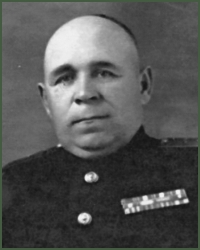
Travkin Zakhar Grigorevich

The counterintelligence officers objected. They shouted at the colonel for his revelation to the prisoner: “It’s forbidden! You have no right!” The colonel could get himself arrested, too. As Solzhenitsyn recalls in his own words, his colonel, “Zakhar Georgiyevich Travkin could have stopped right there! But no! Continuing his attempt to expunge his part in this and to stand erect before his own conscience, he rose from behind his desk — he had never stood up in my presence in my former life — and reached across the quarantine line that separated us and gave me his hand, although he would never have reached out his hand to me had I remained a free man. And pressing my hand… showing that warmth that may appear in an habitually severe face, he said fearlessly and precisely: ‘I wish you happiness. Captain!’ Not only was I no longer a captain, but I had been exposed as an enemy of the people… And he had wished [me] happiness…” Despite the danger to himself, the colonel did what little he could to bless and console a persecuted man – and Aleksandr Solzhenitsyn never forgot this.

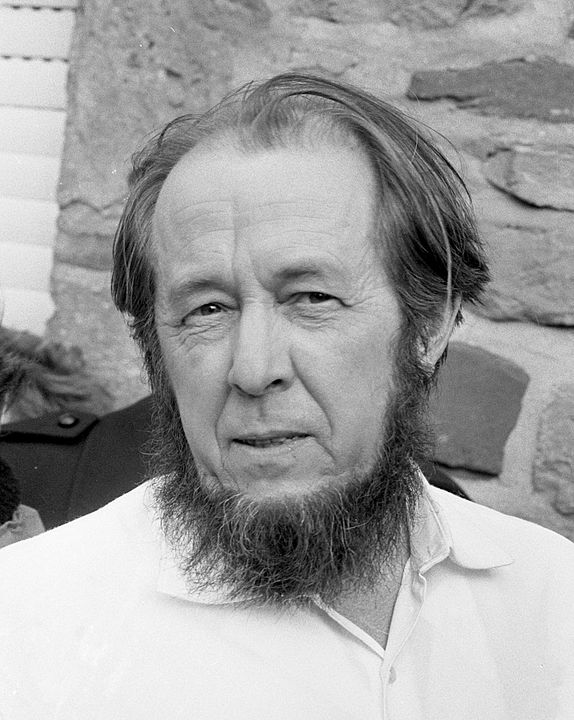
Aleksandr Solzhenitsyn in 1974Solzhenitsyn would go on to survive almost eight years inside prisons and forced labor camps. After his release, he became a world famous author, winning the Nobel Prize for Literature in 1970. But the publication of his most important work, The Gulag Archipelago in 1973, outraged the soviet authorities. They stripped him of his citizenship and expelled him from the USSR – they rejected him in his native place. Two Christmases ago, St. John the Baptist’s Altar Rosary Society gifted to me a subscription to Audible. A week and a half ago, I activated it and this non-fiction book, The Gulag Archipelago, is the first thing I’m listening to. It draws on interviews, documents, diaries, and Solzhenitsyn’s own experiences as a prisoner to detail the history and the horrors of soviet gulags from 1918 to 1956.

The dictator Joseph Stalin suspected and feared he had enemies everywhere, so he would hand down orders for entire groups to be arrested (“Arrest all the generals in the Red Army”) and he ordered large numbers of political arrests to be made (“Arrest 200 people in this city for political crimes by month’s end”). To fill their quotas, the police would arrest innocent people, employ terrible tortures to extract confessions, and then ship these condemned persons off to camps, often to die there from a bullet or from the inhuman conditions.

Getting confessions was very important for the corrupt and cynical interrogators. Caring nothing whether the accused were actually criminal conspirators, they inflicted intense physical and psychological sufferings to make them admit guilt and implicate others. These police were not afraid to lie, and any court trials there were were just for show. In that case, instead of breaking their victims, why didn’t the interrogators just forge signatures onto confessions? I suspect this was due to demonic influence. Demons delight to see the wicked do evil, but they are pleased still more by seeing the good fall, to see them sin by betraying the truth and betraying those they love. Solzhenitsyn urges us to have mercy on those who people fell: “Brother mine! Do not condemn those who, finding themselves in such a situation, turned out to be weak and confessed to more than they should have. … Do not be the first to cast a stone at them.

Vera Korneyeva as a young womanSome prisoners did not lie or betray anyone, but even took the opportunity to proclaim the truth. Solzhenitsyn tells the story of one Vera Korneyeva who was arrested with all seventeen members of a Christian group. Her interrogator had left her alone in a large office of the police building where half a dozen employees were sitting. A conversation started and Vera launched into a sermon. In freedom, she had been no more than a lathe operator, a stable girl, and a housewife. But the typists, stenographers, and file clerks of the secret police listened, sometimes asking her questions. People came in from other offices and the room filled up. She spoke mostly about religious faith and religious believers, and asked why anyone would need to persecute Christians.

Believers don’t need to be watched,” she said, “they do not steal, and they do not shirk [their duties]. Do you think you can build a just society on a foundation of self-serving and envious people? Everything in the country is falling apart. Why do you spit in the hearts of your best? … Why arrest [religious] people?” At that point, her interrogator reentered and started to rudely interrupt her. But everyone shouted at him: “Oh, shut up! Keep quiet! Go ahead, woman, talk.” Solzhenitsyn notes they were forbidden to call her comrade or citizen, but they referred to Vera with the honorable title Christ used: “woman,” and she continued in the presence of her interrogator. So there in an office of the police headquarters they listened to Vera Korneyeva — and why did the words of an insignificant prisoner touch them so? Like Ezekiel, a prophet had been among them.

Soviet prisons and gulags were hellish places, but like Mount Calvary, the Lord was present even there. Nikolai Aleksandrovich Kozyrev, whose brilliant career in astronomy was interrupted by his arrest, sustained himself in prison by doing theoretical work in his mind. His line of mental exploration, however, was blocked by forgotten figures. He could not build any further — he needed the data to develop his theory, but how could he obtain this from his solitary-confinement cell? The scientist prayed: “Please, God! I have done everything I could. Please help me! Please help me continue!” His eyes were fixed on the Lord, pleading for his mercy.

At that time, he was entitled to receive one book every ten days. Half an hour after his prayer, they came to exchange his book. As usual, without asking anything at all, they pushed a book at him. It was entitled A Course in Astrophysics! What was a book like this doing in a prison library? Kozyrev threw himself into it and began memorizing everything he needed and everything he might need later on. After two days, the prison chief made a surprise inspection of his cell and immediately noticed the book. “But you are an astronomer?” “Yes,” he answered. “Take this book away from him!” Yet its providential arrival had opened the way for the scientist’s further work, helping his mind and spirit survive his ten years of detention. Following his release, Dr. Kozyrev would go on to be the discoverer, through telescopic observations, of tectonic activity on the Moon. In other words, he discovered that there is hot magma inside of the Moon. Like Jesus Christ, the Moon is not long-dead (as many have thought) but is dynamically alive today.

Nikolai Aleksandrovich Kozyrev in 1958

Solzhenitsyn observed in 1983, “There always is this fallacious belief [around the world about great atrocities]: ‘It would not be the same here; here such things are impossible.’ Alas, all the evil of the twentieth century is possible everywhere on earth.” Will this church one day be torched by arsonists, as Catholic churches are now being burned down in Canada? Could we one day be fired, beaten, or arrested, be separated from our families, be deprived of our material possessions, or die because of our faith? Jesus Christ was perfect and sinless, “and they took offense at him.” He was hated, denounced, tortured, and murdered. If they persecuted him, why wouldn’t the world persecute us? I do not know how severe the persecution of Christians will become in our lifetimes, but I see no reason not to prepare our souls for this eventuality.

If we are to be like Jesus, even up to the point of dying like Christ rather than denying him (and indeed we are each called to be willing to do this) then we must begin practicing with the little things. Jesus says, “Whoever is trustworthy in very small matters is also trustworthy in great ones; and whoever who is dishonest in very small matters is also dishonest in great ones.” So we must never lie. Make no false professions or false confessions. As Jesus teaches us, “Let your ‘Yes’ mean ‘Yes,’ and your ‘No’ mean ‘No.’ Anything more is from the evil one.”

In addition to never telling falsehoods, we are called to speak the truth, like the woman Vera in the heart of the police organization. Are you afraid of what other people will think? Realize that they are concerned about what you think, too. If you are open, the Holy Spirit will give you opportunities to share the truth with others. Like Colonel Travkin with his accused Captain Solzhenitsyn, we must also be courageous enough to remain loyal to our peers when others would denounce and abandon them. And we must pray and rely on God, like Dr. Kozyrev (who was seemingly, but not truly) alone in his prison cell. Remember that Christ’s grace is sufficient for you, and his power is made perfect in weakness.

Practice these four things: never lie, share the truth, be loyal, and rely on Christ. Even if, in God’s Providence, you never come to suffer like Christ’s martyrs, by practicing these things you will become more like our Lord Jesus Christ.

Faith – The Miracle Worker

June 28, 2021

Blessed Mother Teresa with a happy, armless baby, photo by Eddie Adams of AP

13th Sunday in Ordinary Time
By Deacon Dick Kostner

What stood out for me with today’s readings is the fact that even though we have entered and begun “Ordinary Times” in our Church calendar, that since the Incarnation there does not exist anything that is “Ordinary” in our lives anymore. Miracles appear everywhere and everyday if we but possess the mustard seed of faith. Jesus has taught us that faith as small as a mustard seed will allow his followers to heal those who are ill, will allow us to accomplish supernatural tasks and move mountains that are not physically or humanly possible to move.

My mind journey began when I heard Deacon Matt’s homily on Trinity Sunday and how God has gifted those who have been baptized with supernatural abilities through membership into the family of the Trinity. Through the Sacraments we enter into a unitive state of being one in spirit with the Creator. A state of being where we communicate spiritually with the Trinity and God’s plan to make us one in thought and vocation with him.

Our gospel tells us that the key to life now and forever is “faith.” Jesus has shown us and told us to pick our friends carefully and listen to them. Follow their teachings to see miracles happen before our eyes. Let me tell you three stories about people of great faith who most of you lived with and know by name who have accomplished supernatural tasks through faith. Two are Christmas stories. The first involves Cecelia.

Cecelia and I were friends and she many times would tell me how much she enjoyed my homilies. Her and her sister were friends of my mom and were golf buddies. Cecelia was a daily Mass person and a person of prayer. She was very much concerned about the struggles the Church was having with its ministers and she would ask my advice on things that bothered her. When I had no good answer to the problems she would say, “I guess I will have to pray harder.” When I heard of her death on the Sunday before Christmas I was saddened and knew that I needed to attend her funeral to pray for her and say goodbye to her. The next day, Fr. Victor asked if I would do a Communion Service as he had three funerals scheduled for that week.

On the way to church that Monday, I was listening to Phlash Phelps on Sirius 60 Radio and he told how when he was a young boy his parents had invited their pastor to join them for Christmas Dinner. Phlash said that as a child he was in charge of putting the angel on the Christmas tree by using a hook pole to elevate the angel to the top of the tree. At Christmas dinner the Pastor had asked him what he liked most about Christmas and he responded proudly, “Getting the hooker to put the angel on their Christmas tree.” His parents turned very red and all had a good laugh over his response. I thought to myself, Cecelia would have loved that story and after the final blessing I shared that thought and story with the daily Mass people as a farewell to Cecelia.

That afternoon I began getting thoughts from Cecelia that were asking me to do the homily for her funeral. I called Father and told him that I could do that if he so desired. He was more than happy as he had two other funerals to do for that week. As I was preparing my homily, I thought about how Cecelia and her sister always got into it and argued and I had made the comment that Jesus would have to put up with the “girls” arguing at his birthday party and would have his hands full keeping them in line.

That evening, I received a call from her niece who said she very much enjoyed my homily and that she had been with Cecelia the day that she died. She shared with me that just before she died Cecelia had said, “I think it is time now for me to join my sisters and Jesus for Christmas.” The niece said that she asked Cecelia who Jesus would listen to more with all the “girls” being present and pressuring for recognition from Jesus? Cecelia answered: “The one who is the loudest.” I told Father about this when I told him that I believed we had just buried a Saint. Knowing Cecelia I am sure Jesus was gifted with the hooker story on his birthday that I had gifted Cecelia with at church that day.

The second faith story is about Kathleen when she died some years before on Christmas Day. I had been called over to her home by the family to do some prayers for the family that Christmas evening. Kathleen was one of my original RCIA ministers when I began that program at St. Paul’s and I was well aware of how strong her faith was in Jesus. The family shared with me that she had been dying for many days and the family kept telling her to not worry and that it was OK for her to leave and join Jesus for his birthday party. Her response was, “I know but I just want to savor this time and I will not leave until after we enjoy our customary Christmas meal.” Right after they had eaten she passed. I told her niece that I believe we were blessed with having lived with and prayed with a saint.

The final faith story is a story my cousin Bishop Bob told me about Mother Theresa. Bishop Bob was Bishop for the Diocese of San Diego. Mother Theresa had scheduled some dental work to be done on her mouth and while visiting the area she met with Bishop Bob and asked him if he would drive her around to look at some houses she was thinking about acquiring in the area to set up a new Home for the poor. He agreed and after looking at one house she said to Bob, “I like this one let’s take it.” The bishops’ jaw dropped. Now you need to know Bob is not a person who just jumps into a situation and he explained to her that the house was very expensive and it would take some time to raise the funds necessary to purchase it. Her response was to smile and say, “Oh Robert, you have such little faith!” She reached into her pocket and produced a small medal of Mary. She instructed him to place the medal over the door of the house that she wanted, and they left.

That Sunday, Bishop Bob introduced Mother to the parish and told of her plans to purchase a house for the poor in the area. He indicated that they were planning on a fundraiser in the parish to accomplish this task. After Mass Bishop Bob heard a knock on his door and a lady appeared saying she had been at Mass and heard him talk about raising money to purchase this house that Mother Theresa wanted. She proceeded to take out her checkbook and said, “What is the cost of the house?” He told her and she proceeded to sign a check for the entire amount. I can only imagine the look on Bob’s face of “little faith.” I am sure you too will be able to see and experience that with the faith of a mustard seed anything is possible, even moving a mountain, and that fear will never be able to overcome faith’s power.

Before I began to write this homily I said Morning Prayer and this statement appeared: Ephesians 4:3-6. In closing I share this scripture statement with you:

“Make every effort to preserve the unity which has the Spirit as its origin and peace as its binding force. There is but one body and one Spirit, just as there is but one hope given all of you by your call. There is one Lord, one faith, one baptism; one God and Father of all, who is over all, and works through all, and is in all.”

Amen.

Lovingly Received — Funeral Homily for Allen Pietz, 62

June 22, 2021

Allen is a dear acquaintance of mine. Unlike many of the persons I offer funerals for, I know him really well. But today I’m going to begin by telling you about another warm acquaintance of mine and the story he once told me. I went to seminary with a fellow who is now a diocesan priest in South Carolina named Fr. Andrew Trapp. Fr. Andrew looks a lot like the actor Tobey Maguire (who starred in the Spider-Man movie franchise) and Andrew also has a Peter-Parker-like friendly goodness. Fr. Andrew got a little famous back around 2010 when he beat the champion poker player Daniel Negreanu on a TV game show. He won $100,000 and donated his whole prize (after taxes) to his parish’s renovation project. Before he was ordained, Andrew spent a summer in Paris, France improving his French and helping out at a Catholic church.

There he met a former satanic worshipper who had repented, reconciled to God, and became a member of that parish. Andrew knew that Satanists were known to steal the Holy Eucharist, the Body of Christ, for use and abuse in their rituals. (I’ve heard elsewhere that Satanists are interested in stealing only the Catholic Church’s Communion Hosts to perform Black Masses and other sacrileges.) Andrew asked the man whether it was true that Satanists test their followers using these stolen Hosts, placing a Consecrated Host in a line-up of identical, unconsecrated wafers to see if the person could identify which one it is. The man responded that he had undergone this test and successfully passed it. Andrew asked him, “How did you know which host was the Lord?” And the man replied, “It was the one that I felt hatred towards.”

No brief funeral homily can tell the whole story of a person’s life, but sometimes a particular aspect of a Christian’s life can proclaim the most important things. Allen did not grow up Catholic. He started attending Mass at St. Paul’s in the front row with Sylvia. And it was here that he fell in love with the Holy Eucharist. Sylvia remembers Allen pointing to the altar and saying, “I want that Bread.” This desire was the main reason Allen became Catholic, got Confirmed, and received his First Holy Communion here in 2020, exactly a year and one week before his death. Allen was always eager to receive the Holy Eucharist on Sundays. And whenever he couldn’t come, he missed it profoundly. Sometimes he could barely walk and he still came to Mass. What fueled this intense longing and devotion in Allen? It was the love he felt for Jesus in the Eucharist.

It was Jesus, who said, “I am the living bread that came down from heaven; whoever eats this bread will live forever; and the bread that I will give is my Flesh for the life of the world.” When those in the crowd murmured at this, objecting, “How can this man give us his flesh to eat?” Jesus answered, “Amen, amen, I say to you… [M]y Flesh is true food, and my Blood is true drink. Whoever eats my Flesh and drinks my Blood remains in me and I in him.” Jesus says, “Whoever eats my Flesh and drinks my Blood has eternal life, and I will raise him on the last day.”

In truth, Allen’s great love for Jesus in the Eucharist was only a weak reflection of Jesus’ love for Allen. And what will separate friends of Jesus Christ from the love of Christ? Neither death nor life, neither present things nor future things, neither height nor depth, neither angels nor powers, nor any other created thing will be able to separate them from the love of God in Christ Jesus our Lord. It is right that we pray today for the perfection and glory of our friend Allen’s soul, but we do so with great peace and confidence that Allen, who was so eager to receive our Lord in the Eucharist, will himself be eagerly received by our loving Lord.

Allen Pietz after his 1st Communion

Allen Pietz on the day of his First Communion, June 7, 2020

Valuable Lessons for Life — The Craig & Debbie Zwiefelhofer Wedding

June 22, 2021

Ring Heart Shadow on Bible

Craig and Debbie, today you are here in this beautiful church to freely give yourselves to each other in marriage. Christ’s Church has discerned and affirms that you are both free to marry, and we gather together to celebrate this day with you. The excellent Scripture readings that you selected, and which we all just heard, contain valuable lessons for life. May their inspired insights bless your marriage and every household which takes them to heart.

In our first reading, on their wedding night, Tobiah arises from bed and says to his wife, “Sister, get up. Let’s pray…” Sarah gets up and they start to pray, praising and thanking God, and asking for his help and blessings. And they conclude, saying together, “Amen, amen.” There are couples who have shared a bed for decades who have never shared their prayers like this. They may go to church on Sunday or pray before meals—and that’s great—but sharing prayer as a couple like this is a greater intimacy. You do not need to be eloquent. You can even pray together silently. On a regular basis, offer two or three personal things for your spouse to pray about for you, and ask your spouse to share two or three things you can pray about to God for them. You can pray silently for each other for even just a minute or two and simply wrap up with an Our Father and Hail Mary.

A couple that prays together, and for each other, will be more perfectly one. A life of prayer is also a cure for our anxieties and fears. St. Paul reminds us in our second reading, “The Lord is near.” Therefore, he writes:

“Have no anxiety at all, but in everything,
  by prayer and petition, with thanksgiving,
  make your requests known to God.
  Then the peace of God
  that surpasses all understanding
  will guard your hearts and minds in Christ Jesus.”

The world and my problems may be bigger than me, but God is bigger than them both. Pray often and God’s peace, even without your fully understanding what he is doing, will secure and calm your hearts and minds. St. Paul then goes on to teach the Philippians and us another lesson:

“[B]rothers and sisters,
  whatever is true, whatever is honorable,
  whatever is just, whatever is pure,
  whatever is lovely, whatever is gracious,
  if there is any excellence
  and if there is anything worthy of praise,
  think about these things.”

If you ask someone, “How you doing?” and they say, “I can’t complain,” they don’t mean it literally. Everybody can complain. Things to complain about are all around us. Even good things can be complained about for not being better. Anybody can complain because complaining is easy. But to focus on what is lovely, excellent, and praiseworthy is a choice. Highlighting the good in your everyday life will nurture peace within you, peace between you, and peace around you. Finally, we come to Jesus’ words in our Gospel. Jesus tells his disciples:

“This is my commandment:
  love one another as I love you.
  No one has greater love than this,
  to lay down one’s life for one’s friends.”

Ahead of you are good times and trials, both joys and sufferings, Mount Tabors and Mount Calvarys. Choose to love through them all and your Good Fridays will lead to Easter Sundays. In conclusion, pray together, focus on what is good, and choose to love like Jesus loves you and you will be blessed.

Hearts Like His — The Nathan & Cassandra Hagenbrock Wedding

June 12, 2021

Solemnity of the Most Sacred Heart of Jesus

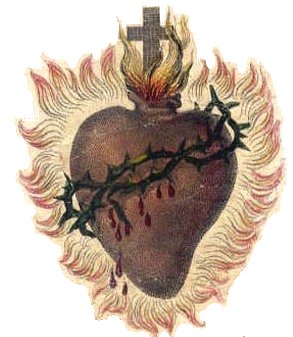
Sacred Heart of JesusNathan and Cassie’s wedding day lands upon this, the third Friday after the Feast of Pentecost, the eleventh day of June. God’s providence has arranged it that they be married on this special day – a feast day, the Solemnity of the Sacred Heart of Jesus, during a month especially dedicated to Jesus’ Sacred Heart. You can see depictions of the Sacred Heart inside this church. There is the statue of Jesus behind me, here in the sanctuary, and presently another statue in our devotional corner in the back. In artistic depictions, you may see Jesus’ Sacred Heart resting upon his chest, or maybe he holds it in his hand offering it to you, and sometimes his heart is depicted by all itself. In every depiction it is a human heart, crowned with thorns, pierced on the side, with flames and a cross emerging from the top. What is the meaning of these things? What do they reveal about Jesus? And what do they mean for Nathan and Cassie and us?

The heart is the organ within every human being which is most associated symbolically with emotion, devotion, and love. Since becoming man through his Incarnation two thousand years ago, the Eternal Son of God, Jesus Christ, has possessed a literal human heart in himself. And Jesus has personally experienced human feelings as well. But Jesus and his heart are not merely human, but divine. This reality is symbolized by the flames. As at the burning bush in Exodus, these flames do not consume his heart, but coexist with it and glorify it. Jesus feels and loves with a divine intensity, and this love leads him to sacrifice for love. This love gives rise to the Cross, upon which he suffered for us. This love occasions the crown of thorns, which he wore for us. And this love led to Jesus’ heart being pierced, the event we hear about in today’s Gospel. Jesus’ Sacred Heart is human and compassionate, divine and loving, long-suffering and glorious. And it is the will of Jesus, meek and humble of heart, to make our hearts like unto his, that you may endure suffering, be loving, and be made glorious.

You can see that this world is broken. Other people are broken. And you know, Nathan and Cassie, that though there is a great deal to like about you both, neither of you is yet perfect. Know that in your marriage, you will inevitably encounter suffering; sufferings caused by the world, sufferings caused by other people, and sometimes sufferings caused by each other. But when these thorns and small cuts come, do not let the fire of your love go out. Choose to keep loving, willing the good of each other. This is how Jesus loves us, and how he calls us to love.

This persistent decision to love is essential, but it is not enough. To love beyond human strength requires God’s strength; divine fire burning in your heart. You must love with Jesus’ love by connecting with him; praying daily, worshipping weekly, and communing with him constantly (spiritually or sacramentally) as you are able. Love each other by the love with which he loves you.

Choosing to love with the love of Christ in marriage is now your calling. This vocation together is to be for your joy, fruitfulness, and glory in the likeness of Christ. May Jesus Christ make your our hearts like unto his Sacred Heart, so that you may endure suffering, be loving, and be made glorious, like Jesus Christ himself.

“As the Father Loves Me, so I Also Love You”

May 8, 2021

6th Sunday of Easter

Who was the first person on earth to know you in your lifetime? Upon reflection, you realize it was your mother. Your mother knew you long before you knew her. And I would wager that she loved you as herself, even willing perhaps to lay down her life for you with the greatest love.

An unborn baby’s understanding of things, of its mother and of itself, is limited. But the mother surrounds the baby. She is responsible for and behind the child’s entire universe. The little one is totally dependent upon her, and experiences everything in the midst of mom. Though the sound is quiet and somewhat muffled with distracting noises, the listening little child can hear the mother’s voice and feel her pulse. Imagine an unborn baby doubting and asking, “Does Mom really exist? Is there really a mother at all?

It is right that we love our mothers, though we ought not to make them into idols. When Cornelius met St. Peter, the Roman centurion fell at his feet to do him homage, but Peter raised him back to his feet, saying, “Get up. I myself am also a human being.” Only one mother in human history has been perfect, but our parents present us with our first living image and icon of God.

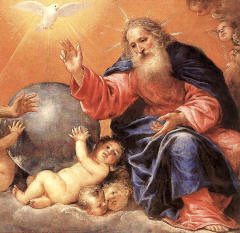
The Holy TrinityAs much as a baby receives from his or her mother, the Son of God receives still more so from his Father. How does God the Father give life to his Son? The Son is eternally begotten of the Father; “God from God, Light from Light, true God from true God.” The Father gives his whole being to the Son, and his Son, so loved, receives everything with joy. In today’s Gospel, Jesus says, “As the Father loves me, so I also love you.” How does God love you and me like the Father loves the Son?

For starters, God loves us first. The Father and Son are coeternal, but the self-gifting of the Father is the source of the Son, who then loves the Father, self-gifting himself in return. Likewise, God loves us and gives himself to us first, before inviting us to do the same. “In this is love,” St. John writes in our second reading, “not that we have loved God, but that he loved us and sent his Son as expiation for our sins.” And St. Paul tells the Romans, “God proves his love for us in that while we were still sinners Christ died for us.

Another way we are loved like the Father loves the Son is in how we receive every good thing from God. Like an unborn child receives from its mother, and the eternal Son receives from the Father, you receive everything from God through Jesus Christ. St. Paul speaks of the importance of the Son to the Colossians: “In him everything in heaven and on earth was created, things visible and invisible… all things were created through him… He is before all things, and in him everything continues in being.” For us, Jesus Christ is the one through whom all good things come.

Now would it make any sense for an unborn child, who is cherished by its mother, to see his or her mommy as an enemy? Or could God the Father and God the Son ever be rivals? Of course not! And yet we are guarded against Jesus. We hesitate to share our time with him, we hesitate to give our money for him, we hesitate to forsake our habitual sins for him. So I challenge you, I dare you, to trust more in him who loves you.

When Jesus says, “Remain in my love. If you keep my commandments, you will remain in my love,” he is not threatening to stop loving us. No—we must keep Christ’s commandments, doing his loving will, to fully receive everything he wants to give us. Jesus, who is first loved by God, who receives everything from God, who does God’s will, who rejoices and remains in God, who loves God and self-gifts himself fruitfully in return to God, desires you and me to experience the same blessedness. “If you keep my commandments,” he says, “you will remain in my love just as I have kept my Father’s commandments and remain in his love. I have told you this so that my joy may be in you and your joy might be complete. … It was not you who chose me, but I who chose you and appointed you to go and bear fruit that will remain.”

This Sunday, let us love, honor, and pray for the mothers from whom we were born on earth; while we love, honor, and trust all the more the eternal Son through whom we are born again from above.

HABITS Produce Much Fruit

May 1, 2021

5th Sunday of Easter
By Deacon Dick Kostner

Descending VineyardOur Gospel from John has Jesus telling his disciples, telling us, how we can survive and be happy not only in this life but gain for us everlasting life if we but realize our dependence for success and life depends on our acceptance of the fact that we cannot succeed without help from the “Vine,” without Jesus. In preparing for this homily, I went to Formed to get their take on today’s gospel. The minister who reflected upon the Gospel said that we need “HABITS” to allow us to produce fruits from the vine of God, who is Jesus, in order to deal with the challenges that we will face if we wish to be followers of Christ and find peace and experience a successful life as we journey to the Father’s house.

H” stands for Holy Time. We need to commit and schedule within our busy life “time” to communicate with Jesus. Many refer to this communication as prayer. I like to think of it as conversation with Jesus about challenges that we are facing as we journey as well as pleasures and great happiness gifts that we appreciate and recognize as being given to us by God, the “dog treats” God graces us with for being fruitful branches of His divine vine. The minister suggested starting with a commitment of ten minutes a day to communicate with Jesus and letting it grow from there.

A” stands for Accountability. The minister said this stands for us having at least one close friend that we can confide in and request guidance, when we need help and direction. I would suggest that this be a person who has already established a close relationship with Jesus and who is a healthy branch of the vine of Jesus. I can remember when shortly after I was ordained I met with our new priest, Fr. Norm Boneck, and asked him if I could develop a per-baptism class at St. Paul’s as we had no program at that time and he responded by saying, “NO! I want you to start an RCIA program for the parish!” Panic hit me. I had absolutely no experience or knowledge of how that could happen. I thought to myself, “Man, you picked the wrong dude to tackle that job.” Barb remembered that one of my deacon friends had mentioned that he and his wife had done a program at their parish, and she suggested I call him and yell “help!” I did that and he invited us to go to Wisconsin Rapids and met with him for some advice. The first thing he said to me is to not worry and that he had experienced the same panic and that the Holy Spirit would not let be get into too deep of water so as to drown. With His help and guidance St. Paul’s began an RCIA program which has produced much fruit from this Branch.

B” stands for Bible. We need to get to know Jesus as a person and that can best be accomplished by reading about him and living a life based on the Gospel messages. Through Scripture we learn that Jesus was given to us to shepherd his followers. We discover that there does exist an evil one who uses the tools of confusion, deception, and fear to control us and lead us away from the protection of the Good Shepherd and his guard dog His Church. We have witnessed this first hand this last year where the world has become afraid and confused by the Covid. We see how evil has attacked our guardian the Church and the faith it teaches to leave us feeling helpless. All this helps separate us from truth and the protection our faith gives us to suppress and overcome the evil in this world.

I” stands for Investing and supporting the parish we are assigned too. The message from Jesus is that we not only read his Word but also live his Word by example. Good fruit requires commitment in the form of financial support of our parish as well as a commitment of our time and talents to our parish so that it may remain healthy and fruitful. Our parish needs your commitment of time, talent, and treasures to be a successful and healthy branch of God that will produce much fruit. Statistics show that only about 30% of a parish membership support their church with their commitment. Only 30% of the people are helping to keep the branch of Christ active and healthy. That percentage needs to increase if we are to produce a good crop of fruit during our lives.

T” stands for Tell Others. We need to share with others the benefits that we will be gifted with if we are productive branches of Christ. We need to share with others the “dog treats” the graces that God has bestowed upon us for being active followers of Jesus. Jesus tells us to spread the Good Word.

Finally, “S” stands for Sacraments. The Church of Jesus is one that is based on Sacrament. Sacrament bestows upon us graces which can and will produce super natural powers that will be gifted upon those who celebrate the Sacraments. These gifts from Jesus will provide us with energy and powers of accomplishment beyond human capabilities. Through the spiritual graces gifted us through participation in the Sacraments the Branches are fed nutrients from the Vine that will allow us to accomplish tasks that would otherwise be humanly impossible.

Bottom line is that we are all dependent upon the Vine for protection from the storms of life and production of fruit. Let us all form HABITS that will make us healthy branches that will produce much fruit from the vine for all who wish to enter the Kingdom of God.