Archive for the ‘Christian Perfection’ Category

Chihuahuas & Heavenly Glory — 22nd Sunday of Ordinary Time—Year C

September 1, 2019


Saturday Night Live used to have a running bit called “Deep Thoughts, by Jack Handy,” and this was my all-time favorite Deep Thought:

I hope if dogs ever take over the world, and they choose a king, I hope they don’t just go by size, because I bet there are some Chihuahuas with some good ideas.

Imagine if our human social standing in the world were based upon size. What if we were looked up to, or looked down upon, because of our height? I imagine that more men would wear big boots and more women would wear high heels. Guys would don tall hats and gals would keep their hair up. Basketball would be the sport of kings. And some unfriendly folk would say, “I don’t want no short people round here.”

Or, what if our worldly status were based upon the alphabetical order of our last names? A, B, and C families would have every honor and advantage, and the middle letter households would be considered middle class. I suspect there would be more romantic stories and fairy tales about Andersons marrying Zwiefelhofers. And I can picture lots of people legally changing their last names, until perhaps this practice got outlawed by a new law signed by President Aaaaaaaaaaaaaaaaah.

These are silly and unjust ways to structure a society. But what is the basis for social standing and status in our real world? Money comes to mind. Now people usually work for their pay or profits, so personal wealth is a personal trait that – to some degree – is earned. But how much have we really merited all the wealth that we possess? Compared to international averages, all of us here are very rich. I try to do my best in ministry, but do I really work five times harder than a priest in Bolivia? Am I actually twelve times more productive than a priest in The Philippines? Am I truly twenty-five times more fruitful than a parish priest in Nigeria? I doubt it. So how proud can I be of my being rich? How much should I be enamored by, or how much should I look up to, people wealthier than me? And how much should I look down on people with less than me? Other sources of status and standing in our society include political power or physical attractiveness. But history teaches us that people in positions of power are often not admirable. And sometimes the wicked in this world can be very attractive, while the good can look quite plain or even ugly.

Our second reading today speaks of a society quite different and far better than this broken world we live in. The Letter to the Hebrews tells us we approach ‘the heavenly Jerusalem, the city of the living God.’ Who lives there? God the judge of all, and countless angels in festal gathering, and the spirits of the just made perfect, and Jesus, the mediator of a new covenant. All are happy who live in Heaven, happy to their fullest, but their individual weights of glory are not the same. It is like how thimbles and small cups can be as completely full as buckets and tubs while holding different amounts of water. We know that glory differs in Heaven because, for starters, who among us could possess as much glory as our Lord? Within the hierarchy of the angels some have more glory than others. And glory varies amongst the human saints in Heaven as well.

The salvation of every saint is only possible through Jesus’ precious blood—the blood of his sacrifice we could not and did not deserve; sprinkled blood which speaks more eloquently than that of Abel, because Abel’s blood cried out from the earth for punishment on his murderer, while Jesus’ blood cries out to God for mercy on us all. Yet, once redeemed by Christ’s blood, we can merit, because God promises to reward our good deeds done in Christ. Jesus promises that he, “the Son of Man will come with his angels in his Father’s glory, and then he will repay everyone according to his conduct.” He tells us today, “When you hold a banquet, invite the poor, the crippled, the lame, the blind… for you will be repaid at the resurrection of the righteous.” St. Paul speaks to this in various places in the New Testament. He says, “…A person will reap only what he sows… Let us not grow tired of doing good, for in due time we shall reap our harvest, if we do not give up.” And St. Paul says elsewhere, “Consider this: whoever sows sparingly will also reap sparingly, and whoever sows bountifully will also reap bountifully.

Our gracious good deeds transform us more and more into God’s likeness, allowing us to receive more and reflect more of his glory, both now in this life and forever in Heaven. So what is the best way to sow bountifully in this life for the greatest possible reward in the next? We can look to and imitate the lives of the saints. We can learn from them and we are wise to befriend them. Yet the saints were first and foremost imitators and friends of Christ; who, though he was in the form of God, emptied himself to became human like us. Jesus deserved to be our king on earth, but he took the form of a servant. He humbled himself, even to the point of death on a cross. And because of this, God greatly exalted him and bestowed upon him the name and honor and glory that is above and before all.

Like in today’s parable, Jesus took the lowest place, and the Father called him up to a higher place, to be seated at his right hand in Heaven. Jesus calls us to be like him, in what we respect and in who we honor, in what we value and in who we treasure, in how we live and in how we treat others. You may or may be considered a big dog in this world, but you must follow our good Master, loyally heed his commands, and show kindness to all the Chihuahuas.
How Many Will Be Saved? — 21st Sunday of Ordinary Time—Year C

August 25, 2019

Someone asks Jesus from the crowd, “Lord, will only a few people be saved?” And Jesus replies, “Strive to enter through the narrow gate, for many, I tell you, will attempt to enter but will not be strong enough.” Instead of quoting some particular figure, like ten thousand or ten billion souls, Jesus says, “Strive to enter through the narrow gate…” Jesus dodges the question. So we are left wondering: in the end, will the number of people saved be small or large?

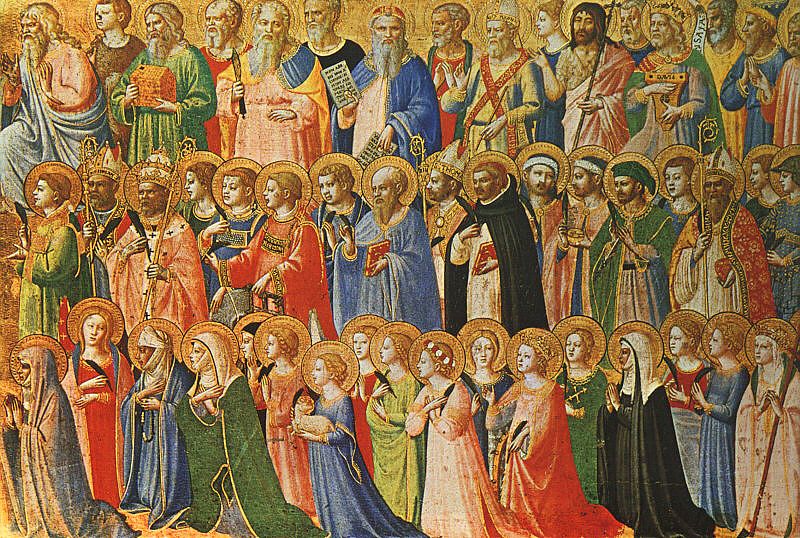
In the Book of Revelation, St. John witnesses a vast number of saints worshiping God in heaven. He beholds “a vision of a great multitude, which no one could count, from every nation, race, people, and tongue.” Note that this ‘countless multitude’ is different and much larger than the “144,000 marked from every tribe of the Israelites” that John observes several verses before. Jesus came to save people not only from the twelve tribes of Israel, but from the whole world. As the Lord declares through the Prophet Isaiah in our first reading, “I come to gather nations of every language; they shall come and see my glory.” Based on this, we can confidently say that a very large number will be saved.

On the other hand, in our gospel’s parallel passage from St. Matthew’s Gospel, Jesus says, “Enter through the narrow gate; for the gate is wide and the road broad that leads to destruction, and those who enter through it are many. How narrow the gate and constricted the road that leads to life. And those who find it are few.” The ‘few’ who enter the narrow gate to life sounds like less than the ‘many’ who do not. From this, it would seem that the number saved will be comparatively small.

However, the words “few” and “many” are relative terms which depend upon the context. For example, nearly 19,000 medals have been awarded in the modern Summer and Winter Olympic Games, and that is indeed many. But how many Olympic gold, silver, or bronze medalists have you personally met? If any at all, probably only a few. In a more tragic example, around 130,000 Americans die each year in accidents, and that’s awfully many. But at the same time, roughly 99.96% of Americans do not die in accidents each year, making the 0.04% who do relatively few. The word “many” sometimes refers to a majority of people, but not always.

Jesus suffered, died, and rose to redeem all of mankind. Even if there had been only one sinner on earth in all of human history, it seems that Jesus would have become man in order to offer himself to save him or her, me or you. Suppose that the number of human souls condemned to Hell on Judgment Day turns out to be only a dozen. Knowing how much our Lord loves each and every person, will not those lost twelve feel like many in the heart of Jesus and those saved billions feel like few? In any case, Jesus never tells us whether the majority of the human race will be saved or lost. Either outcome is possible.

Why isn’t Jesus more clear about exactly how many people will be saved? Because Jesus knows how such knowledge would be harmful for us. If we were told that most people will be saved in the end, we would fall into dangerous presumption. We’d say to ourselves, “I haven’t robbed any banks or murdered anybody; I sure I’m good enough.” And if we were told that most people will be lost in the end, we would fall into poisonous despair. We’d say to ourselves, “With my sins, what’s the use in me even trying?” St. John’s Gospel tells us that Jesus “did not need anyone to testify to him about human nature. He himself understood it well.” So, instead of giving us some precise statistic, some number or percentage about how many will be saved, Jesus gives us this much more beneficial advice: ‘Strive to enter through the narrow gate (for whether you are saved or not depends, in part, on you.)’

Almighty God “wills everyone to be saved and to come to knowledge of the truth,” in the words of St. Paul, but upon coming to know that truth, the Lord requires our personal response. He respects our freedom, and we are free to ignore him, to our own harm. As Jesus tells us, after the master of the house has arisen and locked the door, you may stand outside knocking and saying, “Lord, open the door for us.” He will say to you in reply, “I do not know where you are from.” (In other words, “You’re a stranger to me.”) And you will say, “We ate and drank in your company and you taught in our streets” (as happens at every Holy Mass.) Then he will say to you, “I do not know where you are from. Depart from me, all you evildoers!” In Matthew’s Gospel, Jesus declares, “Not everyone who says to me, ‘Lord, Lord,’ will enter the Kingdom of Heaven, but only the one who does the will of my Father in Heaven.

For adults like you and me, entering through Jesus’ narrow door requires more than merely wishing or have vague aspirations about going to Heaven someday. Striving to enter through the narrow gate entails sacrifices and discipline. As our second reading tells us, to those who are trained by it, discipline brings the peaceful fruit of righteousness. “So strengthen your drooping hands and your weak knees. Make straight paths for your feet.” Consider:

What sacrifice does Jesus ask of you?
What is Jesus asking you to remove from your life?
What is Jesus asking you to add to your life?
What sin does he want you to cease?
What gift does he want you to give?
Think about it. Pray about it.
Jesus has answers for you.

Let us intentionally cooperate with God and his grace. Let us accept the Lordship of Jesus Christ in our lives, so that we may be numbered among ‘the few‘ who are saved in the end.

“The Prince” or the Christ? — 18th Sunday of Ordinary Time—Year C

August 3, 2019

In the 6th century B.C., the Romans had a king named Tarquin the Proud who declared war on a city eleven miles east of Rome called Gabii. When the king was unable to take the city by force, he plotted to take it by deception. His son, Sextus, pretending to be ill-treated by his father and bearing fresh wounds from being flogged, fled to Gabii. The infatuated inhabitants entrusted him with the command of their troops, and when he had obtained the full confidence of the citizens, he sent a messenger to his father to learn what he should do next. The king, who was walking in his garden when the messenger arrived, spoke no words, but kept striking off the heads of the tallest poppy plants with his stick. His son understood the unspoken reply, and put to death or banished on false charges all the leading men of Gabii, after which he had no difficulty in compelling the city to submit to his father.

I was reminded of this story of political power and deceitful scheming this week while listening to Niccolò Machiavelli’s 16th century Italian book, “The Prince.” In this pragmatic, cynical treatise, Machiavelli discusses how a ruler can most effectively rule his realm. For example, upon conquering another king or noble’s territories, Machiavelli recommends exterminating that ruler’s family members to prevent future revolts. Machiavelli also encourages leaders to always appear merciful, faithful, humane, sincere, and religious to appear so but not always be so, because he holds that no ruler can be successful without, at times, deliberately doing evil as circumstances require.

Machiavelli provides numerous historical illustrations, like the story of an Italian ruler whose newly acquired territory was full of corruption, robbery, and violence. He appointed a cruel and efficient man as their governor, entrusting him with full authority to act. This governor quickly restored order with his iron fist, but then his lord had less use for him and saw him as a possible threat. Machiavelli writes that the ruler, “to clear himself [of guilt] in the minds of the people and make them entirely loyal to him, … desired to show that if any cruelty had been practiced it had not originated from him but came from the personal cruelty of the governor. Under this pretense [he arrested the governor] and one morning had him killed and left in [the city square] with the block and a bloody knife at his side. This terrible sight,” writes Machiavelli, “caused the people to be at the same time satisfied and worried.”

Listening to his stories, hearing his advice, I wondered what sort of person would ever want to be such a prince or ruler. Besides the iniquity, Machiavelli himself acknowledges that the prudent leader, when not fighting wars, should constantly focus on preparing for wars. But like King Solomon asks in our first reading, ‘what profit comes to [a ruler] from all the toil and anxiety of heart with which he has labored under the sun? Even at night his mind is not at rest. This is vanity.’ And furthermore, like Jesus says, ‘What does it profit a man to gain the whole world and lose his soul?’

Machiavelli’s advice and methods for maintaining power by any means might work in one sense here in this world, but in the long term all these things are futile. The rich fool says to himself, “Now as for you, you have so many good things stored up for many years, rest, eat, drink, be merry!” But God says to him, “You fool, this night your life will be demanded of you; and the things you have prepared, to whom will they belong?” Thus will it be for all who store up treasure for themselves but are not rich in what matters to God.

Jesus once asked, “What king marching into battle would not first sit down and decide whether with 10,000 troops he can successfully oppose another king advancing upon him with 20,000 troops? But if not, while he is still far away, he will send a delegation to ask for peace terms.” That’s simply basic strategy, yet how many people march towards the inevitable end of their lives — when they will approach the all-powerful King of kings and the Lord of hosts — without consideration of how ill-prepared they are to face him?

Who and what are we loving? And are we loving them as we should?

St. Paul is often quoted from his 1st Letter to Timothy as saying, “The love of money is the root of all evils, and some people in their desire for it have strayed from the faith and have pierced themselves with many pains.” But something about this passage never made sense to me. Does the root of all evil really reside in the love of money? For instance, does every act of adultery stem from a love of money? I don’t think so. But while studying Greek in seminary I discovered that this passage can be justifiably translated a different way: “The love of money is a root of all evils,” and that is very true.

Money, wealth, is a tool, like fire. It’s a neutral thing; good when used rightly but potentially destructive and deadly when mishandled. The love of money, that is to say greed, is rightly called “idolatry” by St. Paul in our second reading, because the greedy person serves and trusts in wealth as their god, their savior and source of blessings. While urging us never to worry, our Lord does call us work, to make material provision for ourselves and our households. St. Paul taught the Thessalonians that “if anyone was unwilling to work neither should that one eat.” And on another occasion he wrote, “whoever does not provide for relatives and especially family members [of his household] has denied the faith and is worse than an unbeliever.” Yet Jesus does not wish us to make work and wealth our idol: “Take care to guard against all greed, for though one may be rich, one’s life does not consist of possessions.”

One day, perhaps sooner than we imagine, our lives will be demanded of us and all the property and possessions we leave behind will be left to others. It is a good thing for us to have a will prepared for this foreseeable event, and I would ask you to remember St. Paul’s Parish and our endowment in your estate. But as praiseworthy as it is to prepare inheritances for that day, it is not as meritorious as giving during your lifetime. How much generosity is there in giving away what you cannot possibly take with you or keep? How generous is it to give away what is no longer of any use to you? Unavoidable giving is a small sacrifice and exercises small trust in God.

And so I recommend to you the practice of tithing, to the Church and to charities. Chose some percentage to tithe to the mission of Jesus Christ in our parish, for needs in our community, and to help people far beyond. In the Old Testament, God commanded his people to tithe 10% of everything, and they were much poorer than us. I urge you to prayerfully discern a number for yourself. Giving in this way practices trusting in the Lord and allows him to show you his providence and his power to provide. Though we do not believe in a “prosperity gospel” which claims believers will never experience trials, Jesus does promise a prize for our every given gift: “Give and gifts will be given to you; a good measure, packed together, shaken down, and overflowing, will be poured into your lap. For the measure with which you measure will in return be measured out to you. … And whoever gives only a cup of cold water to one of these little ones to drink because he is a disciple—amen, I say to you, he will surely not lose his reward.”

Our short life here on earth is an audition and a training ground for life in the Kingdom of Heaven. Through his gracious, saving work, Jesus Christ has extended an invitation to everyone to become a citizen of his Kingdom, now and in the age to come. Presently here on earth, his Kingdom, the City of God and her citizens, exist alongside and amidst the City of Man with its Machiavellian-minded members. But in the coming age, there will be no place for those sinners who live for themselves, and the virtuous meek who are generous to God and their neighbor shall inherit the earth. The choice before us all is for “The Prince” or for the Christ.

The Master-Weaver — Funeral for Goldean Gehring, 93

August 1, 2019

This morning, our parish is honored to be offering our greatest offering, praying our greatest prayer, the Holy Mass, for our own Goldean. May it help her soul to Heaven, and console and strengthen you and me who are called to follow Jesus on the same journey. The full fabric of a person’s life is not reducible to a single thread, be it a job, a pastime, or a hobby. But the threads of a Christian life each lead back to our master-weaver. This homily will follow one such thread.

As you know, beginning at a very young age, Goldean sewed (and later knit and crocheted) throughout her entire life. At one point, her husband Ernie said ‘you should start a list to keep track of how many things you make.‘ That was about 275 sweaters ago. She and close friends would knit and sew together, with their club rotating from house to house, sharing their precious patterns and their congenial company. Goldean was pleased to create and to freely give. She made stocking hats for servicemen deployed to the Middle East for Operation Desert Storm, where nights can be cold and helmets uncomfortable. She made shawls, scarves, and mittens. She also made clothes for her family. Kathy says mom made her dresses and sewed her clothes. Goldean made clothes for her sons, Tom, Pete, and Steve as well. Everything was made in triplicate –whatever one got they all did.

This is like what our Father, our Creator, does for us in Christ. At the beginning of this Mass, Goldean’s casket was draped with the pall, a symbol of her having been clothed in Christ at her baptism. As St. Paul’s wrote to the Galatians: “Through faith you are all children of God in Christ Jesus. For all of you who were baptized into Christ have clothed yourselves with Christ. There is neither Jew nor Greek, there is neither slave nor free person, there is not male and female; for you are all one in Christ Jesus.

God is the master-weaver, who would clothe us all in Christ. Without destroying our precious and unique individuality, our Father desires each one of us to strikingly resemble our brother, Jesus Christ. This resemblance is not merely an external thing, like clothes or a costume that goes on and off. Jesus would transform us within. In our Gospel, Jesus says, “Whoever eats my Flesh and drinks my Blood remains in me and I in him… The one who feeds on me will have life because of me… And whoever eats this bread will live forever.” Goldean rejoiced to receive Him in the Holy Eucharist, and so we rejoice with hope today.

I want to thank Ann Bowe for reading the funeral readings for us today. Ten minutes before the Mass began, I learned that the person who was going to read today, through a misunderstanding or miscommunication, mistakenly thought this funeral was tomorrow. When my server, Donnie Stoik, found and asked Ann to read, she remembered that Goldean had once asked her to read at her funeral. It appears that Goldean is receiving special favors this day.

But pray for her. When I die I want the people who love me to pray for me. Pray that Jesus may tailor any alterations that remain necessary for her soul so that she may fit perfectly into Heaven. And let us be conformed to Jesus Christ; through our daily prayer to him, through frequenting his sacraments, through his holy word, and through a life-long friendship with him, so that we may not be found naked at our judgment on the last day, but gloriously clothed in Christ for ever.

Asking for a Gift to Give — 17th Sunday of Ordinary Time—Year C

July 28, 2019

Remember last Sunday, when Abraham hosted three mysterious visitors from Heaven. Once they had agreed to Abraham’s offer to serve them a meal can you recall the first thing Abraham did? “Abraham hastened into the tent and told Sarah, ‘Quick, three measures of fine flour! Knead it and make rolls.'” How much were “three measures of flour” back then? Through a scripture commentary, I learned that this was about half a bushel, or like twenty pounds of flour. That’s enough to make about twelve of the loaves of bread we buy at the grocery store these days. So, Abraham served about a dozen loaves of bread to three guests. Now I’m as much a fan of unlimited breadstick deals as anybody, but when was the last time you ate four loaves-worth of bread in one sitting? Abraham knew these were extraordinary guests, so he set an extraordinary meal before them. And perhaps he intended to give them all the leftover loaves as a further gift to God.

I wondered about those “three measures of flour” because of Jesus’ parable today: Suppose you have a friend to whom you go at midnight and say, “Friend, lend me three loaves of bread, for a friend of mine has arrived at my house…” So we have a meal with three measures and a parable with three loaves. Three measures of flour for the Lord, and three loaves of bread for a friend. I perceive that these things are connected, but more on that later.

Immediately preceding this parable, Jesus teaches his disciples how to pray. You surely noticed that the Our Father prayer in Luke differs from Matthew’s more familiar version. This is providential. If the two texts were exactly the same, some Christians might mistake Jesus’ example as being our only permissible prayer. But Jesus does not give the Our Father as a magic formula or incantation, but as a model for our approach and attitude to prayer. In Matthew’s version, the prayer begins with “Our Father.” He is not mine, but ours, because he calls us to salvation together. Luke’s version simply begins with “Father”; not “Master,” as though we were merely his slaves; not “Ruler,” as though we were merely his subjects; but “Father,” because we are his children. The prayer’s petitions are direct requests, simple requests, profound requests. For example, consider: “Give us each day our daily bread.” It’s straight-forward, basic, yet deep when you contemplate “our daily bread” as a symbol for all of our constant bodily and spiritual needs. And notice something else that these petitions have in common: “hallowed be your name,” “your kingdom come,” “forgive us our sins.” Each is asking God for something that God already desires for us. They are each a part of his plan already.

Who are we supposed to be like in Jesus’ parable? Surely it’s the persistently asking and seeking door-knocker. Because Jesus says, immediately after this parable, “And I tell you, ask and you will receive; seek and you will find; knock and the door will be opened to you.”

And who is God represented by in this parable? Naturally, the man in the house whose gifts can be gained through asking. Indeed, God is on the other side of Heaven’s door. And even at midnight, in the darkest hour, we can call on him for help. His children inside, the saints and angels who rest peacefully in his house, join their voices to ours when we persistently ask for good things on earth. But God is surely not like this annoyed neighbor in saying, “Do not bother me… I cannot get up to give you anything.” Jesus’ mode of teaching here is from the lesser to the greater. If this annoyed neighbor can be persuaded to give, how much more can God who already desires to give. Likewise, Jesus says, “If you, who are wicked, know how to give good gifts to your children, how much more will the Father in heaven give the Holy Spirit to those who ask him?

The request for three loaves and Abraham’s request for three measures suggests another character like the Lord in this parable: “Lend me three loaves of bread, for a friend of mine has arrived at my house from a journey and I have nothing to offer him.” Mystically speaking, this visiting friend is the Lord. For Jesus says, “Amen, I say to you, whatever you did for one of these least brothers of mine, you did for me.” Jesus says, “Whoever receives one child such as this in my name receives me.” And Jesus says to the early Church’s persecutor, “Saul, Saul, why are you persecuting me?” Jesus is mystically present in every Christian and within in his Church. Thinking of God as represented in this parable by both the homeowner and the visiting friend reveals a dynamic that could change how you relate to prayer.

When you pray for some good thing, when you ask some worthy blessing for yourself, someone else, or even billions of people at once, are you not praying for the greater glory of God among us? What prayer would he, could he, possibly grant you that would not also glory him? Furthermore, what can we offer him that is entirely of ourselves? The man in the parable asks his neighbor for loaves for his friend because “I have nothing to offer him.” As St. Paul asked the Corinthians, “What do you possess that you have not received?” It’s been said that to truly make an apple pie from scratch, you have to recreate the universe. Like Abraham asking Sarah for loaves for his holy guests, like the man in the parable asking for a loan of bread, every good prayer—whatever it may be—is asking for a gift to be gifted to the Lord. It’s like asking your dad for money to buy him a gift for Father’s Day. It’s for his own glory, so you don’t have to persuade or coerce him, he loves you and already wants to give. Which raises a question: if God already wants to give, then why doesn’t God always give immediately in answer to our prayers?

Sometimes God waits for the right time to grant our requests. If you bought your mom the perfect Christmas gift, you might desperately want to give it to her right now, but you would realize that the very best time for her to open it comes later. Would you rather have you prayer answered right now or at the best and perfect moment?

Sometimes God is storing up the accumulated reservoir of your prayers so that once the floodgates are opened a torrent will be unleashed. St. Monica prayed for her sinful, wayward son for years, and when he finally converted he was not merely saved but went on to become the priest, bishop, and great doctor and father of the Church we know as St. Augustine of Hippo. Would you rather have your prayer answered in a small way now or in an overwhelmingly incredible way later?

Sometimes it we must pray persistently, rather than just asking once and setting the request aside, for the powerful influence of that continued offering. On one occasion in the gospels, there was a demon afflicting a boy that the disciples could not exorcise. After Jesus cast out the demon his disciples asked why they were unable. Jesus is written to have answered them, “This kind can only come out through prayer and fasting.” Last week we heard St. Paul tell the Colossians, “I rejoice in my sufferings for your sake, and in my flesh I am filling up what is lacking in the afflictions of Christ on behalf of his body, which is the Church”. It’s not that Jesus’ Passion is insufficient, but that God allows our offered sufferings and sacrifices to have a vital role in Christ’s work of saving souls. Patient, persistent prayer is a sacrifice we offer with him.

In conclusion, the Father, our Father, already wants to give, for the praise and glory of his name, for our good and the good of all his holy Church. So let us not hesitate, but let us persist, in asking good things from Him who loves us.

Meals with the Lord — 16th Sunday of Ordinary Time—Year C

July 21, 2019

Our first reading from Genesis recalls Abraham at a meal with the Lord. In the story immediately preceding this one, God had renewed his covenant with him. The Lord changed his name from Abram to Abraham, which means “father of a multitude,” and indeed, today more than two billion Christians around the world call Abraham our father in faith. A covenant bond is an alliance which transforms unrelated persons into family. In the ancient world, nations and peoples would form covenants, declaring themselves brothers. Today we rightly call marriage a covenant. And God has established many covenants between himself and members of the human race through salvation history. Something that family members do is eat together. Sharing a meal signifies communion and relationship with each other. Today, after renewing his covenant with Abraham, the Lord visits him for a meal.

Genesis says “the LORD appeared to Abraham,” but, “Looking up, Abraham saw three men standing nearby.” Like when God said at Creation, “Let US make man in OUR image,” Christians detect signs here of the presence of the Holy Trinity. There’s an interesting alternation of singulars and plurals in their dialogue. Abraham says, “Sir, if I may ask you (singular) this favor, please do not go on past your servant….” Abraham offers THEM a meal and THEY reply, “Very well, do as you have said.” Later THEY ask him, “Where is your wife Sarah,” and then ONE of them declares, “I will surely return to you about this time next year, and Sarah will then have a son.” Genesis does go on to call two of these three visitors “angels” but in Hebrew and Greek this word angel means “messenger or representative.” And who are the greatest representatives and messengers of God the Father but God the Son and God the Holy Spirit? Whatever the mystery that was actually at play here, Abraham serves a meal with the Lord and is blessed in the encounter.

In today’s Gospel, the Lord God visits Martha in the person of Jesus Christ. She welcomes him and sets about serving him with food and drink. Her sister, Mary, sits beside the feet of the Lord listening to him speak. And Martha, burdened with much serving, comes to him and says, “Lord, do you not care that my sister has left me by myself to do the serving? Tell her to help me.” “Martha, Martha,” Jesus replies, “you are anxious and worried about many things. There is need of only one thing.” Notice how Jesus repeats her name, something seen only a handful of times in the New Testament. Jesus laments over “Jerusalem, Jerusalem” before his Passion, he admonishes “Simon, Simon” at the Last Supper, he cries out “Eloi, Eloi / My God, My God” on the Cross, and he calls out to “Saul, Saul” on the road to Damascus. That’s some extraordinary company she shares. Clearly, Martha matters a great deal to Jesus.

So what was Martha doing wrong? Is it because she was working so hard to serve the Lord a meal? Well, Abraham hastened and hustled to serve too; he ran to pick out a choice steer, get curds and milk, and set these before his guests. Abraham even got others to help him work; telling his wife to make some bread rolls and directing his servant to prepare the meat. The problem wasn’t Martha’s work. It was her mindset, her outlook. “Martha, Martha, you are anxious and worried about many things.” Why was Martha anxious and worried? Anxiety and worry come from fear. What was she afraid of? Was she afraid of failing? Was she afraid of what others might think? Was she afraid of disappointing the Lord? What are you afraid of? What drives your anxiety and worries? Do you think Jesus will abandon you if things go wrong, if things are less than perfect?

Jesus says, “There is need of only one thing.” What is that one thing? Mary apparently had it sitting at his feet, listening to him teach. She was sharing personal communion with him and receiving from him. And later, when Mary got up to do whatever task came next, I bet that peace remained with her. “Mary has chosen the better part,” Jesus says, “and it will not be taken from her.” If you have gravely sinned, then return to Jesus, go back to confession, and come into the state of grace. And when in the state of grace stop letting yourself get in the way of connecting with Jesus and receiving and enjoying his good pleasure in you. Rest with him, rest in him, even as you work hard for him.

Fifty years ago this weekend, mankind took its first steps on the surface of the Moon. The astronauts journeyed from Earth more than 200,000 miles, through the extreme temperatures of an airless void, to achieve a modern marvel watched and celebrated around the world. But a still greater journey is made, a more incredible wonder is accomplished, when Jesus Christ comes from Heaven to this altar and invites you and me (who remain far from perfect) to share this covenant meal with him.

The Great Carpenter — Funeral for James “Jim” Rogge, 55

July 10, 2019

St. Matthew’s Gospel tells us that St. Joseph, the foster-father of Jesus, was a carpenter or craftsman by occupation. He supported his family, both wife and child, as a carpenter, a woodworker, or perhaps a mason, and a builder. And, as his son grew older, Joseph taught him his trade. We read in St. Mark’s Gospel that when Jesus returned to preach in his hometown, the people of Nazareth asked, “Is he not the carpenter, the son of Mary?” Odds are that Jesus the Nazarene was personally well-familiar with the work of preparing timber for his uses.

Every log comes to be from a once-living tree, from a natural canopy or tent of foliage over the earth. But every round log to become fit for the craftsman’s purpose, such as to become a portion of his dwelling place, must be transformed from its original, natural, unfinished state. Before the advent of modern sawmills, this difficult task was done up-close, by hand. First, the rough, brittle, dead bark must be stripped away. In life, this bark served as a protective layer against our imperfect, trial-some world, but in this stripping process this layer is removed and discarded into the craftsman’s fire. From there, the log of wood is hewn (perhaps flattened, notched, or whittled down) to fit its intended purpose. When the carpenter desires to erect a building, each piece, each log or plank, is made to fit with its neighbors, so that the builder’s structure may stand solidly and harmoniously as one. And the greater the carpenter the greater the perfection they desire in their work.

Our Lord Jesus Christ is a carpenter. He is the greatest carpenter. And his work material is the wood of humanity; that is, you, and me, and Jim. The Lord would shape us as he has done with others since ancient times: laboring personally, up-close. As King David said in the psalm: “He guides me in right paths for his name sake. I fear no evil; for you are at my side.” But we build up layers of bark against him and the world, because we’re afraid to trust or we love our faults, yet Jesus doesn’t give up. Our rough, brittle, dead bark must be stripped away, in this life or hereafter.

We must allow Jesus to befriend us – it is supremely important that we befriend him – for as Daniel writes in our first reading and St. Paul in our second, a resurrection and a judgment awaits us all. But if we do befriend the Lord, “we know that [when] our earthly dwelling, a tent, should be destroyed, we have a building from God, a dwelling not made with hands, eternal in Heaven.” As St. Paul told the Ephesians, “Through him the whole structure is held together and grows into a temple sacred in the Lord; in him you also are being built together into a dwelling place of God in the Spirit.

You probably know of Jim’s faith in Jesus, of his strengths and his weaknesses. Pray for him, that he may be hewn and perfectly fitted with our brothers and sisters in Heaven. And today at this altar, renew your commitment to Christ, so that we and he may remain in the house of the Lord, the master craftsman, forever.

Mass Apparitions of Our Lord

June 26, 2019

So there’s Our Lady of Guadalupe, Our Lady of Lourdes, Our Lady of Knock, Our Lady of Fatima, and Our Lady of lots of places. Our Lady of the Rosary, Our Lady of the Miraculous Medal, Our Lady of Good Counsel, Our Lady of Good Help, Our Lady of Sorrows, Our Lady of Victory, Our Lady of Grace, Our Lady of Peace, and Our Lady of lots of other good things, too. When I was a kid, I didn’t realize that all these ladies were the same lady. But eventually I figured out that these were all titles of the Blessed Virgin Mary. With that confusion cleared up, I went on to wonder why there seems to be so many apparitions of Mother Mary throughout Church history and so few of her Son, Jesus Christ.

Sure, there are famous exceptions. In the 18th century, Jesus appeared to St. Margaret Mary Alacoque to invite devotion to his Sacred Heart. The month of June is now dedicated to the Sacred Heart of Jesus. And in the 20th century, St. Faustina Kowalska had visions of Jesus encouraging devotion to his Divine Mercy. As a result, the first Sunday after Easter is celebrated as Divine Mercy Sunday. But it’s usually Mary who we hear about appearing here or there around the world, encouraging people to repent, to listen to her Son’s words, and be saved.

So I wondered, “Why aren’t there more apparitions of Jesus in the world?” Eventually I figured out the reason: there’s an apparition of Jesus Christ at every Holy Mass. At every Mass, Jesus’ words are proclaimed. At every Mass, he works a miracle for us. At every Mass, his Real Presence come to us by the Eucharist. Compared to how frequently Jesus appears before us at Mass, Marian apparitions are the rarity.

In today’s Gospel, Jesus multiplies five loaves and two fish to feed more than five thousand people (and that’s just counting the men.) He has them sit in groups of about fifty, blesses and breaks the food, and hands it to his disciples to serve the people. They all eat and are satisfied, and the leftovers are more than Jesus had started with. The day after this amazing event (a miracle recounted by all four Gospels) St. John tells us that Jesus was in Capernaum, teaching in the synagogue about the Bread of Life:

I am the bread of life,” he said, “whoever eats this bread will live forever; and the bread that I will give is my flesh for the life of the world.” At this the Jews quarreled among themselves, saying, “How can this man give us his flesh to eat?” And Jesus replied, “Amen, amen, I say to you, unless you eat the flesh of the Son of Man and drink his blood, you do not have life within you. Whoever eats my flesh and drinks my blood has eternal life, and I will raise him on the last day. …My flesh is true food, and my blood is true drink. Whoever eats my flesh and drinks my blood remains in me and I in him. …The one who feeds on me will have life because of me. …Whoever eats this bread will live forever.

The crowds were perplexed by this teaching and St. John notes that after this many of Jesus disciples left and no longer followed him. But Jesus doesn’t chase them down saying, “Come back, you misunderstood, I was only using a figure of speech.” Instead, he turns to his apostles and asks, “Do you also want to leave?” St. Peter, not understanding but trusting, replies, “Master, to whom shall we go? You have the words of eternal life.” After the Last Supper, recounted by St. Paul in today’s second reading, the Early Church understood Jesus’ teaching. Multiplying five loaves into enough bread to feed thousands is a miracle, but Jesus’ far greater miracle is feeding the world with bread transformed into himself.

If someone asked you, “Are you an object? Are you a thing?” how would you answer? If someone asked me if I was an object, I’d say that I do have many qualities and traits of an object; I have size, and shape, and color, and weight. But an object or a thing can be bought or sold, used and discarded, held cheaply and treated cheaply. You and I are not merely objects or things, but persons; persons meant to be loved and to recognized as worthy of love. So much about our devotion is set right when we recognize that the Holy Eucharist is not merely an object but a person.

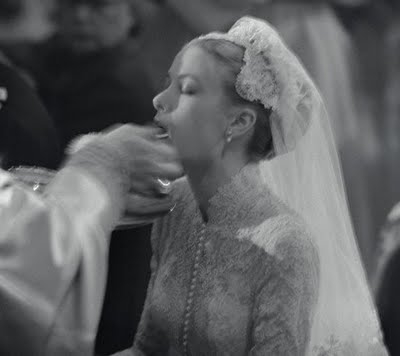
When we dress up for Sunday Mass, we dress up for him. When we sing as Mass, we’re singing for him. Unlike Judas, who took the morsel and left the Last Supper before it was over, we remain until the end of Mass because he is here. Sunday Mass in not merely an obligation, but an opportunity for encounter with him. And when we visit him (on Sundays, or at a weekday Mass, or just stopping by the church) he is please that we are here. In love, Jesus offers us a communion with himself through the Eucharist more intimate and profound than that shared by spouses. Our Eucharistic Lord wants us to behold him, recognize him, and rejoice to receive him. So, if a Christian ever asks you, “Have you personally received Jesus?” you can answer, “Yes, in my hand, on my tongue, into my body and blood, in my soul and in my heart, through the Most Holy Eucharist, which is his very self.

Princess Grace (née Kelly) of Monaco receives
the Holy Eucharist at her 1956 nuptial Mass


Jesus’ Mediated Miracles

May 30, 2019

Icon of the Wedding Feast of Cana
Most miracles in the Gospel of John share a common trait: Jesus works great deeds but in a somewhat withdrawn manner. There’s usually some degree of distance between the Lord and his miracles in John’s Gospel. Let me show you what I mean with several examples:

  • In the second chapter of John, at the wedding feast of Cana, Jesus does not fetch water from the well or hold his hands over the water jars to change their water into wine. Jesus instructs the servers what to do and his miracle is accomplished through their cooperating efforts.
  • Later at Cana, in John chapter four, a royal official whose son is gravely ill begs the Lord to come to Capernaum some twenty miles away and heal him: “Sir, come down before my child dies.” After a dialogue Jesus replies, “You may go; your son will live.” The father believes him and leaves. The next day, on his way home, the royal official’s servants meet him and share good news about his son: “The fever left him yesterday, about one in the afternoon.” And the father realizes that was the hour that Jesus had said “your son will live,” curing him at a distance.
  • In the next chapter, at the pool called Bethesda in Jerusalem, Jesus meets a man who has been ill for thirty-eight years. Jesus says to him, “Rise, take up your mat, and walk.” The Lord makes no physical contact with him, he simply says the word. And immediately the man becomes well, takes up his mat, and walks.
  • In John’s ninth chapter, Jesus encounters a man blind from birth. Jesus bends down, makes a paste of dirt and spittle, and smears it on the blind man’s eyes. The blind man is touched by Jesus but does not immediately see. Jesus tells him, “Go wash in the Pool of Siloam.” The man goes there and washes his eyes, but Jesus is not present when the man sees for the first time.
  • In John eleven, Jesus’ beloved friend Lazarus dies and the Lord journeys to the tomb. He tells others to roll away the stone and does not go inside. Instead, Jesus commands, “Lazarus, come out!” And Lazarus comes out by himself, wrapped head to foot in burial cloths. Then Jesus directs others to “untie him and let him go.”
  • Finally, in the last chapter of John, Jesus works a post-Resurrection miracle from a distance for seven disciples fishing on the sea of Galilee. Jesus is on the shore, about a hundred yards away from Peter, John, and the others in the boat. He asks, “Children, have you caught anything to eat?” They answer, “No.” He tells them, “Cast the net over the right side of the boat and you will find something.” So they cast the net and are not able to pull it back in because of the great number of fish they catch. Jesus was not in the boat with them, but he guides his disciples’ efforts and make them miraculously fruitful.

Why do the miracles of John’s Gospel share this theme of Jesus working once removed? (John observes in closing, “There are also many other things that Jesus did, but if these were to be described individually, I do not think the whole world would contain the books that would be written.” So this Gospel’s miracles have been curated, chosen over others.) Of the four Gospels, John’s was written last. By this stage in the late first century, the majority of Christian believers had never seen Jesus walking the earth and St. John was likely the last of the living Apostles. Perhaps they sensed that John too would soon pass on, which would lead to Christians questioning in their hearts, “What is our remaining connection to Christ?” John’s Gospel reassures its readers (then and now) that though Jesus is visibly removed from our eyes his power remains active among us.

In his Last Supper Discourse, Jesus says, “I am going away and I will come back to you.” (This speaks to Jesus’ death and Resurrection but also his Ascension and Second Coming.) “If you loved me, you would rejoice that I am going to the Father…. I tell you the truth, it is better for you that I go. For if I do not go, the Advocate will not come to you. But if I go, I will send him to you. …Amen, amen, I say to you, whoever believes in me will do the works that I do, and will do greater ones than these, because I am going to the Father.

Why didn’t Jesus stay? Surely he can do what his saints can do and numerous saints have manifested the power of bi-location (being at two places at the same time.) In the twentieth century, St. Padre Pio is reported to have bi-located repeatedly; to celebrate Mass, hear confessions, visit a deathbed, and other things. The seventeenth century nun Venerable Mary of Ágreda is well-documented as having evangelized Native Americans in the American Southwest without leaving her Spanish convent. She instructed Jumano tribe members where to travel to find Franciscan missionaries for sacraments, affirmed under oath to Church investigators in Spain that she was bi-locating, and possessed inexplicable first-hand knowledge of the New World. If his saints can bi-locate, why couldn’t Jesus multi-locate on earth? He already does this in a veiled way in the Holy Eucharist; he is truly present (Body and Blood, Soul and Divinity) living in every tabernacle in every Catholic Church. So why not be visibly present in this world throughout the centuries? Jesus could be the pastor of every parish, the teacher in every classroom, the doctor in every hospital, and the leader for every country. Wouldn’t he do a better job than us?

This is why it was better for us for Jesus to ascend. We are called to be children of God; daughter or sons of the Father, and brothers or sisters of Christ. We must be childlike to enter the Kingdom but we are not to be childish. We must rely on the Lord, for apart from him we can do nothing, but he desires us to become reliable as well. If everything of importance were solely Jesus’ job how would we grow out of immaturity. How would we mature into the full likeness of Jesus Christ? Jesus desires to work through us, and with us, and in us so that we may share fully in his glory. This is the work of love for God and neighbor and it is vitally important; it’s important for your soul, it’s important for the salvation of others, and important to God.

The Church Father, St. Jerome, living in the late 300’s A.D., leaves us this extra-biblical story about St. John the Apostle:

The blessed John the Evangelist lived in Ephesus until extreme old age. His disciples could barely carry him to church and he could not muster the voice to speak many words. During individual gatherings he usually said nothing but, “Little children, love one another.” The disciples and brothers in attendance, annoyed because they always heard the same words, finally said, “Teacher, why do you always say this?” He replied with a line worthy of John: “Because it is the Lord’s commandment and if it alone is kept, it is sufficient.”

This work of love in Christ is important for our souls and the salvation of others; it is the mission entrusted to us by the Lord so that we may share fully in his glory.

Stories of Glory

May 22, 2019

Readings for the 6th Sunday of Easter – Year C

Liberty Films was an independent motion picture production company founded in 1945. They only produced two films before dissolving six years later. Their first film, released in 1946, was the story of a depressed loan officer in upstate New York who is contemplating ending his own life. The critical reviews to the movie were mixed. It had good stars and did rather well at the box office, but not well enough to recoup its production costs and show a profit. It won no Academy Awards except for one in Technical Achievement; for developing a better way to simulate falling snow on a movie set. The co-founder of the company and director of the picture would go on to consider this his favorite film, screening it towards the end of every year for his family. However, he said that creating Liberty Films had proven virtually fatal to his professional career.

After Liberty Films folded up, the ownership of rights to the film changed hands from one media company to the next. I suspect the movie would have been largely forgotten today, if not for a providential oversight. You see the Copyright Act of 1909 granted copyright protection to original creative works for twenty-eight years. This copyright protection could be renewed for an additional twenty-eight years by filing out some paperwork and paying a nominal fee. However, the new owners of the film neglected to renew its 1946 copyright, so the film automatically entered the public domain. As a result, from 1974 until 1993 (when other laws came into play) anyone and everyone was free to copy, sell, or broadcast the film without paying any royalties to anyone. TV stations showed it repeatedly during the Christmas season, more than one hundred distributors sold it on tapes, and the film became immensely popular. I would bet you’ve seen this wonderful film yourself. Today it is considered one of the greatest movies ever made, and rightly so. The name of its main character, the loan officer in upstate New York, who is persuaded by an angel not to end his own life, is George Bailey, and the film is Frank Capra’s “It’s a Wonderful Life.”

In our Gospel, Jesus says: “I give you a new commandment: love one another. As I have loved you, so you also should love one another.” And throughout “It’s a Wonderful Life,” we see George Bailey denying himself out of love for others. He gives up his dreams of going to college, of becoming a rich and famous architect, in order to keep his late father’s Savings & Loan open. He gives up his around-the-world honeymoon vacation to save Bedford Falls’ Savings & Loan again to protect the community from the wicked Mr. Potter. He is willing to suffer in place of another when old Uncle Billy loses track of the Savings & Loan’s $8,000 cash deposit. George, the good man, goes through many trials. As Paul and Barnabas tell us in our first reading: “It is necessary for us to undergo many hardships to enter the kingdom of God.”

In our Gospel, when Judas had left the the Upper Room and the Last Supper to go and arrange Jesus’ arrest, our Lord said, “Now is the Son of Man glorified, and God is glorified in him. If God is glorified in him, God will also glorify him in himself, and God will glorify him at once.” Remember: Jesus was about to suffer crucifixion and death, but also be raised again. Similarly, in “It’s a Wonderful Life” we find George Bailey at his lowest point; he’s worse than sick, he’s discouraged, on the edge of abandoning all hope. But Clarence the angel shows him all the positive difference that his life has meant, and the dark despair surrounding George is lifted. As our second reading tells us, one day God “will wipe every tear from [our] eyes, and there shall be no more death or mourning, wailing or pain, for the old order [will have] passed away.” After glimpsing a world in which he was never born, George realizes how very blessed he is. He still thinks he’ll be going to prison, but he’s overjoyed to have his life, his wife, and his children back. “Behold,” says the Lord, “I make all things new.” When George’s many friends come to his house and come to his aid – donating to cancel out his debt – the long-suffering Mr. Bailey realizes that he’s actually the richest man in town.

Our psalm says, “Let all your works give you thanks, O Lord, and let your faithful ones bless you. Let them discourse of the glory of your kingdom and speak of your might.” This is what I have been discussing, for God’s might and glory in his Kingdom are manifested in ways we might not expect. The Roman Catholic Frank Capra was inspired to make “It’s a Wonderful Life,” and it was his subsequent business failure which allowed this work to become recognized and celebrated as one of the most beautiful stories on film. The character George Bailey’s darkest night led him, with heavenly help, to more clearly see the light. Jesus’ Passion and death proved to be the means of Our Lord’s glory. And so it is our life’s trials. What we give and endure for love of God and others, which will prove to be the means of our greatest glory as well.

A Testing By Fire

April 17, 2019

Jesus teaches, “There will be more joy in Heaven over one sinner who repents than over ninety-nine righteous people who have no need of repentance. … I tell you, there will be rejoicing among the angels of God over one sinner who repents.” I suspect the world’s heartbroken reaction to seeing Paris’ Notre Dame Cathedral ablaze resembles how the angels in Heaven mourn the loss of one soul.

On the day of the fire, many feared that this 12th century church honoring “Our Lady,” which took 182 years to build, was no more. But thankfully, the destruction appears limited to its massive oak beam roof. Its tall limestone walls and celebrated stained-glass windows reportedly survived with minor damage. The great cathedral will be resurrected, yet this event should be a wake-up call, a reminder that the most precious of things can be neglected and lost forever.

It is right and good that buildings for the worship of God should be strikingly beautiful. John’s Gospel recalls how less than a week before Jesus’ Passion, Judas Iscariot criticized Mary of Bethany for wasting wealth; using an expensive, fragrant ointment to adore Jesus rather than help the poor. But Christians are called to both – with our worship inspiring and guiding our charity – and no time in history has been wealthier to do both than ours. Notre Dame Cathedral, even now amid ashes and debris, draws souls to closer God. In this is its true value.

In itself, though great in age or size, a church is a less precious thing than its visitors. As C.S. Lewis wrote, “Nations, cultures, arts, civilization — these are mortal, and their life is to ours as the life of a gnat. But it is immortals whom we joke with, work with, marry, snub, and exploit — immortal horrors or everlasting splendors.” The famous author of The Lion, the Witch and the Wardrobe adds, “All day long we are, in some degree, helping each other to one or other of these destinations.” Our own choices help lead ourselves in one direction or the other, too.

Many will come to church for Easter this Sunday and that is well, but we must do more. Our faith in Jesus Christ must be our life’s foundation and, as St. Paul says, “each one must be careful how he builds upon it… If anyone builds on this foundation with gold, silver, precious stones, wood, hay, or straw, the work of each will come to light, for the Day [of Judgment] will disclose it. It will be revealed with fire, and the fire will test the quality of each one’s work.” As the Letter to the Hebrews tells us, “our God is a consuming fire.” A trial by fire came to France’s great cathedral and, by the grace of God worthy of our praise, it survived. “In just the same way,” Jesus says of souls, “it is not the will of your heavenly Father that one of these little ones be lost.” So let us carefully consider what is truly precious and what we value, what we have been choosing and what we will choose now beyond this Easter morning.

Lessons from the Sins of Simon Peter & Judas

April 9, 2019

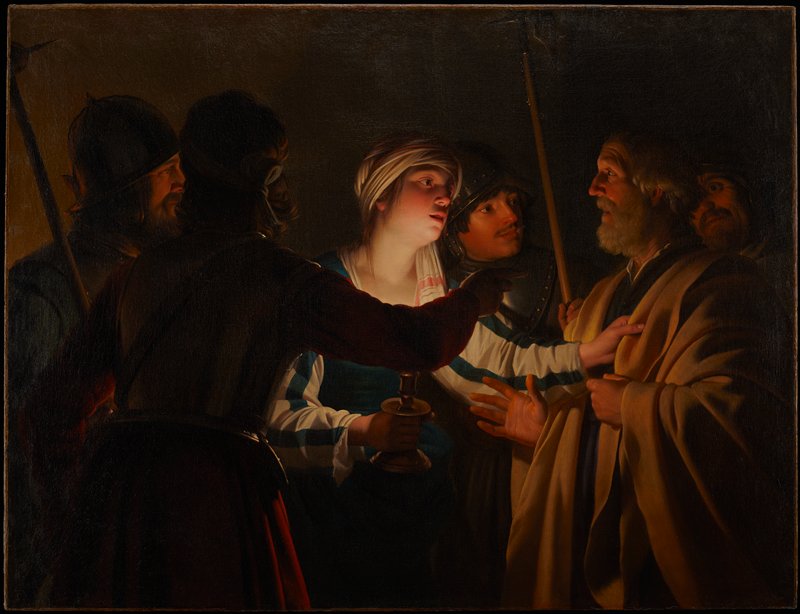
After arresting [Jesus] they led him away and took him into the house of the high priest; Peter was following at a distance. They lit a fire in the middle of the courtyard and sat around it, and Peter sat down with them. … About an hour later, still another insisted, “Assuredly, this man too was with him, for he also is a Galilean.” But Peter said, “My friend, I do not know what you are talking about.” Just as he was saying this, the cock crowed, and the Lord turned and looked at Peter, and Peter remembered the word of the Lord, how he had said to him, “Before the cock crows today, you will deny me three times.” He went out and began to weep bitterly.

– Luke 22:54-55,59-62

This threefold denial by Simon Peter was perhaps the most regretted moment of his life. He denied even knowing Jesus Christ, his teacher, friend, Lord, and God. How humble Peter was to share this story with the Early Church and how wonderful that the Holy Spirit inspired its inclusion in the Gospels! He shows us the fallen can get back up, wanderers can return, sinners can be forgiven, and even those who gravely sin can go on to become the greatest saints.

Jesus would go on to rehabilitate Peter after the Resurrection, alongside another charcoal fire by the Sea of Galilee. Mirroring the three denials, Jesus asks three times, “Simon, son of John, do you love me?” Simon Peter replies, “Yes, Lord, you know that I love you,” and Jesus reinstates him as shepherd of his sheep and lambs. The Sacrament of Reconciliation (or Confession) is likewise a personal encounter with Jesus Christ where we re-profess our love for God and receive his restoring forgiveness through the ministry of his ordained priest.

Though Simon Peter’s sins were forgiven they were not without loss and opportunities squandered. During the Passion, as they led Jesus away, “they took hold of a certain Simon, a Cyrenian, who was coming in from the country; and after laying the cross on him, they made him carry it behind Jesus.” If Simon Peter had not sinned in denying Christ the night before he could have been there, ready and willing to get behind his Lord, pick up Jesus’ cross and follow him. How beautiful that would have been! But this opportunity fell to another Simon.

Thanks be to God, St. Peter went on to repent. He did not give up to despair like Judas Iscariot. When Judas saw Jesus condemned and on his way to execution he deeply regretted what he had done. (One theory for why Judas had sold Jesus out is he wanted to trigger a confrontation with the leaders of Israel which would force Jesus to wield his mighty powers and take the throne.) Judas tried to return the thirty silver coins to the chief priests and elders saying, “I have sinned in betraying innocent blood.” They answered, “What is that to us? Look to it yourself.” Flinging the money into the temple, Judas departed and went off and hanged himself.

What if instead, on Good Friday afternoon, Judas had immediately ran to Calvary Hill? What if he had thrown himself down before Christ hanging on the Cross and begged his forgiveness? What would Jesus have said? What would Jesus have done? I think we already know the answer, or could pretty closely guess. Jesus would have forgiven Judas.

So come to Jesus in sacramental Confession. Come sooner rather than later and more than just once or twice a year. And, once wonderfully absolved, resolve and strive to sin no more. Though sins can be forgiven, we see that every sin or delayed conversion entails some loss, an opportunity missed.

The Mercies of Two Adams

February 24, 2019

In our second reading this Sunday, St. Paul compares the First Man to the Last Adam. In our Gospel, that Second Adam (Jesus Christ) shares teachings on forgiveness which have reshaped the world. Catholic spiritual tradition holds that when Jesus descended to the Abode of the Dead on Holy Saturday he found Adam and announced that the gates of Heaven were now open to him and all the Old Testament’s friends of God. If Adam went to Heaven we know he practiced forgiveness himself because Jesus says “if you do not forgive others, neither will your Father forgive your transgressions.” I’d like to begin by reflecting on three people from Adam’s life whom he had to forgive; and each one has a practical lesson for us touching on forgiveness.

One person Adam had to forgive was his wife, Eve. “She saw that the [forbidden] tree was good for food and pleasing to the eyes, and the tree was desirable for gaining wisdom. So she took some of its fruit and ate it; and she also gave some to her husband, who was with her, and he ate it.” Adam had to forgive her for doing this, but he also had to seek her forgiveness. He had been charged by God with protecting her and the garden. He was with her as the Serpent spoke, and he failed in his duty. Adam and Eve had to forgive each other.

Now a foolish person insists that other people are completely at fault one hundred percent of the time. After a conflict, even if I didn’t sin (even if I did nothing intentionally that I knew to be wrong at the time) I can still reflect upon how I could have expressed myself or handled the situation better. Mistakes are not sins—we can only sin on purpose—but we should learn from our mistakes.

Another person Adam had to forgive was his son, Cain. Because he felt snubbed, Cain was filled with jealous anger towards his brother. “Cain said to his brother Abel, ‘Let us go out in the field.’ When they were in the field, Cain attacked his brother Abel and killed him.” This was the first recorded murder, and Adam had to forgive his son for it.

In 1981, Mehmet Ali Ağca shot the pope in St. Peter’s Square at the Vatican. St. Pope John Paul the Great nearly died, but two years later after he had recovered he went to visit his would-be assassin in prison. I remember being amazed as a kid in CCD class to learn that the pope sat at an arm’s length from the unshackled man who almost killed him in order to personally forgive him. Significantly, the pope did not ask Italy’s leader or government to release Ağca at that time. Ağca served twenty-nine years in prison until his release in 2010. Similarly, God showed his mercy and did not destroy Cain the murderer, but God did place punishments on him.

Sometimes withholding punishment is not kindness because we need discipline, to experience just consequences for our actions, for our own good. As the Letter to the Hebrews says, “whom the Lord loves, he disciplines; he chastises every son he acknowledges. … At the time, all discipline seems a cause not for joy but for pain, yet later it brings the peaceful fruit of righteousness to those who are trained by it.” Mercy and forgiveness do not rule out experiencing any consequences.

A third person Adam had to forgive is one you might not expect: Adam had to forgive the Serpent. Was the wicked Serpent sorry for what he had done? No, but Adam had to forgive for Adam’s own sake. Unforgiveness is a bitter poison we drink in hopes of hurting someone else. Renouncing our claims to vengeance against another actually sets us free.

Jesus said we must forgive to be forgiven ourselves, but some people think they can’t forgive because they think forgiveness means something it doesn’t. Forgiveness is not to say that the sin wasn’t wrong, or that it’s no big deal, or that it doesn’t hurt anymore, or that it never really happened, or everything can go back to how it was before. Forgiveness means loving someone despite their sins, even if prudence may require us to keep a healthy distance from them (as with the Devil.)

Does God hate that ancient serpent, the Devil, the father of lies and a murderer from the beginning? Amazingly, no. As the Book of Wisdom says, “you [Lord] love all things that are and loathe nothing that you have made; for you would not fashion what you hate. [And] how could a thing remain, unless you willed it; or be preserved, had it not been called forth by you? But you spare all things, because they are yours…” God hates what Satan does, but loves him still. God hates the sin, but loves the sinner. In the end, the wicked will not be annihilated, made to no longer exist, but given the disassociation and space away from God they desire forever. God hates no one and neither should we.

In several places in the New Testaments, St. Paul draws parallels between Adam and Jesus. St. Paul wrote the Romans: “just as through the disobedience of one person the many were made sinners, so through the obedience of one the many will be made righteous.” The First Adam gave life to all his descendants, and the Last Adam gives life to all who follow him. The Old Adam, by his selfish sin, condemned the world; but the New Adam, by his holy self-sacrifice, redeems us. The First Adam, as we have seen, practiced forgiveness, but Jesus Christ is personified Mercy.

Consider how autobiographical Jesus’ Gospel teaching on forgiveness is. Jesus says, “To the person who strikes you on one cheek, offer the other one as well.” During the Passion, at his Jewish trial before the Sanhedrin, “they spat in [Jesus’] face and struck him, while some slapped him, saying, ‘Prophesy for us, Messiah: who is it that struck you?’

Jesus says, “From the person who takes your cloak, do not withhold even your tunic.” “When the [Roman] soldiers had crucified Jesus, they took his clothes and divided them into four shares, a share for each soldier. They also took his tunic, but the tunic was seamless, woven in one piece from the top down. So they said to one another, ‘Let’s not tear it, but cast lots for it to see whose it will be…’

Jesus says, “Love your enemies, do good to those who hate you, bless those who curse you, pray for those who mistreat you.” The religious leaders sneered at Jesus as he hung on the Cross. Even the soldiers jeered at him. But Jesus prayed for them saying, “Father, forgive them, they know not what they do.”

Jesus says, “If you love those who love you, what credit is that to you? Even sinners love those who love them. And if you do good to those who do good to you,what credit is that to you? Even sinners do the same.” St. Paul wrote to the Christians at Rome, “God proves his love for us in that while we were still sinners Christ died for us.

Jesus says, “If you lend money to those from whom you expect repayment, what credit is that to you? Even sinners lend to sinners, and get back the same amount. But rather, love your enemies and do good to them, and lend expecting nothing back; then your reward will be great and you will be children of the Most High…” Jesus gave of himself knowing that many would give him nothing in return, he loves sinners knowing that many will not love him back. But Jesus is his Father’s Son, merciful as he is merciful, loving as he is loving, good as he is good, and generous as he is generous. And Jesus invites us to also be children of the Most High like himself.

So let’s be generous in every way towards Jesus, who gives us mercy, our every blessing in life, and his very self in the Eucharist. Jesus’ teaching at the close of today’s Gospel is true not only for financial giving but for every gift to God, for God is never outdone in generosity: “Give, and gifts will be given to you; a good measure, packed together, shaken down, and overflowing, will be poured into your lap. For the measure with which you measure will in return be measured out to you.” Let us be merciful and generous like Jesus is towards us.

Mary in History: A Healing Spring

February 24, 2019

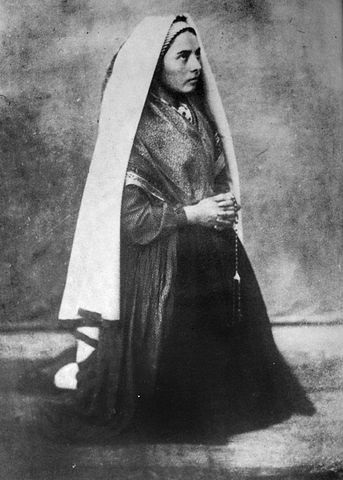
February 25, 1858 – Lourdes, France

By the time of this, the ninth appearance of the beautiful Lady to the fourteen-year-old St. Bernadette Soubirous, word had spread about these apparitions and the visionary. On this date, about 300 people accompanied Bernadette to the grotto near the Gave River outside Lourdes. No one except Bernadette could see the Lady nor hear her speaking aloud in their local French dialect.

On this occasion, the Lady told Bernadette, “Go and wash and drink in the spring.” But Bernadette became confused because there was no spring to be seen. At first she thought she meant the river, but the Lady directed her to the back of the grotto cave. Bernadette walked there, kneeled down, and dug at the earth with her hands. Water began seeping into the hole, turning the soil to mud. Bernadette drank it and washed her face with it. She also, at the lady’s command, ate some of the grass there. Understandably, the crowd was dismayed and thought her crazy. Bernadette answered, “It is for sinners.”

There had been no spring there before, but by the next day the spot was producing a thin stream trickling down to the river. Later, Louis Bourriette, a blinded stonecutter, bathed his eyes in its water and regained his sight. In another famous case, a desperate mom prayerfully plunged her weak and dying infant into the cold spring waters and he became healthy and strong for the first time, amazing the doctors. (This child, Justin Bouhort, who would go on to attend the canonization of St. Bernadette seventy-five years later, on December 8th, 1933.) Though there is nothing scientifically unique about the chemical makeup of this water, more than 7,000 miraculous healings have been counted at Lourdes, of which 67 have been officially recognized as “medically inexplicable” by the International Medical Association of Lourdes. As we see in the spring at Lourdes, St. Bernadette, and Our Lady, the Lord exults the lowly, leading all future generations to call them blessed.

Sound Interpretations

February 17, 2019

Last year, the internet hotly debated whether a particular sound clip was saying Yanny” or “Laurel.” While most people can only hear one name or the other, some people can make out each. In fact, both of the names are sounding in the clip together but at higher and lower pitches. In another online curiosity, a short video shows a small figurine glowing and emitting a sound, either “Brainstorm” or “Green Needle.” The amazing thing is that if you listen to this clip with either phrase in mind then that is the phrase you’ll hear. You can even alternate back and forth between the two. In each of these examples, the messages are indeed there to be heard if one has the ears to hear them.

These phenomena suggest how people in the Bible may have been present to the same auditory events but heard things quite differently. On one occasion recorded in John’s Gospel, Jesus prayed aloud, “Father, glorify your name.” Then a voice came from Heaven, “I have glorified it and will glorify it again.” John notes, “The crowd there heard it and said it was thunder; but others said, ‘An angel has spoken to him.‘” Later, at Pentecost in The Acts of the Apostles, the disciples “were filled with the Holy Spirit and began to speak in different tongues, as the Spirit enabled them to proclaim.” At the sound of it others in Jerusalem from many nations gathered in a large crowd “but they were confused because each one heard them speaking in his own language. … They were all astounded and bewildered, and said to one another, ‘What does this mean?’ But others said, scoffing, ‘They have had too much new wine.’” Sometimes people can hear more than one thing in the same divine message, or dismiss it all as nonsense.

Does each passage of the Bible have only one true interpretation? Some reject that Isaiah 7:14 (“The virgin shall be with child and bear a son, and they shall name him Emmanuel”) could foretell the virgin birth of Jesus, arguing “the author was referring only to the political situation of his day, not to an event centuries later he couldn’t possibly have known.” But this view forgets or denies that human beings are not the sole authors of Scripture. They are co-authors inspired by the Holy Spirit. God is all-knowing and alive outside of time. He can inspire prophesies with both near and distant fulfillments. And God can invest passages with multiple true and divinely-intended meanings. For example, in the Book of Revelation, John beholds in the sky, “a woman clothed with the sun, with the moon under her feet, and on her head a crown of twelve stars.” She gives birth to a son, the Christ, and then she is protected by God from a red dragon, the Devil. Does this represent God’s people of the Old and the New Covenants, or does it symbolize Mary the Mother of God? Yes. The answer is both.

Sacred Scripture, like other things of God, may be compared to a magic pool. It is a pool in which a small toddler may safely play and a great whale may deeply swim. Let us not remain shallow in our understandings, but explore the true depths of God’s Word.