Archive for the ‘Christian Perfection’ Category

Lessons from the Sins of Simon Peter & Judas

April 9, 2019

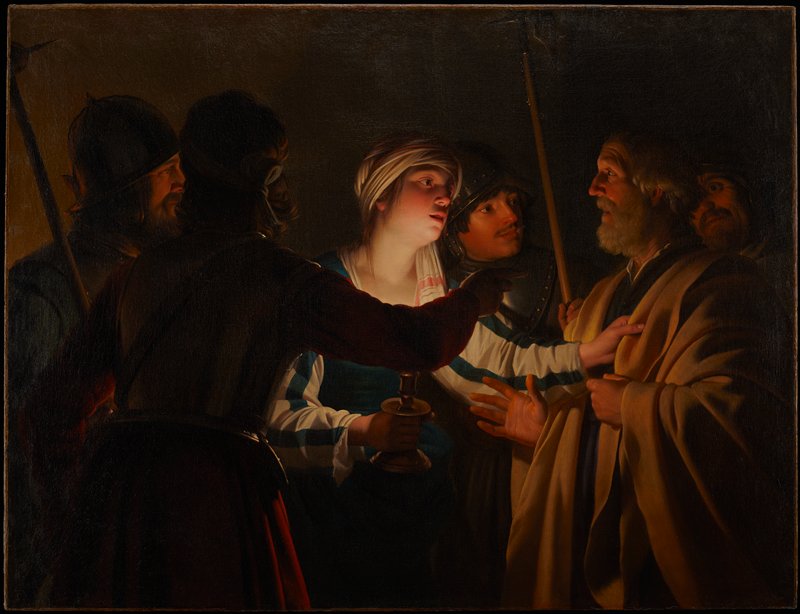
After arresting [Jesus] they led him away and took him into the house of the high priest; Peter was following at a distance. They lit a fire in the middle of the courtyard and sat around it, and Peter sat down with them. … About an hour later, still another insisted, “Assuredly, this man too was with him, for he also is a Galilean.” But Peter said, “My friend, I do not know what you are talking about.” Just as he was saying this, the cock crowed, and the Lord turned and looked at Peter, and Peter remembered the word of the Lord, how he had said to him, “Before the cock crows today, you will deny me three times.” He went out and began to weep bitterly.

– Luke 22:54-55,59-62

This threefold denial by Simon Peter was perhaps the most regretted moment of his life. He denied even knowing Jesus Christ, his teacher, friend, Lord, and God. How humble Peter was to share this story with the Early Church and how wonderful that the Holy Spirit inspired its inclusion in the Gospels! He shows us the fallen can get back up, wanderers can return, sinners can be forgiven, and even those who gravely sin can go on to become the greatest saints.

Jesus would go on to rehabilitate Peter after the Resurrection, alongside another charcoal fire by the Sea of Galilee. Mirroring the three denials, Jesus asks three times, “Simon, son of John, do you love me?” Simon Peter replies, “Yes, Lord, you know that I love you,” and Jesus reinstates him as shepherd of his sheep and lambs. The Sacrament of Reconciliation (or Confession) is likewise a personal encounter with Jesus Christ where we re-profess our love for God and receive his restoring forgiveness through the ministry of his ordained priest.

Though Simon Peter’s sins were forgiven they were not without loss and opportunities squandered. During the Passion, as they led Jesus away, “they took hold of a certain Simon, a Cyrenian, who was coming in from the country; and after laying the cross on him, they made him carry it behind Jesus.” If Simon Peter had not sinned in denying Christ the night before he could have been there, ready and willing to get behind his Lord, pick up Jesus’ cross and follow him. How beautiful that would have been! But this opportunity fell to another Simon.

Thanks be to God, St. Peter went on to repent. He did not give up to despair like Judas Iscariot. When Judas saw Jesus condemned and on his way to execution he deeply regretted what he had done. (One theory for why Judas had sold Jesus out is he wanted to trigger a confrontation with the leaders of Israel which would force Jesus to wield his mighty powers and take the throne.) Judas tried to return the thirty silver coins to the chief priests and elders saying, “I have sinned in betraying innocent blood.” They answered, “What is that to us? Look to it yourself.” Flinging the money into the temple, Judas departed and went off and hanged himself.

What if instead, on Good Friday afternoon, Judas had immediately ran to Calvary Hill? What if he had thrown himself down before Christ hanging on the Cross and begged his forgiveness? What would Jesus have said? What would Jesus have done? I think we already know the answer, or could pretty closely guess. Jesus would have forgiven Judas.

So come to Jesus in sacramental Confession. Come sooner rather than later and more than just once or twice a year. And, once wonderfully absolved, resolve and strive to sin no more. Though sins can be forgiven, we see that every sin or delayed conversion entails some loss, an opportunity missed.

The Mercies of Two Adams

February 24, 2019

In our second reading this Sunday, St. Paul compares the First Man to the Last Adam. In our Gospel, that Second Adam (Jesus Christ) shares teachings on forgiveness which have reshaped the world. Catholic spiritual tradition holds that when Jesus descended to the Abode of the Dead on Holy Saturday he found Adam and announced that the gates of Heaven were now open to him and all the Old Testament’s friends of God. If Adam went to Heaven we know he practiced forgiveness himself because Jesus says “if you do not forgive others, neither will your Father forgive your transgressions.” I’d like to begin by reflecting on three people from Adam’s life whom he had to forgive; and each one has a practical lesson for us touching on forgiveness.

One person Adam had to forgive was his wife, Eve. “She saw that the [forbidden] tree was good for food and pleasing to the eyes, and the tree was desirable for gaining wisdom. So she took some of its fruit and ate it; and she also gave some to her husband, who was with her, and he ate it.” Adam had to forgive her for doing this, but he also had to seek her forgiveness. He had been charged by God with protecting her and the garden. He was with her as the Serpent spoke, and he failed in his duty. Adam and Eve had to forgive each other.

Now a foolish person insists that other people are completely at fault one hundred percent of the time. After a conflict, even if I didn’t sin (even if I did nothing intentionally that I knew to be wrong at the time) I can still reflect upon how I could have expressed myself or handled the situation better. Mistakes are not sins—we can only sin on purpose—but we should learn from our mistakes.

Another person Adam had to forgive was his son, Cain. Because he felt snubbed, Cain was filled with jealous anger towards his brother. “Cain said to his brother Abel, ‘Let us go out in the field.’ When they were in the field, Cain attacked his brother Abel and killed him.” This was the first recorded murder, and Adam had to forgive his son for it.

In 1981, Mehmet Ali Ağca shot the pope in St. Peter’s Square at the Vatican. St. Pope John Paul the Great nearly died, but two years later after he had recovered he went to visit his would-be assassin in prison. I remember being amazed as a kid in CCD class to learn that the pope sat at an arm’s length from the unshackled man who almost killed him in order to personally forgive him. Significantly, the pope did not ask Italy’s leader or government to release Ağca at that time. Ağca served twenty-nine years in prison until his release in 2010. Similarly, God showed his mercy and did not destroy Cain the murderer, but God did place punishments on him.

Sometimes withholding punishment is not kindness because we need discipline, to experience just consequences for our actions, for our own good. As the Letter to the Hebrews says, “whom the Lord loves, he disciplines; he chastises every son he acknowledges. … At the time, all discipline seems a cause not for joy but for pain, yet later it brings the peaceful fruit of righteousness to those who are trained by it.” Mercy and forgiveness do not rule out experiencing any consequences.

A third person Adam had to forgive is one you might not expect: Adam had to forgive the Serpent. Was the wicked Serpent sorry for what he had done? No, but Adam had to forgive for Adam’s own sake. Unforgiveness is a bitter poison we drink in hopes of hurting someone else. Renouncing our claims to vengeance against another actually sets us free.

Jesus said we must forgive to be forgiven ourselves, but some people think they can’t forgive because they think forgiveness means something it doesn’t. Forgiveness is not to say that the sin wasn’t wrong, or that it’s no big deal, or that it doesn’t hurt anymore, or that it never really happened, or everything can go back to how it was before. Forgiveness means loving someone despite their sins, even if prudence may require us to keep a healthy distance from them (as with the Devil.)

Does God hate that ancient serpent, the Devil, the father of lies and a murderer from the beginning? Amazingly, no. As the Book of Wisdom says, “you [Lord] love all things that are and loathe nothing that you have made; for you would not fashion what you hate. [And] how could a thing remain, unless you willed it; or be preserved, had it not been called forth by you? But you spare all things, because they are yours…” God hates what Satan does, but loves him still. God hates the sin, but loves the sinner. In the end, the wicked will not be annihilated, made to no longer exist, but given the disassociation and space away from God they desire forever. God hates no one and neither should we.

In several places in the New Testaments, St. Paul draws parallels between Adam and Jesus. St. Paul wrote the Romans: “just as through the disobedience of one person the many were made sinners, so through the obedience of one the many will be made righteous.” The First Adam gave life to all his descendants, and the Last Adam gives life to all who follow him. The Old Adam, by his selfish sin, condemned the world; but the New Adam, by his holy self-sacrifice, redeems us. The First Adam, as we have seen, practiced forgiveness, but Jesus Christ is personified Mercy.

Consider how autobiographical Jesus’ Gospel teaching on forgiveness is. Jesus says, “To the person who strikes you on one cheek, offer the other one as well.” During the Passion, at his Jewish trial before the Sanhedrin, “they spat in [Jesus’] face and struck him, while some slapped him, saying, ‘Prophesy for us, Messiah: who is it that struck you?’

Jesus says, “From the person who takes your cloak, do not withhold even your tunic.” “When the [Roman] soldiers had crucified Jesus, they took his clothes and divided them into four shares, a share for each soldier. They also took his tunic, but the tunic was seamless, woven in one piece from the top down. So they said to one another, ‘Let’s not tear it, but cast lots for it to see whose it will be…’

Jesus says, “Love your enemies, do good to those who hate you, bless those who curse you, pray for those who mistreat you.” The religious leaders sneered at Jesus as he hung on the Cross. Even the soldiers jeered at him. But Jesus prayed for them saying, “Father, forgive them, they know not what they do.”

Jesus says, “If you love those who love you, what credit is that to you? Even sinners love those who love them. And if you do good to those who do good to you,what credit is that to you? Even sinners do the same.” St. Paul wrote to the Christians at Rome, “God proves his love for us in that while we were still sinners Christ died for us.

Jesus says, “If you lend money to those from whom you expect repayment, what credit is that to you? Even sinners lend to sinners, and get back the same amount. But rather, love your enemies and do good to them, and lend expecting nothing back; then your reward will be great and you will be children of the Most High…” Jesus gave of himself knowing that many would give him nothing in return, he loves sinners knowing that many will not love him back. But Jesus is his Father’s Son, merciful as he is merciful, loving as he is loving, good as he is good, and generous as he is generous. And Jesus invites us to also be children of the Most High like himself.

So let’s be generous in every way towards Jesus, who gives us mercy, our every blessing in life, and his very self in the Eucharist. Jesus’ teaching at the close of today’s Gospel is true not only for financial giving but for every gift to God, for God is never outdone in generosity: “Give, and gifts will be given to you; a good measure, packed together, shaken down, and overflowing, will be poured into your lap. For the measure with which you measure will in return be measured out to you.” Let us be merciful and generous like Jesus is towards us.

Mary in History: A Healing Spring

February 24, 2019

February 25, 1858 – Lourdes, France

By the time of this, the ninth appearance of the beautiful Lady to the fourteen-year-old St. Bernadette Soubirous, word had spread about these apparitions and the visionary. On this date, about 300 people accompanied Bernadette to the grotto near the Gave River outside Lourdes. No one except Bernadette could see the Lady nor hear her speaking aloud in their local French dialect.

On this occasion, the Lady told Bernadette, “Go and wash and drink in the spring.” But Bernadette became confused because there was no spring to be seen. At first she thought she meant the river, but the Lady directed her to the back of the grotto cave. Bernadette walked there, kneeled down, and dug at the earth with her hands. Water began seeping into the hole, turning the soil to mud. Bernadette drank it and washed her face with it. She also, at the lady’s command, ate some of the grass there. Understandably, the crowd was dismayed and thought her crazy. Bernadette answered, “It is for sinners.”

There had been no spring there before, but by the next day the spot was producing a thin stream trickling down to the river. Later, Louis Bourriette, a blinded stonecutter, bathed his eyes in its water and regained his sight. In another famous case, a desperate mom prayerfully plunged her weak and dying infant into the cold spring waters and he became healthy and strong for the first time, amazing the doctors. (This child, Justin Bouhort, who would go on to attend the canonization of St. Bernadette seventy-five years later, on December 8th, 1933.) Though there is nothing scientifically unique about the chemical makeup of this water, more than 7,000 miraculous healings have been counted at Lourdes, of which 67 have been officially recognized as “medically inexplicable” by the International Medical Association of Lourdes. As we see in the spring at Lourdes, St. Bernadette, and Our Lady, the Lord exults the lowly, leading all future generations to call them blessed.

Sound Interpretations

February 17, 2019

Last year, the internet hotly debated whether a particular sound clip was saying Yanny” or “Laurel.” While most people can only hear one name or the other, some people can make out each. In fact, both of the names are sounding in the clip together but at higher and lower pitches. In another online curiosity, a short video shows a small figurine glowing and emitting a sound, either “Brainstorm” or “Green Needle.” The amazing thing is that if you listen to this clip with either phrase in mind then that is the phrase you’ll hear. You can even alternate back and forth between the two. In each of these examples, the messages are indeed there to be heard if one has the ears to hear them.

These phenomena suggest how people in the Bible may have been present to the same auditory events but heard things quite differently. On one occasion recorded in John’s Gospel, Jesus prayed aloud, “Father, glorify your name.” Then a voice came from Heaven, “I have glorified it and will glorify it again.” John notes, “The crowd there heard it and said it was thunder; but others said, ‘An angel has spoken to him.‘” Later, at Pentecost in The Acts of the Apostles, the disciples “were filled with the Holy Spirit and began to speak in different tongues, as the Spirit enabled them to proclaim.” At the sound of it others in Jerusalem from many nations gathered in a large crowd “but they were confused because each one heard them speaking in his own language. … They were all astounded and bewildered, and said to one another, ‘What does this mean?’ But others said, scoffing, ‘They have had too much new wine.’” Sometimes people can hear more than one thing in the same divine message, or dismiss it all as nonsense.

Does each passage of the Bible have only one true interpretation? Some reject that Isaiah 7:14 (“The virgin shall be with child and bear a son, and they shall name him Emmanuel”) could foretell the virgin birth of Jesus, arguing “the author was referring only to the political situation of his day, not to an event centuries later he couldn’t possibly have known.” But this view forgets or denies that human beings are not the sole authors of Scripture. They are co-authors inspired by the Holy Spirit. God is all-knowing and alive outside of time. He can inspire prophesies with both near and distant fulfillments. And God can invest passages with multiple true and divinely-intended meanings. For example, in the Book of Revelation, John beholds in the sky, “a woman clothed with the sun, with the moon under her feet, and on her head a crown of twelve stars.” She gives birth to a son, the Christ, and then she is protected by God from a red dragon, the Devil. Does this represent God’s people of the Old and the New Covenants, or does it symbolize Mary the Mother of God? Yes. The answer is both.

Sacred Scripture, like other things of God, may be compared to a magic pool. It is a pool in which a small toddler may safely play and a great whale may deeply swim. Let us not remain shallow in our understandings, but explore the true depths of God’s Word.

Mary in History: A Surprising Lady

February 11, 2019

February 11, 1858 – Lourdes, France

On the Tuesday before Ash Wednesday (which is called “Fat” or “Shrove” Tuesday,) Bernadette Soubirous, her sister, and a friend were gathering firewood in the cold outside their small French town. They were near a river and a grotto (a shallow cave) where the locals would dump their garbage. Then fourteen-year-old Bernadette heard the sound of a sudden swish of wind. As Bernadette would later recall:

“I had just begun to take off my first stocking [intending to cross the shallow river barefooted as my companions had done] when suddenly I heard a great noise like the sound of a storm. I looked to the right, to the left, under the trees of the river, but nothing moved; I thought I was mistaken. I went on taking off my shoes and stockings, when I heard a fresh noise like the first. Then I was frightened and stood straight up. I lost all power of speech and thought, when, turning my head toward the grotto, I saw at one of the openings of the rock a [rose] bush, one only, moving as if it were very windy. Almost at the same time there came out of the interior of the grotto a golden colored cloud, and soon after a Lady, young and beautiful, exceedingly beautiful, the like of whom I had never seen, came and placed herself at the entrance of the opening above the bush. She looked at me immediately, smiled at me and signed me to advance, as if she had been my mother. All fear had left me, but I seemed to know no longer where I was. I rubbed my eyes, I shut them, I opened them; but the Lady was still there continuing to smile at me and making me understand that I was not mistaken. Without thinking of what I was doing, I took my Rosary in my hands and fell on my knees. The Lady made a sign of approval with her head and took into her hands a rosary which hung on her right arm. When I attempted to begin the Rosary and tried to lift my hand to my forehead, my arm remained paralyzed, and it was only after the Lady had signed herself that I could do the same. The Lady left me to pray all alone; she passed the beads of her Rosary between her fingers but she said nothing; only at the end of each decade did she say the ‘Glory Be’ with me.”

St. Bernadette Soubirous then returned to her family’s poor home, but this would be just the first of eighteen apparitions to her by the Blessed Virgin Mary, Our Lady of Lourdes, over the five months to follow.

The Seventh Jar

January 22, 2019

Anyone who has done the chore of carrying milk gallons from the store to the car, and from the car into the house, knows they are not feather light. “Now there were six stone water jars (at Cana) for Jewish ceremonial washings, each holding 20 to 30 gallons.” Perhaps the servants did not have to lug those stone jars around, but they had to move the water from the local well or cistern to where the party was held. Have you ever considered how much those 120 to 180 gallons of water weighed? One gallon of water weights a little more than eight pounds. So six stone jars holding 20 to 30 gallons each is a weight of water somewhere between 1,000 and 1,500 pounds.

Mary said to the servers, “Do whatever he tells you.”
Jesus told them, ‘Fill the jars with water.’
So they filled them to the brim.”

It wasn’t easy work. At the time it did not seem that important or glorious. But those servants obediently and generously served Christ at that marriage, filling the jars to the very brim, and what they did will be remembered and celebrated forever.

In various times and places, different numbers can carry symbolic meanings. For example, if I asked you for a lucky number, you would probably say “seven.” And if I asked you for an unlucky number, you would probably quote me “thirteen.” The Jewish culture of the Bible has its own symbolic associations with numbers. For instance, for Jews the number six meant imperfection. (This is partly why, in the Book of Revelation, the number of the Beast is “666,” because great evil is profoundly imperfect.) And for Jews the number seven meant completeness. (In the beginning, when God had finished Creation, he rested on the seventh day because his work was complete.)

“Now there were six stone water jars there for Jewish ceremonial washings.” These six jars of water which Jesus turns into wine point to how his New Covenant fulfills and improves upon the imperfect Old Covenant. The water for the purification rites was good, but the wine for the wedding is best. Along with those six stone jars, John’s Gospel goes on to notice one more jar:

“[On the Cross,] aware that everything was now finished, in order that the scripture might be fulfilled, Jesus said, ‘I thirst.’ There was a jar filled with sour wine. So they put a sponge soaked in wine on a sprig of hyssop and put it up to his mouth. When Jesus had taken the wine, he said, ‘It is finished (fulfilled / complete / consummated)’ And bowing his head, he handed over the spirit.”

All four gospels mention this sour wine Jesus received on the Cross, fulfilling the Psalm which said, “for my thirst they gave me vinegar to drink.” Vinegar is made from wine which grows old and sour. This jar of sour vinegar wine at the Cross is the seventh jar which completes the six jars from Cana. The public ministry of Our Lord began with the joy of a wedding. And public ministry led him to sacrificing himself for his spouse, the Church. Every marriage should have its share of joy and sacrifice.

Marriages are often said to go through a “honeymoon” period. When the relationship is fresh and new, life feels like water changed into wine and joy flows easily. But as the relationship continues and grows older, the wine sometimes turns into vinegar. And then people ask themselves, “Did I make a mistake? Did I marry the wrong person? Did I choose the wrong vocation?” And many people give up too hastily. But these challenging times are a call to purifying love.

When someone says, “I love coffee” or “I love pizza,” they’re really saying “I love how these foods make me feel. I love what they do for me.” But this is not how we are called to love God and one another. We are to love others for their own sake. And in this the Cross of Christ is unavoidable. If mere personal happiness were the meaning of life, then suffering would be meaningless. That’s not what we believe. The Cross grows us into Christ. God does not want us to be endlessly miserable, but if we think the journey of our lives will always be on mountain tops, and never in dark valleys, then we will not journey well through the highs and lows and plains of life.

What if I’m saying to myself, “I have no wine.” What should I do? As Jesus’ Mother said to the servers, “Do whatever he tells you.” This means obedience to Jesus Christ. What if I think I lack the strength to do what Christ asks, or despair that things can really change? The Virgin Mary may not have known it at the time, but in saying “Do whatever he tells you” she was echoing this passage from Genesis:

“When the seven years of abundance enjoyed by the land of Egypt came to an end, the seven years of famine set in, just as Joseph had foretold. Although there was famine in all the other countries, food was available throughout the land of Egypt. When all the land of Egypt became hungry and the people cried to Pharaoh for food, Pharaoh said to all the Egyptians: ‘Go to Joseph and do whatever he tells you.’”

Joseph had been storing up surplus grain for seven years before and he proceeded to provide sufficient food for the entire Kingdom of Egypt and all the world who came to him and asked. When there is no wine where there ought to be (in your marriage, in your household, in your life) do your small part like the servants did at Cana, and invite, ask, and rely on Jesus to provide the rest.

The Christian life has highs and lows, but most of our days are lived in between, on the flat plains. Our lives matter greatly to God, so he has told us so and shown us so through Jesus Christ, but for the most part our lives feel ordinary. As our second reading from 1st Corinthians says, the Church of Christ has many members, with various gifts and roles for the Kingdom of God. Yet nobody feels they are particularly extraordinary because our lives are full of the ordinary.

Say you’re raising children, forming saints for Heaven, who produce piles of laundry and dirty dishes. So say you’re working outside of home, doing a regular job, which provides a service so beneficial and valuable that people pay you money to do it, money you then use to help others. Say you’re praying daily (as we’re called to do,) blessing others, near and far, the living and deceased, by your worship and intercessions before Almighty God, and repeatedly checking your watch. Even if you’re ordained priest, you can be celebrating the Holy Sacrifice of the Mass… fourteen times a week. So much of our lives filled with the ordinary that these ordinary things must matter much more than we might think.

Nothing is recorded in the gospels about most of the years of Jesus’ life. We hear about his early years and his later, few-year ministry, but not what happened in between. The span of time from the finding of twelve-year-old Jesus in the Temple to the start of his public ministry at about thirty years of age is called his “hidden years.” Jesus may not have worked any miracles in those years, but in Heaven we will see how he lived and worked and loved then in ordinary and yet far from insignificant ways.

A full Christian life is not easy work. At times what we do may not feel that important or glorious. But if we serve Jesus Christ, obediently and generously, then what we do here will be remembered and celebrated, by us and by all, with joy forever.

Mary in History: Our Lady of the Flowers

December 29, 2018

December 29, 1336 – Italy

Egidia Mathis, a pregnant, young wife, was walking alone at the edge of nightfall near Bra, Italy. Near a pillar bearing a coarsely painted image of the Virgin Mary with Child, she crossed paths with two foreign soldiers-for-hire (that is, mercenaries) whom she sensed wished to do her harm. Incapable of defense or escape, Egidia flung herself towards the pillar, begging Mary’s help. A great light came forth from the image. Mary scared off the wicked men with a commanding gesture and smiled at Egidia with maternal empathy. The stress of the moment caused Egidia to go into labor and she delivered her baby there. As she held her newborn closely in the winter cold, the blackthorn thicket surrounding the pillar was now in full bloom with thousands of white flowers. Upon reaching home, she told her husband of the whole episode and he with their relatives and neighbors all beheld the miraculous, out-of season flowering.

Some might dismiss this tale as merely pious legend. But virtually every winter since 1336, this blackthorn thicket, contrary to its species and scientific explanation, has flowered between December 25th and January 15th. Two rare exceptions were 1914 and 1939, the years the two World Wars began. Furthermore, on three occasions, this winter flowering has extended for months, corresponding each time with rare public expositions of the Shroud of Turin (the possible burial cloth of Christ) housed twenty-seven miles away.

A Prayer Litany for the Souls in Purgatory

November 2, 2018

O Jesus, Thou suffered and died that all mankind might be saved and brought to eternal happiness. Hear our pleas for further mercy on the souls of:

My dear parents & grandparents,

     [Response: “My Jesus, Have Mercy”]

My brothers & sisters & other near relatives,

My godparents & sponsors of Confirmation,

My spiritual & temporal benefactors,

My friends & neighbors,

All for whom love or duty bids me pray,

Those who have suffered disadvantage or harm through me,

Those who have offended me,

Those whose release is near at hand,

Those who desire most to be united to Thee,

Those who endure the greatest sufferings,

Those whose release is most remote,

Those who are least remembered.

Those who are most deserving on account of their services to the Church,

The rich, who are now the most destitute,

The mighty, who are now powerless,

The once spiritually blind, who now see their folly,

The frivolous, who spent their time in idleness,

The poor who did not seek the treasures of heaven, The tepid who devoted little time to prayer,

The indolent who neglected to perform good works, Those of little faith, who neglected the frequent reception of the Sacraments,

The habitual sinners, who owe their salvation to a miracle of grace,

Parents who failed to watch over their children, Superiors who were not solicitous for the salvation of those entrusted to them,

Those who strove for worldly riches & pleasures, The worldly minded, who failed to use their wealth & talent for the service of God,

Those who witnessed the death of others, but would not think of their own,

Those who did not provide for the life hereafter,

Those whose sentence is severe because of the great things entrusted to them,

The popes, kings, & rulers,

The bishops & their counselors,

My teachers & spiritual advisors,

The priests & religious of the Catholic Church,

The defenders of the Holy Faith,

Those who died on the battlefield,

Those who fought for their country,

Those who were buried in the sea,

Those who died of strokes,

Those who died of heart attacks,

Those who suffered & died of cancer,

Those who died suddenly in accidents,

Those who died without the last rites of the Church,

Those who shall die within the next 24 hours,

My own poor soul when I shall have to appear before Thy judgment seat,

Eternal rest grant unto them, O Lord, and let perpetual light shine upon them: For evermore with Thy Saints, because Thou art gracious. May the prayer of Thy suppliant people, we beseech Thee, O Lord, benefit the souls of Thy departed servants and handmaids: that Thou mayest both deliver them from all their sins, and make them to be partakers of Thy redemption. Amen. Eternal rest grant unto them, O Lord. And let perpetual light shine on them. Amen. May their souls & the souls of all the faithful departed through the mercy of God, rest in peace. Amen.

Reintroducing the St. Michael Prayer

October 22, 2018

Our Bishop William Callahan has asked that we begin regularly reciting the St. Michael Prayer at the end of our parish Masses. In last week’s pastoral letter he wrote that “this prayer, given to us by Pope Leo XIII, is a sure defense against the wickedness and snares of the Devil. Now as much as ever we need the assistance of St. Michael to help rid us, the Church, of its current evils.” So, we will be praying this prayer together at each Sunday and weekday Mass following the final blessing (and preceding the closing hymn.)

Who is St. Michael? He is a mighty archangel, a leader among God’s angels. He has several appearances in the Bible, but most famously in the Book of Revelation. There he is beheld leading good angels in battle against the Devil (referred to here as the dragon): “Then war broke out in heaven; Michael and his angels battled against the dragon. The dragon and its angels fought back, but they did not prevail and there was no longer any place for them in Heaven.” (Revelation 12:7-8) St. Michael’s name is Hebrew for the phrase “Who is like God?” Tradition says that this was Michael’s challenging battle cry against the proud, rebellious demons – for no creature is equal our all-glorious God.

The St. Michael Prayer was written by the long-reigning Pope Leo XIII. In 1886, he instituted that it be recited after the celebration of Masses. Though the inspiration for this prayer is uncertain, many historians accept accounts that it followed from Pope Leo experiencing a profound vision. A cardinal from that time explained, “Pope Leo XIII truly had a vision of demonic spirits, who were gathering on the Eternal City (i.e., Rome.) From that experience… comes the prayer which he wanted the whole Church to recite.

Since the St. Michael Prayer in English is a translation from the original Latin text, some versions of the prayer slightly differ from one another. (For instance, some translations ask St. Michael to “cast” Satan and all the evil spirits into Hell, while others use the word “thrust.”) To keep everyone on the same page, please refer to the prayer cards at the end of the pews or the version below. Together, let us pray for aid in our battle against the iniquitous spirits active within God’s Church and our world.

St. Michael the Archangel, defend us in battle.
Be our defense against
the wickedness and snares of the devil.

May God rebuke him, we humbly pray;
and do thou, O Prince of the heavenly hosts,
by the power of God,
thrust into hell Satan and all the evil spirits,
who prowl about the world seeking the ruin of souls.
Amen.

Lessons from Disaster

September 7, 2018

On a Tuesday morning seventeen years ago I was sleeping-in at college. I had no classes that morning so I stayed in my dorm room bed as late as possible, peacefully unaware. I eventually descended from my loft and turned on the TV. The Catholic channel (EWTN) showed people praying in the chapel “for the bombing victims.” Then my roommate walked in and asked me if I’d heard. “Airplanes crashed into the World Trade Towers and the Sears Tower in Chicago. Another plane crashed into the Pentagon, a car bomb blew up at the State Department, and there’s a fire on the National Mall.” Standing there, I realized I would remember that moment for the rest of my life, just as others vividly remembered the attack on Pearl Harbor or the assassination of President Kennedy before me.

It’s striking how much confusion there was on September 11, 2001. Most of what my roommate had told me proved inaccurate. Terrible things had certainly occurred – the murder of thousands and the distressing of millions more – yet the news of that day was clouded with false rumors and inaccurate reports. Time would clarify the truth of what had actually happened.

Eager to help in the days after the towers fell, I went to give blood at a Red Cross drive. I waited perhaps an hour until my turn came to have my finger pricked for the pre-donation iron test. Being uncomfortable around blood, I became woozy, had to lay down, and left without contributing anything. Despite my failed effort, others across the country donated more than enough to meet blood supply needs for months.

The shocking evil of September 11th impressed upon me humanity’s brokenness. Even if these terror groups abroad were answered with overwhelming military force, I grasped that what was wrong with the world would remain unrepaired. When I considered what would be the greatest thing I could do to help change the world and myself for the better, I concluded it was to begin attending weekday Mass. My class schedule did not permit me to go every day, but daily Mass grew me and my love for Jesus in the Eucharist. It helped me to embrace my priestly vocation and did good beyond myself that I believe God will reveal to me someday.

These lessons from 9-11 are applicable today. It is heart-breaking to be confronted by these recent scandals in the Church, but remaining unaware of them (asleep to them with eyes closed) would not have made them any less real. It is better that things be clearly understood in purifying daylight. Great evils and crimes have obviously been perpetrated. Thousands have been hurt and millions have been distressed. Yet we must be cautious to weigh all early reports carefully, for their truth will only be fully known with time. We want to improve the situation in the Church but there may be little you and I can do within our immediate influence. We are not popes or bishops or journalists, but we have access to a power beyond our natural reach. I urge you, in this troubled time, to draw closer to Jesus in his sacraments and our daily prayer. This is the greatest thing we can do to help change the Church, the world, and ourselves for the better.

The Time St. Paul Corrected St. Peter

August 31, 2018

Jesus gave Simon the fisherman the keys to his kingdom and changed his name to “Rock” (that is, “Petros” in Greek, or Peter):

I say to you, you are Peter, and upon this rock I will build my church, and the gates of the netherworld shall not prevail against it. I will give you the keys to the kingdom of heaven.” (Matthew 16:18-19a)

The significance of these things is found in the Old Testament. The Lord changed the names of Abram, Sarai, and Jacob to Abraham, Sarah, and Israel to declare what God would achieve through their lives. (Abraham, for example, means “father of a multitude.”) In the old Davidic dynasty, the king’s chief steward and master of the royal household would carry a key symbolizing his authority. Thus, for Jesus’ Kingdom – the Church – Peter is given the great power and office of prime minister:

Whatever you bind on earth shall be bound in heaven; and whatever you loose on earth shall be loosed in heaven.” (Matthew 16:19b)

Yet, despite his divine calling, St. Peter was not always perfect in his personal example. The New Testament records that on one occasion he had to be fraternally corrected by St. Paul.

In the early years of the Church, as belief in the Gospel began to spread from Jerusalem into pagan lands, the question arose of how much of what God commanded through Moses needed to be observed by the Gentile (that is, non-Jewish) converts to the New Covenent. God gave not only the Ten Commandments in the Old Covenant but some 613 religious rules, touching on many areas of daily life, including food and clothing. These precepts were called the Mosaic law.

St. Peter’s vision at Joppa and his subsequent visit to Cornelius the centurion’s house in Caesarea (recounted in Acts 10) revealed to him God’s will that Gentile converts to Christianity need not be obliged to observe the full Mosaic law. Yet others were teaching, “Unless you are circumcised according to the Mosaic practice, you cannot be saved.” Around the year 50 A.D., the Apostles and other Church leaders gathered for the Council of Jerusalem to settle this question.

There, some from the party of the Pharisees who had become believers in Christ stood up and said to the assembly, “It is necessary to circumcise them and direct them to observe the Mosaic law.” But St. Peter replied, “[Why] are you now putting God to the test by placing on the shoulders of the disciples a yoke that neither our ancestors nor we have been able to bear? On the contrary, we believe that we are saved through the grace of the Lord Jesus, in the same way as they.” (Acts 15:10-11) And the Council decreed that Gentile Christians were free from observing the bulk of Jewish religious rules and customs.

The Dispute at Antioch: Saints Peter & Paul by Jusepe de Ribera

But there was a later episode at Antioch where Peter’s personal example did not match his professed beliefs, and St. Paul was moved to correct him:

[W]hen Cephas (the Aramaic word for “Rock” or “Peter”) came to Antioch, I opposed him to his face because he clearly was wrong. For, until some people came from James, he used to eat with the Gentiles; but when they came, he began to draw back and separated himself, because he was afraid of the circumcised. And the rest of the Jews also acted hypocritically along with him, with the result that even Barnabas was carried away by their hypocrisy. But when I saw that they were not on the right road in line with the truth of the gospel, I said to Cephas in front of all, “If you, though a Jew, are living like a Gentile and not like a Jew, how can you compel the Gentiles to live like Jews?” (Galatians 2:11-14)

Apparently, the “people from James” were Jewish Christians who were disapproving of Peter eating non-kosher meals with the Gentile Christians, leading Peter to withdraw from table fellowship with those non-Jewish converts. St. Peter, the first Pope, was preserved by God from teaching error, but he was not immune to personal faults. Paul publicly corrected Peter because his failure in leadership was leading to scandal within the Church. Spirit-led fraternal correction is a spiritual work of mercy and a duty of Christian love.

The Catholic Church’s Code of Canon Law says:

[The Christian faithful] have the right, indeed at times the duty, in keeping with their knowledge, competence and position, to manifest to the sacred Pastors their views on matters which concern the good of the Church. They have the right also to make their views known to others of Christ’s faithful, but in doing so they must always respect the integrity of faith and morals, show due reverence to the Pastors and take into account both the common good and the dignity of individuals.” (Canon 212, Section 3)

In this present, painful season in the Church, let us remain faithful but not silent. Let us insist of our shepherds that these scandals may lead to cleansing through true leadership and effective reform.

Things You Probably Don’t Know About Contraception & Natural Family Planning

August 31, 2018

We Just Passed a Historic Milestone
July 25, 2018 marked the 50th anniversary of Blessed Pope Paul VI’s encyclical Humanae Vitae (“Of Human Life”) on the moral and immoral regulation of human births. In that document, Pope Paul reaffirmed the Church’s teachings on marriage, the marital embrace, and the prohibition of artificial birth control.

Artificial Contraception Existed in Ancient Times
Egyptian scrolls dating to 1850 B.C. describe various barrier and sperm-killing methods. Pagans practiced contraception techniques in the Roman Empire at the time of Jesus Christ and the Early Church.

God Smote a Man in the Bible for Contracepting
Genesis 38 relates how a man named Onan repeatedly “wasted his seed on the ground” during intercourse to avoid conceiving children. “What he did greatly offended the Lord, and the Lord took his life…”

The Church Fathers Condemned Artificial Birth Control
For example, St. Clement of Alexandria, St. Augustine, St. John Chrysostom all condemned acts of contraception and/or sterilization.

Famous Protestants Also Denounced Contraception
Martin Luther the founder of Lutheranism, John Calvin the founder of Calvinism, and John Wesley the co-founder of Methodism all wrote against it.

All Christian Groups Agreed About This a Century Ago
In 1930, the Anglicans were the very first Protestant denomination to officially approve the use of artificial contraception methods for hard cases. (As recently as 1917, that the same group had declared contraception “demoralizing to character and hostile to national welfare.”)

Protestant Denominations Changed Their Teachings
By 1961, the National Council of Churches could pronounce that “Most of the Protestant churches hold contraception… to be morally right when the motives are right,” adding, “Protestant Christians are agreed in condemning abortion or any method which destroys human life, except when the health or life of the mother is at stake.”

The Catholic Church has Stood Firm
At the end of 1930 and again in 1968, popes issued encyclical letters reaffirming the constant teaching of Christ’s Church. Pope Pius XI’s Casti Connubii and Pope Paul VI’s Humanae Vitae taught truths about the nature, purpose, and goodness of marriage and the marital act. Both repeated our consistent and ancient rejection of all directly-willed acts of contraception, sterilization, and abortion.

Good Intentions are not Enough
As The Catechism of the Catholic Church teaches, “Legitimate intentions on the part of the spouses do not justify recourse to morally unacceptable means… for example, direct sterilization or contraception.” (#2399)

Humanae Vitae Foretold Great Harms
Paul VI predicted that the widespread use of contraception would broadly lower morality, increase marital infidelity, lessen respect towards women, be coercively imposed by governments, and promote the self-harming belief that we have unlimited dominion over our bodies and human life in general.

Contraception has Broken its Promises
According to its advocates, contraception was supposed to strengthen marriages, prevent unplanned pregnancies, reduce abortions, and increase women’s happiness. Today, even after decades of cheap and common contraceptive use, half of all pregnancies are unplanned and half of all marriages end in divorce, about one-in-five U.S. pregnancies are aborted (with more than 60 million killed since Roe vs. Wade in 1973), and women have reported lower and lower levels of happiness throughout the decades since the 1970’s.

The Lord is Pro-Family and Pro-Children
The first commandment in the Garden of Eden was “be fruitful and multiply,” and the the Bible always speaks of having many children and descendants as a blessing rather than a curse. Jesus presents marriage as a holy union of life and love saying “what God has joined together, no human being must separate” and adds “whoever receives one child such as this in my name receives me.”

NFP Regulates Births Both Virtuously and Effectively
Natural Family Planning (also known as NFP) uses signs from a woman’s body to identify the days in her cycle when she can conceive. Equipped with this knowledge, a couple may abstain from marital embrace to avoid a pregnancy or engage in order to achieve one.

There can be Holy Reasons not to Have More Babies
As Pope Paul VI wrote in his famous 1968 encyclical Humanae Vitae, “With regard to physical, economic, psychological, and social conditions, responsible parenthood is exercised by those who prudently and generously decide to have more children, and by those who, for serious reasons and with due respect to moral precepts, decide not to have additional children for either a certain or an indefinite period of time.”

NFP is not the Rhythm Method
The old Rhythm Method simply counted how many days had passed since the woman’s last cycle and was a moral but ineffective approach to avoiding conception. For comparison, faithfully-followed NFP techniques have a 99% effectiveness rate (meaning that up to one in one hundred woman will become pregnant in a year, a rate comparable to widespread methods of artificial contraception.)

NFP Causes None of Contraception’s Harms
Unlike chemical contraceptives, NFP never causes:
– Spontaneous abortions (by preventing implantation
of newly conceived embryos into the uterine wall)
– Increased risks of breast, liver, and cervical cancer
– Nausea, vomiting, stomach problems, or diarrhea
– Depression or mood swings
– Decreased libido
– Or other published side-effects

NFP Strengthens Married Life
Couples who practice Natural Family Planning grow in communication, self-control, and intimacy. They are more open to discerning and embracing God’s plan for their families and are statistically less likely to divorce. Not only is NFP completely natural, the information it tracks about a woman’s body commonly leads to the diagnosis, treatment, and cure of health disorders, from infertility to life-threatening illnesses.

You can Learn NFP From Home
Visit the Diocese of La Crosse’s website (at diolc.org) and search for “NFP”. There you can investigate more about various NFP techniques, its science and benefits, and register for on-line courses.

* * * * * * * * * * * * *

“In destroying the power of giving life through contraception a husband or wife is doing something to self. This turns the attention to self and so it destroys the gift of love in him or her. In loving, the husband and wife must turn the attention to each other as happens in natural family planning, and not to self, as happens in contraception. Once that living love is destroyed by contraception, abortion follows very easily.”  – St. Mother Teresa of Calcutta

“In the conjugal act, husband and wife are called to confirm in a responsible way the mutual gift of self which they have made to each other in the marriage covenant. The logic of the total gift of self to the other involves a potential openness to procreation: in this way the marriage is called to even greater fulfillment as a family. Certainly the mutual gift of husband and wife does not have the begetting of children as its only end, but is in itself a mutual communion of love and of life. The intimate truth of this gift must always be safeguarded. … The two dimensions of conjugal union, the unitive and the procreative, cannot be artificially separated without damaging the deepest truth of the conjugal act itself.”  —Pope St. John Paul II, Letter to Families, 1994

“Marriage must include openness to the gift of children. Generous openness to accept children from God as the gift to their love is the mark of the Christian couple. Respect the God-given cycle of life, for this respect is part of our respect for God himself, who created male and female, who created them in his own image, reflecting his own life-giving love in the patterns of their sexual being.”  —Pope St. John Paul II, 1979

St. Paul’s Vision Problems

July 11, 2018

 The oldest known depiction of St. Paul the Apostle, a fresco from the Catacomb of Saint Thekla in Rome dated to the 300’s A.D.

Paul’s encounter with the risen Jesus on the road to Damascus, accompanied by a great light from the sky which suddenly shone around him, left the great persecutor of the early Church blind. “Saul got up from the ground, but when he opened his eyes he could see nothing…” After three days, the Lord sent a Christian named Ananias to prayerfully lay hands upon Saul/Paul. “Immediately things like scales fell from his eyes and he regained his sight.” Yet problems with Paul’s vision seem to have lingered or later returned.

Writing to Christians in Galatia (central Turkey) more than a decade after his conversion, Paul recalls, “[Y]ou know that it was because of a physical illness that I originally preached the gospel to you…” While he does not directly identify the malady, he then observes, “Indeed, I can testify to you that, if it had been possible, you would have torn out your eyes and given them to me.” And in his personal closing to the letter he adds, “See with what large letters I am writing to you in my own hand!” These clues suggest that swapping-out Paul’s eyeballs for another pair would have improved his poor and ailing sight.

Paul, previously blinded by hatred of Christians, saw the light and was converted. The Lord forgave all of his sins through baptism but forgiveness does not always remove all of our sins’ consequences. In restoring Paul’s sight the Lord may have permitted some physical encumbrance to remain. For what purpose? For Paul’s greater good: to serve as an enduring sign to him that what he experienced on the way to Damascus had been real and to remind him of how far he had come; to keep him humble amid the incredible graces, revelations, and miracles of his epic ministry; and to help him remain faithfully dependent upon our Lord Jesus, who once told him, “My grace is sufficient for you, for power is made perfect in weakness.” May God grant that we would spiritually profit as much from our own divinely-permitted trials as St. Paul did through his.

Mary, the Mother of All Christians

April 26, 2018

Earlier this year, the Vatican announced that the Monday after Pentecost Sunday shall henceforth be celebrated as a new feast day: the Memorial of the “Blessed Virgin Mary, Mother of the Church.” Its worldwide inaugural celebration will be on May 21st this year. The Holy Catholic Church has defined four dogmas about Mary: that she is ever-virginal and the Mother of God, that she was immaculately conceived and assumed body and soul into Heaven. What Pope Francis has decreed is not on the level of defining a fifth Marian dogma, but he is highlighting a precious truth about Our Lady for us to treasure and valuable for us to share with our Protestant brothers and sisters.

Mary is both poetically and actively the Mother of the Church. St. Augustine says of her, “She is clearly the Mother of His members; that is, of ourselves, because she cooperated by her charity, so that faithful Christians, members of the Head, might be born in the Church.” And as Blessed Pope Paul VI professes in his Credo of the People of God: “we believe that the Blessed Mother of God, the New Eve, Mother of the Church, continues in Heaven her maternal role with regard to Christ’s members, cooperating with the birth and growth of divine life in the souls of the redeemed.” How many Christians are unaware that they have a spiritual Mother who loves them?

That Mary is the Mother of all Christians is evident from Scripture. At the Cross, “when Jesus saw his mother and the disciple there whom he loved, he said to his mother, ‘Woman, behold, your son.’ Then he said to the disciple, ‘Behold, your mother.’ And from that hour the disciple took her into his home.” This scene was not included in John’s Gospel to satisfy some idle curiosity about Mary’s living arrangements in her later years. Understanding this scene according to its spiritual significance, every Christian is ‘the disciple who Jesus loved.’ Every Christian is entrusted to Mary as her child and she is given to each one of them as their mother.

Further proof of this is found in the Book of Revelation. There we see a huge dragon (explicitly called “the Devil and Satan”) attempt to destroy “a male child, destined to rule all the nations with an iron rod,” along with his mother who wears “a crown of twelve stars.” This is Jesus the Messianic King and his Queen Mother, Mary. Note what happens after the “ancient serpent” fails to conquer this man and woman: “Then the dragon became angry with the woman and went off to wage war against the rest of her offspring, those who keep God’s commandments and bear witness to Jesus.” Who are Mary’s children? They are Christians — “those who keep God’s commandments and bear witness to Jesus.”

Christ’s Church is meant to be gathered around Mother Mary. Before his Ascension, Jesus told the first Christians to “stay in the city until you are clothed with power from on high.” And so, “when the time for Pentecost was fulfilled, they were all in one place together” beside Mary his Mother and the reconstituted Twelve Apostles in the room where the First Eucharist was celebrated. It was through Mary that the Holy Spirit had first begun to bring mankind into communion with Jesus Christ. So likewise (the Catechism of the Catholic Church observes) “she was present with the Twelve, who with one accord devoted themselves to prayer, at the dawn of the end time which the Spirit was to inaugurate on the morning of Pentecost with the manifestation of the Church.”

This is why the Monday after Pentecost is a very fitting day for us to celebrate Mary as Mother of the Church and why all Christians should come together as her spiritual children. Let Catholics be rejoice and Christians be reunited as one!

Mary, Mother of all Christians, pray for us!

Lingering Wounds — Divine Mercy Sunday—2nd Sunday of Easter

April 15, 2018

Of all the apostles, it could be said that St. Thomas’ faith took him the farthest. Likely tradition says Thomas traveled more than 2,000 miles from Israel to evangelize India. From the seeds of his ministry and martyrdom there, tens of millions of Indians are Christians today. Yet, he’s not known as “Traveling Thomas” or “Faithful, Fruitful Thomas,” but famously as “Doubting Thomas” because of these passages:

Thomas, called Didymus, one of the Twelve, was not with them when Jesus came. So the other disciples said to him, “We have seen the Lord.” But he said to them, “Unless I see the mark of the nails in his hands and put my finger into the nailmarks and put my hand into his side, I will not believe.”

So why was Thomas so slow to believe? I would suggest three theories:

The first explanation would be that Thomas didn’t want it to be true. Many peoples’ lack of belief is due to an unwilling heart. They see no evidence for God because they have closed their eyes. If they were honest they would say, “I don’t want it to be true, because if it is then I’d have to change how I live my life.” Jesus says if we ask, we’ll receive; if we seek, we’ll find; and if we knock, the door will be opened to us. But this sort of person doesn’t ask because they don’t want good answers, they don’t seek because they’re afraid of what they’ll find, and they don’t knock because they don’t want to go in.

In the Book of Revelation, Jesus says, “Behold, I stand at the door and knock.” He knocks on the door of every human soul. But we can lock and block our door; with a big-screen TV of entertainment, or a bookshelf of learning, a trophy case of accomplishments, a heavy safe of accumulated wealth, or with several large-leafy plants so that a person may enjoy the beauty of creation while ignoring the Creator. If we insist upon self-centered ingratitude, the Lord will respect our freedom but we’ll be woefully unsatisfied forever.

But this is was not St. Thomas. He had sacrificed a lot to be Jesus’ apostle and had aspired to give him his all. On one occasion Jesus said, “Let us go back to Judea,” but the disciples replied, “Rabbi, the Jews were just trying to stone you, and you want to go back there?” When Jesus insisted on going, “Thomas, called Didymus, said to his fellow disciples, ‘Let us also go to die with him.’” At the Last Supper, when Jesus said, “Where I am going you know the way,” Thomas replied, “Master, we do not know where you are going; how can we know the way?” He was distressed because he loved Jesus and wanted to follow him anywhere. Thomas wanted the Resurrection to be true, but there was some other reason he wouldn’t or couldn’t believe.

A second theory for why Thomas was so slow to believe is that he was skeptically-minded. St. Thomas’ nickname, as you’ve heard it now a couple of times, was “Didymus.” In Greek, Didymus means “twin.” How was Thomas a twin? Scripture doesn’t say. Perhaps Thomas had a twin brother he had been mistaken for many times. In some icons of Jesus with his apostles, one of the apostles looks just like Jesus. Such art imagines that Thomas shared a twin likeness to the Lord. In either case, one could understand his initial skepticism about people seeing Jesus resurrected. “Nah. You guys saw somebody else.”

But Thomas has sufficient evidence to believe his friends. They are not claiming to have seen Jesus across the marketplace or walking through a field at dusk. (Neither Thomas nor we are expected to have blind faith, but to trust in trustworthy persons and things.) The other apostles are saying, “It’s true Thomas! He knew us, we saw his wounds!” Yet Thomas replies, “Unless I see the mark of the nails in his hands and put my finger into the nailmarks and put my hand into his side, I will not believe.” Why is Thomas so being obstinate?

The third (and I think most likely) explanation for why Thomas was so slow to believe in the Resurrection was that he hurt too much trust again. Who was Jesus to Thomas? He was Thomas’ hero, his admired teacher, his dearly beloved friend. Thomas thought Jesus would be the savior and messianic king of Israel, but Thomas’ great hope was murdered on Good Friday. Imagine Thomas’ prayer after experiencing that. “My God, how could you let this happen? He was innocent, he was so good! He was the best man I’ve ever known, and you let Him die! Why? How could do that to him? How could you do this to me?”

Jesus’ unexpected death broke Thomas’ heart, and perhaps having been so wounded once, he was resolved not to let his heart be taken-in again: ‘Unless I see the mark… put my finger in the nailmarks… put my hand in his side, I will not believe.’ Yet, though he doubts, notice where Thomas is one week after Easter. He’s with the other apostles in the upper room in Jerusalem, gathered behind locked doors for fear of those who killed Jesus. Now there are lots of other, safer places Thomas could have chosen to be. He could have returned to his hometown, back to the family and friends he left behind to follow Jesus a few years before. Though Thomas doubts, he does not leave this house of faith. He struggles with his questions, but he does not fully abandon Jesus. He seeks him here and because of it Thomas finds truth for his mind, healing for his heart, and peace for his soul.

The risen Lord appears in the upper room and how does Jesus respond to Thomas’ resistant unbelief? Not with anger. Not with condemnation. But with the same Divine Mercy we celebrate today. Jesus appears in their midst and says, “Peace be with you.” Then he says to Thomas, “Put your finger here and see my hands, and bring your hand and put it into my side, and do not be unbelieving, but believe.”

Curiously, Jesus still bears some of the wounds from his Passion: in his hands, feet and side. The cuts and swollen bruises are gone from his face, for the disciples respond to him with rejoicing rather than pity or horror, but he retains some marks from the evils that afflicted him. Jesus could heal or cover them—he’s God—but he choose not to. They are his trophies, the means of his glory, how he saved the world.

Our wounds, our losses, the sins and evils we suffer, they can scandalize us like Thomas was after the Passion. But through these things Jesus would glorify us, help to save others, and transform us into his more perfect twin. Jesus, having experienced wounds of his own, can relate and heal you.

Like St. Thomas, this Divine Mercy Sunday, you are gathered in this upper room with Jesus’ disciples. If there is any great wound or uncertainly in you, I invite you to be open to encounter Jesus anew like St. Thomas. Dare to ask, dare to seek, dare to knock. Jesus is not only your Lord and your God, he’s good and his love is everlasting.