Archive for the ‘Redemptive Suffering’ Category

Why Did Jesus Go?

May 29, 2022

The Ascension
By Fr. Victor Feltes

This week, our Catholic school celebrated our eighth graders’ graduation with a Mass and an awards ceremony. Afterwards, while the graduates were having their pictures taken, a teacher and I stood off to the side, looking on. He remarked, “It’s sad to see them go.” I replied, “Yeah, but it would be even sadder if they stayed.

Just whimsically imagine remaining an eighth grader well into your twenties. You don’t have a full-time job because you’re a full-time student without a high school degree. Of course you’re unmarried and have no kids—you’re still in middle school! And sure, after a decade of eighth grade, having had the same lessons over and over, you could ace all of your homework and tests (if you still had any motivation left to do so) but you would not be learning very much. It is bittersweet to see our graduates go forth from us, but it is better that they go. Though in one sense they are leaving us, they are not really gone. Yet this departure is necessary for them to reach their full human maturity and to fulfill God’s plans for their glory.

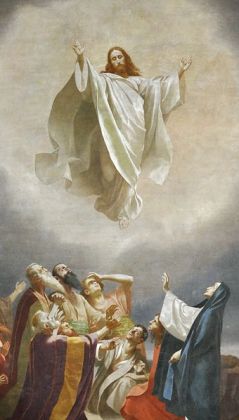
Today we celebrate Jesus’ bodily ascension into Heaven. The traditional day for celebrating the Ascension is forty days after Easter, which was last Thursday, or “Ascension Thursday.” Our diocese, like most dioceses in our country, transfers this celebration to this Sunday. I guess we like keeping Jesus around longer. But seriously, the ascension of Jesus into heaven raises this question: “Why did he go? Why didn’t Jesus stay?

Now Jesus does tell us, “Wherever two or three are gathered in my name I am there in their midst.” He says, “Behold, I am with you always until the end of the age.” And he is truly present for us in the Holy Eucharist. But Jesus’ presence now remains invisible or veiled to our eyes. By bodily ascending and disappearing into the clouds Jesus is visibly departing from us until he comes again with a glory manifested to all. “But I tell you the truth,” he says, “it is better for you that I go.” Why is this better? What would it be like if Jesus dwelt among us throughout the centuries like he did with his disciples those forty days, walking with them and talking with them, following his Resurrection?

There is no physical reason why Jesus could not have done this. His risen body is a glorified body no longer subject to injury or death, so that’s not the reason he did not remain. Did he go because on earth he’s reduced to being in one particular place, or limited in how much he can see, know, or do? Remember, Jesus is not merely human but divine, all-knowing and all-powerful, and his bi-locating saints (such as Venerable Mary of Ágreda or St. Padre Pio) who have manifested the miracle of being more than one place at once surely do not possess any supernatural ability which Jesus lacks.

So God the Father could have chosen “by his own authority” for his Son to remain visibly active here with us, in one, or thousands, or millions of locations at once, throughout the centuries up to our day. Jesus could be the pastor in every parish, the teacher in every classroom, the doctor in every hospital, and the leader in every country. He is the perfect priest, the best teacher, the greatest healer, and the rightful ruler of all. Who is better-qualified than Jesus to do any of these things? Nobody. People would demand this of him and resent him for not doing it. But if Jesus were visibly present and doing everything, then we would be left doing very little.

Would it be a better world if Jesus personally did everything? In some ways, yes. Earth would be closer to paradise in many respects. But would this lead to more souls being saved? I’m not so sure. Adam and Eve lived in an earthly paradise, too, before they fell. And the glory of Christ being manifested to the world in an undeniable way might gain peoples’ submission, but not necessarily their conversion or love. The demons who fell had no doubts about God’s existence and yet they chose to disobey him as far as they were able.

If Jesus did everything of importance on earth without us, one result which seems evident to me is that we would remain in an unending adolescence, like someone attending the eighth grade well into their adulthood. This is why it was better for us that Jesus ascended. We are children of God called to what St. Paul calls “the stature of the fullness of Christ.” If everything which matters were just Jesus’ job to handle, how would we grow from our immaturity into the full maturity of Christ?

Jesus says, “I tell you the truth, it is better for you that I go. For if I do not go, the (Holy Spirit) will not come to you. But if I go, I will send him to you.” By the Holy Spirit, the Church (which is Christ’s Body) is animated in this world. As members of his body we are moved by the Holy Spirit to love and to work united with Christ, growing more into his likeness and glory along the way. Would Jesus not ascending into heaven, remaining constantly here on earth and doing everything without us, have been easier than this present Christian life of ours? Perhaps, but Jesus desires that we would graduate with him to higher things and ascend to a greater glory with himself.
Who is the Fig Tree? Three Interpretations

March 19, 2022

3rd Sunday of Lent
By Fr. Victor Feltes

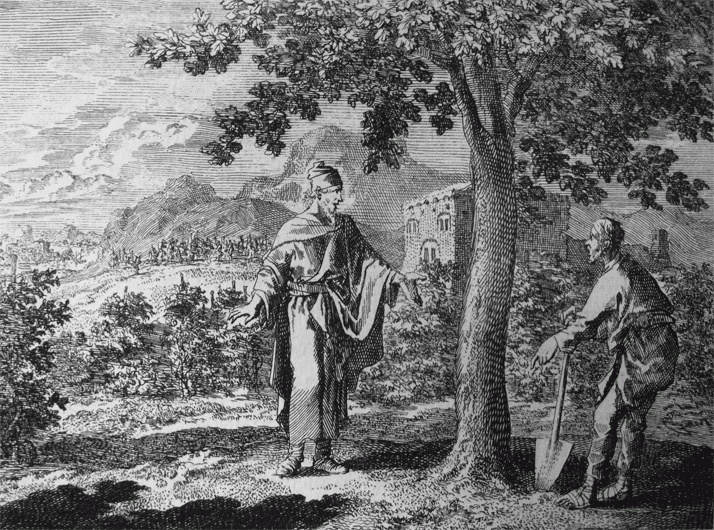
“There once was a person who had a fig tree planted in his vineyard, and when he came in search of fruit on it but found none, he said to the gardener, ‘For three years now I have come in search of fruit on this fig tree but have found none. So cut it down. Why should it exhaust the soil?’ He said to him in reply, ‘Sir, leave it for this year also, and I shall dig around around it and fertilize it; it may bear fruit in the future. If not you can cut it down.’”

The fig tree in Jesus’ parable was fruitless for three years and in danger of being chopped down. Who does this fig tree represent? The prophets Jeremiah and Hosea likened Old Covenant Israel to a fig tree, and the early Church Fathers commonly identified the barrenness of the parable’s fig tree with Israel’s refusal to accept their Messiah. Israel experienced three years of Christ’s public ministry and had still another season of opportunity to become fruitful by embracing Christ’s Church thereafter. But Jerusalem, its Temple, and all its towers were cut down, put to the sword and destroyed by the Romans in 70 A.D.. Parables, however, can have more than one valid and inspired interpretation. Beyond symbolizing an era of history now passed, what meaning does the barren fig tree hold for us today?

In today’s second reading, St. Paul warns the Christians at Corinth against presumption. The Hebrews during the Exodus all shared in a baptism with Moses when they passed through the Red Sea. In the desert, they all ate bread from heaven and drank a miraculously-given drink on their journey. “Yet God was not pleased with most of them, for they were struck down in the desert.” St. Paul says “these things happened as examples for us… as a warning to us,” lest we who are baptized into Christ and regularly consuming his Holy Eucharist think we do not need to reject all grave sins. Do not grumble or rebel like the Hebrews in the desert. Stop following your desires for evil things, or you will perish as they did. Instead, repent and follow our good and loving Lord. He will help and guide you to his Promised Land.

A fig tree may be lush with leaves, giving off a splendid appearance, and yet be barren within. A Christian may appear complete to others, and yet have a sickly soul. To help the barren fig tree, the gardener in our parable pleads to dig around it and add fertilizer. This describes root pruning and the application of manure. Root pruning as a method to make fig trees more fruitful is still recommended today. One article suggests this technique: at the end of winter before new growth begins, go about two feet away from the tree trunk and plunge a spade or shovel down, severing the roots. Skip over one shovel’s-width to the side and then repeat this pattern in a circle once around the tree. Cutting off some of its roots spurs the fig tree to divert its energies from growing foliage to creating fruit. The manure, for its part, provides nutrients (especially nitrogen) which plants require and benefit from. So, if you are a barren fig tree, Jesus the Gardener wishes to radically sever your connections to vices and distractions, in order to productively redirect your energies. He wants to introduce you to stuff which you may now find repellant (including regular confession and daily prayer) but which you need and will benefit from. You do not know how many seasons you have left. Jesus offers you this opportunity to change and become fruitful. Please let Christ the Gardener work with you.

But what if you already follow Christ closely and are aware of no grave sins? What if you have mature self-knowledge, a well-formed conscience, and cannot detect any mortal sins in yourself? Then praise God for that, and consider how our Lord wishes to glorify you through still greater fruitfulness. In the Old Testament Book of Leviticus, God commanded his people not to eat from any tree they planted in Israel throughout its first three growing years. In the fourth year, all of the tree’s fruit was to be dedicated to God as an offering of praise to the Lord. Only in the fifth year, and any years after that, could they eat its fruit. (Leviticus 19:23-25) So how would God dedicate your fruit as an offering to himself and grant you a greater enjoyment of his blessings ever after? A third interpretation of today’s parable suggests how.

Jesus’ parable begins: “A man had a fig tree planted in his vineyard…” (Our New American Bible translates that line’s last word as “orchard” but the Greek word St. Luke uses means “vineyard.”) A vineyard is for growing grapevines. This raises a question I found answered online: why would someone plant a fig tree in a vineyard? A “consulting viticulturist” from New Zealand who has worked fifty years in the vineyard and wine industry says some vineyards plant fig trees because “in some regions figs ripen at about the same time as grapes – birds seem to prefer pecking figs [and] so leave the grapes alone (more-or-less).” Another online commenter, a “cook for over sixty years,” adds that “some vineyards have a problem with small birds who peck at the grapes looking for the seeds and causing the grapes to rot. One solution is to plant fig trees around the vineyard. The birds prefer the figs because they have more seeds and the seeds are more accessible, they then leave the grapes alone.”

The reason a fig tree is planted by a vineyard is to offer up its fruits as a sacrifice for the good of the vineyard, to the delight of the vineyard owner. Who or what is this vineyard in the parable? Jesus teaches, “I am the true vine, and my Father is the vine grower,” and tells his Church, “I am the vine, you are the branches.” (In another parable, The Parable of the Wicked Tenants, Jesus identifies a vineyard as “the Kingdom of God.”) So the fig tree is called to self-sacrifice for the good of God’s vineyard, which is the Church, the Body of Christ, the Kingdom of God. But what does this look like?

In the midst of the French Revolution, a community of Carmelite nuns in Compiègne felt moved to make an offering themselves to God as a sacrifice for their troubled nation and the Catholic Church in France. Almost two years later, after the state had closed and seized all the convents and outlawed the wearing of habits, the sisters were found, arrested, and condemned to death. On July 17th, 1794, sixteen chanting nuns ascended the scaffold one-by-one and were guillotined before a silenced crowd. Ten days after the Blessed Martyrs of Compiègne’s sacrifice the evil “Reign of Terror” ended.

More recently, Fr. John Hollowell, a diocesan priest about my age of the Archdiocese of Indianapolis, was diagnosed in February of 2020 as having a brain tumor. Though grave news, Fr. John saw in his illness an answer to his own prayer. He wrote on his blog at the time, “When the scandals of 2018 broke out, most of you know that they [] affected me deeply, as they have most of the Church. I prayed in 2018 that if there was some suffering I could undertake on behalf of all the victims, some cross I could carry, I would welcome that. I feel like this is that cross, and I embrace it willingly.” Following surgery and treatment, he continues serving today as a pastor in Indiana.

Now it’s natural to hesitate at making such a self-offering. Who wants to suffer – to have our roots cut or be surrounded by dung? Even Jesus prayed before his own self-sacrifice, “My Father, if it is possible, let this cup pass from me; yet, not as I will, but as you will.” Yet Jesus loved his Father and loved us, trusting that whatever his Father willed would be best for us all. The hour had come for the Son of Man to be glorified. Was not this most-difficult thing the greatest thing that Jesus did? Jesus tells us, “Whoever serves me must follow me, and where I am, there also will my servant be. The Father will honor whoever serves me.”

In its first years, a fig tree grows only for itself. A fig tree typically begins bearing fruit when it is three to five years old. So after three years of barrenness, it remains unknown whether the fourth year will witness the tree producing pleasing fruits. Jesus now offers you an opportunity to be fruitful and be glorified like himself. Please love and trust him enough to offer him your fruitful sacrifice.

Why They Rejected Christ

January 29, 2022

4th Sunday in Ordinary Time

When Jesus preached at Nazareth near the start of his public ministry, his own hometown neighbors rose up, filled with fury against him. They drove him out of their village intending to toss him head first off a cliff. Later, near the end of Jesus’ public ministry, one his own twelve apostles, after spending years in his close company, chose to betray Jesus to his enemies. And sometimes in our present day, lifelong Christians experience painful events and give up on their commitment to Christ. Why did Jesus’ neighbors in Nazareth reject him? Why did his apostle, Judas Iscariot, betray him? And why do Christians sometimes abandon him in hard times? All of these expected our Lord to do certain things for them but were disappointed. In each case, Jesus failed to do for them what they desired.

Part of the problem at Nazareth was that Jesus was too familiar to them. He grew up there as a little kid playing in their streets, he worked locally as a carpenter’s son, and he quietly attended their small-town synagogue for years. So when they heard him preaching they asked, “Where did this man get all this?” How could this guy be someone foretold of in the Scriptures? As Jesus acknowledges, “No prophet is accepted in his own native place.”

They wanted him to prove he was somebody special by working miracles before them. A sick doctor should be able to apply his talents for his own recovery and prove he is a real doctor; so the Nazoreans would say to Jesus, “Physician, cure yourself! Do here in your native place the things that we heard were done in Capernaum.” But God’s prophet does not owe them miracles. Jesus notes that neither Elijah nor Elisha, two of the Old Testament’s greatest prophets, worked miracles for Israel’s individual widows or lepers, respectively. St. Mark’s Gospel reports that Jesus did not perform many mighty deeds in Nazareth, apart from curing a few sick people by laying his hands on them. Their lack of faith and lack of openness seems to have limited the gifts of God they could receive. So Jesus failed to match their expectations, and they took great offense at him.

Why did Judas Iscariot betray our Lord for thirty silver pieces? St. John tells us in his gospel that Judas “was a thief and held [Jesus and the apostles’] moneybag and used to steal the contributions.” Those thirty coins represented thirty days’ wages back then, something akin to $3,000 today. Was Judas so greedy for that relatively-modest amount of money that he couldn’t resist? When Judas saw that Jesus had been condemned to death he felt deep regret at what he had done. He tried to return the money to the high priest and elders saying, “I have sinned in betraying innocent blood.” He wishes to undo his deed, but the Jewish leaders brush him off: “What is that to us? Look to it yourself.” Judas goes away in despair and foolishly kills himself. If Judas did not wish for Jesus to die, then why did he sell him out? It seems that this apostle was disappointed by Jesus’ public ministry.

Most Jews expected the Messiah to come as a warrior-king like David. They imagined the Christ would drive out their pagan overlords, conquer Jerusalem, and lead an earthly kingdom of vast power, prestige, privilege, and wealth. But Jesus was not pursuing that popular dream. He devoted his efforts instead to teaching and healing the lowly and poor. When, after feeding thousands with five loaves and two fish, Jesus perceived “they were going to come and carry him off to make him king,” he firmly sent that crowd away and withdrew up the mountain alone. Judas had run out of patience waiting for Jesus’ Kingdom to come. Maybe Judas had given up on Jesus, and took that money to start a new life without him. Or maybe he hoped that Jesus—with his back to the wall—would finally wield his mighty, miraculous power to claim his royal throne, with Judas at his side. Either way, Judas’ disappointed expectations led this disciple to betray Jesus Christ and lose everything.

In our own day, some Christians leave the Lord Jesus after following him for decades. Oftentimes, this happens after a painful tragedy: a terrible diagnosis, a failed marriage, a Church scandal, a child’s tragic death. It is not the Christian life they had envisioned. They likely asked God for a particular miracle but it was not given. I know a man from a previous parish who attends Mass with his wife every Sunday, but he stopped receiving Holy Communion many years ago after their teenage daughter died in a car crash. I know of another long-time Catholic who reportedly became embittered at losing his good health and refused a Catholic funeral. How should a follower of Jesus Christ respond to life’s profound and painful trials?

On the first Good Friday, when Jesus died on the Cross, the Gospel of St. Luke tells us “all his acquaintances stood at a distance, including the women who had followed him from Galilee and saw these events.” St. John’s Gospel highlights that the Blessed Virgin Mary was there at the Cross of Christ along with his beloved disciple. What did they feel like amid that horror? What miracles did they plead for that day? Their prayers to heaven seemed to go unheard. The next day, in shock and grieving on Holy Saturday, they may have questioned in their hearts, “Where was God? How could he let this happen? Does he not care? Where is his faithfulness to his faithful ones? How could this be part of a loving plan?” But the next day, on Easter Sunday, they witnessed the joyful resurrection Jesus had promised, and God’s loving, mysterious purposes became clearer.

Jesus told his disciples and says to us, “Whoever wishes to come after me must deny himself, take up his cross, and follow me.” Jesus does not promise us a life exactly as we would plan it for ourselves. Not every prayer for a miracle will be granted exactly as we would imagine. But remember, the Kingdom of Jesus Christ will come for his faithful ones.

The Cup Jesus Drank

October 17, 2021

29th Sunday in Ordinary Time

James and John, the sons of Zebedee, approach Jesus asking for a favor: “Grant that in your glory we may sit one at your right and the other at your left.” Jesus says to them, “You do not know what you are asking. Can you drink the cup that I drink…?” They respond, “We can!” Jesus answers them, “The cup that I drink, you will drink… but to sit at my right or at my left is not mine to give but is for those for whom it has been prepared.

Jesus told James and John, “You do not know what you are asking,” but how well do we understand what Jesus is saying here? What was the cup that Jesus would drink? How would Jesus be enthroned in glory? And who got those places at his right and his left? The answers are found in the gospel accounts of the Passion.

Jesus, the night before he died, prayed in the Garden of Gethsemane: “My Father, if it is possible, let this cup pass from me; yet, not as I will, but as you will.” And again, “My Father, if it is not possible that this cup pass without my drinking it, your will be done!” Earlier that same evening, at the Last Supper, Jesus told his disciples, “from this time on I shall not drink of the fruit of the vine until the kingdom of God comes. … Amen, I say to you, I shall not drink again the fruit of the vine until the day when I drink it new in the kingdom of God.” So when is the next time we see Jesus drink “the fruit of the vine”? All four gospels record that Jesus was given wine on his Cross. In his suffering, Jesus said, “I thirst.” Someone soaked a sponge in a vessel filled with sour wine and put it up to his mouth. Once Jesus had taken the wine, he said, “It is finished,” and then he died.

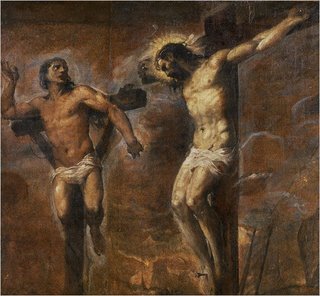
Alongside the cross of Jesus a pair of guilty criminals were also crucified; one on his right and the other on his left. Both of them had mocked Jesus at first, but then one of them repented. Acknowledging Christ’s innocence and lordship, he asked: “Jesus, remember me when you come into your kingdom.” And Jesus replied to him, “Amen, I say to you, today you will be with me in Paradise.

So what is the cup which Jesus drank? His cup is a cup of suffering. When and where was Jesus first enthroned in the kingdom of God? He is enthroned in glory upon his Cross. And who received the places at his right and left? Those places close to Jesus went first to two crucified criminals. Indeed, James and John in today’s gospel did not know what they were asking. Yet these apostles would go on to be glorified through their own shares in Christ’s sufferings: including martyrdom for St. James and exile for St. John “the Beloved Disciple.”

Many people struggle to reconcile the reality of suffering with the power and love of God. Some Christians even mistakenly preach a “Prosperity Gospel,” saying that if you believe in God and love him, he will bless you so that bad things never happen to you. But this view is incomplete. There are true blessings which flow from following Jesus Christ and his Gospel, but the worldview of the “Prosperity Gospel” sets believers up for a fall. When painful hardship or tragedy eventually come, those Christians will either blame themselves for not having had enough faith or blame God for seeming to fail them. This latter group wonders, “If God is not dependable, why should I keep faith in him?” And then, feeling wounded, confused, and abandoned, they abandon God.

We do not completely understand the mystery of evils in our world; why a devastating earthquake happens to some particular city, why a particular healthy adult gets cancer, or why a particular young person perishes in a car wreck. We do know that God’s thoughts are higher than our thoughts, that his plans see farther than our sight. And we know that God, who is the highest good, would not permit evils to exist unless his omnipotence and goodness were such as to bring good even out of evil. In Jesus Christ we see that God intimately knows and deeply cares about all the things we suffer. So what is the Lord up to?

It’s no coincidence that all four gospels mention how Jesus is crucified between two criminals, one on his right and the other on his left, with one who repents and one who appears not to repent. All of humanity is similarly suffering as a result of our original or personal sin. We too begin as guilty rebels condemned. But on the Cross, Jesus Christ the Son of God, though divine and innocent, joins us in our suffering.

The Letter to the Hebrews observes that in him “we do not have a high priest who is unable to sympathize with our weaknesses, but one who has similarly been tested in every way…” This divine plan for Christ to be a suffering servant was foretold through the Prophet Isaiah centuries before: “If he gives his life as an offering for sin… the will of the Lord shall be accomplished through him. …Through his suffering, my servant shall justify many, and their guilt he shall bear.

This Good Shepherd intimately understands the sufferings of the flock. He comes down from his high mountain into our dark valley and calls us to himself. We can respond to him with faith, acknowledging his goodness and lordship as sheep on his right. Or we can remain as faithless goats on his left, unrepentant for our sins and rejecting Christ forever. Realize that Jesus Christ desires not merely to forgive our sins, but that you and I would become children of God the Father just like himself.

Why do evils and sufferings continue to afflict those who follow Christ? As I said before, we do not know the answer to every painful question. (I believe we will understand God’s plan and purposes far better in heaven when he ‘wipes away every tear from our eyes.’) But we do know that Jesus Christ wants us to share in his own greatness and glory.

In today’s gospel, Jesus tries to help his disciples see that the path to true greatness and glory are not what they imagine. “Those who are recognized as rulers over the Gentiles,” Jesus notes, “lord it over them, and their great ones make their authority over them felt. But it shall not be so among you. Rather, whoever wishes to be great among you will be your servant; whoever wishes to be first among you will be the slave of all. For the Son of Man did not come to be served but to serve and to give his life as a ransom for many.

In our loving service and in our faithful suffering, we become more like Jesus. With Jesus, our sacrifices and sufferings are redemptive, helping to make us saints while helping to save the world. This is the precious, challenging, saving cup our Lord offers us. But can we drink it? With the grace and love of Jesus Christ strengthening us, we can!

The Beginning of the New Creation

April 5, 2021

Easter Vigil

Empty Tomb Sunrise

On Holy Thursday, I spoke about Jesus as the New Passover Lamb who calls us to his feast. On Good Friday, I preached about Jesus as the New Adam who begins a marriage covenant with us, the Church, his bride. Tonight, we celebrate Jesus’ Resurrection from the dead, the beginning of the New Creation. In the beginning, when God created the heavens and the earth, he created everything from absolutely nothing and yet he created everything according to a logic, a reason, a Logos, a wisdom, a Word.

“The Word was with God,
and the Word was God.
He was in the beginning with God.
[And] all things came to be through him…”
according to a plan.

This divine plan was not merely to create a vast, material universe of stars, planets, moons and comets in reflection of God’s glory, but also to create (at least on one planet) many living things as well. Plants and trees were added to the dry land. Swimming creatures were added to the sea. Winged birds were added to the sky. and cattle, creeping things, and of all kinds wild animals were added across the earth. But God’s the ultimate living creation would be “the only creature on earth that God has willed for its own sake”:

God created man in his image;
in the image of God he created him;
male and female he created them.
And God blessed them, saying:
“Be fertile and multiply;
fill the earth and subdue it.”

God looked at everything he had made, and he found it very good.” And then, the Book of Genesis says, “on the seventh day God was finished with the work he had been doing, [so] he rested on the seventh day from all the work he had undertaken.” But it would be a short rest. Because of human sins and the Fall of Creation, there would be much more work for God to do.

This work is the story of Salvation History reflected throughout tonight’s Old Testament readings: words and deeds across places and times to reconnect with our human race, to reclaim, redeem, and restore us. These many works of God culminated in Jesus Christ. “The Word became flesh, and dwelt among us.” He lives as the New Adam who passes the test. He dies as the New Passover Lamb who sets us free. Saturday was the Jewish Sabbath Day of Rest. And on Holy Saturday, the seventh day of the week, Jesus perfectly fulfills the law, his lifeless body resting in the tomb. When the Sabbath was over, on Easter Sunday (which is the first day of the week again, or what Early Christians called the eighth day) Jesus begins the New Creation in himself, by his Resurrection.

As proclaimed in our Easter Gospel, the tomb was emptied. “Do not be amazed!” an angel told the women there, “You seek Jesus of Nazareth, the crucified. He has been raised; he is not here. Behold the place where they laid him.” Not merely had Jesus’ spirit been raised, but his physical body too. Were it otherwise, when he appeared to his disciples on Easter, his dead body would still be in the tomb. The risen Jesus visits them in the Upper Room and says, “Look at my hands and my feet, that it is I myself. Touch me and see, because a ghost does not have flesh and bones as you can see I have.” He shows them his hands, his feet, and his side because these still bear the wounds he suffered during his Passion. It seems his many other cuts and bruises are healed and gone, but Jesus retains these wounds without pain as trophies of his triumph.

He is the beginning, the firstborn from the dead.” He is the plan revealed, the pattern of what is to come, both for those in Christ and for our universe. For death is not the end of us and the Last Day is not the end of the world. The dead will live again and the universe will be glorified into “a new heavens and a new earth.” As St. Paul wrote:

“Creation waits with eager longing for the revealing of the children of God […] in hope because creation itself will be set free from its bondage to decay and share in the glorious freedom of the children of God. We know that the whole creation has been groaning in travail together until now; and not only the creation, but we ourselves who have the first fruits of the Spirit groan inwardly as we wait for […] the redemption of our bodies.”

In our lives we now struggle against evil and sin. This broken world causes painful wounds in us. But the glorious wounds which remain in the risen Savior’s body reveal something beautiful: that with Christ all our trials and sufferings will be weaved into the tapestry, into the New Creation, he is now fashioning. “He will wipe every tear from [our] eyes, and there shall be no more death or mourning, wailing or pain, the old order [will have] passed away.” In light of Jesus, St. Paul can say, “I consider that the sufferings of this present time are as nothing compared with the glory to be revealed for us.” The beginnings of that glory are revealed to us tonight, in the Easter resurrection of our Lord. “Behold,” Christ says, “I make all things new.

Wisdom for the Discouraged

February 7, 2021

5th Sunday in Ordinary Time

In our first reading, we hear the deep discouragement of Job:

“Is not man’s life on earth a drudgery?
…I have been assigned months of misery…
…My days… they come to an end without hope.
…I shall not see happiness again.”

If you are familiar with Job’s story you know he says these words during a very dark time in his life. Though innocent, he is in the midst of an extended trial, with emotional suffering, physical pain, loss, and loneliness. His words, like all the words of Scripture, are offered for our benefit — thanks be to God. And indeed, the Book of Job has lessons to teach us in our hard times.

One thing we learn from Job is that we can be real and honest with God. By the end of the book, Job is shown that God’s vast creations, plans, and purposes are beyond Job’s comprehension, for “Great is our Lord and mighty in power; to his wisdom there is no limit,” yet the Lord does not condemn Job for his questioning. In fact, God has Job intercede on behalf of his friends who had argued Job’s sufferings must be on account of his own sins. God has Job pray for them that they may be forgiven their error. The number of plaintive psalms that God inspired and made sure were included in Sacred Scripture suggests that he wants us to bring our complaints to him. The very name of God’s people “Israel” means “He who wrestles with God,” and you cannot wrestle with someone without drawing close to them.

The Lord wants us to be honest with him because that is the real us and the kind of relating that will actually help us. If you wear a disguise in God’s presence, it won’t fool him and it won’t help you. In spiritually directing others and in studying myself, I have noticed that when we are avoiding times of prayer or finding our prayer times very dry, it is often because we are avoiding relating something to the Lord. There’s something we don’t want to look at or talk about with him. Imagine if you had a good doctor, indeed the very best doctor – would it be wise to find excuses to miss your appointments or lie to your physician about how you were feeling? Reveal your wounds and symptoms to the Divine Physician that you may be healed. As today’s psalm says, “He heals the brokenhearted and binds up their wounds.” Today’s gospel tells us, “Rising very early before dawn, [Jesus] left and went off to a deserted place, where he prayed.” If making time for daily personal prayer was a top priority for Jesus, how much more important must it be for us?

A second thing we learn from Job is that God is with us in our struggle and that the struggle is worth it. Though Job did not understand why he suffered, God was never far from him. God was proud of Job and praised him, “There is no one on earth like him, blameless and upright, fearing God and avoiding evil,” and through his trials and sufferings God made him greater still. Other Christians sometimes ask why we have crucifixes on our walls rather than a bare cross. “Christ is risen,” they remind us, “so why depict him as still suffering on the Cross?” In his post-Ascension appearance to one of the Church’s early persecutors, Jesus said, “Saul, Saul, why are you persecuting me?” When asked by Saul, “Who are you, sir?” the reply came, “I am Jesus, whom you are persecuting.” If you are a suffering member of Christ’s body then know that you do not suffer alone. This Saul is better known to us as St. Paul. When St. Ananias hesitated to visit him and heal his blindness, the Lord insisted, “Go, for this man is a chosen instrument of mine to carry my name before Gentiles, kings, and Israelites, and I will show him what he will have to suffer for my name.” St. Paul writes in today’s second reading that his life’s mission, the preaching of the gospel, was an obligation imposed upon him. He could either see this as a hard burden to grumble over, or as an opportunity to rejoice in, and thereby gain reward. St. Paul knew God’s purpose for his life and embraced it to great benefit.

Dr. Viktor Frankl was a Austrian-Jewish doctor who was deported to a Nazi concentration camp during the Second World War. After his liberation, Frankl wrote about what he observed and discovered about human nature during that terrible ordeal in his famous book “Man’s Search for Meaning.” Frankl says, “Life is never made unbearable by circumstances, but only by lack of meaning and purpose.” He says, “Nothing is [more] likely to help a person overcome or endure troubles than the consciousness of having a task [a purpose] in life.” So many people, believing that our existence in this universe is an accident and disbelieving that life has any objective purpose, grope through life striving to generate their own meaning and purpose. But you know you are not here by accident. “[The Lord] tells the number of the stars; he calls each by name.” Each one is in their place according to his purpose and so are you. Who made you? God made you. Why did God make you? He made you to know Him, love Him, and serve Him in this world, and to be happy with Him for ever in the next. But even Christians sometimes wonder, “Does what I’m doing really matter? Is my life important? Are my struggles really worth it?” They think to themselves, “If I wasn’t here, I’d be replaced by someone else.” Perhaps, but that’s not the right way to frame your thought. What if you disappeared from your home, your job, your community, and no one came to fill your void? Consider all the good things that would go undone. That is your contribution to our world and those around you. And God has eternal purposes for you that extend beyond this life and world.

A third and final thing we learn from Job is that things are not so hopeless as they may seem and there are better things to come. The way that we happen to feel in any particular moment does not necessarily reflect reality. One afternoon when I was a seminarian, I was in my dorm room and had homework to do, but I was fed up with it, I had no motivation, and decided to give up and to go to bed. When I woke up three hours later, the world was transformed, brighter. I was happier, eager to work, and even the view outside my window seemed better. Of course, it wasn’t the world that changed but me. I was exhausted and I didn’t know it and this was coloring my perceptions. You are an union of body and spirit. You need sleep, and food, and personal connection. Self-care is important, so love yourself as well as your neighbor. If someone is diabetic, we do not tell them to just buckle down and change their attitude. They need insulin to be healthy. Sometimes people suffer chemical imbalances in their brains, often hereditary in origin, which burden their experience of life. We live in an age of wonders with remarkable medicines and we should be unashamed to seek help. As the 38th chapter of Sirach teaches: “Make friends with the doctor, for he is essential to you; God has also established him in his profession. From God the doctor has wisdom… Through which the doctor eases pain, and the druggist prepares his medicines.” Sirach explains that a good doctor is one of God’s instruments in doing his work on earth.

The story of Job shows us things are not so hopeless as they may seem – there are better things to come. We heard Job’s lament, “I shall not see happiness again,” but he was mistaken. Job’s lot got better. Much better. God restored the prosperity of Job and even gave him twice as much as he had before. Then all of his brothers and sisters came to him, and all his former acquaintances, and they dined with him in his house. They consoled him and comforted him and gave him gifts. Job would see his children, his grandchildren, and even his great-grandchildren in fullness of years. Thus the Lord blessed the latter days of Job more than his former ones. But what if the remaining years of my life do not get better? What if each new year becomes harder than the last? What if I have a stroke, or a heart attack, or terminal cancer and I am dead in six months? How can better times still be waiting for me? Are you not promised Heaven where you will experience the restoration, fellowship, and consoling joys Job knew? Then, in the end, as St. Julian of Norwich said, “All shall be well, and all shall be well, and all manner of thing shall be well.

So remember that you can be completely real and honest with God, he invites this. Remember that the Lord is with you in your struggles and that these struggles are worth it. And remember that things are not so hopeless as they may seem, for with Jesus Christ there are surely better things to come.

Jesus or Barabbas?

November 23, 2020

The Solemnity of Our Lord Jesus Christ, King of the Universe

For the feast of Passover, the Governor Pontius Pilate observed a tradition of releasing to the crowds any one prisoner they wished. On Good Friday, in addition to holding Jesus of Nazareth, the Romans in Jerusalem had a notorious prisoner named Barabbas. When the crowd came forward and began to ask Pilate to do for them as he was accustomed the governor dryly asked, “Do you want me to release to you the king of the Jews?” The chief priests stirred up the crowd to have him release Barabbas for them instead.

Pilate asked, “Which of the two do you want me to release to you? Barabbas, or Jesus who is called Christ?” They answered, “Barabbas!” Pilate said to them in reply, “Then what do you want me to do with the man you call the king of the Jews?” They shouted again, “Crucify him!” Pilate said to them, “Why? What evil has he done?” But they only shouted the louder, “Crucify him!” So Pilate, wishing to satisfy the crowd lest they riot, released Barabbas to them and, after he had Jesus scourged, handed him over to be crucified.

This episode with Jesus and Barabbas is recounted each Palm Sunday and Good Friday when the Passion narratives are read at church. However, the Gospels’ Passion accounts are so lengthy and rich with themes to consider that the crowds’ choice between these two figures is rarely ever preached on. Today, I would like to show you the deeper significance in this rejection of Christ the King.

The first interesting detail is in the meaning of these two men’s names. “Jesus” was the name given through angelic messages to Mary and Joseph, a name chosen in Heaven for the Son of God on earth. “Jesus” or “Yeshuah” in Hebrew means “God saves.” The name Barabbas breaks down into the Aramaic words “Bar” and “Abba”; “Bar” means “the son of,” while “Abba” means “father.” And thus, the name Barabbas means “the son of the father.” So Pilate is proposing a question to the crowd more profound than they realize: “Which son of the father do you choose? Do you desire God’s salvation?

The New Testament tells us that Barabbas was a Jewish revolutionary who, along with other captured rebels, had committed murder in a rebellion against Roman rule. The Jews commonly hated the Romans and resented the occupation of their Promised Land by a foreign, Gentile power. Jews expected that the Christ, the Messiah, if he were to come in Jesus’ day, would drive out the Romans and their puppets using the force of arms. Then they imagined that this man, God’s Anointed One, would take his seat upon his ancestor King David’s throne, establishing a renewed Israeli kingdom of worldly glory, with international power, military strength, and overflowing wealth. So when Jesus came among them they failed to recognize him as the Christ.

Unlike Barabbas, Jesus did not promote hatred for the Romans but a love for enemies. Jesus did not raise an army nor a sword, but preached “blessed are the peacemakers.” On Palm Sunday, Jesus does not enter Jerusalem riding on a warhorse, but on a donkey, as the Old Testament prophet Zechariah had foretold: “Shout for joy, O daughter Jerusalem! See, your king shall come to you; a just savior is he, meek, and riding on a donkey.” But when presented with Jesus and Barabbas, the people rejected their true King and Savior, the Christ. St. Peter would go on to preach to the people of Jerusalem on Pentecost, “You denied the Holy and Righteous One and asked that a murderer be released to you.” The choice between Barabbas and Jesus is a choice between two sorts of saviors, two very different kinds of revolutionaries and kings; one whom the earth thinks would be most effective and the one whom Heaven has sent us. The Christ and an anti-Christ.

It was within Jesus’ power to have forcibly imposed his rule over the whole world. At Jesus’ arrest in the Garden of Gethsemane, Peter is ready to fight—he draws a sword and cuts off the ear of the high priest’s servant. But Jesus intervenes, “Put your sword back into its sheath, for all who take the sword will perish by the sword. Do you think that I cannot call upon my Father and he will not provide me at this moment with more than twelve legions of angels? But then how would the scriptures be fulfilled which say that it must come to pass in this way? Put your sword into its scabbard. Shall I not drink the cup that the Father gave me?” Jesus then heals to slave’s ear before he is led away by the guards.

Like a gentle lamb silently led to slaughter, Jesus endures his Passion and death. And who would have thought any more of him? But God raised him from the dead and he appeared to his disciples, who then courageously proclaimed to everyone that Jesus is the Christ. The Jews and Romans persecuted the early Christians. Though peaceful and innocent, Christians suffered indignities, imprisonments, and martyrdoms, yet the number of those saved by the Church continued to grow. Then, in 313 A.D. the Emperor Constantine legalized Christianity and ten years later gave it the most favored religious status throughout the Roman Empire. “Blessed are the meek, for they will inherit the land … Blessed are those who are persecuted for the sake of righteousness, for they will be satisfied.” Indeed, Jesus Christ and his Church succeeded where Barabbas failed: they conquered the Roman Empire not by destroying it but by converting it.

Today we celebrate Jesus Christ, the King of the Universe. Jesus the Almighty now reigns over us and over the whole world. But this knowledge, upon reflection, can raise troubling questions in our hearts. When we see the horrors of this world, grave evils throughout history and evil happening in our time, we may ask, “Lord, why aren’t you doing more?” Every year in our country, hundreds of thousands of unborn children are being legally murdered. Right now, millions of people in Asia are being held in concentration camps. How many billions of grave sins are being committed every day which cause innocents to suffer? Lord, why don’t you end this evil? Why don’t you force the world to bow down to your will?

We may wish Jesus and others to go violently into full Barabbas-mode against all the world’s evil, but this is not his way. Christ’s goal is the salvation of souls, as many souls as possible. Jesus the Good Shepherd shepherds the world subtly but in every place, speaking to the souls of both his friends and sinners, drawing them freely toward his salvation. But what about the grievous sufferings and injustices along the way? Jesus is not at all indifferent to these. Our loving shepherd is the best of shepherds because he has been a sheep like us, a lamb who was slain. He endured such sufferings and injustices personally as the lamb of God, and he still mystically suffers in and with the innocent. “Amen, I say to you, what you did [or did] not do for one of these least ones, you did [or did] not do for me.

The evil of this world is a heart-breaking scandal. But sin and death do not have the final word. The last word will belong to Jesus Christ. Trust in the crucified One, our suffering God who died and rose for us, the Shepherd of souls, the victorious Lamb, Christ our King. May his Kingdom come and his will be more fully done, on earth as it is in Heaven, in each and every soul.

Prepared for His House — Funeral Homily for Cynthia “Cindy” Nazer, 64

November 3, 2020

Today, St. Paul’s Parish offers you our sympathies, our prayers, and the consolation of Jesus Christ. The parting that comes from death is naturally mournful. But it is our faith in Jesus Christ that allows us to mourn with hope. No funeral homily can capture the full mystery of a Christian life; all that Cindy has done, or all that Christ has done in her. But speaking with Steve, her husband, I learned a particularly interesting aspect of their life together I’d like to share with you.

Cindy always liked things made of wood, and one of her desires was to have a log-cabin home. So, in the 1980’s, Steve and Cindy began building one together midway between Bloomer and Chippewa Falls. They began with the garage. Steve says this was for practice. Better to make one’s mistakes on the garage than with the house. After that, they stored lots of lumber onsite there. The project also involved an barn in which their cut logs were dried for two years, purging them of unwanted water, to prevent them from later warping out of shape. Placing these heavy logs was an exacting process. Steve tells me that each log must be laid in place three times over to make sure they fit properly, along with shaving, trimming, and cutting of the logs all throughout the process. But once perfected in this way, these logs became the home where Cindy and Steve and their family lived together. It was her home through their marriage together until her final day on earth.

This building of a house to share in marriage has a connection to our Gospel today. In Jesus’ time and culture, when a Jewish groom married his bride, he would go off to build or prepare the space of their home. It would typically be an extension upon his own father’s house. And once this long and demanding project was complete, the husband would return to his bride and take her into their new home to share their lives together. This is why Jesus says to his disciples, and tells us, his bride the Church:

In my Father’s house there are many dwelling places. If there were not, would I have told you that I am going to prepare a place for you? And if I go and prepare a place for you, I will come back again and take you to myself, so that where I am you also may be.

Jesus is the bridegroom and we, the Church, are his bride. He says, “Do not let your hearts be troubled. You have faith in God; have faith also in me… Where I am going you know the way.” But this last remark causes St. Thomas alarm, “Master, we do not know where you are going; how can we know the way?” And Jesus answers, “I am the way and the truth and the life. No one comes to the Father except through me.” What does the way of Jesus look like? What does the life of Christ look like? This is the truth in Jesus Christ: for the faithful one, after much suffering, comes death, but this dying is not the end, it is not utter destruction, for this life is followed by new life and resurrection.

Therefore,” as St. Paul writes “we are not discouraged; rather, although our outer self is wasting away, our inner self is being renewed day by day. For this momentary light affliction is producing for us an eternal weight of glory beyond all comparison… For we know that if our earthly dwelling, a tent, should be destroyed, we have a building from God, a dwelling not made with hands, eternal in heaven.

Like those logs chosen, refined, and fitted for the log cabin, God uses the events of our lives, the good moments and the bad, to make us ready for his home. “Chastised a little,” the Book of Wisdom says, “they shall be greatly blessed, because God tried them and found them worthy of himself. As gold in the furnace, he proved them, and as sacrificial offerings he took them to himself.

The parting of a loved one may ache our hearts, but our sufferings are not without hope, or meaning, or purpose. Through Jesus, with Jesus, and in Jesus, the Savior of the world, the prayer of the psalmist can be beautifully fulfilled for Cindy, for others, and ourselves – which is the fulfillment of all our longings:

There is one thing I ask of the Lord;
only this do I seek:
To dwell in the house of the Lord
all the days of my life.
That I may gaze on the loveliness of the Lord
and contemplate his temple.

Do Good While You Sleep

September 28, 2020

St. Paul wrote, “Now I rejoice in my sufferings for your sake, and in my flesh I am filling up what is lacking in the afflictions of Christ on behalf of his body, which is the Church” (Colossians 1:24). The sufferings we endure and penances we freely offer not only help to perfect our own souls but can spiritually benefit others as well. Doing penances of some form (classic three being prayer, fasting, and almsgiving) should be a part of our lives. “The divine law binds all the Christian faithful to do penance each in his or her own way,” says the Church’s Code of Canon Law. Whatever penances we undertake should be properly moderated and suitable to our state in life.

During my seminary days, I experimented with different penances. I practiced fasting by limiting my eating and tried sleeping on my floor, but both of these shared a serious drawback: they deprived me of the energy I needed for my studies. This led me to discover a new penance to offer in their place which preserved my nutrition and good night’s rest.

I have found that when I offer my coming nights’ dreams to God as a penance, my ordinarily unremarkable dreams change. Because they do not terrorize me I would not call them nightmares, but I would describe these dreams as stressful. Ever dream that you must do something you’re unready for, like give a talk or take a test, and then awake relieved to find it was just a dream? When I form an intention that my dreams may have redemptive value and go on to experience dreams like this, I am pleased that God has apparently answered my prayer and used my modest suffering to spiritually aid others.

I recommend trying this experiment for yourself. God will not give you anything or any more than what is good for you, and considering the burdens that others carry in our midst and around the world it’s really a small sacrifice. “[God] pours gifts on his beloved while they slumber,” even enabling us to do good for others while we sleep.

“As Nothing Compared with the Glory”

July 11, 2020

15th Sunday in Ordinary Time

Cardinal Timothy Dolan, the current archbishop of New York, tells a story from his first Lent as a newly ordained associate priest in a small Missouri parish. The president of their church’s men’s group told him unenthusiastically, “Father, you’re supposed to give us an evening of recollection in Lent.” So Fr. Tim, on fire to share the treasures of our Faith, worked earnestly for weeks preparing spiritual reflections about characters appearing in the Stations of the Cross. The big night for his men’s talk came. He opened the church doors early for all those who would be coming — and just two guys showed up. Fr. Tim gave his talk anyway, of course, but the young priest was crestfallen, crushed. When he returned to the rectory, his pastor said, “Oh, I should have told you those never work.” All of his devoted time and effort seemed wasted.

Twelve years later, the same Fr. Timothy Dolan was visiting a woman in the parish who was dying of Lou Gehrig’s disease. He was amazed at how tenderly her elderly husband was taking care of her, staying by her side and helping her with everything. As he was being walked to the door to leave, Father told the husband how much he admired his devotion to his wife. The man replied “Oh, Father, I’m just trying to be that Simon of Cyrene you talked about.” Father Dolan looked at him confused. “Remember that Lenten evening of recollection when you told us that just as Simon of Cyrene helped our Lord carry His cross, we do the same every time we help somebody else carry theirs? I’m just trying to help Ramona carry hers.

I first read about this story as a seminarian and it has stuck with me ever since. It’s a story of suffering. Granted, the young priest’s suffering was not so great as having a terminal disease or accompanying a dying loved one, but it was an experience of suffering whose value — though invisible at the time — was later wonderfully revealed. What Fr. Dolan had sown in painful labor and imagined to have been worthless toil proved beautifully precious and important. As one of the psalms say:

They go out, they go out, full of tears,
carrying seed for the sowing:
they come back, they come back, full of song,
carrying their [harvest] sheaves.

All suffering is painful, but any sort of suffering is worse when we think it has no meaning and all suffering is made easier when we know that it has worth. I speak of all this because of St. Paul’s words to the Romans in our second reading today: “I consider that the sufferings of this present time are as nothing compared with the glory to be revealed for us.” The sufferings of this present time are as nothing compared with the glory to be revealed for us.

Nobody likes suffering, but we all experience it in various ways regardless. We suffer from uncertainties and misunderstandings, from tribulations and persecutions, from worldly anxieties and temptations, but the saints tell us trials of suffering are rich soil which bear fruit manyfold for ourselves and others. St. Vincent de Paul declares, “If we only knew the precious treasure hidden in infirmities, we would receive them with the same joy with which we receive the greatest benefits, and we would bear them without ever complaining or showing signs of weariness.” In light of divine justice, St. Mary Magdalen de’Pazzi assures us, “You will be consoled according to the greatness of your sorrow and affliction; the greater the suffering, the greater will be the reward.” And St. Teresa of Avila encourages us, “Suffering is a great favor. Remember that everything soon comes to an end… and take courage. Think of how our gain is eternal.”

Sometimes God permits or sends sufferings for correction, that sinners may repent and be saved. But other times, sufferings are given in order to further purify, perfect, and glorify his friends. As St. Ignatius Loyola says, “If God sends you many sufferings, it is a sign that He has great plans for you and certainly wants to make you a saint.” St. Faustina Kowalska notes, “Suffering is a great grace; [for] through suffering the soul becomes like the Savior; in suffering love becomes crystallised; the greater the suffering, the purer the love.” And St. Augustine of Hippo observes truly, “God had one son on earth without sin, but never one without suffering.”

It was through the innocent suffering of his Passion that Jesus offered the sacrifice which converts hearts, forgives sins, and achieves Christ’s greatest earthly glory. Do you believe in the power of the Cross to save you? Then believe in the power of your own sufferings — lovingly endured and patiently offered up — to perfect you, save souls, and achieve your greatest glory.

Stories of Glory

May 22, 2019

Readings for the 6th Sunday of Easter – Year C

Liberty Films was an independent motion picture production company founded in 1945. They only produced two films before dissolving six years later. Their first film, released in 1946, was the story of a depressed loan officer in upstate New York who is contemplating ending his own life. The critical reviews to the movie were mixed. It had good stars and did rather well at the box office, but not well enough to recoup its production costs and show a profit. It won no Academy Awards except for one in Technical Achievement; for developing a better way to simulate falling snow on a movie set. The co-founder of the company and director of the picture would go on to consider this his favorite film, screening it towards the end of every year for his family. However, he said that creating Liberty Films had proven virtually fatal to his professional career.

After Liberty Films folded up, the ownership of rights to the film changed hands from one media company to the next. I suspect the movie would have been largely forgotten today, if not for a providential oversight. You see the Copyright Act of 1909 granted copyright protection to original creative works for twenty-eight years. This copyright protection could be renewed for an additional twenty-eight years by filing out some paperwork and paying a nominal fee. However, the new owners of the film neglected to renew its 1946 copyright, so the film automatically entered the public domain. As a result, from 1974 until 1993 (when other laws came into play) anyone and everyone was free to copy, sell, or broadcast the film without paying any royalties to anyone. TV stations showed it repeatedly during the Christmas season, more than one hundred distributors sold it on tapes, and the film became immensely popular. I would bet you’ve seen this wonderful film yourself. Today it is considered one of the greatest movies ever made, and rightly so. The name of its main character, the loan officer in upstate New York, who is persuaded by an angel not to end his own life, is George Bailey, and the film is Frank Capra’s “It’s a Wonderful Life.”

In our Gospel, Jesus says: “I give you a new commandment: love one another. As I have loved you, so you also should love one another.” And throughout “It’s a Wonderful Life,” we see George Bailey denying himself out of love for others. He gives up his dreams of going to college, of becoming a rich and famous architect, in order to keep his late father’s Savings & Loan open. He gives up his around-the-world honeymoon vacation to save Bedford Falls’ Savings & Loan again to protect the community from the wicked Mr. Potter. He is willing to suffer in place of another when old Uncle Billy loses track of the Savings & Loan’s $8,000 cash deposit. George, the good man, goes through many trials. As Paul and Barnabas tell us in our first reading: “It is necessary for us to undergo many hardships to enter the kingdom of God.”

In our Gospel, when Judas had left the the Upper Room and the Last Supper to go and arrange Jesus’ arrest, our Lord said, “Now is the Son of Man glorified, and God is glorified in him. If God is glorified in him, God will also glorify him in himself, and God will glorify him at once.” Remember: Jesus was about to suffer crucifixion and death, but also be raised again. Similarly, in “It’s a Wonderful Life” we find George Bailey at his lowest point; he’s worse than sick, he’s discouraged, on the edge of abandoning all hope. But Clarence the angel shows him all the positive difference that his life has meant, and the dark despair surrounding George is lifted. As our second reading tells us, one day God “will wipe every tear from [our] eyes, and there shall be no more death or mourning, wailing or pain, for the old order [will have] passed away.” After glimpsing a world in which he was never born, George realizes how very blessed he is. He still thinks he’ll be going to prison, but he’s overjoyed to have his life, his wife, and his children back. “Behold,” says the Lord, “I make all things new.” When George’s many friends come to his house and come to his aid – donating to cancel out his debt – the long-suffering Mr. Bailey realizes that he’s actually the richest man in town.

Our psalm says, “Let all your works give you thanks, O Lord, and let your faithful ones bless you. Let them discourse of the glory of your kingdom and speak of your might.” This is what I have been discussing, for God’s might and glory in his Kingdom are manifested in ways we might not expect. The Roman Catholic Frank Capra was inspired to make “It’s a Wonderful Life,” and it was his subsequent business failure which allowed this work to become recognized and celebrated as one of the most beautiful stories on film. The character George Bailey’s darkest night led him, with heavenly help, to more clearly see the light. Jesus’ Passion and death proved to be the means of Our Lord’s glory. And so it is our life’s trials. What we give and endure for love of God and others, which will prove to be the means of our greatest glory as well.

Lingering Wounds — Divine Mercy Sunday—2nd Sunday of Easter

April 15, 2018

Of all the apostles, it could be said that St. Thomas’ faith took him the farthest. Likely tradition says Thomas traveled more than 2,000 miles from Israel to evangelize India. From the seeds of his ministry and martyrdom there, tens of millions of Indians are Christians today. Yet, he’s not known as “Traveling Thomas” or “Faithful, Fruitful Thomas,” but famously as “Doubting Thomas” because of these passages:

Thomas, called Didymus, one of the Twelve, was not with them when Jesus came. So the other disciples said to him, “We have seen the Lord.” But he said to them, “Unless I see the mark of the nails in his hands and put my finger into the nailmarks and put my hand into his side, I will not believe.”

So why was Thomas so slow to believe? I would suggest three theories:

The first explanation would be that Thomas didn’t want it to be true. Many peoples’ lack of belief is due to an unwilling heart. They see no evidence for God because they have closed their eyes. If they were honest they would say, “I don’t want it to be true, because if it is then I’d have to change how I live my life.” Jesus says if we ask, we’ll receive; if we seek, we’ll find; and if we knock, the door will be opened to us. But this sort of person doesn’t ask because they don’t want good answers, they don’t seek because they’re afraid of what they’ll find, and they don’t knock because they don’t want to go in.

In the Book of Revelation, Jesus says, “Behold, I stand at the door and knock.” He knocks on the door of every human soul. But we can lock and block our door; with a big-screen TV of entertainment, or a bookshelf of learning, a trophy case of accomplishments, a heavy safe of accumulated wealth, or with several large-leafy plants so that a person may enjoy the beauty of creation while ignoring the Creator. If we insist upon self-centered ingratitude, the Lord will respect our freedom but we’ll be woefully unsatisfied forever.

But this is was not St. Thomas. He had sacrificed a lot to be Jesus’ apostle and had aspired to give him his all. On one occasion Jesus said, “Let us go back to Judea,” but the disciples replied, “Rabbi, the Jews were just trying to stone you, and you want to go back there?” When Jesus insisted on going, “Thomas, called Didymus, said to his fellow disciples, ‘Let us also go to die with him.’” At the Last Supper, when Jesus said, “Where I am going you know the way,” Thomas replied, “Master, we do not know where you are going; how can we know the way?” He was distressed because he loved Jesus and wanted to follow him anywhere. Thomas wanted the Resurrection to be true, but there was some other reason he wouldn’t or couldn’t believe.

A second theory for why Thomas was so slow to believe is that he was skeptically-minded. St. Thomas’ nickname, as you’ve heard it now a couple of times, was “Didymus.” In Greek, Didymus means “twin.” How was Thomas a twin? Scripture doesn’t say. Perhaps Thomas had a twin brother he had been mistaken for many times. In some icons of Jesus with his apostles, one of the apostles looks just like Jesus. Such art imagines that Thomas shared a twin likeness to the Lord. In either case, one could understand his initial skepticism about people seeing Jesus resurrected. “Nah. You guys saw somebody else.”

But Thomas has sufficient evidence to believe his friends. They are not claiming to have seen Jesus across the marketplace or walking through a field at dusk. (Neither Thomas nor we are expected to have blind faith, but to trust in trustworthy persons and things.) The other apostles are saying, “It’s true Thomas! He knew us, we saw his wounds!” Yet Thomas replies, “Unless I see the mark of the nails in his hands and put my finger into the nailmarks and put my hand into his side, I will not believe.” Why is Thomas so being obstinate?

The third (and I think most likely) explanation for why Thomas was so slow to believe in the Resurrection was that he hurt too much trust again. Who was Jesus to Thomas? He was Thomas’ hero, his admired teacher, his dearly beloved friend. Thomas thought Jesus would be the savior and messianic king of Israel, but Thomas’ great hope was murdered on Good Friday. Imagine Thomas’ prayer after experiencing that. “My God, how could you let this happen? He was innocent, he was so good! He was the best man I’ve ever known, and you let Him die! Why? How could do that to him? How could you do this to me?”

Jesus’ unexpected death broke Thomas’ heart, and perhaps having been so wounded once, he was resolved not to let his heart be taken-in again: ‘Unless I see the mark… put my finger in the nailmarks… put my hand in his side, I will not believe.’ Yet, though he doubts, notice where Thomas is one week after Easter. He’s with the other apostles in the upper room in Jerusalem, gathered behind locked doors for fear of those who killed Jesus. Now there are lots of other, safer places Thomas could have chosen to be. He could have returned to his hometown, back to the family and friends he left behind to follow Jesus a few years before. Though Thomas doubts, he does not leave this house of faith. He struggles with his questions, but he does not fully abandon Jesus. He seeks him here and because of it Thomas finds truth for his mind, healing for his heart, and peace for his soul.

The risen Lord appears in the upper room and how does Jesus respond to Thomas’ resistant unbelief? Not with anger. Not with condemnation. But with the same Divine Mercy we celebrate today. Jesus appears in their midst and says, “Peace be with you.” Then he says to Thomas, “Put your finger here and see my hands, and bring your hand and put it into my side, and do not be unbelieving, but believe.”

Curiously, Jesus still bears some of the wounds from his Passion: in his hands, feet and side. The cuts and swollen bruises are gone from his face, for the disciples respond to him with rejoicing rather than pity or horror, but he retains some marks from the evils that afflicted him. Jesus could heal or cover them—he’s God—but he choose not to. They are his trophies, the means of his glory, how he saved the world.

Our wounds, our losses, the sins and evils we suffer, they can scandalize us like Thomas was after the Passion. But through these things Jesus would glorify us, help to save others, and transform us into his more perfect twin. Jesus, having experienced wounds of his own, can relate and heal you.

Like St. Thomas, this Divine Mercy Sunday, you are gathered in this upper room with Jesus’ disciples. If there is any great wound or uncertainly in you, I invite you to be open to encounter Jesus anew like St. Thomas. Dare to ask, dare to seek, dare to knock. Jesus is not only your Lord and your God, he’s good and his love is everlasting.

Why?

January 22, 2016

As [Jesus] passed by he saw a man blind from birth. His disciples asked him, “Rabbi, who sinned, this man or his parents, that he was born blind?” Jesus answered, “Neither he nor his parents sinned; it is so that the works of God might be made visible through him. [Jesus cures the man’s blindness, leading to his giving glory to God and salvation in Christ.]

—The Gospel of John, chapter 9

The question of Jesus’ disciples reflects an ancient assumption: that bad things happen to people as a punishment for their sins. In perhaps the oldest Old Testament book, the friends of Job insist that his great suffering must be his fault somehow. Before throwing out the man born blind, the Pharisees tell him, “You were born totally in sin, and are you trying to teach us?” While our own personal sins can carry with them their own punishments, innocent suffering also exists. Job was innocent. Jesus Christ was sinless, and his mother Mary, too. Yet each one suffered greatly through no fault of their own.

Why does God (who is all-good, all-knowing, and all-powerful) allow the innocent to suffer? God certainly does not work evil, yet he clearly permits evils to occur. Why? St. Paul wrote, “We know that in everything, God works for good for those who love him.” (Romans 8:28) And St. Augustine rightly concludes, “God would never allow any evil if he could not cause good to emerge from it.” Like Jesus answered his disciples in regards to the man born blind, “Neither he nor his parents sinned; it is so that the works of God might be made visible through him.”

It is natural to question the plans of God in times of tragedy. But we Christians have reassurance even in the face of suffering and death. At the heart of our faith is the too-all-eyes senseless death of Jesus Christ, murdered on a cross. Yet from this evil God raised up great good for his Son, for us, and for the whole world. Like Christ’s first disciples, we do not always readily know the why’s and purposes of God, but in all things we have hope.

By Satan’s Power — Friday, 27th Week in Ordinary Time—Year II

October 10, 2014

Readings: Galatians 3:7-14; Luke 11:15-26

Some in the crowd said of Jesus, “By the power of Beelzebul, the prince of demons, he drives out demons.” In a certain sense, those people would be right.

Satan’s power in the world led to Jesus’ Passion. The devil probably thought he was winning by getting Jesus crucified, for ‘cursed is everyone who hangs on a tree.’ Yet Jesus surprised him by turning this curse into ‘a blessing for all nations.’ Jesus suffered Satan’s power, but brought good out of the evil. In this way, by the power of Beelzebul, the prince of demons, Jesus drove out demons from the world.

Originally posted on October 8, 2010

Enduring Deprivation — Monday, 20th Week of Ordinary Time—Year II

August 18, 2014

Readings: Ezekiel 24:15-23, Matthew 19:16-22

The word of the LORD came to me: “Son of man, by a sudden blow I am taking away from you the delight of your eyes, but do not mourn or weep or shed any tears. Groan in silence, make no lament for the dead, bind on your turban, put your sandals on your feet, do not cover your beard, and do not eat the customary bread.” That evening my wife died, and the next morning I did as I had been commanded.

Then the people asked me, “Will you not tell us what all these things that you are doing mean for us?” I therefore spoke to the people that morning, saying to them: “Thus the word of the LORD came to me: ‘Say to the house of Israel: Thus says the Lord GOD: I will now desecrate my sanctuary, the stronghold of your pride, the delight of your eyes, the desire of your soul. …  Your turbans shall remain on your heads, your sandals on your feet. You shall not mourn or weep, but you shall rot away because of your sins and groan one to another.”

Christ and the Rich Young Ruler, by Heinrich HofmannWhat does Ezekiel in the first reading have in common with the young man in today’s gospel?

A young man approached Jesus and said, “Teacher, what good must I do to gain eternal life?” … Jesus said to him, “If you wish to be perfect, go, sell what you have and give to the poor, and you will have treasure in heaven. Then come, follow me.” When the young man heard this statement, he went away sad, for he had many possessions.

The Lord asked the rich young man to give up something precious to him, and the Lord took away something precious from Ezekiel. What if Ezekiel had rebelled after his loss, refusing to do anything further in the Lord’s service? People sometimes react to tragic loss in this way. What if that rich young man who went away sad never changed his mind? Divine callings often entail hardship, but consider the greater loss of never fulfilling the purpose of one’s life.

Every good thing, every person or possession, has come to us from God, and his desire for us is our supreme good. Therefore, the Lord is worthy of trust, even if we are stripped of what is dearly precious to us. As the suffering Job observed,

“Naked I came forth from my mother’s womb,
and naked shall I go back there.
The LORD gave and the LORD has taken away;
blessed be the name of the LORD!”