Archive for the ‘Witness’ Category

Called To See

October 27, 2024

30th Sunday in Ordinary Time
By Fr. Victor Feltes
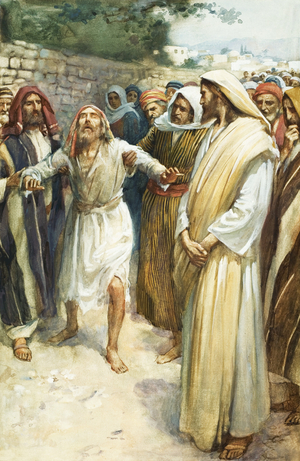
Jesus cured many people during his public ministry but very few of their names are recorded in the Gospels. Jesus raised Lazarus of Bethany from the tomb, cast out seven demons from Mary Magdalene, and restored the ear of Malchus in the Garden of Gethsemane. But beyond that, no recipients of Christ’s healings are named except for the blind man Bartimaeus, the son of Timaeus. The first three Gospels all recount this event, but the name of Bartimaeus the son of Timaeus appears only in today’s Gospel.

St. Mark wrote, “As Jesus was leaving Jericho with his disciples and a sizable crowd, Bartimaeus, a blind man, the son of Timaeus, sat by the roadside begging.” In Aramaic, the prefix Bar- means “Son of,” so Bartimaeus means “Son of Timaeus.” Why do St. Mark and the Holy Spirit doubly-emphasize the name of Bartimaeus the son of Timaeus, and what does Timaeus mean?

An Aramaic interpretation of the name Timaeus suggests “uncleanness,” but in Greek the name means “highly prized” or “honored.” This Bartimaeus sat begging on the ground alongside a road near Jericho—an extremely ancient city which symbolized the sinful world. He was blind, impoverished, ignored, despised, called a son of uncleanness, and he was unclean, yet our Lord considered him precious.

Bartimaeus had heard about Jesus’ healings and had faith in him. He shouts, “Jesus, son of David, have pity on me,” because he believes Jesus is the Christ (or the Messiah), the prophesized descendant of King David, and he believes Jesus possesses the power to heal him.

At first, many disciples rebuked the beggar, telling him to be silent, while he kept calling out all the more. Then Jesus stopped and said, “Call him.” So people in the crowd told the blind man, “Take courage; get up, Jesus is calling you!” The man sprang up from the dust and came closer to Christ, guided by Jesus’ disciples.

We are also journeying in a large crowd of Jesus’ disciples today, walking with him in his Church. Are we ignoring people who are not here with us, as the crowd at first ignored Bartimaeus? Jesus commands us to call them and help lead them to himself.

Before Bartimaeus could see, he had heard what other people were saying about Jesus. Are we sharing our stories, our cause for hope, with others? Are we mentioning the miracles that we have witnessed? Are we telling them the difference our Catholic Faith makes? Are we encouraging them to join us here?

Bartimaeus had faith due to what he heard and from God’s grace already active within him, for God is calling everyone. Bartimaeus called out to Jesus and, being called, threw aside his dirty, smelly cloak, lest it restrict his movement or cause offense. We, likewise, must cast off our sinful habits, lest they offend the Lord and impede our progress toward him.

When Bartimaeus reached Jesus, our Lord asked him: “What do you want me to do for you?” Christ could read the hearts of men, so why did he ask the blind man what he wanted? St. Augustine wrote that God wills us to ask him for things not because he doesn’t know (for he cannot fail to know) but “to exercise our desire through our prayers so that we may be able to receive what he is preparing to give us.” For “the deeper our faith, the stronger our hope, the greater our desire, the larger our capacity to receive will be…” Praying for our requests also helps us remember how much we need God and deepens our relationship. St. Teresa of Avila said, “You pay God a great compliment by asking great things of him.”

Jesus asks, “What do you want me to do for you?” How will we answer him? The blind man answered boldly, “Master, I want to see.” And Jesus told him, “Go your way; your faith has saved you.” Bartimaeus immediately received his sight and followed Jesus on the way. May this famous story of Blind Bartimaeus help us to see in new ways too.

Two Parables, a Poll, & a Purpose

September 15, 2024

24th Sunday in Ordinary Time
By Fr. Victor Feltes

Once upon a time, many years ago, a man who knew nothing about food production resettled to the countryside. He saw a farmer tilling a field and thought, “What a waste of effort! He’s just turning over dirt!” Then he saw the farmer planting seeds and wondered, “What’s he burying? Pebbles?” When the plants began to sprout and grow, he thought, “Ah, I see now! He’s growing a garden.” But the man was shocked at harvest time, “He’s cutting down everything he grew!” And when the farmer and his wife began hand-threshing, the man was baffled, “Why are they beating the plants?” The farmer’s wife ground flour and made loaves, placing them inside an oven, and the man was dumbfounded, “Now they’re burning it in a fire!” The farmer, of course, was growing grain and his wife was baking bread, but the onlooker did not understand all this until he was invited over to their house for supper.

Once upon a time in another tale, a little girl sat on the carpet of her living room while her mother sat in a nearby chair weaving embroidery stitches. The girl looked up and saw the chaotic, mishmashed underside of the embroidery and asked her good, and wise, and loving mother why she would create something so ugly. Her mother turned over the cloth, revealing what she was weaving and the little girl saw a beautiful, half-completed work of art.

Our God is all-good, and wise, and loving, and he is currently fashioning a beautiful, meaningful, lasting masterpiece for us on a scale the size of the universe. But until its completion we will see and experience ugly, painful things we will not understand, like the sufferings of Christ on Good Friday. His thoughts are not our thoughts, nor are his ways our ways, for we “are thinking not as God does but as human beings do.” Following Jesus will mean picking up the difficult crosses which come to us, denying ourselves, and acknowledging Christ before others.

Did Jesus care about what other people thought of him? Yes and no. Jesus asks, “Who do people say that I am?” and “Who do you say that I am?” That question is important, for Jesus declares, “I am the way and the truth and the life,” and “No one comes to the Father except through me.” Jesus gives his Church our Great Commission because all people are called to receive his baptism and to embrace all that he has taught for human thriving and salvation. But in another sense, he did not care what people thought of him.

Jesus did not allow what other people thought prevent him from doing what he should. Not even his friend Peter could change Jesus’ mind to do something against God’s will. Jesus knew that he would “suffer greatly and be rejected by the elders, the chief priests, and the scribes and be killed” but he went up to Jerusalem anyway and testified that he is the Christ. Christians today are called to courage too.

This week, I created an online survey to which 135 self-identified Christians responded. The poll’s question was: “Do you suffer for Christ?” 67% answered, “Yes, a little.” 12% replied, “Yes, significantly.” And 21% said, “No.” Do you suffer because you are a Christian? I asked a pastor-friend of mine how a Christian might discern if we’re suffering for Christ “significantly” or just “a little.” He thought that if we’re not sure, then it’s probably just “a little” — suffering greatly for Christ would be unmistakable.

So most Christians seem to suffer only a little for Christ, if at all, and yet we’re so afraid. You pray before meals, and that is good. Do you also pray before your meals in public? Do your coworkers or neighbors know you are a Catholic Christian? Have you invited anyone to our worship, to share this precious treasure? (Our classes for becoming Catholic begin two weeks from today.) As St. James says, ‘A faith without works is dead.’ We are called to be courageous, like the Prophet Isaiah, ‘to set our faces like flint, knowing that we shall not be put to shame, for the Lord God is our help.

I doubt the sufferings which flow from your Christian witness will be as severe as you might fear, but if sufferings do come your way know that you are not abandoned. When you suffer for Jesus and his Gospel, know that you are living out your faith with him. If you are faithfully carrying your Christian crosses, then you are following Christ.

Sharing His Real Presence

August 12, 2024

19th Sunday & 20th Sunday in Ordinary Time
By Fr. Victor Feltes

All four Gospels recall the miracle of Jesus using five loaves and two fish to feed five thousand people. But only John’s Gospel records what Jesus taught the following day in Capernaum. The Gospels of Matthew, Mark, and Luke all quote Jesus’ Last Supper declaration “This is my Body.” But John’s Gospel, written after them all, clarifies what these words mean.

Today we hear from the sixth chapter of John, where Jesus says, “I am the bread that came down from heaven.” Some in the synagogue congregation murmur, “Is this not Jesus, the son of Joseph? Do we not know his father and mother? Then how can he say, ‘I have come down from heaven’?” Jesus of Nazareth was the son of Mary and the adopted son of Joseph, but Jesus also truly came down from God his Father in heaven. The people did not yet understand how what Jesus said was real.

Jesus then goes on to say, “I am the living bread … whoever eats this bread will live forever and the bread that I will give is my flesh….” The people quarrel among themselves about this, “How can this man give us [his] flesh to eat?” They envision something grotesque, but once again what Jesus said was real in a way his hearers did not yet understand.

In retelling Jesus’ response to this objection from the crowd, John’s Gospel repeatedly employs a Greek verb for eating which is more intense than before — a word which does not mean merely “to eat” but “to chew, or gnaw.” In other words, Jesus preaches:

Whoever [gnaws] my flesh and drinks my blood has eternal life, and I will raise him on the last day. … Whoever [chews] my flesh and drinks my blood remains in me and I in him. Just as the living Father sent me and I have life because of the Father, so also the one who [gnaws] on me will have life because of me. … Unlike your ancestors (during the Exodus) who ate (bread from heaven) and still died, whoever [chews] this bread will live forever.

Jesus does not intend to make his followers cannibals by feeding them a portion of his dead or detached flesh. Jesus would offer them his entire living self as food: his body and blood, soul and divinity. “Take this, all of you, and of eat it, for this is my body.” His Church has kept his commandment to do this in memory of him every Sunday throughout the centuries since.

Today, some Christians say, “This meal is only symbolic.” There is some symbolism present in the Eucharist: to separate a body from its blood and then reunite them is a symbol of death and resurrection. Jesus’ coming to us as food speaks to how essential receiving him in this sacrament is for our spiritual life. (“Amen, amen, I say to you, unless you eat the flesh of the Son of Man and drink his blood, you do not have life within you.”) And Jesus taking on the appearances of bread and wine reflects his wish to be one with us in both the ordinary and the exceptional. (“Whoever eats my flesh and drinks my blood remains in me and I in him.”) The Eucharist contains symbolism but the Eucharist is not just a symbol.

We are not idolaters. We do not worship bread. We worship Jesus Christ in the Eucharist. This is the teaching of the Sacred Scriptures. This is the faith of the early Church. This is a wonder confirmed by miracles. This is our Most Blessed Sacrament. This is Jesus, the joy of the saints.

At Capernaum, when Jesus’ disciples first hear him preach about this “Bread of Life” which is his flesh, many of them murmur, “This saying is hard; who can accept it?” Jesus replies, “Does this shock you?” They doubted if he really came down from heaven, so he asks, “What if you were to see the Son of Man ascending to where he was before? (Which is something Jesus went on to literally do.) … The words I have spoken to you are Spirit and life.” Jesus does not retract his teaching, and verse John 6:66 records that “as a result of this, many of his disciples returned to their former way of life and no longer accompanied him.” Jesus turns to his apostles and asks, “Do you also want to leave?” And St. Peter responds with trusting faith, “Master, to whom shall we go? You have the words of eternal life.

Notice how Christ did not immediately chase down those departing disciples. Like the father of the Prodigal Son who ran from home, Jesus’ great love was unable to keep them close to him that day. But Jesus hoped that time, God’s grace, and the welcoming witness of his disciples would bring them back to his Holy Communion someday. Does the disunity of Christians and waywardness of the world trouble you too? Jesus wants us to be his welcoming witnesses today.

Having encountered the goodness and love of Jesus, having received him in the Eucharist, invite others to his Church. Pray for souls and tell them the difference being a Catholic Christian makes in your life. Share good homilies, articles, videos, talks, your favorite prayer devotions and saintly heroes. Pray for and invite your family, friends, coworkers, neighbors to come to Mass with you, and when you see new faces here help to make them feel welcome. Our parish classes for becoming Catholic (for those above the age of reason who want to be baptized or confirmed and be received into the Church) begin next month. Now is the time to encourage people to consider registering, even if only to come, see, and learn more. You possess a great treasure it costs you nothing to share. So invite others, as our psalmist says, to “taste and see the goodness of the Lord.”

Barbershop Theology

January 21, 2023

3rd Sunday of Ordinary Time
By Fr. Chinnappan Pelavendran

Today I have another story to share. A man went to a barbershop to have his haircut and his beard trimmed. They talked about many things, and then the barber said, “I do not believe that God exists. Look at all the sick people, suffering, and pain in the world. I can’t believe that a loving God Would allow this.” The customer thought about it, but did not say anything and left the shop. Once he was outside, he saw a man with long, dirty hair. He went back into the barbershop and said, “You know what? Barbers do not exist.” “How can you say that?” asked the barber. “I am here and I am a barber.” “No,” the customer answered, “Barbers do not exist because if they did, there would be no people with dirty long hair, like that man outside.” “However, barbers do exist, that is what happens when they do not come to me.” “Exactly,” said the customer, “That is the point! God also DOES exist! That is what happens when people do not go to Him and don’t ask Him for help.”

The first reading today tells us that the people of Israel were living in darkness. They were living under the control of Assyrians. Isaiah declares that God’s power is greater than the oppression they are living under. Jesus is the great light and will lead them into abundant joy. By His resurrection, He has assured us that darkness can never overcome us. The light that Isaiah is talking about is the light of God which scatters the darkness of ignorance and sin.

In the second reading, St. Paul tells the Corinthians that they must stop fighting among themselves, and to follow the humility and obedience of Jesus. They need to work together as followers of Christ. They need to keep their focus on Jesus Christ.

Our Gospel today tells us about the beginning of Jesus’ public life, after John the Baptist had been arrested. The good news that Jesus preaches is hope, peace, promise, truth, and salvation. Jesus is the messenger of good news. As Jesus began his public life, He gathered his disciples. He found Andrew, and his brother Simon (who is called Peter). Next, He found James and John, the sons of Zebedee. They left everything and followed Jesus to be His disciples. The story of the calling of the first disciples showed their unconditional response to Jesus. The calling of the disciples is the beginning of the church. These disciples were drawn to Jesus like a magnet. They left everything not knowing where all this would lead.

We need to appreciate our call to be Christ’s disciples. Christ came two thousand years ago to share the good news with all of his people. There are still many people who don’t know about Christ, we need to be Christ’s disciples now to preach and bring them to God. God sends us to proclaim the good news of the kingdom. Jesus traveled, teaching in the synagogues, proclaiming the good news of the kingdom, and curing his people. We are asked to follow the example of love given to us by Jesus. We need to become the light of the world as Jesus. We need to receive the light of Christ and share it with everyone as love, forgiveness, and respect for all. If we want to improve our looks, we go to the barber. If we want to save our souls, we need to go to God.

How Could They Follow Him?

January 21, 2023

3rd Sunday of Ordinary Time
By Fr. Victor Feltes

When I read the four Gospels for the first time, I naturally began with Matthew’s Gospel, and I remember being offended by today’s gospel reading. Matthew tells us Jesus was walking by the Sea of Galilee and saw two brothers, Simon and Andrew, with their fishing nets. He said, “Come after me, and I will make you fishers of men.” And they followed him. Then the Lord saw two other brothers, James and John, mending their nets. He called them too, and they immediately left their boat and their father to follow him. This episode really bothered me. Imagine being at your home or at your workplace, and a stranger knocks on your front door or walks up to your desk and says, “Follow me.” So you quit your job and leave your family to follow this person. Who would do that? It’s crazy. How can the Lord expect anyone to do that? But John’s Gospel reveals that today’s gospel was not the first time Jesus had met these future apostles.

Simon Peter’s brother Andrew and (traditionally) John the son of Zebedee were the two disciples who heard John the Baptist point out Jesus and say, “Behold, the Lamb of God.” This declaration led them to meet Jesus and spend the day with him. After this, Andrew first found his brother Simon and told him, “We have found the Messiah!” (that is, the Christ). Then Andrew brought Simon to Jesus. Jesus looked at him and said, “You are Simon the son of John; you will be called Cephas” (which is translated Peter). If John the son of Zebedee was that other unnamed disciple, then he likely told his older brother James all about meeting Jesus too. So in today’s gospel, when Jesus called the four men to follow him as “fishers of men” he was not some total stranger.

The various Gospels sometimes include or omit different details when recounting the same events. Luke’s Gospel adds further context to this scene. He records there was a crowd pressing in on Jesus that day by the Sea of Galilee. So Jesus got into Simon and Andrew’s boat, sat down, and taught the people from there a short distance from the shore. When Jesus finished speaking, he told Simon, “Put out into deep water and lower your nets for a catch.” Skeptical Simon reluctantly agreed, and they proceeded to catch such a great number of fish that their nets were tearing. They signaled to their partners in the other boat to come help and both boats became so filled that they were in danger of sinking. Astonishment at that catch of fish seized Simon and Andrew, and likewise James and John, who were Simon’s business partners. Jesus said to Simon, “Do not be afraid; from now on you will be catching men.”

Therefore, reading the Gospels together, we learn that Jesus was not a random stranger who just showed up one day demanding their full devotion. They were already familiar with Jesus, had heard his teaching, and witnessed his power. This enabled Simon, Andrew, James, and John to reasonably and radically follow Jesus Christ like they did.

Among all famous figures, Jesus Christ may have the highest name recognition in the world. Everyone has heard of Jesus, but how well do people know him? Surely, Jesus would like to call many to more; to a deeper relationship with himself and a closer connection to his one, holy, catholic, and apostolic Church. How can you help? Your non-Catholic or non-practicing family, friends, and acquaintances know you, they like you, and regard you. They rarely (if ever) see or hear me, but they frequently encounter you. Simon Peter took Jesus seriously because his brother Andrew. Andrew already knew Jesus, told stories and spoke highly of him, and encouraged Simon to meet him. You can be like Andrew for people in your life. As I preached at the other Masses last Sunday, three ways you can draw people closer to Christ and his Church are by sharing your prayers, sharing your stories, and sharing your invitations.

Share your Prayers
When you share your prayers with others it reflects that you know Jesus. Whenever someone asks for your prayers, or even when someone entrusts their burdens to you, offer to pray with them then and there. It’s easy—just talk to Jesus out loud. The words of your prayer don’t need to be eloquent, just sincere. People are typically receptive to this and very grateful for it, and your shared prayer can open the door for a miracle in their lives.

Share your Stories
When you share your faith stories with others it reveals the power of Jesus in our world. How have you encountered Jesus? What has the Lord done for you? What are your personal miracles and spirit stories? Don’t hide these highlight experiences of your spiritual life under bushel baskets, but be humble enough to share them for others’ good. When the disciples realized what Jesus Christ could do, through the miracle of the great catch of fish, they left everything to follow him.

Share your Invitations
When you share your holy invitations with others this offers them an opportunity to encounter Jesus and his Church. Invite them to join you here in the house of the Lord, for Holy Mass, Eucharistic Adoration, or parish events. Invite them to share in our Christ-centered worship and close community. Even if they decline, you will have planted a seed that may bear fruit someday.

Simon, Andrew, James, and John encountered friends of Jesus, discovered his power to do good, and had the opportunity to personally encounter him. Your faithful prayers, your powerful stories, and your holy invitations, can offer your non-practicing or non-Catholic dear ones the opportunity to follow Jesus Christ more closely. Here is your homework for this week: share a prayer, or a story, or an invitation with someone it could help. Cast your net so that Jesus Christ may be better known, and let’s see what Jesus does with it.

Share the Gospel

January 15, 2023

2nd Sunday in Ordinary Time
Fr. Victor Feltes

The message of the Gospel is simple:

1. We are created by an all-good and loving God.
2. But sin separates us from him.
3. So God has sent his Son to be our Savior.
4. Therefore, believe & repent, that he may save you.

St. John the Baptist proclaimed this Good News to sinners. John preached that God’s judgement is at hand (indeed, each of us only lives once, and after this life comes the judgment). And as John warned, “Every tree which does not bear good fruit is cut down and thrown into the fire. … [So] flee from the wrath to come.” After our harvest time, the “chaff” will “burn with unquenchable fire,” he said, but the Savior will safely “gather his wheat into his barn.” The reason why John came baptizing with water was so that this Savior might be made known. Christ is the one of whom John said, “A man is coming after me who ranks ahead of me because he existed before me.” After baptizing Jesus, John proclaimed him the sacrificial “Lamb of God, who takes away the sin of the world,” saying, “Now I have seen and testified that he is the Son of God.” Repent and believe in Jesus Christ, so that his sacrifice may save you.

Who will be saved? How many professed atheists, or Hindus, or Muslims, or Jews, or Protestants, or Orthodox, or Catholics will go to Heaven? Thankfully, perfect, final, Divine Judgement is not my job. My mission and your mission is the Great Commission. After his Resurrection, Jesus said, “Go… and make disciples of all nations, baptizing them in the name of the Father, and of the Son, and of the Holy Spirit, teaching them to observe ALL that I have commanded you.”

Baptism and the other sacraments are the ordinary (that is, normal) means through which Christ offers the grace necessary for salvation. Jesus established his Catholic Church as both the ordinary minister of these seven sacraments and as the one, reliable guardian of Christ’s teachings on faith and morals in a hostile, sinful world through the centuries. Our Lord Jesus Christ and his one, holy, catholic, and apostolic Church are the ordinary means of salvation for the world. Your non-practicing or non-Catholic relatives, friends, and neighbors are called to more with Christ. Like St. John the Baptist, your witness can help others receive this gift.

Your non-Catholic or non-practicing family, friends, and close acquaintances know you, like you, and respect you. They rarely (if ever) see or hear me, but they frequently encounter you. So here are three ways you can draw them closer to Christ and his Church: by sharing your prayers, by sharing your stories, and by sharing your invitations.

Share your Prayers
It is important to pray for the conversion of others, but you can easily pray with them, too. Whenever someone asks you for your prayers, or even when someone entrusts their burdens to you, offer to pray with them then and there. The words of your prayer don’t need to be eloquent, just sincere. People are usually quite receptive to this and very grateful for it.

Share your Stories
Today’s Gospel reading is simply St. John the Baptist sharing the story of what he had experienced with the Lord. And through this testimony, more came to know and follow Jesus. What has the Lord done for you, how have you encountered him, what are your miracles and spirit stories? Don’t hide these highlight experiences of your life under bushel baskets; be humble enough to share them with others for their good.

Share your Invitations
Invite them to accompany you to Holy Mass, Eucharistic Adoration, or our community events. Invite them to share in the life of the Gospel. Even if they decline, you will have planted a seed that may bear fruit someday. You and they were made for the fullness of God in Jesus Christ, and our hearts are restless until they rest in him.

In conclusion, here is your homework for this week: share a prayer, or a story, or an invitation with someone it could help – you may well save a soul.

The Fear of Inadequacies

July 12, 2021

15th Sunday in Ordinary Time
By Deacon Dick Kostner

Jesus at Prayer, Overlooking the Sea of GalileeOn my last homily I talked about the fact that faith can produce miracles. Today’s scripture readings helps us to understand how we acquire that gift of faith and participate in God’s divine partnership plan.

When I was studying for my Masters Degree in Pastoral Studies one of the revelations that God shared with me and that stood out in my mind was the fact that although God has no need to ask for help from anyone, that contrary to that he desires humans to participate in advancing and growing the body of Christ through human involvement in preaching and practicing the gospel message of love and service to others. The gift he bestows on those he asks for help from, and who accept his requests, is peace and happiness not only in this life but also the gift of the key to everlasting life in heaven.

For humans this presents us with obstacles in accepting those requests God asks from us, the greatest of which is our fear of inadequacy. Let me give you an example of this. When I began ministry studies one of my greatest fears was facing death or witnessing death. When I first got out of law school one of the first things I did was draft a will for myself and I placed a directive in it that I wished no funeral and requested that I be buried within twenty-four hours of my death. My thoughts were that this would make it easier for my family and friends to move on with their lives.

This fear stayed with me until I became a deacon and one day when our priest was on vacation, I received a call late one evening from our hospital. A car accident had happened and the family of the victim was trying to find a priest to administer the Sacrament of Healing for this young man. I advised the nurse that Father was gone out of town. She asked if I could come and be with the family. Fear hit me, and I told the nurse that I could not administer the Sacrament as deacons cannot do this. She then asked if I would come and maybe say some prayers with the family. My thoughts were that I was not adequate for the job and I did not feel I could do anything that would be beneficial for the family or their loved one. Then I remembered that part of my training for deacon ministry was to walk with someone and minister to someone who was dying. Fr. Frank, my director had assigned me to a elderly gentleman in Eau Claire who was terminally ill. I would meet with him on a weekly basis, at his home, and I would take Communion to him and his wife while spending time with him. I remember how after he died his wife called me and asked if I would do the Wake Service for him as he so much appreciated the times we got together while he was dying. I remembered how good this made me feel to know that they appreciated my company even though I felt inadequate for the mission Fr. Frank had assigned to me.

I decided to go and pray with that family at the hospital, and after doing so the family said they so much appreciated that I was willing to come and be with them during their suffering I finally realized that all that one needs to do is to show up and be there for those suffering and fearing death as the representative body of Christ. Jesus and the Holy Spirit do the rest. God knows that this is difficult for us but he always rewards those who say “Yes” to his call for help.

Our Gospel this weekend has Jesus telling his friends that its time for them to stand up and accept the job of helping others overcome their fears through their presence and healing. Jesus knows they don’t feel adequate for the job and so he sends them out in two’s knowing that this will help them feel more comfortable and capable of accepting their ministry mission. He tells them to not prepare and to take nothing with them as he promises to provide all the help that they will need to be successful.

Our parish at St. Paul’s is having a meeting this coming Monday to request help for our Fall Festival. This event provides not only financial support for the Parish but also allows its members to participate and say “Yes” to God’s requests for help. This will give evidence that Jesus is with us in helping not only others but ourselves to overcome our feelings of inadequacies. Like Jesus, the Parish is going to ask groups to come together as a unit to accomplish fellowship and support within our Parish Family Ministry. To the St. Paul’s committee people please plan on attending the meeting and by saying you will help build and exercise the Body of Christ in our community. St. John’s people encourage others to join you in planning your Parish activities to help reduce the fear we all have of being inadequate for the ministries asked of us by Jesus.

Remember the words of Jesus in today’s Gospel: “Take nothing for the journey but a walking stick—no food, no sack, no money.” Remember that God will provide you with everything necessary for his mission requests.

Living Christ’s Mysteries — Funeral Homily for Deacon Ed Feltes, 65

February 23, 2021

On the day Victor and Ramona brought their eighth son to be baptized, while his little head was still damp from holy water, Edward Joseph was draped with white linen. And the priest said (in Latin), “Receive this white garment, which mayest thou carry without stain before the judgment seat of our Lord Jesus Christ, that thou mayest have life everlasting.” Today, we bring Ed’s body before the Lord, draping him in white cloth once more. My uncle Ed told me that as a deacon he would always say yes to doing baptisms. It was, he said, “the introduction of a new life into the Church. By baptizing them you are basically installing them into a Catholic environment and hopefully they will grow in it and not back away from it.” Ed has been a Catholic Christian for more than sixty-five years, ever since he was baptized into Christ’s death and resurrection. And throughout his nearly twenty-four thousand days Jesus Christ accompanied him through life. The life of a Christian is found in Jesus Christ. And the mysteries of Christ’s life are reflected in, shared with, the faithful Christian. We see this throughout Ed’s life.

At his First Communion, young Edward approached and saw the Real Presence of his Lord held before his eyes: “The Body of Christ / Corpus Christi.” Ed received Jesus and Jesus received Ed into a more profound union, a more intimate relationship, between them. In receiving Christ’s Body, Ed was called to be the Body of Christ for this world. When Jesus tells us at the Last Supper, “Do this in memory of me,” he not only commands that we would receive him at the Holy Sacrifice of the Mass, but that we would imitate him in his self-gift: “This is my body, which will be given up for you. Do this in memory of me.” When Ed was sealed with the gift of the Holy Spirit at his Confirmation, he entered a more powerful relationship with that same Spirit of inspiration, grace, and power who led Jesus in his works on earth. The Holy Spirit’s gifts manifested through Ed not merely for himself, for his own salvation, but to serve the wider mission of Christ’s Church, that every person in this wayward world might be saved.

The main vehicle of Ed life’s work and witness would be through his first vocation: marriage. Ed and Jessica met during his studies at Notre Dame University and the year he graduated they entered a new covenant together. Almost forty years ago, they freely committed without reservation to give themselves to each other in marriage, to love and honor each other for as long as they both would live, and to accept children lovingly from God—raising them up according to the law of Christ and his Church. Recall that Jesus Christ called himself the Bridegroom and that in Sacred Scripture his Church is called his Bride. Every Christian is called to imitate Christ, and every Christian soul is spiritually his Bride. But just as the Holy Eucharist we celebrate is not merely a symbol or a memory but Jesus’ Real Presence among us so the Sacrament of Marriage makes present the mystical marriage of Jesus and his Church, within and between a husband and a wife. In beholding a holy, Christian marriage, in its loving, mutual, and lasting fidelity, we see a sign for us and for the world. That love is real, that love is foundational, that love is fruitful. That we were made in love, made to love, made for a holy communion of love, a family. We saw this in Ed and Jessica’s strong marriage which bore fruit, not least of all in their children: in their living son, Christopher, of whom they are so proud, and four other loved children who passed away very, very young; Francis, Steven, Elizabeth, and Meagan. Ed said he looked forward to meeting them and now has that opportunity.

In his marriage, together with Jessica, Ed discerned and pursued a call within his call, a second vocation. Relying on the help of the Lord God and our Savior Jesus Christ, Ed was chosen and ordained for the Order of the Diaconate. After the laying of the bishop’s hands and being dressed with stole and vestment, he was handed a Book of the Gospels with this admonition: “Believe what you read, teach what you believe, and practice what you teach.” Deacon Ed then ministered here at St. Catherine’s, celebrating in this sanctuary and serving throughout this parish. Teaching and preaching, even though he often found preaching difficult. Ed told me that he primarily sought to advance the Kingdom by sharing his life, showing how he lived. He said, “Always live your life such that people want the same that you do.” Looking back at the end of his quiet life, Ed had few regrets, but he did wonder if he was “maybe quiet too long.” Deacon Ed understood well that we need not enter into every pointless, unhelpful argument, but the Spirit does call and help us to speak the important words people need to hear alongside seeing our deeds.

In these last years, these final years, Ed reflected Christ and became configured to him in a new way, by joining him in suffering. Ed had at least six different strokes—twice nearly dying yet surviving—and endured strokes’ debilitating effects. Ed and Jessica described these past several years to me as an experience of continuous loses and grief, but also of continuous mercy and grace. Reportedly, the devastating impact of strokes often breaks up families, but this family grew closer through the trials. I think Ed also became bolder in Christ. While under hospice care at home he never stopped offering good things to his guests; blessings, prayers, holy water and blessed salt, to anyone who visited, wherever they might be in their faith walk.

When I last spoke with my uncle Ed I asked him what he was looking forward to. He simply said, “Heaven. I poured a lot of my life into experiencing, into living life on earth with a heavenly approach.” Asked as to what his near future held, he said, “It’s really up to God. I accept everything he has for me.” Ed and Jessica related to me that it was last March, almost a year ago, over a lunch at Panera Bread, that he told her, “I’m going to go to the Lord in six months to a year.” And he was right. Ed knew he was in God’s hands, being led and offered like an oblation for his glory and as a blessing for many. Knowing that this day was not in the far-distant future, I asked Ed about his wish for all of you on this day of his funeral. He answered, “Pray that they seek God more closely and live a more Christian life. I wish they would seek God for the answers and not just rely on themselves.” So if you have seen Jesus Christ in the life of Deacon Ed Feltes, please listen and heed his words.

And now, in conclusion, like Edward heard in his Last Rites:

I commend you, our dear brother, to almighty God and entrust you to your Creator. May you return to God who formed you from the dust of the earth. May holy Mary, the angels, and all the saints come to meet you as you go forth from this life.

May Christ who was crucified for you bring you freedom and peace. May Christ who died for you admit you into his garden of paradise. May Christ, the true Shepherd, acknowledge you as one of his flock.

May the Lord forgive all your sins and set you among those he has chosen. May you see your Redeemer face to face and enjoy the vision of God for ever.

Strong Reactions — 5th Sunday in Ordinary Time—Year A

March 3, 2020

My childhood memories of summer include the Osseo City Pool. I remember having fun in the water with friends, the 80’s songs playing from the lifeguards’ boombox, and the big brown door with red letters, warning something like: “Danger, Deadly Chlorine Gas, Staff Only!” As you might imagine, I never ventured into that room. Another memorable experience from my youth involving chemicals happened some years later. My science teacher, Mr. Hall, placed a bucket of water into the snow outside of our high school. Then, using tongs, he carefully dropped into it a chunk of pure sodium, and quickly backed away. The water steamed and bubbled and exploded a couple of times. It was intimidating and awesome. Two potent chemicals: chlorine and sodium. What happens when you combine them? You get sodium chloride. Today, this compound is present in the environment and inside of our homes. It’s in the oceans, on our streets, and even in the food we eat. Sodium Chloride may sound dangerous, but you know this common compound by another name: it’s salt.

Sodium Chloride (a.k.a. Salt)

Salt preserves, salt disinfects, and salt also adds flavor. Salt can preserve food from spoiling. In the days of sailing ships, unrefridgerated salted-pork could safely feed a crew for three months at sea. Salt has been used as a disinfectant and cleaning product since ancient times. The Egyptians, Greeks, and Romans employed salt water to treat cuts, wounds, and mouth sores. Even in 2010, a study from the Mayo Clinic found that gargling warm salt water reduces cold symptoms, including sore throat pain and mucus. And you know firsthand from a lifetime of eating that the addition of salt can make an otherwise bland dish taste much better.

Today, Jesus tells his disciples: “You are the salt of the earth.” Like salt, Christianity is found all over the world, preserving its good, purifying its evil, and adding flavor to what would otherwise be bland, meaningless life. And yet, like Sodium Chloride, Christianity is irrationally feared. This is nothing new. Listen to this second century Letter to Diognetus describing how Christians are present throughout the world, both helpful and good, and yet feared and opposed:

“Christians are indistinguishable from other men either by nationality, language or customs. They do not inhabit separate cities of their own, or speak a strange dialect, or follow some outlandish way of life. … With regard to dress, food and manner of life in general, they follow the customs of whatever city they happen to be living in, whether it is Greek or foreign. And yet there is something extraordinary about their lives. They live in their own countries as though they were only passing through. They play their full role as citizens, but labor under all the disabilities of aliens. Any country can be their homeland, but for them their homeland, wherever it may be, is a foreign country. Like others, they marry and have children, but they do not expose [their children to death]. They share their meals, but not their wives. They live in the flesh, but they are not governed by the desires of the flesh.”

“They pass their days upon earth, but they are citizens of Heaven. Obedient to the laws, they yet live on a level that transcends the law. Christians love all men, but all men persecute them. Condemned because they are not understood, they are put to death, but raised to life again. They live in poverty, but enrich many; they are totally destitute, but possess an abundance of everything. They suffer dishonor, but that is their glory. They are defamed, but vindicated. A blessing is their answer to abuse, deference their response to insult. For the good they do they receive the punishment of malefactors, but even then they rejoice, as though receiving the gift of life. They are attacked by the Jews as aliens, they are persecuted by the Greeks, yet no one can explain the reason for this hatred.”

Why does the world oppose devout Christianity? One reason is they imagine believing Christians behave like sodium in water, boiling hot with hatred and intolerance and violent in their reactions. Yet Christians’ allegiance to Jesus and his teachings on mercy, love, and the value of every human person are the best antidotes to mankind’s natural hatred and indifference toward others. Who is more responsible for sharing bread with the hungry, sheltering the oppressed and the homeless, and clothing the naked in world history than Christians in general and the Catholic Church in particular?

Another reason why worldly people oppose Christianity is that they think our faith is lethal to life’s pleasures; they fear that embracing Christianity would asphyxiate their happiness, like breathing chlorine gas. This too is nothing new. In Roman times, Christians were charged with “hatred of humanity” because the Romans believed ‘a lover of man should love what men love.’ The Early Christians would not partake of common sins for passing pleasures while, at the same time, living joyful lives. Joyful even at their martyrdom. As Diognetus’ pen-pal observed in the second century: “The world hates the Christians, not because they have done it any wrong, but because [Christians] are opposed to its enjoyments.” And so it is today. When we tell the world some things it loves are false roads to happiness the world hates us for it.

Jesus said, “If the world hates you, realize that it hated me first. If you belonged to the world, the world would love its own; but because you do not belong to the world, and I have chosen you out of the world, the world hates you. If they persecuted me, they will also persecute you. … In the world you will have trouble, but take courage, I have conquered the world.” So what are we to do? First, realize that the modern animosity to Christianity is nothing new. Don’t wait for that cultural hostility to pass; it won’t pass in our lifetimes. Next, never accept or act like your faith is a shameful thing. Jesus declares: “You are the light of the world. Your light must shine before others, that they may see your good deeds and glorify your heavenly Father.” If you are a Christian, Jesus wants the people around you to see something different in you and wonder, “What’s your secret.” Be unafraid to tell them the truth, “It’s my personal relationship to Jesus Christ and his Holy Church.” Cooperating with Christ to live like this saves souls and transforms our world.

There is another, more literal translation of Jesus’ words in our gospel: “You are the salt of the earth… You are the light of the world”: “You are the salt of the ground… You are the light of the cosmos.” Through your life, and every Christian life however humble, Jesus would reveal his divine light to the world, the glory and love that sustain the cosmos.

Shepherds & Fishermen — 3rd Sunday in Ordinary Time—Year A

March 3, 2020

What did the twelve apostles do for a living before Jesus called them to follow him? For six of the first apostles, that is half of the original twelve, we have no words from Scripture concerning their previous jobs. We are told that St. Matthew was a tax collector for the Roman government. We also hear of St. Simon the Zealot, who was either especially zealous in his personal religious devotion, or had ties to the Jewish Zealot movement is Israel. The Zealot movement sought, through politics and insurrection, to overthrow the Roman government in the Promised Land. If Matthew and Simon did indeed come from opposite sides of that era’s political spectrum, it suggests that every political party or faction has important things to learn from Jesus Christ.

In today’s Gospel, we learn the shared profession of four other apostles: Simon Peter, Andrew, James, and John; they were commercial fishermen. Now the Lord choosing men from the fishing industry was something new in salvation history. In the Old Testament, God often employs shepherds in his holy service. Among the patriarchs there is Abraham, Jacob-Israel, and his twelve sons – shepherds all. Later there’s the prophet Moses, King David, and Amos the prophet, each of whom tended flocks for some time before receiving their higher calling from God. As far as I can tell, there are no fishermen of particular note in the Bible before these four to whom Jesus says, “Come after me, and I will make you fishers of men.” Jesus, in calling fishermen, is doing something new. Now if the fishing background of these four apostles were irrelevant, I doubt the Holy Spirit would have inspired the inclusion of this fact into the Gospels. So what is the significance of this detail?

The work of a shepherd is different from that of fisherman. A shepherd tends his flock. He knows his sheep and his sheep know him. Some new lambs are born while other, older sheep go off to market or return to the earth, but the size of the sheepfold tends to remain rather stable. A fisherman, on the other hand, through his practiced skills and God’s providence, seeks and finds new fish every day. The fish are living in their own dark, watery world until the fisherman gathers them to himself. A shepherd maintains his numbers, but a fisherman goes out to seek more and more. Jesus chose his apostles not only to shepherd his people Israel, but to go forth to fish for people from all nations. Jesus made Peter not only a “fisher of men” but commanded him to ‘”feed my lambs… tend my sheep… feed my sheep.

Today we primarily think of water as a symbol of life, because nothing lives without water. Yet in the ancient world, water was often seen as a symbol of death. It’s possible even on a calm day to drown in a river, lake, or sea, but the volatile, deadly nature of large bodies of water is the subject of stories, poems, and songs even up to our day. For example:

The legend lives on from the Chippewa on down
Of the big lake they called Gitche Gumee
Superior, they said, never gives up her dead
When the gales of November come early

Fish live with this realm of death, a dark, watery world. The fisherman brings fish into the light, to a higher realm, a world they had previously ignored or never imagined. In our semi-post-Christian world today, is Jesus calling you and I to be shepherds or fishermen? Are we meant to maintain our flock, or to endeavor for more unnetted souls? There is need for both missions. In fact, we are called to do both. Many around us are baptized and still identify as Christians, yet how deep does their faithful devotion really go? Peter and Andrew left their careers for Jesus. James and John left their family for Jesus. Yet how few people today even come to church for him. True devotion and divine relationship is ignored or never imagined. Jesus calls you to be a missionary; not on the far side of the earth so much as in our own community. Be able to give witness to him. When I was a kid, when we were driving home from Sunday Mass, my family would often talk about what we heard in the homily. Today you your drive home from church I encourage you to ask each other: Why did you come to church today? What difference does it make for your life? We need to practice sharing why our faith is a gift with one another so that we can invite others to share this treasure.

In our first reading from St. Paul’s first letter to the Corinthians, we learn that the Christians in Corinth were choosing favorites and forming factions: ‘I belong to Paul. I belong to Apollos. I belong to Cephas.‘ St. Paul writes to remind them, you belong to Christ! Do not allow another person to get in way of Jesus for you. Pastors are important and Jesus has ordained it so, since without clear leadership how could St. Paul’s prayer and Christ’s desire, ‘that all of us agree in what we say, that there be no divisions among us, that we be united in the same mind and in the same purpose‘ ever be achieved? The need for human leadership of Jesus’ Church in this broken world, however, makes grave sin and scandal possible. This is a terrible thing, wherever and whenever it occurs. But please, please, do not separate from Peter on account of another apostle’s sin. You need Jesus, I need Jesus, and everyone else needs Jesus, too. Let us be good shepherds and fishers of men, caring for and seeking out everyone in our midst, as Jesus calls us to do.

Obstacles to Jesus — 31st Sunday of Ordinary Time—Year C

November 6, 2019

Last week, Jesus told us a parable about a penitential tax collector. This Sunday, St. Luke recounts for us a true story about real one. Jesus came to Jericho and a man there named Zacchaeus, a chief tax collector and a wealthy man, was seeking to see him. You just heard the ending of that story; Zacchaeus joyfully succeeds in to beholding and encountering Jesus, and Jesus happily succeeds in finding and saving Zacchaeus. But Zacchaeus’ story would have ended differently if he had allowed any earthly obstacle or any human excuse to stop him. What sort of things could have gotten in Zacchaeus’s way of seeing and encountering Jesus? Many of the same things that can get in our way.

For starters, Zacchaeus could have believed or claimed that he was too busy to devote time for Jesus. Zacchaeus was a chief tax collector, a busy man, and this appears to have been a working business day. Faithful Jews did not walk long distances on the Sabbath day of rest. The rabbinic tradition set the limit for Saturday travel at 2,000 cubits or about ¾ of a mile. (That’s not very far.) But Jesus walked to Jericho and had intended to pass through the town, suggesting that tolls and taxes from toilers and traders and travelers were there for the tax man’s taking. But Zacchaeus made time for Jesus in his busy day.

Are we busy? I’d bet that most people would say that they are, but busy with what? Last year, the average American adult spent 3 hours and 44 minutes a day watching television; that’s more than 28 hours per week, that’s a full 56 days in a year! Maybe you don’t watch TV at home (I don’t) but how much time do we expend with games and social media and entertainments online? Whether we have time or not for something is really a question of priorities.

We just celebrated All Saints’ Day’s. Have you ever considered, if you get canonized as a saint someday, what you would like to become the patron saint of? If I get canonized I’d like to be the patron saint of packing. I have a number of reasons for desiring this niche but needed patronage, but it all goes back to a lesson from my father. One time, for an Illinois trip, he taught me how to pack a car trunk. He said, “Put the big things in first, and then fit the smaller things in around them.” So it is with life; put the big things in first. Make time for weekly Mass, daily prayer, spiritual study, and spiritual growth. Make them your priority.

Another reality that could have made Zacchaeus give up on Jesus when they got in his way was other people. “Zacchaeus was seeking to see who Jesus was; but he could not see him because of the crowd, for he was short in stature.” (In other words, Zacchaeus wasn’t tall.) The crowd was not only an imposing physical barrier, but a hostile obstacle as well. They all knew him by sight and despised him as a sinner. Because of Zacchaeus’s small size, they could easily and effectively block him out or even push him away from Jesus.

On this occasion, the short of statue Zacchaeus was one of the “little ones” whom Jesus warns us not to despise: “It is not the will of your heavenly Father that one of these little ones be lost.” And Jesus warns of great woe for anyone who causes his little ones spiritual harm: “Whoever causes one of these little ones who believe in me to sin, it would be better for him to have a great millstone hung around his neck and to be drowned in the depths of the sea.” It is gravely wrong to push people away from Jesus through sin, but it is also a great error for us to allow others to push us away from Jesus. Jesus’ Church is holy but it’s the home of sinners, too. Do not let Judas’s betrayals or Peter’s denials, as horrible as these scandals are, keep you away from meeting Jesus here.

Zacchaeus did not let the obstacle of other people thwart him. When he was unable to penetrate the crowd, “he ran ahead and climbed a sycamore tree in order to see Jesus, who was about to pass that way.” It is debated within scripture commentaries whether is was considered undignified for a first century Jewish man to run apart from an emergency. But another embarrassing aspect of this story remains recognizable for us today. When was the last time you saw a grown man climb a tree for any reason other than to cut down a branch? Climbing trees is something kids do. When people saw Zacchaeus, the rich man, sitting in a tree on Main Street they probably pointed and laughed at him. But Zacchaeus ignored their gossip and mockery to do this for Jesus, and that made the difference for his soul.

Jesus expects us to be different from the world sometimes, both in the things we do and the things we don’t or refuse to do. And people will not always respect us or like us because of it. There are various reasons for this hostility, but a major one was noted in the second century by a Christian who wrote: “the world hates the Christians not because they have done it any wrong, but because they are opposed to its enjoyments.” Jesus tells his disciples at the Last Supper before his death: “If the world hates you, realize that it hated me first. If you belonged to the world, the world would love its own; but because you do not belong to the world, and I have chosen you out of the world, the world hates you.”

Do you sometimes avoid doing good things because you’re afraid of looking too pious or of being thought of as a goody-two-shoes? Do pray before meals to give thanks to God and ask him to bless your food at home but never at restaurants? Do you avoid receiving Jesus’ absolution in sacramental confession because you’re afraid of what the priest or others might think? When and where was the last time you mentioned the name of Jesus outside of church or apart from prayer? We need to be unashamed to be Christians, unashamed to be Catholics, not cowed by peer pressure but bold in doing what Jesus desires of us.

Let’s make a quick review of the things that might have prevented Zacchaeus, or might prevent us, from seeking and encountering Jesus: believing or saying we’re too busy; obstacles from other people, their sinfulness or peer pressure; and finally, our own resistance to full or true conversion.

When Jesus reached the tree he saw a fruit hanging in it for his harvest. Jesus looked up and said, “Zacchaeus, come down quickly, for today I must stay at your house.” And Zacchaeus came down quickly and received him with joy. Jesus was not content to simply exchange pleasantries and then go their separate ways. Jesus says, “I must stay at your house.” This more than merely a historical detail–this is a profound utterance; the Lord desires to dwell with Zacchaeus for all his days.

In encountering Jesus Christ, Zacchaeus realizes he must change the way he lives. He can’t play host to Jesus one day and then behave like it never happened. Well, he could, that’s the temptation. He can keep clinging to his sins, but his sins haven’t made him happy. If Zacchaeus had been content with his life he would not have been trying so hard to see Jesus. Now, Zacchaeus is free to change his life with Christ, and he’s excited by the new hope set before him. Zacchaeus declares: “Behold, half of my possessions, Lord, I shall give to the poor, and if I have extorted anything from anyone I shall repay it four times over.” The focus of Zacchaeus’ life has changed. No more defrauding. No more hoarding. Now, the Lord dwells in Zacchaeus’ house as his honored guest. And giving away one-half of all his wealth suggests his heart’s intention to love his neighbor as himself. And Jesus says to him, “Today salvation has come to this house.

The name Zacchaeus is a Hebrew name. It means “clean” or “pure.” While Zacchaeus was still imperfect, still unclean, still impure, Jesus called out to him by name and said “today I must stay at your house.” And Zacchaeus, by finding and knowing Jesus, became true to his name, realized his true identity, became his true self. The Lord desires the same for each of us. So allow nothing to get in your way of seeing and encountering Jesus.

Reflections on Martyrdom

December 29, 2016

I have not seen and cannot recommend the recently-released Martin Scorsese film Silence, but reviewers describe it as haunting and unsettling for believers and non-believers alike. It is set in Japan during a fierce persecution of Roman Catholics in the mid-1600’s. In one scene, a Jesuit missionary is forced to watch arrested Japanese Christians be cruelly tortured before him. The young priest is told that these men and women’s sufferings will cease if he would only step on an image of Christ and renounce his faith. What does Jesus want his followers to do if faced with such a choice?

A person might think there is little harm done in trampling the crude likeness of someone, or by insincerely mouthing a few words, but Jesus told his disciples, “Everyone who acknowledges me before others I will acknowledge before my heavenly Father. But whoever denies me before others, I will deny before my heavenly Father.” (1) At the very start of his ministry it seems that Jesus himself was confronted with the film’s test; the temptation to deny God so that human suffering would end.

After his baptism, Jesus was led by the Spirit into the desert to be tempted by the devil. He fasted for forty days and forty nights, and afterwards he was hungry. The tempter approached and said to him, “If you are the Son of God, command that these stones become loaves of bread.” (2) But Jesus firmly refused. Jesus Tempted in the Wilderness by James Tissot 1886-1894.What was so wicked about the devil’s suggestion? What could be wrong with alleviating hunger? Imagine if Jesus had relented, waving his hand over a nearby brown stone and then biting through its soft crust. Then the devil could accuse him, “So, you have provided food for yourself—how can you now refuse to wield your power to feed the whole world!?” Satan also pressured Jesus to insist that the Father spare him from death: “If you are the Son of God, throw yourself down [from this great height]…” But Jesus again refused. The tempter preferred Jesus to be a messiah who would give people an abundance of material wealth and safety while leaving them in their sins, separated from God forever.

Then the devil took him up to a very high mountain, and showed him all the kingdoms of the world in their magnificence, and he said to him, “All these I shall give to you, if you will prostrate yourself and worship me.” At this, Jesus said to him, “Get away, Satan! It is written: ‘The Lord, your God, shall you worship and him alone shall you serve.’” Jesus accepted suffering with and alongside us as a crucified savior-king and never surrendered to the temptation of becoming an earthly ruler who had denied God and bowed to Satan. Jesus Christ understood that he would be Isaiah’s “Suffering Servant” and “the Lamb of God who takes away the sins of the world” as St. John the Baptist proclaimed him. (3) Even as his desert tempter invited him to end all earthly hardship, Jesus in some sense foresaw the multitude of suffering martyrs who would follow his path after him. Jesus did not waiver. Jesus refused to capitulate to evil for this world’s fleeting, lesser goods because was not the will of God, his Father.

These reflections came to mind last week on the December 28th Feast of the Holy Innocents, those little ones who died in place of Jesus Christ. When Herod realized that he had been deceived by the magi, he became furious. He ordered the massacre of all the boys in Bethlehem and its vicinity two years old and under, in accordance with the time he had ascertained from the magi. (4) Modern biblical scholars estimate Bethlehem’s population was around 1,000 at that time, which means that up to about twenty infants were slain. (5)

These babies and toddlers have been venerated in the Church since the first century.  Early Church Fathers, including St. Irenaeus of Lyon and St. Augustine, and the liturgical tradition of the Church have celebrated them as saints and martyrs. (6) This pair of titles is remarkable for those “who, though still unable to profess [Jesus] in speech, were crowned with heavenly grace on account of his birth.” (7) None of these young Jewish boys were baptized or made a conscious decision to die for Jesus, but they were all saved through Christ.

Jesus spoke of the importance of baptism for salvation, for instance saying, “Whoever believes and is baptized will be saved.” (8) Yet he also said, “Let the children come to me, and do not prevent them; for the Kingdom of Heaven belongs to such as these.” (9) The Church, lacking an explicit teaching from Christ about children who die unbaptized, “can only entrust them to the [great] mercy of God, as she does in her funeral rites for them.” (10) Perhaps the Lord, knowing his own provisions for their salvation, has kept us in our uncertainty lest we employ the twisted logic of Herod, Pharaoh, or Pilate to rationalize the intentional killing of little ones. In any case, it has been the firm conviction and long tradition of Christ’s Catholic Church that the Holy Innocents of Bethlehem now dwell with him in Heaven.

Jesus Christ and his martyrs, from Bethlehem to Japan, reveal and witness to strengthening truths: That this life, however long or short, is not all that there is. That God can bring salvation out of evil, even from crimes and disasters that break our hearts and surpass our understanding. And the martyrs affirm that, as Charles Spurgeon said, “Suffering is better than sinning. There is more evil in a drop of sin than in an ocean of affliction. Better [to] burn for Christ, than [to] turn from Christ.” Whatever terrible crosses may afflict us or those we love we can remember that our crucified Lord has suffered likewise and is always with us. Jesus tells us, “In the world you will have trouble, but take courage, I have conquered the world.” (11)

26-martyrs-of-japan

A memorial to “The Twenty-Six Martyrs of Japan,” a group of Roman Catholics executed by crucifixion on February 5, 1597 at Nagasaki. Their feast day (i.e., St. Paul Miki and companions) is February 6th.

Footnotes:
(1) –  Matthew 10:32.
(2) –  Matthew 4:1-11.
(3) –  Isaiah 52:13-53:12, John 1:29 & 1:36.
(4) –  Matthew 2:16.
(5) – Raymond E. Brown, The Birth of the Messiah, pp.104–121.
Donald A. Hagner, World Biblical Commentary, Matthew 1–13, pg.37.
“Holy Innocents” entry in the Catholic Encyclopedia. 
(6) – Hugo H. Hoever, Lives of the Saints, pg.525.
(7) –  Opening Mass Prayer for The Feast of the Holy Innocents.
(8) –  Mark 16:16.
(9) –  Matthew 19:14.
(10) – Catechism of the Catholic Church, #1261.
(11) – John 16:33.


Perspective for Our Times

August 9, 2016

“It was the best of times, it was the worst of times, it was the age of wisdom, it was the age of foolishness, it was the epoch of belief, it was the epoch of incredulity, it was the season of Light, it was the season of Darkness, it was the spring of hope, it was the winter of despair, we had everything before us, we had nothing before us, we were all going direct to Heaven, we were all going direct the other way – in short, the period was so far like the present period, that some of its noisiest authorities insisted on its being received, for good or for evil, in the superlative degree of comparison only.”

So begins Charles Dickens’ A Tale of Two Cities. Our time is a mixture of good things and bad. In some ways we’re progressing, while in others we’re in decline. Some despair, but the trials of past generations were far worse than ours. As St. Augustine of Hippo (354-430 A.D.) observed:

“Is there any affliction now endured by mankind that was not endured by our fathers before us? What sufferings of ours even bears comparison with what we know of their sufferings? And yet you hear people complaining about this present day and age because things were so much better in former times. I wonder what would happen if they could be taken back to the days of their ancestors–would we not still hear them complaining?  You may think past ages were good, but it is only because you are not living in them.”

There has been no perfect “Golden Age” since Eden. We learn from the New Testament that even the first-century Christian communities had controversies within and persecutions from without. Yet pining for a romanticized past pairs with an opposite, pervasive error today: thinking that “old things” have nothing to teach or offer us. C.S. Lewis noted this modern disposition in 1955:

“…Chronological snobbery [is] the uncritical acceptance of the intellectual climate common to our own age and the assumption that whatever has gone out of date is on that account discredited. You must find why it went out of date. Was it ever refuted (and if so by whom, where, and how conclusively) or did it merely die away as fashions do? If the latter, this tells us nothing about its truth or falsehood. From seeing this, one passes to the realization that our own age is also ‘a period,’ and certainly has, like all periods, its own characteristic illusions. They are likeliest to lurk in those widespread assumptions which are so ingrained in the age that no one dares to attack or feels it necessary to defend them.”

The ignorant dismissal of the past leads to foolishness today. All advocate for change, but not all change is progress. For example, naively tearing down the wrong fences can permit evils to get in. G.K. Chesterton wrote in 1929:

“In the matter of reforming things, as distinct from deforming them, there is one plain and simple principle; a principle which will probably be called a paradox. There exists in such a case a certain institution or law; let us say, for the sake of simplicity, a fence or gate erected across a road. The more modern type of reformer goes gaily up to it and says, “I don’t see the use of this; let us clear it away.” To which the more intelligent type of reformer will do well to answer: “If you don’t see the use of it, I certainly won’t let you clear it away. Go away and think. Then, when you can come back and tell me that you do see the use of it, I may allow you to destroy it.”

We live in a time filled with serious problems and great blessings. We have grave reasons for concern, such as the present threats to religious liberty and the persistent Culture of Death, but we should not despair. Not only do we know Who wins in the end, but even today’s broken world has good things to offer. Computers are facilitating new technologies and improved communications. Healthcare advances are saving and enhancing lives. International economic development is helping billions rise from poverty. Imagine how these modern-day advances in communication, healthcare, economic wealth, and other fields could be utilized for the Kingdom of God. Jesus once asked his disciples:

“Do you understand all these things?” They answered, “Yes.” And he replied, “Then every scribe who has been instructed in the kingdom of heaven is like the head of a household who brings from his storeroom both the new and the old.” (Matthew 13:51-52)

To keep proper perspective today we must be neither naive nor despondent. We should be conscious of both the dangers and the opportunities around us. These present times will surely try us, but there has yet to be an era of the Church that has not tested the saints. Our generation is called to be faithful witnesses to Christ’s Church and Sacred Tradition. As Scripture says:

Anyone who is so ‘progressive’ as not to remain in the teaching of the Christ does not have God; [but] whoever remains in the teaching has the Father and the Son.”  (2nd John 1:9)

The world may refuse to heed us as it recklessly marches on but we can still benefit ourselves, for this life and the next, by holding on to  timeless truths. Our Church has persevered through controversies and persecutions from its beginning. It challenged the Roman culture while making use of the best things it had to offer to introduce and spread the Kingdom of God on earth. That Kingdom endures to our day. By keeping what is good and rejecting what is evil, let us remain ever-faithful to Jesus Christ in our times.

O Jerusalem by Greg Olsen

Captain America, St. Thomas More, & the Spirit of Truth

May 14, 2016

In the new blockbuster movie Captain America: Civil War the titular hero is discerning an important decision when he hears this message in a church:

“Compromise where you can. And where you can’t, don’t. Even if everyone is telling you that something wrong is something right, even if the whole world is telling you to move. It is your duty to plant yourself like a tree, look them in the eye and say, no. You move.”

Captain America - No, You MoveAs I watched in the movie theater, that bit about the tree struck me as odd. Trees bend and can be cut down, but pillars of iron or stone mountains don’t budge. I later discovered that these movie lines were adapted from a famous comic book speech Captain America once addressed to Spider-Man:

“When the mob and the press and the whole world tell you to move, your job is to plant yourself like a tree beside the river of truth, and tell the whole world — ‘No, you move.’”

Did you spot the difference? “Plant yourself like a tree beside the river of truth.” That’s not only more beautiful, it’s also an allusion to Old Testament imagery. Psalm 1:3 says:

“[The Just Man] is like a tree planted near streams of water that yields its fruit in due season, whose leaves do not wither, and whatever he does prospers.”

And Jeremiah 17:8 says:

“[Those who trust in the Lord] are like a tree planted beside the waters that stretches out its roots to the stream: It does not fear heat when it comes, its leaves stay green; In the year of drought it shows no distress, but still produces fruit.”

These verses teach that the just man who is rooted in the Law (or the Truth) of God prospers, and that those who trust in the Lord prevail against adversity.

I wish that Hollywood had included the fuller quote in the new Captain America movie—not only because it’s better writing, not only because it echoes Sacred Scripture, but because it better reflects the truth about where Truth comes from. My all-time favorite film disappoints me in a similar way.

A Man for All Seasons - St. Thomas More at TrialA Man for All Season won the 1966 Academy Award for Best Picture, but its depiction of its hero, St. Thomas More, falls short of perfection. In the movie, as in real life, Thomas More suffers unjust imprisonment for refusing to swear an oath recognizing King Henry VIII as the supreme head of the Catholic Church in England. The movie’s screenwriter, the agnostic Robert Bolt, drew on More’s own writings to craft some fantastic dialogues, but Bolt somewhat misrepresents the saint’s true motivations.

In one scene, Thomas More’s friend, the Duke of Norfolk, asks why he won’t just “give in.” Thomas answers, “I will not give in because I oppose it — I do — not my pride, not my spleen, nor any of my appetites, but I do — I!” The real St. Thomas More’s motivations are portrayed more accurately in the scene at his trial. He tells the court:

“The indictment [against me] is grounded in an act of Parliament which is directly repugnant to the law of God, and his Holy Church, the Supreme Government of which no temporal person may by any law presume to take upon [himself.] This was granted by the mouth of our Savior, Christ himself, to Saint Peter and the Bishops of Rome whilst He lived and was personally present here on earth. It is, therefore, insufficient in law to charge any Christian to obey it.”

The real St. Thomas More refused to sign the King’s oath because he saw in it a denial of Christ. He preferred to die rather than lose Heaven; and he did go on to die, thereby gaining Heaven. But Robert Bolt has his Thomas More conclude his courtroom speech like this:

“Nevertheless, it is not for [refusing the King’s] Supremacy that you have sought my blood, but because I would not bend to the [King’s re-marriage]!” (In other words, “No one is going to make me act contrary to my own self-will!”)

The real St. Thomas More was not standing up against the world for individually-chosen truth. (More opposed heretics when he served as King Henry’s High Chancellor.) He knew that Truth and right and wrong are not things we create for ourselves. We receive them, as water from a river. They do not flow from us as their source. The real St. Thomas More was a champion for the Truth which comes from God.

So how can we be faithful to the Truth which comes from God? How can we be planted like trees beside the River of Truth that flows from God? By prayerfully welcoming the Holy Spirit.

At his interrogation before the Roman Governor Pontius Pilate, Jesus says: “Everyone who belongs to the truth listens to my voice.” (In the Holy Trinity, the Father is the Speaker, Jesus is the Word, and the Holy Spirit is the Voice) But Pilate refuses to listen. He retorts to Jesus, “What is truth?” He rejects the Spirit of Truth and walks away.

Later, at his Ascension, Jesus instructs his disciples to remain in Jerusalem until they are clothed with power from on high with the Spirit of Truth who will teach them everything and remind them of all he has told them. Unlike Pilate, the disciples listen to Jesus and obey him. Some 120 persons (including the apostles, the Virgin Mary, some women, and some male relatives of Jesus) gather together and all devote themselves to prayer. They pray for nine days—the Church’s first novena, and on the tenth day, on the Jewish feast of first fruits called Pentecost, the Holy Spirit, the Spirit of Truth, comes and fills them.

St. Peter PreachingOnce the Spirit’s fire touches their heads, the disciples know what to say and they are unafraid to say it. Previously they had been hiding behind locked doors, but now they go out into Jerusalem’s crowded streets praising and preaching Jesus. This new-found wisdom and courage are gifts from the Holy Spirit, who empowers them to begin reaping the Church’s first fruits from the world. Observe well what the disciples do, for we are called to do the same: they listen to Jesus and obey him, they gather together and pray, they receive the Holy Spirit’s inspiration and gifts, and then they go forth to speak and act powerfully in the world.

In the Gospel of John, on the last and greatest day of one of the Jewish feasts, Jesus stands up in the temple area and exclaims, “Let anyone who thirsts come to me and drink. Whoever believes in me, as scripture says: ‘Rivers of living water will flow from within him.’” Here the Gospel writer adds: “He said this in reference to the Spirit that those who came to believe in him were to receive.”

The Holy Spirit is our River of Living Water. As trees planted beside him we will prosper, and by being rooted in him we will prevail against adversity. In Holy Mass let us pray to receive the Spirit wholeheartedly and to be clothed with his power. And then, filled with the Spirit of Truth, even if the whole world tells us to move, we will have the words and courage to stand our ground. By the Holy Spirit, we can be heroes for this world in desperate need of heroes, in the likeness of Captain America, St. Thomas More, and the apostles after Pentecost.

The Old Covenant’s (Surprising) Last Seven Prophets

May 6, 2016

A prophet is someone enlightened by God to reveal his message. Each Sunday, we familiarly proclaim that the Holy Spirit has “spoken through the prophets,” but the identities of the seven last Old Covenant prophets (as seen in the Bible) may well surprise you.

#7 :  The Author of 2nd Maccabees

Malachi is the last book in the Old Testament, yet the Bible’s books do not always appear in chronological order. Our separated Protestant brethren would identify Malachi as the last prophetic book in the Old Testament, but the Church’s Bible includes seven books which they exclude. The last of these is 2nd Maccabees, written during the 1st century BC.

The author of 2nd Maccabees, who chronicles the Jews’ successful rebellion against their Greek persecutors, does not seem to know he writes by divine inspiration. In his closing remarks he adds, “If [this story] is well written and to the point, that is what I wanted; if it is poorly done and mediocre, that is the best I could do.” (15:38) However, neither does St. Paul appear to grasp that his letters to the churches would be revered on the level of Genesis, Joshua, or Daniel. This shows that God can use us in amazing ways, in perfect accord with his will, even if we fail to recognize it at the time.

#6 & #5 :  St. Zachariah & St. Elizabeth

The Visitation by BlocZachariah and his wife, Elizabeth, are old and childless. But the Archangel Gabriel appears to Zachariah in the Temple and says that they shall have a son. Although he knows that God has blessed with children elderly and barren couples of old, Zachariah disbelieves the message. In response, he is put on a forty-week silent retreat. Zachariah becomes mute and apparently deaf as well (since his neighbors and relatives will later resort to making gestures to ask him the name of his newborn son.) Though he cannot tell his pregnant wife of their unborn son’s great mission, Elizabeth receives insights from the Holy Spirit.

When she hears the greeting of her visiting relative, Elizabeth is “filled with the holy Spirit” and cries out in a loud voice, “Most blessed are you among women, and blessed is the fruit of your womb!” The Blessed Virgin’s belly has not yet begun to grow, but Elizabeth prophesies and confirms to Mary that she is indeed pregnant with a boy who is “the Lord.” (Luke 1)

The Holy Spirit also seems to reveal to Elizabeth the name of her child: “John,” a name unfamiliar to her family. At the naming ceremony, Zechariah regains his voice, confirms her word, and “filled with the holy Spirit, prophesie[s]” through the canticle which bears his name. This holy, prophetic couple would ready their son for the great mission prepared for him by God.

#4 :  The Blessed Virgin Mary

The Annunciation by Henry Ossawa Tanner, Philadelphia, 1898.The Archangel Gabriel declared unto Mary that she would conceive the Son of God by the Holy Spirit. But is Mary a prophetess? Unlike Elizabeth and Zachariah, Luke’s Gospel does not say Mary, “filled with the Holy Spirit, prophesied,” or “filled with the Holy Spirit, cried out in a loud voice.” However, as Fr. Raymond Brown observed, the Annunciation to Mary shares the biblical form of a prophetic calling (like those of Moses, Gideon, Isaiah, Jeremiah, and Ezekiel before her):

(1) An Encounter with God or His Angel
(2) An Introductory Word
(3) A Call or Commission
(4) Objection(s) to the Message
(5) Reassurance by God or His Angel
(6) A Sign is Given

In her later canticle, Blessed Mary speaks a prophesy which remains fulfilled in our midst: “Behold, from now on all generations will call me blessed.” Mary is a prophetess, filled with the Holy Spirit, who bears God’s Word.

Simeon Holding the Baby Jesus in the Temple as His Parents Look On#3 & #2 :  St. Simeon & St. Anna

When the baby Jesus’ parents brought him to the Temple for the first time, they were met by Simeon and Anna; she was “a prophetess” and  “[t]he holy Spirit was upon him.” Simeon “came in the Spirit into the temple,” took Jesus in his arms, and declared him “a light for revelation to the Gentiles, and glory for your people Israel.” Anna likewise came forward at that very time and “gave thanks to God and spoke about the child to all who were awaiting the redemption of Jerusalem.” (Luke 2)

Simeon may have been advanced in years, but “it had been revealed to him by the holy Spirit that he should not see death before he had seen the Messiah of the Lord.” Anna, for her part, was an eighty-four-year-old widow who “never left the temple, but worshiped night and day with fasting and prayer.” Anna and Simeon show us how the old can bless the young through sharing the word of the Lord they have personally come to know.

#1 :  St. John the Baptist

St. John the Baptist PreachingWe do not know exactly how many Old Covenant prophets God inspired after the author of 2nd Maccabees. (A case might be made for the Bethlehem shepherds and the Magi as well.)  But we do know that John the Baptist represents the last Old Covenant prophet, the forerunner to the New Covenant Christ. He is “more than a prophet,” Jesus says. “All the prophets and the law prophesied up to the time of John. … Amen, I say to you, among those born of women there has been none greater than John the Baptist; yet the least in the kingdom of heaven is greater than he.” (Matthew 11)

At baptism, each Christian is entrusted with a prophetic mission. As those enlightened with God’s ultimate revelation, we are to share this Word. As great as it is to proclaim Christ’s coming, to proclaim his triumph is still greater.