Archive for the ‘Culture’ Category

C.S. Lewis on Our Immortality & Potential Glory

August 14, 2010

From The Weight of Glory:

It is a serious thing to live in a society of possible gods and goddesses, to remember that the dullest and most uninteresting person you talk to may one day be a creature which, if you saw it now, you would be strongly tempted to worship, or else a horror and a corruption such as you now meet, if at all, only in a nightmare. All day long we are, in some degree, helping each other to one or other of these destinations.

It is in the light of these overwhelming possibilities, it is with the awe and the circumspection proper to them, that we should conduct all our dealings with one another, all friendships, all loves, all play, all politics. There are no ordinary people. You have never talked to a mere mortal. Nations, cultures, arts, civilization—these are mortal, and their life is to ours as the life of a gnat. But it is immortals whom we joke with, work with, marry, snub, and exploit—immortal horrors or everlasting splendours.

This does not mean that we are to be perpetually solemn. We must play. But our merriment must be of that kind (and it is, in fact, the merriest kind) which exists between people who have, from the outset, taken each other seriously—no flippancy, no superiority, no presumption. And our charity must be a real and costly love, with deep feeling for the sins in spite of which we love the sinner—no mere tolerance or indulgence which parodies love as flippancy parodies merriment.

Next to the Blessed Sacrament itself, your neighbour is the holiest object presented to your senses. If he is your Christian neighbour he is holy in almost the same way, for in him also Christ vere Latitat [Latin, “truly hides”]—the glorifier and the glorified, Glory Himself, is truly hidden.

The Rich Fool — 18th Sunday in Ordinary Time—Year C

August 12, 2010

I regret to inform you that you are going to die. Perhaps not today, but someday, and it could be very soon. We should ask ourselves, “Am I ready? How can I prepare?”

The Gospel relates the story of a man who was not ready, a man God calls a “fool.” Jesus offers Him as an anti-role model; a person whose example we should learn from, but not imitate. Yes, he is a fool for hoarding his possessions. The old saying is true, “You can’t take it with you.” But there are more subtle lessons we can learn from his bad example. This morning I would like to present three things this rich man has to teach us:

The first lesson comes from what he does when his land produces a bountiful harvest. He asks himself, “What shall I do?” There is nothing wrong with this question in itself, but he is a fool in the way he asks it. The rich man asks himself, and only himself, “What shall I do?” He does not consult with God, in either his conscience or in prayer, to learn what His will is.

What is the lesson here for us?  Let us remember to listen to the Lord as He speaks in our conscience, through prayer, the Scriptures, and the people He has placed in our lives. We should listen for God’s direction every day, and throughout each day.

A second cautionary lesson is found in the rich man’s plan for solving his storage problem. He says, “This is what I shall do: I shall tear down my barns and build larger ones.” What was wrong with the older barns? They were not large enough to hold everything, but why tear them down? The rich man has plenty of land. Why did he want to replace his perfectly good barns?

Vanity of vanities, he wanted his storehouses to be the newest, the biggest, and the best. Though the rich man was not very concerned about other people, he was very concerned about their high opinion of him. Even in those days, people were tempted to consumerism.

Consumerism seems to consist in two phantom promises: that having just a little more will truly give me lasting happiness, and that others will regard, accept, and love me when they notice the things that I have. These are phantom promises, for as soon as one reaches to grasp them they prove empty, illusory, receding further out of reach.

The fact is that the people who are happiest in life are not the wealthiest. (By that measure, pretty much every American should be among the happiest people in the world.) The happiest people tend to be those who share the most or give the most away. The person who recognizes they have enough, that life does not consist in possessions, is content and secure enough to share. Some people try to get the most out of life as possible, but what we appreciate most in our lives is the ways in which we have given of ourselves for others.

Our third cautionary lesson is heard in God’s rebuke of the man: “You fool, this night your life will be demanded of you; and the things you have prepared, to whom will they belong?” When we think of the things the rich man has prepared, we think of his harvest and goods.  One of the things he has ill-prepared… is his soul, which this night will be demanded of him. And now, to whom will it belong?

The lesson here for us?  As focused as we are upon our possessions, we must be more attentive to our souls. Someday, we are going to die. In the meantime, then, let us put to death, the parts of you that are earthly, as St. Paul said: immorality, impurity, passion, evil desire, and the greed that is idolatry.

What lessons does the rich man teach us? Reject the false promises of the consumer cult, for life does not consist in possessions. (Self-gift is the meaning of life) Turn your heart to your spiritual well-being, for your life and this world shall pass away.  And to frequently ask Jesus, everyday, “What shall I do?” Let us begin today, before it is too late for us to begin living wisely.

Signs of the Times — Thursday, 18th Week in Ordinary Time—Year II

August 5, 2010

The Chicago Archbishop, Cardinal Francis George, [reportedly] recently remarked, “I expect to die in my bed. I expect my successor to die in prison and his successor to die a martyr’s death.” An overly-dark prediction? Perhaps. But there are threatening signs for the Catholic Church’s future in America.

Yesterday a federal judge overturned Proposition 8, California’s Marriage Protection Act. He ruled same-sex marriage to be a constitutional right. About two years from now, the issue will reach the Supreme Court, where most anticipate a 5-4 decision to go one way or the other. A poor decision, enshrining a national right to gay marriage, could drive Catholic organizations out of many charitable efforts, such as adoption services.

This year in Wisconsin, the legislature came close to removing the statute of limitation for all child sexual abuse cases. This would have allowed civil suits, no matter how old, to be brought against alleged perpetrators and their employers. (Government institutions, like public schools, were exempted.)

What’s wrong with a law like this? Consider the difficulty of gathering facts, witnesses, and accurate testimony for events twenty, thirty, or even forty years ago. This is why statute of limitation laws exist. How does one question a dead priest or a dead bishop to assess their response to an allegation or their knowledge of an incident? Merely responding to a handful of these new-old cases in litigation would cost Wisconsin dioceses immensely. The legislation died this year in committee, but its supporters intend to reintroduce it next year.

The President’s recent health insurance overhaul will intertwine the federal government into medicine more than ever before. What will this mean down the line for the work of Catholic hospitals? That remains to be seen.

So what shall do? We will pray. As St. John Vianney told us yesterday, ‘God commands us to pray, but He forbids us to worry.’ We shall continue to love, for love is what changes hearts. We should vote, because we live in a democracy where the government is made in the image of those who vote.

And finally, we shall be faithful, no matter what. Even if, God forbid, churches are confiscated and sold off… even if Catholic charities and hospitals have to close their doors… even if priests and bishops go to jail for things they say or things they are unwilling to do… we will be faithful and unafraid. For Jesus promises us, “the gates of the netherworld shall not prevail against the Church.”

We shall not deny Jesus Christ, nor His teachings, before the world. We, the Church, will be faithful to Christ and His teachings. We shall be His people, and He shall be our God.

We’re in a Hurry — 16th Sunday in Ordinary Time—Year C

July 18, 2010

The other day I was thinking about this homily when I heard the words of some modern poets on my radio. They said:

I’m in a hurry to get things done,
Oh, I rush and rush until life’s no fun.
All I really gotta do is live and die,
But, I’m in a hurry and don’t know why.

This goes to show that we still have a Martha problem today. The group Alabama said that they didn’t know why we get in a hurry, even though we’re not having fun, but I think I know the answer. The reason is that our loves and good desires are mixed with fears. If we would take that fear away, we would find peace.

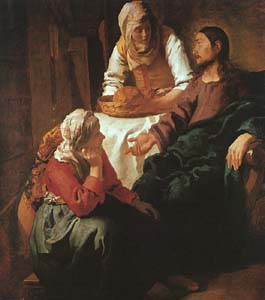
Martha loved the Lord and wanted to serve Him well, but she had fears mixed in. She was the one who invited Him to the house and He probably had His apostles and other disciples with Him. She was busy serving them all, perhaps making the biggest meal she had ever made, and she was full of worries. “What if I’m a poor host and Jesus is disappointed with me? What if there’s not enough food for everyone to eat?”

We are often the same way. We fear that our lives are on the edge of disaster if our own plans and efforts should fail. We worry about bad things happening to ourselves and the people we love. We are anxiety about how Jesus feels about us.

Martha had a great desire to do good, but Martha’s fear tempted her to do harm. Her sister, Mary, was sitting at Jesus’ feet, listening to His words. (The Greek word for disciple actually means “one who sits at the feet of.”) Martha tries to take Jesus’ disciple away from Him.

Similiar thing can happen in our live on account of fear mixed with love. A husband and father can obsess about his work, out of a love for his family and a desire to provide, but his family can be left feeling like they come second in his life. A wife and mother can be so concerned that her loved ones will be safe and happy that she tries to control everything, making her family less happy because of it. Martha’s problem and ours is not that we work–work is a part of life–but in how we go about it.

Jesus says to Martha, and to us, “Martha, Martha, you are anxious and worried about many things. There is need of only one thing.” What is this one thing we need? We need the peace of Christ. What is the peace of Christ? It is several things.

It is the awareness that God is near and guiding us. In the first reading, three heavenly visitors approach outside of Abraham’s tent. Now, the Holy Spirit dwells within our tents, Jesus is at our side, and we have a Father above. We are never left on our own.

With the peace of Christ we recognize that whatever may happen to us or those we love, it is for our good. As St. Paul observes in the second reading, even his sufferings are a cause for rejoicing for they advance the salvation of the whole Church with Christ.

With the peace of Christ we recognize that misery is not just around the corner, nor is happiness out of reach. Happiness is at head, in the knowledge that Jesus loves us, likes us, cares about us, and cares for us. Living in the peace of Christ means there is no reason for us to be unhappy.

Let us continue to do works of love for God, ourselves, and others, but let us do them always in the peace of Christ.

Checkout Catholic Movies

July 14, 2010

Did you know the St. Vincent DePaul Society just two blocks from St. John’s (location) has a library of Christian movies, books, and CD’s free for checkout? Pick up the films below for a spiritually edifying and entertaining evening:

The Ten Commandments (1956, VHS, 219 min)
Moses faces Pharoah demanding “Let my people go!”
+ Charleton Heston, Yul Brynner, and a cast of thousands
+ Regarded as the greatest Biblical epic of all-time
+ In *Technicolor*!

For another film about a great shepherd of God’s people, I recommend…

John Paul II (2005, DVD, 180 min)
A dramatic biography about Karol Wojtyla, Pope John Paul II
+ Regarded as the best drama about the Great Pope
+ Cary Elwes (The Princess Bride) plays the young Wojtyla
+ Jon Voight stars as Pope John Paul II
— The latter half is better; I suggest skipping to the conclave

For another film about a character who becomes a new man midway into the film, I recommend…

Becket (1964, VHS,  150 min)
St. Thomas Becket’s conversion makes him King Henry II’s enemy
+ Good dialogue, verbal sparring
+ A great excommunication scene
+ Teaches that personal conversion is possible

For another film with another English Thomas crossing with another King Henry, I most highly recommend…

A Man for All Seasons (1966, DVD, 120 min)
St. Thomas More’s conviction makes him King Henry VIII’s enemy
+ Won Best Picture, Actor, Director, Cinematography
— This title can be mistaken for another starring Charlton Heston
+ Brilliant dialogue, drawn from More’s own words
+ My all-time favorite film, it’s almost perfect…
— Gives More a pride at heart inconsistent with his character
+ Teaches the awesomeness and the attractiveness of virtue

For another film about religious conviction not bowing to the politics of the age, I recommend…

Sophie Scholl: The Final Days (2005, DVD, 117 min)
A German girl is arrested for writing against the Nazis during WWII
— Subtitled
+ The lead actress is captivating
+ Great verbal combat throughout the interrogation and trial
— Ends sadly, like A Man for All Seasons
+ Shows times can cloud truth, but that conscience still speaks

For another film about another Christian who heroically resisted the Nazis, I suggest…

Maximilian: Saint of Auschwitz (1995, VHS, 76 min)
St. Maximilian Kolbe is a knight for Mary in a darkened age
+ All roles are interestingly played by one man, Leonardo Defilippis
— The recurring theme music is not bad, but overplayed
+ Satan’s speeches are enjoyable in a Screwtape Letters way
— A tad too preachy by way of the masonic, communist, Nazi foes
+ Presents the value and power of Marian devotion

For another film by Defilippis about a saint whose faith was a spiritual romance, I suggest…

John of the Cross (1997, VHS, 60 min)
A Spanish mystic seeks God and reform with St. Teresa of Avila
+ Leonardo and Patti Defilippis play all of the major roles
+ Gives a taste of John’s spirituality, quoting his Spiritual Canticle

For another film by Defilippis about a Carmalite Doctor of the Church, I suggest…

Therese (2004, DVD 96 min)
Thérèse of Lisieux’s story, the most popular saint of modern times.
+ Anyone with a fondness for her will gain from this movie
+ The lead actress, whom Providence led to this production, shines
— Criticized for not being as good as it should have been
— One gets no clear sense of her simple, “Little Way” spirituality
+ This film increases one’s love for this great, little saint

For another film about a holy nun’s experiences in the convent, I recommend…

Faustina (1994, DVD, 75 min)
Jesus tells a Polish nun, St. Faustina, to proclaim Divine Mercy
— Subtitled
+ A work of art of profound depth
+ Her love for Jesus and message of mercy are communicated well
+ Teaches that Jesus’ Mercy embraces all willing to receive it

For another film about supernatural phenomena and the value of suffering, I recommend…

Padre Pio: Miracle Man (2000, DVD, 214 min)
St. Padre Pio bears Christ’s wounds, reads souls, & battles Satan
— Subtitled; English is optional but its voices and dialogue are poor
— Long, 3 hours and 34 minutes, presented in two halfs.
+ Great scenes, like the actresses’ confession and His spiritual battles
+ Teaches, among other lessons, that holiness is manly

For another film about a Franciscan priest with amazing spiritual gifts, I recommend…

The Reluctant Saint: The Story of St. Joseph of Cupertino (1962, VHS, 104 min)
An unintelligent man rises to the heights of sanctity
— Black and white
+ Joseph is played handsomely and enduringly
+ Rather funny, if you are in a fun mood
— Runs about fifteen minutes longer than it needs to
+ Shows a little of the old ritual for exorcism, which is interesting
+ Teaches that God takes the weak and makes them strong

For another film about a simple mystic who was doubted in their day, I recommend…

The Song of Bernadette (1943, DVD or VHS 158 min)
St. Bernadette Soubirous’ sees Mary appear in Lourdes, France
— Black and white
+ Jennifer Jones, at her most innocent, in a Best Actress role
+ Vincent Price (Thriller) plays the skeptic
+ Teaches that God is still real and found among the small

For another film about the life of the Visionary of Lourdes, I recommend…

The Passion of Bernadette (1989, VHS, 106 min)
St. Bernadette Soubirous’ life after entering the convent
+ Sydney Penny reprises her role as Bernadette
+ Shows that humility is beautiful

For another film about a great French saint, I recommend…

Monsieur Vincent (1947, DVD, 114 min)
St. Vincent DePaul grows in his understanding and care of the poor
— Subtitled
— Black and white
+ Gritty, yet beautiful
+ Well crafted characters
+ Teaches us to love our neighbor as ourself

For another film about charity and our resposibility to the poor, I highly recommend…

Entertaining Angels: The Dorthy Day Story (1996, VHS, 112 min)
Dorthy Day’s journey from communist to Catholic humanitarian
+ Stars Moira Kelly (The Cutting Edge) and Martin Sheen
+ Heather Graham (Austin Powers 2) does surprisingly good acting
— Contains an historical, non-graphic nor explicit abortion subplot
+ Teaches that life’s meaning is in committed personal life

For another film with an American, pro-life message, I highly recommend…

Bella (2006, DVD, 91 min)
A man with emotional scars helps a friend through a crisis
— Not a true story
+ Rich characters
+ Shows that life is beautiful, in every sense of the word

For another film about escaping prisons of the heart, I recommend…

The Count of Monte Cristo (2002, VHS, 131 min)
A falsely-condemned Frenchmen escapes prison and plots revenge
— Not a true story
+ Stars Jim Caviezel (The Passion of the Christ) charmingly
+ Richard Harris (Harry Potter) portrays a good Christian
+ In a great scene, a fight to the death has a surprising end
+ Explores the Problem of Evil vs. Providence in a powerful way

For another film about an imposter who gradually becomes a real hero, I recommend……

Meet John Doe (1941, DVD, 122 min)
A feel good movie about American values and the little guy
+ This film is in the public domain; click above to watch it now
— Black and white
— Not a true story
+ Directed by Frank Capra (It’s A Wonderful Life)
+ Teaches about the enduring strength of the little guy
Gospel Movies

July 1, 2010

Below are five original shorts drawn from the Scriptures. Click the images to watch them.

Teddy Bear Annunciation


The Annunciation of the Archangel Gabriel to the Blessed Virgin Mary; the Gospel of Luke, chapter 1, with teddy bears.

Robot Jesus at the Watering Hole

 
Jesus meets the woman at the well; the Gosple of John, chapter 4, starring robots.

The Rich Young Rapper

 
A rich young rapper questions Jesus on the subway; a remix of Matthew, chapter 19 and Mark, chapter 10.  

Doubting Thomas

 The resurrected Christ appears to a skeptical disciple in the Gospel of John, chapter 20.

The Importance of the Resurrection


From St. Paul’s 1st Letter to the Corinthians, chapter 15.

An Original Marian Hymn

June 3, 2010
Hail Mary, with God You Found Favor
by Father Victor Feltes
 

Set to the tune Rendez a Dieu, (audio, sheet music ) as in “Father, We Thank Thee who has Planted,” or “When John baptized by Jordan’s River.” For use with permission only.

Hail Mary, with God you found favor,
preserved from sin and filled with grace;
prepared as gate for our Creator,
and new Eve for our human race.
“Let it be done to me as you say,”
you told the angel God had sent;
becoming mother of our Savior,
and new ark of the covenant.
 
Hail Mary, mother of all Christians,
you stood by Christ the day He died.
Now you reign as our queen in heaven,
enthroned beside Him glorified.
Blessed are you among all women
and blessed is your fruit adored.
Pray for us Mary, now and always,
to ever love your Son, our Lord.

Approved for use in the Mass in the Diocese of La Crosse by (then) Bishop Jerome Listecki in August 2009.

A Mystery Revealed — Trinity Sunday

June 2, 2010

You may recall my mention of one of my favorite professors at seminary, Dr.  Perry Cahall. And I remember him telling us one day in class, “If, someday when you’re a priest, I hear that you got into the pulpit on Trinity Sunday and tell the people, ‘You know, the Trinity is a mystery, and so there’s really nothing we can know or say about it…’ I will hunt you down like the dogs you are.” This is my first homily on Trinity Sunday, and I’m going to make sure I give Dr. Cahall no reason to come after me.

The Trinity is a mystery, but that doesn’t men we know nothing or can say nothing about this central mystery of our Faith. In Catholic theology, a “mystery” is not something which is unknowable to us, it is just something which our human reason could not have discovered on its own.

Imagine if you came upon a sophisticated and well-written mystery novel. It’s so good that you can’t put it down. But as you get towards the end, you discover that the last couple chapters of the book are missing. You noticed some clues as the story unfolded, but without those last pages you can’t figure out the identity of the one “who did it.” You might try to find the ending in another copy of the book, but what if no other copies existed and no one had ever read the ending before? Your only hope would be to speak with the author. The author could tell you the rest of the story. The author could unveil the mystery for you and reveal the identity of the one “who did it.” Like that in sophisticated mystery novel, our God has placed clues throughout creation and His Old Testament interactions with His People. Yet, it was not until the coming of Jesus that the “who done it” was plainly revealed: God, the Author of the universe, is Father, Son and Holy Spirit.

Today I would like to talk about some common questions people have about the Trinity. For instance, how is God both one and three, and then what difference does the Trinity make?

Some people have trouble with the concept of the Trinity because they think it is the claim that “one equals three” in God. However, this is not what we believe about the Trinity. The number one does not equal the number three, not in God or anywhere else, and not even the omnipotent power of God can make a logical contradiction true.

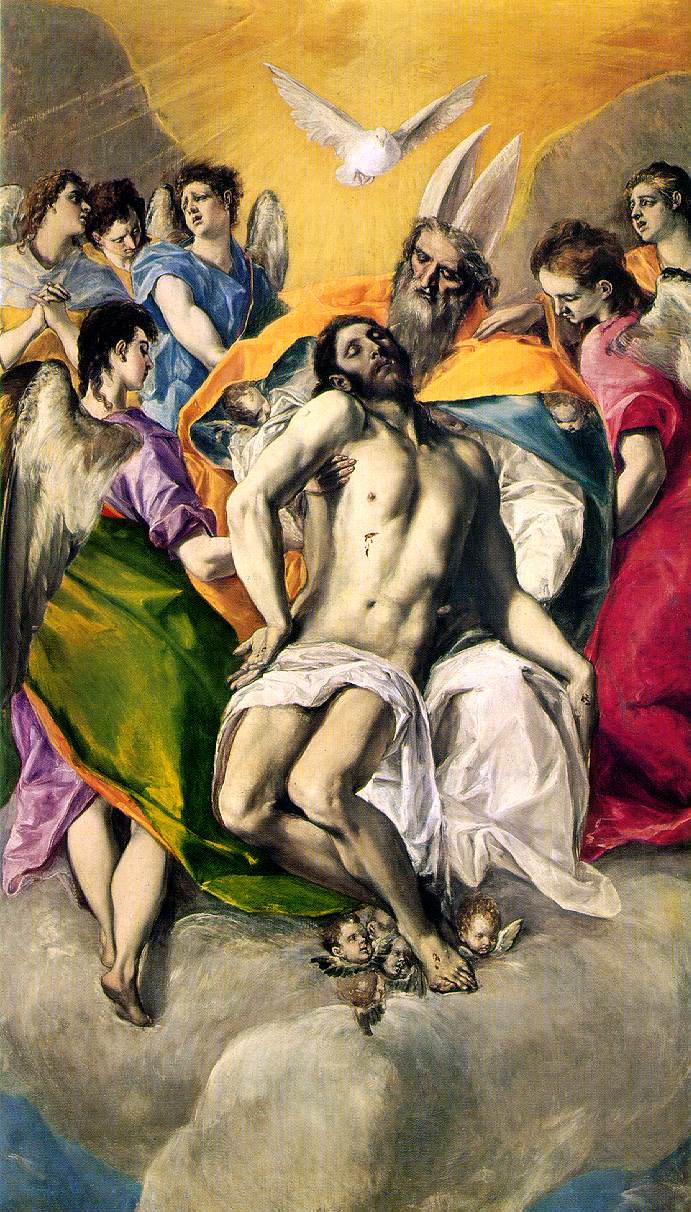
We believe one God, comprised of three divine persons: the Father, the Son, and the Holy Spirit. God is one What, as three Who’s. There is one divine nature, but three divine knowers, three divine willers, and three divine actors. We do not believe in three anonymous forces, but three loving persons. There is no God apart from or beyond these three persons.

Now the Father is not Jesus Christ. Jesus is not the Holy Spirit. And the Spirit is not our Father. They are distinct persons. Yet, at the same time, each possesses the fullness of the divinity: perfect goodness, infinite beauty, perfect knowledge, infinite power, perfect mercy, and infinite love. We do not worship three gods, but three eternal persons who comprise one God.

The belief in the oneness of God was firmly instilled into the Jewish people. This conviction helped to keep Israel from falling into the worship of false gods and experiencing all of the evils that brings. For instance, Israel’s Canaanite neighbors were idolaters, who worshiped mere objects as gods that could make them happy. They practiced child sacrifice, killing their own children in hopes of receiving greater blessings in this life from the gods. And they had temple prostitution, in which promiscuous sexuality was as hailed as sacred.

Notice how our society has become more and more like those pagans as it has drifted from belief in the one true God. Our worship of objects which we think can make us happy is called materialism, or consumerism. Our human sacrifice, done in hopes of greater blessings in this life, is called abortion. And some have raised up sexual promiscuity as the way of greatest freedom and happiness.

The Jews were spared all of these evils so long as they clung to their conviction that “All gods are not the same, and we are to worship only one.” The God of Abraham, Isaac, and Jacob. Even to this day, observant Jews pray a prayer twice daily called the “Shema Yisrael,” from a passage in Deuteronomy:

“Hear, O Israel! The LORD is our God, the LORD is one!  Therefore, you shall love the LORD, your God, with all your heart, and with all your soul, and with all your strength.”

Jews remain Jews today because they do not believe that Jesus is the promised messiah, or the Christ, the one for whom they have been waiting. Sometimes they criticize Christians saying we are not really monotheists, but polytheists, who believe in three gods: “The LORD is our God, the LORD is one!”

Yet, revealingly, the word that God inspired in this Old Testament passage (“The Lord is one”) is not one of the words in Hebrew which always means numerical and solitary oneness (such as “yachid” or “bad”.)  Instead, the Holy Spirit selected a word which usually means a unified oneness: “echad.” This word (“echad”) is the same word used in Genesis, where God says of man and woman, “the two shall become one flesh.” In their union, the persons are as one being. And recall, God had said, “Let us make man in our image , after our likeness. …[And] God created man in his image; in the divine image he created him; male and female he created them.” When husband and wife become a unified one, as one couple, in time, they are in the image and likeness of the Father, Son, and Spirit, who have are a unified one, as one God, eternally.

So what difference does the reality of the Trinity make for our lives? The Trinity shows us that God is not a solitary individual, isolated and alone. God is a loving communion of persons. This is the reality we come from, and this is the reality we are called to, in this life and the next.

In our post-modern age, some people talk about “the meaning of life” as if it were some kind of joke, or an unsolvable mystery beyond our capacity to discover or know. But we Christians believe we know the meaning of life, for it has been revealed to us. The meaning of life is the loving communion of persons. The loving communion of persons is what gives our lives meaning and it will be our primary delight forever in Heaven. Love is the reality we come from, and the reality we are called to.

‘Hear, O Church of God! The LORD is our God, the LORD is a unified one!  Therefore, you shall love the LORD, your God, with all your heart, and with all your soul, and with all your strength.’ Love the Lord your God, who is Father, Son, and Spirit, and become like the God you love.

God’s Favorite Instrument — Tuesday, 6th Week of Easter

May 11, 2010

What is God’s favorite musical instrument? Harps? Organs? Bongos? I believe it is the instrument He created Himself, the one which He loved so much that He gave one to each of us for free–the human voice.

God is pleased when we sing for Him. St. Augustine said, “The person who sings prays twice.” Some people say this is because singing adds melody to our words of prayer. But it could be that a person sings twice because singing enlists the heart to join in the prayer of the mind. Singing lifts up our hearts to the Lord.

In today’s first reading, the missionaries St. Paul and Silas get beaten and stripped. They are locked in prison with their ankles placed in stocks. Things are at their darkest and most difficult time, but the night finds them not only praying, but singing hymns. This lifts their spirits, shakes loose their bonds, and pours out grace on that place. Singing makes a difference.

Maybe you feel like coming to our weekly school Masses is like being led somewhere in shackles. But if you must be here either way, why not make the most of it? Singing at Mass (and I mean really singing) is liberating, and a gift to God. 

If God has blessed you with a beautiful voice, sing strongly, as if to say to God, “You gave me this gift, and I offer it back to you.” If He has not blessed you with a good voice, you should still sing boldly, as though to say, “You gave me this voice, and I’m going to let you have it.” Your voice is God’s favorite instrument. So at this Mass and at every Mass, let Him hear it.

Gift of Self — 5th Sunday in Easter—Year C

May 2, 2010

I would like to begin today by telling the beautiful story of a gorgeous young woman named Leah Darrow. Leah grew up in a strong Catholic family in Oklahoma, but when she was in high school she says that her Catholicism started to get “fuzzy.”  By the time she was in college Leah says she had become a “Catholic But.” She would say, “I’m Catholic, but I don’t agree with the Church’s teaching on cohabitation,” or, “I’m Catholic but I don’t see the problem with a couple who love each sleeping together before their marriage… I think the Church is behind the times.”

One evening at college she saw a reality TV show called “Americas’s Next Top Model,” with Tyra Banks and thought to herself, “I’m pretty cute, maybe I could be on that show.” She tried out and got on, but lost the competition, yet she was resolved not to let her TV elimination mean the end of her modeling career. And she was rather successful.  She still recalls her excitement at receiving her first paycheck with a comma (a comma!) in it.

Leah eventually found herself at a photo-shoot high above 5th Avenue in New York that would change her life forever. She came to pose for an international magazine which wanted to help her develop a more risque image. They brought out a number of itsy-bitzy outfits for her to wear.  She picked one out and shooting began. Now Leah says that every model knows not to look at the flash when the photos are being taken (and she insists that she didn’t look at the flash) yet while she was posing, a vision flashed in her mind, three images in the span of perhaps a second or two. This is what she saw:

She saw herself standing in a large white space in the immodest outfit she was wearing. In this scene she wasn’t in pain, but she had the sense that she had died. In the second image Leah was looking up, holding out her open hands at her waist, with the knowledge that she was in the presence of God. In the third and final image, another white flash hit her eyes and Leah saw herself holding her hands all the way up, offering to God all that she had, but in that moment she realized that she was offering Him nothing. For her entire life up to that point, with all of the blessings, talents, and gifts that God had given her, she had wasted them all on herself. If she had died at that moment, Leah knew that she would have nothing to offer Christ.

She came back to reality when the photographer said, “Leah, Leah, are you OK?” She shook her head and said, “No, I can’t.” He said, “Ok, we can go over here.” And she said, “No, I can’t .”  She ran back to the makeup counter, changed back into her own clothes, and ran down 5th Avenue, balling her eyes out, afraid that she might be losing her mind.

She called her dad and said, “Dad, if you don’t come get me I am going to lose my soul.” Dad drove across the country to New York, and when he arrived she wanted to leave town, but he said he couldn’t wait to see the sights; Central Park, the Empire State Building, the Carnegie Deli, “But first we go to confession.” She made a good, tearful confession spanning the ten commandments like she was ordering off the dollar menu: ‘Two number ones, four number twos…’ She came out like a new woman, healed.  Today she goes around telling her story and supporting an organization that promotes modesty in young lades’ dress.

Leah says she was living a very selfish life before her conversion. Perhaps she was confused, as many in our culture, about the nature of true love. In English we use the word love in a broad and ambiguous way.  We say, “I love that TV show. I love the Packers. I love my children. I love my wife. I love God. I love my dog.” But all of these loves are different in kind and degree. When we say, “I love pizza,” or, “I love wine,” it is not really pizza and wine that we love so much as  ourselves.  I love myself, and that’s why I consume pizza or wine. Yet, not all love is easy, warm, and fuzzy. True love is a sacrifice, and often feels that way.

As St. Paul tells us in the first reading, “It is necessary for us to undergo many hardships to enter the kingdom of God.” And Jesus says in the gospel, “I give you a new commandment: love one another.” Love how? “As I have loved you, so you also should love one another.” How did Jesus love us? Through a total gift of self.

Now we know from the Gospels that Jesus’ self-giving wasn’t always a ordeal. It was often joyful. Jesus enjoyed going to weddings, dinner parties, and spending time with His friends. But Jesus’ acts of love were the most powerful and manifest when they were hard, as when He was on the cross.

Self-gifting love powerfully good. Someone can live a life of great fame and wealth, but without self-gift their life will account for nothing.  This is the world of difference we see between George Bailey and Mr. Potter in It’s a Wonderful Life.

Difficult self-gifting love is also the most powerful witness. Some theologians have speculated that Jesus could have redeemed in other ways besides the cross. (Perhaps a single cry from the infant God-Man would have been enough if that had been the divine plan.) But Jesus dying for us on the cross communicates a powerful message about His love for us. Jesus said, “This is how all will know that you are my disciples, if you have love for one another.” The way we love should be a witness, it should make us stand out.

Earth is a training ground. Our life here on Earth is training for Heaven. In Heaven, self-gifting is the rule and the norm. If that’s not the sort of thing we are interested in, there will be no place for us to be at home in heaven–and there is only one other place for us to go forever. In today’s second reading, Heaven is seen “coming down out of heaven from God, prepared as a bride adorned for her husband.” It is a revealing description, for spousal relationship prepares us for the life of Heaven.

We are all called to marriage and parenthood, either natural or spiritual. Some are called to live single lives, to enter religious life, or be ordained, in a fruitful spousal relationship with Christ and/or His Church. Others are called to natural marriage and to fruitfulness seen in their spousal love and its natural or spirital children.

Self-gift is the life of marriage. What if there is a priest who does not pray, who does not serve, but who seeks only his own comfort? Such a priest will eventually leave his priesthood. So it is with a natural marriage. If one spouse seeks just their own pleasure, their marriage will seem empty. But if both spouses seek to make a self-gift to the other, they will both be satisfied. Jesus said, “Seek first the kingdom of God, and His righteousness, and all thing will be added on to you.” If we go for self-gratification, even that escapes us, but if we focus on self-gift, satisfaction comes as well. This is the reason for the Catholic tradition of a crucifix hanging over a husband and wife’s bed.

Jesus has given us a new commandment: love one another. As He has loved us we should love one another. Such love is powerful. It should make us stand out as disciples of Christ. And it prepares us for the life of Heaven, where self-gift is rule.

Leah Darrow Interview on the Drew Mariani Catholic radio show (4/30/10)

Leah Darrow Talk to a Boston Catholic Women’s Conference (2/27/10)

For One’s Friends — Tuesday, 3rd Week of Easter

April 20, 2010

Jesus said, “No one has greater love than this, [than] to lay down one’s life for one’s friends.” Have you ever wondered if that’s true? Is that really the greatest love? Wouldn’t it be greater for someone to lay down their life for their enemies? No, for I tell to you that no one can do this. It is impossible to lay down your life for an enemy. You can only lay down your life for people you love.

St. Stephen, like the Savior he followed, loved those who killed him. Stephen’s murders hated him, but he did not hate them in return. He was their enemy, but they were not his. Stephen loved them enough to challenge and correct them, but this made them very angry. Before dying, Stephen said, “Lord, do not hold this sin against them.” He was acting with mercy, generosity, and prayer in imitation of Jesus Christ, his role-model.

In this community, I do not feel that we are plagued with the disease of hatred: hatred for others, hatred for classmates, or hatred for God. But I do fear that we are infected by indifference: indifference towards each other, indifference towards those in need, and indifference towards God. I challenge you: in the past week what have you done to be more merciful, more generous, or more prayerful?

St. Stephen had mercy, generosity, and prayers for those who hated him. St. Augustine wrote that if it had not been for this, that young man named Saul who was guarding the cloaks, consenting to the execution, would not have later converted to become St. Paul, the great apostle. If St. Stephen overcame hatred and did this, imagine what overcoming our indifference could do?

We may not necessarily have to die as bloodied martyrs, like St. Stephen did, but Jesus asks each of us to lay down our lives for our friends.

Easter Endures — Easter Friday—Year C

April 11, 2010

For the rest of the world, today is the second friday of April. For us, today is Easter. The rest of the world has gone back to life as before, but we in the Church continues to remember and celebrate Easter.

In the Gospel we see Peter and some of the disciples going back to their old ways, back fishing in Galilee. And in the first reading we see the Jewish leaders, elders, and scribes operating just the same as before. But they all get reminded that Easter has changed everything.

So let’s not forget the graces we received this Triduum. And let us remember that in these “last days” every day is Easter and that our lives and our world will never be the same as before.

11 Absent Students — March 25 — Annunciation

March 28, 2010

You have probably wondered why our school chapel’s icon, statues, and crucifixes are veiled with purple cloth. Covering of religious images is a tradition for the last two weeks of Lent, a period we call Passiontide. So why do we have this tradition?

One explanation recalls that Jesus’, when His enemies sought to kill Him, hid Himself prior to His final days: “Jesus left and hid from them.” (John 12:36) Others see in this veiling a symbol for how Jesus’ divinity was veiled within His humble and vulnerable humanity. He was God incarnate, but none of the rulers of His age knew, “for if they had known it, they would not have crucified the Lord of glory.” (1 Corinthians 2:8) But behind all of this I think there is a very human reason for why we veil the holy images of Jesus and the saints at Passiontide. “Absence makes the heart grow fonder.”

During Lent we deprive ourselves of luxuries and pleasures for our personal conversion and growth in holiness, but we also do this so that we can celebrate the Christ’ Easter triumph with an even greater feeling of joy. This is why we normally don’t sing as much (or say the Gloria or the “A”-word before the Gospel) during Lent—so that we can enjoy pulling out all the stops at Easter.

Veiling our statues of Mary and Joseph, our wall icon of Elizabeth Ann Seton, and our crucifixes causes a little pain of separation within us. But what if this chapel had never been furnished? What if our chapel had always been bare of religious art? Then their absence would not affect us at all because we would not know that we were missing them.

There are not as many students here today as there should be. Now I’m not saying that this should have been a whole school Mass, and I’m not begrudging anyone who may have stayed in study hall this hour to work on homework.  This is a great turn out and every seat is filled. But still, there are not as many students here as should be here today.

In the early nineties, when most of you were born, for every three live births in our country there was one boy or girl who was intentionally killed. (CDC) I counted roughly 33 students here today. That means we are missing 11 of your classmates who were not allowed to be born.

Today we recall the Annunciation, which some people call “Pro-Life Christmas,” for even though Jesus will be born nine months from now, today is the day of the Incarnation, when God became a human being like us in the womb of the Virgin Mary. After the angel Gabriel departed, Mary went in haste to see her relative. Elizabeth exclaimed, “Who am I that the mother of my Lord should come to me,” and John the Baptist leapt for joy in his mother’s womb in the presence of our microscopic Savior, Jesus Christ. (Luke 1:43-44)

Imagine if 11 of your classmates were to die in a bus accident. You would you feel terrible from the loss, and our whole school would be in mourning. But we have never known the 11 who are missing here today, so we do not feel our loss.

At this Mass and henceforth, let us keep the following things in mind regarding the past, present, and future. As to the past, remember these absent classmates and pray for them. They never received a name, they never had a funeral, and few people have ever prayed for them. Pray for their parents, too. 

In the present, perhaps you honestly find yourself not feeling much emotion one way or the other towards the reality of one million innocents being murdered in our country every year. If so, then ask God to give us His heart and His sight to love what He loves and to hate what He hates. God loves us all, but He hates our sins. He hates our sins because they are bad for us, and the worse they are for us the more He hates them. His love for us and His hatred for our sins are two sides of the same coin. Blessed Mother Teresa of Calcutta said “the greatest destroyer of peace today is abortion.” The Lord’s heart is certainly not indifferent to this evil, and neither should ours be.

And finally, for the future, keep hope that this evil of abortion will come to an end in our time. We can have this hope, for as the angel Gabriel said to Mary, “nothing will be impossible for God.”

One Catholic Church — Tuesday, 3rd Week of Lent

March 9, 2010

In the first reading we hear the ardent prayer of an Old Testament Jew named Azariah who finds himself in a pretty hot spot. He fervently prays, “… O Lord, do not deliver us up forever, or make void your covenant. [Save us for] the sake of Abraham, your beloved… to whom you promised to multiply … offspring like the stars of heaven, or the sand on the shore of the sea.”

This was God’s covenant promise to Abraham, and God has indeed made Abraham’s spiritual offspring vast and numerous. Today, half of the people on earth claim Abraham as their father in faith—these are Christians, Muslims and Jews who all seek to worship the God of Abraham.

Yet Jesus prayed that all people would be one in Him, as one holy family of God—a diversity of persons sharing one perfect unity. To achieve this goal Jesus established one, holy, catholic, and apostolic Church, so that all may be one, as He and the Father are one. Our Church was established by Jesus, Himself, who said to Peter, our first pope, “You are rock, and upon this rock I will build My Church.”

Our Catholic family is made up of every race and reaches to every nation. To illustrate this, I would ask all high school students; freshmen, sophomores, juniors, and seniors, to stand up now. Imagine that these 146, or so, young men and women represent the world’s nearly 1.2 billion Catholics. Each one represents about eight million of our  Catholic brothers and sisters.

In the United States we have 68 million Catholics, but this is only 5.7% of all the Catholics in the world. I would now ask the male freshmen to remain standing and for everyone else to sit down. These guys represent the Catholics of the United States, plus the rest of North America and the Caribbean—just 9% of Catholics worldwide.

The freshmen can sit down and I would ask the male sophmores to stand up. This is Asia, Australia, and the Pacific Islands, totaling 11% of all Catholics.

You can sit and I’ll ask the senior males to stand. This is Africa’s Catholics, 12% of the Catholics in the world.

You can sit and we’ll have the male juniors and the female seniors rise. This is Europe, 27% of all Catholics.  (The pope is in there somewhere.)

You can sit and we’ll have our largest region of all, represented by the female juniors and the full sophomore class, please stand. This is Central and South America, where 39% of all Catholics live.

So, as you can see our Catholic family is far more diverse than you might have imagined. We are young and old, men and women, rich and poor, sinners and saints.

Our Catholic family not only spans the globe, it also spans the centuries. This is reflected in the ancient prayers we sing today, such as the Latin Sanctus and Agnus Dei, the Kyrie which is ancient Greek, and the Amen which is Hebrew.

Let me put this another way: Could I have one high school student please stand up. This one person represents about 13½ years, which is about how long you have had to explore and get to know about your faith. Now could all of the high schoolers please stand up. You represents all the years that the Church has been on earth, since 33 AD. Our Church has been around a lot longer than we have. You may be seated.

Roman Catholics make up the largest religious denomination in the United States.  However, it is said that the second largest denomination in our country would be former Catholics. Tragically, many Catholics leave the Church. Oftentimes, they experience one or two parishes and a couple of priests, in one region, of one country, over a handful of years, and they imagine that they have exhausted the riches of the 2,000 year-old worldwide Church and Faith of Jesus Christ. But in reality, you can explore the mysteries of Catholic beauty and truth for a lifetime and never exhaust them.

My message for you, with all passionate the urging of Jesus Christ, is this: always remain in the Church that Jesus Christ founded. Never walk away from the fullness of God’s family, but dwell in the household of God.

Sources:
Distribution of Catholic Population, by Region: 2000
USCCB: The Catholic Church in the United States At A Glance

Alive in Christ — Funeral for Lila O’Brien, 94

March 3, 2010

On behalf of Christ the King parish I wish to offer to you, Lila’s family and friends, the sympathies and prayers of this community. I also want to give special recognition, praise and thanks to Lila’s children, who provided her with around the clock companionship and care, allowing her the blessing of dying at her home with her loved ones.

In these last months, I had the privilege to visit Lila at home on two occasions. The first time I came, I anointed her with holy oil, to strengthen her for the share in Christ’s passion which laid before her. The second time some of her family and I gathered and pray with her the prayers of commendation for the dying.

When I ask people about Lila they tell me that she was friendly and feisty. That she was ever active and always on the go. That she was funny, a bit goofy, and unpredictable. They tell me that she was very independent, yet also very personable. Lila was a neat lady. Let us not forget that she remains a neat lady.

It is the habit in our culture to refer to people who have died using the past tense. For instance people say, “So and so was such a loving person,” and they say the person “would have really enjoyed being with us today.” Even if unintentionally, these words implies that the dead love no longer and that they are no longer aware of us.

Yet after death, a person who is loving in this life becomes still more loving. It seems quite likely that each of us will be aware of our own funerals, just as I believe that Lila is aware of our gathering today.

Though we fall into speaking of the departed in the past tense, we do not really believe that death is the end. Dying does not annihilate those we love. As Jesus said, ‘The God of Abraham, the God of Isaac, and the God of Jacob is not the God of the dead, but of the living, for to Him all are alive.’

Nor does dying make a person less fully themselves than what they were before. “Whether we live or die, we are the Lord’s.” And as Jesus said in the gospel, to the good thief crucified with Him, “Amen, I say to you, today you will be with me in Paradise.”

Lila has passed on, but if you would like to talk to her, just go ahead and pray. She will hear you and she will appreciate it. And be sure to pray for her too.

In her years on earth, Lila did not like to travel far from home and she didn’t take long trips, unless the promise of a casino jackpot awaited her. But now Lila is making the human soul’s furthest trip, the journey to full and heavenly presence of God. She has an incredible jackpot to motivate her, the promise of supreme and perfect happiness, however receiving this reward is not a matter of luck. It requires the purification of her soul and the help of our prayers, so offer this morning’s mass and your continued prayers to God for her.

Lila has died, but Lila is not dead. If the woman we remember has changed it is only to become more perfectly who she really is, in all her unrepeatable uniqueness. Lila was, and she remains, a friendly, funny and feisty lady.