Archive for the ‘Holy Trinity’ Category

The Oil for our Lamps

November 7, 2020

32nd Sunday in Ordinary Time

“The kingdom of heaven will be like ten virgins who took their lamps and went out to meet the bridegroom. Five of them were foolish and five were wise.”

What are we to make of Jesus’ parable today? Who is this bridegroom and who are these virgins? What are these lamps and the oil that fuels them? How can we be like those wise virgins who enter the wedding feast, and unlike the foolish who are unhappily locked outside? We will better understand the meaning of this parable through a familiarity with Jewish marriage customs.

In the culture of Jesus’ day, when a young man betrothed a woman they would remain apart, typically for twelve months, manifesting the propriety of their union. Once this time of separation was over, the groom would return to his bride with his groomsmen, usually with a nighttime torchlight procession. The bride and her bridesmaids would be expecting him but without knowing the exact hour of his arrival. This is why the bridegroom’s second coming would be preceded by his friend and forerunner’s announcing cry: “Behold, the bridegroom! Come out to meet him!” Then the bride and her virgin attendants would go up with the groom to his father’s house for a great wedding feast. There the marriage would be consummated and days of feasting and merriment would commence. So whose marriage is being symbolized in Jesus’ parable? Who is the bridegroom and who is his bride? The Scriptures point to Jesus Christ as the bridegroom and his Church as his bride.

The Old Testament prophet Isaiah spoke of God’s promise: “As a young man marries a virgin, your Builder shall marry you; and as a bridegroom rejoices in his bride so shall your God rejoice in you.” In the Gospels, St. John the Baptist testifies, “I am not the Christ but I have been sent ahead of Him. He who has the bride is the bridegroom…” Then later, when Jesus is questioned as to why his disciples do not fast, he replies, “Can the wedding guests fast while the bridegroom is with them? As long as they have the bridegroom with them they cannot fast.” Later in the New Testament, St. Paul tells the Church at Corinth, “I betrothed you to one husband, so that to Christ I might present you as a pure virgin.” And finally, the Book of Revelation peers into Heaven declaring, “The marriage of the Lamb has come and His bride has made herself ready. … Blessed are those who are invited to the marriage supper of the Lamb.” Heaven is the fullness of the marriage supper of the Lamb to which his Bride, the Church, is called.

While the Church is one, its members are many. The one Bride of Christ exists as a collection of persons. This is why there are multiple bridesmaids in this parable. Each of us is called individually and together to join the Bridegroom in Heaven. Each virgin in the parable awaits the coming of the Bridegroom and each holds a lamp which could provide light to lead her to the joyful wedding feast. Yet not all have oil for their lamps and, due to their foolishness, some go on to find themselves locked outside.

What is this lamp that leads to Heaven and what is the oil that fuels it? We can look to other Bible passages for answers. The Second Book of Samuel quotes David rejoicing in God: “You are my lamp, O Lord; and the Lord illumines my darkness.” While Psalm 119 calls God’s word a lamp: “Your word is a lamp for my feet, a light for my path.” But how could both God and God’s word be the lamp? “In the beginning was the Word, and the Word was with God, and the Word was God.” Jesus Christ is the Word of God. Later John’s Gospel, Jesus says: “I am the light of the world. (Which can also be translated as, “I am the lamp of the world.”) Whoever follows me will not walk in darkness, but will have the light of life.” So we are individually the bridesmaids, and Jesus is our lamp that would lead us to Heaven. But we must not neglect the oil which fuels this lamp.

What or who is this oil? Oil (which was used to anoint biblical priests, prophets, and kings) is a symbol for the Holy Spirit and grace. After the Holy Spirit descended upon Jesus at his baptism, revealing him to be the promised Messiah and Christ (two words which both mean “Anointed One”) Jesus likens the Holy Spirit to anointing oil. “In the power of the Spirit” Jesus declares at Nazareth; “The Spirit of the Lord is upon me, because he has anointed me…” And the Book of Acts recalls how, “God anointed Jesus of Nazareth with the Holy Spirit and power…” The Holy Spirit is a gift of God, and Jesus teaches that “the Father in Heaven [will] give the Holy Spirit to those who ask him.” This Spirit connects us to Jesus, to know him and be like him. As the Holy Spirit inspired and strengthened Jesus throughout his ministry, like the oil of a lamp fueling its light, so the Holy Spirit enables the Christian to shine. “You are the light [the lamp] of the world,” Jesus tells us, “Your light must shine before others…

In Jesus’ parable, all of the virgins believed in the bridegroom and expected his arrival. All of them had lamps but not all had oil. Similarly, all Christians have heard of Jesus and of his Second Coming, yet not all of them are prepared for him, to burn with his holy light. As the Book of Proverbs says, “The light of the just gives joy, but the lamp of the wicked goes out.” When the foolish virgins’ need for oil becomes clear, why don’t the wise virgins give to those without? This seems very strange to us because sharing would seem to be the kind and generous Christian thing to do. But the oil the wise virgins possess is not something they can hand over. “No… Go instead to the merchants,” they say, “and buy some for yourselves.” This oil is the gift of the Holy Spirit and grace that God the Father provides; but then what is meant by this detail of dealing with the merchants?

In our world, whenever we make a purchase or trade, we exchange a thing we possess for something else we desire more. For instance, when I fill up my tank at Kwik Trip, I’m exchanging $25 I have for gasoline instead. I can have either the money or the gas but I can’t have both. I must to decide which I value more — though without the gas I won’t get very far. The wise virgins brought flasks of oil with their lamps but the foolish ones did not. They carried extra coins of the world instead. The Holy Spirit is not of this world. St. Paul wrote the Corinthians, “We have not received the spirit of the world but the Spirit that is from God.” But to possess the Holy Spirit we must sacrifice — hand back to the world — what is taking up the space for the Spirit and his graces.

For example, for some Christians, TV prime time crowds out quiet prayer time. For too many, Sunday various entertainments and excursions take the place of Sunday Mass. A smartphone can distract us from noticing God is calling. And if we are possessed by our possessions, our fearful clinging excludes a generous spirit. Are you restrained in your devotion to Jesus because of what worldly people might think of you? Chose either God or the world, take the oil or the coins, you can’t have both. Sacrifice in your life what makes the Holy Spirit and his grace unwelcome.

Just as Lady Wisdom (poetically described in our first reading) is met by those who seek, desire, and watch for her, so the Holy Spirit more readily comes not to those who are indifferent or resistant, but to those who are intentional, receptive, and docile for him. Know that the Holy Spirit is given not merely so that your labors can be more fruitful — though you will be more fruitful. Something else is more important than all good works. Elsewhere in Matthew’s Gospel, Jesus teaches, “Not everyone who says to me, ‘Lord, Lord,’ will enter the kingdom of Heaven… Many will say to me on that day, ‘Lord, Lord, did we not prophesy in your name? Did we not drive out demons in your name? Did we not do mighty deeds in your name?’ Then I will declare to them solemnly, ‘I never knew you. Depart from me, you evildoers.’” Note that this is just like what the Bridegroom says to the foolish virgins after the door to the feast has been locked. They say, “Lord, Lord, open the door for us!” But he says in reply, “Amen, I say to you, I do not know you.”

The most important mission of the Holy Spirit is not to make us fruitful laborers, but to grow our relationship with the Holy Trinity, so that we will approach God’s door as friends and not as strangers. The Holy Spirit leads us to the Father. St. Paul writes to the Romans, “you received a Spirit of adoption, through which we cry, ‘Abba, Father!’ The Spirit himself bears witness with our spirit that we are children of God.” And the Holy Spirit reveals to us the person of Jesus Christ. St. Paul tells the Corinthians, “the natural [worldly] person does not accept what pertains to the Spirit of God, for to him it is foolishness, and he cannot understand it, because it is judged spiritually. The spiritual person, however, can judge everything… [Because] we have the mind of Christ.

However, we know neither the day nor the hour of Christ the Bridegroom’s Second Coming. He does not reveal this knowledge to us for our own good, but Jesus urges us to always be ready for him. Like all ten virgins in the parable,  it is quite possible that all of us here will fall asleep, will experience the sleep of death, before Jesus returns. But when the cry goes up at his coming and the dead are raised, will we be prepared to follow him into his joyful wedding feast? That will all depend upon what we do now in this present life. Will we have already traded away the coins of this world to have the precious oil, the Holy Spirit, fueling the lamp of our relationship with Jesus Christ? This is what the wise will do, and what the foolish will neglect until it is too late to their great regret. So let us be wise and welcome the Holy Spirit and his graces.

The Unity of the Trinity

June 8, 2020

Trinity Sunday—Year A

My favorite professor at seminary was a young, married, Catholic layman named Dr. Perry Cahall. He taught us several courses but his Church History class stands out in my mind. I took away two big insights from Church History.

First, in every age, century after century, it seemed like the Catholic Church was circling the drain, about to go down the tubes for good. There were Roman persecutions, Gnostic and Arian Heresies, barbarian invasions, Islamic conquests, Protestant rebellions, atheist revolutions, fascist and communist totalitarianisms. And yet, the Church endures because God is with her. Remembering this has been a reassuring consolation for me in the past, in our present circumstances, and will be in the future.

The second major insight was how heresies clarify the Church’s teachings. When some sect or movement would arise teaching some new heresy this would prompt a Church Council to more clearly define what we believe as Christians. Error prompts the profession of truth. This was especially so in our profession of the Holy Trinity.

Dr. Cahall is a pretty mild guy, so one of his most memorable lectures stands out in my mind. He said, “Gentlemen, if some day you are ordained and on Trinity Sunday you get into the pulpit and say, ‘The Trinity is a mystery and there’s nothing we can really say about it,’ I’ll hunt you down like the dogs you are.” Why? Because as the Catechism says, “The mystery of the Most Holy Trinity is the central mystery of Christian faith and life. It is the mystery of God in himself. It is therefore the source of all the other mysteries of faith, the light that enlightens them. It is the most fundamental and essential teaching in the hierarchy of the truths of faith. The whole history of salvation is identical with the history of the way and the means by which the one true God, Father, Son and Holy Spirit, reveals himself to men and reconciles and unites with himself those who turn away from sin.” Well, I don’t want to be a dog, so I’m not going to just going to tell you “it’s a mystery.

So what are some of the things we can we say with certainty about the Most Holy Trinity? In the words of the Athanasian Creed, this is what the Catholic Faith teaches:

We worship one God in the Trinity and the Trinity in unity.
Neither confounding the Persons, nor dividing the substance.
For there is one person of the Father, another of the Son, another of the Holy Spirit.
But the Father and the Son and the Holy Spirit have one divinity, equal glory, and co-eternal majesty.
What the Father is, the Son is, and the Holy Spirit is.
The Father is uncreated, the Son is uncreated, and the Holy Spirit is uncreated.
The Father is boundless, the Son is boundless, and the Holy Spirit is boundless.
The Father is eternal, the Son is eternal, and the Holy Spirit is eternal.
Nevertheless, there are not three eternal beings, but one eternal being.
So there are not three uncreated beings, nor three boundless beings, but one uncreated being and one boundless being.
Likewise, the Father is omnipotent (that is, all-powerful), the Son is omnipotent, the Holy Spirit is omnipotent.
Yet there are not three omnipotent beings, but one omnipotent being.
Thus the Father is God, the Son is God, and the Holy Spirit is God.
However, there are not three gods, but one God.
The Father is Lord, the Son is Lord, and the Holy Spirit is Lord.
However, there are not three lords, but one Lord.
For as we are obliged by Christian truth to acknowledge every Person singly to be God and Lord, so too are we forbidden by the Catholic religion to say that there are three Gods or Lords.
The Father was not made, nor created, nor generated by anyone.
The Son is not made, nor created, but begotten by the Father alone.
The Holy Spirit is not made, nor created, nor generated, but proceeds from the Father and the Son.
There is, then, one Father, not three Fathers; one Son, not three sons; one Holy Spirit, not three holy spirits.
In this Trinity, there is nothing before or after, nothing greater or less. The entire three Persons are co-eternal and coequal with one another.
So that in all things… the Unity is to be worshiped in Trinity and the Trinity in Unity.

How does the Church come to know such things? We learned them through Jesus Christ. “God so loved the world that he gave his only Son, so that everyone who believes in him might not perish but might have eternal life.” Jesus teaches there is one God, and that the Father and he are one, and that whoever has seen Jesus himself has seen the Father. He accepts Doubting Thomas declaring him “My Lord and my God,” and yet relates to his Father God as another person. When Jesus prays aloud in the Garden of Gethsemane, “My Father, if it is possible, let this cup pass from me,” he is not talking to himself, he’s not pretending or putting on a show for the apostles. The Lord Jesus is the Father’s only-begotten Son and reveals the mystery of the Trinity to us.

God is not a solitary individual, but a loving communion of persons – less like a hermit and more like a family. God is three who know, three who love, three who will and act. The divine persons each work uniquely and together, yet the Father did not die on the Cross, the Holy Spirit did not become man, and the Son did not descend as a dove or tongues of fire. However, each divine person’s works are done in harmonious concert with the others’. We have one “Father from whom all things are, and one Lord Jesus Christ through whom all things are, and one Holy Spirit in whom all things are.” We are made in the image and likeness of God not merely because we posses existence, intellect, freewill, and lordship over creation, but because we live to our fullest in loving communion with others.

St. Paul writes to “brothers and sisters, rejoice. Mend your ways, encourage one another, agree with one another, live in peace, and the God of love and peace will be with you. Greet one another with a holy kiss.” I am pleased that we are beginning the (likely gradual) return to fully gathering at Sunday Mass. Though we can do good apart, it is best for us to be together. I am also praying for our larger society’s coming together as a community of communities. Strife, violence, and destruction are not the path to unity. If Almighty God had wanted to destroy us all he could have, but “God did not send his Son into the world to condemn the world, but that the world might be saved through him.” True unity will come in the likeness of the Trinity. This is the life of Heaven that holy community can begin to know on earth. All of us are called to share in the life of the Holy Trinity, here and now into forever.

Uniting All Peoples

May 30, 2020

Pentecost Sunday—Year A

Did you know that the Feast of Pentecost actually predates Christianity? This solemn Jewish feast (called Shavuot in Hebrew and Pentecost in Greek) was established by God to celebrate and give God thanks for Israel’s wheat harvest. On this day, seven weeks after Passover, the Jews were to bring the first fruits of their harvests and present these in a basket at the Lord’s Temple. This is why “there were devout Jews from every nation under heaven” present in Jerusalem when the Holy Spirit descended on Pentecost. The Christians, who had been praying the first nine-day novena for His coming, were transformed by the Holy Spirit’s power and began proclaiming Jesus Christ in the streets. At the sound of it, a large crowd of these visiting Jews gathered, astonished and confused, because each one heard them speaking in his own language. In amazement they asked:

“Are not all these people who are speaking Galileans? Then how does each of us hear them in his native language? We are Parthians, Medes, and Elamites, inhabitants of Mesopotamia, Judea and Cappadocia, Pontus and Asia, Phrygia and Pamphylia, Egypt and the districts of Libya near Cyrene, as well as travelers from Rome, both Jews and converts to Judaism, Cretans and Arabs, yet we hear them speaking in our own tongues of the mighty acts of God.”

At this, St. Peter (suddenly emboldened by the Holy Spirit) proclaims the Good News about Jesus being the Resurrected Messiah that is the Christian Gospel. He urges the crowd: “Repent and be baptized, every one of you, in the name of Jesus Christ for the forgiveness of your sins; and you will receive the gift of the Holy Spirit. … Save yourselves from this corrupt generation.” Those who accepted his message were baptized and about three thousand persons were added that day.

Today, the solemn Christian feast of Pentecost celebrates the blessed gift of the Holy Spirit upon the earth and the harvest of the first fruits; men and women gathered from the nations and presented to God’s Church. As Jews and converts to Judaism, they were of many races and languages, they were of many cultures and countries of origin, but they were all called to be one in Christ. In time, the Holy Spirit led the apostles to see that this call to salvation was immediately accessible to non-Jews, to Gentile people, as well. Every person is created by God, loved by God, and called to close relationship with God through Jesus and his Church. In the words of St. Paul, “Through faith you are all children of God in Christ Jesus. For all of you who were baptized into Christ have clothed yourselves with Christ. There is neither Jew nor Greek, there is neither slave nor free person, there is not male and female; for you are all one in Christ Jesus.

Individuals are unique, one from another, so each person must be taken as they come. While we have differing backgrounds and talents, different material resources and gifts of the Spirit with which to serve, each person has equal worth before God. Yet a society apart from God will never fully honor that dignity. The people of Babel sought to build a great city reaching up to heaven. While working together apart from God’s truth and grace, however, they could bring about great evils in this world. (History is littered with such cultures and subcultures; you can know them by their fruits.) At Pentecost, the Lord undoes Babel. The peoples of many languages are reunited, becoming citizens and co-builders of the City of God. From where comes peace and true unity on this earth? Let us be led by the Holy Spirit and one with Jesus Christ that all peoples may be united in the one Kingdom of God.

Joyful Gifts — The Reception of Lane Severson into Full Communion

May 17, 2020

6th Sunday of Easter—Year A

Today we have special cause for joy. This Sunday, Lane Severson formally joins the Catholic Church and will receive the Sacraments of Confirmation and First Holy Communion. His story bears a likeness to today’s first reading from the Book of Acts, in which the people of Samaria heard the preaching of the Gospel:

“Philip went down to the city of Samaria and proclaimed the Christ to them. … Once they began to believe Philip as he preached the good news about the kingdom of God and the name of Jesus Christ, men and women alike were baptized.”

Lane became a Christian thirteen years ago when, professing faith in our Lord and Savior Jesus Christ, he was baptized in a Washington State pond. This was God’s greatest gift to him since the day of his birth. Today, he comes to Jesus Christ’s Church because, as it was for the people of Samaria, God has additional great gifts he delights to give him and calls him to receive.

“[W]hen the apostles in Jerusalem heard that Samaria had accepted the word of God, they sent them Peter and John, who went down and prayed for them, that they might receive the Holy Spirit, for it had not yet fallen upon any of them; they had only been baptized in the name of the Lord Jesus. Then they laid hands on them and they received the Holy Spirit.”

Those Samaritans had each been baptized, but there was still more for them to receive, still more for each to experience. God does not merely seek to cleanse us of former sins and fill us with new grace — as wonderful as that is — the Most Holy Trinity desires personal and profound relationship with each of us, desires that we would become intimately united to each Divine Person. God calls us to be more deeply united to the Spirit through Confirmation, to be more deeply united to the Son through the Eucharist, and to be led to the Father and the eternal life of Heaven beginning in his Church here on earth.

The Sacrament of Confirmation is a special outpouring of the Holy Spirit as once granted to the apostles on the day of Pentecost. It increases the gifts and fruits of the Holy Spirit within us. It roots us more deeply as prayerful children of God, moving us to cry out, “Abba! Father!” And it provides the Spirit’s strength to spread and defend the faith by word and deed as true witnesses of Christ; to confess the name of Christ boldly, unashamed of the Cross; to “always be ready,” as St. Peter says in our second reading, “to give an explanation to anyone who asks you for a reason for your hope.

The Holy Eucharist is also an incredible gift of God. This sacrament is a partaking in the same holy meal and offering Jesus gave his apostles at the Last Supper. It increases and deepens our union with Christ. As Jesus says, “Whoever eats my flesh and drinks my blood remains in me and I in him. Just as the living Father sent me and I have life because of the Father, so also the one who feeds on me will have life because of me.” The Holy Eucharist separates us from sin, wiping away venial sins when we receive the Lord worthily and strengthening us against future temptation. And it unites us as one with each other in the Mystical Body of Christ, his Church. As St. Paul writes, “The cup of blessing which we bless, is it not a participation in the blood of Christ? The bread which we break, is it not a participation in the body of Christ? Because there is one bread, we who are many are one body, for we all partake of the one bread.

We are all excited for Lane joining the Catholic Church and receiving her great God-given gifts this day. And we Catholics who have already received these precious sacraments will profit to remember their powerful effects which, in the state of grace, endure within each of us. In Samaria, at the preaching of the Gospel and the mighty signs of God, “There was great joy in that city.” We, like they, have cause for joy today. So in the words of today’s psalm:

“Shout joyfully to God, all the earth,
sing praise to the glory of his name;
proclaim his glorious praise.
Say to God, ‘How tremendous are your deeds!’”


New Catholic Lane Severson & Carol Kaszubowski, his Confirmation Sponsor, on May 17, 2020.

The Good Father

June 26, 2019

How do we know about the Most Holy Trinity? Humanity learned of the it late in history, but the Trinity existed before the universe began. In retrospect, Christians can read the Old Testament and see the truth of the one true God being one God in three Divine Persons hinted at, but this eternal reality was only clearly revealed to us through Jesus Christ.

Some people, past and present, have claimed that Jesus was not divine – that he was just a man, or an angel, or something else more exulted than us but less than God. But this is not what the Early Church believed. Prologue of St. John’s Gospel proclaims: “the Word was with God, and the Word was God… And the Word became flesh.” (That’s Jesus Christ.) And when St. Thomas sees Jesus resurrected and exclaims: “My Lord and my God!” Jesus does not correct him for idolatry, because Jesus is truly God.

Others, past and present, have held that the Father, Son, and Holy Spirit are just one person, God, who manifests himself in different modes, like an actor who puts on masks to play different parts. But in the Garden of Gethsemane, Jesus prays: “My Father, if it is possible, let this cup pass from me; yet, not as I will, but as you will.” If Jesus and the Father are the same person, then who is Jesus talking to? The Father and the Son are distinct persons who know and love each other.

Others people have said, simplifying the mystery, that the three persons of the Trinity are three Gods. But God had instilled Monotheism, the belief that there is only one God, deeply into his Jewish people: “Hear, O Israel! The Lord is our God, the Lord is one!” And the earliest Christians, all of them Jews, believed this as well. For example, in his New Testament letter, St. James writes, “You believe that God is one. You do well. Even the demons believe that and tremble.” The oneness of God is treated as a given, while at the same time the Church confessed that “Jesus Christ (the Son of God) is Lord.” Jesus said, “I and the Father are one,” and “whoever has seen me has seen the Father.”

This year, Holy Trinity Sunday lands upon Father’s Day weekend. God the Father is the origin and paragon of fatherhood. So let’s explore what Jesus reveals to us about God the Father and what fathers are called to be.

The Good Father has Authority, but is he not Unapproachable
In the Garden, Jesus prayed, “Abba, Father, all things are possible to you. Take this cup away from me, but not what I will but what you will.” Jesus submits to his “Abba, Father’s” plan. And his use of the word “Abba” is a big deal. As St. John Paul the Great observed, “An Israelite would not have used [“Abba” to address God] even in prayer. Only one who regarded himself as Son of God in the proper sense of the word could have spoken thus of him and to him as Father – Abba, or my Father, Daddy, Papa!” We are encouraged by Scripture and the Holy Spirit to be this familiar with the Father as well, calling God our “Abba” too.

The Good Father Listens
Outside the tomb of Lazarus, Jesus said, “Father, I thank you for hearing me. I know that you always hear me…” God always hears our words to him; be they words of Adoration, Contrition, Thanksgiving, or Supplication, or just our telling him about our day.

The Good Father Cares and Provides
Jesus said, “The Father loves the Son and has given everything over to him.” “Ask and it will be given to you; seek and you will find; knock and the door will be opened to you.” Though when we ask for something he may answer with a “not yet,” or by fulfilling our longing in a better way than we had thought of, the Father always cares, listens, and provides.

The Good Father Encourages
At Jesus’ baptism in the Jordan River, the Father declared from Heaven, “You are my beloved Son, in whom I am well pleased.” And on Mt. Tabor, at Jesus’ Transfiguration, the Father spoke from the cloud, “This is my beloved Son, listen to him.” Imagine how it must have felt for Jesus to hear his Father profess his love for him and pleasure in him. Our words are powerful for one another. Let us strive, with the Holy Spirit’s help, to make our compliments and praises outnumber our criticisms and complaints.

The Good Father Teaches through his Word and Example
Jesus said, “the word you hear is not mine but that of the Father who sent me.” “Amen, amen, I say to you, a son cannot do anything on his own, but only what he sees his father doing; for what he does, his son will also do.” The influence a father can have is reflected by a large, 1990’s Swiss study which found that the religious practice of a father is what most determines the future attendance of his children at church. It found that if a father is non-practicing and the mother is a regular churchgoer, only 2% of their children will go on to become regular worshipers while over 60% of such children will be lost completely to the church. However, if the father is a regular churchgoer while the mother is non-practicing, 44% of these children grow up to become regular churchgoers too – more than twenty-fold impact! Such is the importance and influence of a father’s example.

And finally, the Good Father Loves his Child’s Mother
At the Visitation, filled with the Holy Spirit, Elizabeth declared to Mary, “Most blessed are you among women,” and Mary rejoiced, “From this day all generations will call me blessed. The Almighty has done great things for me, and holy is his name.” It has been rightly said that the best way for a father to love his children is to dearly love their mother.

Some of us have had very good dad, while for some of us our fathers were very far from perfect. There is a cultural crisis with fatherhood today; we see its effects in our country’s schools and in our country’s prisons. Gentlemen, take our heavenly Father as your model. And if you’re ever unsure of how to resemble our Father, look at His son, for St. Paul calls him “the image of the invisible God.” May God bless all our fathers, living or passed on, and may God help all of us here who are fathers to become better ones.

The Gift of the Holy Spirit

June 11, 2019

If you ask people what the Solemnity of Pentecost is about, most will say “the sending of the Holy Spirit.” But Pentecost was not the first time the Holy Spirit had been active in human history.

On Easter Sunday evening, Jesus appeared the Apostles in the Upper Room – although the doors were locked. He said, “Peace be with you,” and showed them his hands and his side. Then Jesus breathed on them and said, “Receive the Holy Spirit…” Earlier in the Gospels, at the Annunciation, Mary asked the archangel how the Messiah, the Christ, would be conceived in her; and Gabriel replied it would be a miraculous work of the Holy Spirit. And then soon after, at the Visitation, her relative Elizabeth, with the little John the Baptist within her, was “filled with the Holy Spirit,” moving Elizabeth to joyfully exclaim the hidden knowledge: “Most blessed are you among women, and blessed is the fruit of your womb!” And the Holy Spirit worked in more than just the time of the Gospels. The Nicene Creed says the Holy Spirit “has spoken through the prophets.” He inspired all the books of both the Old and New Testaments.

So what was different about Pentecost? Before answering that, let’s review what happened. On that day, the Holy Spirit descended to the sound of strong, driving wind and in the appearance of flames, which separated and came to rest upon each of the gathered disciples without doing them any harm.

They were moved to voice ecstatic praises glorifying God and the Holy Spirit gave them the power to speak in different languages they did not naturally know to address Jews visiting from many lands of the then-known world. These devout Jews were gathered in Jerusalem to celebrate the annual Jewish feast of Pentecost, their feast of first fruits celebrating the new harvest from the earth. Similarly, the first Christian Pentecost was the disciples’ first abundant harvest of souls into Christ’s Kingdom.

The Holy Spirit not only gave the disciples the capacity to speak but embed them with courage to bear witness to Christ. Previously, they had hidden behind locked doors. Now they spoke openly in the streets. Peter, who during the Passion had denied Jesus three times out of fear, is inspired this day to begin preaching the Gospel to total strangers. “Those who accepted his message were baptized, and about 3,000 persons were added that day.”

On Pentecost, the curse of Babel is reversed. In the Genesis story of Babel, people tried to reach Heaven by building a towering city apart from God. God confused their language as a kindness, to limit the evil they could do. But at Pentecost, the Holy Spirit is building and populating the city of God, the Church, gathering them to God with this miracle of all languages united as one. Indeed his Church is catholic, that is universal, for every land and people, tribe and tongue.

So, returning to the previous question, what is different about Pentecost? Notice that these gifts of the Holy Spirit were given to each of the disciples gathered in the house; not only the Blessed Virgin full of grace, not just the Apostles—the first leaders of the Church, but each and every one of the roughly one hundred and twenty Christians gathered together there. The Holy Spirit was not acting in the world for the first time at Pentecost; nor was his presence and gifts meant for only for the most famous saints in the Early Church. The Holy Spirit’s activity continues in the Church today, not only within a favored few but in all of us in Christ.

As St. Augustine preached: “What the soul is to the human body, the Holy Spirit is to the Body of Christ, which is the Church.” In a living human body, all the parts of the body are joined to each other and joined to their supremely important head. Without the head, the body dies. Without the soul, the body is lifeless. We are the Body of Christ, Jesus is our exalted Head, and the Holy Spirit—the Soul of the Church—animates the body and every living part of it.

You and I first received the Holy Spirit at our baptisms, probably at an age earlier than we can remember. (I wish I had the time and opportunity to ask people baptized as adults to describe the difference having the Holy Spirit in their life has had.) We were more deeply configured to the Holy Spirit at our confirmations. (After my confirmation at Zorn Arena in Eau Claire, as my family and I were driving to a restaurant, I remember feeling particularly happy and wondering why. Then I remembered, “Oh yeah, the Holy Spirit.” Joy is one of his fruits.) The Holy Spirit was not new at Pentecost but he outpoured amazing gifts into all the Christians. Likewise, the Holy Spirit is not new in you, but he desires to outpour himself to you with his gifts anew.

How can this happen for us? Simply by asking and inviting him. Jesus tells us, “Everyone who asks, receives; and the one who seeks, finds; and to the one who knocks, the door will be opened.” In those days, a round, baked, loaf of bread could resemble a brown stone, so Jesus adds, “Which one of you would hand his son a stone when he asks for a loaf of bread? If you, who are wicked (who are sinful), know how to give good gifts to your children, how much more will the Father in Heaven give the Holy Spirit to those who ask him?” Ask for the Holy Spirit to empower you.

Try some experiments with the Holy Spirit. For instance, invite him into your prayer times. Anyone committed to regular prayer will have times of dryness, listlessness, lack of direction. St. Paul writes to the Romans that the Holy Spirit “comes to the aid of our weakness; for we do not know how to pray as we ought, but the Spirit intercedes…” At dry times in prayer, when I remember to ask the Holy Spirit for help, my prayer immediately becomes easier.

Invite the Holy Spirit to inspire your work. Though I care a great deal about writing good homilies, most Friday nights I don’t know what I will be preaching on Saturday afternoon. I think the Lord does this to improve my trust. After ten years of priesthood, he has never left me high and dry without anything to preach for Sunday.

And ask for the Holy Spirit’s aid in your interactions with others. I ask for his help in confessions or before challenging conversations. Now I share these examples because they are examples from my life, but don’t think that the Holy Spirit only comes to our air with church-y things. He wants to be present, to share his gifts in your everyday life, because this is where souls are lost and won for the Kingdom of God.

About a dozen years ago, I was lying on my bed one afternoon praying to the Holy Spirit rather apologetically. I said, ‘Holy Spirit, you are like the forgotten and ignored third Person of the Trinity. You’re just as much God as the Father and the Son, but we address many more prayers to them than you; and when we do pray to you it’s because we want something, but you’re more than just some divine vending machine.” Then I heard in my mind these words: “I am gift.”

Now whenever you receive a word in prayer it’s good to verify it against the truths that you know. So I thought, “Let’s see if this checks out.” From all eternity, God the Father gives all that he is to God the Son, and the Son gives himself back as a total gift to the Father. From this exchange of self-gift and love, God the Holy Spirit eternally proceeds. The Father and the Son send the Holy Spirit to earth as a gift to sanctify and transform us so we can join the life of the Trinity. The Holy Spirit rejoices to be gift. It is who he is. And when we ask for his gifts we are implicitly welcoming for his presence; for how could his gifts be manifested where he is not?

So conduct some experiments with the Holy Spirit. Invite him, and ask that his gifts be manifested in you. He is happy to give.

One Bible, Many Interpretations

October 20, 2017

Not everyone understands God in the same way Catholic Christians do. Consider the Mormons, Oneness Pentecostals, and Jehovah’s Witnesses:

Mormons teach that the Father, Son, and Holy Spirit are three Gods, and that we too can become Gods in our own right someday.

You may reply to them, for instance, with James 2:19, “You believe that God is one. You do well. Even the demons believe that and tremble,” but Mormons will have some explanation for that New Testament passage which fits their theology.

Oneness Pentecostals teach that the Father, Son, and Holy Spirit are not three persons but three manifestations of one divine person, God.

You may ask them who Jesus is praying to in Matthew 26:39 when he says in the Garden of Gethsemane, “My Father, if it is possible, let this cup pass from me; yet, not as I will, but as you will,” yet Oneness Pentecostals will offer some answer for why Jesus is not actually praying to another person.

Jehovah’s Witnesses teach that Jesus is not divine, not God, but God’s first and greatest angel, and that the Holy Spirit is not a person but the active force of God the Father in the world.

You may point to John’s prologue, where we see “the Word was with God, and the Word was God. … And the Word became flesh,” or to John 20:28, where “Thomas answered and said to [Jesus,] ‘My Lord and my God!‘” However, Jehovah’s Witnesses will surely have some answer for these verses.

A diagram of the true, ancient, catholic, and orthodox understanding of the Holy Trinity:
One God in Three Divine Persons

In my personal encounters, advocates of Mormon polytheism, Oneness Pentecostal modalism, or Jehovah’s Witnesses’ Arianism-like theology have all been sincere, friendly, and not unintelligent people. They studied the Bible, regarded it as God’s infallible Word, and used it to support their beliefs. All of them proudly claimed the name of “Christian.” And yet, the undeniable fact that their theologies contradict each other proves that these praiseworthy personal traits are not enough to guarantee a true understanding of the Christian Faith. Indeed, Bible-alone Christians find a multitude of conflicting interpretations amongst themselves. Texts out of context can yield several defensible, though incorrect, interpretations. Likewise, interpreting biblical texts outside the context of the one, holy, catholic, and apostolic Church results in many errors.

At my previous assignment, a few years ago, two very nice Jehovah’s Witnesses visited my rectory and we conversed for a couple of hours. At one point we debated whether Jesus’ numerous “I Am” statements in the Gospel of John were professions of his divinity (echoing the “I Am Who Am” spoken from the burning bush in Exodus.) One of my guests remarked, “We can’t really be certain what he meant.” I replied to the effect, “You’re right! — If your opinion and my opinion are all we have to go on, if there’s no visible authority on earth with power from Christ to infallibly answer essential questions, then we can never be certain our biblical interpretations are true. Many sincere, reasonable, and scholarly Christians strenuously disagree about the Scriptures. Without a clear and reliable teaching authority within the Church we would be left as sheep without a shepherd and inevitably scatter!

2nd Timothy 3:16 states that “all Scripture is inspired by God and is useful for teaching,” but ‘useful’ is not the same thing as ‘sufficient,’ or saying that the Bible is ‘all you need‘ to know the truth. While inspired words do come from God (as is taught in 2nd Peter 1:21) the problem remains of knowing which texts belong to Scripture. There was much debate among early Christians over which New Testament writings were inspired and should be included in the canon. The early Church Fathers’ lists of the Bible books varied. The Letter to the Hebrews? The Shepherd of Hermas? The Book of Revelation? The Didache? The Letter of James? The First and Second Letters of Clement? How could this question of canon be definitively resolved, particularly when some inspired books seem to have pseudonymous authors?

Recall that Jesus is not known to have written anything in the Gospels (besides perhaps something in the dust near the woman caught in adultery.) He did, however, establish a Church. Through this Church, the New Testament was composed, collected, canonized, and celebrated. This process was certainly not complete within the first century AD. It was the Catholic Church, her pope and bishops, who ultimately canonized the twenty-seven New Testament books which all Christians acknowledge today. Most Christians revere the Holy Scriptures as God’s infallible Word, and this is good and right, but for some reason many of them reject the Catholic Church through which the Scriptures come.

One belief shared by Mormons and Jehovah’s Witnesses is the idea that a “Great Apostasy” devastated the early Church. These religions say a great deception occurred soon after the death of the apostles causing the vast majority of self-professed Christians ever since to hold core doctrines widely different from the truth. The New Testament does contain passages warning Christians not to be mislead (as by “wolves in sheep’s clothing,”) and false prophets and heresies arise in every age, but was there a “Great Apostasy” soon after the apostles that so corrupted Christianity that foundational teachings (like the true nature of God) were thoroughly abandoned and forgotten?

All Christians will agree that Jesus is a wise man. Jesus was indeed a wise man who built his house on rock. Jesus declared to Simon, “‘I say to you, you are Peter [that is, you are “Rock” in Greek] and upon this rock I will build my Church, and the gates of the netherworld shall not prevail against it.’” (Matthew 16:18) If Jesus is a wise man who built his house on rock then we can be assured that even though “the rain fell, the floods came, and the winds blew and buffeted the house–it did not collapse; [his Church] had been set solidly on rock.” (Matthew 7:24-25)

Jesus entrusts the keys of his Kingdom to St. Peter
A Sistine Chapel fresco by Pietro Perugino, c. 1482.

After building his Church upon Peter for some forty years did Jesus let it go to shambles and neglect to repair it for about eighteen centuries until Joseph Smith or The Watchtower came along? If so, Jesus really dropped the ball. If the Mormons or Jehovah’s Witnesses are right, then God managed to get all of the New Testament books infallibly written, correctly canonized, and faithfully passed-on through millennia, but failed to preserve the truth about himself in that same Church much beyond the apostles croaking.

In truth, our Lord Jesus Christ succeeded in preserving both his teachings and the hierarchical authority he gave to his Church, from St. Peter (the first pope) and the apostles to Pope Francis and the bishops in communion with him today – a clear and necessary line of teaching authority spanning the centuries through Apostolic Succession and the Sacrament of Holy Orders. The Holy Catholic Church perfectly canonized the New Testament books and safeguarded Christ’s teachings long after the death of the apostles because she is “the pillar and foundation of truth.” (1st Timothy 3:15)

As a Catholic, you will encounter people who present very different interpretations of the Bible. Do not let your hearts be troubled. There are good reasons for everything we believe as Catholics. They may claim to know the Bible but we are blessed to know Christ’s Church from which the Bible comes. St. Joan of Arc, who personally experienced the sometimes messy mystery of the Church as a divine and human institution, said, “About Jesus Christ and the Church, I simply know they are just one thing and we shouldn’t complicate the matter.” If you love Jesus Christ, then love his Body and Bride, his Holy Catholic Church.

Truths About Our God

June 9, 2017

Based upon the “Litany of the Attributes of God” by St. Francis Borgia (1510 – 1572 A.D.) which itself drew upon teachings in St. Thomas Aquinas’ 13th century Summa Theologica.

O highest God, whom no one but yourself can perfectly know, who are the subject of theology, who in yourself are unknown to us, whose existence is perfectly demonstrable, who possesses existence in yourself, who are the highest good and perfect,  who contains in yourself most eminently the perfections of all things, who is infinite, who alone is everywhere, who alone is changeless, who is eternal, who is the height of riches and wisdom and knowledge, who comprehends all things that are and are not, who knows evil things by knowing good things, who knows the infinite, whose knowledge is unvarying, who is the one only truth according to which all things are true, who is eternal and unchanging truth, in whom is will, who freely will even things other than yourself, whose will is the cause of things, whose will is unchanging and always accomplished, whose will does not impose necessity upon free will, in whom is love, who love all that you have made, who love all with one simple act of will, who love better things more by willing a greater good to them, in whom is a justice that grants all things their due, who are merciful and compassionate, who govern all things by providence and by whose providence all things are subjected, whose providence does not impose necessity upon the free, who save us according to your mercy and not from our works of justice, who can do all things more abundantly than we seek or understand, to whom blessedness belongs, have mercy on us and bestow on us all good things, now and forever.     Amen.

God, in Trinity & History

August 24, 2016

This Monday, I dialogued with Muslims, Jews, and Unitarians in an online comments section. How’d it go? A Muslim man accused me of an “unforgivable sin” for espousing Trinitarianism. (I thought: “If that’s literally true, then that makes me less inclined to become Muslim. I mean, why bother?”) But the commenters were generally thoughtful and kind.

The blogger who hosts the website had written, “The Jews had no idea of the Trinity. Their faith was centred in the Shema: a unitary monotheistic confession.  Jesus clearly affirmed that very same unitary monotheism in Mark 12:29. [“Jesus replied, ‘The first (commandment in the law) is this: “Hear, O Israel! The Lord our God is Lord is one!”] How is it that Christians today have abandoned their rabbi on this point?” I felt moved to reply and what follows is based upon my responses.

A diagram of the ancient, orthodox, Christian conception of the Holy TrinityFaithful Jews recite the Shema prayer each morning and evening, quoting Deuteronomy 6:4: “Hear, O Israel: The LORD our God, the LORD is one.” Is the oneness professed in this passage of God’s word irreconcilable with Trinitarian belief?

In declaring that “the Lord is one,” the Hebrew passage employs the word “echad” for “one.” Echad is often used to mean singularity, but sometimes the same word denotes a unified entity. For instance, in the Garden, “For this reason a man will leave his father and mother and be united to his wife, and they will become one (echad) flesh.” And again, at the Tower of Babel, “If now, while they are one (echad) people and all have the same language, they have started to do this, nothing they presume to do will be out of their reach.”

God could have selected a different word to be inspired for this passage, but the one He chose allows a providential flexibility. Echad permits the unified oneness of the Persons of the Trinity without requiring this reading from the Jewish generations who came before Christ. So, contrary to the blogger’s claim, when Jesus quotes the Shema it is not clear that He is affirming the very same unitary monotheism assumed by his ancestors. Interestingly, the “oneness” of God taught in Deuteronomy 6:4 leads to the conclusion that we ought to love God with the unified oneness of three aspects of ourselves. The immediately following verse reads: “Therefore, you shall love the LORD, your God, with your whole heart, and with your whole being, and with your whole strength.”

A Unitarian (a Christian who asserts God’s unity and rejects the doctrine of the Trinity) found this last observation interesting and asked me to recommend a book that makes a great case for the Trinity. To him, I replied:

I would suggest approaching the Holy Trinity in the same way the first Christians came to this knowledge; through Jesus of Nazareth. Some dismiss the Christology of John’s Gospel as later theological development, but even the Gospels thought to be written earlier show Jesus doing and saying things only God could rightly do (e.g., forgiving sins, declaring himself lord of the Sabbath, demanding an absolute total commitment to himself, etc.) A book I recommend that explores this is Pope Benedict XVI’s 2007 “Jesus of Nazareth (Part 1)” In it, Benedict spends a good deal of time discussing Rabbi Jacob Neusner’s book, “A Rabbi Talks with Jesus.” The central issue that prevents that rabbi from believing in Jesus is the same scandal that led Jesus to his death: his revealing himself as God.
Trinity Symbol

To objections at Christians detecting in the Shema something which no Jews had previously held–indications of the Trinity–I answered:

In the course of the Jewish Scriptures, we can see God developing humanity along; from polytheism to monotheism, from polygamy to monogamy, from blood vengeance to “an eye for an eye.” That the LORD was not just one god among the many gods–but the only God, was a revelation His people learned over time. (For example, Moses must ask of God in Exodus 3:13: “If I go to the Israelites and say to them, ‘The God of your ancestors has sent me to you,’ and they ask me, ‘What is his name?’ what do I tell them?”) When Jesus comes He extends the revelation further; “Love your enemies,” “What God has joined let no man separate,” “The Father and I are one.” My point is this: To argue Christian beliefs cannot be true because they were not previously known among Jews is like saying there cannot be only one God because this was not clear to the Patriarchs; Abraham, Isaac, and Jacob/Israel.

One Muslim asked whether the Old Testament prophets who did not know about the Trinity would therefore be worshiping an incomplete God. I answered:

All analogies touching on the Trinity fall short, but imagine being introduced to a friendly and engaging man at a dinner-party. In the course of your conversation you learn that he is a doctor, married, and has three kids. Now these things were true about the man from the first moment you knew him but you came to know him more fully with time. Likewise, God has always been a Trinity of Persons; Father, Son, and Holy Spirit; acting, speaking, and revealing throughout history. Abraham and the prophets’ understanding of God were not as filled-out as in later generations, but they did indeed know and love and worship God. Of course, the parallel I’m trying to draw is not that God is one person wearing three different hats like that doctor-husband-father (which is the heresy of modalism.) I’m noting how Abraham and the prophets could enjoy true relationship with the Holy Trinity without yet knowing of that doctrine.

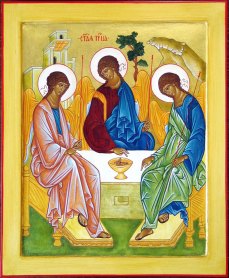
Trinity Icon based upon the original by Andrei Rublev, c. 1408-25

A modern icon based upon Andrei Rublev’s “The Trinity” (also called “The Hospitality of Abraham“) from the fifteenth century.

Consider the interesting episode of Abraham’s three visitors in Genesis 18: “The LORD appeared to Abraham by the oak of Mamre… Looking up, he saw three men standing near him.” Now two of this trio are later called angels (Genesis 19:1) but more precisely these are “messengers,” and the Son and the Holy Spirit do indeed serve the Father this way, revealing God the Father and his will among men. Did Abraham perceive in his guests what Christians suspect in retrospect, that this was a manifestation of the Holy Trinity? Maybe not, yet Abraham could still commune in God’s presence.

I think something that trips people up about Christianity is imagining God the Father as the sole Divine Person in the Old Testament, with the Son and the Holy Spirit only appearing later in the New. However, if the Trinity is true it has always been true, and the three Persons (possessing the same Divine Essence the prophets praised) have been active in the affairs of mankind throughout history. Christians reflect back on the Jewish Scriptures and see the Persons of the Trinity at work together. Our Nicene Creed professes that the Holy Spirit has “spoken through the prophets.” Look at the episodes where a “messenger” speaks in the divine first-person (e.g., Genesis 22:12, Judges 6:16 & 13:21-22) I would say Abraham and the prophets’ experiences of God were Trinitarian even if they did not fully grasp it then. I believe the same is true for all today.

Captain America, St. Thomas More, & the Spirit of Truth

May 14, 2016

In the new blockbuster movie Captain America: Civil War the titular hero is discerning an important decision when he hears this message in a church:

“Compromise where you can. And where you can’t, don’t. Even if everyone is telling you that something wrong is something right, even if the whole world is telling you to move. It is your duty to plant yourself like a tree, look them in the eye and say, no. You move.”

Captain America - No, You MoveAs I watched in the movie theater, that bit about the tree struck me as odd. Trees bend and can be cut down, but pillars of iron or stone mountains don’t budge. I later discovered that these movie lines were adapted from a famous comic book speech Captain America once addressed to Spider-Man:

“When the mob and the press and the whole world tell you to move, your job is to plant yourself like a tree beside the river of truth, and tell the whole world — ‘No, you move.’”

Did you spot the difference? “Plant yourself like a tree beside the river of truth.” That’s not only more beautiful, it’s also an allusion to Old Testament imagery. Psalm 1:3 says:

“[The Just Man] is like a tree planted near streams of water that yields its fruit in due season, whose leaves do not wither, and whatever he does prospers.”

And Jeremiah 17:8 says:

“[Those who trust in the Lord] are like a tree planted beside the waters that stretches out its roots to the stream: It does not fear heat when it comes, its leaves stay green; In the year of drought it shows no distress, but still produces fruit.”

These verses teach that the just man who is rooted in the Law (or the Truth) of God prospers, and that those who trust in the Lord prevail against adversity.

I wish that Hollywood had included the fuller quote in the new Captain America movie—not only because it’s better writing, not only because it echoes Sacred Scripture, but because it better reflects the truth about where Truth comes from. My all-time favorite film disappoints me in a similar way.

A Man for All Seasons - St. Thomas More at TrialA Man for All Season won the 1966 Academy Award for Best Picture, but its depiction of its hero, St. Thomas More, falls short of perfection. In the movie, as in real life, Thomas More suffers unjust imprisonment for refusing to swear an oath recognizing King Henry VIII as the supreme head of the Catholic Church in England. The movie’s screenwriter, the agnostic Robert Bolt, drew on More’s own writings to craft some fantastic dialogues, but Bolt somewhat misrepresents the saint’s true motivations.

In one scene, Thomas More’s friend, the Duke of Norfolk, asks why he won’t just “give in.” Thomas answers, “I will not give in because I oppose it — I do — not my pride, not my spleen, nor any of my appetites, but I do — I!” The real St. Thomas More’s motivations are portrayed more accurately in the scene at his trial. He tells the court:

“The indictment [against me] is grounded in an act of Parliament which is directly repugnant to the law of God, and his Holy Church, the Supreme Government of which no temporal person may by any law presume to take upon [himself.] This was granted by the mouth of our Savior, Christ himself, to Saint Peter and the Bishops of Rome whilst He lived and was personally present here on earth. It is, therefore, insufficient in law to charge any Christian to obey it.”

The real St. Thomas More refused to sign the King’s oath because he saw in it a denial of Christ. He preferred to die rather than lose Heaven; and he did go on to die, thereby gaining Heaven. But Robert Bolt has his Thomas More conclude his courtroom speech like this:

“Nevertheless, it is not for [refusing the King’s] Supremacy that you have sought my blood, but because I would not bend to the [King’s re-marriage]!” (In other words, “No one is going to make me act contrary to my own self-will!”)

The real St. Thomas More was not standing up against the world for individually-chosen truth. (More opposed heretics when he served as King Henry’s High Chancellor.) He knew that Truth and right and wrong are not things we create for ourselves. We receive them, as water from a river. They do not flow from us as their source. The real St. Thomas More was a champion for the Truth which comes from God.

So how can we be faithful to the Truth which comes from God? How can we be planted like trees beside the River of Truth that flows from God? By prayerfully welcoming the Holy Spirit.

At his interrogation before the Roman Governor Pontius Pilate, Jesus says: “Everyone who belongs to the truth listens to my voice.” (In the Holy Trinity, the Father is the Speaker, Jesus is the Word, and the Holy Spirit is the Voice) But Pilate refuses to listen. He retorts to Jesus, “What is truth?” He rejects the Spirit of Truth and walks away.

Later, at his Ascension, Jesus instructs his disciples to remain in Jerusalem until they are clothed with power from on high with the Spirit of Truth who will teach them everything and remind them of all he has told them. Unlike Pilate, the disciples listen to Jesus and obey him. Some 120 persons (including the apostles, the Virgin Mary, some women, and some male relatives of Jesus) gather together and all devote themselves to prayer. They pray for nine days—the Church’s first novena, and on the tenth day, on the Jewish feast of first fruits called Pentecost, the Holy Spirit, the Spirit of Truth, comes and fills them.

St. Peter PreachingOnce the Spirit’s fire touches their heads, the disciples know what to say and they are unafraid to say it. Previously they had been hiding behind locked doors, but now they go out into Jerusalem’s crowded streets praising and preaching Jesus. This new-found wisdom and courage are gifts from the Holy Spirit, who empowers them to begin reaping the Church’s first fruits from the world. Observe well what the disciples do, for we are called to do the same: they listen to Jesus and obey him, they gather together and pray, they receive the Holy Spirit’s inspiration and gifts, and then they go forth to speak and act powerfully in the world.

In the Gospel of John, on the last and greatest day of one of the Jewish feasts, Jesus stands up in the temple area and exclaims, “Let anyone who thirsts come to me and drink. Whoever believes in me, as scripture says: ‘Rivers of living water will flow from within him.’” Here the Gospel writer adds: “He said this in reference to the Spirit that those who came to believe in him were to receive.”

The Holy Spirit is our River of Living Water. As trees planted beside him we will prosper, and by being rooted in him we will prevail against adversity. In Holy Mass let us pray to receive the Spirit wholeheartedly and to be clothed with his power. And then, filled with the Spirit of Truth, even if the whole world tells us to move, we will have the words and courage to stand our ground. By the Holy Spirit, we can be heroes for this world in desperate need of heroes, in the likeness of Captain America, St. Thomas More, and the apostles after Pentecost.

Taking Jesus Too Literally

September 30, 2015

Jesus Facepalm

We do well to closely heed all that our Lord Jesus says, but we must also carefully understand what the Word of God Incarnate is really telling us. Using Scripture to interpret Scripture, let us consider two examples where some modern-day Christians misinterpret Jesus’ teaching by taking him too literally.


“Do not swear at all”

Jesus declares, “You have heard that it was said to your ancestors, ‘Do not take a false oath, but make good to the Lord all that you vow.’ But I say to you, do not swear at all; not by heaven, for it is God’s throne; nor by the earth, for it is his footstool; nor by Jerusalem, for it is the city of the great King. Do not swear by your head, for you cannot make a single hair white or black. Let your ‘Yes’ mean ‘Yes,’ and your ‘No’ mean ‘No.’ Anything more is from the evil one.” (Matthew 5:33-37)

Swearing an oath or vow invokes God as one’s witness to a claim or a promise and invites God’s just punishments if his name is taken in vain. It seems that people in Jesus’ day were trying to steal credibility without fearing divine retribution by swearing by lesser holy things. But Jesus warns that all good things belong to God, and condemns clever manipulations of the truth as coming from the devil. Instead, Jesus says, “do not swear at all,” but “let your ‘Yes’ mean ‘Yes.’”

So do any appropriate times and places remain for swearing oaths or vows in the New Covenant? God reveals that such exist through St. Paul. In Galatians 1:20 and 2nd Corinthians 1:23, God himself inspires St. Paul to swear oaths (for example, “I call upon God as witness, on my life, that it is to spare you that I have not yet gone to Corinth.“) And in Acts 18:18, we read that St. Paul “had taken a vow.” Thus, in rare, righteous, and serious situations a Christian may solemnly swear to things before God.


“Call no one on earth your father”

Jesus tells us, “Call no one on earth your father; you have but one Father in heaven.” (Matthew 23:9) Does this mean that we should not call priests (or our even own dads) “Father?” This is not how the first Christians understood Jesus’ words.

St. Stephen calls the Jewish leaders “fathers” in Acts 7:2, and St. Paul does similarly in Acts 22:1. God prompted St. John to address Christian community elders as “fathers.” (1st John 2:13-14) God also willed St. Paul to write of “our father Isaac” and to call Abraham “the father of us all.” (Romans 9:10, 4:16-17) God inspired St. Paul to regard and describe himself as a father to his spiritual children. (1st Corinthians 4:14-15, 1st Timothy 1:2, Titus 1:4, Philemon 10) Therefore, the true concern of our Lord is not with the label of “father,” but that our greatest devotion and love always be directed toward “our Father who art in Heaven.”

The “Light” of the Holy Spirit

May 21, 2015

        “The Spirit is the source of holiness, a spiritual light, and he offers His own light to every mind to help it in its search for truth. By nature the Spirit is beyond the reach of our mind, but we can know Him by His goodness. The power of the Spirit fills the whole universe, but he gives Himself only to those who are worthy, acting in each according to the measure of his faith.

“I believe in the Holy Spirit, the Lord, the giver of life, who proceeds from the Father and the Son, who with the Father and the Son is adored & glorified, who has spoken through the prophets.”

        Simple in Himself, the Spirit is manifold in His mighty works. The whole of His being is present to each individual; the whole of His being is present everywhere. Though shared in by many, He remains unchanged; His self giving is no loss to Himself. Like the sunshine, which permeates all the atmosphere, spreading over land and sea, and yet is enjoyed by each person as though it were for him alone, so the Spirit pours forth His grace in full measure, sufficient for all, and yet is present as though exclusively to everyone who can receive Him. To all creatures that share in Him he gives a delight limited only by their own nature, not by His ability to give.  …

        As clear, transparent substances become very bright when sunlight falls on them and shine with a new radiance, so also souls in whom the Spirit dwells, and who are enlightened by the Spirit, become spiritual themselves and a source of grace for others. From the Spirit comes foreknowledge of the future, understanding of the mysteries of faith, insight into the hidden meaning of Scripture, and other special gifts. Through the Spirit we become citizens of heaven, we enter into eternal happiness, and abide in God. Through the Spirit we acquire a likeness to God; indeed, we attain what is beyond our most sublime aspirations—we become God.”

— St. Basil the Great (c. 329-379 AD)

Why Did Christ Call the Grace of the Holy Spirit Water?

May 21, 2015

In John’s gospel, Jesus tells the Samaritan woman at the well, “Whoever drinks the water I shall give will never thirst; the water I shall give will become in him a spring of water welling up to eternal life.” Later, Jesus stands up at the Temple and exclaims, “Let anyone who thirsts come to me and drink. Whoever believes in me, as scripture says: ‘Rivers of living water will flow from within him.’” The text explains, “He said this in reference to the Spirit that those who came to believe in him were to receive.” Why did Jesus liken the grace of the Holy Spirit to water? St. Cyril of Jerusalem (313-386 AD) gives this insightful explanation:

“[A]ll things are dependent on water; plants and animals have their origin in water. Water comes down from heaven as rain, and although it is always the same in itself, it produces many different effects, one in the palm tree, another in the vine, and so on throughout the whole of creation. It does not come down, now as one thing, now as another, but while remaining essentially the same, it adapts itself to the needs of every creature that receives it.

Holy Spirit Dove - Sacred Heart Catholic Church -  Wauzeka WIIn the same way the Holy Spirit, whose nature is always the same, simple and indivisible, apportions grace to each man as he wills. Like a dry tree which puts forth shoots when watered, the soul bears the fruit of holiness when repentance has made it worthy of receiving the Holy Spirit.

Although the Spirit never changes, the effects of his action, by the will of God and in the name of Christ, are both many and marvelous. The Spirit makes one man a teacher of divine truth, inspires another to prophesy, gives another the power of casting out devils, enables another to interpret holy Scripture. The Spirit strengthens one man’s self-control, shows another how to help the poor, teaches another to fast and lead a life of asceticism, makes another oblivious to the needs of the body, trains another for martyrdom. His action is different in different people, but the Spirit Himself is always the same. In each person, Scripture says, the Spirit reveals his presence in a particular way for the common good.

The Spirit comes gently and makes Himself known by His fragrance. He is not felt as a burden, for He is light, very light. Rays of light and knowledge stream before Him as He approaches. The Spirit comes with the tenderness of a true friend and protector to save, to heal, to teach, to counsel, to strengthen, to console. The Spirit comes to enlighten the mind first of the one who receives Him, and then, through Him, the minds of others as well.

As light strikes the eyes of a man who comes out of darkness into the sunshine and enables him to see clearly things he could not discern before, so light floods the soul of the man counted worthy of receiving the Holy Spirit and enables him to see things beyond the range of human vision, thing hitherto undreamed of.”

A Holy Spirit Novena

May 14, 2015

All novenas are inspired by the nine days during which Mary, the apostles, and the other disciples prayed in the upper room for the coming of the Spirit with power. To pray a novena to the Holy Spirit preceding this Pentecost yourself, begin this Friday, May 15th. Many Pentecost novenas are available online, but your daily prayer could simply be this:

 “Come Holy Spirit, fill the hearts of your faithful and kindle in them the fire of your love. Send forth your Spirit & they shall be created. And You shall renew the face of the earth.

O, God, who by the light of the Holy Spirit, did instruct the hearts of the faithful, grant that by the same Holy Spirit we may be truly wise and ever enjoy His consolations, Through Christ Our Lord, Amen.”

How God The Father Loves His Son

June 16, 2014

How does the Eternal Father love Jesus Christ his Son?
The Scriptures provide us insights into their relationship.


The Father gives his Son instruction and example

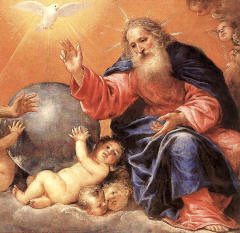
God the Father BlessingAs Jesus once said, “Amen, amen, I say to you, a son cannot do anything on his own, but only what he sees his father doing; for what he does, his son will also do,” adding, “I cannot do anything on my own.” The Father loves his Son and shows him everything that he does. Sometimes believers find it harder to relate to God the Father than Christ the Son. But what is the Father really like? He is just like his Son. Jesus “is the image of the invisible God.” As Jesus said, “Whoever has seen me has seen the Father.”  The Father offers his Son the perfect example, and his Son perfectly follows him.

The Father listens to his Son

Outside the tomb of Lazarus, Jesus said, “Father, I thank you for hearing me. I know that you always hear me…” Jesus shares his own attitude toward prayer when he tells us, “In praying, do not babble like the pagans, who think that they will be heard because of their many words. Do not be like them. Your Father knows what you need before you ask him. This is how you are to pray: Our Father…” Jesus knows that wordy, poetic prayers are not necessary because his Father is always listening.

The Father encourages his Son

At Jesus’ baptism in the Jordan River, the Father declared from heaven, “You are my beloved Son, in whom I am well pleased.” And on the summit of Mt. Tabor, at Jesus’ Transfiguration, the Father spoke from the cloud, “This is my beloved Son, listen to him.” The Father encourages his Son with reminders of his love.

The Father provides for his Son

Jesus said, “Everything that the Father has is mine.” Jesus’ Father is like the father in the parable of the Prodigal Son who told his first-born, “My son, you are here with me always; everything I have is yours.” Confident in his Father’s providence, Jesus tells us to be likewise unafraid concerning our basic needs, what we are to eat and drink, or what we are to wear: “Seek first the kingdom of God and his righteousness, and all these things will be given you besides.” The Father also provides his Son with gifts greater than material things. At the Last Supper, Jesus said of disciples, “Father, they are your gift to me.”

The Father welcomes closeness with his Son

It was a big deal when Jesus prayed, “Abba, Father.” As St. John Paul the Great observed, “An Israelite would not have used [“Abba” to address God] even in prayer. Only one who regarded himself as Son of God in the proper sense of the word could have spoken thus of him and to him as Father–Abba, or my Father, Daddy, Papa!” Because the Father welcomes intimate closeness with his Son, Jesus can say, “I and the Father are one.”

The Father loves his Son’s mother

At the Visitation, filled with the Holy Spirit, Elizabeth declared to Mary, “Most blessed are you among women,” and Mary rejoiced, “From this day all generations will call me blessed. The Almighty has done great things for me, and holy is his name.” By pouring his love and blessings into Mary, God the Father gave his Son a loving mother full of grace.

The Father fosters growth in his Son and sends him on mission

The Letter to the Hebrews says, “Son though he was, [Jesus] learned obedience from what he suffered; and when he was made perfect, he became the source of eternal salvation for all who obey him, declared by God high priest according to the order of Melchizedek.” But this raises a question: how can the divine Son grow in any way? Though perfect in heaven, the Son of God had no firsthand experience of weakness, suffering, or the trials of obedience, until his Incarnation. Through these things he was made complete so that he could be the savior of humanity. The Father prepares his Son and sends him on a mission to transform the world. “God did not send his Son into the world to condemn the world, but that the world might be saved through him.”

The Father as our model for Fatherhood

Whether we are biological or spiritual fathers, Jesus’ heavenly Father gives men a model for our fatherhood. We are to give our children instruction and good example. We should listen to them and encourage them, letting them know that they are well-beloved. We should provide for our children, according to our abilities, supplying their basic needs without neglecting the greater gifts. We are to welcome closeness with our children. We are to love our children by loving their mother, whether she be our spouse or the Church. We are to foster maturity and virtue in them so that they may go forth in mission to transform the world.  Which aspect of your fatherhood are you resolved to grow in with God the Father?

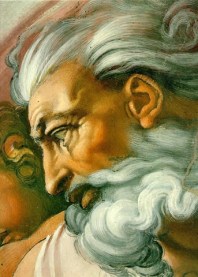
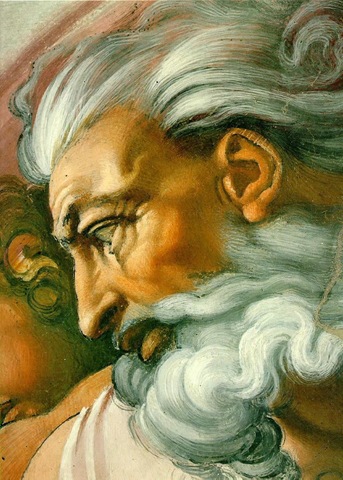
God the Father in the Creation of Man by Michelangelo, Sistine Chapel Ceiling, Vatican.Our Perfect Father

Some of us have had very good fathers, while some of our fathers were very far from perfect. But regardless of the quality of our earthly fathers, we all have a heavenly Father who loves us perfectly. As Jesus tells us, “the Father himself loves you, because you have loved me…” Our Father instructs us and shows us his example through his Word. He always listens, and we should not be surprised when he encourages us, speaking to us, in prayer. Our Father provides for our material needs and gives us the greater gifts. “For everyone who asks, receives…” Our Father welcomes intimacy with us, giving his children the spirit of his Son so that we too may cry, “Abba, Father!”  And he gives us Mary, the same perfectly loving mother he provided for his Son. Our Father would grow and mature us into greatness, into saints, into the likeness of his Son, and send us on mission for the transformation of the world.