Archive for the ‘Homily’ Category

Longing to go Home — Funeral Homily for Donetta Bowe, 90

September 27, 2021

You may or may not have known it, but Donetta wrote poetry. She wrote these words during her retirement:

“I want to go home
  Not to the house in town
  But back to the farm.”

In the following lines she went on to fondly recall the farm’s many sights and sounds, the cardinals and chickadees, the wild turkeys and pheasants, “the humming birds by the flowers,” the deer crossing through the fields, and the barn cats she left behind.

“But it’s not the same anymore,” she wrote,
“I need to find another way
  To satisfy those feelings now.”

In her later years, Donetta felt the fading of her flesh, and lamented at not being able to do all that she could do before.

“Only in my spirit,” she wrote,
“Only in my spirit
  can I run up a green grassy hill.
Only in my spirit
  can I skip along a shady park path.
Only in my spirit
  can I still run up the stairs.”

Over time, our lives accumulate losses. We painfully lose people and places and bodily powers. If this were only natural, why doesn’t it sit more naturally with us? Why do we desire the infinite? Where is the fulfillment of our insatiable longings to be found?

As Martha mourned the death of her brother Lazarus, Jesus assured her this was not her loved one’s end. She replied to him, “I know he will rise, in the resurrection on the last day.” Jesus told her, “Whoever believes in me, even if he dies, will live… Do you believe this?” She answered him, “Yes, Lord,” and Martha saw his words proven true sooner that she had expected.

Therefore,” as St. Paul told the Christians of Corinth, Greece, “we are not discouraged… Although our outer self is wasting away, our inner self is being renewed day by day… This momentary light affliction is producing for us an eternal weight of glory… We look not to what is seen but to what is unseen; for what is seen is passing, but what is unseen is eternal.

Despite looking back, Donetta looked ahead, to the ultimate fulfillment of her longings through our Lord, Jesus Christ. Here are the words of a final Donetta poem, as it appears on her funeral card:

“My time has come for me to go
  and say goodbye to the ones I know.
My body is tired my mind is weak
  it’s difficult for me to speak.
And now I’m waiting by the gate
  so as I go don’t be sad
  for I am grateful for all I had.
Embrace the day and smile for me
  for I am going where I want to go.”

Cutting Off the Near Occasions

September 25, 2021

26th Sunday in Ordinary Time

Jesus says if your hand causes you to sin, cut it off. If your foot causes you to sin, cut if off. If your eye causes you to sin, pluck it out. It is better for you to enter into eternal life maimed, or crippled, or half-blinded, than with two hands, two feet, and two eyes to be thrown into Gehenna (into hell) forever. There are two mistakes one can make with this gospel teaching. The first mistake is less grave than the other.

This first mistake would be imagining that one’s hand, foot, or eye were the source of your sins. If that were what Jesus meant, how could he think that plucking out just one eye, would be an effective solution? Pretty much any sin you can do with two eyes can be done just as easily with one. No, the Church does not encourage elective amputations because that’s not what Jesus is saying here. Jesus is using hyperbole, over-the-top rhetoric, to vividly drive home an important point.

As much as you enjoy your hand, your foot, or your eye, you can live without them. So if any of these were leading you to your death, you would be a fool not to part ways with it. How much more so is this true for the lesser things people enjoy which lead to spiritual death?

Human beings, for better or worse, are creatures of habit. The sins we commit and the virtues we practice tend to be habitual. So think: is there a person, setting, or thing that often leads you to sin? Whom do you sin with? Where and when do you sin? What object, substance, or technology do you sin with often? Jesus knows that you know your pattern of weakness and sin, or that you could easily recognize your pattern with a little self-reflection, and he wants you to take this issue seriously. For the love of God who loves you, for the good of your own soul and the souls of others, curtail in your life the near occasions of sin or, even better, cut them out entirely. Make a firm resolution, make a conscious renunciation, make a good confession, and begin better living the life Jesus wills for you.

Now here is the second, graver mistake people make with Jesus’ teaching. Since Jesus uses hyperbolic imagery about chopping off body parts some think that he isn’t being serious about the dangers of hell. Yes, Jesus uses symbolic imagery to describe it, but hell is very real.

Gehenna, for instance, was a valley southwest of Jerusalem, just outside the walls of God’s holy city. It had once been the site of pagan temples where children were offered as holocausts to idols of Baal and Moloch. The Jews went on to use that shameful place as a smoldering garbage dump, with rotten, worm-infested refuse and continuously burning trash. Will there be literal fire in hell? Maybe not. We would not say hell must have “undying worms” for Jesus’ teachings to be true. But fire does speak to great agony and worms to corruption.

In Jesus’ parable of the royal wedding guests, the king finds a man unfit for his feast. The king says to his servants, “Bind his hands and feet, and cast him into the darkness outside, where there will be wailing and grinding of teeth.” Wailing accompanies despair and the grinding of teeth, violent anger. As light is to vision and wisdom, the outer darkness is to blindness and error – error which is not innocent ignorance but falsehood blamefully embraced.

In that parable, the condemned one is utterly bound, hand and foot, and thrown out. Yet in Jesus’ parable of the sheep and the goats, the condemned go off on their own. Christ tells us that when he returns as king he will sit upon his glorious throne and turn to the unrighteous goats on his left and say, “Depart from me, you accursed…” And these, he tells us, “will go off to eternal punishment.” Hell is their sentence, but hell is also what they have freely chosen.

Grave sin, freely and knowingly chosen, is a rejection of the Kingdom of God. Mortal sin rejects Christ’s Way; it rejects the life of heaven. This decision to stray is ours, but the decision to respond to God’s grace and return is ours as well.

People today assume almost everybody is going to heaven, but the early Church Fathers were far less optimistic. Whether the number who will be saved in the end is a majority or a minority of the human race, I want all of you to make it. So please take Christ’s words to you seriously. Repent of your sins and change your ways. This is Jesus’ loving will for you.

Geraldine, Genghis, & John — Funeral Homily for Geraldine Halfman, 82

September 24, 2021

I would like to reflect with you today upon three people who have passed away. You have heard of all three, but you have only met one of them. Their names are Geraldine, Genghis, and John.

John lived a century ago. He made his fortune in American oil. Adjusting for inflation, he is considered the richest person in modern history and the wealthiest American of all time. He died at age 97, taking none of his money with him to the grave, leaving all his wealth behind.

Genghis lived eight centuries ago. He led conquering armies on horseback throughout Central Asia and reigned over one of the largest empires in history. He fathered so many children in his lifetime that an estimated 8% of all people living in that region of the world today are direct descendants of his. After many years of killing others, Genghis died himself, lost his throne, and left behind his empire to others.

Geraldine (or Gerry) was born in 1939. She conquered no lands. She never accumulated vast riches. She raised no biological children of her own. Her life’s most significant work may have been caring for her eldest sister. Gerry’s sister, Mary, became sick as a teenager from M.S. (multiple sclerosis) and needed ongoing care until her death at the age 70. Gerry spent decades living with and helping Mary; bathing her, dressing her, feeding her, and giving her worthwhile activities to engage with and enjoy. The world would encourage Geraldine to go off and live her own life but Gerry loved her sister as herself, as Jesus Christ and her Catholic Faith taught her to do. Geraldine died on her eighty-second birthday.

Geraldine, Genghis, and John are three very different people, who lived very different lives, but they share these things in common: all three lived, all three died, the souls of all three will have been judged, and all three of them will rise again. “For we shall all stand before the judgment seat of God,” and “each of us shall give an accounting of himself to God,” and all the dead shall rise again on the Last Day.

What will be important at our Last Judgment? What will matter on the Last Day? Jesus tells us:

“Blessed are the poor in spirit,
for theirs is the Kingdom of heaven.
Blessed are the meek,
for they will inherit the land.
Blessed are the merciful,
for they will be shown mercy.
Blessed are the clean of heart,
for they will see God.
Blessed are the peacemakers,
for they will be called children of God.”

Remember that Jesus Christ is the measure of what matters. And in the end, every knee shall bend before him, either in resentful submission, as with the condemned, or in faithful love, as his holy ones.

Pray for Geraldine’s soul. Like gold in a furnace, she might still require the healing fire of God to purify her sin-wounded person into perfect flawlessness, so that God may take her to the fully-unveiled presence of his all-holy self. But do not fear for her, for in the words of the Book of Wisdom: “Those who trust in him shall understand truth, [including the truth about what is most important,] and the faithful shall abide with him in love. Grace and mercy are with his holy ones, and his care is with his elect.”

Does Jesus Have an Arc?

September 19, 2021

25th Sunday in Ordinary Time

Katniss Everdeen (Jennifer Lawrence) in The Hunger Games (2014)

When I was growing up, my dad read a lot of science fiction novels and he once made an observation that I’ve remembered ever since. He noted how science fiction stories always feature some futuristic thing (like cloning, time-machines, or space travel) but if a sci-fi story only talked about the technology, it would be boring. “Every good story,” he said, “is a story about people.” It’s true. All great stories, be they found in literature, television, or film, are stories about people – interesting characters living through events.

What do Katniss Everdeen, Sir Thomas More, and Paddington Bear have in common? They are all film characters with the same kind of character arc. A character arc refers to the inner journey of a character throughout the course of a story. A character may go here or there, and do this or that, but their character arc is their transformation as a person. There are three main types of character arc: Positive, Negative, and Flat.

Positive arc characters change for the better. They originally believe lies about themselves and the world, things like “I’ll never find true love,” or “I can’t be a warrior.” But by the end, they’ve found the truth, embraced it, and triumphed. Most of the stories you’ve seen or heard are stories like this. Negative arc characters, on the other hand, change for the worse. They come to accept lies and wickedness. Villains’ origin stories are like this. Michael Corleone from The Godfather or Walter White in Breaking Bad are famous examples of characters with negative arcs. Katniss Everdeen, Thomas More, and Paddington, however, are characters of a third type; characters who do not change.

Flat arc characters possess the truth and live it out from the start of their stories to the end. These characters also experience struggles like the others, but rather than being transformed themselves they transform the people and world around them. In The Hunger Games, Katniss Everdeen, from beginning to end, knows that the tyrannical government is evil and is willing to sacrifice herself for others (as for her little sister, Prim). In A Man for All Seasons, 1966’s Best Picture winning film about a real-life Catholic saint, Sir Thomas More is a man of virtue who endures persecution for refusing to swear a false oath against his conscience and God’s law. And throughout the Paddington movies, young Paddington remains consistently earnest, honest, polite, and friendly while enhancing the lives of the people he meets.

When we consider the Gospels and the Book of Acts as stories (indeed, true stories and the greatest ever told) what kind of arcs do we find? What kind of arc does Jesus Christ have, and what sort of characters are his apostles? Though Jesus is born as a baby and grows into adulthood, though he ministers and is put to death as a suffering servant and returns as triumphant Lord, Christ’s inner self remains the same. The Person of Jesus Christ is divine, the eternal Son of God, a flat arc character who remains the same “yesterday, today, and forever.” He knows the wickedness of the world and sacrifices himself for others. He only speaks the truth and makes no compromise with evil, despite its persecutions. And his love converts the hearts of others, healing and saving the world around him. Jesus is the model, the pattern, the archetype, of every true hero.

What is the character arc of his apostles? The Gospels do not hide their flaws. We catch them arguing among themselves about who is the greatest. They still believe the world’s lies about who and what’s important, which produces the disorders St. James describes: jealousy, envy, and selfish ambition, greed, fighting, and slavery to passions, with every foul practice. But by the Book of Acts, the apostles’ positive arc has led each of them (except Judas Iscariot) to see that the greatest of all is not the ruler over peoples but the one who cares for even little ones. Jesus’ apostles have become new men, loving servants of all in the likeness of their Lord.

We human beings love stories. That’s part of why Jesus so often taught in parables. But why do we love stories so much? And why do we root for the underdogs, such as Rocky Balboa, Forrest Gump, or Joan of Arc? We love them because we are in a story ourselves, God’s great underdog story, in which you and I are characters. Our lives are important subplots to Christ’s overarching saga. We are co-authoring with Jesus our own character arcs within it.

Will you rise higher and higher in a positive arc, finding the truth in Christ’s Church, embracing the truth and living it out? Will you eventually become like Jesus and his greatest saints, who hold to the truth in a flat arc, blessing and transforming all around them? Or, following lies into darkness, will a negative arc lead you to final tragedy and disaster? If you are on this downward path, realize that a vast audience in heaven looks on, longing for a plot-twist which you can accomplish with Christ. But do not delay, for you do not know how many more pages of the book or minutes in the movie remain before your life’s eternal epilogue. This Sunday’s gospel antiphon acclaims: “God has called us through the Gospel to possess the glory of our Lord Jesus Christ.” Let us whole-heartedly play our part in Jesus Christ’s heroic saga, that we may also share in his story’s glorious happy ending.

Following the Shepherd

September 12, 2021

24th Sunday in Ordinary Time

[Homily Part 1 at both parishes]

Jesus asked his disciples, “Who do you say that I am?” Simon Peter replied, “You are the Christ.” That was a correct and inspired answer. Jesus then began to openly teach his disciples that he, as the Christ, must greatly suffer, be rejected by the Jewish religious leaders, be murdered, and rise after three days. Peter then took Jesus aside and began to correct him. St. Matthew reports that Peter said, “God forbid, Lord! No such thing shall ever happen to you!” At this, Jesus turned and, looking at his disciples, rebuked Peter in return, saying, “Get behind me, Satan. You are thinking not as God does, but as human beings do.” Jesus calls St. Peter, his apostle, his Church’s first pope—“Satan.” What are we to make of this?

Satan” is the title given to the highest angel who rebelled against God at the beginning of Creation. The Book of Revelation recalls how “the serpent of old who is called the devil and Satan, who deceives the whole world … was thrown down to the earth, and his angels were thrown down with him.” Jesus talks about this Evil One: “I saw Satan fall like lightning from heaven. … He was a murderer from the beginning and does not stand in truth, because there is no truth in him. …He is a liar and the father of lies.” Both Jesus Christ and his Church today definitely believe in the Devil and that he prowls about the world opposing God and our good. But Jesus does not accuse Peter of being that fallen angel.

The Hebrew word “satan” means “adversary.” Jesus calls Peter his adversary at that moment because he is opposing God’s plan and being an obstacle in Jesus’ path. Like the Devil during the Temptations in the Desert, Peter is suggesting that Jesus be a Messiah who never suffers, a rich, powerful, comfortable Christ who imposes his will over peoples in the same mold as earthly kings. This is what Peter and Judas and the Jews in those days expected. But Jesus knew that the Christ must greatly suffer if the Kingdom of God would save human souls.

During the forty days in the desert, Jesus rebuked the Devil, “Get away, Satan!” And at the Last Judgment, Christ the King upon his throne will tell the unrighteous goats on his left, “Depart from me, you accursed, into the eternal fire prepared for the devil and his angels.” But notice Jesus does not say to Peter “get away” or “depart from me.” Jesus tells him, “get behind me.” Peter is not yet thinking as God does but the Lord Jesus does not desire to cast Peter off forever, if that fate can be avoided. If Peter would humbly follow Jesus, the Lord would show him the Way. Jesus saying “get behind me” was not a personal rejection of Peter, but asking him to follow his Good Shepherd from a new perspective to the Promised Land of heaven.

[Homily Part 2 at St. Paul’s]

Peter thought he had a great plan for Jesus and himself, but Jesus had a different plan, a more challenging plan, but a better plan for them both.

There is godly prudence in our forming of plans and working hard to achieve them. Like in Aesop’s fable about the ant and the grasshopper, the Book of Proverbs urges the lazy to work and prepare for tomorrow: “Go to the ant, O sluggard; consider her ways, and be wise. Without having any chief, officer, or ruler, she prepares her bread in summer and gathers her food in harvest.” St. Paul believed in Divine Providence, but also taught the Thessalonians: “When we were with you, we instructed you that if anyone was unwilling to work, neither should that one eat.” And Jesus said, “Suppose one of you wants to build a tower. Won’t you first sit down and estimate the cost to see if you have enough money to complete it?” Jesus then encourages his hearers to be just as prudently intentional and totally invested in being his disciple. It is good for us to make plans and work hard toward worthy goals. But we should also keep in mind that all of our earthly plans are uncertain.

We simply do not know what our remaining time on this earth will be like. St. James writes in his New Testament Letter: “Come now, you who say, ‘Today or tomorrow we shall go into such and such a town, spend a year there doing business, and make a profit’ — you have no idea what your life will be like tomorrow. You are a puff of smoke that appears briefly and then disappears. Instead you should say, ‘If the Lord wills it, we shall live to do this or that.’” As another verse from the Book of Proverbs says: “Many are the plans in a person’s heart, but it is the Lord’s purpose that prevails.

In this land of the living, we do not know our earthly futures and we cannot control everything to make our futures entirely as we’d like. But then again, who’s to say that knowing our future perfectly would be good for us? Who’s to say that having the power to craft a future exactly to our liking, would be best for us? We very well may not know what is best for us and what is best for us may not be something we would readily choose. We do not always think as God does, but as human beings do.

Young Simon Peter could not imagine that the Christ would be killed, but this was how Jesus would save the world. Young Peter used to dress himself and go where he wanted; but when he grew old, he stretched out his hands and someone else dressed him and led him where he did not want to go. Jesus had foretold this to Peter, signifying by what kind of death he would glorify God in the divine plan: crucified in the likeness of his friend and Lord and God, and sharing (more than most) in his glory. Our personalized path to sainthood may not be the one we’d expect or choose for ourselves.

We ought to plan and work hard towards worthy goals, even though this broken world and the sins of men and demons make all of our plans uncertain. Our human sight and wisdom are limited. We do not always see, or have the courage to pursue, what is best for us. But we do know, as St. Paul taught the Romans, “that God works all things for the good of those who love him, who have been called according to his purpose.” Jesus tells us, “Whoever wishes to come after me must deny himself, take up his cross, and follow me. For whoever wishes to save his life will lose it, but whoever loses his life for my sake and that of the gospel will save it.” With this firm confidence, let us get behind Jesus Christ and follow him who leads our lives to salvation even through the Cross.

[Homily Part 2 at St. John the Baptist’s]
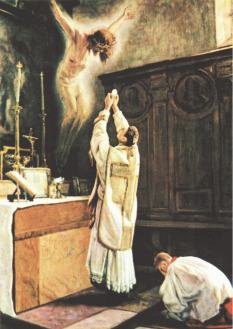
This is where your homily this morning diverges from what I’m preaching at St. Paul’s this weekend because I have been meaning to talk to you about ad Orientem Masses. Since the Second Vatican Council, the most common way priests have celebrated Mass is versus populum, or “towards the people.” Yet the much longer-practiced custom has been for the priest and the people to face literally or symbolically towards the East together, or “ad Orientem.” Like Muslims today who pray towards Mecca, the custom of the Jews was to pray towards the Temple in their holy city of Jerusalem. The writings of the Church Fathers show that the early Christians prayed towards the east.

In the second century, St. Clement of Alexandria wrote “prayers are made looking towards the sunrise in the east.” And in the third century, Origen noted: “…Of all the quarters of the heavens, the east is the only direction we turn to when we pour out prayer…” Tertullian records that Christians facing east to pray caused some non-Christians to mistakenly believe we worshiped the sun. But the Christians praying towards the sunrise saw a symbol of Christ rising from the dead and of his promised return to earth in radiant glory one day. Throughout the centuries, even in churches which were not built to face east, the priest and the people faced the same direction (or “liturgical east”) together. However, since the 1970’s the prevailing custom has been for the priest to face towards the congregation.

Now I am not saying that one way of celebrating English Masses is good and the other way is terrible. The Catholic Church approves both versus populum and ad Orientem as valid, legitimate options. But these two ways of celebrating the Mass emphasize different things. Celebrating versus populum, toward the people, emphasizes the horizontal aspect, the communal meal. And the Holy Mass is indeed a meal, a memorial of the Last Supper; where Jesus Christ and his disciples gather at his table. Celebrating ad Orientem, toward the East, emphasizes the vertical aspect, the sacrificial offering. And the Holy Mass is indeed a sacrifice, a memorial of the Cross; where Jesus Christ is offered up for us from his altar.

I experienced my first ad Orientem Mass back when I was still in seminary. The celebrant was a priest of our diocese, a graduate from our seminary returning to visit us, Fr. Derek Sakowski. I remember fearing that I would hate the Mass being said that way because I often dislike change. (For instance, our seminary once changed the toaster in the dining hall and, even though I almost never used that old toaster, I was annoyed when they had replaced it with another because the old one was pleasantly familiar.) Fr. Sakowski said the same English prayers as at other Masses, but seeing him celebrating that Mass ad Orientem, facing us when speaking to us and facing God when praying to God, I found it surprisingly beautiful and it made a lot of sense. Here at St. John the Baptist Church, I’ve celebrated our Monday, Thursday, and First Friday Masses ad Orientem since 2019, and attendees have reported positive experiences similar to mine. I’d like to give you the opportunity to experience this, too.

Around fifty years ago, when versus populum (Mass facing the people) became the prevailing custom in the Church, pastors often introduced the liturgical change abruptly and without adequate explanation. It was jarring, many lay people were bewildered and hurt, and public Masses celebrated ad Orientem were very rarely offered. I do not wish to repeat those mistakes going in the opposite direction.

Having consulted with our Parish Pastoral Council (who encouraged me to proceed with this plan) I’d like to alternate celebrating Masses ad Orientem and versus populum over four upcoming weekends. This means that if you consistently attend the same Mass time over those four weeks, you’ll experience the English Mass offered ad Orientem twice. Come with an open mind. After that, I’ll survey your feedback. Which approach do you find more fruitful? Which weekend Mass would you like to see celebrated ad Orientem on a regular basis: Saturday night, Sunday morning, neither, or both? I’ll want to hear what would help you worship best, and then we’ll go from there. For now, let us turn to Jesus Christ who invites us this morning, like St. Peter before us, to share in his holy meal and his perfect sacrifice.

Ephphatha! Be Opened!

September 5, 2021

23rd Sunday in Ordinary Time

What message does the Holy Spirit want you to hear through this homily? In what way does Jesus want you to be opened?

In today’s gospel, people bring to Jesus a deaf man with a speech impediment. They had heard Jesus’ teachings and reports of his miracles. Maybe they had seen and experienced his healing power themselves, so they bring this man to Jesus and beg the Lord to lay his hand and heal him. See how they lead someone they care about to meet Jesus and intercede before the Lord on his behalf. You and I are called to bring people to Jesus, too, and pray to God for their salvation. This gospel story shows that miracles can happen when we do.

Jesus takes this deaf man off by himself, away from the crowd. Like St. Zachariah, the father of St. John the Baptist, whose neighbors and relatives had resorted to making gestures to ask him the name of his newborn son, the deaf man’s speech problem is related (at least in part) to his inability to hear. Jesus wills to restore both the man’s hearing and speech, and see how our Lord does it: he puts his finger into the man’s ears and, spitting, touches the man’s tongue. Notice that Jesus does not heal this man through a word alone but through a physical encounter with himself. Likewise, Jesus encounters us today not only through his Scriptures and his Spirit, but through his Body and his Sacraments. The visible Church of Christ on earth and this material world have key parts to play in our salvation. And notice that this deaf man is delivered not merely through action alone, but also through prayer.

Jesus looks up to his Father God in heaven and groans, and says to the man, “Be opened!” (which is, “Ephphatha” in the Aramaic tongue). Behold the intensity of Jesus’ desire for this man’s good, the yearning in our Lord’s prayer. St. Paul writes in his Letter to the Romans that the Holy Spirit intercedes within us to help us intensely will what God wills, aiding our prayer with what Paul calls “inexpressible groanings.” St. Augustine preaches that the task of prayer “is generally accomplished more through sighs than words, more through weeping than speech.” So remember that you do not need many eloquent words in order to powerfully pray. A heartfelt groan can obtain a miracle.

Jesus says to the man, “Be opened!” and immediately the man’s ears are opened, the man’s mouth opens too, and he begins speaking plainly. The Holy Spirit inspired this story’s inclusion within St. Mark’s Gospel, and Christ’s Church recalls this episode in her Masses all around the world today. This is because Jesus’ healing of that deaf man has relevance for us all. This is reflected at sacrament of baptism. There is a custom of the priest or deacon touching the baby’s ears and lips with his thumb and praying: “May the Lord Jesus, who made the deaf to hear and the mute to speak, grant that you may soon receive his word with your ears and profess the faith with your lips, to the glory of God the Father. Amen.” This tradition is called the Ephphatha Rite. The story of Jesus curing that deaf man is meant to make us consider: how is the Lord wishing me, commanding me, to be opened?

Today’s first reading from the Prophet Isaiah proclaims that our God comes to save us, to clear the ears of the deaf and cause the tongues of the mute to sing. But this reading begins by saying “to those whose hearts are frightened: Be strong, fear not!” Do not be afraid of what our Lord wishes for you. Be strong and fulfill his command. Ephphatha! Be opened! But in what way does Jesus want you to be opened? Would he open your ears to somehow listen, or open your mouth to somehow speak, or open your heart to feel somehow, or open your mind to somehow think anew? The Holy Spirit can tell you.

Perhaps, like St. James talks about in today’s second reading, you are called to be more open to respecting and caring for the poor. Or perhaps there’s a person in your life whom you’ve been overlooking, neglecting someone you are called to be more open to. Maybe Jesus would take you off by yourself, away from the crowd, to be open to more daily prayer, or calling to follow him more closely in your vocation.

After curing the deaf man, Jesus ordered that the miracle be kept secret (for the time was not ripe for it to be shared). Yet the more he commanded this, the more they proclaimed it. Now we are commanded to share the Good News with others, and yet we are often silent. Perhaps Jesus wants you to be open to speaking with other people about your Faith. Maybe invite a non-Catholic person you’re close to to attend RCIA, which begins at St. Paul’s on September 16th.

I do not know in what particular way God desires you to be opened. But I believe that Jesus Christ, who “has done all things well,” who succeeded in making even the ears of a deaf man hear him, can surely tell you his will through the Spirit.

A Labor of Love — Funeral Homily for Alice Karr, 91

August 31, 2021

No funeral homily can present the complete fullness of a Christian’s life. At best, I think a funeral homily can focus on aspects of a person’s life, and through this, help reveal the beautiful, saving mysteries of God. In the brief, less than 200-word obituary which Alice wrote for herself, she noted that she taught and was the principal of schools in Gary, Indiana; Milwaukee, Marshfield, and Eau Claire, Wisconsin; and in Littleton and Denver, Colorado. Today, I would like to reflect upon these years of Alice as an educator/administrator.

In 1984, she became principal of Good Shepherd Catholic School in Denver, Colorado. The school’s prospects at the time were very bleak, having a registered enrollment of just 34 students. But “during her first two years on the job, [she] put herself on a 78-hour week, organized a recruitment program, showed maintenance men how to clean bathrooms and mop floors, opened the first middle school in the Archdiocese, organized many elective classes, and involved parents in maintenance.” Her pastor at the time praised her “exceptional leadership and organizational abilities” and observed how her “relationship with faculty, students, and parents has been unusually successful; and all are supportive of her administration.” By her third year on the job, the total student enrollment was 280 and still growing. As one parent recalled, Alice “made a personal commitment to each child by providing the best possible educational environment … I remember the dire warnings we all received about the lack of future our school faced. Without [her] loving, dedicated, and wise guidance—not to mention the 12-hour days she puts in—we would be without our school. She is truly a remarkable person.” This story of Alice’s faithful fruitfulness was featured in a 1987 article of Today’s Catholic Teacher Magazine when they named her their November “principal of the month.”

This was not this first time Alice had made the press. She was also profiled in the summer of 1970, within the pages of The School Sisters of Notre Dame Magazine, in a piece entitled “Educator for the Special Child.” It describes her work at the Lorenz Institute, a private, non-sectarian, residential treatment center in Eau Claire for emotionally-disturbed children. When Alice accepted the invitation to become the principal at a facility such as this, the article recalls “she knew what she could expect—anything, at any time.” The author notes how “hours of duress, frustration, and Excedrin strain [would take] their toll” on Alice and her teaching staff, but Alice would buoy them with her seemingly constant smile, ready humor, and practical wisdom. One man interviewed said he saw Alice’s work with the staff as even more valuable than that with the children. She was a dynamo of productive energy back in those days, too. The staff affectionately dubbed her “the black and white tornado.” Why did Alice labor so incessantly? 12-hour days, six-and-a-half days a week, quite possibly until she had eventually burnt herself out. Why did she so dedicate herself to her work like this? The answer, the reason, is love.

At The Lorenz Institute, the magazine author records, the staff didn’t know what to make of Alice at first, but “evidence of [her] concern for the boys and girls unfolded day by day.” For example, “An upset boy expecting a scolding was taken off guard by the firm hand [she] laid on his shoulder, by the penetrating gaze of her steady eyes, and—once the lad’s defenses were lowered—a teasing word and/or serious directive reached its mark.” The article includes a photo of one corner of her office at that facility. The caption describes “a unique conference setting: a plain folding chair for her, a brightly decorated milk-can stool for the child. This arrangement puts the child higher than the adult, and, immeasurably, the child grows.” Alice believed love to be the very best behavior modifier. “It is not enough to teach children how to read and write,” she said, “we must show them how to live with each other.” Alice believed we must teach others to love through loving them, by loving them like God loves us.

Jesus has a great love for children. Once, calling a child over and putting his arms around it, he said, “Whoever humbles himself like this child is the greatest in the Kingdom of Heaven.” “Whoever receives one child such as this in my name receives me.” “See that you do not despise one of these little ones, for I say to you that their angels in heaven always look upon the face of my heavenly Father.” “It is not the will of your heavenly Father that one of these little ones be lost.” When children in the Gospels knew Jesus’ love towards them they were being shown God the Father’s love as well. And when children experienced Alice’s love for them they were being shown a partial reflection of God’s love for them.

Let the children come to me, and do not prevent them,” Jesus says, “for the Kingdom of Heaven belongs to such as these.” “Unless you turn and become like children, you will not enter the Kingdom of Heaven.” Brothers and sisters in Christ, realize that we are God’s children now. The Father has adopted us as his own sons and daughters because he loves us. Today we pray for Alice’s soul, as is right and just, for who among us is perfect? But if you have ever witnessed Alice’s love for you, then realize that you have seen a small reflection of God’s love for you.

Many Good Gifts

August 28, 2021

22nd Sunday in Ordinary Time

Dear brothers and sisters, as St. James tells us in our second reading: “All good giving and every perfect gift is from above, coming down from the Father of lights.” We at St. Paul’s and St. John the Baptist’s Parishes have lately been blessed with many good gifts. Our churches are open for the celebration of the sacraments and parishioners are returning to Mass. We have COVID vaccines which appear to be very effective in preventing hospitalizations and deaths among the vaccinated, and are helping get lives back to normal.

Our local RCIA classes, for any adults interested in getting baptized, for any Christians interested in becoming Catholic, and for any Catholic adults who desire the Sacrament of Confirmation, will begin at St. Paul’s on September 16th with the largest class we’ve had in years. And for our children, Bloomer’s Catholic school will be open for classes, returning to safe, in-person instruction this week with over one hundred students enrolled. St. Paul’s School had multiples gaps to fill in our faculty and staff this year, but God’s Providence provided us with great new hires, a mixture of new and familiar faces.

St. John the Baptist’s church interior renovation project is complete. And the widespread consensus is that it turned out absolutely beautifully. If you haven’t already, check it out in two weeks, during St. John’s Fall Festival on Sunday, September 12th. And today, St. John the Baptist Parish is completely free of long-term debt.

St. Paul’s Parish has wonderful news regarding its finances as well. St. Paul’s has been paying down a long-term debt which at times over the past ten years has exceeded $160,000. Parishioners’ generous giving towards the school roof and parish debt fundraising campaign (which ends at the end of August), plus a $100,000 gift from the estate of Sylvan Prill and a very recent $25,000 gift from the estate of Alta Beranek, will allow St. Paul’s to pay off all of our long-term debts next month. (Alta also graciously left a $25,000 gift to St. John the Baptist Parish.) Please consider remembering your parish in your will as well.

Both parishes being debt-free is a excellent thing, but please, please do not give up on or reduce your tithing. St. Paul’s, in years past, has come out of and back into debt before. If people stop giving, new debt will surely follow. Your generosity carried us successfully through the pandemic lockdown, and by the end of September both St. Paul’s and St. John’s will be completely debt free. That is something to celebrate and a hopeful sign for the future.

The faithfulness of the Thrift Sale’s many volunteers and customers is generating one of its best years ever, and St. Paul’s September 26th Fall Festival is just around the corner. Both parishes’ Finance Councils have happily adopted balanced budgets for the current fiscal year; but the outcome of these budgets, of course, depends upon your continued giving.

We are more blessed than we realize. Recent, terrible news from abroad reminds us that not all places on earth have the peace and freedom we enjoy. We all have much to be thankful for. “All good giving and every perfect gift is from above, coming down from the Father of lights.” So, echoing the words of the opening prayer of today’s Mass, with a deepening sense of reverence and love in our hearts for God’s name, let us give thanks to our God of might, the giver of every good gift.

Mary & the Holy Eucharist

August 14, 2021

Solemnity of the Assumption
(20th Sunday in Ordinary Time – Year B)

The first three evangelists, Saints Matthew, Mark, and Luke, all detail the same event from the Last Supper. In his First Letter to the Corinthians, St. Paul recounts it in these words:

“I received from the Lord what I also handed on to you, that the Lord Jesus, on the night he was handed over, took bread, and, after he had given thanks, broke it and said, ‘This is my body that is for you. Do this in remembrance of me.’ In the same way also the cup, after supper, saying, ‘This cup is the new covenant in my blood. Do this, as often as you drink it, in remembrance of me.’”

At every Mass, we recall how Jesus instituted the Holy Eucharist the night before he died. But the Gospel of John does not feature these words of institution. The Last Supper spans five full chapters in John’s Gospel—spending far more verses detailing Jesus’ words and deeds at table that night than is done by Matthew, Mark, and Luke combined—yet the phrase “This is my Body” is not included there. Why is this?

Both the early Church Fathers and modern scripture scholars agree that John’s was the last canonical gospel to be written. St. John probably thought it was unnecessary to retread again the same familiar ground as his predecessors, so he chose to omit the institution narrative. Instead, St. John shares with us the Bread of Life discourse. We’ve been listening to this chapter from John for the previous two weeks. Next Sunday presents the resolution of this story. And this Sunday, we would ordinarily be hearing the climax of Jesus’ teaching. Rather than being quoted saying “This is my body” at the Last Supper, in this gospel Jesus declares at the synagogue in Capernaum:

“Amen, amen, I say to you, unless you eat the flesh of the Son of Man and drink his blood, you do not have life within you. …For my flesh is true food, and my blood is true drink. Whoever eats my flesh and drinks my blood remains in me and I in him. …The one who feeds on me will have life because of me. …Whoever eats this bread will live forever.”

The other gospels include the eucharistic words of institution, but John particularly emphasizes Jesus’ real eucharistic presence.

As I said, we would ordinarily be hearing this climax to Jesus’ Bread of Life discourse this weekend, but it is preempted this year by the August 15th Solemnity of the Assumption of the Blessed Virgin Mary. Now I’m a very big fan of Mary but I also love that particular gospel reading from John 6, so I was a bit disappointed when I realized the first would be cancelling the second. But then I reflected upon Mary’s profound connections to Jesus’ Real Presence in the Eucharist, and there is actually great beauty in the convergence of these two holy days.

Consider: from where did Jesus receive the flesh he gives us in the Holy Eucharist? God ordained that Jesus Christ receive his human nature from his mother, Mary. At the Annunciation, Mary gave God her pure flesh and pure “yes,” saying “Let it be done to me according to your word,” on behalf of all humanity. That she might respond with a truly free “yes” and be a truly worthy source and vessel for her Son, the most Blessed Virgin Mary was preserved in flawless holiness by the grace of God from the first moment of her life. She lived all her days on earth in sanctity untainted by sin. The 16th psalm proclaims of God: “You will not allow your holy one to see decay.” And so, “the Immaculate Mother of God, the ever Virgin Mary, having completed the course of her earthly life, was assumed body and soul into heavenly glory.” This is the wonderful event which we remember and celebrate with Jesus and Mary today.

The sacred body and precious blood of Jesus we see held aloft at Mass come to us through the Blessed Virgin Mary. She is symbolically present on the altar as well. Consider the chalice. It is made from a precious metal and fashioned for a sacred purpose. It is traditionally veiled, denoting its dignity and sanctity. It is femininely curved, a vessel open to receiving and holding God’s gifts. The chalice is a symbol of the Virgin Mary, who is not to be adored as God and yet who is most profoundly close to him. Like Mary at the visit of the Magi, the chalice holds Jesus for all peoples to adore him.

At the Annunciation, after Mary responded, “Behold, I am the handmaid of the Lord. May it be done to me according to your word,” did she feel anything the instant the Word became flesh within her? Maybe she had the most enrapturing mystical experience ever known. Or maybe, when the angel departed from her, she felt nothing at the moment of the Incarnation. Either extreme seems possible, or it may have been something in between. When you receive the Holy Eucharist, you may or may not be graced to feel any different from the presence of Jesus within you. But consider how Jesus Christ has come to dwell in you at the center of your being as he did first within the Blessed Virgin Mary.

May Blessed Mary, the source of Christ’s flesh; the Lord’s holy chalice; the first Christian to commune with Jesus; intercede for you, helping you to know, love, and follow her Son. May you join them both in heaven one day so that all generations may call you blessed.

Jesus Christ Joined Our Team — Funeral Homily for Russell “Russ” Dachel, 73

August 12, 2021

There are many humorous stories about Russ. He loved to leave you with a smile, a smile on your face and a smile on his. So today, I would like to share with you the funniest story I’ve heard about him, and I believe Russ will be amused at its retelling. It happened over forty years ago. Some of the finer details are uncertain, but an eyewitness who was there confirms that the broad strokes of this story are true.

Once, in the second half of the 1970’s, Russ was officiating at a junior high school basketball game; Eau Claire Memorial versus Eau Claire North. The young men on both sides were giving it their all, and so was Russ. His friend Jim, a former coach who was at the game, tells me that Russ was a good official. Russ had refereed games before, and would go on to ref games after, but this game won him some local fame.

In one telling, Memorial had the ball and dribbled it down court. On this possession, Russ the Ref was the back official, standing nearest to the empty backcourt. Suddenly, a North player stole the ball and made a fast break for the unguarded basket. As the young man went in for what he, both teams, and all the spectators in the bleachers expected to be a routine lay-up, they witnessed something rarely—if ever—seen since James Naismith invented basketball in 1891.

Recall that Russ loves sports. He’s intensely competitive, he hates to lose, and always gives one hundred percent. On this occasion, it seems that Russ got so wrapped-up into the action that he forgot what he was supposed to be doing. As that young man drove to the basket, Russ’ instincts kicked in. Despite not being tall, his feet leaped from the floor to an impressive height, and with his up-raised hand, Russell the Muscle blocked the shot. His friend Jim recalls it was “The Defensive Play of the Game.” Everybody laughed and Russ wanted to disappear, but “change of possession” was signaled and the game went on. A referee becoming a player in the game is against the rules in that setting, but Jesus Christ does something similar to this in our most important story.

Our fallen human race was up against sin and death, the devil and his demons, and we were sure to be beaten. In our wounded condition we could never win on our own. But the Son of God did not wish to merely be our judge, which would guarantee our total defeat. Jesus Christ entered the game on our side, divinity joined humanity. He gave his all, one hundred percent, as someone who hates to lose. And if we die with him who died for us, we shall also live with him. And if we persevere in the struggle before us we shall also reign with him.

Because of the importance of his Catholic Faith, Russ was dedicated to Holy Mass here each Sunday, sitting in his pew near the confessional. He said, “I have to go to church. I feel better when I do.” He felt that way because Jesus Christ is here. As you pray today for Russ’ soul, if you’ve been away from Jesus Christ, I ask you to resolve to get back on his bench and to strive on his side in the contest of life with all your heart, that you may share in his great victory.

Drawn to Jesus by God’s Grace

August 8, 2021

19th Sunday in Ordinary Time
By Deacon Matthew Bowe

There are many things that we are drawn to. I am drawn to delicious food, as you can tell. I am also drawn to playing golf, watching the Olympics, and spending time with friends and family. I have noticed that we can easily talk about the tangible and physical things that we are drawn to, whether it be sports, fishing, hunting, outdoor activities, card-playing, work, or any other thing. Curiously, I wondered how do we tell others about the spiritual things that we are drawn to? Examples include praying, going to Mass, charitable works, retreats, and any other sort of thing. Do we not tell people because we are not drawn to spiritual things, or do physical things attract us more than the spiritual things?

Currently, we are in the middle of the Bread of Life discourse from the Gospel of John. Two weeks ago, it was the reading about the multiplication of the loaves. Jesus fed five thousand people with just five barley loaves and two fish. In that story, the power of Jesus can do a lot with the little that we can give Him. Last week, the crowds pursued Jesus seeking to have this bread always, and the reading concluded with Jesus saying that he was the bread of life. Whoever comes to Him will never hunger, and whoever believes in Him will never thirst. In his writings, the evangelist John never uses the word “miracle.” Rather, he writes about the signs that Jesus worked. A sign points toward something. A stop sign signifies that it is the law to stop at this intersection. In this Gospel, the physical signs point to a spiritual reality. In this Bread of Life discourse, the physical sign is the bread, and the spiritual reality is that Jesus is the bread of life. This is one reason John wrote the Gospel – to show that Jesus was not only fully human but also fully divine.

Now, we turn to today’s Gospel reading. The Jews are murmuring and struggling that Jesus said that He is the bread that came down from heaven. The crowd could see the physical reality, or the humanity, of Jesus. They knew that Jesus was the son of Joseph and of Mary. However, they were spiritually blind. Despite the wonders and the signs that Jesus worked, they saw not the divinity of Jesus, the true bread that came down from heaven. Our culture today disbelieves the spiritual reality of the created world and idolizes the physical world. It is a culture that espouses that “science is everything,” “follow the science,” and “do whatever makes you happy,” yet the culture fails to recognize that the created world is more than just the physical and the pleasurable. That is not to say that the Church is anti-science. The Church promotes and espouses the arts and the sciences. Science leads us to a deeper understanding of the created world and thus of our Creator. Science serves to deepen our knowledge of God. The culture says that it is unreasonable to believe in God, but I say that is unreasonable to not believe in God and the spiritual reality of Creation.

Then, Jesus sternly answers the murmurs of the crowd. There is a lot here, most of which I will leave for your spiritual meditation. In each of our lives, God always makes the first move. When we pray, it is because He first drew us to pray. When we give charitably, it is because He first gave us the grace to do so. Everyone is capable of being drawn by the Father, but not everyone responds to that invitation. The early Church Fathers, who wrote commentaries on this passage, noted that the Arians, fourth-century heretics who denied the divinity of Christ (even after the Church declared otherwise), were not drawn by the Father. Because they denied a truth of the faith, they denied Truth Himself, who is Jesus Christ. Thus, they could not be drawn by the Father because the Father does not draw us partially. He draws us to Himself fully. Even people today who support and are gravely involved in any immorality or injustice condemned by the Church or hold opinions contrary to the teachings of the Church deny Truth and are thus not drawn by the Father. There is something that is lacking.

This is why we should pray, my brothers and sisters, that everyone may be drawn in by the Father, into the Catholic Church, which safeguards the fullness of Truth and Faith. There is always hope, for God is merciful and kind, as the Psalmist says. Repentance and conversion are always possible for us so long as there is life in us. This is the first way in which we are drawn by the Father. To repent of our sinful ways and to turn back toward Him. As St. Paul wrote to the Ephesians, we should remove all bitterness, fury, anger, shouting, reviling, and malice and replace it with kindness compassion, and forgiveness. We should imitate Christ. The ultimate imitation is sacrifice (even death on a cross). Then, we listen to Father, humbly being taught by God, and we will come to Jesus. Jesus is the bread of life, of life eternal. It is not by our bodies that we believe, but it is by our spirits that we choose to believe, through divine assistance. We who believe will be raised up on the last day and have eternal life.

How is it that we are intimately drawn into a spiritual union with Jesus? Foremost, it is via the Sacrament of the Holy Eucharist. The classic expression “You are what you eat” holds exceptionally true. Not only is there spiritual contact with Jesus, but we can also physically touch Jesus, for what was once ordinary bread becomes, by sacramental grace, the Real Presence, the Body of Christ. Jesus left us a Sacrament by which He is ever present on Earth. The Eucharist is the bread that comes down from heaven to lead us into heaven just as God came down from heaven and became Man. Whoever eats this bread will live forever, for this bread is the very flesh of Christ, Who is Life, and Jesus Who gives Life to the world. Brothers and sisters, let us pray that we may be drawn to Jesus today in this Blessed Sacrament, to believe more deeply in the Life of the world, and to delight in the heavenly things which are to come.

Beyond “Mercenary Love”

July 31, 2021

18th Sunday in Ordinary Time

Alongside other security personnel, the Holy Father and the Vatican City State are protected by one hundred and thirty-five men who have been called “the world’s smallest army.” Pilgrims and tourists to St. Peter’s Basilica may see them on duty wearing uniforms inspired by the Renaissance era – in garments comprised of yellow, blue, and red stripes and helmets topped with colored ostrich feathers. Yet these soldiers are not merely there for ceremonial decoration. Each of them takes a solemn vow to, if necessary, lay down their lives in defense of the pope. All of them are Roman Catholics, citizens of Switzerland, and have completed basic training with the Swiss Armed Forces. They are known as the Swiss Guard and have served the Holy Father semi-continuously for more than 500 years. But why Swiss guards, rather than Italian, Spanish, or French?

Before answering that, here is another small mystery of history. During the Revolutionary War, on the night of December 25th, 1776, General George Washington led his men in boats across the icy Delaware River to attack 1,500 enemy troops garrisoned in Trenton, New Jersey the next day. This daring tactic found their opponents unprepared. Our Continental Army suffered only two dead and five wounded in the mission but captured about nine hundred German soldiers. Yes that’s right, Germans. What were Germans doing in America during the Revolutionary War?

The reason why German soldiers fought for Great Britain in 1776 and why the pope began having Swiss guards in 1506 is that these troops were mercenaries, third-party soldiers-for-hire. In an era of conflict between Italian factions and his Papal States, the pope hired soldiers from friendly Switzerland five hundred miles away. It’s been the tradition to have Swiss guards ever since. And when the Revolutionary War broke out, the Holy Roman Emperor, Frederick II, saw an opportunity. He leased his German soldiers (nicknamed Hessians) to the British Empire to fight for them overseas.

Those serving in Swiss Guard today are remarkable and devout young men. And even if the pope were unable to continue paying their salaries I would not be surprised if almost all of them would faithfully complete their terms of service. The classic, mercenary soldier-for-hire, however, does not serve because he loves the king, country, or people he sides with, he does not risk his life because he believes in some just and noble purpose. The mercenary’s motivation is the money he is paid or promised. Deny him that payment and his loyalty and services will disappear with him. Similarly, the saints throughout the centuries have observed that many Christians have a “mercenary love” for God. That is, they love the Lord when times are easy, so as long as he “pays” them with many graces, consolations, and good things. But when those sensible blessings dry up, their loyal service and devotion disappear. Though God’s love does not depart from them, but they abandon him.

The Hebrews in the desert had witnessed God’s care for them. They saw the mighty deeds he wrought in the Exodus. But when they became hungry, the whole Israelite community grumbled. “Would that we had died at the Lord’s hand in the land of Egypt, as we sat by our fleshpots and ate our fill of bread! But you had to lead us into this desert to make the whole community die of famine!” God knew they needed food, he fully intended to meet their need, but he wanted them to trust in him and rely on him as a good Father. The Lord Jesus likewise desires a closer personal relationship with each one of us.

In today’s gospel, Jesus calls out the crowds at Capernaum on their mercenary motives. They love the gifts, but not yet the Giver. “Amen, amen,” he says to them, “you are looking for me not because you saw signs but because you ate the loaves and were filled. …Believe in [me,] the one [the Father] sent.” Jesus calls them higher, to a devoted love for himself, “Do not work for food that perishes but for the food that endures for eternal life, which the Son of Man will give you. … I am the bread of life.” When we look at ourselves, what is the quality of our love for God?

St. Basil the Great wrote in the fourth century: “If we turn away from evil out of fear of punishment, we are in the position of slaves. If we pursue the enticement of wages, …we resemble mercenaries. Finally, if we obey for the sake of the good itself and out of love for him who commands… we are in the position of [devoted] children.” The Doctor of the Church, St. Bernard Clairvaux observed in the twelfth century: “Whosoever praises God for his essential goodness, and not merely because of the benefits he has bestowed, does really love God for God’s sake, and not selfishly.” So how can we develop a more perfect love for God, and how can we be more faithful when our next dry time of trial comes?

One way to a purer, more personal love for God is to realize that when you come to the sacraments, Jesus Christ meets you there. The Eucharistic Host you receive is him. It is he who forgives your sins through the priest in Confession. And when you receive the Anointing of the Sick, Jesus is uniting your suffering to his and his strength to your weakness. So do not avoid encountering him and do not meet him on autopilot. Recognize whom you are approaching, appreciate the Gift and appreciate the Giver, and your relationship with Jesus will grow.

This personal relationship with the Lord is also cultivated through daily prayer. Memorized prayers can be very good. Our Fathers, Hail Marys, litanies, and chaplets are great. But they can also become routine and impersonal, like chores. Regularly speak to our heavenly friends in your own words as well. When you boil it down, there are basically four things we can say whenever we pray: “I’m sorry, please, I love you, and thank you.” That is, there are prayers of Sorrow, Asking, Loving, and Thanking. (That’s S-A-L-T or SALT.) Many people spend their prayer times focused on the first two: Sorrow and Asking: “I’m sorry, Lord, please forgive me. Please Lord, grant this good thing for me and for them.” Jesus wants to pray for such things, but be mindful that your prayers are properly seasoned with expressions of Loving and Thanking as well. “I love you, Lord, and I praise you. You are holy and worthy and good. I thank you for your blessings all around me.” Focus more on rejoicing in who he is and what he’s done, not just on the things you want, and your love for him will deepen.

And when you find yourself in your next dry desert, tried and hungering like the Hebrews, or fighting on your next battlefield, serving without appearing payment, do not spurn or abandon the Lord. Go to him with your needs, recognizing how much you need him. Realize that even when the pleasant, warm fuzzies of consolation are withdrawn for a time, the Lord’s love for you remains and he offers you his sufficient grace to keep going in his will. And be patient knowing, that sooner or later, felt consolations and peace will return. With a more personal, more pure, and more perfect love for God, you can persevere as far more than a slave or mercenary, but as a devoted child of the Father and a true friend of Christ, as you are meant to be.

Value Your Faithful Offerings

July 24, 2021

17th Sunday in Ordinary Time

I’d like to share with you an unusual thought experiment, then a couple of experiences from the real world, and finally a gospel reflection to encourage you in your life with Jesus Christ. Imagine if you woke up on Monday morning and all of your shoes were missing; your dress shoes, sneakers, sandals, and slippers – all gone. Somehow you understand that you’re not being pranked and you haven’t been robbed; your shoes have simply vanished. And amazingly, the mystery of how or why this has occurred doesn’t bother you. Your concern is how you’re going to get through your day without shoes. So what would you do?

As long as you’re not planning to leave the house, you’re fine. But what about the next day, or the day after that? What would happen if you showed up at your workplace barefoot? You could drive someplace to buy new shoes, but what if the store has a strict “no shoes, no service” policy? Maybe you could borrow someone else’s shoes, or ask somebody to go shopping and pick up a pair in your size on your behalf. If all else failed, you might resort to creatively wrapping your feet using materials at hand, or go online and order shoes to be shipped to you overnight. Whatever steps you would choose to take, your life would be disrupted by the simple disappearance of your humble, ordinary, everyday shoes. Even if you’re a person who loves shoes, you probably don’t think about them all that much. You take this blessing for granted.

A while back, the microwave oven in my rectory stopped working. And when it broke I discovered how much I relied upon it. After my refrigerator and sink, the microwave is the most useful appliance in my kitchen. On more than one occasion, I’d take some food out of the cupboard or the fridge, pour it into a bowl or put it on a plate, turn to use the microwave and remember, “Oh yeah, it’s broken. Now what do I do?” Buying my replacement microwave (for like $15 used) was a purchase whose value far exceeded its price.

Have you ever had a co-worker go on vacation, or take some family or medical leave, or quit to begin another job elsewhere, and then experienced how very essential your missing coworker was? When you have to pick up all the slack of a productive peer, you realize how much they were carrying and the difference that they were making. Shoes, microwave ovens, and the people around us have a greater impact on our world than we may realize.

Five Loaves and Two FishIn today’s gospel, Andrew the brother of Simon Peter sees the hungry crowd of thousands and says to Jesus, “There is a boy here who has five barley loaves and two fish; but what good are these for so many?” Andrew is discouraged and despairing. He has located some food – five loaves and two fish, and if they’re for sale he perhaps has enough coins on his person to purchase them. “But what good are these for so many?” Does what Andrew has to offer really matter? Will it make any real difference?
Jesus takes the loaves he’s offered, praises and thanks his Father, then distributes the loaves and fishes to the crowd as much as they desire. Afterwards, when the leftover bread fragments are collected, they fill twelve wicker baskets full. It wasn’t that Jesus simply inspired the crowds to share with one another – you don’t carry someone off to become your king merely for encouraging sharing. The people recognized a miracle had occurred, like in our first reading’s story about the Prophet Elisha. Andrew presents Jesus what little he has to offer and, with this simple gift, Jesus does something amazing. He can do the same with us.

When a priest causes grave scandal or a family falls apart, we witness the devastating fallout of sin. If such failures cause great harm – and they do – consider how much blessedness comes from our daily faithfulness. It is our five loaves and two fish placed into Jesus’ hands. So do not doubt that your humble, ordinary, everyday faithfulness to Christ is doing more good than you know.

Reflecting Christ — Funeral Homily for Edward “Ed” Boehm, 96

July 23, 2021

Edward BoehmHe is known and loved by many. A man others are drawn to because they feel welcome and loved around him. He is wise and witty, joyful and just, honest and unpretentious; a strong, steady, peaceful presence. A great storyteller and a great listener. A hardworking craftsman who both builds and repairs. He’s faithful and devout, hating no one, a lover of God’s word and a believer in the Resurrection. He is the reason that we are all gathered here today. The man I speak of is Jesus Christ.
One of the things I love most about “The Chosen,” an excellent mini-series (now through its second season) about Christ and his disciples, is its wonderful depiction of Jesus. What sort of person’s three-year public ministry could so transform the world ever after? What kind of person would people leave everything behind to follow? Someone engaging and winsome, who can see into your soul and still loves you. “The Chosen” is currently free to watch online, and I urge you see it because it is truly well done, but you can always read the books that the series is based on instead and encounter Jesus Christ in the four Gospels.

Regardless, it is essential that each of us get to know and love him. As Pope Emeritus Benedict XVI once observed, “Being Christian is not the result of an ethical choice or a lofty idea, but the encounter with an event, a person, which gives life a new horizon and a decisive direction.” As Jesus says in St. John’s Gospel today, this is the will of God the Father: that everyone who sees God the Son and believes in him may have eternal life, and be raised up on the last day.

Even though my opening description lists praiseworthy traits of Jesus Christ also found in Edward Boehm, those who know and love him and report such things about him acknowledge that Ed was not perfect. (This, by the way, is why the Church offers prayers for the dead, to help those who die as friends of God be sanctified through and through, to be completely healed and purged of any obvious or hidden flaw, since Revelation teaches us nothing impure can enter the heavenly Jerusalem, the holy city, where God’s unveiled glory dwells.) Ed was not perfect, but where did his Christ-like traits come from? Our world is not perfect, but where does its beauty come from? These things come from Jesus Christ, through whom all things were made, through whom all good things come.

We are finite creatures who desire the infinite. This longing for ever greater and unending goodness, beauty, truth, life, happiness, and love is to be fulfilled in God who, though we are dust, has placed these longings within us from the beginning. Though many do not realize it, our ultimate longing is for communion with God himself. There is a God-shaped hole in every human heart. And we meet the divine in human form in the person of Jesus Christ. Realize that the goodness you love in Edward Boehm reflects something of God’s goodness. Jesus Christ is the one on whom rests all our joyful hope, for Ed and for ourselves. He is the Alpha and the Omega, the beginning and the end.

The Master Chef — Funeral Homily for John Kenneavy, 74

July 22, 2021

John KenneavySt. John the Baptist Parish is honored welcome you and to offer our greatest prayer, the Holy Mass, for John’s soul and the consolation of all who know and love him. No short funeral homily can capture the fullness of a person. If I were to preach to you for an hour about his life, afterwards I bet that each of you here could add another unique story. This morning, I’m going to reflect upon just a single aspect of John’s life, one that all of you who are his family and friends are already familiar with: his being a chef.

John opened and operated the Kenneavy’s Kitchen restaurant for seventeen years, preparing homestyle dishes, fresh bakery items, and his famous pizza. After selling that restaurant in 1993, he cheffed at several other Door County restaurants. He went on to be one of the first cooks hired to run the kitchen at a brand new, area nursing facility. And, in his own retirement, he helped to helped cook and serve a weekly lunch for his Florida residential community. In addition to his customers and neighbors, how many countless times did he use his culinary talents to feed his family and friends? Consider how much nourishment and delight John provided for literally thousands through his culinary gifts in life. And John delighted in doing it.

So what is the joy in cooking? Everyone likes to eat good food – chefs included – but the joy from cooking is more than merely eating. There is delight in creating a dish and delight in sharing it. The chef offers up a gift of self to create a great meal and offers this meal to others. A chef’s feast is offered for peoples’ nourishment and joy, that they may have life and have it more abundantly. And a great feast brings people together, connecting the chef with his friends, family, or guests.

At the Last Supper and at the Holy Mass, Jesus gathers his friends for a feast. The Good Shepherd spreads a table before them in the house of the Lord. Christ prepares a meal for his family, makes a gift of himself for us, and offers us this gift. Jesus says: “I am the living bread that came down from heaven; whoever eats this bread will live forever; and the bread that I will give is my Flesh for the life of the world. Whoever eats my Flesh and drinks my Blood has eternal life, and I will raise him on the last day.” This is not mere metaphor, for Jesus insists, “my Flesh is true food, and my Blood is true drink,” and so his Church has always professed and believed. This meal brings us into communion with the Chef who prepares it: “Whoever eats my Flesh and drinks my Blood remains in me and I in him. Just as the living Father sent me and I have life because of the Father, so also the one who feeds on me will have life because of me.” Whoever eats this bread will live forever with the Lord on the holy mountain that the Prophet Isaiah describes, where death will be no more and those who are saved will rejoice in their salvation.

When St. Augustine’s mother, St. Monica, was dying she famously told her son, “Bury my body wherever you will…. Only one thing I ask of you, that you remember me at the altar of the Lord wherever you may be.” St. Monica knew the Holy Mass is our greatest prayer because this feast connects to the Lord and one another, that we might have life and have it more abundantly. Today, let us pray for the peace of John’s soul and receive Christ’s consolation for ourselves. Jesus Christ the Master Chef has prepared his feast for us, and “blessed are those called to the Supper of the Lamb.”