Archive for the ‘Homily’ Category

The Prodigal Us — 24th Sunday of Ordinary Time—Year C

September 11, 2016

Readings

It has been said that there are two kinds of people in this world: sinners who think they’re saints, and saints who know they’re sinners. Every saint has a past, and every sinner can have a future. We all have been the Prodigal (or wasteful) Son at various times in our lives. Whether for years, for days or hours, or just for moments, we have each strayed from and returned to our Father-God who delights to have us back. When we are being tempted to sin, we are being tempted to leave our Father’s house and no longer keep his company. In sinning we say, even if in a small way, “You may not be dead, but I want it to be as if you were. Give me an inheritance now. I can have an easier time, or a more enjoyable time, misusing your stuff than I can have by remaining with you.”

The Prodigal Son took his father’s things and went off to a distant country. The Kingdom of God and the Kingdom of this World are countries distant from each other, and yet they exist side-by-side. Sinners and saints live side-by-side together here below, but the difference between them is vast. A life of sin may be easier for awhile. The Prodigal Son enjoyed sensual pleasures and was free of his duties, like working in the fields with his older brother. But sin soon leaves us spent and depleted, as in drought and famine. If honest with ourselves, we sense our dire need.

At first, the Prodigal Son attempted his own coping-mechanisms short of repentance. He hired himself out to one of the local citizens who sent him to his farm to tend the pigs. (For Jews, tending ritually-unclean pigs would be one of the most degrading things a person could do.) The Prodigal Son longed to eat his fill of the pods on which the swine fed, but nobody gave him any. (His boss provided for the swine better than for him.) A sinner’s life is slavery. It’s unsatisfying, it’s unhappy, and they feel unloved. This does not excuse away the bad and harmful things they do, but hurting people hurt people. And knowing this, we can feel compassion for sinners.

The Return of the Prodigal Son by Rembrandt, St. Petersburg, 1662.Coming to his senses, realizing how much he has lost, the Prodigal Son decided to go back home. He knew his unworthiness, so he prepared a speech to persuade his father to show mercy. But his Father needs no persuasion. While his son was still a long way off, the father caught sight of him, and was filled with compassion. He ran to his son, embraced him and kissed him. I imagine the father saw him from a long way off because he often looked to that road hoping his son would return. This day, he did. The father ran to his son—even though in that culture a dignified men would not run. Men might walk or let others come to them, but this father ran to his son. Then the father restores his son, with robe, sandals and ring, and declares a feast.

The son had decided to leave and decided to return home. The decision to dwell in the Kingdom of God or the Kingdom of this world is our choice. We are free, to wander or return, because God’s offer of grace (including his invitation to the sacrament of reconciliation) is always there. Though we wander in sin, averting our eyes from God, we can never escape his sight. Psalm 139 says, “Where can I go from your Spirit? Where can I flee from your presence? If I ascend to the heavens, you are there; if I lie down in the underworld, there you are.” And when we turn back to him, he runs to us, as the same humility we saw in the Incarnation. And then the celebration begins. As Jesus says, “There will be more joy in heaven [and among the angels of God] over one sinner who repents than over ninety-nine righteous people who have no need of repentance.

As St. Paul declares in our second reading, “This saying is trustworthy and deserves full acceptance: Christ Jesus came into the world to save sinners.” Every saint has a past, and every sinner can have a future. In this Year of Mercy, let us each trust in God’s mercy, respond to his mercy, and practice mercy as Jesus would have us do.

Pray for Our Religious Freedom — 25th Sunday of Ordinary Time—Year C

August 24, 2016

Sunday Readings

Christians Martyrs and the Lions

St. Paul asked “that supplications, prayers, petitions, and thanksgivings be offered for everyone, for kings and for all in authority.” To what purpose? “That we may lead a quiet and tranquil life in all devotion and dignity.” The Roman ruler at that time was the Emperor Nero and his later persecutions of the Church proved the timeliness of Paul’s request.

When I was in seminary, some of my peers predicted bloody persecutions against the Church in America, but I have always thought that our trials would be more subtle; not martyrdoms, but diminishments, exclusions, and humiliations. No law will explicitly forbid Catholics from being public officials, business owners, doctors, nurses, pharmacists, therapists, teachers or any other occupation; but laws could demand that all these professions act in ways contrary to our Faith. People increasingly-dubious that our churches and religious institutions serve society’s good could cripple them by stripping their tax-exempt status, and they would do so with the approval of their own consciences. Some people, like those the Lord denounces through Amos the prophet, care most about their pocketbooks, but we are called to always keep our Faith first in our lives, and we will, no matter what.

Jesus says “the person who is dishonest in very small matters is also dishonest in great ones,” and Psalm 146 says, “Put no trust in princes, in mortal men in whom there is not help… [but] blessed is the one whose help is the God of Jacob, whose hope is in the LORD, his God.” So no matter who wins election this fall, let us pray to the Lord that religious freedom may be preserved in our time so that we may lead quiet and tranquil lives in all devotion and dignity.

Our Pilgrimage to the Shrine

August 4, 2016

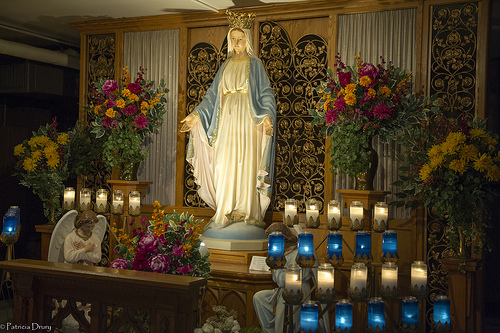
OLGH Shrine Mary StatueRegister for our Tuesday, August 16th pilgrimage to The Shrine of Our Lady of Good Help outside of Green Bay. Our bus will depart from St. Wenceslaus’ parking lot at 7:30 AM and return there about 7:30 PM the same day. This pilgrimage is free, but you must mail (P.O. Box 109, Eastman WI 54626) or deliver a deposit to St. Wenceslaus to reserve your spots on the bus ($15 per person or $75 per family, whichever is less.) This check will be returned to you if and when you attend the pilgrimage. Required release forms for minors are available in the back of church or may be downloaded here. Remember to pack sack lunches. Please contact Father with any additional questions.

Be Rich In What Matters — 18th Sunday of Ordinary Time—Year C

July 30, 2016

The Parable of the Rich Fool by Rembrandt, 1627.

The Parable of the Rich Fool by Rembrandt, 1627.

A large crowd surrounds Jesus as he preaches and teaches. During a brief pause, a man in the crowd says to Jesus, “Teacher, tell my brother to share the inheritance with me!” Presumably, his brother is there amongst them as well (otherwise how could Jesus reprove him?) Yet the Lord replies to the man, “Friend, who appointed me as your judge and arbitrator?” That seems like an odd response from Jesus. Is Jesus denying his own authority?  On a different occasion, Jesus stated, “If I should judge, my judgment is valid, because I am not alone, but it is I and the Father who sent me.” Imagine if the man in the crowd had answered Jesus’ rhetorical question, “Friend, who appointed me as your judge and arbitrator?” The man might say, “Well Teacher, we think you’re God’s prophet, so you speak for God.”

To this, Jesus could reply, “Indeed, the words that I speak to you I do not speak on my own. But if you accept that I am God’s prophet, that I speak for God, then listen and heed all that I teach, not just the things you want to hear. On the last day, when I return in my glory with all the angels with me, I will sit upon my glorious throne with all peoples assembled before me and I shall judge and separate the righteous and the unrighteous, one from another, as a shepherd separates the sheep from the goats. Yet, my Father God did not send me into this world to condemn the world, but that the world might be saved through me.

In our Gospel, Jesus goes on to tell the crowd (including those two feuding brothers): “Take care to guard against all greed, for though one may be rich, one’s life does not consist of possessions.” Jesus is warning the crowd, the brothers, and us that ‘personal bitterness and earthly greed will hinder you from entering the Kingdom.’ Rather, we must keep a heavenly perspective. As St. Paul urges in our second reading, “seek what is above, where Christ is seated at the right hand of God. Think of what is above, not of what is on earth.

Of course, we all have material needs as human beings here on earth —we’re not angels and we need our daily bread. So Jesus teaches us to practice prudent stewardship, marked by frugality, generosity, and a trust in the Lord that frees us from worthless worrying. However, both Jesus in our Gospel and King Solomon in our first reading note the futility of amassing riches for ourselves.

Jesus tells a parable of “a rich man whose land produced a bountiful harvest. He asked himself, ‘What shall I do, for I do not have space to store my harvest?’” (Notice how “He asked himself, ‘What shall I do?” The man does not look beyond himself for holy wisdom or guidance.)

And [then the rich man] said, ‘This is what I shall do: I shall tear down my barns and build larger ones.” (Why does he need to tear down his old barns? Does not the rich man, who just reaped a bountiful harvest, own plenty of land on which to build more barns? It seems his vanity desires to tear down the old barns so that his new barns may be huge and impressive.)

The rich man continues his conversation with himself, “[In my new barns] I shall store all my grain and other goods and I shall say to myself, ‘Now as for you, you have so many good things stored up for many years, rest, eat, drink, be merry!’” (He shows no thought for his family or friends, his neighbors or the needy, only his own personal pleasure.)

The rich man has made grand plans for himself, but God says to him, “You fool, this night your life will be demanded of you!” If this man is only interested in his own will, his own glory, and his own happiness in this life, then how will he love his neighbors, hallow God’s name, or desire God’s will in the next life?

To find ourselves at home in Heaven someday we should seek and follow God’s will for our time, talents, and treasure today. We should practice faithful stewardship, with prudence and trust, frugality and generosity. And this stewardship should include tithing and supporting worthy causes—not to buy Heaven (for God cannot be bribed or bought) but in order to become more virtuous and loving, to become more fit for Heaven. Those who store up treasure for themselves on earth profit nothing in the end. Let us not be foolish. Let us instead become rich in what matters to God by becoming more like Jesus, who has been so generous to us.

“We God’s People” — July 4th Weekend — 14th Sunday of Ordinary Time—Year C

July 3, 2016

Twelve score, or 240 years ago, our American forefathers began a revolution for freedom. For eight years, they fought to secure their independence from tyranny. They would go on to establish a national government; not meant create rights from nothing, but to help ensure and keep safe the human rights that “We the People” have from God. At the close of the 1787 Constitutional Convention in Philadelphia, a lady asked Dr. Benjamin Franklin, “Well Doctor, what have we got, a republic or a monarchy?” He replied, “A republic, if you can keep it.

U.S. FlagThe Framers established a government with three separate branches: a Legislative branch to create laws, an Executive branch to enforce the law, and a Judicial branch to resolve conflicts of law. This separation and balance of powers was designed to protect liberty against our fallen human nature. In the words of James Madison, who is called the architect of U.S. Constitution: “Ambition must be made to counteract ambition.” The Framers knew how leaders tend to consolidate power around themselves as dictators and the tendency of majorities to trample the rights of weaker minorities. James Madison adds, “It may be a reflection on human nature, that such devices should be necessary to control the abuses of government. But what is government itself, but the greatest of all reflections on human nature? If men were angels, no government would be necessary.

Our American republic depends not merely upon its laws but on the virtue of its people. George Washington said, “Religion and morality are the essential pillars of civil society.” John Adams said, “Our Constitution was made only for a moral and religious people. It is wholly inadequate to the government of any other.” Ben Franklin said, “Only a virtuous people are capable of freedom. As nations become corrupt and vicious, they have more need of masters.”

Our representative government is made in our image, and unfortunately it reflects and shares our errors and flaws today. For example, we live beyond our means. The average American household owes $7,400 on credit cards. And our government in our likeness cannot repay its debts, which are approaching $20 trillion, or about $60,000 of debt for each one us. We end the lives of our unborn children, almost one million of them each year, and our three branches of government are either unwilling or unable to safeguard in law every innocent human being’s God-given right to life. We are increasingly non-religious, leading people to think that churches serve no spiritual or social good and that their tax-exemption should be stripped. And we see our religious freedom diminishing, such that you can be financially-ruined for exercising your religious conscience in your occupation. We think it’s OK to do whatever it takes to win, we see parents and coaches encouraging kids to cheat or siding with them when they get caught. Meanwhile our political leaders are so brazenly lawless and tell such transparent lies, yet there are no consequences for any of it. How can our country remain free if virtue and our respect for the rule of law dies?

It appears that trying years are ahead for Catholic Americans, but there are (at least) three things we can do: pray, prepare, and keep perspective.

St. Michael the Archangel in the Battle of HeavenWe pray the St. Michael prayer near the end of our Masses to ask his help as the leader of the heavenly armies. We do this because evil spirits are real and active in our day. They are smarter than us and more powerful than us, but they are not more powerful than God and His angels. We should pray for our country. I cannot see how our country’s bad trends will be reversed, but God is cleverer and mightier than our imaginations so hope for a rebirth of virtue and freedom for our country remains.

In addition to prayer, we should prepare, beginning with ourselves. The final words before the signatures on the Declaration of Independence say, “[F]or the support of this Declaration, with a firm reliance on the protection of Divine Providence, we mutually pledge to each other our Lives, our Fortunes, and our sacred Honor.” How much are we willing to sacrifice in obedience to Christ? This is important to consider, for Jesus says, “Everyone who acknowledges me before others I will acknowledge before my heavenly Father. But whoever denies me before others, I will deny before my heavenly Father.” We should also endeavor to prepare our children, be they youths or adults, for a future living as “lambs among wolves.” For if the things we see now are done when the wood is green, what will happen when it is dry?

Besides prayer and preparation, we should also keep perspective. This American experiment has been, on a whole, a blessing for its people and the world. However, there is no guarantee that the United States will endure until Jesus returns. Only the Catholic Church is assured to remain until the end, even if as a small, beleaguered remnant. One of the benefits of studying Church history is that you realize how the Church has always appeared to be going down the drain, with troubles and persecutions in every age, and yet she endures. Let us remember that this is not our eternal home. In not so many years, each one of us will shake the dust of this earth from our feet to leave for our true homeland. As Isaiah says in our first reading, “In Jerusalem [that is, the heavenly Jerusalem] you shall find your comfort.” We are citizens of Heaven, and as for this country, we are only passing through.

So let us pray, prepare, and keep perspective. Things look bad for our country in the years and decades ahead. Nevertheless, do not despair at the advances of evil around us, but rejoice because your names are written in heaven, and we know who wins in the end.

Aphantasia — A Corpus Christi Homily

June 5, 2016

Aphantasia (Greek for “without fantasy”) has been written about since 1880 but it has recently gained increased attention. To understand what I am talking about, picture a red triangle, a horse running, or the house where you grew up. With a moment’s attention you can see them in your mind. However, people with  Aphantasia are incapable of voluntarily forming images in their mind’s-eye.

Blake, a successful 30-year-old software engineer only recently learned he experienced the world differently from others. He relates a conversation similar to this with a Facebook friend:

—If I ask you to imagine a beach, how would you describe what happens in your mind?
    —Uhh, I imagine a beach. What?
—Like, the idea of a beach. Right?
    —Well, there are waves, sand. Umbrellas. It’s a relaxing picture. Are you okay?
— But it’s not actually a picture? There’s no visual component, right?
    —Yes, there is, in my mind. What are you talking about?
—Is it in color?
    —Yes…
—How often do your thoughts have a visual element?
    —A thousand times a day?
—Oh, my goodness…

An African BeachIf someone were to ask Blake to “imagine a beach,” he could ruminate on the concept of a beach: it has sand, waves, heat, sun. He could recognize a beach when he saw one, but even if he were standing on a beach he could not recreate or remember the image with his eyes closed.

Philip is a 42-year old photographer from Toronto. He is happily married, but he cannot conjure up his wife’s face (or any other image) in his mind’s eye. He was recently listening to a podcast presenter describing aphantasia. He says it came as a complete surprise, “I was like ‘what do you mean? People do that?’” He thought it was a joke so he checked with his four-year old daughter. “I asked her whether she could picture an apple in her mind, she said ‘yeah, it’s green’. I was shocked.

A 2009 survey of 2,500 people suggests that aphantasia is the experience of about 2% of people. So far, I have found it in two of my friends, including  a fellow priest. He tells me that when our spiritual director in seminary would tells us to prayerfully picture ourselves, say, at the table of the Last Supper he thought it was just a metaphor. He was surprised to learn that when people “counted sheep” to fall asleep that was more than just a figure of speech.

Disbelief is a common response when people on either side of this phenomena hear that other people do no experience the world like themselves. (“That’s impossible. You’re lying. You’re pulling my leg.”) However, unless we happen to carry around an MRI machine, we have to take our friend at his or her word in order to know the truth. And here we come to the connection with this Feast of Corpus Christi.

An extraordinary experience at the center of our Faith is founded upon a trust in our friend Jesus Christ’s testimony. At the Last Supper, Jesus does not say, “This is like my body,” or “This symbolizes or represents my body.” He says, “This is my body.” Around the year 150 AD, St. Justin Martyr described what early Christians everywhere believed about these words:

“The apostles, in the memoirs composed by them, which are called Gospels, have thus delivered unto us what was enjoined upon them; that Jesus took bread, and when He had given thanks, said, “Do this in remembrance of Me, this is My body;” and that, after the same manner, having taken the cup and given thanks, He said, “This is My blood” … “This food is called among us the Eucharist… For not as common bread and common drink do we receive these; but in like manner as Jesus Christ our Savior, having been made flesh by the Word of God, had both flesh and blood for our salvation, so likewise have we been taught that the food which is blessed by the prayer of His word, and from which our blood and flesh by transmutation are nourished, is the flesh and blood of that Jesus who was made flesh.”

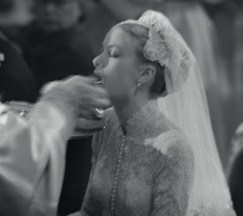
Princess Grace (Kelly) Receives The Holy EucharistThe Church has always proclaimed and worshiped Jesus Christ as truly present, body, blood, soul, and divinity in the Eucharist. This belief has been confirmed for us throughout the centuries. The Holy Spirit, whom Jesus promised would lead us to all truth and remind us of all that he told us, has reaffirmed this teaching in Councils of the Church. Jesus has also allowed Eucharistic miracles to unveil this mystery we cannot normally perceive. For instance, at the Miracle of Lanciano in eighth century AD, a priest who was doubting Jesus’ Real Presence witnessed the bread become flesh and the wine become blood (which coagulated and broke into five globules in the chalice) as he said the words of consecration. In 1971, scientific analysis indicated that, as at similar miracles, the Host was human cardiac muscle. Who would go through such trouble when a fraudster’s more convenient use of pig’s flesh would have been undetectable? The truth is that Jesus gives us his heart in the Eucharist, along with his whole self. You can go to Lanciano, Italy and behold this Host today.

For many Christians, the Lord’s Supper is merely a symbolic commemoration, a ritual that remembers him. But if Jesus is everywhere, then he is nowhere. It then impossible to physically draw near to him any place on earth. Unless you are blessed with a vision of Jesus, you can never see him with your eyes or touch him in your flesh until after your death and resurrection. But with the Real Presence of Jesus in the Eucharist, “Behold, I am with you always…

If you have always enjoyed mental images, or if you have received the Real Presence of Jesus in Holy Communion since you were a child, then you may not appreciate the gift you have. If you experience aphantasia, or if you have never believed in the Real Presence of Jesus in the Eucharist, then you may not even know what you are missing. So for our non-Catholic family and friends, tell them about this treasure—Jesus wants them to receive him, too. And for ourselves, let us truly appreciate the incredible gift that we are blessed to receive.

Captain America, St. Thomas More, & the Spirit of Truth

May 14, 2016

In the new blockbuster movie Captain America: Civil War the titular hero is discerning an important decision when he hears this message in a church:

“Compromise where you can. And where you can’t, don’t. Even if everyone is telling you that something wrong is something right, even if the whole world is telling you to move. It is your duty to plant yourself like a tree, look them in the eye and say, no. You move.”

Captain America - No, You MoveAs I watched in the movie theater, that bit about the tree struck me as odd. Trees bend and can be cut down, but pillars of iron or stone mountains don’t budge. I later discovered that these movie lines were adapted from a famous comic book speech Captain America once addressed to Spider-Man:

“When the mob and the press and the whole world tell you to move, your job is to plant yourself like a tree beside the river of truth, and tell the whole world — ‘No, you move.’”

Did you spot the difference? “Plant yourself like a tree beside the river of truth.” That’s not only more beautiful, it’s also an allusion to Old Testament imagery. Psalm 1:3 says:

“[The Just Man] is like a tree planted near streams of water that yields its fruit in due season, whose leaves do not wither, and whatever he does prospers.”

And Jeremiah 17:8 says:

“[Those who trust in the Lord] are like a tree planted beside the waters that stretches out its roots to the stream: It does not fear heat when it comes, its leaves stay green; In the year of drought it shows no distress, but still produces fruit.”

These verses teach that the just man who is rooted in the Law (or the Truth) of God prospers, and that those who trust in the Lord prevail against adversity.

I wish that Hollywood had included the fuller quote in the new Captain America movie—not only because it’s better writing, not only because it echoes Sacred Scripture, but because it better reflects the truth about where Truth comes from. My all-time favorite film disappoints me in a similar way.

A Man for All Seasons - St. Thomas More at TrialA Man for All Season won the 1966 Academy Award for Best Picture, but its depiction of its hero, St. Thomas More, falls short of perfection. In the movie, as in real life, Thomas More suffers unjust imprisonment for refusing to swear an oath recognizing King Henry VIII as the supreme head of the Catholic Church in England. The movie’s screenwriter, the agnostic Robert Bolt, drew on More’s own writings to craft some fantastic dialogues, but Bolt somewhat misrepresents the saint’s true motivations.

In one scene, Thomas More’s friend, the Duke of Norfolk, asks why he won’t just “give in.” Thomas answers, “I will not give in because I oppose it — I do — not my pride, not my spleen, nor any of my appetites, but I do — I!” The real St. Thomas More’s motivations are portrayed more accurately in the scene at his trial. He tells the court:

“The indictment [against me] is grounded in an act of Parliament which is directly repugnant to the law of God, and his Holy Church, the Supreme Government of which no temporal person may by any law presume to take upon [himself.] This was granted by the mouth of our Savior, Christ himself, to Saint Peter and the Bishops of Rome whilst He lived and was personally present here on earth. It is, therefore, insufficient in law to charge any Christian to obey it.”

The real St. Thomas More refused to sign the King’s oath because he saw in it a denial of Christ. He preferred to die rather than lose Heaven; and he did go on to die, thereby gaining Heaven. But Robert Bolt has his Thomas More conclude his courtroom speech like this:

“Nevertheless, it is not for [refusing the King’s] Supremacy that you have sought my blood, but because I would not bend to the [King’s re-marriage]!” (In other words, “No one is going to make me act contrary to my own self-will!”)

The real St. Thomas More was not standing up against the world for individually-chosen truth. (More opposed heretics when he served as King Henry’s High Chancellor.) He knew that Truth and right and wrong are not things we create for ourselves. We receive them, as water from a river. They do not flow from us as their source. The real St. Thomas More was a champion for the Truth which comes from God.

So how can we be faithful to the Truth which comes from God? How can we be planted like trees beside the River of Truth that flows from God? By prayerfully welcoming the Holy Spirit.

At his interrogation before the Roman Governor Pontius Pilate, Jesus says: “Everyone who belongs to the truth listens to my voice.” (In the Holy Trinity, the Father is the Speaker, Jesus is the Word, and the Holy Spirit is the Voice) But Pilate refuses to listen. He retorts to Jesus, “What is truth?” He rejects the Spirit of Truth and walks away.

Later, at his Ascension, Jesus instructs his disciples to remain in Jerusalem until they are clothed with power from on high with the Spirit of Truth who will teach them everything and remind them of all he has told them. Unlike Pilate, the disciples listen to Jesus and obey him. Some 120 persons (including the apostles, the Virgin Mary, some women, and some male relatives of Jesus) gather together and all devote themselves to prayer. They pray for nine days—the Church’s first novena, and on the tenth day, on the Jewish feast of first fruits called Pentecost, the Holy Spirit, the Spirit of Truth, comes and fills them.

St. Peter PreachingOnce the Spirit’s fire touches their heads, the disciples know what to say and they are unafraid to say it. Previously they had been hiding behind locked doors, but now they go out into Jerusalem’s crowded streets praising and preaching Jesus. This new-found wisdom and courage are gifts from the Holy Spirit, who empowers them to begin reaping the Church’s first fruits from the world. Observe well what the disciples do, for we are called to do the same: they listen to Jesus and obey him, they gather together and pray, they receive the Holy Spirit’s inspiration and gifts, and then they go forth to speak and act powerfully in the world.

In the Gospel of John, on the last and greatest day of one of the Jewish feasts, Jesus stands up in the temple area and exclaims, “Let anyone who thirsts come to me and drink. Whoever believes in me, as scripture says: ‘Rivers of living water will flow from within him.’” Here the Gospel writer adds: “He said this in reference to the Spirit that those who came to believe in him were to receive.”

The Holy Spirit is our River of Living Water. As trees planted beside him we will prosper, and by being rooted in him we will prevail against adversity. In Holy Mass let us pray to receive the Spirit wholeheartedly and to be clothed with his power. And then, filled with the Spirit of Truth, even if the whole world tells us to move, we will have the words and courage to stand our ground. By the Holy Spirit, we can be heroes for this world in desperate need of heroes, in the likeness of Captain America, St. Thomas More, and the apostles after Pentecost.

An Ascension & Mother’s Day Homily

May 8, 2016

The Belly of a Woman with Child

Today, two great celebrations providentially align: the Feast of the Ascension of Jesus Christ into Heaven and Mother’s Day. After his resurrection, Jesus spent 40 days teaching, instructing, and preparing his disciples for their new life ahead. The number 40 often appears in the Bible in relation to times of preparation.  Noah spent 40 days and nights on the ark as the waters of the flood were renewing the world. Moses and the Hebrews spent 40 years wandering in the desert before God’s people entered the Promised Land. Before beginning his public ministry, Jesus spent 40 days and 40 nights praying and fasting in the desert. And after his death on the cross, Jesus’ body spent (by tradition) 40 hours in the tomb awaiting the resurrection. The number 40 also has a place in your life story as well. Each of you remained 40 weeks, more or less, within your mother’s womb being prepared for a new life. I ask you to reflect on that time.

Attached to your mother’s vine you grew into the mature fruit of her womb. You were nourished and grew within her. You were never far from her heart or mind. You existed within her, connected to her at the center of your being.  (Your belly button marks the spot where you were once attached to her.) She fed you with her very self. She provided for all your needs. Apart from her you could do nothing. You remained in her and you found your rest within her.

In the womb, at those earliest stages of life, our minds did not comprehend very much, but what if you could have understood then everything that your mother was doing for you? Surely you would have directed your thoughts to her often.  And, from time to time, you would have turned to her with the eyes of your heart to bask in her love for you.

What if, imagining further, that you could have spoken with your mom when you were in her womb? Wouldn’t you have taken the opportunity to speak with her every day? Wouldn’t you have thanked her with a deep gratitude and let her know how much you love her? I suppose a baby could ignore its mother in such as situation and continue to live on, at least biologically, but the child would be deprived without this first and special relationship with mom.

As you and your mother would continue to talk throughout the days and months of pregnancy she would eventually present you with a most-frightening prospect. She might put it this way, “My child, soon, in a little while, you are going to begin a new stage of your life. You will be departing from the life you know, and then you’ll experience a whole world of people and things you have never known before. Once you are born, you will meet me in a new way.

You might say, “I’m scared! I don’t want to go—not now, not ever!” But she would reassure you, “I realize this concept is scary for you, but trust me when I say that it is better that you go. In fact, someday soon you’ll look back and think it a silly thought to be back again where you are now. This transition is going to hurt a little bit… trust me, I know… but when the appointed time comes, I’ll be right here with you. So don’t be afraid, it’s going to be O.K.

Our life in our mother’s womb is like our life in Jesus Christ. You are attached to Him as to a vine. You are nourished and grow within Him. You are never far from His heart or mind. You exist within Him; you live and move and have your being in Him, connected to Him at the center of your being. He feeds you with His very self in the Eucharist. He provides for all your needs. Apart from Him, you can do nothing. You remain in Him and can find your rest in Him.

Knowing and believing this, shouldn’t we direct our thoughts to Him often? Shouldn’t we, from time to time, turn to Him with the eyes of our hearts to bask in His love for us. We have the ability to talk with Jesus Christ whenever we want in prayer. We should take the opportunity to speak with Him every day, thanking Him out of deep gratitude and telling Him how much we love Him. A person who ignores Him will still continue to live, at biologically, but they will not be fully alive without this primary and special relationship with Christ. We must to pray every day if we want to remain in Him and bear much fruit.

We don’t want to die and that’s perfectly natural. But Jesus says to us, “Soon, in a little while, you are going to begin a new stage of your life. You will be departing from the life you know, and then you’ll experience a whole world of people and things you have never known before. Once you die, you will meet me in a new way. I realize this concept is scary for you, but trust me when I say that it is better that you go. In fact, someday soon you’ll look back and think it a silly thought to be back again where you are now. This transition is going to hurt a little bit… trust me, I know… but when the appointed time comes, I’ll be right there with you. So don’t be afraid, it’s going to be O.K.

Was Jesus afraid when he ascended into heaven? In the Garden of Gethsemane the night before his died Jesus was anxious and distressed at the sufferings before Him. But at the Ascension, as he rose high above the ground, I do not think He was afraid at all. He was beyond all fear and He was going home. The anecdotal evidence of near death experiences indicates that for friends of God the journey beyond this life is peaceful and joyful. A friend of mine once went into cardiac arrest and had a vision like that of going home. When they defibrillated her heart in the Emergency Room and brought her back to into this world she felt quite angry and tore off the wires they had stuck on her skin because she so much wanted to go back to where she had just been.

As our mothers would have told us before we were born from womb into world, and as Jesus tells us before our birth from this life to next, we do not need to be afraid. Instead let us live in gratitude and peace. Today, let us thank God for the life, love, and tender care we have received from our mothers and through Jesus Christ. May God bless our mothers and may Jesus Christ be praised.

The Centrality of Jesus — Monday, 4th Week of Easter—Year II

April 18, 2016

Readings: Acts 11:1-18, John 10:1-10

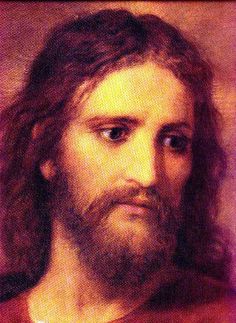
Detail of The Rich Young Ruler by Heinrich HofmannIn St. John’s Gospel, Jesus is the Good Shepherd, the Lamb of God, and the Gate for the flock.

Our Easter preface (V) for the Mass calls him “the priest, the altar, and the lamb of sacrifice.”

Jesus declares, “I am the way and the truth and the life. No one comes to the Father except through me.”

One may say Jesus is the road we travel, the vehicle we take, and the destination we long for.

The centrality and importance of Jesus Christ cannot be overstated.

Like Cornelius’ household at Caesarea, the God-fearing and truth-loving people amongst the nations need him, seek him, and perhaps (even if unknowingly) have a nascent love for him. As Jesus says, “I have other sheep that do not belong to this fold. These also I must lead, and they will hear my voice, and there will be one flock, one shepherd.” Jesus says to Pilate, “Everyone who belongs to the truth listens to my voice.”

Let us grow in our knowledge, relationship, and love of the Lord Jesus Christ at this Mass and every day, and labor to help others come to know and love him more deeply as well.


St. Stanislaus: A Patron Saint of Poland

April 11, 2016

Stanislaus was born of noble parents on July 26, 1030 near Kraków, Poland. After his priestly ordination he became known for his preaching and good spiritual advice. At age 42, he was made bishop of Kraków (the future office of St. John Paul the Great, who nearly chose the name “Stanislaus” as pope.)

King Boleslaus the Bold oppressed the Church and hated Stanislaus for denouncing his reign’s injustices and cruelties. In hopes of the Polish king’s conversion, Stanislaus excommunicated the king, even ceasing cathedral liturgies upon his entrance. On April 11, 1079, the sword-wielding king murdered Stanislaus himself while the bishop was saying Mass in a chapel outside the city.

The martyr St. Stanislaus has long since been celebrated as the Polish nation’s beloved patron.

He Proved Faithful — Good Friday Homily

March 25, 2016

Few proved faithful to Jesus on Good Friday, but on Good Friday Jesus proved himself faithful to us.

The political leaders were supposed to serve justice, but Pilate and Herod failed to protect Jesus as an innocent man. Jesus protected us when we were guilty.

The religious leaders were supposed to serve holiness, but the High Priests and the Sanhedrin failed to accept Jesus as their Messiah. Jesus accepted us so that we might become holy.

The disciples were supposed to serve their teacher and lord, but Judas betrayed him, Peter denied him, and the others abandoned him. By enduring his suffering and death, Jesus proved himself faithful to us.

Jesus’ mother Mary was faithful. She stood with him at the foot of the cross. It was a consolation for Jesus to have her there. Two of his beloved disciples were also there: Mary Magdalene and the apostle John. Jesus was grateful to have them close by.

Today, on this Good Friday, by the grace of God, we are at the foot of the cross. Let us pray for mercy, for ourselves and for others. Despite our past unfaithfulness, let us honor his faithfulness to us. Jesus is pleased that we are here with him, and he is grateful for our gratitude.

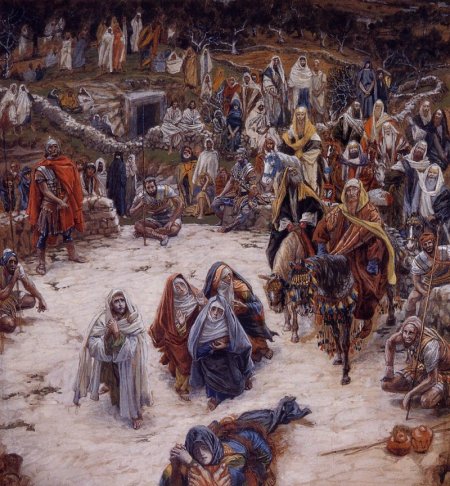
View From the Cross by Tissot

Returning the Favor — Holy Thursday Homily

March 24, 2016

St. Augustine wrote a famous reflection on Proverbs 23:1 :

“If you sit down to eat at the table of a ruler,
observe carefully what is set before you.”

Why? Because you will be expected to provide the same kind of meal for him. This proverb is a practical tip of worldly wisdom, but St. Augustine goes deeper; what is its spiritual meaning for the Christian?

Who is our ruler?  It is Jesus our Lord.
Where is his table? It is here, his altar.
Now carefully observe the food he sets before us: it is the Eucharist, his very self.

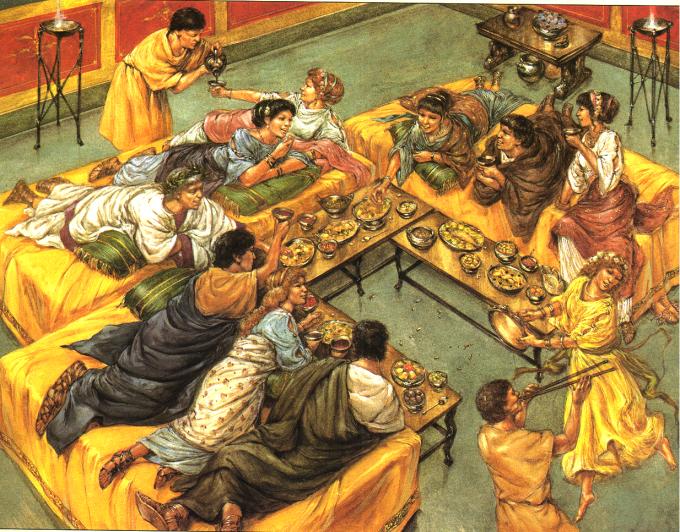
Jesus, like others in the ancient world, reclined at table.Jesus calls us to prepare the same kind of meal for him. He says, “This is my body, given up for you. Do this in memory of me.” We must make a gift of ourselves by living our lives for him, and we are to serve him in others for he tells us, “Amen, I say to you, whatever you did for one of these least brothers of mine, you did for me.”

After washing his disciples feet at the Last Supper where he institutes the Eucharist, Jesus says to his disciples, and to us: “Do you realize what I have done for you? … I have given you a model to follow, so that as I have done for you, you should also do.

The Significance of Anna’s Age and Lifestyle — Sixth Day in the Christmas Octave

December 31, 2015

Readings: 1st John 2:12-17, Luke 2:36-40

Whenever we read the Bible, it is profitable for us to remember that every detail is there for a reason. The sacred authors and the Holy Spirit chose to omit so many minor facts that “I do not think the whole world would contain the books that would be written” if they had described everything. (John 21:25) Instead, all that we find in Scripture has been purposely included for our benefit. (John 20:30-31) Consider the details mentioned in this encounter from the Presentation, when Joseph and Mary brought the baby Jesus to the temple in Jerusalem for the first time:

The Presentation of Jesus in the Temple by James Tissot

There was a prophetess, Anna, the daughter of Phanuel, of the tribe of Asher. She was advanced in years, having lived seven years with her husband after her marriage, and then as a widow until she was eighty-four. She never left the temple, but worshiped night and day with fasting and prayer. And coming forward at that very time, she gave thanks to God and spoke about the child to all who were awaiting the redemption of Jerusalem.

This is the only episode in the New Testament where the prophetess Anna appears. Why does St. Luke include Anna’s age and the length of her marriage? Let’s explore this obscure detail. The 84-year-old widow was married for seven years, and thus was unmarried for 77 years of her life. She is 7 x 12: the Jewish number symbolizing completeness and perfection times the number of the tribes of Israel. Anna personifies Old Testament Israel at her best. But of the twelve tribes, which tribe would correspond with Anna’s seven years of marriage?

After the death of Saul, all the tribes of Israel came to David (of the tribe of Judah) seeking to make him their king. They said: “Look! We are your bone and your flesh,” echoing the words of Adam towards Eve at the beginning of their marriage covenant, “This one, at last, is bone of my bones and flesh of my flesh.” (2nd Samuel 5:1, Genesis 2:23) Old Testament Israel had been wedded for a time to David, but now she awaited the kingship of a Son of David from the tribe of Judah. While David had once conquered Jerusalem from the Jebusites, Anna and others in her day were “awaiting the redemption of Jerusalem” by the Messiah/Christ. (1st Chronicles 11:4-5)

Living like a Christian nun veiled in anticipation of her bridegroom’s arrival, Anna “never left the temple, but worshiped night and day with fasting and prayer.” Why would Anna, or any woman, choose to live in this way? St. John’s first epistle offers this admonition:

Do not love the world or the things of the world. If anyone loves the world, the love of the Father is not in him. For all that is in the world, sensual lust, enticement for the eyes, and a pretentious life, is not from the Father but is from the world. Yet the world and its enticement are passing away. But whoever does the will of God remains forever.

Alexandrian World Chronicle (5th century) featuring Anna the ProphetessThough Anna understood the evil corruptions of “the world,” she was also well aware of the goodness of creation. She had known the blessings of marriage and the (at least occasional) pleasures of feasting, but Anna knew that these passing things could not fully satisfy her. Her deepest longings could only be met by the One to come, not only for her but for all Jews and Gentiles. When Jesus Christ came to the temple, Anna rejoiced, gave thanks, and “spoke about the child to all who were awaiting the redemption of Jerusalem.” Because she devoted herself to “the will of God,” Anna’s scriptural legacy and joy before the Lord ‘remain forever.’

Our Holy Conspiracy & the End of the World — 33rd Sunday of Ordinary Time—Year B

November 16, 2015

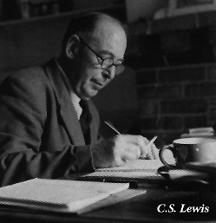
C.S. Lewis, 1898-1963A new liturgical Church year will begin in a couple of weeks with the first Sunday of Advent. As this Church year ends, our Mass readings (like today’s Sunday readings) focus on the Last Things and the end of the world as we know it. This weekend’s news reports, especially the terrible events in France, remind us that though the Kingdom of God is among us, we pray “thy Kingdom come” because it is not yet fully here in total, unveiled power. This weekend’s readings and news events remind me of passages from C.S. Lewis in excellent book Mere Christianity:

“Enemy-occupied territory—that is what this world is. Christianity is the story of how the rightful king has landed, you might say landed in disguise, and is calling us all to take part in a great campaign of sabotage. When you go to church you are really listening-in to the secret wireless [radio] from our friends: that is why the enemy is so anxious to prevent us from going.”

Why does Lewis say that our king has landed “in disguise?” Well, where would you expect a king to be born? The Magi sought the newborn king of the Jews in the palace at Jerusalem, but Jesus was born in a barn—a cave in Bethlehem—to a pair of poor parents. How would one expect the Jewish Messiah to enter into Jerusalem to claim his throne? Probably riding on a warhorse, but Jesus came meekly riding on a donkey, just as had been prophesied about him. Who would have thought that God would become a man, and then suffer and die as he did? After the vindication of the resurrection, one would have thought he would appear to the high priest and Governor Pilate, or to the Emperor Tiberius in Rome, to declare that he was indeed who he claimed to be. Instead, Jesus appeared discretely, to his disciples.

Lewis writes that God has landed in this enemy-occupied world in disguise and has started “a sort of secret society” to undermine the devil. This secret society he speaks of is the Church. But what is so secret about the Church? We have a sign in front with our Mass times. We don’t check ID’s at the door. And if anyone wants to know about what we do or what we believe, we will gladly inform them. But, in a sense, the Church is a secret society—for the world and even many Catholics do not recognize who and what we really are. We are a holy conspiracy. We are fighting the propaganda of the world and the devil with the truth of God. We are recruiting others to the side of the Lord. We are his special forces sabotaging evil with the weapons of love in preparation for the king’s arrival.

From where do we receive our power for this mission? The source of our power is the Holy Mass. Today’s second reading says that the Old Testament’s priests offered many sacrifices because those  could not truly achieve their purpose, but Jesus our High Priest offers his sacrifice once for all. At Mass we transcend space and time to personally encounter that sacrifice, and it’s power is applied to us here and now, providing all the graces we need to fulfill his will.

Lewis asks, “Why is [God] not [yet] landing in [total unveiled] force, invading [our world]? Is it that He is not strong enough? Well, Christians think He is going to land in force; [but] we do not know when.”

Indeed, as Jesus says in today’s Gospel, “of that day or hour, no one knows… but only the Father.”

We do not know when the Lord is going to land in force. “But,” Lewis continues, “we can guess why He is delaying. He wants to give us the chance of joining His side freely. I do not suppose you and I would have thought much of a Frenchman [during World War II] who waited till the Allies were marching into Germany and then announced he was on our side. God will invade.”

Why has God not yet invaded our world with his full, unveiled force? Why does he allow the wicked to use their freedom for evil, like the terrorism we saw in Paris?

Lewis writes, “I wonder whether people who ask God to interfere openly and directly in our world quite realize what it will be like when He does. When that happens, it is the end of the world. When the author walks on to the stage the play is over. God is going to invade, all right: but what is the good of saying you are on His side then, when you see the whole natural universe melting away like a dream and something else—something it never entered your head to conceive—comes crashing in; something so beautiful to some of us and so terrible to others that none of us will have any choice left?”

I think “the whole natural universe melting away” is an excellent reflection on today’s gospel. Jesus tells us that at the end:

“the sun will be darkened,
and the moon will not give its light,
and the stars will be falling from the sky,
and the powers in the heavens will be shaken…”

In the ancient world, the sun and moon, stars and planets, were considered the most stable and eternal things in the cosmos (and you can understand why.) But when even these things are passing, you know the universe as we know it is melting away. After this, the Lord Jesus comes with judgment. “And then they will see ‘the Son of Man coming in the clouds’ with great power and glory… (and his angels, like St. Michael from our first reading, along with him…)”
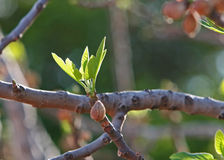
Sprouting Fig Tree in SpringtimePerhaps we may find it surprising that Jesus describes these events as a good thing to his disciples. He says:

“Learn a lesson from the fig tree. When its branch becomes tender and sprouts leaves, you know that summer is near. In the same way, when you see these things happening, know that [the Son of Man] is near, at the gates.”

We usually associate the end of things with the fall. Youth is called the springtime of life, while old age is the fall. In the Northern Hemisphere, every Church year ends in the fall. Yet Jesus presents an analogy for the end of the world as one of spring becoming summer: ‘When the tender branch sprouts leaves, you know that summer is near.’ A small thing, the branch, points to the arrival of a much greater reality, the summer. Why would we cling to the branch when the whole world is being renewed in glory? For friends of God, what is to come is better than what we see. The life we live now in this world is the winter. What is still to come for us is the spring and summer. Let us not hesitate to hope for it, envision it, and rejoice in it.

When the last day comes, “it will be God without disguise; something so overwhelming that it will strike either irresistible love or irresistible horror into every creature. It will be too late then to choose your side. … That will not be the time for choosing: it will be the time when we discover which side we really have chosen, whether we realized it before or not. Now, today, this moment, is our chance to choose the right side. God is holding back to give [people] that chance. [But it] will not last forever. We must take it or leave it.”

How long will it be until the Lord comes again? Jesus says in today’s gospel that, “This generation will not pass away until all these things have taken place.” But he said this a long time ago. Was Jesus wrong? No, for when you read these passages from Mark in full context, Jesus is responding to his disciples questions about two things side-by-side: the fall of Jerusalem and the end of the world. The Romans destroyed the great city and its temple in 70 A.D., during the lifespan of some of Jesus’ hearers, and to many Jews it felt like the end of the world. This event prefigured the passing away of all things. Like other prophesies in the Bible, Jesus’ prophesy has a near and distant fulfillment, one after a forty-year opportunity for conversion, and another at the end of time.

So when will the Lord come again? The answer for every generation before us has been “not yet.” If this world endures to the year 10,000 A.D., the Christians of that time will probably regard us as the early Christians. I personally think it will still be awhile before he comes, for it is still legal to be a Christian in too many places on earth. Yet, in a sense, it doesn’t matter when Jesus is coming, for the end of our individual lives is equivalent to the end of the world for us. If you’re ready for one, you’re ready for the other. But if you, or people that you know, are not ready for either, then now is the time for conversion.

The Lord our King has recruited us into his holy conspiracy, arming us with the weapons of truth and love. You and I are his advanced forces and, among other tasks, he is sending us on rescue missions to bring others to himself. Who do you know that is far from Christ? We are to draw on the power of this Mass for them. We are called to pray, fast, and sacrifice for them, and even to be so bold as to talk with them—inviting them to come to Jesus Christ and his Church. Seize this opportunity and do not let it pass away, for whether the Lord first comes to us or we go forth to him, each and all will encounter him soon, face-to-face, in his full, unveiled glory.

What the Scribes Did Right — 32nd Sunday of Easter—Year B

November 8, 2015

Let me open with a joke:

The pastor of a big-city parish answered his rectory door to find a man wearing a face of great anxiety and concern. “Father, there’s a local family in dire need that could really use the church’s help.” The priest invited him inside and listened to the details. “The mother is a young widow with ten kids who lost her job last month. She’s been looking for work, but they’re barely keeping food on the table. Worst of all, unless they can scrape together $300 for rent by this Friday, they’ll be evicted and thrown out into the street.” The priest replied, “That’s a terrible and difficult situation. By the way, how do you know the family?” The man wiped a tear from the corner of his eye and said, “Oh… well, I happen to be their landlord.”

Hypocrisy is the pretense of holding beliefs, standards, behaviors, or virtues that one does not truly hold. Not many good things are usually said about hypocrisy, but I can say one. Usually, hypocrisy acknowledges (however insincerely) what is really true and truly good. Even a corrupt politician speaks the truth when he or she says that government should be transparent, politicians should be honest, and campaign promises should be kept. A wedding ring is a visible sign that proclaims marriage to be a sacred and lifelong bond even on the hand of an adulterer. Hypocrisy  is the homage, the respect, that vice shows to virtue.

The Widow's MitesIn today’s gospel, Jesus talks about the scribes and a poor widow. He praises her, but criticizes them. Jesus saw her at one of the Temple’s thirteen contribution trumpets in the court of the women. These were donation chests topped as with tall road cones, but made of metal, with an opening at the top for dropping in coins. The coins of large contributions would make a large racket, like how a slot machine pays out in a casino. But the poor widow’s two coins fell in with quiet: *click* *click*

Jesus called his disciples to himself to point her out to them. (Perhaps he saw in her an image of himself, the one who trusts in God and is willing to give everything  to him.) After criticizing scribes who “devour the houses of widows” as those who “will receive a very severe condemnation,” he praises this poor widow’s gift.

Most homilies preached around the world today will be about the poor widow’s trusting generosity. (You may have noticed that our lectionary gives the option of omitting the scribes from this reading entirely, making a brief gospel reading even shorter.) But today I will be preaching about the scribes and from an angle that I would bet you’ve never heard before: what we have to learn from what the scribes were doing right.

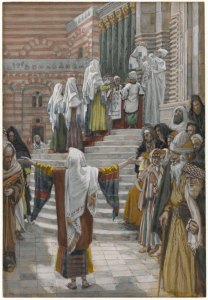
Woe unto You Scribes and Pharisees by James Tissot

Jesus condemns the scribes for their hypocrisy, and rightly so, but at least they acted like God and true religion were the most important things in their lives. Do our acquaintances at work or school have reason to think that God comes first in our lives? If it were illegal in this country to be a Catholic Christian, would there be enough public evidence to convict you? Our words and actions should reflect our faith in Jesus and his Church.

The scribes took seats of honor in synagogues, but at least they were faithfully there each week. God commands us to keep his days holy—every Sunday and Holy Day of Obligation. He commands this because he deserves our praise and thanks, but also because he knows how much we need this.

The scribes liked to go around in long robes, but at least they dressed up in a God-honoring way. Our clothing should always be modest and dignified, but especially at church. How would you dress for your boss at work, for an meeting with the president, or an audience with the pope? How much more then should we dress well to come before God at Mass.

The scribes accepted greetings in marketplaces and places of honor at banquets, but at least they were active and known in their community. We should not be mere homebodies, but involved in our own community.

The scribes recited lengthy prayers for show, but at least they were not afraid to acknowledge God before others. Do you pray before meals at restaurants? Do you talk about Jesus or your faith with anyone? When someone shares their burdens with you, do you offer to pray with them? (Try it sometime. They will probably be more receptive than you think.) We should not be afraid.

Why did Jesus say the scribes deserved a severe condemnation? Because they focused on externals and disregarded what was within. They cared about fancy clothes, and prayers and deeds that others would notice, but did not care whether widows became destitute. It’s fine to desire friendship—it’s one of life’s great blessings—but we must desire God’s friendship more. We naturally care what others think of us—no one wants to be hated—but we should care more about what God thinks about us. The scribes were attentive to appearances, but neglected the truth and love.

After the poor widow put her coins into the treasury, the gospel says that Jesus called his disciples to himself. He summoned his followers to physically draw nearer in order to teach them and highlight her deed. But in a deeper sense, Jesus was calling them to his very self, that they would come to resemble him like the widow did. Jesus is the man of integrity whose exterior words and actions perfectly align with his inner-self. He wants all of us to be like himself. Jesus wills that our secret selves would be as noble and admirable as our public personas, and that our interior faith would be reflected through all of our external words and actions. Like the landlord in the opening joke, whether or not Jesus is welcome to dwell and live with us as he desires, increasing our likeness to his, is entirely up to us.