Archive for the ‘Homily’ Category

A Memorial Run-Walk Prayer

October 25, 2015

Jesus, our Lord, we gather to remember and to celebrate Bridget, your sister and friend. Though gone forth from us, she is not parted from you, for to you all are alive.

Lord Jesus, your word reminds us that ‘We are surrounded by a great a cloud of witnesses like Bridget… who urge us to persevere in running the race that lies before us, while keeping our eyes fixed on you, the leader and perfecter of our faith.’

Lord Jesus, it is written that they who hope in the you ‘will renew their strength, they will soar on eagles’ wings; They will run and not grow weary, walk and not grow faint.’

Lord Jesus, one day, when we reach the end of our earthly lives, may it be said: ‘We have competed well; we have finished the race; we have kept the faith.’

Jesus, please grant that this may be a safe and joyful event. Please bless Bridget and each of us. Amen.

Holy Aphorisms — August 4 — St. John Vianney

August 4, 2015

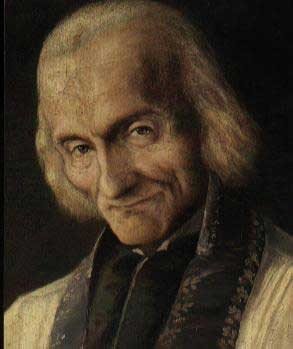
        St. John Vianney, the Curé of Ars and patron saint of priests, is well known as a confessor who could see into peoples’ souls and who took great penances upon himself for the conversion of sinners. Less known, though, is his wisdom. St. John Vianney may have had difficulties learning Latin and passing his seminary exams, but he preached beautiful spiritual insights such as these:

“To approach God you should go straight to Him, like a bullet from a gun.”

“Prayer is the conversation of a child with his Father.  Of a subject with his King.  Of a servant with his Lord.  Of a friend with the Friend to whom he confides all his troubles and difficulties.”

“A pure soul is with God, as a child with its mother.  The child caresses and embraces her, and its mother returns all its endearments.”

“God commands you to pray, but He forbids you to worry.”

“You must accept your cross.  If you bear it courageously it will carry you to heaven.”

However, “Our Lord takes pleasure in doing the will of those who love him.”

“Just as a mother holds her child in her hands to cover it with kisses, so does God hold the devout person.”

“Here is a rule for everyday life: Do not do anything which you cannot offer to God.”

And as we approach the Eucharist, let us recall this final thought: “To content his love, God must give Himself to us separately, one by one.”

(Originally published August 4, 2010;
edited & republished August 4, 2015)

Fallaciously Faithless — Monday, 10th Week in Ordinary Time—Year I

June 8, 2015

Reading: 2nd Corinthians 1:1-7

St. Paul writes to the Christians at Corinth:

Blessed be the God and Father of our Lord Jesus Christ, the Father of compassion and the God of all encouragement,  who encourages us in our every affliction, so that we may be able to encourage those who are in any affliction with the encouragement with which we ourselves are encouraged by God.

When I was in college, there was a span of a couple of weeks when I stopped receiving the Holy Eucharist. I kept going to Mass, but I hesitated to approach for Communion. I refrained because I feared that I did not have enough faith in the Lord to receive Him worthily.

pondering-at-a-question-markI shared my concerns with our Newman Center parish priest. Father Mark did not provide me with any specific answers, but I remember him saying, “Perhaps God is allowing you to experience this so that someday you can help other people who are going through the same thing.” Inside, I felt like saying, “Thanks for nothing, Father.”

I kept praying and pondering for several days until this realization finally came to me: “People who don’t believe in God don’t spend time worrying about whether or not they believe in God—that’s something only a believer would do.” If I was worried about whether I had faith, then there was no reason to worry. Freed from my fear and greatly relieved, I returned to Holy Communion.

If you know someone trapped in the same spot I was, please feel free to pass this helpful insight along. Father Mark and St. Paul were right. God encourages us in our every affliction so that we may encourage others with the same encouragement we receive from Him.

Bridget Achenbach Funeral Homily

May 29, 2015

May my words approach what Jesus Christ and Bridget would like me to speak. May my words give you consolation and timely help.

Bridget Achenbach Fair Ambassador

Bridget Achenbach, 1995-2015

Last year, Bridget left home to become a freshman at UW-La Crosse. I’ve heard it said that when a young person goes off to college the experience is very different for the child and for the family. It’s much easier for the child leaving home than for the family left behind. For a young person like Bridget, this transition begins an adventure. She’s learning fascinating, new, amazing things. She’s meeting great people, making new friends. Of course, she still loves and cares about her family at home. Yet she is so happy and excited to be beginning her new life.

For her parents and siblings at home, it’s understandably much harder. While her life is full, they can feel an emptiness. At home, she’s not in her room. She’s not in her seat at the kitchen table. Her voice and laughter are not heard in the house. Of course, her family can still speak to her long-distance. And she is still well-aware of everything that’s going on at home. But her departure creates some degree of separation, and that’s hard, and that’s sad.

Deeply loving parents could wish that their child would never leave home. “Why couldn’t she just live here?” When their child has gone away from home they worry if she’s OK, if she’s safe, if she’s happy, if she’s staying close to the Lord. Some, despite their Christian upbringing, when faced with the free choice, choose to leave the Lord and go their own way. When Bridget went to college last year, she was not like one of those. She went from good to better. She drew even nearer to Jesus, and grew with Him.

During her Freshman year, through the UW-L Catholic Newman Center, she was involved in Bible studies, attended a five-day Catholic youth conference in Tennessee, and pilgrimaged to the March for Life. On the bus trip of that last trip she shared with friends about how Jesus was transforming her life. She said she felt closer to Him than ever before.

Last year, Bridget began going to weekday Mass, receiving our Eucharistic Lord on more than just Sundays. Why would a young person like Bridget go to daily Mass? It’s not as though popular culture promotes that kind of devotion. It’s not because anyone is required to attend Mass on a weekday. A person who goes to daily Mass resonates with the psalmist’s words:

O God, you are my God, for you I long;
for you my soul is thirsting.
My body pines for you like a dry,
weary land without water.
So I gaze on you in the sanctuary
to see your strength and your glory.

A person desires to go Mass and receive Jesus in the Eucharist frequently because one has the desire to be closer to God. And this desire is not of ourselves but from Jesus’ desire to draw us closer to Him.

As you know, Bridget Achenbach is a remarkable woman. People who meet Bridget found her joyful and intelligent; faithful, yet approachable; pious, and yet relatable. One of Bridget’s mission trip leaders once said to himself, “I wish I had whatever she’s got.” Bridget’s past goodness and our present loss raises this troubling question: “How could Jesus allow his beloved one to be taken from us?” We echo the questioning plea of Martha and Mary to Jesus at the death of Lazarus, “Lord, if you had been here, my brother would not have died!” What are we to make of this?

We know that Jesus never, ever commits evil. He is goodness and love incarnated. “In Him there is no darkness at all.” But we also know that Jesus refrained from intervening with some (even subtle) miracle to prevent this from happening. Why would God permit such a charismatic young lady, apparently richly endowed with the Holy Spirit’s gifts, to die on Pentecost Sunday? Wouldn’t she do more good if she were left alive on earth? Wouldn’t her life be fuller if she lived on earth a full number of years?

Today we are like the disciples on the first Holy Saturday, the day after Good Friday’s shock and horror yet before Easter Sunday’s glory. On Good Friday, the disciples beheld the most distressing death of their Messiah. On Holy Saturday, His followers were grieving and questioning. But on Easter Sunday, they saw the resurrection Jesus had promised. Today is like Holy Saturday because we see our loss but not God’s purposes.

Bridget Achenbach PhotoPerhaps, as the Book of Wisdom says, God saw Bridget reach that perfection of soul He treasures and delivered her from this world’s wickedness to be safe with Him. Perhaps we don’t see reality with the clear vision of St. Paul, who assures us “we would rather leave the body and go home to the Lord.” We think of this place as home but Scripture tells us our true home is in Heaven. Perhaps Bridget has been called to continue the Lord’s work on earth from Heaven. The Blessed Virgin Mary, the spiritual mother of all Christians, was an invaluable presence among the first Christians in the early Church. But after she completed the course of her earthly life and was taken up into Heaven Mary was able to assist more powerfully than before. In her glorified state, Mary our mother can hear and intercede on behalf of millions while loving each of us uniquely. Perhaps God has such a mission for Bridget as well. We don’t yet know the answers now—“we walk by faith, not by sight”—but we do know the Lord Jesus in whom we trust.

We are not without hope, but it’s still hard. Today is sad, but you are not alone. This place literally overflows with love for you and Bridget. In times to come, give us the gift of allowing us to give gifts of our love to you. Talk to Jesus every day. As he told us, “I am with you always.” Share with Him your true feelings and your honest thoughts. Whether it’s anger or gratitude, He wants you to tell Him. He who suffered and died among us wants to walk with you through this and through all of life. And talk to Bridget. Whether through the power of God, the mediation of angels, or a soul to soul communication that is clearer than our words on earth, she will hear you. Like going off to college, Bridget is beginning a new life. But she still loves you and will enjoy hearing from you.

Our God is good. Jesus Christ is here. Bridget is loved, and she is at peace.

Friends of Jesus — 6th Sunday of Easter—Year B

May 13, 2015

Readings: Acts 10:25-26, 1st John 4:7-10, & John 15:9-17

In our first reading, St. Peter is sent by the Holy Spirit to the house of Cornelius, a Gentile and Roman centurion:

When Peter entered, Cornelius met him
and, falling at his feet, paid him homage.
Peter, however, raised him up, saying,
“Get up. I myself am also a human being.”

In other words, Peter says, “Relax, I’m made from the same stuff as you.” This was said for Cornelius’ benefit and for ours.

Icon of the Twelve ApostlesThe Evangelists and the Holy Spirit did us a huge favor by recording the early disciples’ flaws and infidelities. Most of these first followers of Christ went on to live their lives for him, some even dying for him, and so we rightly call them saints. Yet the New Testament reveals that they were far from perfect at the start. It would have been so understandable, so easy, for the Gospel writers to omit the embarrassing, regrettable, and even sinful moments of the Church’s founding figures. The fact these unflattering details were included points to the veracity of the Gospels. Imagine how deprived we would be today if these details had been had whitewashed away.

St. Mary Magdalene Clings to JesusLuke tells us that Jesus cast seven demons from out of Mary Magdalene. We are never told how their evil influence had affected Mary’s life, but it probably was neither subtle or pretty. Without knowing this detail, some might think, “Jesus couldn’t accept someone with an ugly past like mine. I’m no model of perfect devotion, like Mary Magdalene.”

James and John had their mother ask Jesus to seat them upon thrones at his left and right in glory. Without this story, those who struggle with ambition and vainglory might lament, “Why can’t I be content to humbly serve, like the fisherman sons of Zebedee?”

Without the story of Doubting Thomas, times of struggle with questions and doubts might bring the self-reproach, “Why can’t I just trust in Jesus, like Believing Thomas?”

Without the story of Peter’s three denials of Christ, after a great fall we might despair, “How could Jesus forgive me? I was not faithful to him like St. Peter the Rock.”

All this is not to say that our sins and imperfections do not matter. As Jesus says in today’s Gospel, “Remain in my love. If you keep my commandments, you will remain in my love… This I command you: love one another [and (by implication) love me as well.]” Every sin is a failure to love as we ought, so we must do our best to root our the lusts, prides, and infidelities from our lives. Jesus says, “You are my friends if you do what I command you.” Recognizing our own sins and failings, this raises a concern within us: Are we Jesus’ friends?

The setting for today’s Gospel is the Last Supper. Jesus, knowing everything the apostles had done wrong in the past, knowing how poorly they would perform in the near future, told them, “I no longer call you slaves… I have called you friends…” Jesus declares them to be his friends, long before they are perfect. Jesus’ plan, for them and us, is to love us into holy righteousness and glory.

From today’s second reading, from John’s first epistle, we learn:

In this is love:
not that we have loved God, but that he loved us
and sent his Son as expiation for our sins.

Jesus died for us as surely as he ‘laid down his life for his friends‘ the apostles, and Jesus loves us in the same way as them. Relationship, Identity, and Mission: Your relationship is a friendship with Christ. Your identity is a friend of Christ. Your mission is to live as a friend of Jesus Christ. And with the friendship of Christ, we can do all things in him who loves us.

A Game of Monopoly & the Rich Man

March 10, 2015

Lazarus at the Rich Man's DoorGospel: Luke 16:19-31
Thursday, 2nd Week of Lent

    A UC-Berkley psychology professor sets two people down for an experiment: the pair will play a game of Monopoly with modified rules. One player will get the Rolls Royce while the other will be the old shoe. The player with the car will start with $2,000 and play by standard Monopoly rules, while the old shoe’s player gets $1,000, rolls just one die (making doubles impossible,) and collects only $100 for passing “Go.” Who gets which is decided by a fateful coin-flip. At the end of the game, the professor asks the winner (invariably the Rolls Royce player) whether they feel like they deserved to win the game. And the winner always says ‘yes.’

    I can understand the winner’s perspective. At the beginning of the game both players had a fair chance of winning (for either could have ended up with the car,) but the winner won that coin flip, played by the rules, and did what was necessary to arrive at victory. If the winner had cheated the loser, stealing cash or refusing rents, then that victory would feel undeserved.

Abraham, Lazarus, and the Rich Man    The Rich Man who showed no concern for poor Lazarus may have felt like one of those Rolls Royce players. He “dressed in purple garments and fine linen and dined sumptuously each day,” but nothing in the text indicates that he had defrauded or exploited anyone to obtain his wealth. Maybe he looked at poor people like Lazarus and shrugged, “Some receive what is good in their lifetimes while others receive what is bad,” words that Father Abraham would throw back in his face. Perhaps the Rich Man had not so much perpetrated evils, but rather (ignoring the Scriptures) felt no responsibility to help the less fortunate outside his door.

    May the one who reads this—a winner in the coin-toss of life—not be condemned for failing to give alms.

Was the Book of Revelation Written for Us?

November 17, 2014

Monday, 33rd Week in Ordinary Time—Year II
Readings: Revelation 1, Luke 18:35-43

     The revelation of Jesus Christ, which God gave to him, to show his servants what must happen soon. He made it known by sending his angel to his servant John, who gives witness to the word of God and to the testimony of Jesus Christ by reporting what he saw. Blessed is the one who reads aloud and blessed are those who listen to this prophetic message and heed what is written in it, for the appointed time is near.

Revelation’s island of Patmos and its seven churches in Asia Minor (or modern-day Turkey)

        So begins the most misunderstood book of the Bible. The Book of Revelation speaks of “what must happen soon” and of an appointed time which is “near,” but to whom is it speaking? Some answer this question historical-critically; it is addressing seven particular churches in Asia Minor during the first or second century. Others answer eschatologically; it is describing the wonders and travails awaiting the generation which will immediately precede Jesus’ return. But what about the many generations who come and go between those two bookend-eras of Christian history? Was the Book of Revelation addressed or applicable to them? In what sense was its prophetic message truly “near” or “soon” for all that time?

        The Book of Revelation involves specific historical contexts in the past and describes a historical climax (apparently) still to come, but it also speaks to Christians of every age. Consider today’s gospel: Jesus heals a blind man and declares the saving power of his faith or faithfulness (“pistis” in the Greek.) How narrowly should we interpret this gospel? Are the miracles and message of Jesus Christ intended only for the people of His time and place? Is the Gospel of Luke meant only for the first century Christians to whom it was written? Rather, the whole of Sacred Scripture, co-authored and inspired by the Holy Spirit who sees all of history simultaneously, speaks to the life and times of every Christian. Corruptions of the world, persecutions of the Church, manifestations of God’s power, and triumphs of His people belong to every age. The Book of Revelation truly tells “[God’s] servants what must happen soon” because these realities are always “near.”

Three Crosses Line Break

By Satan’s Power — Friday, 27th Week in Ordinary Time—Year II

October 10, 2014

Readings: Galatians 3:7-14; Luke 11:15-26

Some in the crowd said of Jesus, “By the power of Beelzebul, the prince of demons, he drives out demons.” In a certain sense, those people would be right.

Satan’s power in the world led to Jesus’ Passion. The devil probably thought he was winning by getting Jesus crucified, for ‘cursed is everyone who hangs on a tree.’ Yet Jesus surprised him by turning this curse into ‘a blessing for all nations.’ Jesus suffered Satan’s power, but brought good out of the evil. In this way, by the power of Beelzebul, the prince of demons, Jesus drove out demons from the world.

Originally posted on October 8, 2010

Popes Are Not Perfect — Wednesday, 27th Week of Ordinary Time—Year II

October 8, 2014

Readings: Galatians 2:1-2,7-14; Luke 11:1-4

[W]hen Cephas came to Antioch, I [Paul] opposed him to his face because he clearly was wrong. For, until some people came from James, he used to eat with the Gentiles; but when they came, he began to draw back and separated himself, because he was afraid of the circumcised. And the rest of the Jews acted hypocritically along with him, with the result that even Barnabas was carried away by their hypocrisy. But when I saw that they were not on the right road in line with the truth of the Gospel, I said to Cephas [Peter] in front of all, “If you, though a Jew, are living like a Gentile and not like a Jew, how can you compel the Gentiles to live like Jews?”

Jesus was praying in a certain place, and when he had finished, one of his disciples said to him, “Lord, teach us to pray just as John taught his disciples.” He said to them, “When you pray, say: Father, …forgive us our sins….”

Christ Handing the Keys to St. Peter by Pietro Perugino (detail)The Church on earth is both human and divine — it is holy, yet made up of and led by sinners. When the apostles asked Jesus how they should pray he told those men who were to become the Church’s first leaders to always ask that God the Father would forgive their sins.

Some bulk at the doctrine of papal infallibility asking, “How can a pope, a sinful man, be infallible?” (One could likewise ask how sinful men could write the Sacred Scriptures.) A pope is infallible when he proclaims a doctrine by a definitive act as supreme pastor and teacher of all the faithful regarding faith or morals, but nothing guarantees that he and the Church’s other leaders will never make sincere yet unwise decisions, or that they will never commit serious sins. Infallibility is not the same as impeccability. Imagine the Church as car on the interstate. The Holy Spirit provides guard rails to prevent us from crashing, but we do not always drive as straightly and speedily as we could.

In today’s reading from Galatians, St. Paul recalls the time he gave some fraternal correction to the first pope. St. Peter had not been teaching error regarding the Gentiles and the Mosaic Law, but his personal example (withdrawing from their company so as not to offend the circumcised) was sending a mixed and wrong signal. Even St. Peter could make a mess of things sometimes. Popes, bishops, and priests need the help of our prayers. Like St. Augustine observed: for you, they are leaders; but with you, they are Christians. They are disciples of Jesus Christ who, like yourself, must strive and follow after Him daily.

Parallelism & Padre Pio — Monday, 25th Week of Ordinary Time—Year II

September 23, 2014

Readings: Proverbs 21:1-6, 10-13; Psalm 119:1, 27, 30, 34-35, 44

We see within today’s readings a literary structure often found in the Bible: parallelism. A verse states an idea and is immediately followed by a line reexpressing that same truth (or contrasting it.) For example, in our psalm we read:

The way of truth I have chosen;
I have set your ordinances before me.

And in Proverbs:

The soul of the wicked man desires evil;
his neighbor finds no pity in his eyes.

When the arrogant man is punished, the simple are the wiser; when the wise man is instructed, he gains knowledge.

Parallelism is a providential gift to translators and readers of the Bible because it helps them to understand Scripture’s meaning better than they would through a singular statement alone.

St. Padre Pio PortraitSt. Padre Pio (or Pius of Pietrelcina) is among the most famous saints of the past century. Like Jesus, large crowds were drawn to him and religious authorities were cautiously wary of him, but he always remained obedient. Like Jesus, Padre Pio possessed the mystical ability to read peoples’ souls — to know strangers’ stories, sins, and struggles. He spent long hours in the confessional, being firm with the hardened and gentle with the weak, just like Jesus was with the Pharisees and the woman at the well. Also, by God’s gift, Padre Pio bore the stigma, the wounds of Christ, in his hands, feet, and side.

God uses parallelism to help us to fathom His Word better. In both Sacred Scripture and in the saints of Jesus Christ, parallelism helps us to understand the Lord better.

Generosity & Envy — 25th Sunday in Ordinary Time—Year A

September 21, 2014

Readings: Isaiah 22:6-9; Philippians 1:20c-24, 27a; Matthew 20:1-16a

DenariusHe woke up while it was still dark and kissed his wife while she slept.

He dressed and left home quietly, so as not to wake up the children across the room.

He walked into town and came to the large market square, where the venders were already setting up shop, and day laborers like himself were congregating.

At dawn, landowners came to hire men to harvest their vineyards and fields.

He was left behind, yet he did not leave.

Hopefully, someone would hire him at noon for at least a half-day’s work.

Three o’clock came, and he was still standing there unemployed, refusing to go home. How could he go home… empty-handed?

Around five o’clock, a landowner found him and asked, “Why do you stand here idle all day?”

Speaking for those standing with him he answered, “Because no one has hired us.”

The landowner said to them, “You too go into my vineyard.”

When it was evening, the vineyard owner had his foreman summon the harvesters and pay them—in this he was abiding by the command in the book of Leviticus, “You shall not withhold overnight the wages of your laborer.”

When he received his pay, the man thought there had been some mistake.

Though he worked only an hour, he had been given a silver denarius coin, the standard pay for a full day’s work.

He badly wanted to leave with it, but he was a righteous man, and quietly approached the foreman.

But the foreman reassured him—there had been no mistake!

Oh, the joy he felt! For tonight and tomorrow, his family would not be hungry.

*  *  *  *  *

Was the landowner unfair in the treatment of his workers? At the beginning of the day, the Greek text says the landowner achieved ‘harmonious agreement’ with the labors regarding the usual daily wage. This was not fraud nor exploitation, but a just wage for an honest day’s work. Were the later workers been idle due to laziness? No, they honestly say, but “because no one has hired us.”

Let us revisit the landowner’s arguments in his own defense: he said to one of the grumblers in reply, “My friend, I am not cheating you. Did you not agree with me for the usual daily wage? Take what is yours and go. What if I wish to give this last one the same as you? Or am I not free to do as I wish with my own money? Are you envious because I am generous?” The landowner was not being unfair, he was being generous. He kept the precept of Leviticus, which ensured that poor laborers would not be deprived of their daily bread overnight, but he also kept the command which comes in Leviticus five verses later: “You shall love your neighbor as yourself.”

Would the grumblers have been happier if the coins were taken back from the hands of all of the one hour workers? Yes, and no. For the envious person is not happy until everyone is unhappy like himself. And even then, he is still unhappy. What if the grumblers had had perfect hearts? Then they would have been concerned about those unchosen workers, as impoverished as themselves, that were left behind in the marketplace, and upon seeing those latecomers receive a full daily wage they would be happy and relieved for them. But these grumblers’ thoughts were not God’s thoughts, and their ways were not his ways.

Saint Augustine in his Study by Botticelli, 1480Beware of envy. Envy is sadness at the sight of another’s blessings and the immoderate desire to acquire them for oneself. The Catechism of the Catholic Church teaches, when envy wishes grave harm to a neighbor, it is a mortal sin. St. Augustine rightly called envy “the diabolical sin,” for the book of Wisdom tells us that “by the envy of the devil, death entered the world.” St. Augustine observed, “From envy are born hatred, detraction, slander, joy caused by the misfortune of a neighbor, and displeasure caused by his prosperity.”

What is envy’s antidote or preventative vaccine? A good will towards all people, and rejoicing in their blessings and happiness as much as your own. Do you feel envious out of fear or resentment that there may not enough good things for you? Remember that the landowner in today’s parable, who ensures that his laborers receive their daily bread, represents God, who provides for the needs of those who serve him. As the psalmist says, “The Lord is near to all who call upon him.”

In Jesus’ parable, the landowner represents God, the laborers are those who faithfully serve him, and the equal pay they receive is salvation, eternal life, the reward of Heaven. Does this mean that all who serve God receive an equal reward? Once again, the answer is yes, and no. Each is given Heaven, but not all souls enjoy the same glory there. In our second reading, St. Paul says, “If I go on living in the flesh, that means fruitful labor for me.” He is not sure if he would rather live or die (“I do not know which I shall choose”) because death means peaceful rest with Christ, while more labor in life means a greater reward.

St. ThereseWhen St. Therese of Lisieux was a little girl, she was rather put out to learn that not all souls enjoy the same glory in heaven. For the young, fairness means simple sameness. Her older sister, Pauline, told her to fetch a thimble and her father’s water tumbler and to fill both of them to the top with water. Pauline then asked her which one was fuller. St. Therese saw that every soul in heaven is filled to its brim and can hold no more; each being full of God and completely happy. In Heaven, there is enough love, glory, and happiness for everyone, even if we grow and develop different capacities for these while on earth.

So who will have the largest capacity in Heaven? Who will hold the most glory? I believe, as Jesus says, “the last will be first, and the first will be last.” The greatest glory will not go to those who are focused on who is first and greatest, but to those interested in promoting in the greater glory of all.

God’s angels have different degrees of glory and power, yet they find delight in one another. They have labored for the Lord since the beginning of time, yet they rejoice that God has been generous with us latecomers and included us in his work. Let us be like our angels, who happily pray for us and aid us, so that we might attain a glory greater than their own. Let us pray that others might become holier than us, provided we become as holy as we ought.
“Get Behind Me” — 22nd Sunday in Ordinary Time—Year A

August 31, 2014

Gospel: Matthew 16:21-27

Jesus began to show his disciples that he must go to Jerusalem and suffer greatly from the elders, the chief priests, and the scribes, and be killed and on the third day be raised.  Then Peter took Jesus aside and began to rebuke him, “God forbid, Lord! No such thing shall ever happen to you.”  He turned and said to Peter, “Get behind me, Satan! You are an obstacle to me.  You are thinking not as God does, but as human beings do.”

In Hebrew, “satan” means “adversary.” Peter is not the devil, but in opposing the Father’s true will for the Messiah, Peter is acting as an adversary and an obstacle to Jesus. Earlier in Matthew’s Gospel, during the temptation in the desert, Jesus told the devil, “Get away, Satan!” Later, in describing the Last Judgment, Jesus tells the unrighteous goats on his left, “Depart from me, you accursed…” Yet to St. Peter, Jesus says, ‘You are my friend, so get behind me… Stay close to me, and follow my lead.”

Enduring Deprivation — Monday, 20th Week of Ordinary Time—Year II

August 18, 2014

Readings: Ezekiel 24:15-23, Matthew 19:16-22

The word of the LORD came to me: “Son of man, by a sudden blow I am taking away from you the delight of your eyes, but do not mourn or weep or shed any tears. Groan in silence, make no lament for the dead, bind on your turban, put your sandals on your feet, do not cover your beard, and do not eat the customary bread.” That evening my wife died, and the next morning I did as I had been commanded.

Then the people asked me, “Will you not tell us what all these things that you are doing mean for us?” I therefore spoke to the people that morning, saying to them: “Thus the word of the LORD came to me: ‘Say to the house of Israel: Thus says the Lord GOD: I will now desecrate my sanctuary, the stronghold of your pride, the delight of your eyes, the desire of your soul. …  Your turbans shall remain on your heads, your sandals on your feet. You shall not mourn or weep, but you shall rot away because of your sins and groan one to another.”

Christ and the Rich Young Ruler, by Heinrich HofmannWhat does Ezekiel in the first reading have in common with the young man in today’s gospel?

A young man approached Jesus and said, “Teacher, what good must I do to gain eternal life?” … Jesus said to him, “If you wish to be perfect, go, sell what you have and give to the poor, and you will have treasure in heaven. Then come, follow me.” When the young man heard this statement, he went away sad, for he had many possessions.

The Lord asked the rich young man to give up something precious to him, and the Lord took away something precious from Ezekiel. What if Ezekiel had rebelled after his loss, refusing to do anything further in the Lord’s service? People sometimes react to tragic loss in this way. What if that rich young man who went away sad never changed his mind? Divine callings often entail hardship, but consider the greater loss of never fulfilling the purpose of one’s life.

Every good thing, every person or possession, has come to us from God, and his desire for us is our supreme good. Therefore, the Lord is worthy of trust, even if we are stripped of what is dearly precious to us. As the suffering Job observed,

“Naked I came forth from my mother’s womb,
and naked shall I go back there.
The LORD gave and the LORD has taken away;
blessed be the name of the LORD!”

Ezekiel’s Consolation — Tuesday, 19th Week of Ordinary Time—Year II

August 12, 2014

Readings: Ezekiel 2:8-3:4; Matthew 18:1-5, 10, 12-14

The Lord GOD said to me: “As for you, son of man, obey me when I speak to you: be not rebellious like this house of rebellion, but open your mouth and eat what I shall give you.” It was then I saw a hand stretched out to me, in which was a written scroll which he unrolled before me. It was covered with writing front and back, and written on it was: “Lamentation and wailing and woe!”

He said to me: “Son of man, eat what is before you; eat this scroll, then go, speak to the house of Israel.” So I opened my mouth and he gave me the scroll to eat. “Son of man,” he then said to me, “feed your belly and fill your stomach with this scroll I am giving you.” I ate it, and it was as sweet as honey in my mouth. He said: “Son of man, go now to the house of Israel, and speak my words to them.”

How can a message of “lamentation and wailing and woe” taste sweet in the prophet’s mouth? Ezekiel found the message sweet because it meant God was neither blind nor indifferent to the evils in his midst and that these evils, one way or another, would not continue forever. Either sincere conversion or painful events would soon check his people’s wickedness. This was the prophet’s consolation. Jesus says:

If a man has a hundred sheep and one of them goes astray, will he not leave the ninety-nine in the hills and go in search of the stray?

Guardian Angels by JHS MannIn the parable of the Lost Sheep, we focus on the lost sheep’s consolation while forgetting the ninety-nine’s desolation. The flock may fare just fine, but they will find the experience quite unsettling. Jesus tells us:

Whoever receives one child such as this in my name receives me.

It is not the will of your heavenly Father that one of these little ones be lost.

For forty years, the people of our land have intentionally and legally ended the lives of roughly one million unborn children annually. What would the opposite of receiving Jesus look like, if not this? Jesus warns us:

See that you do not despise one of these little ones, for I say to you that their angels in heaven always look upon the face of my heavenly Father.

This represents a warning, because God’s angels are fearsome and righteous creatures. Let us earnestly pray for our country’s conversion to a culture of life. Yet we too share Ezekiel’s consolation, for one way or another, this evil in our midst will not go on forever.

Jesus in the Storm — 19th Sunday in Ordinary Time—Year A

August 11, 2014

walking-on-water-by-aivazovsky-1890I do not think that the apostles wanted to get into that boat. Jesus made them do it.

After he had fed the people, Jesus made the disciples get into a boat and precede him to the other side, while he dismissed the crowds.

Why would they not want to go? Peter, Andrew, James, and John were previously fishermen working on this Sea of Galilee. They could recognize an approaching storm. The apostles did not want to be on the sea that night, but they obediently went.

[After sending away the apostles and the crowds, Jesus] went up on the mountain by himself to pray. When it was evening he was there alone. Meanwhile the boat, already a few miles offshore, was being tossed about by the waves, for the wind was against it.

Why did Jesus dismiss them without himself? Jesus wanted to be alone to pray after hearing about the killing of his relative and friend, John the Baptist. (Even Jesus needed dedicated times for prayer.) But there was another reason: Jesus wanted the apostles to experience one of the most memorable, most difficult, most amazing nights of their lives. After battling against the winds and waves from evening through the hours before dawn, the apostles were exhausted physically and emotionally. Then…

During the fourth watch of the night, he came toward them walking on the sea. When the disciples saw him walking on the sea they were terrified. “It is a ghost,” they said, and they cried out in fear. At once Jesus spoke to them, “Take courage, it is I; do not be afraid.”

The apostles have been casting out demons with Jesus for a long time. Perhaps they fear that this angry storm has been the work of a demon who is coming toward them in visible form on the water to finally kill them. In fact, the source of their greatest fear is actually their salvation. Jesus says, “Take courage, it is I; do not be afraid.” Jesus says, “Be not afraid,” more frequently than anything else. And it is not a suggestion, it is a command. When it feels like a the hurricane blows above, and an earthquake shakes below, and fire surrounds you, it can be difficult to hear God’s tiny whispering sound. However, the Lord is always close. People are afraid of many things: Loss and poverty, loneliness and suffering, disease and pain, dying to ourselves and dying from this life. What are you most afraid of?

After [Jesus and Peter] got into the boat, the wind died down.

Jesus says, “Take courage, it is I; do not be afraid.” Like the Apostles, if any distress comes to you, the Lord has permitted this for your good. “Be not afraid.” Jesus comes to meet us in the storm. He does this because meeting Jesus in the storm is among the most memorable, most amazing, and most powerful experiences of our lives. As we see with Saint Peter, these difficult experiences make us more like Jesus. In everything, Jesus is near and telling us, “Be not afraid.”

Three Crosses Line Break

No creo que los apóstoles querían entrar en ese barco. Jesús les hizo hacerlo.

En aquel tiempo, inmediatamente después de la multiplicación de los panes, Jesús hizo que sus discípulos subieran a la barca y se dirigieran a la otra orilla, mientras Él despedía a la gente.

¿Por qué ellos no quieran ir? Pedro, Andrés, Santiago y Juan eran anteriormente los pescadores que trabajan en este mar de Galilea. Podían reconocer una tormenta que se aproxima. Los apóstoles no quieren estar en el mar esa noche, pero obedientemente se fueron.

Después de despedirla, [Jesús] subió al monte a solas para orar. Llegada la noche, estaba él solo allí. Entre tanto, la barca iba ya muy lejos de la costa y las olas la sacudían, porque el viento era contrario.

¿Por qué Jesús despedirlos sin él? Jesús quería estar a solas para orar después de enterarse de el asesinato de su pariente y amigo, Juan el Bautista. (Incluso Jesús necesitaba tiempos dedicados para la oración.) Pero había otra razón: Jesús quería que los apóstoles de experimentar una de las más memorables, más difíciles, más increíbles noches de sus vidas. Después de luchar contra los vientos y las olas de la noche a través de las horas antes del amanecer, los apóstoles estaban exhaustos física y emocionalmente. Entonces…

A la madrugada, Jesús fue hacia ellos, caminando sobre el agua. Los discípulos, al verlo andar sobre el agua, se espantaron y decían: “¡Es un fantasma!” Y daban gritos de terror. Pero Jesús les dijo enseguida: “Tranquilícense y no teman. Soy yo”.

Los apóstoles han sido echando fuera demonios con Jesús durante mucho tiempo. Tal vez tienen miedo de que esta tormenta enojado ha sido obra de un demonio que ahora viene hacia ellos en forma visible en el agua para finalmente matarlos.  De hecho, la fuente de su miedo más grande es en realidad su salvación. Jesús dice: “Tranquilícense y no teman. Soy yo”.

Jesús dice: “No temas,” con más frecuencia que cualquier otra cosa. Y no es una sugerencia, es una orden.  Cuando parece que un huracán sopla encima, y un terremoto sacude a continuación, y el fuego le rodea, puede ser difícil de oír el murmullo de una bias suave. Sin embargo, el Señor siempre está cerca. La gente tiene miedo de muchas cosas: la pérdida y la pobreza, la soledad y el sufrimiento, la enfermedad y el dolor, muriendo a nosotros mismos y muriendo algún día. ¿Qué es lo que más miedo?

En cuanto [Jesús y Pedro] subieron a la barca, el viento se calmó.

Jesús viene para encontrarnos en la tormenta. Él hace esto porque un encuentro con Jesús en la tormenta es una de las experiencias más sorprendentes, más memorables y más poderosos de nuestras vidas.  Como vemos con San Pedro, estas experiencias difíciles nos hacen más como Jesús. En todo, Jesús está cerca, y nos diciendo, “Tranquilícense y no teman.”