Archive for the ‘Homily’ Category

Wine and Drunkenness — Tuesday, 5th Week of Ordinary Time—Year I

February 8, 2011

“God looked at everything he had made, and he found it very good. … Such is the story of the heavens and the earth at their creation.”

Everything that God has made is good, but anything can be misused or abused in ways that are wrong. A volleyball-sized amount of Uranium can provide electrical power to 200 U.S. homes for a year, but it can also be used in a single bomb to level a city like Hiroshima. The complimentarily of man and woman is very good.  They were made for each other, but they sometimes use each other in painful and unloving ways.

What about alcohol in its many forms? Is it good or bad? On the one hand, the Scriptures praise God for it as a gift: “You bring bread from the earth, and wine to gladden our hearts.” (Psalm 104:14-15) Yet throughout, the Scriptures also caution about the sin of drunkenness: “…Do not get drunk on wine, in which lies debauchery, [instead] be filled with the Spirit.” (Ephesians 5:18) You’ll recall that Jesus provided wine for the wedding feast of Cana, yet He would not be pleased if the guests used His gift for getting trashed.  If we are adults we may only drink alcohol in moderation, and if we are still minors we may only consume it under our parents’ direct supervision. Anything else is misuse, abuse, immoral and dangerous.

But what about illegal or recreational drugs? Can they be used in moderation? No, there is no moderation in this, for the entire goal of using them is to get high, to become intoxicated. If you have never abused drugs or alcohol, I hope you never start; and if you have, I hope you never will again.

Please do not dismiss this teaching as merely the tradition of your elders; for it is God’s command that we should never get drunk or high. God forbids it, just as every good parent forbids it of their children, because getting intoxicated is harmful and dangerous for us. The Scriptures say, “Honor your father and your mother,” and, “Whoever curses father or mother shall die.” Indeed, those who spurn their parents in this can taste sin and death in many forms.

When you’re intoxicated you make dumb decisions. (I don’t know about you, but I already make enough dumb mistakes in a day as it is.) Someone who is drunk or high will do impulsive, stupid things that they would never do otherwise. You lose control of yourself and become vulnerable to others. I don’t want any of you to wake up a morning after, regretting some serious thing done the night before. I don’t want any young woman here to find herself with child, and be tempted to do something terrible.

Imagine which experience would be worse as a consequence of getting intoxicated? To die alone from driving your car off a road into a tree, or to survive a head-on collision that kills a stranger or a friend? Go too far just once and alcohol poisoning or a drug overdose can have you pass out and never wake up again, put you in a coma or make you drown in your own vomit.

Or consider the risk and costs of addiction. Any recovering alcoholic can tell you a story about how much addiction costs, and any smoker can tell you how hard additions are to break. Of course, not everyone who gets drunk or high will become an addict, but some will, and after the first use of certain drugs, addiction is all but certain. With addiction, even if drug or alcohol abuse never sends you to prison, it can still cost you your freedom. And even if drug use never takes your life, it can cost lives of people far away.

Did you know that since 2007 there have been over 35,000 deaths in Mexico from the violence of their organized crime drug cartels? That’s almost ten times the number of American troops who have died in combat since 2001 in Iraq and Afghanistan. Why so much violence? It’s because the Mexican drug cartels make more than one hundred billion dollars a year from selling marijuana and other drugs to Americans, and they will murder or assassinate whoever stands up to them. When we buy their drugs, we’re supporting their terror.

Today I set before you life and death; choose life. If you have never abused drugs or alcohol, I hope you never start; and if you have, I hope you never do again. May no one ever say of Columbus Dons as Jesus said of the Pharisees: their hands are clean in public and ‘they honor me with their lips, but their hearts are far from me.’

Evil: Unholy Holes — Tuesday, 5th Week of Ordinary Time—Year I

February 8, 2011

“God looked at everything he had made, and he found it very good.” Everything that God has made, everything that has being, contains God’s goodness. What then is this thing called evil?

Think of a hole in the ground. What is the hole made of? Nothing really. If not for the good earth surrounding it you would not even know that a hole was there. Evil is like that hole, it’s an absence, a deprivation, a negation of something good. Evil can only be present within something good, as a corruption. Even though evil is essentially nothingness, that doesn’t mean that it can’t still hurt you, like falling into a deep, gaping hole.

Let no one think that evil is necessary for there to be good. No one should think of evil as the Ying to God’s Yang. God created a universe which was entirely good. It has been the free choices of the demons and of us to rebel in sin which have brought evils upon us.

Because of the goodness that remains in them, God shall love and preserve the Devil, the demons, and the damned forever. They shall not be destroyed, but they shall no longer do harm. They shall be as the wounds in Jesus’ hands, feet and side, which are as they are due to evil, but which cause no more pain, only glory.

5 Things / 5 Cosas — 5th Sunday in Ordinary Time—Year A

February 5, 2011

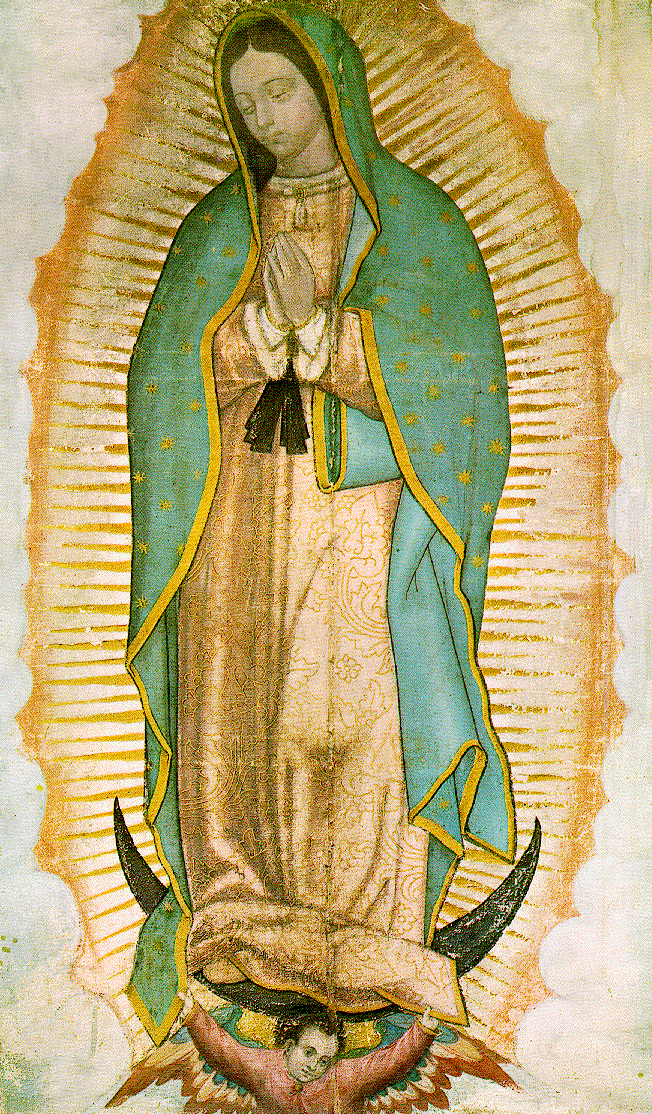
The Blessed Virgin Mary, our Lady of Guadalupe, comes to Saint Juan Diego dressed in the sun. She is clothed in light. Her light comes from God. In 1531, she does simple things. She says few words. She asks for one thing. She gives one gift. And as a few, small grains of salt can flavor a meal for many, Mary’s few, simple actions transformed a people, a culture, and a land forever.

You are called to be the light of the world, but remember that the light never begins you—the light only comes from Christ and shines through you. How can you be clothed in the sun of His grace? You need to pray every day, you need to receive the sacraments frequently, you need to fight against sin, you need holy community, and one of these friends must be Jesus.

By the light of Christ, you may be led to ‘share your bread with the hungry, open your house to the homeless, and clothe the naked’ in new ways. However, Jesus does not want you to do one thousand more things, He wants you to do the one thousand simple things that comprise your life differently, with peace and power. ‘The just man shines like a light in the darkness, and firm and without fear in his heart.’

With Jesus, you can become the best possible you. The best possible you is who you desire to be. This best possible you may still do few and small things, but the effect of these deeds will be powerful around you, as the salt of the earth transforms a bland meal.

Prayer, sacraments, conversion, community, intimacy with Christ. The light of Jesus comes through these. In which of these do you most need to grow? What are you going to do about it? Jesus and Mary await your reply.

La Virgen María, nuestra Señora de Guadalupe, llega a San Juan Diego, vestido con el sol. Ella está revestida en luz. Su luz viene de Dios. En 1531, ella hace cosas sencillas. Ella dice algunas palabras. Ella pide por una cosa. Ella da un regalo. Y como pocos, pequeños granos de sal pueden sabor a una comida para muchos, las acciones pocos y simples de María transformen un pueblo, una cultura y una tierra para siempre.

Usted está llamado a ser la luz del mundo, Pero, recuerde que la luz nunca empieza desde usted: la luz sólo viene de Cristo y brilla a través de usted. ¿Cómo puede usted ser revestido en el sol de la gracia de Christo? Es necesario orar cada día, es necesario recibir los sacramentos con frecuencia, es necesario luchar contra el pecado, es necesario formar parte de una comunidad santa, y uno de sus grandes amigos debe ser Jesús.

Por la luz de Cristo, es posible compartir su pan con el hambriento, abrir su casa al pobre sin techo, y vistir al desnudo de otra manera. Sin embargo, Jesús no quiere que haga mil cosas más, él quiere que haga las mil cosas simples que hace todos los dias pero de una manera diferente, con paz y poder. ‘La persona justo brilla como una luz en las tinieblas, y firme está y sin temor en su corazón.’

Con Jesús, usted puede convertirse en alguien mejor. Usted quiere ser major persona y eso es lo que Jesús tambien desea. Siendo una major persona usted puede todavía hacer pequeñas cosas, pero el efecto de estos hechos serán poderosos alrededor suyo, como la sal de la tierra transforma una comida ordinaria.

Oración, sacramentos, conversión, comunidad, y intimidad con Cristo. La luz de Jesús viene a través de estos. ¿En cuál de estos necesita mejorar al máximo? ¿Qué hará usted acerca de él? Jesús y María esperan su respuesta.

The Beatitudes Incarnate — 4th Sunday in Ordinary Time—Year A

January 30, 2011

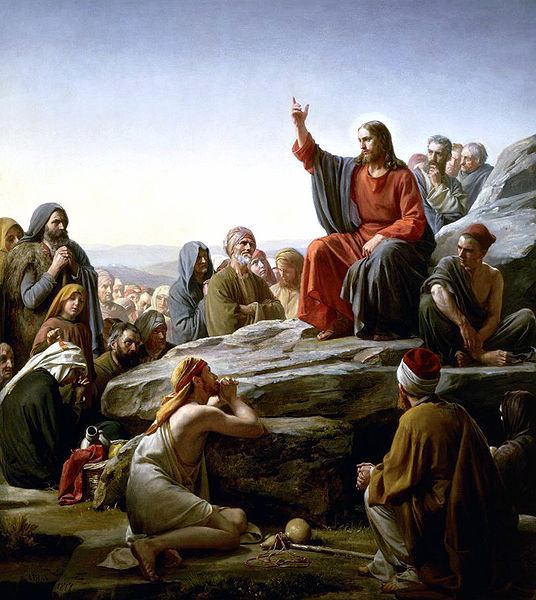
If you want to know what the beatitudes mean, look at Jesus Christ. And if you want a window into Christ, consider the beatitudes. Let us consider how Jesus embodies the beatitudes and choose to imitate Him.

Jesus is poor in spirit. Sometimes we get can proud and adore ourselves as if we were complete and self-sufficient. But Jesus, even though He was divine, never worshiped Himself. Jesus prayed every day. He depended on His Father, like a humble child, because He was poor in spirit. Do we pray every day like Him?

Jesus is a person who mourns. But what does He mourn? He mourns the sins of others and how badly lost they are. His lament is for many when He says, “Jerusalem, Jerusalem, you who kill the prophets and stone those sent to you, how many times I yearned to gather your children together as a hen gathers her brood under her wings, but you were unwilling!” Another time, He said through tears, “If… you only knew what makes for peace…” Do we know people who are far from God? When we mourn and pray for people far from God, our hearts are like the heart of Jesus.

Jesus is meek. He says so Himself, “Take my yoke upon you and learn from me, for I am meek and humble of heart.” As Zechariah prophesized about Him, Jesus did not enter to Jerusalem on a war horse or chariot, but meekly, on a donkey. Jesus doesn’t carry a sword, but a cross-shaped yoke. He comes not as the destroyer of nations, but as the planter of a harvest. In this way, Jesus conquered the world. Why do we think that own petty battles over matters of pride even need to be fought?

Jesus hungers and thirsts for what is right. He feels it from his gut when He says, “I have come to set the earth on fire, and how I wish it were already blazing!” When we see what is objectively wrong we should feel a hunger to fix it, and this hunger for righteousness should move us to action, to pray or petition, to volunteer or vote, to donate or give our witness to the truth. What wrongs do you hunger and thirst and work to have changed?

Jesus is merciful and He seeks to make peace. Jesus, as men were murdering Him in a crime that cried out for justice, pleaded to Heaven for mercy, “Father, forgive them, they know not what they do.” Jesus says that if we show mercy, we will be shown mercy. Only if we are peacemakers, we will know peace. Do we pray for those who hate us or are not at peace with us?

Jesus is clean of heart. This means more than just being chaste. He is clean of heart because His heart is full of goodness. Jesus teaches that “from the fullness of the heart the mouth speaks. A good person brings forth good out of a store of goodness, but an evil person brings forth evil out of a store of evil.” What impurities need to be scrubbed out from our hearts before we shall see God face to face?

Jesus was persecuted for the sake of righteousness, and He tells us our reward will be great if others insult us and persecute us and utter evils against us falsely because of Him. Has this ever happened to us? If not, why not? Are we too timid in bearing witness to Christ before others.

Living the beatitudes conforms us to Jesus Christ. My hope is that you will take even one thing from this homily and put it into practice in your life, for those who practice Christ’s beatitudes are promised to share His rewards.

Fear of Death — Friday, 3rd Week of Ordinary Time—Year I

January 28, 2011

God permits us to feel a natural aversion to death. This is healthy and for our good. (Imagine what the world would be like if everyone were completely indifferent as to whether they lived or died.) However, for faithful Christians, there is no reason to be terrorized by a fear of death.

If you remain close to the sacraments and rooted in daily prayer you have no reason to be afraid. Maybe you feel ill-prepared to die, but like the seed that grows without the farmer understanding how, God is preparing you for the unending life of Heaven in ways you don’t even perceive. Like the mustard seed, we may go into the ground as seemingly small and weak human beings, but we will rise with a greatness and power that even delights and blesses the angels of Heaven.

A natural aversion to death is healthy, but for Christians a fear of death is out of place. For, as the Letter to the Hebrews says, “We are not among those who draw back and perish, but among those who have faith and will possess life.”

Lamps, Baskets & Beds — Thursday, 3rd Week of Ordinary Time—Year I

January 27, 2011

“Is a lamp brought in to be placed under a bushel basket or under a bed, and not to be placed on a lampstand?”

How many bushels can a bushel basket hold when the bushel basket is covering a lamp? Zero. A basket used like this is totally unproductive for bringing in a harvest.

How would you feel about sleeping in a bed with an open flame beneath it? You probably wouldn’t get much peaceful rest.

You are the lamp and your light is from Christ. Having been brought into the house, the Church, your light should shine for the benefit of others. As the Letter to the Hebrews says, “We must consider how to rouse one another to love and good works. We should … encourage one another.”

How do you help others to produce good works? How do you help others to be at peace? What else could you do to help those around you to become more productive and more peaceful with Christ?

No Regrets — Tuesday, 2nd Week of Ordinary Time—Year I

January 21, 2011

When I was a kid, my Uncle Tom said to me, “I remember when I was young like you, when I felt invincible and thought that I’d live forever.” It struck me, because I have never felt that way. In fact, the idea that I would someday have to look back on my whole life was a consideration throughout my youth.

When I was about the age of most of you, I began to read the Gospels on my own and started to seriously consider Jesus’ teachings. What He said challenged me. Jesus said, “Give and gifts will be given to you; a good measure, packed together, shaken down, and overflowing, will be poured into your lap. For the measure with which you measure will in return be measured out to you.” I had always felt like whatever I gave away only made me that much more vulnerable to harm. But I thought to myself, “Do I want to have to look back from my deathbed and have to wonder how my life would have been blessed if I had been more generous?”

Jesus said, ‘Do not worry about your life, what you will eat or drink, or about your body, what you will wear.  If our heavenly Father feeds the birds and clothes the grass in flowers, will he not much more provide for you, O you of little faith? Are not you more important than they?’ Jesus was telling me not to worry when there seemed so much to worried about. But I thought to myself, “Do I want to have to look back at the end of an anxiety-filled life and wonder if I could have live in peace the whole time?”

When Jesus encountered the apostles and called them to follow Him, it seemed like He might be calling me, too, to serve Him as a priest. Though I had always respected our priests, priesthood had never been a personal dream of mine. But I knew that if I never went to seminary to seriously discern it, even if I went on to live an otherwise o.k. life, I would still wonder if I had missed out on God’s plan for me.

I wanted to live a regret-free life, so I tested whether God’s blesses a giver, I tried out what life was like when I trusted God to handle things, and I followed where I thought He was calling me. I’m glad I did.

There are two different views of religion reflected by the Pharisees and Jesus. For the Pharisees, religion is about keeping rules.  They say, “Look, why are [your disciples] doing what is unlawful on the sabbath?” Jesus answers, “The sabbath was made for man, not man for the sabbath.” For Jesus, religion is about freedom and fulfillment. So it is with Sundays, our Sabbath, the Lord’s Day.

When I was in college I wanted to try taking Jesus at His word by keeping the third commandment, so I resolved to make every Sunday a true day of rest. That meant no studying or homework, no matter what I had due on Monday. Now I had some pretty late Saturday nights, but I was faithful to my commitment. The funny thing I discovered was that when I gave my Sundays to God, He gave them back to me. Before, Sunday had been just another day; but after, I had a vacation day every week; to sleep, to have meals and fun with friends, to go to Mass and to pray.

Do you want to live a regret-free life, and not have to look back someday and wonder what your life would have been life if you had trusted Jesus more? Then take Jesus at His word, and put His words into practice.

Attacks Within — Tuesday, 1st Week of Ordinary Time—Year I

January 18, 2011

In the beginning, when God created the heavens and the earth, He also created purely spiritual beings called angels to serve Him and share His friendship. Unfortunately, some of these spirits decided that they would not serve, and rejected His friendship. We call these rebels demons, and with intense hate they wage spiritual war against us on the battlefields of our hearts and minds.

Demons are pleased when we hold either of these two extreme attitudes towards them: either in denying their very existence, so that we will be completely unaware of their activity in the world, or in fixating upon them, so that we are paralyzed with false fears of their power. Demons are powerful (by nature we human being are “lower than the angels”) but we should not be terrorized. First, Jesus is greater than them all. Made “for a little while lower than the angels” the Father has crowned Jesus “with glory and honor, subjecting all things under his feet.” Second, as a baptized Christian, you belong to Christ, you are claimed by Him, and that gives you special protection. Demons cannot possess you like the man in the Gospels unless you invite them in. (This is why Ouija Boards, Tarot cards, seances, magic and other things occult are so dangerous.) Demons cannot control us, overriding our freewill, but they can influence our thoughts and feelings.

When I interact with you, I can influence your thoughts and feelings by what I say and how I act. If I mention elephants, you’ll think of elephants. If I smile and compliment you, you’ll feel good, and if I insult you, you’ll feel bad. But however I interact with you, you can see and hear me doing it right in front of you. The work of spirits, on the other hand, is more subtle since they operate invisibly, speaking in our thoughts and influencing our hearts. God’s good angels direct us toward what is good, but demons would lead us toward sin and harm. To be forewarned and aware of the demons’ tactics is to be forearmed and prepared to resist them.

One typical demonic tactic is to first entice and then condemn. Suppose you gave up cookies for Lent and you notice the cookie jar sitting on the counter. A demon might entice you by speaking thoughts to you like this: “… a cookie would be great right now …this sucks …I’ve been good all Lent… I’ve earned it.” Then, once you give in and have the cookie, the enemy shifts to words of condemnation: “…couldn’t even give up one cookie for God.” Whenever you fall into sin, the demons don’t want you to get back up with Christ, they want to kick you when you’re down and keep you there. Sometimes our heavenly friends will correct and challenge us, but whenever they do, they always do it in a way that makes us stronger to do what’s right.

Another demonic tactic is Always/Never, or All or Nothing Thinking. If you find yourself thinking that you’re “always” this, or “never” that, you’re probably being fed a lie; either an untruth welling-up out of your own human brokenness, or a lie coming from an external attack. If you find yourself thinking that you ‘always mess things up,’ or that you ‘don’t have any friends,’ or that you ‘never really sin,’ you’re facing a falsehood. The truth is that only in rare cases are you “always” or “never” anything. The truth is probably somewhere in the middle.

Another tip: don’t dialogue with temptations. Whether the temptation springs from an external enemy or merely from our own desirous passions, both demons and we ourselves are cleaver enough to persuade us into sinning, if granted enough time for convincing.

So what can we do to defend against such attacks? We should pray every day and stay close to Jesus Christ through frequent reception of confession and the Eucharist. We should use holy water and holy images to sanctify the places where we dwell. We should call on our heavenly friends; Mary, St. Michael the Archangel, leader of God’s angelic armies, and all the saints. We should also remember that we are always accompanied by a Guardian Angel who God-given mission is to light, to guard, to rule, and to guide us.

Demons want us to either fixate on them or to deny that they even exist. Instead, let’s be forewarned in faith and confident in Christ about the invisible spiritual warfare fought on the battlefields of our hearts and minds.

Novo Anno Domini — Januray 1 — Mary, Mother of God / Epiphany

January 16, 2011

This new year begins us an interesting conjunction of dates. Today, a day typically thought of as a secular holiday comes right alongside an acknowledged Christian holy day. I speak of New Year’s and the Feast of the Epiphany.

People tend to celebrate New Year’s in a rather worldly way. They drink, usually more than they should, and frequently gather to watch something drop at midnight: in New York it’s a ball; in Miami it’s an Orange; in Bangor, Maine it’s a sardine. There are many such examples. When the new year arrives people traditionally look for someone to kiss, while others propose marriage.  The new year is felt to offer new hope and people make resolutions to change their lives. We tend to think of New Year’s as a secular holiday, but it actually marks a Christian milestone.

On the eighth day from His birth, Mary and Joseph had Jesus circumcised according to the law God had given His people through Moses. On this day, Jesus entered into the covenant of the Jews. One could argue that this eighth day from December 25th, January 1st, is the day that Jesus became the king of the Jews.

In the ancient world, events were often dated according to the reigns of the kings in power. For instance, the Romans would have once referred to 20 B.C. as “the eighth year of the reign of Emperor Augustus.” [One Gospel records that John the Baptist’s preaching began “in the fifteenth year of the reign of Tiberius Caesar.” – Luke 3:1] Today, we date our years according to the reign of our king, Jesus Christ, the King of kings.

The abbreviation “B.C.” means Before Christ.  “A.D.” doesn’t mean After Death, as some people suppose. (If it did, where would be the other 30 years of Jesus’ life?) “A.D.” is a Latin phrase, Anno Domini, which means In the Year of Our Lord. We call this new year of ours 2011 A.D., or the 2011th year of our Lord’s reign.

Whether they know it or not, when the world celebrates New Year’s they are really anticipating and celebrating the reign of a King who has already come. They raise their eyes up to see something descend — they look for the One who descended from Heaven. They long for an passionate love and an unending intoxication — the Bridegroom has come with the Holy Spirit of joy. They resolve to change into better people — the Christ who calls us to change and empowers us to do it has already come.

Two thousand years ago, the world did not realize that the Christ had been born, but the Magi, the “Great Ones,” knew. With devotion like the Magi, let us journey and draw near to Jesus. In your prayer, let the infant Jesus grab your finger and watch Him smile at you. In finding Jesus’ parents, the Magi found the Lord. Draw closer to Mary and Joseph, for they are already your friends and they lead whoever comes closer to them to their Son. In this 2011th year of his reign, let us rejoice in our King, Jesus Christ, and resolve to love Him more deeply.

The Lamb of God — 2nd Sunday in Ordinary Time—Year A

January 16, 2011

When John the Baptist sees Jesus coming toward him he declares, “Behold, the Lamb of God, who takes away the sin of the world!” Why does John say that? How is Jesus like a lamb? Under the Old Covenant, animal sacrifices were offered for the forgiveness of sins.  The symbolism was that the animal, typically an unblemished lamb, was dying in place of the sinner who offered it. Jesus, like an obedient sheep that follows its master’s voice, does His Father’s will and takes our place in the sacrifice that truly forgives our sins. This is why Jesus is the Lamb of God who takes away the sins of the world.

John the Baptist goes on to say, “He is the one of whom I said, ‘A man is coming after me who ranks ahead of me because he existed before me.’” Indeed, Jesus existed before the universe itself. Through Him, all things were made, and all things that were made to point to Christ. For this reason, it is not so much that Jesus resembles the lambs of Old Covenant sacrifices. Instead, God established the ritual of sacrificing lambs for the forgiveness of sins in order to point to Christ.

Jesus is born in the age of the New Testament, but throughout the entire Old Testament the Holy Spirit has spoken through the prophets about Him. For example, our first reading from the book of Isaiah, written several centuries before Christ, is just one of hundreds and hundreds of passages pointing to Him. But, before we look at it again, a little background: Jacob was Abraham’s grandson. Jacob was renamed “Israel” by God and fathered twelve sons. From these twelve sons descended the twelve tribes of Israel. This is why the names “Jacob” and “Israel” can be interchangeable, and can refer to one person or many.

In Isaiah, the prophet writes, “The Lord said to me: You are my servant, Israel, through whom I show my glory.” To whom is God speaking here? Who is the servant whom God formed in the womb; the prophet himself, God’s faithful people, or Jesus Christ? There is truth to each of these interpretations, but Jesus shines especially through. Isaiah continues:

“It is too little, the Lord says, for you to be my servant, to raise up the tribes of Jacob, and restore the survivors of Israel; I will make you a light to the nations, that my salvation may reach to the ends of the earth.”

Jesus is the one who brings salvation and the resurrection not only to the descendants of Abraham, Isaac and Jacob, but for all the nations on earth, bringing His light to Gentiles like you and I.  For another example, consider today’s psalm, written by King David 1,000 years before Christ. Hear these words again as coming from Jesus’ own lips:

Sacrifice or offering you wished not,
but ears open to obedience you gave me.
Holocausts or sin-offerings you sought not;
then said I, “Behold I come.”

“In the written scroll it is prescribed for me,
to do your will, O my God, is my delight,
and your law is within my heart!”

I announced your justice in the vast assembly;
I did not restrain my lips, as you, O Lord, know.

I have waited, waited for the Lord,
and he stooped toward me and heard my cry.
And he put a new song into my mouth,
a hymn to our God.

I suspect that these words had a personal meaning to David when he composed them, and the fortieth psalm has been prayed in a personal way by God’s faithful people ever since, but these words apply especially to the person and life of Christ. After preaching God’s word before crowds of thousands in the time of His ministry and obediently coming to the cross at its end, after crying out for His Father to save Him and waiting three days in the tomb, the resurrection has put a new song in Jesus’ mouth, a new hymn of praise to our Father.

The point is this: the Old Testament is not a dead letter, or a merely historical book. The passages of the Old Testament meant something historically to the people who wrote them, but those men were not the only authors—the Holy Spirit was writing, too. The Spirit was writing for all generations of God’s faithful people, including you and I today. The Spirit was also revealing and prophetically pointing to the person and life of Jesus Christ.

St. Jerome said, “Ignorance of the Scriptures is ignorance of Christ.” So when you hear the Old Testament proclaimed at Mass, and read the Bible on your own, look for the meaning it had in its historical context, look for the spiritual meaning it has for us today, and look for Jesus, because you can find Him there, and get to know Him better.

He Came To Us — Wednesday, 1st Week in Ordinary Time—Year I

January 12, 2011

In today’s Gospel, “everyone” was looking for Jesus but only a few disciples could find Him. Jesus told them, “Let us go on to the nearby villages that I may preach there also. For this purpose have I come.”

Since the beginning, humanity has been searching for its completeness in God, but only a few could find Him. This is why He came to us as one of us. As the Letter to the Hebrews said, “Since the children share in blood and flesh, Jesus likewise shared in them.” He approached us as one of us, grasped our hands and helped us up, because everyone had been looking for Him, but only a few could find Him.

Two Becoming One — The Ann and Larry Feltes Wedding

January 12, 2011


Has the institution of marriage now passed its time? More and more people are not getting married at all. Has the time for marriage passed? Is marriage good for nothing but to be thrown out and trampled under foot? No. Marriage is not old-fashioned, it is from the beginning. Marriage is not customary, it is foundational. Marriage, the sacrament of marriage, is needed today more than ever. The world looks around and wonders… “Can promises really be kept for life? Is self-less love really sustainable?” Yes. By the power of this sacrament, which Larry and Ann will henceforth be able to call upon whenever they have need.

What is the source of this sacrament’s power? Jesus, on the night before He gave His life for us, took bread and wine and said, ‘This is my body and blood, this is my very self. I give myself to you, lay myself down for you, and offer you a covenant. I love you, I want to bless you, and I want us to be one.’ Finally, He said, “Do this in memory of me.” This is what husbands and wives do in the sacrament of marriage.

Sacraments make present the realities they signify. The sacrament of marriage is not merely like the love shared between Christ and His Church, the sacrament really makes this mystery present. In your marriage, you can draw upon the love of Christ for His bride and upon the love of the saints for the Bridegroom. Stay close to the Eucharist, continue to pray together every day (as you do now,) and you will embody this mystery clearly for all to see.

On this day, it is natural for us to think of Jim and Mary; and it is right that we do so, for no one puts bushel baskets over shinning lamps. Mary and Jim are irreplaceable, and we would not try to replace them. Today, Ann and Larry enter this sacrament so that they may continue to enjoy and be blessed by the great goods contained in marriage. There may be challenges in melding two families together, but God’s grace will level any bumps on the path, and help the two become one. Every year, Ann writes a Christmas letter to her grandchildren. This Christmas she told them that this year would be special because they would be getting “a bonus grandpa.” Today I feel that I am receiving a “bonus aunt.”

When I asked Ann what she liked about Larry she said, “He’s a good man.” Later, when I asked Larry what he liked about Ann he said (and I paraphrase,) “In summary, in preponderance of all the evidence, and in conclusion… she’s a good woman.” Larry and Ann, because your marriage will be built on this powerful sacrament, with a shared mission (focused on God, family and the work of love,) I trust that people will see your good marriage, and glorify our heavenly Father, for many happy years to come.

Multiplying Our Gifts — Tuesday After Epiphany

January 5, 2011

When the crowd gets hungry, Jesus takes the five loaves and two fish that his disciples offer to Him and uses these to feed everybody. Now if Jesus had wanted to, He could have used just one loaf and one fish. Or, He could have transformed a single piece of bread into more loaves, more fish, or whatever He chose. In fact, Jesus could have forgone the bread and fish business entirely and created a meal from absolutely nothing (ex nihilo) if He had wished. Yet, Jesus takes everything that the disciples offer to Him, blesses it, and uses it to a greater effect than any of them could imagine. Let us remember this when we consider offering our gifts to God.

God’s Icon, The Family — Feast of the Holy Family

January 5, 2011

Our Catholic Faith is full of mysteries, but what is a “mystery?” In the world, or in a novel, a mystery can be completely solved once important clues are found. “It was Cornel Mustard, in the Library, with the Candle Stick”–case closed. But in the Church, a mystery is something rather different. Is not something that one more clue could solve, nor something so dark and impenitrable that we can know nothing for certain about it. We can know many things with certainty about Christian mysteries, but they are parts of our Faith which are so rich that we will never completely exhaust them. The Trinity is perhaps the greatest of these mysteries, but by God’s revelation (through words and deeds and created things) truths about the Trinity have been revealed to us. Invisible realities can be known through the things that God has made. One great window into the mystery of the Trinity is the human family.

In the beginning, the Lord God said: “It is not good for the man to be alone. I will make a suitable partner for him.” So the Lord God cast a deep sleep on the man, took out one of his ribs, and built it into a woman.  When he brought her to the man, the man said: “This one, at last, is bone of my bones and flesh of my flesh” The two came together, and brought forth new life.

In the Trinity, the Son is of the Father; “God from God, light from light, true God from true God.” The Son is “begotten, not made,” He is a person from a person; not a lesser, created thing. From the everlasting, mutual self-gift of love shared between the Father and the Son, God the Holy Spirit proceeds.

The human family is an icon of the Trinity, like the icon of Mary and Jesus on our Marian altar. An icon can teach us about, and actually connect us to, the events and holy people they depict; however, it is also possible to misunderstand their metaphor. Gazing and meditating upon the Holy Mother and Child can help us to know them and relate to them better, but it would be foolish to think that they are made of wood and paint like the icon. Not everything found in a human family applies equally to the Trinity, but the family is perhaps the greatest icon of the Trinity, sharing many of its realities.

The Trinity is one; three persons sharing the same divine nature. Jesus said, “The Father and I are one,” and, “Whoever has seen me has seen the Father.” Likewise, in the family, husband and wife are one flesh and their children are their very flesh and blood. No matter what, your biological parents and siblings will be related forever, for there is a special oneness to your nature.

There is equality in the Trinity. Jesus accepted peoples’ worship, something only God can justly receive, and the Holy Spirit does the same: “With the Father and the Son, He is worshiped and glorified.” Likewise, there is equality (or at least there should be) between husband and wife in marriage. Though there are natural differences between them, the two are equal in dignity.

Though there is equality among the persons of the Trinity, there is also an order among them. Jesus said, “I do nothing on my own, but I say only what the Father taught me…. The Father who sent me commanded me what to say and speak.” Though equal in dignity, the Son follows the Father’s lead.

Notice in the Gospel how three angelic messages come to Joseph in three separate dreams: first, to flee to Egypt; second, to return to Israel; and third, to settle in Nazareth. Now God could have chosen to send His angel to Mary. He had done it before, Mary would have certainly obeyed God’s command, and Joseph (following her miraculous pregnancy) would have believed her, but that’s not what God did. God wanted Joseph to lead his family, and when Joseph woke his wife up in the middle of the night and said, “Mary, I had a dream–we need to leave, right now.” Mary said, “Ok,” because she knew that he loved her and trusted him. As Mary was to be the heart of their home, Joseph was to be the head of their family.

Mothers and fathers, in sometimes different but complementary ways,  reflect the divine attributes of God. Our moms and dads were distant likenesses of God, but through them we first came to conceptualize about God. Through them we first experience beauty and strength, the firmness of justice and the tenderness of mercy, the immanent love that braces what we are and the transcendent love that calls us to be more.  Parents are icons of God. That is why bad parents can be such a scandal to a life of faith. If our own parents were poor, let us recognize that it is the ideal they failed to live up to, not their behavior, which is the actual likeness of God.

We are all called to marriage, either natural or spiritual. We are all called to raise up biological or spiritual children for God. We are all called to be icons of God. Let us pray for the grace for our own married and parental love to be a worthy icon of the Trinity. That may seem intimidating, but don’t be afraid. You were made for this.

Recognizing God’s Child — Monday Before Epiphany

January 3, 2011

If you saw Jesus clean-shaven, in slacks and a shirt, would you recognize Him? Probably not — John the Baptist only knew Him as God’s Son after he saw the Holy Spirit descend upon Him at His Baptism. The world did not recognize Jesus as God’s Son, nor does it recognize us as God’s children, yet so we are! Sometimes we treat others as if they were obstacles, distractions, or not even there. Instead, let us think of how Jesus would treat us if He anonymously encountered you or I, and then follow His example.