Archive for the ‘Homily’ Category

Close At Hand — 3rd Sunday of Advent—Year A

December 14, 2010

Today, the third Sunday of Advent, we light the pink or rose-colored candle because today is Gaudete Sunday. “Gaudete” means “rejoice” in Latin and we hear this call in the opening antiphon: “Rejoice in the Lord always; again I say, rejoice! The Lord is near.” Now that we are about halfway through this purple, penitential season, the Church is reminding us that Advent is also a time for joy. Though we await Him, “the Lord is near.”

This Guadete Sunday, we have extra cause for joy. As you may have heard, this week, a shrine in Champion, Wisconsin, 10 miles northeast of Green Bay, is now our country’s first Church-approved Marian apparition site. On the Feast of the Immaculate Conception, this happy news was announced by Bishop David Ricken of Green Bay:

“I declare with moral certainty and in accord with the norms of the Church that the events, apparitions and locutions given to Adele Brise in October of 1859 do exhibit the substance of supernatural character, and I do hereby approve these apparitions as worthy of belief (although not obligatory) by the Christian faithful.”

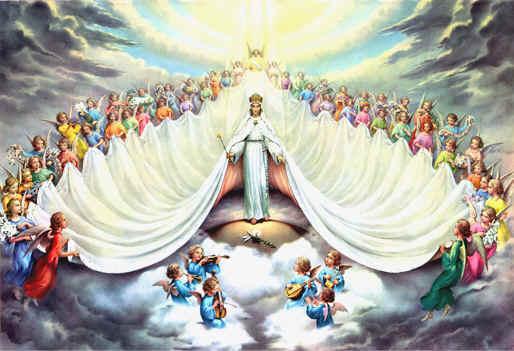
151 years ago, a lady clothed in dazzling white, with a yellow sash around her waist and a crown of stars around her head appeared to a 28-year-old lay woman named Adele. Adele asked the lady who she was and what she wanted, and the lady answered, “I am the Queen of Heaven who prays for the conversion of sinners, and I wish you to do the same. You received Holy Communion this morning and that is well. But you must do more. Make a general confession and offer Communion for the conversion of sinners… Gather the children in this wild country and teach them what they should know for salvation….”

That was the core of Mary’s message: the need for sinners to be converted and for children to be taught the faith. But Adele hesitated, and asked Mary how she was to teach the young when she knew so little herself. Mary replied, “Teach them their catechism, how to sign themselves with the sign of the Cross, and how to approach the sacraments; that is what I wish you to do. Go and fear nothing, I will help you.” After that encounter, Adele’s father built a small chapel on the site and Adele went about fulfilling her mission from Mary for the rest of her life.

The Bride of Christ, the Church, teaches that parents are the primary educators of their children. This means that even if your children go to Catholic or public school, you are their first and foremost teacher in the important lessons of life. But how often do our parents talk to their children about Jesus or Mary, or teach their children about what they should know for salvation? I suspect that many parents are intimidated because, like Adele Brise, they feel like they know too little. But Mary reassures us that we can all teach our children simple but important lessons in the faith that will remain with them and bless them forever.

Like Mary said, teach them the sign of the cross and how to approach the sacraments. At Mass, whisper in their ears, “Look, Father is holding up Jesus,” and on the way home in the car, ask them what they learned from the homily. Have interesting conversations with your children about the faith. Ask them, for example, if they think that Jesus likes sports, ask them what they think Mary’s favorite prayer is, or ask them what they think Heaven is like, and then share your answers with each other. And, perhaps most importantly, teach your children how to pray, by praying with them daily.

Though you know enough already to teach your children a great deal, you must always keep learning yourself. As your children mature in age, you must also mature in your understanding of the faith. Explore why we as Catholics do what we do, and learn why the Bride of Christ, our Mother, teaches as she does. For example, why do we make the sign of the cross? We do it at the open and close of our prayers and you’ve done it since you were little, but now consider more deeply what it means.

Its words and gestures encapsulate our faith’s most central mysteries. It confesses the Trinity and trances our redemption through the cross of Jesus Christ. We pray not “in the names,” but the “in the name of the Father, and of the Son, and of the Holy Spirit,” for God is three persons who are one in nature. [†] From the Father descends the Son, and the Holy Spirit proceeds from the love between them. Tracing the cross on ourselves, [†] we recall how the Father sent the Son to save us, and how the Holy Spirit now acts through our lives with power.

To pray this prayer, for it is a prayer, calls upon God to be powerfully with us. It is to say: “Father, Son and Holy Spirit, I ask you to be near me, here and now.” In the face of temptation or evil, this sign declares, “I belong to neither to the Devil nor the world, I belong to Jesus Christ.” So much is contained in this simple prayer and gesture. It can be taught to a child, yet meditated upon for a lifetime. And this is just one element of our faith. There is always more to explore.

Let us rejoice today, for the apparition of Our Lady of Champion reminds us, that even in Wisconsin, the Lord is near,  and [†] we can call upon Him at any time. Let us teach the faith to our children, so that they will remain near to Him and call upon His name.

The New Eve — December 8 — Immaculate Conception

December 8, 2010

In the beginning, when our first parents fell, they lost a great deal, but they were not deprived of hope, for God spoke in their hearing a prophesy to the deceiving serpent, the devil. God said, “I will put enmity between you and the woman, and between your offspring and hers; he will strike at your head, while you strike at his heel.” Who is this offspring, who strikes back at the devil? He is Jesus the Christ, the New Adam, the Son of God. And who is this woman, who is Satan’s enemy? She is Mary of Nazareth, the New Eve, the Immaculate Conception.

After their Fall, when Adam and Eve heard God approaching in the garden, they became afraid, they fled and hid, so God called out, “Where are you?” When God drew near to Mary, she also was afraid, but she did not hide or flee. She declared, “Behold, I am the handmaid of the Lord. May it be done to me according to your word.” And, because she did, her Holy Offspring could go on to say in His garden of testing, “Father… not my will but yours be done.”

The first man, Adam, called the first woman Eve, because she became the mother of all the living. Now, Mary is the New and Second Eve, for she is the mother of all the living, and she loves each one of us personally as her very own children.

She is the icon of the Church, and as she is, we are called to be: holy and without blemish before God, as the second reading from Ephesians says. But how can we do this? Unlike Mary, at times we have been allies of Satan by our sins. To cleanse us, God gives us the sacrament of reconciliation, and to strengthen us He gives us the fruit from the new tree of life; that tree is the cross, and its fruit is the Eucharistic Christ.

If it has been a long time since you have been to confession, come that you may be purified as pure as Mary. And if you receive our Lord in the Eucharist tonight, consider that the Son of God Incarnate has come to dwell in you, just as truly as He dwelt in Mary.

Let Advent Be Advent — 2nd Sunday of Advent—Year A

December 5, 2010

John the Baptist was living quite differently compared to people in his day. What he wore was different, what he ate was different, and what came from his lips was also different. Yet, John shared something in common with us today. Like Christians in this season of Advent, John knew that the Christ, or Messiah, had already been born, years before in the past. Like us, what John was preparing for was the coming of Christ anew.

That’s the reason why in Advent, in this season of awaiting the Messiah’s arrival, John the Baptist is so prominently featured in our Sunday Gospel readings, like today’s. By looking at John we can learn how to prepare ourselves for Christ’s arrival. As I mentioned before, John was rather different from his neighbors in his day. Today I suggest that we in the Church need to be a bit more different from everybody else if we want to prepare better for Christ’s coming this year.

What did John do with all that time alone in the desert, when he wasn’t out preaching or baptizing? Surely, John was praying, asking for grace and contemplating the one who was coming. The desert is a quiet place, free of distractions, and conducive to prayer. The world can make this month before Christmas a very stressful time. This Advent, you must find a desert, a quiet place, free from distractions, where you can pray each day. Create a daily desert space for your own family as well and prayer together as one. You cannot prepare well for Christ’s coming without daily prayer and the peace it gives.

What did John eat in the desert? He ate locusts, or grasshoppers, and wild honey. The wild honey may sound pretty sweet, until you realize that it was guarded by wild bees. John ate simply. Our meals in Advent should be simple too. You know how it is at Easter, when you enjoy what you gave up for Lent again for the first time? You find yourself enjoying what you denied yourself more than ever before. Then just think of how much greater your Christmas feasting will be if you eat more simply in Advent. (Besides, if you fast or diet now, there will less pounds to lose next year.)

John dressed differently than other people in his day. He wore a garment made of camel’s hair and tied a leather belt around his waist. He dressed like the Old Testament prophet Elijah because he wanted people to know that these were special days. You can also dress in ways that witness to the world that these are special days. One way to do this is to dress liturgically. As you can see, the main color of Advent is purple. If you have purple outfits or ties, now is their season.

By the way, this Wednesday, December 8th, is a holy day of obligation and Christ is asking you to attend the worldwide feast in honor of His immaculately conceived mother. On such a day, intentionally wearing blue or white would honor her. Try dressing liturgically and you’ll find that it reminds you and others of what makes these days special.

What came from the lips of John was different, and despite the large crowds, whatever he spoke was not for himself but for Christ. This year, wish people “merry Christmas” instead of “seasons greetings,” and instead of “happy holidays,” say “happy holy days,” for by this you give witness to the true reason for the season.

John knew that he must decrease and that Christ must increase, for John himself was not the light but had come to give testimony to the light. In the world, the Christmas songs have already begun on the radio and the Christmas trees are all up and lit in the malls, but the day after Christmas their songs will stop and their decorations will be taken down. But as the world is packing Christ away for another year, the Church is just beginning its celebration. You know the “twelve days of Christmas?” On Christmas day, the twelve day begin, not end. Like Easter, the Church celebrates not just one day, but for weeks after.

This year, let Advent be Advent, and save Christmas for Christmas. Sing Advent songs for Advent, and (as much as possible) save Christmas carols for their time. I suggest leaving your Christmas lights, on your tree and on your house, unlit during Advent. Then, when you plug-in at last on Christmas Eve, you shall enjoy a joyful sign that the light of the world has come.

St. John the Baptist calls to you through the Scriptures. I encourage you here, before you. And I hope the Holy Spirit is now prompting you, in your hearts and minds, to keep Advent as Advent this year, and to prayerfully prepare for the coming of Christ at Christmas more profoundly than you ever have before.

7 Superpowers — Tuesday, 1st Week of Advent

November 30, 2010

Back when I was in seminary, we would sometimes joke around with a game we called Superpower/Super-weakness. One of us would imagine a superpower for himself, and then we would try to come up with a super-weakness, or vulnerability, to go with it.

So let’s say that you’re able to fly; then, your super-weakness is that you can only fly to Iowa. Imagine you have the ability to change anything into food; however, that food is always celery and you don’t have any teeth. Or perhaps you can talk with animals, but they only want to talk to you about lawnmowers, trees, and how things smell.

Today, I have a challenge for you. I am going to describe to you seven superpowers, seven more-than-human abilities, though none of these will have built-in drawbacks. Your challenge is to choose which superpower you want for yourself. Here we go:

The first is the power to always recognize what is truly important. With this power, you always keep the big picture in mind. With this power, trifles never distract you and you always spend your time and money well. Let’s call this, Wisdom.

Or, would you rather have the ability to power to penetrate deeply into any topic and grasp it thoroughly. With this power, you could become an expert in any chosen field. If you were to study the dynamics of the stock market, or the weather, or even your female classmates, you would soon understand them thoroughly. Let’s call this power, Understanding.

Or, would you prefer the power to sense the best course of action to take in the middle of any situation? With this power, you would always get reliable hunches in uncertain moments. Let’s call this power, Counsel. (Possessing superhuman intuition would be useful, but even if you always knew the best choice to make, you wouldn’t necessarily always have the strength or courage to follow it through.)

Would you rather have the power to be free from all unreasonable fears and to be able to ignore any sufferings? With this ability, you are be perfectly brave and an overwhelming force. Let’s call this power, Fortitude.

Or, would you want the ability to detect when someone is speaking truth or a falsehood? With this power, you are more than a human lie-detector, you are able to see through subtle and false arguments which other people accept as true. Let’s call this power, Knowledge.

Or, would you prefer to have the innate ability that you would always intensely desire to do what you know to be right? People often know the right thing to do but they still don’t do it. With this power, you are irresistibly drawn to do what’s good. Let’s call this power, Piety.

Or, lastly, would you rather have total protection from ever doing anything stupid? With this ability, you are spared from making the mistakes and errors which are committed by many other people. Let’s call this power, Holy Fear.

So, how many here would choose Wisdom; the ability to always recognize what is truly important and to keep first things first in life?

Who here would choose Understanding; to penetrate deeply into great mysteries?

How many would choose Counsel; an uncanny intuition for choosing the best course of action?

How many here would choose Fortitude; the power to be freed from fears and endure all sufferings?

Who would choose Knowledge; the ability to recognize truth or falsehood whenever you hear it?

How many would choose Piety; the ability to intensely desire to do whatever you know to be right?

And how many would choose Holy Fear, or the Fear of the Lord, to be protected from doing foolish things?

These seven superpowers, these seven more-than-human abilities, are the seven gifts of the Holy Spirit. Their names come from today’s first reading, Isaiah 11:1-10. The good news for us is that God freely gives these gifts to the childlike who ask Him for them, and He does not limit us to just one. At this Mass, pray for all seven gifts of the Holy Spirit, but especially for the power which you desire the most.

Willing, Yet Unwilling — 1st Sunday of Advent—Year A

November 28, 2010

This morning, I’m going to tell you the true story of a friend of mine, a person whom I respect, who was once addicted to sensual sins. As he tells the story, when he was 32 years old, he found himself in an intense spiritual struggle; my friend found himself willing, and yet unwilling, to change his life for Christ.

When he would turn and honestly look at himself, at the things he was doing and the way he was living, what he saw was ugly, sordid, and ulcerous. He desired life with Christ. He knew that holiness should mean more to him than all bodily pleasures, but he could not seem to detach himself from his sins. He hesitated to die to death and to live to life. Old enticements tugged at him and softly whispered: “Are you going to part with us?” Doubts kept nagging him, “Do you really think you can live without these pleasures, forever?”

But together with these temptations, other thoughts beckoned to him. He could envision a smiling multitude of saintly men and women of every age, who had lived both chastely and happily. A voice seemed to say to him, ‘You can also do what these men and women did, but none of them did it by themselves. The Lord their God gave it to them. Why do you try to stand by your own strength, only to fall over and over again? Cast yourself on Christ; don’t be afraid. He will not flinch and you will not fall. Cast yourself on him without fear, for he will accept and heal you.’

My friend was both willing and unwilling, attracted to both and repulsed by both. There were times when he would even pray, Lord, give me chastity, but not yet.” One day, these struggles came to a head for him, as he happened to be sitting in a garden outside of his house. Like Adam and Jesus in their gardens, he had come to a crucial moment of agonizing decision. With tears, he cried, ‘Why do I keep delaying to until tomorrow? Why not now? Why not end my uncleanness this very hour?’ Yet he could not find the strength to do it.

As he was saying these things, he heard the voice of child coming from the house next door, chanting over and again, “Pick it up and read it; pick it up and read it.” Thinking this a rather strange thing for a child to say at play, he took it a divine command to open his Bible and to read the first thing his eyes should fall upon. I took his Bible, opened it, and read these words in silence, words from today’s second reading: “Let us conduct ourselves properly as in the day, not in orgies and drunkenness, not in promiscuity and licentiousness, not in rivalry and jealousy. But put on the Lord Jesus Christ, and make no provision for the desires of the flesh.”

That moment changed my friend’s life for as instantly as he finished reading those words he says that his heart was infused with something like the light of full certainty and all the gloom of doubt vanished away. By this God-given grace, his life began to change, and he went on to become a saint. Actually, you know my friend too, because he’s a friend of yours as well. We call him Saint Augustine of Hippo, and he tells us his own story in Western history’s first autobiography, The Confessions by St. Augustine. [see Book 8, Chapter 11]

All of us here are recovering sinners, and we all struggle with personal addictions to sins large or small. Maybe we find ourselves committing and confessing the same sins over and over again. Maybe we are tempted to doubt that we can really change our lives for Christ. If we try to exert ever-greater efforts of personal will power, and find ourselves failing and falling again, perhaps a new approach is needed.

Instead of making promises and firmly resolving, that this time, somehow, I will amend my life and sin no more, try praying in this way: “Lord Jesus, I want to sin no more, but I have proven again and again, to myself and to You, that I can’t do it. I can’t do it, but You can. Please, give me the gift of your grace. Show me your power working in me. Jesus, live your life through me. I can’t do it, but You can.” Humble yourself and accept the gift of grace. Rely on Christ, for apart from Him we can do nothing. Pray everyday and confess your poverty, and Christ will provide what you need. If we neglect to pray or to humble ourselves, we are showing the pride of a branch that thinks it can produce fruit without the vine. If we do that, we should know that our next fall is near.

This season of Advent is for us to prepare for the Christmas coming of Christ. This year, He is asking us for only one thing; the gift of ourselves. Let us ask for the gift of His grace, so that we may present ourselves to Him, holy, pure, and whole.

[A similiar homily about St. Augustine’s mother, St. Monica.]

The Sound of Heaven — Monday, 34th Week in Ordinary Time—Year II

November 22, 2010

What do you think Heaven sounds like? In the first reading, St. John describes it for us. “I heard a sound from Heaven like the sound of rushing water or a loud peal of thunder. The sound I heard was like that of harpists playing their harps.”

The sound of Heaven that John describes is powerful and beautiful. It is like the onslaught of a tidal wave or a thunder burst, yet it has the harmony, clarity, proportion and perfection of supreme beauty. What John is hearing is the sound of worship in Heaven.

In the Gospel, we hear another sound, neither great nor gorgeous in itself: the quiet chinking of two small coins. Yet, this simple sound has echoed for two-thousand years and millions have been drawn to it. When Jesus Himself heard the sound of the faithful, poor widow’s generous gift, He was moved to speak words in praise. Despite its subtlety, it reminded Jesus of a sound He knew well; it reminded Him of the sound of Heaven.

In our own simple ways, with unending joy, let us echo on earth the song of the angels in Heaven as they praise God’s glory for ever.

Laodicean Christians — Tuesday, 33rd Week in Ordinary Time—Year II

November 16, 2010

The Christians of Laodicea lived in what is now southwestern Turkey. Today, their city is merely ruins, but in those days it was a modern, rich, commercial center of banking, industry, and entertainment. The Christians there were well-off and contented, but Jesus knew them and their city well and he was not content with them. In the Book of Revelation He rebukes them, “You say, ‘I am rich and affluent and have no need of anything,’ and yet do not realize that you are wretched, pitiable, poor, blind, and naked.”

A few decades before, in 60 AD, an earthquake ravaged their city and the Roman emperor offered to send them money to aid in their recovery, but within a year, the wealthy Laodiceans had finished rebuilding using only their own resources. To a people too rich and proud to accept a king’s aid, Jesus says, ‘I advise you to buy from me gold, (good works) refined by fire, so that you may be (truly) rich.’

Laodicea was home to the Marshfield Clinic of its day in the field of eye medicine. There they produced of an ointment for the eye which was used throughout the Roman empire. But Jesus urges the Chrisitians, ‘buy (true) ointment to smear on your eyes so that you may see (the truth).’

Laodicea was also known for its fine, soft, black cloth, made from the wool of the region’s excellent dark sheep. But Jesus sees the Christians’ immorality and warns, ‘put on white garments, so that your shameful nakedness may not be exposed.’

Laodicea had an aqueduct which carried water to the city from hot springs some five miles away, but by the time this water would get to them, it would be merely lukewarm; neither cold enough to cool in hot weather, nor hot enough to warm-up in cold weather. Jesus likens the Laodicean Christians to their water supply. “I know that you are neither cold nor hot. I wish you were either cold or hot. So, because you are lukewarm, neither hot nor cold, I will spit you out of my mouth.”

Jesus Christ, being divine, knows the Christians of Laodicea perfectly well. By their values, words, and actions, He sees them living not much different than any other Laodiceans. And because He loves them, he corrects them, and warns them that they need to repent and to start getting serious about living true, Christian lives.

Do we live in a Christian nation? Compared to the secularized countries of Europe, or to the Asian or African countries where Christianity is the minority religion, the United States is a very Christian nation. On the other hand, only about one in four Americans went to Church last weekend. [source] Only one in four Americans offered up an hour to God, to thank Him, worship Him, and to fulfill the commandment, “You shall keep holy the Lord’s day.” Of course, being a Christian is about more than just going to Church, but this gives us some indication of our society’s commitment to Christ.

To think of our country as a Christian nation at a 25% level, or to a 25% degree, is both discouraging and encouraging. It is discouraging that our devotion is not greater, but there is encouragement to be found in this: if our society’s half-hearted, or even quarter-hearted commitment to Christ and His Gospel can do as much good as we see now, imagine what things would be like if we were whole-heartedly His disciples.

As G.K. Chesterton said, “Christianity has not been tried and found wanting; it has been found difficult and not tried.” The Gospel is supposed to be radical. It’s supposed to change the world. If there is nothing very counter-cultural about your life as a Christian, then you are not yet living out the Gospel like Christ calls you to do. If you are living the same way as everyone else in our present-day Laodicea, then Jesus Christ’s wake-up call from the Book of Revelation through the centuries is addressed to you.

Jesus is looking for people who will go out on a limb for Him, people like Zacchaeus, people who will risk the mockery and judgment of others, people who would give half of their possessions to the poor if that is what Christ wills, people who will rise and open the door for Christ when they hear Him knocking. Jesus is looking for disciples who seek the riches of being a true and whole-hearted Christian. With a person like that, Jesus can change the world.

Go to church every weekend, pray every day, and do not merely learn about our faith but act on it in your life. Jesus Christ pleads to you, through me and your teachers who have witnessed their faith to you, please: go out on the limb for Him.

Demonic Delay — 33rd Sunday in Ordinary Time—Year C

November 14, 2010

Once upon a time, an uncertain number of years ago, there was an important meeting of demons in Hell. In the midst of their fires and shadows, with a foul and terrible stink in the air, the top of Hell’s hierarchy was planning a long-term strategy for how to mislead humanity.

Why do they scheme against us? Because on the day when Jesus comes again to judge and rule the world with justice, the demons do not want us to experience His healing rays; they want us to burn with fire, like themselves. Since they cannot hurt God directly, they lash out by trying to make us share in their misery.

As they met, brainstorming for ideas, one demon suggested, “How about we try telling them that there is no such thing as evil?” The chairman said, “You stupid worm, you pathetic disgrace, the humans will never believe that! Do you think that we can pit a person against a person, a nation against a nation, or a soul against our Enemy above, without the humans noticing the sadnesses, sufferings, impurities, jealousies, envies, rivalries, resentments, hatreds, injustices, cruelties, or murders that follow? They see evidence of evil on the front page of every newspaper and in every gossip’s tale! Humans are reminded that something’s wrong with their world whenever their alarm clocks ring, whenever their toes get stubbed, or whenever someone they know dies! You’ll have to do better than that!”

A little while later, another demon suggested, “What if we told them that there is no such thing as goodness?” The chairman said, “You worthless slime, you ugly idiot, the humans will never believe that! Our Enemy above has littered their world with beauties and gifts to many to count, and everything that the humans do is in the pursuit of what they think is good! They have this irresistible desire to be happy that our Enemy has built into them! Tell me, how would we tempt them to sin without promising them something which attracts them, something which is at least seemingly good? Is there anyone here who is not a useless fool?”

But then, one of the chairman’s most cunning underlings suggested another approach, an approach which was immediately welcomed by the others with cruel smiles and restrained applause (for a demon resists praising anyone but himself.) This insightful demon said, “Let us convince the humans… that there’s no need to hurry.”

In every generation, there have been Christians who belived that their generation would be the last. But personally, I don’t expect the second coming of Jesus Christ to happen in the very near future for the simple fact that it remains legal to be a Christian throughout North and South America. There are great evils in our world, even within our own country, but the final attack of evil against Christ’s Church in the last days should be far worse than this. [For more from the Catechism of the Catholic Church on “The Church’s Ultimate Trial,” see CCC 675-677 ]

I do not expect Christ to come in the immediate future to us, but we must always be preparing ourselves to be ready to go to Him, for we never know when we will die. Never be anxious and never be afraid, but prepare yourself for what is certainly coming. Instead of being busybodies, distracted by many unimportant things, let’s get busy making the most important things the most important things.

If you knew for a fact that you were going to die six months from today how would you begin to live your life differently? Would you pray more each day? Would you go to confession and to Mass more often? Would you work harder at doing good works? Would you crush your lingering vices? Would you forgive your enemies? Would you show more love to the people in your daily life?

Seriously thinking about what you would you do different if you knew you were going to die will give you a good place to start in living more intentionally for Christ, with your eternal goal in mind. Do not believe the demon’s whispered lie that ‘there is no need to hurry,’ for your last day is closer than it was yesterday, and it may be much closer than you think.

True Christian Soldiers — November 11 — St. Martin of Tours — Veterans Day

November 11, 2010

This morning I would like to tell you two stories. The first is the story of a cavalry officer who was sent to serve in France. He grew up in a military family and got enlisted when he was still only a teenager. Interestingly, his parents were not Christians, but this young man was studying in preparation to become a one himself. He was what we call a catechumen.

One cold winter day, at the gates of the French city of Amiens (A-mi-en), he encountered a shivering, half-naked beggar. This miserable sight disturbed the young soldier and he drew his sword from its scabbard. Because he had nothing else to give the poor man, the soldier took his own cloak, cut it in two pieces, and reaching down from his horse handed one half to the beggar. Giving away half of his cloak was no small gift, considering that the soldier himself needed to keep warm, too. In this act, he had loved his neighbor, the beggar, as himself.

That night, the soldier had a dream in which he saw Jesus Christ, surrounded by angels, and dressed in half a cloak. He heard a voice say to look at the garment and say whether he recognized it. He then heard Jesus say to the angels, “Martin, as yet only a catechumen, has covered me with his cloak.” Very soon after that dream, Martin, the 18-year-old Roman soldier, was baptized. He would go on to become a monk, a priest, and a bishop. Today we call him as St. Martin of Tours, and celebrate him as the patron saint of soldiers.

My second story comes from more recent times. A great and horrible war was raging, as it had for more than four years, killing every day. Many people could see no end in sight. But then, ninety-two years ago today, the wonderful order came announcing an end to all armed conflict at the 11th hour, of the 11th day, of the 11th month, of the year 1918. This was the end of the First World War and it came to pass on the ancient feast day of St. Martin of Tours, the 11th of November.

Do you think that St. Martin in Heaven may have prayed for his beloved France and for their enemies, too? Do you think that he interceded before God for peace on Earth? Of course he did, for he was a true Christian soldier. No true Christian soldier loves war, or even hates his enemy. He fights not because he hates who is in front of him, but because he so loves what is behind him. The Christian soldier trains for war because he loves peace.

Today we thank and honor our veterans for they have served to defend our nation and freedom-loving people around the world. Through the intercession of St. Martin of Tours, let us pray that our country, history’s most benevolent superpower, may be served by Christian soldiers like them for many peaceful generations to come.

The Saints & Us — 22nd Sunday in Ordinary Time—Year C

November 5, 2010

 
Brothers and sisters, as the Letter to the Hebrews tells us, we have approached Heaven even as we remain on earth. Though we are dust and sinners, we stand before Jesus, the eternal Father, and the Holy Spirit. We draw near to each other and they invite us to share more deeply in their friendship. And they are not alone. They are surrounded by countless angels and by a multitude of men and women whom they have made perfect in goodness and love. We have a name for these “holy ones” who live with God in Heaven. We call them “saints,” and Jesus invites us to share their friendship, too.

Have you ever had the pleasure to introduce your friends to each other; people who already know and enjoy you, but who have never met each other? I think you’ll agree that it’s a very special joy when your friends to befriend each other. When your friends befriend each other do they love you less because of it, as if their affection has been divided or diluted? No, the love between all of you is greater for being shared. So it is with Jesus, the saints, and us. Some Christians fear that befriending Jesus’ friends in Heaven will lessen our love for Him. They fear that talking to them and honoring them will distract us from Christ. But these are silly fears. Love increases by being shared.

When someone asks you, “Would you pray for me,” or asks you to pray for one of their heartfelt concerns, what do you say in reply? Do you refuse, saying, “Why should you ask me to pray for you when you can go directly to God?” Nobody says that. Instead, Christians say, “Of course I’ll pray for you.” Christians ask each other to intercede for them not because they have lost hope in Christ, but because they have it, and because Scriptures tell us, “pray for one another.” Asking our friends and family in Heaven to pray for us is no different than asking our friends and family on earth, except that the prayers of the saints are offered by souls perfected in love and divine intimacy.

What about the objection that honoring the saints distracts from Christ? Today’s Gospel shows that Jesus does not think that sharing honor with His saints detracts from His own preeminent glory. He has said to them, “My friend, move up to a higher position. Then you will enjoy the esteem of your companions at the table.” By giving seats of honor to His saints at His heavenly wedding banquet Jesus invites us to esteem them. In honoring them, we honor Him.

Remember that our circle of closest family and friends is not limited to earth. We have brothers and sisters in Heaven; saints and angels who know us, love us, and want to help us arrive at our true home. Let us remember to take the opportunity to make their acquaintance and grow in their friendship.

Uniquely Different — October 28 — Sts. Simon and Jude

November 3, 2010

[Jesus] called his disciples to himself,
and from them he chose Twelve,
whom he also named Apostles:
Simon, whom he named Peter…
Simon who was called a Zealot,
and Judas the son of James,
and Judas Iscariot, who became a traitor.

In the early days of their ministry, whenever Jesus called out for ‘Simon’ or ‘Judas,’ more than one head may have turned. Among Jesus’ apostles there were two Simon’s and two Judas’. There was Simon Peter and Simon the Zealot, and Judas (or Jude) the son of James and Judas Iscariot the betrayer. Though these pairs shared the same names and the same calling to be apostles, they were different in important ways.

Simon Peter was called to be the Rock, the leader of the apostles and of the nascent Church. Simon the Zealot may have shared his zeal, but he was not meant to have the same role as Peter. Each saint’s apostleship was unique to him.

Sometimes Christians who eagerly desire to be saints themselves strive to impersonate their favorite holy heroes. We do well to learn from the lived examples of the saints, for St. Paul did say, “Be imitators of me, as I imitate Christ,” but there can truly be only one St. Paul, one St. Francis, or one St. Therese of Lisieux. Every saint in history has been unique, and every future saint will be, too.

The two Judas’ teach us a lesson, too. Even after years of preaching the Gospel, I can imagine some people felt an initial uncertainty towards Judas the son of James. Intellectually, Christians would know that this apostle could not possibly be Judas the betrayer (because he one took his own life,) yet they might feel wary about this “Judas” in their midst.

Sometimes our feelings toward other people are influenced by who they remind us of. For instance, if you meet someone whose face resembles a person who has hurt you in the past, you may be involuntarily uncomfortable around them. In psychology, this shift of emotions from one person or thing to another is called transference. This is the stuff that prejudice is made of, and the good apostle, Judas, caught some of its unjust, negative effect.

Though the apostles shared names and a common calling, they were unique individuals. The two Simons teach us that each is called to live out their own, unique, holy life. The two Judas’ teach us that we must always receive others in their own personal uniqueness.

Have A Holy Halloween!—31st Sunday in Ordinary Time—Year C

October 31, 2010

Have you ever noticed how our Christian holidays get filled with stuff that distracts us from what we’re really celebrating? Take Christmas, for example. There’s nothing wrong with exchanging gifts and decorating with tress and lights, but there is good reason in that season that we need be reminded, to “Keep Christ in Christmas.” For many people, celebrating the birth of the Prince of Peace on earth is the most stressful time of the year. Or consider Easter: There’s nothing wrong with chocolate bunnies and hunting for Easter eggs, but the connection between egg-laying rabbits and Jesus’ resurrection is tenuous at best.

However, this disconnection between Christian holy days and the cultural observance of holidays is the greatest when it comes to Halloween. There’s nothing wrong with kids playing dress-up and going door-to-door to ask for candy, (I have many happy memories of this myself,) but Halloween’s connection to its Christian holy day seems to have been forgotten. The name “Halloween” comes from “All Hallows Eve,” or the evening before All Saint’s Day. Something is “Hallowed” when it is sanctified or respected, as in, “Our Father, who art in Heaven, Hallowed be thy name.” All Saints Day celebrates the “hallowed” ones, the holy ones, the saints who are now in Heaven. Some of these saints are canonized, but most of them are not.

For every friend and relative we knew on earth who is now in Heaven, November 1st is their feast day in the Church. And for our holy dead who are still being purified and made perfect so that they may enter the fully-unveiled presence of our infinite God, there is November 2nd, the Feast of All Souls. In this fall season, when the natural world appears dying, our Church celebrates the holy dead, for we have hope in the new life.

Halloween, or “All Hallows Eve,” is to All Saints Day what Christmas Eve is to Christmas. As Christmas Eve reminds us of Christ’s coming, so Halloween should remind us of the victory of the saints, and of our own life’s calling: to become the best possible versions of ourselves, to become saints.

I think it is in no way an overreaction to observe that the secular observance of Halloween has overtones in dark, demonic things; the things of horror. Isn’t it suspicious that from a feast celebrating the saints in light, we have a secularized holiday focused on things of darkness? Instead of Christian hope in the resurrection of the dead, Halloween gives us images of zombies. Instead of the consolation that we are surrounded by the perfected souls of the saints, who love us and are full of concern to help us, Halloween gives us tales of ghosts and demons who want to harm and scare us. How does this sort of thing happen? I don’t think it is crazy to think that the Evil One wants to distract people from the true reason for this season; that the Devil would have us thinking about him, rather than the saints, that he wants us to be terrified, rather than full of hope.

Did you know that this Sunday, Satanic worshipers will come to Masses and Catholic Churches around the country trying to steal our Lord in the Eucharist? (Interestingly, they don’t go after the communions of Protestant denominations, but only the Catholic Eucharistic Hosts.) Their plan is to desecrate Jesus in a ritual they call a Black Mass. In doing this they are trying to rebel, seeking a false freedom that cannot make them happy. They try to harm Jesus, but only hurt Him in as much as they sadden Him. These sad people, who strike out at Jesus, are really hurting themselves and the Jesus still loves them. We know that the Lord loves every person He has made, for as the first reading notes, if the Lord did not love His creations, they would not continue to exist. As we see in today’s gospel about Zacchaeus the sinful tax-collector, there is hope for them and all of us, for Jesus “has come to seek and to save what was lost,” and He calls every one of us to be happy and holy with Him.

This Halloween, let us pray for the misguided persons, who knowingly or unknowingly, will dabble in bad things tonight, that they may turn to Christ. Let also offer Jesus our consolation for how the feelings of His Sacred Heart will be wounded by their offenses against His love. And for ourselves, let us try celebrating Halloween in some different ways this year.

Maybe everyone in your household already has their trick-or-treat costumes ready (but I know it can sometimes be a last minute decision.) If you’re still looking for costume ideas, how about dressing up as an awesome saint? Saint costumes can be easy and very creative. Dressing like this delights the saints (and it will probably score you more candy.)

Does your family have a patron saint? If not, then pick one this Halloween and entrust your family to them for the year ahead. Print off their picture from the internet and put it on the wall, learn about them as a family, and pray to them, asking that they pray for you. (I, for myself, am choosing St. John Vianney this year; the patron saint of priests and a good guy to know.) Great saints are waiting, just waiting, to grow in friendship with you.

This year, make it a point to celebrate the vigils and feasts of All Saints and All Souls. Our family and friends who are now in Heaven or on their way there expect us to be joyful on these feast days in their honor, and there is not better place for us on earth to draw near to them than here, around the altar of Jesus Christ.

Christ is the Light who shines through the darkness. This Halloween, let us claim the night for Jesus Christ and His saints.

Catholic Medical Ethics—30th Sunday in Ordinary Time—Year C

October 27, 2010

In today’s second reading we hear from St. Paul, a prisoner in Rome on account of Christ and the Gospel.  Paul senses that the end of his life on earth is near. He writes:

“I am already being poured out like a libation,
and the time of my departure is at hand.”

The emperor will soon order Paul to be executed by beheading, sending him to Christ’s eternal reward. Yet this is not to the emperor’s glory, for the blood of St. Paul’s murder will be on his hands.

By God’s grace, Paul was not left all alone in this difficult, final season of his life. Elsewhere in this chapter from 2nd Timothy, he writes, “Luke is the only one with me.”  (This is St. Luke the evangelist, whose Gospel we are reading this liturgical year.) In another letter, Paul calls Luke his “beloved physician.”

Now what if Luke, seeing Paul’s burdens and what trials awaited him, were to procure some hemlock with which to end his friend’s life? Would Paul be pleased with him? Would he not rather be angry that Luke would presume to thwart God’s purposes for him on earth?

The Lord, the author of our lives, is the one to decide when someone’s life story is complete. God has joined our souls to our bodies and what God has joined together, no human being must separate; for it is always and everywhere wrong to intentionally kill the innocent. God sent Luke to Paul not to kill him, but to strengthen, console and support him in this last season of his life.

Healthcare and end of life issues touch all our lives, and people of good will have many questions in this area. Like, “What is wrong with euthanasia or assisted suicide?” “What does Christ’s Church teach about living wills, ventilators, feeding tubes, and palliative care?” And, “What kind medical care is morally required, and what sorts of care are optional?”

The Church calls care and treatments which are morally required “ordinary care.” Treatments which are optional called “extraordinary care.” Each of us has an obligation to respect our lives and bodies as precious gifts from God.  This means that we must always receive, and provide to others, “ordinary care.” However, circumstances can arise where various treatments become “extraordinary” and may be omitted. Treatments which involve great pain, or extreme cost, or little likelihood of doing much good can be deemed extraordinary care.  Burden, cost, and futility can make a treatment morally optional.

Yet, every treatment must be put into context. Sometimes the same procedure, which is ordinary in some cases, will be extraordinary in others. Sometimes a ventilator can be an extraordinary treatment, making it acceptable for people to refuse or discontinue its use. However, imagine if an otherwise healthy person should come to the hospital with a routinely curable lung condition which requires surgery and the short-term use of a ventilator.  In this case, the ventilator—which can be costly and burdensome—is not extraordinary because its benefits far outweigh its burdens.

This is a danger with living wills and advance directives.  Making medical decisions about treatments, in the abstract, in advance, and out of context, can easily lead to wrong decisions. Consider the use of feeding tubes. A person can check a box on a living will that says they never want one, but feeding tubes are quite often ordinary care; however, in some cases, they become extraordinary care.

Sometimes, in the process of dying, a person may no longer be able to digest food. In such an instance, use of a feeding tube would be futile, painful, extraordinary, and rightly omitted. But if someone is not dying, to deprive them of food or water is like preventing a diabetic from taking their insulin. That is not allowing nature to take its course—it is homicide. Pope John Paul II taught that ‘a sick person in a vegetative state, awaiting recovery or a natural end to their life, still has the right to basic health care (such as nutrition, hydration, cleanliness, warmth, and the like), and to the prevention of complications related to his or her confinement to bed. … Causing someone’s death by starvation or dehydration, if done knowingly and willingly, is truly euthanasia by omission.’

We condemn euthanasia and assisted suicide because they are about killing the person rather than killing the disease, and we can never intentionally kill the innocent. It is wrong to kill the sick, but it is good to alleviate their pain and discomfort while they live. This kind of treatment, aimed at increasing a person’s comfort, is called palliative care and it is a great good. The work of Hospice and others is to provide palliative care in the final stages of life.

Would it be wrong to overdose a person with morphine to end their life?  Yes, for it is wrong to intentionally kill the innocent. But what about a case where treating someone’s pain with pain-killers (in the normal doses) might have the unintended side-effect of shortening their remaining days? Would it be wrong to request or administer such a treatment?  No because the aim is not to kill the sick person, but to relieve their pains. Sometimes, people with cancer choose to forgo chemotherapy and its burdens even though treatment might help them live longer than they would without it. Are these people choosing death? No, they are choosing a different way to live. The burdens of chemotherapy can make it an extraordinary treatment, and we are free to forego extraordinary treatments, even if it may shorten our lives.

The three principles I have tried to present today are these: first, that it is always and everywhere wrong to intentionally kill the innocent.  Second, that we must receive, and provide to others, ordinary care. And third, that treatment which entails great pain, or extreme cost, or little likelihood of doing much good can be deemed extraordinary care, and is morally optional.

I hope you now have a clearer understanding of some points of Catholic medical ethics, but these can be complicated issues. If you are facing difficult treatment decisions, for yourself or someone you love, seek out counsel of those who know the Church’s teachings on this subject. Holy Mother Church’s wisdom on healthcare issues is the natural and logical extension of her dedication to human dignity. As Roman Catholics in a culture of death, we must we stand for the dignity of every human life, from conception to natural death, and we need to vote for it, too.

  • An article on “ordinary” and “extraordinary” care.

Prepare Yourself—Wednesday, 30th Week in Ordinary Time—Year II

October 20, 2010

If you knew for a fact that you were going to die, or that Jesus was coming again,  one month from today, how would you begin living your life differently?

  • Would you pray more? 
  • Would you work harder to do good deeds?
  • Would you resolve to crush lingering vices?
  • Would you forgive enemies?
  • Would you show greater love toward people in your life?

Jesus said to his disciples:

“Be sure of this: if the master of the house had known the hour when the thief was coming, he would not have let his house be broken into. You also must be prepared, for at an hour you do not expect, the Son of Man will come.”

This is much is certain: someday we will die, or we shall live to see Jesus return ‘at an unexpected hour.’ So, let us commit ourselves by the grace of God  to living in such a way now that if someone were to ask us what we would do differently if the end of the world or the end of our lives were near, we could honestly answer, “Nothing. Nothing at all.”

Prayer is Necessary — 29th Sunday in Ordinary Time—Year C

October 17, 2010

As the Hebrews fought the Amalekites, Moses held up in his hands, above his head, the wooden staff of God. In doing this, He resembles Jesus, who outstretched his arms on the cross, and the priests of Christ’s Church, who raise their hands up to Heaven.  Each one, Moses, Jesus, and His priests, offer prayers to the Father.

As long as Moses kept his hands raised up,
Israel had the better of the fight,
but when he let his hands rest,
Amalek [the enemy] had the better of the fight.

What would have happened if Moses had kept his arms just down at his sides? God’s people would have lost their deadly battle. What would happen if Jesus were to stop pleading for us at right hand of the Father in Heaven? We would be left all on our own. What would happen if priests were to no longer to offer the Mass? The Church would be deprived of graces. If Moses, or Jesus, or the priests of the Church were not persistent in prayer, souls would be lost. The same is true for you and I as individuals.

If you or I wish to be saved, it is necessity for us to pray always without becoming weary. As St. Alphonsus Liguori, a doctor of the Church, said: “He who prays is certainly saved; he who does not pray is certainly damned. All the saints in heaven, except infants, were saved because they prayed; and all the damned in hell were damned because they did not pray, and this is their greatest torment to see how easily they could have been saved, had they prayed, and that now the time for prayer is over.”

Prayer is how we grow in our relationship with God. And Heaven consists first and foremost in an intimate relationship with Him. But, if we do not pray, we will not have much of a relationship with God, and Heaven will not be a place where we really want to live. It is essential that you commit yourself to praying every day, ‘whether it is convenient or inconvenient.’

To remain committed to this, ask the help of other to strengthen you and keep you faithful to prayer. Moses had the help of Aaron and Hur, at his right and his left. Jesus had the help Mary and John, at the foot of His cross. The priest celebrating Mass has the help of God’s people, those in the church on earth and those in the Church in Heaven. So have your spouse, your children, and your friends to pray with you and keep you faithful to prayer.

Families should pray together, parents with their children. This will instill the Faith in them more than anything else.  And Fathers need to take the lead, for if only Mom prays with the children they will wonder, “Why doesn’t Dad pray, too?”

Couples should also pray together.  A couple that prays together every day a divorce rate less than one percent. And it makes sense, because if I know that someone is praying for me, that they’re willing my true good, then even if there are rough spots between us, I know that we’re on the same side. So before you leave the house, or before you go to bed, pray together as a couple; even if it’s as simple as a moment of silent prayer. Remember that the family that prayers together, stays together.

It is necessity for us to pray always without becoming weary, as families and individuals, for “He who prays is certainly saved; he who does not pray is certainly damned.” So pray every day, because our souls depend on it.