Archive for May, 2026

Comfort To My People — Funeral Homily for Deon Zwiefelhofer, 61

May 22, 2026

By Fr. Victor Feltes

Isaiah the Prophet proclaimed: “‘Comfort, give comfort to my people,’ says your God.” In light of Deon’s passing, on this day of her funeral, may my words give you comfort. With the coming of Pentecost Sunday, we recall how Jesus assured us: “I will ask the Father, and he will give you another Advocate [or “Comforter”] to be with you always… You know him (the Holy Spirit), because he remains with you and will be in you.”

How do we know the Holy Spirit is with us? One sign of this St. Paul gives to the Corinthians is how “no one can say, ‘Jesus is Lord,’ except by the Holy Spirit.” Another sign of the Holy Spirit’s presence is how he moves us to cry out to God the Father like Jesus did. St. Paul tells the Galatians: “As proof that you are sons, God sent the Spirit of his Son into our hearts, crying out, ‘Abba, Father!’” And St. Paul tells the Romans: “You received a Spirit of adoption through whom we cry, ‘Abba, Father!’ The Spirit himself bears witness with our spirit that we are children of God, and if children, then heirs, heirs of God and joint heirs with Christ, if only we suffer with him so that we may also be glorified with him.” St. John confirms in his first New Testament letter that we have become the children of God, writing: “See what love the Father has bestowed on us that we may be called the children of God. Yet so we are. Beloved, we are God’s children now; what we shall be has not yet been revealed. We do know that when it is revealed we shall be like him, for we shall see him as he is.”

Jesus came to earth as man so that we could enjoy his eternal life and become more like him. St. Matthew describes how before preaching his Sermon on the Mount, “when Jesus saw the crowds, he went up the mountain, and after he had sat down, his disciples came to him.” This is not merely recording a historical detail; it foreshadows our joining Jesus on his holy mountain one day. Jesus has ascended and is now seated at the right hand of the Father, and his disciples will come to him. The Prophet Isaiah tells us that: “On this mountain the Lord of hosts will provide for all peoples. …He will destroy death forever. The Lord God will wipe away the tears from all faces. On that day it will be said: ‘Behold our God, to whom we looked to save us! This is the Lord for whom we looked; let us rejoice and be glad that he has saved us!’”

I am told that when family would visit Deon’s home she would often send them on their way with food, usually baked goods, as a gift of her love. Likewise, when we come here to Jesus’ house he sends us forth with the gift of his most precious Food. At this and every Holy Eucharist, you can pray for Deon’s soul (to aid her in any purification) and renew your profession that Jesus is your Lord and that God is your Father. Allied with Jesus Christ and led by the Holy Spirit, we can all go up to God the Father where we will experience full consolation. Ours will be the Kingdom of Heaven and we will be comforted. We will inherit the earth as well and we will be satisfied. We will be shown mercy and we will see God. We will be the children of God and we will rejoice and be glad, for after the trials and hardships of this life our reward will be great in heaven.

Why Did Jesus Go?

May 17, 2026

Solemnity of the Ascension
By Fr. Victor Feltes

Jesus’ Ascension can feel like a bittersweet mystery. Jesus ascends with his human nature into heaven and takes his seat enthroned at the right hand of the Father. This is a wonderful event for us, but it can also feel sad. The apostles had felt that way. Jesus told them at the Last Supper, “I am going to the one who sent me… But because I told you this, grief has filled your hearts. But I tell you the truth, it is better for you that I go.” We might feel like St. Mary Magdalene, who rejoiced to hear and see and touch the Risen Jesus at the tomb on Easter Sunday. She did not want to ever let him go. Jesus told her, “Stop holding on to me, for I have not yet ascended to the Father.” Why was it better that Jesus ascended?

Jesus now enjoys supreme honor and intimacy with his Father in heaven, reigning and interceding for us. But a Christian still might wonder, “Why wouldn’t it be better if Jesus had remained visibly on earth (as during his public ministry)?” Imagine Jesus leading his Church and various nations today as our visible high priest and king whom we could see and hear directly. Some might argue that Jesus on earth was limited by his humanity, saying, “His human nature allowed him to only be one place at a time, like Capernaum or Jerusalem, but not both places simultaneously. So maybe reigning from heaven allows Jesus to be more present to every person and place.” But is the Risen Jesus’ glorified humanity actually limited in this way?

A number of Catholic saints have reportedly manifested the gift and miracle of bilocation during their earthly lifetimes. There are stories of St. Anthony of Padua, St. Martin de Porres, St. Alphonsus Liguori, St. John Bosco, St. Padre Pio, and others being physically present at one location while also being present or manifesting at another. Contemporaneous evidence and sworn testimony indicate that in the 1620s a cloistered Catholic nun named Venerable Mary of Agreda was teaching the Faith to American Indians in what is today eastern New Mexico and western Texas without ever leaving her convent in Spain. So if Christ’s earthly servants can be more than one place at once, then Christ the God-Man should be able to do this all the more. Besides, Jesus is really present (albeit in a veiled way) in the Eucharist at Catholic Churches all around the world, so the miracle of visible multilocation does not seem beyond our Lord’s ability. Imagine Jesus ministering today as the pastor of every parish, as the teacher in every classroom, as the doctors at every hospital, and the staff members for every charity. Wouldn’t Jesus do a better job in our roles than you or me? So why doesn’t he do it?

Before his Ascension, Jesus tells his disciples, tells his Church: “All power in heaven and on earth has been given to me.” So Jesus could do everything himself, yet he rejects that approach. Instead he gives us a mission, our Great Commission: “Go… and make disciples of all nations, baptizing them in the name of the Father, and of the Son, and of the Holy Spirit, teaching them to observe all that I have commanded you.” Jesus does not leave us with nothing to do, forever immature and passive. He wants us to actively share in his mission, in his joyful labors, and in his glory. “As the Father has sent me, so I send you.” “Amen, amen, I say to you, whoever believes in me will do the works that I do, and will do greater ones than these, because I am going to the Father.” Ours is a high calling and a great responsibility toward the good of souls, but Jesus does not expect us to do it alone or by our own power.

Jesus says, “I tell you the truth, it is better for you that I go. For if I do not go, the Advocate will not come to you. But if I go, I will send him to you.” “You will receive power when the Holy Spirit comes upon you.” “And behold,” Jesus says, “I am with you always, until the end of the age.” Jesus has important Kingdom work for each of us: to reflect him and witness to him for others and help draw them to himself. In your life you have family and friends, coworkers and customers, neighbors and strangers, whom you interact with and may know well! Jesus would utilize you for his holy purposes, but it is important to make ourselves open and available to him. So pray to him: “Here I am, Lord, I come to do your will. Here I am, send me.” Then watch for and take up the opportunities that follow.

Our Jewish Bridegroom

May 2, 2026

5th Sunday of Easter
By Fr. Victor Feltes

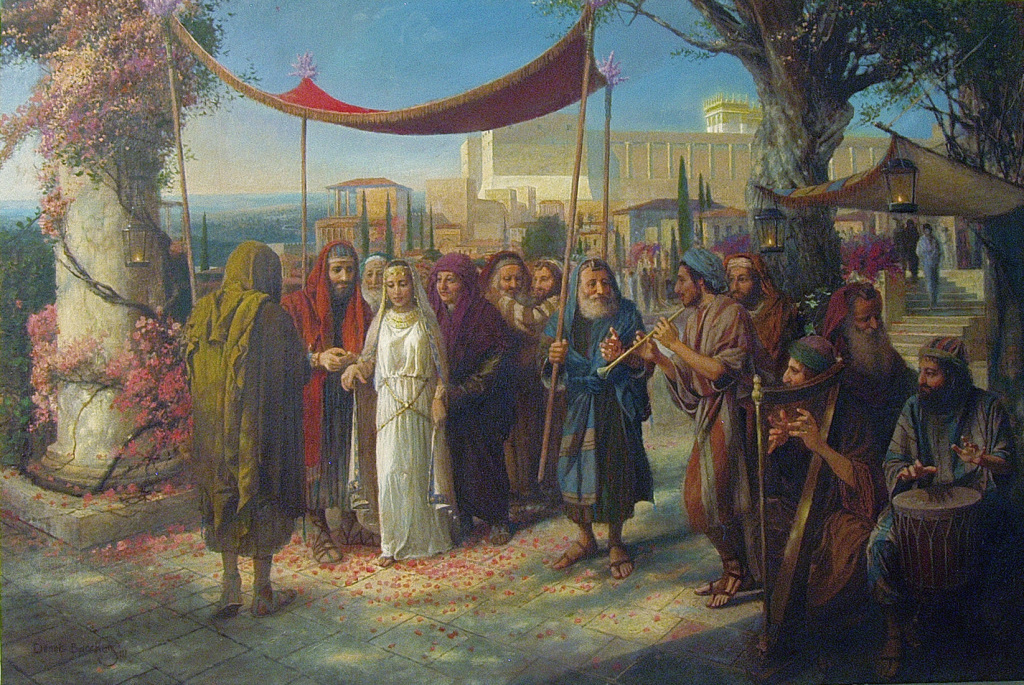
First century Jews had marriage customs different than ours today. When a Jewish man wished to marry a woman, he would journey from his father’s house to hers. There he would establish a covenant by paying the agreed-upon dowry price to the father. With this payment and a shared drinking of a cup of wine, their new covenant was established. This event was called “betrothal” and the man and woman were henceforth legally husband and wife. The bridegroom, however, would not yet begin living with his bride. To manifest the purity and honorableness of his love toward her, he would return to his father’s house, typically for twelve months. During this time, the bridegroom would build-on an addition or prepare a residence at his father’s house. The bride, meanwhile, would ready her wedding garments and jewelry and practice skills for their life together.

St. Matthew’s Gospel recounts the story of Joseph and Mary’s betrothal. When “Mary was betrothed to Joseph but before they lived together, she was found with child through the Holy Spirit. Joseph her husband, since he was a righteous man yet unwilling to expose her to shame, decided to divorce her quietly. Such was his intention when, behold, the angel of the Lord appeared to him in a dream and said, ‘Joseph, son of David, do not be afraid to take Mary your wife into your home. For it is through the Holy Spirit that this child has been conceived in her…’ When Joseph awoke, he did as the angel of the Lord had commanded him and took his wife into his home.

When the separation time was over at the end of a Jewish betrothal, the bridegroom and his groomsmen would journey, usually at night in a torchlight procession, to where the bride lived. She would be expecting his return but would not know exactly when. That is why a friend of the bridegroom would run ahead to announce: “Behold, the bridegroom! Come out to meet him!” The bridegroom, reunited with his bride, would take her to his father’s house, to their new home together. There the couple would consummate their union and seven days of joyful wedding feasting would begin. I relate all of these details about ancient Jewish wedding customs because they provide insight into Jesus Christ’s words and works.

The Prophet Isaiah had foretold: “As a young man marries a virgin, your Builder shall marry you; and as a bridegroom rejoices in his bride so shall your God rejoice in you.” Through his Incarnation, Jesus descends from his Father’s house in heaven to where we live here on earth. Jesus declares and calls himself “the Bridegroom” and the New Testament subsequently calls his Church his “Bride.” St. John the Baptist was his forerunner-friend who testified, “I am not the Christ, but…I was sent before him,” adding, “The one who has the Bride is the Bridegroom; the friend of the Groom, who stands and listens to him, rejoices greatly at the Bridegroom’s voice.” Once, Jesus was asked why his disciples were not fasting. He replied, “Can the wedding guests mourn as long as the bridegroom is with them? The days will come when the Bridegroom is taken away from them and then they will fast.” Christ is the Bridegroom and looking back we can see he paid dowry price for the Church his Bride on the Cross with his blood and he invites us to partake with him of his chalice.

Having established his new covenant bond with us, Jesus ascends to his Father’s house until his Second Coming, a return which his Bride the Church expects and awaits, but of which we know neither the day nor the hour. This Bridegroom symbolism is why Jesus says at the Last Supper: “In my Father’s house there are many dwelling places. If there were not, would I have told you that I am going to prepare a place for you? And if I go and prepare a place for you, I will come back again and take you to myself, so that where I am you also may be.

This betrothal and consummation of the union between Christ and his Church is like the coming of the Kingdom of God: it is already partially fulfilled but not yet fully complete. St. Paul told the Church at Corinth, “I betrothed you to one husband, so that I might present you as a pure virgin to Christ.” And Paul teaches the Ephesians that “husbands should love their wives as their own bodies… for no one hates his own flesh but rather nourishes and cherishes it, even as Christ does the church, because we are members of his body. … This is a great mystery, but I speak in reference to Christ and the Church.” And the Book of Revelation’s vision of Heaven says “the wedding day of the Lamb has come, his bride has made herself ready. She was allowed to wear a bright, clean linen garment. The linen represents the righteous deeds of the holy ones… Blessed are those who are invited to the marriage supper of the Lamb.

The espousal of Jesus with his Church is a relationship with the Church as a whole but it also has meaning for our individual relationships with Christ as well. Consider what habits help a marriage to endure and be fruitful. One important habit for couples is to confide in each other daily. Jesus likewise wants us to pray to him every day. Another valuable marriage habit is sharing meals together. Jesus likewise invites us to his table, at minimum, every Sunday. Folks in troubled marriages grumble and see each other as the problem. Jesus wants us to be close allies and tackle our problems together. Successful marriages focus on gratitude, even during hard times. Jesus likewise wants us to have joy, even while bearing our crosses. Loving spouses must serve each other’s good. We can serve Jesus by serving his Body’s members around us. Renew your faithful devotion to Jesus Christ our Bridegroom who has loved and espoused himself to us, for he is our way, our truth, and our life.