 The Holy Family’s first Christmas was both stressful and joyful.
- Jesus the Bread of Life was born in Bethlehem, which means “House of Bread.”
- Jesus was born and laid to rest in caves. His body was wrapped, in birth and death.
- Joseph taught carpentry to Him through whom all things were made.
- Mary taught prayers to God.
- St. Joseph, protector of the Holy Family, is now universal patron of the Church.
- St. Mary, the bearer of one child, is now mother of all Christians.
Archive for the ‘Jesus Christ’ Category
Mysteries of the Holy Family
December 26, 2014
By Satan’s Power — Friday, 27th Week in Ordinary Time—Year II
October 10, 2014 Readings: Galatians 3:7-14; Luke 11:15-26
Some in the crowd said of Jesus, “By the power of Beelzebul, the prince of demons, he drives out demons.” In a certain sense, those people would be right.
Satan’s power in the world led to Jesus’ Passion. The devil probably thought he was winning by getting Jesus crucified, for ‘cursed is everyone who hangs on a tree.’ Yet Jesus surprised him by turning this curse into ‘a blessing for all nations.’ Jesus suffered Satan’s power, but brought good out of the evil. In this way, by the power of Beelzebul, the prince of demons, Jesus drove out demons from the world.
Originally posted on October 8, 2010
Ezekiel’s Consolation — Tuesday, 19th Week of Ordinary Time—Year II
August 12, 2014Readings: Ezekiel 2:8-3:4; Matthew 18:1-5, 10, 12-14
The Lord GOD said to me: “As for you, son of man, obey me when I speak to you: be not rebellious like this house of rebellion, but open your mouth and eat what I shall give you.” It was then I saw a hand stretched out to me, in which was a written scroll which he unrolled before me. It was covered with writing front and back, and written on it was: “Lamentation and wailing and woe!”
He said to me: “Son of man, eat what is before you; eat this scroll, then go, speak to the house of Israel.” So I opened my mouth and he gave me the scroll to eat. “Son of man,” he then said to me, “feed your belly and fill your stomach with this scroll I am giving you.” I ate it, and it was as sweet as honey in my mouth. He said: “Son of man, go now to the house of Israel, and speak my words to them.”
How can a message of “lamentation and wailing and woe” taste sweet in the prophet’s mouth? Ezekiel found the message sweet because it meant God was neither blind nor indifferent to the evils in his midst and that these evils, one way or another, would not continue forever. Either sincere conversion or painful events would soon check his people’s wickedness. This was the prophet’s consolation. Jesus says:
If a man has a hundred sheep and one of them goes astray, will he not leave the ninety-nine in the hills and go in search of the stray?
 In the parable of the Lost Sheep, we focus on the lost sheep’s consolation while forgetting the ninety-nine’s desolation. The flock may fare just fine, but they will find the experience quite unsettling. Jesus tells us:
Whoever receives one child such as this in my name receives me.
It is not the will of your heavenly Father that one of these little ones be lost.
For forty years, the people of our land have intentionally and legally ended the lives of roughly one million unborn children annually. What would the opposite of receiving Jesus look like, if not this? Jesus warns us:
See that you do not despise one of these little ones, for I say to you that their angels in heaven always look upon the face of my heavenly Father.
This represents a warning, because God’s angels are fearsome and righteous creatures. Let us earnestly pray for our country’s conversion to a culture of life. Yet we too share Ezekiel’s consolation, for one way or another, this evil in our midst will not go on forever.
The Untamed Christ — Wednesday, 13th Week of Ordinary Time
July 2, 2014Gospel: Matthew 8:28-34
When Jesus came to the territory of the Gadarenes, two demoniacs who were coming from the tombs met him. They were so savage that no one could travel by that road. They cried out, “What have you to do with us, Son of God? Have you come here to torment us before the appointed time?” Some distance away a herd of many swine was feeding. The demons pleaded with him, “If you drive us out, send us into the herd of swine.” And he said to them, “Go then!” They came out and entered the swine, and the whole herd rushed down the steep bank into the sea where they drowned.
Though pigs were ritually-unclean to the Jews, these Gentiles raised them to eat and trade in order to secure a comfortable life. Once Jesus casts the demons into the swine the herd runs into the sea and drowns. (Perhaps the demons drove them, predicting the discord that would result, or perhaps the animals simply could not bear the demons’ terrible presence.)
The swineherds ran away, and when they came to the town they reported everything, including what had happened to the demoniacs. Thereupon the whole town came out to meet Jesus, and when they saw him they begged him to leave their district.
Rather than rejoicing at the restoration of their brothers, the townspeople grieve over the loss of their herds. They would wish for the demons to return to the men if that meant their pigs would be restored to their pastures. These people do not want to see any more mighty deeds from this clearly holy man, but instead beg Jesus to leave. Like the demons, they perceive Jesus as a threat to their lifestyle. The townspeople desired comfort more than righteousness. They loved bacon more than their brothers. They preferred being left alone to having Jesus.
Domesticating the person of Jesus Christ and his revolutionary gospel, so that he neither challenges nor demands anything from us, is a danger in the Christian life. The real, undomesticated Christ calls us to constant growth and sacrifice for the love of God and neighbor. As C.S. Lewis puts it, Aslan is not a tame lion, but he is good.
How God The Father Loves His Son
June 16, 2014How does the Eternal Father love Jesus Christ his Son?
The Scriptures provide us insights into their relationship.
The Father gives his Son instruction and example
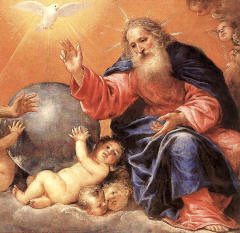 As Jesus once said, “Amen, amen, I say to you, a son cannot do anything on his own, but only what he sees his father doing; for what he does, his son will also do,” adding, “I cannot do anything on my own.” The Father loves his Son and shows him everything that he does. Sometimes believers find it harder to relate to God the Father than Christ the Son. But what is the Father really like? He is just like his Son. Jesus “is the image of the invisible God.” As Jesus said, “Whoever has seen me has seen the Father.” The Father offers his Son the perfect example, and his Son perfectly follows him.
The Father listens to his Son
Outside the tomb of Lazarus, Jesus said, “Father, I thank you for hearing me. I know that you always hear me…” Jesus shares his own attitude toward prayer when he tells us, “In praying, do not babble like the pagans, who think that they will be heard because of their many words. Do not be like them. Your Father knows what you need before you ask him. This is how you are to pray: Our Father…” Jesus knows that wordy, poetic prayers are not necessary because his Father is always listening.
The Father encourages his Son
At Jesus’ baptism in the Jordan River, the Father declared from heaven, “You are my beloved Son, in whom I am well pleased.” And on the summit of Mt. Tabor, at Jesus’ Transfiguration, the Father spoke from the cloud, “This is my beloved Son, listen to him.” The Father encourages his Son with reminders of his love.
The Father provides for his Son
Jesus said, “Everything that the Father has is mine.” Jesus’ Father is like the father in the parable of the Prodigal Son who told his first-born, “My son, you are here with me always; everything I have is yours.” Confident in his Father’s providence, Jesus tells us to be likewise unafraid concerning our basic needs, what we are to eat and drink, or what we are to wear: “Seek first the kingdom of God and his righteousness, and all these things will be given you besides.” The Father also provides his Son with gifts greater than material things. At the Last Supper, Jesus said of disciples, “Father, they are your gift to me.”
The Father welcomes closeness with his Son
It was a big deal when Jesus prayed, “Abba, Father.” As St. John Paul the Great observed, “An Israelite would not have used [“Abba” to address God] even in prayer. Only one who regarded himself as Son of God in the proper sense of the word could have spoken thus of him and to him as Father–Abba, or my Father, Daddy, Papa!” Because the Father welcomes intimate closeness with his Son, Jesus can say, “I and the Father are one.”
The Father loves his Son’s mother
At the Visitation, filled with the Holy Spirit, Elizabeth declared to Mary, “Most blessed are you among women,” and Mary rejoiced, “From this day all generations will call me blessed. The Almighty has done great things for me, and holy is his name.” By pouring his love and blessings into Mary, God the Father gave his Son a loving mother full of grace.
The Father fosters growth in his Son and sends him on mission
The Letter to the Hebrews says, “Son though he was, [Jesus] learned obedience from what he suffered; and when he was made perfect, he became the source of eternal salvation for all who obey him, declared by God high priest according to the order of Melchizedek.” But this raises a question: how can the divine Son grow in any way? Though perfect in heaven, the Son of God had no firsthand experience of weakness, suffering, or the trials of obedience, until his Incarnation. Through these things he was made complete so that he could be the savior of humanity. The Father prepares his Son and sends him on a mission to transform the world. “God did not send his Son into the world to condemn the world, but that the world might be saved through him.”
The Father as our model for Fatherhood
Whether we are biological or spiritual fathers, Jesus’ heavenly Father gives men a model for our fatherhood. We are to give our children instruction and good example. We should listen to them and encourage them, letting them know that they are well-beloved. We should provide for our children, according to our abilities, supplying their basic needs without neglecting the greater gifts. We are to welcome closeness with our children. We are to love our children by loving their mother, whether she be our spouse or the Church. We are to foster maturity and virtue in them so that they may go forth in mission to transform the world. Which aspect of your fatherhood are you resolved to grow in with God the Father?
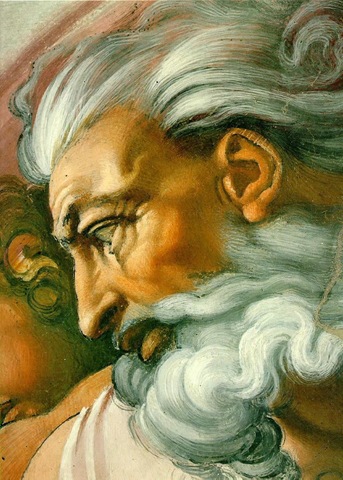 Our Perfect Father
Some of us have had very good fathers, while some of our fathers were very far from perfect. But regardless of the quality of our earthly fathers, we all have a heavenly Father who loves us perfectly. As Jesus tells us, “the Father himself loves you, because you have loved me…” Our Father instructs us and shows us his example through his Word. He always listens, and we should not be surprised when he encourages us, speaking to us, in prayer. Our Father provides for our material needs and gives us the greater gifts. “For everyone who asks, receives…” Our Father welcomes intimacy with us, giving his children the spirit of his Son so that we too may cry, “Abba, Father!” And he gives us Mary, the same perfectly loving mother he provided for his Son. Our Father would grow and mature us into greatness, into saints, into the likeness of his Son, and send us on mission for the transformation of the world.
The Seven Last “Words” of Christ
March 21, 2014“Father, forgive them for they know not what they do.” (Luke 23:34)
To the good thief: “Amen, I say to you: this day you will be with me in paradise.” (Luke 23:43)
To Mary: “Woman, behold your son.” And to his beloved disciple: “Behold your mother.” (Luke 19:26-27)
“My God, my God, why have you forsaken me?” (Mark 15:34)
“I thirst.” (John 19:28)
“It is consummated.” (John 19:30)
“Father, into your hands I commend my spirit.” (Luke 23:46)
Servants, Students, & Sons — Tuesday, 2nd Week of Lent
March 19, 2014Gospel: Matthew 23:1-12
As for you, do not be called ‘Rabbi.’ You have but one teacher, and you are all brothers.
Call no one on earth your father; you have but one Father in heaven.
Do not be called ‘Master’; you have but one master, the Christ.
Christ is our master and we must conform our lives to his will. Our flesh resists as if it were slavery, but in God’s will we find our greatest freedom and fulfillment.
The Lord is our teacher and we must learn from him. Unlike the scribes and the Pharisees, whose words we should heed but whose example we should ignore, all of Jesus Christ’s words and deeds are fit for our emulation.
Many people interpret “call no man on earth your father” as if it were about not addressing clergy as “Father.” Yet these persons call their dads their fathers, their teachers “teacher,” and forget that St. Paul wrote “I became your father in Christ Jesus through the gospel,” and “I urge you on behalf of my child Onesimus, whose father I have become in my imprisonment,” and often referred to “Father Abraham” (1 Corinthians 4:15, Philemon 10, Romans 4:16-17) However, Jesus is actually pointing to the importance of loving God as our good and loving Father. It is good for us to love the pope, but if we feel more fondness for our Holy Father than for God the Father then we very much need to develop and deepen our devotion to our Father in Heaven.
Tempting the Messiah — 1st Sunday in Lent—Year A
March 7, 2014Gospel: Matthew 4:1-11
 The devil suggests Jesus should change stones into bread. He wants Jesus to be a materialistic Messiah who will focus on nourishing bodies to the neglect saving souls. Jesus replies that “one does not live on bread alone, but on every word that comes forth from the mouth of God.” Christ shall change bread into himself at the Last Supper “for the life of the world.” (John 6:51)
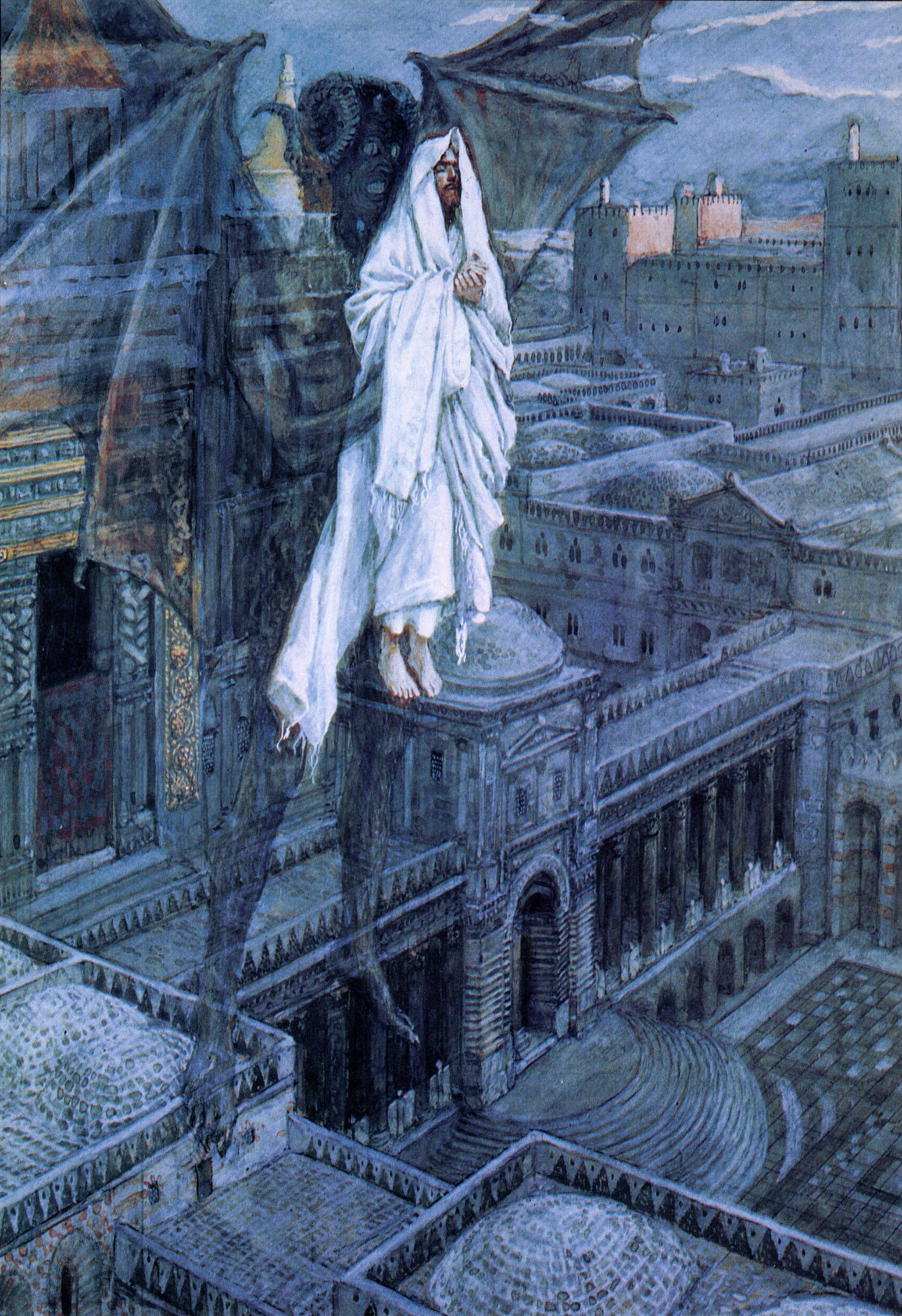 The devil takes Jesus to a precipice atop the temple in Jerusalem and challenges him to throw himself down. He wants Jesus to be a Messiah who will hope to never suffer. Jesus responds that “you shall not put the Lord, your God, to the test” by trying to force him into doing our will. Christ shall be tested and condemned by the Sanhedrin in Jerusalem and be made a suffering Savior according to God’s plan. (Isaiah 53)
The devil takes Jesus up to a very high mountain, shows him all the kingdoms of the world, and promises to bestow them all if Jesus would simply prostrate himself and worship him. He wants Jesus to be a compromised Messiah who will pursue good by doing (or serving) evil. Jesus replies that “Lord, your God, shall you worship and him alone shall you serve.” By unwavering obedience to his heavenly Father, Christ shall become the king of all nations, enthroned high upon a cross on Mount Calvary. (Matthew 20:21)
Recognizing the Christ — Thursday, 6th Week of Ordinary Time—Year II
February 20, 2014Readings: James 2:1-9, Mark 8:27-33
St. Peter confesses that Jesus is the Christ, but “the elders, the chief priests, and the scribes” reject him. Would we have recognized and welcomed the Christ when he came? Let us consider: Do we show partiality for or against others based on their popularity or prominence?
Would we have received Jesus’ challenging teachings? All the prophets were persecuted for sharing truths people refused to hear. How do we respond when someone critiques or challenges us?
Jesus was poor and perhaps wore “shabby clothes.” Do we have any friends who are poor?
As Dorothy Day said, “We love God as much as the one we love the least.” If we want to know whether we would have recognized and welcomed the Christ we should consider whether we receive and love him now, for Jesus says, “whatever you did for one of these least brothers of mine, you did for me.” (Matthew 25)
Stained Glass Symbols — “IHS”
February 4, 2014 A Symbol for Jesus’ Holy Name
In Greek, the name “Jesus” is spelled “ΙΗΣΟΥΣ.” These first three Greek letters were Latinized into “IHS,” forming a symbol for the Holy Name of Jesus.
Stained Glass Symbols — The Ichthys Fish
February 3, 2014 A Summary of Our Faith
The early Christians used the fish as a symbol for Christianity. The Greek word for fish is “Ichthys,” or using the Greek letters: “ΙΧΘΥΣ.” The letters of this word were an acronym for a phrase summarizing some of our core Christian beliefs: “Jesus Christ, [is] God’s Son, [and our] Savior.”
Stained Glass Symbols — The Star
February 1, 2014 A Symbol of Christ’s Coming
In ancient Old Testament times, a prophet declared, “I see him, though not now; I observe him, though not near: A star shall advance from Jacob, and a scepter shall rise from Israel…” (Numbers 24:17) Later, a psalmist mused to the Lord, “When I see your heavens, the work of your fingers, the moon and stars that you set in place—What is man that you are mindful of him, and a son of man that you care for him?” (Psalm 8:4-5) Then in the fullness of time, the God who cares for man and who set the stars according to His plan, gave a Savior to the world and announced Him by a star: “Behold, magi from the east arrived in Jerusalem, saying, ‘Where is the newborn king of the Jews? We saw his star at its rising and have come to do him homage.'” (Matthew 2:2)
Stained Glass Symbols — The Chi-Rho
January 30, 2014 A Symbol for “Christ”
The Jewish people awaited God’s anointed one (or in Hebrew, “Messiah,”) a priest, prophet, and king who would lead and save them. Jesus, anointed by the Holy Spirit and God the Father’s favor, was that promised Messiah. In Greek, the word for “anointed one” is “Christos,” spelled “ΧΡΙΣΤΟΣ.” (Thus, “Christ” is not Jesus’ last name, but rather his title.) The Chi-Rho symbol merges the first two letters of this Greek word as a symbol for “Christ.”
Who Were The Sadducees?
November 16, 2013In the Synoptic Gospels, some Sadducees come forward to challenge Jesus about his teachings on the resurrection. The Sadducees were an upper class Jewish sect of Jesus’ day. Despite disbelieving many popular Jewish beliefs, they dominated the Jews’ religious and political leadership in Jerusalem.
The Sadducees only accepted the Bible’s first five books as inspired and rejected any religious teachings they could not find there; including angels, life after death, and the resurrection of the dead. This is why when the Sadducees try to use an absurd (polyandrous) example to mock Jesus’ belief in the resurrection, he replies by citing the scene of Moses and burning bush from Exodus—a book of Scripture they accept.
The Sadducees administered in the Temple, often served as its priests, and were numerous on the Jewish high counsel—the Sanhedrin—which would go on to condemn Jesus to death for blasphemy. Jesus, however, would go on to demonstrate his contention that “the dead will rise” in his own person.
How Tall Was Jesus?
October 9, 2013Based upon the Shroud of Turin, Jesus grew to an adult height of between 5’8″ to 6’1″. (It’s actually a much trickier problem than just measuring the shroud image from head to toe.) On the other hand, in a resurrected body, I suspect someone can be whatever height he or she would like.
 Parishable Items