Archive for the ‘Jesus Christ’ Category

The Age of the Donkey — 14th Sunday in Ordinary Time—Year A

July 4, 2011


Jesus tells us in today’s gospel, “All things have been handed over to me by my Father.” But if that is so, why do so many things in the world seem so out of hand? We see that many things are sinful, broken, and not as they should be. Zechariah foretold that the true king would proclaim establish peace among the nations. Yet, this Fourth of July weekend sees our country fighting in at least two wars abroad. If we take our faith seriously, and think seriously about our faith, we’re led to ask, “Where is the reign of Jesus and where is His promised peace?”

In our first reading, we heard Zechariah prophesy that the true king, the Messiah, the Christ, would come to Jerusalem riding on a donkey. You will recall, of course, how Jesus fulfilled this passage when he rode into Jerusalem on Palm Sunday to the people’s shouts of joy. So what is the significance of His riding in on a donkey? The significance of the donkey is that it points to the meekness of Jesus’ reign.

In the ancient world, when a general sieged and took a fortified city, he would most often ride through its city gates by means of horse power. That conqueror would either be saddled upon one of these magnificently fast and powerful animals, or else he would ride in a chariot pulled by them. Then, upon entering, one would expect him to ruthlessly establish the new order of things. Oftentimes, to secure the conqueror’s rule, new laws would be proclaimed and severely enforced, prominent enemies would be put to death, and all local resistance would be crushed.

Jesus, however, comes into Jerusalem in a different way; not on a warhorse or in a chariot, but on a slow and humble donkey. This signifies that His reign shall be different. Apart from the relatively tame activism of scattering livestock and tipping tables at the temple, Jesus introduces his reign without any sign of force. In fact, the only person who would be murdered in the course of Jesus’ rise to power… would be Jesus Himself.

When Jesus stood accused before the high priest and the Sanhedrin, when He was in chains before Pilate and his troops, do you not think that He could have called upon His Father to provide Him in an instant with more than twelve legions of angels? Jesus could have backed Himself up with the power of more than 60,000 angelic warriors, but then He would not have died, and His kingdom would have been very different.

Let me speak for a minutes about the angels. God’s angels, in the first instant of their created existence, had a clear knowledge into God’s goodness and preeminence. In that moment, some of them decided that they would rather live as their own gods. As the Book of Revelation tells us, a war broke out in heaven; St. Michael the Archangel and his angels battled against Satan. Satan and its angels fought back, but they did not prevail and there was no longer any place for them in heaven. Satan was thrown down to earth, and his angels were thrown down with him, where they have tempted us to share in their rebellion ever since. Sometimes people ask if Satan and the demons could be someday be saved. However, angels and demons are creatures that do not change their minds. Unlike human beings, they do not change over time. We human beings are a different sort of creatures. We learn through experience and (hopefully) grow in maturity. If one of us chooses to rebel through grave sin, hope remains for us, as long as we live, that we will repent and turn again to God, to love Him and others as we ought. Even after Caiaphas and Pilate condemned Jesus and handed Him over to for execution, hope remained for their conversion and salvation.

What if Jesus had called in His angelic reinforcements, unveiling before them the Heavenly armies in their terrifying fierceness? What if Christ had tolerated no resistance to the advent of His reign, to the coming of His Kingdom, in 33 AD?        In that case, all of humanity would be confronted with a sudden and inescapable choice, a choice either for Christ or against Him; a moment of choosing like that experienced by the angels and demons.

Some human beings, when confronted with Christ in this way, would sinfully refuse to follow Him, and that refusal would be a rebellion. And here we come to the heart of the problem: How can Christ allow these rebels to remain on the earth, in hopes that they may repent, unless He is willing to show some tolerance and patience toward their sinful resistance for a time? Jesus could wipe away all sin from the face of the earth in an instant, but He would have to wipe out all of the earth’s unrepentant sinners in the process. A sudden judgment would bring a quick and clean end to sin, but less of mankind would be saved. The approach Jesus has taken with us is more merciful, but is also messier. God hopes that all shall turn to Him freely, and not by force, because love cannot be forced. Jesus Christ hopes and works for the conversion and salvation of all. As St. Peter writes, “The Lord’s patience is directed towards salvation.” And though it can be difficult for us to see God’s providential purposes and plans in our lives, “we know that,” as St. Paul says, “all things work for good for those who love God.”

Where is the peace that was promised to the world? Its total reign, the fullness of the kingdom of God, is yet to come. For now, the spirit of the world and the Spirit of life do battle. But we can experience peace in our souls, peace in our families, and peace in our communities, if we live by the Spirit of Christ.

In this age, Jesus comes to us on a donkey, but in the age to come He shall ride a warhorse. As the Book of Revelation says:

“I saw the heavens opened, and there was a white horse; its rider was called ‘Faithful and True.’ He judges and wages war in righteousness.… He wore a cloak that had been dipped in blood, and his name was called the Word of God. The armies of heaven followed him, mounted on white horses and wearing clean white linen. Out of his mouth came a sharp sword to strike the nations. He will rule them with an iron rod, and he himself will tread out in the wine press the wine of the fury and wrath of God the almighty. He has a name written on his cloak and on his thigh, ‘King of kings and Lord of lords.’”

In this age, Jesus rides the donkey, for this is the time of patient mercy. But on the Last Day, Jesus shall ride the white warhorse, for that is the time of decisive and definitive judgment. Let sinners take note; we shall not be permitted to keep sinning forever. And let those who mourn the brokenness, the sin, the suffering and death in the world take courage, for these things shall pass away. ‘See, your king shall come to you; a just savior is he. He shall proclaim peace to the nations. And His rule shall be to the ends of the earth.’

United Hearts — The Kristopher and KayLee Schnitzler Wedding

July 4, 2011

Kristopher and KayLee, when you chose this day, July 2nd, to be your wedding day you were probably not aware that you were choosing an extra special date. We unite your hearts today in holy matrimony amidst Sacred Heart of Jesus and the Immaculate Heart of Mary. Yesterday was the Solemnity of His Sacred Heart and today is the Memorial of her Immaculate Heart. We celebrate these two feasts so closely on the calendar, one after the other, because no two human hearts are so intimately united in a perfect love. I present them to you as role models for your love

Mary and Jesus were mother and Son. They were never married in the way we think of marriage, so how can they be role models for your marriage? In Jesus and Mary, we see the perfect man with the perfect woman, we see the New Adam together with the New Eve, we see the King and Queen of Heaven and Earth. Jesus is the Bridegroom and Mary is the flawless image of the Church, which is His Bride. By seeing how Jesus loves her and how Mary loves Him we can learn much about how men and women are to serve and love each other.

How does Jesus love Mary? For one thing, he listens to her. He is receptive to her wants and needs. It was true at the wedding feast of Cana, He worked a miracle to provide wine at her request, and it is still true now in heaven, where she continues to ask for good things for us. A good husband must be receptive to his wife’s wants and needs. On the other hand, in what manner do you think Mary asks things of Jesus? Mary does not nag Jesus, asking Him in plaintive tones. She doesn’t sit next to Jesus in Heaven and sigh, “I see you still haven’t taken care of the garbage down there.” Instead, I imagine she says to Him, “It would make me very happy if you would do this for me.” A good wife must allow pleasing her to be her husband’s joy, not his burden.

A good husband must die to himself in many ways for his family, and a good wife must support him through his sacrifices. Look how Jesus goes to the cross and offers Himself for the good of Mary and her children. He suffers for her and lays down his life for her. And how does Mary support Him? She is right there, at the foot of the cross, faithful and consoling. God gave Eve to Adam as a partner, to support him in the garden. Mary continues to be a helpmate to Jesus in His work of harvesting the vineyard of this world. A good husband lays down his life for his wife and a good wife must support him through his sacrifices.

From the cross, Jesus make Mary the mother of all Christians. He desired Mary to be the mother of many children, and now, Mary’s motherhood is perhaps her greatest joy. A good husband and wife must be open to children. This is the will of God for you and He will bless you with joy for saying “Yes” to Him.

The worship of God and following His will was at the center of the relationship between Jesus and Mary. Every Sabbath they came to join the worship at the synagogue (the Church of their day) and every day they said prayers and remained close to God. So too, God must be at the center of every good marriage. You must come to Mass every Sunday and pray every day. Good husbands and wives share the same mission in life, to assist each other and their children in getting to Heaven.

From earth to Heaven, Jesus led Mary through life with love, and Mary faithfully followed Him. A good husband must have the integrity not to phone it in, but to lead, and a good wife must have the courage to follow that lead. Kristopher and KayLee, May the hearts of Jesus and Mary reign in your homes. May you model their virtues on earth. And may you draw each other, and your children, to share their heavenly joy forever.

Sending Another Advocate — 6th Sunday in Easter—Year A

May 29, 2011

At the Last Supper, Jesus told His apostles that He would soon be departing from them. His disciples found this news distressful. Jesus had been their spiritual leader and intimate friend. For the better of three years, they spent almost all day, every day, with Him; sharing breakfasts in the morning, walking down the roads and conversing with Him, watching Him preach and heal n villages, spending evenings with Him around the fire. Not only had he taught them about God, he had also made them more godly men. And so, understandably, word of their Good Shepherd’s departure saddened them.

But Jesus told them, “Do not let your hearts be troubled. You have faith in God, have faith also in me.” In obedience to His Father, Jesus was going away, but He told the disciples that they would not be left orphans. God would send them another person to lead and sanctify them. Jesus told them God the Father would send them another Advocate, another Helper, another Guide, to be with them always. Jesus spoke of the Holy Spirit, who would continue the same work which Jesus had begun in them. The Father had blessed them before by sending them Jesus. Now, at Jesus’ departure, the Lord wanted them to trust and remember this: that they would be blessed again.

Today, this Gospel is fulfilled in our hearing. Father Stoetzel has asked me to read you this letter from him:

Dear parishioners,

Bishop Callahan has asked me to take a new parish assignment beginning July 1st. I will be the next rector of St. Joseph the Workman Cathedral in La Crosse. Also, I am very happy to announce your new pastor here and St. John the Baptist in Marshfield. He is Fr. Samuel Martin who is presently the director of the Holy Cross House of Formation and teacher at Aquinas High School in La Crosse. Please welcome him graciously as he is being sent by the bishop to be your pastor.

I want to thank you very much for the privilege of being your pastor for the past 15 years. My gratitude goes to you for the prayers and many acts of kindness you have shown. Let us continue to pray for one another. Be assured that you will be in my fondest thoughts.

Sincerely,
Fr. Stoetzel

The fact that our bishop has appointed Fr. Stoetzel to be the rector of the cathedral (the bishop’s own parish) says much about Father’s quality as a pastor. We will miss him in many ways. I don’t know Fr. Martin too well, but every encounter I have had with Him has been a positive one. I predict that we will all be very pleased with him when he comes in July and will be blessed by getting to know him better. In the meantime, let’s remember pray for Fr. Stoetzel, as he prepares for his new assignment in La Crosse. Let us also pray for our pastor-to-be, Fr. Sam Martin, as he prepares for us.

Jesus says, “Do not let your hearts be troubled. You have faith in God, have faith also in me.” The Lord wants us to trust and remember this: that He has blessed us before and that He we will be blessed again.

The Way, Truth, & Life — 5th Sunday in Easter—Year A

May 22, 2011

Jesus said, “I am the way and the truth and the life. No one comes to the Father except through me.”

The Mass is an encounter with Jesus Christ, leading us to God the Father. Like Jesus Himself, the Mass contains the Way, the Truth, and the Life of Jesus. First, we journey on the Way to Jesus, then we come to the Truth of Jesus, finally we join in the Life of Jesus.

The Mass begins with the sign of the cross, for God is the beginning and end of everything. Next, we confess our unworthiness to approach the Lord, asking mercy for our sins, so that we may dare to take this journey to God. The, from the Holy Scriptures, we hear of God’s words and deeds among the Old Testament peoples and within the New Testament Church. In this, we learn of the providential way that God has prepared throughout time for us to encounter Jesus Christ today. Just as the journey on this Way through history leads to Jesus Christ, so the liturgy of the Word leads to the Gospel. Certainly, Jesus Christ the Word of God is present throughout the entire Word of God which is Sacred Scripture, but for the reading of the Gospel, we all stand up for Him and sing “Alleluia,” “Praise the Lord,” because we have come to Jesus Christ and He is more fully present among us in the proclamation of the Gospel.

The Gospel reading proclaims Jesus, who is the Truth. The homily that follows proclaims that the Truth matters for us here and now and demands our personal response. To this call, we answer with the Creed, proclaiming our faith in who God is and what He has done for us. In the Creed, we proclaim our acceptance of Jesus, the Truth. In the prayers of the faithful, we petition the Lord for our needs and concerns, saying in so many words, “Lord, let your kingdom come, on earth as it is in Heaven! Let us share you life! Give us your life!” At Mass, the Way leads to the Truth, and from the Truth we long for God’s Life. At Mass, the Liturgy of the Word leads to the Liturgy of the Eucharist.

The presentation of the gifts is not merely about moving around cash and bread and water and wine. The presentation of the gifts is about the presentation of everything that we have, and everything that we are, to God. We lift up our hearts to be one with our sacrifice. Amidst praises to the Father, the one life-giving sacrifice of the Last Supper, of the cross, and of Heaven becomes present here to us. We join in offering this sacrifice through Jesus, with Jesus, and in Jesus, in union with the Holy Spirit, to God the Father in Heaven.

Through this offered sacrifice, we join in God’s Life. We pray “Our Father,” because uniting with the paschal mystery, the great Easter deeds of Jesus, gives us life as the Father’s sons and daughters. Then we share with one another the sign of peace, the loving peace that is possessed by God’s holy ones. Finally, at the climax, we partake of Jesus Christ, Life Himself, most truly present in the Holy Eucharist.

Sometimes people say, “I just don’t get anything out of going to Mass. Father, I know that you say all this important and wonderful stuff is going on, but I don’t see it and I don’t feel it. The Mass is boring for me.” I understand. When I was a boy, I made a point of going to the bathroom (sometimes twice) during every Mass, just to break up the monotony. When I would see the priest cleaning the dishes at the altar—that was a good sign, because it meant that the Mass was almost done. I didn’t really know what was happening at Mass, so I really didn’t believe in what was happening at Mass. But as I grew older I began to learn what was happening, and as I grew in faith I began to believe in what was happening, and my experience of the Mass was transformed.

People who say that the Mass is boring resemble St. Phillip in something he said to Jesus at the first Eucharist, the Last Supper: “Master, (we don’t see or feel the presence of God the Father,) show us the Father, and that will be enough for us.” And Jesus said to him, “Have I been with you for so long a time and you still do not know me, Philip? Whoever has seen me has seen the Father. (Whoever has been to Mass has encountered my mysteries.) How can you say, ‘Show us the Father’? (How can you say, ‘The Mass is boring?’)” The awesome mystical realities of the Mass are true, and real, and present and active at every Mass we attend, whether we see them, or feel them, or believe in them, or not.

Jesus Christ and the Holy Mass contain the Way, the Truth, and the Life, and we shall receive from them according to our faith. Let us pray, that at this Mass and every Mass, we may be as fully present to Jesus Christ and His mysteries as they are to us at every Mass.

The Significance of Standing — Tuesday, 3rd Week of Easter

May 10, 2011

There’s a curious detail about Stephen’s vision of Heaven in our first reading today:

“Stephen, filled with the Holy Spirit, looked up intently to heaven and saw the glory of God and Jesus standing at the right hand of God, and Stephen said, ‘Behold, I see the heavens opened and the Son of Man standing at the right hand of God.’”

Stephen looks up to Heaven and sees Jesus standing at the Father’s right hand, but both the Apostles’ Creed and Nicene Creed (which we say each Sunday) describe Jesus as “seated at the right hand of the Father.” What are we to make of this?

In the ancient world, to be seated at someone’s right hand gave you the place of higher honor. At a meal, this favored seat granted a special closeness to the host. In a kingdom, the one seated at the right hand of the throne would share in the king’s authority and rule. Of course, describing Jesus as “seated at the right hand of the Father” is only an image (God the Father is unlimited, pure spirit and doesn’t have a right hand.) But this phrase from our creeds does describe a reality: that Jesus is now in the intimate presence of God the Father, sharing supremely in His glory and rule. In his vision, Stephen beholds Jesus in the place of honor, at the Father’s “right hand,” but Stephen sees Jesus standing. So why is Jesus standing?

Did you know that whenever the President of the United States enters a room, everybody stands up? It doesn’t matter if it is a room full of Democrats or Republicans, members of the press, or ordinary citizens, everyone stands up for the President. The same goes for a judge in his courtroom: “All rise, the Honorable Judge So-and-so presiding.” And a gentleman knows that he ought to stand up whenever he greets a lady. Why do they stand? Because it is a sign of respect. If you think about it, whenever we’re offering prayers in the Mass, provided we’re not kneeling, we’re standing up to pray. We stand to pray as a sign of respect to God.

Sometimes, people stand as a sign of respect not so much for the individual but for the greatness of the office they possess. Even a U.S. President’s most hostile critics in Congress, political opponents who couldn’t say one good thing about him, will stand up when he arrives to give his State of the Union address out of respect for the office he holds. It wasn’t for this reason that Jesus stood. No one on earth could have demanded Jesus’ respect by holding an office higher than his.

Jesus stood up because he wanted to show Stephen a sign of His respect. Jesus stood up because he was proud of Stephen. I think that we forget that Jesus is a real human being, with human feelings and emotions about the human events he sees. At the same time, He is also God; and therefore, He sees us all.

When you’re alone, and overcome temptation to do what you know is good, Jesus sees you and He’s proud of you. When you give an anonymous contribution or do a secret kindness, Jesus sees it and He’s proud of you. When you are opposed like Stephen, by people who hate you, or that just don’t understand you, when all the while you’re trying act with love, you do not stand alone. Remember that when you do what’s hard for Jesus, He sees it, and He sees you and He’s proud of you for it.

A Man In Jesus’ Image — Divine Mercy Sunday—Year A

May 1, 2011

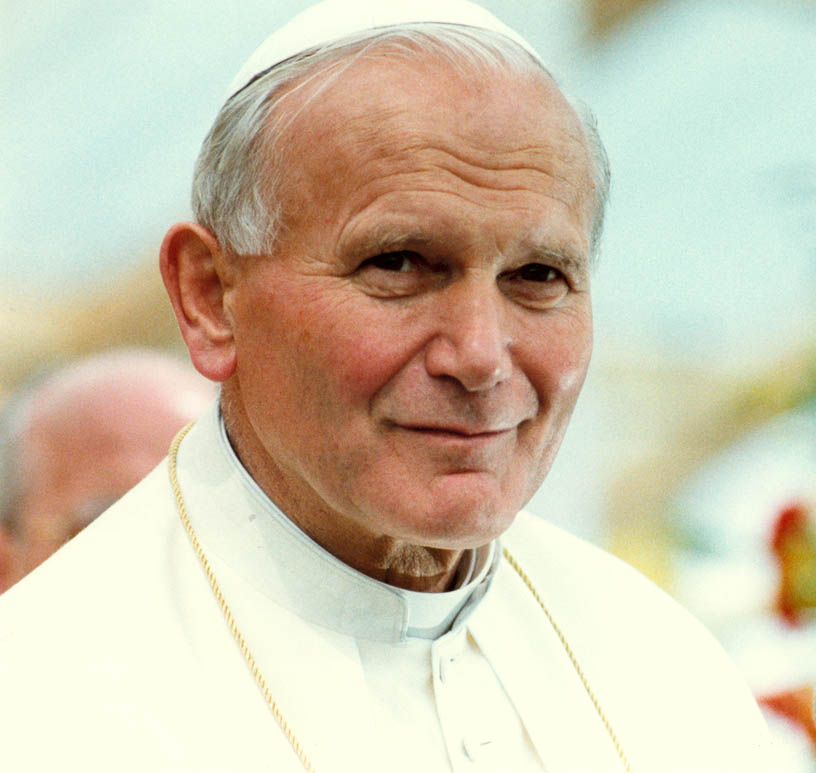
This Divine Mercy Sunday, our Catholic Church throughout the world celebrates and glorifies two men together in a special way. The first is our Savior, our Lord and our God, Jesus Christ; and the second is the great pope John Paul the Second, who is being beatified today in Rome. John Paul the Great, born Karol Wojtyla, is a man who lived in the image and likeness of Jesus Christ.

Both chose the Blessed Virgin Mary to be their mother. One chose her after the loss of his earthly mother as a boy. The other chose her from all eternity. Growing up, both of their beloved homelands were occupied and oppressed by foreign empires. For one it was the Romans. For the other it was the Nazis and then the Soviet Union. As young men, they both worked as manual laborers, in lives hidden from the world. When people encountered their ministries for the first time, many said, “Who is this man, and where does he come from?”

Both men transformed this world, not by leading violent revolutions, not by amassing incredible fortunes, but by speaking the truth, and living the truth, and leading others in doing the same for God. They preached God’s message, and their words gave hope and courage to many, but their words were not accepted by all. Both men had enemies who sought to destroy them, but they forgave, face to face, those who sought their lives.

At the end of their lives, both men were afflicted with great physical sufferings, but neither laid down their crosses. Some onlookers mocked or dismissed them in their afflictions, but those with spiritual insight beheld them to be offering a sacrifice to the Father for the salvation of the world.

St. John tells us that Jesus has done many other signs in the presence of his disciples that are not written in his Gospel. As St. John writes elsewhere, “There are many other things that Jesus did, but if these were to be described individually, I do not think the whole world would contain the books that would be written.”

Among these signs are the lives of the saints throughout the centuries, saints like Pope John Paul the Great. His life was a sign worked by Jesus Christ in our midst so that we would come to believe more deeply that Jesus is the Christ, the Son of God, and that through this belief we may have life in his name.

Why did people love Pope John Paul II so much? Catholics of every country and of all ages loved and flocked to him. Even non-Catholics and non-Christians were drawn to him. What explains this phenomenon? I think the answer is simple. People saw in him a reflection of Jesus Christ’s love for them. John Paul the Second was an icon of Christ and his love.

Every time you saw Pope John Paul, he was smiling. He traveled the nations, and embraced everyone warmly. When you encountered him, you felt loved, even if you were one person in a crowd of thousands. This was the Holy Spirit at work. Although you did not see Jesus you loved him in Pope John Paul; even though you did not see Jesus you believed in him all the more because of him, and rejoiced with an indescribable and glorious joy.

This morning we celebrate a feast day which Pope John Paul II established, Divine Mercy Sunday. What is divine mercy like? What does Jesus’ unfathomable love, which enfolds every one of us here and every person God has made, look like? Through the life of Pope John the Great we saw a partial glimpse of the divine mercy and love of Jesus Christ.

“He Is Not Here” — Easter Vigil

April 23, 2011

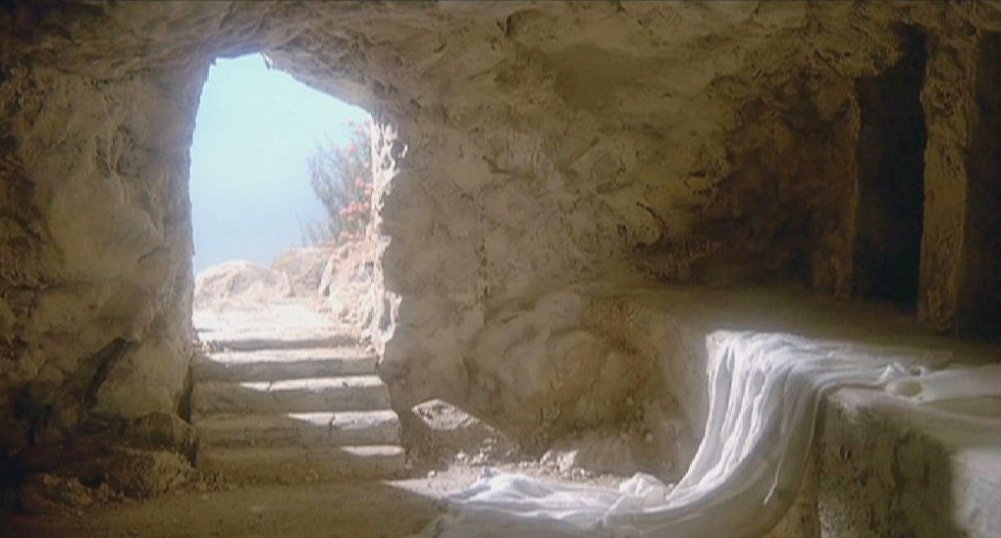
When the women came to the tomb they did not find Jesus, but a radiant messenger. He told them, “Do not be afraid! I know that you are seeking Jesus the crucified. He is not here.…” The tomb was empty, Jesus was not there.

Jesus was present at the beginning of creation, for through Him all things were made. Going forth from the Father’s mouth, He was at hand on earth throughout the ages, achieving His purposes.

He was mystically with Noah, who saved his family from death by building a ship, just as Jesus built the Church to save us.

He was mystically with Isaac, who, though bound and led to sacrifice, was not to be lost forever.

He was mystically with Moses, who freed God’s people from Pharaoh’s demonic slavery by leading them through miraculous waters.

He was mystically with all the prophets, in proclaiming a law to be written on hearts instead of stones, in promising the gift of a Holy Spirit from Heaven, in suffering at the hands of those who refused to hear wisdom.

He has been in His saints, from the least to the greatest, throughout the centuries to this very night. He is present here in all of us who are ‘living for God in Christ Jesus.’

By the all foreshadowings that proceeded His coming, and by the fruitful witness of all His saints ever since, we can confirm the angel’s words, “he has been raised just as he said.”

Jesus is not there in the empty tomb. He is here,  tonight, with us.

“I Thirst” — Good Friday

April 22, 2011

Shortly before He died on the cross, Jesus said, “I thirst.” Why did He say, “I thirst”? He was certainly physically dehydrated. As Psalm 22 foretells, His throat was as dry as broken pottery and His tongue stuck to His palate, but there was more reason for His words than just this.

Last night, at the Last Supper, Jesus had postponed drinking the traditional fourth and final cup of Passover. He said “I thirst” so that they would bring Him wine, so that He could drink, and unite the Last Supper and His Passion as one event. However, there is even more reason for His words than this.

Beside the crucifixes, in all of the chapels, in all of her religious houses around the world, Blessed Mother Teresa had written the words, “I thirst.” She understood that what Jesus thirsts for on the cross is us. Mother Teresa wrote, “Jesus is God, therefore His love, His Thirst, is infinite. He the Creator of the universe, asked for the love of His creatures. He thirsts for our love…” 

As we come to Him on the cross today, let us satisfy His thirst with the refreshment we can give to Him.

“Do This…” — Holy Thursday

April 21, 2011

At the Last Supper, the night before he suffered for us, Jesus took some bread. He thanks to God for it and He broke it. And He declared it to be His body which would be given up for others. Then He offered it to those He loved. When the supper was ended, Jesus took a cup of wine. Again He gave thanks and praise to the Father. And He declared it to contain His blood, blood to be shed for all. Then He offered the cup to His disciples and said, “Do this in remembrance of me.”

At the Last Supper, Jesus ordained His apostles the first priests of the New Covenant. They and their successors would do this in remembrance of Him, throughout the centuries, up to this very night, and until He comes again. When you and I celebrate the Mass we remember Him and what He did, and more than just recalling it, we re-encounter it as that same sacrifice is offered in front of us. But Jesus’ words, ‘to do this in memory of Him’ means more than just coming to Mass.

Jesus is calling and commanding us to do the thing that He is doing. We must give God thanks and praise for what He has given us. We must take our bodies and give them up. We must take our life’s blood and pour it out. And we can do this, for God and for each other, in as many ways as there is to love. The sacrifices of your daily life, at home, at work, and at prayer; the work of washing feet; may not seem significant to you now, but these sacrifices shall your glory in Heaven forever.

As Jesus washed His apostles’ feet He said, “What I am doing, you do not understand now, but you will understand later.” And when He had finished He said, “If I, … the master and teacher, have washed your feet, you ought to wash one another’s feet.  I have given you a model to follow, so that as I have done for you, you should also do.” At the Last Supper, Jesus said to His disciples, “Do this in remembrance of me.” Tonight, He says the same to us as well.

Our Triduum Crowd — Palm Sunday—Year A

April 20, 2011

On Palm Sunday, the crowds welcomed Jesus into Jerusalem as a hero.  On Good Friday, the crowds will clamor for His death. How do we explain this dramatic switch from love to hate? It might be that the mob had become infatuated with Jesus, thinking that He was going to be the earthly messiah of their dreams, the one who would force the hated Romans out of their land and reign as a new and greater King David. Perhaps the crowd realized that this wasn’t Jesus’ plan, and then angrily turned on Him like a lover spurned, hating Him for disappointing their high hopes.

Another possibility is that we are seeing two different crowds, made up almost entirely of different people. Perhaps the chief priests and the Pharisees had assembled a mob around them of those they knew they could easily manipulate. They had arrested Jesus late in the night and brought Him to Pilate early the next morning. Perhaps many of Jesus’ the Palm Sunday supporters had no idea what was happening until Jesus was already in the tomb. Perhaps the next day many of them said, “I wish I had known! I would have been there for Jesus!” Or perhaps they did hear about what was afoot, but had already disowned Jesus for disappointing their messianic dreams. Maybe some people said, “Jesus of Nazareth? I’m too busy to be bothered with Him anymore. I’ll keep my distance, and see how this thing plays out in the end.” Whatever the reason, the crowd that turned-up for Jesus’ trial was short on those who loved Him.

The liturgy of Holy Thursday, Good Friday, and Easter Vigil (what we call the Easter Triduum) is our greatest celebration in the Church. It’s bigger than Christmas and Jesus invites you to be there. Jesus invites you to attend his last meal and to keep watch with Him Thursday night, to accompany Him through His Passion and to reverence Him on the cross, and to keep vigil at His tomb Saturday night and to be the first witnesses to His resurrection. If you truly cannot make it, Jesus understands, but if you would come here to join this crowd accompanying Jesus throughout these holy days, it would please Him, very much.

The Real Jesus — Monday of Holy Week

April 20, 2011

Who is Jesus? What is He like? Jesus is not the things that many people dismiss as being. Jesus is not an ancient myth or a bedtime story. Jesus is not a heavenly Mr. Rogers. Jesus is not a mean guy on a cloud. Jesus is not a hippy and Jesus is not an unmanly wimp. Jesus is not a weirdo, or a freak, and yet Jesus is not ordinary either. Jesus is not a religious fanatic and yet Jesus is not tamed. Jesus is not far away and He is not inactive. Jesus is not out-of-date and He is not irrelevant. Jesus is not a joke but He is not a stick-in-the-mud either. Jesus is not just a “nice guy” or a “buddy.” Jesus is not just a Jewish carpenter who died a long time ago. Jesus is not just a social reformer or a moral teacher who transformed the entire world more than anybody else. Jesus Christ is God and the greatest human being alive.

Our secular culture and sometimes Christians themselves create false pictures of who Jesus is, what He’s like, and what He’s about. And these false depictions can make us hesitate to draw closer to Him. But with the real Jesus, there is nothing to be embarrassed about. In the real Jesus there is nothing to be afraid or ashamed of.

My prayer today is that each of you would all come to know the real Jesus Christ better. This is relationship is at the very core of what it is to be a Christian. Listen to what Pope Benedict wrote for the opening of his very first encyclical: “Being Christian is not the result of an ethical choice or a lofty idea, but the encounter with an event, a person, which gives life a new horizon and a decisive direction.” (This event, this person, is of course Jesus Christ.) “We have come to believe in God’s love.” In these words the Christian can express the fundamental decision of his or her life.

In today’s Gospel, Mary the sister of Lazarus approaches Jesus at a dinner with an alabaster jar of ointment. The jar was made of a type of marble and had a narrow neck to pour out the precious oil slowly. However, Mary breaks the jar and pours it entirely on Jesus’ feet, and its fragrance fills the house. When Judas saw this he criticized her, “Why was this oil not sold for three hundred days’ wages and given to the poor?” Some of the other disciples felt that way too. (Imagine spending $25,000 on a gift for someone.) But Mary knew the real Jesus in a way that Judas never would. She knew Him, and loved Him, and therefore desired to pour her entire self out for Him. If you know the real Jesus like Mary did, it makes sense.

I pray that you will seek to know the real Jesus through a commitment to daily prayer, without which spiritual growth is impossible. Ask Jesus in this Mass to reveal Himself to you. Then you too shall know Him, love Him, and pour yourself out like Mary the sister of Lazarus did, and then fragrance of the wonderful life will fill the house for all.

We Owe Him Big — Tuesday of Holy Week

April 20, 2011

When I was your age, there was a popular show on TV that I liked to watch that maybe you’ve heard of, the show was called The Simpsons. And though it was 20 years ago, I still remember my favorite episode: “Bart Gets an F.” This episode happens to be the most highly-rated Simpsons of all-time and Entertainment Weekly once picked it as the “31st Greatest Moment in Television [History].”

Bart Simpson was failing the fourth grade, and Mrs. Krabappel told him that if he failed his next exam he would forced to repeat the year. Bart tries to prepare by teaming up with Martin to study, but Martin abandons him. And so, the night before the exam, Bart has run out of time. Bart goes to his bedside, kneels down, and prays.

“I know I haven’t always been a good kid, but, if I have to go to school tomorrow, I’ll fail the test and be held back.  I just need one more day to study, Lord.  I need Your help! A teachers strike, a power failure, a blizzard… Anything that’ll cancel school tomorrow.  I know it’s asking a lot, but if anyone can do it, You can!  Thanking You in advance, Your pal, Bart Simpson.” Bart turns off the light, goes to bed, and outside, snowflakes begin to fall.

The next day, the whole world is white and deep. Kids are throwing snowballs, building forts, and riding sleds downhill. Even the adults are joining in the fun. Mayor Quimby solemnly proclaims, “I hereby declare this day to be Snow Day, the funnest day in the history of Springfield!” Bart grabs his sled and makes to rush out the front door, but when arrives at the door, Lisa’s ominous shadow blocks the way.

“I heard you last night, Bart.  You prayed for this.  Now your prayers have been answered.  I’m no theologian; I don’t know who or what God is exactly, all I know is He’s a force more powerful than Mom and Dad put together, and you owe Him big.”

Bart pauses and says, “You’re right.” He removes his goggles from his head and hands them to Lisa. “I asked for a miracle, and I got it.  I gotta study, man!” He goes up stairs and studies like he’s never studied before, or probably since. The next day Bart passes his exam, and the fourth grade, with a D—, and mother Marge puts his test proudly on the fridge.

This weekend, we are going to have a lot of days off from school. Let us remember whom we have to thank for that, what he did for us, and what this long weekend is for. I know you will all be in church on Easter. Everybody’s in church on Easter. But Holy Thursday evening, and Good Friday afternoon, Jesus would enjoy your company at church then, too. If you can’t come at least think of Him then, and of what He’s done for us. Let’s not be like Judas, who was without gratitude, and was the first one out the door. Let us be like Bart Simpson, at least in this much, in showing our thanks to the God who saved our butts, because we owe Him big.

Penance Service Rosary Meditations

April 20, 2011

The First Sorrowful Mystery: The Agony in the Garden

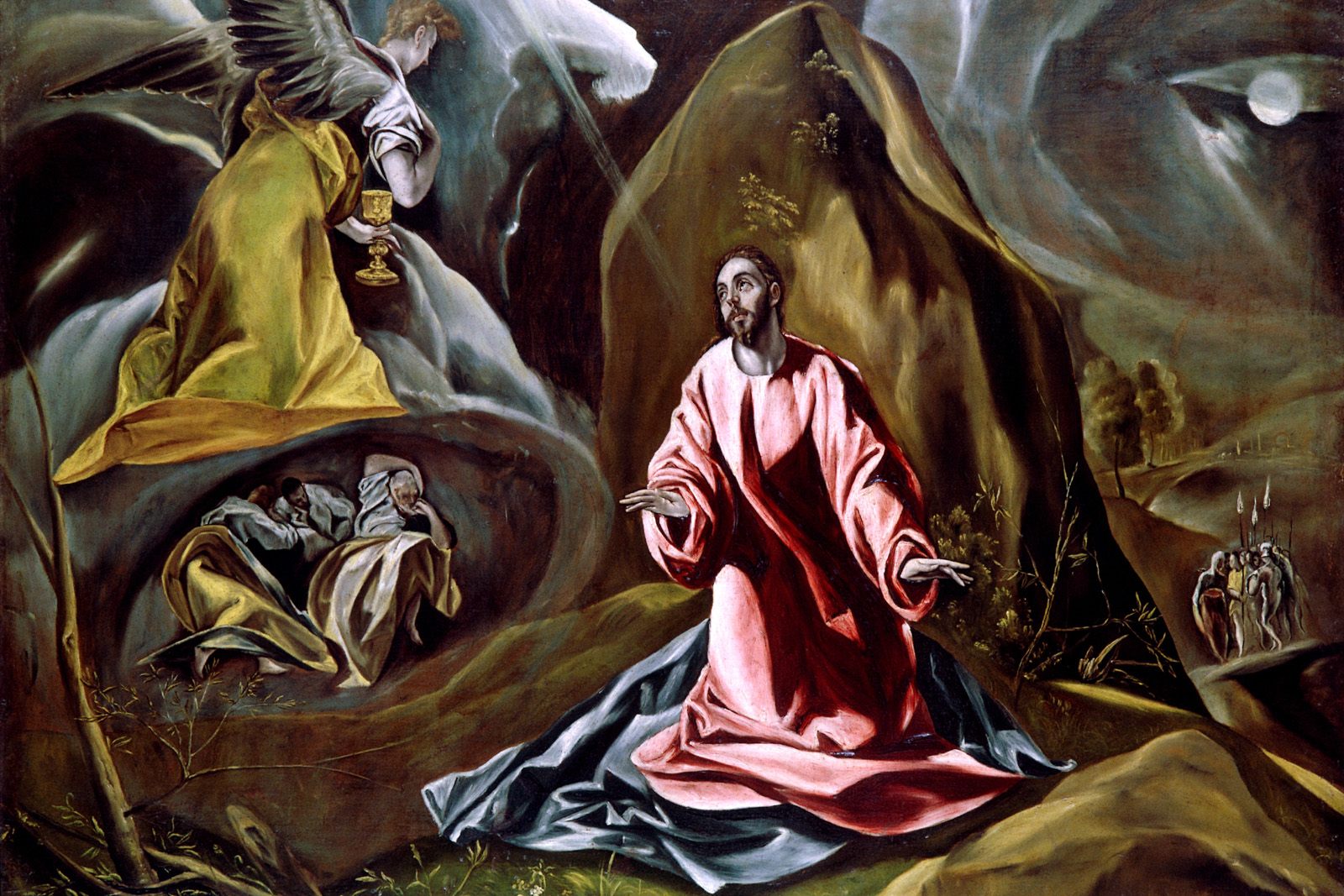
Jesus went out with his disciples across the Kidron Valley. There was a garden there and he and his disciples entered it. He took along Peter and Zebedee’s two sons, and began to experience sorrow and distress. Then he said to them, “My heart is nearly broken with sorrow. Remain here and stay awake with me.” He advanced a little and fell prostrate in prayer. “Father, if it is possible, let this cup pass me by. Yet not my will, but yours be done.” In his anguish he prayed with all the more intensity, and his sweat became like drops of blood falling to the ground. Then he rose from prayer and came to his disciples, only to find them sleeping. He said to Peter, “Simon, are you asleep? Could you not keep watch for one hour? ”

When Peter, James and John fell asleep that hour in the garden, they let Jesus down, but Jesus still loved them. When we sin, we also let Jesus down, but Jesus still loves us, too. Let us all make good confessions, and pray attentively, in this hour with Jesus.

The Second Sorrowful Mystery: The Scourging at the Pillar

When it was morning, those who had arrested Jesus bound him, led him away, and handed him over to Pilate, the governor. Now for Passover, the governor was accustomed to release to the crowd one prisoner whom they wished. At that time they had a notorious prisoner, a revolutionary, a robber and a murderer, called Jesus Barabbas. (The name Barabbas means “son of the father.) When they had assembled, Pilate said to the crowd, “Which one do you want me to release to you, Jesus Barabbas, or Jesus called Christ?” They answered, “Barabbas!” Then he released Barabbas to them, but after he had Jesus scourged, he handed him over to be crucified.

Whenever we sin, we choose a Barabbas instead of Christ. Jesus promises us that choosing Him will make us the most happy, but when we choose to do what’s wrong, we disbelieve Him, and choose someone or something else to make us happy. With our confession and these prayers, let us recommit ourselves to always choosing Jesus Christ, who suffered whips for love of us.

The Third Sorrowful Mystery: The Crowning with Thorns

Then the soldiers of the governor took Jesus inside of their fortress and gathered the whole army around him. They stripped off his clothes and threw a scarlet military cloak about him. Weaving a crown out of thorns, they placed it on his head, and put a reed in his right hand. And kneeling before him, they mocked him, saying, “Hail, King of the Jews!” They spat upon him and took the reed and kept striking him on the head. And when they had mocked him, they stripped him of the cloak, dressed him in his own clothes, and led him off to crucify him.

For as much as those soldiers mocked Jesus, let us now honor Jesus sincerely through this decade of the Rosary, with our hearts full of sorrow and thanks.

The Fourth Sorrowful Mystery: The Carrying of the Cross

They took Jesus, and carrying the cross himself he went out to what is called the Place of the Skull, in Hebrew, Golgotha. As they led him away, they laid hold of a man named Simon who was coming in from the country. They put a crossbeam on Simon’s shoulder for him to carry behind Jesus. A great crowd of people followed him, including women who beat their breasts and lamented over him.

During this decade of the Rosary, let us imagine ourselves helping Jesus to carry His cross. By being with Him and knowing how He felt, this will help us to love Him more. And who knows, perhaps our prayer will travel through space and time to help lighten, even just a little, the burden that He carried.

The Fifth Sorrowful Mystery: The Crucifixion

They brought Jesus to the place of Golgotha (which is translated Place of the Skull) and crucified Him there. At noon, darkness came over the whole land until three in the afternoon. And at three o’clock Jesus cried out in a loud voice, “My God, my God, why have you forsaken me?” Finally, Jesus cried out in a loud voice, “Father, into your hands I commend my spirit”; and when he had said this he breathed his last.

The forgiveness of our sins is so easy for us. When we go to confession and it is brief and painless. But let us always remember this: the forgiveness of our sins is so easy for us in the confessional because Jesus let the forgiveness of our sins be so hard on Him on the cross. Let us thank Him and honor Him for this great gift.

The Passion of Lent — 1st Sunday in Lent—Year A

March 14, 2011


Today Satan approaches Jesus in the desert at the end of His forty days of prayer and fasting and attempts to divert Him from the Father’s plan.   The ancient serpent employs the same tactics he used on Eve in the garden, twisting God’s words and playing on human desires. So how much did Satan know about what Jesus intended to do in the years ahead? St. Matthew suggests the Devil knew something of this, because the three temptations Satan puts to Jesus foreshadow His future Passion.

First, Satan comes and says to Jesus, “If you are the Son of God, command that these stones become loaves of bread.” Is it a coincidence that at the Last Supper Jesus will command bread to transformation into His very Self? It is as if the Devil were saying, “Why not simply give everyone bread. Why give yourself into their hands?” Jesus answers, “Man does not live on bread alone, but on every word that comes forth from the mouth of God.”

Jesus knows that a lifetime supply of bread would not save us. To live forever the Bread of Life must nourish us. Jesus is the Bread of Life. We do not live by bread alone, with whatever this world can offer, but by the Word that comes forth from the mouth of God. The Word of God is Jesus Christ.

This first temptation and Jesus’ answer point to the importance of prayer and the Eucharist. Prayer lifts our minds above having worldly thoughts alone. The Eucharist empowers our hearts to live for God. Do you pray every day? Prayer must be a top priority in Lent. Do you frequently receive Jesus in the Eucharist? In Lent, try coming to weekday Masses. Those who do so find it so powerful and precious that they often wonder how they ever used to make it a full seven days without receiving Jesus in between.

For his next temptation, Satan takes Jesus to the very top of the temple in Jerusalem. About three years later, not far from that place, the hostile Sanhedrin will gather and put Jesus on trial, questioning Him, demanding to know, ‘Are you the Son of God?’ and they’re not going to like His answer. The Devil says, “If you are the Son of God, throw yourself down.  [God’s angels will protect you.]” It is as if the Devil were saying, “Since you are a child of God He will be with you to save you no matter what, so why not do your own will and decline to give difficult witness?” But Jesus answers, “You shall not put the Lord, your God, to the test.”

You and I are also children of God and He is always with us,  but this must not lead us to presumption. We need to seek His will and give witness in the world by our words and deeds. If we sin, God always offers forgiveness, but we must take Him up on the offer. God always welcomes sinners, but we must turn to Him. To keep sinning without any words or actions of repentance is to put God to the test.

This second temptation and Jesus’ response point to the importance of confession and conversion. This Lent, turn from sin, come to confession at least once, and put some serious thought into planning how you will “sin no more and to avoid the near occasions of sin.”

For the third temptation, the Devil takes Jesus up to a very high mountain and shows him all the kingdoms of the world in their magnificence. He says, “All these I shall give to you, if you will prostrate yourself and worship me.” Jesus plans to claim His universal kingdom by climbing another mountain by Himself, Mount Calvary, and by taking his throne on the cross. (This is why Jesus tells James and John that they do not know that they are asking when they request to sit ‘one at His right hand and one at His left when He enters His kingdom and glory.’) Here it is as if the Devil were saying, “If you simply give up you won’t have to sacrifice, you won’t have to suffer. Lay down your cross and lay down before me.” But Jesus rebukes the devil, (much like he will later rebuke St. Peter for saying, ‘God forbid such a thing should ever happen to you): “Get away, Satan! The Lord, your God, shall you worship and him alone shall you serve.”

This third temptation and Jesus’ answer point to the importance spiritual sacrifices and patiently bearing our burdens. We have taken on Lenten penances, let us not give them up; and when unforeseen trials come to us, let us trust that Jesus knows what He’s doing; for it is through crosses like these that God makes us holy.

Prayer and the Eucharist, confession and conversion, spiritual sacrifices and patiently bearing our burdens. Let these things be in your response as you are tested these forty days.

The Giving Tree — Tuesday, 8th Week in Ordinary Time—Year I

March 1, 2011

Do you remember The Giving Tree, that very green childrens book by Shel Silverstein? It’s a story about a boy and the tree that loved him. When he is a boy, the tree gives him her leaves to play with and her apples to eat. However, when the boy becomes a young man he comes asking for money, so that he can buy things and have fun. Since money doesn’t grow on trees, she gives him her apples for him to sell. Time passes, and he comes back, this time asking for a house. The tree lets him cut off her branches so that he may build one. Later, much later, the boy returns again, but he is now a much older and sadder man.”I want a boat that will take me far away from here,” he says. “Can you give me a boat?” The tree offers her trunk and he takes it. He fashions a boat, and sails far away. After a long time, the boy returns, now a very tried and very old man. The tree is now just an old stump. He has taken everything, but she still gives. The story closes with these words: “‘Come, Boy, sit down. Sit down and rest.’ And the boy did. And the tree was happy.”

Now if The Giving Tree has always been one of your favorite books, that’s ok. If it has a special place in your heart, don’t let me or anybody take that from you. But, as for me, this book has always bothered the heck out of me. Even when I was a kid, the story filled me with indignation. Do you know what I’m taking about?

It’s the boy! The selfish, ungrateful boy, who never gives anything back. He receives everything the tree has to give and he never says, “Thank you.” He takes everything she has to give, uses all of it up on himself, and he never says, “I’m sorry.” This book would have been so much better if he just said “thank you” at the end. Does this kid’s behavior in the story of The Giving Tree bother you like it bothers me? If so, then you and I should make sure that we’re not doing the same in our own lives.

So who would be the “giving tree” we take for granted in our lives? Our moms and dads come first to mind. They’ve given us life, food, shelter, clothing, and love our entire lives. What have we given back to them? They probably don’t need your material support right now, but they would appreciate signs of your love. (It’s probably no coincidence that Shel Silverstein dedicated The Giving Tree to his own mom.) But there is another “Giving Tree” we can take for granted, who is even greater and more generous than our parents. I speak of God, and of Jesus Christ, “from whom all good things come.” What should we do for our parents and for God? We should honor them with our words. We should obey them in our actions. We should be grateful for everything and show it.

For God, we do this by way of sacrifices. (This Eucharist is a thanksgiving sacrifice. The name itself means thanksgiving in Greek.) Yet our sacrifice is not merely what happens here at church, but the offering of our whole lives. Those who make no sacrifices for God in their daily lives bring nothing to His altar. What do we have to offer Him today? What will we have to offer him tomorrow?

Jesus Christ is The Giving Tree. At this sacrifice, let us say to Him, “I’m sorry, for misusing your gifts.” Let us say, “Thank you, for your generosity to us.” And let us say, “I love you,” because that will make Him happy.