Archive for the ‘Jesus Christ’ Category

A Heaven-Sent Hug

July 10, 2022

15th Sunday in Ordinary Time
By Fr. Victor Feltes

Last month, a parishioner told me she looked forward to the great stories I would bring back from vacation. Today, I would like to tell you the best story from my time away. It’s actually a story of Tori, the wife of a former college roommate I visited. It is a God story which all involved are happy to share with others, and this story is entirely true.

Tori worked ten years at a Christian school in Oregon with a much-beloved Bible teacher named Dave. He was like a father figure for her. Tori did not really know his wife, Marcy, but he often spoke of her in glowing terms. When Tori had left her teaching job and moved away, Dave was diagnosed with an aggressive form of cancer shortly after his retirement. Dave and Marcy helped keep their friends and family in the loop through their joint Facebook account until he passed in 2017.

Amanda Robin Sandberg

Fast-forward to May of 2022. Tori and her family have lived in Northern Idaho for a little more than a year. And it so happens that Marcy, the now remarried widow, has also moved to Idaho and lives less than two miles away from Tori, though they still remain merely acquaintances. One Monday, Tori is scrolling Facebook and sees one of Marcy’s posts: it’s the picture (right) of a smiling 42-year-old woman paired with the caption “My beautiful daughter.” This seems like a rather benign item, but Tori’s thoughts keep returning back to it, over and over. So Tori revisits the post the next day and reads its many replies. From this she learns that Marcy’s daughter Amanda has died, recently and suddenly, in an unmentioned way.

Being a mother herself, Tori’s heart breaks; she weeps, moved with compassion. Seeing far away Facebook friends writing to Marcy saying “I wish we could be there for you,” Tori prays, “I’m right here, I’m close. God, what can I do?” And the idea she receives is, “Go! Go to her house!” Tori thinks, “I don’t know her very well. I should bring her cookies or flowers.” But this was answered with, “No, don’t bring anything. … Bring her a hug. That’s what you’re allowed to bring her and nothing else.”

Now Tori is very kind, but naturally an introvert. This plan to just drop-in on a mourning acquaintance was not her preference. She asked, “Is this really what you want me to do?” And the compelling idea continued urging her like a mantra: “Show up, bring her a hug. Show up, bring her a hug.” Like she had experienced in previous inspired episodes, this thought’s persistence despite Tori’s personal fears and doubts were a sign to her that it was coming from the Lord. Tori reports, “I felt stronger and stronger: ‘This hug is from her daughter. This is what she wants to give her.’

Late Tuesday afternoon, her stomach sick with anxiety, Tori went to Marcy’s home and rang the bell. Marcy soon opened the door with a surprised but friendly expression. Tori said, “I believe I saw something on Facebook.” Marcy’s face fell and she nodded. Extending her arms, Tori said, “I’m here to give you…” and Marcy interrupted, “A Hug!” Tori is ordinarily a light hugger but she gave Marcy strong embraces. Marcy joyfully said to her husband, “She hugs just like Amanda!” The two women smiled, cried, and hugged again and again.

Amanda had died just four days before in a car accident. She was the same age as Tori. Marcy had Christian faith her daughter was in heaven but was asking God for a sign that Amanda was alright. Just hours before Tori’s visit, Marcy had told her husband one of the things she was going to miss most were Amanda’s hugs. Marcy told Tori that Amanda had once hugged her mom so tightly that she broke some of her mother’s ribs. “I never told her,” Marcy said, “but I guess she knows now!” What beautiful things would the Lord do through us if we were more open to his promptings?

This morning, Jesus shares with us one of his greatest Gospel stories. In this famous parable, after evil befalls a traveler on the road at least three people happen by. When the priest, Levite, and Samaritan began their days’ journeys none of their plans had foreseen a detour to help a stranger in need. The priest and the Levite both saw the robbers’ victim but they were too busy or too afraid to help, or they simply assumed God didn’t want them to get involved. The Samaritan, however, was open to the will of the Lord that day in a way the other two were not. The Samaritan was moved with compassion and approached the man; cared for him, lifted him up, provided help for him, and left him better than he found him. Of the three, Jesus presents the Good Samaritan as an example for us to follow, telling us to “go and do likewise.”

You can do likewise by being open and asking, by asking the Lord and being open to his promptings. First, choose to increase your openness to loving “the Lord, your God, with all your heart, with all your being, with all your strength, and with all your mind, and your neighbor as yourself.” Then ask the Lord in prayer to use you as his voice, hands, and feet; as his conduit, his vessel, his powerful instrument in your daily life. (“God, please show me your will.”) Finally, as you go throughout your day, be open to his invitations.

What are the Lord’s promptings like? When some innocuous thing seems highlighted in Tori’s attention or when someone comes to her mind during prayer, in a dream, or in the course of her day, she pauses to ask Jesus about it. Maybe she is supposed to reach out to someone with inspired words or some good deed. Tori notices the Lord’s ideas hit her differently than her own, they stick with her rather than fade away, returning to her in quiet moments. And if she were ever to hear an evil suggestion, she would then know it’s not from him. Provided Tori does not give in to busyness or distraction, when she is welcoming heaven’s invitations, “Every time I’m open to God doing something,” she says, “he does stuff.”

This spiritual openness, asking and listening and doing, is a skill to practice. Like when cultivating a new garden or starting to lift weights, it is better to begin small and to grow over time than to never start at all. Be prepared to take some risks for Jesus. It is better to make small mistakes than to miss amazing opportunities. Christ died for us. We must be concerned about more than merely our own comfort and plans. Like the Good Samaritan, be interested in helping to save and bless others. Be open and ask God to use you, ask our loving Lord and be open to his great ideas.

Why Did Jesus Go?

May 29, 2022

The Ascension
By Fr. Victor Feltes

This week, our Catholic school celebrated our eighth graders’ graduation with a Mass and an awards ceremony. Afterwards, while the graduates were having their pictures taken, a teacher and I stood off to the side, looking on. He remarked, “It’s sad to see them go.” I replied, “Yeah, but it would be even sadder if they stayed.

Just whimsically imagine remaining an eighth grader well into your twenties. You don’t have a full-time job because you’re a full-time student without a high school degree. Of course you’re unmarried and have no kids—you’re still in middle school! And sure, after a decade of eighth grade, having had the same lessons over and over, you could ace all of your homework and tests (if you still had any motivation left to do so) but you would not be learning very much. It is bittersweet to see our graduates go forth from us, but it is better that they go. Though in one sense they are leaving us, they are not really gone. Yet this departure is necessary for them to reach their full human maturity and to fulfill God’s plans for their glory.

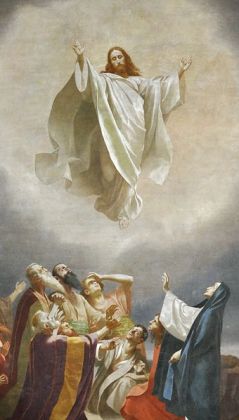
Today we celebrate Jesus’ bodily ascension into Heaven. The traditional day for celebrating the Ascension is forty days after Easter, which was last Thursday, or “Ascension Thursday.” Our diocese, like most dioceses in our country, transfers this celebration to this Sunday. I guess we like keeping Jesus around longer. But seriously, the ascension of Jesus into heaven raises this question: “Why did he go? Why didn’t Jesus stay?

Now Jesus does tell us, “Wherever two or three are gathered in my name I am there in their midst.” He says, “Behold, I am with you always until the end of the age.” And he is truly present for us in the Holy Eucharist. But Jesus’ presence now remains invisible or veiled to our eyes. By bodily ascending and disappearing into the clouds Jesus is visibly departing from us until he comes again with a glory manifested to all. “But I tell you the truth,” he says, “it is better for you that I go.” Why is this better? What would it be like if Jesus dwelt among us throughout the centuries like he did with his disciples those forty days, walking with them and talking with them, following his Resurrection?

There is no physical reason why Jesus could not have done this. His risen body is a glorified body no longer subject to injury or death, so that’s not the reason he did not remain. Did he go because on earth he’s reduced to being in one particular place, or limited in how much he can see, know, or do? Remember, Jesus is not merely human but divine, all-knowing and all-powerful, and his bi-locating saints (such as Venerable Mary of Ágreda or St. Padre Pio) who have manifested the miracle of being more than one place at once surely do not possess any supernatural ability which Jesus lacks.

So God the Father could have chosen “by his own authority” for his Son to remain visibly active here with us, in one, or thousands, or millions of locations at once, throughout the centuries up to our day. Jesus could be the pastor in every parish, the teacher in every classroom, the doctor in every hospital, and the leader in every country. He is the perfect priest, the best teacher, the greatest healer, and the rightful ruler of all. Who is better-qualified than Jesus to do any of these things? Nobody. People would demand this of him and resent him for not doing it. But if Jesus were visibly present and doing everything, then we would be left doing very little.

Would it be a better world if Jesus personally did everything? In some ways, yes. Earth would be closer to paradise in many respects. But would this lead to more souls being saved? I’m not so sure. Adam and Eve lived in an earthly paradise, too, before they fell. And the glory of Christ being manifested to the world in an undeniable way might gain peoples’ submission, but not necessarily their conversion or love. The demons who fell had no doubts about God’s existence and yet they chose to disobey him as far as they were able.

If Jesus did everything of importance on earth without us, one result which seems evident to me is that we would remain in an unending adolescence, like someone attending the eighth grade well into their adulthood. This is why it was better for us that Jesus ascended. We are children of God called to what St. Paul calls “the stature of the fullness of Christ.” If everything which matters were just Jesus’ job to handle, how would we grow from our immaturity into the full maturity of Christ?

Jesus says, “I tell you the truth, it is better for you that I go. For if I do not go, the (Holy Spirit) will not come to you. But if I go, I will send him to you.” By the Holy Spirit, the Church (which is Christ’s Body) is animated in this world. As members of his body we are moved by the Holy Spirit to love and to work united with Christ, growing more into his likeness and glory along the way. Would Jesus not ascending into heaven, remaining constantly here on earth and doing everything without us, have been easier than this present Christian life of ours? Perhaps, but Jesus desires that we would graduate with him to higher things and ascend to a greater glory with himself.

Transforming Love

May 1, 2022

3rd Sunday of Easter
By Fr. Chinnappan Pelavendran

Today we have another account of Jesus appearing to his disciples on Easter Sunday wherein he prepares a meal for them and gives them support. He comes constantly to the disciples to be with them, guide them and encourage them. All the three readings of today tell us of our vocation and our mission to be at the service of the word and not to hesitate to proclaim our closeness to Jesus. We admire the courage of the Disciples of Jesus who preach with boldness and are ready to face sufferings happily for His sake.

John the Evangelist tells us that God is love. God’s love is unconditional, unmerited, and without limit. It lasts forever. It’s the beginning and end. And it’s the essence of what it means to be a Christian – one who knows God’s love and forgiveness and who loves God in return with all one’s heart, soul, mind, body, and strength. God’s love heals and transforms our lives and frees us from fear, selfishness, and greed. It draws us to the very heart of God and it compels us to give to him the best we have and all we possess – our gifts, our time, our resources, and our very lives. St. Paul the Apostle tells us that God’s love has been poured into our hearts through the Holy Spirit which has been given us.

Why did Jesus question Peter’s love and fidelity three times in front of the other apostles? It must have caused Peter pain and sorrow since he had publicly denied Jesus three times. Now Peter, full of remorse and humility, stated that he loved his master and was willing to serve him whatever it might cost. Jesus asks him “do you love me more than these?

Jesus may have pointed to the boats, nets, and catch of fish. Do you love me more than these things? He may have challenged Peter to abandon his work as a fisherman for the task of shepherding God’s people. Jesus also may have pointed to the other disciples and to Peter’s previous boast: “Though they all fall away because of you, I will never fall away.” (Matthew 26:33) Peter now makes no boast or comparison but humbly responds: “You know I love you.”

The Lord Jesus calls each one of us, even in our weakness, sin, and failings, to love him above all else. Saint Augustine in his Confessions wrote: “Late have I loved you, O Beauty so ancient and so new. Late have I loved you! …You shone your Self upon me to drive away my blindness. You breathed your fragrance upon me… and in astonishment I drew my breath…now I pant for you! I tasted you, and now I hunger and thirst for you. You touched me! – and I burn to live within your peace.” (Confessions 10:27) Nothing but our sinful pride and willfulness can keep us from the love of God. It is a free gift, unmerited and beyond payment. We can never outmatch God in giving love. He loved us first and our love for him is a response to his exceeding graciousness and mercy towards us. Do you allow God’s love to change and transform your heart? “Lord Jesus, inflame my heart with your love and remove everything that is unloving, unkind, ungrateful, unholy, and not in accord with your will.”

“Do You Love Me?”

April 30, 2022

3rd Sunday of Easter
By Fr. Victor Feltes

At the Last Supper, Simon Peter assures Jesus, “Lord, I am prepared to go to prison and to die with you.” But Jesus replies, “Peter, before the rooster crows this day, you will deny three times that you know me.” Later that night, during Jesus’ trial before the Jewish high priest, Peter stands with the servants and soldiers outside. It’s a cold night, so they warm themselves around a charcoal fire in the middle of the courtyard. This is where Peter denies three times that he is in any way connected to Jesus. A rooster crows, Jesus turns and makes eye-contact with Peter, and Peter breaks down and weeps.

In our gospel, the risen Jesus appears to seven of his disciples at the Sea of Galilee (also known as the Sea of Tiberius). He invites them to breakfast with him around another charcoal fire. This is the context for the conversation between Jesus and Peter today. After Peter’s three denials, Jesus provides him an opportunity to thrice-reaffirm his love. Jesus meets Peter by that charcoal fire like he mercifully encounters you and me in the confessional.

Now there is more going on in the original Greek of this gospel text than can be seen in our English translation. In English, the word “love” does a lot of heavy lifting. We say: “I love my family,” “I love my car,” “I love my country,” “I love pizza,” and “I love God.” But in Greek, there are multiple words for “love.” For example, “Phileo” refers to friendship or brotherly love, “Eros” refers to romantic love, and “Agape” refers to self-sacrificial, unconditional love. Agape is the way God actively loves us and how we are called to love too. “This is my commandment,” says the Lord, “that you (apage) one another, just as I have (agaped) you.

In today’s gospel, Jesus first asks: “Simon, son of John, do you love me (do you agape me) more than these?” And Simon Peter answers, “Yes, Lord, you know that I (phileo) you.” Simon loves Jesus as a dear brother and friend, but Peter, now humbled, recognizes that he does not love Jesus perfectly. Then Jesus asks again, “Simon, son of John, do you (agape) me?” Simon Peter answers, “Yes, Lord, you know that I (phileo) you.” But the third and final time, Jesus asks, “Simon, son of John, do you (phileo) me?

Peter is distressed that Jesus switches this time to asking, “Do you (phileo) me?” Peter may be wondering, “Is Jesus questioning whether I even love him that much?” He says, “Lord, you know everything; you know that I (phileo) you.” Jesus is not doubting Peter’s phileo love for him, but rather meeting him where he’s at, allowing him to answer with an unqualified “yes.” Peter’s love is not yet perfect, they both recognize that, but Jesus tells him to feed his lambs, tend his sheep, and feed his sheep as the chief shepherd of Christ’s flock on earth as the first pope. Jesus reveals to Peter that his faithful service will lead him to the perfection of self-sacrificial, agape love in end.

Amen, amen,” Jesus tells him, “when you were younger, you used to dress yourself and go where you wanted; but when you grow old, you will stretch out your hands, and someone else will dress you and lead you where you do not want to go.” Jesus said this signifying by what kind of death Peter would glorify God; that is, a martyr’s death. Peter would go on to be crucified upside-down and buried on Vatican Hill. Our gospel concludes with Jesus telling St. Peter and us: “Follow me.”

Like Peter there on the seashore, we probably realize that our love for God is real though imperfect. Jesus knows this too, of course, but he still loves us here and now. He meets us where we’re at, he loves us as we are, but he will not settle for that. He intends to call us, lead us, press us forward to more perfect love. His providence will lead us to places we may not want to go, to experience trials we would not choose for ourselves. But his purpose is to make us into a person, a person who loves, like Jesus Christ himself.

A final story…
In C.S. Lewis’ Christian fantasy novel, “The Lion, The Witch, and The Wardrobe,” a little girl named Lucy is told about a great lion named Aslan. Aslan is the Christ figure in the world of Narnia. Mr. Tumnus tells Lucy, “He’s wild, you know. Not like a tame lion.” Lucy asks, “Is he—quite safe?” And Mr. Beaver replies, “Who said anything about safe? [Of] course he isn’t safe. But he’s good.”

Because He Loves You

April 17, 2022

Easter Vigil
By Fr. Victor Feltes

Our human knowledge and human awareness are limited and finite. Jesus Christ, however, is both fully human and fully divine. As the eternal, Second Person of the Trinity, his understanding and consciousness are unlimited. And so, amazingly and truly, he knew us and loved us even before time began.

At the beginning of creation, he foreknew you and loved you. He called Father Abraham in ancient times, in part, because he loves you. He freed the Hebrews from slavery in Egypt because he loves you. He settled his people in the Promised Land because he loves you. He established King David’s dynasty because he loves you. He commissioned all the prophets because he loves you. He brought his people back from exile because he loves you.

In the fullness of time, he became man because he loves you. He preached and ministered on earth because he loves you. He tolerated rejection and betrayal because he loves you. He endured whipping and mockery because he loves you. He accepted the Holy Cross because he loves you. He suffered and died because he loves you. But during this night upon the third day, he conquered death and rose again because he loves you.

In more recent days, he gave you life in your mother’s womb because he loves you. He encounters you in his Catholic Church because he loves you. He baptizes you to be his Father’s child because he loves you. He confirms you as the Holy Spirit’s temple and instrument because he loves you. He incorporates you into being a member of his mystical Body and Bride because he loves you. And he fills your life with more blessings than you can count because he loves you.

Each of us rightly celebrates this night because of Jesus Christ. You are here at Easter Vigil because you love him. But more importantly, you are here tonight because he loves you.

Entering Holy Week

April 9, 2022

Palm Sunday
By Fr. Chinnappan Pelavendran

Today the Church is celebrating Palm Sunday, Palm Sunday reminds us of the glorious and triumphal entry of Jesus into Jerusalem. As Jesus entered Jerusalem the crowds greeted him with shouts of joy and proclaimed him as the messianic king. They spread their cloaks on the ground and placed the palm branches on the street and shouted “Hosanna to the Son of David” and “Blessed is he who comes in the name of the Lord.” The donkey was a symbol of peace and those who rode upon them proclaimed peaceful intentions. The laying of palm branches indicated that the king or dignitary was arriving at victory or triumph.

In the second reading of today. The hymn tells us that even though he was divine, he took willingly the human form for our sake. He is the new Adam who became obedient and did not cling to his divinity and, He is the servant of God who accepted sufferings for the sake of humanity. Finally, he died on the cross a death of shame and humiliation. That death became the sign of triumph and glory and the means of salvation for the world.

The Gospel tells us of his victory and reveals in painful detail the physical sufferings of Jesus. There is rejection, pain, misunderstanding, and Humiliation and yet through it, all Jesus stands firm, faithful to God till the end. In the process, there is a transformation. The leader becomes a servant, shame turns to honor, mockery becomes praise, fear turns to trust, abandonment becomes love, despair turns into hope, and above all death blossoms into new life.

In today’s Passion narrative, Luke builds up to five basic events that take place during the last few days of the earthly life of Jesus. The first is that Jesus shares his final meal with the disciples. Second, Jesus is arrested by his enemies. Third, Jesus is subjected to the so-called Jewish trial. Fourth, Jesus is subjected to the Roman trial and is condemned to death. Fifth, Jesus is crucified on the Cross. He dies on the Cross and is buried soon after.

We must be ready to surrender our lives to Jesus during this Holy Week and welcome Him into all areas of our life as our Lord and Savior, singing “Hosanna.” Today, we receive palm branches at the Divine Liturgy. Let us take them to our homes and put them in a place where we can always see them. Let the palms remind us that Christ is the King of our families, which Christ is the King of our hearts, and that Christ is the only true answer to our quest for happiness and meaning in our lives. And if we do proclaim Christ as our King, let us try to make time for Him in our daily life. Let us remember that He is the One with whom we will be spending eternity. Let us be reminded further that our careers, our education, our finances, our homes, and all of the basic material needs in our lives are only temporary. Let us prioritize and place Christ the King as the primary concern in our lives. It is only when we have done this that we will find true peace and happiness in our confused and complex world.

This week, let us reflect upon the mystery of the Passion of Jesus, our King, as we prepare ourselves to commemorate His glorious Resurrection. Let us remember that Jesus died for our sins, your sins, my sins. Let us be most thankful to the Lord Jesus in thoughts, words, and in actions. And may the Spirit of Jesus be with us during the coming week as we relive the last few days in the life of Jesus on earth. This is a perfect opportunity for us to learn about Divine love so we too may grow in the love of Jesus by the grace of the Heavenly Father.

Holy Week Gifts to Jesus

April 9, 2022

Palm Sunday
By Fr. Victor Feltes

Today, Jesus sends two of his disciples on a special mission. He tells them, “Go into the village opposite you, and as you enter it you will find a colt tethered [a young donkey] on which no one has ever sat. Untie it and bring it here.” Jesus rides that animal into Jerusalem in fulfillment of Zechariah’s ancient prophesy: “Shout for joy, O daughter Jerusalem! Behold: your king is coming to you, a just savior is he. Humble, and riding on a donkey, on a colt, the foal of a donkey.” Jesus does not approach with force upon a warhorse, but peaceably, humbly, a savior riding on a donkey.

Today, on Palm Sunday, his followers celebrate while his enemies complain. Later, on Good Friday, Jesus’ foes accomplish his murder while his friends mourn. A secret disciple of Jesus, St. Joseph of Arimathea, helps take the body of Jesus down from the Cross and wraps it in a linen cloth, laying him in a new tomb which Joseph had hewn from rock and “in which no one had yet been buried.” St. Luke notes how Jesus rides an animal “on which no one has ever sat” and is placed in a tomb “in which no one had yet been buried.” What is the significance of highlighting these details?

Both objects being never used before suggests them being set apart, consecrated for specific use by the Lord. In the Old Testament, God’s law sometimes required the sacrifice of heifers who had never worn a yoke. At times, the Ark of the Covenant was moved using brand new carts. And a Jewish tradition held that no one else could ride the animal upon which the king of Israel rode.

Providence had prepared that colt and that cave for Jesus Christ himself. Notice how neither the animal nor the grave was stolen; both of them were freely given to Jesus during Holy Week. And both these gifts were returned to their owners with added glory because of Christ. These things are symbols for us.

What does Jesus desire this Holy Week? He desires something made and meant for him, but which he will not steal. The gift can only be freely given, and the giver will share in his glory. What Jesus desires this Holy Week is you. Before you celebrate his Resurrection with him at Easter, join him at his table for Holy Thursday, and accompany him through his Passion on Good Friday. Jesus rode another’s colt, and he wishes to journey with you. Jesus laid in another’s cave, and he wishes to rest and live again in you. Gift yourself to Jesus Christ this Holy Week and he will share with you his glory.

Encountering God, we Cannot Remain the Same

April 3, 2022

5th Sunday of Lent
By Fr. Chinnappan Pelavendran 

We are just one week away from the Holy Week and away from our celebration of God’s love shown in the passion, death, and resurrection of Jesus. For us, this season of Lent is a time of special grace in which we experience the presence of a God who cares and loves us. Our response is to transform ourselves and to live according to his will. Before him, we acknowledge our weakness and we know that he is the one who supports us and builds with us new relationships we ought to change our lives during Lent and come closer to him.

In today’s First Reading, we heard the prophetic Words of the Lord God speaking to the prophet Isaiah. Yahweh begins by identifying Himself. He says that it was He who created Israel. It was He who led the Exodus of His people under the leadership of Moses. It was He who divided the Red Sea and who destroyed the great army of the Pharaoh of Egypt. It was He who quenched the life out of the enemies of His people. God tells them to look ahead and not to look back into the past. The past always closes our minds and does not allow us to see things in the present moment as they are. The Lord promises to the people, “I am about to do a new thing for I am about to create new heavens and a new earth, and former things shall not be remembered or come to mind.”

In the second reading of today, St. Paul tells the church of Philippi to break away from its past. St. Paul presents his reflections on how much God loves him, He says I have accepted the loss of everything, and I look at everything so much as rubbish if only I can have Christ and be given a place in him. All I want is to know Christ and the power of his resurrection. In his search for perfection, he observed all the rules and norms as a Pharisee, but ultimately he found the meaning in Christ. He accepted the loss of all things that he might gain Christ.

The Gospel of today places before us an episode that emphasizes the need to examine ourselves and avoid passing any judgment on others. Generally, there is a tendency within us to find fault in others and to condemn them. As we approach the end of the Lenten season, we are reminded of the great opportunity to cooperate with God’s special graces. The Gospel presents to us a sharp contrast between the cruelty and wickedness of the scribes and Pharisees and the compassion of Jesus. The scribes and Pharisees had no regard for the woman caught in adultery and brought her to Jesus the master. They were only interested in using her to try to trap Jesus. Jesus places a bigger challenge before the accusers. He asks them to consider their actions and their shortcomings. He tells them to look into themselves before passing any judgment on others.

Jesus has forgiven the woman’s sin and expects her to live from now on in a life of grace and union with God by not sinning anymore. He gives her a chance to change her life completely. The Pharisees and the Scribes were proud and arrogant and preferred to judge. They had no idea how to love, how to forgive but only how to observe the Law externally. They did not love God’s people.

Once a person is touched by God and has received His divine command, he cannot remain the same person. That was the experience of Moses, Isaiah, Jeremiah, Peter, Paul, and several others who came into close contact with him and remained united to Him. In the Word of God today, we heard the divine message that God makes all things new. Jesus gives us a basic command that helps us to identify that we are on our way to reaching union with Him. We must persevere in our living faith. As Jesus said to the woman so he tells us Go your way, and from now on do not sin again.

More Than a Means to an End

April 3, 2022

5th Sunday of Lent
By Fr. Victor Feltes

A present-day view of the Temple Mount from the Mount of Olives, with the Kidron Valley in between.

In the chapter preceding our reading from John’s Gospel, Jesus was preaching to a crowd of people in the Temple courtyard. Because of his words, “some of them… wanted to arrest him, but no one laid hands on him… Then each went to his own house, while Jesus went to the Mount of Olives.” But early the next morning Jesus returns to the temple area and all the people start coming to him. He sits down and teaches them, setting the stage for today’s famous scene with the woman caught in adultery.

I would like to describe for you the geography of these places referenced in our gospel. The Mount of Olives looks down over the old city of Jerusalem with a valley, the Kidron Valley, situated between them. The Mount of Olives descends about four hundred feet to the valley below. At the bottom of this hillside is the Garden of Gethsemane, where St. John tells us Jesus often met with his disciples. On the opposite side of the valley, the ground rises up again some two hundred feet to Jerusalem’s ancient city wall and the Temple Mount.

The Mount of Olives gets its name from an olive orchard which grew on its western slope facing the city. At harvest time, its olives would be gathered, brought down the hillside, and crushed to make olive oil. This oil was used for food, for medicine, to make skin clean and radiant, and as fuel for oil lamps. The Garden of Gethsemane was once a location for this processing – the name Gethsemane means “oil press” in Hebrew.

After the Last Supper, as was his custom, Jesus crossed the Kidron Valley and entered the Garden of Gethsemane with his disciples. He said to them, “Sit here while I pray.” He took Peter, James, and John along with him a little further on, and began to be troubled and distressed. Then he said to them, “My soul is sorrowful even to death. Remain here and keep watch.” St. Luke records that Jesus was then in such agony and prayed so fervently “that his sweat became like drops of blood falling on the ground.” Like olives being crushed to bring forth precious oil at harvest time, this is the beginning of Jesus being crushed in his Passion.

In fulfillment of the words of the Prophet Isaiah, he was crushed for our iniquity and pierced for our sins, “He bore the punishment that makes us whole, by his wounds we were healed.” Without the crushing of the olives we would not enjoy the blessings of their oil. Without Christ’s Passion we would have no Eucharistic food, no saving medicine for our souls, no cleansing, no resurrected glory for our flesh, and no light of hope in our darkened world.

It is interesting that Jesus liked to come to the Garden of Gethsemane to pray. The Gospels usually record him climbing up to higher places to pray, like Mount Tabor or mountains overlooking the Sea of Galilee. But here Jesus prays in a valley, perhaps a dark valley, depending on the foliage.

When I traveled to the Holy Land in 2016, I visited the Garden of Gethsemane where a number of very old olive trees still grow. Looking across the valley there, it occurred to me there that the upper portions of the Temple would have been visible rising above the city wall. Just as we sit before the presence of Jesus in the Tabernacle, I could imagine our Lord facing his Father’s dwelling place, praying with personal devotion and receiving consolation, knowing that his God was there.

Why did Jesus bring his disciples with him to the Garden of Gethsemane on Holy Thursday night when he could have easily gone alone? In part, it was so that they could be eyewitnesses to the events there, but Jesus also did this to provide companionship for himself in his darkest hours. Like the comfort of having his mother Mary at the Cross, Jesus having his disciples with him in the Garden made him feel a little less alone.

The scribes and Pharisees in our gospel story today do not care about the woman caught in adultery. They do not actually care whether she gets punished or forgiven. If they really cared about her adultery then why didn’t they bring along for judgment the man she sinned with also? I doubt this woman was caught in the act and Jesus’ enemies hatched their plan all on the same morning. Her affair may well have happened many months or years before this moment. They are merely using her as a prop, as a tool, as a means to an end: in order to entrap Jesus. They want our Lord to say something against the Law of Moses so that they may condemn him.

At first, Jesus seems to feign disinterest. When they continue pestering him to answer, he declares: “Let the one among you who is without sin be the first to throw a stone at her.” Then he returns to writing something (we don’t know what) upon the ground. “And in response, they went away one by one, beginning with the elders,” discarding the woman and leaving her alone with Jesus. But this woman wasn’t a prop to Jesus. He sees her as a person and personally cares about her. “Has no one condemned you?” he asks her, “Neither do I condemn you. Go, and from now on do not sin any more.”

How do we relate to Jesus? Do we relate to Jesus personally or do we treat him merely a means to an end? We all want to go to Heaven of course, and Jesus wants that for us too, but do we desire a deeper personal relationship with Jesus Christ as well? Do I care what he thinks, how he feels, what he wants? Jesus desires to be more than a religious prop or tool for us.

Let your daily prayer be interpersonal. Prayer is not just saying words or casting wishes, it is speaking with a friend in heaven. So encounter Christ in prayer. Meet him in your place of prayer at home. Meet him before his altar and his tabernacle. Come keep watch with in the Garden after the evening Mass on Holy Thursday, which is just around the corner. Could you not keep watch with him one hour? Give Jesus the gift of your companionship, this and every day.

The Seven Last Words of Christ

March 19, 2022

The seven last words (or statements) Jesus said from his Cross are a classic reflection for Lent. This year, Fr. Chinnappan Pelavendran preached on this theme throughout a four evening parish mission retreat at held St. Paul’s, March 14-17. His four talks are below.

Monday’s Talk
“Father, forgive them, for they don’t know what they’re doing”
“Truly, I say to you, today you will be with me in paradise.”

Tuesday’s Talk
“Jesus said to his mother: ‘Woman, this is your son.’ Then he said to the disciple: “This is your mother.”
“My God, my God, why have you forsaken me?”

Wednesday’s Talk
“I thirst.”
“It is finished.”

Thursday’s Talk
“Jesus cried out in a loud voice, ‘Father, into your hands I commend my spirit!’”

The Lover’s Return — Funeral Homily for Richard “Dick” Aubert, 85

February 24, 2022

Dick was swept off his feet and went head over heels on his first date with Michele. It was during the winter which spanned 1959 and 1960. They were both quite young. He had just returned from service in the U.S. army She was piously contemplating becoming a nun. Facilitated by mutual friends, Dick and Michele decided to go ice skating together.

There were a lot of people at the rink that night. Many skaters going to-and-fro on the ice. Suddenly, during a moment while Michele was either distracted or not nearby, Dick slipped, and fell, and smacked his head on the ice. Michele later saw somebody sitting on the ice, a crowd of people gathered around him, but she did not realize that that young man was her date.

Having suffered a concussion, Dick was brought off the emergency room. But Michele thought he had ghosted her. She assumed he had abandoned her, without even saying goodbye. Surely this must have seemed like the end of their relationship. How could a relationship continue after that? Well, Dick soon returned, explained what he had happened and where he had gone, and they booked a second date.

After a year of dating, they committed their hearts to each other, entering a marriage covenant in the Sacred Heart of Jesus Catholic Church in Eau Claire in 1961. And their love bore fruit, particularly in three daughters; Catherine, Lori, and Heather, in their grandchildren and great grandchildren.

We are gathered here on this day, rather than gathered elsewhere, because of one man more than any other. For love, he pursued a holy and beautiful bride. He was painfully struck down, and they were separated for a time. She did not understand why they were parted and had not hoped to see him again. But then he rose again and returned to her, and their love has borne fruit since. I speak of Jesus Christ and his Church. Behold, he makes all things new, renewing his mysteries within our lives.

The holy love of a husband and wife reflects the holy love Christ and his Church. Dick and Michele have been married for sixty years, even throughout the past three years of his mental decline, living together at home until just three months ago.

On a day like there are tears from sadness due to parting and tears from beholding the beauty of faithful love. Jesus will one day wipe every tear from our eyes, and there shall be no more death or mourning, wailing or pain, when this world is finally set free from slavery to corruption and this old order has passed away, replaced by the new. St. Paul urges us to “consider that the sufferings of this present time are as nothing compared with the glory to be revealed for us.

The Lord Jesus, who makes us children of God the Father; Christ, the lover of our souls, who proposes to us an everlasting covenant with himself; Jesus Christ, who suffered with us but rose again, he is the reason we are here today for Dick’s funeral. In this broken world of suffering and beauty, Jesus is our cause for hope and our greatest consolation.

Dorothy at Home — Funeral Homily for Dorothy Turner, 85

February 22, 2022

I am informed that Dorothy dreaded snowstorms. In years past, she would urge her family not to travel on a day with weather like today’s. But for love of Dorothy you have gathered here to spiritually aid her on her journey and for your mourning hearts to be blanketed by heavenly grace. Today, I would like to share and reflect on a handful of Dorothy stories.

When her kids were growing up, her beloved husband Bob would come home in time for supper when his work schedule permitted. Bob loved everything and everyone to be in their right and proper place. So, near five o’clock, Dorothy would glance out the window to glimpse her husband’s approach. “He’s coming around the corner,” she would yell, and the whole household would spring into action. One child would run into the living room, to tidy up the toys and homework materials. Meanwhile in the kitchen, one kid set the table, another prepared the dessert, while another helped mom put the food into bowls. When dad walked in, Dorothy had everyone seated and ready, awaiting him at the table.

Four years ago, after sixty years of marriage together, Bob passed away. In addition to her many relatives and friends, one of Dorothy’s great consolations in these last years has been her favorite dog, Bud. After suffering a stroke and heart attack eight years ago, Dorothy moved with much more difficulty. Yet Bud would not impede her path or bump into Dorothy’s legs. He would walk with her, behind her all the way. When Dorothy sat or slept, he was there nearby.

A few days before her recent passing at home, Dorothy was saying, “I need to go upstairs. I need to go upstairs.” Josh, her devoted caregiver, asked her, “Why do you need to go upstairs?” She answered, “Because Pa and Ma and all my brothers and sisters are waiting for me.” Dorothy lived in a ranch duplex, it has no second story upstairs. But like others who have approached the end of their earthly lives with perceptions of the hereafter, Dorothy referred “not to what is seen but to what is unseen.” As St. Paul writes, though our bodies (“our earthly dwellings”) may be destroyed, we have a building from God, eternal in heaven.

And who through the many years of Dorothy’s life has most faithfully accompanied her? When she would rest or rise, he was there. He was never an obstacle but her constant companion. Who was her Good Shepherd who has never misled or abandoned her and would seek her out if she ever strayed? He is our Lord Jesus Christ, of whom the blessed say, “You spread the table before me.”

We rightly pray for Dorothy’s soul today but it is also right for us to hope that our holy family upstairs is now in a flurry of activity, making last-minute arrangements, preparing her place at the heavenly banquet. In the difficult moments ahead as you mourn Dorothy’s passing imagine an archangel announcing in our Father’s house, “She’s coming around the corner! Dorothy is coming home!

Jesus Invites You

February 12, 2022

6th Sunday of Ordinary Time

When we come before our Lord for the Holy Mass it is good to prepare ourselves. Greet Jesus present for us in the Tabernacle. Ask his help so that you may also be fully present and worship well. Also before Mass, form Mass intentions; choose which persons or problems you wish to be especially blessed by the graces which will flow from this Sacrifice on the altar. Having a Mass intention helps ward off distractions because you will not be merely a spectator—just watching the priest pray—but an invested, active-participant in offering his sacrifice and yours, for the needs of many. If you have prayerfully prepared for Mass and there’s still a few minutes remaining before it begins, perhaps look over the day’s readings printed in the missalette.

There’s a feature in our missalettes you may or may not have noticed: for each Sunday, the readings are preceded by an introductory reflection. The entry for this Sixth Sunday in Ordinary Time begins with an illustration which struck me: “How would you feel if you received an invitation today to a simple but free meal, maybe a plate with beans, some bread, and a tall glass of cool water? If you are wealthy, you would likely refuse, for you know you could afford a much more sumptuous meal elsewhere. But if you are having difficulty putting food on your table and your family is starving, this complimentary meal would be a godsend.”

Would I go to attend that meal? If the invitation to this meal were addressed to everyone in the general public rather than a personal invitation specifically to me, I can easily imagine myself staying at home, most likely to enjoy some reheated leftovers. But what if this invitation came from the Lord Jesus himself, wishing to be our host and companion at his simple meal? Then who would attend? We would like to think everybody would, yet how many people skip Sunday Mass for other activities instead? It is very possible to overlook or to undervalue the invitations of Jesus Christ.

Unlike the famous Sermon on the Mount (with its eight “blessed” Beatitudes recorded by St. Matthew), this morning’s Sermon on the Plain recounted by St. Luke features four blessings paired with four woes. “Woe” was the cry of Israel’s prophets (such as Isaiah, Amos, and Habakkuk) who warned people of impending distress. Jesus says:

Woe to you who are rich…
  Woe to you who are filled now…
  Woe to you who laugh now…
  Woe to you when all speak well of you…

The danger is, if we’re comfortable, satisfied, happy, and at home in this world, we may imagine that we don’t need God or may refuse to make personal sacrifices we’re called to make for him. We can easily ignore the needs of other people, if we decide not to care. We can distract ourselves from the reality of our own mortality, sometimes up until the very end. We can dismiss our impending judgment by the holy, righteous God and refuse to change our ways. The poor, the hungry, the suffering, and the mistreated are blessed, in part, because they more easily see that all is not right with this world. They more readily recognize, they are more open to accepting, that our flawed hearts and sinful cultures need the Divine Savior, Christ. And that openness is a blessing.

You accepted Jesus’ invitation to his meal here today, and that is very good, but in what areas of your life do you still decline him? The thing about even a free meal of beans and bread and water is that this menu seems unappetizing, unappealing. Many good things Christ wants to share with us feel like that at first. We have plenty of free time for the internet or television, but do we want to spend more time with the Lord in prayer? If we take home $30,000-a-year after taxes, our individual income is greater than 95% of people on earth, but do we want to share as generously as Jesus calls us to? We see the needs of our neighbors, near and far, but do we want to offer penances and acts of service for them, serving Christ within them?

The season of Lent is only two-and-a-half weeks away. To what new engagement with himself is Jesus personally inviting you? Blessed are you who respond to him, for this is the kingdom of God. Blessed are you who share his simple table, for he promises you will be satisfied. And blessed are you who accept Christ’s invitations, for your reward will be great in heaven.

God Chooses People Like You

January 29, 2022

4th Sunday of Ordinary Time
By Fr. Chinnappan Pelavendran

“Isn’t this the son of a carpenter?” —Luke 4:22

God chooses and uses ordinary people to do extraordinary things. He doesn’t need our ability, but rather our availability. He uses ordinary people who have nothing of their own to offer except their faithfulness and willingness to say “Yes” to God. One important point to note is that God does not call anyone by accident. Instead, He carefully considered before calling us. He knew each one of us personally. He also knows what he wants us to do for him. He calls us by our own names, with a plan in His mind.

We see this in the First Reading, which speaks of the calling of Jeremiah to be a prophet who will communicate God’s Word to his people. It was a calling that went back to the time before he was born. “Before I formed you in the womb I knew you, before you were born I dedicated you, a prophet to the nations I appointed you.” All of us have actually been called in this way. But our reaction is often similar to Jeremiah’s: “‘Ah, Lord God!’ ‘I know not how to speak; I am too young.’” But the Lord responded, “Say not, ‘I am too young’. To whomever I send you, you shall go; whatever I command you, you shall speak…” Then the Lord extended his hand and touched his mouth, saying: “See, I place my words in your mouth.” An ordinary youth called by God to do His Mission.

Look at the Apostle Paul. Whose feast day we celebrated on January 25th. St. Paul was one of the most educated men of his day and yet God brought him down in Acts 9. God opened his eyes to the beauty and glory of Jesus. Once Paul knew Jesus, all of his education, gifts, and talents were directed towards the Gospel. The Lord uses those humbled by a vision of His greatness and glory to testify to the proud and religious. The Lord humbled the Apostle Paul and used him mightily to plant churches, preach the Gospel, write more than a dozen New Testament letters, and so much more. God used educated people for His glory but often humbled them because of their pride so they will rely on Him.

Peter was a fisherman by trade, along with his brother Andrew. He grew into a gifted preacher and bold leader. Jesus told Peter that he would deny Him three times, but Peter didn’t believe Him. Imagine Peter, the leader of the Apostles and a member of the inner circle of the Son of God, denied him three times. Peter felt devastation, shame, and guilt. He may have thought “I’m such a failure that God could never use me again,” but that isn’t true. God uses our failures, hardships and trials for His glory. He turns what was meant for bad to testify to His grace. You say that you are a failure and yet God says because of the finished work of Christ you are victorious. The Apostle Peter went on to be mightily used by God because He was broken. You may be broken right now but in due season God will build you up and use you for His glory. Don’t run from Him, run to Jesus. God uses ordinary people for His glory.

Jesus is a good manual worker from a small village. He is just another person in the town. But the rumors being spread about his actions in Capernaum and the words he has just spoken seem to indicate a special connection with God. On the one hand, his origins are well-known, but on the other hand his origin is completely unknown. Who is Jesus really? The ordinary carpenter, Jesus, is the Son of God who has become man in order to redeem us from our sins.

How could God use you? Look at your situation and your surroundings. Perhaps God has placed you in your school, your job, your family, or your neighborhood to do something special for the Lord Jesus Christ. God is calling you right now; all you have to do is say, “Yes, Lord!” Will you make yourself available to Him? Remember, God uses ordinary people to do extraordinary things for His glory!

Why They Rejected Christ

January 29, 2022

4th Sunday in Ordinary Time

When Jesus preached at Nazareth near the start of his public ministry, his own hometown neighbors rose up, filled with fury against him. They drove him out of their village intending to toss him head first off a cliff. Later, near the end of Jesus’ public ministry, one his own twelve apostles, after spending years in his close company, chose to betray Jesus to his enemies. And sometimes in our present day, lifelong Christians experience painful events and give up on their commitment to Christ. Why did Jesus’ neighbors in Nazareth reject him? Why did his apostle, Judas Iscariot, betray him? And why do Christians sometimes abandon him in hard times? All of these expected our Lord to do certain things for them but were disappointed. In each case, Jesus failed to do for them what they desired.

Part of the problem at Nazareth was that Jesus was too familiar to them. He grew up there as a little kid playing in their streets, he worked locally as a carpenter’s son, and he quietly attended their small-town synagogue for years. So when they heard him preaching they asked, “Where did this man get all this?” How could this guy be someone foretold of in the Scriptures? As Jesus acknowledges, “No prophet is accepted in his own native place.”

They wanted him to prove he was somebody special by working miracles before them. A sick doctor should be able to apply his talents for his own recovery and prove he is a real doctor; so the Nazoreans would say to Jesus, “Physician, cure yourself! Do here in your native place the things that we heard were done in Capernaum.” But God’s prophet does not owe them miracles. Jesus notes that neither Elijah nor Elisha, two of the Old Testament’s greatest prophets, worked miracles for Israel’s individual widows or lepers, respectively. St. Mark’s Gospel reports that Jesus did not perform many mighty deeds in Nazareth, apart from curing a few sick people by laying his hands on them. Their lack of faith and lack of openness seems to have limited the gifts of God they could receive. So Jesus failed to match their expectations, and they took great offense at him.

Why did Judas Iscariot betray our Lord for thirty silver pieces? St. John tells us in his gospel that Judas “was a thief and held [Jesus and the apostles’] moneybag and used to steal the contributions.” Those thirty coins represented thirty days’ wages back then, something akin to $3,000 today. Was Judas so greedy for that relatively-modest amount of money that he couldn’t resist? When Judas saw that Jesus had been condemned to death he felt deep regret at what he had done. He tried to return the money to the high priest and elders saying, “I have sinned in betraying innocent blood.” He wishes to undo his deed, but the Jewish leaders brush him off: “What is that to us? Look to it yourself.” Judas goes away in despair and foolishly kills himself. If Judas did not wish for Jesus to die, then why did he sell him out? It seems that this apostle was disappointed by Jesus’ public ministry.

Most Jews expected the Messiah to come as a warrior-king like David. They imagined the Christ would drive out their pagan overlords, conquer Jerusalem, and lead an earthly kingdom of vast power, prestige, privilege, and wealth. But Jesus was not pursuing that popular dream. He devoted his efforts instead to teaching and healing the lowly and poor. When, after feeding thousands with five loaves and two fish, Jesus perceived “they were going to come and carry him off to make him king,” he firmly sent that crowd away and withdrew up the mountain alone. Judas had run out of patience waiting for Jesus’ Kingdom to come. Maybe Judas had given up on Jesus, and took that money to start a new life without him. Or maybe he hoped that Jesus—with his back to the wall—would finally wield his mighty, miraculous power to claim his royal throne, with Judas at his side. Either way, Judas’ disappointed expectations led this disciple to betray Jesus Christ and lose everything.

In our own day, some Christians leave the Lord Jesus after following him for decades. Oftentimes, this happens after a painful tragedy: a terrible diagnosis, a failed marriage, a Church scandal, a child’s tragic death. It is not the Christian life they had envisioned. They likely asked God for a particular miracle but it was not given. I know a man from a previous parish who attends Mass with his wife every Sunday, but he stopped receiving Holy Communion many years ago after their teenage daughter died in a car crash. I know of another long-time Catholic who reportedly became embittered at losing his good health and refused a Catholic funeral. How should a follower of Jesus Christ respond to life’s profound and painful trials?

On the first Good Friday, when Jesus died on the Cross, the Gospel of St. Luke tells us “all his acquaintances stood at a distance, including the women who had followed him from Galilee and saw these events.” St. John’s Gospel highlights that the Blessed Virgin Mary was there at the Cross of Christ along with his beloved disciple. What did they feel like amid that horror? What miracles did they plead for that day? Their prayers to heaven seemed to go unheard. The next day, in shock and grieving on Holy Saturday, they may have questioned in their hearts, “Where was God? How could he let this happen? Does he not care? Where is his faithfulness to his faithful ones? How could this be part of a loving plan?” But the next day, on Easter Sunday, they witnessed the joyful resurrection Jesus had promised, and God’s loving, mysterious purposes became clearer.

Jesus told his disciples and says to us, “Whoever wishes to come after me must deny himself, take up his cross, and follow me.” Jesus does not promise us a life exactly as we would plan it for ourselves. Not every prayer for a miracle will be granted exactly as we would imagine. But remember, the Kingdom of Jesus Christ will come for his faithful ones.