Archive for the ‘Mass’ Category

Five Seeming Liturgical Abuses That Are Actually Legit

August 27, 2015

These five liturgical practices may seem unorthodox, but the Roman Catholic Church officially allows for each of them:

1.  Receiving the Blessed Sacrament Twice in the Same Day

The Church limits the number of communions the faithful may receive in a day, lest people misguidedly pursue sanctity by filling their days with numerous communions, and to keep the reception of this most sacred gift from feeling common by receiving too-frequently. According to the Code of Canon Law (which governs Church practices) the faithful may receive Our Eucharistic Lord twice daily. And, unless someone is in danger of death, the second time must be while participating at Holy Mass. (Canons 917 & 921)

Ten Commandments - Sacred Heart Catholic Church - Wauzeka WI2.  A Priest Eating Between His Sunday Masses

Ordinarily, a person who is going to receive Our Lord in the Most Holy Eucharist is to abstain from all food and drink (besides water or medicine) for at least one hour before holy communion. This is done to prepare oneself to worthily receive this most precious food (though the elderly, the infirm, and those caring for them are exempted from the fast.) The Church, recognizing that a priest could have difficulty finding time for needed nourishment, allows priests who celebrate the Eucharist two or three times in the same day to take something between their Masses, even if there is less than one hour between them. (Canon 919)

3.  Offering Mass for the Soul of a Notorious Person

May a priest offer a Mass for the soul of Osama Bin Laden, Adolf Hitler, or Judas Iscariot? Pastoral prudence may advise him against doing so publicly but the Code of Canon law affirms, “A priest is entitled to offer Mass for anyone, living or dead.” (Canon 901) While the Church has declared many saints and blesseds to be now in Heaven, she has never declared any particular human being to be presently in Hell. Since Jesus warns us so strongly and frequently about damnation, and we know that the devil and ‘one third’ of the angels are eternally consigned to Hell, it seems very unlikely that all people will be saved. (Revelation 12:4 & 9, Matthew 25:41, Catechism of the Catholic Church #393) However, even if hoping against hope, we may still offer our prayers (capable of transcending space and time) for the salvation of any and all human souls.

4.  A Wedding Couple Processing into Church Behind the Priest

At weddings in the United States, the groom typically takes his place near the altar to await his bride’s walk down the aisle. But the Catholic Rite of Marriage, while allowing for local custom, presents a different entrance as the norm: “If there is a procession to the altar, the ministers go first, followed by the priest, and then the bride and the bridegroom.” (Rite of Marriage, no. 20) The ministers of the sacrament of marriage are actually the bride and groom themselves — the priest (or deacon) simply presides as the Church’s official witness. (Catechism #1623) Thus, it is fitting that the couple enter the church on their wedding day side-by-side in liturgical procession.

5.  A Priest Dipping Hosts Into the Precious Blood at the Distribution of Communion

Host and Chalice - Sacred Heart Catholic Church - Wauzeka WIA minister of the Holy Eucharist who steeps the Host into the Precious Blood before placing it upon a communicant’s tongue is distributing by “intinction.” The General Instruction of the Roman Missal (or GIRM, which governs liturgical practices for Holy Mass) states, “The Blood of the Lord may be consumed either by drinking from the chalice directly, or by intinction, or by means of a tube or a spoon.” (GIRM, no. 245) While noting that “distribution of the Precious Blood by a spoon or through a straw is not customary in the Latin dioceses of the United States of America,” the U.S. Conference of Catholic Bishops reiterates that a bishop may allow distribution by intinction in his diocese. (Norms, no. 48 & 24, citing GIRM no. 283)

As the GIRM describes it, “If Communion from the chalice is carried out by intinction, each communicant, holding a Communion-plate under the mouth, approaches the Priest who holds a vessel with the sacred particles, with a minister standing at his side and holding the chalice. The Priest takes a host, intincts it partly in the chalice and, showing it, says, The Body and Blood of Christ. The communicant replies, Amen, receives the Sacrament in the mouth from the Priest, and then withdraws.” (GIRM, no. 287) The U.S. Bishops further emphasize that the faithful, including extraordinary ministers of the Eucharist, are never to self-communicate by intinction. (Norms, no. 50) May an extraordinary minister of the Eucharist distribute by intinction? The GIRM passage above speaks of “the Priest,” but I would refer people to their local bishop’s norms on the distribution of Communion for a judgment on this question.

The Priest’s “Secret” Prayers at Mass

July 22, 2015

Offering the Mystical and Holy Mass     Did you know that the Church gives priests celebrating the Mass several prayers to say in a low voice such that few (if any) in the church hear them? These are called the “secret” prayers (from the Latin word for “hidden.”) May the great beauty of these prayers inform and inspire your own devotion at Holy Mass.

The priest, before proclaiming the Gospel, pauses in front of the altar to bow and pray:

“Cleanse my heart and my lips, almighty God, that I may worthily proclaim your holy Gospel.”

 At the end of the Gospel, the priest (or proclaiming deacon) kisses the book and prays:

“Through the words of the Gospel may our sins be wiped away.”

During the Offertory, the priest (or assisting deacon) pours a little water into the chalice of unconsecrated wine and prays:

By the mystery of this water and wine may we come to share in the divinity of Christ, who humbled himself to share in our humanity.”

After thanking God for the gifts of bread and wine He has given us to offer (“Blessed are you, Lord God of all creation…”) the priest bows behind the altar and prays:

“With humble spirit and contrite heart may we be accepted by you, O Lord, and may our sacrifice in your sight this day be pleasing to you, Lord God.”

While the priest washes his hands, he prays:

“Wash me, O Lord, from my iniquity and cleanse me from my sin.”

During the “Lamb of God,” the priest places a small piece of the Host into the chalice, praying:

“May this mingling of the Body and Blood of our Lord Jesus Christ bring eternal life to us who receive it.”

At the end of the “Lamb of God,” the priest joins his hands and prays one of these two prayers:

1. “Lord Jesus Christ, Son of the living God, who, by the will of the Father and the work of the Holy Spirit, through your death gave life to the world, free me by this, your most holy Body and Blood from all my sins and from every evil; keep me always faithful to your commandments, and never let me be parted from you.”

2. “May the receiving of your Body and Blood, Lord Jesus Christ, not bring me to judgment and condemnation, but through your loving mercy be for me protection in mind and body and a healing remedy.”

Before consuming the Body of Christ, the priest prays:

May the Body of Christ keep me safe for eternal life.

Before consuming the Blood of Christ from the chalice, the priest prays:

May the Blood of Christ keep me safe for eternal life.

Finally, while purifying the sacred vessels following the distribution of Communion, the priest prays:

“What has passed our lips as food, O Lord, may we possess in purity of heart, that what has been given to us in time may be our healing for eternity.”

What Happened to our “Alleluia” & the Gloria?

February 26, 2015

Glorious Godlike Creatures   You may have noticed that the Gloria and the Alleluia have gone missing since Ash Wednesday. “Alleluia” is Hebrew for “Praise the Lord,” (literally, “Praise Yahweh,”) and it is typically sung before the proclamation of the Gospel. The Gloria, an ancient hymn of ecstatic praise to God, is usually sung at Sunday Masses. However, in Lent, the Church sets both of these aside.

Throughout this penitential season, we deprive ourselves of things so that we may be more perfectly prepared to celebrate Easter joy. By refraining from saying “Alleluia” or singing the Gloria (except for Solemnities) during Lent, their Easter resurrection is made that much more special.

A Christmas Lessons & Carols Program

December 23, 2014

1st Reading : The Christmas Proclamation
1st Song : “O Little Town of Bethlehem”
2nd Reading : The Birth of Jesus in Bethlehem
2nd Song: “Away in a Manger”
3rd Reading : The Shepherds are Heralded by Angels
3rd Song: “Hark the Herald Angels Sing”
4th Reading : The Shepherds Come to the Manger
4th Song: “O Come All Ye Faithful”
5th Reading : The Shepherds Go Forth Rejoicing
5th Song: “Joy to the World”

Christmas Lessons & Carols Readings & Songs
Christmas Lessons & Carols Songs Only


Prayers of the Faithful / Petitions / Intercessions (Year A)

November 22, 2014

1st Sunday Advent, Year A (Dec 1, 2013)

3rd Sunday Advent, Year A (Dec 15, 2013)

4th Sunday Advent, Year A (Dec 22, 2013)

Christmas, Year A (Dec 25, 2013)

Feast of the Holy Family, Year A (Dec 29, 2013)

Solemnity of Mary, Mother of God, Year A (Jan 1, 2014)

Solemnity of the Epiphany, Year A (Jan 5, 2014)

Feast of the Baptism of the Lord, Year A (Jan 12, 2014)

3rd Sunday Ordinary Time, Year A (Jan 26, 2014)

Feast of the Presentation of the Lord, Year A (Feb 2, 2014)

5th Sunday Ordinary Time, Year A (Feb 9, 2014)

6th Sunday Ordinary Time, Year A (Feb 16, 2014)

7th Sunday Ordinary Time, Year A (Feb 23, 2014)

8th Sunday Ordinary Time, Year A (Mar 2, 2014)

1st Sunday Lent, Year A (Mar 9, 2014)

2nd Sunday Lent, Year A (Mar 16, 2014)

3rd Sunday Lent, Year A (Mar 23, 2014)

4th Sunday Lent, Year A (Mar 30, 2014)

5th Sunday Lent, Year A (Apr 6, 2014)

Palm Sunday, Year A (Apr 13, 2014)

Holy Thursday, Year A (April 17, 2014)

Easter Sunday, Year A (Apr 20, 2014)

Divine Mercy Sunday, Year A (Apr 27, 2014)

3rd Sunday of Easter, Year A (May 4, 2014)

4th Sunday of Easter, Year A (May 11, 2014)

5th Sunday of Easter, Year A (May 18, 2014)

6th Sunday of Easter, Year A (May 25, 2014)

7th Sunday of Easter, Year A (June 1, 2014)

Pentecost Sunday, Year A (June 8, 2014)

Solemnity of the Most Holy Trinity (June 15, 2014)

Solemnity of Corpus Christi (June 22, 2014)

Solemnity of Saints Peter & Paul (June 29, 2014)

14th Sunday Ordinary Time, Year A (July 6, 2014)

15th Sunday Ordinary Time, Year A (July 13, 2014)

16th Sunday Ordinary Time, Year A (July 20, 2014)

17th Sunday Ordinary Time, Year A (July 27, 2014)

18th Sunday Ordinary Time, Year A (Aug 3, 2014)

19th Sunday Ordinary Time, Year A (Aug 10, 2014)

Solemnity of the Assumption, Year A (Aug 15, 2014)

20th Sunday Ordinary Time, Year A (Aug 17, 2014)

21st Sunday Ordinary Time, Year A (Aug 24, 2014)

22nd Sunday Ordinary Time, Year A (Aug 31, 2014)

23rd Sunday Ordinary Time, Year A (Sept 7, 2014)

Feast of the Holy Cross, Year A (Sept 14, 2014)

25th Sunday Ordinary Time, Year A (Sept 21, 2014)

26th Sunday Ordinary Time, Year A (Sept 28, 2014)

27th Sunday Ordinary Time, Year A (Oct 5, 2014)

28th Sunday Ordinary Time, Year A (Oct 12, 2014)

29th Sunday Ordinary Time, Year A (Oct 19, 2014)

30th Sunday Ordinary Time, Year A (Oct 26, 2014)

Solemnity of All Saints, Year A (Nov 1, 2014)

Feast of All Souls, Year A (Nov 2, 2014)

Feast of the Dedication of St. John Lateran (Nov 9, 2014)

33rd Sunday Ordinary Time, Year A (Nov 16, 2014)

Solemnity of Christ the King (Nov 23, 2014)

Unpacking the Perfect Prayer

September 5, 2014

Based on CCC 2761-2865

Jesus “was praying at a certain place, and when he was finished, one of his disciples said to him, ‘Lord, teach us to pray, as John taught his disciples.'” In response, the Lord entrusted to his disciples and his Church the fundamental Christian prayer, the Our Father.

St. Luke presents a brief text of five petitions, while St. Matthew gives a more developed version of seven petitions. The liturgical tradition of the Church has followed St. Matthew’s text.

Early Christians prayed the Our Father three times a day and it has always been associated with the celebration of the Lord’s Supper, the Mass.

The doxology, “For the Kingdom, and the power, and the Glory are yours, now and forever,” which follows the Our Father is not found in the most ancient Gospel texts, but it does date back to very early Church tradition.

The Our Father uses some unfamiliar, old English words: “Art” is a form of “is,” while the word “thy” means “your.” Thus, the prayer begins, “Our Father, who is in heaven, hallowed be your name…”

We pray “Our Father” rather than “My Father” because our relationship with God is not individualistic, but communion that includes our brothers and sisters as well.

Our Father above surpasses the excellence of all good fathers on earth, and He is the ideal that inferior fathers fail to embody.

Saying “Our Father who art in heaven” does not point to some spatial place far away, but speaks to His beatific majesty among us.

For the Jews, seven was a number symbolizing perfection. The Our Father consists of seven petitions. The first three mainly address God’s glory: “thy name, thy kingdom, thy will.” The last four refer to our needs: “give us, forgive us, lead us, deliver us.”

“Hallowed be thy name” We cannot make God more holy; but his name, his person, can be regarded as more sacred among us. Not only does this rule out blasphemy, but prays that all would come to a deeper personal relationship with Him.

“Thy Kingdom come” We pray for the fullness of His kingdom, his kingship, and his reign on earth. The Kingdom of God has begun among us with Christ, but the evils on earth show that it has not yet come in full measure.

“Thy will be done on earth as it is in heaven” Imagine if everyone on earth did His will as perfectly as the saints and angels? These first three petitions are advanced by God’s graces and our cooperation.

“Give us this day our daily bread” We need three kinds of sustenance: literal food for our survival, gracious rations for our many other human needs, and the Most Holy Eucharist for our perfection.

We pray “this day” for “our daily bread” to emphasize our constant reliance and trust.

“And forgive us our trespasses as we forgive those who trespass against us” Jesus tells us that if we do not forgive others from our hearts, we will not enter the Kingdom of Heaven. You can pray for your enemies, know that you are loving them as a friend.

“And lead us not into temptation” God tempts no one. The original Greek can be translated, “Do not allow us to enter into temptation,” or “Do not let us yield to temptation.” We know our weakness and should pray for protection and deliverance.

“But deliver us from evil” We pray for freedom from all evils; present, past, & future; of which Satan, the Evil One, is the primary author or instigator. Just as the listings of apostles begin with Peter and end with Judas, so the Lord’s prayer begins with Our Father and ends with evil. Our confident, loving focus is on God, but we should not be naively unaware of the enemy of our souls.

With this deeper understanding of the Lord’s Prayer, the Our Father, the perfect prayer, try praying its words slowly and meditatively for new intimacy and fruits.

Glossary for the Mass

July 8, 2014

Alleluia

 Alleluia = Hebrew for “Praise (all of you) Yahweh!”

Begotten, not made, consubstantial with the Father” (Nicene Creed)

 Beget = To procreate or generate offspring, typically said of a male parent.

 Consubstantial = Of one and the same substance, essence, or nature.

“Holy, holy, holy Lord God of Hosts

 Host = An army, or a multitude or great number of persons or things.

Hosanna in the highest”

 Hosanna = Hebrew for “Please (God) Save!”

“Be pleased to look upon these offerings with a serene and kindly countenance…” (Eucharistic Prayer #1)

 Countenance = A person’s facial expression; or support or approval.

“Therefore, Lord, we pray: graciously accept this oblation of our service, that of your whole family…” (Eucharistic Prayer #1)

 Oblation = An act of making a religious offering, or the thing being offered.

Ten Things Catholics Don’t Believe

June 15, 2014

The Venerable Bishop Fulton J. Sheen once wrote, “There are not a hundred people in America who hate the Catholic Church. There are millions of people who hate what they wrongly believe to be the Catholic Church — which is, of course, quite a different thing.”

Mending the mistaken notions of our non-Catholic friends and relatives about what we actually believe is both a spiritual work of mercy and an important step in the reunion of all Christians. Below is a list of ten common misconceptions paired with what the Catholic Church really teaches:

1. Catholics don’t believe that Mary is a goddess, but that she is the holy mother of God and of all Christians.

2. Catholics don’t worship statues, but images help us connect with our friends in Heaven.

3. Catholics don’t believe that the pope is sinless or inerrant about everything, but that he is the successor to St. Peter and can teach infallibly on faith and morals.

4. Catholics don’t believe that people shouldn’t read Sacred Scripture, but that we won’t interpret it well apart from Sacred Tradition.

5. Catholics don’t believe that we are “saved by works,” but that we must cooperate with God’s saving graces.

6. Catholics don’t believe that Jesus is re-sacrificed every Mass, but that the Mass re-presents (makes present) his one sacrifice and applies its power here and now.

7. Catholics don’t believe in cannibalism, but that the Eucharist truly is the real, living person of Jesus Christ.

8. Catholics don’t believe that married couples must have as many children as humanly possible, but that it is harmful to separate what God has joined in the marital embrace.

9. Catholics don’t believe that purgatory is a second chance or “temporary hell,” but that God perfects us to be in his holy presence in Heaven.

10. Catholics don’t believe that all non-Catholics will go to hell, but we want everyone to come into full communion with us in Christ’s one Church.

God’s Words — Tuesday, 1st Week of Lent

March 11, 2014

Readings: Isaiah 55:10-11, Matthew 6:7-13

[My word] shall not return to me void, but shall do my will, achieving the end for which I sent it.

Jesus said to his disciples: “This is how you are to pray: Our Father who art in heaven, hallowed be thy name…”

God’s word is an effective word. What God says, is. In the beginning, God said, “Let there be light,” and there was light. Jesus told the leper, “Be made clean,” and the paralytic, “Your sins are forgiven,” and so they were. At the Last Supper, Jesus said, “This is my body,” and it became so.

When we pray the Our Father we are asking for what the Father already desires for us using the very words of Jesus. Therefore, let us pray the Our Father with confidence, knowing we are praying the Father’s loving will and the Son’s effective word.

Stained Glass Symbols — The Host & Chalice

February 8, 2014

Host and Chalice - Sacred Heart Catholic Church -  Wauzeka WIA Symbol of Christ’s Death

Jesus Christ is really and truly present in the Eucharist Host and chalice, yet the Host and chalice are symbolic as well. At the Last Supper, Jesus took bread, broke it, and said, “This is my body, which will be given up for you.” Then he took a chalice of wine and said, “This is the chalice of my blood… which will be poured out for you…” When a living creature’s blood is separated from its broken body, death naturally follows. Though Christ’s Body, Blood, Soul, and Divinity are fully present in every fragment of the Host and in every drop of the chalice, the symbolic separation of Jesus’ body and blood points to his sacrificial death.

Stained Glass Symbols — The Ichthys Fish

February 3, 2014

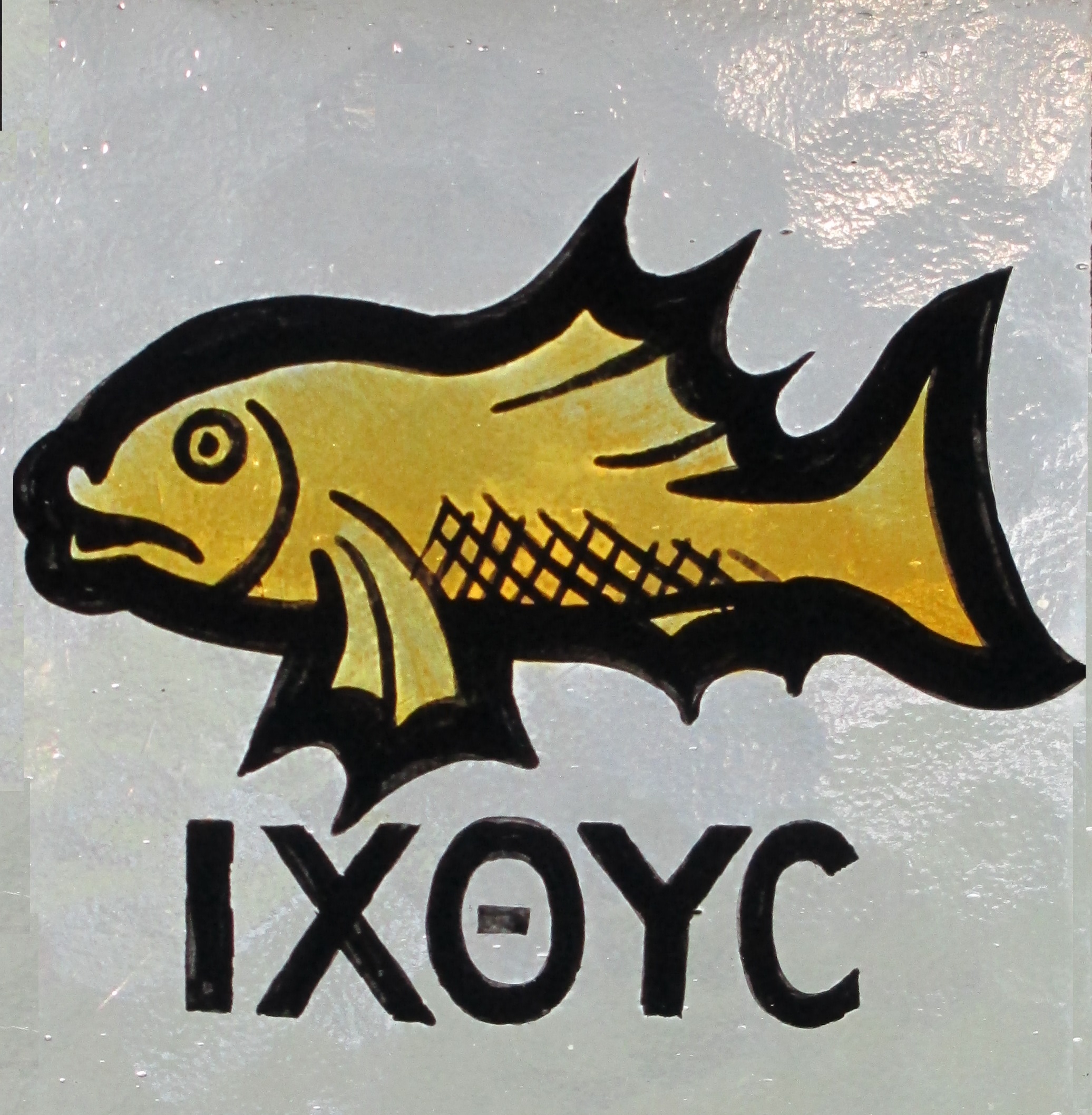
Ichthys Fish - Sacred Heart Catholic Church -  Wauzeka WIA Summary of Our Faith

The early Christians used the fish as a symbol for Christianity. The Greek word for fish is “Ichthys,” or using the Greek letters: “ΙΧΘΥΣ.” The letters of this word were an acronym for a phrase summarizing some of our core Christian beliefs: “Jesus Christ, [is] God’s Son, [and our] Savior.”

Prayers of the Faithful / Petitions / Intercessions (Year C)

December 5, 2013

14th Sunday Ordinary Time, Year C (July 7, 2013)

15th Sunday Ordinary Time, Year C  (July 14, 2013)

16th Sunday Ordinary Time, Year C  (July 21, 2013)

17th Sunday Ordinary Time, Year C  (July 28, 2013)

18th Sunday Ordinary Time, Year C (Aug 4, 2013)

19th Sunday Ordinary Time, Year C  (Aug 11, 2013)

Solemnity of the Assumption, Year C  (Aug 15, 2013)

20th Sunday Ordinary Time, Year C  (Aug 18, 2013)

21st Sunday Ordinary Time, Year C  (Aug 25, 2013)

22nd Sunday Ordinary Time, Year C  (Sept 1, 2013)

23rd Sunday Ordinary Time, Year C  (Sept 8, 2013)

24th Sunday Ordinary Time, Year C  (Sept 15, 2013)

25th Sunday Ordinary Time, Year C  (Sept 22, 2013)

26th Sunday Ordinary Time, Year C  (Sept 29, 2013)

27th Sunday Ordinary Time, Year C  (Oct 6, 2013)

28th Sunday Ordinary Time, Year C  (Oct 13, 2013)

29th Sunday Ordinary Time, Year C  (Oct 20, 2013)

30th Sunday Ordinary Time, Year C  (Oct 27, 2013)

Solemnity of All Saints, Year C  (Nov 1, 2013)

All Souls Day, Year C  (Nov 2, 2013)

31st Sunday Ordinary Time, Year C  (Nov 3, 2013)

32nd Sunday Ordinary Time, Year C  (Nov 10, 2013)

33rd Sunday Ordinary Time, Year C  (Nov 17, 2013)

Solemnity of Christ the King (Nov 24, 2013)


Click to view additional Year C petitions (from 2016)

12 Reasons Why I Quit Going to [Sporting Events]

November 7, 2013
As seen on Facebook

12 Reasons Why I QUIT Attending SPORTS Events

  1. The coach never came to visit me.
  2. Every time I went, they asked me for money.
  3. The people sitting in my row didn’t seem very friendly.
  4. The seats were very hard.
  5. The referees made a decision I didn’t agree with.
  6. I was sitting with hypocrites—they only came to see what others were wearing!
  7. Some games went into overtime and I was late… getting home.
  8. The band played some songs I had never heard before.
  9. The games are scheduled on my only day to sleep in and run errands.
  10. My parents took me to too many games when I was growing up.
  11. Since I read a book on sports, I feel that I know more than the coaches, anyway.
  12. I don’t want to take my children because I want them to choose for themselves what sport they like best.

What We’re Missing When We Leave Mass Early

October 2, 2013

If we leave right after Communion

we miss the moment to pray, “Thank you.”

If we leave before the final blessing

we miss out on the gift of God’s favor.

If we leave before the final song

we miss the chance to sing to our Beloved.

If we leave before everyone else

we miss the opportunity to meet them.

If we’re leaving before the Mass is over

we’re missing out on what the Mass is all about.

20 Good Reasons

August 8, 2013

Twenty good reasons to attend Mass on Sundays and every holy day of obligation: 

  1. Jesus wants you there.

  2. Mary wants you there.

  3. The angels and saints want you there.

  4. Father wants you there.

  5. Jesus, through his Church, insists.

  6. Our Church needs prayers.

  7. Our world needs prayers.

  8. Our country needs prayers.

  9. Your family and friends need prayers.

  10. Your absence would deprive our parish.

  11. We must put God first in our lives.

  12. We must keep the 3rd Commandment.

  13. Kids must see that Mass is important.

  14. Joining at Mass prepares us for Heaven.

  15. If we refuse, we are unready for Heaven.

  16. The Mass empowers you for daily life.

  17. The Holy Spirit would speak to you.

  18. The Son would come to you.

  19. The Father would bless you.

  20. God is not outdone in generosity.