Archive for the ‘O.T. Figures’ Category

Absalom and Satan — Monday, 4th Week in Ordinary Time—Year II

February 1, 2010

Absalom was one of David’s very own, but Absalom would betray him. Absalom’s name means “Father of Peace,” but he far closer resembles the “Father of Lies.”

In almost our earliest story about him, Absalom arranged his brother’s murder. He’s a murderer from the beginning.

We read that Absalom, like Satan, had a radiant beauty. “In all Israel there was not a man who could so be praised for his beauty as Absalom, who was without blemish from the sole of his foot to the crown of his head.”

Like the devil, Absalom’s glory was equaled by his vanity. At the end of every year, when his long hair grew too heavy, he would have it shaved and weighed it according to the royal standard.

Absalom was willing do havoc to attract another’s attention, as when he set fire to the field of a person ignoring him.

Like the serpent, Absalom was cunning and he would readily lie to serve his purposes. Absalom would sit at the city gates, listen to peoples’ (legal) grievances, and assure each one that they were right and entitled. Then he would manipulatively muse on how much better their lives would be if only he had the power.

Finally, Absalom sought to overthrow and kill his king. Absalom’s best advisor would counsel him, ‘Please let me choose twelve thousand men, and be off in pursuit of David tonight. When all the people with him flee, I shall strike down the king alone. It is the death of only one man you are seeking; then all the people will be at peace.’ This plan was agreeable to Absalom and to all the elders of Israel.

In our first reading we see David weeping on the Mount of Olives as he flees from Absalom. 1,000 years later, a descendant of David would be troubled in spirit on that same hill overlooking Jerusalem. Unlike David, Jesus did not flee His pursuers and was dead within a day. Jesus and the Sanhedrin agreed on this: it was better that one man should die, so that the whole nation may not perish.

David would flee and survive, but Absalom would die, thrust through with spears, hanging from a tree, entangled by his long, glorious hair.  But after this comes an episode which is a window into God’s incredible love for us. When news of the villainous betrayer’s death reaches King David, he mourns inconsolably at the loss of his beloved.

Likewise, and amazingly, despite Satan’s great and intractable wickedness; his betrayals, violence, and lies; the Lord still loves him. As the Book of Wisdom affirms, “[Lord,] you love all things that are and loathe nothing that you have made; for what you hated, you would not have fashioned. And how could a thing remain, unless you willed it; or be preserved, had it not been called forth by you?

There is a great encouragement in this for each one of us. If the Lord loves Satan, like David loved Absalom, then how could we ever doubt that the Lord will always love us, or imagine that He rejects us whenever we turn to Him?

Man’s Mission — Friday, 3rd Week in Ordinary Time—Year II

January 29, 2010

In the beginning, the Lord God settled the man in the garden of Eden, to cultivate and care for it. Then the Lord made the man a partner suitable for himself. Each day had seen God make greater and greater creations and on this last day, God makes His final, ultimate creation: woman.

The man beholds her with joy. He authors her name, which points to his authority, yet this authority is not meant for dominance but service, like the authority exercised by Christ. The man is meant to work to nuture and guard the garden and to nurture and guard his wife.

Before the Fall, all work was free from toil. Work carried with it no pains, no exhaustion, no boredom or strain—only feelings of satisfaction, creative accomplishment, and pleasure like those which we still sometimes enjoy from doing a job well done.

The man was placed in the garden with an important job to do, to nurture and protect, but he neglected his duty, and this led to the Fall. For where was he when the cunning serpent was out of place and out of line enticing his wife towards death? Maybe he was off sleeping on the job, taking an afternoon nap somewhere, like David in the first reading:

‘At the turn of the year, when kings go out on campaign, David, however, remained in Jerusalem. One evening David rose from his siesta and strolled about on the roof of the palace (for he had nothing else to do) and from the roof he saw a woman bathing, who was very beautiful.’

David forgets about his kingly work and duty, to fight the good fight, and from this comes his fall. He exploits the power of his authority and sins against a woman he should to honor and defend.

Our lives are meant to more than just our work, but faithfulness to some form of work before God is meant to be a part of our lives. Our work helps us to be good and to do good for others. Maybe you’re retired now, but if you’re still here on earth then the Lord must still have some important work for you.

What work has the Lord entrusted to you? Be as faithful to it as you ought so that Christ, the new Adam, may grow His virtues in you and harvest good works in you.

Persons are Mysteries — Tuesday, 1st Week in Ordinary Time—Year II

January 12, 2010

Persons are always a mystery to each other. You could be lifelong friends with someone, and never exhaust their mystery. Husbands and wives can be married for fifty or sixty and still surprise each other.  Persons are always remain a mystery because our thoughts and minds, our motives and hearts, are hidden from each other. Realizing this, we should be very careful about the conclusions we arrive at about others.

For example, in the first reading, Hannah comes to the temple with a great longing in her heart. She wants a child and she asks for this from God at length, from her heart, with tears. 

Eli [the priest,] thinking her drunk, said to her, “How long will you make a drunken show of yourself? Sober up from your wine!”

She is pouring out her heart as a saint before him, but Eli thinks she is a drunk. (This is not one of the greatest moments in history for priestly pastoral ministry.) It’s wrong to get drunk, and it would be o.k. for Eli to tell her so if she were, but she’s not. Eli doesn’t understand  her. He doesn’t even understand what’s happening right in front of him. Oftentimes, we’re just like Him.  Another example of arriving at false conclusions in seen in the Gospel:

In their synagogue was a man with an unclean spirit; he cried out, “What have you to do with us, Jesus of Nazareth? Have you come to destroy us?

The demon doesn’t understand Jesus’ motives.  The demon looks at things in terms of power, control, and domination, not love. The demon thinks that no one can be better than himself. Thus, Jesus is a threat that must be knocked down.

It’s not our style to accuse and criticize people so directly.  We’re too timid for that. When someone commits a fault or offense, how likely are we to go to them face to face about it? How much more likely are we to complain to someone else about it out of their presence?

What’s wrong with speaking negatively about others?  For starters, what we think we know is often false, like we saw with Eli. And even if the report is true we judge uncharitably, like the demon.  Speaking negatively about others is also unhelpful.  Jesus says in the Gospel. “If your brother sins against you, go to him in private.” This can clear up many misunderstandings and result in a solution. Instead, we may talk to everyone in the world about our burden besides the one person we actually need to. Finally, speaking negatively about others, even in private, wounds unity.  Even if your criticisms never find their way back to the person which they are about, harm is still done.  The person you are speaking with will wonder to themselves, “Does this person talk about me behind my back to others? How small of a fault on my part would that take?”

At times you will be misunderstood and people will speak ill of you, especially if you are faithful in following Jesus Christ.  But as for your part, never speak a bad word about anyone, unless it is really necessary. Live in this way and people will respect & love you for it. People will notice, as they did with Jesus, and say, “This person does not speak like the others. They speak like Jesus Christ.”

Advent Penance Service

December 1, 2009

 The psalm says, ‘On the holy mountain is [Jerusalem], his city, cherished by the Lord. The Lord prefers the gates of Zion to all Israel’s dwellings. Of you are told glorious things, O city of God, [Jerusalem].’  (Psalm 87) The Lord God loved Jerusalem and lived within its walls. God dwelt there in a special way in His temple on Mount Zion.

The people of Jerusalem felt pretty special about having such close access to God, but this pride was often their greatest weakness. You see the people of Jerusalem imagined they had this holiness thing in the bag, being so close to the Lord and all. Imagine their shock when a prophet would come along to tell them that they were not so perfect as they thought. When God sent them the prophet Jeremiah, he told them:

“Thus says the Lord of hosts, the God of Israel: Reform your ways and your deeds, so that I may remain with you in this place. Put not your trust in the deceitful words: “This is the temple of the LORD! The temple of the LORD! The temple of the LORD!” Only if you thoroughly reform your ways and your deeds; if each of you deals justly with his neighbor; if you no longer oppress the stranger, the orphan, and the widow; if you no longer shed innocent blood in this place, or follow strange gods to your own harm, will I remain with you in this place…”

Time and again, God sent prophets to Jerusalem to call them to conversion, but Jerusalem would persecute, imprison and kill them. But they did not convert.  And, in the lifetime of Jeremiah, their enemies (the Babylonians) conquered  the city of Jerusalem and destroyed the temple of God within it. We hear God’s feelings about all this through words of Jesus:

“Jerusalem… Jerusalem… you who kill the prophets and stone those sent to you, how many times I yearned to gather your children together, as a hen gathers her young under her wings, but you were unwilling! Behold, your house will be abandoned, desolate. I tell you, you will not see me again until you say, ‘Blessed is he who comes in the name of the Lord.’”

Jesus’ words matter for us today too, because Jerusalem symbolizes our souls. At our baptism, God began to dwell in our souls as His temple, as His new Jerusalem. The psalm is speaking about your soul and mine when it says:

O praise the Lord, Jerusalem! 
Zion, praise your God!
He has strengthened the bars of your gates,
He has blessed the children within you.
He established peace on your borders,
He feeds you with finest wheat.   (Psalm 147)

Indeed, God has strengthened the bars of our gates, our defenses against evil. He has blessed the children, everything that is good and loveable, within us. He establishes peace on our borders, in our relationships with others. And He feeds us with the finest of wheat in the Eucharist. We should feel pretty special about having such close access to God, but we should not make the same mistakes as the old Jerusalem.

You and I can persecute God’s prophets too. We do it whenever we choose to rebel and sin against the good God wills for us. We do it whenever we kill the voice of conscience within us. We do it whenever we imprison the Holy Spirit’s movements within us to the confines of a tiny cell. We do it whenever ignore or refuse to listen to the teachers Christ has given for His Church.

When we are persecuting God’s prophets, we can even evict God’s presence from our souls through freely and knowingly committing a grave or serious sin. We are conquered by our enemy and the temple inside us is destroyed. And ‘behold, our house is abandoned, desolate; and we do not see Him again until we say, ‘Blessed is he who comes in the name of the Lord.’ What can do to help prevent this horrible estrangement from occurring?  And if it does occur, how can we ask the Lord God to return?

In the sacrament of reconciliation, we acknowledge that Jesus Christ is the Blessed One who comes in the name of the Lord. When we acknowledge this, He forgives our sins, and God joyfully dwells in His cherished city. Today, Jesus Christ calls your city to repentance and the conversion of your soul.

Wednesday, 34th Week in Ordinary Time—Year I

November 25, 2009

Today’s responsorial psalm is not actually one of the 150 Psalms.  It comes from Daniel 3, where 3 men (none of whom are Daniel) are thrown into a fiery furnace for refusing to worship a golden  statue of King Nebuchadnezzar. (Isn’t it always so that all of history’s oppressive states and rulers have insisted that everyone fall down and worship gilded images of themselves or else be thrown to the fire?) Anyway, these three men are heaved into the flames, but God sends to them an “angel of the Lord,” or literally, a messenger, to preserve them from all harm. The trio sings a hymn of praise, part of which we heard today as our responsorial psalm.

Sun and moon, bless the Lord…
Stars of heaven, bless the Lord…
Every shower and dew, bless the Lord…
All you winds, bless the Lord…
Fire and heat, bless the Lord…
Cold and chill, bless the Lord;
praise and exalt him above all forever.

King Nebuchadnezzar rose in haste and asked his nobles, “Did we not cast three men bound into the fire?” “Assuredly, O king,” they answered. “But,” he replied, “I see four men unfettered and unhurt, walking in the fire, and the fourth looks like a son of God.”

Could this “son of God” amidst the flames actually be the Second Person of the Trinity, God the Father’s greatest messenger, or is it merely one of God’s many angelic spirits? In either case, this heaven-sent deliverer for God’s faithful ones at least symbolically points to Jesus Christ. We should not be surprised to find signs of Christ in the Old Testament.  Nor should we be surprised to see symbols of Him built into God’s creation all around us.

Consider the sun in the sky, which gives light to the world. It comes to earth, dies, and is buried, but then it rises again for us.

Consider the moon in the night, which resembles the Eucharistic host. We admire it held on high. We see it broken before us. Though consumed, it is renewed again for us.

Consider the stars, which resemble Christ’s numerous and glorious saints shining in heaven.

Consider the showers and dews, which resemble Him who humbly comes down from heaven to earth to give life to the world.

Consider the winds, which resembles Christ’s Spirit, mysteriously moving and active across the whole world.

Fire and heat, bless the Lord. Cold and chill, bless the Lord. For even in the extremes and in-between’s of life, God is to be found. Let us praise and exalt him above all forever.

Tuesday, 34th Week in Ordinary Time—Year I

November 25, 2009

The prophets go beyond what is seen, to reveal what is hidden. Their purpose is to lead people to God.

In the first reading, Daniel reveals what was seen in the king’s dream. In the Gospel, Jesus reveals what will be seen in Jerusalem and at the end of this world as it no stands. In this homily, I will reveal to you three prayers hidden within the Mass which are always present there, but which you may have never heard before.

The first of these hidden prayers comes after the presentation of the gifts. A few of the faithful bring forth the bread and wine to the altar. It is no empty chore. This symbolizes the offering of all your gifts and of your whole lives to God.

I receive the gifts and then I say a prayer of praise to the God of all creation for this bread which we have to offer. Yet before I go on to a similar prayer with the cup of wine you may have noticed something unusual. The priest takes the water and pours a little into the cup of wine. It’s only a few drops, and the wine appears unchanged, but the water and wine have become inseparably one. As he pours, the priests silently prays this:

“By the mystery of this water and wine may we come to share in the divinity of Christ, who humbled himself to share in our humanity.”

You and I will always be God’s finite creatures, but, by the Incarnation, Jesus has made Himself inseparably one with our humanity. It is Jesus’ desire to make us more and more like His divine self through our personal union with Him.

What is the lesson for us here at Mass? We should come to each Mass with high expectations. Do you believe that your whole-hearted participation in this sacrament can make you a better, more beautiful, or more admirable person, and do powerful things for our world? Approach this sacrifice with high expectations. On this point St. John of the Cross and St. Therese of Lisieux agree: “We receive from God as much as we hope for.”

After these prayers for the bread and wine, you will see me bow at the altar. At this moment comes the second hidden prayer. The priest prays:

“Lord God, we ask you to receive us and be pleased with the sacrifice we offer you with humble and contrite hearts.”

What is the lesson for us here at Mass? We should strive to be fully-present at every Mass. Pray the Mass and sing the songs with your whole heart. Offer God this sacrifice with humility, contrition, gratitude and love.

After this comes the washing of the hands and a third silent prayer. The priest prays:

“Lord, wash me of my iniquity; cleanse me from my sin.”

I pray this prayer from particularly from the heart because I do not want my offering and partaking of this most holy sacrament to be the cause of my condemnation and death on account of my sins. (If you think of it, pray for your priest as he washes his hands, that He may offer this sacrifice well for you.) Approaching our all-holy God is serious stuff.

What is the lesson for us here at Mass? If you are aware of serious sins on your soul, come to  confession, the sacrament of reconciliation. Come and be cleansed. Lighten your burden. Do it today.

The prophets go beyond what is seen, to reveal what is hidden. Their purpose is to lead people to God. Through the revealing of these holy prayers I pray you be led to closer to our Lord Jesus Christ at this very Mass.

Friday, 33rd Week in Ordinary Time—Year I

November 23, 2009

In the year 167 before Christ, the empire dominating the Jews, in attempt to unify their peoples, forbid the Jewish sacrifices, banned observance of the Sabbath and feasts, and outlawed circumcision. Altars to Zeus and other Greek gods were set up in the temple, and unclean animals, like pigs, were sacrificed upon them. In response, Mattathias Maccabeus and his sons led a Jewish revolt against their oppressors. Two years later, they had crushed their enemies and went up to purify the temple and to rededicate it for proper worship.

Two hundred years later, another zealous lover of God’s law went up to the temple to cleanse it and rededicate for true worship. Jesus entered the temple area and proceeded to drive out those who were selling things, saying to them, “It is written, My house shall be a house of prayer, but you have made it a den of thieves.”

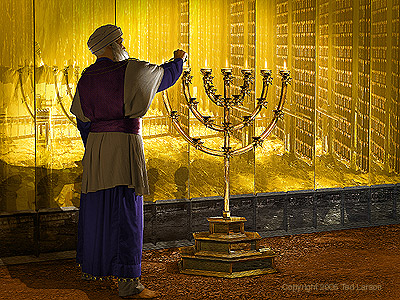
After the Maccabees had rededicated the temple they celebrated for eight days.  When they relit the seven wicks of the menorah in the sanctuary they only had enough olive oil on hand to keep it burning for one day.  But, by a miracle, it is said that the lamp kept burning for eight days, long enough to press, prepare and consecrate more fresh oil. The rededication of the temple and this miracle are still commemorated in our time as a Jewish holy day.  From the Hebrew word for “dedication” or “consecration”, the Jews call this celebration “Hanukkah.”

Christ has dedicated and consecrated us as the new temple and house of God. How are we to keep our temple lamps lit? How are we to obtain oil for our souls? We are not to do it by grasping, by stealing things from the world, in a vain effort to fill ourselves. The Lord’s house is not to be a den of thieves. Instead, we must pray, asking for the grace we need to remain burning brightly. As Jesus said, “My house shall be a house of prayer.”

Tuesday, 33rd Week in Ordinary Time—Year I

November 17, 2009

Imagine if the United States of America, with all its freedoms and rights, were not the United States of America, and on your way to school today, you were stopped along roadside by the secret police. They ask you for your name. You cooperate give it. Then they order you to put your hands on the hood of the squad car. They handcuff you and place you under arrest.

You ask them, “What’s going on? What have I done?” They reply, “You’re under arrest for the charge that you are a believing Catholic Christian.” You didn’t realize it, but the police have had you under intense surveillance for the past several weeks, wire-tapping your phone, monitoring your computer, searching your personal belongs, and watching all your movements and activities.

Imagine yourself in this situation. This is the question I pose to you: At your trial, when all of the evidence they have gathered is presented against you, will there be enough to convict you? Would there be sufficient evidence to find you guilty of being a believing Catholic Christian? What would they have on you?

Would they have testimony from informants that you observe every Friday as a day of penance, that you keep every Sunday as a special, day of rest, and faithfully go to Mass and frequent the sacrament of reconciliation? Could anyone testify against you that they heard you saying positive things about Jesus Christ, or that you spoke up for the Catholic faith when it was mocked or criticized in your presence? Could they put into evidence a rosary, or a Bible, or some other Catholic book, marked with fresh traces of DNA from your fingertips? Would they have hidden camera footage of you praying before meals at school or at restaurants? Would they have grainy night-vision footage of you praying before going to bed, or praying the first thing in the morning, making the tell-tale sign of the cross.

A few hours after your arrest you find yourself in a courtroom (because the “people’s” authoritarian government believes in speedy trials.) The intimidating judge looks down at you from the bench, “It says here that you were picked up on your way to the Columbus school. We have evidence of illegal Christian propaganda being taught there and we also have reliable reports that various Catholic rituals are done there, superstitions which are offensive to reason and the spirit of our times. Now I imagine that you went to that school because that’s where your parents sent you. And I’m sure that your parents would be shocked to discover that such repugnant activities as these are happening at your school.”

The judge continues, “The punishment for being found guilty of being a believing Catholic Christian is a grave one. But… if you were simply mixed-up in these activities, unthinkingly, by accident—if you were just doing them because that’s what everyone else around you was doing—well then that would be a different story. Spies and traders may come to our government rallies, but that doesn’t make them loyal citizens now does it? So just going through the motions doesn’t make you a believing Catholic at all, am I right?”

“So I can completely understand how this regretable misunderstanding has occurred. You didn’t really understand what you were doing did you? Now if you would simply formally renounce any and all belief in these silly superstitions, you may go on your way. Just sign your name here on this piece of paper testifying to that effect, and you’re free to go.”

What would you do? What do you wish you would have the courage to do? Would we have the courage to refuse to sign, just as Eleazar refused to eat? The eating of a little meat, like the movement of a pen, is a small act, but Eleazar refused and accepted an unjust death because to do otherwise would mean a rejection of the Lord, the one true God, the King of all other kings.

Now it is very unlikely that you or I will ever have to lay down our lives as red, or bloody martyrs for our faith in Christ. But, like Zacchaeus, there will be certainly times when we will have to go out on a limb for Christ. The crowd laughed to see the rich man Zacchaeus up in that tree, but what did Zacchaeus care about? His focus was totally fixed upon his connection with Jesus Christ.

Be like Eleazar, and don’t swallow whatever the world sets before you, because a lot of it is not good and can alienate you from God. Be like Zacchaeus, with the courage to go out on a limb regardless of what other people might think or say, for the sake of your relationship with Christ.

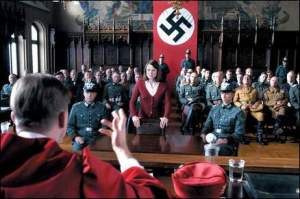
[The images for this post come from the movie Sophie Scholl–The Final Days. If you liked A Man for All Seasons, you’ll like this one too (but I’ll warn you up front that it ends the same way.)]

Tuesday, 27th Week in Ordinary Time—Year I

October 6, 2009

Velazquez, Christ in the House of Martha and Mary. 1618

Today you heard two familiar Bible stories. In the first reading, Jonah reluctantly preaches and the Ninevites, who wholeheartedly convert. In the Gospel, Martha serves while Mary listens at Jesus’ feet. The characters in these two stories would seem to have nothing in common with each other… but that is not so.

What do Martha and Jonah have in common? Both Martha and Jonah are doing work for the Lord, work which they found to be unpleasant. What do Mary and the Ninevites share? What do they have in common? Both Mary and the Ninevites are doing the one thing that is needed, they have turned themselves towards the Lord. Now let’s apply their lesson to ourselves as students.

Ever since I was five years old, up to this very year, I have been in school as a student every year of my life. So I’ve sat through a lot of classes; some which I really enjoyed, and others that I didn’t. Now it’s easy to work on a subject we enjoy, but in other classes we’re like Martha and Jonah, it’s God’s will for us that we be there, doing what we’re doing, but we’re certainly not thrilled about it.

So the next time you feel bummed-out in one of your classes (hopefully not in one of my classes) try doing this: Turn your eyes and your heart to the Lord, like Mary and the Ninevites, and offer yourself and that hour’s work to Jesus.   You already have your cross, so use it for a spiritual sacrifice. What difference will it make when you redirect yourself and your work like this to the Lord? There’s only one way to find out.

Wednesday, 26th Week in Ordinary Time—Year I

September 30, 2009

Why do the Jews in today’s psalm begin to mourn when their “captors” ask them to sing one of Zion’s songs? This psalm refers to the time of the Jewish Exile. The kingdom of Judea was conquered by the Babylonian Empire 586 years before Christ. Many Jews were deported from their homeland to the rivers of Babylon in the East. Time passed, and that superpower was conquered by another, and after 50 years of Babylonian Captivity, the Persian Empire allowed the Jews to go home. However, many years passed, and Jerusalem, the city of God, remained in great disrepair.

This weighed heavily on the heart of Nehemiah, who was the cupbearer to the king of Persia. As cupbearer, he was the king’s highly-trusted servant because it was his job to drink of any wine that would be offered to the king, lest that it be poisoned. In the first reading we heard Nehemiah recall in his own words how he obtained permission from the king to rebuild God’s city, the city of his ancestors. Nehemiah is a “type” or foreshadowing of Christ.

As Nehemiah had the consent of his king for his mission, so Jesus had the consent of His father to come to Jerusalem as the restorer of God’s people.

Like Nehemiah before Him, Jesus desired, with all the sentiments of His human heart, to bless His deceased ancestors in their graves, for their blood ran through His own veins.

Like Nehemiah, Jesus wanted to build God’s city, giving it a new glory that would attract all nations to a more perfect worship of God within its walls.

Nehemiah used the timber of the Gentiles to build the earthly Jerusalem. To build the heavenly Jerusalem, Jesus used the wood of the Roman’s cross.

Nehemiah was old cupbearer, who faced death in service of the king. Jesus is the new cupbearer, who drinks from the cup, so that sins may be forgiven.

The cup that Jesus drinks is a cup of suffering mingled with joy. Today, at this Mass, Jesus asks us to follow Him. He says, take this cup, all of you, and to drink from it in remembrance of me.

September 29 – The Archangels

September 29, 2009

Today we celebrate Saints Michael, Gabriel, and Raphael. God created lots of angels, so that they might enjoy, share and manifest His glory. Within this multitude, Michael, Gabriel, and Raphael hold special rank as archangels. The angels and archangels are like us in important ways, but in other ways they’re very different.

Just like us, God did not create the angels to fulfill some need He had. God needs nothing to be happy and complete. God made heaven and earth, all that is seen and unseen, out of sheer love, overflowing. God created us because love likes to share.

Just like us, God created the angels as persons. We are persons because we both have intellect and will, the capacity to know and the ability to freely choose. Just like us, angels are persons, having souls which will never die. But unlike us, angels don’t have a physical body united to their soul. Instead of body and spirit, angels are spirit alone.

Like us, angels know things and choose things. Like us, they’re made for interpersonal-communion. They interact with God, with each other, with us, and our world. But like God, and unlike us, angels live outside of time. We humans grow, and change, and mature, day by day. We’re incomplete and we develop over time. We can choose holiness one day, choose to sin the next, and on the day after that, think better of it, repent, go to confession, and return to God. But in the case of angels, their natures are complete and finished. And the free choices they’ve made once are made for all time. That is why the angels are forever sinless creatures, and why the demons, who are the angels who chose to rebel and were cast down from heaven, will never turn back to God.

We do not know exactly why Satan and the many demons fell, but it is clear that they did not, in their sinful pride, want the roles in God’s kingdom which God had prepared for them. Some speculate that when the angels where created, God gave them some knowledge of His plans for the human race. God wished the angels to share in this plan, but, for some reason, some refused to serve.

Perhaps it was the scandal of the Incarnation, the idea that the eternal Second Person of the Trinity, would take on material flesh. Maybe they refused to worship the Eternal Word, Jesus Christ, in such a state as that. Perhaps, filled with pride about their own glory, which was entirely God’s gift, they refused to be Christ-like and serve creatures they deemed to be inferior to themselves.

Whatever the reason for it, a war broke out in heaven. Michael and his angels battled against Satan. Satan and his angels fought back, but they did not prevail. The demons wanted to be like God, but without God. Perhaps Michael challenged them with the meaning of his name, “Who is like God?” They wanted to be God, but without God, and there was no longer any place for them in heaven.

And now we arrive at the lesson we learn from the demons’ Fall that I want you to take to heart…

When the demons refused to be what they were made and called by God to be, they became something far less than what they were meant to be. By turning away from God, the source of their life, they became stupid, ugly, and weak compared to what they should have been.

Compared to what God makes us, calls us, and longs for us to be, sin makes us stupid, ugly, and weak too.

Do you have any sins?

Every Tuesday I sit in my office as much time as can, from the end of morning Mass until 3:00 PM, when prayers are offered in the Columbus chapel that God the Father would have mercy on us. I’ve spent hours at my desk, behind my confessional screen, catching up various work. And in all that time, not a single student has come for the sacrament that reconciles sinners with our Lord Jesus Christ. Now don’t think that I’m angry about this. Tuesdays for me as they are now are very productive days. I get a lot done behind my desk. But I would very much prefer, that so many of you would come, to the healing forgiveness, and strengthening graces, that Jesus is waiting to give you in this sacrament, that I would get nothing else done.

I want you to come to the sacrament that cleans your slate and lightens your heart. I want you to come to the sacrament that makes you wiser, stronger, and more attractive as a person than you are when you’re in sin. I want you to come to the sacrament of reconciliation, not for my sake, but for your sake.

Through the intercession of St. Raphael, whose name means “God’s healing,” may we believe in God’s power to heal our wounds. Through the intercession of St. Gabriel, whose name means “God’s power,” may we believe in God’s power to recreate the repentant sinner. And through the intercession of St. Michael, may we consider “who is like God,” who shows mercy to all who come to Him.

Thursday, 20th Week in Ordinary Time—Year I

August 20, 2009

It can be important to remember that not every person and deed in the Bible is meant to be emulated as a model for us. Oftentimes the Scriptures are just recording the facts; the misdeeds and sinfulness of humans in need a savior. This is frequently true in the Old Testament where today we see Jephthah vowing to do an evil thing. There is a lot wrong with what Jephthah did.

First of all, human sacrifice was loved by the false gods surrounding and often infecting Israel, but it was absolutely forbidden under the Law of the Lord. Jephthah was disobeying that Law. He vowed to do something evil for the Lord, which is a self-contradiction. Finally, why did Jephthah promise to sacrifice the first person he saw—why did he not offer himself for the sacrifice?

Perhaps it was easy for Jephthah to vow a human sacrifice when he thought it would only cost him a stranger or one of his servants. But to offer his firstborn, or he himself, that was beyond his imagination. In this context, let us ponder and grapple with this strange mystery at the center of our faith:

Jesus Christ, God’s only and unique Son, allowed Himself to be sacrificed by sinners for His Father’s victory; for the salvation of God’s people.

What makes this divine sacrifice so different from Jephthah’s? Why is the one glorious and the other abominable?

Jephthah’s sacrifice was pointless and unnecessary, it was not needed to save God’s people. God fully planned to lead Israel to victory over the Ammonites even before, and without, Jephthah’s evil vow. On the other hand, the divine self-offering was necessary to save God’s people. (For His part, Jesus’ total self-offering, even to the point to death, was not a “necessary evil,” but a necessary good.) Theologians speculate and debate about whether our redemption could have come about under different circumstances, but Jesus spoke more than once during His life of the necessity that He go up to Jerusalem, to suffer and die, for our salvation.

Another importance difference is that Jephthah intentionally killed his innocent daughter (which is the definition of murder) by his own hand. The Father did not murder His Son, nor did the Son commit suicide. Jesus was killed by sinners.  The Father and Son permitted this, endured this, and made of this the perfect sacrifice for the salvation of the world.

We can imagine these words of the psalm as coming from Christ, but not as coming from Jephthah:

“Sacrifice or oblation you wished not,
but ears open to obedience you gave me.
Burnt offerings and sin-offerings you sought not;
then I said, ‘Behold, I come.’”

While Jephthah transgressed the Law by his sacrifice, Jesus uniquely and perfectly fulfilled it, at great personal cost to Himself. Christ is the model we should emmulate.

Tuesday, 20th Week in Ordinary Time—Year I

August 18, 2009

Jesus said, “For men [by themselves, salvation] is impossible, but for God all things are possible.” Evidence of this truth is seen in Gideon, whom the Lord this morning asks to save Israel.

Like Mary at the Annunciation, a messenger assures him, “The Lord is with you.”  But Gideon asks, “Please, my lord, how can I save Israel?” “I shall be with you,” the Lord says to him.

Gideon presents his strange visitor with a meal of unleavened bread and of young goat’s meat. He is directed to pour the broth of meat juices upon it. The juice flows over the bread and the meat and onto the ground, like Christ’s blood flowing over His flesh and down to the foot of the cross. Gideon sees the wondrous sacrifice and realizes that the presence and the power of God are in his midst.

After overcoming his hesitancies, Gideon listens to the Lord God as his military advisor, and using just 300 men, armed with lanterns in one hand and trumpet horns in the other, routs a hoard of Israel’s enemies.

God works no overwhelming miracles for Gideon. He never causes Gideon’s enemies to be swallowed up by earthquakes, or by balls of fire from heaven, or by tidal waves. Instead, God only uses little signs to reassure Gideon, to teach him to trust, and to listen to the still small voice of the Lord. In this way, Gideon becomes an effective instrument in fulfilling God’s plans. We can learn from Gideon, because the Lord prefers to work in the same way with us and through us: little signs, strengthen our trust, teach us to listen, and to fulfill God’s plans.

Gideon’s story is one of my favorites in the Old Testament. Unfortunately, you’re not going to hear any more of it after today because our lectionary skips beyond it. But the rest of Gideon’s fascinating story waits for you in the book of Judges, chapters 6 and 7.

August 14 – Vigil of the Assumption of Mary

August 17, 2009

When I was younger, I used to wonder why Mary was such a big deal. It wasn’t that I was against her or anything. I prayed Hail Mary’s to her, and I wasn’t out to deny anything our Church said about her. I just didn’t understand why we, as Catholics, honored her so much.

Some people say that Mary is no big deal, that she’s just another Christian.  They might point to today’s Gospel as evidence, where a woman from the crowd calls out to Jesus, “Blessed is the womb that carried you, and the breasts at which you nursed.”  And Jesus replies, “Rather, blessed are those who hear the word of God and observe it.” “So you see,” they would say, “it’s nothing special to be the mother of Jesus.” But in this Gospel Jesus is not denying Mary’s greatness, He is rather affirming it.

If Mary had merely been the biological mother of Jesus, delivering Him, and nursing Him, she might have been just another Christian. But Mary is most blessed among the disciples of Christ, of which she is the first, because she heard the word of God and observed it. She heard the word of God from the angel Gabriel and answered,

“Behold, I am the handmaid of the Lord. Let it be done to me according to your word.”

The overwhelming evidence for Mary’s exceptional glory, and her unique loveliness, is to be found throughout the Bible. The two Testaments, the Old, together with the New, show us why Mary is worthy of our great admiration and deserving of our special affection.

In the first reading we heard of the ark, the ark of the covenant, which you may remember seeing in Indiana Jones and the Raiders of the Lost Ark.  The ark was a wooden box, plated with gold inside and out, with two gold statues of winged angels on its lid.  This box, the ark, was carried about using two long polls, since men would be struck down if they touched the holy ark. The ark bore the presence of the Lord, it was His throne amidst His people.

The Lord had told Moses, who constructed the ark, according to the Lord’s precise specifications, to have some interesting things placed inside of it.  First, the wooden staff of Aaron, which had miraculously grown shoots and blossoms. Second, the two stone tablets inscribed with the Ten Commandments which were written by God’s own hand. And third, an urn full of manna, the food which the Lord had given his people to eat during the Exodus.

That was the ark of the Old Testament.
Mary is the ark of the New Testament.

As the ark was a box of wood, plated with precious gold, inside and out, so Mary was a human being, surrounded and filled with divine grace. Like the dead wood of Aaron’s staff, which (naturally speaking) should not have borne life, the Virgin Mary miraculously blossomed life within her. Unlike the written word of God in stone, Mary carried within her the eternal Word of God in flesh. Mary borne within herself the true bread from heaven, Our Lord Jesus Christ.

In the first reading we heard how David led the ark of God’s presence into Jerusalem.  The ark’s coming to Jerusalem is also commemorated in the psalm we heard.  Jerusalem is sometimes poetically referred to as Zion, since Mt. Zion was the place of the temple in Jerusalem.

Just as the Lord’s presence came into Zion, the presence of the Lord came to dwell in Mary. Nine times out of ten, whatever Scripture says of Zion or Jerusalem, also goes for Mary. Mary is Jerusalem.  She is Zion.

“For the Lord has chosen Zion;”
says the Psalm
He prefers her for his dwelling.
Zion is my resting place forever;
In her will I dwell, for I prefer her.”

And, nine times out of ten, whatever can be said of Mary, also applies to Christ’s Church. Mary is the icon of the Church.

So, as you can see, Mary is a big deal. And none of us is more admirable, praiseworthy, and sweetly loveable than her.

‘Therefore her heart is glad and her soul rejoices,
her body, too, abides in confidence;
because God did not abandon her soul to the netherworld,
nor would He suffer His faithful one to undergo corruption.’

He assumed His beloved into heaven. Thanks be to God, who gave Mary this victory over death, through her Lord and ours, Jesus Christ.

August 8 – St. John Marie Vianney

August 17, 2009

For many years, around 300 people would travel by train each day to a small town of 230 people. Why did they come? They came because they sought the mercy and counsel of Christ in the confessional of John Marie Vianney. Why did Father John 12 to 17 hours a day sitting in his confessional? He was there because he believed that this sacrament was that important.

Today we often hear people say, “Why do I have to confess my sins to a priest when I can just pray to God directly? It’s like the complaint of Aaron and Miriam in the first reading,  “Is it though Moses alone that the Lord speaks?”

Jesus, in the upper room, breathed on his apostles and said to them, “Receive the holy Spirit.  Whose sins you forgive are forgiven them, and whose sins you retain are retained.” Did Jesus give them this authority and power for no purpose at all?

Jesus gave us the sacrament of reconciliation because we need it. Confession prevents my sins from just being between me and myself. It prevents me from making mountains into molehills, and molehills into mountains. It allows me to know with absolute confidence that this sin of mine is forgiven forever. When we go to confession we acknowledge the Incarnation, that Christ redeemed us in His flesh, not merely by composing a prayer to the Father.

If you are too shy to admit your sins to a priest, who won’t know who you are, and couldn’t tell another soul even if he did, then what makes you think you will have the poise to stand face to face with Christ at the judgment?

When Miriam and Aaron sinned, they turned for mercy to the Lord’s servant, Moses, and their sin was healed. If you have neglected confession, please come. There is mercy, peace, and God’s help awaiting you.

If you already go to confession with some frequency, then please offer a penance today for the conversion of sinners. St. John Vianney did penances for conversions because he was convinced that it made a difference.

In the Gospel we heard that every sick person who came and touched Jesus’ cloak was healed, but those sick people first had to be brought to Jesus. Help carry them.