Archive for the ‘O.T. Figures’ Category

Catholic Twitter

October 16, 2019

Twitter.com is a social media website where both famous figures and less famous folks share their free thoughts of 280 characters or less. Pope Francis posts there daily (@Pontifex) alongside many other Catholics as well. There is a good deal of Catholic community, evangelization, and defenses of the Faith to be found on Twitter, depending on whom you follow. I recently came across a wonderful reflection by Fr. Dylan Schrader, a Catholic pastor in Missouri with a Ph.D. in systematic theology. @FrDylanSchrader wrote:

If the Catholic Church fulfills the figure of Noah’s Ark, then of course the Church is ridiculed and seems stupid, crazy, or like a waste of time to the world until all of a sudden we realize that it’s our only hope.” Like Jesus says in the Gospels, in the days before the Great Flood people were eating and drinking, marrying and given in marriage, up until the day that Noah entered the ark. They had disbelieved until the flood waters came, and it carried them all away. So it will be with the Second Coming of Christ.

Twitter allows threads of conversation and Fr. Schrader’s tweet was apparently replied to by a Protestant Christian who wrote: “CHRIST JESUS, alone, is the hope of a [C]hristian… if your hope is in a church, then your hope is misplaced.” Does the Church displace or minimize the Lord? To this, Fr. Schrader answered, “That’s like saying that it’s Noah who saves from the flood, not the Ark.” Indeed, Noah built his Ark and Jesus builds his Church. The Ark was God’s means to save a portion of humanity through Noah. Likewise, the Catholic Church is God’s means for saving the human race through Christ.

Meals with the Lord — 16th Sunday of Ordinary Time—Year C

July 21, 2019

Our first reading from Genesis recalls Abraham at a meal with the Lord. In the story immediately preceding this one, God had renewed his covenant with him. The Lord changed his name from Abram to Abraham, which means “father of a multitude,” and indeed, today more than two billion Christians around the world call Abraham our father in faith. A covenant bond is an alliance which transforms unrelated persons into family. In the ancient world, nations and peoples would form covenants, declaring themselves brothers. Today we rightly call marriage a covenant. And God has established many covenants between himself and members of the human race through salvation history. Something that family members do is eat together. Sharing a meal signifies communion and relationship with each other. Today, after renewing his covenant with Abraham, the Lord visits him for a meal.

Genesis says “the LORD appeared to Abraham,” but, “Looking up, Abraham saw three men standing nearby.” Like when God said at Creation, “Let US make man in OUR image,” Christians detect signs here of the presence of the Holy Trinity. There’s an interesting alternation of singulars and plurals in their dialogue. Abraham says, “Sir, if I may ask you (singular) this favor, please do not go on past your servant….” Abraham offers THEM a meal and THEY reply, “Very well, do as you have said.” Later THEY ask him, “Where is your wife Sarah,” and then ONE of them declares, “I will surely return to you about this time next year, and Sarah will then have a son.” Genesis does go on to call two of these three visitors “angels” but in Hebrew and Greek this word angel means “messenger or representative.” And who are the greatest representatives and messengers of God the Father but God the Son and God the Holy Spirit? Whatever the mystery that was actually at play here, Abraham serves a meal with the Lord and is blessed in the encounter.

In today’s Gospel, the Lord God visits Martha in the person of Jesus Christ. She welcomes him and sets about serving him with food and drink. Her sister, Mary, sits beside the feet of the Lord listening to him speak. And Martha, burdened with much serving, comes to him and says, “Lord, do you not care that my sister has left me by myself to do the serving? Tell her to help me.” “Martha, Martha,” Jesus replies, “you are anxious and worried about many things. There is need of only one thing.” Notice how Jesus repeats her name, something seen only a handful of times in the New Testament. Jesus laments over “Jerusalem, Jerusalem” before his Passion, he admonishes “Simon, Simon” at the Last Supper, he cries out “Eloi, Eloi / My God, My God” on the Cross, and he calls out to “Saul, Saul” on the road to Damascus. That’s some extraordinary company she shares. Clearly, Martha matters a great deal to Jesus.

So what was Martha doing wrong? Is it because she was working so hard to serve the Lord a meal? Well, Abraham hastened and hustled to serve too; he ran to pick out a choice steer, get curds and milk, and set these before his guests. Abraham even got others to help him work; telling his wife to make some bread rolls and directing his servant to prepare the meat. The problem wasn’t Martha’s work. It was her mindset, her outlook. “Martha, Martha, you are anxious and worried about many things.” Why was Martha anxious and worried? Anxiety and worry come from fear. What was she afraid of? Was she afraid of failing? Was she afraid of what others might think? Was she afraid of disappointing the Lord? What are you afraid of? What drives your anxiety and worries? Do you think Jesus will abandon you if things go wrong, if things are less than perfect?

Jesus says, “There is need of only one thing.” What is that one thing? Mary apparently had it sitting at his feet, listening to him teach. She was sharing personal communion with him and receiving from him. And later, when Mary got up to do whatever task came next, I bet that peace remained with her. “Mary has chosen the better part,” Jesus says, “and it will not be taken from her.” If you have gravely sinned, then return to Jesus, go back to confession, and come into the state of grace. And when in the state of grace stop letting yourself get in the way of connecting with Jesus and receiving and enjoying his good pleasure in you. Rest with him, rest in him, even as you work hard for him.

Fifty years ago this weekend, mankind took its first steps on the surface of the Moon. The astronauts journeyed from Earth more than 200,000 miles, through the extreme temperatures of an airless void, to achieve a modern marvel watched and celebrated around the world. But a still greater journey is made, a more incredible wonder is accomplished, when Jesus Christ comes from Heaven to this altar and invites you and me (who remain far from perfect) to share this covenant meal with him.

Returning to Dust & Rising From the Ashes

March 11, 2019

Funeral Homily for Daniel G. Zwiefelhofer
by Fr. Victor Feltes on March 7, 2019

The Fall of Mankind and Expulsion from Paradise
by Michelangelo on the ceiling of the Sistine Chapel

Remember that you are dust, and to dust you shall return.” These words were heard many times yesterday on Ash Wednesday as ashes were applied to foreheads. There is another phrase the ash-bestowing minister can say, but “remember that you are dust, and to dust you shall return” is the classic option. Where does this phrase come from? It’s from the story of Genesis, following the Original Sin, the Fall of Man.

When Adam and Eve sinned in the Garden, punishments were placed on them and their descendants. To the woman God said, “I will intensify your toil in childbearing; in pain you shall bring forth children.” And to the man God said, “In toil you shall eat the ground’s yield all the days of your life. Thorns and thistles it shall bear for you, and you shall eat the plants of the field. By the sweat of your brow you shall eat bread, until you return to the ground, from which you were taken; for you are dust, and to dust you shall return.” And God announced a punishment upon the wicked serpent too: “I will put enmity between you and the woman, and between your offspring and hers; he will strike at your head, while you strike at his heel.”

We still feel the consequences of sin and observe of the brokenness of our world. Birthing babies is painful and raising children is challenging. Daniel learned these truths firsthand alongside Marion. And, as a lifelong farmer, Daniel experienced firsthand that farming is hard work. Growing food, from beasts or fields, demands the sweat of one’s brow. And today, after eighty-one years of life on this earth, we gather for Daniel’s funeral; for we are dust, and to dust we return. If these things were all that we saw and knew we would be left in sad despair, but this is not the end of the story; for Genesis, for Daniel, or for us.

I mentioned earlier that there’s another phrase option for ash-distributors to say on Ash Wednesday: “Repent and believe in the Gospel.” The Gospel is a message of living hope and it was proclaimed from the beginning. The Church teaches that the Protoevangelium, or “First Gospel” promising salvation was announced in the Garden of Eden. Recall how God said to the serpent, in the presence of Adam and Eve: “I will put enmity between you and the woman, and between your offspring and hers; he will strike at your head, while you strike at his heel.” This is speaking to more than the natural hatred between humans and deadly snakes – it’s a prophesy. That “he,” the offspring of the woman, was to be Jesus. The ancient serpent, the devil, struck out at Jesus’ lowly flesh (as at Jesus’ heel) in the Passion. But Jesus the New Adam, triumphed through his Passion, death, and resurrection, crushing the enemy’s head.

Jesus is the New Adam. Tempted in a garden (the Garden of Gethsemane) Jesus did not falter. Called to lay down his wife for his bride (the Church) Jesus did not balk. And by the sweat of his brow (even sweating blood) he has provided her bread, in the Most Holy Eucharist, which is himself. He accepted a crown of thorns from a world turned against him, but by his toil of carrying his Cross Jesus has produced a fruitful yield on earth. Jesus was placed into the dust of the earth — entombed at death, but Jesus was not abandoned to the dustbin of history. The New Adam triumphs over death.

And the New Eve, his bride the Church, continues (with toil and pains, but also with joy) to bear forth children who live and die with faith in Christ, like Daniel. And, as Daniel’s prophetic namesake says in our first reading, “Those who sleep in the dust of the earth shall awake; and some shall live forever…” Likewise, in our second reading, St. Paul proclaims to the Thessalonians: “We do not want you to be unaware, brothers and sisters, about those who have fallen asleep, so that you may not grieve like the rest, who have no hope. For if we believe that Jesus died and rose, so too will God, through Jesus, bring with him those who have fallen asleep.” The first Adam, by sinning, and gave death to all his descendants. But Jesus Christ, the new faithful Adam, offers life to all who follow him.

On Ash Wednesday and at any funeral, we are reminded that are dust and to dust we shall return. But we must also remember to repent and believe in the Good News of the Gospel. As night lead to dawn and sleep to arising; as winter leads to spring and Lent leads to Easter, so the dying of friends of Jesus leads to joyful resurrection.

The Mercies of Two Adams

February 24, 2019

In our second reading this Sunday, St. Paul compares the First Man to the Last Adam. In our Gospel, that Second Adam (Jesus Christ) shares teachings on forgiveness which have reshaped the world. Catholic spiritual tradition holds that when Jesus descended to the Abode of the Dead on Holy Saturday he found Adam and announced that the gates of Heaven were now open to him and all the Old Testament’s friends of God. If Adam went to Heaven we know he practiced forgiveness himself because Jesus says “if you do not forgive others, neither will your Father forgive your transgressions.” I’d like to begin by reflecting on three people from Adam’s life whom he had to forgive; and each one has a practical lesson for us touching on forgiveness.

One person Adam had to forgive was his wife, Eve. “She saw that the [forbidden] tree was good for food and pleasing to the eyes, and the tree was desirable for gaining wisdom. So she took some of its fruit and ate it; and she also gave some to her husband, who was with her, and he ate it.” Adam had to forgive her for doing this, but he also had to seek her forgiveness. He had been charged by God with protecting her and the garden. He was with her as the Serpent spoke, and he failed in his duty. Adam and Eve had to forgive each other.

Now a foolish person insists that other people are completely at fault one hundred percent of the time. After a conflict, even if I didn’t sin (even if I did nothing intentionally that I knew to be wrong at the time) I can still reflect upon how I could have expressed myself or handled the situation better. Mistakes are not sins—we can only sin on purpose—but we should learn from our mistakes.

Another person Adam had to forgive was his son, Cain. Because he felt snubbed, Cain was filled with jealous anger towards his brother. “Cain said to his brother Abel, ‘Let us go out in the field.’ When they were in the field, Cain attacked his brother Abel and killed him.” This was the first recorded murder, and Adam had to forgive his son for it.

In 1981, Mehmet Ali Ağca shot the pope in St. Peter’s Square at the Vatican. St. Pope John Paul the Great nearly died, but two years later after he had recovered he went to visit his would-be assassin in prison. I remember being amazed as a kid in CCD class to learn that the pope sat at an arm’s length from the unshackled man who almost killed him in order to personally forgive him. Significantly, the pope did not ask Italy’s leader or government to release Ağca at that time. Ağca served twenty-nine years in prison until his release in 2010. Similarly, God showed his mercy and did not destroy Cain the murderer, but God did place punishments on him.

Sometimes withholding punishment is not kindness because we need discipline, to experience just consequences for our actions, for our own good. As the Letter to the Hebrews says, “whom the Lord loves, he disciplines; he chastises every son he acknowledges. … At the time, all discipline seems a cause not for joy but for pain, yet later it brings the peaceful fruit of righteousness to those who are trained by it.” Mercy and forgiveness do not rule out experiencing any consequences.

A third person Adam had to forgive is one you might not expect: Adam had to forgive the Serpent. Was the wicked Serpent sorry for what he had done? No, but Adam had to forgive for Adam’s own sake. Unforgiveness is a bitter poison we drink in hopes of hurting someone else. Renouncing our claims to vengeance against another actually sets us free.

Jesus said we must forgive to be forgiven ourselves, but some people think they can’t forgive because they think forgiveness means something it doesn’t. Forgiveness is not to say that the sin wasn’t wrong, or that it’s no big deal, or that it doesn’t hurt anymore, or that it never really happened, or everything can go back to how it was before. Forgiveness means loving someone despite their sins, even if prudence may require us to keep a healthy distance from them (as with the Devil.)

Does God hate that ancient serpent, the Devil, the father of lies and a murderer from the beginning? Amazingly, no. As the Book of Wisdom says, “you [Lord] love all things that are and loathe nothing that you have made; for you would not fashion what you hate. [And] how could a thing remain, unless you willed it; or be preserved, had it not been called forth by you? But you spare all things, because they are yours…” God hates what Satan does, but loves him still. God hates the sin, but loves the sinner. In the end, the wicked will not be annihilated, made to no longer exist, but given the disassociation and space away from God they desire forever. God hates no one and neither should we.

In several places in the New Testaments, St. Paul draws parallels between Adam and Jesus. St. Paul wrote the Romans: “just as through the disobedience of one person the many were made sinners, so through the obedience of one the many will be made righteous.” The First Adam gave life to all his descendants, and the Last Adam gives life to all who follow him. The Old Adam, by his selfish sin, condemned the world; but the New Adam, by his holy self-sacrifice, redeems us. The First Adam, as we have seen, practiced forgiveness, but Jesus Christ is personified Mercy.

Consider how autobiographical Jesus’ Gospel teaching on forgiveness is. Jesus says, “To the person who strikes you on one cheek, offer the other one as well.” During the Passion, at his Jewish trial before the Sanhedrin, “they spat in [Jesus’] face and struck him, while some slapped him, saying, ‘Prophesy for us, Messiah: who is it that struck you?’

Jesus says, “From the person who takes your cloak, do not withhold even your tunic.” “When the [Roman] soldiers had crucified Jesus, they took his clothes and divided them into four shares, a share for each soldier. They also took his tunic, but the tunic was seamless, woven in one piece from the top down. So they said to one another, ‘Let’s not tear it, but cast lots for it to see whose it will be…’

Jesus says, “Love your enemies, do good to those who hate you, bless those who curse you, pray for those who mistreat you.” The religious leaders sneered at Jesus as he hung on the Cross. Even the soldiers jeered at him. But Jesus prayed for them saying, “Father, forgive them, they know not what they do.”

Jesus says, “If you love those who love you, what credit is that to you? Even sinners love those who love them. And if you do good to those who do good to you,what credit is that to you? Even sinners do the same.” St. Paul wrote to the Christians at Rome, “God proves his love for us in that while we were still sinners Christ died for us.

Jesus says, “If you lend money to those from whom you expect repayment, what credit is that to you? Even sinners lend to sinners, and get back the same amount. But rather, love your enemies and do good to them, and lend expecting nothing back; then your reward will be great and you will be children of the Most High…” Jesus gave of himself knowing that many would give him nothing in return, he loves sinners knowing that many will not love him back. But Jesus is his Father’s Son, merciful as he is merciful, loving as he is loving, good as he is good, and generous as he is generous. And Jesus invites us to also be children of the Most High like himself.

So let’s be generous in every way towards Jesus, who gives us mercy, our every blessing in life, and his very self in the Eucharist. Jesus’ teaching at the close of today’s Gospel is true not only for financial giving but for every gift to God, for God is never outdone in generosity: “Give, and gifts will be given to you; a good measure, packed together, shaken down, and overflowing, will be poured into your lap. For the measure with which you measure will in return be measured out to you.” Let us be merciful and generous like Jesus is towards us.

Christ the King & His Kingdom Among Us

November 27, 2018

We tend to think of Mexico as one of the most Catholic countries on earth, but for a time in 1920’s it was illegal to publicly celebrate Mass there. Following a revolution, the new, socialist, Mexican government effectively sought to outlaw the Catholic Church. They seized church property, expelled all foreign priests, and closed the monasteries, convents and religious schools.

But this did not stop priests like Blessed Miguel Pro from secretly ministering to the faithful; celebrating the Eucharist, distributing Holy Communion, hearing confessions, and anointing the sick clandestinely. He would often sneak from place to place in disguise, sometimes as a mechanic, or an office worker, or as a beggar. After many close calls, Fr. Pro was arrested by the government and, without trial, condemned to death on false charges that he was connected to a bombing assassination plot.

On November 23, 1927, Fr. Pro was led out for his execution by firing squad. He blessed the soldiers, knelt and quietly prayed for a time. He declined the blindfold and faced his executioners with a crucifix in one hand and a rosary in the other. He held out his arms like the crucified Christ and shouted, “May God have mercy on you! May God bless you! Lord, you know that I am innocent! With all my heart I forgive my enemies!”

Just before the order was given to fire, he proclaimed, “Viva Cristo Rey!” (which means “Long live Christ the King!”) When the initial bullets failed to kill him, a soldier shot him point-blank. The anti-Catholic government had a photographer on hand to capture these moments for propaganda purposes, but soon after these images were published in all the newspapers the possession of these pictures was outlawed. Seeing this Catholic priest dying innocently, bravely, and faithfully was an inspiration to the oppressed people of Mexico, who eventually won back their freedom of religion and freedom for Christ’s Catholic Church.

Today we celebrate “Christ the King,” but where is his Kingdom? During his ministry, Jesus said, “If I cast out devils by the finger of God, [and he did] then the kingdom of God has come upon you.” On another occasion he said, “Behold, the Kingdom of God is among you.” And at the Last Supper he declared, “Amen, I say to you, I shall not drink again the fruit of the vine until the day when I drink it new in the kingdom of God.” The next time he drank the fruit of the vine (that is to say, wine) was the next day, Good Friday, when he drank it from a sponge held to his lips as he hung upon the Cross. So when Jesus tells Pilate, “My kingdom does not belong to this world,” and, “My kingdom is not here,” he is not saying it is entirely absent from this world, that we will only begin to see it in Heaven or at his Second Coming when his Kingdom will come in its fullness. His Kingdom is not here because it is not yet here fully, and his Kingdom does not belong to this world because it is not from this world but from Heaven.

So where is Jesus’ Kingdom on earth? Jesus was called the “Son of David,” that is, the descendant of King David and heir to his throne. It was believed that the Christ would become the new King of Israel. And in fact, when Jesus was put to death on the Cross, the written charge declared above his head was: “This is Jesus the Nazarene, King of the Jews.” The Kingdom of David and his successors (the old, Davidic dynasty) was imperfect but it prefigured Jesus’ Kingdom. As St. Augustine taught, the Old Testament is the New Testament concealed, and the New Testament is the Old Testament revealed. The old foreshadows and points to the new. So, we can draw clues from the old Davidic Kingdom to identify Jesus’ new Kingdom in our midst.

The kings in the Davidic dynasty had many, many wives. From the beginning, God intended marriage to be between one man and one woman, but the kings of Israel – thinking blood is thicker than water – used marriages to seal their peace treaties and alliances with other nations. But this presented a problem: when the king has many wives, who is the queen? You can imagine the rivalry and discord this question could generate. The solution in the Davidic dynasty was to have the mother of the king fulfill that role, as Queen Mother. She had a throne of honor at the king’s right hand and served as an intercessor for the people of the kingdom. If someone had a request, one might bring it to her to present to the king. If the request were pleasing to the king and good for the kingdom he would happily grant it to please his well-loved mother.

The king of Israel had many ministers, but there was one prime minister among them: the king’s chief steward, the master of the royal household. As a sign of that man’s office and authority, the chief steward carried a large wooden key on his shoulders. When he would retire, or die, or be removed from office, another would take his place. His power was that of the king, on whose and with whose authority he acted. But a chief steward acting contrary to the king’s will would soon find himself replaced.

In the courts of ancient kingdoms, including Israel’s, you would find eunuchs. A eunuch is a man born or rendered physically incapable of marrying or having children. Eunuchs were preferred for practical reasons. First, they were safe to be around the king’s wives and harem. Secondly, since they had no wife or children of their own, eunuchs were entirely focused on the king and the kingdom. Their mission, personal success, and legacy were entirely wedded to that of the king’s.

Now we can see how the old conceals the new, and how the new reveals what the old prefigured. Jesus called all those willing and able to be “eunuchs for the sake of the Kingdom of Heaven.” Today, many ministers serve him devotedly in his celibate Priesthood. Jesus told Peter, “I give you the Keys to the Kingdom of Heaven. Whatever you bind on earth shall be bound in Heaven, and whatever you loose on earth shall be loosed in Heaven.” Jesus made Peter the first Pope, the first prime minister, chief steward, and master of his royal household on earth. Jesus has sealed his peace treaty and alliance with peoples of all nations through a single marriage: his marriage to his bride, the Church. But among the Church’s many members, is anyone the queen? As before, she is the mother of the King. The Lord has called Mary to a throne at his right hand where she intercedes for his people. If we have a request, we can ask her to present it to her Son, and if the request is pleasing to the King and good for his Kingdom he will happily grant it because he loves his mother so.

We are called to be good citizens of this country, but we are first and foremost citizens of Christ’s Kingdom. We are to vote and participate in the political process (for good polices and laws do good, while bad laws and policies do great harm) but we are not to put our trust in princes or politicians. We are to obey the law, but we know there is a higher law that supersedes unjust laws, and we know that above every earthly leader there is a higher King. That is why Blessed Miguel Pro was willing to defy the laws and president of Mexico to celebrate the Church’s sacraments and was not too terrified to face death before a firing squad. Let us remain loyal to Christ our King, and remain loyal to his Kingdom, a Kingdom which is among you, in His Holy Catholic Church.

Reintroducing the St. Michael Prayer

October 22, 2018

Our Bishop William Callahan has asked that we begin regularly reciting the St. Michael Prayer at the end of our parish Masses. In last week’s pastoral letter he wrote that “this prayer, given to us by Pope Leo XIII, is a sure defense against the wickedness and snares of the Devil. Now as much as ever we need the assistance of St. Michael to help rid us, the Church, of its current evils.” So, we will be praying this prayer together at each Sunday and weekday Mass following the final blessing (and preceding the closing hymn.)

Who is St. Michael? He is a mighty archangel, a leader among God’s angels. He has several appearances in the Bible, but most famously in the Book of Revelation. There he is beheld leading good angels in battle against the Devil (referred to here as the dragon): “Then war broke out in heaven; Michael and his angels battled against the dragon. The dragon and its angels fought back, but they did not prevail and there was no longer any place for them in Heaven.” (Revelation 12:7-8) St. Michael’s name is Hebrew for the phrase “Who is like God?” Tradition says that this was Michael’s challenging battle cry against the proud, rebellious demons – for no creature is equal our all-glorious God.

The St. Michael Prayer was written by the long-reigning Pope Leo XIII. In 1886, he instituted that it be recited after the celebration of Masses. Though the inspiration for this prayer is uncertain, many historians accept accounts that it followed from Pope Leo experiencing a profound vision. A cardinal from that time explained, “Pope Leo XIII truly had a vision of demonic spirits, who were gathering on the Eternal City (i.e., Rome.) From that experience… comes the prayer which he wanted the whole Church to recite.

Since the St. Michael Prayer in English is a translation from the original Latin text, some versions of the prayer slightly differ from one another. (For instance, some translations ask St. Michael to “cast” Satan and all the evil spirits into Hell, while others use the word “thrust.”) To keep everyone on the same page, please refer to the prayer cards at the end of the pews or the version below. Together, let us pray for aid in our battle against the iniquitous spirits active within God’s Church and our world.

St. Michael the Archangel, defend us in battle.
Be our defense against
the wickedness and snares of the devil.

May God rebuke him, we humbly pray;
and do thou, O Prince of the heavenly hosts,
by the power of God,
thrust into hell Satan and all the evil spirits,
who prowl about the world seeking the ruin of souls.
Amen.

The Holy Family and Yours

January 1, 2018

Every year, Holy Mother Church presents the Holy Family for our contemplation and imitation. Some imagine life in the home of Jesus, Mary, and Joseph in the soft, pastel colors of a Christmas card; so holy, so flawless, so unobtainable. We wonder, “Can the Holy Family and my family really relate to one another?” At least two out of the three members of the Holy Family never sinned in their entire lives together. We, meanwhile, could jokingly refer to the Feast of the Holy Family as “Elbow-Nudge Sunday.” Throughout the world this day, wives and husbands, parents and children, take turns gently nudging one another as they listen to God’s words about marriage and family life. The Holy Family was holy, but that doesn’t mean their lives were easy or smooth.

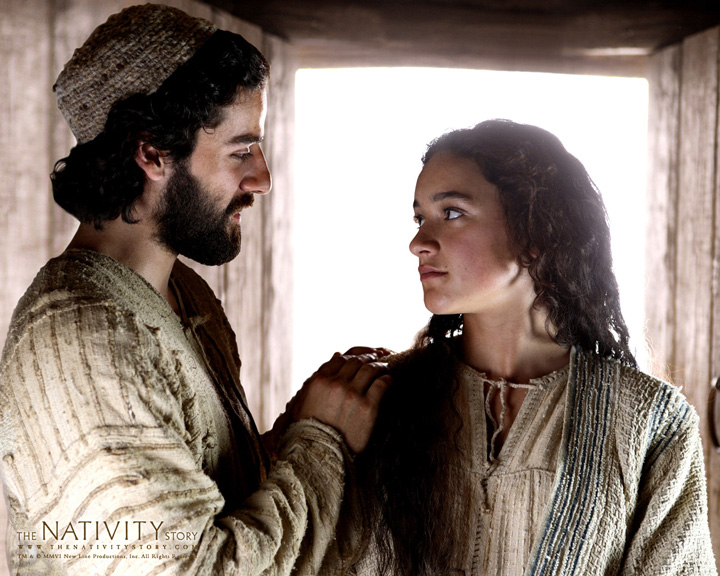
I’ve previously written about the stresses and difficulties of the holy couple leading up to the first Christmas: about Mary’s crisis pregnancy, about Joseph grappling with his wife telling him the child within her is the Son of God and Joseph contemplating a divorce, about their giving birth to that holy child in an animal stable. And their trials together continued after Jesus’ birth.

Imagine being Mary and hearing Simeon prophesy, “Behold, this child is destined … to be a sign that will be contradicted — and you yourself a sword will pierce…” How would that make you feel about the future for you and your child? Picture being Mary as her husband awakes and says “our boy is being hunted, we need to leave tonight.” Consider Joseph, the servant-leader of his family, having to pack-up quickly and leave so much behind to take his family into hiding in Egypt. Later, an angel tells Joseph to bring his family back into Israel. So Joseph returns with Jesus and Mary, but he’s afraid to resettle in the south because the son of Herod the Great now rules Judea. With the help of another dream, Joseph decides to resettle in the north, in Nazareth of Galilee.

I mention all this because St. Joseph, the just and holy man, feared an earthly king even as he trusted God. St. Mary at the Annunciation did not know all the details of her future, but she trusted in God by saying, “Let it be done to me according to your word.” Our Lord Jesus, sweating blood from stress the night before he died, trusted God to say, “Not my will but yours be done.” Their holy lives were often difficult, but God always rewarded their trust, bringing about good for them in the end.

In Genesis, Abram (whose name later got changed to Abraham) was promised a son by the Lord. But the childless Abraham looks at the old age of his wife and himself and asks, ‘Will my steward, Eliezer, be my heir?‘ God answers, ‘No, not him; your own flesh and blood son shall be your heir.’ Then the Lord took Abraham outside and said, “Look up at the sky and count the stars, if you can. Just so,” he added, “shall your descendants be.” And Abraham put his faith in the Lord.

When I first heard this story (and maybe when you heard it too) I assumed this event happened at night. But the message is even more powerful if God told him to “look up at the sky and count the stars, if you can,” during the daytime. Where do the stars go during the day? We know they’re still there, even though the Sun’s brightness the sky’s blueness prevent us from seeing them. Abraham trusted in the Lord’s unwavering goodwill towards him and beheld God’s word fulfilled in the birth of Isaac. Through that son, Abraham received glory and the whole world was blessed.

One of the things Jesus says in the Gospels more than anything else is, “Be not afraid.” Sacrifice your fears. Imagine taking those obsessive worrying thoughts from your mind, placing them upon the altar, and lighting them afire like a sacrifice of old to God. “Let the peace of Christ control your heart…” Trust that “God works all things for the good of those who love him” and then “the peace of God, which surpasses all understanding will guard your hearts and minds in Christ Jesus.”

God not only wants peace within us, but peace among us as well. In our homes there is always room for improvement. The household of the Holy Family may have been a sinless one, but mistakes and miscommunications surely happened. Joseph probably broke or misplaced tools. Mary probably burnt an occasional loaf of bread. From the Gospels we know they both thought they knew where their 12-year-old boy was as they left Jerusalem for home; several hours passed before they realized he was missing. Even when we deeply love one another, we must learn and practice how to love and serve each other better.

We love each other in many ways, and the best modes by which we experience love can vary from person to person. The book “The Five Love Languages” lays out five major ways that we give and receive love, namely:

Gift Giving
Acts of Service
Affectionate Touch
Words of Affirmation
Quality Time

What are your top-two love languages? Can you guess the preferred languages of your spouse and children? Sometimes we try to love others as ourselves by loving them exactly as ourselves and we unfortunately miss our mark. For example, imagine a spouse complaining, “Why don’t you let me know that you love me,” when they really mean “why don’t you get me surprises anymore” (gift giving) or “why don’t you tell me that I delight you and you’re pleased with me” (words of affirmation.) At this, their spouse might reply, “What do you mean? I’m loving you all the time,” when they’re really saying “I take care of the kids and do housework” (acts of service) and “We eat and sit in the living room together every evening” (quality time.) These two loving spouses are loving past each other.

Learn the preferred love languages of your family members, and don’t expect others read your mind, sabotaging our own happiness. Tell them how to delight you. They love you and they want to make you happy. Don’t attack and criticize (“You always this” or “You never that”) but invite them to bless you. And pray together, as a couple and a family. The Holy Family surely did and its one of the most valuable things I can recommend. Some married couples, who have shared a bed for years, have never revealed their personal prayer requests to each other. Pray together, and then even whenever frictions arise, you will remember that you are on the same team, together on the same side with God.

Your home will never be perfect – not even the Holy Family’s was perfect. Life’s circumstances will go awry, and there will be sins we have to apologize for and forgive one another. But with trust in God and a daily commitment to loving and serving each other better, you too can live in the peace and joy of the Holy Family.

Jesus as the Anti-Cain

February 17, 2017

A Reflection on Genesis 4:1-15

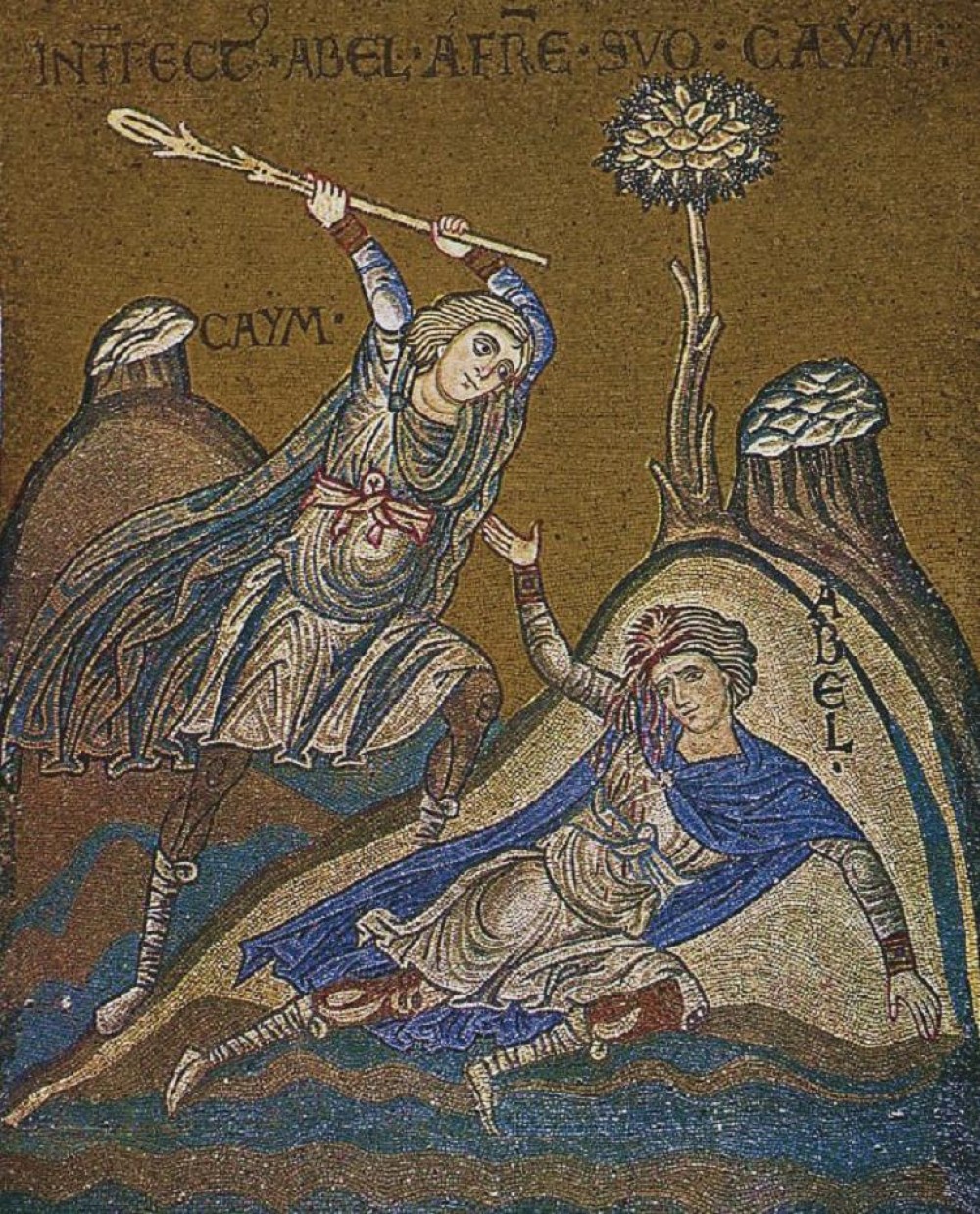
Cain and Abel Mosaic in Monreale, Sicily, 12th century.Adam had relations with his wife Eve, and she conceived and bore Cain, saying, “I have produced a man with the help of the Lord.” Through Eve, Cain is the firstborn of man. Through Mary, the new Eve, Jesus is firstborn of God.

Cain brought an offering to the Lord from the fruit of the soil, while Abel, for his part, brought one of the best firstlings of his flock. This implies that Cain is not offering his very best. Jesus’ sacrifice offers everything to God.

Cain said to his brother Abel, “Let us go out in the field.” When they were in the field, Cain attacked his brother Abel and killed him. Jealousy and a hardened heart leads Cain to murder his brother in the countryside. Similar wickedness leads to Jesus being murdered by his own outside Jerusalem’s gates.

The Lord asked Cain, “Where is your brother Abel?” He answered, “I do not know.  Am I my brother’s keeper?” Cain is not a keeper of animals, but Jesus says: “I am the good shepherd, and I know mine and mine know me.” (John 10:14)

The Lord God then said to Cain: “What have you done! Listen: your brother’s blood cries out to me from the soil!” The blood that Cain shed cried out to Heaven for vengeance, but “the sprinkled blood [of Jesus] speaks more eloquently than that of Abel.” (Hebrews 12:24) The blood of Jesus outpoured begs mercy, for the forgiveness of sins on earth.

Cain said to the Lord: “My punishment is too great to bear. Since you have now banished me from the soil, and I must avoid your presence and become a restless wanderer on the earth, anyone may kill me at sight.” “Not so!” the Lord said to him. “If anyone kills Cain, Cain shall be avenged sevenfold.” So the Lord put a mark on Cain, lest anyone should kill him at sight. Cain is given a protective mark (perhaps a tattoo, common in violent nomadic cultures.)

Jesus enjoys no protective  distinction: “There was in him no stately bearing to make us look at him, nor appearance that would attract us to him.” Cain was not executed for his crime, but Jesus “was pierced for our sins” and “the Lord laid upon him the guilt of us all.” (Isaiah 53:2,6) Killing Cain would have returned “seven fold revenge,” but Jesus’ death  brings forth multitudes of mercy, as through the seven Sacraments.

Our Lord Jesus Christ is the anti-Cain. Praise be to God!

Reflections on Martyrdom

December 29, 2016

I have not seen and cannot recommend the recently-released Martin Scorsese film Silence, but reviewers describe it as haunting and unsettling for believers and non-believers alike. It is set in Japan during a fierce persecution of Roman Catholics in the mid-1600’s. In one scene, a Jesuit missionary is forced to watch arrested Japanese Christians be cruelly tortured before him. The young priest is told that these men and women’s sufferings will cease if he would only step on an image of Christ and renounce his faith. What does Jesus want his followers to do if faced with such a choice?

A person might think there is little harm done in trampling the crude likeness of someone, or by insincerely mouthing a few words, but Jesus told his disciples, “Everyone who acknowledges me before others I will acknowledge before my heavenly Father. But whoever denies me before others, I will deny before my heavenly Father.” (1) At the very start of his ministry it seems that Jesus himself was confronted with the film’s test; the temptation to deny God so that human suffering would end.

After his baptism, Jesus was led by the Spirit into the desert to be tempted by the devil. He fasted for forty days and forty nights, and afterwards he was hungry. The tempter approached and said to him, “If you are the Son of God, command that these stones become loaves of bread.” (2) But Jesus firmly refused. Jesus Tempted in the Wilderness by James Tissot 1886-1894.What was so wicked about the devil’s suggestion? What could be wrong with alleviating hunger? Imagine if Jesus had relented, waving his hand over a nearby brown stone and then biting through its soft crust. Then the devil could accuse him, “So, you have provided food for yourself—how can you now refuse to wield your power to feed the whole world!?” Satan also pressured Jesus to insist that the Father spare him from death: “If you are the Son of God, throw yourself down [from this great height]…” But Jesus again refused. The tempter preferred Jesus to be a messiah who would give people an abundance of material wealth and safety while leaving them in their sins, separated from God forever.

Then the devil took him up to a very high mountain, and showed him all the kingdoms of the world in their magnificence, and he said to him, “All these I shall give to you, if you will prostrate yourself and worship me.” At this, Jesus said to him, “Get away, Satan! It is written: ‘The Lord, your God, shall you worship and him alone shall you serve.’” Jesus accepted suffering with and alongside us as a crucified savior-king and never surrendered to the temptation of becoming an earthly ruler who had denied God and bowed to Satan. Jesus Christ understood that he would be Isaiah’s “Suffering Servant” and “the Lamb of God who takes away the sins of the world” as St. John the Baptist proclaimed him. (3) Even as his desert tempter invited him to end all earthly hardship, Jesus in some sense foresaw the multitude of suffering martyrs who would follow his path after him. Jesus did not waiver. Jesus refused to capitulate to evil for this world’s fleeting, lesser goods because was not the will of God, his Father.

These reflections came to mind last week on the December 28th Feast of the Holy Innocents, those little ones who died in place of Jesus Christ. When Herod realized that he had been deceived by the magi, he became furious. He ordered the massacre of all the boys in Bethlehem and its vicinity two years old and under, in accordance with the time he had ascertained from the magi. (4) Modern biblical scholars estimate Bethlehem’s population was around 1,000 at that time, which means that up to about twenty infants were slain. (5)

These babies and toddlers have been venerated in the Church since the first century.  Early Church Fathers, including St. Irenaeus of Lyon and St. Augustine, and the liturgical tradition of the Church have celebrated them as saints and martyrs. (6) This pair of titles is remarkable for those “who, though still unable to profess [Jesus] in speech, were crowned with heavenly grace on account of his birth.” (7) None of these young Jewish boys were baptized or made a conscious decision to die for Jesus, but they were all saved through Christ.

Jesus spoke of the importance of baptism for salvation, for instance saying, “Whoever believes and is baptized will be saved.” (8) Yet he also said, “Let the children come to me, and do not prevent them; for the Kingdom of Heaven belongs to such as these.” (9) The Church, lacking an explicit teaching from Christ about children who die unbaptized, “can only entrust them to the [great] mercy of God, as she does in her funeral rites for them.” (10) Perhaps the Lord, knowing his own provisions for their salvation, has kept us in our uncertainty lest we employ the twisted logic of Herod, Pharaoh, or Pilate to rationalize the intentional killing of little ones. In any case, it has been the firm conviction and long tradition of Christ’s Catholic Church that the Holy Innocents of Bethlehem now dwell with him in Heaven.

Jesus Christ and his martyrs, from Bethlehem to Japan, reveal and witness to strengthening truths: That this life, however long or short, is not all that there is. That God can bring salvation out of evil, even from crimes and disasters that break our hearts and surpass our understanding. And the martyrs affirm that, as Charles Spurgeon said, “Suffering is better than sinning. There is more evil in a drop of sin than in an ocean of affliction. Better [to] burn for Christ, than [to] turn from Christ.” Whatever terrible crosses may afflict us or those we love we can remember that our crucified Lord has suffered likewise and is always with us. Jesus tells us, “In the world you will have trouble, but take courage, I have conquered the world.” (11)

26-martyrs-of-japan

A memorial to “The Twenty-Six Martyrs of Japan,” a group of Roman Catholics executed by crucifixion on February 5, 1597 at Nagasaki. Their feast day (i.e., St. Paul Miki and companions) is February 6th.

Footnotes:
(1) –  Matthew 10:32.
(2) –  Matthew 4:1-11.
(3) –  Isaiah 52:13-53:12, John 1:29 & 1:36.
(4) –  Matthew 2:16.
(5) – Raymond E. Brown, The Birth of the Messiah, pp.104–121.
Donald A. Hagner, World Biblical Commentary, Matthew 1–13, pg.37.
“Holy Innocents” entry in the Catholic Encyclopedia. 
(6) – Hugo H. Hoever, Lives of the Saints, pg.525.
(7) –  Opening Mass Prayer for The Feast of the Holy Innocents.
(8) –  Mark 16:16.
(9) –  Matthew 19:14.
(10) – Catechism of the Catholic Church, #1261.
(11) – John 16:33.


Catholic Teachings About The End Times

November 10, 2016

Catechism of the Catholic Church #668-679

I.  HE WILL COME AGAIN IN GLORY
Christ already reigns through the Church…

The Resurrection by Piero della Francesca, 1450-1463.        “Christ died and lived again, that he might be Lord both of the dead and of the living.”
Christ’s Ascension into heaven signifies his participation, in his humanity, in God’s power and authority. Jesus Christ is Lord: he possesses all power in heaven and on earth. He is “far above all rule and authority and power and dominion,” for the Father “has put all things under his feet.” Christ is Lord of the cosmos and of history. In him human history and indeed all creation are “set forth” and transcendently fulfilled.

        As Lord, Christ is also head of the Church, which is his Body. Taken up to heaven and glorified after he had thus fully accomplished his mission, Christ dwells on earth in his Church. The redemption is the source of the authority that Christ, by virtue of the Holy Spirit, exercises over the Church. “The kingdom of Christ [is] already present in mystery,” “on earth, the seed and the beginning of the kingdom.”

        Since the Ascension God’s plan has entered into its fulfillment. We are already at “the last hour.” “Already the final age of the world is with us, and the renewal of the world is irrevocably under way; it is even now anticipated in a certain real way, for the Church on earth is endowed already with a sanctity that is real but imperfect.” Christ’s kingdom already manifests its presence through the miraculous signs that attend its proclamation by the Church.

…until all things are subjected to him.

      Though already present in his Church, Christ’s reign is nevertheless yet to be fulfilled “with power and great glory” by the king’s return to earth. This reign is still under attack by the evil powers, even though they have been defeated definitively by Christ’s Passover. Until everything is subject to him, “until there be realized new heavens and a new earth in which justice dwells, the pilgrim Church, in her sacraments and institutions, which belong to this present age, carries the mark of this world which will pass, and she herself takes her place among the creatures which groan and travail yet and await the revelation of the sons of God.” That is why Christians pray, above all in the Eucharist, to hasten Christ’s return by saying to him: Marana tha! “Our Lord, come!”

        Before his Ascension Christ affirmed that the hour had not yet come for the glorious establishment of the messianic kingdom awaited by Israel which, according to the prophets, was to bring all men the definitive order of justice, love, & peace. According to the Lord, the present time is the time of the Spirit and of witness, but also a time still marked by “distress” and the trial of evil which does not spare the Church and ushers in the struggles of the last days. It is a time of waiting and watching.

The glorious advent of Christ, Israel’s hope

        Since the Ascension Christ’s coming in glory has been imminent, even though “it is not for you to know times or seasons which the Father has fixed by his own authority.” This eschatological coming could be accomplished at any moment, even if both it and the final trial that will precede it are “delayed.”

        The glorious Messiah’s coming is suspended at every moment of history until his recognition by “all Israel,” for “a hardening has come upon part of Israel” in their “unbelief” toward Jesus. St. Peter says to the Jews of Jerusalem after Pentecost: “Repent therefore, and turn again, that your sins may be blotted out, that times of refreshing may come from the presence of the Lord, and that he may send the Christ appointed for you, Jesus, whom heaven must receive until the time for establishing all that God spoke by the mouth of his holy prophets from of old.” St. Paul echoes him: “For if their rejection means the reconciliation of the world, what will their acceptance mean but life from the dead?” The “full inclusion” of the Jews in the Messiah’s salvation, in the wake of “the full number of the Gentiles,” will enable the People of God to achieve “the measure of the stature of the fullness of Christ,” in which “God may be all in all.” 

The Church’s ultimate trial

The Devil Tempting a Young Woman by André Jacques Victor Orsel, 1832.

        Before Christ’s second coming the Church must pass through a final trial that will shake the faith of many believers. The persecution that accompanies her pilgrimage on earth will unveil the “mystery of iniquity” in the form of a religious deception offering men an apparent solution to their problems at the price of apostasy from the truth. The supreme religious deception is that of the Antichrist, a pseudo-messianism by which man glorifies himself in place of God and of his Messiah come in the flesh.

      The Antichrist’s deception already begins to take shape in the world every time the claim is made to realize within history that messianic hope which can only be realized beyond history through the eschatological judgment. The Church has rejected even modified forms of this falsification of the kingdom to come under the name of millenarianism, especially the “intrinsically perverse” political form of a secular messianism.

        The Church will enter the glory of the kingdom only through this final Passover, when she will follow her Lord in his death and Resurrection. The kingdom will be fulfilled, then, not by a historic triumph of the Church through a progressive ascendancy, but only by God’s victory over the final unleashing of evil, which will cause his Bride to come down from heaven. God’s triumph over the revolt of evil will take the form of the Last Judgment after the final cosmic upheaval of this passing world.

II. TO JUDGE THE LIVING AND THE DEAD

The Resurrection by El Greco, Madrid, 1596-1600.      Following in the steps of the prophets and John the Baptist, Jesus announced the judgment of the Last Day in his preaching. Then will the conduct of each one and the secrets of hearts be brought to light. Then will the culpable unbelief that counted the offer of God’s grace as nothing be condemned. Our attitude about our neighbor will disclose acceptance or refusal of grace and divine love. On the last day Jesus will say: “Truly I say to you, as you did it to one of the least of these my brethren, you did it to me.”

        Christ is Lord of eternal life. Full right to pass definitive judgment on the works and hearts of men belongs to him as redeemer of the world. He “acquired” this right by his cross. The Father has given “all judgment to the Son.” Yet the Son did not come to judge, but to save and to give the life he has in himself. By rejecting grace in this life, one already judges oneself, receives according to one’s works, and can even condemn oneself for all eternity by rejecting the Spirit of love.

God, in Trinity & History

August 24, 2016

This Monday, I dialogued with Muslims, Jews, and Unitarians in an online comments section. How’d it go? A Muslim man accused me of an “unforgivable sin” for espousing Trinitarianism. (I thought: “If that’s literally true, then that makes me less inclined to become Muslim. I mean, why bother?”) But the commenters were generally thoughtful and kind.

The blogger who hosts the website had written, “The Jews had no idea of the Trinity. Their faith was centred in the Shema: a unitary monotheistic confession.  Jesus clearly affirmed that very same unitary monotheism in Mark 12:29. [“Jesus replied, ‘The first (commandment in the law) is this: “Hear, O Israel! The Lord our God is Lord is one!”] How is it that Christians today have abandoned their rabbi on this point?” I felt moved to reply and what follows is based upon my responses.

A diagram of the ancient, orthodox, Christian conception of the Holy TrinityFaithful Jews recite the Shema prayer each morning and evening, quoting Deuteronomy 6:4: “Hear, O Israel: The LORD our God, the LORD is one.” Is the oneness professed in this passage of God’s word irreconcilable with Trinitarian belief?

In declaring that “the Lord is one,” the Hebrew passage employs the word “echad” for “one.” Echad is often used to mean singularity, but sometimes the same word denotes a unified entity. For instance, in the Garden, “For this reason a man will leave his father and mother and be united to his wife, and they will become one (echad) flesh.” And again, at the Tower of Babel, “If now, while they are one (echad) people and all have the same language, they have started to do this, nothing they presume to do will be out of their reach.”

God could have selected a different word to be inspired for this passage, but the one He chose allows a providential flexibility. Echad permits the unified oneness of the Persons of the Trinity without requiring this reading from the Jewish generations who came before Christ. So, contrary to the blogger’s claim, when Jesus quotes the Shema it is not clear that He is affirming the very same unitary monotheism assumed by his ancestors. Interestingly, the “oneness” of God taught in Deuteronomy 6:4 leads to the conclusion that we ought to love God with the unified oneness of three aspects of ourselves. The immediately following verse reads: “Therefore, you shall love the LORD, your God, with your whole heart, and with your whole being, and with your whole strength.”

A Unitarian (a Christian who asserts God’s unity and rejects the doctrine of the Trinity) found this last observation interesting and asked me to recommend a book that makes a great case for the Trinity. To him, I replied:

I would suggest approaching the Holy Trinity in the same way the first Christians came to this knowledge; through Jesus of Nazareth. Some dismiss the Christology of John’s Gospel as later theological development, but even the Gospels thought to be written earlier show Jesus doing and saying things only God could rightly do (e.g., forgiving sins, declaring himself lord of the Sabbath, demanding an absolute total commitment to himself, etc.) A book I recommend that explores this is Pope Benedict XVI’s 2007 “Jesus of Nazareth (Part 1)” In it, Benedict spends a good deal of time discussing Rabbi Jacob Neusner’s book, “A Rabbi Talks with Jesus.” The central issue that prevents that rabbi from believing in Jesus is the same scandal that led Jesus to his death: his revealing himself as God.
Trinity Symbol

To objections at Christians detecting in the Shema something which no Jews had previously held–indications of the Trinity–I answered:

In the course of the Jewish Scriptures, we can see God developing humanity along; from polytheism to monotheism, from polygamy to monogamy, from blood vengeance to “an eye for an eye.” That the LORD was not just one god among the many gods–but the only God, was a revelation His people learned over time. (For example, Moses must ask of God in Exodus 3:13: “If I go to the Israelites and say to them, ‘The God of your ancestors has sent me to you,’ and they ask me, ‘What is his name?’ what do I tell them?”) When Jesus comes He extends the revelation further; “Love your enemies,” “What God has joined let no man separate,” “The Father and I are one.” My point is this: To argue Christian beliefs cannot be true because they were not previously known among Jews is like saying there cannot be only one God because this was not clear to the Patriarchs; Abraham, Isaac, and Jacob/Israel.

One Muslim asked whether the Old Testament prophets who did not know about the Trinity would therefore be worshiping an incomplete God. I answered:

All analogies touching on the Trinity fall short, but imagine being introduced to a friendly and engaging man at a dinner-party. In the course of your conversation you learn that he is a doctor, married, and has three kids. Now these things were true about the man from the first moment you knew him but you came to know him more fully with time. Likewise, God has always been a Trinity of Persons; Father, Son, and Holy Spirit; acting, speaking, and revealing throughout history. Abraham and the prophets’ understanding of God were not as filled-out as in later generations, but they did indeed know and love and worship God. Of course, the parallel I’m trying to draw is not that God is one person wearing three different hats like that doctor-husband-father (which is the heresy of modalism.) I’m noting how Abraham and the prophets could enjoy true relationship with the Holy Trinity without yet knowing of that doctrine.

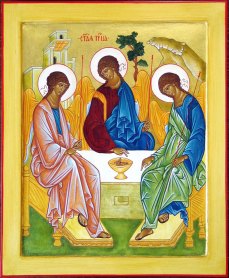
Trinity Icon based upon the original by Andrei Rublev, c. 1408-25

A modern icon based upon Andrei Rublev’s “The Trinity” (also called “The Hospitality of Abraham“) from the fifteenth century.

Consider the interesting episode of Abraham’s three visitors in Genesis 18: “The LORD appeared to Abraham by the oak of Mamre… Looking up, he saw three men standing near him.” Now two of this trio are later called angels (Genesis 19:1) but more precisely these are “messengers,” and the Son and the Holy Spirit do indeed serve the Father this way, revealing God the Father and his will among men. Did Abraham perceive in his guests what Christians suspect in retrospect, that this was a manifestation of the Holy Trinity? Maybe not, yet Abraham could still commune in God’s presence.

I think something that trips people up about Christianity is imagining God the Father as the sole Divine Person in the Old Testament, with the Son and the Holy Spirit only appearing later in the New. However, if the Trinity is true it has always been true, and the three Persons (possessing the same Divine Essence the prophets praised) have been active in the affairs of mankind throughout history. Christians reflect back on the Jewish Scriptures and see the Persons of the Trinity at work together. Our Nicene Creed professes that the Holy Spirit has “spoken through the prophets.” Look at the episodes where a “messenger” speaks in the divine first-person (e.g., Genesis 22:12, Judges 6:16 & 13:21-22) I would say Abraham and the prophets’ experiences of God were Trinitarian even if they did not fully grasp it then. I believe the same is true for all today.

Abraham’s Intercessions for Sodom & Gomorrah

July 23, 2016

A Mathematical Analysis of Genesis 18:22-33

Conversation
Exchange
Bid # for Innocents
# Decrease
% Decrease
Factional Decrease

1st

   50

   –

2nd

   45

5

10% 1/10

3rd

   40

10

11.111% 1/9

4th

   30

10

25% 1/4

5th

   20

10

33.333% 1/3

6th

   10

10

50% 1/2

The Old Covenant’s (Surprising) Last Seven Prophets

May 6, 2016

A prophet is someone enlightened by God to reveal his message. Each Sunday, we familiarly proclaim that the Holy Spirit has “spoken through the prophets,” but the identities of the seven last Old Covenant prophets (as seen in the Bible) may well surprise you.

#7 :  The Author of 2nd Maccabees

Malachi is the last book in the Old Testament, yet the Bible’s books do not always appear in chronological order. Our separated Protestant brethren would identify Malachi as the last prophetic book in the Old Testament, but the Church’s Bible includes seven books which they exclude. The last of these is 2nd Maccabees, written during the 1st century BC.

The author of 2nd Maccabees, who chronicles the Jews’ successful rebellion against their Greek persecutors, does not seem to know he writes by divine inspiration. In his closing remarks he adds, “If [this story] is well written and to the point, that is what I wanted; if it is poorly done and mediocre, that is the best I could do.” (15:38) However, neither does St. Paul appear to grasp that his letters to the churches would be revered on the level of Genesis, Joshua, or Daniel. This shows that God can use us in amazing ways, in perfect accord with his will, even if we fail to recognize it at the time.

#6 & #5 :  St. Zachariah & St. Elizabeth

The Visitation by BlocZachariah and his wife, Elizabeth, are old and childless. But the Archangel Gabriel appears to Zachariah in the Temple and says that they shall have a son. Although he knows that God has blessed with children elderly and barren couples of old, Zachariah disbelieves the message. In response, he is put on a forty-week silent retreat. Zachariah becomes mute and apparently deaf as well (since his neighbors and relatives will later resort to making gestures to ask him the name of his newborn son.) Though he cannot tell his pregnant wife of their unborn son’s great mission, Elizabeth receives insights from the Holy Spirit.

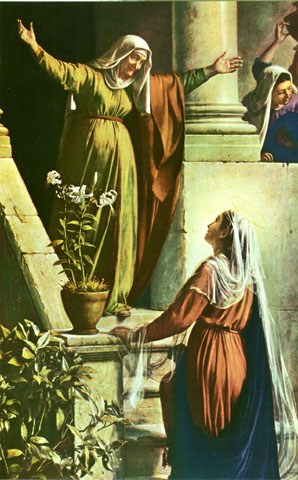
When she hears the greeting of her visiting relative, Elizabeth is “filled with the holy Spirit” and cries out in a loud voice, “Most blessed are you among women, and blessed is the fruit of your womb!” The Blessed Virgin’s belly has not yet begun to grow, but Elizabeth prophesies and confirms to Mary that she is indeed pregnant with a boy who is “the Lord.” (Luke 1)

The Holy Spirit also seems to reveal to Elizabeth the name of her child: “John,” a name unfamiliar to her family. At the naming ceremony, Zechariah regains his voice, confirms her word, and “filled with the holy Spirit, prophesie[s]” through the canticle which bears his name. This holy, prophetic couple would ready their son for the great mission prepared for him by God.

#4 :  The Blessed Virgin Mary

The Annunciation by Henry Ossawa Tanner, Philadelphia, 1898.The Archangel Gabriel declared unto Mary that she would conceive the Son of God by the Holy Spirit. But is Mary a prophetess? Unlike Elizabeth and Zachariah, Luke’s Gospel does not say Mary, “filled with the Holy Spirit, prophesied,” or “filled with the Holy Spirit, cried out in a loud voice.” However, as Fr. Raymond Brown observed, the Annunciation to Mary shares the biblical form of a prophetic calling (like those of Moses, Gideon, Isaiah, Jeremiah, and Ezekiel before her):

(1) An Encounter with God or His Angel
(2) An Introductory Word
(3) A Call or Commission
(4) Objection(s) to the Message
(5) Reassurance by God or His Angel
(6) A Sign is Given

In her later canticle, Blessed Mary speaks a prophesy which remains fulfilled in our midst: “Behold, from now on all generations will call me blessed.” Mary is a prophetess, filled with the Holy Spirit, who bears God’s Word.

Simeon Holding the Baby Jesus in the Temple as His Parents Look On#3 & #2 :  St. Simeon & St. Anna

When the baby Jesus’ parents brought him to the Temple for the first time, they were met by Simeon and Anna; she was “a prophetess” and  “[t]he holy Spirit was upon him.” Simeon “came in the Spirit into the temple,” took Jesus in his arms, and declared him “a light for revelation to the Gentiles, and glory for your people Israel.” Anna likewise came forward at that very time and “gave thanks to God and spoke about the child to all who were awaiting the redemption of Jerusalem.” (Luke 2)

Simeon may have been advanced in years, but “it had been revealed to him by the holy Spirit that he should not see death before he had seen the Messiah of the Lord.” Anna, for her part, was an eighty-four-year-old widow who “never left the temple, but worshiped night and day with fasting and prayer.” Anna and Simeon show us how the old can bless the young through sharing the word of the Lord they have personally come to know.

#1 :  St. John the Baptist

St. John the Baptist PreachingWe do not know exactly how many Old Covenant prophets God inspired after the author of 2nd Maccabees. (A case might be made for the Bethlehem shepherds and the Magi as well.)  But we do know that John the Baptist represents the last Old Covenant prophet, the forerunner to the New Covenant Christ. He is “more than a prophet,” Jesus says. “All the prophets and the law prophesied up to the time of John. … Amen, I say to you, among those born of women there has been none greater than John the Baptist; yet the least in the kingdom of heaven is greater than he.” (Matthew 11)

At baptism, each Christian is entrusted with a prophetic mission. As those enlightened with God’s ultimate revelation, we are to share this Word. As great as it is to proclaim Christ’s coming, to proclaim his triumph is still greater.

Why?

January 22, 2016

As [Jesus] passed by he saw a man blind from birth. His disciples asked him, “Rabbi, who sinned, this man or his parents, that he was born blind?” Jesus answered, “Neither he nor his parents sinned; it is so that the works of God might be made visible through him. [Jesus cures the man’s blindness, leading to his giving glory to God and salvation in Christ.]

—The Gospel of John, chapter 9

The question of Jesus’ disciples reflects an ancient assumption: that bad things happen to people as a punishment for their sins. In perhaps the oldest Old Testament book, the friends of Job insist that his great suffering must be his fault somehow. Before throwing out the man born blind, the Pharisees tell him, “You were born totally in sin, and are you trying to teach us?” While our own personal sins can carry with them their own punishments, innocent suffering also exists. Job was innocent. Jesus Christ was sinless, and his mother Mary, too. Yet each one suffered greatly through no fault of their own.

Why does God (who is all-good, all-knowing, and all-powerful) allow the innocent to suffer? God certainly does not work evil, yet he clearly permits evils to occur. Why? St. Paul wrote, “We know that in everything, God works for good for those who love him.” (Romans 8:28) And St. Augustine rightly concludes, “God would never allow any evil if he could not cause good to emerge from it.” Like Jesus answered his disciples in regards to the man born blind, “Neither he nor his parents sinned; it is so that the works of God might be made visible through him.”

It is natural to question the plans of God in times of tragedy. But we Christians have reassurance even in the face of suffering and death. At the heart of our faith is the too-all-eyes senseless death of Jesus Christ, murdered on a cross. Yet from this evil God raised up great good for his Son, for us, and for the whole world. Like Christ’s first disciples, we do not always readily know the why’s and purposes of God, but in all things we have hope.

The Two (Old & New) Arks of God

December 17, 2015

Remember Raiders of the Lost Ark? The Ark that Indiana Jones and the Nazis were pursued in that entertaining film was the most precious object in the entire Old Testament. But what is lost on many is how that holy artifact is related to the most important woman in the New Testament and its New Covenant.

The Old Testament Ark of the Covenant was a box built in the days of Moses according to God’s instructions at Mount Sinai. It was made of wood overlaid with pure gold, inside and out. No man was allowed to touch God’s Holy Ark—lest they die—so it was designed to be carried about using a pair of poles. The Ark was the throne for God’s presence on earth. The wings of two, golden Cherubim angel statues atop the Ark’s lid served as his “mercy-seat.” The Ark itself contained within several interesting items from the time of the Exodus: the two stone tablets of the 10 Commandments, the wooden staff of Aaron (which miraculously blossomed to confirm his divinely-ordained priesthood), and a gold container holding some of the Manna from heaven which God provided to feed his people on their desert pilgrimage.

Ark

About 450 years after its construction, around 1000 BC, King David reigned over all of Israel. He tried to bring the Ark up to his royal city, Jerusalem, until one of the priests (who should have known better) touched the Ark and fell down dead. David exclaimed, “How can the Ark of the Lord come to me?” He arranged for it to be kept at the house of Obed-edom in the Judean countryside. The Ark remained there for three months and manifestly blessed the whole household. When it was reported to the king how richly Obed-edom was being graced, King David decided to try transporting the Ark into Jerusalem once more. David himself led that procession, dancing and leaping before the Lord with joyful abandon.

The Ark would eventually reside in the Jerusalem Temple built by David’s son, King Solomon. It is written that before that Temple was destroyed by the Babylonians in 587 BC, Jeremiah the Prophet took the Ark and hid it in a secret cave, saying, “No one must know about this place until God gathers his people together again and shows them mercy.”Unlike in the 1981 film, the Lost Ark has never been found, but a new Ark of God did appear.

The Blessed Virgin Mary is the New Ark of the Covenant because she bears Jesus Christ, God’s fullest presence on earth. By God’s design, the first Ark was made of wood and covered with gold; Mary is a human being full with grace. The former Ark carried the word of God in stone; Mary’s womb carries the Word become flesh. Aaron’s dead staff miraculously flowered; Mary’s virgin womb blossomed with a bud from the stump of Jesse. The Ark held Manna from heaven; Mary bore the true bread from heaven. Mary’s womb holds Jesus Christ, our Prophet, Priest, and King.

The Visitation by Albertinelli, 1503.As the Gospel of Luke tells us, after she was visited by St. Gabriel the Archangel at the Annunciation, “Mary set out and traveled to the hill country in haste to a town of Judah, where she entered the house of Zechariah and greeted Elizabeth. When Elizabeth heard Mary’s greeting, the infant leaped in her womb, and Elizabeth, filled with the holy Spirit, cried out in a loud voice and said, ‘Most blessed are you among women, and blessed is the fruit of your womb. And how does this happen to me, that the mother of my Lord should come to me?’” And Mary would bless them with her help and companionship, staying at their house in the Judean hill country about three months.

Like King David, St. Elizabeth questions and St. John the Baptist leaps for joy before the Ark of the Lord. St. Joseph, regarding the inviolable sanctity of his wife with reverent fear, never touched her virginity. Mary would also go on to literally serve as God’s throne, his mercy-seat; “On entering the house [the Magi] saw the child with Mary his mother.”

In the Book of Revelation, St. John’s vision of heaven includes a sighting of the Lost Ark: “Then God’s temple in heaven was opened, and the Ark of his Covenant could be seen in the temple.” Then John beholds “in the sky, a woman clothed with the sun, with the moon under her feet, and on her head a crown of twelve stars.” We soon discover that this  glorious woman is pregnant with “a son, a male child, destined to rule all the nations….” This is the Christ, and she is his Holy Ark.

Now the Lord’s Ark is not meant to be worshiped. (Though among God’s most holy creations, an Ark of God is not divine.) Yet, as one draws nearer to the Holy Ark, one inevitably draws nearer to God’s presence. Just as the old Ark of the Covenant was of central (though secondary) importance in the Old Covenant, so God gives the Blessed Virgin Mary an essential role in his New Covenant. All who come to her are drawn nearer to her Son.

Imagine daring to enter the old Jewish Temple’s the Holy of Holies where the Ark of God was kept. What awe and reverence would you feel before the all-holy presence of God? Now consider drawing near to the even greater Ark, Mary the Mother of all Christians, who reaches out to each of us with love and takes away our fear. And now reflect upon the great privilege we have in approaching and even touching the Christmas Gift of God she bore, Jesus Christ himself. Mary is blessed among women and blessed is the fruit of her womb, Jesus. But blessed are we who would believe in all that the Lord has revealed to us.