Archive for the ‘Parables’ Category

What Truly Lasts

July 31, 2022

18th Sunday in Ordinary Time
By Fr. Chinnappan Pelavendran

Our God is a personal God who is concerned about each and every one of us and personally takes care of us. He is a benevolent Father caring for the needs of his children and planning a future for each one. The Bible presents God as a father who takes care of His children. His concern is beyond our understanding. The readings of today invite us to place our trust in God. We are invited to focus our attention on the heavenly realities more than on the earthly shadows.

Today we are also reminded that we are in a transitory world. This means that everything here changes. Everything passes. Hence, it is a call to make use of the things of this world prudently without losing our ultimate goal. Heaven is our goal. In heaven, nothing passes away.

The first reading of this Sunday begins with a warning, “Vanity, vanity,” the reading says, “vanity.” The author reminds us that there will be an ultimate end to all created things. This strikes a reality that most of us have neglected. However, one day each of us will come to terms with it. The author also calls us to remember God in all we do. And, he reminds us that the ultimate goal here on earth is to walk our way straight to heaven.

In the second reading, St. Paul advises the Colossian community that they must look for the things of heaven where Christ is. He wanted all thoughts to be centered on heavenly things, not on the things that are on earth. He reminded the Colossian community that in Baptism they have become new persons as they have been raised with Christ. There we find the perfect image of God in Jesus who is the perfect pattern of our life.

In today’s Gospel, in the parable of the foolish rich man, Jesus warns us against all types of greed, because greed takes our life’s focus away from God-away from serving and loving God and other people. Jesus says that God calls the greedy rich man a fool because the man thought he would not die soon and that he was not accountable for the way he used his riches. The rich man forgot the fact that his wealth had been lent to him by God for sharing with the needy. Jesus also warns us that our eternal life does not consist of earthly possessions. These we should share to gain eternal life.

We are invited to share our blessings with others, the parable of the rich fool gives us a warning as an invitation. It reminds us that our possessions are merely lent to us by God. And that we are accountable for their use. We must be generous in sharing our time, our treasure, and our talents in Christian stewardship. Even if we are financially poor, we may be blessed with intelligence, good will, a sense of humor, or the ability to console, encourage, inspire, support, and help others. God expects us to give our thanks to Him for all these blessings by sharing them with others for His glory.

Let us control our greed. Our greed takes different shapes and forms. For some, it may be the desire for the approval and praise of others, for some it may be an uncontrolled desire for power, control, or fame. For some still others, greed takes the form of excessive and sinful indulgence in eating, drinking, gambling, or drugs. Greed also turns our life away from God and away from loving and serving Him and other people. Greed directs all our energy and attention to fulfilling the self. We need to come out of ourselves and understand God and His creation, all the created things will pass away, but God never changes or passes away.

Stories of Three Fruitful Conversions

July 30, 2022

18th Sunday in Ordinary Time
By Fr. Victor Feltes

Leah Darrow grew up in a strong Catholic family, but she recalls that in high school her Catholicism started to get “fuzzy.” By the time she was in college, Leah says she had become a “Catholic But,” as in, “I’m Catholic but I don’t agree with the Church’s teaching on cohabitation… I’m Catholic but I don’t see the problem with a couple who love each other sleeping together before their marriage… I think the Church is behind the times.”

One evening at college Leah watched a reality show called “America’s Next Top Model.” She thought to herself, “I’m pretty cute, maybe I could be on that show.” Leah tried out, got accepted, and competed on national television against other gorgeous women. Even though she didn’t win the competition this exposure and fame jump-started her modeling career. She still recalls her excitement at receiving her first modeling paycheck featuring a number with a comma in it. Leah’s chosen path eventually led her to an experience in a New York City skyscraper which forever changed her life.

She came to pose for a risqué, international, men’s magazine. They brought out a number of itsy-bitsy outfits for her, she put one on, and the photoshoot began. Yet while Leah was posing, a vision flashed into her mind: three images in the span of perhaps a second or two. First, she saw herself standing in a large white space wearing that immodest outfit. She felt no pain in that moment, but had a sense that she had died. In the second image, Leah was looking up, holding out her open hands at her waist with the knowledge that she was in God’s presence. In her third and final scene, Leah saw herself holding her hands all the way up, offering God all that she had, but she saw that she was offering him nothing. She realized that with all of the blessings, talents, and gifts God gave her she had wasted them on herself. She saw that if she had died at that moment she would have nothing to offer Christ.

Leah abruptly abandoned the photo session, changed back into her own clothes, and ran down 5th Avenue balling. She called home saying, “Dad, if you don’t come get me I am going to lose my soul.” So her father drove across the country from Oklahoma to New York City. When her dad arrived, though Leah wanted to leave for home immediately, her father insisted upon seeing the sights. “But first,” he said, “we go to confession.” Leah made a good confession through tears, and came out of the confessional healed, like a new woman. In the years since, Leah Darrow has been bearing good fruit as a national Catholic speaker.

I was reminded of Leah’s story by a young man’s testimony this week. My spiritual retreat house in Illinois was a short distance from the Mundelein Seminary, which allowed me to take in a portion of the Courage International conference being held there now. Courage is a fellowship helping men and women who experience same-sex attractions to live chastely — faithful to Jesus Christ and Catholic teaching on sexuality.

Part of the training day for clergy was hearing a Courage member share his story. He grew up Catholic with faithful, loving parents, but like the Prodigal Son went off on his own way. He says his lifestyle had many pleasures but there remained an unsatisfied sadness. He knew what he was doing wasn’t right. One night, awakening from sleep, he also had a life-changing vision. He saw his heart of flesh descending over a dark ocean, dropping deeper and deeper down into the depths. And then he heard the Lord say two things to him (if I recall the phrasing precisely): “My son, come home,” and “Time is running out.” This experience helped him see he was God’s beloved but needed to change his life. He was called by Christ to something greater, and now his joyful life is bearing good fruit.

A different speaker at the conference shared another great story. It was an anecdote about a husband and father who had an addiction to viewing indecent images. Through renewed devotion and the help of God’s grace, this man began to experience victory and freedom from this sin. One day, as he was driving down the road chit-chatting with his four-year-old daughter in the backseat, she remarked, “I like new daddy more than old daddy.” (To be clear, both “old daddy” and “new daddy” were references to him.) This man’s four-year-old daughter did not know why things were now different, but she delighted in how much more present, attentive, and open her dad had become for her by valuing pure love more than sin.

As St. Paul urges us in today’s second reading, “Put to death, then, the parts of you that are earthly: immorality, impurity, passion, evil desire, and the greed that is idolatry.” Your old self and its practices must give way to the new. “Think of what is above,” Paul writes, “not of what is on earth.” Be renewed in God to share in his delight and great rewards.

The rich man in today’s parable gathered earthly wealth, planning and preparing for himself pleasures in this life. He thought he still had many years ahead of him to enjoy, but his time was running out. God calls him a fool since he is soon to appear before the Lord with empty hands, poor “in what matters to God.” “Vanity of vanities,” our first reading says; this world is full of vanities! Stop chasing after and clinging to worthless things. Remember that you are loved, that you were made for great things, and that the joy and freedom Jesus Christ has given to others he can also give to you.

The Parable of the Midnight Visitor

July 24, 2022

17th Sunday in Ordinary Time
By Fr. Victor Feltes

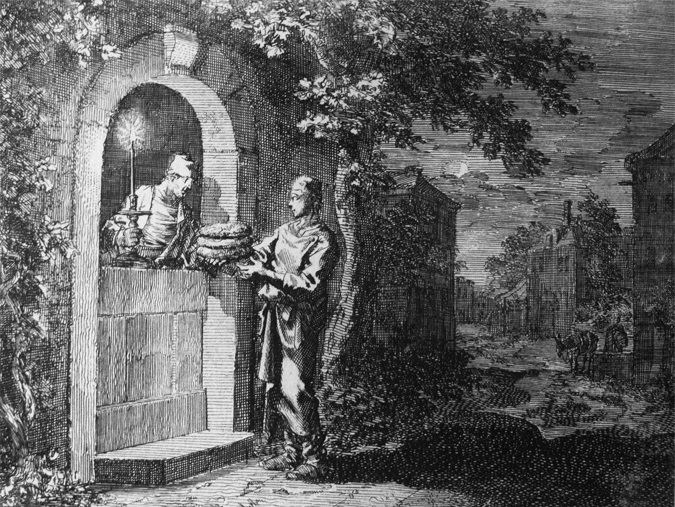
Imagine a visitor arrives at your home. He’s hungry but you have nothing to feed him. Suppose it’s so late at night that all the stores are closed. So you go down the road to the house of your friend and knock on his door. You rap gently and quietly at first, but then beat more firmly and loudly. It’s midnight, and your friend won’t answer the door. So you call out, “Friend, lend me three loaves of bread, for a friend of mine has arrived at my house from a journey and I have nothing to offer him!” But your annoyed friend replies from within, “Do not bother me; the door has already been locked and my children and I are already in bed. I cannot get up to give you anything.”

Is it really true that he cannot give you anything, or just that he would rather not? Notice what he doesn’t say; he doesn’t say he has no bread. Jesus assures us that if this neighbor of yours does not get up to give you those loaves of bread because of your friendship, he will surely get up to give you whatever you need because of your persistence. Why is this so? Because of his kids. Your neighbor inside says he and his children are already in bed. Are his children asleep? They were… before you came knocking. What will happen if you’re persistent and keep on calling at the door? The kids will not be happy. They will cry and complain, and their father will find no peace. That’s why his surrendering of some bread is guaranteed.

So what is Jesus really teaching us through this story? How to bother your friends and extort their food? The meaning of this parable is revealed by its context. Right before this story, Jesus’ disciples are taught how to pray to our Father. They are encouraged to ask him to “give us each day our daily bread.” And right after the parable, Jesus invites his disciples to seek and knock and ask, that we may find that we receive at an opened door. Jesus then reminds us that if even sinful fathers know how to give their children good gifts when asked, how much more so will our sinless Father give good gifts like the Holy Spirit to those who ask him? Today’s parable about knocking and asking at our friend’s door is likewise a lesser example teaching a greater truth: if your flawed and annoyed earthly neighbor can be persuaded to get out of bed in the middle of the night to give you bread, how much more readily will your perfect, patient, heavenly Father give you the daily bread, gifts, and graces you ask of him in prayer?

Later in the New Testament, St. James writes, “You do not possess because you do not ask.” So why don’t we ask God for more things in prayer? Perhaps you don’t ask because you’re afraid of being selfish or needy. But it’s not selfish to ask for what you or others need. Our parable’s protagonist had a praiseworthy purpose, to feed a hungry guest. To ask our Father for his good gifts is a good thing we are commanded to do. So if you never pray for yourself, or if you never pray for others, then definitely add such petitions to your prayers. Perhaps you don’t ask for more things in prayer because you worry you will ask for the wrong things. But that is not something to fear. If your son asks you for a poisonous snake or scorpion, would you then hand them over to him? Of course not. Nor will your heavenly Father grant wishes which would harm you.

And here’s a final reflection. If we are the main character in today’s parable (the one who is seeking and knocking and asking), and God is the father whom we approach with our request, then who are the father’s children at rest with him in his house? Who else in heaven can hear our prayers and add their voices to our requests, not because of annoyance at us but from their great love for us? We see in the Book of Revelation that in this present age (before the Second Coming) the saints in heaven are offering prayers to God. They do not pray for themselves, but for us. Like Abraham who once interceded before God for Sodom, the saints in heaven can intercede for us now. So ask them. As St. James wrote, “The fervent prayer of a righteous person is very powerful.

Jesus’ parable would teach us to not be bashful but be bold in asking for good things from God. So knock on the door of heaven, with your prayers to our Father and his children above.

God Close to Us

July 11, 2022

15th Sunday in Ordinary Time
By Fr. Chinnappan Pelavendran

Today we celebrate the God who is close to us both in His Word and in our neighbor. As the image of the unseen God, and as the Good Samaritan, Christ is close to us in all circumstances of life. So, the church asks us to acknowledge the presence of God both in his Word, and in our neighbor. Jesus teaches us through the parable of the Good Samaritan that God’s grace comes to us in all forms and through all kinds of people.

The first reading taken from the Book of Deuteronomy is one of the most consoling and joyful words given to the people. It was time for Moses to take leave of his people as he could not reach the Promised Land. He says to his people God is our life, hear the voice of God from the Law and to keep His Commandments, He tells them God is very near to them in the neighbors we shall encounter each day. When we act as neighbor to them, we act as neighbor to God Himself.

The second reading is from the Letter of St. Paul to the Colossians. It tell us about the divinity of Jesus and that Jesus is the image of invisible God, the firstborn of all creation. All creation was in Him, through Him, and for Him. Since all is created in and through him, Christ is the center of Unity. Jesus is the full revelation of God, it is this Jesus who lives in us and in our neighbors. We love Jesus when we love our neighbors.

In today’s Gospel, a scribe asked Jesus a very basic religious question, “What should I do to inherit eternal life?” In answer to the question, Jesus directs the scribe’s attention to the Sacred Scriptures. Love God and express it by loving your neighbor.

God could be found in his Word which is close to him. To love God therefore is to love his Word. The Word of God is personified in the Good Samaritan in today’s gospel. The word of God is Jesus himself, who speaks to us, and Jesus who is ever close to us like the Good Samaritan.

The Gospel also presents to us another way through which God is close to us. That is, in our neighbor. As a humble master, he is always available to us in simple ways and things. He is close to us in the scriptures, in the poor, in the just, in the pious, in the marginalized, in the sick, and in the weak. Like the Good Samaritan, if we search for God in these, we will find Him. The Good Samaritan saw God in the victim, and so was moved to help him.

The Good Samaritan represents those who seek Christ in the weak, wounded, and the poor. He represents those who are mindful of their neighbors and those who are wounded. Also, he represents Christ who is always quick to come to our help when we are weak, despised, and abandoned. He is ever ready to help us to recover from our injuries, and He is so close to take care, and to heal us.

We have one life and we do not get another one. So live your life praising God and if you fall astray, always run back to Him because He will always welcome you with open arms. Use the gifts He has blessed you with to serve others. Do not live your life wasting away with the temporary happiness of life, find permanent happiness in living out the virtues and serving others. God loves us so much that He gave us this life.

A Heaven-Sent Hug

July 10, 2022

15th Sunday in Ordinary Time
By Fr. Victor Feltes

Last month, a parishioner told me she looked forward to the great stories I would bring back from vacation. Today, I would like to tell you the best story from my time away. It’s actually a story of Tori, the wife of a former college roommate I visited. It is a God story which all involved are happy to share with others, and this story is entirely true.

Tori worked ten years at a Christian school in Oregon with a much-beloved Bible teacher named Dave. He was like a father figure for her. Tori did not really know his wife, Marcy, but he often spoke of her in glowing terms. When Tori had left her teaching job and moved away, Dave was diagnosed with an aggressive form of cancer shortly after his retirement. Dave and Marcy helped keep their friends and family in the loop through their joint Facebook account until he passed in 2017.

Amanda Robin Sandberg

Fast-forward to May of 2022. Tori and her family have lived in Northern Idaho for a little more than a year. And it so happens that Marcy, the now remarried widow, has also moved to Idaho and lives less than two miles away from Tori, though they still remain merely acquaintances. One Monday, Tori is scrolling Facebook and sees one of Marcy’s posts: it’s the picture (right) of a smiling 42-year-old woman paired with the caption “My beautiful daughter.” This seems like a rather benign item, but Tori’s thoughts keep returning back to it, over and over. So Tori revisits the post the next day and reads its many replies. From this she learns that Marcy’s daughter Amanda has died, recently and suddenly, in an unmentioned way.

Being a mother herself, Tori’s heart breaks; she weeps, moved with compassion. Seeing far away Facebook friends writing to Marcy saying “I wish we could be there for you,” Tori prays, “I’m right here, I’m close. God, what can I do?” And the idea she receives is, “Go! Go to her house!” Tori thinks, “I don’t know her very well. I should bring her cookies or flowers.” But this was answered with, “No, don’t bring anything. … Bring her a hug. That’s what you’re allowed to bring her and nothing else.”

Now Tori is very kind, but naturally an introvert. This plan to just drop-in on a mourning acquaintance was not her preference. She asked, “Is this really what you want me to do?” And the compelling idea continued urging her like a mantra: “Show up, bring her a hug. Show up, bring her a hug.” Like she had experienced in previous inspired episodes, this thought’s persistence despite Tori’s personal fears and doubts were a sign to her that it was coming from the Lord. Tori reports, “I felt stronger and stronger: ‘This hug is from her daughter. This is what she wants to give her.’

Late Tuesday afternoon, her stomach sick with anxiety, Tori went to Marcy’s home and rang the bell. Marcy soon opened the door with a surprised but friendly expression. Tori said, “I believe I saw something on Facebook.” Marcy’s face fell and she nodded. Extending her arms, Tori said, “I’m here to give you…” and Marcy interrupted, “A Hug!” Tori is ordinarily a light hugger but she gave Marcy strong embraces. Marcy joyfully said to her husband, “She hugs just like Amanda!” The two women smiled, cried, and hugged again and again.

Amanda had died just four days before in a car accident. She was the same age as Tori. Marcy had Christian faith her daughter was in heaven but was asking God for a sign that Amanda was alright. Just hours before Tori’s visit, Marcy had told her husband one of the things she was going to miss most were Amanda’s hugs. Marcy told Tori that Amanda had once hugged her mom so tightly that she broke some of her mother’s ribs. “I never told her,” Marcy said, “but I guess she knows now!” What beautiful things would the Lord do through us if we were more open to his promptings?

This morning, Jesus shares with us one of his greatest Gospel stories. In this famous parable, after evil befalls a traveler on the road at least three people happen by. When the priest, Levite, and Samaritan began their days’ journeys none of their plans had foreseen a detour to help a stranger in need. The priest and the Levite both saw the robbers’ victim but they were too busy or too afraid to help, or they simply assumed God didn’t want them to get involved. The Samaritan, however, was open to the will of the Lord that day in a way the other two were not. The Samaritan was moved with compassion and approached the man; cared for him, lifted him up, provided help for him, and left him better than he found him. Of the three, Jesus presents the Good Samaritan as an example for us to follow, telling us to “go and do likewise.”

You can do likewise by being open and asking, by asking the Lord and being open to his promptings. First, choose to increase your openness to loving “the Lord, your God, with all your heart, with all your being, with all your strength, and with all your mind, and your neighbor as yourself.” Then ask the Lord in prayer to use you as his voice, hands, and feet; as his conduit, his vessel, his powerful instrument in your daily life. (“God, please show me your will.”) Finally, as you go throughout your day, be open to his invitations.

What are the Lord’s promptings like? When some innocuous thing seems highlighted in Tori’s attention or when someone comes to her mind during prayer, in a dream, or in the course of her day, she pauses to ask Jesus about it. Maybe she is supposed to reach out to someone with inspired words or some good deed. Tori notices the Lord’s ideas hit her differently than her own, they stick with her rather than fade away, returning to her in quiet moments. And if she were ever to hear an evil suggestion, she would then know it’s not from him. Provided Tori does not give in to busyness or distraction, when she is welcoming heaven’s invitations, “Every time I’m open to God doing something,” she says, “he does stuff.”

This spiritual openness, asking and listening and doing, is a skill to practice. Like when cultivating a new garden or starting to lift weights, it is better to begin small and to grow over time than to never start at all. Be prepared to take some risks for Jesus. It is better to make small mistakes than to miss amazing opportunities. Christ died for us. We must be concerned about more than merely our own comfort and plans. Like the Good Samaritan, be interested in helping to save and bless others. Be open and ask God to use you, ask our loving Lord and be open to his great ideas.

God’s Universal & Personal Love

March 27, 2022

4th Sunday of Lent
By Fr. Chinnappan Pelavendran 

God’s love is universal and at the same time, it is personal. Our God is concerned for each person individually yet at the same time he loves us the whole community. God loved the world so much that He sent only Son to gather us together so that we may have new life in Him. God also sends us to carry his divine love into the world and to share this message of life and light.

The Fourth Sunday of Lent is called Rejoice (Laetare) Sunday anticipating Easter joy. Today’s readings invite us to rejoice by being reconciled with God through repentance and the confession of our sins and celebrating our coming home to be with our loving and forgiving God.

The First Reading tells us that Israel had reached the Promised Land under the leadership of Joshua. Their arrival was made possible by a miracle of the Lord. Just as the Red sea opened up for them as they escaped Egypt, the Israelites could live freely in their own country. The reading tells us that they happily ate the produce of the land. The manna which was their food for forty years ceased to come from heaven. The people could now enjoy the abundance of the Promised Land.

In the Second Reading, St Paul tells the Corinthians that if anyone is in Christ, there is already a new creation everything old has passed away, and everything has become new! Paul tells them that everything is from God, who reconciled them to himself through Christ and has given them the ministry of reconciliation. Jesus is the mediator in the process and our part is to accept God’s gift of Reconciliation. He invites them to remember that God for our sake made Christ be sin who was sinless so that in Him might become the righteousness of God. In other words, our sins are forgiven so we can share in the very holiness of God.

In today’s gospel, we have the story of the Prodigal Son which presents us with a picture of God is Love, care, and forgiveness. In the parable, we are given a most beautiful description of our heavenly Father. He is outside of the house waiting for the younger son to return. He is certain that he will return to him. When the son returns, his father runs to him, clasped him in his arms, kisses him tenderly and he brings him in and throws a party for him. When we return to God, He throws a party for us too.

The Father immediately readmits him as part of the family and gives the order to bring the robe, the ring, the sandals, and to kill the fatted calf for a celebration. The son had no understanding of what mercy really meant. Now he learns the depth of the love of the Father. In this parable, Jesus teaches us the depth of the generosity of God and His mercy. God, our heavenly Father, is always waiting at the door for us to come to Him. At every Mass, we receive the same invitation from Jesus, to share his body and blood and, hence, his forgiveness.

The lost son realized that in his father’s house there was sustenance for him. So he humbled himself, willing, if necessary, to be his father’s servant, and started back home. This turning away from sin and toward God is the first indication of His love for us.

This parable says that God is at work. That he is able to see the younger son when he was still a long way off means that the father has been watching for his son, waiting for him, longing for him. The father runs to him, embraces him, loves him, and gives him gifts. This is a wonderful picture of the great love of God towards us. He seeks after us, reaches out to us. When we come to Him, He washes away all our evil deeds of the past, not holding them against us. The road back to God is sometimes long, but easy.

How Both Brothers Are Alike

March 27, 2022

4th Sunday of Lent
By Fr. Victor Feltes

What do the two brothers in Jesus’ parable have in common? Both of them are loved by the same generous and merciful father, but neither one believes it.

In the beginning of the story, the younger son says to his father, “Give me the share of your estate that should come to me.” So the father divides the property between him and his brother. According to God’s law in the Book of Deuteronomy, a firstborn son got a double-portion of the inheritance. So in our story when dad divided the property between them, the elder son would receive two-thirds of the estate while the younger son took a third. After a few days, the younger son collects all his belongings, likely converting them into cash, and sets off for a distant, foreign country.

Carob Tree Pods

To be prodigal with one’s wealth means to spend it freely and recklessly. Everyone knows the younger son by this title for squandering his fortune in sinful and wasteful ways. After he spends it all, a famine strikes and he takes an area job as a farmhand. He’s now working on a farm with pigs, an often filthy animal which is also ritually-unclean for Jews. The younger son is starving, dying from hunger, and he is feeding swine. He is now so degraded that he longs to eat the pigs’ food, but nobody gives him any. This story’s original Greek text indicates he fed the pigs the pods which grow on carob trees. Carob pods have been used to fatten pigs and as a lower-class food from ancient times to present day. Though carob pods are tough, and hard on the teeth of those who eat them, they do contain a sweet, honey-like taste inside.

The Prodigal Son then sits down and thinks: ‘Wouldn’t I be much better off as one of my father’s hired workers? They always have more than enough food! I don’t deserve to be called his son. He surely despises me and feels like I’m dead to him. But there’s always lots of work to be done on the farm; maybe he’ll have me back as a laborer.’ So he gets up and goes back to his father. Imagine that son’s surprise when his dad sees him in the distance, runs to him, and embraces him (literally “falling upon his [son’s] neck”). The father kisses, clothes, and restores him, saying “let us celebrate with a feast, because this son of mine was dead, and has come to life again! He was lost, and has been found!” Despite everything, his father has never stopped loving him.

The Parable of the Prodigal Son is also the story of the older son. This son has been obediently serving his father for years. He’s coming back to the house from working hard in the field when he learns of his brother’s return. His father is throwing a party with music, dancing, and a big steak dinner, but the older son becomes angry and refuses to go in. His father comes pleading to him, but he replies: “Look, all these years I served you and not once did I disobey your orders; yet you never gave me even a young goat to feast on with my friends! But when your son returns who swallowed up your property with prostitutes, for him you slaughter the fattened calf!” Why is the older brother angry and jealous? Because he doesn’t believe his father loves him. ‘Why do you love my shameful sibling more than me? You never even gave me a young goat to feast on with my friends!’ (The elder son apparently never asked for this gift, for who could imagine his merciful father refusing him?)

The father replies, “My son, you are here with me always; everything I have is yours.” What his father says is true; everything on the family estate is already the elder son’s by the inheritance divided and bestowed at the start of the story. “But now,” his father explains, “we must celebrate and rejoice.” The father wants his treasured sons to be reconciled and added to each other’s inheritance from him. Likewise, Jesus wishes the Pharisees and scribes could be happy that their estranged brothers, the tax collectors and sinners, are now returning home repentant.

Both of the brothers in Jesus’ parable disbelieved their generous, merciful father loved them. You might feel that way, too. Maybe you’ve been unfaithful and believe, “God can’t love me because I’m too sinful.” If a Jewish man can longingly crave the hard-to-eat food of swine, God can love whatever sweet goodness there is in you. Or maybe you’ve been faithful to God through years of trial yet think, “God clearly doesn’t love me, because he doesn’t bless me.” Laboring in our Father’s vineyard can be difficult, but “whoever asks, receives.” Jesus says, “Behold, the kingdom of God is among you,” and “Behold, I am with you always.” God our Father tells us, “You are with me always, and everything I have is yours.” Perhaps you need to repent and return to our Father in the Sacrament of Confession, leaving your sins behind. Or perhaps you need to let go of your bitterness, realizing how truly blessed you are within our Father’s house. But you should definitely believe and accept this: that our loving Father loves you.

Hidden Wealth — Wake Service Homily for Leonard Stewart, 80

July 17, 2021

Leonard Eugene StewartToday St. Paul’s Parish is pleased to open our church and offer our prayers at this wake service for Len, whom you know and love so well. No brief homily can capture the fullness of someone’s life. But I believe that aspects of a Christian’s life will contain images of Christian mysteries. Jesus preached about the Kingdom of God using images like captured fish, sprouting seeds, precious pearls, and other things as illustrations. Similarly, a particular part I learned about Len’s life—though surely not the most important aspect of his life—especially strikes me as an icon of important Christian truths.

After Len and Carolyn moved to Eau Claire to build their home and raise their children there, Len began a coin game machine business. He bought gaming machines and would service them for customers on his route. Len reasoned, “People will always have quarters.” But eventually, in 2008, Len started a similar but greater line of work. Len began managing ATM (automatic teller) machines. He was still working around many of his previous customers. Not being showy, he continued dressing like them, unassumingly; with frayed hems, holes at his knees, and a ratty hat atop his head. But now, instead of lugging heavy heaps of quarters, Len might be transporting many thousands of dollars. He was adept at hiding this great wealth. Len’s family tells me, “He could carry $30,000 and you’d never know it.” He looked like everybody else so people didn’t notice that he carried a treasure with him. As I said, this strikes me as an icon of important Christian truths.

Men and women are born into this world with heaps of blessings, many tokens of God’s goodness. But the Christian experiences a greater, richer life. The Christian might keep the same company as others; their dress and appearance might be unremarkable; but they carry with them a hidden wealth. “See what love the Father has bestowed on us,” St. John exclaims, “that we may be called the children of God. Yet so we are! …Beloved, we are God’s children now.” The world might not notice the great treasure concealed in us, but this figures; they didn’t notice the greatness of Jesus the Son of God, either.

Though, as the psalm says, “man’s days are like those of grass; like a flower of the field he blooms; the wind sweeps over him and he is gone, and his place knows him no more,” Jesus reassures us in the face of death. He tells us, “Do not let your hearts be troubled. You have faith in God; have faith also in me.” Jesus has died and has gloriously risen, and he promises the same for us, his brothers and sisters, his friends. Jesus tells us, “In my Father’s house there are many dwelling places….I am going to prepare a place for you… and take you to myself, so that where I am you also may be.” So, though it is natural to feel sadness on such a day as this, with the sadness we possess a joyful expectation, for Len and for ourselves: Jesus will always have quarters for us.

Receiving the Gift

June 13, 2021

11th Sunday in Ordinary Time
By Deacon Eric Mashak

Christmas PresentThis is awesome! This Gospel. What a gift God wants to give us: Salvation, Himself, Heaven. The parable of the mustard seed which becomes the massive tree is symbolic. The mustard seed is the grace and faith which God gives us in this life; often times it seems so small that we hardly notice it. The huge tree is the fruition of what God has started in us by His grace; God bringing us to Himself: Heaven.

This is an amazing gift. Probably, many of you are good at giving gifts. There is a certain pleasure in giving the perfect gift to someone at a special occasion; birthdays, Christmas, or at holidays. Some of you may know a certain type of gift giver whom we would call a ‘re-gifter.’ You know, that person who has everything that they want, and who doesn’t keep any gift they receive; instead they give it away to someone else. There was one such person, a ‘re-gifter,’ who happened to be a priest from Detroit, Michigan. He was not only a ‘re-gifter’ but even an ‘expert re-gifter’ because he would receive a gift and then keep it for a decade to avoid getting caught re-gifting. One Christmas he was given a small Christmas Ornament by a family in his parish. As usual he briefly looked it over, put it back in the box, and set the box on his shelf in the closet … and didn’t give the ornament another thought for over ten years!

Obviously, this is no way to receive a gift! … and the gift of faith and of Heaven, which God wants to give you, are infinitely more precious than any gift we know how to give. This is because God desires to give you Himself! It’s not like God wants to give you some random object. He wants to give you Himself—and that is what Heaven is: the Beatific Vision is unmediated vision of God. After all, between true lovers, only the gift of self will do. I don’t want more cars … more money … more vacations! The best thing that you can give to someone is yourself … and that is exactly what God desires to give you.

Two weeks ago we celebrated the Solemnity of the Most Holy Trinity. We learned of that beautiful exchange which happens between the Three Divine Persons, and we know that the Holy Trinity, which is God, is inexhaustible … we can’t get bored with God. He is a gift which surpasses everything we have ever known; He cannot be passed over briefly or forgotten.

And so that Christmas Ornament sat on that priests shelf in his closet for 10 years … 12 years … 15 years, until finally he moved to a different parish. It was at that moment that he thought he could ‘re-gift’ the ornament with no one being the wiser. He decided to give the ornament to some parishioners whom he did not know very well. A few days later they came to his office in tears to thank him … and the priest was very surprised at this … because, after all, wasn’t it only a small Christmas Ornament. The parishioners saw his confusion at their heartfelt thanks and explained to the priest. “Father, when we looked closely at the ornament and found the hidden latch on the back … and when we opened it and found the $500 dollars which you had hidden inside for us … we were very surprised! We didn’t know that you loved us so much!” The priest thought to himself, “Me neither!

Some gifts take time to appreciate! The gift of grace and of salvation, which God wants to give us, takes time to unpack. The gift which God makes of Himself to us is like the Christmas Ornament: You have to spend time with it. You can’t get it all in one go. How are we to receive such a gift? For St. Paul tells us in the second reading (to the Corinthians), “For we must all appear before the judgement seat of Christ … so that each might receive recompense … whether good or evil.” This gift is received through death and judgement—places we would not expect to look. This gift of salvation is found on the same path that Jesus walked. Our standard of success cannot be different from that of Christ: who suffered and died for us. From the Garden of Gethsemane to the Carrying of the Cross, to His Crucifixion and Death, all the way to His Glorious Resurrection. We receive salvation ONLY in our Crucified and Risen Lord. So please, this week, spend some time with the gift that God wants to give you … in the sacraments … or in your own homes with 10 minutes of good quality prayer each day — get to know your Lord! 10 minutes a day may seem small … like a mustard seed, but in the end it makes a huge difference … perhaps an eternal difference.

As we gather before this altar to receive Jesus Christ, in His Body and Blood, may we ask for the grace to come to know Him and to love Him … so intimately that we would place all of our trust and confidence in Him—in His power to save us—such that at our particular judgement (that great moment when we come face to face with love itself) we might hear the words, not only of our judge, but also of our friend: “Well done, my good and faithful servant, come, share in your master’s joy.”

Christ Was Lifted Up

March 7, 2021

3rd Sunday of Lent

People would pilgrimage to the Temple in Jerusalem from across the known world to worship, often bringing money to purchase oxen, sheep, or doves for sacrifices to God. So vendors had set up shop in the Temple’s outermost court exchanging foreign currencies into Hebrew coins for a percentage fee and selling animals for a healthy profit. God, however, had designated that large, marble-paved court as the Court of the Gentiles where non-Jews (that is, the Gentiles) could come to worship him at his Temple. The Father willed his Temple to be “a house of prayer for all the nations,” but the moneychangers and animal sellers were making it a noisy, smelly “marketplace.” And by charging unlawful interest and demanding excessive prices even of the poor, they were also “making it a den of thieves.

A place intended to be free for holy worship and communion with God had become unclean, profaned by sin. So Jesus personally comes to Jerusalem at the time of Passover and does something dramatic. He zealously cleanses the Temple, conquering evil, achieving justice, restoring relationship between God and man, drawing people to himself, and indeed sacrificing himself; for when the chief priests and scribes heard of this incident they began seeking a way to put him to death. Their plotting would lead to the Pascal Mystery at the heart of The Apostles’ Creed:

He suffered under Pontius Pilate,
was crucified, died and was buried,
he descended into hell,
on the third day he rose again from the dead,
he ascended into heaven,
and is seated at the right hand of God the Father Almighty.

Why does Jesus Christ do these things? Because sin had caused the human race to fall far from God and paradise. Suffering, dying, and being barred from Heaven were our human lot. We had become slaves to sin and the Evil One, held hostage against our will. Our offenses against the All-Holy One required an incalculable repayment. And our separation from God had made us doubtful of his goodness and love for us. It was a slavery we could not escape, a debt of justice we could not repay, and a broken relationship we could not heal. But God had a plan to save us. He would aid humanity with his divinity by fashioning a remedy for us out of our weakness and suffering and mortality, that from fallout of our downfall would come the means to our salvation. By his Incarnation, the Son of God enters our sinful world as one of us and by his Pascal Mystery sets us free, cleansing us, for holy worship and communion with God. First, Jesus assumes our nature, and then he offers a perfect sacrifice.

As the Letter to the Hebrews says, since we “share in blood and Flesh, Jesus likewise shared in them, that through death he might destroy the one who has the power of death, that is, the Devil, and free those who through fear of death had been subject to slavery all their life.” Jesus said that he came “to give his life as a ransom for many.” And lest it be unclear, St. Paul proclaims that the Lord “gave himself as a ransom for all.” Christ’s death frees the slaves and ransoms the captives, and now saints and angels sing to Jesus, the Lamb of God, in Heaven: “Worthy are you… for you were slain and with your blood you purchased for God those from every tribe and tongue, people and nation.

To some, the idea of Almighty God dying on a cross seems impossible, unbecoming foolishness. Yet Christ crucified is the power and wisdom of God. “The foolishness of God is wiser than human wisdom, and the weakness of God is stronger than human strength.” This mysterious, hidden, wisdom, planned by God before the ages for our glory, was not understood by the devil and his demons; “for if they had known it, they would not have crucified the Lord of glory.” In sinning God, Adam had handed himself and his descendants into the devil’s clutches, but in crucifying Christ (the sinless New Adam) the serpent overplays his hand and loses big. St. Augustine uses the image of a mousetrap in which Jesus is the bait. The devil takes this bait in putting Jesus on the Cross, but by shedding Christ’s innocent blood the devil is forced to release his claims on those who are joined to Christ. The trap snapped down and crushed the serpent.

Jesus’ sacrifice was also able to pay the incredible debt of human sins before God. All sin is wrong, but consider which sin is worse: to lie to a stranger or to betray a friend; to slap your enemy or to slap your mother? The greater the generous goodness and love that a person has shown us, the greater is the offense of our trespasses against them. So how great a crime then are our sins against God, whose love created us and from whom all good things come? How very great a debt of justice must then be satisfied? Our sins caused a debt no sinner could repay. God had commanded his Old Covenant people to offer animal sacrifices for their sins, the idea being that the creature was dying in the place of the sinner whose sins had merited death. However, as the Letter to the Hebrews says, “it is impossible that the blood of bulls and goats take away sins. For this reason, when [Jesus] came into the world, he said: ‘Sacrifice and offering you did not desire, but a body you prepared for me; holocausts and sin offerings you took no delight in. Then I said, as is written of me in the scroll, “Behold, I come to do your will, O God.”’

Jesus Christ, God become man, perfectly fulfills the Law, keeping the commandments and doing his Father’s will. He lives for God without sin, honoring his Father and mother, proclaiming the Kingdom of God without idolatry or blasphemy, without murder or adultery, without thievery or lying or coveting, but with abundant love. And in his death, Christ obediently offers the perfect, acceptable sacrifice we were incapable of on our own; a divinely-perfected offering of humanity to God. By his Incarnation, Jesus has in a certain way united himself with every human person, inviting them to become one with him. Through his sacraments, we are more perfectly joined to Jesus to share in his life and enjoy the benefits of what he has accomplished. Christ is the Victor over sin and death, over the tomb and the underworld, over the world and the devil, and he invites us to partake in his victory.

In the beginning, though the Holy Trinity did not desire humanity to sin and fall, our freely-chosen rebellion did not come as a surprise. Before Creation, the eternal, all-knowing Trinity foreknew what it would cost to save us. And God still said Yes, “Let there be light.” Jesus Christ was freely delivered up crucifixion by lawless men according to the set plan and foreknowledge of God, as foreshadowed by the Old Testament Scriptures. But could God, if he had wished, before Creation or in the course of time, have ordained a manner for the Son’s saving sacrifice other than dying upon a Roman Cross? If so, if there were other unchosen options, then the Cross of Christ was chosen as a most effective and compelling sign for us. A less painful, less ignoble, less public, less striking death — if such a death could have saved us — would not speak to us so clearly as a powerful sign of God’s love for us as this. Jesus makes himself so vulnerable and so lowly so as to awaken a response of love in our hearts. He extends his arms on the Cross in hopes that the whole world will be drawn to his embrace. As Jesus said, “When I am lifted up from the earth, I will draw all people to myself.”

After Jesus died, the Apostles’ Creed says, “he descended into hell.” What are we to make of this? Death is the separation of one’s soul from one’s body. On Holy Saturday, while Jesus’ dead body laid in his sealed tomb keeping a perfect Sabbath rest, Jesus’ soul visited the souls of those in the realm of the dead. Our creed translates this abode of the dead (called “Sheol” in Hebrew or “Hades” in Greek) as “hell” because all souls there, whether righteous or unrighteous, were deprived of the vision of God. But this does not mean that the situations of the Just and Unjust there were identical. Jesus’ Parable of the Rich Man and Lazarus describes the afterlife before the gates of Heaven had opened, showing Lazarus comforted in the bosom of Father Abraham while the uncaring, anonymous rich man (whose name is not written in the Book of Life) suffers torment in the flames.

Jesus descends to hell as Savior, proclaiming the Good News to the souls imprisoned there. He does not descend into hell to deliver the damned, nor to destroy the hell of damnation, but to free the souls of the Just. Jesus had said, “Amen, amen, I say to you, the hour is coming and is now here when the dead will hear the voice of the Son of God, and those who hear will live.” By proclaiming the Gospel in the underworld and inviting souls to Heaven, Jesus extends his saving victory to all the faithful people who had preceded him in death.

On the third day he rose again from the dead,
he ascended into heaven,
and is seated at the right hand of God the Father Almighty.

I do not have the time to speak much about these lines this Sunday, but in closing, note what St. Paul beautifully observes about Christ in his Letter to the Philippians:

Though he was in the form of God, Jesus did not deem equality with God something to be grasped at. Rather, he emptied himself and took the form of a slave, Being born in the likeness of men, …it was thus that he humbled himself, obediently accepting even death, death on a cross!

Because of this, God highly exalted him and bestowed on him the name that is above every other name, so that at Jesus’ name every knee must bend in the heavens, on the earth, and under the earth, and every tongue proclaim to the glory of God the Father: Jesus Christ is Lord!

Jesus empties himself in his Incarnation, humbles himself in his holy obedience, submits himself to his Passion and death, descends to the depths of the underworld, lower and lower and then Jesus is raised up from there, higher and higher, to life and rewards, glory and honor and power, enthroned at the favored righthand of God the Father. St. Paul says to “have among yourselves the same attitude” as this in your Christian life, for as Jesus teaches, “Whoever exalts himself will be humbled; but whoever humbles himself will be exalted.

The Oil for our Lamps

November 7, 2020

32nd Sunday in Ordinary Time

“The kingdom of heaven will be like ten virgins who took their lamps and went out to meet the bridegroom. Five of them were foolish and five were wise.”

What are we to make of Jesus’ parable today? Who is this bridegroom and who are these virgins? What are these lamps and the oil that fuels them? How can we be like those wise virgins who enter the wedding feast, and unlike the foolish who are unhappily locked outside? We will better understand the meaning of this parable through a familiarity with Jewish marriage customs.

In the culture of Jesus’ day, when a young man betrothed a woman they would remain apart, typically for twelve months, manifesting the propriety of their union. Once this time of separation was over, the groom would return to his bride with his groomsmen, usually with a nighttime torchlight procession. The bride and her bridesmaids would be expecting him but without knowing the exact hour of his arrival. This is why the bridegroom’s second coming would be preceded by his friend and forerunner’s announcing cry: “Behold, the bridegroom! Come out to meet him!” Then the bride and her virgin attendants would go up with the groom to his father’s house for a great wedding feast. There the marriage would be consummated and days of feasting and merriment would commence. So whose marriage is being symbolized in Jesus’ parable? Who is the bridegroom and who is his bride? The Scriptures point to Jesus Christ as the bridegroom and his Church as his bride.

The Old Testament prophet Isaiah spoke of God’s promise: “As a young man marries a virgin, your Builder shall marry you; and as a bridegroom rejoices in his bride so shall your God rejoice in you.” In the Gospels, St. John the Baptist testifies, “I am not the Christ but I have been sent ahead of Him. He who has the bride is the bridegroom…” Then later, when Jesus is questioned as to why his disciples do not fast, he replies, “Can the wedding guests fast while the bridegroom is with them? As long as they have the bridegroom with them they cannot fast.” Later in the New Testament, St. Paul tells the Church at Corinth, “I betrothed you to one husband, so that to Christ I might present you as a pure virgin.” And finally, the Book of Revelation peers into Heaven declaring, “The marriage of the Lamb has come and His bride has made herself ready. … Blessed are those who are invited to the marriage supper of the Lamb.” Heaven is the fullness of the marriage supper of the Lamb to which his Bride, the Church, is called.

While the Church is one, its members are many. The one Bride of Christ exists as a collection of persons. This is why there are multiple bridesmaids in this parable. Each of us is called individually and together to join the Bridegroom in Heaven. Each virgin in the parable awaits the coming of the Bridegroom and each holds a lamp which could provide light to lead her to the joyful wedding feast. Yet not all have oil for their lamps and, due to their foolishness, some go on to find themselves locked outside.

What is this lamp that leads to Heaven and what is the oil that fuels it? We can look to other Bible passages for answers. The Second Book of Samuel quotes David rejoicing in God: “You are my lamp, O Lord; and the Lord illumines my darkness.” While Psalm 119 calls God’s word a lamp: “Your word is a lamp for my feet, a light for my path.” But how could both God and God’s word be the lamp? “In the beginning was the Word, and the Word was with God, and the Word was God.” Jesus Christ is the Word of God. Later John’s Gospel, Jesus says: “I am the light of the world. (Which can also be translated as, “I am the lamp of the world.”) Whoever follows me will not walk in darkness, but will have the light of life.” So we are individually the bridesmaids, and Jesus is our lamp that would lead us to Heaven. But we must not neglect the oil which fuels this lamp.

What or who is this oil? Oil (which was used to anoint biblical priests, prophets, and kings) is a symbol for the Holy Spirit and grace. After the Holy Spirit descended upon Jesus at his baptism, revealing him to be the promised Messiah and Christ (two words which both mean “Anointed One”) Jesus likens the Holy Spirit to anointing oil. “In the power of the Spirit” Jesus declares at Nazareth; “The Spirit of the Lord is upon me, because he has anointed me…” And the Book of Acts recalls how, “God anointed Jesus of Nazareth with the Holy Spirit and power…” The Holy Spirit is a gift of God, and Jesus teaches that “the Father in Heaven [will] give the Holy Spirit to those who ask him.” This Spirit connects us to Jesus, to know him and be like him. As the Holy Spirit inspired and strengthened Jesus throughout his ministry, like the oil of a lamp fueling its light, so the Holy Spirit enables the Christian to shine. “You are the light [the lamp] of the world,” Jesus tells us, “Your light must shine before others…

In Jesus’ parable, all of the virgins believed in the bridegroom and expected his arrival. All of them had lamps but not all had oil. Similarly, all Christians have heard of Jesus and of his Second Coming, yet not all of them are prepared for him, to burn with his holy light. As the Book of Proverbs says, “The light of the just gives joy, but the lamp of the wicked goes out.” When the foolish virgins’ need for oil becomes clear, why don’t the wise virgins give to those without? This seems very strange to us because sharing would seem to be the kind and generous Christian thing to do. But the oil the wise virgins possess is not something they can hand over. “No… Go instead to the merchants,” they say, “and buy some for yourselves.” This oil is the gift of the Holy Spirit and grace that God the Father provides; but then what is meant by this detail of dealing with the merchants?

In our world, whenever we make a purchase or trade, we exchange a thing we possess for something else we desire more. For instance, when I fill up my tank at Kwik Trip, I’m exchanging $25 I have for gasoline instead. I can have either the money or the gas but I can’t have both. I must to decide which I value more — though without the gas I won’t get very far. The wise virgins brought flasks of oil with their lamps but the foolish ones did not. They carried extra coins of the world instead. The Holy Spirit is not of this world. St. Paul wrote the Corinthians, “We have not received the spirit of the world but the Spirit that is from God.” But to possess the Holy Spirit we must sacrifice — hand back to the world — what is taking up the space for the Spirit and his graces.

For example, for some Christians, TV prime time crowds out quiet prayer time. For too many, Sunday various entertainments and excursions take the place of Sunday Mass. A smartphone can distract us from noticing God is calling. And if we are possessed by our possessions, our fearful clinging excludes a generous spirit. Are you restrained in your devotion to Jesus because of what worldly people might think of you? Chose either God or the world, take the oil or the coins, you can’t have both. Sacrifice in your life what makes the Holy Spirit and his grace unwelcome.

Just as Lady Wisdom (poetically described in our first reading) is met by those who seek, desire, and watch for her, so the Holy Spirit more readily comes not to those who are indifferent or resistant, but to those who are intentional, receptive, and docile for him. Know that the Holy Spirit is given not merely so that your labors can be more fruitful — though you will be more fruitful. Something else is more important than all good works. Elsewhere in Matthew’s Gospel, Jesus teaches, “Not everyone who says to me, ‘Lord, Lord,’ will enter the kingdom of Heaven… Many will say to me on that day, ‘Lord, Lord, did we not prophesy in your name? Did we not drive out demons in your name? Did we not do mighty deeds in your name?’ Then I will declare to them solemnly, ‘I never knew you. Depart from me, you evildoers.’” Note that this is just like what the Bridegroom says to the foolish virgins after the door to the feast has been locked. They say, “Lord, Lord, open the door for us!” But he says in reply, “Amen, I say to you, I do not know you.”

The most important mission of the Holy Spirit is not to make us fruitful laborers, but to grow our relationship with the Holy Trinity, so that we will approach God’s door as friends and not as strangers. The Holy Spirit leads us to the Father. St. Paul writes to the Romans, “you received a Spirit of adoption, through which we cry, ‘Abba, Father!’ The Spirit himself bears witness with our spirit that we are children of God.” And the Holy Spirit reveals to us the person of Jesus Christ. St. Paul tells the Corinthians, “the natural [worldly] person does not accept what pertains to the Spirit of God, for to him it is foolishness, and he cannot understand it, because it is judged spiritually. The spiritual person, however, can judge everything… [Because] we have the mind of Christ.

However, we know neither the day nor the hour of Christ the Bridegroom’s Second Coming. He does not reveal this knowledge to us for our own good, but Jesus urges us to always be ready for him. Like all ten virgins in the parable,  it is quite possible that all of us here will fall asleep, will experience the sleep of death, before Jesus returns. But when the cry goes up at his coming and the dead are raised, will we be prepared to follow him into his joyful wedding feast? That will all depend upon what we do now in this present life. Will we have already traded away the coins of this world to have the precious oil, the Holy Spirit, fueling the lamp of our relationship with Jesus Christ? This is what the wise will do, and what the foolish will neglect until it is too late to their great regret. So let us be wise and welcome the Holy Spirit and his graces.

Which Son of the Father Sinned?

September 27, 2020

26th Sunday in Ordinary Time

Because I am a sinner, I receive the Sacrament of Reconciliation on a regular basis. About twice a month, typically on my day off, I drive about twenty minutes away to confess my sins and receive absolution from another area pastor. The gracious gift of this sacrament helps me to be a better man than what I would be without it. After my most recent confession, Father and I went for a walk and talked about several topics. Something he said in our conversation made me laugh because there is some truth to it. He said, ‘The homilies that get the most compliments from parishioners are the ones they think that other people need to hear.’ (“That was a great homily, Father! You really told ’em.”) The homilies that we think we don’t need to hear – but that we think other people do – can make us feel good about ourselves without us actually becoming better people.

In today’s Gospel, Jesus asks the chief priests and elders of the people, ‘Which of these two sons did his father’s will? The first, who when asked by his father to work in the vineyard, refused, but then changed his mind and went; or the second, who when approached by his father with the same request replied, “Yes, sir,” but chose not to go?’ The Jewish leaders answered that it was the first son who did the father’s will. But did they answer correctly? It’s true that the first son eventually did go to work in the vineyard. However, the Jewish leaders discount the fact that neither son did the Father’s will perfectly. One son sins by not going to the vineyard at all, but the other son sins by disrespecting his father, disobeying him to his face. No one obeyed the father completely.

The Pharisees had a similar blind spot. Once, when they saw Jesus and his disciples dining with many tax collectors and sinners, they objected: “Why does [he] eat with tax collectors and sinners?” Jesus answered, “Those who are well do not need a physician, but the sick do. … I did not come to call the righteous but sinners.” But wait, doesn’t Jesus come to call everyone and save everyone? Yes, but the Pharisees, the chief priests, and the elders of the people did not accept that “Christ came to save sinners,” and that this included themselves. When they confronted Jesus with the woman caught in adultery and he replied to the crowd, “Let the one among you who is without sin be the first to throw a stone at her,” Jesus was not expecting there to be one such person among them. Even the most religious among them had sins to repent of.

Jesus would point this out, at times calling them hypocrites. Jesus’ words were hard against hypocrites, yet his words were gentle with sinners. So what’s the difference between a hypocrite and a sinner? A hypocrite is not just someone who professes one thing and does another. (Unless they lack moral principles, all sinners do that.) A hypocrite is more than a sinner. A hypocrite is someone who says one thing, does another, and doesn’t care anymore about the disconnect, if they ever cared at all.

Jesus was hard with hypocrites in hopes of shaking them from their deadly complacency. But the tax collectors and prostitutes knew they were sinners and wanted to change their lives. They were unhappy and hoped for more. They wanted a better life. They desired the way of righteousness that John the Baptist and Jesus were offering. But the Jewish leaders did not, and tax collectors and prostitutes were entering the Kingdom of God before them. As the Prophet Ezekiel records in our first reading, the Lord is more interested in the direction we are headed than where we have been. The person who turns from wickedness to do what’s right can live and be saved, but the one who turns away from virtue to do evil can die and be lost. This is why the Sacrament of Reconciliation is so important.

Regular confession helps us to not be hypocrites, complacent in and comfortable with our sins. Confession helps hold us accountable, it helps to make us face reality and live in the truth. A good confession forgives our sins; in the case of grave sins, it saves our soul and reconnects us to Christ. The sacrament is an encounter with Jesus Christ, and we leave confession with a new beginning, a fresh start, new graces, and a fresh perspective. We walk away much lighter and more joyful than before.

When was your last confession? I offer confession times every week, but I have heard very few in recent months. Perhaps the posted times and places are inconvenient for you. If so, then contact me to make a confession appointment, for yourself or your whole family. We can do it in church or out of church in a way that is safe and convenient for you. Please make me busy hearing your confessions. What could our lives and community be like if we unloaded ourselves of sins? Is this a homily that you’ve needed to hear? Is the Father calling you to confession? Then please respond by doing your Father’s will.

God’s Confirmation Gift to You

September 19, 2020

25th Sunday in Ordinary Time
By Deacon Dick Kostner

From our first reading from Isaiah we hear from God our lesson for today: “For my thoughts are not your thoughts, nor are your ways my ways, says the Lord.” God is telling us to think above what the world teaches and we will find the Kingdom of God with all its treasures.

As we continue on in Ordinary Time, Jesus continues to educate us about experiencing the Kingdom of God here and now through parables. Remember parables are stories Jesus uses to move a preconceived thought we hold to the flip side so as to move our thoughts and life to a higher level; to the level all experience in the Kingdom of God. The story we are told is about a landowner who needs help harvesting his crops. So he goes out and asks for help and agrees with others the wage that will be paid for their help. He does this in the morning, noon, three o’clock, and at five. When evening comes he directs his foreman to pay the laborers starting with those who came to help last. The wage was the same for all the workers but the ones who came to help first thought they would receive a greater wage and when they received the same they grumbled and complained to the landowner because they had worked more and so they felt they should get more.

In our ordinary way of thinking we are taught that the more we work the more we should get paid, right? That’s the way things work in our world, right? We should be paid according to how much time we spend working for others because that’s only fair, right? Jesus is saying to us that although this is the way of the world it is not the way found in the Kingdom of God. God thinks differently. God rewards those who respond to his call for help when he asks for help. The workers were thinking only about themselves and what is in it for them. They failed to see their call from another for help and the joy that can be found in helping others not to better ourselves but to better the life of another.

This higher level of service is done not for ourselves but rather to elevate and help others who need our help. Our Catechism tells us that we were created to know, love, and serve God. To serve God is to serve others. The body of Christ consists of human bodies who consent to the call from God to help him serve other people by and through our actions. The reward is the same for all who answers God’s request for help it is not governed by the amount of time we spend accomplishing the call, or even if we are successful, but rather it is paid because we consenting to answering God’s call for help.

These last few months we have people who have answered God’s call for help. These people have or will be receiving the last of the three Sacraments of Initiation, that being Confirmation. It is their final great gift of the presence of God’s Holy Spirit through the Sacraments of Initiation. The first was Baptism; the second is Holy Communion; the third, Confirmation. This is the final Sacrament which makes them full-fledged members of the Church of Jesus. It is the Church’s way of recognizing their importance and having reached the maturity level necessary to become active members of the Body of Christ. It is this maturity that allows them to speak to God and say, “Lord, I am ready and willing to help in any way I can to further the Kingdom of God in ways that I will be personally requested by you to accomplish.

But you may ask, “But how will I know what God wants me to do?” The answer is that God has given each and every one of His chosen people what I will call a personal pager powered by the Holy Spirit. That pager will go off and you will hear the call in your mind, when God desires your help. It will only go off when God has picked you personally to help. I will give you an example. A few years ago, I received a call from my best friend who told me that his dad was dying. I told him I was sorry to hear this and that I would pray for him and his family. In my mind I wondered whether I needed to do anything other than pray. One part of me said the family is going to want to be alone with their dad during this trying time. This made good sense to me and besides I felt uncomfortable experiencing death. And then the pager went off. And a voice screamed out to me and said, “Deacon, your friend was calling for support, if you can’t go to the aid of your best friend how will you ever go and help someone on my behalf that you might not even know?

Boy, how could I ever respond in a negative way to that kind of call? I grabbed my prayer book and took off for the hospital. When I entered the room and began praying with the family I witnessed the peace that came and I knew that I was indeed the Agent of Jesus to this family. I was to them the physical body of Christ present during this time of suffering.

Jesus tells us that the pay for helping him will be the same whether he calls once a month for help or once a year. The pay is not based on the number of calls he makes but the number of times we willingly agree to respond to the landowners request for help. The Kingdom of God exists now and forever for those who are willing to answer God’s call for assistance to those he loves. May you receive the peace of Christ today and every day and never refuse to answer His page to you for help!

Forgiving others is crucial (and maybe easier than you think.)

September 12, 2020

24th Sunday in Ordinary Time

In Jesus’ parable today, a servant owes his king a huge debt, more precisely (in the original Greek) 10,000 silver talents. This was an amount equal to 150,000 years’ worth of labor in the ancient world, something akin to $4.5 billion today. It’s an unrepayable debt, but the servant’s king is rich in compassion; he feels pity and forgives the man’s entire loan.

Now, this servant was a creditor himself, and one of his fellow servants owed him a significant but much smaller amount, literally 100 denarii, which was 100 days’ wages back then. Think of it like $10,000. The newly debt-free man sought out this fellow servant and started to choke him, demanding, “Pay back what you owe!” Despite pleading for patient mercy, that first servant put the second into debtors’ prison until he should pay back his debt.

Now when other servants witnessed all of this they felt deeply troubled by it. They went and reported the whole situation to the king and master of them all. The king summoned the unforgiving servant and pronounced a swift judgment: “You wicked servant! I forgave you your entire debt because you begged me to. Should you not have had pity on your fellow servant, as I had pity on you?” Then, in anger, his master threw him into debtors’ prison as well until he should pay back his whole debt.

The king was clearly angry. One rarely-considered reason for his anger is that all of these servants were his own. The 100 denarii debtor suffered by being tossed into prison, his fellow servants suffered from witnessing the scandal, and all of this impacted the king personally. Their distress affects him deeply, for the king is compassionate, but it affected him in another way as well: his servants being detained or disturbed by this unhappy affair kept them from doing his important work. They’re all his servants, but the actions of one impeded the others from freely and fully fulfilling his will.

Of course, the king and master in this parable represents God. Who on earth forgives someone’s $4.5 billion personal debt like our Lord forgives the debt of our sins? And we are each his servants, like St. Paul says, “whether we live or die, we are the Lord’s.” So, if we are to learn a lesson from the servant whose great debt was forgiven, how can we avoid imprisoning or impeding our fellow servants? Through merciful love.

When someone is angry with you, yells at you, or criticizes you, when you know someone dislikes or despises you, how does that affect you? Does your tension and anxiety go up? Do you think about that person and the situation obsessively? Do you run scenarios in your mind about what you wish you had said or done previously, or what you’ll do the next time you cross paths? Do you avoid that person, or the places they could be, and feel uncomfortable in their presence? Do you gossip to others about your ongoing bitter conflict, thereby spreading the scandal to them? If so, then you’re being imprisoned, partially impeded in your peaceful service of our Lord.

We can easily have this effect on others by how we treat them. And cherishing and nurturing our own anger makes a prisoner of yourself to anger. When you experience some slight or shortcoming from another, be gracious. Maybe just let it be; let it pass. Give their actions a most-generous interpretation. Mistakes are more common than malevolence. And you yourself have bad days, too.

Sometimes, though, we need to address matters for the common good. As we heard about last week, love sometimes calls us to do fraternally correction. But when we do it, let’s do it with a kindly, gentle spirit, sharing the truth in love that they might be able to receive it. Merciful love is necessary to keep each other out of prison, the prison of unrepentance and the prison unforgiveness.

In the Our Father, we pray, “Forgive us our trespasses as we forgive those who trespass against us.” Jesus teaches his disciples, “If you do not forgive others, neither will your Father forgive your transgressions.” And at the end of today’s parable, Jesus warns us that our fate will be like that of the unforgiving servant ‘unless you forgive your brother from your heart.’ Now many Christians find this teaching deeply disconcerting. They’re troubled because they believe they just can’t forgive. But I usually find they think this because they imagine forgiveness means something it’s not.

Forgiving is not the same thing as forgetting. You can’t force yourself to have amnesia and forget. You might remember the misdeed for the rest of your life. And forgiveness doesn’t mean saying what someone did wasn’t serious or wrong. The offense committed may have been a grave sin and to say otherwise would be a lie. Forgiveness doesn’t mean that what someone did no longer hurts. Only grace and time can heal some wounds, but we can forgive even with lingering pains. Forgiveness doesn’t require you to pretend nothing happened. Forgiveness doesn’t mean that everything must go back to the way it was before. Forgiveness might lead to full reconciliation, but not always. You can forgive someone even before they can be trusted. You can forgive even before they are sorry for what they did. Why? Because forgiveness means loving someone despite the wrongs that they have done.

Forgiveness is loving someone despite their sins. Is there someone you’re worried that you haven’t forgiven? Then pray for them, because you can’t hate someone and pray for them at the same time. Is there someone you find it hard to pray for? Then that’s whom you should pray for, for their sake and for yours. Jesus came to reconcile us to one another and to the Father. So have mercy. Jesus works to heal the wounds of sin and division. So have mercy. And Jesus intercedes for us with our Father. So have mercy, too.

Finding Your Treasure Map

July 27, 2020

17th Sunday in Ordinary Time

“The Kingdom of Heaven is like a treasure buried in a field, which a person finds and hides again, and out of joy goes and sells all that he has and buys that field. Again, the Kingdom of Heaven is like a merchant searching for fine pearls. When he finds a pearl of great price, he goes and sells all that he has and buys it.”

Jesus gives us few details but I imagine his first story like this. A traveler is walking a dusty road he has gone down many times before, but today as he looks out at a field nearby he notices a sunlit glint coming from the dirt. Now curious, he investigates and discovers a broken wooden crate full of gold and silver coins, apparently uncovered by recent plowing and rain. (Reportedly, in the turbulent conditions of the Holy Land in that era, it was not unusual to safeguard valuables by burying them in the ground.) Shoving the coins back inside, the man reburies the treasure on the spot with handfuls of dirt and then joyfully goes off to sell all he has in order to buy the entire field with the treasure in it. But why doesn’t he simply carry the treasure away? Who would ever know? Because that would be stealing, and in the words of our psalm the commands of God are “more precious (to him) than thousands of gold and silver pieces.” True happiness is not to be gained through evil, and one cannot come to possess the riches of God’s Kingdom using wicked means.

In Jesus’ second story today, a pearl merchant comes across a high-priced pearl for sale. Its price, let’s say, is a hundred thousand dollars. Others may have beheld this beautiful jewel before, but this pearl merchant has a discerning, expert eye. He recognizes that this pearl’s worth is significantly more than its cost and shrewdly sells everything he owns to possess it. To onlookers, he seems crazy. “Selling everything you own just for one pearl?” But the man knows what he’s about and that he will profit from this transaction.

Obviously, these two parables are similar. In both stories, men find things of great value and sell everything that they have to possess them. In this, both the traveler and the merchant display courage; courage against others’ judgments, and courage against their own natural fears. Onlookers might tell them, “What are you doing? Are you nuts? You’re giving up everything just for that?” And because we all have an incredible ability to doubt ourselves, the traveler and merchant might wonder, “What if I’m mistaken and the thing I found is a worthless fake? Or what if sell all I own and return to find the thing has disappeared?” These men will only possess the treasure or the pearl (and the profit which come from them) if they do not give in to their own unfounded fears or the misplaced criticisms of others.

We can also learn from these two stories’ differences. The fact that Jesus gives us two parables instead of just one suggests he’s teaching through their unique details. For instance, both the traveler and the merchant find valuable things, but the pearl merchant knows and actively seeks out what he’s looking for in market after market, while the traveler stumbles upon his treasure. As Jesus says, both of these parable stories describe aspects of the Kingdom of Heaven. “The Kingdom of Heaven is like…” he says.

Humanity seeks after Jesus and his Kingdom; some knowingly, but many without knowing. Some seek him everywhere and rejoice to find him. Others love truth, beauty, and goodness, and are surprised to find these in Christ in his Church. His parables tell us that when we find Jesus, he expects of us a total commitment, an all-in investment; that we would love and serve him more than all else, and that we would love everyone and everything in light of him. We do this especially by embracing and living out our vocation.

The word “vocation” comes from the Latin word “vocare,” which means “to call.” Your vocation is your life’s calling from God. Your vocation is the means by which he intends for you to become holy and a great blessing. Some people find their vocation like the traveler on the road – stumbling upon it without having sought it. I think this is often true for marriages. A man and woman can be drawn to each other, fall in love, delight in each other, and decide to spend their lives together with or without much discerning God’s purpose for their lives. Yet, since “we know that all things work for good for those who love God, who are called according to his purpose,” as St. Paul says in our second reading, leading us to where he wants us even despite ourselves. If you are in the sacrament of marriage, your vocation is clear: your primary mission in life is to be the best spouse and parent you can be and to help lead your spouse and children to Heaven. There will be other works to do and people to bless through your life, but your treasure is not to be found in different fields or shops; your means to holiness is already in your midst and in your grasp.

On the other hand, some people are still searching for their vocation, like the merchant for his pearl. One does not become a priest, a religious sister or brother, or a holy celibate person in the world without a firm commitment to live one’s life for God. To others, such a choice may seem crazy: “You won’t be happy! You’re throwing your life away! We want grandchildren!” And within ourselves, it’s possible to feel cold feet and doubts toward any real commitment in this life. (“What if… what if… what if?”) But when God calls us to our vocations, we will only possess the treasure or the pearl and the profit which come from them if we do not give in to their own unfounded fears or the misplaced criticisms of others. To find and embrace your vocation requires prayerful discernment, courage, and desire for what’s truly valuable, for what ever endures.

In today’s first reading, the Lord appears to Solomon in a dream and tells him, “Ask something of me and I will give it to you.” Solomon the new, young king, feels overwhelmed by his high office, and says, “I am a mere youth, not knowing at all how to act. I serve you in the midst of the people whom you have chosen, a people so vast that it cannot be numbered or counted. Give your servant, therefore, an understanding heart to judge your people and to distinguish right from wrong.” Solomon’s request of wisdom for the benefit of the kingdom of God pleased the Lord, so God granted him great wisdom and all the gifts he had not asked for as well. Likewise, Jesus says, “Seek first the Kingdom of God and his righteousness, and all these things will be given you besides.

Pray to God for the wisdom to find your vocation and, having found it, to joyfully embrace it (like the traveler and the merchant) with the investment of everything you have. In this way, you will come to possess treasure and the pearl of great price – Jesus Christ and his Kingdom.