Archive for the ‘Parables’ Category

Three Parables for Us — 24th Sunday of Ordinary Time—Year C

September 14, 2019

It was not without design that Jesus, St. Luke, and the Holy Spirit place before us today a trio of Gospel parables: that of a sheep that strayed and was found, that of a coin that was lost and then recovered, and that of a son dead through sin but then returned to life. The lost sheep is joyfully brought back by the Shepherd. The missing coin (specifically a Greek silver drachma worth one day’s wage) is joyfully found by the woman. And the son, repenting of his sinful wandering, retraces his footsteps to his father and is joyfully embraced.

The Pharisees and scribes had complained about Jesus: “This man welcomes sinners and eats with them.” So Jesus replies with these three parables, three allegorical stories teaching spiritual truths about God, the Church, and us. So where are we symbolically in these parables? We are that sheep, we are that coin, and we are that prodigal son.

Who is the good shepherd in today’s parable? This Good Shepherd is Jesus Christ, who took upon Himself your sins and bears you upon His own Body because he treasures you. And who is the woman who has lost her silver coin, a coin perhaps from an ornamental belt which held her sentimentally-valuable marriage dowry? This woman, this bride, is the Church, who searches and longs for you, because you are precious to her. And who is the merciful father? The merciful father is God the Father, the Father who receives you back.

Consider how, amongst our Good Shepherd’s riches, we are but one one-hundredth portion. Besides us he has vast, sprawling flocks: the angels and archangels, thrones and dominions, and possesses in himself every divine attribute and glory. But he stepped away from these in a mysterious way to save us. In the words of St. Paul, ‘though was in the form of God, Jesus emptied himself, coming in human likeness; he humbled himself for us, even facing death.’ “I am the good shepherd,” Jesus says. “A good shepherd lays down his life for the sheep.”

Consider how that ancient drachma coin would bear an image, perhaps the likeness of a god or of the king who had minted it. In whose image are we minted?

God created mankind in his image;
in the image of God he created them;
male and female he created them.”

The Bride of Christ rejoices in every coin she picks up and holds, because each one bears an image of her beloved, uniquely shows his face, and enriches her all the more with him.

And consider how living in our Father’s house is better than life in a country distant from him. The word “prodigal” means to spend wastefully, and the son’s time spent away was truly wasted. After paying to enjoy sinful pleasures in the dark of night what did he have left to show for it in the new day’s light? But living in the Father’s household bears good fruit, “fruit that will remain.” And there is more than enough food to eat. “Whoever comes to me will never hunger,” Jesus says, “and whoever believes in me will never thirst.” And the joyful celebrations his Father’s house are not regretted after.

These three parables today are about us. We are the sheep; let us heed our Good Shepherd’s voice. We are precious coins; let us believe our great worth. And we are beloved children; let us live in our Father’s house.

Chihuahuas & Heavenly Glory — 22nd Sunday of Ordinary Time—Year C

September 1, 2019


Saturday Night Live used to have a running bit called “Deep Thoughts, by Jack Handy,” and this was my all-time favorite Deep Thought:

I hope if dogs ever take over the world, and they choose a king, I hope they don’t just go by size, because I bet there are some Chihuahuas with some good ideas.

Imagine if our human social standing in the world were based upon size. What if we were looked up to, or looked down upon, because of our height? I imagine that more men would wear big boots and more women would wear high heels. Guys would don tall hats and gals would keep their hair up. Basketball would be the sport of kings. And some unfriendly folk would say, “I don’t want no short people round here.”

Or, what if our worldly status were based upon the alphabetical order of our last names? A, B, and C families would have every honor and advantage, and the middle letter households would be considered middle class. I suspect there would be more romantic stories and fairy tales about Andersons marrying Zwiefelhofers. And I can picture lots of people legally changing their last names, until perhaps this practice got outlawed by a new law signed by President Aaaaaaaaaaaaaaaaah.

These are silly and unjust ways to structure a society. But what is the basis for social standing and status in our real world? Money comes to mind. Now people usually work for their pay or profits, so personal wealth is a personal trait that – to some degree – is earned. But how much have we really merited all the wealth that we possess? Compared to international averages, all of us here are very rich. I try to do my best in ministry, but do I really work five times harder than a priest in Bolivia? Am I actually twelve times more productive than a priest in The Philippines? Am I truly twenty-five times more fruitful than a parish priest in Nigeria? I doubt it. So how proud can I be of my being rich? How much should I be enamored by, or how much should I look up to, people wealthier than me? And how much should I look down on people with less than me? Other sources of status and standing in our society include political power or physical attractiveness. But history teaches us that people in positions of power are often not admirable. And sometimes the wicked in this world can be very attractive, while the good can look quite plain or even ugly.

Our second reading today speaks of a society quite different and far better than this broken world we live in. The Letter to the Hebrews tells us we approach ‘the heavenly Jerusalem, the city of the living God.’ Who lives there? God the judge of all, and countless angels in festal gathering, and the spirits of the just made perfect, and Jesus, the mediator of a new covenant. All are happy who live in Heaven, happy to their fullest, but their individual weights of glory are not the same. It is like how thimbles and small cups can be as completely full as buckets and tubs while holding different amounts of water. We know that glory differs in Heaven because, for starters, who among us could possess as much glory as our Lord? Within the hierarchy of the angels some have more glory than others. And glory varies amongst the human saints in Heaven as well.

The salvation of every saint is only possible through Jesus’ precious blood—the blood of his sacrifice we could not and did not deserve; sprinkled blood which speaks more eloquently than that of Abel, because Abel’s blood cried out from the earth for punishment on his murderer, while Jesus’ blood cries out to God for mercy on us all. Yet, once redeemed by Christ’s blood, we can merit, because God promises to reward our good deeds done in Christ. Jesus promises that he, “the Son of Man will come with his angels in his Father’s glory, and then he will repay everyone according to his conduct.” He tells us today, “When you hold a banquet, invite the poor, the crippled, the lame, the blind… for you will be repaid at the resurrection of the righteous.” St. Paul speaks to this in various places in the New Testament. He says, “…A person will reap only what he sows… Let us not grow tired of doing good, for in due time we shall reap our harvest, if we do not give up.” And St. Paul says elsewhere, “Consider this: whoever sows sparingly will also reap sparingly, and whoever sows bountifully will also reap bountifully.

Our gracious good deeds transform us more and more into God’s likeness, allowing us to receive more and reflect more of his glory, both now in this life and forever in Heaven. So what is the best way to sow bountifully in this life for the greatest possible reward in the next? We can look to and imitate the lives of the saints. We can learn from them and we are wise to befriend them. Yet the saints were first and foremost imitators and friends of Christ; who, though he was in the form of God, emptied himself to became human like us. Jesus deserved to be our king on earth, but he took the form of a servant. He humbled himself, even to the point of death on a cross. And because of this, God greatly exalted him and bestowed upon him the name and honor and glory that is above and before all.

Like in today’s parable, Jesus took the lowest place, and the Father called him up to a higher place, to be seated at his right hand in Heaven. Jesus calls us to be like him, in what we respect and in who we honor, in what we value and in who we treasure, in how we live and in how we treat others. You may or may be considered a big dog in this world, but you must follow our good Master, loyally heed his commands, and show kindness to all the Chihuahuas.

How Many Will Be Saved? — 21st Sunday of Ordinary Time—Year C

August 25, 2019

Someone asks Jesus from the crowd, “Lord, will only a few people be saved?” And Jesus replies, “Strive to enter through the narrow gate, for many, I tell you, will attempt to enter but will not be strong enough.” Instead of quoting some particular figure, like ten thousand or ten billion souls, Jesus says, “Strive to enter through the narrow gate…” Jesus dodges the question. So we are left wondering: in the end, will the number of people saved be small or large?

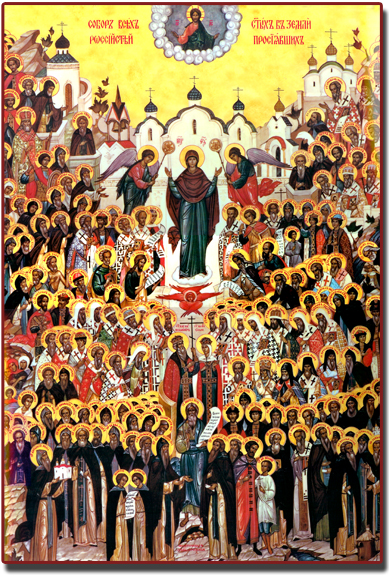
In the Book of Revelation, St. John witnesses a vast number of saints worshiping God in heaven. He beholds “a vision of a great multitude, which no one could count, from every nation, race, people, and tongue.” Note that this ‘countless multitude’ is different and much larger than the “144,000 marked from every tribe of the Israelites” that John observes several verses before. Jesus came to save people not only from the twelve tribes of Israel, but from the whole world. As the Lord declares through the Prophet Isaiah in our first reading, “I come to gather nations of every language; they shall come and see my glory.” Based on this, we can confidently say that a very large number will be saved.

On the other hand, in our gospel’s parallel passage from St. Matthew’s Gospel, Jesus says, “Enter through the narrow gate; for the gate is wide and the road broad that leads to destruction, and those who enter through it are many. How narrow the gate and constricted the road that leads to life. And those who find it are few.” The ‘few’ who enter the narrow gate to life sounds like less than the ‘many’ who do not. From this, it would seem that the number saved will be comparatively small.

However, the words “few” and “many” are relative terms which depend upon the context. For example, nearly 19,000 medals have been awarded in the modern Summer and Winter Olympic Games, and that is indeed many. But how many Olympic gold, silver, or bronze medalists have you personally met? If any at all, probably only a few. In a more tragic example, around 130,000 Americans die each year in accidents, and that’s awfully many. But at the same time, roughly 99.96% of Americans do not die in accidents each year, making the 0.04% who do relatively few. The word “many” sometimes refers to a majority of people, but not always.

Jesus suffered, died, and rose to redeem all of mankind. Even if there had been only one sinner on earth in all of human history, it seems that Jesus would have become man in order to offer himself to save him or her, me or you. Suppose that the number of human souls condemned to Hell on Judgment Day turns out to be only a dozen. Knowing how much our Lord loves each and every person, will not those lost twelve feel like many in the heart of Jesus and those saved billions feel like few? In any case, Jesus never tells us whether the majority of the human race will be saved or lost. Either outcome is possible.

Why isn’t Jesus more clear about exactly how many people will be saved? Because Jesus knows how such knowledge would be harmful for us. If we were told that most people will be saved in the end, we would fall into dangerous presumption. We’d say to ourselves, “I haven’t robbed any banks or murdered anybody; I sure I’m good enough.” And if we were told that most people will be lost in the end, we would fall into poisonous despair. We’d say to ourselves, “With my sins, what’s the use in me even trying?” St. John’s Gospel tells us that Jesus “did not need anyone to testify to him about human nature. He himself understood it well.” So, instead of giving us some precise statistic, some number or percentage about how many will be saved, Jesus gives us this much more beneficial advice: ‘Strive to enter through the narrow gate (for whether you are saved or not depends, in part, on you.)’

Almighty God “wills everyone to be saved and to come to knowledge of the truth,” in the words of St. Paul, but upon coming to know that truth, the Lord requires our personal response. He respects our freedom, and we are free to ignore him, to our own harm. As Jesus tells us, after the master of the house has arisen and locked the door, you may stand outside knocking and saying, “Lord, open the door for us.” He will say to you in reply, “I do not know where you are from.” (In other words, “You’re a stranger to me.”) And you will say, “We ate and drank in your company and you taught in our streets” (as happens at every Holy Mass.) Then he will say to you, “I do not know where you are from. Depart from me, all you evildoers!” In Matthew’s Gospel, Jesus declares, “Not everyone who says to me, ‘Lord, Lord,’ will enter the Kingdom of Heaven, but only the one who does the will of my Father in Heaven.

For adults like you and me, entering through Jesus’ narrow door requires more than merely wishing or have vague aspirations about going to Heaven someday. Striving to enter through the narrow gate entails sacrifices and discipline. As our second reading tells us, to those who are trained by it, discipline brings the peaceful fruit of righteousness. “So strengthen your drooping hands and your weak knees. Make straight paths for your feet.” Consider:

What sacrifice does Jesus ask of you?
What is Jesus asking you to remove from your life?
What is Jesus asking you to add to your life?
What sin does he want you to cease?
What gift does he want you to give?
Think about it. Pray about it.
Jesus has answers for you.

Let us intentionally cooperate with God and his grace. Let us accept the Lordship of Jesus Christ in our lives, so that we may be numbered among ‘the few‘ who are saved in the end.

“The Prince” or the Christ? — 18th Sunday of Ordinary Time—Year C

August 3, 2019

In the 6th century B.C., the Romans had a king named Tarquin the Proud who declared war on a city eleven miles east of Rome called Gabii. When the king was unable to take the city by force, he plotted to take it by deception. His son, Sextus, pretending to be ill-treated by his father and bearing fresh wounds from being flogged, fled to Gabii. The infatuated inhabitants entrusted him with the command of their troops, and when he had obtained the full confidence of the citizens, he sent a messenger to his father to learn what he should do next. The king, who was walking in his garden when the messenger arrived, spoke no words, but kept striking off the heads of the tallest poppy plants with his stick. His son understood the unspoken reply, and put to death or banished on false charges all the leading men of Gabii, after which he had no difficulty in compelling the city to submit to his father.

I was reminded of this story of political power and deceitful scheming this week while listening to Niccolò Machiavelli’s 16th century Italian book, “The Prince.” In this pragmatic, cynical treatise, Machiavelli discusses how a ruler can most effectively rule his realm. For example, upon conquering another king or noble’s territories, Machiavelli recommends exterminating that ruler’s family members to prevent future revolts. Machiavelli also encourages leaders to always appear merciful, faithful, humane, sincere, and religious to appear so but not always be so, because he holds that no ruler can be successful without, at times, deliberately doing evil as circumstances require.

Machiavelli provides numerous historical illustrations, like the story of an Italian ruler whose newly acquired territory was full of corruption, robbery, and violence. He appointed a cruel and efficient man as their governor, entrusting him with full authority to act. This governor quickly restored order with his iron fist, but then his lord had less use for him and saw him as a possible threat. Machiavelli writes that the ruler, “to clear himself [of guilt] in the minds of the people and make them entirely loyal to him, … desired to show that if any cruelty had been practiced it had not originated from him but came from the personal cruelty of the governor. Under this pretense [he arrested the governor] and one morning had him killed and left in [the city square] with the block and a bloody knife at his side. This terrible sight,” writes Machiavelli, “caused the people to be at the same time satisfied and worried.”

Listening to his stories, hearing his advice, I wondered what sort of person would ever want to be such a prince or ruler. Besides the iniquity, Machiavelli himself acknowledges that the prudent leader, when not fighting wars, should constantly focus on preparing for wars. But like King Solomon asks in our first reading, ‘what profit comes to [a ruler] from all the toil and anxiety of heart with which he has labored under the sun? Even at night his mind is not at rest. This is vanity.’ And furthermore, like Jesus says, ‘What does it profit a man to gain the whole world and lose his soul?’

Machiavelli’s advice and methods for maintaining power by any means might work in one sense here in this world, but in the long term all these things are futile. The rich fool says to himself, “Now as for you, you have so many good things stored up for many years, rest, eat, drink, be merry!” But God says to him, “You fool, this night your life will be demanded of you; and the things you have prepared, to whom will they belong?” Thus will it be for all who store up treasure for themselves but are not rich in what matters to God.

Jesus once asked, “What king marching into battle would not first sit down and decide whether with 10,000 troops he can successfully oppose another king advancing upon him with 20,000 troops? But if not, while he is still far away, he will send a delegation to ask for peace terms.” That’s simply basic strategy, yet how many people march towards the inevitable end of their lives — when they will approach the all-powerful King of kings and the Lord of hosts — without consideration of how ill-prepared they are to face him?

Who and what are we loving? And are we loving them as we should?

St. Paul is often quoted from his 1st Letter to Timothy as saying, “The love of money is the root of all evils, and some people in their desire for it have strayed from the faith and have pierced themselves with many pains.” But something about this passage never made sense to me. Does the root of all evil really reside in the love of money? For instance, does every act of adultery stem from a love of money? I don’t think so. But while studying Greek in seminary I discovered that this passage can be justifiably translated a different way: “The love of money is a root of all evils,” and that is very true.

Money, wealth, is a tool, like fire. It’s a neutral thing; good when used rightly but potentially destructive and deadly when mishandled. The love of money, that is to say greed, is rightly called “idolatry” by St. Paul in our second reading, because the greedy person serves and trusts in wealth as their god, their savior and source of blessings. While urging us never to worry, our Lord does call us work, to make material provision for ourselves and our households. St. Paul taught the Thessalonians that “if anyone was unwilling to work neither should that one eat.” And on another occasion he wrote, “whoever does not provide for relatives and especially family members [of his household] has denied the faith and is worse than an unbeliever.” Yet Jesus does not wish us to make work and wealth our idol: “Take care to guard against all greed, for though one may be rich, one’s life does not consist of possessions.”

One day, perhaps sooner than we imagine, our lives will be demanded of us and all the property and possessions we leave behind will be left to others. It is a good thing for us to have a will prepared for this foreseeable event, and I would ask you to remember St. Paul’s Parish and our endowment in your estate. But as praiseworthy as it is to prepare inheritances for that day, it is not as meritorious as giving during your lifetime. How much generosity is there in giving away what you cannot possibly take with you or keep? How generous is it to give away what is no longer of any use to you? Unavoidable giving is a small sacrifice and exercises small trust in God.

And so I recommend to you the practice of tithing, to the Church and to charities. Chose some percentage to tithe to the mission of Jesus Christ in our parish, for needs in our community, and to help people far beyond. In the Old Testament, God commanded his people to tithe 10% of everything, and they were much poorer than us. I urge you to prayerfully discern a number for yourself. Giving in this way practices trusting in the Lord and allows him to show you his providence and his power to provide. Though we do not believe in a “prosperity gospel” which claims believers will never experience trials, Jesus does promise a prize for our every given gift: “Give and gifts will be given to you; a good measure, packed together, shaken down, and overflowing, will be poured into your lap. For the measure with which you measure will in return be measured out to you. … And whoever gives only a cup of cold water to one of these little ones to drink because he is a disciple—amen, I say to you, he will surely not lose his reward.”

Our short life here on earth is an audition and a training ground for life in the Kingdom of Heaven. Through his gracious, saving work, Jesus Christ has extended an invitation to everyone to become a citizen of his Kingdom, now and in the age to come. Presently here on earth, his Kingdom, the City of God and her citizens, exist alongside and amidst the City of Man with its Machiavellian-minded members. But in the coming age, there will be no place for those sinners who live for themselves, and the virtuous meek who are generous to God and their neighbor shall inherit the earth. The choice before us all is for “The Prince” or for the Christ.

The Good Samaritan — 15th Sunday of Ordinary Time—Year C

July 14, 2019

Jesus’ Parable of the Good Samaritan is among his most famous and familiar. Yet, like Jesus Christ himself, it has still more to teach us. Today I will share contexts and symbolisms of this parable that you’ve probably never heard before.

Jesus’ story begins, “A man fell victim to robbers as he went down from Jerusalem to Jericho.” In Wisconsin, we talk about going up to Canada or going down to Madison; for us north is “up” and south is down. But in Israel, the city of Jericho lies fourteen miles east of Jerusalem. The man went down to Jericho because Jerusalem has a much higher elevation. Have you ever seen the Sears Tower (now called the Willis Tower) in Chicago? Picture its height from street-level to the top of its two antennas; now imagine stacking another Sears Tower standing on top of those antennas. From top to bottom, that’s how much a traveler descends when going from Jerusalem to Jericho.

Jerusalem was the Holy City, the place of God’s dwelling. But Jericho, as you may recall, was the city which Joshua at God’s command marched the Hebrews around in a circle for seven days, before blowing their horns and shouting, causing its walls to collapse. They conquered the city which symbolizes sin, human fallenness, and rebellion from God. Jericho, incidentally, is not far from the Dead Sea, the shore of which is the lowest dry land on the surface of the earth—the furthest you can be from heaven above.

The robbers stripped and beat the man and went off leaving him half-dead. A priest happened to be going down that road, but when he saw him, he passed by on the opposite side. In the same way, a Levite came to the place, and when he saw him, he passed by on the opposite side.” Who were these men? The Jewish priest would have offered sacrifices at the Temple while the Levite would have assisted there like a sacristan. Why did both men pass by ‘on the opposite side of the road’ as they walked in the direction of Jericho? Perhaps that they thought the motionless body on the shoulder of the road was already dead. Under the Law of Moses, touching a dead body made a person ritually unclean. Whether this was their reason, or they just did not care enough to be bothered, a third man comes along who is both willing and able to help.

A Samaritan traveler came upon him and was moved with compassion at the sight.” We know that Jews and Samaritans didn’t like each other, but why? Who were the Samaritans? Some five hundred years before the coming of Christ the Babylonians were the superpower of the ancient world. When the Jewish king decided he wasn’t going to pay tribute to Babylon anymore, the Babylonian king was not pleased. He sent his army, sieged Jerusalem, conquered it, and carried off the region’s inhabitants into what is called the Babylonian Exile. Not everyone was taken though; some of the poor laborers, the farmers and vine-dressers, were left behind. To ensure that this Jewish remnant did not rebel again, and to make sure the good land did not go idle, the Babylonians resettled the people of five pagan nations among them.

Seventy years after this catastrophe, after the Babylonians themselves were conquered by the Persian Empire, the king of Persia gave the Jews permission to return to their homeland. When they arrived they found that those who had been left behind had intermarried with the pagans and adopted some of their religious practices. The Jews looked down on these people, these Samaritans, as unfaithful to the Lord. It’s no mere coincidence that the Samaritan Woman at the Well with whom Jesus speaks in John’s Gospel has had five husbands—just like the five resettled pagan nations. This real woman symbolizes her people, with whom Jesus desires to be reconciled and whom he wants to save.

Jesus’ chosen hero for this parable, the Good Samaritan, “approached the victim, poured oil and wine over his wounds and bandaged them. Then he lifted him up on his own animal, took him to an inn and cared for him.” In today’s Gospel, Jesus tells the scholar of the law (and us) to be like “the one who treated him with mercy.” That’s a very important, famous, and familiar lesson, but there is symbolism within this parable which teaches even more.
The man who fell to the robbers represents our human race. Traveling from Jerusalem to Jericho, we were descending from the height of communion with God to the depths of sin. We fell to robbers, to evil spirits and wicked desire. They stripped us naked, depriving us of our previous glory. They beat us and left us half-dead; biologically we were still living, but spiritually we were dead. No one could or would help us. But then our Good Samaritan came – Jesus Christ.

He looked upon us and was moved with compassion. He approached us and poured His blood over us, like wine, to cleanse the wounds of sin. He poured the Holy Spirit on us, like oil, to strengthen us. He bandaged our members with his teachings; and though these disciplines bind us they are for the freedom of full health. He lifted us up on his beast of burden, his own flesh in the Passion, to bring us to the inn. This inn, where the robbers’ victim is cared for until he comes again, is the Church.

You and I are represented by the robbers’ victim brought into the inn for care. But you and I are also represented by the inn-keeper, for we are likewise called to care for others. The Good Samaritan provides two coins to the inn-keeper along with an instruction and a promise: “Take care of him. If you spend more than what I have given you, I shall repay you on my way back.” In the parable, these are two coins are Roman silver denarii, equal to two day’s wages. Jesus provides for our mission to serve him and our neighbor, for today and for tomorrow, and whatever we expend in time, talent, or treasure in his inn, the Church, will have his divine repayment.

In light of this great parable, ask Jesus to show you your neighbor, who he has entrusted to your care, then “Go and do likewise.” The command which he ‘enjoins on you today is not too mysterious and remote for you. …No, it is something very near to you, already in your mouths and in your hearts; you have only to carry it out.’ You shall love the Lord your God supremely, and love your neighbor as yourself.

A Parable on Pushing Boulders

January 24, 2018

Once upon a time, a Christian hermit lived in a cabin on a wooded mountainside, devoting himself to prayer. One morning, as he quieted himself and opened himself receptively to God, he sensed Jesus speaking to him – hearing him not with his ears but in his mind. The Lord said, “Go to that large boulder outside your house.” The man got up and went. Then the Lord said, “I want you to push this boulder for a half-hour every day.” The man obeyed, daily exerting his body in every manner against the smooth, massive stone, yet even after months of pushing the boulder remained completely unmoved.

The man asked himself, “Why am I failing? What am I doing wrong? The Gospels say that faith the size of a mustard seed can move mountains, but I can’t even budge this boulder an inch. Why does God demand this of me when he knows I can’t do it?” At this, the man became quite angry and (wisely) voiced his frustration, confusion, and hurt to the Lord.

The man heard Jesus reply, “Do you have reason to be angry? I told you to push the boulder, but I never asked you to move it. Look at your arms, look at your legs – by your faithfulness to me you have become strong. Now you are prepared for my next task for you. Though you thought you were failing, you were succeeding in fulfilling my will.”

“The Ten Virgins & Wedding Party Prudence” — 32nd Sunday of Ordinary Time—Year A

November 13, 2017

Learning about first century Jewish marriage customs helps us understand the Gospels better, including the Parable of The Wise and Foolish Virgins. In Jesus’ day, when a young man wished to marry a woman, he would journey from his father’s house to hers. He and her father would agree upon a dowry and once this dowry price was paid the marriage covenant was established. This event was called “betrothal” and the man and woman thereafter were considered husband and wife. The groom, however, would not then begin to live with his bride. He returned to his father’s house for twelve months, manifesting his respectful self-restraint and honorableness toward her. (Betrothal was the situation St. Matthew described: “When Mary… was betrothed to Joseph, but before they lived together, she was found with child through the Holy Spirit.” So Mary was never an unwed mother, but she knows the experience of having a crisis pregnancy.) During their year apart, the man and woman would prepare for their new life together. One of the groom’s most important tasks in this period was to prepare living accommodations for them at his father’s house.

Once their time of separation was over, the groom would return to his bride’s house with his groomsmen, usually at night with a torchlight procession. She would be expecting him but not know the exact hour of his arrival. That is why the groom’s second coming would be preceded by his messenger’s shout. Then the bride and her female attendants and the groom and his groomsmen would return to his Father’s house (their new home) for a wedding feast with their other gathered friends, family, and neighbors. There the husband and wife would consummate their marriage, and seven days of feasting and merriment would begin.

In the Gospels, Jesus is declared and calls himself “the bridegroom.” The New Testament names the Church his “bride.” The relationship between Christ and his Church parallels a Jewish marriage. For instance, in the Incarnation, God the Son left his Father’s house in Heaven to journey to our dwelling place on earth. Jesus paid our dowry price with his own blood. And after establishing his covenant, Jesus ascends to his Father’s house for a time until his second coming. This is why Jesus says at the Last Supper:

In my Father’s house there are many dwelling places. If there were not, would I have told you that I am going to prepare a place for you? And if I go and prepare a place for you, I will come back again and take you to myself, so that where I am you also may be.”

This Sunday’s second reading describes this return.  As St. Paul tells the Thessalonians, “The Lord himself, with a word of command, with the voice of an archangel and with the trumpet of God, will come down from heaven…” Notice how the Lord’s angelic messenger announces to the bride that her bridegroom is at hand. St. Paul continues, “And then the dead in Christ will rise first. Then we who are alive, who are left, will be caught up together with them in the clouds to meet the Lord in the air. Thus we shall always be with the Lord.”

In the Book of Revelation we see this nuptial union of Christ and his Church continues above. St. John hears Heaven sing:

Let us rejoice and be glad and give him glory. For the wedding day of the Lamb has come, his bride has made herself ready. She was allowed to wear a bright, clean linen garment.” (The linen represents the righteous deeds of the holy ones.) Then the angel said to me, ‘Write this: Blessed are those who have been called to the wedding feast of the Lamb.‘”

The virgin, young women in today’s parable are the bride’s attendants awaiting the bridegroom. Five are called wise and five are called foolish. The important distinction between them is not one of I.Q.—of being naturally intelligent or unintelligent—but in being thoughtful versus thoughtless. In the 1994 Best Picture Winning film, Forrest Gump is a man of below-average intelligence who, by his simple virtue, lives an admirable and remarkable life. A couple of times he’s asked, “Are you stupid or something?” and Forrest replies, “Stupid is as stupid does, sir.” I didn’t know what this meant when I was a kid, so I asked my dad. He explained that if you’re blessed with intelligence, but keep doing bad or foolish things, then you’re stupid. On the other hand, even if you’re not that bright but you make good and smart choices, then you are wise.

What is the meaning of the oil lamps that play such a significant role in Jesus’ story? The consensus of the Church Fathers is that they represent good works. Elsewhere in Matthew’s Gospel, Jesus likens lamps to good deeds:

No one lights a lamp and then put its under a bushel basket; it is set on a lampstand, where it gives light to all in the house. Just so, your light must shine before others, that they may see your good deeds and glorify your heavenly Father.

(But doesn’t Jesus warn us, just a few verses before in his Sermon on the Mount, “Take care not to perform righteous deeds in order that people may see them; otherwise, you will have no recompense from your heavenly Father”? What reconciles these two teachings The answer is in whose glory is being sought. If I pray, fast, and give alms for my own glory, then some people may think well of me for a little while until they forget, and I will have received my reward. But if I do good works for the glory of God, then he will be glorified and he will reward me and I will share in his glory.)

The two types of virgins in the parable represent two types of people awaiting Christ the bridegroom. All the virgins fall asleep. Likewise, all of us (unless Jesus comes again first) will experience the falling asleep of death. The virgins are roused from sleep. Likewise we will be roused from sleep in the Resurrection. All of the virgins have at least a little oil, some light. At the Judgment, I suspect everyone will have some good deeds to point to – even murderous dictators have loved their dogs. But is that love sufficient? Are those good deeds enough? For the thoughtless, foolish virgins, their little oil is not enough.

They say, “Give us some of your oil, for our lamps are going out.” But the wise ones reply, “No, for there may not be enough for us and you.” (Apparently, their oil and abundance is not something that can be shared or transferred between persons.) “Go instead to the merchants and buy some for yourselves.” That’s where the wise virgins would have bought their oil in preparation, but remember what time it is. The bridegroom’s arrival was announced at midnight. All the stores are closed. Where are the foolish virgins going to find a merchant to sell them oil? They won’t. It’s too late.

Who are these merchants that we must buy our oil from now, before it is too late? These merchants are your neighbors in their need. At the judgment of the world, the Lord Jesus will say the righteous, “Come, you who are blessed by my Father. Inherit the kingdom prepared for you from the foundation of the world. For I was hungry and you gave me food, I was thirsty and you gave me drink, a stranger and you welcomed me, naked & you clothed me, ill and you cared for me, in prison and you visited me.’ Then these righteous ones will wonder when this happened. And our king will say in reply, “Amen, I say to you, whatever you did for one of these least brothers of mine, you did for me.” And elsewhere, Jesus tells us, “Whoever gives only a cup of cold water to one of these little ones to drink because he is a disciple — amen, I say to you, he will surely not lose his reward.” Our neighbors, near and far, are the merchants from whom we obtain the oil of good works now for our lamps of glory later. We pay our neighbors with our time, our talents, and our treasure to purchase our good deeds.

This opportunity to do good on earth will not last forever. In Charles Dickens’ “A Christmas Carol,” old man Scrooge is visited by the ghost of his old business partner, Jacob Marley.

[Standing in his bed chamber, Scrooge] became sensible of confused noises in the air; incoherent sounds of lamentation and regret; wailings inexpressibly sorrowful and self-accusatory. The [ghost of Jacob Marley], after listening for a moment, joined in the mournful dirge; and floated out upon the bleak, dark night. Scrooge followed to the window: desperate in his curiosity. He looked out. The air was filled with phantoms, wandering hither and thither in restless haste, and moaning as they went. Every one of them wore chains like Marley’s Ghost; some few…were linked together; none were free. Many had been personally known to Scrooge in their lives. He had been quite familiar with one old ghost, in a white waistcoat, with a monstrous iron safe attached to its ankle, who cried piteously at being unable to assist a wretched woman with an infant, whom it saw below, upon a doorstep. The misery with them all was, clearly, that they sought to interfere, for good, in human matters, and had lost the power for ever.”

We know the souls in Heaven can help effect good on earth – that’s why we pray for their intercession. The souls in Purgatory may or may not be able to pray and intercede for us – that’s an open question in Catholic theology. The souls in Hell definitely do not help us, but both they and those in Purgatory regret and lament having failed to do more good on earth when they had their chance in life.

When the foolish virgins finally arrive late to the wedding feast they find the door is locked. They cry, “Lord, Lord, open the door for us!” But the bridegroom says in reply, “Amen, I say to you, I do not know you.” This echoes what Jesus teaches elsewhere:

Not everyone who says to me, ‘Lord, Lord,’ will enter the kingdom of heaven, but only the one who does the will of my Father in heaven. Many will say to me on that day, ‘Lord, Lord, did we not prophesy in your name? Did we not drive out demons in your name? Did we not do mighty deeds in your name?’ Then I will declare to them solemnly, ‘I never knew you. Depart from me, you evildoers.’”

Jesus is teaching us that we are not saved by faith alone, by the mere acknowledgment that he is “Lord, Lord.” Nor are we saved by the vast accumulation of good works, for one could even prophesy, drive out demons, or do mighty deeds without having a saving relationship with him. We are saved by Jesus’ love for us and our loving him in return; by both faith in him and good works in him.

So what was the foolish virgins’ great sin? Who hasn’t accidentally forgotten to pack something on occasion? It’s hard to imagine Jesus condemning people for a mere accident. I think the virgins’ oversight in this parable suggests a far more serious fault. These young women heard there was going to be a big party and that a lot of people were going. They jumped on the bandwagon but were just going along for the ride. They did not really know the bride or groom and didn’t really care about them. If they had loved the couple, they would have put more thought into being their good guests and true friends, they would have been more serious in their personal preparations, and that prudent diligence would have saved them from being locked out in the end.

I do not wish to unsettle you, but Jesus preached this parable to the crowds and ensured that it was included in Matthew’s Gospel because he wanted us to consider this question: am I loving the bridegroom and his bride, am I loving the Church and her Lord? Are you dedicating your time, talents, and treasure to God and your neighbor? Are you striving for the narrow path and the narrow door that Jesus tells us few attain? Or are you, like many, just going with the flow in comfortable complacency? Jesus’ final warning in today’s gospel is, “Stay awake, (be vigilant, be diligent,) for you know neither the day nor the hour.” The bridegroom and bride request the honor of your presence at their banquet. So let us wisely be diligent, doing good works in Christ, while this precious daylight remains.

Defending our Vineyard from our Enemy’s Servants

October 12, 2017

Today’s parable has a straight-forward interpretation: God is the landowner. He establishes his people Israel like a man who sets up a vineyard. God entrusted the care of his vineyard to the chief priests and elders of the people. They are the tenants. Then God sent his servants – the prophets – to obtain the good harvest. But the Jewish leaders resisted and persecuted the prophets; sometimes beating them, sometimes killing them, sometimes stoning them. Finally, God, in the crazy twist to our story, sends his own Son to them. The chief priests and the elders will go on to seize Jesus, condemn him, and see to it that he is taken outside the walls of Jerusalem and killed on a cross. “Therefore,” Jesus says to them, “the kingdom of God will be taken away from you and given to a people that will produce its fruit.” The authority of the Jewish leaders will be handed over to the Apostles and priests of Jesus’ New Covenant Church; a Church that will baptize and embrace Jews and Gentiles alike, forming a new people in Christ who will produce much fruit.

That is the straight-forward meaning of Jesus’ tale, but I would like to turn your attention back to those wicked tenants in the parable, because they, in a certain way, can serve as an example for us. Now I would not dare to suggest such a thing – I would fear it being scandalous to use the wicked as a Christian example – if Jesus himself had not once used a dishonest steward as someone we could learn from.

As you may recall, the dishonest steward, knowing that he would soon be losing his job, wrote off the debts of his boss’ debtors so that, once he got fired, these new friends of his would welcome him into their homes. Jesus used the shrewdness of this bad man as an example to teach his disciples to ‘make friends for yourselves with the wealth of this world, so that, when these passing things fail one day, you will be welcomed into eternal dwellings.’ Likewise, I believe we have something valuable to learn from the shrewdness of the vineyard’s wicked tenants in today’s parable.

What if, when the servants of the landowner had arrived at the vineyard, the tenants did not promptly beat them, kill them, or stone them? Imagine if the tenants, instead of turning them out, welcomed the servants’ arrival; giving them food to eat and somewhere to stay on the grounds. Now the wicked tenants’ prior plans to never deliver any of the harvest to the landowner would still be in place, but can you imagine what might happen to their resolve over time?

The good servants staying with the tenants would keep speaking with them so kindly and pleasantly and persuasively, encouraging them to do the right thing. The good servants would encourage the tenants to imagine their possible reward: “If you do what is just, our good master will be even more generous with you! If you will not give him the total amount, could you perhaps give him the least little bit? Surely that wouldn’t hurt and it wouldn’t cost you very much.” If allowed to stay, the servants may well convince the tenants to give up some or all of what they have. However, if the tenants wish to remain faithful to their original intentions, then when their enemy’s servants arrive they should be neither fed nor lodged, conversed with nor welcomed in any friendly manner, lest their persuasion change minds and hearts and plans.

There is a spiritual battle in our midst. You can hear about it on the news and see it in the headlines, hidden behind every divisive controversy and murderous atrocity. (For instance, if no demons played a role in the rise of ISIS, then the demons are not doing anything in our world these days.) But the spiritual battle in our midst is not only fought out there; it is fought within us.

How do temptations come into our minds? From our senses, what we see and hear; from our invisible spiritual enemies, the demons; from our own human brokenness; or any combination of these. However our temptations come, in whatever form they take, our response to them should be as unfriendly at their arrival as those wicked tenants were at the arrival of the landlord’s servants.

Do not welcome temptation when it arrives. Do not feed it. Do not give it a place to dwell and lodge within you. Do not converse with it. Do not fantasize at its suggestions. Do not compromise with it, not even a little. Do not allow it to change your mind, your heart, your plans. Do not befriend temptation, but violently turn it out as a servant of your enemy.

Now temptations may come in our direction even against will – sensations, sights, sounds, thoughts, feelings, memories – these can seem to pop up out of nowhere. Remember that an unwilled temptation, in and of itself, is not a sin. A saint is not someone who never experiences temptation. A saint is someone who chooses what is right and good and loving even amid temptation.

What should you do when temptation comes? First, pray. Pray now, and then again when temptation arrives. Prayer opens the door to Christ and lets him take the lead in our daily lives because he respects our freewill. Pray every day and call on the Lord in times of temptation. He is stronger than all the demons put together and mightier than your weaknesses.

A second helpful thing to do regarding temptation is to change your environment. Sometimes people in confession lament to me about always confessing the same sins. I try to encourage them by pointing out, “Well, thank goodness it’s not something totally different every time: ‘Father, last month I committed arson and this week I robbed a bank! I have no clue what I might do next!‘” Human beings, for better or worse, are creatures of habit, so we can learn a lot from our repeated failures. By changing your environment can do much to avoid temptation. For example, if you’re always gossiping with the same gathering of people, then perhaps avoid that group. If you are always unchaste using the same media, then block, limit, or cut out that technology. If you always get drunk at the same establishment, then stop going there. When you have traveled the same road many times you know well where that road leads. When you find yourself walking on that road, then stop and turn around or take another path. Changing your environment can lead you away from near occasions of sin.

A third and final thing to do amid temptation is to change your focus. The human mind is made to process ideas, to chew on thoughts; we cannot think about nothing. (If I were to tell you not to think about flying alligators, I bet you couldn’t do it for sixty seconds—you’d either be thinking about flying alligators or checking to see whether you’re thinking about them.) What should you think about instead when tempted? Whatever is true, honorable, just, pure, lovely, gracious, excellent, praiseworthy, think about those things, and you will persevere in doing what you have learned and received and heard and seen in Jesus Christ.

Some people only think of temptation as enticements to pleasurable things. But temptation can also be towards unpleasant things, like shame, despair, fear, and anxiety. The devil not only wants you to fall, but to stay down and not get back up. And if he cannot make you fall into sin, he wants you to be neutralized and paralyzed by fear and confusion. What is the antidote for such negative temptations? St. Paul offers this prescription for anxiety: “Brothers and sisters: Have no anxiety at all, but in everything, by prayer and petition, with thanksgiving, make your requests known to God. Then the peace of God that surpasses all understanding will guard your hearts and minds in Christ Jesus.” Let’s break that down.

Have no anxiety at all.” Concern is of good use. If you were not concerned about going to church you wouldn’t come. I were not concerned about my homily then I would have nothing to say. Concern is useful, but worry is worthless. Have no anxiety at all, “but in everything, by prayer and petition, with thanksgiving, make your requests known to God.” In everything, whether you are anxious or not, make your requests known to God; not because he doesn’t know, but because it opens you up to him and invites him to work. Pray prayers of praise for who he is, voice your petitions for what you need or want, and do so with thanksgiving – without which you feel impoverished and embittered despite your innumerable blessings. ‘Then the peace of God that surpasses all understanding

will guard your heart and mind in Christ Jesus.’ We do not have the big picture, long-term perspective of God to see how God will work all things for the good of those who love him, but by prayer comes a peace that surpasses our limited understanding. This peace will guard your mind and heart in Jesus Christ amid temptation.

God entrusted the Garden of Eden to Adam and Eve to tend and to protect. By the devil’s temptation, they lost their great treasure. Among the many treasures Jesus has given, he has entrusted to you the vineyard of your mind. Tend it and protect it. Do not fall to temptations but drive them out as your enemy’s servants. May your vineyard remain at peace and bear much fruit in Jesus Christ.

“The 4 Types of Soil & How to Improve Our Own” — 15th Sunday of Ordinary Time—Year A

July 17, 2017

On that day, Jesus went out of the house and sat down by the sea. Such large crowds gathered around him that he got into a boat and sat down, and the whole crowd stood along the shore. And he spoke to them at length in parables, saying: “A sower went out to sow. And as he sowed, some seed fell on the path, and birds came and ate it up. Some fell on rocky ground, where it had little soil. It sprang up at once because the soil was not deep, and when the sun rose it was scorched, and it withered for lack of roots. Some seed fell among thorns, and the thorns grew up and choked it. But some seed fell on rich soil, and produced fruit, a hundred or sixty or thirtyfold. Whoever has ears ought to hear.”

Despite all the changes and developments over these past two thousand years, the parables of Jesus Christ still hold up. Not only is the imagery in his parables still relatable today, but the lessons of his parables remain true. In today’s Gospel, Jesus tells a parable about a sower who sows across four different types of ground. The Gospel’s authors, namely St. Matthew and the Holy Spirit, go on to make the interpretation of this parable easy by including Jesus’ own explanation.

Jesus says, “The seed sown on the path is the one who hears the Word of the Kingdom without understanding it, and the evil one comes and steals away what was sown in his heart. The seed sown on rocky ground is the one who hears the Word and receives it at once with joy.  But he has no root and lasts only for a time. When some tribulation or persecution comes because of the Word, he immediately falls away.  The seed sown among thorns is the one who hears the Word, but then worldly anxiety and the lure of riches choke the Word and it bears no fruit.  But the seed sown on rich soil is the one who hears the Word and understands it, who indeed bears fruit and yields a hundred or sixty or thirtyfold.”

And so, what is sown by the sower, so generously and so far and wide, is “the Word of the Kingdom.” And the four kinds of ground it touches denote four types of would-be disciples. What is this “Word of the Kingdom?” Jesus gives no precise definition for it in these passages, but I think it can be taken in various senses, all of them true: It is the Good News about the Kingdom of God Jesus was preaching. It is God’s Word revealed in both Sacred Scripture and Sacred Tradition through Christ’s Catholic Church. And the Word of the Kingdom is the Word of God made flesh, Jesus Christ himself, the fullest revelation of God the Father. When people encounter God’s word in these forms, they have four kinds of reactions:

The first (the path) are those who hear without understanding. They, like the footpath, are hardened against the message. Perhaps they do not want to understand it. Some people ask hard questions about our Faith in order to understand—and that is very good, for whoever asks, receives and whoever seeks, finds. However, many people ask religious questions only in order to criticize, mock, and comfortably continue in their unbelief. If you are ever in a religious conversation with a friend, relative, or co-worker and you sense that they are this latter sort, I recommend calling them on this attitude. “Are you asking so that can understand, or so that you can have an excuse not to listen?” This is important, because until their hardened will opens there is no crack for the seed to enter in, and they are easy pickings for the evil one.

The second (the rocky ground) are those who hear the Word and initially receive it with joy. But since they have no deep root they last only for a time and wither away. Some of this rocky ground are those who were raised Catholic but never developed a mature relationship with Jesus Christ and his Church. Those who attempt to weather this adult world of ours with only, say, a grade-schooler’s knowledge and practice of the Faith, will likely fail in the heat of temptation and trial. If you and your family are going to remain Catholic Christians these days we cannot stay shallow.

The third (the thorny soil) are those who hear the Word, and it begins to grow in them, but it does not grow alone: worldly anxiety and the lure of riches choke the Word and it bears no fruit. As Jesus said, ‘no one can serve to masters at the same time.’ You cannot say “Yes” to Jesus and “Yes” to your fears or “Yes” to your selfishness A “Yes” to Jesus demands a liberating “No” to many lesser things. Until we do that, we will not be truly fruitful as Christ wills us to be.

Finally, the fourth (the rich soil) hears the Word and understands it, says “Yes” to it and indeed bears fruit, yielding a many-fold return. It is a blessing to itself and others and a great joy to the Sower.

Jesus’ four varieties of ground describe four types of people. I suspect that in the end one of these will describe the prevailing theme of our lives. And yet, we know that soil types can change. You you grew up on a farm, you probably remember your father sending you out into the field to pick stones. This wasn’t just make-work; your father did this to make the rocky soil more fruitful. If you’re a gardener, you know what happens if good soil is left untended—you’ll soon be pulling weeds. Soil can change; sinners can convert into saints, and the righteous can fall.

We can change the sort of soil we are over our lifetime, but to a lesser extent we can also change throughout the hours of our day. In the same day, I can be hardened against God’s will, superficial towards God and other people, or dominated by fear or selfishness, and then turn to bear fruit in Christ. But how can I change the kind of soil we are throughout our lives and throughout our days? You can’t do it alone, but God won’t do it without you. God is all-powerful, but he respects our human freedom. Not even the most important event in God’s plan since Creation, the incarnation of his Son within the Virgin, was to occur without her consent. But once Mary said, “Let it be done to me according to your will,” God began working great new things within her. Despite his omnipotence, God cannot force anyone to freely give him their “Yes.”

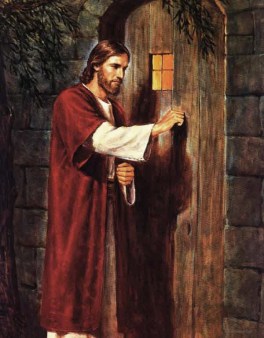
In the Book of Revelation, Jesus says, “Behold, I stand at the door and knock. If anyone hears my voice and opens the door, then I will enter his house and dine with him, and he with me.” You may have seen paintings of this, with Jesus knocking at a cottage door. Oftentimes, the door is depicted as having no outside door-handle. This is because the cottage represents your soul, and the door to your soul can only be opened from the inside. Daily prayer opens the door to Christ.

One of the best ways to prayerfully invite Jesus into your day is through the “Morning Offering.” There are various forms of this prayer, but they usually begin like this: “O Jesus, through the Immaculate Heart of Mary, I offer you my prayers, works, joys, and sufferings of this day for all the intentions of your Sacred Heart…” The exact words you use are not so important as the intention, the decision, the act of the will to offer yourself to Christ. If you don’t think that you’ll remember to do this first thing in the morning, then you can put your guardian angel on the job. Then, as soon as you open your eyes and see your bedroom ceiling, the thought of offering this prayer will occur to your mind. Daily prayer is key for growing in a life of holiness. You can do it anywhere, but visiting Our Lord at church, before his Eucharistic Presence in the tabernacle, is particularly powerful and precious to him.

Remember last week, when Jesus said, “Take my yoke upon you and learn from me, for I am meek and humble of heart“? Yokes are braces that go on an animals’ shoulders for pulling plows or wagons, and there are single-animal yokes, but I think Jesus has a double-yoke in mind. When there is an older, more experienced animal, it can be paired beside a younger, inexperienced one in order to train it and to bear the load together. And, when you look at a double-yoke from above, it forms a cross. What Jesus calls you to, you can’t do alone. He does not expect you to do it alone, but he’s waiting for your “Yes.” Give him your “Yes,” become good soil, and then watch him grow great things in you.

The Lazarus You Know — 26th Sunday of Ordinary Time—Year C

September 25, 2016

Sunday Readings

Lazarus at the Rich Man's Door

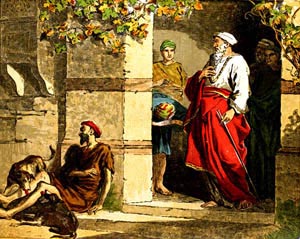
The Lord says though the prophet Amos, “Woe to the complacent,” to those warm and well-fed, comfortable on their couches without concern for others. Indeed, Scripture says, “whoever does not love a brother whom he has seen cannot love God whom he has not seen.” (1st John 4:20) You know of Jesus’ concern for the needy. Though he was rich, dwelling in the comfort of the Trinity, our Lord came to earth and became poor for your sake, so that by his poverty you might become rich. (2nd Corinthians 8:9) The rich man in Jesus’ parable could not have been unaware of the man lying at his door. Apparently, the rich man even knew his name: “Father Abraham…  Send Lazarus…” But the rich man came to deeply regret his indifference toward this neighbor.

You know a Lazarus as well. He’s not sleeping on your doorstep, but you probably know his name. He (or she) may be well-known to you or only an acquaintance. Maybe Lazarus goes to your church, or hasn’t come for years. Maybe Lazarus lives just down the street or in a nursing home far away. Your Lazarus is in great need, but probably not for food or shelter.

St. Teresa of Calcutta, who cared for many Lazaruses in India’s slums, said, “The spiritual poverty of the Western World is much greater than the physical poverty of our people.” The poorest of the poor are in our midst. Knowing this, I ask that you to earnestly pray to the Holy Spirit, that He may reveal your personal Lazarus to you, so that you may lovingly attend to that person as Jesus would have you do.

3 Interpretations of the Parable of the Dishonest Steward

September 17, 2016

Luke 16:1-13

The Parable of the Dishonest Steward, Biblia Ectypa, 1695.#1: The previously-dishonest steward is merely writing-off his own commissions. Likewise, we must forgive our debtors’ debts (or sins) so that we may be shown mercy. (Matthew 6:12) But why would his commissions be 20% for one debt and 50% on another? Perhaps the dishonest steward is actually covering his thievery’s tracks. Which brings us to…

#2: The steward is giving away what belongs to the rich man, his boss. Likewise, everything that we possess belongs to God, but we win favor though sharing these blessings with others. Both Mercy and Generosity win welcome into eternal dwellings, for Jesus says ‘whatever you do for the least of these you do it for me’ and ‘the measure with which you measure will be measured out to you.’

#3: What would have become of the dishonest steward without his decisive plan and action? Disaster. Likewise, we must be intentional about our own religious/spiritual growth. “The children of this world are more prudent in dealing with their own generation than are the children of light.” What excuse do we have? More importantly, what is our plan?

The Prodigal Us — 24th Sunday of Ordinary Time—Year C

September 11, 2016

Readings

It has been said that there are two kinds of people in this world: sinners who think they’re saints, and saints who know they’re sinners. Every saint has a past, and every sinner can have a future. We all have been the Prodigal (or wasteful) Son at various times in our lives. Whether for years, for days or hours, or just for moments, we have each strayed from and returned to our Father-God who delights to have us back. When we are being tempted to sin, we are being tempted to leave our Father’s house and no longer keep his company. In sinning we say, even if in a small way, “You may not be dead, but I want it to be as if you were. Give me an inheritance now. I can have an easier time, or a more enjoyable time, misusing your stuff than I can have by remaining with you.”

The Prodigal Son took his father’s things and went off to a distant country. The Kingdom of God and the Kingdom of this World are countries distant from each other, and yet they exist side-by-side. Sinners and saints live side-by-side together here below, but the difference between them is vast. A life of sin may be easier for awhile. The Prodigal Son enjoyed sensual pleasures and was free of his duties, like working in the fields with his older brother. But sin soon leaves us spent and depleted, as in drought and famine. If honest with ourselves, we sense our dire need.

At first, the Prodigal Son attempted his own coping-mechanisms short of repentance. He hired himself out to one of the local citizens who sent him to his farm to tend the pigs. (For Jews, tending ritually-unclean pigs would be one of the most degrading things a person could do.) The Prodigal Son longed to eat his fill of the pods on which the swine fed, but nobody gave him any. (His boss provided for the swine better than for him.) A sinner’s life is slavery. It’s unsatisfying, it’s unhappy, and they feel unloved. This does not excuse away the bad and harmful things they do, but hurting people hurt people. And knowing this, we can feel compassion for sinners.

The Return of the Prodigal Son by Rembrandt, St. Petersburg, 1662.Coming to his senses, realizing how much he has lost, the Prodigal Son decided to go back home. He knew his unworthiness, so he prepared a speech to persuade his father to show mercy. But his Father needs no persuasion. While his son was still a long way off, the father caught sight of him, and was filled with compassion. He ran to his son, embraced him and kissed him. I imagine the father saw him from a long way off because he often looked to that road hoping his son would return. This day, he did. The father ran to his son—even though in that culture a dignified men would not run. Men might walk or let others come to them, but this father ran to his son. Then the father restores his son, with robe, sandals and ring, and declares a feast.
The son had decided to leave and decided to return home. The decision to dwell in the Kingdom of God or the Kingdom of this world is our choice. We are free, to wander or return, because God’s offer of grace (including his invitation to the sacrament of reconciliation) is always there. Though we wander in sin, averting our eyes from God, we can never escape his sight. Psalm 139 says, “Where can I go from your Spirit? Where can I flee from your presence? If I ascend to the heavens, you are there; if I lie down in the underworld, there you are.” And when we turn back to him, he runs to us, as the same humility we saw in the Incarnation. And then the celebration begins. As Jesus says, “There will be more joy in heaven [and among the angels of God] over one sinner who repents than over ninety-nine righteous people who have no need of repentance.

As St. Paul declares in our second reading, “This saying is trustworthy and deserves full acceptance: Christ Jesus came into the world to save sinners.” Every saint has a past, and every sinner can have a future. In this Year of Mercy, let us each trust in God’s mercy, respond to his mercy, and practice mercy as Jesus would have us do.

How Many Will Be Saved?

August 19, 2016

In this Sunday’s gospel, someone asks Jesus from the crowd, “Lord, will only a few people be saved?” Jesus replies, “Strive to enter through the narrow gate, for many, I tell you, will attempt to enter but will not be strong enough.” (Luke 13:24) Instead of quoting some particular figure, like one million or ten billion souls, Jesus says, “Strive to enter through the narrow gate…” We are left to wonder: in the end, will the number saved be numerous or few?

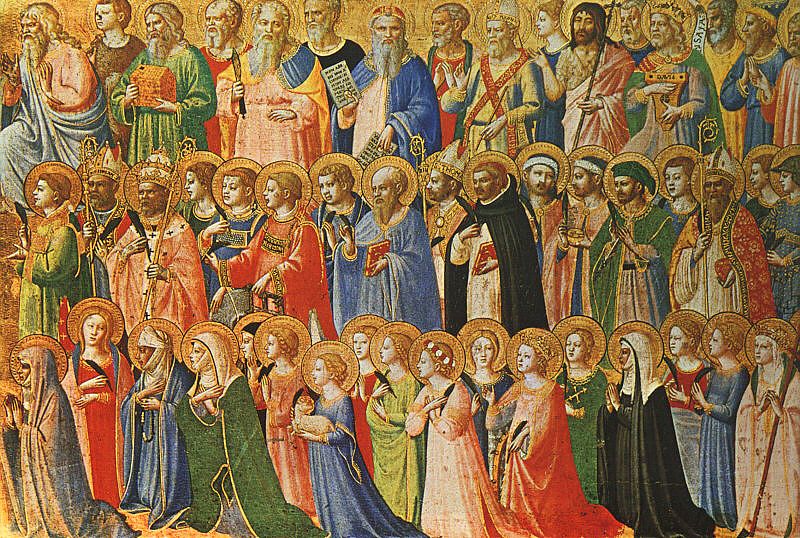
All-Saints by Fra Angelico, 1400's.In the Book of Revelation, St. John witnesses a vast number of saints worshiping God in heaven. He beholds “a vision of a great multitude, which no one could count, from every nation, race, people, and tongue.” (Revelation 7:9) Note that this ‘countless multitude’ is different and much larger than the “one hundred and forty-four thousand marked from every tribe of the Israelites” that St. John enumerates several verses before. Jesus came to save souls not only from the twelve tribes of Israel. As the Lord declares through the prophet in Sunday’s first reading, “I come to gather nations of every language; they shall come and see my glory.” (Isaiah 66:18) Based on this, we can confidently say that a great number will be saved.

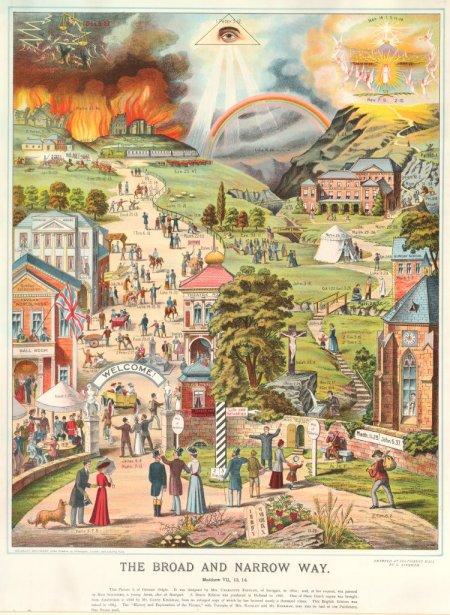
On the other hand, in our gospel’s parallel passage from St. Matthew, Jesus says, “Enter through the narrow gate; for the gate is wide and the road broad that leads to destruction, and those who enter through it are many. How narrow the gate and constricted the road that leads to life. And those who find it are few.” (Matthew 7:13-14) The ‘few’ who enter the narrow gate to life sounds smaller than the ‘many’ who do not. Based on this, it would seem that the number saved will be comparatively small.

However, “few” and “many” are relative terms which depend upon the context. For example, more than 18,000 Olympic medals have been awarded in the modern Summer and Winter Games and that is indeed many. But how many Olympic medalists have you personally ever met? Probably, at most, only a few. In a more tragic example, around 130,000 Americans die annually in accidents and that is awfully many. But at the same time, roughly 99.96% of Americans do not perish in accidents each year, making the 0.04% who do a relative few. The word “many” sometimes refers to a majority of people, but not always.

Jesus Christ suffered and died on the cross to redeem all mankind. Even if there were only one sinner on earth in all of human history, it seems that Jesus would have become man in order to offer himself for just him, or her, or you. Suppose that the number of human souls condemned on the last day turns out to be only a dozen. Knowing how much our Lord loves each and every person, will not those twelve feel like many in the heart of Jesus and those billions he saves seem too few? In any case, Jesus never reveals to us whether most human beings will be saved or lost. Either outcome is possible.

Why was Jesus not more clear about exactly how many people would be saved? Because he knew how such knowledge would be harmful for us. He knew that if we were told that most people would be saved in the end, it would lead us into dangerous presumption. If we were told that most people would be lost, he knew it would lead us into poisonous despair. Jesus “did not need anyone to testify about human nature. He himself understood it well.” (John 2:25)

Instead of providing us with some number or percentage, Jesus gives us some much more valuable and beneficial advice: “Strive to enter through the narrow gate (for whether you are saved or not depends, in part, upon you.)” God “wills everyone to be saved and to come to knowledge of the truth.” (1st Timothy 2:4) And to “as many as did accept him, [Jesus] gave power to become children of God.” (John 1:12) Let us strive to cooperate with God, let us accept the Lordship of Jesus Christ in our lives, so that we may be numbered among “the few” who are saved and enter into life.

The Braod and Narrow Way, 1883.

Be Rich In What Matters — 18th Sunday of Ordinary Time—Year C

July 30, 2016

The Parable of the Rich Fool by Rembrandt, 1627.

The Parable of the Rich Fool by Rembrandt, 1627.

A large crowd surrounds Jesus as he preaches and teaches. During a brief pause, a man in the crowd says to Jesus, “Teacher, tell my brother to share the inheritance with me!” Presumably, his brother is there amongst them as well (otherwise how could Jesus reprove him?) Yet the Lord replies to the man, “Friend, who appointed me as your judge and arbitrator?” That seems like an odd response from Jesus. Is Jesus denying his own authority?  On a different occasion, Jesus stated, “If I should judge, my judgment is valid, because I am not alone, but it is I and the Father who sent me.” Imagine if the man in the crowd had answered Jesus’ rhetorical question, “Friend, who appointed me as your judge and arbitrator?” The man might say, “Well Teacher, we think you’re God’s prophet, so you speak for God.”

To this, Jesus could reply, “Indeed, the words that I speak to you I do not speak on my own. But if you accept that I am God’s prophet, that I speak for God, then listen and heed all that I teach, not just the things you want to hear. On the last day, when I return in my glory with all the angels with me, I will sit upon my glorious throne with all peoples assembled before me and I shall judge and separate the righteous and the unrighteous, one from another, as a shepherd separates the sheep from the goats. Yet, my Father God did not send me into this world to condemn the world, but that the world might be saved through me.

In our Gospel, Jesus goes on to tell the crowd (including those two feuding brothers): “Take care to guard against all greed, for though one may be rich, one’s life does not consist of possessions.” Jesus is warning the crowd, the brothers, and us that ‘personal bitterness and earthly greed will hinder you from entering the Kingdom.’ Rather, we must keep a heavenly perspective. As St. Paul urges in our second reading, “seek what is above, where Christ is seated at the right hand of God. Think of what is above, not of what is on earth.

Of course, we all have material needs as human beings here on earth —we’re not angels and we need our daily bread. So Jesus teaches us to practice prudent stewardship, marked by frugality, generosity, and a trust in the Lord that frees us from worthless worrying. However, both Jesus in our Gospel and King Solomon in our first reading note the futility of amassing riches for ourselves.

Jesus tells a parable of “a rich man whose land produced a bountiful harvest. He asked himself, ‘What shall I do, for I do not have space to store my harvest?’” (Notice how “He asked himself, ‘What shall I do?” The man does not look beyond himself for holy wisdom or guidance.)

And [then the rich man] said, ‘This is what I shall do: I shall tear down my barns and build larger ones.” (Why does he need to tear down his old barns? Does not the rich man, who just reaped a bountiful harvest, own plenty of land on which to build more barns? It seems his vanity desires to tear down the old barns so that his new barns may be huge and impressive.)

The rich man continues his conversation with himself, “[In my new barns] I shall store all my grain and other goods and I shall say to myself, ‘Now as for you, you have so many good things stored up for many years, rest, eat, drink, be merry!’” (He shows no thought for his family or friends, his neighbors or the needy, only his own personal pleasure.)

The rich man has made grand plans for himself, but God says to him, “You fool, this night your life will be demanded of you!” If this man is only interested in his own will, his own glory, and his own happiness in this life, then how will he love his neighbors, hallow God’s name, or desire God’s will in the next life?

To find ourselves at home in Heaven someday we should seek and follow God’s will for our time, talents, and treasure today. We should practice faithful stewardship, with prudence and trust, frugality and generosity. And this stewardship should include tithing and supporting worthy causes—not to buy Heaven (for God cannot be bribed or bought) but in order to become more virtuous and loving, to become more fit for Heaven. Those who store up treasure for themselves on earth profit nothing in the end. Let us not be foolish. Let us instead become rich in what matters to God by becoming more like Jesus, who has been so generous to us.

History’s Ten Wealthiest People and the Vanity of Riches

July 27, 2016

In estimated billions of present-day dollars

  1. Cornelius Vanderbilt ($185, died 1877)
    This railroad tycoon’s only large philanthropic gift gave about 1% of his fortune to build Vanderbilt University.
  1. Henry Ford ($199, died 1947)
    This deceased automaker’s name survives on vehicles seen upon every road and junkyard.
  1. Muammar Gaddafi ($200, died 2011)
    This dictator of Libya, after being discovered hiding in a desert culvert, was killed by his people.
  1. Jakob Fugger “the Rich ($221, died 1525)
    While he lived, this German merchant-financier declared, “The king reigns, but the bank rules!
  1. William The Conqueror ($229, died 1087)
    After killing many to capture England, this Duke of Normandy, France joined the dead.
  1. Mir Osman Ali Khan ($230, died 1967)
    As head of the state of Hyderabad, India, he used a 185-carat diamond as a paperweight.
  1. Czar Nikolas II ($300, died 1918)
    This Russian ruler was assassinated along with his family by communist revolutionaries.
  1. Andrew Carnegie ($310, died 1919)
    This steel magnate and philanthropist said, “The man who dies rich dies disgraced.”
  1. John D. Rockefeller ($340, died 1937)
    He sold oil drawn from Ohio’s earth and now lays buried in the same.
  1. Mansa Musa I ($400, died 1337)
    This African king of Mali was the richest man to ever live. But have you ever heard of him?

Psalm 49:7-12 :

“No man can buy his own ransom, or pay a price to God for his life. The ransom of his soul is beyond him. He cannot buy life without end, nor avoid coming to the grave. He knows that wise men and fools must both perish and must leave their wealth to others. Their graves are their homes for ever, their dwelling place from age to age, though their names spread wide through the land. In his riches, man lacks wisdom; he is like the beasts that are destroyed.”