Archive for the ‘Parables’ Category

The Other Son — 4th Sunday of Lent—Year C

March 11, 2013

In today’s Gospel, Jesus tells one of his most famous parables. Usually, people focus on the younger son who ran away and on the loving father who forgives him when he returns. Jesus uses this father and son to teach us an important lesson. Even though we are like that selfish, ungrateful, and sinful younger brother sometimes, our Father never stops longing to embrace us. No one should ever say, “God could never forgive me after all the bad things I’ve done.” God’s merciful forgiveness always awaits us if we are willing to return to him.

This is an important lesson, but we should not overlook the brother who felt overlooked. We can learn something important through the older brother’s experience, too. While the younger son ran away, the older son loyally remained with their father. While the younger brother was having sinful fun with prostitutes at night, the older brother was working long days in the fields together with the slaves. While the younger son became unhappy in the distant country, the older son was unhappy at home.

We see the discontent of the older son when he says to his father, “Look, all these years I served you and not once did I disobey your orders; yet you never gave me even a young goat to feast on with my friends!” The older son doubts that his father really loves him. The older brother is close to the father physically but far away emotionally. Does his father love him? Of course! The father would have been happy to throw him a party, but his son never asks. The older son squnders his opportunity. He never receives because he never asks and so becomes bitter toward his father.

We can be like this older brother sometimes. We do our dutiful work for God and never ask for anything because we think it is better to never ask for anything. But, this can lead to bitter feelings toward God. God our Father wants to bless his children with good things so that our joy, faith, and love will increase. We should not be afraid to ask him. As Jesus says, “Ask, and you will receive.” Learn a lesson from the older brother who never asked for anything. Ask for good things from God because he is your loving and merciful Father.

En el evangelio de hoy, Jesús le dice uno de sus parábolas más famosas. Por lo general, la gente se centra en el hijo menor que se fue y en el padre amoroso que lo perdona. Jesús usa este padre e hijo para enseñarnos una lección importante. Somos como el hermano menor a veces (egoístas, ingratos y pecadores) pero nuestro Padre siempre anhela para abrazarnos. Nadie debe decir: “Dios nunca podría perdonarme después de todas las cosas malas que he hecho.” El perdón misericordioso de Dios siempre nos espera, si estamos dispuestos a volver con él.

Esta es una lección importante, pero no debemos pasar por alto el hermano que sentía por alto. También podemos aprender algo importante a través de la experiencia del hermano mayor. Mientras que el hijo menor se fue lejos, el hijo mayor lealmente se mantuvo con su padre. Mientras que el hermano menor pecaminosamente se divirtieron con prostitutas por la noche, el hermano mayor estaba trabajando largos días en los campos junto con los sirvientes. Mientras que el hijo menor se convirtió en descontento en el país lejano, el hijo mayor estaba infeliz en la casa de su padre.

Vemos el descontento del hijo mayor cuando dice a su padre: “¡Hace tanto tiempo que te sirvo, sin desobedecer jamás una orden tuya, y tú no me has dado nunca ni un cabrito para comérmelo con mis amigos!” El hijo mayor duda de su padre realmente lo ama. El hijo mayor está cerca del padre físicamente, sino emocionalmente lejos.  ¿El padre lo ama? ¡Por supuesto!  El padre habría estado muy contento de darle una fiesta, pero su hijo nunca pregunta.  El hijo mayor no recibe nunca, porque el hijo nunca se pregunta, y así se convierte en resentimiento hacia su padre.

Podemos ser como el hermano mayor a veces. Hacemos nuestro trabajo obediente a Dios y nunca pedir nada porque pensamos que es mejor no pedir nada. Sin embargo, esto puede conducir a sentimientos de amargura hacia Dios. Dios, nuestro Padre quiere bendecir a sus hijos con cosas buenas para que nuestra alegría, nuestra fe y nuestro toda amor se incrementará.  No debemos tener miedo de preguntarle.  Como dice Jesús: “Pedid, y se os dará”.  Aprende una lección del hermano mayor que nunca pidió nada.  Pregunte por las cosas buenas de Dios porque él es tu Padre amoroso y misericordioso.

Parables About Jesus — Monday, 17th Sunday in Ordinary Time—Year A

July 26, 2011

Jesus speaks of Kingdom of God (or the Kingdom of Heaven) more times in the Gospel than perhaps anything else. But what is this kingdom? The Kingdom dwells among us when God’s will is done on earth as it is in Heaven. The Kingdom reigns wherever the will of God is known and followed. His Kingdom is not equally present at all times and everywhere, which is why we pray for the kingdom to fully come, yet it can be present within a good community, in a loving family, or within a Christian’s soul.

Jesus leads us into the Kingdom of God. He teaches us how to live as kingdom people. There’s an interesting twist contained in Jesus’ teachings: whenever He speaks about the kingdom of God, He is usually teaching us something true about Himself. This is so, because Jesus is the kingdom incarnate. Wherever Jesus is, you find the Kingdom, and wherever the Kingdom is, Jesus is there.

Because of this close identification between Jesus and the Kingdom, we can substitute between these terms and reread Scripture with new eyes. For example, “In those days John the Baptist appeared, preaching in the desert of Judea saying, ‘Repent, for (Jesus Christ) is at hand!’” The beatitude becomes: “Blessed are the poor in spirit, for theirs is (Jesus Christ).” One time, when Jesus sees how his disciples are shooing the little children away, He becomes indignant and says to them, “Let the children come to me; do not prevent them, for (I) belong to such as these.” And we hear it said, “Seek ye first (Jesus Christ) and his righteousness, and all these things will be given you besides.” When applied to today’s Gospel, Jesus three parables become revelatory of Jesus Himself.

Jesus is like a treasure buried in a field. This means that Jesus must be found. In the movie Forrest Gump, a down-in-the-dumps Lt. Dan Taylor asks Forrest derisively, “Have you found Jesus, Gump?” Forrest replies, “I didn’t know I was supposed to be looking for Him, Sir.” If I ask you if you’ve found Jesus you might feel like a bit Forrest; you’re baptized, you’re here at church, how could you still need to find him?

Well, think of it this way: do you have a joy and excitement in your relationship with Christ anything like a man who finds a hidden treasure? Does you life feel rich and full of opportunity because you know Him? If not, then you have not yet found Him like He wants you too. We need to seek after Him in prayer and learning. Encounter Him in the Gospels, especially if you never have before. (Do you want to reach the end of your days without ever having read the Gospels?) Jesus is a rich treasure whom we must seek out and discover.

The second parable: Jesus is like a merchant searching for fine pearls. (Notice that Jesus was first the treasure, now He’s the searcher.) This means that Jesus searches after us. We should not despair. He pursues more passionately than a man searching a profit. Jesus seeks us as a man in love. A pearl may get dirty and think it is no longer desirable, but Jesus has the solution for cleansing pearls. He emptied Himself of glory to become man for us, and then he gave everything He had to die as a man for us. Do not forget that if we were the only sinner on earth He would have still come for you. Never despair. Jesus will always pursue you like a man in love.

In the third and final parable, Jesus is like a net thrown into the sea, which collects fish of every kind. This means that Jesus confronts us all. As Simenon foretold of The baby Jesus when Mary and Joseph brought Hi to the temple, “Behold, this child is destined for the fall and rise of many in Israel, and to be a sign that will be contradicted so that the thoughts of many hearts may be revealed.” The truth of Jesus Christ confronts all people, even if they’ve never heard the name of Jesus. But we have heard His name, and we must not put off responding to Him forever.

Jesus is the treasure we must seek. We must not despair, for Jesus relentlessly seeks after us. Jesus is the net who confronts us all, so we must not put Him off forever.

Enduring Despite Scandal — 16th Sunday in Ordinary Time—Year A

July 17, 2011

I know of a man who was called and chosen to lead, to preach, and to be a minister on behalf of Christ. Good and powerful things were done through his ministry and he was respected by many Christians. However, despite outward appearances, this man was a sinner (a great sinner,) and when his sins became known he brought great scandal to the Church. It was revealed that he had repeated stolen from funds collected for the poor. It also became known that he had betrayed Christ, his people, and his vocation in a vastly more terrible way. So terribly, in fact, that Jesus said, “It would be better for that man if he had never been born.”  (Better for him if he had never lived life outside his mother’s womb.) This man, who preached the gospel, who worked mighty deeds, who drew crowds to Jesus Christ, was the Apostle Judas Iscariot.

Could you imagine being one of those Christians who had been evangelized by the Apostle Judas? What if he had preached the gospel and ministered in your hometown? Imagine how your faith might be shaken by his sins. How tragic it would be if any Christians had parted ways with Jesus Christ, the apostles and the Church because of the scandal of this one man.

Though the one, apostolic, and Catholic Church is holy, she does contain sinners. Jesus said that there would be weeds that grow alongside the wheat. It has always been this way, and so it shall be, until the separating harvest at the end of the age. There have been terrible sinners among the Church’s popes and priests, her lay men and women; children of the evil one. Yet, these sinners, should not make us forget about the Church’s many canonized and uncanonized saints, the children of the kingdom, through whom far greater good has been done.

Like the mustard seed Jesus described, His Catholic Church, which began as a speck in history, has grown into the largest of plants, a peaceful dwelling place which brings together all peoples. And like the yeast in the dough that Jesus spoke of, the works and teachings of His Catholic Church have raised up the whole world for the better. For instance, the Catholic Church is the largest charitable organization in the world and she has been the defender of universal human dignity through the centuries. The modern world accepts the concept of universal human rights as a given because the Catholic Church first championed human dignity by her teachings and deeds. Despite the sins of some of its members, let no one say that the Catholic Church has not been a source and a force for good in the world.

We see that Jesus foreknew what Judas was freely going to do. Jesus said, “Did I not choose you twelve? Yet is not one of you a devil?” “Amen, I say to you, one of you will betray me.” (He said this in reference to Judas.) Why did Jesus, who knew all the while what Judas would freely do, permit him to remain in their company? One could rightly say it was because the Father had ordained it so, or that it was necessary to fulfill Old Testament prophesies, or so that the Son of Man and Savior of mankind would experience the human suffering of betrayal by someone who knew Him well and should have loved Him. Perhaps there are one thousand true reasons for it in God’s providential plan, but I am convinced that one of these reasons is this: So that in the future, whenever one of Jesus’ own betrayed Christ’s Church, be they a member of the clergy or laity, it would not destroy our faith in Christ.      Ultimately, the only person our Catholic faith depends upon is Him, and Jesus will never let us down.

For those who have been alienated from the Faith because of scandals, let us pray whatever the offense, that no Judas shall keep them away from Jesus Christ and His Church.

Sodium Chloride Reaction — 5th Sunday in Ordinary Time—Year A

February 8, 2011

Let me tell you two stories about chemicals that produced quite a reaction in me. In summers when I was a kid, I liked to go to the Osseo city pool. They had there a brown door with red letters warning something to the effect of: “Danger, Deadly Chlorine Gas, Staff Only!” I needed no further persuading. Years later, my high school science teacher put a bucket in the snow, and in the bucket he put some water, and in the water he put in a chunk of pure sodium, using tongs. The water steamed and bubbled and exploded a couple of time. It was awesome, but also rather threatening.

What do you get if you put these two dangerous elements together? You get sodium chloride. I warn you that this compound is now found in our environment and in our homes. The oceans are full of it. It’s on our city streets. It’s even in the food we eat and feed to our children. Sodium chloride sounds rather threatening, but you know this benign compound by another name: Salt.

Like salt, Christianity is pervasive, it’s everywhere. Like salt, people can fear and oppose Christianity, thinking it’s harmful for people and bad for our world. But in truth, Christianity, like salt, is necessary for life. Christians, to the extent that they are truly Christians, are the salt of the earth.

The world’s irrational fear and opposition to our faith is nothing new. Listen to this anonymous letter written to a man named Diognetus that dates from the second century. Listen for how Christians resemble the salt of the world, ubiquitous, helpful and good, and feared and opposed:

“Christians are indistinguishable from other men either by nationality, language or customs. They do not inhabit separate cities of their own, or speak a strange dialect, or follow some outlandish way of life. … With regard to dress, food and manner of life in general, they follow the customs of whatever city they happen to be living in, whether it is Greek or foreign. And yet there is something extraordinary about their lives. They live in their own countries as though they were only passing through. They play their full role as citizens, but labor under all the disabilities of aliens. Any country can be their homeland, but for them their homeland, wherever it may be, is a foreign country. Like others, they marry and have children, but they do not expose them. They share their meals, but not their wives.  They live in the flesh, but they are not governed by the desires of the flesh.

They pass their days upon earth, but they are citizens of heaven. Obedient to the laws, they yet live on a level that transcends the law. Christians love all men, but all men persecute them. Condemned because they are not understood, they are put to death, but raised to life again. They live in poverty, but enrich many; they are totally destitute, but possess an abundance of everything. They suffer dishonor, but that is their glory. They are defamed, but vindicated. A blessing is their answer to abuse, deference their response to insult. For the good they do they receive the punishment of malefactors, but even then they, rejoice, as though receiving the gift of life. They are attacked by the Jews as aliens, they are persecuted by the Greeks, yet no one can explain the reason for this hatred.

Why does the world oppose devout Christianity, now as then? One reason is that the Christian dedicates himself exclusively to Jesus Christ, in a way that worldly people think is disproportionate and dangerous. They imagine the believing Christian behaves like sodium in water, hot with intolerance and hatred, violent in their reactions. In fact, a Christian’s total commitment to Jesus Christ is what leads Him to have mercy for all and extend love toward all. Who is more responsible for ‘sharing bread with the hungry, sheltering the oppressed and the homeless, and clothing the naked’ in history of the world than Christians in general and the Catholic Church in particular?

Another reason why the world hates Christianity is that worldly people think it lethal to the joys of life. Like inhaling chlorine gas, they fear that Christianity stands to afixiate their happiness. This too is nothing new. In Roman times Christians were charged with “hatred of humanity” for it was thought, “whoever loves man will love what man loves.” As the writer to Diognetus observed in the second century, “The world hates the Christians, not because they have done it any wrong, but because [Chritians] are opposed to its enjoyments.” It is still so today. It is as Jesus said: He calls us the light of the world, and elsewhere notes, “Everyone who does wicked things hates the light and does not come toward the light, so that his works might not be exposed.” We tell the world that some things that it loves are false roads to happiness, and it hates us for it.

So what are we to do? First, realize that the modern world’s hostility to Christianity is nothing new. Don’t wait for the world’s hostility to pass, it won’t. And don’t think your faith is a shameful thing, it’s not. Instead, do as Jesus teaches, “your light must shine before others, that they may see your good deeds and glorify your heavenly Father.” If you are a Christian, people who know you should see something different in you and ask, “What’s your secret.” And when they do you should say, “It’s because of my relationship to Jesus Christ and His Church.” Pray for this grace. Pray that you may be a witness to Christ in both your words and deeds. Then, as the psalmist said, you will be “a light in darkness” and you will help to save many souls in the world.

5 Things / 5 Cosas — 5th Sunday in Ordinary Time—Year A

February 5, 2011

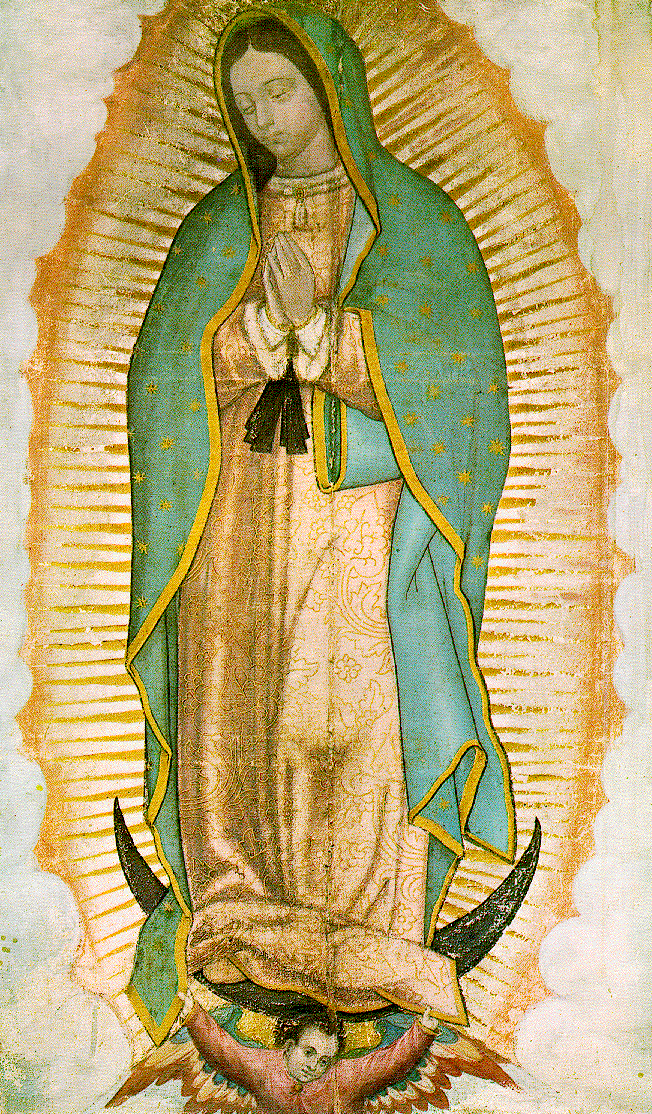
The Blessed Virgin Mary, our Lady of Guadalupe, comes to Saint Juan Diego dressed in the sun. She is clothed in light. Her light comes from God. In 1531, she does simple things. She says few words. She asks for one thing. She gives one gift. And as a few, small grains of salt can flavor a meal for many, Mary’s few, simple actions transformed a people, a culture, and a land forever.

You are called to be the light of the world, but remember that the light never begins you—the light only comes from Christ and shines through you. How can you be clothed in the sun of His grace? You need to pray every day, you need to receive the sacraments frequently, you need to fight against sin, you need holy community, and one of these friends must be Jesus.

By the light of Christ, you may be led to ‘share your bread with the hungry, open your house to the homeless, and clothe the naked’ in new ways. However, Jesus does not want you to do one thousand more things, He wants you to do the one thousand simple things that comprise your life differently, with peace and power. ‘The just man shines like a light in the darkness, and firm and without fear in his heart.’

With Jesus, you can become the best possible you. The best possible you is who you desire to be. This best possible you may still do few and small things, but the effect of these deeds will be powerful around you, as the salt of the earth transforms a bland meal.

Prayer, sacraments, conversion, community, intimacy with Christ. The light of Jesus comes through these. In which of these do you most need to grow? What are you going to do about it? Jesus and Mary await your reply.

La Virgen María, nuestra Señora de Guadalupe, llega a San Juan Diego, vestido con el sol. Ella está revestida en luz. Su luz viene de Dios. En 1531, ella hace cosas sencillas. Ella dice algunas palabras. Ella pide por una cosa. Ella da un regalo. Y como pocos, pequeños granos de sal pueden sabor a una comida para muchos, las acciones pocos y simples de María transformen un pueblo, una cultura y una tierra para siempre.

Usted está llamado a ser la luz del mundo, Pero, recuerde que la luz nunca empieza desde usted: la luz sólo viene de Cristo y brilla a través de usted. ¿Cómo puede usted ser revestido en el sol de la gracia de Christo? Es necesario orar cada día, es necesario recibir los sacramentos con frecuencia, es necesario luchar contra el pecado, es necesario formar parte de una comunidad santa, y uno de sus grandes amigos debe ser Jesús.

Por la luz de Cristo, es posible compartir su pan con el hambriento, abrir su casa al pobre sin techo, y vistir al desnudo de otra manera. Sin embargo, Jesús no quiere que haga mil cosas más, él quiere que haga las mil cosas simples que hace todos los dias pero de una manera diferente, con paz y poder. ‘La persona justo brilla como una luz en las tinieblas, y firme está y sin temor en su corazón.’

Con Jesús, usted puede convertirse en alguien mejor. Usted quiere ser major persona y eso es lo que Jesús tambien desea. Siendo una major persona usted puede todavía hacer pequeñas cosas, pero el efecto de estos hechos serán poderosos alrededor suyo, como la sal de la tierra transforma una comida ordinaria.

Oración, sacramentos, conversión, comunidad, y intimidad con Cristo. La luz de Jesús viene a través de estos. ¿En cuál de estos necesita mejorar al máximo? ¿Qué hará usted acerca de él? Jesús y María esperan su respuesta.

Fear of Death — Friday, 3rd Week of Ordinary Time—Year I

January 28, 2011

God permits us to feel a natural aversion to death. This is healthy and for our good. (Imagine what the world would be like if everyone were completely indifferent as to whether they lived or died.) However, for faithful Christians, there is no reason to be terrorized by a fear of death.

If you remain close to the sacraments and rooted in daily prayer you have no reason to be afraid. Maybe you feel ill-prepared to die, but like the seed that grows without the farmer understanding how, God is preparing you for the unending life of Heaven in ways you don’t even perceive. Like the mustard seed, we may go into the ground as seemingly small and weak human beings, but we will rise with a greatness and power that even delights and blesses the angels of Heaven.

A natural aversion to death is healthy, but for Christians a fear of death is out of place. For, as the Letter to the Hebrews says, “We are not among those who draw back and perish, but among those who have faith and will possess life.”

Lamps, Baskets & Beds — Thursday, 3rd Week of Ordinary Time—Year I

January 27, 2011

“Is a lamp brought in to be placed under a bushel basket or under a bed, and not to be placed on a lampstand?”

How many bushels can a bushel basket hold when the bushel basket is covering a lamp? Zero. A basket used like this is totally unproductive for bringing in a harvest.

How would you feel about sleeping in a bed with an open flame beneath it? You probably wouldn’t get much peaceful rest.

You are the lamp and your light is from Christ. Having been brought into the house, the Church, your light should shine for the benefit of others. As the Letter to the Hebrews says, “We must consider how to rouse one another to love and good works. We should … encourage one another.”

How do you help others to produce good works? How do you help others to be at peace? What else could you do to help those around you to become more productive and more peaceful with Christ?

Two Becoming One — The Ann and Larry Feltes Wedding

January 12, 2011


Has the institution of marriage now passed its time? More and more people are not getting married at all. Has the time for marriage passed? Is marriage good for nothing but to be thrown out and trampled under foot? No. Marriage is not old-fashioned, it is from the beginning. Marriage is not customary, it is foundational. Marriage, the sacrament of marriage, is needed today more than ever. The world looks around and wonders… “Can promises really be kept for life? Is self-less love really sustainable?” Yes. By the power of this sacrament, which Larry and Ann will henceforth be able to call upon whenever they have need.

What is the source of this sacrament’s power? Jesus, on the night before He gave His life for us, took bread and wine and said, ‘This is my body and blood, this is my very self. I give myself to you, lay myself down for you, and offer you a covenant. I love you, I want to bless you, and I want us to be one.’ Finally, He said, “Do this in memory of me.” This is what husbands and wives do in the sacrament of marriage.

Sacraments make present the realities they signify. The sacrament of marriage is not merely like the love shared between Christ and His Church, the sacrament really makes this mystery present. In your marriage, you can draw upon the love of Christ for His bride and upon the love of the saints for the Bridegroom. Stay close to the Eucharist, continue to pray together every day (as you do now,) and you will embody this mystery clearly for all to see.

On this day, it is natural for us to think of Jim and Mary; and it is right that we do so, for no one puts bushel baskets over shinning lamps. Mary and Jim are irreplaceable, and we would not try to replace them. Today, Ann and Larry enter this sacrament so that they may continue to enjoy and be blessed by the great goods contained in marriage. There may be challenges in melding two families together, but God’s grace will level any bumps on the path, and help the two become one. Every year, Ann writes a Christmas letter to her grandchildren. This Christmas she told them that this year would be special because they would be getting “a bonus grandpa.” Today I feel that I am receiving a “bonus aunt.”

When I asked Ann what she liked about Larry she said, “He’s a good man.” Later, when I asked Larry what he liked about Ann he said (and I paraphrase,) “In summary, in preponderance of all the evidence, and in conclusion… she’s a good woman.” Larry and Ann, because your marriage will be built on this powerful sacrament, with a shared mission (focused on God, family and the work of love,) I trust that people will see your good marriage, and glorify our heavenly Father, for many happy years to come.

Prayer is Necessary — 29th Sunday in Ordinary Time—Year C

October 17, 2010

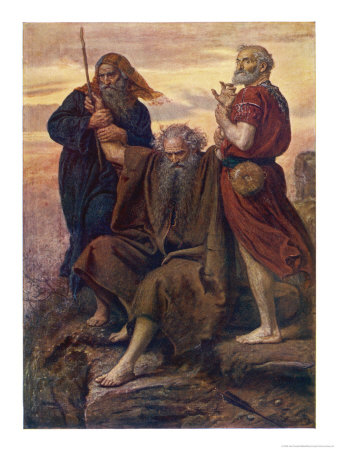
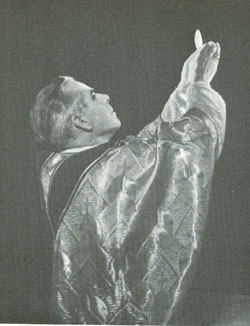
As the Hebrews fought the Amalekites, Moses held up in his hands, above his head, the wooden staff of God. In doing this, He resembles Jesus, who outstretched his arms on the cross, and the priests of Christ’s Church, who raise their hands up to Heaven.  Each one, Moses, Jesus, and His priests, offer prayers to the Father.

As long as Moses kept his hands raised up,
Israel had the better of the fight,
but when he let his hands rest,
Amalek [the enemy] had the better of the fight.

What would have happened if Moses had kept his arms just down at his sides? God’s people would have lost their deadly battle. What would happen if Jesus were to stop pleading for us at right hand of the Father in Heaven? We would be left all on our own. What would happen if priests were to no longer to offer the Mass? The Church would be deprived of graces. If Moses, or Jesus, or the priests of the Church were not persistent in prayer, souls would be lost. The same is true for you and I as individuals.

If you or I wish to be saved, it is necessity for us to pray always without becoming weary. As St. Alphonsus Liguori, a doctor of the Church, said: “He who prays is certainly saved; he who does not pray is certainly damned. All the saints in heaven, except infants, were saved because they prayed; and all the damned in hell were damned because they did not pray, and this is their greatest torment to see how easily they could have been saved, had they prayed, and that now the time for prayer is over.”

Prayer is how we grow in our relationship with God. And Heaven consists first and foremost in an intimate relationship with Him. But, if we do not pray, we will not have much of a relationship with God, and Heaven will not be a place where we really want to live. It is essential that you commit yourself to praying every day, ‘whether it is convenient or inconvenient.’

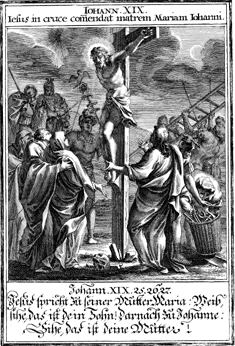
To remain committed to this, ask the help of other to strengthen you and keep you faithful to prayer. Moses had the help of Aaron and Hur, at his right and his left. Jesus had the help Mary and John, at the foot of His cross. The priest celebrating Mass has the help of God’s people, those in the church on earth and those in the Church in Heaven. So have your spouse, your children, and your friends to pray with you and keep you faithful to prayer.

Families should pray together, parents with their children. This will instill the Faith in them more than anything else.  And Fathers need to take the lead, for if only Mom prays with the children they will wonder, “Why doesn’t Dad pray, too?”

Couples should also pray together.  A couple that prays together every day a divorce rate less than one percent. And it makes sense, because if I know that someone is praying for me, that they’re willing my true good, then even if there are rough spots between us, I know that we’re on the same side. So before you leave the house, or before you go to bed, pray together as a couple; even if it’s as simple as a moment of silent prayer. Remember that the family that prayers together, stays together.

It is necessity for us to pray always without becoming weary, as families and individuals, for “He who prays is certainly saved; he who does not pray is certainly damned.” So pray every day, because our souls depend on it.

The Eager Provider — Thursday, 27th Week in Ordinary Time—Year II

October 7, 2010

Today we celebrate Our Lady of the Rosary and we hear a parable about a man who would rather not be bothered.  Let us compare this man to Mary.

He considers his visitor his friend, but she claims us as her children.

He feels too tired to help, but she never sleeps.

He hesitates to provide, but she is eager to give.

If mothers who are imperfect know how to give good gifts to their children, how much more will our perfect mother in Heaven intercede to give us good things whenever we ask her in the Rosary. It is a prayer which she receives from us as a sweet bouquet of roses.

Faith Enough — 27th Sunday in Ordinary Time—Year C

October 3, 2010

The apostles say to Jesus, “Increase our faith.” They have faith, but they feel like it’s not enough so they ask for more. Jesus replies, “If you have faith the size of a mustard seed, you would say to this mulberry tree, ‘Be uprooted and planted in the sea,’ and it would obey you.” In saying this, Jesus’ is not expressing disappointment in His disciples—He’s means to encourage them and us.

He wants us to understand that we have enough faith right now to be faithful in his service and to do incredible things. You have already enough faith to do what He asks you to do today. You need only to act upon it.

As we see with Habakkuk, we may need patience to see the fruits of our faithfulness. And as Paul reminds Timothy, we must put our faith into action. But the thing Jesus wants us to understand today is that we do not need to wait for more faith before we begin to be more faithful. We have already enough faith to do what He asks of us today.

If you had a perfect faith, what would you do? Try acting that way today, and you will find yourself living in faithfulness. Wouldn’t you like to see the difference that makes?

Jesus once called the mustard seed as the smallest of seeds. The mustard seed may be tiny, but its flavor is most powerful.  So it is with our faith.  The faith within us can be powerful despite its small size. A faith-filed Christian can transform the world. Think of Blessed Mother Teresa of Calcutta. Her faith helped and blessed so many people. Our faith can do great good too, but we do well to remember Mother Teresa words, “We are called upon not to be successful, but to be faithful.” Our job is to be faithful. If we do that, the Lord take care of the miracles. 

After teaching the apostles about the incredible power of their faith, Jesus reminds them of them of the importance of their being humble. We need to remember that the He is the master, and we are only His servants. Like the sorcerer’s apprentice, if we try to work great magic on our own we will only make a mess of things. Our efforts and projects must be from Him, with Him, and for Him if they are to do any lasting good.

We need not wait for God to increase our faith to begin to be more faithful. Christ has already given us enough faith to begin transforming our lives, our families, our communities, and our world. But our efforts must be those of humble servants of Christ our Lord, from whom all good things come.

Rich Man’s Loss — 26th Sunday in Ordinary Time—Year C

September 26, 2010

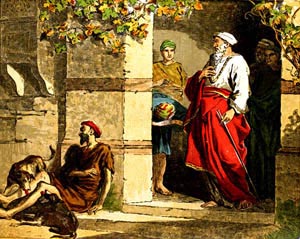
[The rich man] cried out, “Father Abraham, have pity on me. Send Lazarus to dip the tip of his finger in water and cool my tongue, for I am suffering torment in these flames.”

Why does the rich man suffer in flames? It’s not that Abraham is unaware of him, for when the rich man speaks Abraham answers him. And it’s not that Abraham no longer acknowledges him, for Abraham calls him “my child.” It’s not that Abraham lacks in mercy, for Abraham once intervened to spare a city of sinners. The rich man is not in the flames because of Abraham, or Moses, or the prophets of God, for if he had listened to them he would not be in torment.

So why does the rich man suffer in flames? He suffers because he feasted each day, while Lazarus starved. Because he dressed in fine linen, while Lazarus went naked. Because he was clothed in purple, while Lazarus was covered in purple sores. Yet the rich man is not in the flames because he is rich, for King David was far richer than he and is heralded as a man after God’s own heart. The rich man suffers because the dogs who licked Lazarus’ wounds showed the poor man more kindness than he ever did.

The rich man was not unaware of Lazarus lying at his door, for he had passed him enough times to recognize him when he saw him. The rich man even knew Lazarus by name, for he calls out, “Father Abraham… Send Lazarus…”  The rich man suffers in flames because he did not care about Lazarus. The rich man suffers because he did not love. If we wish to avoid the flames, we should ponder and act on this question: Who is Lazarus in your life?

Investments & Debts — 25th Sunday in Ordinary Time—Year C

September 19, 2010

Last week we heard Jesus’ parable of the Prodigal (or squandering) Son. Today He tells us about a debt-canceling steward. These stories offer similar lessons: the first lesson is about how to use our wealth profitably.

The prodigal son wastes his wealth on himself, on a life of self-indulgence, and he finds himself poor and alone. But hisgood father uses his wealth to generously cloth and feed him, and he thereby restores their relationship. Today’s steward gets reported for squandering the master’s property and is soon to be sent away destitute. But the prudent steward finds a way to always have a place to stay. He forgives others’ their debts and thereby wins their friendship. The first lesson is that we will lose whatever we hoard for ourselves, but whatever we invest in love will have an everlasting return.

The reason we exist, the reason we were created, is for personal relationships with God and each other. And when we die, we will take nothing with us, except these relationships. Our computers, cars and credit cards will be left behind, but personal love remains with us. A $100 bottle of wine can be enjoyed for an evening, but then it is lost forever. A donation to Catholic Relief Services can save a life, and a donation to Relevant Radio can save a soul, and someday, when all of our investments in love for family, neighbors and strangers are revealed, they will give us everlasting joy forever. So “I tell you, make friends for yourselves with dishonest wealth, so that when it fails, you will be welcomed into eternal dwellings.”
 
The second lesson of these parables is the importance of forgiveness. The good father wins back his dead and lost son, because he is willing to forgive him. The older son, however, is unwilling to forgive. He refuses to enter the house of his father and will not join the feast until his heart is changed. The good father symbolizes God, and the house is Heaven, and unless we forgive everyone one from the heart, we will refuse to join the feast. The second parable is also symbolic. God is the rich man and we are the squandering steward. Consider how much He has given you and how fruitlessly you have used it. At the end of our lives we will be called to give an account of our stewardship, and who can stand that judgment? This is what we must do: we must forgive our debtors their debts by forgiving their sins against us.

A sin forms a debt because it takes away from others what is owed to them by right. Every sin makes a debt, first and foremost to God, but also to the people trespassed against. It is speculated that the steward in the parable was forgiving his master’s debtors the part which was his own commission. If we are prudent like him, we will quickly take the opportunity to forgive our debtors the debt owed to us by forgiving the sins they have sinned against us. For we have it on Jesus’ word, “If you forgive others their transgressions, your heavenly Father will forgive you. But if you do not forgive others, neither will your Father forgive your transgressions.”
 
Now a lot of people refuse to forgive, or think that they can’t, because they think forgiveness means something its not. To forgive another’s sin is not to say that what they did wasn’t wrong—that would be a lie. And forgiveness doesn’t mean convincing yourself that the wrong doesn’t hurt—Jesus forgave his enemies amid excruciating pain. To forgive, all you need to do is to will the good of your trespasser. If you can pray for them, you are forgiving them. On the other hand, if there is anyone that you find that you are unable to pray for, then you have not forgiven them. That is the person whom you must pray for, for your own sake as well as theirs. So let your “supplications, prayers, petitions, and thanksgivings be offered for everyone… This is good and pleasing to God our savior, who wills everyone to be saved and to come to knowledge of the truth.”

Jesus’ parables teach us this: to use our wealth for lasting profit, and to forgive our debtors their debts. Let us be prudent to obtain true riches on earth and a everlasting home in Heaven.

Strive to Enter — 21st Sunday in Ordinary Time—Year C

September 2, 2010

The Emmy-winning Servant of God, Bishop Fulton J. Sheen, once said that in Heaven we will have three surprises: 

  1) We’ll see people there that we didn’t expect to see…

  2) We won’t see people there that we did expect to see, and…

  3) We’ll be surprised to see ourselves there!
 
 
In today’s gospel, someone shouts out from the crowd, “Lord, will only a few people be saved?” Jesus answers Him, “Strive to enter through the narrow gate, for many, I tell you, will attempt to enter but will not be strong enough.” Instead of giving the man a figure, Jesus gives him more valuable counsel, “Strive to enter through the narrow gate, for whether or not you will be saved depends (in part) on you.” Yet we are still left wondering, “Will the number saved be many, or only a few?”

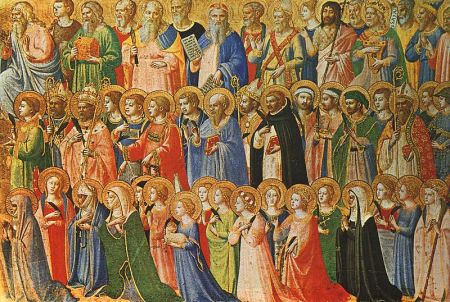
On the one hand we have John’s eyewitness testimony from the Book of Revelation. When he say the worship of the saints in heaven he saw  “a vision of a great multitude, which no one could count, from every nation, race, people, and tongue.” (Note that this ‘countless multitude’ is much larger than 144,000 which had just been counted.) It is as the Lord said through the prophet Isaiah in our first reading, “I come to gather nations of every language; they shall come and see my glory.” Based on this we can say that many will be saved.

On the other hand, in the Gospel of Matthew, in the parallel passage to today’s gospel, Jesus says, “Enter through the narrow gate; for the gate is wide and the road broad that leads to destruction, and those who enter through it are many. How narrow the gate and constricted the road that leads to life. And those who find it are few.” The ‘few’ who find the narrow gate certainly sounds like less than the ‘many’ who don’t. Based on this we can say that many will not be saved.

My purpose in raising this topic is not to frighten you, for Jesus said, over and again, “Do not be afraid.” But I believe it is with Jesus’ heart that I urge you not to be complacent. To be complacent is to be self-satisfied and unaware of possible dangers. Jesus urges us to, “Strive to enter through the narrow gate” for many will not be able.

There is no way to know, but something in me suspects that the man who called out to Jesus assumed his own salvation to be a certainty; he was merely curious if many others would be joining him.  Jesus warned him not to be presumptuous, and this gospel has come down to us today because it’s a message meant for us too.

All of us come to church, and that’s a very good thing, but coming to church every Sunday does not guarantee our salvation. In the parable that Jesus told, the master of the house arises like the judge of our world at the end of time. People knock on the locked door and say, “Lord, we ate and drank in your company and you taught in our streets.” We eat and drink in Jesus’ company too, and he teaches in our streets. We eat and drink with Him here, at the Eucharist, and whenever the Scriptures are proclaimed, Christ speaks. Being a disciple of Christ, a true friend of Christ, means more than just coming to church.

We must strive to enter the narrow gate. We must pursue and embrace holy discipline for our lives, as we heard from the Letter to the Hebrews: “…Do not disdain the discipline of the Lord or lose heart when reproved by him; for whom the Lord loves, he disciplines…. At the time, all discipline seems a cause not for joy but for pain, yet later it brings the peaceful fruit of righteousness to those who are trained by it.  So strengthen your drooping hands and your weak knees. Make straight paths for your feet, that what is lame may not be disjointed but healed.”

What in your life needs holy discipline? Do you pray every day, or is God only a bedtime afterthought? Do you pray with your spouse and your children, besides at mealtimes? Do you read and watch things that feed your soul? Do you fast and give alms? Do you treat every Friday as a day of penance and every Sunday as a day of joyful rest? What good habit do you need to begin? And what persistent sin do you need to fight, like a life-threatening cancer, for indeed it is. If you were to look back on your life someday from your deathbed, what would you most regret having left undone?

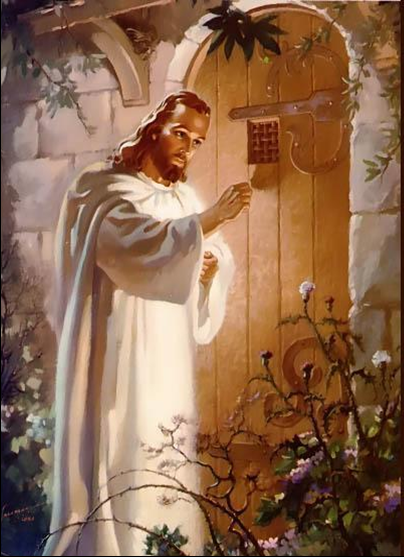
Jesus says to us in this present age, “Ask and it will be given to you; seek and you will find; knock and the door will be opened to you. For everyone who asks, receives; and the one who seeks, finds; and to the one who knocks, the door will be opened.” Are you asking, are you seeking, are you knocking? Strive for holiness while the door remains unlooked, and be encouraged, for Jesus is also striving after you. In Revelation He says, “Those whom I love, I reprove and chastise. Be earnest, therefore, and repent. Behold, I stand at the door and knock. If anyone hears my voice and opens the door, (then) I will enter his house and dine with him, and he with me.”

Jesus knocks on the door of our hearts, minds, and souls; in our feelings, thoughts, and deepest desires. If we open our doors and welcome Him now, and strive with Him for holiness, Jesus will open for us the door to Heaven and welcome us inside.

Saintly Vigilance — Thursday, 21st Week in Ordinary Time—Year II

August 26, 2010

The usual reading of today’s Gospel sees Jesus warning His followers to be ever watchful and prepared for the coming of the Lord. When we hear his image of a mud-brick house being broken into (or literally, dug through) we think of the devil as that thief, robbing us of the treasure in our souls. This interpretation is good and true. We should be vigilant in the keeping of our own immortal souls. But let me suggest that He teaches us another lesson as well, for Jesus words are autobiographical.

Jesus is that “master of the house.” He is the husband in His household, the Church. And Jesus did know the pivotal hour of night to “stay awake” and “keep watch” in the garden of Gethsemane. When His enemies arrived, Jesus did not allow His household be broken into and robbed. He said, “…If you are looking for me, let these men go.” He did not lose any of His own which the Father had given to Him.

“Who then is the faithful and prudent servant, whom the master has put in charge of his household to distribute to them their food at the proper time?” Jesus is that faithful and prudent servant, who feeds us our needed food. And seeing His suffering servant’s love, God the Father, who the master of all, has placed Jesus over all His property.

Yes, we should be vigilant in the keeping of our own immortal souls, but Jesus’ example suggests something more, to be have concern for the care of others’ souls as well. Who has God entrusted to you? Perhaps family members come first to mind, but think of your friends, co-workers, and others as well. Ask yourself in what ways you can be of good to their souls as well. God rewards those who love like this with a greater glory than just salvation alone.