Archive for the ‘Parables’ Category

Faith Enough — 27th Sunday in Ordinary Time—Year C

October 3, 2010

The apostles say to Jesus, “Increase our faith.” They have faith, but they feel like it’s not enough so they ask for more. Jesus replies, “If you have faith the size of a mustard seed, you would say to this mulberry tree, ‘Be uprooted and planted in the sea,’ and it would obey you.” In saying this, Jesus’ is not expressing disappointment in His disciples—He’s means to encourage them and us.

He wants us to understand that we have enough faith right now to be faithful in his service and to do incredible things. You have already enough faith to do what He asks you to do today. You need only to act upon it.

As we see with Habakkuk, we may need patience to see the fruits of our faithfulness. And as Paul reminds Timothy, we must put our faith into action. But the thing Jesus wants us to understand today is that we do not need to wait for more faith before we begin to be more faithful. We have already enough faith to do what He asks of us today.

If you had a perfect faith, what would you do? Try acting that way today, and you will find yourself living in faithfulness. Wouldn’t you like to see the difference that makes?

Jesus once called the mustard seed as the smallest of seeds. The mustard seed may be tiny, but its flavor is most powerful.  So it is with our faith.  The faith within us can be powerful despite its small size. A faith-filed Christian can transform the world. Think of Blessed Mother Teresa of Calcutta. Her faith helped and blessed so many people. Our faith can do great good too, but we do well to remember Mother Teresa words, “We are called upon not to be successful, but to be faithful.” Our job is to be faithful. If we do that, the Lord take care of the miracles. 

After teaching the apostles about the incredible power of their faith, Jesus reminds them of them of the importance of their being humble. We need to remember that the He is the master, and we are only His servants. Like the sorcerer’s apprentice, if we try to work great magic on our own we will only make a mess of things. Our efforts and projects must be from Him, with Him, and for Him if they are to do any lasting good.

We need not wait for God to increase our faith to begin to be more faithful. Christ has already given us enough faith to begin transforming our lives, our families, our communities, and our world. But our efforts must be those of humble servants of Christ our Lord, from whom all good things come.

Rich Man’s Loss — 26th Sunday in Ordinary Time—Year C

September 26, 2010

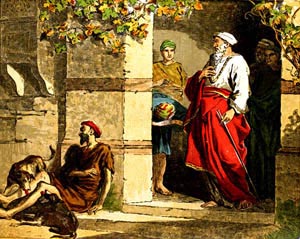
[The rich man] cried out, “Father Abraham, have pity on me. Send Lazarus to dip the tip of his finger in water and cool my tongue, for I am suffering torment in these flames.”

Why does the rich man suffer in flames? It’s not that Abraham is unaware of him, for when the rich man speaks Abraham answers him. And it’s not that Abraham no longer acknowledges him, for Abraham calls him “my child.” It’s not that Abraham lacks in mercy, for Abraham once intervened to spare a city of sinners. The rich man is not in the flames because of Abraham, or Moses, or the prophets of God, for if he had listened to them he would not be in torment.

So why does the rich man suffer in flames? He suffers because he feasted each day, while Lazarus starved. Because he dressed in fine linen, while Lazarus went naked. Because he was clothed in purple, while Lazarus was covered in purple sores. Yet the rich man is not in the flames because he is rich, for King David was far richer than he and is heralded as a man after God’s own heart. The rich man suffers because the dogs who licked Lazarus’ wounds showed the poor man more kindness than he ever did.

The rich man was not unaware of Lazarus lying at his door, for he had passed him enough times to recognize him when he saw him. The rich man even knew Lazarus by name, for he calls out, “Father Abraham… Send Lazarus…”  The rich man suffers in flames because he did not care about Lazarus. The rich man suffers because he did not love. If we wish to avoid the flames, we should ponder and act on this question: Who is Lazarus in your life?

Investments & Debts — 25th Sunday in Ordinary Time—Year C

September 19, 2010

Last week we heard Jesus’ parable of the Prodigal (or squandering) Son. Today He tells us about a debt-canceling steward. These stories offer similar lessons: the first lesson is about how to use our wealth profitably.

The prodigal son wastes his wealth on himself, on a life of self-indulgence, and he finds himself poor and alone. But hisgood father uses his wealth to generously cloth and feed him, and he thereby restores their relationship. Today’s steward gets reported for squandering the master’s property and is soon to be sent away destitute. But the prudent steward finds a way to always have a place to stay. He forgives others’ their debts and thereby wins their friendship. The first lesson is that we will lose whatever we hoard for ourselves, but whatever we invest in love will have an everlasting return.

The reason we exist, the reason we were created, is for personal relationships with God and each other. And when we die, we will take nothing with us, except these relationships. Our computers, cars and credit cards will be left behind, but personal love remains with us. A $100 bottle of wine can be enjoyed for an evening, but then it is lost forever. A donation to Catholic Relief Services can save a life, and a donation to Relevant Radio can save a soul, and someday, when all of our investments in love for family, neighbors and strangers are revealed, they will give us everlasting joy forever. So “I tell you, make friends for yourselves with dishonest wealth, so that when it fails, you will be welcomed into eternal dwellings.”
 
The second lesson of these parables is the importance of forgiveness. The good father wins back his dead and lost son, because he is willing to forgive him. The older son, however, is unwilling to forgive. He refuses to enter the house of his father and will not join the feast until his heart is changed. The good father symbolizes God, and the house is Heaven, and unless we forgive everyone one from the heart, we will refuse to join the feast. The second parable is also symbolic. God is the rich man and we are the squandering steward. Consider how much He has given you and how fruitlessly you have used it. At the end of our lives we will be called to give an account of our stewardship, and who can stand that judgment? This is what we must do: we must forgive our debtors their debts by forgiving their sins against us.

A sin forms a debt because it takes away from others what is owed to them by right. Every sin makes a debt, first and foremost to God, but also to the people trespassed against. It is speculated that the steward in the parable was forgiving his master’s debtors the part which was his own commission. If we are prudent like him, we will quickly take the opportunity to forgive our debtors the debt owed to us by forgiving the sins they have sinned against us. For we have it on Jesus’ word, “If you forgive others their transgressions, your heavenly Father will forgive you. But if you do not forgive others, neither will your Father forgive your transgressions.”
 
Now a lot of people refuse to forgive, or think that they can’t, because they think forgiveness means something its not. To forgive another’s sin is not to say that what they did wasn’t wrong—that would be a lie. And forgiveness doesn’t mean convincing yourself that the wrong doesn’t hurt—Jesus forgave his enemies amid excruciating pain. To forgive, all you need to do is to will the good of your trespasser. If you can pray for them, you are forgiving them. On the other hand, if there is anyone that you find that you are unable to pray for, then you have not forgiven them. That is the person whom you must pray for, for your own sake as well as theirs. So let your “supplications, prayers, petitions, and thanksgivings be offered for everyone… This is good and pleasing to God our savior, who wills everyone to be saved and to come to knowledge of the truth.”

Jesus’ parables teach us this: to use our wealth for lasting profit, and to forgive our debtors their debts. Let us be prudent to obtain true riches on earth and a everlasting home in Heaven.

Strive to Enter — 21st Sunday in Ordinary Time—Year C

September 2, 2010

The Emmy-winning Servant of God, Bishop Fulton J. Sheen, once said that in Heaven we will have three surprises: 

  1) We’ll see people there that we didn’t expect to see…

  2) We won’t see people there that we did expect to see, and…

  3) We’ll be surprised to see ourselves there!
 
 
In today’s gospel, someone shouts out from the crowd, “Lord, will only a few people be saved?” Jesus answers Him, “Strive to enter through the narrow gate, for many, I tell you, will attempt to enter but will not be strong enough.” Instead of giving the man a figure, Jesus gives him more valuable counsel, “Strive to enter through the narrow gate, for whether or not you will be saved depends (in part) on you.” Yet we are still left wondering, “Will the number saved be many, or only a few?”

On the one hand we have John’s eyewitness testimony from the Book of Revelation. When he say the worship of the saints in heaven he saw  “a vision of a great multitude, which no one could count, from every nation, race, people, and tongue.” (Note that this ‘countless multitude’ is much larger than 144,000 which had just been counted.) It is as the Lord said through the prophet Isaiah in our first reading, “I come to gather nations of every language; they shall come and see my glory.” Based on this we can say that many will be saved.

On the other hand, in the Gospel of Matthew, in the parallel passage to today’s gospel, Jesus says, “Enter through the narrow gate; for the gate is wide and the road broad that leads to destruction, and those who enter through it are many. How narrow the gate and constricted the road that leads to life. And those who find it are few.” The ‘few’ who find the narrow gate certainly sounds like less than the ‘many’ who don’t. Based on this we can say that many will not be saved.

My purpose in raising this topic is not to frighten you, for Jesus said, over and again, “Do not be afraid.” But I believe it is with Jesus’ heart that I urge you not to be complacent. To be complacent is to be self-satisfied and unaware of possible dangers. Jesus urges us to, “Strive to enter through the narrow gate” for many will not be able.

There is no way to know, but something in me suspects that the man who called out to Jesus assumed his own salvation to be a certainty; he was merely curious if many others would be joining him.  Jesus warned him not to be presumptuous, and this gospel has come down to us today because it’s a message meant for us too.

All of us come to church, and that’s a very good thing, but coming to church every Sunday does not guarantee our salvation. In the parable that Jesus told, the master of the house arises like the judge of our world at the end of time. People knock on the locked door and say, “Lord, we ate and drank in your company and you taught in our streets.” We eat and drink in Jesus’ company too, and he teaches in our streets. We eat and drink with Him here, at the Eucharist, and whenever the Scriptures are proclaimed, Christ speaks. Being a disciple of Christ, a true friend of Christ, means more than just coming to church.

We must strive to enter the narrow gate. We must pursue and embrace holy discipline for our lives, as we heard from the Letter to the Hebrews: “…Do not disdain the discipline of the Lord or lose heart when reproved by him; for whom the Lord loves, he disciplines…. At the time, all discipline seems a cause not for joy but for pain, yet later it brings the peaceful fruit of righteousness to those who are trained by it.  So strengthen your drooping hands and your weak knees. Make straight paths for your feet, that what is lame may not be disjointed but healed.”

What in your life needs holy discipline? Do you pray every day, or is God only a bedtime afterthought? Do you pray with your spouse and your children, besides at mealtimes? Do you read and watch things that feed your soul? Do you fast and give alms? Do you treat every Friday as a day of penance and every Sunday as a day of joyful rest? What good habit do you need to begin? And what persistent sin do you need to fight, like a life-threatening cancer, for indeed it is. If you were to look back on your life someday from your deathbed, what would you most regret having left undone?

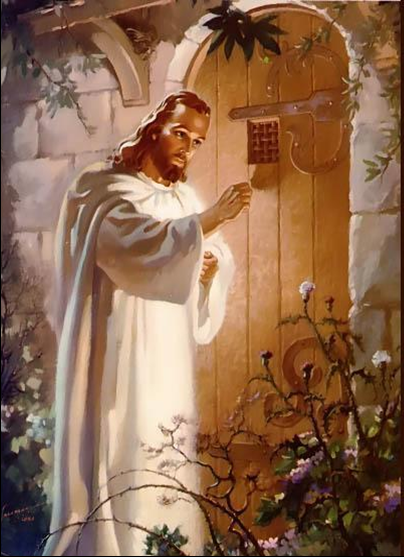
Jesus says to us in this present age, “Ask and it will be given to you; seek and you will find; knock and the door will be opened to you. For everyone who asks, receives; and the one who seeks, finds; and to the one who knocks, the door will be opened.” Are you asking, are you seeking, are you knocking? Strive for holiness while the door remains unlooked, and be encouraged, for Jesus is also striving after you. In Revelation He says, “Those whom I love, I reprove and chastise. Be earnest, therefore, and repent. Behold, I stand at the door and knock. If anyone hears my voice and opens the door, (then) I will enter his house and dine with him, and he with me.”

Jesus knocks on the door of our hearts, minds, and souls; in our feelings, thoughts, and deepest desires. If we open our doors and welcome Him now, and strive with Him for holiness, Jesus will open for us the door to Heaven and welcome us inside.

Saintly Vigilance — Thursday, 21st Week in Ordinary Time—Year II

August 26, 2010

The usual reading of today’s Gospel sees Jesus warning His followers to be ever watchful and prepared for the coming of the Lord. When we hear his image of a mud-brick house being broken into (or literally, dug through) we think of the devil as that thief, robbing us of the treasure in our souls. This interpretation is good and true. We should be vigilant in the keeping of our own immortal souls. But let me suggest that He teaches us another lesson as well, for Jesus words are autobiographical.

Jesus is that “master of the house.” He is the husband in His household, the Church. And Jesus did know the pivotal hour of night to “stay awake” and “keep watch” in the garden of Gethsemane. When His enemies arrived, Jesus did not allow His household be broken into and robbed. He said, “…If you are looking for me, let these men go.” He did not lose any of His own which the Father had given to Him.

“Who then is the faithful and prudent servant, whom the master has put in charge of his household to distribute to them their food at the proper time?” Jesus is that faithful and prudent servant, who feeds us our needed food. And seeing His suffering servant’s love, God the Father, who the master of all, has placed Jesus over all His property.

Yes, we should be vigilant in the keeping of our own immortal souls, but Jesus’ example suggests something more, to be have concern for the care of others’ souls as well. Who has God entrusted to you? Perhaps family members come first to mind, but think of your friends, co-workers, and others as well. Ask yourself in what ways you can be of good to their souls as well. God rewards those who love like this with a greater glory than just salvation alone.

The Rich Fool — 18th Sunday in Ordinary Time—Year C

August 12, 2010

I regret to inform you that you are going to die. Perhaps not today, but someday, and it could be very soon. We should ask ourselves, “Am I ready? How can I prepare?”

The Gospel relates the story of a man who was not ready, a man God calls a “fool.” Jesus offers Him as an anti-role model; a person whose example we should learn from, but not imitate. Yes, he is a fool for hoarding his possessions. The old saying is true, “You can’t take it with you.” But there are more subtle lessons we can learn from his bad example. This morning I would like to present three things this rich man has to teach us:

The first lesson comes from what he does when his land produces a bountiful harvest. He asks himself, “What shall I do?” There is nothing wrong with this question in itself, but he is a fool in the way he asks it. The rich man asks himself, and only himself, “What shall I do?” He does not consult with God, in either his conscience or in prayer, to learn what His will is.

What is the lesson here for us?  Let us remember to listen to the Lord as He speaks in our conscience, through prayer, the Scriptures, and the people He has placed in our lives. We should listen for God’s direction every day, and throughout each day.

A second cautionary lesson is found in the rich man’s plan for solving his storage problem. He says, “This is what I shall do: I shall tear down my barns and build larger ones.” What was wrong with the older barns? They were not large enough to hold everything, but why tear them down? The rich man has plenty of land. Why did he want to replace his perfectly good barns?

Vanity of vanities, he wanted his storehouses to be the newest, the biggest, and the best. Though the rich man was not very concerned about other people, he was very concerned about their high opinion of him. Even in those days, people were tempted to consumerism.

Consumerism seems to consist in two phantom promises: that having just a little more will truly give me lasting happiness, and that others will regard, accept, and love me when they notice the things that I have. These are phantom promises, for as soon as one reaches to grasp them they prove empty, illusory, receding further out of reach.

The fact is that the people who are happiest in life are not the wealthiest. (By that measure, pretty much every American should be among the happiest people in the world.) The happiest people tend to be those who share the most or give the most away. The person who recognizes they have enough, that life does not consist in possessions, is content and secure enough to share. Some people try to get the most out of life as possible, but what we appreciate most in our lives is the ways in which we have given of ourselves for others.

Our third cautionary lesson is heard in God’s rebuke of the man: “You fool, this night your life will be demanded of you; and the things you have prepared, to whom will they belong?” When we think of the things the rich man has prepared, we think of his harvest and goods.  One of the things he has ill-prepared… is his soul, which this night will be demanded of him. And now, to whom will it belong?

The lesson here for us?  As focused as we are upon our possessions, we must be more attentive to our souls. Someday, we are going to die. In the meantime, then, let us put to death, the parts of you that are earthly, as St. Paul said: immorality, impurity, passion, evil desire, and the greed that is idolatry.

What lessons does the rich man teach us? Reject the false promises of the consumer cult, for life does not consist in possessions. (Self-gift is the meaning of life) Turn your heart to your spiritual well-being, for your life and this world shall pass away.  And to frequently ask Jesus, everyday, “What shall I do?” Let us begin today, before it is too late for us to begin living wisely.

The Kingdom is Like… — Monday, 17th Week in Ordinary Time—Year II

July 26, 2010

Jesus says the Kingdom of heaven is like a mustard seed sown in a field, or like some yeast worked into three measures of dough. These passages are usually taken to describe how the Church, or the Christian faith, despite small beginnings, has spread and transformed the entire world for the better. This is a valid interpretation, but the Kingdom of heaven is not only an external reality; it is internally and personally experienced. Since the Scriptures are written not only by human authors, but by the Holy Spirit as well, every passage contains more than one true interpretation. Jesus’ similies also describe faith in the life of individual Christians.

At the beginning of one’s discipleship, the seed of faith is small and vulnerable. Any challenge or trial, any passing bird, can potentially come along and consume it. This seed of faith must be guarded, watered, and given light. This means vigilence, education, and contact with Christ in prayer and the sacraments. In time, faith grows to the point that trials and challenges are no longer a grave threat, but calmly accepted.

The faith of the Christian is also like yeast which is not meant to be merely kept in a jar in on the shelf, segregated to Church or private life. It is meant to be mixed into the whole of life; at home, at work, and everywhere, so that the entire batch of life will be transformed and raised.

If your faith is young and fledging, or a confined and isolated part of your life, be encouraged by the hope these passages promise. The Kingdom of God is at hand for you.

We’re Inn-Keepers — 15th Sunday in Ordinary Time—Year C

July 18, 2010

The “Good Samaritan” is a very familiar parable, but there remains much for us to learn from it. Today I will present the history, the context, behind it; the symbolic meaning contained within it; and the challenge to ourselves that comes out of it.

Jesus’ story begins, “A man fell victim to robbers as he went down from Jerusalem to Jericho.” From this we might think that Jericho is south of Jerusalem because we put the South at the bottom of our maps. Yet, Jericho is actually some twenty miles to northeast of Jerusalem. The reason why the man went down from Jerusalem is that Jerusalem is situated 2,550 feet above sea level, while Jericho is about 1,200 feet below sea level, near the Dead Sea, which is the lowest place on the surface of the earth.

Jerusalem was the city of the temple, the place of God’s dwelling. Jericho, you may remember, was the city which Joshua and the Hebrews marched around for seven days, before blowing their horns and shouting, causing the walls to fall down. They conquered the city because it was in rebellion with God.

“The [robbers] stripped and beat [the man] and went off leaving him half-dead. A priest happened to be going down that road,
but when he saw him, he passed by on the opposite side. Likewise a Levite came to the place, and when he saw him, he passed by on the opposite side.”

You know what a priest is. He is one who offers sacrifice. What is a Levite? They were like acolytes or altar servers; they helped the priest offer the sacrifices at the temple. Why did they both pass by ‘on the opposite side?’ Maybe that they thought the man was already dead and wanted to avoid ritual impurity. The Mosaic Law taught that contact with a dead body made one ritually impure and ritual purity was necessary to worship at the temple. Whether this was their reason, or whether they just did not care enough to be bothered, another comes along who is both willing and able to help.

“…A Samaritan traveler who came upon him and was moved with compassion at the sight.” Who are these Samaritans? We hear about them in the Gospels and we know they didn’t get along with the Jews. For instance, the woman at the well that Jesus meets in John was a Samaritan. Where do they come from?

Some five hundred years before the coming of Christ the Babylonians were the superpower of the ancient world. When the king in Jerusalem decided he was not going to pay tribute to Babylon anymore, the king of Babylon was not pleased. He sieged Jerusalem, conquered it, and carried the region’s inhabitants into what is called the Babylonian Exile. Not everyone was taken though; some of the poor, the farmers and the vine-dressers, were left behind. To ensure that the people did not rebel again, and to make sure that the land did not go to waste, the Babylonians settled five pagan nations in the land.

Seventy years later, after the Babylonians had been conquered by the Persians, the new king gave the Jews permission to return to their homeland. When they got there they found that the people who had remained behind had intermarried with the pagans, in both their families and religion. The Jews regarded these people, these Samaritans, as unfaithful to the Lord. It is no coincidence that the Samaritan woman at the well had had five husbands.

Jesus chooses a Samaritan as the protagonist, the hero, of his story. He does this to show us an example we are to follow. The Samaritan was not Jewish victim’s neighbor geography, for he was only a traveler to the region, nor was he related to him by blood, nor by prior friendship. In the same way, our neighbors are not to be only those who are close to us in distance, are in our family, or who have shown kindness to us. Everyone is to be our neighbor. Such is the meaning of the parable in its historical context, but contained within this story there is Christian symbolism, as well.

The man who fell to the robbers is you and I, this man represents all mankind. Traveling from Jerusalem to Jericho, we were descending from the height of communion with God to the depths of rebellion. We fell to robbers, to evil spirits and evil desire. These stripped us naked, depriving of our original honor and glory. They beat us and left us half-dead; biologically we still lived, but spiritually we were dead. No one could or would help us. But then the Good Samaritan came. This man is Jesus Christ.

He looked upon us and was moved with compassion. Jesus approached to us and poured His blood on us, like wine, to cleanse the wounds of our sin. He poured the Holy Spirit on us like oil to make us strong again. Jesus gave us his teachings and commandments as bandages for our wounds. These disciplines bind us, yet they free us through the health they provide. Jesus lifted us up on his own animal.  This beast of burden was his own flesh. He took us to the inn, which is the Church, and here He continues to care and provide for us in it until the time of His return.

Even though the man who fell to the robbers is meant to symbolize each one of us, I don’t think he is the character in this story with whom we can most identify ourselves. The character I have in mind is one everyone overlooks. I don’t mean the Good Samaritan, nor the priest or the Levite. The character I’m thinking of is the inn-keeper, who is only mentioned in passing.

Here’s all that Jesus tells us about the inn-keeper: “The next day [the Good Samaritan] took out two silver coins and gave them to the innkeeper with the instruction, ‘Take care of him. If you spend more than what I have given you, I shall repay you on my way back.’”

Most of us here entered into the Catholic Church when we were baptized as infants. So we don’t remember being brought into the Church, half-dead.  For us, it feels like this inn has always been our home. This is where we have lived and worked for as long as we can remember. So I think we may identify more with the inn-keeper, more then the victim who has been gratefully saved. With this comes a challenge for our lives.

We are like the inn-keeper.  We are comfortably at home, and business is good. The Samaritan brings in this guy like a sack of potatoes, buys a room and takes care of him. That’s fine with us, but this Samaritan guy comes along and instructs us to take care of this friend of His. Now he is shifting that job onto us. Sure he’s given us some coin for doing it, two silver denarii, the sum of two day’s wages, and he says that if we spend more than what he has given he will repay us on his way back, but do I really want this hassle?

Besides, is that Samaritan fellow really coming back?  If not, then the more I give caring for this invalid the less I’ll have left for myself. If I’m stuck with the bill for this guy and his friend, them I’ll feel like a fool. On the other hand, if I just toss the guy out of my inn, or just ignore him while he’s here, that’s two day’s profit for me guaranteed. If I just pretend that I never heard that Samaritan’s instructions, if I can just quiet my conscience, I’ll get along just fine.

I’m busy enough as it is already. Is playing nurse to this crime statistic really worth my time? Do I trust that Samaritan? Do I believe he is he truly good?  Do I believe he is really coming back? Jesus is the Good Samaritan, and he brings many people to our lives and asks us to take care of them in our inn. Are you living as though Jesus is really coming back to repay each of us according to our deeds, or are you just minding your own business?

Everything you have comes from Jesus, and everything you have belongs to Him.  He is entitled to your time, talents, and treasure and He wants you to share them with your neighbors. Do not fear, don’t be afraid. The truth is that you can never spend more than what He has given you. Act with confidence that He will repay you an amount far greater than you give, not only at the end of your life, but even by the end of the day.

Jesus Christ’s command which He “enjoin[s] on you today is not too mysterious and remote for you. …No, it is something very near to you, already in your mouths and in your hearts; you have only to carry it out.” You shall love your neighbor as yourself.

The Miraculous Pool — Tuesday, 4th Week of Easter

April 28, 2010

Once upon a time, in a certain forest clearing, there was a miraculous (and strange) pool of water. The pool’s waters’ were miraculous, having unique healing and life-giving properties, but something else made this pool strange. When travelers would come upon it, the pool would appear differently depending on how the person approached it.

For those who expected to find something remarkable, the pool was large and deep, and drinking its waters was powerful. But for those who came expecting little or nothing (and there were many such people,) the pool had the appearance of a small, cloudy puddle, and they would not drink from it.


Why did so many come expecting so little, and walk away unchanged? Maybe they had passed by that clearing a hundred times before; and, never expecting much, never had found very much. Maybe they dismissed the whole idea as superstition, as an old myth. Maybe they had never seen evidence that this pool was any better than any other because the people whose lives had been changed by its waters were too timid to give a strong witness to its power and reality.

Now we come to the point of this parable of mine. Encountering our Catholic Faith, the Mass, and the Scriptures is a lot like encountering this miraculous pool. When we expect much, we find much, and receive a great deal. And when we expect to get nothing from them, the usually meet our expectations.

I believe our Catholic Faith is a miraculous pool with the power to change everything. Walking in Christian faithfulness is hard for everyone at times, but I have seen too much, firsthand and from others’ experiences, ever to walk away from Christ and His Church. I have forsaken all other paths for my one life because I am convinced that our Faith, the Mass, and the Scriptures are true, and powerful, and good. Yet even I often need to remind myself not to settle, but to go more deeply and prayerfully into these dangerously familiar things. And when I do, I receive more. I think we all need to receive more. So, in the weeks ahead, I’m going to teach, through pre-Mass talks like this one, or through homilies during Mass, about ways to drink from the miraculous pool to our greater benefit.

For this morning’s Mass, I have four suggestions:

1.  Pray to the Holy Spirit for a more expectant and receptive heart.
2. Form a Mass intention to pray for during the Eucharistic prayer.
3. During the psalm, try to find the Virgin Mary or the Church in it.
4. Listen to Jesus speak to you in the Gospel for He will be speaking to you through His word.

 Let us approach this miraculous pool expectantly.

The Prodigal Son — 4th Sunday in Lent—Year C

March 14, 2010

If today happens to be your first time coming back to church in a long time, then take today’s gospel as a sign. God our Father is incredibly merciful and He welcomes you home with a loving embrace.

But most of us here, I suspect, came to Mass last week, and the week before that, because you always come every week. If so, then you probably hear this familiar parable of the Prodigal (that is, squandering) Son and wonder where you fit into the story. When you look at yourself I bet you can honestly say that you’re not living a life of great dissipation like the younger son, and the idea of a sinner being reconciled with God makes you genuinely happy, not bitter, like the older son or the Pharisees. So what does this story have to teach those of us who are doing a lot more right than we’re doing wrong?

First, let’s look at the younger, prodigal son. He goes to his father and says, “Father, give me the share of your estate that should come to me.” Here, he is asking for his inheritance while his father is still alive. He is basically saying, “I don’t want to share my life with you,” and then he demonstrates it a few days later by setting off to a distant country. There he squanders his inheritance on a life of dissipation, but after he has freely spent everything, he finds himself in dire need. What he thought would make him happy left him disappointed in the end.

Sure, we’re not professional, all-star sinners like the prodigal son, but we act like him in many little ways in our daily lives. The prodigal son asked his father for something which was not his and which he had no right to take (while his father is still alive.) Whenever we live as if our lives were our own, as if our lives did not come from God and do not belong to God, our Father, we say to Him, “I don’t want to share my life with you.”

Though our small and venial sins only hinder or wound our relationship with God, in every sin we turn our backs and set off for awhile to a distant country. Whenever we insist upon it, God permits us to freely spend our lives in squandering ways, in ways which we think will make us happy but which disappointing us in the end. When we return to our Father, He forgives our sins and welcomes us back, but you and I must learn to stop trying to live our lives without sharing them completely with God.

Why are we afraid of the idea of doing what God wants us to do every moment of our day? I think we are afraid that doing God’s will won’t really make us happy. Maybe we imagine that doing God’s will means we will have to pray ten hours a day at church or walk around wearing a burlap outfit. Of course that’s crazy. God probably wants you to live the same life you are living now, but with some minor adjustments, and more closely to Him.

Maybe we are afraid to give ourselves completely to God because we are a lot like the other, older, more faithful son in the parable. We have served our Father for years without ever asking or expecting much for ourselves. But working hard for God without ever experiencing His good gifts and joys does not make us holy; over time it makes us angry and embittered, like the older son who never asked for anything. We start to think of our Father, not as our father, but as a slave master. But our Father says to us today, “My child, you are here with me always; everything I have is yours.”

“Taste and see the goodness of the Lord,” as our psalm said. Do not let your face blush with shame at asking for good things for you and your friends to enjoy. When we are poor and call out the Lord hears us, and He will save us from all our distress. So look to God, and be radiant with joy.

We’ve learned important lessons from both of the sons in this parable, and I hope we will put them into practice.

From the faithful but disgruntled son, we learned the importance of asking for good things from God. So today, at this Mass, ask our Father to surprise you today with some good gift that you’ll enjoy. Then watch to see what He does for you.

From the prodigal son we learned the importance of living with and for God every day of our lives. So tomorrow morning, when you wake up and you’re lying in bed, make the sign of the cross and entrust yourself to God for that day, that you may live your life that day always with Him and for Him. Ask you guardian angel to remind you and I bet you will remember.  Try it, and I think you’ll be pleasantly surprised by the difference it makes in your day.

For an Extraordinary Marriage — Wedding of Andrew and Laura Foreki

March 3, 2010

I would like to begin this homily today by sharing with you the extraordinary story of how this boy, Andrew, met this girl, Laura. Picture Andrew, walking one morning across the University of Wisconsin campus in the deep cold of winter. He is on his way to Chadborn Hall where a prayer group is meeting for their twice-weekly 7:30 rosary. 

He walks into the room where the group is meeting and casts his eyes, for the very first time, upon a drowsy-eyed coed named Laura. And can you guess what Andrew said to himself when his eyes saw Laura for the very first time? That’s right. He said to himself, “Oh, I don’t know who that is.” This reaction, of course, is to be expected, since Andrew and Laura didn’t know each other prior to being introduced a few moments later.

Now Andrew’s first impression is not what makes this an extraordinary story. Did you notice what was the extra-ordinary part? Here it is: Here we have two college students, getting up, out of warm beds, on a cold day, to pray a rosary, at 7:30 in the morning! Now, you have to understand, in College Student Time, this is like getting up at 4:30 AM. Your typical college student doesn’t get up any earlier than he has to, but these two got up… to pray. For this and a thousand other reasons, I think you will all agree with me, that we have here two extra-ordinary people, from whom we good reason to expect an extraordinary marriage.

Do you two want to ensure you share an extraordinary marriage together? Then there are three things that I, as an ordained servant of Jesus Christ, believe that you should do.

First, like Tobit and his wife Sarah in our first reading, you should pray together. Of course you must pray individually. And of course you must pray with your children once they come. But you also need to pray together. It doesn’t need to be anything complicated.  Just hold each others’ hands a few moments before you part for work, or stand, or kneel, at your bedside, like Tobit and Sarah did, and speak aloud from your hearts to God. Ask blessings for each other, and give thanks for all the blessing you have received, and close you prayer by saying, “Amen, amen.”

Some couples find this kind of prayer too intimidating, or too personal, to be attempted; for our prayers express our most intimate selves, our fears, our hopes, our pains, our joys, our deepest longings. If you pray honestly in this way, nothing will be hidden between you. Today you will vow to give yourselves completely to each other. Do you want to be truly and totally one? Then pray together. Through marriage you will share of one flesh, if but pray together and you will also share of one spirit. Pray together and you will share an extraordinary marriage as one flesh with one soul. So please, pray together.

The second thing you should do for an extraordinary marriage is to come to Mass. Come to Mass every Sunday and every holy day of obligation. Come, and be moved by the beauty of architecture and songs. Come, and be strengthened by the experience of Christian fellowship. Come, and be inspired by the eloquence of Gospel preaching.

No doubt some people hear this and think to themselves, “That sounds great… But our church is ugly and the songs are dumb and hard to sing. And our community is little more than a gathering of strangers. And our priest always gives the same boring homilies.” Which all boils down to saying, I just don’t get anything out of going to Mass. Then hear this, even if everything else is lacking at Mass, Jesus Christ is always here for us, Body, Blood, Soul, and Divinity in the Eucharist. At Mass, the one sacrifice of Calvary and the Last Supper are made truly present to us for us to receive their power.

At Mass Jesus Christ shows us the perfect spousal love that He calls each of us to imitate. Jesus never called himself “the bachelor.” No, He joyfully called himself “the bridegroom” and eagerly seeks to unite himself to His bride. On the cross, naked without shame, He consummates this union with her, giving himself freely, fully, fruitfully, and forever… freely, fully, fruitfully, and forever. Do you want your union with each other to be free, fully, fruitful, and forever? Then come to Mass to learn the pattern of how Christ loves us and draw from the power He offers us through communion with Him. His is the pattern and the power for an extraordinary marriage. So please, come to Mass.

The third and final thing you should do for an extraordinary marriage is to be salt and light in the world. What does this mean? Being salt and light means that your Christianity should show. As Jesus says, “Your light must shine before others, that they may see your good deeds and glorify your heavenly Father.”

Your good deeds should stand out in the world. As St. Paul says in the second reading, “Do not conform yourselves to this age, but be transformed by the renewal of your mind” If the world never judges you to be radical in any aspect of your Christian life, then you’re not doing it right. Then you’re not yet living as salt and light–you’re not yet living like the saints. For example, everyone loves their friends, but who loves their enemies and prayers for them? Most people pray, but who spends a long time to be with God every day. Many people can give when times are prosperous, but who gives generously when times are tight? Such things as this are what it means to be the light and the salt of the world. Light is different than the darkness, and salt makes the ordinary flavorful.

Clearly, you two are salt and light already, for who goes on weekend retreats to know God better? Or who drives to Washington D.C. to march for life? Or who goes down to Louisiana to volunteer for Hurricane relief? Or who get up at 7:30 in the morning to pray the Rosary? So, please keep on being salt and light, and your marriage will be extraordinary.

Years from now, I don’t expect that you will remember much from this homily, but I hope you remember these three things: Pray together, come to Mass, and be salt and light and you will have an extraordinary marriage.

[Preached as a deacon for my sister’s wedding,  November 22, 2008]

Christian and Unashamed — Ash Wednesday at the Parish

February 17, 2010

In today’s Gospel, Jesus warns us against giving so that others see us giving, against praying so that others see us praying, and against fasting so that others see us fasting. Yet, I don’t think that showy religiosity is where the danger lies for us.

In Jesus’ day, the popular culture proudly believed in God and respected religious piety. Hence, those people were tempted to publically flaunt their acts of prayer, fasting, and almsgiving and thereby gain the respect and praise of others. But today, in our secularized culture, the temptation is to do the opposite, and to do something far worse. We are tempted to deny our faith in Jesus and teachings before others because we’re afraid of what they might think of us.

The hypocrites Jesus spoke of, who pray to be seen by others, merely limit their prayers’ reward, but if we deny Christ before others we lose our rewards entirely. For Jesus tells us:

“Whoever is ashamed of me and of my words, the Son of Man will be ashamed of when he comes in his glory and in the glory of the Father and of the holy angels.” “Everyone who acknowledges me before others I will acknowledge before my heavenly Father. But whoever denies me before others, I will deny before my heavenly Father.”

This is why the early Christians went to the lions rather than to deny Christ, and it was their courageous witness to Him that conquered the pagan culture which surrounded them.

This Lent, let us begin to practice putting the Lord before men. For instance, are you someone who will be so embarrassed by having an smudge of ash on your forehead that you’ll want to wash it off the first chance you get? If so, then you should leave it there until it wipes away on its own.

Are you are someone who sees good deeds that just call out to be done but pass them by because of your peers would see you doing them? Then you need to bite the bullet and start doing those hard-good-deeds anyways.

Are you someone who is self-conscious about other people seeing you pray, here at Church, at work, or when your family goes out to a restaurant? Then you need to make it a point to pray, and when you do, do not ask that God would make you invisible; ask Him that other people would become invisible to you and then pray to Him as from your heart.

Now, these are not examples of performing righteous deeds so that others may see you. This is about doing the right thing even if others might happen to see you do it. This Lent, let us begin to love and serve our eternal Lord amidst a world which is destined to become dust.

You are called to be the light of the world. People do not light a candle and then put a bucket over it; it is set it high up, where it can give light for everyone. Just so, your light must shine before others, that they may see your good deeds and glorify your heavenly Father. This Lent, let’s begin to shine.

Unashamably Christian — Ash Wednesday at the School

February 17, 2010

In today’s Gospel, Jesus warns us against giving so that others see us giving, against praying so that others see us praying, and against fasting so that others see us fasting. Yet, I don’t think that showy religiosity is where the danger lies for us.

In Jesus’ day, the popular culture proudly believed in God and respected religious piety. Hence, those people were tempted to publically flaunt their acts of prayer, fasting, and almsgiving and thereby gain the respect and praise of others. But today, in our secularized culture, the temptation is to do the opposite, and to do something far worse. We are tempted to deny our faith in Jesus Christ and His teachings before others because we’re afraid of what they might think of us.

The hypocrites who pray to be seen by others limit their rewards, but if we deny Christ lose our rewards entirely. I’ve touched on this topic twice before from this ambo, as recently as three weeks ago, but I feel that it is important for me to emphasize it, and that it’s important for you to hear it. For Jesus tells us:

“Whoever is ashamed of me and of my words, the Son of Man will be ashamed of when he comes in his glory and in the glory of the Father and of the holy angels.” “Everyone who acknowledges me before others I will acknowledge before my heavenly Father. But whoever denies me before others, I will deny before my heavenly Father.”

This Lent, let us begin to put God first; in our prayers, in our penances, and in our personal relationships.

Are you someone who will be so embarrassed by having an smudge of ash on your forehead that you’ll want to wash it off the first chance you get? Well then, you’re someone who needs to leave it there until it wipes away on its own.

Are you are someone who sees good deeds that call out to be done but pass them by because of the people who would see you doing it?  Then you need to bite the bullet and start doing those hard-good-deeds anyways.

Are you someone who will have more to say in gratitude to God after Mass this morning than is allowed by the eight seconds before your pew starts clearing-out? Well, then you need to stay in your pew to say what your heart wants to say as long as you need to say it (without, of course, being late to class.)

Now, these are not examples of performing righteous deeds so that others may see you.  This is doing the right thing even if others might happen to see you doing it.

If you’re self-conscious about other people seeing your devotion to the Lord (for instance at Mass) do not pray that you would be invisible to them; ask that they would invisible to you and continue as you would.

You are called to be the light of the world. People do not light a candle and then put a bucket over it; it is set on a lampstand, where it gives light for everyone. Just so, your light must shine before others, that they may see your good deeds and glorify your heavenly Father.

This Lent let us begin to love and serve the Lord in the world. This Lent, let’s begin to shine.

Asking and Receiving — Friday, 4th Week in Ordinary Time—Year II

February 5, 2010

King Herod said to his daughter, “Ask of me whatever you wish and I will grant it to you.” He even swore many things to her, “I will grant you whatever you ask of me, even to half of my kingdom.” If Herod, who was wicked, could be moved to give his daughter gifts, how much more will our heavenly Father give us good things if we ask Him. Praying for good things is something Jesus commands us to do.

While many Christians fall into the mistake of only praying when they want something from God, there are other Christians, who pray every day, who make an opposite mistake. These Christians pray for good things for others, but they never ask anything for themselves, fearing that this would be a selfish prayer. But the danger in this, in never requesting and never expecting God’s gifts and consolations, is that we’ll become discouraged and gradually embittered.

If we never ask for a share in the Father’s gifts we risk becoming like the older brother in Luke’s parable of the prodigal son. Eventually we’ll say to God, “Look, all these years I served you and not once did I disobey your orders; yet you never even gave me something to feast on with my friends.” But our generous and forgiving Father would say to us, “My child, you are here with me always; everything I have is yours for the asking.”

Jesus said, “Whatever you ask in my name, I will do, so that the Father may be glorified in the Son.” So ask God to give you gifts—this is not a selfish prayer, for it will strengthen you in holiness and glorify God. I suggest that you try out a little experiment. Pray, “Lord, please treat me to something special today,” and then watch for his gift to come.

A Weird Passage — Wednesday, 3rd Week in Ordinary Time—Year II

January 28, 2010

“Focus on the weird.”  That’s advice I heard that a homiletics professor once gave. “Focusing on the weird part of the readings in preparing one’s homily leads to the unlocking of mysteries. Besides, it’s what the people are most likely to be distracted thinking about during your homily anyways.” (This is a good rule of thumb for one’s personal Bible studies too.) So what’s the weird part about today’s readings? It comes in Jesus’ private answer to the disciples about His parables:

“The mystery of the Kingdom of God has been granted to you. But to those outside everything comes in parables, so that they may look and see but not perceive, and hear and listen but not understand, in order that they may not be converted and be forgiven.”

Does Jesus really teach in parables so that the crowd will not understand?  Why teach them if you don’t want them to learn? And why would Jesus want to be misunderstood by people “in order that they may not be converted and be forgiven”? Doesn’t He want all to be saved?

Jesus spoke in parables because it allowed those with open minds and hearts to understand Him, while serving as a defense against his hostile critics (who had appeared in Mark’s Gospel just before this scene.) Those who were open to the truth would patiently ponder His imagery and come to understand.  Those who chose to be closed off to Jesus would dismissively discard His stories without comprehending. Jesus did not want to be too clear too soon with His enemies, for if He had spoken to them plainly about Himself and His mission they might have moved to kill Him too early for God’s plan to unfold fully.

Did Jesus speak in parables with His enemies “in order that they may not be converted and be forgiven.” Surely not, for Jesus wills the salvation of all. The choice not to be converted and forgiven lays at their own feet. They themselves choose not to be open, not to understand, “in order that they may not be converted and be forgiven.”

Are we open to Jesus’ message and will for us? We sometimes say that we wish that Jesus would be more clear about His will for our lives. Could it be that the reason Jesus doesn’t lay out His will for us plainly is that He knows we would simply answer “No” to His wishes? If we want to understand and respond to Jesus’ will for us in big things, we need to practice responding to His will for us in small, everyday things.

We need to turn off the TV or internet when He tells us we’re wasting our time. We need to respond to His invitations to prayer. We need to show patience and kindness with all the people He has placed in our day-to-day lives. If we are faithful in small matters then He will trust us to be faithful in big ones; we will hear His words, receive them with joy, and bear fruit thirty and sixty and a hundredfold.