Archive for the ‘Reflection’ Category

Moral Principles & Just War

July 23, 2015

St. Paul providentially wrote,

“[W]hy not say — as we are accused and as some claim we say — that we should do evil that good may come of it? Their penalty is what they deserve.” (Romans 3:8)

In this passage, the Holy Spirit led St. Paul to denounce the idea that having a good goal in mind can ever justify using immoral means to achieve it. God’s most basic commandment is heard in every human conscience: “Do good, avoid evil.” We must never do evil in hopes that good may result. If we do, there is no guarantee that our hoped for goal will come to pass, but we will have surely allied ourselves (in some measure) with evil by opposing God’s will.

A second moral principle (which frees us as it binds) is this: we must never intentionally kill the innocent, for this is murder. All human life is sacred and precious, which makes any decision to wage war a most serious one. Catholic Just War doctrine teaches that all of the following conditions must hold for a war to be morally just:

  1. The damage inflicted by the aggressor on the nation or community of nations must be lasting, grave, and certain.
  2. All other means of putting an end to it must have been shown to be impractical or ineffective.
  3. There must be serious prospects of success.
  4. The use of arms must not produce evils and disorders graver than the evil to be eliminated.
    (See The Catechism of the Catholic Church, #2309)

B-24 BomberEven if all of these conditions are met and a country goes justly off to battle, enemy civilians must not be targeted. It is inevitable that some innocents will die in the chaos of war; sometimes bombs dropped over a military target will accidentally hit homes nearby. But it is something very different to intentionally aim for the civilians in hopes of killing as many as possible. This is a war crime. It is murder. “But what if murdering civilians will end the war faster and save more lives in the end?” (*) This is the tempter’s promise, but God’s commandment remains without exception: ‘You shall not become a murderer.’

I do not share these moral principles to condemn any previous wartime generation. God knows it is hard do what is right in times of stress and fear; and only He can judge hearts. I share these teachings because history shows that even in peacetime we stand between wars. When the next conflict threatens we must judge aright whether it must be fought, and if so, guard that the war does not make casualties our souls.

Three Crosses Line Break

( * – Some may claim that if enemy civilians are working, paying taxes, and not in rebellion against their government, then they are legitimate military targets, since they are aiding the enemy. Such thinking abandons the distinctions between combatants and non-combatants, condoning all sorts of evils. A similar case could be made for summarily-executing enemy prisoners of war, since their captivity aids the enemy by diverting our wartime resources. )
Sunday: A Day of Rest & Grace

July 22, 2015

From the Catechism of the Catholic Church, #2184-2187

      Just as God “rested on the seventh day from all his work which he had done,” (Genesis 2:2) human life has a rhythm of work and rest. The institution of the Lord’s Day helps everyone enjoy adequate rest and leisure to cultivate their familial, cultural, social, and religious lives.

      On Sundays and other holy days of obligation, the faithful are to refrain from engaging in work or activities that hinder the worship owed to God, the joy proper to the Lord’s Day, the performance of the works of mercy, and the appropriate relaxation of mind and body. Family needs or important social service can legitimately excuse from the obligation of Sunday rest. The faithful should see to it that legitimate excuses do not lead to habits prejudicial to religion, family life, and health.

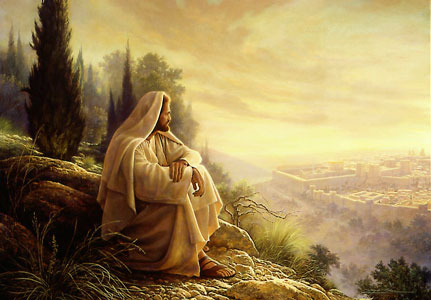
Jesus Overlooking Jerusalem      Those Christians who have leisure should be mindful of their brethren who have the same needs and the same rights, yet cannot rest from work because of poverty and misery. Sunday is traditionally consecrated by Christian piety to good works and humble service of the sick, the infirm, and the elderly. Christians will also sanctify Sunday by devoting time and care to their families and relatives, often difficult to do on other days of the week. Sunday is a time for reflection, silence, cultivation of the mind, and meditation which furthers the growth of the Christian interior life.

      Sanctifying Sundays and holy days requires a common effort. Every Christian should avoid making unnecessary demands on others that would hinder them from observing the Lord’s Day. Traditional activities (sports, restaurants, etc.), and social necessities (public services, etc.), require some people to work on Sundays, but everyone should still take care to set aside sufficient time for leisure. With temperance and charity the faithful will see to it that they avoid the excesses and violence sometimes associated with popular leisure activities. In spite of economic constraints, public authorities should ensure citizens a time intended for rest and divine worship. Employers have a similar obligation toward their employees.

The Priest’s “Secret” Prayers at Mass

July 22, 2015

Offering the Mystical and Holy Mass     Did you know that the Church gives priests celebrating the Mass several prayers to say in a low voice such that few (if any) in the church hear them? These are called the “secret” prayers (from the Latin word for “hidden.”) May the great beauty of these prayers inform and inspire your own devotion at Holy Mass.

The priest, before proclaiming the Gospel, pauses in front of the altar to bow and pray:

“Cleanse my heart and my lips, almighty God, that I may worthily proclaim your holy Gospel.”

 At the end of the Gospel, the priest (or proclaiming deacon) kisses the book and prays:

“Through the words of the Gospel may our sins be wiped away.”

During the Offertory, the priest (or assisting deacon) pours a little water into the chalice of unconsecrated wine and prays:

By the mystery of this water and wine may we come to share in the divinity of Christ, who humbled himself to share in our humanity.”

After thanking God for the gifts of bread and wine He has given us to offer (“Blessed are you, Lord God of all creation…”) the priest bows behind the altar and prays:

“With humble spirit and contrite heart may we be accepted by you, O Lord, and may our sacrifice in your sight this day be pleasing to you, Lord God.”

While the priest washes his hands, he prays:

“Wash me, O Lord, from my iniquity and cleanse me from my sin.”

During the “Lamb of God,” the priest places a small piece of the Host into the chalice, praying:

“May this mingling of the Body and Blood of our Lord Jesus Christ bring eternal life to us who receive it.”

At the end of the “Lamb of God,” the priest joins his hands and prays one of these two prayers:

1. “Lord Jesus Christ, Son of the living God, who, by the will of the Father and the work of the Holy Spirit, through your death gave life to the world, free me by this, your most holy Body and Blood from all my sins and from every evil; keep me always faithful to your commandments, and never let me be parted from you.”

2. “May the receiving of your Body and Blood, Lord Jesus Christ, not bring me to judgment and condemnation, but through your loving mercy be for me protection in mind and body and a healing remedy.”

Before consuming the Body of Christ, the priest prays:

May the Body of Christ keep me safe for eternal life.

Before consuming the Blood of Christ from the chalice, the priest prays:

May the Blood of Christ keep me safe for eternal life.

Finally, while purifying the sacred vessels following the distribution of Communion, the priest prays:

“What has passed our lips as food, O Lord, may we possess in purity of heart, that what has been given to us in time may be our healing for eternity.”

Starving the Beast

July 22, 2015

A Baby Held In Hands

According to 2nd Vote, a consumer research app, the following corporations have all made direct contributions to Planned Parenthood—the group which sold and performed more than 327,000 abortions in our country last year:

Clothes & Body: Avon, Bath & Body Works, Converse, Dockers, Johnson & Johnson, La Senza, Levi Strauss, Macy’s, Nike, Unilever, Pfizer

Charities: American Cancer Society, March of Dimes, Susan G. Komen, United Way

Finance & Insurance: American Express, Bank of America, Deutsche Bank, Fannie Mae, Liberty Mutual, Morgan Stanley, Progressive, Wells Fargo

Food: Ben & Jerry’sPepsiCo, Starbucks, Tostitos

Industrial: Energizer, Clorox, ExxonMobil

Tech: Adobe, AT&T, Expedia, Groupon, Intuit, Microsoft, Oracle, Verizon

It is not a sin for a person to use the products or services of these Planned Parenthood supporting companies (since the customer’s connection to abortions is so very indirect and remote.) However, it might do good for many of us to cease, wherever possible, giving these companies our business and to let them know our reason why. For example:

Dear Sir or Madam,

It has come to my attention that your company has given direct contributions to Planned Parenthood, a group that has killed millions of innocent human beings. Because of this, as far as possible, I will no longer be your customer and I will encourage others to do likewise. I urge your company to reconsider its support of Planned Parenthood.

Sincerely,
{Signed}

[Links to each company’s feedback page are provided above.]

Finally, it should be noted that the largest single contributor to Planned Parenthood is not any of these companies, but our own government. In the 2013-2014 fiscal year, Planned Parenthood received $528.4 million in taxpayer-funded health service grants and reimbursements. Efforts to end this public funding of Planned Parenthood are also worthy of our support.

Source:  The Daily Signal – “Meet the 38 Companies That Donate Directly to Planned Parenthood

My Five Most Common Bits of Advice in Confession

July 17, 2015
Peter Swims to Jesus on the Shore in John 21

Peter was not afraid to approach the Lord whom he had denied, leading to his tripartite reconciliation. We can encounter Jesus likewise in the Sacrament of Confession.

Of the seven sacraments, Confession is my second favorite (after the Holy Eucharist.) This holds whether I am the one absolving or the one being absolved. It feels good to have that joy of a fresh beginning, or to know that I have helped another come nearer to the Lord. Having our sins forgiven does us incredible good — exorcists say a good confession is more powerful than an exorcism — but the priest in the confessional usually also offers some advice to help us cooperate with God’s grace, sin no more, and live daily life with peace.

Priests tend to hear certain sins or fears more often than others in confession, and in response to these a priest will tend to give similar advice. At risk of making my priestly counsel stale, but in hopes of spreading these helpful lessons for the benefit of many, I have detailed below the five most frequent pieces of advice that I share in confession.

Being Tempted Is Not The Same As Sinning

No priest should say that a sin is not a sin, but priests do right to free troubled consciences from guilt about things which are not sinful. Guilt from experiencing temptation is one example. Temptation, in and of itself, is not a sin. A temptation becomes a sin when we welcome its presence and give it our “yes.”

Sometimes people confess having bad thoughts or desires. I ask them whether they welcomed or entertained these temptations or if they resisted them. This matters because thoughts, feelings, and desires will often come our way without our willing them, but it is what we choose that is important. Only when our will chooses do we act in a saintly or sinful way. For instance, choosing to resist a temptation by praying or distracting ourselves is a holy deed. A saint is not someone who never knows temptation—he or she will likely understand temptation better than most—a saint is someone who consistently chooses love and the Lord even amidst temptation.

Good & Bad Reasons For Missing Mass

Our Sunday obligation flows from the commandment to keep the Lord’s Day holy. Whenever someone confesses missing Holy Mass I ask whether it was by their own choice. (Again, what we do not choose is not our sin.) Sickness, hazardous travel conditions, or the need to care for others are all serious reasons that justly excuse us from attending Mass. However, deliberate, willful absence (such as on a family vacation) is a sin to be avoided. Using the internet and a telephone we can plan ahead to find and celebrate the Lord’s Sacrifice wherever our travels take us.

Forgiving May Not Be What You Think

Sometimes anguished persons confess that they just cannot forgive someone, even though they want to. Usually, this turmoil is due to thinking that forgiveness means something it does not. For example, without a bout of amnesia, we cannot literally “forgive and forget.” And trying to agree that past sins done to us were not actually wrong is a lie against the truth. Sometimes sins break relationships and circumstances such that things cannot go back to same way they were before. Or, perhaps we may still feel the pain inflicted—for some wounds cannot be healed merely by our willing it, but only with grace and time. However, none of these realities prevent us from forgiving. In fact, the person who desires to forgive already has everything they need to begin.

Forgiveness means loving someone despite past wrongs. Jesus calls us to love everyone, which means that we must forgive everyone. If you fear that there is someone whom you hate or whom you have not forgiven, simply pray for them. It is impossible to both will the eternal good of another (as we do in prayer) and to hate them at the same time. If you are praying for them, you are loving and forgiving them. The Holy Spirit may prompt you to take further steps in forgiveness down the road, but your prayer begins to open you both to the transforming power of God.

Training Yourself Not To Misuse Holy Names

Crude language is bad, but swearing by misusing the holy name of God or his saints is worse. Our love and respect for someone should be reflected, not negated, by our words. Whenever someone confesses the habitual sin of taking the Lord’s name in vain I suggest a new habit: The next time you misuse a holy name, as soon as you realize it, follow it with a praise (such as “I love you, Lord,” or a “Glory Be…’) This will do three things: it will help undo the wrong with a good (getting you back on the horse,) it will help drive out the bad habit with a good one, and it will present a Christian witness to anyone who may have overheard your profanity.

Apologizing To Your Children

When parents confess to yelling in (uncontrolled) anger at their kids, I ask them whether they apologized to their children. This is a good and beautiful thing for a parent to do because it models true Christian behavior for the children: “I needed to discipline you because you were doing something wrong, but I shouldn’t have yelled at you. I’m sorry.” If we want our children to repent of wrongdoings and seek forgiveness, we must walk the talk and show them how it looks. Authority is most respected when it manifests integrity.

A Tail of Abraham Lincoln

June 28, 2015

Abe Lincoln reportedly said, “How many legs does a dog have if you call the tail a leg? Four. Calling a tail a leg doesn’t make it a leg.”

Someone today might ask, “Why do you hate dogs, Mr. President? Don’t you want them to be happy?”

I can imagine Abe honestly replying, “I do not hate them (while I personally prefer felines*, I also like canines) but declaring their tails a leg won’t help them run any faster. And if some poor creature attempts to run on it, it just won’t work. He’ll hurt himself and he won’t be happier. God’s creatures, in order to be happy, must walk in proper ways.”

(*– When asked if her husband had a hobby, Mary Todd Lincoln replied, “Cats.” )

The Meaning of Life

June 9, 2015

Homer Simpson once had this exchange with “God”:

HomerGod, I’ve gotta ask you something.
What’s the meaning of life?

God:      Homer, I can’t tell you that.
HomerC’mon!
God:      You’ll find out when you die.
HomerI can’t wait that long!
God:      You can’t wait six months?
HomerNo, tell me now!
God:      Well, OK. The meaning of life is…

[The theme song and ending credits interrupt before we hear the answer.]

So what is the meaning of life? Why are we here, for what purpose do we exist?

Philosophers and TV writers may balk at the answer, but for Christians this is not an unanswerable riddle. Jesus Christ tells us what we are meant to do on earth (and likewise, in Heaven): first, to “love the Lord, your God, with all your heart, with all your soul, with all your strength, and with all your mind,” and second, to “love your neighbor as yourself.” (Matthew 22:37-40, Mark 12:30-31, & Luke 10:27-28)

Nothing is more important than this. This is what the Law, the Gospels, the prophets, and the saints are all about. Loving relationship with God and each other is the meaning of our lives. Of what enduring value is anything else if separated from this?

Blessed with knowing this precious knowledge, how are you going to live?

A Memorial Day Prayer

May 25, 2015

Lord Jesus Christ, you journeyed far from your home in heaven to save us on earth who could not save ourselves.

You were not eager to suffer and to die, but you gave your life so that the good would prevail.

Lord, you taught us: ‘There is no greater love than to lay down one’s life for one’s friend.’

Today we remember those who journeyed far from home, to defend, to fight for, to save people who could not save themselves.

We remember those who, while still loving life, risked their lives, and ultimately gave their lives, for freedom, for goodness, for right to prevail.

We honor those who laid down their lives for Americans at home, for innocents abroad, and for the brothers-in-arms at their side.

May our remembrance today of these fallen dead honor them fittingly, and be pleasing to you, as we honor the virtues displayed in them which you love so much. 

Amen.

U.S. Flag

The “Light” of the Holy Spirit

May 21, 2015

        “The Spirit is the source of holiness, a spiritual light, and he offers His own light to every mind to help it in its search for truth. By nature the Spirit is beyond the reach of our mind, but we can know Him by His goodness. The power of the Spirit fills the whole universe, but he gives Himself only to those who are worthy, acting in each according to the measure of his faith.

“I believe in the Holy Spirit, the Lord, the giver of life, who proceeds from the Father and the Son, who with the Father and the Son is adored & glorified, who has spoken through the prophets.”

        Simple in Himself, the Spirit is manifold in His mighty works. The whole of His being is present to each individual; the whole of His being is present everywhere. Though shared in by many, He remains unchanged; His self giving is no loss to Himself. Like the sunshine, which permeates all the atmosphere, spreading over land and sea, and yet is enjoyed by each person as though it were for him alone, so the Spirit pours forth His grace in full measure, sufficient for all, and yet is present as though exclusively to everyone who can receive Him. To all creatures that share in Him he gives a delight limited only by their own nature, not by His ability to give.  …

        As clear, transparent substances become very bright when sunlight falls on them and shine with a new radiance, so also souls in whom the Spirit dwells, and who are enlightened by the Spirit, become spiritual themselves and a source of grace for others. From the Spirit comes foreknowledge of the future, understanding of the mysteries of faith, insight into the hidden meaning of Scripture, and other special gifts. Through the Spirit we become citizens of heaven, we enter into eternal happiness, and abide in God. Through the Spirit we acquire a likeness to God; indeed, we attain what is beyond our most sublime aspirations—we become God.”

— St. Basil the Great (c. 329-379 AD)

Why Did Christ Call the Grace of the Holy Spirit Water?

May 21, 2015

In John’s gospel, Jesus tells the Samaritan woman at the well, “Whoever drinks the water I shall give will never thirst; the water I shall give will become in him a spring of water welling up to eternal life.” Later, Jesus stands up at the Temple and exclaims, “Let anyone who thirsts come to me and drink. Whoever believes in me, as scripture says: ‘Rivers of living water will flow from within him.’” The text explains, “He said this in reference to the Spirit that those who came to believe in him were to receive.” Why did Jesus liken the grace of the Holy Spirit to water? St. Cyril of Jerusalem (313-386 AD) gives this insightful explanation:

“[A]ll things are dependent on water; plants and animals have their origin in water. Water comes down from heaven as rain, and although it is always the same in itself, it produces many different effects, one in the palm tree, another in the vine, and so on throughout the whole of creation. It does not come down, now as one thing, now as another, but while remaining essentially the same, it adapts itself to the needs of every creature that receives it.

Holy Spirit Dove - Sacred Heart Catholic Church -  Wauzeka WIIn the same way the Holy Spirit, whose nature is always the same, simple and indivisible, apportions grace to each man as he wills. Like a dry tree which puts forth shoots when watered, the soul bears the fruit of holiness when repentance has made it worthy of receiving the Holy Spirit.

Although the Spirit never changes, the effects of his action, by the will of God and in the name of Christ, are both many and marvelous. The Spirit makes one man a teacher of divine truth, inspires another to prophesy, gives another the power of casting out devils, enables another to interpret holy Scripture. The Spirit strengthens one man’s self-control, shows another how to help the poor, teaches another to fast and lead a life of asceticism, makes another oblivious to the needs of the body, trains another for martyrdom. His action is different in different people, but the Spirit Himself is always the same. In each person, Scripture says, the Spirit reveals his presence in a particular way for the common good.

The Spirit comes gently and makes Himself known by His fragrance. He is not felt as a burden, for He is light, very light. Rays of light and knowledge stream before Him as He approaches. The Spirit comes with the tenderness of a true friend and protector to save, to heal, to teach, to counsel, to strengthen, to console. The Spirit comes to enlighten the mind first of the one who receives Him, and then, through Him, the minds of others as well.

As light strikes the eyes of a man who comes out of darkness into the sunshine and enables him to see clearly things he could not discern before, so light floods the soul of the man counted worthy of receiving the Holy Spirit and enables him to see things beyond the range of human vision, thing hitherto undreamed of.”

A Persistent, Predictable Trend

May 2, 2015

Wedding Cake Man and WifeIn the garden, the first married couple was approached by the tempter. He sowed distrust of God and His teaching within their minds and hearts. He told them to decide for themselves what was good for them. So they ate the fruit that God had warned them about, and they tasted its consequences. Yet God did not abandon them.

The early Church was not unaware of contraceptive means and methods. She insisted that acts of marital union must not be cut off from an openness to life. Before 1930, all Protestant denominations agreed, but one by one their positions changed. By 1968, some were surprised that Pope Paul VI upheld the Church’s teaching in Humanae Vitae. The pope warned that contraception would lead to increased fornication, marital infidelity, disrespect toward women, and government coercion. The world did not listen.

What has come from our culture intentionally severing an openness to life from its lovemaking? It has led to millions of children having single mothers because fathers considered themselves under no obligation. It has led to the death of millions of “mistakes” before they could be born. Contraceptives promised to make families stronger, but broken marriages are widespread.

The contraceptive mentality has progressed so far that many no longer see physical complimentarily as essential to marriage at all. How will children be impacted if new forms of marriage become the law of the land? If marriage is merely an emotional bond between persons, why should it be limited to pairs? Marital union between one man and one wife is a gift from God for love and life. And what God has joined, we human beings separate to our own harm.

We see the Sexual Revolution becoming an open war against the Bride of Christ and her sons and daughters. As Chicago’s Cardinal Francis George, who passed away last month, once said, “I expect to die in bed, my successor will die in prison, and his successor will die a martyr in the public square. His successor will pick up the shards of a ruined society and slowly help rebuild civilization, as the church has done so often in human history.” Trials await us. Yet, anchored in the truth, our hope always remains, for God will not abandon us.

Our Glorified Bodies Shall Be Like His

April 18, 2015

In inspired Scripture, St. Paul tells us:

“[The Lord Jesus Christ] will change our lowly body to conform with his glorified body by the power that enables him also to bring all things into subjection to himself.” 1

This means that we can glimpse what our own resurrected bodies will be like someday by studying the resurrected body of Jesus Christ.

The Resurrection by El Greco, Madrid, 1596-1600.•  Jesus’ Resurrected Body is the Same Body He Died In

        The tomb is empty on Easter morning because Jesus’ body is raised.2 On Easter evening, Jesus shows his disciples the wounds of his hands, feet, and side, which he received on the cross.3 His body retains its “flesh and bones” and can be touched and held.4 Our own dead bodies will similarly be reclaimed and resurrected, from the tomb, the sea, or the dust of the earth.5 St. Paul is so insistent on our own future resurrection he says, “If there is no resurrection of the dead, then neither has Christ been raised.” 6

•  Jesus Resurrected can do the Ordinary Things He did Before

        On Easter Sunday, Jesus walks and talks.7 He can breathe and eat.8 He knows who he is and he remembers his friends.9 (There is no reason to think that the dead will forget the lives they lived or their loved ones.)

•  Jesus’ Resurrected Body can also do Extraordinary Things

        Though he is no ghost, Jesus can appear suddenly within a locked room or vanish from another.10 He can make himself unrecognizable to those who know him.11 His body can ascend into heaven.12 And now, resurrected to life, he dies no more, for “death no longer has power over him.” 13

        The spiritual gifts granted to some saints on earth (such as bi-location, levitation, incorruptibility, etc.) suggest powers belonging to our future glorified bodies. For her various apparitions, the Blessed Virgin Mary may be modifying her glorified body’s physical appearance (for example, to be as a dark-haired native at Guadalupe in Mexico, but fair and blond-haired at Champion, Wisconsin.)

•  Our Conclusion

        The bodies in which we live and die will be same ones in which we rise. Our glorified bodies will be able to do the familiar things we know, yet we shall also possess new abilities which seem extraordinary to us now. St. Paul describes our future glorified bodies in this way:

“Someone may say, ‘How are the dead raised? With what kind of body will they come back?’

It is sown corruptible; it is raised incorruptible. It is sown dishonorable; it is raised glorious. It is sown weak; it is raised powerful. It is sown a natural body; it is raised a spiritual body.

That which is corruptible must clothe itself with incorruptibility, and that which is mortal must clothe itself with immortality.” 14

Endnotes:

  1. Philippians 3:21
  2. Matthew 28:6
  3. Luke 24:40, John 20:20
  4. Luke 24:39, John 20:17, Matthew 28:9
  5. John 5:28-29, Revelation 20:13
  6. 1 Corinthians 15:13
  7. Luke 24:15
  8. John 20:22, Luke 24:42-43
  9. Luke 24:39, John 20:16-17
  10. John 20:19 & 26, Luke 24:31
  11. Luke 24:16, John 21:12
  12. Acts 1:9, Mark 16:19; Luke 24:51
  13. Romans 6:9
  14. 1 Corinthians 15:35, 42-44 & 53

Shalom x 3

April 11, 2015

Isaiah saw Seraphim in the temple before God crying out to each other, “Holy, holy, holy is the LORD of hosts! All the earth is filled with his glory!” (Isaiah 6:3) God is indeed the most holy.

The charge nailed to the cross above Jesus’ head reads three times: “Jesus of Nazareth, King of the Jews” (written in Hebrew, Greek, & Latin.) Jesus is the greatest king.

After his resurrection, Jesus appears twice in the upper room and says the same thing three times: “Peace be with you.” He offers us the profoundest peace.

5 Fresh Ways to Pray the Psalms

April 3, 2015

Daily prayer is essential to the Christian life and the psalms are prayers  inspired for us by God. They were prayed in the Old Testament Jewish Temple and within the New Covenant Christian Church up to our day. Here are five fresh ways to pray the psalms:

Mount Calvary's Cross - Sacred Heart Catholic Church -  Wauzeka WI1.  Pray Jesus’ Passion Psalms

For thousands of years, Jews have ritually prayed Psalms 113–118 at their Passover meals. These are psalms of joy and thanksgiving at God delivering his people. At the Last Supper, Jesus and his apostles chanted these psalms: “Then, after singing a hymn, they went out to the Mount of Olives.” (Mark 14:26, Matthew 26:30)

Later, hanging on the cross, Jesus said, “My God, my God, why have you abandoned me?” This is the opening line of Psalm 22, which describes the anguish of someone suffering just like Jesus. For example, it says, “They have pierced my hands and my feet…” The psalm, however, ends in hope: “I will live for the LORD.”

Praying these psalms (113-118 & 22) can connect us more to Jesus and his Passion.

2.  Pray the Psalms Through Jesus or Mary

Fleur-De-Lis - Sacred Heart Catholic Church -  Wauzeka WIWould you like to read Jesus and Mary’s prayer book? This is what we have in the psalms. Being faithful Jews, Jesus and his mother would have known them well and prayed them often. A fresh way to approach the psalms is to open yourself to sharing in Jesus or Mary’s thoughts and emotions. Praying with their minds and hearts helps us to experience the psalms with new insights and depths.

3.  Pray the Psalms to Jesus

Jesus said, “The Father and I are one,” and St. Paul wrote, “Jesus Christ is Lord.” (John 10:30, Philippians 2:11) Therefore, wherever the psalms mention “(the) Lord,” substituting “Jesus” usually applies just as truly. Here, for example, is a converted passage from Psalm 27:

Hear my voice, Jesus, when I call;
have mercy on me and answer me.
“Come,” says my heart, “seek his face”;
your face, Jesus, do I seek!

Praying the psalms’ to Jesus in this way brings us personally closer to him. Here are a few suggested Jesus Psalms: 3, 27, 86, 100, 103, & 138.

4.  Pray Repeating Each Line of the Psalm

Burning Incense - Sacred Heart Catholic Church -  Wauzeka WIAs you read through a psalm, pray each line twice, meditating on the profound, absolute truth of each statement. Praying in this way helps to make the prayer “yours” and yields greater focus and personal conviction.

5.  Pray the Psalms for Others

Some people do not, or cannot, pray the psalms. Some lack belief in God and prayer. Others feel too overwhelmed by their pains, anxieties, or other burdens to offer these prayers themselves. Among the 150 psalms there are prayers for the vast range of human experience. Not everyone will resonate with your personal situation on a particular day, but each one is exactly the prayer that, somewhere, someone else desperately needs. Pray it for them to help them go through their darkness into the light.

“One on His Right, the Other on His Left”

March 24, 2015

Revealing fascinating prophetic connections between Moses, Joshua, Samson, and Jesus Christ on the Cross; featuring the religious paintings of James Tissot (1836-1902.)