Archive for the ‘Reflection’ Category

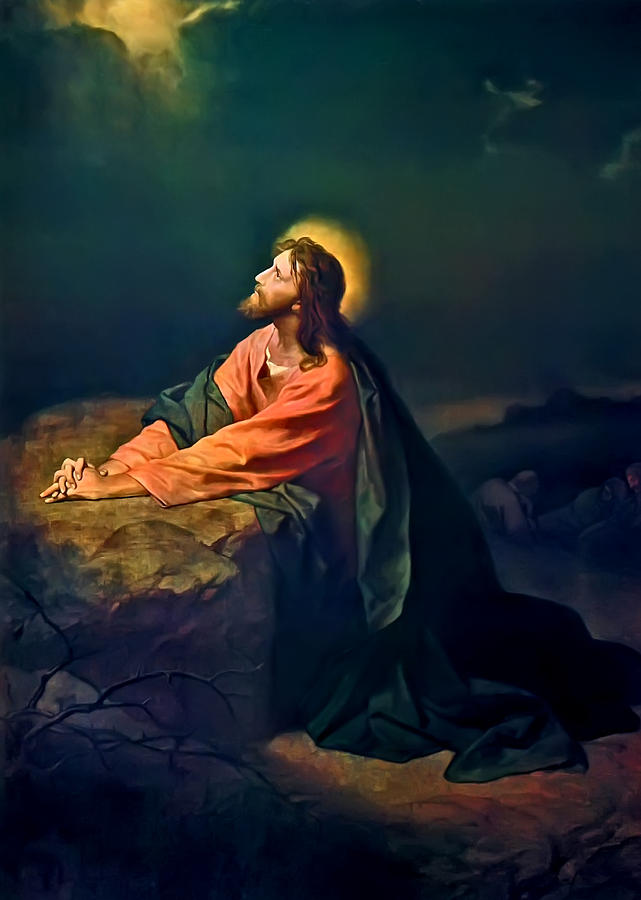
Jesus Psalms

July 30, 2020

To pray the psalms in a fresh new way, wherever you see “the LORD” in a verse substitute the name “Jesus“. For example, here is most of this Sunday’s psalm (Ps 145:8-21) as explicit praise and celebration of God the Son:


Jesus is gracious and merciful,
slow to anger and abounding in mercy.

Jesus is good to all,
compassionate toward all your works.

All your works give you thanks, Jesus,
and your faithful bless you.

They speak of the glory of your reign
and tell of your mighty works,

Making known to the sons of men your mighty acts,
the majestic glory of your rule.

Your reign is a reign for all ages,
your dominion for all generations.

Jesus is trustworthy in all his words,
and loving in all his works.

The Jesus supports all who are falling
and raises up all who are bowed down.

The eyes of all look hopefully to you;
you give them their food in due season.

You open wide your hand
and satisfy the desire of every living thing.

Jesus is just in all his ways,
merciful in all his works.

Jesus is near to all who call upon him,
to all who call upon him in truth.

He fulfills the desire of those who fear him;
he hears their cry and saves them.

Jesus watches over all who love him,
but all the wicked he destroys.

My mouth will speak the praises of Jesus;
all flesh will bless his holy name forever and ever.

Meet St. Paul’s Newest Teacher

July 20, 2020

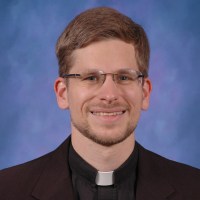
Rachael Butek is a Cooks Valley native and graduate of Christendom College. She will be teaching English and Religion at St. Paul’s Catholic School this fall.

Why did you choose to teach at St. Paul’s?
Because to me teaching is a mission, not just a job, and as a member of St. John’s for the past 15 years I desired to give back to the community which has done so much for me.

What do you love about English?
Everything! I love the intricacy of our language, and delving into its origins in order to better understand how we communicate today. I also enjoy exploring the way that good literature can communicate Truth and Beauty to us.

What are ten other things you like?
In no particular order: Anglo-Saxon England, gardening, calligraphy, wild turkeys, book binding, singing, bugs, dancing, long walks, and good conversation. Feel free to ask me about any of them!

What do you wish to become patron saint of someday?
Good communication. I think about 90% of the worlds problems could be improved by better communication skills!

To learn more about enrolling into St. Paul’s Catholic School call our principal, Jackie Peterson, at 715-568-3233.

Virtuous Thomas

July 14, 2020

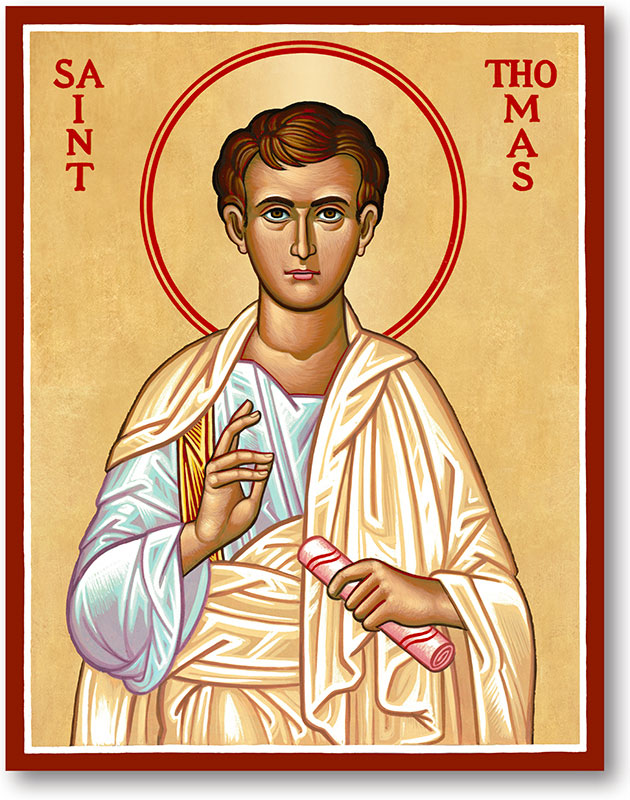
Doubting Thomas — That is how the apostle is remembered since he said, “Unless I see the mark of the nails in his hands and put my finger into the nailmarks and put my hand into his side, I will not believe.” Upon seeing Jesus alive he professed, “My Lord and my God,” but the ignoble nickname endures. St. Thomas has just four quotes in the gospels, all of them found in John; his two other quotes reveal more of his character.

After Lazarus had died, Jesus said, “Let us go back to Judea,” and the disciples objected, “Rabbi, the Jews were just trying to stone you and you want to go back there?” When Jesus insists on going, Thomas says to his fellow disciples, “Let us also go to die with him.” Then later, Jesus says at the Last Supper, “Where I am going you know the way.” And Thomas relies, “Master, we do not know where you are going; how can we know the way?

From his four quotes we glimpse Thomas’ weakness and his strengths. He should have believed his friends’ testimony that they had indeed seen and touched and spoken with Jesus resurrected (especially after having witnessed Lazarus risen from the dead) but Thomas was lacking in trust. Yet at the same time, Thomas possesses great loyalty and courage.

Where is Thomas one week after Easter Sunday? The disciples are gathered in the upper room, hiding behind locked doors for fear of those who murdered Jesus, and Thomas is right there with them. He could have chosen to retreat to someplace safer but he is loyal and brave and these virtues lead him to encounter the risen Christ.

We typically focus on our faults and flaws, on the vices and sins that hinder us. However we each possess virtues as well, areas where God has had success in us. Know and acknowledge these virtues, give thanks to God for them, and utilize them to grow. Pray for grace and use your strengths to lead you to perfect holiness like St. Thomas’ virtues led him to glory with Jesus Christ.

False Paths to Paradise

July 9, 2020

Early in the Book of Genesis we read about a great flood wiping out humanity (sparing only Noah, his three sons, and their wives) and then about people building a great city and high tower until God confounds their efforts. These two inspired tales hold important lessons for every society in history, including our’s today.

When God saw how wicked the human race was he decided to pour down judgment on the earth and start over. So he told Noah, the best of men, to build an ark for his family to survive. Once the floodwaters had receded, “God blessed Noah and his sons and said to them: Be fertile and multiply and fill the earth.” This was to be Eden anew. But when Noah drank wine to excess and became drunk he was somehow violated by his son while laying naked inside his tent. The flood was meant to cleanse the earth of sin, but sin stowed away upon the ark.

Then, after detailing Noah’s descendants, Genesis tells how people said, “Come, let us build ourselves a city and a tower with its top in the sky, and so make a name for ourselves!” The Lord said, “If now, while they are one people and all have the same language, they have started to do this, nothing they presume to do will be out of their reach.” God confused their language so that they stopped building the city and scattered across the earth. Why did God react this way? That city is called Babel because God made them babblers but also likely in reference to ancient Babylon, the enemies of God’s people who had high towers called zigguratts on which they worshiped false gods and offered human sacrifices. God thwarts Babel to limit the evils they can accomplish.

The tales of the Great Flood and the Tower of Babel reflect two ineffective strategies for eradicating evil: purging all the wicked and uniting everyone apart from God. Our world seeks scapegoats, persons and groups to blame for our problems. “If only it were all so simple,” writes Aleksandr Solzhenitsyn. “If only there were evil people somewhere insidiously committing evil deeds, and it were necessary only to separate them from the rest of us and destroy them. But the line dividing good and evil cuts through the heart of every human being. And who is willing to destroy a piece of his own heart?” Our world also clamors for greater unity in one leader or party, nation or race, economic system or secular ideology. We must not ignore politics, realizing that a movement detached from God and sufficiently empowered will lead people to physical and spiritual deaths.

God’s desire is to unite all peoples in Christ, undoing Babel with Pentecost. The Church, Christ in his members, is sent to save our world through conversion rather than destruction “for God did not send his Son into the world to condemn the world but that the world might be saved through him.” Sin and sinners must be opposed but not without the love which we ourselves have received as sinners reconciled to God. Take courage today by recalling the conversions of Saul and the Romans Empire, Christianity’s early enemies – by grace and virtue the Church can win over even her worst persecutors.

Called & Led into His Friendship & Community

June 17, 2020

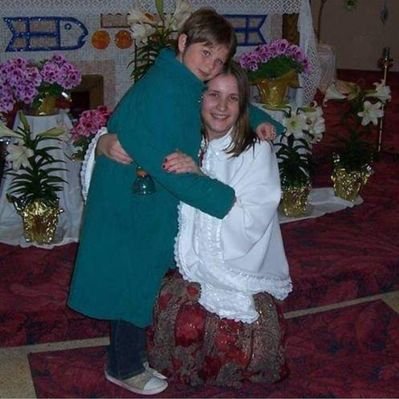
Elena Feick at 2007’s Easter Vigil where she received the Sacraments of Initiation

How does a 15-year-old unbaptized Canadian girl, a practicing Wiccan with SSA, come to find a relationship with Jesus in his Catholic Church? For Elena Feick, her journey began when she sought to join a coven.

Elena used to meditate by herself, worshiping the five elements and a pagan goddess, but she longed for more community. A particular coven, before they would admit her, asked that she research another religion besides Wicca first. Elena chose to read Christianity’s Gospels thinking she would be able to easily dismiss them. However, to her surprise, “I just… believed them. I didn’t want to. But when I got to Luke 11:9 (“And I tell you, ask and you will receive; seek and you will find; knock and the door will be opened to you”), I realised I did believe. But I didn’t like how the Christian God wasn’t willing to share me with other ‘gods’ so I resisted for a long time.” She still wanted to practice Wicca and worship a goddess yet she couldn’t say she didn’t believe in Christianity. So, instead of joining a coven, she joined the Unitarian Universalists (a creedless religious movement founded in 1961).

Elena’s journey to God was then helped by another unlikely source: “Sex and the City.” That was her favorite TV show as a teenager and her favorite character on it was Charlotte (played by Kristin Davis). In one episode, Charlotte converted to a new religion in hopes that her Jewish boyfriend would marry her. Elena was very disappointed in Charlotte, convinced that she had the ordering of things all wrong. “One’s relationship with God should come before even romantic relationships,” she thought. That’s when Elena decided not to date anyone seriously until she figured out for sure what she believed. She went on to explore lots of religions. Eventually, against her will, she ended up at a Catholic Mass.

The Mass was held at her new Catholic school and she was very afraid to attend. She thought the priest might supernaturally read her soul and denounce her as a witch. But when he gave her a blessing at Communion time something happened. In a way she couldn’t explain or put a finger on, she felt different and overwhelmed. “I can still sometimes feel his thumb tracing a cross on my forehead. It was the first time I really experienced the feeling of the love of God.” A few weeks later she decided to ask the priest about the experience and that was her inroad to the Church. A year later, she joined the local RCIA program to become Catholic. “It took quite a few conversations before I would agree to stop practicing Wicca though! But I did, just before I started RCIA.

Elena beside a reliquary of St. Therese of Lisieux in Scotland in the fall of 2019

When her RCIA teachers instructed the class about the Real Presence of Jesus in the Holy Eucharist, Elena was skeptical. “Ok, so they’re crazy,” she thought. But at the encouragement of the now-trusted priest who had blessed her (Fr. Terence Runstedler of Ontario) she began going to the perpetual adoration chapel every day and recognized its graces. “[I] realised that things I had prayed over at home that made no sense made perfect sense if I prayed over them in the chapel. …Every time I went to Adoration, Jesus spoke to me in some way. Every time. I couldn’t ignore it. … The Eucharist is the reason I didn’t completely ignore Church teaching on SSA [same-sex attraction] and find myself a girlfriend.

Elena had been in denial about her attractions growing up. After discovering Catholicism, she prayed for these feelings to go away but they wouldn’t. She decided that maybe the Church was wrong and started going to LGBT support groups. Her mind changed back again at her grandmother’s funeral. It was a non-Catholic service and everyone was invited to come forward and receive their communion, “but I just knew so powerfully that I couldn’t because it wasn’t *Him*. It was lacking the Real Presence. Which meant I still believed in the Eucharist. Which meant the Church has to be right. So I changed my whole life again even though I didn’t understand the teachings on chastity.”

In 2007, at the age of 19, Elena was baptized, confirmed, and received her First Communion at the Easter Vigil. “Right up to the night, I was still partially afraid that God would strike me down when the baptismal waters touched me. I wanted so much to belong to Him but half thought that maybe He didn’t want me… I thought if He wanted me in the Church, why didn’t He have me born in a Catholic family? But then I received Him for the first time and I just *knew*. I could hear Him (not like a voice but like thoughts that you know come from Him) saying that I always belonged to Him and always would.” Elena notes that some people have deeply intellectual reasons for converting but her reasons were more relational. “[The Lord] just kept inviting me and pulling me along and putting things in my path I couldn’t ignore. He kept introducing me to Himself, over and over, until I finally recognised it was Him I was longing for.

Elena at The March for Life UK in London, May 2019

Today, Elena is 32 years old, lives in Scotland, and prior to the pandemic she worked as a personal support healthcare worker. (I myself made her acquaintance and learned her story this year through the social media website Twitter.) In her spare time, Elena enjoys writing songs and making rosaries and is a member of both Courage International and Eden Invitation, two groups which support those with same-sex attractions in living chaste and saintly lives. Through Catholic faith and community, she says, “I started to learn my identity as belonging to Christ and as a daughter to the Father.” Elena hopes to help other LGBT-identifying persons to also discover a deeper self-identity in God. Even in the discouraging modern culture we live in, Elena’s story encourages us that Jesus Christ is still powerfully, lovingly, calling and leading people into his friendship and community.

Virtue in Obedience

June 11, 2020

According to likely tradition, St. Ignatius the bishop of Antioch learned about our Faith from St. John the Apostle. Around the year 110 A.D., St. Ignatius was brought by Roman guards from Syria to Rome for his martyrdom. On this long journey, he wrote seven famous letters which provide insight into the teachings and beliefs of the Early Church. In his letter to the Christians in Smyrna, he wrote:

See that you all follow the bishop even as Jesus Christ does the Father, and the presbytery [priests] as you would the apostles; and reverence the deacons as being the institution of God. Let no man do anything connected with the Church without the bishop. Let that be deemed a proper Eucharist which is administered either by the bishop or by one to whom he has entrusted it. Wherever the bishop shall appear, there let the multitude of the people also be; even as wherever Jesus Christ is, there is the Catholic Church.”

Catholic priests at ordination promise obedience to their bishop and his successors, but religious submission to one’s bishop-shepherd (in things which are not sinful) is Christ’s will for all the faithful. “Whoever hears you, hears me,” Jesus said, and “whatever you shall bind on earth shall be bound in Heaven, and whatever you shall loose on earth shall be loosed in Heaven.” “Let us be careful, then, not to set ourselves in opposition to the bishop,” St. Ignatius wrote to the Ephesians, “in order that we may be subject to God.” Before he lost the kingdom, King Saul was told by the Prophet Samuel, “Obedience is better than sacrifice; to listen, better than the fat of rams.” The Lord delighted in obedience to his will more than in burnt offerings and animal sacrifices because holy obedience is a sacrifice of one’s own self.

Even the yoke of Christ remains a yoke. It’s natural to feel frustration at our gradual return to normal, towards the careful procedures our bishop has promulgated throughout our diocese to help protect against a still-deadly pandemic. These policies may prove overly cautious in retrospect—and I hope that is the case rather than seeing our safeguards prove tragically inadequate—but the will of Christ for you and I is to obey our God-ordained successor to the apostles. Blessed is that servant whom the Lord on his arrival finds doing so.

Watch “The Chosen”

June 8, 2020

The Chosen” is a truly excellent dramatized series about Jesus’ early ministry. I highly recommend it. They flesh-out characters and scenes from the Gospel texts in creative but faithful ways. The depiction of Jesus is particularly compelling. You can see the first season’s episodes on YouTube or through this free app.


Our Favorite Psalms

May 10, 2020


Matthew Bowe – Psalm 8

My favorite psalm is Psalm 8 – “Yet you [man] have made him little less than a god, crowned him with glory and honor” (verse six). As a mathematics and physics education major in college, I had opportunities to enroll plenty of science courses, including two astronomy courses. I have a fascination with the heavenly bodies. Last year in March I went to Arizona on a science pilgrimage and visited Kitt Peak, which houses astronomical observatories. The universe is expansive and immense. Yet, God is bigger than that. He created the universe, and He is always in control. “O Lord, our Lord, how awesome is your name through all the earth! I will sing of your majesty above the heavens” (verse two). Although the universe massive, it is insignificant compared to God. However, God is Love, and He loves us. We have immense worth and dignity. He gave us “rule over the works of” His “hands” (verse 7a). God is significant for us, and we are significant to Him.


Isaac Pecha – Psalm 16

My favorite Psalm is number 16, principally on account of two lines. The first is “He has put into my heart a marvelous love, for the faithful ones who dwell in his land.” I love this visual of how God, who so loves his children, chooses to show some of his love for others through us. It reminds me of when my dad would invite me to help prepare a Mother’s Day gift for my mom with him — he could have done it just as well on his own, but because he loves both me and my mom, he chose to include me in his act of love for her. The second line is “It is you [God] yourself who are my prize; the lot marked out for me is my delight: welcome indeed the heritage that falls to me!” As a convert to Catholicism, I love the idea of inheriting the Faith from those who went before us. In my hope to become a priest (God-willing), I dream of being involved in God’s acts of love for his children and of passing on this heritage of faith to others in the particular ways that a priest does.


Eric Mashak – Psalm 22

When I first read the passion narrative in the Gospel of Mark I was not sure what to think of verse 27:46. It is where, from the cross, Jesus says those famous words: “My God, My God, why have you forsaken me?” Had the Father really forsaken His Beloved Son? I asked a great assortment of similar questions! It wasn’t until a few years later that I found out that Jesus was actually quoting Psalm 22, which begins: “My God, My God, why have you forsaken me? …” As Jesus grew up praying the Psalms, he knew many of them by heart. They exemplify His relationship with the Father. Reading Psalm 22 in its entirety, I realized that it is actually a psalm of trust in the Father even in the midst of intense tribulation. Jesus was praying this psalm, in His knowledge and love of the Father, in His dying moments. It is beautiful to be brought into the relationship between the Father and the Son in praying this Psalm.


Fr. Victor Feltes – Psalm 63

Praying in bed at night or before the tabernacle in the sanctuary, I desired God since my youth. “O God, you are my God, for you I long.” I saw that without Him there is no lasting satisfaction. “So I gaze on you in the sanctuary to see your strength and your glory.” I discerned that serving God would be the best use of my life. “So I will bless you all my life, in your name I will lift up my hands. My soul shall be filled as with a banquet, my mouth shall praise you with joy.” My desire for the priesthood was really something He placed in me and the Lord brought my vocation to fulfillment, “for you have been my help; in the shadow of your wings I rejoice.” Jesus at the Father’s right hand and Mary at the right hand of Christ have been faithful in their love for me. “My soul clings to you; your right hand holds me fast.” I have not memorized many scripture passages but I know the first twenty lines of the 63rd Psalm very well.

The Christian Commentary of the Ferengi Fathers

April 28, 2020

Though thoroughly pagan, Ferengi culture is very rich. While the love of money and of what tickles the ears leads to many sins and errors, the brilliance of hidden treasure may still be glimpsed shining forth through dirt. Like St. Justin Martyr wrote, God has planted “seeds of truth”, seeds of the Logos, within all pre-Christian peoples in preparation for the fullness of the Gospel.

Let us examine how aphorisms found within Ferengi society’s most influential text (Grand Nagus Gint’sThe Rules of Acquisition”) sometimes point, even despite themselves, to revealed Christian truths. I doubt many Ferengi will forgive me if my interpretations here are too generous, but I hope that many may gain some profit from them.


Jesus called them. So they left their father Zebedee in the boat along with the hired men and followed him.

Rule #6: Never allow family to stand in the way of opportunity.


“Everyone who belongs to the truth listens to my voice.”

Rule #7: Keep your ears open.


“You have drunk, but have not been exhilarated;
have clothed yourselves, but not been warmed;
and he who earned wages earned them
for a bag with holes in it.”

Rule #19: Satisfaction is not guaranteed.


“I give them eternal life, and they shall never perish.   No one can take them out of my hand.”

Rule #42: What’s mine is mine.


“I do not pray for the world but for the ones you have given me, because they are yours, and everything of mine is yours and everything of yours is mine, and I have been glorified in them.”

Rule #43: What’s yours can be mine.


Jesus said, “Father, glorify your name!” Then a voice came from heaven, “I have glorified it and will glorify it again.” The crowd there heard it and said it was thunder, but others said, “An angel has spoken to him.”

Rule #44: Never confuse wisdom with luck.


On that day, there broke out a severe persecution of the church in Jerusalem, and all were scattered throughout the countryside of Judea and Samaria, except the apostles.

Rule #45: Expand or Die.


As Jesus passed on from there, he saw a man named Matthew sitting at the customs post. He said to him, “Follow me.” And he got up and followed him.

Rule #46: Make your shop easy to find.


“God so loved the world that he gave his only Son, so that everyone who believes in him might not perish but might have eternal life.”

Rule #49: Everything is worth something to somebody.


The angel said to the women at the tomb, “I know that you are seeking Jesus the crucified. He is not here, for he has been raised… Go quickly and tell his disciples he has been raised from the dead… Behold, I have told you.”

Rule #55: Advertise.


“Are you the only visitor to Jerusalem who does not know of the things that have taken place there in these days?!”
And Jesus replied to them, “What sort of things?”

Rule #56: Be discreet.


“You must not distort justice: you shall not show partiality; you shall not take a bribe, for a bribe blinds the eyes even of the wise and twists the words even of the just.”

Rule #61: Never underestimate the power of bribery.


“We speak God’s wisdom, mysterious, hidden, which God predetermined before the ages for our glory, and which none of the rulers of this age knew; for if they had known it, they would not have crucified the Lord of glory.”

Rule #85: Never let the competition know what you’re thinking.


“Do not store up for yourselves treasures on earth, where moth and decay destroy, and thieves break in and steal. But store up treasures in heaven, where neither moth nor decay destroys, nor thieves break in and steal.”

Rule #90: The Divine Treasury awaits.


In those days John the Baptist appeared, preaching in the desert of Judea saying, “Repent, for the kingdom of heaven is at hand! … Even now the ax lies at the root of the trees.”

Rule #93: Act without delay! The sharp knife cuts quickly.


“Love your enemies, do good to those who hate you, bless those who curse you, pray for those who mistreat you… Then your reward will be great and you will be children of the Most High, for he himself is kind to the ungrateful and the wicked.”

Rule #118: There is no profit in revenge.


“[Jesus Christ] emptied himself… he humbled himself, becoming obedient to death, even death on a cross. Because of this, God greatly exalted him and bestowed on him the name that is above every name…”

Rule #154: Pain passes, but profits remain.


After they had crucified him, they divided his garments by casting lots…

Rule #162: Even in the worst of times, someone turns a profit.


Behold, the angel of the Lord appeared to Joseph in a dream and said, “Rise, take the child and his mother, flee to Egypt, and stay there until I tell you. Herod is going to search for the child to destroy him.”
Joseph rose and took the child and his mother by night and departed for Egypt.

Rule #173: Dream, plan, believe, act.


“Which of you wishing to construct a tower does not first sit down and calculate the cost to see if there is enough for its completion? Otherwise, after laying the foundation and finding himself unable to finish the work the onlookers should laugh at him… In the same way, everyone of you who does not renounce all his possessions cannot be my disciple.”

Rule #195: You can’t jump a twenty foot gorge in two ten foot jumps.


“I give praise to you, Father, Lord of heaven and earth, for although you have hidden these things from the wise and the learned you have revealed them to the childlike.”

Rule #207: Sense without education is better than education without sense.


The high priest asked him and said to him, “Are you the Messiah, the son of the Blessed One?”
Then Jesus answered, “I am;
and ‘you will see the Son of Man
seated at the right hand of the Power
and coming with the clouds of heaven.”

Rule #208: Sometimes the only thing more dangerous than a question, is an answer.


When the wine ran short, the mother of Jesus said to him, “They have no wine.”
Jesus said to her, “Woman, how does your concern affect me? My hour has not yet come.”
His mother said to the servers, “Do whatever he tells you.”

Rule #225: Always follow one step ahead.


(On the pride of Goliath and Absalom)

Rule #235: Duck; death is tall.


“Do not give what is holy to dogs, or throw your pearls before swine, lest they trample them underfoot, and turn and tear you to pieces.”

Rule #250: Precious things are for those that can prize them.


“Put to death, then, the parts of you that are earthly: immorality, impurity, passion, evil desire, and the greed that is idolatry. Because of these the wrath of God is coming upon the disobedient.”

Rule #257: Despise the things you cannot have.


“After this I had a vision of a great multitude, which no one could count, from every nation, race, people, and tongue. They stood before the throne and before the Lamb, wearing white robes and holding palm branches in their hands.”

Rule #276: Overbooking is standard practice.


Our Seminarians’ Coronavirus Stories

April 6, 2020

God has blessed our parishes with priestly vocations. Of the sixteen seminarians currently enrolled in major seminary for our La Crosse Diocese, three of them (fully 18%) belong to St. Paul’s or to St. John the Baptist’s Parishes. These young men have now returned safely home to us, but what was it like for them to be at seminary as this pandemic arose and what has life been like since? These are their stories.
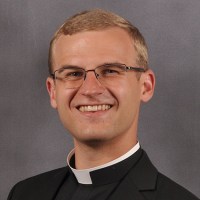
 

Isaac Pecha of St. Paul’s Parish in Bloomer had been studying in 1st Theology at the North American College in Rome. He writes:

My experience of the Coronavirus outbreak has occurred in three stages: the initial outbreak in Italy, the two-week quarantine upon returning to America, and then the statewide stay-at-home order that started right as I left quarantine. Each has come with its own graces, which I share below.

In late February, a few towns in the north of Italy were put on lockdown, but Rome continued as normal. I even remember telling a classmate on March 4th, “I don’t think classes will be cancelled unless someone in the university gets sick.” The next day, the government announced that they were suspending all school activities. Then on March 9th, the lockdown was extended to the whole country. We were called back to America, with a flight out in 11 hours. I said my goodbyes, packed a single suitcase, and we left Rome. An hour after we landed on the 11th, the U.S. suspended travel from Europe. During this stage, my biggest graces were the clear reminder of how little we are in control of things, and having a bishop who acted so wisely as to call us home when he did.

When we got back to America, the four of us La Crosse seminarians had to quarantine together for two weeks before we could go to our families. In the unused rectory where we stayed, we established an horarium and continued to pray, study, and enjoy fraternal time as usual. There was a sliding glass door, and on Sundays a nearby priest would say Mass on the porch outside (with us safely contained in the house). This was the greatest grace of the personal quarantine—a concrete reminder of how lucky we are to have the sacraments, and the lengths to which priests will go to bring them to us.

The day before our release from personal quarantine, Governor Evers issued the statewide stay-at-home order, so as soon as the health department cleared us to leave, we all went straight back to our families. Since then, I have been at home, still taking classes online, spending time with my family. Having little to do besides pray, study, and hang out with my family members has been a great grace.

I am reminded of the words of one of my favorite holy women, Servant of God Chiara Corbella Petrillo. She said, “God does not want to take good things away from you, and if he takes, it is only to give you so much more.” Obviously, I cannot wait to go back to Rome, or receive a parish assignment here in our diocese, but it would be wrong to only long for those things without thanking God also for the good things he has given me in the meantime.
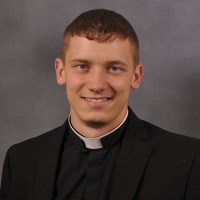
 

To this account, Eric Mashak, the 3rd year theologian from St. John the Baptist Parish in Cooks Valley, simply adds:

For us seminarians who study in Rome, it was very unexpected to be called back to the U.S. by our bishop. We found out that we were coming home around dinner time and were at the airport about 12 hours later. This, for me, was a simple lesson in obedience. There is a necessity for fast acting obedience in the priesthood. Like the Apostle Andrew who dropped his nets and instantly followed Christ, so too the priest needs to be ready to take a new parish assignment at a call from the bishop. Formation never stops! Even when we can’t be in a seminary.


Matthew Bowe of St. Paul’s was studying in 2nd Theology at St. Francis de Sales Seminary just outside of Milwaukee. He writes:

Greetings, brothers and sisters in Christ. I pray that everyone is doing well and is staying healthy. If you or your family or your friends have been deeply affected by the Coronavirus, please know that they are being prayed for in a special way.

Like other places, St. Francis de Sales Seminary had to adjust to the Coronavirus situation. After finishing our spring break, we had classes the week of March 9th. On Friday, March 13th, around 11 a.m., we received an email stating that the plan was to continue with classes on the following Monday. Later that evening around suppertime, all that changed when emails were sent about going to online classes until Easter and that formation would be suspended for a couple of weeks. Seminarians would be allowed to St. Francis Seminary under quarantine during that time if they so wished. For the seminarians of the Diocese of La Crosse, we received an email after supper stating that we were to go home as soon as possible. I have been home since March 14th.

Since then, classes will be conducted online through the end of the semester, and seminarians are to remain where they currently are until St. Francis Seminary tells us otherwise. At home, I have found balance in completing my schoolwork while maintaining prayer times and other healthy habits (e.g., eating well, exercise, and leisure activities). I have been catching up on some good movies and enjoying home-cooked meals with my parents. Further, I help out around the house. Other than that, my life is somewhat uneventful and routine, and there is a peace with that. The stress and pressure of a normal seminary life, which does give me life, have been removed, and I have a more comfortable position to reflect on the good that God has given me during my time as a seminarian. God has given me good gifts during this time of trial and tribulation.

I would like to conclude by asking everyone to continue to keep faith. Although this is a difficult time for everyone, let it bring forth good fruit that can only be achieved by uniting oneself to the will of God. Trust God, and He will do good things for you (in ways that you may not expect). While we brave this storm, let us pray for one another. I will continue to pray for the families of the parish, and I ask you to pray for my family and for my brother seminarians. May the merits of Jesus’ Passion enliven our faith during this Holy Week.

Tips to be Better Prepared

March 31, 2020

Since February 20th, I have encouraged parishioners to be well-prepared for disaster in both body and soul. This post offers some advice on how to be better materially-ready to face this pandemic.

Statistical models from The University of Washington predict U.S. Coronavirus hospitalizations and deaths to peak nationally around April 15th and to peak in Wisconsin around April 27th. Our home state looks like it will fare better than most, but the worst of this crisis still remains ahead of us.

To prepare for this pandemic, the Department of Homeland Security recommends:

  • Storing-up additional supplies of food and water.
  • Periodically checking your prescription drugs to ensure a continuous supply in your home.
  • Having nonprescription drugs and other health supplies on hand (including pain relievers, stomach remedies, cough and cold medicines, fluids with electrolytes, and vitamins).
  • Obtaining copies and maintaining electronic versions of your health records from doctors, hospitals, pharmacies, and other sources and storing them for personal reference.
  • Talking with family members and loved ones about how they would be cared for if they get sick, or what will be needed to care for them in your home.

DHS also urges social distancing; washing your hands with soap or sanitizer; covering your coughs and sneezes; not touching your eyes, nose, or mouth; avoiding people who are sick; and practicing healthy habits.

I also personally recommend these steps (for the unlikely possibility of power or water outages):

  • Storing-up nonperishable food items.
  • Filling spare bathtubs or containers with water, or at least remembering that your water heater and toilet tops contain fresh water.
  • Keeping some extra cash money on hand.
  • And, if running low, filling-up your car’s gas tank. (Though be careful with your hands in touching the pump and nozzle.)

If you need to visit the pharmacy to fill a prescription, call ahead and they may be willing and able to bring out your order to your car and drop it through your passenger side window.

Since, according to the World Health Organization, temperatures of 140° to 150° Fahrenheit are enough to kill most viruses, your oven may be used to sanitize things like mail, documents, or money. (Note however, while paper famously burns at 451°F, some plastics melt at temperatures as low as 165°F.)

God bless and be well.

Screwtape on Pandemics

March 25, 2020

I was introduced to the Christian writing of C.S. Lewis years ago during a time of temptation. Alone at my uncle and aunt’s home, I prayed to God for some kind of diversion. “Lord, give me something (to change where I see things are headed).” The next moment, scanning the living room shelves, I saw a book cover with the image you see here. That paperback preserved me that evening and would go one to become one of my all-time favorite books: The Screwtape Letters.

In these letters, a senior demon named Screwtape instructs a junior demon, his “nephew” Wormwood, in the tactics of misleading humans. Screwtape describes how to draw the soul of one’s “patient” away from God (“the Enemy“) toward the devil (“Our Father Below“). The book is not only often seasoned with ironic, dry humor, but also contains great insights into human nature and spiritual realities.

At the time of Screwtape’s fifth letter to Wormwood, Britain had just recently entered the Second World War. However, as Lewis observes in his preface, “The history of the European War, except in so far as it happens now and then to impinge upon the spiritual condition of one human being, is obviously of no interest to Screwtape.” What the demon has to say about the influence of war in the greater battle for souls contains spiritual reflections that apply to our current time of pandemic as well.

Below is the text of that letter refashioned with pandemic being substituted for war.


My dear Wormwood,

It is a little bit disappointing to expect a detailed report on your work and to receive instead such a vague rhapsody as your last letter. You say you arc “delirious with joy” because [of this new pandemic.](1) I see very well what has happened to you. You are not delirious; you are only drunk. Reading between the lines in your very unbalanced account of the patient’s sleepless night, I can reconstruct your state of mind fairly accurately. For the first time in your career you have tasted that wine which is the reward of all our labours — the anguish and bewilderment of a human soul — and it has gone to your head. I can hardly blame you. I do not expect old heads on young shoulders. Did the patient respond to some of your terror-pictures of the future? Did you work in some good self-pitying glances at the happy past? — some fine thrills in the pit of his stomach, were there? You played your violin prettily did you? Well, well, it’s all very natural. But do remember. Wormwood, that duty comes before pleasure. If any present self-indulgence on your part leads to the ultimate loss of the prey, you will be left eternally thirsting for that draught of which you are now so much enjoying your first sip. If, on the other hand, by steady and cool-headed application here and now you can finally secure his soul, he will then be yours forever — a brim-full living chalice of despair and horror and astonishment which you can raise to your lips as often as you please. So do not allow any temporary excitement to distract you from the real business of undermining faith and preventing the formation of virtues. Give me without fail in your next letter a full account of the patient’s reactions to the war, so that we can consider whether you are likely to do more good by making him [a reactionary extremist of one kind or the other.](2) There are all sorts of possibilities. In the meantime, I must warn you not to hope too much from a [pandemic.](3)

Of course a [plague](3) is entertaining. The immediate fear and suffering of the humans is a legitimate and pleasing refreshment for our myriads of toiling workers. But what permanent good does it do us unless we make use of it for bringing souls to Our Father Below? When I see the temporal suffering of humans who finally escape us, I feel as if I had been allowed to taste the first course of a rich banquet and then denied the rest. It is worse than not to have tasted it at all. The Enemy; true to His barbarous methods of warfare, allows us to see the short misery of His favourites only to tantalise and torment us — to mock the incessant hunger which, during this present phase of the great conflict, His blockade is admittedly imposing. Let us therefore think rather how to use, than how to enjoy, this [worldwide pandemic.](4) For it has certain tendencies inherent in it which are, in themselves, by no means in our favour. We may hope for a good deal of cruelty and [greed.](5) But, if we are not careful, we shall see thousands turning in this tribulation to the Enemy, while tens of thousands who do not go so far as that will nevertheless have their attention diverted from themselves to values and causes which they believe to be higher than the self. I know that the Enemy disapproves many of these causes. But that is where He is so unfair. He often makes prizes of humans who have given their lives for causes He thinks bad on the monstrously sophistical ground that the humans thought them good and were following the best they knew. Consider too what undesirable deaths occur [in plagues.](6) Men [die](7) in places where they knew they might [die](8) and to which they go, if they are at all of the Enemy’s party, prepared. How much better for us if all humans died [of old age](9) in costly nursing homes amid doctors who lie, nurses who lie, friends who lie, as we have trained them, promising life to the dying, encouraging the belief that sickness excuses every indulgence, and even, if our workers know their job, withholding all suggestion of a priest lest it should betray to the sick man his true condition! And how disastrous for us is the continual remembrance of death which [pandemic](3) enforces. One of our best weapons, contented worldliness, is rendered useless. [During a plague](6) not even a human can believe that he is going to live forever.

I know that Scabtree and others have seen in [plagues](10) a great opportunity for attacks on faith, but I think that view was exaggerated. The Enemy’s human partisans have all been plainly told by Him that suffering is an essential part of what He calls Redemption; so that a faith which is destroyed by a war or a pestilence cannot really have been worth the trouble of destroying. I am speaking now of diffused suffering over a long period such as the [pandemic](3) will produce. Of course, at the precise moment of terror, bereavement, or physical pain, you may catch your man when his reason is temporarily suspended. But even then, if he applies to Enemy headquarters, I have found that the post is nearly always defended.

Your affectionate uncle
SCREWTAPE


Endnotes:

(1) – Originally, “the European humans have started another of their wars.”

(2) – “an extreme patriot or an ardent pacifist.”

(3) – “war”

(4) – “European war”

(5) – The original word here was “unchastity,” but the levels of that sin during this pandemic appear either decreased or the same as before. An intense and selfish attachment to material goods and wealth seems the more tempting vice at this time.

(6) – “in wartime”

(7) – “are killed”

(8) – “be killed”

(9) – These words are my insertion as a contrast to those dying in nursing homes from the Coronavirus.

(10) – “wars”


For more of The Screwtape Letters, I highly-recommend this excellent illustrated series on YouTube.

A Future Pope on Fasting from the Eucharist

March 18, 2020

In the Latin Rite of the Catholic Church (of which 98.6% of the world’s Catholics are members) there is only one day each year when no Masses are to be celebrated – that is, Good Friday. That day’s liturgy contains a Communion service in which presanctified (previously consecrated) Hosts are received and eaten by the faithful. However, in the early Church, there was no consumption of Holy Communion on Good Fridays by the faithful at all. This tradition was noted by the esteemed theologian Joseph Cardinal Ratzinger (the future Pope Benedict XVI) in his 1986 book “Behold the Pierced One” and again (reprinted) in the 2002 book “Pilgrim Fellowship of Faith: The Church as Communion.”

In passages relevant to our present-day, Lenten reality, Cardinal Ratzinger reflects upon the spiritual value that could be found in the practice of Catholics in full communion with the Church abstaining for a time from consuming Jesus Christ in the Holy Eucharist:

“When Augustine felt his death approaching, he ‘excommunicated’ himself and took upon himself ecclesiastical penitence. In his last days, he set himself alongside, in solidarity, with the public sinners who seek forgiveness and grace through the pain of not receiving the Communion. He wanted to meet his Lord in humility of those who hunger and thirst for righteousness, for Him, the righteous and gracious One. Against the background of his sermons and writings, which describe the mystery of the Church as a communion with the Body of Christ and as the Body of Christ, on the basis of the Eucharist, in a really marvelous way, this gesture is quite shocking. It seems to me more profound and fitting, the more often I ponder it. Do we not often take things too lightly today when we receive the most Holy Sacrament? Could such a spiritual fasting not sometimes be useful, or even necessary, to renew and establish more deeply our relation to the Body of Christ?

In the early Church there was a most expressive exercise of this kind: probably since the time of the apostles, Eucharistic fasting on Good Friday was part of the Church’s spirituality of Communion. Not receiving Communion on one of the most holy days of the Church’s year, which was celebrated with no Mass and without any Communion of the faithful, was a particularly profound way of sharing in the Passion of the Lord: the sorrowing of the bride from whom the bridegroom has been taken away (see Mark 2:20). I think that a Eucharistic fast of this kind, if it were deliberate and experienced as a deprivation, could even today be properly significant, on certain occasions that would have to be carefully considered—such as days of penitence (and why not, for instance, on Good Friday once more?), or also perhaps especially at great public Masses when there are so many people that a dignified distribution of the Sacrament is often not possible, so that by not receiving the Sacrament people could truly show more reverence and love than by doing so in a way that contradicts the sublime nature of this event.

Such fasting—which could not be allowed to become arbitrary, of course, but would have to be consonant with the spiritual guidance of the Church—could help people toward a deepening of their personal relation to the Lord in the Sacrament; it could be an act of solidarity with all those who have a yearning for the Sacrament but cannot receive it. It seems to me that the problem of people who have been divorced and remarried, yet equally the problem of intercommunion (in mixed marriages, for example), would be less of a burden if voluntary spiritual fasting was at the same time undertaken in visible recognition and expression of the fact that we are all dependent upon that ‘healing of love’ which the Lord effected in the ultimate solitude of the Cross. I would not of course wish to suggest by this a return to some kind of Jansenism: in biological life, as in spiritual life, fasting presumes that eating is the normal thing to do. Yet from time to time we need a cure for falling into mere habit and its dullness. Sometimes we need to be hungry—need bodily and spiritual hunger—so as once more to comprehend the Lord’s gifts and to understand the suffering of our brethren who are hungry. Spiritual hunger, like bodily hunger, can be a vehicle of love.”

News of a Sad but Necessary Measure

March 17, 2020

By Fr. Victor Feltes

Monday evening, our Bishop William Callahan announced the suspension of public Masses in the Diocese of La Crosse starting this Friday. “In light of the continued concern surrounding the coronavirus, and the advice of medical experts, across the country, and especially in our State, all Masses in the Diocese of La Crosse will be canceled beginning 20 March 2020 until further notice.” This means that there will be no Sunday or weekday parish Masses open to the general public. Earlier on Monday, Wisconsin Governor Tony Evers had announced his decision to ban public gatherings greater than fifty people in hopes of mitigating the deadly spread of COVID-19.

[Post-Script: Tuesday evening, Bishop Callahan directed his priests to abide by Wisconsin’s statewide ban on all gatherings of 10 or more people announced earlier in the day and cancelled all public Masses.

What does this mean for Holy Week and Easter?
Bishop Callahan predicts that this suspension of public Masses will need to continue until the beginning of May. If so, the rites of this year’s Easter Triduum at St. Paul’s will be celebrated without public participation.

Will Confession still be available?
Yes. Bishop Callahan has asked his brother priests to offer even more and varied times for hearing confessions.

What about Funerals and Weddings?
Funerals and weddings will continue to be celebrated for the faithful but with strictly-limited attendance.

Will our Churches be open?
Bishop Callahan asks that the churches in our diocese remain accessible for private prayer. St. Paul’s and St. John the Baptist’s churches are not kept unlocked 24-7, but they will continue to be as open as they were before this epidemic arose.

Will Anointing of the Sick and Viaticum be available?
Priests will make every effort to reach the sick or dying to share these precious sacraments. Please contact us if you are aware of someone in need. Fr. Feltes can be reached at 715-568-3255.

Will any Masses be offered?
Many priests of our diocese will be privately offering Mass each day for you, the Church, and the whole world. Fr. Feltes’ daily Masses will be celebrated unannounced, at irregular times, so as to limit dangerous contact amongst God’s people.

What can we do?
Amidst these events, unprecedented in our lifetimes, Bishop Callahan calls us to charity, faithful prayer, and patience. He asks us to pray for all of our brothers and sisters whose personal lives and the lives of their families have been affected by this disease. He also invites healthy volunteers to clean our churches at various times during the day for those who may wish to make a private visit or come for Confession. If interested in joining such a cleaning effort, please call or email the parish office. Our bishop also urges us to “Please stay well and take every precaution to do so.” Stay tuned, as Fr. Feltes will provide helpful updates and edifying reflections in these days and weeks ahead. “And behold,” Jesus tells us, “I am with you always, until the end of the age.” (Matthew 28:20)

Concerning Coronavirus

March 12, 2020

Coronavirus is a Serious Concern

The Wuhan Coronavirus is very contagious and estimated by Dr. Anthony S. Fauci, head of the National Institute of Allergy and Infectious Diseases, to be ten times deadlier than the seasonal flu. This new pandemic poses some small danger to the young but puts the elderly and those with underlying health issues at much graver risk. In Italy, where 6% of those confirmed to be infected with Coronavirus have died thus far, the Italian Catholic bishops have suspended all public Masses in their churches until at least April 3rd. And in Washington State, where 31 people have died, the Catholic Archdiocese of Seattle has suspended all public Masses indefinitely.

Due to current limitations in the United States’ ability to test for the Coronavius, it is unclear how pervasively the illness is spreading in this country. For some idea of how bad things could become, according to the Centers for Disease Control and Prevention’s (CDC) figures the less contagious and less lethal Influenza virus has infected between 3% to 14% of Americans per year since 2010, resulting in 12,000 to 61,000 deaths annually. If, hypothetically, 14% of Americans go on to catch this new Coronavirus and its mortality rate proves to be 1% (as Dr. Fauci predicted this Wednesday in his testimony before Congress) it will result in 458,000 U.S. deaths. The Wuhan Coronavirus is clearly a matter for our serious attention.

Signs of Illness & Means of Prevention

What are the symptoms of the Wuhan Caronavirus? The World Health Organization (WHO) reports that among confirmed cases about 90% of patients manifest a high fever and about 70% have a dry cough. Shortness of breath is another noted symptom. If someone believes they are infected, the CDC recommends calling ahead to their personal doctor or hospital for instructions rather than just walking into their local E.R. and possibly infecting others. The sick are urged to stay home and to wear a mask to prevent spreading the disease. There is currently no vaccine to protect against this Coronavirus and a safe vaccine is not expected for at least another year.

The CDC says the virus is thought to spread mainly person-to-person, between people in close contact with one another (6 feet or less,) especially from the coughs or sneezes of an infected person. They recommend frequently washing your entire hands with soap and water for at least 20 seconds or (if soap and water are not available) to use hand sanitizer with at least 60% alcohol content. They also urge no touching of your eyes, nose, or mouth with unwashed hands, disinfecting commonly touched surfaces, avoiding contact with those who are sick, and distancing yourself from other people in general.

Missing Mass & Spiritual Communion

Common, good, and prudent reasons for missing Sunday Mass include being ill, dangerous conditions, or needing to care for another person. Therefore, when someone is sick, or believes that venturing out would be dangerous, or believes that the risk of bringing a sickness back home to someone in their care is too great, they are excused from attending Sunday Mass. However, if someone is avoiding Sunday Mass as a too-risky activity then it seems that person also should not be attending parties, going to the movies, out shopping for non-essential items, and the like, but rather social distancing in a way consistent with one’s concern. And if you will be missing Mass for an extended time, to help ensure the continued health of your parish consider registering for automatic withdrawal (ACH) giving from your checking account. Additionally, even if one has a legitimate reason to skip Mass, our duty to worship God and rest on the Lord’s Day remains.

Jesus Christ’s Catholic Church encourages frequent (even daily) Holy Communion, but if we cannot attend Mass we can still unite ourselves to Our Lord by making a Spiritual Communion. St. Teresa of Ávila wrote, “When you do not receive Communion and you do not attend Mass, you can make a Spiritual Communion, which is a most beneficial practice; by it the love of God will be greatly impressed on you.” Once, in a vision, Jesus showed St. Catherine of Siena two chalices, one gold and one silver. He said her Sacramental Communions were preserved in the gold chalice and her Spiritual Communions in the silver one. A Spiritual Communion with Jesus is the next best thing to physically receiving Him in the Eucharist.

If public Masses are suspended in your diocese, remember that the Holy Mass can be seen on TV or online as a next best alternative. Know that the daily Mass readings can be found at the U.S. Conference of Catholic Bishops (USCCB) website. And realize that Catholic priests, even if standing alone in their churches, will still be offering the Holy Mass daily for the whole world and bringing Confession, Holy Anointing, and Viaticum to the sick for as long as they are able. The Wuhan Coronavirus pandemic is rightfully concerning, but whatever comes we need not fear, for “we know that all things work for good for those who love God,” and “whether we live or die, we are the Lord’s.” (Romans 8:28,14:8) As Jesus often said, “Be not afraid.