Archive for the ‘Blessed Virgin Mary’ Category

Gospel Movies

July 1, 2010

Below are five original shorts drawn from the Scriptures. Click the images to watch them.

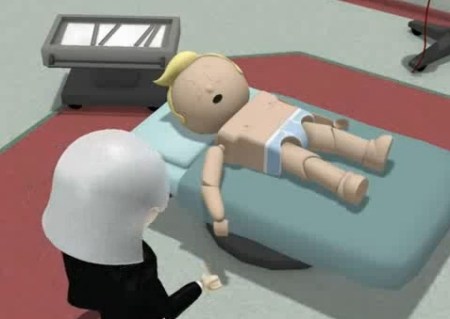
Teddy Bear Annunciation


The Annunciation of the Archangel Gabriel to the Blessed Virgin Mary; the Gospel of Luke, chapter 1, with teddy bears.

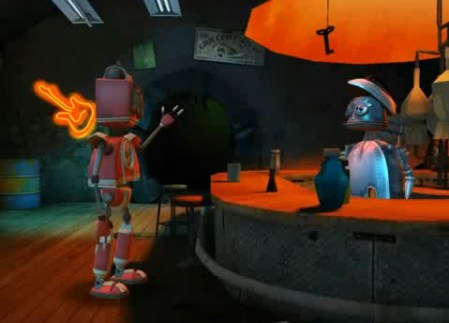
Robot Jesus at the Watering Hole

 
Jesus meets the woman at the well; the Gosple of John, chapter 4, starring robots.

The Rich Young Rapper

 
A rich young rapper questions Jesus on the subway; a remix of Matthew, chapter 19 and Mark, chapter 10.  

Doubting Thomas

 The resurrected Christ appears to a skeptical disciple in the Gospel of John, chapter 20.

The Importance of the Resurrection


From St. Paul’s 1st Letter to the Corinthians, chapter 15.

An Original Marian Hymn

June 3, 2010
Hail Mary, with God You Found Favor
by Father Victor Feltes
 

Set to the tune Rendez a Dieu, (audio, sheet music ) as in “Father, We Thank Thee who has Planted,” or “When John baptized by Jordan’s River.” For use with permission only.

Hail Mary, with God you found favor,
preserved from sin and filled with grace;
prepared as gate for our Creator,
and new Eve for our human race.
“Let it be done to me as you say,”
you told the angel God had sent;
becoming mother of our Savior,
and new ark of the covenant.
 
Hail Mary, mother of all Christians,
you stood by Christ the day He died.
Now you reign as our queen in heaven,
enthroned beside Him glorified.
Blessed are you among all women
and blessed is your fruit adored.
Pray for us Mary, now and always,
to ever love your Son, our Lord.

Approved for use in the Mass in the Diocese of La Crosse by (then) Bishop Jerome Listecki in August 2009.

Fatima Rosary Reflections

May 31, 2010

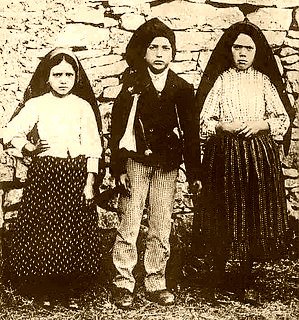
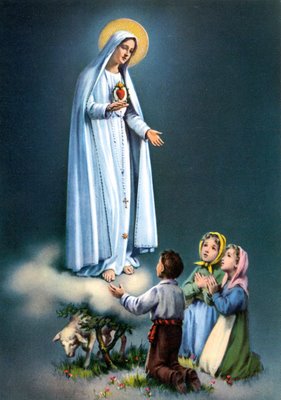
We celebrate May as the month of Mary, but we gather this particular day because 93 years ago Mary appeared to three children outside a small village in Portugal named Fatima. We will now pray the rosary and I will share with you just some of this story of Mary, Our Lady of Fatima.

[Pray the usual introductory Rosary Prayers]

In the year before Mary appeared to them, Lucia age 10, and her cousins Francisco and Jacinta, ages eight and seven, were grazing their sheep in a field. A dazzlingly beautiful young man, seemingly made of light, appeared to them and identified himself as the Angel of Peace. He invited them to pray with Him, and taught them a simple prayer.  I will pray this prayer three times and I invite you to join with me.

“My God, I believe, I adore, I trust and I love You! I beg pardon for all those who do not believe, do not adore, do not trust and do not love You. Amen.”

In the 1st Luminous Mystery we encounter “Jesus’ Baptism in the Jordan.” Jesus was not a sinner, He did not need baptism for himself, but He was baptized to become an advocate and intercessor for others. Likewise, let us pray as advocates and intercessors for all those who do not believe, do not adore, do not trust, or do not love God throughout the world.

[Pray the First Luminous Mystery]

On another occasion, the Angel of Peace appeared before them holding a chalice in his hands. Above it was suspended a host from which drops of blood were falling into the chalice. The Angel left the chalice suspended in the air, prostrated himself before it, and taught the children this prayer:

“O Most Holy Trinity, Father, Son and Holy Spirit, I adore Thee profoundly. I offer Thee the most precious Body, Blood, Soul and Divinity of Jesus Christ present in all the tabernacles of the world, in reparation for the outrages, sacrileges and indifferences by which He is offended. By the infinite merits of the Sacred Heart of Jesus and the Immaculate Heart of Mary I beg the conversion of poor sinners. Amen.”

In the 2nd Luminous Mystery we encounter “Jesus’ Miracle at the Wedding Feast of Cana.” For them, Jesus changed water into wine. For us, He changes wine into His blood. Are we indifferent to this miracle in our midst, or does it really matter to us? Let us pray that the Eucharist would transform us.

[Pray the Second Luminous Mystery]

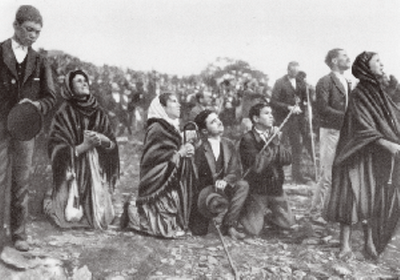
On May 13, 1917, after lunch on a clear blue day, the children were praying the rosary. Suddenly, they saw two bright flashes. They looked up and saw, in Lucia’s words, “a lady, clothed in white, brighter than the sun…”

The Lady smiled and said: “Do not be afraid, I will not harm you.” Lucia asked her where she came from. The Lady pointed to the sky and said: “I come from heaven.” Lucia asked what she wanted. She said, “I have come to ask you to come here for six months on the 13th day of the month, at this same hour.” They tried to keep it to themselves, word of the children’s encounter with the Heavenly Lady got out. Though they were met with the townspeople’s skepticism and mockery, the children would not deny what they had seen and heard.

In the 3rd Luminous Mystery we encounter “Jesus’ Proclamation of the Kingdom of God.” Let us pray to be irresistibly led to proclaim what we have experienced in Christ.

[Pray the Third Luminous Mystery]

On July 13th, the incredibly beautiful Lady appeared to them again. Lucia asked her who she was, and for a miracle so everyone would believe. She answered, “Continue to come here every month. In October, I will tell you who I am and what I want, and I will perform a miracle for all to see and believe.” And the Lady taught them this prayer:

“Oh my Jesus, forgive us our sins, save us from the fires of hell. Lead all souls to Heaven,  especially those in most need of Thy Mercy.”

In the 4th Luminous Mystery we encounter “Jesus’ Transfiguration.” Sometimes we look at other people and think that they can’t change what they are. The apostles thought like this, but Jesus opened their eyes with His Transfiguration. Let us pray for the grace of transformation; in our family members, in our friends, and especially among those in most need of God’s Mercy.

[Pray the Fourth Luminous Mystery]

At noon on the 13th of October, 1917, some 70,000 people were gathered in the field. With a flash of light the Lady appeared to the children, and Lucia, for the last time, asked her what she wanted. The Lady answered, “I want to tell you that a chapel is to be built here in my honor. I am the Lady of the Rosary. Continue always to pray the Rosary every day. The war is going to end, and the soldiers will soon return to their homes.” And the Blessed Virgin Mary urged the conversion of hearts, as she had many times before, “Do not offend the Lord our God any more, because He is already so much offended.”

What happened next was reported at the time in an anti-religious Portuguese newspaper, by a reporter who had previously written dismissively about the goings-on at Fatima:

“…One could see the immense multitude turn towards the sun, which appeared free from clouds and at its zenith. It looked like a plaque of dull silver and it was possible to look at it without the least discomfort. It might have been an eclipse which was taking place. But at that moment a great shout went up and one could hear the spectators nearest at hand shouting: “A miracle! A miracle!” Before the astonished eyes of the crowd… the sun trembled, made sudden incredible movements outside all cosmic laws – the sun “danced” according to the typical expression of the people.”

In the 5th Luminous Mystery we encounter “Jesus’ Institution of the Eucharist.” What the masses saw in the heavens that day was a great miracle. But what we encounter at every Mass is an even greater wonder. Let us pray that we would always have the eyes to see it.

[Pray the Fifth Luminous Mystery, followed by the usual closing Rosary Prayers]

(Primary Source)

3 What If’s — Tuesday, 5th Week of Easter

May 4, 2010

Before today’s Mass, I would like you to imagine three “what if” scenarios. How would you respond in the three situations I’m about to describe?

First:  Imagine, what if, at this morning’s school Mass, the great apostle St. Paul was going to preach to you? How interested are you in whatever he has to tell you?

A second scenario: What if there were a book out entitled, Actual Prayers of Jesus and Mary, and what if there was strong archeological evidence to support that these really were prayers which Jesus and Mary prayed frequently during their lives on earth? How interested are you in discovering these prayers? How powerful would it be for you to pray their prayers?

The third and final scenario: What if I were to tell you, calmly and with firm conviction, that I had received a message for you, a revelation, from Jesus Christ, which He wanted you to hear through me at this Mass? How interested and open are you to receiving such a message?

Of these three scenarios, which one would you most desire to be true?Now listen closely…. All three of these scenarios will be realized, will be true, at this Mass.

The first scenario will be realized: St. Paul will indeed preach to you–in this morning’s first reading. Perhaps St. Paul did not realize it when he first spoke these words, nor perhaps did the sacred author who wrote them down in the Book of Acts, but the Holy Spirit was inspiring, was guiding these words.

And the Holy Spirit did not only have the first-century Christians of Lystra, Iconium, and to Antioch in mind when He prompted these words. St. Paul’s inspired message is meant for us today just as much as they. So this morning, St. Paul will preach a message (though only one sentence long) which is truly intended for you.

As to the second scenario, where is this book containing Actual Prayers of Jesus and Mary? We read from it at almost every Mass, as we will today. This book is the Book of Psalms. In the day of Jesus and Mary, all devout Jews prayed these 150 psalms and they usually knew them by heart. Jesus and Mary prayed the Psalms too. These prayers were inspired by the Holy Spirit to be prayed by all God’s people, including us today, but one could say that the Psalms find their fullest voice through Jesus and Mary. In today’s responsorial psalm, we will join Jesus and Mary in one of their powerful prayers in praise of the Lord.

The third scenario will also be true at this Mass: I have indeed received a message from Jesus Christ which He wants you to hear through me this morning. You will hear His message addressed to you in the proclaimation of the Gospel. At the Last Supper, Jesus was not only speaking to the disciples seated around Him. With His divine sight, Jesus saw all of us here then, and He speaks intending His words for us this morning just as much as they. How much will you allow Jesus’ message to you to affect and change you?

We believe that, “When the Scriptures are read in the Church, God himself is speaking to his people and Christ, present in his own word, is proclaiming the Gospel.” At this and at every Mass, let us come to the Scriptures expecting much, so that we may find much, and receive in from them in abundance.

Romantic Christianity — Friday after Ash Wednesday

February 21, 2010

In the gospel disciples of John ask Jesus, “Why do we and the Pharisees fast much, but your disciples do not fast?” Jesus answered them, “Can the wedding guests mourn as long as the bridegroom is with them?” Of all the images in the Bible to depict the relationship between God and His people, perhaps the most common is that of bridegroom and bride.

As we begin this Lent we should understand that the saints became holy and made their great sacrifices not by relying upon their own “iron-wills,” but by falling passionately in love.

If we strive after holiness as a personal achievement our exertions will make us discouraged and resentful, like the people in the first reading who complain, “Why do we fast, and you do not see it? Afflict ourselves, and you take no note of it?”

But what sort of person can make incredible sacrifices for another, without counting the cost, and feel intoxicating happiness as they do so? A person who can do this is a person who’s in love.

What if Christianity is not supposed to be so hard as you’re making it out to be? What if it is supposed to be as easy as falling in love? Perhaps you are being called to a new approach.

Mary and Pilate — 6th Sunday in Ordinary Time—Year C

February 14, 2010

In a few moments, after this homily, we will recite our creed, the summary of our faith. Every Sunday, we profess, in union with the Christians who came before us, our belief in these truths and our resolve to live our lives according to them. This morning we will look at just one rich aspect of our creed and consider its implications for our lives.

Have you ever noticed that in the entire creed, only two non-divine persons are mentioned by name? These are the Virgin Mary and Pontius Pilate.

“By the power of the Holy Spirit, He was born of the Virgin Mary and became man. For our sake He was crucified under Pontius Pilate; He suffered, died and was buried.”

Now many other figures from the Old and New Testaments could have justifiably been included in our creed; such as Adam and Eve, Abraham, Moses, David, Mary Magdalene, Peter, Paul, and many others. Yet, only Mary and Pilate get mentioned. So why is this? There seems to be two very good reasons. The first of these reasons I will give now—and the second I will save for the end.

The first reason why Mary and Pilate receive special mention is that they ground Jesus’ life, death, and resurrection in our real history. Jesus was ‘born of the Virgin Mary, suffered and died under Pontius Pilate, and on the third day, He rose again.’ Now other pre-Christian religions sometimes had stories about dying gods who came to life again, but those stories were always said to have happened ‘once upon a time,’ in some remote and mythic past. But with Jesus Christ, this ancient intuition and longing of humanity is actually realized. The inclusion of Mary and Pilate in the creed witness to this: that God became man, died, and rose for us, in this world and in real history.

Some people try to be too sophisticated by saying it doesn’t really matter if Jesus rose from the dead, or even if He lived at all, because His teachings are what’s important. But St. Paul blows this idea out of the water. “If Christ has not been raised, your faith is vain; you are still in your sins. Then those who have fallen asleep in Christ have perished” and “we are the most pitiable people of all.” Without Jesus Christ and His resurrection there is no Gospel, there is no Good News.

Just like Jesus Christ, Mary His Mother and Pontius Pilate His executioner are not fictional characters made up for some story. They are real people, from a time not that much different from our own. Our styles and technologies may have changed, but human beings themselves remain much the same. When we look at Mary and Pilate we can see ourselves in these two people whom Christ encountered twenty centuries ago.

Pilate is the secular Man of the World.
Mary is the devoted Disciple of Christ.

Pilate seeks the glory of men.
Mary seeks the glory of God.

Pilate knows worldly wisdom, he is clever and cunning.
But Mary knows God’s wisdom, and she is truly wise.

Pilate thinks he knows how the world works and the pragmatic way to get things done. For Pilate, our world is totally shaped by of power, money, and influence, with some blind luck thrown into the mix. When Jesus stands silent before him, Pilate says, “Do you not speak to me? Do you not know that I have the power to release you and I have the power to crucify you?” Jesus replies, “You would have no power over me if it had not been given you from above.”

Pilate is a very post-modern man.  He’s a moral relativist. When he asks Jesus, “What is truth,” he doesn’t bother to wait for an answer from Truth Himself. That’s because Pilate thinks that the ‘truth’ cannot be known except for the ‘truths’ which we choose for ourselves or impose upon others.

The Gospels show that Pilate knows Jesus is innocent, or at least that he poses no real threat to society, yet Pilate is willing to have this innocent man whipped and even crucified when that becomes the most expedient thing to do. The crowd threatens Pilate, “If you release him, you are not a friend of Caesar,” and he quickly caves and hands Jesus over.
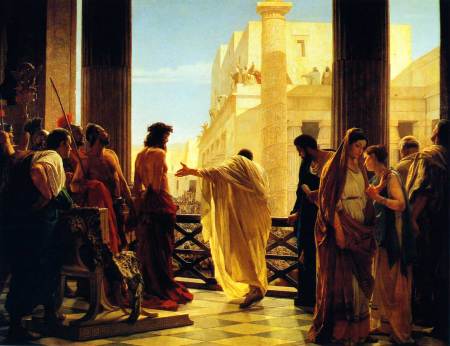
Pilate washes his hands of responsibility, and extends Christ’s arms on the cross. Mary had extended her arms declaring, “Let it be done to me according to your word,” and lovingly held the infant savior in her hands.

Pilate, despite all his power, is ruled by fear.
Mary, despite her weaknesses, is freed from it.

Governor Pilate is rich in wealth and power and yet he has no peace.
Mary, the poor widow, has peace and everything she needs from God.

Pilate has no faith in the God of Israel. He says, “I am not Jew, am I?” But for Mary, God is her rock and this makes all the difference in the world. Mary is defined by her faith, hope and love.

Mary never attends an academy, but she is profoundly wise because she reflects in her heart on the words and deeds of God and because she lives by her own advice: “Do whatever he tells you.” She knows that we do not manufacture the truth for ourselves, we receive it, ultimately from God. We love it, we defend it, and we share it with others. “Blessed [is she],” as Elizabeth said, “who believed that what was spoken to [her] by the Lord would be fulfilled.” Mary trusted and believed, for she saw the evidence through history that God “has mercy on those who fear Him in every generation,” that “He scatters the proud in their pride, and casts down the mighty from their throwns, but He lifts up the lowly.”

Mary’s life was full, but was not free from trials. When Mary consents to be found with child through the Holy Spirit she is uncertain of what will happen to her, but she trusts in God. She does not know how she and her husband will get by as poor immigrants in foreign country, but she continues to trust. Mary’s response to every trial in life, even to the death of her son, is to trust in God. Despite men’s sins, she trusts in God as the Lord of history, that He casts down the proud and mighty from their throwns and raises up the lowly.

Pilate is indifferent to Christ, and he consents to sending Him to the cross, but Mary is wholly devoted to Christ, and she consents to share in His Passion. Pilate’s heart is hardened despite Christ’s Passion, while Mary’s heart is pierced by it.

Governor Pilate was once the most powerful man in Judea, but where is he now? Mary, the poor widow, is now our glorious queen, the most beautiful and powerful woman in heaven or earth, and through her reign she draws millions to Christ our king.

She is the one who wept and now laughs.
He is the one who laughed and now weeps.

He was rich in the world and now he is poor.
She was poor in the world and now the kingdom is hers.

He took root in the desert, he was barren and uprooted.
But she was planted beside the flowing waters, she endured and bore much fruit.

So what do all of these reflections about Mary and Pilate have to do with us? I promised you at the beginning a second good reason why Mary and Pilate are mentioned in the creed; and here it is: Mary and Pilate represent us. They stand as archetypes, models or patterns, for every person.

The faithful one and the faithless one.

The one who serves God and the one who serves himself.

The one who gives Christ life and the one who puts him to death.

We live our daily lives as either Mary or Pilate, with shades of the other thrown in. As we come to the season of Lent, let us examine and discern who we are. “How am I Pilate, and how am I Mary?” And at this Eucharist, let us ask Jesus to exchange in us the ways of Pilate for the ways of Mary, for hers is the way of Christ.

Carrying Water — 2nd Sunday in Ordinary Time—Year C

January 20, 2010

Today’s Gospel, the miracle at the wedding fest of Cana, is a scene rich in symbolism and has many preachable parts. For example, the water of Old Covenant law is changed into New Covenant wine. It is the seventh day in John’s Gospel, according to the narration, pointing to a new Creation and rest. And the New Adam and the New Eve are at a wedding feast together, foreshadowing the marriage of Christ and His Church. But this morning, I would like to bring your attention to an extraordinary part of this Gospel which we disregard as being ordinary. I’m referring to the six stone water jars and the servers who carried them.

“Now there were six stone water jars there for Jewish ceremonial washings, each holding twenty to thirty gallons. Jesus told them, ‘Fill the jars with water.’ So they filled them to the brim.”

You’ve carried a gallon of milk before.   Imagine carrying 25 gallons of milk. I doubt you could do it all at once. Not only would they be too bulky, they would be awfully heavy too. Maybe you could put them on a pole and carry them with a partner. Maybe that’s what the servers in the Gospel had to do, or maybe they were doing laps between the well of Cana and the stone jars at the party. In either case, they we’re hauling an awful lot of water and weight.

Now a gallon of water weighs a little more than eight pounds. If each jar in the Gospel was at least 40 pounds of stone and held 20 to 30 gallons, then we are talking about six filled jars weighing 200 to 300 pounds apiece. And we know they were completely filled, for Mary had told them, “Do whatever he tells you,” and Jesus had told them, “Fill the jars with water.” “So they filled them to the brim.”

The saying “To carry water for (someone)” means to do a menial or difficult task for others.  That’s what these servers were doing and they definitely felt the burden.  Did they have any idea, as they carried those 1,500 pounds of stone and water, that they were a part of something remarkable? Did they know that they were playing an intimate role in one of Jesus’ most memorable miracles? No, they had no idea, not until later, and this reflects a encouraging truth for us to hold onto this week. We often don’t realize the extraordinary impact of our ordinary sacrifices.

You may feel burdened in your life, like your just scrapping or limping along; at work, at school, or at home; with your peers, your friends, or your family. But you do more good than you know. Sometimes we catch glimpses of this, like when someone takes your hand and says, “Thank you sooo much,” or when someone shares with you that they have always looked up to you, or when a child grows to realize and thank you for everything you did for them. After this life, one of our joys in heaven will be seeing how our ordinary sacrifices have touched and changed the lives of thousands, even millions, of people.

Like the servers with their six stone jars, we disregard our efforts as ordinary and do not realize their extraordinary impact. Maybe you don’t see it now, but your ordinary sacrifices do more good than you know. Let us be encouraged by recalling this truth in our daily lives, for if you’re carrying water for Jesus, you’re going to have a part in His miracles. So, “do whatever He tells you,” no matter how ordinary it may seem.

Luke’s Source — January 1 — Mary the Mother of God

January 1, 2010

Have you ever wondered how it is that Luke the Gospel writer knows the stuff he’s telling us? For instance, he wasn’t present at the Annunciation to take down notes.  Only Mary and the Archangel Gabriel were there. And in today’s Gospel, after the shepherds visit, it says, “Mary kept all these things, reflecting on them in her heart.” Now how does Luke know what Mary was thinking? Who could know something like that besides Mary herself?

Now I suppose the Holy Spirit could have directly infused the knowledge of these things into him, but that’s probably not what has happened here. Luke probably learned of these details in the most natural and human way; by being told about them, first or second-hand, by people who knew. Luke begins his Gospel by saying that his narrative of events is composed from what “those who were eyewitnesses from the beginning and ministers of the word have handed … down to us.”

But there is only one person who could have been the original source for many of Luke’s details, and that is Mary herself. In fact, some call the beginning chapters of the Gospel of Luke “the Memoirs of Mary.” Perhaps Luke heard of these details from Mary’s very own lips and took them all to heart.  Then later, knowing these things by heart, committed them to writing.

And so we do know something today of what was going on inside of Mary in those early days, “Mary kept all these things, reflecting on them in her heart.” And some years later, upon finding Jesus in the temple, Luke reports that Mary and Joseph did not understand what their boy when said to them, but “his mother kept all these things in her heart.” In this there is a lesson for us to discover through Mary, a lesson that is particularly applicable for us this New Year’s [Eve/Day].

In her life, Mary knew some important aspects of God the Father’s plan, but there was always a great deal about which she did not know. She knew that her Son was messiah, savior, and Lord, but his future, and hers, remained largely a mystery. Perhaps Mary wondered, as we often wonder when faced with evils and obstacles, “How can this be, Lord?  How will your promises be fulfilled despite this?”  Yet through it all, Mary firmly trusted that the Lord was with her, and we should do the same.

What does the new year ahead hold for each of us? Like Mary, we do not know, yet Mary shows us that we do not have to know.  We do not have to fully know our future to be able to do great things for God and to be richly blessed by Him. We do not need to know our future for the Almighty to do great things for us.

In the year ahead, may the Lord bless you and keep you, as He did the Virgin Mary.

May the Lord let his face shine upon you, and be gracious to you, as He did for Mary through Jesus’ infant face.

And may the Lord look upon you kindly and give you peace, a peace like that which Mary always kept with her Son, Jesus the Christ.

Strengthening Your Family — Holy Family

December 29, 2009

Today we are going to try something unique. Close your eyes and let the Holy Spirit guide your imagination to show you what family life was like in the home of Joseph, Mary, and the boy Jesus…

Theirs is a small dwelling and you can see all of them there…

How old is Jesus as you see Him? What is He doing?

What are His parents up to? What are Joseph and Mary like as you see them interact with each other?

It comes to time to eat. What do you see the Holy Family doing?

As they relate to one other, what do you see expressed in their faces? It is now later in the evening and time for prayer. What do you see the members of the Holy Family doing?

You can return in your imagination to visit this house any time you wish, but now, let’s open our eyes and review our mediation.

What did you see as Joseph and Mary interacted with each other? Were they not tender and reverent towards each other? I bet you could see their great mutual love reflected in their smiles.

What happened in their house when it was time to eat? Who would imagine them not coming together to share their meal in each others’ company?

And later, when it was time for prayer, did the Holy Family do? Did you see them go off to their own corners, or did they come together, to pray as one family?

Did you see the Holy Family’s intimacy, their happiness, and their love for each other? Do you want your family to share a bond like theirs? Then take the Holy Family as your model: share your love, share your meals, and share your prayers.

First, on sharing your love. Let your spouse and children know every day that you love them. You can say it, you can show it, or you can do both. For instance, kids never tire of being hugged and told their loved each day.

As for married couples, don’t make the mistake of thinking that intimacy and love are only expressed physically. For St. Joseph had all sorts of simple, little ways to let Mary know that she was loved, and vice-versa. Be like the Holy Family in sharing your love.

A second way to model the Holy Family is to share your meals. The research of social scientists indicates that having frequent family meals together contributes many goods for one’s family: For starters, everyone eats healthier meals, and so kids are less likely to become overweight or obese. And kids who eat family meals are less likely to start smoking, to drink alcohol, or to try or to be addicted to drugs. These kids’ grades are better at school, and there is less stress in their homes. These things probably stem from the fact that families which eat together are bound to talk more, provided the TV is off.

These parents are more likely to know about their children’s lives and struggles and, just as importantly, their kids are more likely to know that their parents are proud of them and love them.

Jesus Christ thinks that the shared family meal is so important for us that He has instituted one for His Church and expects His entire family to be there; for to share in the Eucharist is to share in the life and communion of His family.

A third way to make your family more like the Holy Family is to share your prayers. Apart from dinner prayers or going to Church, most Catholic families do not pray together. I think that maybe we see the priest praying the Church’s prayers and think that we are not equipped to lead prayers of our own at home.

But it’s not true.  As fathers and mothers you have a spiritual authority within your families, what John Paul the Great called “the domestic Church.” Your spouse and your children need you to pray, not only for them, but with them. Right after the family meal might be the perfect time for this ritual of family prayer.

Now you may be thinking to yourself, “But we’ve never done this as a family before.” Remember this: as parents, you create what’s normal for you children. If you want it to be normal for your children to eat meals with you, then make it normal for them.

If you want it to be normal for your children to pray to God with you, then do it normally. As parents, you create what is normal for your children and through your gift of these traditions to them you can bless them for a lifetime.

Finally, husbands and wives, if you do not pray one-on-one with each other, then you do not yet share a perfect intimacy together.  It is in prayer that our most intimate selves are laid bare and we ask another person to help us with our heartfelt needs and concerns.

Maybe you’ve never prayed with your spouse before. Then perhaps you can begin like this:  hold each others’ hands, close you eyes, and pray to God for each other, for a little while, even if for just ten seconds, say, before you go out the door. 

Once this becomes comfortable you can begin to telling each other what you want to be prayed for. And, after this is comfortable, you can begin to pray for each other aloud.  Begin the process of praying like this and it will transform your intimacy together.

Perhaps you gave many gifts to your family members yesterday for Christmas, but the greatest gift you can give to each other is yourselves. So follow the way of the Holy Family: share your love, share your meals, and share your prayers.

Treasure the Gift — Christmas Mass at Midnight

December 26, 2009

It’s Christmas, and today we hear one of the most familiar passages in the Gospel, the nativity scene in Bethlehem.  Is there anything that we can learn out of such a familiar text?  Yes, very much indeed. For example, have you ever wondered: what are swaddling clothes anyways?  ‘Mary wrapped her Son in swaddling clothes and laid him in a manger.’

When I was young I thought swaddling clothes were just dirty pajamas, but in fact swaddling refers to an ancient custom. They would use tightly bound cloths to wrap-in an infants’ arms and legs to their bodies (they thought this was important for promoting proper posture.) This practice was called “swaddling.” Was it cruel to confine the babies like this? No, the babies liked this. It reminded them of their many months, warm and snug, within their mothers’ wombs. Another thing I’ve learned since the time I was a kid was what a manger really was.  A manger is not a stable. It’s a feeding trough.  Mary wrapped Jesus up in swaddling clothes and laid him in a feeding trough.

Even if you knew all that stuff before, there remains the question of why St. Luke included these details in his Gospel. Why is it important?  Not only does it show the poverty and humility of the Christ, it also points to Jesus’ future. This is not the last time that His mother would wrap Him in tight cloths and lay His body down. And baby Jesus is laid in a feeding trough because when He is grown He will say to His disciples, as you will her Him say to you here, “Take this, all of you, and eat it. This is my body which will be given up for you.” The swaddling cloths point to Jesus burial cloth, and laying in the manger points to His Eucharist, where which He offers us His whole self, His body, blood, soul, and divinity as food.

So you see, whether we are a talking about the Sacred Scriptures, prayer, the sacraments, the teachings of Christ’s Bride (our Mother, the Church,)  our Catholic faith is not a half-cut orange whose richness you can drain out with one or two squeezes and then toss away. A lifetime of discovery will not exhaust what all that our Catholic Faith contains.

When I was a kid I might have looked at this manger scene and though that some people were missing.  “Where are the Magi, the wise men (or astrologers) from the East?”  They’re over there, hiding among the poinsettias. Maybe they are journeying through the forests, or maybe they haven’t even left home yet, but one thing we do know is that they were not there on Christmas night.  When they arrive in Jerusalem they ask King Herod, “Where is the newborn king of the Jews?” Days, weeks, or even months have passed since Christmas, and when they do arrive in Bethlehem they do not find Jesus, Mary and Joseph living in a stable or a cave, but in a house.

So who was there that first Christmas night? The shepherds were there. The angel said to them in the fields, ‘I declare to you news of great joy! A savior who is Christ and Lord is born for you in Bethlehem.  You will find Him wrapped in swaddling clothes and lying in a manger.” The shepherds look at each other and say, “Hey, we’ve gotta check this out.” Who wouldn’t turn out for that first Christmas after an angelic invitation like that?

The shepherds came to the stable and find the infant Christ just as the angel described. From there, Luke’s Gospel says, they returned rejoicing and spread the word about what had happened to all. The shepherds probably knew everybody from Bethlehem, since they were locals (“from that region”) and within walking distance from the stable.

Yet there is a question which I would like us to consider, a question which the Gospels do not answer, and it is this: After that first Christmas, did the shepherds ever come back to visit the Holy Family again? I doubt you could find two people more friendly and welcoming than Joseph and Mary, so I sure that any guest was welcome in their home, but did the shepherds ever take the opportunity to visit them again? The Magi had to travel hundreds of miles just to see Jesus once, but the shepherds were only a short distance away. 

Did the shepherds ever get to know Mary and Joseph better, these two holy saints of God? Did they ever take time come back to adore Jesus, to consider what the birth of this Child meant for their lives, and to praise and thank God for all the blessings they had received? If they had merely spent a single hour each week in the Christ child’s presence, imagine what difference it would have made for their relationships, their work, and their lives in general? We don’t know whether the shepherds ever came back again after that first Christmas, but if they didn’t, then they were foolish and they really missed out.

This Christmas Jesus Christ invites you come back and see Him again, to visit this house of Joseph and Mary, where He is always present to be adored. He wants to bless you through His saints, His teachings, His sacraments, and His Real Presence here, the whole year round. You may be receiving many gifts this Christmas, but make sure that you do not return this one.

Saying Amen — Golden Mass

December 26, 2009

Can you guess what word I’m thinking of? It’s a Hebrew word… it’s four letters long… and you’ll say it seven times in this (weekday) Mass. Have you got it?  I’ll give you one more hint… It starts with “A” and ends with “Men.” That’s right… “Amen.”

What do we mean when we say “amen”? Sometimes we say “amen” as a declaration of our faith. In this case our “amen” translates to us saying, “I believe it; this is true.” The sign of the cross, the Gloria, and the Creed all end with “amen’s” by which we declare, “This is true.”

At other times, we say “amen” to entrust our prayers (and ourselves) to God. Whenever we come to the end of our prayers, whether we’re alone or in a group, we always conclude by saying “amen.” With this “amen” we are saying, “Please, Lord, let this be done for us.”

What do we mean when we say “amen”? We’re saying “This is true,” as a confident profession of our faith, or we’re entrusting our prayers to God, saying, “Let this be done for us, Lord, according to your will.” That is what we’re saying when we say “Amen.”

Now here’s another riddle… Who was the first Christian, by which I mean, the first person to believe in Jesus Christ? You might be thinking it was John the Baptist, or one of Jesus’ apostles, but it wasn’t. Mary was the first Christian; she was the first person to believe in Jesus Christ. (Adam and Eve believed in the Redeemer, but they did not know His name.)

The angel announced to Mary, ‘Behold, you will conceive in your womb and bear a son, and you shall name him Jesus. …and He will be called the Son of the Most High.’ And Mary said, “Behold, I am the handmaid of the Lord. May it be done to me according to your word.”

In a word, Mary said “Amen,” in both senses, to the angel’s message: “I believe it, Lord; let this be done.” With this word, the Second Person of the Trinity took on flesh within her. Jesus the Christ was small within her, but truly present as God and man. Imagine the joy Mary must have experienced as she thought of His presence within her.

Just minutes from now, you will stand before a Eucharistic minister who will say to you, “The Body of Christ.” And you will answer “Amen,” like Mary answered the angel. “Amen, Lord, I believe you that are truly present in the Eucharist,” and, “Amen, Lord, let this be done to me, let me become your body; your presence in the world.”

With this word, you will receive the Christ; small within you, but truly present as God and man. When you return to your pew today consider Jesus’ presence within you and ask Mary that you be given a taste of her joy from the day the Lord first dwelt in her.

3rd Sunday of Advent—Year C

December 14, 2009

Advent is a season for penance and conversion, for the confession of sins and the changing of lives, but this Sunday of Advent reminds us that it is also time for joy. Today we celebrate Gaudete Sunday, a name which comes from the Latin command “rejoice!” This command is heard from St. Paul in today’s second reading:

“Rejoice in the Lord always.
I shall say it again:  rejoice!”

But is it that why do we need to be reminded, even commanded, to rejoice? Why are we not a people of constant joy and peace, even though we have great reason to be? I think it is because our hearts and minds give in to fear.

God is near, but when we give in to fear we do not trust that He really cares about us and really provides for us. In fear we become anxious about our future. In our fear we feel too stressed-out to be thankful. And in fear we forget or refuse to pray. St. Paul seems to have realized all this, that may be why he followed his command to rejoice with these words, words that it would do a lifetime of good to know by heart:

“The Lord is near.
Have no anxiety at all,
but in everything,
by prayer and petition,
with thanksgiving,
make your requests known to God.
Then the peace of God
that surpasses all understanding
will guard your hearts and minds in Christ Jesus.”

Today I would like to share with you a true story about two friends of mine who had every seeming reason to afraid, but who kept God’s peace. Let’s call them Andrew and Christi. I have changed their names to conceal their identities, but I know they wouldn’t mind me sharing with you their story because it can teach us all a lot.

To say my friends had a difficult first year of marriage would be to understate it. Andrew, a hard-working man with rough hands and a good heart, became afraid that marrying Christi had been a mistake and he seriously considered getting a divorce. Christi, a beautiful woman inside and out, prayed fervently to God, for both Andrew and herself. She honestly did not know how God would provide for her, but God gave her a peace that surpassed her limited understanding of His plans. Then, as Andrew tells it, God intervened, giving him a sign that this marriage was indeed His will and that Andrew should not be afraid. This divine reassurance strengthened Andrew and he resolved to remain faithfully at Christi’s side no matter what.

A few months later, forces beyond their control forced Andrew and Christi to leave their hometown, away from all their family and friends, and to move down south to a town where Andrew had some distant relatives. But, once they got down there, all of these relatives proved to be too distant or too busy to care enough to lend this vulnerable couple a hand. Their first Advent season together, Andrew and Christi were jobless, homeless, and with child.

It would have been so easy for them to give in to despair that first Christmas Eve, for Andrew to feel like he had failed his wife as a husband, or for Christi to feel anxious and afraid about their future as a family. Yet, Andrew and Christi trusted that the Lord was near. They would pray together as a couple, and gain courage and strength, peace and even joy through their prayers.

Indeed the Lord was near them, through it all, and their first Christmas together turned out to be was the brightest and the most joyful that they, or the world, had ever seen. As I said, this is the true story of two friends of mine, but they’re also friends of yours and you knew their story even before I told it to you today. For Andrew’s real name is St. Joseph and Christi’s real name is St. Mary.

Today we rightly call them saints, not because they lived in a world free from difficulties, an imaginary world different from our own. Joseph and Mary are saints because they knew and practiced how to live in this world well; with joy, kindness, prayer, thanksgiving, and peace. And so brothers and sisters:

Rejoice in the Lord always.
I shall say it again:  rejoice!
Your kindness should be known to all.
The Lord is near.
Have no anxiety at all,
but in everything,
by prayer and petition,
with thanksgiving,
make your requests known to God.
Then the peace of God
that surpasses all understanding
will guard your hearts and minds in Christ Jesus.

September 15 – Our Lady of Sorrows

September 16, 2009

Imagine if you had to start a whole new life. I don’t mean just changing schools, or moving away from home, or even entering the federal witness protection program. Imagine if you had to start a whole new life from the very beginning, as a tiny little embryo. And imagine that this reincarnation of yours required you to choose a new mother for yourself, from among all the women in all the world. What qualities would you look for in choosing a new mom?

You would want her to be beautiful, not only on the outside, but on the inside too, for what we desire most of all from our mothers, is a great and beautiful love.

You would want her to be wise and full of goodness, someone who could introduce you to the world and show you how to live in it well.

You would want her to be the perfection of femininity, so you girls could see how to grow into excellent women, and to show you boys what to look for in an excellent wife someday.

You would want a mother with patience, and tenderness, and compassion, who would be at your side if you were sick or in pain, and who would comfort you just by her presence.

As fantastic as this sounds, Jesus faced a scenario a lot like this one. He had to choose from among all the women in all the history of all the world, the one woman who would become His mother. For his incarnation, Jesus chose Mary to be His own mother.

She was beautiful, inside and out. She introduced Him to life in our world. She loved Jesus with a great and beautiful love. And when Jesus looked at Mary, he saw the likeness of His future bride, because Mary is the icon of the Church perfected. She stood at His cross with compassionate strength and her presence helped Him amidst his suffering.

Mary was so great a mother, that Jesus wanted to share her with us. He wanted her to be our mother, too. Jesus looked down from the cross, on her and the beloved disciple, and said, “Woman, behold, your son,” and to the beloved disciple, “Behold, your mother.” You and I are the beloved disciple. Jesus gives us Mary to be a mother for us. He created her perfectly, to be His own mother and our mother, too.

From that hour, at the cross, the beloved disciple took Mary into the heart of his life. From this hour, at this Eucharist, take Mary deeper into the heart of your life; because she loves you more than you know.

September 8 – Nativity of Mary

September 9, 2009

I once heard a man express why he believed that of all the causes for celebration, birthdays were among the stupidest. I don’t remember his arguments word for word, but they went along these lines…

“Why celebrate a birthday? I mean it’s not as if you’ve done anything to reach that ‘special day,’ besides living for another 365 days and riding the earth another lap around the sun. Your mom was the one who actually did something on the day you were born. All you did was show up. How does merely showing up for another year merit a party?”

He had an interesting argument, but he was entirely missing the point when it comes to why we celebrate birthdays.  It’s not that the person has done any one, big, special thing that makes us celebrate that day.  It is for the countless little things, for all the things which make them who they are for us, this is why we rejoice over them just being around for another year of life. The reason we celebrate birthdays is to celebrate the very fact of a person’s existence, to celebrate who they are, in their own unique and unrepeatable goodness, to celebrate the gift of their presence in our lives.

Today, we celebrate Mary’s birthday. We celebrate the fact that God created her and has given her to us. We celebrate who she is, in her own unique and unrepeatable goodness. We celebrate the gift of her presence in our lives. Today we rejoice over Mary, our mother, our sister, and our close friend, and we wish her a very happy birthday, just for being who she is.

29th Sunday in Ordinary Time—Year A

August 23, 2009

[Given before the 2008 presidential election]

I think it is by God’s providence that this Gospel about money, politics, and religious faith, is being read today in Catholic Churches throughout our country, and especially here in Ohio. We are now experiencing what people are calling a financial crisis, and we are on the verge of a pivotal election. First I would like to speak to you about the Gospel, then our financial fears, and then about this election.

In today’s Gospel, we see the Pharisees engaging in the politics of personal destruction against Jesus. They don’t like Jesus so they have launched a negative campaign to trap him in a damaging sound bite. The Pharisees’ dirty tricks squad comes to Jesus to set him up.  They begin with some flattery and then they ask Jesus about the religious lawfulness of paying the census tax. Notice that they don’t ask about the rightness or wrongness of paying taxes to the occupying Romans in general. They focus on one particular tax, the census tax, because census-taking was condemned in the Law of Moses.

God told Moses that the future leaders of His people should not make a count of the whole people. Knowing these figures, a king would know how to maximize his tax revenues. He would also know the size of the pool of men available to him to draft for his conquests. But with the king clearly knowing these things, knowing the great wealth and power at his disposal, he would be tempted to hubris. The king would be likely to fall to ambition and pride, to be forgetful of God and indifferent to God’s will. This would lead him, and all the people, towards disaster. The Law of Moses forbid the census-taking of the people, because a census-taking king is inclined to think that the people and everything belong to him, to do with as he wishes. But in truth, God’s people and everything else really belongs to God.

But isn’t this a lot like us? When we become overconfident in our position and wealth and power, when we live beyond our needs and live beyond our means, when our passions and pride are leading us, we are forgetful of God and indifferent to God’s will, and this leads us towards disaster. From time to time we should ask ourselves: is it in coins we trust, or is it in God we trust?

Now Back to Jesus, the Pharisees, and the Herodians. The disciples of the Pharisees hope that Jesus will answer this way: “The census tax is unlawful and no faithful Jew should pay it.” Because when he does that, the Herodians will step in and have Jesus arrested. You see the Herodians are the supporters of King Herod, the Roman-backed puppet king of Galilee. If the Herodians hear Jesus say that it is wrong to pay the Roman tax, they’ll have Jesus arrested for sedition, for preaching rebellion. Now you understand something of the difficult and dangerous spot in which the Pharisees and the Herodians have placed Jesus.

But Jesus answers with a phrase you already know well, “Repay to Caesar what belongs to Caesar and to God what belongs to God.”  This answer amazes Jesus’ hearers. All they can do is walk away. But what does this statement mean? I believe he is saying this to us: “Coins are of little consequence. Whose image and inscription is on this coin? Caesar’s? Then they belong to Caesar, let him have them. But as for you, whose image and inscription do you bear? The image and the likeness and the name that you bear is God’s.  So you belong to God. Give yourself to Him.”

[The fears raised by this financial crisis]

Jesus said, time and again, perhaps more than anything else, “Don’t be afraid.” So do not be afraid. It’s going to be ok. Worry is worthless, concern is enough. If you are doing the little that is in your power, be at peace with that.  Pray, and leave the rest to God. Because it’s going to be ok. Why? Because as much as Caesar loves his money, God loves you a thousand times more.  How great of a compliment is it to God when we choose not to worry, because this is an act of faith and trust in His goodness and His love for us.

Now please don’t dismiss me when I say “it’s going to be ok” because you think I’m Pollyannish, or that I’m youthful and overly optimistic about life. I say it because this is the good news our faith. The worst scenario that you can imagine happening in the future is very unlikely to occur, but let’s imagine for a moment that this financial crisis results in the very worst for you.  What if you’re stripped naked, left in complete poverty and humiliation? What if you experience pain like the palms of your hands and the soles of your feet nailed to beams of wood? What if you become so powerless that you can’t even wipe away blood and tears from your eyes? Even if this happens to you, even then, it’s going to be ok. Even if everyone else abandons you, you will not be alone. God our loving Father, who might seem distant, will never abandon you. He will be helping you. Mary our Mother, who always loves us, will never be far. She will be interceding for you. In your suffering, you will be with Christ, and you will rise again and be glorified with Him. So don’t be afraid, because no matter what, even if this happens to you, it’s going to be ok.

[What to consider in this pivotal election]

What makes America great? Is it our wealth and our military strength? I don’t think so, at least not in themselves, for a miser is wealthy, but he is hardly a great man. And a violent criminal may be very strong, but he is hardly a great man. If you judge greatness according to wealth and military strength, then Caesar was a great man and Jesus wasn’t. I believe America is great because it is founded upon human dignity.

“We hold certain truths to be self-evident, that all people are created equal, that they are endowed by God, their Creator, with certain rights that cannot be taken away, and that among these are the right to pursue happiness, the right to liberty, and the right to life.” We recognize that people do not have value or rights merely because the government says so, but because we are valued by God and invested with just rights by Him.

The greatest and proudest moments in American history have been when we defended human dignity. The WWII generation, which is called the Greatest Generation, defended the world from Nazism and liberated the concentration camps. In our time, we have given hundreds of millions of dollars in tsunami relief for people in Southeast Asia. We have never meet these people and will likely never meet them in this life, but when we saw them on TV we knew they were human beings just like us and we had to do something. I also believe we have good reason in our day to be proud of our armed forces because they are protecting the innocent from the kind of people who execute women in soccer stadiums and who strap bombs to the young and send them into market places. In as much as our troops are defending human dignity abroad, I believe that’s something to be very, very proud of.

On the other hand, the saddest and most regrettable moments in our history have been where we failed to defend human dignity. Such as the oppression of the Native Americans, the institution of slavery, or our history of racial prejudice. Remember learning about history when you were a kid?  Perhaps you remember saying things like this: “If I had lived in the South in those days, I wouldn’t have owned slaves,” or, “If I had lived in Nazi Germany, I wouldn’t have been silent.” But the truth is that when you are living in a particular time it can be frighteningly easy to accept things as just the way things are. In one hundred years, when American school children look back at our times, about what will they say, “How could they have been so blinded, so indifferent, to what was going on in their midst? Why didn’t they do more to defend human dignity from conception to natural death?”

In short, everything I have said today, about the Gospel, our financial fears and this pivotal election can be summed up in this: We belong to God, we bear His image and He values us, so give yourself to Him.