Archive for the ‘Saintly People’ Category

Saving Dates & Saving Souls

September 5, 2020

23rd Sunday in Ordinary Time

The just shall flourish like the palm tree… They shall bear fruit even in old age, they will stay fresh and green…” (Psalm 92)

In the time of Jesus, forests of Judean date palms covered the whole region from the Sea of Galilee to the Dead Sea. This plant, the date palm, symbolized ancient Israel. When the scriptures call Israel “the land of milk and honey” we today think of cow’s milk and the honey of bees. But milk in the Old Testament is just as likely to be goat’s milk and the honey it refers to is usually the sweet honey of dates. By the 1500’s, human activity or changes in the climate had caused the Judean date palm to disappear. Because of that species’ extinction, the date palm plants grown across Israel today were brought over from California in the 1950’s and 60’s; they’re different in species and originally native to elsewhere in the Middle East. However, the Judean date palm was not to be lost forever.

The Judean Date Palm Tree Methuselah in 2018

During the 1960’s, archaeologists excavated the mountaintop palace fortress of Masasda built by King Herod the Great near the Dead Sea. There they found, preserved dry and sheltered in an ancient jar, a cache of date seeds which carbon testing indicates are 2,000 years old. These seeds were kept in storage at an Israeli university in Tel Aviv for forty years. Then, in 2006, an American-educated horticulturalist in Israel planted several of those seeds. To her and her colleagues’ delighted surprise, one sprouted. They named that plant after the oldest person in the Old Testament, Methuselah. Today it’s over eleven feet tall. After their success with Methuselah, they planted more ancient date seeds from Masada and the caves in which the Dead Sea Scrolls were found, and six new samplings have grown. They hope to pollinate one or more of the new female palms with pollen from Methuselah, which is male palm, eventually yielding the famous delicious dates of ancient times.

While the fruit of Judean date palms was celebrated for its sweet flavor and medicinal uses, its palm branches are also noteworthy. They were probably the kind of palm branches that the crowds waved and laid before Jesus as he entered Jerusalem on the Sunday before he was killed, the day we call Palm Sunday. Jesus once lamented: “Jerusalem, Jerusalem, you who kill the prophets and stone those sent to you, how many times I yearned to gather your children together, as a hen gathers her young under her wings, but you were unwilling! Behold, your house will be abandoned, desolate. I tell you, you will not see me again until you say, ‘Blessed is he who comes in the name of the Lord.’”

Jesus knew the history of the prophets as he entered Jerusalem – how God would send them to proclaim the right path to his people, usually urging conversion from their sins. Heeding the truth will set you free; but first, it may make you uncomfortable, defensive, and angry. God’s people typically resisted the saving message and derided, denounced, attacked, imprisoned, and killed the prophets. And then, the unhappy consequences the prophets had foretold would follow naturally and unchecked. Knowing how reluctant sinners are to listen and change, why did the prophets bother? And what was the point of it all when people so rarely listened? I suggest God’s prophets had three motivations.

One was to personally avoid God’s judgment themselves. In our first reading, the Lord warns the prophet Ezekiel: “You, son of man, I have appointed watchman for the house of Israel; when you hear me say anything, you shall warn them for me. If I tell the wicked, “O wicked one, you shall surely die,” and you do not speak out to dissuade the wicked from his way, the wicked shall die for his guilt, but I will hold you responsible for his death. But if you warn the wicked, trying to turn him from his way, and he refuses to turn from his way, he shall die for his guilt, but you shall save yourself.” The prophets did not want to be condemned for failing to do their holy duty.

A second motivation of the prophets was love, love for God and love for their neighbors. As St. Paul told the Romans in our second reading: “the one who loves another has fulfilled the law… whatever other commandment there may be, [is] summed up in this saying, namely, “You shall love your neighbor as yourself.” If you were in danger, recklessly or unknowingly headed towards some serious physical or spiritual harm, don’t you wish someone would warn you? The prophets loved enough to try.

And a third motivation of the prophets was hope, hope that one day, perhaps many years later, the people they spoke to would be saved. The previously rebellious people, seeing their city ruined and their kingdom conquered as the prophets had foretold, would know that God had warned them and know that their next step should be to return to the Lord and walk in his ways. What motivated the prophets of old should motivate us as well, for many people go astray today.

Brothers… if a person is caught in some transgression,” St. Paul tells the Galatians, “you who are spiritual should correct that one in a gentle spirit…” Jesus teaches us in today’s gospel, “If your brother sins against you, go and tell him his fault (privately,) between you and him alone. If he listens to you, you have (successfully) won over your brother.” And as St. James writes in his New Testament letter, “My brothers, if anyone among you should stray from the truth and someone bring him back, he should know that whoever brings back a sinner from the error of his way will save his soul from death and will cover a multitude of sins.

Fraternal correction isn’t fun, I know, but “admonishing the sinner” is a spiritual work of mercy you and I as Christians are called to do. Like the prophets, we are to place seeds, seeds containing the power and potential to yield sweet and healing fruit. Sometimes these seeds produce an immediate holy harvest through conversion. Yet we know our seeds will often be set aside, discarded, and forgotten; until, perhaps many years later after much desolation, these dormant seeds’ true and precious value is recognized, they’re allowed to sprout with deep new roots, and life that was once lost and dead is fully restored, producing good fruits again, to the joy of all God’s people.

Her Very Close Friends — Funeral Homily for Doris Prince, 92

September 2, 2020

Doris has been a faithful and longtime parishioner of St. John the Baptist’s in Cooks Valley. At the end of this hour, we will be taking her earthly remains there, to St. John’s Cemetery, to await day of the resurrection. The reason we gathered here at St. Paul’s Church for Doris’ funeral Mass was to guarantee that there would be enough space in church for all of you to attend. There are now more than seven and a half billion people living on this earth. Consider that you who are gathered here (plus those who attended Doris’ visitation yesterday) are the people on earth who know her best and love her best. There are many ways one could preach a funeral homily for a devout woman like Doris, but I believe Doris is pleased to know that I am going to speak to you about friends of hers who have known her and loved her better than any of us here. You’ve probably never met them and you don’t know most of their names. They formally introduced themselves to Doris herself for the first time only just last week, but they have been faithfully there for her and she has been fond of them for many years. I speak of the angels.

Doris had a huge collection of angels she collected over the past fifty years or more. There were more than two hundred of them within her house, some in almost every room. She had angels of all kinds; porcelain angels, plastic angels, cloth angels, some glittery angels, some outdoor angels, some that glowed in the dark, and that some played music, all for Doris to delight in. In her later years, an angel was the go-to gift one gave to her. After moving into the nursing home seven years ago, Doris began giving away her angels as gifts herself. She even gave them out to surprised trick-or-treaters. God has similarly collected angels for his own delight, and the Lord has shared his angels with us, to lead us to the Father’s house on the mountain of God to share in their heavenly joy.

What is an angel? Angels are purely spiritual beings, created by God but not made of matter. Angels are personal and immortal creatures possessing intellect and will, knowing and choosing. They surpass in perfection every earthly creature we can see. Never having fallen, they are sinless and glorious; loving God, one another, and human beings with a intense and extraordinary devotion. Precious Moments statues rightly depict angels as pure and innocent, but these small and fragile figurines do not reflect angels’ awesome power and often intimidating presence. The Bible records that angels who reveal their otherworldly glory to human beings throughout salvation history have typically needed to first calm and reassure, “Be not afraid.”

God sends angels to us as his servants and messengers. As the Book of Hebrews rhetorically confirms, “Are they not all ministering spirits sent forth to serve, for the sake of those who are to obtain salvation?” Though “some have entertained angels unawares,” we seem to rarely see angels; yet, angels are never far from us, even the smallest children. Jesus said, “See that you do not despise one of these little ones, for I say to you that their angels in Heaven always look upon the face of my heavenly Father.” So, even the littlest ones have angels. Each of us, from the beginning to the end of our lives, have been assigned a guardian angel whose mission from God is to help to enlighten, and guard, and rule, and guide us through this world. In the words of St. Basil, “Beside each believer stands an angel as protector and shepherd leading him to life.

Each angel has a name, but we know only three individual angels’ names from Scripture, all of them archangels: St. Michael, St. Gabriel, and St. Raphael. An archangel announced the first coming of Jesus to the Virgin Mary; and today’s second reading from St. Paul says an archangel’s voice will announce to us the Second Coming of the Lord Jesus descending from Heaven. We have no authority to name our angels; they are named by God and belong to him.

Your relationship with Jesus Christ, the Good Shepherd, is most essential, but do you have a personal relationship with your guardian angel as well? We can and should have a relationship with our angels. Thank them for their assistance and ask them for their help. We can ask them to pray for us. The New Testament Letter of St. James says, “The prayers of a righteous person are very powerful,” so imagine how powerful these sinless creatures’ prayers are before God.

We can ask them to remind us of important things because angels never forget. They are brilliant creatures, more intelligent than any of us, and we can ask them to enlighten us. (For instance, I asked angels’ help in writing this homily.) We can also ask them to go on small missions for us, to lend aid to others we care about wherever they may be. Our angel guardians’ ultimate mission is to lead us to salvation. The angels are more glorious than any creature on earth, but their humble and earnest desire is that we would become even more glorious than themselves in Heaven.

Doris has been a friend to the angels. May you be their Christian friends as well. For our beloved, devout, and faithful Doris, who surrounded herself with angels, and someday for all of us here:

“May choirs of angels lead you into paradise,
and may the martyrs come to welcome you,
to bring you home into the holy city,
so you may dwell in new Jerusalem.

May holy angels be there at your welcoming,
with all the saints who go before you there,
that you may know the peace and joy of paradise;
that you may enter into everlasting rest.”

Your Chosen Cross

August 30, 2020

22nd Sunday in Ordinary Time

In last Sunday’s gospel, Simon Peter was inspired to declare of Jesus, ‘you are the Messiah, you are the Christ,‘ and Jesus affirmed that it was true. Then, immediately following in Matthew’s Gospel, Jesus begins to show his disciples that he must go to Jerusalem and suffer greatly from the Jewish religious leaders, be killed, and on the third day be raised. Peter is scandalized by this news. The Messiah is supposed to be our triumphant king! How could the Christ suffer and be killed? Peter has seen Jesus’ powers; like curing the sick, casting out demons, multiplying loaves and fish. The Lord doesn’t have to let anyone get the better of him. Peter took Jesus aside and began to rebuke him, “God forbid, Lord! No such thing shall ever happen to you.” Peter presumes that he knows better than the Lord. Jesus turns and says to Peter, “Get behind me, Satan!” (“Satan” is the Hebrew word for “adversary.”) You are [being] an obstacle to me. You are thinking not as God does, but as human beings do.

God the Father did not prepare an easy life for his beloved Son. That’s what Peter had hoped for, a smooth and easy path to glory. Jesus’ life was marked by joy and sadness, struggles and sacrifice, death and resurrection. Christ’s was not an easy life but a great and glorious life, and Jesus calls you and I to follow him. Jesus says to his disciples, “whoever wishes to save his life (from every trial, hardship, and sacrifice) will lose it, but whoever loses his life for my sake (whoever devotes himself in love and service for me) will find it. Whoever wishes to come after me must deny himself, take up his cross, and follow me.” This call included Peter. Notice how Jesus in correcting Peter does not say to him “Depart from me, you accursed,” but rather “Get behind me”; in other words, “Follow me.

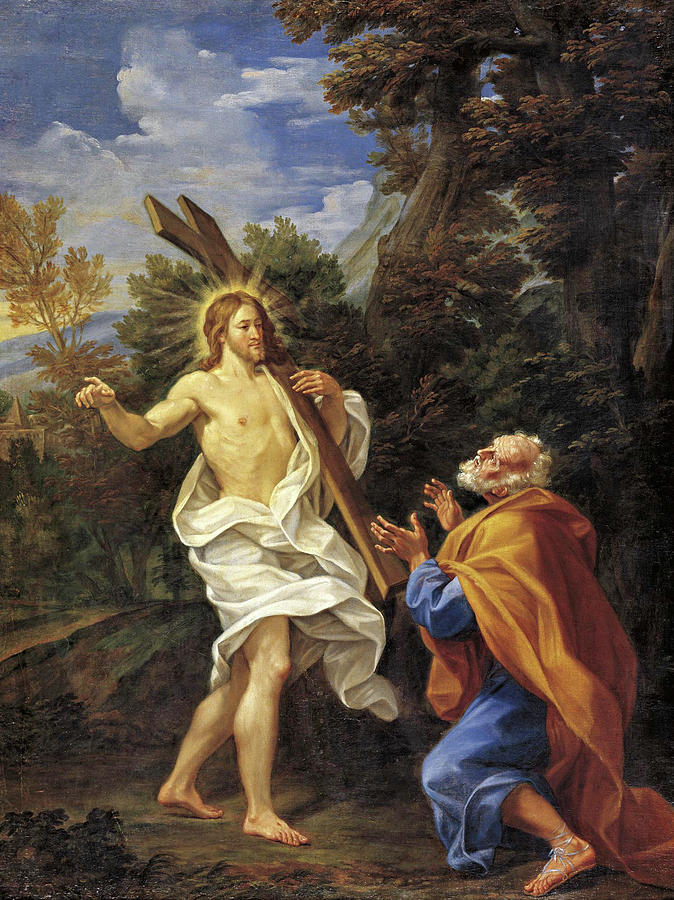
In the New Testament, we see that Simon Peter was not perfect. Both before and after Jesus’ resurrection, Peter made mistakes. Yet Peter’s faith in Jesus Christ was a foundation the Lord could build upon. And through a lifetime of providential trials, Simon Peter grew more and more into Christ’s likeness. Peter became the first pope, the first bishop of Rome, and while there, in 64 A.D., the Roman Emperor Nero unleashed a severe persecution of Christians, scapegoating the Church for a six-day fire that devastated Rome in July of that year. One tradition says that Peter, seeing the danger, reasoned that it would be better to flee the persecution so he could continue to lead the Church. However, on his way out of the city, Peter had a vision of Jesus walking in the opposite direction. Peter asked, “Lord, where are you going?” (“Domine, quo vadis,” in Latin.) “I am going to Rome to be crucified again,” Jesus replied.

This story comes to us from a late second century text and may or may not be pious legend, but what follows is very firmly known. St. Peter was arrested and condemned to die by crucifixion at Rome. However, Peter did not consider himself worthy to die in the very same manner as our Lord, so he made an unusual request. He asked to be crucified upside down, with his feet toward Heaven and his head toward the earth, and this is what the soldiers did. Peter died, his body was taken down from his cross, and Christians buried him in a grave very close-by. That place, a Roman hill, bears the same name now as it did then: Vatican Hill. The Emperor Constantine built a church over the place in the fourth century, and an even more magnificent St. Peter’s Basilica was built over the same site in the 1500’s and stands there to this day.

In the mid-twentieth century, archaeologists uncovered and forensic scientists studied ancient bones from below St. Peter’s, found some sixty feet directly below the main altar. Analysis indicates these bones came from a man between sixty and seventy years old, about five foot seven inches tall; and possessing a robust frame, as we might expect a fisherman to have. These bones were formerly wrapped in a very expensive cloth comprised of gold and purple threads in the pattern of an ancient Roman weave. The skeleton is largely complete but the feet are missing. If the Roman soldiers had no respect for Peter’s remains, it’s easy to imagine them using a sword to hack down his body from the cross, leaving his feet behind, nailed high on the wood. Jesus once declared, “You are Peter and upon this Rock I will build my Church.” It appears that Jesus has not only fulfilled his words spiritually, through St. Peter’s faithful life, but has literally built his Church over St. Peter’s bones as well. This is what Jesus did and achieved with a man formerly so flawed and fickle as St. Peter. The Lord would do great things through the transformative trials of our lives as well.

Once upon a time, one night, a Christian had a dream. They were carrying a cross, representing all of their burdens, temptations, and trials, and approached Jesus standing beside a large warehouse. The Christian said, “Lord, my cross is hard to carry. May I exchange it for another?” Jesus invited them inside the warehouse containing millions of crosses of different styles, materials, and sizes. Walking the aisles, the Christian sees an attractive, short cross with straight edges and flat sides made of pure gold. Gold is extremely heavy, about ten times denser than brick, so the Christian was not strong enough to lift it up. Going further on, there was a beautiful, tall and thin cross made entirely of diamonds. Now diamonds are very hard; they are sometimes employed at the tips of drill bits because they are harder than pretty much anything else. The Christian could lift this cross, but it poked and gnawed and cut into one’s palms and shoulder, so it was set down again. Circling back, the Christian saw a wooden cross of head-height leaning against the wall. Its sides were uneven but wear had smoothed them. It was not light, but not too heavy to carry. It was a simple cross, but a noble one. The Christian returned to Jesus and said, “This is the cross I’d like to carry.” And Jesus replied, “That’s the cross you came here with.

Jesus says, “Whoever wishes to come after me must deny himself, take up his cross, and follow me.”

The Saint Lawrence

August 10, 2020

The Feast of St. Lawrence

The Great Lakes (Superior, Michigan, Huron, Erie, and Ontario) comprise the largest body of freshwater in the world. All told, these five lakes contain one-fifth of all the freshwater on the surface of the earth, about six quadrillion gallons (that’s six million billions) a figure not fully fathomable for the human mind. Like all moving waters, these flow downhill from high to low. Near Buffalo, New York, between Lake Erie and Lake Ontario, they descend 167 feet with a mighty rushing sound at Niagara Falls. Leaving Lake Ontario, they become a river that flows past a “royal mountain” and city of the same name: Montréal. The name of this river in which whales swim, which empties into the world-spanning ocean, is the Saint Lawrence River.

The river is named for St. Lawrence, one of the Seven Deacons of Rome under St. Pope Sixtus II. (Both of these saints’ names are invoked at Mass in Eucharistic Prayer I.) In 258 A.D., the Roman Emperor Valerian issued an edict commanding that all bishops, priests, and deacons should immediately be put to death. The pope and many others were martyred, including St. Lawrence on his present feast day, August 10th. Back then, deacons managed the Church’s funds and charitable efforts. Though the tale is uncertain, St. Ambrose of Milan writes that when his persecutors demanded that Archdeacon Lawrence handover the Church’s treasures, he showed them the poor and the sick. This same source also recounts how during his slow death upon a gridiron over a fire St. Lawrence quipped, “I am cooked on that side; turn me over…

God’s graces are like The Great Lakes; vast, life-giving waters beyond our full comprehension. They flow down from above into a channel open to receive them, like the Saint Lawrence. Through such rivers, waters pour forth across the world in the sight of the Royal Mountain and the City of God to the delight of the angels. Let us imitate St. Lawrence and God’s other saints who by humble willingness became mighty streams of His goodness and glory.


Praying Like Jesus

August 9, 2020

19th Sunday in Ordinary Time

From the start to the finish of his public ministry, Jesus makes time for private, personal prayer. We see this throughout the gospels. In the first chapter of Mark’s Gospel, the morning after Jesus cured Simon Peter’s mother-in-law and others in the town of Capernaum, it says, “Rising very early before dawn, (Jesus) left and went off to a deserted place, where he prayed.” Then, before calling certain men from among his many followers to form his key inner circle, Luke’s Gospel notes: “(Jesus) departed to the mountain to pray, and he spent the night in prayer to God. When day came, he called his disciples to himself, and from them he chose Twelve, whom he also named apostles.” And Matthew’s Gospel records how, on the night before he died, “Jesus came with (eleven of those Apostles) to a place called Gethsemane, and he said to his apostles, “Sit here while I go over there and pray.” He took along Peter, James, and John, and began to feel sorrow and distress. Then he said to them, “My soul is sorrowful even to death. Remain here and keep watch with me.” He advanced a little and fell prostrate in prayer, saying, “My Father, if it is possible, let this cup pass from me; yet, not as I will, but as you will.” Today’s gospel begins with another example of Jesus’ commitment to private, personal prayer.

After Jesus had fed the crowds with the loaves and the fishes (which we heard about last Sunday) he made the apostles get into a boat and depart before him for the other side of the Sea of Galilee. Then Jesus went up on the mountain by himself to pray. When it was evening, he was there alone. Like the Prophet Elijah in our first reading, who retreated to a mountain to encounter God, Jesus seeks out a quiet and deserted place to pray. Though the wind, the earthquake, and the fire outside of Elijah’s cave all reflect something of God’s glory, chasing after these would be a distraction. God’s presence is revealed to Elijah as “a tiny whispering sound.” Do you put yourself in a place, do you give yourself enough time and space and silence, to encounter within you God’s tiny whispering sound through prayer? If it was very important for Jesus Christ the Son of God to devote focused time for prayer (and he did) how much moreso for you and me?

What was on Jesus’ mind and heart the night he prayed in today’s gospel? What did Jesus take to prayer? Recall that John the Baptist had recently been murdered. John’s disciples, after burying his body, went and told Jesus. When Jesus hears this news, he withdraws in a boat for a deserted place with the apostles where he finds thousands awaiting him. He heals them and teaches them and feeds them all. Then he dismisses the crowds, sends the apostles off ahead of him, and goes up the mountain to pray alone.

Was Jesus feeling sad that evening? Our Blessed Lord once said, “Blessed are they who mourn.” And he himself wept at the tomb of Lazarus. Jesus mourning at the death of John the Baptist, his friend, relative, and ally, is easy to imagine. Might Jesus have felt angry that night? Anger is the natural human reaction to a perceived injustice, and what happened to John was gravely wrong, a great injustice. Anger, like all human emotion, can be turned toward good or evil. For instance, zeal for his Father’s house moved Jesus to make a righteous mess of a marketplace that was hindering peoples’ worship and profaning the temple in Jerusalem. There are a number a divinely-inspired prayers among the Psalms which give voice to human sorrows, frustrations, and anxieties.

Did Jesus feel stress and strain about the steps of the path ahead of him? When people saw Jesus multiply those loaves and fishes, John’s Gospel tells us the crowd was going to carry him off to make him King of Israel, the Messiah of their dreams. But that would have derailed Christ’s redemptive mission as the Lamb of God, so Jesus did not permit his followers to do so. Jesus’ enemies, of course, presented obstacles as well. How was Jesus to reach and drink the cup at his mission’s end? In the Garden of Gethsemane, we see Jesus under great stress and strain even speak to his Father about the course of the Father’s plan. In prayer, Jesus could bring to God his Father, whatever he thought or felt.

Did Jesus pray for other people? In our second reading, St. Paul reveals a “great sorrow and constant anguish” in his heart. He swears by the Holy Spirit that he could wish himself “cut off from Christ,” could wish himself condemned to Hell, if that would somehow lead his people, the Jews, to Heaven. Do you think Paul prayed with that sorrow and anguish for others’ salvation? If Paul prays with such intense feeling, how much moreso does Jesus pray for the salvation of others from his Sacred Heart?

Jesus Christ is not only our Lord and Savior, he’s the best example for our Christian life. We must learn from him and imitate him. Here are three things Jesus does that we all should do likewise. First, Jesus makes time for private, personal prayer. Whether early morning or late at night, he created time for communing with the God who loves and leads him. Turn off the car radio, the TV, the devices, to make some silence to hear within you the “tiny whispering sound” of God. Second, Jesus prays with everything on his mind and heart. No thought or feeling need be hidden from the God who knows and loves you better than you do yourself. The Holy Trinity and our other heavenly friends want us to share these things, so that we may grow close together in their likeness and friendship. And third, Jesus prays for himself and others. Jesus says, “You shall love your neighbor as yourself.” Therefore, if you only pray for yourself, or only pray for other people, something is out of balance in your prayer. In conclusion, make time for personal private prayer. Pray about anything on your mind and heart. And pray for yourself and others. Make this sacrifice, give yourself this gift, of communing in prayer with the Lord who loves and leads you.

Virtuous Thomas

July 14, 2020

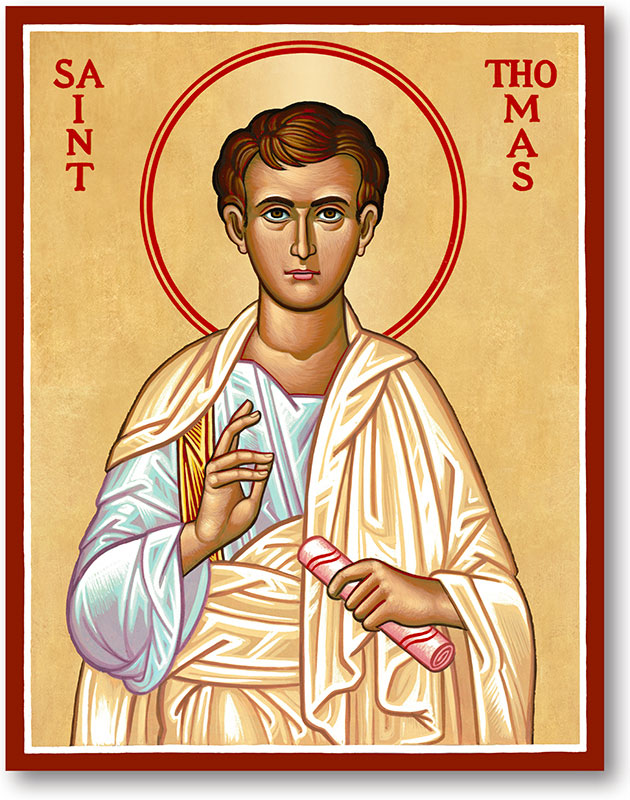
Doubting Thomas — That is how the apostle is remembered since he said, “Unless I see the mark of the nails in his hands and put my finger into the nailmarks and put my hand into his side, I will not believe.” Upon seeing Jesus alive he professed, “My Lord and my God,” but the ignoble nickname endures. St. Thomas has just four quotes in the gospels, all of them found in John; his two other quotes reveal more of his character.

After Lazarus had died, Jesus said, “Let us go back to Judea,” and the disciples objected, “Rabbi, the Jews were just trying to stone you and you want to go back there?” When Jesus insists on going, Thomas says to his fellow disciples, “Let us also go to die with him.” Then later, Jesus says at the Last Supper, “Where I am going you know the way.” And Thomas relies, “Master, we do not know where you are going; how can we know the way?

From his four quotes we glimpse Thomas’ weakness and his strengths. He should have believed his friends’ testimony that they had indeed seen and touched and spoken with Jesus resurrected (especially after having witnessed Lazarus risen from the dead) but Thomas was lacking in trust. Yet at the same time, Thomas possesses great loyalty and courage.

Where is Thomas one week after Easter Sunday? The disciples are gathered in the upper room, hiding behind locked doors for fear of those who murdered Jesus, and Thomas is right there with them. He could have chosen to retreat to someplace safer but he is loyal and brave and these virtues lead him to encounter the risen Christ.

We typically focus on our faults and flaws, on the vices and sins that hinder us. However we each possess virtues as well, areas where God has had success in us. Know and acknowledge these virtues, give thanks to God for them, and utilize them to grow. Pray for grace and use your strengths to lead you to perfect holiness like St. Thomas’ virtues led him to glory with Jesus Christ.

“As Nothing Compared with the Glory”

July 11, 2020

15th Sunday in Ordinary Time

Cardinal Timothy Dolan, the current archbishop of New York, tells a story from his first Lent as a newly ordained associate priest in a small Missouri parish. The president of their church’s men’s group told him unenthusiastically, “Father, you’re supposed to give us an evening of recollection in Lent.” So Fr. Tim, on fire to share the treasures of our Faith, worked earnestly for weeks preparing spiritual reflections about characters appearing in the Stations of the Cross. The big night for his men’s talk came. He opened the church doors early for all those who would be coming — and just two guys showed up. Fr. Tim gave his talk anyway, of course, but the young priest was crestfallen, crushed. When he returned to the rectory, his pastor said, “Oh, I should have told you those never work.” All of his devoted time and effort seemed wasted.

Twelve years later, the same Fr. Timothy Dolan was visiting a woman in the parish who was dying of Lou Gehrig’s disease. He was amazed at how tenderly her elderly husband was taking care of her, staying by her side and helping her with everything. As he was being walked to the door to leave, Father told the husband how much he admired his devotion to his wife. The man replied “Oh, Father, I’m just trying to be that Simon of Cyrene you talked about.” Father Dolan looked at him confused. “Remember that Lenten evening of recollection when you told us that just as Simon of Cyrene helped our Lord carry His cross, we do the same every time we help somebody else carry theirs? I’m just trying to help Ramona carry hers.

I first read about this story as a seminarian and it has stuck with me ever since. It’s a story of suffering. Granted, the young priest’s suffering was not so great as having a terminal disease or accompanying a dying loved one, but it was an experience of suffering whose value — though invisible at the time — was later wonderfully revealed. What Fr. Dolan had sown in painful labor and imagined to have been worthless toil proved beautifully precious and important. As one of the psalms say:

They go out, they go out, full of tears,
carrying seed for the sowing:
they come back, they come back, full of song,
carrying their [harvest] sheaves.

All suffering is painful, but any sort of suffering is worse when we think it has no meaning and all suffering is made easier when we know that it has worth. I speak of all this because of St. Paul’s words to the Romans in our second reading today: “I consider that the sufferings of this present time are as nothing compared with the glory to be revealed for us.” The sufferings of this present time are as nothing compared with the glory to be revealed for us.

Nobody likes suffering, but we all experience it in various ways regardless. We suffer from uncertainties and misunderstandings, from tribulations and persecutions, from worldly anxieties and temptations, but the saints tell us trials of suffering are rich soil which bear fruit manyfold for ourselves and others. St. Vincent de Paul declares, “If we only knew the precious treasure hidden in infirmities, we would receive them with the same joy with which we receive the greatest benefits, and we would bear them without ever complaining or showing signs of weariness.” In light of divine justice, St. Mary Magdalen de’Pazzi assures us, “You will be consoled according to the greatness of your sorrow and affliction; the greater the suffering, the greater will be the reward.” And St. Teresa of Avila encourages us, “Suffering is a great favor. Remember that everything soon comes to an end… and take courage. Think of how our gain is eternal.”

Sometimes God permits or sends sufferings for correction, that sinners may repent and be saved. But other times, sufferings are given in order to further purify, perfect, and glorify his friends. As St. Ignatius Loyola says, “If God sends you many sufferings, it is a sign that He has great plans for you and certainly wants to make you a saint.” St. Faustina Kowalska notes, “Suffering is a great grace; [for] through suffering the soul becomes like the Savior; in suffering love becomes crystallised; the greater the suffering, the purer the love.” And St. Augustine of Hippo observes truly, “God had one son on earth without sin, but never one without suffering.”

It was through the innocent suffering of his Passion that Jesus offered the sacrifice which converts hearts, forgives sins, and achieves Christ’s greatest earthly glory. Do you believe in the power of the Cross to save you? Then believe in the power of your own sufferings — lovingly endured and patiently offered up — to perfect you, save souls, and achieve your greatest glory.

A Prophet’s Reward

June 27, 2020

13th Sunday in Ordinary Time

Jesus says, “Whoever receives a prophet because he is a prophet will receive a prophet’s reward.” So what is a prophet’s reward? Being a prophet in this world is a kind of a mixed bag.

On the positive side, a prophets’ words and deeds and their role in working miracles can give great blessings and yield joyful fruits for both the preacher and the people. For instance, the Shunammite woman in our first reading repeatedly received the prophet Elisha into her home and to her table, and he was pleased to be so warmly welcomed. First, she was graced by the holy man’s words and presence, then she was blessed through the miracle he announced: “This time next year you will be fondling a baby son.” She was overjoyed at the birth of a son, and Elisha surely shared that joy. Those who heed the word of God are blessed to see its fruits.

On the other hand, on the negative side of the ledger, the prophets and their words were not always welcomed and received. In fact, they were usually met with hostility. The Letter to the Hebrews recalls how some of the prophets “endured mockery, scourging, even chains and imprisonment. They were stoned, sawed in two, put to death at sword’s point; they went about in skins of sheep or goats, needy, afflicted, tormented.” Knowing this, is it worth it for a prophet to answer God’s call?

Well, consider what else belongs to the prophet’s reward: Consider the value of living a holy life with a clear conscience. There is a great peace in doing what is right that is unlike the spiritual disquiet of sin. Consider the value of a life doing good with holy purpose, helping to save others’ souls. A selfish life lacks deeper, greater meaning, and its emptiness is a terrible taste of what Hell is like forever. Consider the value of a life that will be remembered. Remembered by people on earth? Maybe, maybe not, beyond the people whose lives you bless— but certainly remembered by God, who will reward his faithful ones with the joy of Heaven, an everlasting reward beyond our imagining. And all along this way to Heaven, you will share in the personal, intimate, friendship of God.

Now Jesus says, “Whoever receives a prophet because he is a prophet will receive a prophet’s reward” and “whoever receives a righteous man because he is a righteous man will receive a righteous man’s reward.” But where can we today find a prophet and righteous man to share in his reward? Long ago, Moses said, “A prophet like me will the Lord, your God, raise up for you from among your own kinsmen; to him you shall listen in all that he may say to you. Everyone who does not listen to that prophet will be cut off from the people.” Remembering this, when the crowds saw Jesus perform the miracle of the multiplication the loaves they said, “This is truly the Prophet who is to come into the world.” On one occasion, Jesus stated that the men of Nineveh “repented at the preaching of (the Prophet) Jonah; and there is something greater than Jonah here.” Then, after Jesus’ Ascension, St. Stephen the first martyr preached that the prophets had “previously announced the coming of the Righteous One…” and St. Ananias announced to Saul, who had encountered the Lord Jesus on the road to Damascus, “The God of our fathers has appointed you to know His will and to see the Righteous One.” Thus, the one who receives Jesus Christ will receive a prophet’s and righteous man’s reward. “And whoever gives only a cup of cold water to one of these little ones to drink because the little one is a disciple —amen, I say to you, he will surely not lose his reward,” for Jesus says, “whatever you did for one of these least brothers of mine you did it for me.

How can we receive the Lord? First of all, through the sacraments. Are you unaware that in baptism you were baptized into Christ? To quote St. Paul, “all of you who were baptized into Christ have clothed yourselves with Christ.” And your baptism has led you here today, to receive him anew in the supreme gift of the Holy Eucharist, the Most Blessed Sacrament. (For some of you, you are blessed to be about to receive Jesus in this way for the very first time, and we’re all very happy for you.) In this sacrament Jesus Christ comes to visit and dine with you with you: “Behold, I stand at the door and knock. If anyone hears my voice and opens the door, I will enter his house and dine with him, and he with me.” And if we have prepared a place for him and welcome him to dwell, Jesus stays and remains with us. The good Shunammite woman prepared room for Elisha in the highest place of her home, upon the cool rooftop, and furnished it for him with a bed, table, chair, and lamp, so that he could comfortably stay. She converted and reorganized her house for her holy guest. Jesus expects the same of us; the conversion and dedication of our lives, our souls, our homes; for Jesus wishes to dwell with us.

Receiving Jesus Christ in the Eucharist is not a one and done event. Even returning to encounter him here again at Mass every Sunday – as we are rightly commanded to do – is not all that he desires of us or for us. Jesus says, “Whoever does not take up his cross and follow after me is not worthy of me.” Following Jesus requires us to die to sin and offer loving sacrifices like himself. It’s often hard to live for Christ. Knowing this, is it worth it to answer his call?

Consider the value of living a holy life with a clear conscience, with the peace that come from doing what is right. Consider the value of a life doing good with holy purpose, helping to save others’ souls. Consider the value of a life that will be remembered by God and those whose lives you bless forever. And consider how Christ will reward you with Heaven, an unending joy beyond imagining, and share his personal, intimate, friendship with you all along your way there. Jesus says, “Whoever finds his life will lose it,” but “whoever loses his life for my sake will find it.” And whoever truly receives our Lord Jesus Christ will receive the Christ’s reward.

A Man for our Seasons

June 22, 2020

12th Sunday in Ordinary Time

June 22nd is the feast day of St. Thomas More, one of my favorite saints. Back in 1929, the great Catholic writer G.K. Chesterton wrote: “Thomas More is more important at this moment than at any moment since his death, even perhaps the great moment of his dying; but he is not quite so important as he will be in about a hundred years’ time.” This prediction’s one hundred year anniversary arrives this decade. So who is St. Thomas More, what made him a martyr, and what lessons does he have for us today?

In 1509, the new eighteen-year-old Catholic King of England, Henry VIII, married a smart and extremely beautiful Spanish princess, Catherine of Aragon. Seventeen years later, King Henry, without a male heir, with his affections now shifted toward a mistress, began citing a passage from the Old Testament book of Leviticus to argue that his marriage to Catherine was invalid and he asked the pope to annul his marriage. What happened thereafter is a story retold in my favorite movie, 1966’s Best Picture Winning film, A Man for All Seasons. That remarkable man for all seasons – adept in all circumstances – was St. Sir Thomas More.

A successful attorney, judge, diplomat, and statesman, Thomas More served in many official roles, including as Speaker of the British House of Commons. His brilliance is reflected by his witty quotes and writings. Four hundred ten English words have their invention (or at least their first-known appearances) from him, including the word “Utopia,” the title of his most famous book. A deeply devout Catholic, Thomas More had seriously considered becoming a monk, but instead discerned a call to marriage, family, and a career in public life. All these traits combined made him a great asset to the King. For instance, More once helped Henry VIII write a treatise in “Defense of the the Seven Sacraments” against Martin Luther’s errors for which the pope bestowed upon the king the title “Defender of the Faith.” The king trusted and admired Thomas More for years and appointed him to be the Lord Chancellor of England, a very high office. Then a season of great evil came to that land.

When King Henry asked Pope Clement VII to annul his marriage the pope refused. What Henry sought would have been a divorce, and Jesus said, “Whoever divorces his wife and marries another commits adultery.” Henry continued petitioning, but the Holy Father’s refusal was steadfast against this king spurning his queen. In response, Henry divorced and remarried anyway and went on to assert his supremacy over and against the pope, declaring himself to be the leader of the Catholic Church throughout his realm. Henry then used the power of the state to make all his subjects fall into line. It became a crime to agree with the pope against the king and all public figures were required to swear oaths affirming the king’s supreme headship over the Church in England. Those who denied the king’s claims would be executed.

Thomas had resigned his office and withdrawn from public life because of and prior to the king’s illegitimate remarriage and Thomas did not attend the wedding ceremony. Thomas was not going to endorse, by his words or actions what he did not believe. The king’s remarriage was wrong, but Thomas hoped that by maintaining public silence he and his family would be left alone. However, the compelled oath affirming the king’s supremacy would no longer tolerate Thomas’ neutrality. The oath was evil. Jesus, from his own lips while on this earth, had entrusted the role of supreme governance of the Church to St. Peter and his successors, the popes. Thomas was absolutely resolved not to swear a false oath, for Jesus warns us, “Whoever denies me before others, I will deny before my heavenly Father.”

When Thomas would not take the oath, he was imprisoned in the Tower of London and was charged with high treason. Thomas, the brilliant expert of law and debate, put up a sound defense that under the law they had no grounds to punish him, but following evidently false testimony from an ambitious acquaintance who betrayed him, Thomas More, under this pretext, was found guilty. The condemned man then spoke out against the unchristian oath and the injustice being done, yet in closing he said this to his judges: “More have I not to say, my lords, but that like as the blessed apostle Saint Paul, as we read in the Acts of the Apostles, was present and consented to the death of St. Stephen, and kept their clothes that stoned him to death, and yet be they now [both] holy saints in heaven and shall continue there friends forever: so I verily trust and shall therefore right heartily pray, that though your lordships have now in earth been judges to my condemnation, we may yet hereafter in Heaven merrily all meet together to our everlasting salvation.” At his beheading for being condemned as a traitor, at his martyrdom for being faithful to Christ and his Church, St. Thomas More spoke these words: “I die the king’s good servant and God’s first.”

Today, like willful King Henry VIII, much of our prevailing culture also wants things contrary to God’s will and Christ’s teachings. They declare that all who do not fully agree with them are evil and should be expelled, cancelled from society. And the powers of government, our courts and leaders, seem to be taking their side. Jesus said:

“Have you not read that from the beginning the Creator ‘made them male and female’ and said, ‘For this reason a man shall leave his father and mother and be joined to his wife, and the two shall become one flesh’? So they are no longer two, but one flesh. Therefore, what God has joined together, no human being must separate.”

God made us male and female, he created marriage, all peoples and races share a common origin and dignity from him, and Christ was sent to save us all. Thus, marriage is a lifelong union between one man and one woman, an adult female is a woman and an adult male is a man, no one should be judged for the color of their skin, and Jesus Christ is the only way to the Father. These beliefs are not always popular, but ignoring these truths leads to pain and loss. The story of St. Thomas More shows us that public silence and private disagreement may not be tolerated by this world. Sooner or later, it may be demanded that you too either submit or suffer. At that time, and all times, remember: do not lie, never ever lie, and do not be a party to a lie.

Jesus says, “Blessed are they who are persecuted for the sake of righteousness… thus they persecuted the prophets who were before you.” In years past, this passage made me think of suffering Christians in the distant mission lands of Asia or Africa, where they are the vulnerable minority, or of how the Roman pagans persecuted the early Church. But who was Jesus referring to when he said “they persecuted the prophets who were before you”? Who persecuted the Jewish prophets in the Old Testament? It wasn’t so much the unbelieving pagans as the prophets’ own leaders and neighbors they were sent to, the people of God. Likewise, a Christian can easily become a betrayer or a passive party to evil if he or she does not resolve like St. Thomas More to live in the truth and stand with Christ no matter what.

Though Thomas More was clearly innocent, it took his twelve jurors only fifteen minutes to find him guilty. They were afraid. There were fifteen judges at his trial, many of whom had been his friends, but none of them were willing to defend him. They were all afraid too. The saint might have been saved if only one had stood firm instead of just standing by. The Church in England might not have collapsed if there had been more upright men like St. Thomas More. What we do in the time that is given us matters. Stand with him and the Lord will strengthen you like he did the Prophet Jeremiah. You may feel alone, but you won’t be, and Jesus Christ will be proud of you.

This stand may cost you dearly. Will it be worth it? Jesus tells us, “Blessed are you when they insult you and persecute you and utter every kind of evil against you falsely because of me. Rejoice and be glad, for your reward will be great in Heaven.” So do not be afraid. Jesus says, “Fear no one.” Remember there is only One whose opinion ultimately matters. “Do not be afraid of those who kill the body but cannot kill the soul; rather, be afraid of the one who can destroy both soul and body in Gehenna. Everyone who acknowledges me before others I will acknowledge before my heavenly Father.” St. Thomas More said, “I do not care very much what men say of me, provided that God approves of me.”

Last Friday evening, a statue of St. Junipero Serra, the Franciscan missionary to California, was pulled down and desecrated by about one hundred people in San Francisco. The police did nothing to stop them. Those people who did this probably believed false and horrible things about the saint, and that would be some encouragement except that many people believe false and terrible things about our Church today. Along this path it’s not hard to imagine Catholic churches being firebombed sooner or later. But remember, even if this happens, whatever may come, whatever persecution we may face, Jesus says, “love your enemies and pray for those who persecute you.” Love God and everyone because it’s Christian love that saves. This is what Jesus Christ, St. Thomas More, and all the martyrs showed in their courageous words and actions. Let’s learn from them and imitate them in whatever seasons await us, and so come to share in the eternal reward of the Just in Christ’s Kingdom.


Called & Led into His Friendship & Community

June 17, 2020

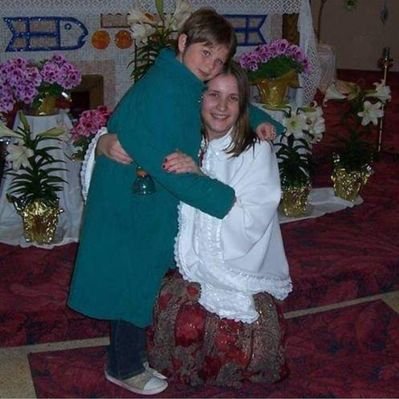
Elena Feick at 2007’s Easter Vigil where she received the Sacraments of Initiation

How does a 15-year-old unbaptized Canadian girl, a practicing Wiccan with SSA, come to find a relationship with Jesus in his Catholic Church? For Elena Feick, her journey began when she sought to join a coven.

Elena used to meditate by herself, worshiping the five elements and a pagan goddess, but she longed for more community. A particular coven, before they would admit her, asked that she research another religion besides Wicca first. Elena chose to read Christianity’s Gospels thinking she would be able to easily dismiss them. However, to her surprise, “I just… believed them. I didn’t want to. But when I got to Luke 11:9 (“And I tell you, ask and you will receive; seek and you will find; knock and the door will be opened to you”), I realised I did believe. But I didn’t like how the Christian God wasn’t willing to share me with other ‘gods’ so I resisted for a long time.” She still wanted to practice Wicca and worship a goddess yet she couldn’t say she didn’t believe in Christianity. So, instead of joining a coven, she joined the Unitarian Universalists (a creedless religious movement founded in 1961).

Elena’s journey to God was then helped by another unlikely source: “Sex and the City.” That was her favorite TV show as a teenager and her favorite character on it was Charlotte (played by Kristin Davis). In one episode, Charlotte converted to a new religion in hopes that her Jewish boyfriend would marry her. Elena was very disappointed in Charlotte, convinced that she had the ordering of things all wrong. “One’s relationship with God should come before even romantic relationships,” she thought. That’s when Elena decided not to date anyone seriously until she figured out for sure what she believed. She went on to explore lots of religions. Eventually, against her will, she ended up at a Catholic Mass.

The Mass was held at her new Catholic school and she was very afraid to attend. She thought the priest might supernaturally read her soul and denounce her as a witch. But when he gave her a blessing at Communion time something happened. In a way she couldn’t explain or put a finger on, she felt different and overwhelmed. “I can still sometimes feel his thumb tracing a cross on my forehead. It was the first time I really experienced the feeling of the love of God.” A few weeks later she decided to ask the priest about the experience and that was her inroad to the Church. A year later, she joined the local RCIA program to become Catholic. “It took quite a few conversations before I would agree to stop practicing Wicca though! But I did, just before I started RCIA.

Elena beside a reliquary of St. Therese of Lisieux in Scotland in the fall of 2019

When her RCIA teachers instructed the class about the Real Presence of Jesus in the Holy Eucharist, Elena was skeptical. “Ok, so they’re crazy,” she thought. But at the encouragement of the now-trusted priest who had blessed her (Fr. Terence Runstedler of Ontario) she began going to the perpetual adoration chapel every day and recognized its graces. “[I] realised that things I had prayed over at home that made no sense made perfect sense if I prayed over them in the chapel. …Every time I went to Adoration, Jesus spoke to me in some way. Every time. I couldn’t ignore it. … The Eucharist is the reason I didn’t completely ignore Church teaching on SSA [same-sex attraction] and find myself a girlfriend.

Elena had been in denial about her attractions growing up. After discovering Catholicism, she prayed for these feelings to go away but they wouldn’t. She decided that maybe the Church was wrong and started going to LGBT support groups. Her mind changed back again at her grandmother’s funeral. It was a non-Catholic service and everyone was invited to come forward and receive their communion, “but I just knew so powerfully that I couldn’t because it wasn’t *Him*. It was lacking the Real Presence. Which meant I still believed in the Eucharist. Which meant the Church has to be right. So I changed my whole life again even though I didn’t understand the teachings on chastity.”

In 2007, at the age of 19, Elena was baptized, confirmed, and received her First Communion at the Easter Vigil. “Right up to the night, I was still partially afraid that God would strike me down when the baptismal waters touched me. I wanted so much to belong to Him but half thought that maybe He didn’t want me… I thought if He wanted me in the Church, why didn’t He have me born in a Catholic family? But then I received Him for the first time and I just *knew*. I could hear Him (not like a voice but like thoughts that you know come from Him) saying that I always belonged to Him and always would.” Elena notes that some people have deeply intellectual reasons for converting but her reasons were more relational. “[The Lord] just kept inviting me and pulling me along and putting things in my path I couldn’t ignore. He kept introducing me to Himself, over and over, until I finally recognised it was Him I was longing for.

Elena at The March for Life UK in London, May 2019

Today, Elena is 32 years old, lives in Scotland, and prior to the pandemic she worked as a personal support healthcare worker. (I myself made her acquaintance and learned her story this year through the social media website Twitter.) In her spare time, Elena enjoys writing songs and making rosaries and is a member of both Courage International and Eden Invitation, two groups which support those with same-sex attractions in living chaste and saintly lives. Through Catholic faith and community, she says, “I started to learn my identity as belonging to Christ and as a daughter to the Father.” Elena hopes to help other LGBT-identifying persons to also discover a deeper self-identity in God. Even in the discouraging modern culture we live in, Elena’s story encourages us that Jesus Christ is still powerfully, lovingly, calling and leading people into his friendship and community.

Watch “The Chosen”

June 8, 2020

The Chosen” is a truly excellent dramatized series about Jesus’ early ministry. I highly recommend it. They flesh-out characters and scenes from the Gospel texts in creative but faithful ways. The depiction of Jesus is particularly compelling. You can see the first season’s episodes on YouTube or through this free app.


How They All Went Wrong

May 3, 2020

4th Sunday of Easter—Year A

Why did Satan rebel against God?
Why did Judas betray Jesus?
Why did Peter deny the Lord three times?
The underlying answer is important for our present lives.

Why did the Devil rebel? Though mysterious, it seems that this angel proudly desired a greater “glory” than was found in God’s hierarchy. To be God without God. This was his suggestion in tempting our first parents; “you will be like gods”. Satan, being the most powerful of the demons, rules a fallen kingdom apart from goodness, truth, and God.

Why did Judas Iscariot betray Jesus? It might have been for the money; thirty pieces of silver was about five weeks of wages and St. John the Apostle reports that Judas “was a thief and held the [apostles’] moneybag and used to steal the contributions.” Yet St. Matthew writes that when Judas saw Jesus condemned he deeply regretted what he had done and returned the money to the chief priests and elders saying, “I have sinned in betraying innocent blood.” Perhaps Judas never intended the Lord to die but had hoped that Jesus, with his back against the wall, would finally wield his mighty, miraculous powers to claim David’s earthly kingdom (and hand Judas himself a privileged place within it.) Yet Judas’ dishonest and disloyal scheming left him with nothing.

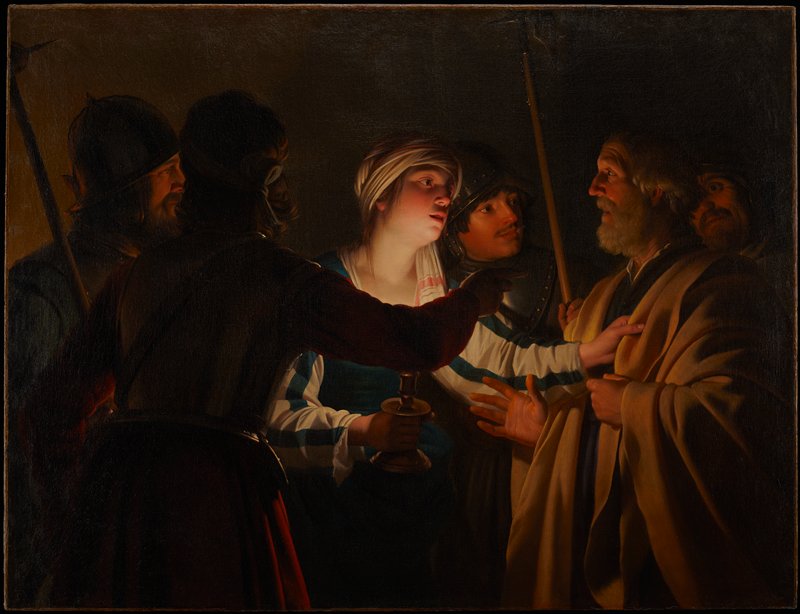
Why did Simon Peter deny the Lord three times during the Passion? St. John’s Gospel suggests he lied about having any connection to Jesus first to gain entry into the courtyard of the high priest, then to keep from being tossed out, and finally to avoid being physically assaulted by a relative of the man whose ear he had severed with a sword earlier that evening in the garden. St. Luke tells us that Peter, when he then heard a rooster crow, “went out and began to weep bitterly” over what he had done.

Satan, Judas, and Peter chose sin because they thought wrongdoing was the way to good things they would not otherwise have. But this is not Jesus’ way. In our second reading St. Peter writes of the Lord, “He committed no sin, and no deceit was found in his mouth.” He was “leaving you an example that you should follow in his footsteps.” In our Gospel, Jesus declares:

Amen, amen, I say to you, whoever does not enter a sheepfold through the gate but climbs over elsewhere is a thief and a robber. But whoever enters through the gate is the shepherd of the sheep. The gatekeeper opens it for him, and the sheep hear his voice, as the shepherd calls his own sheep by name and leads them out. When he has driven out all his own, he walks ahead of them, and the sheep follow him, because they recognize his voice. But they will not follow a stranger; they will run away from him, because they do not recognize the voice of strangers. … Amen, amen, I say to you, I am the gate for the sheep.

Jesus is our gate. He is “the way, the truth, and the life.” Always come and go through this narrow gate, for many prefer to bypass it like thieves and robbers. “How narrow the gate and constricted the road that leads to life. And those who find it are few.” Jesus’ sheep know his voice and are called to uncompromisingly follow it. Before Pontius Pilate, Jesus said, “Everyone who belongs to the truth listens to my voice.”

The words of a Jewish proverb pray to God:

Two things I ask of you,
do not deny them to me before I die:
Put falsehood and lying far from me,
give me neither poverty nor riches;
provide me only with the food I need;
Lest, being full, I deny you,
saying, “Who is the Lord?”
Or, being in want, I steal,
and profane the name of my God.

In our present season of trial, the complacency of riches has withdrawn but other temptations draw near. This is a time of testing. Will I tell lies? Will I steal? Will I sin to possess or enjoy good things I might not otherwise have? Do not give in, do not compromise, do not capitulate to evil. This is Christ’s will for you. Remember and be resolved: “The Lord is my shepherd; there is nothing I shall want.”

But what if you do go on to fall, or what if you have already sinned? What then should you do? Due to their nature, the demons will never adjust their wills towards repentance. Judas deeply regretted what he had done but he despaired of forgiveness and forfeited his life. St. Peter however returned, repented, and renewed his devotion to his Savior. (“Simon, son of John, do you love me?” He said to him, “Yes, Lord, you know that I love you.”) St. John assures us about Christ, “If we acknowledge our sins, he is faithful and just and will forgive our sins and cleanse us from every wrongdoing.”

The commandments of Christ flow from his own divine nature — total truth, pure goodness, perfect love — and these must not be spurned. Yet realize that the essence of Christianity is not rules or laws but a personal relationship: “If you love me, you will keep my commandments. … I will not reject anyone who comes to me.” Follow the Good Shepherd faithfully and goodness and kindness will follow all the days of your life and you shall dwell in the house of the Lord forever.

Fasting from the Eucharist

April 10, 2020

Good Friday

St. Pope John Paul II and Joseph Cardinal Ratzinger, Lent of 1995

The Latin Rite of the Catholic Church, to which we and 98.6% of the world’s Catholics belong, has just one day each year when no Masses are to be celebrated. That day is today, Good Friday. After a reading of Christ’s Passion from the Gospel of John and reverencing his holy Cross, the Good Friday liturgy contains a Communion service in which presanctified (previously consecrated) Hosts are distributed and consumed. However, in the early Church, there was no reception of Holy Communion by the faithful on Good Fridays at all. This fact was once noted by Joseph Cardinal Ratzinger. Cardinal Ratzinger, this highly-esteemed theologian, would go on to be elected pope and take the more familiar name Benedict XVI. In his 1986 book “Behold the Pierced One,” he reflected upon the spiritual benefits that could be found by Catholics in full communion with the Church abstaining for a time from receiving our Lord in the Holy Eucharist. Obviously, these interesting passages are relevant to us now during this Long Lent of 2020.

Cardinal Ratzinger wrote:

“When [St.] Augustine felt his death approaching, he ‘excommunicated’ himself and took upon himself ecclesiastical penitence. In his last days, he set himself alongside, in solidarity, with the public sinners who seek forgiveness and grace through the pain of not receiving the Communion. He wanted to meet his Lord in humility of those who hunger and thirst for righteousness, for Him, the righteous and gracious One. Against the background of his sermons and writings, which describe the mystery of the Church as a communion with the Body of Christ and as the Body of Christ, on the basis of the Eucharist, in a really marvelous way, this gesture is quite shocking. It seems to me more profound and fitting, the more often I ponder it. Do we not often take things too lightly today when we receive the most Holy Sacrament? Could such a spiritual fasting not sometimes be useful, or even necessary, to renew and establish more deeply our relation to the Body of Christ?

In the early Church there was a most expressive exercise of this kind: probably since the time of the apostles, Eucharistic fasting on Good Friday was part of the Church’s spirituality of Communion. Not receiving Communion on one of the most holy days of the Church’s year, which was celebrated with no Mass and without any Communion of the faithful, was a particularly profound way of sharing in the Passion of the Lord: the sorrowing of the bride from whom the bridegroom has been taken away (see Mark 2:20). I think that a Eucharistic fast of this kind, if it were deliberate and experienced as a deprivation, could even today be properly significant, on certain occasions that would have to be carefully considered—such as days of penitence (and why not, for instance, on Good Friday once more?) […]

Such fasting — which could not be allowed to become arbitrary, of course, but would have to be consonant with the spiritual guidance of the Church — could help people toward a deepening of their personal relation to the Lord in the Sacrament; it could be an act of solidarity with all those who have a yearning for the Sacrament but cannot receive it. […] I would not of course wish to suggest by this a return to some kind of Jansenism: in biological life, as in spiritual life, fasting presumes that eating is the normal thing to do. Yet from time to time we need a cure for falling into mere habit and its dullness. Sometimes we need to be hungry—need bodily and spiritual hunger—so as once more to comprehend the Lord’s gifts and to understand the suffering of our brethren who are hungry. Spiritual hunger, like bodily hunger, can be a vehicle of love.”

During this dangerous Coronavirus pandemic, faithful shepherds charged by Christ to care for the fullness of persons entrusted to them have prescribed sad but necessary measures which have restricted access to Holy Communion. In doing this, our Church leaders follow in the prudential footsteps of past prelates who likewise suspended public Masses during times of deadly contagion, from the medieval plagues to the modern Spanish Flu. Although public liturgies with Communion have ceased it is important to remember that the Holy Mass continues to be offered by priests in our Catholic churches. The graces of Jesus’ sacrifice pour forth from these altars into Christians souls around the world. Do not doubt that our Lord will provide sufficient grace for all that you are called to do in this season of our lives. As the Lord once told St. Paul when the saint prayerfully begged for a certain trial to be taken away, “My grace is sufficient for you, for power is made perfect in weakness.”

When we cannot physically receive Jesus in the Eucharist we can still unite ourselves to him through a prayer for Spiritual Communion. Pope St. John Paul the Great wrote that the practice of Spiritual Communion “has happily been established in the Church for centuries and recommended by saints who were masters of the spiritual life. St. Teresa of Jesus wrote: ‘When you do not receive Communion and you do not attend Mass, you can make a Spiritual Communion, which is a most beneficial practice; by it the love of God will be greatly impressed on you.’” Once, in a 14th century vision, Jesus showed St. Catherine of Siena two chalices, one gold and one silver. He said her Sacramental Communions were preserved in the gold chalice and her Spiritual Communions in the silver one. When our sacramental reception of our Lord proves impossible, Jesus desires our Spiritual Communion. Until the day we are all safely reunited around his altar, I urge you to make acts of Spiritual Communion, such as this famous prayer of St. Alphonsus Liguori:

My Jesus,
I believe that You are present in the Most Holy Sacrament.
I love You above all things, and I desire to receive You into my soul.
Since I cannot at this moment receive You sacramentally,
come at least spiritually into my heart.
I embrace You as if You were already there
and unite myself wholly to You.
Never permit me to be separated from You.
Amen.

Just one month ago, when pews were full for the 2nd Sunday of Lent, we heard the Gospel story of the Transfiguration. On Mount Tabor, Jesus’ face shone like the sun and his clothes became white as light. Ecstatic, Simon Peter said in reply, “Lord, it is good that we are here! If you wish, I will make three tents here, one for you, one for Moses, and one for Elijah.” Peter wanted to never leave that euphoric time and place, but it was necessary that Jesus lead him down from that mountain top into the dark valley; from the Mount of Transfiguration to the Hill of Crucifixion.

It is a true sacrifice to fast from the Eucharist this Good Friday amidst this Long Lent. But our Christian sacrifice is not without purpose nor without hope. Like Jesus’ Passion, it is a sacrifice offered for the love of others. This is his Body given up to save many; we do this in memory of him. And like Jesus within his Passion, we can be confident that this arduous trial shall pass away and our suffering and obedience will soon yield great rewards, particularly a deepened love for our Eucharistic Lord. Being followers of the transfigured Christ takes us to Calvary, but the Passion is what leads us to his Resurrection. And the more we share in the likeness of Christ, the more we will share in his glory.

An Identity and a Mission

April 1, 2020

2nd Sunday in Ordinary Time—Year A


When St. John the Baptist sees Jesus coming toward him he declares, “Behold, the Lamb of God, who takes away the sin of the world!” Why did John say that? How is Jesus like a lamb? Under the Old Covenant, animal sacrifices were offered for sins. The symbolism was that the living animal, often an unblemished male sheep, was dying in place of the sinner who offered it. This prefigured what was to come. Jesus Christ, like a flawless, obedient sheep, hears and follows his master’s voice, He does the Father’s will, and takes our place in the sacrifice which actually forgives sins. This is why Jesus is rightly called the Lamb of God who takes away the sins of the world.

John the Baptist goes on to say, “He is the one of whom I said, ‘A man is coming after me who ranks ahead of me because he existed before me.’” Indeed, Jesus, as the Second Person of the Most Holy Trinity, existed before the universe itself. Through Him all things were made, and the things that came to be pointed to and culminated in Him. For this reason, it is not so much that Jesus resembles the lambs of Old Covenant sacrifices, but rather that God establishes the ritual of lamb sacrifice for sins in order to point to Jesus and his ultimate sacrifice.

The story of the life of Jesus appears in the New Testament, but the Holy Spirit has spoken through the prophets about Him throughout the Old Testament. For example, our first reading from the Book of Isaiah written several centuries before Christ, is one of hundreds of passages which speak of Him. But before we return to that passage again, let’s review a little historical background.

We read in the Book of Genesis that Jacob was Abraham’s grandson. Jacob was renamed “Israel” by God and fathered twelve sons. From these twelve sons the “twelve tribes of Israel” descended. This is why the names “Jacob” and “Israel” are usually interchangeable, and may refer to one person or to many. In Isaiah, the prophet writes, “The Lord said to me: You are my servant, Israel, through whom I show my glory. Now the Lord has spoken who formed me as his servant from the womb…” To whom is God speaking in these lines? Who is the servant whom God formed from their beginning; the prophet himself, God’s faithful people, or Jesus Christ? There is truth in each of these interpretations, but this reading’s relevance to Jesus particularly shines forth. The prophesy continues:

It is too little, the Lord says, for you to be my servant, to raise up the tribes of Jacob, and restore the survivors of Israel; I will make you a light to the nations, that my salvation may reach to the ends of the earth.”

Jesus is the one who brings light and salvation not only for the physical descendants of Abraham, Isaac, and Jacob, but for all the nations on earth, to non-Jewish Gentiles like you and me through His one, holy, catholic, and apostolic Church. Another foreshadowing of Christ is seen in today’s psalm, written by King David one thousand years before Christ. Hear these words as if spoken from Jesus’ lips:

[Mere] sacrifice or offering you wished not, but ears open to obedience you gave me. [More of the former] burnt-offerings or sin-offerings you sought not; then said I, “Behold I come.”

In the written scroll it is prescribed [that is, it is foretold in the Scriptures.] For me to do your will, O my God, is my delight, and your law is within my heart!

I announced your justice in the vast assembly; I did not restrain my lips, as you, O Lord, know. I have waited, waited for the Lord, and he stooped toward me and heard my cry. And he put a new song into my mouth, a hymn to our God.

I fully suspect the 40th Psalm had an original, personal meaning for King David when he authored it, and these words have been prayed by God’s faithful people in a personal way ever since, but these words especially apply to the person and mission of Christ. After preaching God’s word to vast assemblies, obedience to his mission led Jesus to His Passion. After crying out for His Father to save Him, and waiting, waiting three days in the tomb, Jesus’ resurrection has put a new song in his mouth, a new hymn of praise to the Father in which we all have a part.

As I mentioned in my homily last week, by baptism you are baptized into Christ. And by remaining connected to Jesus Christ through his sacraments, He remains in you. The prophecies of Scripture refer not only to the human authors, like Isaiah or David, and they refer not only to Jesus, these passages’ fullest fulfillment, but also to us, His Bride and His Body, the Church in her members, the New Israel which comes to us through the twelve Apostles of Jesus. Hear those words of the Lord from Isaiah again:

You are my servant, Israel, through whom I show my glory. Now the Lord has spoken… that Jacob may be brought back to him and Israel gathered to him.”

Israel had been scattered, whole tribes of Jacob were lost due to sin and its consequences, but God Ever-Faithful used Israel, perfected in his Son, to gather his people Israel back to Himself. He says to us:

You are my servant, O Church of God, through whom I show my glory. Now the Lord has spoken… that the People of God may be brought back to him and the Church gathered to him.

God has purpose for your life. A purpose found in Christ. A mission to be faithful and fruitful in Christ. Jesus is still working to save souls today and he desires to work though each of us in His Body, the Church.

Screwtape on Pandemics

March 25, 2020

I was introduced to the Christian writing of C.S. Lewis years ago during a time of temptation. Alone at my uncle and aunt’s home, I prayed to God for some kind of diversion. “Lord, give me something (to change where I see things are headed).” The next moment, scanning the living room shelves, I saw a book cover with the image you see here. That paperback preserved me that evening and would go one to become one of my all-time favorite books: The Screwtape Letters.

In these letters, a senior demon named Screwtape instructs a junior demon, his “nephew” Wormwood, in the tactics of misleading humans. Screwtape describes how to draw the soul of one’s “patient” away from God (“the Enemy“) toward the devil (“Our Father Below“). The book is not only often seasoned with ironic, dry humor, but also contains great insights into human nature and spiritual realities.

At the time of Screwtape’s fifth letter to Wormwood, Britain had just recently entered the Second World War. However, as Lewis observes in his preface, “The history of the European War, except in so far as it happens now and then to impinge upon the spiritual condition of one human being, is obviously of no interest to Screwtape.” What the demon has to say about the influence of war in the greater battle for souls contains spiritual reflections that apply to our current time of pandemic as well.

Below is the text of that letter refashioned with pandemic being substituted for war.


My dear Wormwood,

It is a little bit disappointing to expect a detailed report on your work and to receive instead such a vague rhapsody as your last letter. You say you arc “delirious with joy” because [of this new pandemic.](1) I see very well what has happened to you. You are not delirious; you are only drunk. Reading between the lines in your very unbalanced account of the patient’s sleepless night, I can reconstruct your state of mind fairly accurately. For the first time in your career you have tasted that wine which is the reward of all our labours — the anguish and bewilderment of a human soul — and it has gone to your head. I can hardly blame you. I do not expect old heads on young shoulders. Did the patient respond to some of your terror-pictures of the future? Did you work in some good self-pitying glances at the happy past? — some fine thrills in the pit of his stomach, were there? You played your violin prettily did you? Well, well, it’s all very natural. But do remember. Wormwood, that duty comes before pleasure. If any present self-indulgence on your part leads to the ultimate loss of the prey, you will be left eternally thirsting for that draught of which you are now so much enjoying your first sip. If, on the other hand, by steady and cool-headed application here and now you can finally secure his soul, he will then be yours forever — a brim-full living chalice of despair and horror and astonishment which you can raise to your lips as often as you please. So do not allow any temporary excitement to distract you from the real business of undermining faith and preventing the formation of virtues. Give me without fail in your next letter a full account of the patient’s reactions to the war, so that we can consider whether you are likely to do more good by making him [a reactionary extremist of one kind or the other.](2) There are all sorts of possibilities. In the meantime, I must warn you not to hope too much from a [pandemic.](3)

Of course a [plague](3) is entertaining. The immediate fear and suffering of the humans is a legitimate and pleasing refreshment for our myriads of toiling workers. But what permanent good does it do us unless we make use of it for bringing souls to Our Father Below? When I see the temporal suffering of humans who finally escape us, I feel as if I had been allowed to taste the first course of a rich banquet and then denied the rest. It is worse than not to have tasted it at all. The Enemy; true to His barbarous methods of warfare, allows us to see the short misery of His favourites only to tantalise and torment us — to mock the incessant hunger which, during this present phase of the great conflict, His blockade is admittedly imposing. Let us therefore think rather how to use, than how to enjoy, this [worldwide pandemic.](4) For it has certain tendencies inherent in it which are, in themselves, by no means in our favour. We may hope for a good deal of cruelty and [greed.](5) But, if we are not careful, we shall see thousands turning in this tribulation to the Enemy, while tens of thousands who do not go so far as that will nevertheless have their attention diverted from themselves to values and causes which they believe to be higher than the self. I know that the Enemy disapproves many of these causes. But that is where He is so unfair. He often makes prizes of humans who have given their lives for causes He thinks bad on the monstrously sophistical ground that the humans thought them good and were following the best they knew. Consider too what undesirable deaths occur [in plagues.](6) Men [die](7) in places where they knew they might [die](8) and to which they go, if they are at all of the Enemy’s party, prepared. How much better for us if all humans died [of old age](9) in costly nursing homes amid doctors who lie, nurses who lie, friends who lie, as we have trained them, promising life to the dying, encouraging the belief that sickness excuses every indulgence, and even, if our workers know their job, withholding all suggestion of a priest lest it should betray to the sick man his true condition! And how disastrous for us is the continual remembrance of death which [pandemic](3) enforces. One of our best weapons, contented worldliness, is rendered useless. [During a plague](6) not even a human can believe that he is going to live forever.

I know that Scabtree and others have seen in [plagues](10) a great opportunity for attacks on faith, but I think that view was exaggerated. The Enemy’s human partisans have all been plainly told by Him that suffering is an essential part of what He calls Redemption; so that a faith which is destroyed by a war or a pestilence cannot really have been worth the trouble of destroying. I am speaking now of diffused suffering over a long period such as the [pandemic](3) will produce. Of course, at the precise moment of terror, bereavement, or physical pain, you may catch your man when his reason is temporarily suspended. But even then, if he applies to Enemy headquarters, I have found that the post is nearly always defended.

Your affectionate uncle
SCREWTAPE


Endnotes:

(1) – Originally, “the European humans have started another of their wars.”

(2) – “an extreme patriot or an ardent pacifist.”

(3) – “war”

(4) – “European war”

(5) – The original word here was “unchastity,” but the levels of that sin during this pandemic appear either decreased or the same as before. An intense and selfish attachment to material goods and wealth seems the more tempting vice at this time.

(6) – “in wartime”

(7) – “are killed”

(8) – “be killed”

(9) – These words are my insertion as a contrast to those dying in nursing homes from the Coronavirus.

(10) – “wars”


For more of The Screwtape Letters, I highly-recommend this excellent illustrated series on YouTube.