Archive for the ‘Saintly People’ Category

The Sound of Heaven — Monday, 34th Week in Ordinary Time—Year II

November 22, 2010

What do you think Heaven sounds like? In the first reading, St. John describes it for us. “I heard a sound from Heaven like the sound of rushing water or a loud peal of thunder. The sound I heard was like that of harpists playing their harps.”

The sound of Heaven that John describes is powerful and beautiful. It is like the onslaught of a tidal wave or a thunder burst, yet it has the harmony, clarity, proportion and perfection of supreme beauty. What John is hearing is the sound of worship in Heaven.

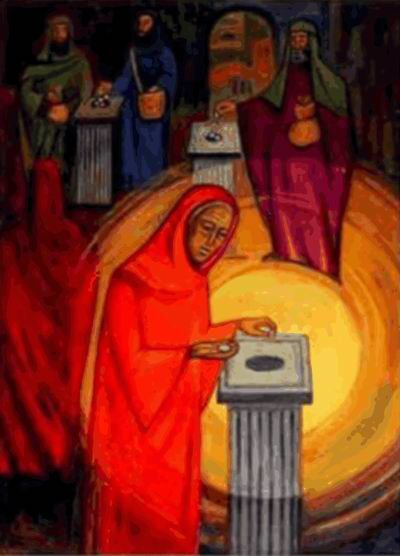
In the Gospel, we hear another sound, neither great nor gorgeous in itself: the quiet chinking of two small coins. Yet, this simple sound has echoed for two-thousand years and millions have been drawn to it. When Jesus Himself heard the sound of the faithful, poor widow’s generous gift, He was moved to speak words in praise. Despite its subtlety, it reminded Jesus of a sound He knew well; it reminded Him of the sound of Heaven.

In our own simple ways, with unending joy, let us echo on earth the song of the angels in Heaven as they praise God’s glory for ever.

Everything Awaits Her Reply

November 20, 2010

From a homily ‘In Praise of the Virgin Mother’ by St. Bernard of Clairvaux:

You have heard, O Virgin, that you will conceive and bear a son; you have heard that it will not be by man but by the Holy Spirit. The angel awaits an answer; it is time for him to return to God who sent him. We too are waiting, O Lady, for your word of compassion; the sentence of condemnation weighs heavily upon us.

The price of our salvation is offered to you. We shall be set free at once if you consent. In the eternal Word of God we all came to be, and behold, we die. In your brief response we are to be remade in order to be recalled to life.

Tearful Adam with his sorrowing family begs this of you, O loving Virgin, in their exile from Paradise. Abraham begs it, David begs it. All the other holy patriarchs, your ancestors, ask it of you, as they dwell in the country of the shadow of death. This is what the whole earth waits for, prostrate at your feet. It is right in doing so, for on your word depends comfort for the wretched, ransom for the captive, freedom for the condemned, indeed, salvation for all the sons of Adam, the whole of your race.

Answer quickly, O Virgin. Reply in haste to the angel, or rather through the angel to the Lord. Answer with a word, receive the Word of God. Speak your own word, conceive the divine Word. Breathe a passing word, embrace the eternal Word.

Why do you delay, why are you afraid? Believe, give praise, and receive. Let humility be bold, let modesty be confident. This is no time for virginal simplicity to forget prudence. In this matter alone, O prudent Virgin, do not fear to be presumptuous. Though modest silence is pleasing, dutiful speech is now more necessary. Open your heart to faith, O blessed Virgin, your lips to praise, your womb to the Creator. See, the desired of all nations is at your door, knocking to enter. If he should pass by because of your delay, in sorrow you would begin to seek him afresh, the One whom your soul loves. Arise, hasten, open. Arise in faith, hasten in devotion, open in praise and thanksgiving. “Behold the handmaid of the Lord,” she says, “be it done to me according to your word.”

True Christian Soldiers — November 11 — St. Martin of Tours — Veterans Day

November 11, 2010

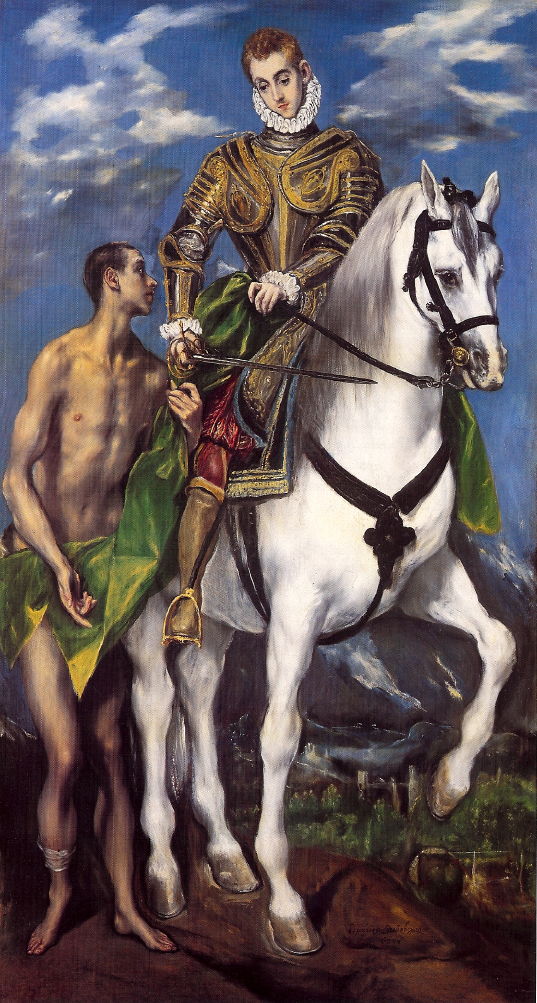
This morning I would like to tell you two stories. The first is the story of a cavalry officer who was sent to serve in France. He grew up in a military family and got enlisted when he was still only a teenager. Interestingly, his parents were not Christians, but this young man was studying in preparation to become a one himself. He was what we call a catechumen.

One cold winter day, at the gates of the French city of Amiens (A-mi-en), he encountered a shivering, half-naked beggar. This miserable sight disturbed the young soldier and he drew his sword from its scabbard. Because he had nothing else to give the poor man, the soldier took his own cloak, cut it in two pieces, and reaching down from his horse handed one half to the beggar. Giving away half of his cloak was no small gift, considering that the soldier himself needed to keep warm, too. In this act, he had loved his neighbor, the beggar, as himself.

That night, the soldier had a dream in which he saw Jesus Christ, surrounded by angels, and dressed in half a cloak. He heard a voice say to look at the garment and say whether he recognized it. He then heard Jesus say to the angels, “Martin, as yet only a catechumen, has covered me with his cloak.” Very soon after that dream, Martin, the 18-year-old Roman soldier, was baptized. He would go on to become a monk, a priest, and a bishop. Today we call him as St. Martin of Tours, and celebrate him as the patron saint of soldiers.

My second story comes from more recent times. A great and horrible war was raging, as it had for more than four years, killing every day. Many people could see no end in sight. But then, ninety-two years ago today, the wonderful order came announcing an end to all armed conflict at the 11th hour, of the 11th day, of the 11th month, of the year 1918. This was the end of the First World War and it came to pass on the ancient feast day of St. Martin of Tours, the 11th of November.

Do you think that St. Martin in Heaven may have prayed for his beloved France and for their enemies, too? Do you think that he interceded before God for peace on Earth? Of course he did, for he was a true Christian soldier. No true Christian soldier loves war, or even hates his enemy. He fights not because he hates who is in front of him, but because he so loves what is behind him. The Christian soldier trains for war because he loves peace.

Today we thank and honor our veterans for they have served to defend our nation and freedom-loving people around the world. Through the intercession of St. Martin of Tours, let us pray that our country, history’s most benevolent superpower, may be served by Christian soldiers like them for many peaceful generations to come.

The Saints & Us — 22nd Sunday in Ordinary Time—Year C

November 5, 2010

 
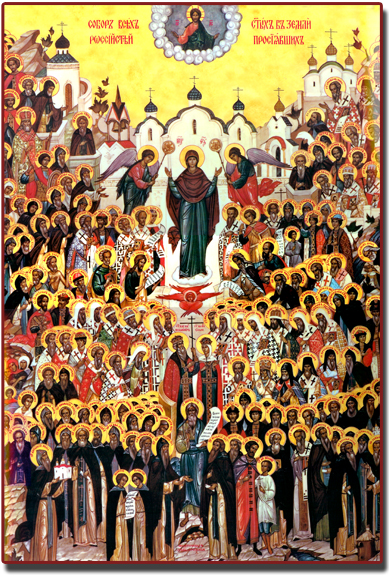
Brothers and sisters, as the Letter to the Hebrews tells us, we have approached Heaven even as we remain on earth. Though we are dust and sinners, we stand before Jesus, the eternal Father, and the Holy Spirit. We draw near to each other and they invite us to share more deeply in their friendship. And they are not alone. They are surrounded by countless angels and by a multitude of men and women whom they have made perfect in goodness and love. We have a name for these “holy ones” who live with God in Heaven. We call them “saints,” and Jesus invites us to share their friendship, too.

Have you ever had the pleasure to introduce your friends to each other; people who already know and enjoy you, but who have never met each other? I think you’ll agree that it’s a very special joy when your friends to befriend each other. When your friends befriend each other do they love you less because of it, as if their affection has been divided or diluted? No, the love between all of you is greater for being shared. So it is with Jesus, the saints, and us. Some Christians fear that befriending Jesus’ friends in Heaven will lessen our love for Him. They fear that talking to them and honoring them will distract us from Christ. But these are silly fears. Love increases by being shared.

When someone asks you, “Would you pray for me,” or asks you to pray for one of their heartfelt concerns, what do you say in reply? Do you refuse, saying, “Why should you ask me to pray for you when you can go directly to God?” Nobody says that. Instead, Christians say, “Of course I’ll pray for you.” Christians ask each other to intercede for them not because they have lost hope in Christ, but because they have it, and because Scriptures tell us, “pray for one another.” Asking our friends and family in Heaven to pray for us is no different than asking our friends and family on earth, except that the prayers of the saints are offered by souls perfected in love and divine intimacy.

What about the objection that honoring the saints distracts from Christ? Today’s Gospel shows that Jesus does not think that sharing honor with His saints detracts from His own preeminent glory. He has said to them, “My friend, move up to a higher position. Then you will enjoy the esteem of your companions at the table.” By giving seats of honor to His saints at His heavenly wedding banquet Jesus invites us to esteem them. In honoring them, we honor Him.

Remember that our circle of closest family and friends is not limited to earth. We have brothers and sisters in Heaven; saints and angels who know us, love us, and want to help us arrive at our true home. Let us remember to take the opportunity to make their acquaintance and grow in their friendship.

A Great Cloud of Friends

November 5, 2010

The saints know you, love you, and are just waiting for you to make their aquaintance.

Here is a long list of about 14,000 of saints from Saints.SQON.com‘s alphabetical listing of holy ones.

Uniquely Different — October 28 — Sts. Simon and Jude

November 3, 2010

[Jesus] called his disciples to himself,
and from them he chose Twelve,
whom he also named Apostles:
Simon, whom he named Peter…
Simon who was called a Zealot,
and Judas the son of James,
and Judas Iscariot, who became a traitor.

In the early days of their ministry, whenever Jesus called out for ‘Simon’ or ‘Judas,’ more than one head may have turned. Among Jesus’ apostles there were two Simon’s and two Judas’. There was Simon Peter and Simon the Zealot, and Judas (or Jude) the son of James and Judas Iscariot the betrayer. Though these pairs shared the same names and the same calling to be apostles, they were different in important ways.

Simon Peter was called to be the Rock, the leader of the apostles and of the nascent Church. Simon the Zealot may have shared his zeal, but he was not meant to have the same role as Peter. Each saint’s apostleship was unique to him.

Sometimes Christians who eagerly desire to be saints themselves strive to impersonate their favorite holy heroes. We do well to learn from the lived examples of the saints, for St. Paul did say, “Be imitators of me, as I imitate Christ,” but there can truly be only one St. Paul, one St. Francis, or one St. Therese of Lisieux. Every saint in history has been unique, and every future saint will be, too.

The two Judas’ teach us a lesson, too. Even after years of preaching the Gospel, I can imagine some people felt an initial uncertainty towards Judas the son of James. Intellectually, Christians would know that this apostle could not possibly be Judas the betrayer (because he one took his own life,) yet they might feel wary about this “Judas” in their midst.

Sometimes our feelings toward other people are influenced by who they remind us of. For instance, if you meet someone whose face resembles a person who has hurt you in the past, you may be involuntarily uncomfortable around them. In psychology, this shift of emotions from one person or thing to another is called transference. This is the stuff that prejudice is made of, and the good apostle, Judas, caught some of its unjust, negative effect.

Though the apostles shared names and a common calling, they were unique individuals. The two Simons teach us that each is called to live out their own, unique, holy life. The two Judas’ teach us that we must always receive others in their own personal uniqueness.

Have A Holy Halloween!—31st Sunday in Ordinary Time—Year C

October 31, 2010

Have you ever noticed how our Christian holidays get filled with stuff that distracts us from what we’re really celebrating? Take Christmas, for example. There’s nothing wrong with exchanging gifts and decorating with tress and lights, but there is good reason in that season that we need be reminded, to “Keep Christ in Christmas.” For many people, celebrating the birth of the Prince of Peace on earth is the most stressful time of the year. Or consider Easter: There’s nothing wrong with chocolate bunnies and hunting for Easter eggs, but the connection between egg-laying rabbits and Jesus’ resurrection is tenuous at best.

However, this disconnection between Christian holy days and the cultural observance of holidays is the greatest when it comes to Halloween. There’s nothing wrong with kids playing dress-up and going door-to-door to ask for candy, (I have many happy memories of this myself,) but Halloween’s connection to its Christian holy day seems to have been forgotten. The name “Halloween” comes from “All Hallows Eve,” or the evening before All Saint’s Day. Something is “Hallowed” when it is sanctified or respected, as in, “Our Father, who art in Heaven, Hallowed be thy name.” All Saints Day celebrates the “hallowed” ones, the holy ones, the saints who are now in Heaven. Some of these saints are canonized, but most of them are not.

For every friend and relative we knew on earth who is now in Heaven, November 1st is their feast day in the Church. And for our holy dead who are still being purified and made perfect so that they may enter the fully-unveiled presence of our infinite God, there is November 2nd, the Feast of All Souls. In this fall season, when the natural world appears dying, our Church celebrates the holy dead, for we have hope in the new life.

Halloween, or “All Hallows Eve,” is to All Saints Day what Christmas Eve is to Christmas. As Christmas Eve reminds us of Christ’s coming, so Halloween should remind us of the victory of the saints, and of our own life’s calling: to become the best possible versions of ourselves, to become saints.

I think it is in no way an overreaction to observe that the secular observance of Halloween has overtones in dark, demonic things; the things of horror. Isn’t it suspicious that from a feast celebrating the saints in light, we have a secularized holiday focused on things of darkness? Instead of Christian hope in the resurrection of the dead, Halloween gives us images of zombies. Instead of the consolation that we are surrounded by the perfected souls of the saints, who love us and are full of concern to help us, Halloween gives us tales of ghosts and demons who want to harm and scare us. How does this sort of thing happen? I don’t think it is crazy to think that the Evil One wants to distract people from the true reason for this season; that the Devil would have us thinking about him, rather than the saints, that he wants us to be terrified, rather than full of hope.

Did you know that this Sunday, Satanic worshipers will come to Masses and Catholic Churches around the country trying to steal our Lord in the Eucharist? (Interestingly, they don’t go after the communions of Protestant denominations, but only the Catholic Eucharistic Hosts.) Their plan is to desecrate Jesus in a ritual they call a Black Mass. In doing this they are trying to rebel, seeking a false freedom that cannot make them happy. They try to harm Jesus, but only hurt Him in as much as they sadden Him. These sad people, who strike out at Jesus, are really hurting themselves and the Jesus still loves them. We know that the Lord loves every person He has made, for as the first reading notes, if the Lord did not love His creations, they would not continue to exist. As we see in today’s gospel about Zacchaeus the sinful tax-collector, there is hope for them and all of us, for Jesus “has come to seek and to save what was lost,” and He calls every one of us to be happy and holy with Him.

This Halloween, let us pray for the misguided persons, who knowingly or unknowingly, will dabble in bad things tonight, that they may turn to Christ. Let also offer Jesus our consolation for how the feelings of His Sacred Heart will be wounded by their offenses against His love. And for ourselves, let us try celebrating Halloween in some different ways this year.

Maybe everyone in your household already has their trick-or-treat costumes ready (but I know it can sometimes be a last minute decision.) If you’re still looking for costume ideas, how about dressing up as an awesome saint? Saint costumes can be easy and very creative. Dressing like this delights the saints (and it will probably score you more candy.)

Does your family have a patron saint? If not, then pick one this Halloween and entrust your family to them for the year ahead. Print off their picture from the internet and put it on the wall, learn about them as a family, and pray to them, asking that they pray for you. (I, for myself, am choosing St. John Vianney this year; the patron saint of priests and a good guy to know.) Great saints are waiting, just waiting, to grow in friendship with you.

This year, make it a point to celebrate the vigils and feasts of All Saints and All Souls. Our family and friends who are now in Heaven or on their way there expect us to be joyful on these feast days in their honor, and there is not better place for us on earth to draw near to them than here, around the altar of Jesus Christ.

Christ is the Light who shines through the darkness. This Halloween, let us claim the night for Jesus Christ and His saints.

The Sorrowful Mysteries, Meditations on Vocation with the Saints

October 29, 2010

The 1st Sorrowful Mystery:
The Agony in the Garden

Years before Jesus agonized in the Garden of Gethsemane, the Blessed Virgin Mary had an agony of her own, when the Archangel Gabriel came to announce to her that she would bear the Son of God. Mary was “greatly troubled,” and the angel sought to reassure her “Do not be afraid, Mary….” Even after the plan was presented to her, she must have been full of questions about her future, like “What will Joseph and my parents think?” But Mary answered, “Behold, I am the handmaid of the Lord. May it be done to me according to your word,” and because she said that, Jesus could say years later, “Father… not my will but yours be done.”

God has a plan for every life, and a calling, a “vocation,” meant for them. Accepting God’s plan for our lives can take great, trusting courage, but answering “Yes” to Him will do more good than we know. Let us pray for the grace, trust, and courage to say “Yes” to our own God-given callings.

The 2nd Sorrowful Mystery:
The Scourging at the Pillar

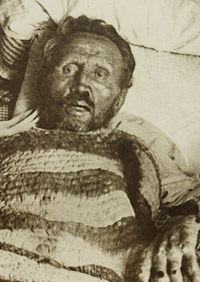
Father Damien went to the Hawaiian island of Molokai to minister the spiritual and bodily needs of lepers exiled there. Last year, in 2009, Father Damien was canonized a saint. But in 1889, six months after his death, the following letter was published in a Protestant Christian newspaper:

Dear Brother,

In answer to your inquires about Father Damien, I can only reply that we who knew the man are surprised at the extravagant newspaper laudations, as if he was a most saintly philanthropist. The simple truth is, he was a coarse, dirty man, headstrong and bigoted. He was not sent to Molokai, but went there without orders; did not stay at the leper settlement (before he became one himself), but circulated freely over the whole island (less than half the island is devoted to the lepers), and he came often to Honolulu. He had no hand in the reforms and improvements inaugurated, which were the work of our Board of Health, as occasion required and means were provided. He was not a pure man in his relations with women, and the leprosy of which he died should be attributed to his vices and carelessness. Other have done much for the lepers, our own ministers, the government physicians, and so forth, but never with the Catholic idea of meriting eternal life.

– Yours, etc., “C. M. Hyde”

Hyde’s comments are noted today only because they were so exquisitely answered in an open letter by Robert Louis Stevenson, the author of Treasure Island (1883) and The Strange Case of Dr. Jekyll and Mr. Hyde (1886). Stevenson quite rightly wrote, “[If the world will] at all remember you, on the day when Damien of Molokai shall be named a Saint, it will be in virtue of one work: your letter to the Reverend H. B. Gage.” The whole reply, assessing Damien and rebuking Hyde, is worth your reading, but I will give you the closing words: “[Father Damien] is my father… and the father of all who love goodness; and he was your father too, if God had given you grace to see it.”

In yesterday’s gospel, Jesus asked, “Do you think that I have come to establish peace on the earth? No, I tell you, but rather division.” This is because when someone set about to do God’s will, the world, which opposes God, will attack that person. Criticisms will land on the just man like lashes on the back. Jesus said, “Woe to you when all speak well of you,” for ‘the world loves its own.’ If there is nothing very counter-cultural about your life, then you are not yet living out the Gospel as Christ calls you to do. Let us pray for the grace to be faithful to the Gospel, even at personal cost.

The 3rd Sorrowful Mystery:
The Crowning with Thorns

Once, when St. Maximillian Kolbe was a boy, his behavior began trying his mother’s patience. She said in exasperation, “Maximillian, what will become of you?” As St. Maximillian writes, “Later, that night, I asked the Mother of God what was to become of me. Then she came to me holding two crowns, one white, the other red. She asked me if I was willing to accept either of these crowns. The white one meant that I should persevere in purity, and the red that I should become a martyr. I said that I would accept them both.” How bold of him to imagine, and how bolder still to ask, that he might receive them both. St. Maximillian would receive both crowns, as a holy Franciscan brother, and as a victim of the Nazis at Auschwitz, where he took the place of another innocent man who was condemned to die.

At yesterday’s Mass you heard that God, by His power, “is able to accomplish far more than all we ask or imagine.” Yet we will receive little if we are too timid to imagine or ask much of Him. Let us pray for the grace to imagine and ask to be crowned by Christ with a life with far greater than whatever we would merely drift into on our own.

The 4th Sorrowful Mystery:
The Carrying of the Cross

In 1961, Gianna Molla was expecting another child. During her second month of pregnancy, a tumor developed in her uterus. She could have chosen to have her uterus removed—preserving her own life, but resulting in her baby’s death.  Instead, she chose to try having the tumor surgery removed. After the operation, complications continued throughout her pregnancy. Gianna told her family, “This time it will be a difficult delivery, and they may have to save one or the other—I want them to save my baby.” On Good Friday, 1962, Gianna gave birth to her daughter, Gianna Emanuela, but it was too late for the mother. St. Gianna Molla died one week later.

Naturally, we all hate to suffering, but if you were to ask St. Gianna Molla what was the greatest thing she ever did, the thing she least regrets and of which she is most proud, I bet she point to this final trial, carrying the cross for the life of her child. I suspect, that on the other side of death, we shall see how much good an offered suffering can do, and we will regret not having offered more. We should ask ourselves, would I rather live a great life, or merely an easy one. Let us pray for the grace to be a lasting blessing to others though the crosses that come our way.

The 5th Sorrowful Mystery:
The Crucifixion

We think of Mexico as one of the most Catholic countries there are, but in 1920’s, it was illegal to celebrate Mass there.  That did not stop priests like Blessed Miguel Pro, S.J. from sneaking about to minister to people in their homes.  After many close calls, Fr. Pro was captured by police and condemned to death on false charges that he was somehow connected to a bombing assassination plot.

When he was led out for his execution by firing squad, Fr. Pro be blessed the soldiers, knelt and quietly prayed for a time. Declining a blindfold, he faced his executioners with a crucifix in one hand and a rosary in the other and held his arms out in imitation of the crucified Christ and shouted, “May God have mercy on you! May God bless you! Lord, you know that I am innocent! With all my heart I forgive my enemies!” Just before the firing squad was ordered to shoot, he proclaimed, “Viva Cristo Rey!” (“Long live Christ the King!”) When the first shots failed to kill him, a soldier shot him point-blank. The government had a photographer on hand, capturing these moments for propaganda purposes, but soon after the images were published their possession was made illegal—a Catholic priest dying faithfully and bravely was an inspiration giving new life to a people oppressed.

At the end of the Rosary we pray, “O God… grant, we beseech Thee, that, meditating upon these mysteries of the Most Holy Rosary of the Blessed Virgin Mary, we may imitate what they contain and obtain what they promise through the same Christ Our Lord. Amen.” If we are faithful to Christ, the mysteries of His life we be made manifest in our own. And if we are faithful to Christ, we will receive a glory similar to His own. Let us pray for the grace to live extraordinary lives in the likeness of Jesus Christ.

The Joyful Mysteries, Meditations with the Saints

October 28, 2010

The 1st Joyful Mystery: 
The Annunciation

The Blessed Virgin Mary may have been just 13 years old when the angel Gabriel announced to her that she would give birth to Jesus. She shows us that even if you are young, God can still do big things with you, if you say “Yes” to Him.

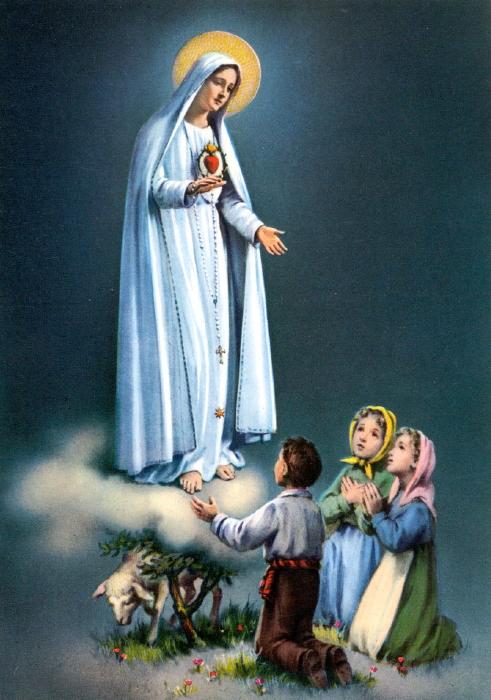
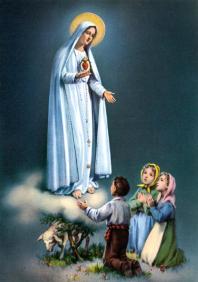
On May 13, 1917, three Portuguese children were praying the rosary after lunch in a field on a clear blue day.  The eldest was Lucia, age 10, and she was with her cousins, Francisco and Jacinta, ages eight and seven. Suddenly, they saw two bright flashes. They looked up and saw “a lady, clothed in white, brighter than the sun…” The Lady smiled and said, “Do not be afraid, I will not harm you.” Lucia asked her where she came from. The Lady pointed to the sky and said, “I come from heaven.” Lucia asked what she wanted. The Lady said, “I have come to ask you to come here for six months on the 13th day of the month, at this same hour.”

On July 13, the incredibly beautiful Lady appeared again. Lucia asked her who she was, and for a miracle so everyone would believe. The Lady answered, “Continue to come here every month. In October, I will tell you who I am and what I want, and I will perform a miracle for all to see and believe.” Then she taught them this prayer: “Oh my Jesus, forgive us our sins, save us from the fires of hell. Lead all souls to Heaven, especially those in most need of Thy Mercy.”

At noon, on October 13, 1917, some 70,000 people were gathered in the field. With a flash of light, the Lady appeared to the children and declared, “I am the Lady of the Rosary.” Some spectators cried out and the crowd turned their eyes upward to the cloudless sky, and they gazed on the sun without the least discomfort.  They saw it tremble and danced in a miraculous way.

Mary, Lucia, Francisco and Jacinta teach us this lesson: Even if you are young, God can do big things with you, if you say “Yes” to Him. Let us pray that we would be open to doing God’s will every day.
The 2nd Joyful Mystery:
The Visitation

“During those days Mary set out and traveled to the hill country in haste to a town of Judah, where she entered the house of Zechariah and greeted Elizabeth. When Elizabeth heard Mary’s greeting, the infant leaped in her womb, and Elizabeth, filled with the Holy Spirit, cried out in a loud voice and said, ‘Most blessed are you among women, and blessed is the fruit of your womb. And how does this happen to me, that the mother of my Lord should come to me? For at the moment the sound of your greeting reached my ears, the infant in my womb leaped for joy.’” (Luke 1)

Imagine how St. Elizabeth must have felt to have Mary, Mother of God, walk in through her door. Elizabeth could not see the tiny Jesus, a fetus in Mary’s womb, but she was convinced that He was hidden there. How would you treat someone if you knew that Jesus was hidden inside of them?

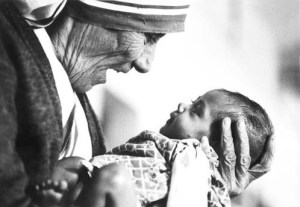
Blessed Mother Theresa cared for the poorest of the poor in the streets of Calcutta, India. Despite years of strenuous physical, emotional and spiritual work, Mother Teresa seemed unstoppable. Though frail and bent, with numerous health problems, she always returned to her work, to those who received her compassionate care for more than 50 years. How did she do it? She could do it because she encountered her beloved Christ both in times of prayer and in the people she cared for. Mother Teresa remembered Jesus’ words, “Amen, I say to you, whatever you did for one of these least brothers of mine, you did for me.” (Matthew 25:40) Mother Teresa loved others as if they were the Lord Himself.

Blessed Mother Teresa and St. Elizabeth teach us this lesson: Jesus is present in your classmates here at school, so you should always be welcoming and loving toward them. Let us pray for the grace to love others in this way.

The 3rd Joyful Mystery:
The Nativity

In his youth, Francis had been quite rich, the son of a wealthy merchant, yet he sensed that there was more to life. He put his former life behind him and devoted himself to following Christ. One day, at Mass, the Gospel told of how Christ’s disciples were to possess neither gold nor silver, nor traveling items, but were to exhort sinners to repentance and announce the Kingdom of God. Francis took these words as if spoken directly to himself, and as soon as Mass was over he threw away what little he had and went forth at once, exhorting the people of the country-side to penance, brotherly love, and peace. He was poor, but clearly happy, and others were attracted to join his movement. By the time of his death, hundreds had joined his religious order. On October 3, 1226, St. Francis died a penniless, but happy man. 

St. Francis of Assisi loved Christmas.  In fact, one story tells of how he petitioned the Holy Roman Emperor to make an edict that grain and bread should be provided to birds, beasts, and the poor this day, so that all God’s creatures would have occasion to rejoice in the Lord. St. Francis also invented the Christmas tradition of making a model of the nativity scene. These nativity scenes, called Crèches, remind us that even though Christ was rich in Heaven, he became poor when he was born on earth in a barn. Yet, Jesus was a happy man, despite his poverty.

Jesus and St. Francis teach us this lesson: You do not need to be wealthy in order to be happy. Let us pray that we may be content and happy with the riches that we have.
The 4th Joyful Mystery: 
The Presentation of Jesus in the Temple

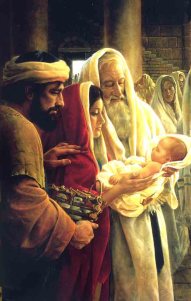
In the year that Jesus was born, “there was a man in Jerusalem whose name was Simeon. This man was righteous and devout” and he longed to see the Messiah who would save God people. It had been revealed to him by the Holy Spirit that he would indeed see the Christ before he died and Simeon trusted and hoped in that promise.

One day, the Spirit inspired him to come into the temple. When he say Mary and Joseph carrying in the baby Jesus to offer a sacrifice for Him, Simeon “took him into his arms and blessed God, saying: ‘Now, Master, you may let your servant go in peace, according to your word, for my eyes have seen your salvation, which you prepared in sight of all the peoples, a light for revelation to the Gentiles, and glory for your people Israel.’” (Luke 2)

What are the promises the Lord has made to us?  Do we trust and hope in these promises? Simeon teaches us this lesson: That we ought to trust and hope in the Lord’s promises, for all of them will be fulfilled in the sight of all someday.

The 5th Joyful Mystery:
The Finding of Jesus in the Temple

This is a true story, the story of a Catholic mother of three whose oldest son joined an anti-Catholic religious cult. It started him down a path of sinful pride and many sensual sins. It broke her heart and for years she prayed tearful prayers for his conversion.

She even asked the bishop to intervene in winning over her son. He counseled her to be patient, saying, “God’s time will come.” When she persisted in asking, the bishop (perhaps busy with many other things) famously reassured her: “Go now, I beg you; it is impossible that the son of so many tears should perish.”

That mother was St. Monica, and that son of hers, who was lost and found, was the great St. Augustine. Sts. Monica and Augustine teach us this lesson: that your persistent prayer can help people to find Christ. Let us pray for someone that we know, that he or she may be drawn closer to Jesus Christ.

Sources:
On Fatima
On St. Francis
On Blessed Mother Teresa
The Glorious Mysteries, Meditations with the Saints

October 27, 2010

The 1st Glorious Mystery:
The Resurrection of Jesus from the Dead

St. John Bosco, an Italian priest, founded a famous school for boys in the mid-1800’s and is the patron saint of students. He is known to have worked many miracles, but one from 1849 stands out. Returning from a journey, he learned that Charles, a 15 year old student, had died. He went immediately to the teenager’s home where the family informed him that Charles had been dead for over 10 hours. The body was laid out in the living room, already dressed for burial.

Fr. Bosco asked everyone to leave except the mother and the aunt. After some time in silent prayer, he cried out: “Charles, rise!” Charles emitted a long sigh, stirred, opened his eyes, stared at his mother and asked, “Why did you dress me like this?” Then, realizing Fr. Bosco was present, he told him how he had cried out for him and how he had been waiting for him. He exclaimed, “Father, I should be in hell!” He told of how a few weeks before he had fallen into serious sin. Then he said he had a “dream” of being on the edge of a huge fiery furnace, and as he was about to be thrown into the flames, a beautiful lady appeared and prevented it. She said, “There is still hope for you, Charles. You have not yet been judged.” Then he heard the voice of Fr. Bosco calling him back.

Charles asked Fr. Bosco to hear his confession. After his confession, the mourners filled the room again, and Fr. Bosco said, “Charles, now that the gates of heaven lie wide open for you, would you rather go there or stay here with us?” A profound silence filled the room. Charles, with tears in his eyes said, “I’d rather go to heaven.” Then he leaned back on the pillows, closed his eyes and breathed his last.

Unless Jesus’ Second Coming happens first, each of us here will die, and rise. As we meditate on Jesus’ resurrection, let us consider how ready we are to meet Him.

The 2nd Glorious Mystery:
The Ascension of Jesus into Heaven.

St. Padre Pio is another Italian priest from not so long ago who also worked remarkable miracles. During WWII, Allied planes flew bombing raids over Italy. Almost all of the centers of the region were subjected to repeated bombardment, but no bombs ravaged the town of San Giovanni Rotondo. Every time the aviators approached that place, they saw a monk flying in the air who prevented them from dropping their bombs. Understandably, reports of this flying friar did not amuse the superior offices.

Bernardo Rosini, a general of the Italian Air Force, recounts this story: “One day, an American commander wanted to lead a squadron of bombers himself to destroy the German arms depository of war material that was located at San Giovanni Rotondo. The commander related that as he approached the target, he and his pilots saw rising in the sky the figure of a friar with his hands held outward. The bombs released of their own accord, falling in the woods, and the planes completely reversed course without any intervention by the pilots.”  

Someone told the commanding general that in a convent at this town, there lived a saintly man. At war’s end, the general wanted to go meet this person. “He was accompanied by several pilots… He went to the convent of the Capuchins. As soon as he crossed the threshold of the sacristy, he found himself in front of several friars, among whom he immediately recognized the one who had ‘stopped’ his planes. Padre Pio went forward to meet him, and putting his hand on his shoulder, he said, `So, you’re the one who wanted to get rid of us all!’”

As we meditate on the Ascension of Jesus, to the right hand of the Father in Heaven, let us pray that He would establish justice and peace, in this country and the whole world, in our time.

The 3rd Glorious Mystery:
The Descent of the Holy Spirit at Pentecost

We usually don’t associate India with Christianity, but that nation has over 24 million Christians.  That’s about as many people as live in Texas, our second largest state. If you were to ask them how the faith reached their land they would point to St. Thomas the Apostle.

What led St. Thomas, who at first refused to even believe in the Good News, to travel over 2,500 miles to bring them the Gospel? It was not merely seeing the risen Christ. Jesus knew His disciples would need more to strengthen them then merely their memories of Him. St. Thomas journeyed because the Lord had sent the Holy Spirit at Pentecost, to fill them with gifts, like wisdom, courage, and zeal.

If we are in the state of grace, God the Holy Spirit dwells in us too, and He wants to empower us with His gifts. As we meditate on the descent of the Holy Spirit at Pentecost, let us pray for whatever spiritual gift that we need the most.

The 4th Glorious Mystery:
The Assumption of the Virgin Mary.

No Church, in the East or the West, claims to contain the body of St. Mary. This is because “the Immaculate Mother of God, the ever Virgin Mary, having completed the course of her earthly life, was assumed body and soul into heavenly glory.” This is because Jesus would not suffer Mary, His sinless, faithful beloved, to undergo corruption.

Death is a consequence of human sin, and without human intervention, as in embalming or mummification, our dead bodies will ordinarily experience its corruption. But, sometimes, the Lord preserves the dead bodies of his saints, to give a sign of their holiness, and to show that death is not all that awaits us.

Among the numerous saints whose incorrupt bodies you can still see today are:  St. John Bosco, St. John Vianney, St. Catherine Laboure (the visionary of the Miraculous Medal), St. Bernadette Soubirous (the visionary of Lourdes), and St. Maria Goretti.

As we meditate on the Assumption of the Virgin Mary, let us pray for purity in our lives.

The 5th Glorious Mystery:
The Coronation of Mary as the Queen of Heaven and Earth

Once, when St. Maximillian Kolbe was a boy, his behavior began trying his mother’s patience. She said in exasperation, “Maximillian, what will become of you?” As St. Maximillian writes, “Later, that night, I asked the Mother of God what was to become of me. Then she came to me holding two crowns, one white, the other red. She asked me if I was willing to accept either of these crowns. The white one meant that I should persevere in purity, and the red that I should become a martyr. I said that I would accept them both.” St. Maximillian would receive both crowns, as a holy Franciscan brother, and as a victim of the Nazis at Auschwitz, were he took the place of another innocent man who was condemned to die.

Jesus crowns his holy ones. He wills that those who share in His sacrifice should also share in His glory. As we meditate on the Coronation of Mary, let us pray to accept whatever crowns of burden and glory the Lord wants to give to us.

Catholic Medical Ethics—30th Sunday in Ordinary Time—Year C

October 27, 2010

In today’s second reading we hear from St. Paul, a prisoner in Rome on account of Christ and the Gospel.  Paul senses that the end of his life on earth is near. He writes:

“I am already being poured out like a libation,
and the time of my departure is at hand.”

The emperor will soon order Paul to be executed by beheading, sending him to Christ’s eternal reward. Yet this is not to the emperor’s glory, for the blood of St. Paul’s murder will be on his hands.

By God’s grace, Paul was not left all alone in this difficult, final season of his life. Elsewhere in this chapter from 2nd Timothy, he writes, “Luke is the only one with me.”  (This is St. Luke the evangelist, whose Gospel we are reading this liturgical year.) In another letter, Paul calls Luke his “beloved physician.”

Now what if Luke, seeing Paul’s burdens and what trials awaited him, were to procure some hemlock with which to end his friend’s life? Would Paul be pleased with him? Would he not rather be angry that Luke would presume to thwart God’s purposes for him on earth?

The Lord, the author of our lives, is the one to decide when someone’s life story is complete. God has joined our souls to our bodies and what God has joined together, no human being must separate; for it is always and everywhere wrong to intentionally kill the innocent. God sent Luke to Paul not to kill him, but to strengthen, console and support him in this last season of his life.

Healthcare and end of life issues touch all our lives, and people of good will have many questions in this area. Like, “What is wrong with euthanasia or assisted suicide?” “What does Christ’s Church teach about living wills, ventilators, feeding tubes, and palliative care?” And, “What kind medical care is morally required, and what sorts of care are optional?”

The Church calls care and treatments which are morally required “ordinary care.” Treatments which are optional called “extraordinary care.” Each of us has an obligation to respect our lives and bodies as precious gifts from God.  This means that we must always receive, and provide to others, “ordinary care.” However, circumstances can arise where various treatments become “extraordinary” and may be omitted. Treatments which involve great pain, or extreme cost, or little likelihood of doing much good can be deemed extraordinary care.  Burden, cost, and futility can make a treatment morally optional.

Yet, every treatment must be put into context. Sometimes the same procedure, which is ordinary in some cases, will be extraordinary in others. Sometimes a ventilator can be an extraordinary treatment, making it acceptable for people to refuse or discontinue its use. However, imagine if an otherwise healthy person should come to the hospital with a routinely curable lung condition which requires surgery and the short-term use of a ventilator.  In this case, the ventilator—which can be costly and burdensome—is not extraordinary because its benefits far outweigh its burdens.

This is a danger with living wills and advance directives.  Making medical decisions about treatments, in the abstract, in advance, and out of context, can easily lead to wrong decisions. Consider the use of feeding tubes. A person can check a box on a living will that says they never want one, but feeding tubes are quite often ordinary care; however, in some cases, they become extraordinary care.

Sometimes, in the process of dying, a person may no longer be able to digest food. In such an instance, use of a feeding tube would be futile, painful, extraordinary, and rightly omitted. But if someone is not dying, to deprive them of food or water is like preventing a diabetic from taking their insulin. That is not allowing nature to take its course—it is homicide. Pope John Paul II taught that ‘a sick person in a vegetative state, awaiting recovery or a natural end to their life, still has the right to basic health care (such as nutrition, hydration, cleanliness, warmth, and the like), and to the prevention of complications related to his or her confinement to bed. … Causing someone’s death by starvation or dehydration, if done knowingly and willingly, is truly euthanasia by omission.’

We condemn euthanasia and assisted suicide because they are about killing the person rather than killing the disease, and we can never intentionally kill the innocent. It is wrong to kill the sick, but it is good to alleviate their pain and discomfort while they live. This kind of treatment, aimed at increasing a person’s comfort, is called palliative care and it is a great good. The work of Hospice and others is to provide palliative care in the final stages of life.

Would it be wrong to overdose a person with morphine to end their life?  Yes, for it is wrong to intentionally kill the innocent. But what about a case where treating someone’s pain with pain-killers (in the normal doses) might have the unintended side-effect of shortening their remaining days? Would it be wrong to request or administer such a treatment?  No because the aim is not to kill the sick person, but to relieve their pains. Sometimes, people with cancer choose to forgo chemotherapy and its burdens even though treatment might help them live longer than they would without it. Are these people choosing death? No, they are choosing a different way to live. The burdens of chemotherapy can make it an extraordinary treatment, and we are free to forego extraordinary treatments, even if it may shorten our lives.

The three principles I have tried to present today are these: first, that it is always and everywhere wrong to intentionally kill the innocent.  Second, that we must receive, and provide to others, ordinary care. And third, that treatment which entails great pain, or extreme cost, or little likelihood of doing much good can be deemed extraordinary care, and is morally optional.

I hope you now have a clearer understanding of some points of Catholic medical ethics, but these can be complicated issues. If you are facing difficult treatment decisions, for yourself or someone you love, seek out counsel of those who know the Church’s teachings on this subject. Holy Mother Church’s wisdom on healthcare issues is the natural and logical extension of her dedication to human dignity. As Roman Catholics in a culture of death, we must we stand for the dignity of every human life, from conception to natural death, and we need to vote for it, too.

  • An article on “ordinary” and “extraordinary” care.

A Great Quote about St. Issac Jogues

October 20, 2010

August, 1642 AD. The Jesuit missionary St. Issac Jogues is canoeing to the land of the Herons in New France when he is captured by Mohawk Iroquois. They torture him and cut off several of his fingers. He later escapes them and returns home to France, but he laments no longer being able to preside at the Mass.  (Canon law prohibits him from offering the sacrifice with his maimed hands.)

An appeal is made to Pope Urban VIII in Rome for an unprecedented dispensation. The pope  responds with this famous reply:

“Can one deny the right to say Mass to a martyr of Christ?”

St. Issac Jogues returns to Canada and sheds his blood a second, final time at the hands of those he came to save.

Prayer is Necessary — 29th Sunday in Ordinary Time—Year C

October 17, 2010

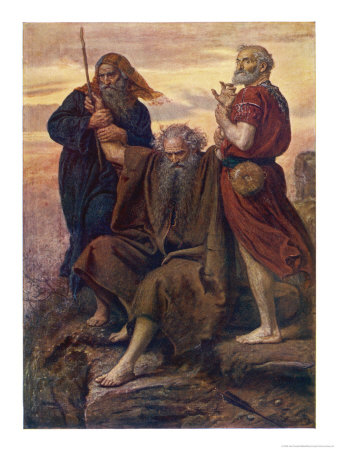
As the Hebrews fought the Amalekites, Moses held up in his hands, above his head, the wooden staff of God. In doing this, He resembles Jesus, who outstretched his arms on the cross, and the priests of Christ’s Church, who raise their hands up to Heaven.  Each one, Moses, Jesus, and His priests, offer prayers to the Father.

As long as Moses kept his hands raised up,
Israel had the better of the fight,
but when he let his hands rest,
Amalek [the enemy] had the better of the fight.

What would have happened if Moses had kept his arms just down at his sides? God’s people would have lost their deadly battle. What would happen if Jesus were to stop pleading for us at right hand of the Father in Heaven? We would be left all on our own. What would happen if priests were to no longer to offer the Mass? The Church would be deprived of graces. If Moses, or Jesus, or the priests of the Church were not persistent in prayer, souls would be lost. The same is true for you and I as individuals.

If you or I wish to be saved, it is necessity for us to pray always without becoming weary. As St. Alphonsus Liguori, a doctor of the Church, said: “He who prays is certainly saved; he who does not pray is certainly damned. All the saints in heaven, except infants, were saved because they prayed; and all the damned in hell were damned because they did not pray, and this is their greatest torment to see how easily they could have been saved, had they prayed, and that now the time for prayer is over.”

Prayer is how we grow in our relationship with God. And Heaven consists first and foremost in an intimate relationship with Him. But, if we do not pray, we will not have much of a relationship with God, and Heaven will not be a place where we really want to live. It is essential that you commit yourself to praying every day, ‘whether it is convenient or inconvenient.’

To remain committed to this, ask the help of other to strengthen you and keep you faithful to prayer. Moses had the help of Aaron and Hur, at his right and his left. Jesus had the help Mary and John, at the foot of His cross. The priest celebrating Mass has the help of God’s people, those in the church on earth and those in the Church in Heaven. So have your spouse, your children, and your friends to pray with you and keep you faithful to prayer.

Families should pray together, parents with their children. This will instill the Faith in them more than anything else.  And Fathers need to take the lead, for if only Mom prays with the children they will wonder, “Why doesn’t Dad pray, too?”

Couples should also pray together.  A couple that prays together every day a divorce rate less than one percent. And it makes sense, because if I know that someone is praying for me, that they’re willing my true good, then even if there are rough spots between us, I know that we’re on the same side. So before you leave the house, or before you go to bed, pray together as a couple; even if it’s as simple as a moment of silent prayer. Remember that the family that prayers together, stays together.

It is necessity for us to pray always without becoming weary, as families and individuals, for “He who prays is certainly saved; he who does not pray is certainly damned.” So pray every day, because our souls depend on it.

The Rot Inside — Tuesday, 28th Week in Ordinary Time—Year II

October 13, 2010

St. Paul says in the first reading that “the works of the flesh are obvious.”  If so, then why does Jesus have to point out the sins of the scribes and Pharisees, whose sinfulness “are like unseen graves over which people unknowingly walk”? It’s not that Jesus is pronouncing “woe” upon people unaware that they have sins, the problem is these people think that their hidden sins are no big deal because of their outward practices and appearances.

As long as we are at ease with “immorality, impurity, licentiousness, idolatry, sorcery, hatreds, rivalry, jealousy, outbursts of fury, acts of selfishness, dissensions, factions, occasions of envy, drinking bouts, orgies, and the like,” in our lives we will not enter the Kingdom of God. Even if we do not end up in Hell because of them, we will certainly have to wait on the doorstep to Heaven in Purgatory until these sins are rooted out. Let us crush these sins in our lives like the cancers that they are.

The Eager Provider — Thursday, 27th Week in Ordinary Time—Year II

October 7, 2010

Today we celebrate Our Lady of the Rosary and we hear a parable about a man who would rather not be bothered.  Let us compare this man to Mary.

He considers his visitor his friend, but she claims us as her children.

He feels too tired to help, but she never sleeps.

He hesitates to provide, but she is eager to give.

If mothers who are imperfect know how to give good gifts to their children, how much more will our perfect mother in Heaven intercede to give us good things whenever we ask her in the Rosary. It is a prayer which she receives from us as a sweet bouquet of roses.