Archive for the ‘Saintly People’ Category

3 What If’s — Tuesday, 5th Week of Easter

May 4, 2010

Before today’s Mass, I would like you to imagine three “what if” scenarios. How would you respond in the three situations I’m about to describe?

First:  Imagine, what if, at this morning’s school Mass, the great apostle St. Paul was going to preach to you? How interested are you in whatever he has to tell you?

A second scenario: What if there were a book out entitled, Actual Prayers of Jesus and Mary, and what if there was strong archeological evidence to support that these really were prayers which Jesus and Mary prayed frequently during their lives on earth? How interested are you in discovering these prayers? How powerful would it be for you to pray their prayers?

The third and final scenario: What if I were to tell you, calmly and with firm conviction, that I had received a message for you, a revelation, from Jesus Christ, which He wanted you to hear through me at this Mass? How interested and open are you to receiving such a message?

Of these three scenarios, which one would you most desire to be true?Now listen closely…. All three of these scenarios will be realized, will be true, at this Mass.

The first scenario will be realized: St. Paul will indeed preach to you–in this morning’s first reading. Perhaps St. Paul did not realize it when he first spoke these words, nor perhaps did the sacred author who wrote them down in the Book of Acts, but the Holy Spirit was inspiring, was guiding these words.

And the Holy Spirit did not only have the first-century Christians of Lystra, Iconium, and to Antioch in mind when He prompted these words. St. Paul’s inspired message is meant for us today just as much as they. So this morning, St. Paul will preach a message (though only one sentence long) which is truly intended for you.

As to the second scenario, where is this book containing Actual Prayers of Jesus and Mary? We read from it at almost every Mass, as we will today. This book is the Book of Psalms. In the day of Jesus and Mary, all devout Jews prayed these 150 psalms and they usually knew them by heart. Jesus and Mary prayed the Psalms too. These prayers were inspired by the Holy Spirit to be prayed by all God’s people, including us today, but one could say that the Psalms find their fullest voice through Jesus and Mary. In today’s responsorial psalm, we will join Jesus and Mary in one of their powerful prayers in praise of the Lord.

The third scenario will also be true at this Mass: I have indeed received a message from Jesus Christ which He wants you to hear through me this morning. You will hear His message addressed to you in the proclaimation of the Gospel. At the Last Supper, Jesus was not only speaking to the disciples seated around Him. With His divine sight, Jesus saw all of us here then, and He speaks intending His words for us this morning just as much as they. How much will you allow Jesus’ message to you to affect and change you?

We believe that, “When the Scriptures are read in the Church, God himself is speaking to his people and Christ, present in his own word, is proclaiming the Gospel.” At this and at every Mass, let us come to the Scriptures expecting much, so that we may find much, and receive in from them in abundance.

Hearing Him — Friday, 3rd Week of Easter

April 23, 2010

Jesus says, “Whoever eats my Flesh and drinks my Blood,” as we are about to do in at this Mass, “remains in me and I in him.” After we receive Him, He remains with us and we with Him.  And He stays with us, provided we do not cast Him out through committing serious sin, until we receive Him again.

Jesus remains close to us throughout our day. Wouldn’t it make sense, that time to time, He would occasionally have something to tell us? Maybe we don’t hear Him because He knows we would refuse to listen. Perhaps He knows we would dismiss hearing Him speak to us out of hand, or maybe He knows we don’t trust Him enough to go out on a limb. For example, if you got the feeling that the Lord wanted you to relay to a message, a message you didn’t really understand, to particular person what would you do?

In the first reading, the Lord speaks to Ananias and Ananias answers, “Here I am.” Then the Lord gives Him an entirely wholesome, but very counter-intuitive task: lay your hands on Saul and heal him. Ananias hesitates a little. Ananias might be wondering if this is really coming from the Lord, or maybe he’s not sure he wants to risk this much for the Lord. But in the end, Ananias listens, and because of it, Saul became St. Paul.

If we would like the Lord to do such things with us let us be faithful in little things, faithful to the commands of our consciences and to the gentle nudges of the Holy Spirit throughout our daily lives. If we are willing to trust Him, Jesus will ask us to be His chosen instrument in greater matters too. So let’s listen, let’s be docile, and see what He does with us.

For One’s Friends — Tuesday, 3rd Week of Easter

April 20, 2010

Jesus said, “No one has greater love than this, [than] to lay down one’s life for one’s friends.” Have you ever wondered if that’s true? Is that really the greatest love? Wouldn’t it be greater for someone to lay down their life for their enemies? No, for I tell to you that no one can do this. It is impossible to lay down your life for an enemy. You can only lay down your life for people you love.

St. Stephen, like the Savior he followed, loved those who killed him. Stephen’s murders hated him, but he did not hate them in return. He was their enemy, but they were not his. Stephen loved them enough to challenge and correct them, but this made them very angry. Before dying, Stephen said, “Lord, do not hold this sin against them.” He was acting with mercy, generosity, and prayer in imitation of Jesus Christ, his role-model.

In this community, I do not feel that we are plagued with the disease of hatred: hatred for others, hatred for classmates, or hatred for God. But I do fear that we are infected by indifference: indifference towards each other, indifference towards those in need, and indifference towards God. I challenge you: in the past week what have you done to be more merciful, more generous, or more prayerful?

St. Stephen had mercy, generosity, and prayers for those who hated him. St. Augustine wrote that if it had not been for this, that young man named Saul who was guarding the cloaks, consenting to the execution, would not have later converted to become St. Paul, the great apostle. If St. Stephen overcame hatred and did this, imagine what overcoming our indifference could do?

We may not necessarily have to die as bloodied martyrs, like St. Stephen did, but Jesus asks each of us to lay down our lives for our friends.

Peter’s New Season — 3rd Sunday of Easter

April 20, 2010

Once, when Jesus was preaching as he stood on the shore of the Sea of Galilee, a large and eager crowd was pressing in on Him.  So Jesus got into a fisherman’s boat and asked him to put out aways so that He could sit and teach the crowds. The tired fisherman complied. And after Jesus had finished speaking, He said to this fisherman, “Put out into deep water and lower your nets for a catch.” The fisherman said, “We have worked hard all night and have caught nothing, but at your command I will lower the nets.” When they had done this, they caught an incredible number of fish such that their nets were tearing. And Jesus said to the startled man, “Do not be afraid. From now on you will be catching men.” As you probably remember, the fisherman was Simon Peter, and from that day on his life entered a new season. For the next few years Simon Peter would follow Jesus and evangelize towns on His behalf.

In today’s gospel, from the days after the resurrection, Peter is fishing again. And once again, Jesus is there on the shore. They have caught nothing, but Jesus says to try once more, and they catch an incredible number of fish. When Simon Peter realizes it is Jesus he eagerly comes to Him as fast as he can. He finds Jesus beside a charcoal fire. This should be familiar to Peter, too, calling to mind  another charcoal fire in the dark courtyard of the high priest.

After sharing a meal, Jesus says, “Simon, son of John, do you love me more than these? Do you love me?  Do you love me?” Simon Peter says, “Yes, Lord, you know that I love you. Yes, Lord, you know that I love you. Lord, you know everything; you know that I love you.” Jesus has given Peter the opportunity to undo his triple denial of Jesus with a triple confession of his love. And after each time, Jesus speaks of a new season for Peter’s life: “Feed my lambs. Tend my sheep. Feed my sheep.”

Now it is one thing to catch fish, but it is another thing to shepherd a flock. Up to now, Peter has been following Jesus and bringing others to Him. But now Jesus is asking Peter to do something new, to shepherd His flock for Him. Do you think Peter nervous? Is he concerned about whether he is up to the task? Is he worried about being led where he doesn’t want to go? I bet he is, but Jesus would have him ‘not be afraid,’ for he won’t be doing it alone. Jesus says to Peter, “Follow me.”

Our lives are often entering new seasons. Maybe you’re moving into a new town or a new school. Maybe you’re transitioning from engagement to marriage, welcoming new children, or living for the first time without children in the house. Maybe you have a new job, or don’t have a job for the first time. But whatever season of our life Jesus calls us into, His calling and our mission remain the same. Jesus said, ‘”I give you a new commandment; love one another as I have loved you,” and ” “There is no greater love than this, than to lay down your life for a friend.” Every new season of life offers us the unique opportunity to deepen our love for Christ and each other more than ever before.

Maybe you feel nervous? Maybe you’re concerned about whether you are up to the task? Maybe you’re worried about being led where you don’t want to go? But remember Simon Peter and don’t be afraid.  Jesus gives lots of second chances and He does not expect us to do it alone.

Rabbi Gamaliel’s Wisdom — Friday, 2nd Week of Easter

April 16, 2010

The apostles were brought before the Sanhedrin, the Jewish High Council, to be questioned for why they continued to teach in “that name.” At hearing the apostles’ answers, the Jewish leaders “became infuriated and wanted to put them to death,” but a Pharisee in the Sanhedrin stood up and had the apostles put outside. This was Gamaliel, a great teacher of the law who was respected by all the people. (It was at this rabbi’s feet that St. Paul received his Pharisaical training.)

Gamaliel said, “Fellow children of Israel, be careful what you are about to do to these men.” Now his form of address here is interesting and revealing. He could have addressed his peers in the Sanhedrin in many different ways, but by calling them “fellow children of Israel” he recalls Jacob (whose name God changed to Israel) and his twelve sons.

Now of all those sons, Joseph was Jacob’s favorite. This made the others so jealous that they sold Joseph into slavery. But through suffering this dishonor Joseph would go on to become the instrument of their salvation. Even though they meant to destroy him, they failed. God intended this for good, to achieve the salvation of many.

Gamaliel concluded his speech to the Sanhedrin wisely observing, “If this endeavor or this activity is of human origin, it will destroy itself. But if it comes from God, you will not be able to destroy them…”

Evil endeavors or activities are destroyed in time. But what is of God endures, even if it is sometimes setback by evil and sins. In these beleaguering times, for our country, for our Church, and for our pope, this lesson from Rabbi Gamaliel gives us good reason for hope.

Faithful Despite Doubts — Divine Mercy Sunday—2nd Sunday in Easter—Year C

April 11, 2010

Thomas, called Didymus, one of the Twelve, was not with them when Jesus came. So the other disciples said to him, “We have seen the Lord.” But he said to them, “Unless I see the mark of the nails in his hands and put my finger into the nailmarks and put my hand into his side, I will not believe.”

Why is “Doubting” Thomas so slow to believe. Why is Thomas so reluctant to trust? A clue might be found in the gospel’s interesting inclusion of Thomas’ Greek nickname: Didymus. Didymus means “twin,” but in relation to whom was Thomas a twin? Some speculate that Thomas the Apostle bore a striking resemblance to Jesus Himself. This tradition is sometimes reflected in iconography where Thomas is the apostle who looks a lot like Jesus.

If this is why Thomas was the apostle called “the twin” then we can understand his rational skepticism. How many times during Jesus’ ministry had people come up to Thomas and said, “O Jesus, we’re so happy to see you! We’ve walked for miles to see you again!” Then, with some annoyance, Thomas might have answered, “We’ll you’ll have to walk a little bit further. Jesus is over there.” So now, when the other disciples come up to Thomas after Easter and say, “We have seen the Lord,” Thomas replies, ‘I’ll need more evidence than that.’

Thomas’ resistance to believing the good news about Jesus might not only be coming from his mind, but also from his heart. Jesus was Thomas’ hero, his teacher, and his close, beloved friend. Thomas thought that Jesus was going to be the savior and messianic king of Israel. But their close relationship and all of Thomas’ great hopes were destroyed for him at the crucifixion. Imagine how Thomas might have prayed then: “My God, why have you let this happen? How could you let Him be taken instead of me? Jesus was so good! He was completely innocent, and you let Him be die! Why?”

The unexpected death of Jesus broke Thomas’ heart, and having been so hurt once, Thomas was resolved not to let his heart be taken in again: “Unless I see the mark of the nails in his hands and put my finger into the nailmarks and put my hand into his side, I will not believe.”

Yet, though he doubts, notice where Thomas is one week after Easter. He is with the other apostles in the upper room in Jerusalem, gathered behind locked doors for fear of the authorities who killed Jesus. Now there are lots of other places Thomas could have chosen to be. There were safer places he could have gone, like back to his hometown and to the extended family and friends he had left behind to follow Jesus a few years before. Though Thomas doubts, he does not leave this house of faith. He struggles with his faith, but does not abandon it. He seeks within this house of faith, this Church, and because of it, Thomas finds sufficient evidence for his mind and healing for his heart.

The risen Lord appears in the upper room and how does Jesus respond to Thomas’ resistant unbelief? Not with anger.  Not with condemnation.  But with the divine mercy we celebrate today. Jesus appears in their midst and says, “Peace be with you.” Then he says to Thomas, “Put your finger here and see my hands, and bring your hand and put it into my side, and do not be unbelieving, but believe.”

In our lives we too will struggle with our faith and our doubts, with our emotions and with our thoughts, in our hearts and in our minds. Jesus does not condemn our honest struggles. But Jesus wants us to sincerely seek within this house of faith; this, His apostles’ Church, where the truth and healing is found by all those who seek Him.

11 Absent Students — March 25 — Annunciation

March 28, 2010

You have probably wondered why our school chapel’s icon, statues, and crucifixes are veiled with purple cloth. Covering of religious images is a tradition for the last two weeks of Lent, a period we call Passiontide. So why do we have this tradition?

One explanation recalls that Jesus’, when His enemies sought to kill Him, hid Himself prior to His final days: “Jesus left and hid from them.” (John 12:36) Others see in this veiling a symbol for how Jesus’ divinity was veiled within His humble and vulnerable humanity. He was God incarnate, but none of the rulers of His age knew, “for if they had known it, they would not have crucified the Lord of glory.” (1 Corinthians 2:8) But behind all of this I think there is a very human reason for why we veil the holy images of Jesus and the saints at Passiontide. “Absence makes the heart grow fonder.”

During Lent we deprive ourselves of luxuries and pleasures for our personal conversion and growth in holiness, but we also do this so that we can celebrate the Christ’ Easter triumph with an even greater feeling of joy. This is why we normally don’t sing as much (or say the Gloria or the “A”-word before the Gospel) during Lent—so that we can enjoy pulling out all the stops at Easter.

Veiling our statues of Mary and Joseph, our wall icon of Elizabeth Ann Seton, and our crucifixes causes a little pain of separation within us. But what if this chapel had never been furnished? What if our chapel had always been bare of religious art? Then their absence would not affect us at all because we would not know that we were missing them.

There are not as many students here today as there should be. Now I’m not saying that this should have been a whole school Mass, and I’m not begrudging anyone who may have stayed in study hall this hour to work on homework.  This is a great turn out and every seat is filled. But still, there are not as many students here as should be here today.

In the early nineties, when most of you were born, for every three live births in our country there was one boy or girl who was intentionally killed. (CDC) I counted roughly 33 students here today. That means we are missing 11 of your classmates who were not allowed to be born.

Today we recall the Annunciation, which some people call “Pro-Life Christmas,” for even though Jesus will be born nine months from now, today is the day of the Incarnation, when God became a human being like us in the womb of the Virgin Mary. After the angel Gabriel departed, Mary went in haste to see her relative. Elizabeth exclaimed, “Who am I that the mother of my Lord should come to me,” and John the Baptist leapt for joy in his mother’s womb in the presence of our microscopic Savior, Jesus Christ. (Luke 1:43-44)

Imagine if 11 of your classmates were to die in a bus accident. You would you feel terrible from the loss, and our whole school would be in mourning. But we have never known the 11 who are missing here today, so we do not feel our loss.

At this Mass and henceforth, let us keep the following things in mind regarding the past, present, and future. As to the past, remember these absent classmates and pray for them. They never received a name, they never had a funeral, and few people have ever prayed for them. Pray for their parents, too. 

In the present, perhaps you honestly find yourself not feeling much emotion one way or the other towards the reality of one million innocents being murdered in our country every year. If so, then ask God to give us His heart and His sight to love what He loves and to hate what He hates. God loves us all, but He hates our sins. He hates our sins because they are bad for us, and the worse they are for us the more He hates them. His love for us and His hatred for our sins are two sides of the same coin. Blessed Mother Teresa of Calcutta said “the greatest destroyer of peace today is abortion.” The Lord’s heart is certainly not indifferent to this evil, and neither should ours be.

And finally, for the future, keep hope that this evil of abortion will come to an end in our time. We can have this hope, for as the angel Gabriel said to Mary, “nothing will be impossible for God.”

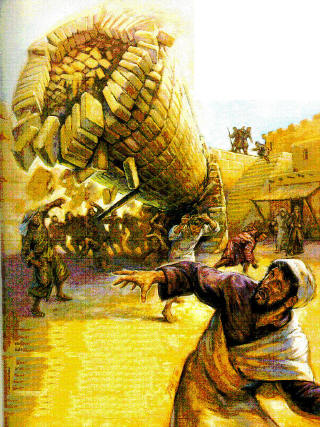
When Towers Fall — 3rd Sunday in Lent—Year C

March 7, 2010

When disasters happen, like the recent earthquakes in Haiti and Chile, some Christian observers respond according to two opposite extremes. One reaction says that a truly just God would never let the innocent die along side the guilty; therefore, all of the victims must have been punished for their sins and got what they had coming to them. The opposite reaction says that a truly loving God would never punish our sins; therefore, all of the victims must have been innocent.

The truth is more complicated than either of these simple and pat explanations. Our God is both perfectly loving and perfectly just. In this world the wheat grows side by side with the weeds. At harvest time, the two are uprooted together, but their eternal fates are not the same. We see that the truth is more complex than some assume by looking at the gospels.

One day Jesus and His disciples observed a man blind from birth. The disciples asked Jesus, “Rabbi, who sinned, this man or his parents, that he was born blind?” Jesus answered, “Neither he nor his parents sinned; it is so that the works of God might be made visible through him.” Jesus smeared clay in man’s eyes and told him to wash in the Pool of Siloam. The innocent man washed and returned able to see.

Yet, on another occasion (in the same Gospel of John) Jesus saw a man lying on the ground who had been ill for thirty-eight years. Jesus miraculously cured this man too, but finding him later Jesus said to the man, “Look, you are well; do not sin any more, so that nothing worse may happen to you.” In this case, it appears that the man’s sin was connected to the cause of his sufferings.

We need to remember that people who suffer and die are not always guilty. On the other hand, people are not always innocent either. Discerning the truth behind why this or that evil befell this or that person or place usually lies well beyond our own limited vision.

For instance, the friends of Job insisted with all confidence that Job’s sufferings must be due to some great sin he had committed.  However, Job stood firm on his innocence, and he truly was as righteousness he claimed. Great sufferings and even violent death are no certain indication of a person’s sinfulness, that “they had it coming.” Just look at our holy and beloved saints:

  • St. John the Baptist was murdered in his 30’s, and St. Paul in his 60’s—they were both beheaded.
  • St. Peter was murdered too, crucified upside down, and of all the apostles, only St. John died of old age.
  • St. Joan of Arc, age 19, was murdered with fire.
  • St. Therese of Lisieux and St. Faustina Kowalska both died of tuberculosis, at ages 24 and 33.
  • St. Maximilian Kolbe and St. Edith Stein were murdered by the Nazi’s in the Auschwitz concentration camp.
  • More recently, before our eyes, John Paul the Great suffered greatly and died of Parkinson’s disease.
  • Even the Blessed Virgin Mary, as perfectly innocent as she was, shared as a mystic and a mother in suffering the passion and death of her Son.

The innocent who suffer live and die in the likeness of Jesus Christ are promised a heavenly reward like His.

So from where do earthquakes and other natural disasters come? In the beginning of time, some of the angels and all of humanity rebelled against God and we rejected our proper places within His creation. This Fall introduced disharmony into our (now) mortal bodies and into the entire natural world. Since that time, Christ has come and in perfect obedience to our Father, died, rose, and has enabled us to be reconciled with God. However, the disharmony of nature remains and we remain free to choose to rebel against our God.

If rebel in sin, we should not be surprised if bad things happen as a result. Usually in this world, we are punished through our sins, more so than for them. For example, someone who neglects prayer and Sunday worship should expect that they will feel disconnected from God. Someone who abuses drugs or alcohol, will see the harmful consequences it brings to their relationships and at school or at work. Someone who covets their neighbors’ spouse and possessions will become sickly green with lust and envy. Add up the sum total of an entire peoples’ sins and you can easily see how an empire or a great nation can decline and decay over time.

God hates our sins, but not merely because they “break His rules.” God hates our sins in proportion to how harmful they are to us. If sins were not bad for us, then God would not command us not to do these things. God hates our sins because He loves us; these are two sides of the same coin.

So what should we do when we witness disaster strike half a world away or in our own community? We should pray for the dead and give our aid to those who live on. Christ calls us to give our compassion, love, spiritual support, and material aid to those who need it. And as for ourselves, such disasters should lead us to convert and reform our lives. Death can come suddenly to any of us. A car crash or a heart attack could take any of us tomorrow placing us unexpected before the judgment seat of God. Let us take such opportunities to prepare ourselves for that day which will come to us all.

What if is not instant death, but a more prolonged evil that comes to me? For instance, what if I go to the doctor and receive a terrible diagnosis?  When such a day comes for me, I hope that I may remember the tree from today’s Gospel, which the gardener worked and fertilized in hopes that it would bear much fruit. If I, like that tree, will humbly accept the manure that comes to me, then it will be a source of great fruitfulness to me.

Could an evil such as this be a correction or a chastisement from God on account of my sins? Possibly, but if I’m not aware of any serious unconfessed sins on my conscience, then probably not. More likely, Jesus is giving me the opportunity to following in His footsteps, to have a share in His cross like the holy saints who came before me. If we accept our crosses with humility, then they can become the means of our sanctification in the likeness of Christ and a source for spiritual fruitfulness for ourselves and the entire world.

Romantic Christianity — Friday after Ash Wednesday

February 21, 2010

In the gospel disciples of John ask Jesus, “Why do we and the Pharisees fast much, but your disciples do not fast?” Jesus answered them, “Can the wedding guests mourn as long as the bridegroom is with them?” Of all the images in the Bible to depict the relationship between God and His people, perhaps the most common is that of bridegroom and bride.

As we begin this Lent we should understand that the saints became holy and made their great sacrifices not by relying upon their own “iron-wills,” but by falling passionately in love.

If we strive after holiness as a personal achievement our exertions will make us discouraged and resentful, like the people in the first reading who complain, “Why do we fast, and you do not see it? Afflict ourselves, and you take no note of it?”

But what sort of person can make incredible sacrifices for another, without counting the cost, and feel intoxicating happiness as they do so? A person who can do this is a person who’s in love.

What if Christianity is not supposed to be so hard as you’re making it out to be? What if it is supposed to be as easy as falling in love? Perhaps you are being called to a new approach.

Mary and Pilate — 6th Sunday in Ordinary Time—Year C

February 14, 2010

In a few moments, after this homily, we will recite our creed, the summary of our faith. Every Sunday, we profess, in union with the Christians who came before us, our belief in these truths and our resolve to live our lives according to them. This morning we will look at just one rich aspect of our creed and consider its implications for our lives.

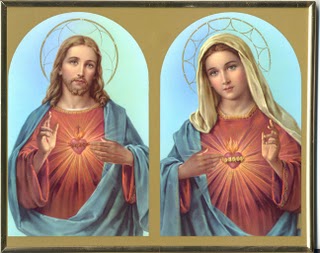
Have you ever noticed that in the entire creed, only two non-divine persons are mentioned by name? These are the Virgin Mary and Pontius Pilate.

“By the power of the Holy Spirit, He was born of the Virgin Mary and became man. For our sake He was crucified under Pontius Pilate; He suffered, died and was buried.”

Now many other figures from the Old and New Testaments could have justifiably been included in our creed; such as Adam and Eve, Abraham, Moses, David, Mary Magdalene, Peter, Paul, and many others. Yet, only Mary and Pilate get mentioned. So why is this? There seems to be two very good reasons. The first of these reasons I will give now—and the second I will save for the end.

The first reason why Mary and Pilate receive special mention is that they ground Jesus’ life, death, and resurrection in our real history. Jesus was ‘born of the Virgin Mary, suffered and died under Pontius Pilate, and on the third day, He rose again.’ Now other pre-Christian religions sometimes had stories about dying gods who came to life again, but those stories were always said to have happened ‘once upon a time,’ in some remote and mythic past. But with Jesus Christ, this ancient intuition and longing of humanity is actually realized. The inclusion of Mary and Pilate in the creed witness to this: that God became man, died, and rose for us, in this world and in real history.

Some people try to be too sophisticated by saying it doesn’t really matter if Jesus rose from the dead, or even if He lived at all, because His teachings are what’s important. But St. Paul blows this idea out of the water. “If Christ has not been raised, your faith is vain; you are still in your sins. Then those who have fallen asleep in Christ have perished” and “we are the most pitiable people of all.” Without Jesus Christ and His resurrection there is no Gospel, there is no Good News.

Just like Jesus Christ, Mary His Mother and Pontius Pilate His executioner are not fictional characters made up for some story. They are real people, from a time not that much different from our own. Our styles and technologies may have changed, but human beings themselves remain much the same. When we look at Mary and Pilate we can see ourselves in these two people whom Christ encountered twenty centuries ago.

Pilate is the secular Man of the World.
Mary is the devoted Disciple of Christ.

Pilate seeks the glory of men.
Mary seeks the glory of God.

Pilate knows worldly wisdom, he is clever and cunning.
But Mary knows God’s wisdom, and she is truly wise.

Pilate thinks he knows how the world works and the pragmatic way to get things done. For Pilate, our world is totally shaped by of power, money, and influence, with some blind luck thrown into the mix. When Jesus stands silent before him, Pilate says, “Do you not speak to me? Do you not know that I have the power to release you and I have the power to crucify you?” Jesus replies, “You would have no power over me if it had not been given you from above.”

Pilate is a very post-modern man.  He’s a moral relativist. When he asks Jesus, “What is truth,” he doesn’t bother to wait for an answer from Truth Himself. That’s because Pilate thinks that the ‘truth’ cannot be known except for the ‘truths’ which we choose for ourselves or impose upon others.

The Gospels show that Pilate knows Jesus is innocent, or at least that he poses no real threat to society, yet Pilate is willing to have this innocent man whipped and even crucified when that becomes the most expedient thing to do. The crowd threatens Pilate, “If you release him, you are not a friend of Caesar,” and he quickly caves and hands Jesus over.
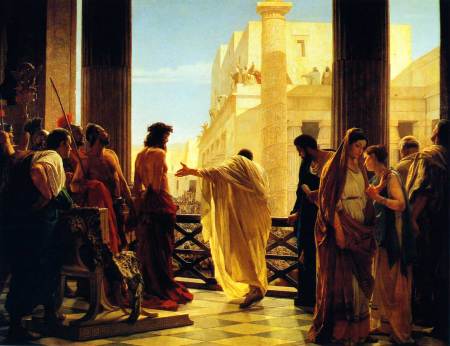
Pilate washes his hands of responsibility, and extends Christ’s arms on the cross. Mary had extended her arms declaring, “Let it be done to me according to your word,” and lovingly held the infant savior in her hands.

Pilate, despite all his power, is ruled by fear.
Mary, despite her weaknesses, is freed from it.

Governor Pilate is rich in wealth and power and yet he has no peace.
Mary, the poor widow, has peace and everything she needs from God.

Pilate has no faith in the God of Israel. He says, “I am not Jew, am I?” But for Mary, God is her rock and this makes all the difference in the world. Mary is defined by her faith, hope and love.

Mary never attends an academy, but she is profoundly wise because she reflects in her heart on the words and deeds of God and because she lives by her own advice: “Do whatever he tells you.” She knows that we do not manufacture the truth for ourselves, we receive it, ultimately from God. We love it, we defend it, and we share it with others. “Blessed [is she],” as Elizabeth said, “who believed that what was spoken to [her] by the Lord would be fulfilled.” Mary trusted and believed, for she saw the evidence through history that God “has mercy on those who fear Him in every generation,” that “He scatters the proud in their pride, and casts down the mighty from their throwns, but He lifts up the lowly.”

Mary’s life was full, but was not free from trials. When Mary consents to be found with child through the Holy Spirit she is uncertain of what will happen to her, but she trusts in God. She does not know how she and her husband will get by as poor immigrants in foreign country, but she continues to trust. Mary’s response to every trial in life, even to the death of her son, is to trust in God. Despite men’s sins, she trusts in God as the Lord of history, that He casts down the proud and mighty from their throwns and raises up the lowly.

Pilate is indifferent to Christ, and he consents to sending Him to the cross, but Mary is wholly devoted to Christ, and she consents to share in His Passion. Pilate’s heart is hardened despite Christ’s Passion, while Mary’s heart is pierced by it.

Governor Pilate was once the most powerful man in Judea, but where is he now? Mary, the poor widow, is now our glorious queen, the most beautiful and powerful woman in heaven or earth, and through her reign she draws millions to Christ our king.

She is the one who wept and now laughs.
He is the one who laughed and now weeps.

He was rich in the world and now he is poor.
She was poor in the world and now the kingdom is hers.

He took root in the desert, he was barren and uprooted.
But she was planted beside the flowing waters, she endured and bore much fruit.

So what do all of these reflections about Mary and Pilate have to do with us? I promised you at the beginning a second good reason why Mary and Pilate are mentioned in the creed; and here it is: Mary and Pilate represent us. They stand as archetypes, models or patterns, for every person.

The faithful one and the faithless one.

The one who serves God and the one who serves himself.

The one who gives Christ life and the one who puts him to death.

We live our daily lives as either Mary or Pilate, with shades of the other thrown in. As we come to the season of Lent, let us examine and discern who we are. “How am I Pilate, and how am I Mary?” And at this Eucharist, let us ask Jesus to exchange in us the ways of Pilate for the ways of Mary, for hers is the way of Christ.

Holy Reading — Wednesday, 5th Week in Ordinary Time—Year II

February 11, 2010

If a saint, like St. Scholastica or St. Benedict, were coming to speak at our parish tonight, would you come out to listen to what they had to say? The queen of Sheba (thought to be present day Ethiopia) traveled hundreds of miles just to hear the wisdom of King Solomon. What would you be willing to offer in time and treasure to listen to the wisdom of a saint today? In truth, we can encounter their wisdom today and at fraction of the queen’s effort.

The saints of both modern times and centuries long past wrote their wisdom in books, which are easily assessable for us today. Jesus observes that food which comes from outside and passes through us cannot defile. The saints’ holy books, however, can sanctify us, if we hold on to their words with a receptive heart.

As it is written: “One does not live by bread alone, but by every word that comes forth from the mouth of God.” Spiritual reading is important for the growth of the Christian disciple, so commit yourself to beginning some holy reading that interests you.

Staying Until Leaving — Thursday, 4th Week in Ordinary Time—Year II

February 4, 2010

Jesus provided the Twelve with their message to preach, their authority to cast out demons, and their power to cure the sick. However, Jesus withheld from the Twelve some basic provisions: no food, no bags, no spending cash, no second tunics for warmth in the cold night. On the other hand, Jesus instructs them carry walking sticks and wear sandals. What is Jesus thinking?

Jesus wants His disciples to be mobile, so that they can quickly travel to distant towns, but Jesus doesn’t want His disciples to be self-sufficient once they get there. Their lack of food, of money and of a place to sleep, forces them to become fully present to others. It necessitates the personal encounter.

Jesus told the Twelve to enter the lives of others, to enter their homes and to stay there until they leave. But what does it mean for them to stay until they leave? (How could someone leave before they’ve left?) Jesus is commanding them not trade up from house to house, as better accommodations are offered, thereby alienating and dishonoring their first hosts.

What does this gospel mean for us today? First of all, that our most important work, whatever our state in life, is our personal ministry to the people to whom Christ is sending us. We’re all busy, but we must not be too busy for what’s most important. Our professional careers will end, but our personal relationships will last, literally, forever.

Sometimes when we encounter other people we neglect Jesus’ advice to stay until we leave. Someone is speaking to us and we mentally check-out to green pastures. Sometime we fail to encounter the other person at all, brushing them off like dust on our feet.

I’ve heard it said that something which often struck people who met Pope John Paul the Great was how totally present He was to them, with his eyes and his mind, as if they were for him—in that moment—the most important person in the entire world. Can we imagine a personal encounter with Jesus Christ being any different? John Paul was a very busy man with a world of concerns on his shoulders, just like Jesus Christ, but they both had the time for what was most important.

I want to live more like that.  Don’t you?

By the Throat — February 3 — St. Blaise

February 3, 2010

I began going to daily Mass in the fall semester of 2001. In college I had always gone to Sunday Mass, but after September 11th I felt that if the world was going to change for the better, it would require that people present themselves to God and offer Him more opportunity to work His grace in them. And so, two years later and seven years ago today, I was at daily Mass on the feast day of St. Blaise for the first time in my life.

At the end of Mass, Father Mark offered an opportunity for a special blessing of throats by means of two crossed candles and the intercession of St. Blaise. A line formed of the faithful, but I stayed in my pew. I felt a tug of conscience to go up there too, but I was really embarrassed by the oddness of it. “Who gets ailments of the throat anyways,” I justified to myself, and headed out the door.

With noon Mass behind me, I walked to the dining hall for lunch. I remember that I was passing an empty salad bar on my left when I got stopped in my tracks. It was like my throat suddenly got completely dry. I recognized I wasn’t choking, so I wasn’t frightened, but it took me a good minute or two get right again.

Now my best natural explanation for what happened to me is that I inhaled dust kicked up by some unseen kitchen sweeper which got blown in by a fan through the open door on my right. But it didn’t take me long to remember St. Blaise and to recognize in this providential incident God’s gentle correction.  The message: “Don’t refuse a holy blessing.”

We Catholics should not feel ashamed of our traditional blessings and sacramentals. Things like holy water, miraculous medals, and house blessings make a difference; for with these things we make an act of presenting ourselves to God and offer Him more opportunity to work His grace in us.

Jesus is Love — 4th Sunday in Ordinary Time—Year C

January 30, 2010

Today’s second reading from St. Paul is perhaps his most known and most loved. You’ve probably heard it at weddings—perhaps you remember hearing it at your own, but most people don’t realize that St. Paul wrote these words to a community in disunity.

The Christian church in Corinth, Greece was divided. Various factions insisted that they were right, that they had “wisdom,” even as they bitterly quarreled with each other. St. Paul acknowledged what the Corinthians possessed in gifts and knowledge, and they had both, but he shined light upon how incomplete they were. “Strive eagerly for the greatest spiritual gifts,” he says, “But I shall show you a still more excellent way.” And then he teaches them about love.

Love is easy when it’s warm and fuzzy, and no one needs a lesson on doing what comes naturally. But how are we to behave when personalities conflict and there are serious disagreements and old resentments within our families, at work, or in our parish? During these times of tension, let us think of Christ and embrace Him as our model for action.

Jesus is patient.  Jesus is kind. In a way, Jesus is jealous, He’s jealous for our souls, but Jesus never manipulates others. He is not pompous. He is not inflated. He is not rude. Jesus is humble. He does not seek His own interests. He is not quick-tempered. He does not brood over injuries, no matter how unjust. He does not rejoice over wrongdoing but rejoices with the truth. Jesus bears all things and endures all things. Look at how He responded in Nazareth when His own acquaintances, whom He had known almost all of His life, turned against Him:

“They were all filled with fury. They rose up, drove him out of the town, and led him to the brow of the hill on which their town had been built, to hurl him down headlong.  But Jesus passed through the midst of them and went away.”

Jesus knew exactly what they were up to as they led Him towards the plummeting edge of town, and He could have turned and walked out on them whenever He chose, so why did He give even them the time of day? Jesus was patient, he was humble, and He endured this trial in hopes that He might lead them from their wrong way and restore personal communion with them. When they were just about to throw Him down, Jesus walked away, for the time had not yet come for Him to lay down His life for love of them.

God assures us through St. Paul that “love never fails.” The love of Jesus Christ never fails, even if we can’t see how, even if His victory, as for the souls for the community of Nazareth, takes more than a single day to accomplish. “Love never fails,” so follow Christ in this most excellent way; at home, at work, and in our church, and the promise of this Scripture passage, that “love never fails,” will be fulfilled in us.

Speaking Up — January 26 — Sts. Timothy and Titus

January 26, 2010

Think back.  When was the last time that the name of Jesus passed your lips? For comparison, do you speak about Jesus Christ less often than, say, Brett Favre, or President Obama? But isn’t Jesus Christ far more important than professional athletes or politicians? Our culture teaches us to keep our faith in Jesus unspoken and hidden, but this is a habit we need to unlearn. Our Christian faith is supposed to be personal, but it’s not supposed to be secret.

Today’s first reading comes from a letter from St. Paul to a young Christian named Timothy. Timothy grew up in a Christian family, but as we see in the Gospel, family ties are not what make a person close to Christ. What makes one close to Christ is the choice to do God’s will. Paul understood that Timothy’s youth might cause him to be too timid about expressing his faith in Jesus Christ. So Paul told Timothy, as I say to you, “stir into flame the gift of God that you have…. For God did not give us a spirit of cowardice but rather of power and love and self-control. So do not be ashamed of your testimony to our Lord….”

Never deny or be ashamed of Jesus because of the people who happen to be around you. Often, people are more receptive about Christ than you might think, and witnessing to your faith can change lives. Besides, if the people you’re with would mock our savior then the opinion they have about you doesn’t matter much anyways. Still, they may well may mock you one day, and respect you for your convictions the next.

Don’t be too timid lead prayers out loud to Jesus. Nobody expects you to be a poet. Just speak simply from your heart and your words will have a powerful effect. Listening to another’s struggle can help, but sharing prayer to Christ with them can really heal.

Be unafraid to talk about Jesus. Everyone needs Him and what He has to teach us, even if we’ve been Christians all of our lives. John Paul the Great said that Jesus Christ reveals humanity to itself. Jesus provides the answer; to why we’re here, where we’re going, how we should live, and how we are loved. He is the most worthy of topics for conversation.

As our psalm says,

“Announce [Christ’s] salvation, day after day.
Tell his glory among the nations;
[and] among all peoples, his wondrous deeds.”

So be unashamed of Jesus no matter who happens to be around you. Lead prayers aloud to Jesus for the benefit of your neighbors. And be not afraid to let the name of Jesus past your lips.