Archive for the ‘St. Peter’ Category

Uniquely Different — October 28 — Sts. Simon and Jude

November 3, 2010

[Jesus] called his disciples to himself,
and from them he chose Twelve,
whom he also named Apostles:
Simon, whom he named Peter…
Simon who was called a Zealot,
and Judas the son of James,
and Judas Iscariot, who became a traitor.

In the early days of their ministry, whenever Jesus called out for ‘Simon’ or ‘Judas,’ more than one head may have turned. Among Jesus’ apostles there were two Simon’s and two Judas’. There was Simon Peter and Simon the Zealot, and Judas (or Jude) the son of James and Judas Iscariot the betrayer. Though these pairs shared the same names and the same calling to be apostles, they were different in important ways.

Simon Peter was called to be the Rock, the leader of the apostles and of the nascent Church. Simon the Zealot may have shared his zeal, but he was not meant to have the same role as Peter. Each saint’s apostleship was unique to him.

Sometimes Christians who eagerly desire to be saints themselves strive to impersonate their favorite holy heroes. We do well to learn from the lived examples of the saints, for St. Paul did say, “Be imitators of me, as I imitate Christ,” but there can truly be only one St. Paul, one St. Francis, or one St. Therese of Lisieux. Every saint in history has been unique, and every future saint will be, too.

The two Judas’ teach us a lesson, too. Even after years of preaching the Gospel, I can imagine some people felt an initial uncertainty towards Judas the son of James. Intellectually, Christians would know that this apostle could not possibly be Judas the betrayer (because he one took his own life,) yet they might feel wary about this “Judas” in their midst.

Sometimes our feelings toward other people are influenced by who they remind us of. For instance, if you meet someone whose face resembles a person who has hurt you in the past, you may be involuntarily uncomfortable around them. In psychology, this shift of emotions from one person or thing to another is called transference. This is the stuff that prejudice is made of, and the good apostle, Judas, caught some of its unjust, negative effect.

Though the apostles shared names and a common calling, they were unique individuals. The two Simons teach us that each is called to live out their own, unique, holy life. The two Judas’ teach us that we must always receive others in their own personal uniqueness.
Enduring Injustices — Tuesday, 23rd Week in Ordinary Time—Year II

September 7, 2010

St. Paul rebukes the Corinthians today, saying, “[It is] a failure on your part that you have lawsuits against one another.” Then he says something that rubs us the wrong way: Paul asks, “Why not rather put up with injustice? Why not rather let yourselves be cheated?” We resist, saying, “It’s just common sense that we shouldn’t let ourselves be cheated.” But sometimes common sense falls short. That’s why we need the teachings Jesus Christ revealed. Jesus said:

“When someone strikes you on your right cheek, turn the other one to him as well. If anyone wants to go to law with you over your tunic, hand him your cloak as well. Should anyone press you into service for one mile, go with him for two miles. Give to the one who asks of you, and do not turn your back on one who wants to borrow.”

Now this does not mean that we should be indifferent to injustices done to others, nor that we should seek out opportunities to be wronged by others ourselves. But when we are personally wronged, Paul suggests that we try imitating Jesus. St. Peter would agree, for he wrote:

“If you are patient when you suffer for doing what is good, this is a grace before God. For to this you have been called, because Christ also suffered for you, leaving you an example that you should follow in his footsteps. ‘He committed no sin, and no deceit was found in his mouth.’ When he was insulted, he returned no insult; when he suffered, he did not threaten; instead, he handed himself over to the one who judges justly. He himself bore our sins in his body upon the cross, so that, free from sin, we might live for righteousness. By his wounds you have been healed.”

The next time you find yourself wronged, try imitating Christ. Jesus trusted that the Father would provide for Him, and He was provided for. Jesus accepted His unjust suffering, and it changed the world. Jesus invites you to accept a cross and to follow Him into this mystery.

Preparing for Tests — Friday, 8th Week of Easter

May 31, 2010

Today were heard from the first encyclical of the first pope. Today’s first reading came from the First Letter of St. Peter. And what he said applies to you: “The end of all things is at hand.” Originally, St. Peter meant that Christians should always be ready for the end of their lives or the end of the world (whichever comes first.) But this morning I think we can hear the Holy Spirit speaking to us about the coming end of this school year.

At Columbus, the end of all things is at hand: that means finals week, with all of its due dates, studying, and exams. Don’t be surprised that this trial by fire is occurring among you, as if something strange were happening to you. Finals week happens every year. I know that finals time is a challenge and that it takes some hard work, but why should this trial overwhelm us or make us behave ugly towards each other? If we have Jesus Christ in our lives we should face difficulties differently than the world does. The beauty of a soul at peace in Christ, is seen through the person’s  graceful actions.

So how should we face our finals? First of all, have faith in God, and remain at peace, confident that no matter what, everything is going to be ok.  Second, be serious and sober-minded. You’ve worked for the whole semester. Now keep going just one more week to maintain or even improve those grades you’ve worked for all semester. And third, above all and through it all, let your love for one another be intense, be hospitable to one another without complaining, and as each of you has received gifts. Use them to help one another.

At this Mass, prepare yourself. Ask Jesus for constant peace, for steady focus, and for generous love throughout finals week so that you may perform at your best in every respect. It’s nice to get good grades in school, but that’s not the most important thing. The most important thing is to be prepared for the final exam which awaits us all.

Peter’s New Season — 3rd Sunday of Easter

April 20, 2010

Once, when Jesus was preaching as he stood on the shore of the Sea of Galilee, a large and eager crowd was pressing in on Him.  So Jesus got into a fisherman’s boat and asked him to put out aways so that He could sit and teach the crowds. The tired fisherman complied. And after Jesus had finished speaking, He said to this fisherman, “Put out into deep water and lower your nets for a catch.” The fisherman said, “We have worked hard all night and have caught nothing, but at your command I will lower the nets.” When they had done this, they caught an incredible number of fish such that their nets were tearing. And Jesus said to the startled man, “Do not be afraid. From now on you will be catching men.” As you probably remember, the fisherman was Simon Peter, and from that day on his life entered a new season. For the next few years Simon Peter would follow Jesus and evangelize towns on His behalf.

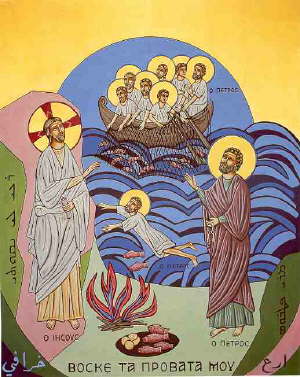
In today’s gospel, from the days after the resurrection, Peter is fishing again. And once again, Jesus is there on the shore. They have caught nothing, but Jesus says to try once more, and they catch an incredible number of fish. When Simon Peter realizes it is Jesus he eagerly comes to Him as fast as he can. He finds Jesus beside a charcoal fire. This should be familiar to Peter, too, calling to mind  another charcoal fire in the dark courtyard of the high priest.

After sharing a meal, Jesus says, “Simon, son of John, do you love me more than these? Do you love me?  Do you love me?” Simon Peter says, “Yes, Lord, you know that I love you. Yes, Lord, you know that I love you. Lord, you know everything; you know that I love you.” Jesus has given Peter the opportunity to undo his triple denial of Jesus with a triple confession of his love. And after each time, Jesus speaks of a new season for Peter’s life: “Feed my lambs. Tend my sheep. Feed my sheep.”

Now it is one thing to catch fish, but it is another thing to shepherd a flock. Up to now, Peter has been following Jesus and bringing others to Him. But now Jesus is asking Peter to do something new, to shepherd His flock for Him. Do you think Peter nervous? Is he concerned about whether he is up to the task? Is he worried about being led where he doesn’t want to go? I bet he is, but Jesus would have him ‘not be afraid,’ for he won’t be doing it alone. Jesus says to Peter, “Follow me.”

Our lives are often entering new seasons. Maybe you’re moving into a new town or a new school. Maybe you’re transitioning from engagement to marriage, welcoming new children, or living for the first time without children in the house. Maybe you have a new job, or don’t have a job for the first time. But whatever season of our life Jesus calls us into, His calling and our mission remain the same. Jesus said, ‘”I give you a new commandment; love one another as I have loved you,” and ” “There is no greater love than this, than to lay down your life for a friend.” Every new season of life offers us the unique opportunity to deepen our love for Christ and each other more than ever before.

Maybe you feel nervous? Maybe you’re concerned about whether you are up to the task? Maybe you’re worried about being led where you don’t want to go? But remember Simon Peter and don’t be afraid.  Jesus gives lots of second chances and He does not expect us to do it alone.

Ordinary Time — Monday, 1st Week in Ordinary Time—Year II

January 12, 2010

Do you notice something different at Mass today? I’m wearing green, because today is the first day of Ordinary Time. This season is not considered that special compared to other Church seasons,  like Lent and Easter, or Advent and Christmas. But Ordinary Time is not so-named because it’s plain. The counting numbers (1, 2, 3, 4…)  are called the ordinal numbers.  Likewise, Ordinary Time counts the weeks of the year.

Green is the liturgical  color of this season.  It symbolizes life and growth. Even if we regard other seasons as more special, we must not close ourselves off to the opportunities for spiritual life and growth in this one.  It was an ordinary day when Jesus encountered Simon and Andrew, James and John working in their boats, but they answered a call that changed their lives. It was another sad, childless trip to Jerusalem for Hannah, but this ordinary time she would receive a special gift from God.

So let us learn from their experience, and be attentive and receptive to the Lord in this ordinary time.

Thursday, 22nd Week in Ordinary Time—Year I

September 3, 2009

Peter has worked hard all night and has nothing to show for it. He’s frustrated and tired. Then Jesus comes along. The two men had met before. Peter met Jesus through his brother. Apparently, Peter had been impressed by this man whom Andrew insisted was the messiah; for when Jesus asks Peter to take the boat from the shore, to give some space for speaking to the crowds, Peter obliges.

How long do you think Jesus spoke out there, sitting in the boat? It probably wasn’t a short while. And when Jesus finishes talking, he turns again to Peter and wants him to go out further, to cast his nets into the deeper waters. Peter thinks it’s pointless, and he says so, but He continues showing a willingness to oblige Jesus.

Peter casts the nets and brings in his biggest catch ever. And here, seeing himself richly blessed, by a great and holy man, Peter hits the limit of his capacity to serve. It’s not that Peter’s too tired or hungry, too busy or lazy. It’s his shame for his sins. Peter’s shame would prevent him from serving Jesus any farther.

Peter turns to Jesus and says, “Depart from me, Lord, for I am a sinful man.” It’s the opposite from what we should ask of Jesus when we acknowledge our sinfulness. Jesus tells him, “Do not be afraid. (I will do great things with you.)”

We are not worthy to receive Him, but we are called to His supper and to serve Him all the same. And even with recovering sinners like us, He can do great things.