Archive for the ‘Salvation History’ Category

He Proved Faithful — Good Friday Homily

March 25, 2016

Few proved faithful to Jesus on Good Friday, but on Good Friday Jesus proved himself faithful to us.

The political leaders were supposed to serve justice, but Pilate and Herod failed to protect Jesus as an innocent man. Jesus protected us when we were guilty.

The religious leaders were supposed to serve holiness, but the High Priests and the Sanhedrin failed to accept Jesus as their Messiah. Jesus accepted us so that we might become holy.

The disciples were supposed to serve their teacher and lord, but Judas betrayed him, Peter denied him, and the others abandoned him. By enduring his suffering and death, Jesus proved himself faithful to us.

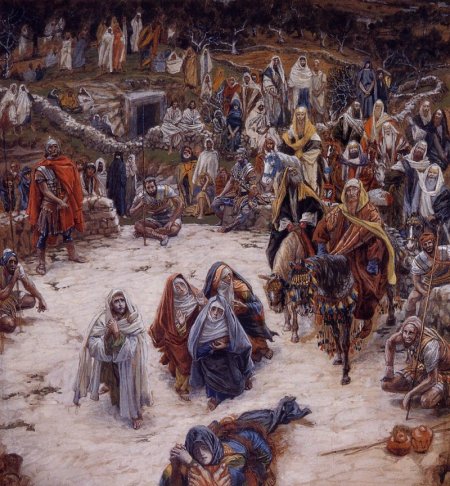
Jesus’ mother Mary was faithful. She stood with him at the foot of the cross. It was a consolation for Jesus to have her there. Two of his beloved disciples were also there: Mary Magdalene and the apostle John. Jesus was grateful to have them close by.

Today, on this Good Friday, by the grace of God, we are at the foot of the cross. Let us pray for mercy, for ourselves and for others. Despite our past unfaithfulness, let us honor his faithfulness to us. Jesus is pleased that we are here with him, and he is grateful for our gratitude.

View From the Cross by Tissot

Returning the Favor — Holy Thursday Homily

March 24, 2016

St. Augustine wrote a famous reflection on Proverbs 23:1 :

“If you sit down to eat at the table of a ruler,
observe carefully what is set before you.”

Why? Because you will be expected to provide the same kind of meal for him. This proverb is a practical tip of worldly wisdom, but St. Augustine goes deeper; what is its spiritual meaning for the Christian?

Who is our ruler?  It is Jesus our Lord.
Where is his table? It is here, his altar.
Now carefully observe the food he sets before us: it is the Eucharist, his very self.

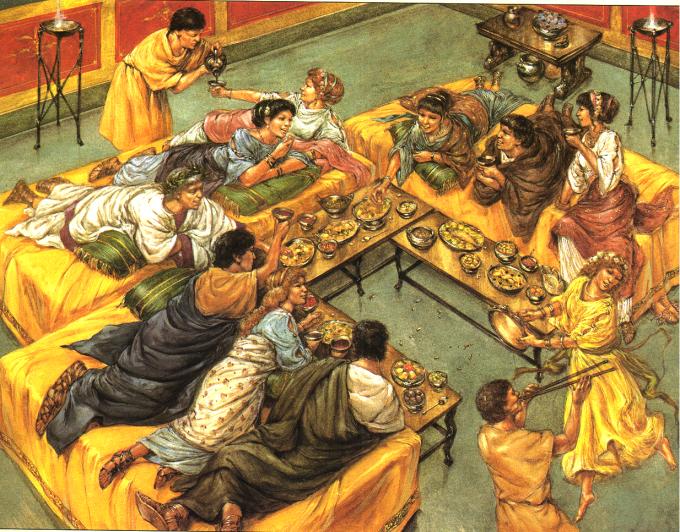
Jesus, like others in the ancient world, reclined at table.Jesus calls us to prepare the same kind of meal for him. He says, “This is my body, given up for you. Do this in memory of me.” We must make a gift of ourselves by living our lives for him, and we are to serve him in others for he tells us, “Amen, I say to you, whatever you did for one of these least brothers of mine, you did for me.”

After washing his disciples feet at the Last Supper where he institutes the Eucharist, Jesus says to his disciples, and to us: “Do you realize what I have done for you? … I have given you a model to follow, so that as I have done for you, you should also do.

Reflections on the Passion in Luke

March 18, 2016
  • Christ Carrying the Cross by Hieronymous Bosch, 1485-1490.At the Last Supper, Jesus says he has “eagerly desired to eat this Passover with you before I suffer…” Jesus did not allow stress to prevent him from enjoying the people and good things in his life. Do I experience joy at Holy Mass? Do I eagerly desire it?
  • Taking a cup, Jesus says, “I shall not drink of the fruit of the vine until the kingdom of God comes.” The next time Jesus drinks wine is on his cross; so God’s kingdom has begun on earth. Despite my trials, what good things am I looking forward to?
  • An argument breaks out among the apostles about which of them should be regarded as the greatest. Justifying ourselves through comparisons with others undermines our personal growth. Instead, Jesus commends imitating him as a servant to all.
  • To save Jerusalem, David tearfully fled the city by way of the Mount of Olives to escape his traitorous son, Absalom. Jesus also retreats there but resolves not to elude his betrayer and escape his death so that he might save us all.
  • Jesus is in such agony, praying so fervently in the garden, that his sweat becomes as drops of blood falling on the ground. This describes Hematidrosis, which has been observed in rare modern cases of people undergoing acute fear and intense mental contemplation. While I seek relief, do I offer my physical and emotional sufferings as a sacrifice?
  • He approaches Jesus to kiss him and Jesus asks, “Judas, are you betraying the Son of Man with a kiss?” Does my familiar intimacy with holy things lead me to hold them cheaply?
  • Jesus’ disciples realize what is about to happen and ask, “Lord, shall we strike with a sword?” However, they act before he can reply. Do I discern prayerfully and wait patiently for the Lord’s direction?
  • One of the disciples (St. Peter) strike the high priest’s servant (Malchus) and cut off his right ear. Jesus exclaims, “Stop, no more of this!” He touches the servant’s ear and heals him. Those without faith in Jesus cannot be converted by violence, that cuts off their ears to hear. Do I share Jesus Christ and my Catholic Faith in a winsome way?
  • Peter was willing to fight and die for Jesus in the garden, when he thought it would make a difference, but Peter did not recognize the importance of acknowledging Jesus to those around the fire. Do I recognize the importance of being faithful to Christ in all company and every moment?
  • Both Peter and Judas regretted what they had done, but Peter returned to Jesus. When I sin, do I delay to repent and return to Jesus?
  • Jesus was condemned for identifying as the Son of God and king of the Jews. When was the last time I suffered for telling the truth?
  • Pilate is glad to refer Jesus’ case to Herod. Pilate never hates Jesus, but sins through not caring about him. Who am I indifferent towards?
  • Herod enjoyed listening to John the Baptist until he had him executed. Jesus gives the unrepentant Herod only silence. Do I receive and heed God’s written and preached word when I can?
  • Barabbas is a murderer and a rebel. His name means “Son of the Father.” The crowds call out for him to be released to them instead of Jesus. Is my hope greater in political actors rather than the Lord?
  • Peter three-times denies Jesus and Pilate condemns Jesus after three-times declaring him innocent. They fold because they fear what others will say or do. Do I allow other people to persuade me to compromise on the truth or what is right?
  • The crowd cries, “Crucify him!” Every decision to sin chooses, at least in a small way, to exile Christ from our world.
  • Simon of Cyrene, coming in from the country, was pressed to carry Jesus’ cross. If Simon Peter had remained faithful, perhaps he would have come to Jesus’ aid. When I sin, what good do I forfeit?
  • The women of Jerusalem mourning and lamenting Jesus, crying for his Passion to end, may have served as a temptation for Jesus. He redirects them to pray for their own families’ deliverance. Do I pray for the salvation of my family and friends?
  • Two criminals were crucified beside Jesus. They symbolize all humanity, and Jesus suffers and dies among them. One is saved and one is likely lost.
  • One criminal acknowledges, “We have been condemned justly, for the sentence we received corresponds to our crimes, but this man has done nothing criminal.” Do I consider what my sins would deserve apart from the saving mercy of God?
  • Jesus says, “Father, forgive them, they know not what they do.” Do I assume malice where simple ignorance could explain the behavior of others?
  • Jesus cries out in a loud voice, “Father, into your hands I commend my spirit,” and breathes his last. What do I want my final, dying words to be?

Time Travel & God’s Prophesies

March 3, 2016

Many science-fiction stories have explored the idea of traveling through time and changing the past. For example, 1980’s “The Final Countdown” imagined a modern-day U.S. aircraft carrier being transported back to 1941 and facing the choice of either thwarting the Japanese attack on Pearl Harbor or allowing history to play out unchanged. In the early 1990’s, the TV time traveler Dr. Sam Beckett would “Quantum Leap” into other people’s lives, “striving to put right what once went wrong.” Just last fall, the internet hotly-debated the morality of going back in time to kill Adolf Hitler when he was still too young to have chosen or have committed any crimes.

ITardiss it possible to go back in history and change the past? There’s good reason to think that it is logically impossible. Here is why: Imagine traveling back in time and, by some tragic accident, killing your grandparent as a child. This would mean that one of your parents would have never been born… so you would have never been born… which raises the question: who killed your grandparent? Or imagine a time traveler’s intended history-changing mission succeeding, such as stopping JFK’s assassination. If so, then there is no cause for the time traveler to have ever been sent back from the future at all. This sort of logical contradiction is called a paradox.

Most serious time travel stories avoid this paradox problem using the premise that the past can be visited but never truly altered. Time travelers simply fulfill the role they have always played in those past events. Any and all attempts to avert some disaster in history will either prove useless or actually contribute to bringing about the calamity.

Time travel is merely fantasy, but the prophesies of God, which have correctly foretold future events, are very real. Consider, for instance, these passages from the 22nd Psalm written by King David under the inspiration of the Holy Spirit some 1,000 years before the coming of Christ:

“My God, my God, why have you abandoned me? … All who see me mock me… Like water my life drains away; all my bones are disjointed. My heart has become like wax, it melts away within me. As dry as a potsherd is my throat; my tongue cleaves to my palate… They have pierced my hands and my feet. I can count all my bones. They stare at me and gloat; they divide my garments among them; for my clothing they cast lots. … I will live for the Lord…”

This psalm is clearly fulfilled in Christ’s sufferings on the cross; the onlookers’ gloating mockery, the gambling over his garments, his dehydration and laboring heart, wounds cutting to his bones. What other form of torture is there that pierces the hands and feet? Jesus spoke this psalm’s opening words even while sharing the psalm’s closing hope in a life restored. These events were accurately described a millennium before they occurred.

God prophesying future events raises questions about human freewill. If Jesus’ crucifixion could be long foretold then what responsibility could Judas, Caiaphas, or Pontius Pilate possibly bear for their roles in the Passion? The answer is that Eternal God, from his vantage point outside of time, can behold all of history, including the free choices that each of us make. C.S. Lewis reconciles God’s knowledge and our freedom in these passages from his book “Mere Christianity”:

“…God is outside and above the Time-line. In that case, what we call ‘tomorrow’ is visible to Him in just the same way as what we call ‘today’. All the days are ‘Now’ for Him. He does not remember you doing things yesterday; He simply sees you doing them, because, though you have lost yesterday, He has not. He does not ‘foresee’ you doing things tomorrow; He simply sees you doing them: because, though tomorrow is not yet there for you, it is for Him. You never supposed that your actions at this moment were any less free because God knows what you are doing. Well, He knows your tomorrow’s actions in just the same way— because He is already in tomorrow and can simply watch you. In a sense, He does not know your action till you have done it: but then the moment at which you have done it is already ‘Now’ for Him.”

God’s knowledge of our free choices does not make our choices any less free. As St. Augustine once noted, “Just as you do not compel past events to happen by your memory of them, so God does not compel events of the future to take place by his knowledge of them.” God’s divine knowledge does not strip us of human freewill, but it does permit him to communicate perfect prophesies to his people concerning events further along our timeline. Such prophesies concern not only the Messiah’s life, but our times and future as well.

Jesus Christ has already victoriously prevailed. His Second Coming in glory is foretold and assured, and his people’s final victory over sin and death is prophesized and certain. This is the connection between time travel stories and the prophesies of God: like the futility of time travelers attempting to avert some historic disaster, any and all attempts to prevent the ultimate triumph of Christ will either prove useless or actually contribute to bringing about the coming of his Kingdom. The enemies of Jesus schemed to destroy him and his movement, but their very plotting led to the fulfillment of his mission and the birth of the Church. This knowledge is a cause for Christian endurance and joy, even amidst our times of struggle. We know that we are free to serve a faithful role in helping bring about the great, holy, happy ending of history.

Jesus is Risen, Not Undead

February 26, 2016

All the classics of horror are Catholicism twisted. Vampires are the shadow opposite of Jesus in the Eucharist; they prey on the blood of others to possess eternal life apart from God. Depictions of Frankenstein are distortions of the Mystical Body of Christ, with the dead parts of many monstrously combined as one. And what are zombie stories but corruptions of the Resurrection? A new friend of mine teaches a faith formation class with a 5th grader who periodically pipes up saying, “Jesus was a zombie.” So, this week, she taught them about how Jesus is different from zombies.

Zombies are typically said to be created by a virus or a magic spell, but Jesus lives by the power of God. Zombies lose their memory and intellects, but the risen Jesus knows his friends and converses with them. The bodies of zombies decay and they can be “killed,” but the risen Jesus is free from corruption and can die no more. Zombies “desire” to kill people, but Jesus would give them life. (What other differences can you find with your family?)

After seeing The Passion of the Christ in 2004, I heard a fellow seminarian say that the movie ending with Jesus walking from the tomb on Easter morning frustrated him—he want to see what happened next, he wanted the story to continue. Last Friday, I had the great pleasure of seeing a new film which tells that story: Risen. In it, a Roman soldier named Clavius is tasked by Governor Pontius Pilate to find the body of Jesus the Nazarene and end rumors of his resurrection. Only about a dozen people were in the theater on opening night, so if you want to enjoy this highly-recommended film on the big screen you should make a point to see it soon.


The Significance of Anna’s Age and Lifestyle — Sixth Day in the Christmas Octave

December 31, 2015

Readings: 1st John 2:12-17, Luke 2:36-40

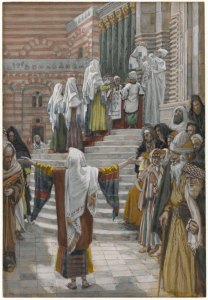
Whenever we read the Bible, it is profitable for us to remember that every detail is there for a reason. The sacred authors and the Holy Spirit chose to omit so many minor facts that “I do not think the whole world would contain the books that would be written” if they had described everything. (John 21:25) Instead, all that we find in Scripture has been purposely included for our benefit. (John 20:30-31) Consider the details mentioned in this encounter from the Presentation, when Joseph and Mary brought the baby Jesus to the temple in Jerusalem for the first time:

The Presentation of Jesus in the Temple by James Tissot

There was a prophetess, Anna, the daughter of Phanuel, of the tribe of Asher. She was advanced in years, having lived seven years with her husband after her marriage, and then as a widow until she was eighty-four. She never left the temple, but worshiped night and day with fasting and prayer. And coming forward at that very time, she gave thanks to God and spoke about the child to all who were awaiting the redemption of Jerusalem.

This is the only episode in the New Testament where the prophetess Anna appears. Why does St. Luke include Anna’s age and the length of her marriage? Let’s explore this obscure detail. The 84-year-old widow was married for seven years, and thus was unmarried for 77 years of her life. She is 7 x 12: the Jewish number symbolizing completeness and perfection times the number of the tribes of Israel. Anna personifies Old Testament Israel at her best. But of the twelve tribes, which tribe would correspond with Anna’s seven years of marriage?

After the death of Saul, all the tribes of Israel came to David (of the tribe of Judah) seeking to make him their king. They said: “Look! We are your bone and your flesh,” echoing the words of Adam towards Eve at the beginning of their marriage covenant, “This one, at last, is bone of my bones and flesh of my flesh.” (2nd Samuel 5:1, Genesis 2:23) Old Testament Israel had been wedded for a time to David, but now she awaited the kingship of a Son of David from the tribe of Judah. While David had once conquered Jerusalem from the Jebusites, Anna and others in her day were “awaiting the redemption of Jerusalem” by the Messiah/Christ. (1st Chronicles 11:4-5)

Living like a Christian nun veiled in anticipation of her bridegroom’s arrival, Anna “never left the temple, but worshiped night and day with fasting and prayer.” Why would Anna, or any woman, choose to live in this way? St. John’s first epistle offers this admonition:

Do not love the world or the things of the world. If anyone loves the world, the love of the Father is not in him. For all that is in the world, sensual lust, enticement for the eyes, and a pretentious life, is not from the Father but is from the world. Yet the world and its enticement are passing away. But whoever does the will of God remains forever.

Alexandrian World Chronicle (5th century) featuring Anna the ProphetessThough Anna understood the evil corruptions of “the world,” she was also well aware of the goodness of creation. She had known the blessings of marriage and the (at least occasional) pleasures of feasting, but Anna knew that these passing things could not fully satisfy her. Her deepest longings could only be met by the One to come, not only for her but for all Jews and Gentiles. When Jesus Christ came to the temple, Anna rejoiced, gave thanks, and “spoke about the child to all who were awaiting the redemption of Jerusalem.” Because she devoted herself to “the will of God,” Anna’s scriptural legacy and joy before the Lord ‘remain forever.’

The Temptations of the First Christmas

December 22, 2015

If I were a demon prowling about the world for the discouragement, confusion, and ruin of souls, how might I have tried to tempt God’s beloved ones in the year leading up to the first Christmas?

If I were a demon, I would say to St. Elizabeth, “Did people imagine that Zechariah had a vision while he was serving in the temple? He simply had a stroke and he will never speak again. You’re feeling sick every day and your abdomen is expanding. You clearly have a cancer. You will soon be dead. There is no hope.

If I were a demon, I would say to St. Mary, “You think you saw an angel? That’s crazy! You’re imagining things. Who are you to be the mother of God’s son? Who do you think you are! Don’t even bother going to visit Elizabeth. You’ll feel foolish when you arrive and see that nothing has changed. None of your family, friends, or neighbors will believe you. Joseph will divorce you and you will be all alone.

And if I were a demon, I would say to St. Joseph, “Do you really believe Mary conceived by God’s Spirit? She’s obviously lying. Even if it’s true, who are you to be a father to the Messiah? Either way, it is best for you to just get a divorce. Whatever you imagined when you married her, now you can see that you were so very wrong.

Mary & Joseph

Even with the coming of Christmas, my diabolical efforts would not cease. I would advise Bethlehem’s shepherds to steer safely-clear of the holy child and to keep to watching their flocks. I would urge the Magi to dismiss the starry signs as meaningless coincidences and not to risk a long journey. I would encourage Joseph to ignore the warning dream to take his family into Egypt and I would encourage Mary not to trust in her loving husband’s lead: “Surely, God would have told you this before telling Joseph.” Thankfully for us, none of them were prevented from doing God’s will through being tripped-up by such traps.

Some people think of temptation strictly as a prompting toward pleasurable, immoral action. But temptation can come in other forms. It can also pull us toward inaction and negative experiences like fear, doubt, sadness, and despair.

Some people assume that the saints do not know temptation like the rest of us. But did Mary, Joseph, and Elizabeth live oblivious to the thoughts and unassailed by the feelings realistically described above? In truth, the saints come to understand temptation well as they discern and persevere through the trials of life.

Some people believe that God loves and watches over a few favored saints while having less concern for the rest of us. But this is also a temptation. Even if our life takes a shocking turn and we don’t know what to do, even if we have a stroke, or cancer, or our mind begins to fail, even if we seem betrayed or abandoned by everyone, each and all of us are his dearly beloved ones. (And we shouldn’t listen to anyone telling us otherwise, even if they speak to us in our own voice.)

The Two (Old & New) Arks of God

December 17, 2015

Remember Raiders of the Lost Ark? The Ark that Indiana Jones and the Nazis were pursued in that entertaining film was the most precious object in the entire Old Testament. But what is lost on many is how that holy artifact is related to the most important woman in the New Testament and its New Covenant.

The Old Testament Ark of the Covenant was a box built in the days of Moses according to God’s instructions at Mount Sinai. It was made of wood overlaid with pure gold, inside and out. No man was allowed to touch God’s Holy Ark—lest they die—so it was designed to be carried about using a pair of poles. The Ark was the throne for God’s presence on earth. The wings of two, golden Cherubim angel statues atop the Ark’s lid served as his “mercy-seat.” The Ark itself contained within several interesting items from the time of the Exodus: the two stone tablets of the 10 Commandments, the wooden staff of Aaron (which miraculously blossomed to confirm his divinely-ordained priesthood), and a gold container holding some of the Manna from heaven which God provided to feed his people on their desert pilgrimage.

Ark

About 450 years after its construction, around 1000 BC, King David reigned over all of Israel. He tried to bring the Ark up to his royal city, Jerusalem, until one of the priests (who should have known better) touched the Ark and fell down dead. David exclaimed, “How can the Ark of the Lord come to me?” He arranged for it to be kept at the house of Obed-edom in the Judean countryside. The Ark remained there for three months and manifestly blessed the whole household. When it was reported to the king how richly Obed-edom was being graced, King David decided to try transporting the Ark into Jerusalem once more. David himself led that procession, dancing and leaping before the Lord with joyful abandon.

The Ark would eventually reside in the Jerusalem Temple built by David’s son, King Solomon. It is written that before that Temple was destroyed by the Babylonians in 587 BC, Jeremiah the Prophet took the Ark and hid it in a secret cave, saying, “No one must know about this place until God gathers his people together again and shows them mercy.”Unlike in the 1981 film, the Lost Ark has never been found, but a new Ark of God did appear.

The Blessed Virgin Mary is the New Ark of the Covenant because she bears Jesus Christ, God’s fullest presence on earth. By God’s design, the first Ark was made of wood and covered with gold; Mary is a human being full with grace. The former Ark carried the word of God in stone; Mary’s womb carries the Word become flesh. Aaron’s dead staff miraculously flowered; Mary’s virgin womb blossomed with a bud from the stump of Jesse. The Ark held Manna from heaven; Mary bore the true bread from heaven. Mary’s womb holds Jesus Christ, our Prophet, Priest, and King.

The Visitation by Albertinelli, 1503.As the Gospel of Luke tells us, after she was visited by St. Gabriel the Archangel at the Annunciation, “Mary set out and traveled to the hill country in haste to a town of Judah, where she entered the house of Zechariah and greeted Elizabeth. When Elizabeth heard Mary’s greeting, the infant leaped in her womb, and Elizabeth, filled with the holy Spirit, cried out in a loud voice and said, ‘Most blessed are you among women, and blessed is the fruit of your womb. And how does this happen to me, that the mother of my Lord should come to me?’” And Mary would bless them with her help and companionship, staying at their house in the Judean hill country about three months.

Like King David, St. Elizabeth questions and St. John the Baptist leaps for joy before the Ark of the Lord. St. Joseph, regarding the inviolable sanctity of his wife with reverent fear, never touched her virginity. Mary would also go on to literally serve as God’s throne, his mercy-seat; “On entering the house [the Magi] saw the child with Mary his mother.”

In the Book of Revelation, St. John’s vision of heaven includes a sighting of the Lost Ark: “Then God’s temple in heaven was opened, and the Ark of his Covenant could be seen in the temple.” Then John beholds “in the sky, a woman clothed with the sun, with the moon under her feet, and on her head a crown of twelve stars.” We soon discover that this  glorious woman is pregnant with “a son, a male child, destined to rule all the nations….” This is the Christ, and she is his Holy Ark.

Now the Lord’s Ark is not meant to be worshiped. (Though among God’s most holy creations, an Ark of God is not divine.) Yet, as one draws nearer to the Holy Ark, one inevitably draws nearer to God’s presence. Just as the old Ark of the Covenant was of central (though secondary) importance in the Old Covenant, so God gives the Blessed Virgin Mary an essential role in his New Covenant. All who come to her are drawn nearer to her Son.

Imagine daring to enter the old Jewish Temple’s the Holy of Holies where the Ark of God was kept. What awe and reverence would you feel before the all-holy presence of God? Now consider drawing near to the even greater Ark, Mary the Mother of all Christians, who reaches out to each of us with love and takes away our fear. And now reflect upon the great privilege we have in approaching and even touching the Christmas Gift of God she bore, Jesus Christ himself. Mary is blessed among women and blessed is the fruit of her womb, Jesus. But blessed are we who would believe in all that the Lord has revealed to us.

Our Holy Conspiracy & the End of the World — 33rd Sunday of Ordinary Time—Year B

November 16, 2015

C.S. Lewis, 1898-1963A new liturgical Church year will begin in a couple of weeks with the first Sunday of Advent. As this Church year ends, our Mass readings (like today’s Sunday readings) focus on the Last Things and the end of the world as we know it. This weekend’s news reports, especially the terrible events in France, remind us that though the Kingdom of God is among us, we pray “thy Kingdom come” because it is not yet fully here in total, unveiled power. This weekend’s readings and news events remind me of passages from C.S. Lewis in excellent book Mere Christianity:

“Enemy-occupied territory—that is what this world is. Christianity is the story of how the rightful king has landed, you might say landed in disguise, and is calling us all to take part in a great campaign of sabotage. When you go to church you are really listening-in to the secret wireless [radio] from our friends: that is why the enemy is so anxious to prevent us from going.”

Why does Lewis say that our king has landed “in disguise?” Well, where would you expect a king to be born? The Magi sought the newborn king of the Jews in the palace at Jerusalem, but Jesus was born in a barn—a cave in Bethlehem—to a pair of poor parents. How would one expect the Jewish Messiah to enter into Jerusalem to claim his throne? Probably riding on a warhorse, but Jesus came meekly riding on a donkey, just as had been prophesied about him. Who would have thought that God would become a man, and then suffer and die as he did? After the vindication of the resurrection, one would have thought he would appear to the high priest and Governor Pilate, or to the Emperor Tiberius in Rome, to declare that he was indeed who he claimed to be. Instead, Jesus appeared discretely, to his disciples.

Lewis writes that God has landed in this enemy-occupied world in disguise and has started “a sort of secret society” to undermine the devil. This secret society he speaks of is the Church. But what is so secret about the Church? We have a sign in front with our Mass times. We don’t check ID’s at the door. And if anyone wants to know about what we do or what we believe, we will gladly inform them. But, in a sense, the Church is a secret society—for the world and even many Catholics do not recognize who and what we really are. We are a holy conspiracy. We are fighting the propaganda of the world and the devil with the truth of God. We are recruiting others to the side of the Lord. We are his special forces sabotaging evil with the weapons of love in preparation for the king’s arrival.

From where do we receive our power for this mission? The source of our power is the Holy Mass. Today’s second reading says that the Old Testament’s priests offered many sacrifices because those  could not truly achieve their purpose, but Jesus our High Priest offers his sacrifice once for all. At Mass we transcend space and time to personally encounter that sacrifice, and it’s power is applied to us here and now, providing all the graces we need to fulfill his will.

Lewis asks, “Why is [God] not [yet] landing in [total unveiled] force, invading [our world]? Is it that He is not strong enough? Well, Christians think He is going to land in force; [but] we do not know when.”

Indeed, as Jesus says in today’s Gospel, “of that day or hour, no one knows… but only the Father.”

We do not know when the Lord is going to land in force. “But,” Lewis continues, “we can guess why He is delaying. He wants to give us the chance of joining His side freely. I do not suppose you and I would have thought much of a Frenchman [during World War II] who waited till the Allies were marching into Germany and then announced he was on our side. God will invade.”

Why has God not yet invaded our world with his full, unveiled force? Why does he allow the wicked to use their freedom for evil, like the terrorism we saw in Paris?

Lewis writes, “I wonder whether people who ask God to interfere openly and directly in our world quite realize what it will be like when He does. When that happens, it is the end of the world. When the author walks on to the stage the play is over. God is going to invade, all right: but what is the good of saying you are on His side then, when you see the whole natural universe melting away like a dream and something else—something it never entered your head to conceive—comes crashing in; something so beautiful to some of us and so terrible to others that none of us will have any choice left?”

I think “the whole natural universe melting away” is an excellent reflection on today’s gospel. Jesus tells us that at the end:

“the sun will be darkened,
and the moon will not give its light,
and the stars will be falling from the sky,
and the powers in the heavens will be shaken…”

In the ancient world, the sun and moon, stars and planets, were considered the most stable and eternal things in the cosmos (and you can understand why.) But when even these things are passing, you know the universe as we know it is melting away. After this, the Lord Jesus comes with judgment. “And then they will see ‘the Son of Man coming in the clouds’ with great power and glory… (and his angels, like St. Michael from our first reading, along with him…)”

Sprouting Fig Tree in SpringtimePerhaps we may find it surprising that Jesus describes these events as a good thing to his disciples. He says:

“Learn a lesson from the fig tree. When its branch becomes tender and sprouts leaves, you know that summer is near. In the same way, when you see these things happening, know that [the Son of Man] is near, at the gates.”

We usually associate the end of things with the fall. Youth is called the springtime of life, while old age is the fall. In the Northern Hemisphere, every Church year ends in the fall. Yet Jesus presents an analogy for the end of the world as one of spring becoming summer: ‘When the tender branch sprouts leaves, you know that summer is near.’ A small thing, the branch, points to the arrival of a much greater reality, the summer. Why would we cling to the branch when the whole world is being renewed in glory? For friends of God, what is to come is better than what we see. The life we live now in this world is the winter. What is still to come for us is the spring and summer. Let us not hesitate to hope for it, envision it, and rejoice in it.

When the last day comes, “it will be God without disguise; something so overwhelming that it will strike either irresistible love or irresistible horror into every creature. It will be too late then to choose your side. … That will not be the time for choosing: it will be the time when we discover which side we really have chosen, whether we realized it before or not. Now, today, this moment, is our chance to choose the right side. God is holding back to give [people] that chance. [But it] will not last forever. We must take it or leave it.”

How long will it be until the Lord comes again? Jesus says in today’s gospel that, “This generation will not pass away until all these things have taken place.” But he said this a long time ago. Was Jesus wrong? No, for when you read these passages from Mark in full context, Jesus is responding to his disciples questions about two things side-by-side: the fall of Jerusalem and the end of the world. The Romans destroyed the great city and its temple in 70 A.D., during the lifespan of some of Jesus’ hearers, and to many Jews it felt like the end of the world. This event prefigured the passing away of all things. Like other prophesies in the Bible, Jesus’ prophesy has a near and distant fulfillment, one after a forty-year opportunity for conversion, and another at the end of time.

So when will the Lord come again? The answer for every generation before us has been “not yet.” If this world endures to the year 10,000 A.D., the Christians of that time will probably regard us as the early Christians. I personally think it will still be awhile before he comes, for it is still legal to be a Christian in too many places on earth. Yet, in a sense, it doesn’t matter when Jesus is coming, for the end of our individual lives is equivalent to the end of the world for us. If you’re ready for one, you’re ready for the other. But if you, or people that you know, are not ready for either, then now is the time for conversion.

The Lord our King has recruited us into his holy conspiracy, arming us with the weapons of truth and love. You and I are his advanced forces and, among other tasks, he is sending us on rescue missions to bring others to himself. Who do you know that is far from Christ? We are to draw on the power of this Mass for them. We are called to pray, fast, and sacrifice for them, and even to be so bold as to talk with them—inviting them to come to Jesus Christ and his Church. Seize this opportunity and do not let it pass away, for whether the Lord first comes to us or we go forth to him, each and all will encounter him soon, face-to-face, in his full, unveiled glory.
A Chalice Reflection

October 13, 2015

Virgin Mary by the Host by Jean Auguste Dominique Ingres, 1854.     How could we possibly celebrate the Holy Mass without the chalice? Without the chalice, how would we adore the Precious Blood? The chalice holds the Lord and it gives form to his presence. He is not lifted up in sacrifice without its close collaboration. Perhaps our Lord could have chosen another means but this is the one He chose. The chalice at Mass is not divine, but when our Lord is adored it shares in His glory.

The chalice at Mass is an icon of a person. The chalice of Jesus Christ is the Blessed Virgin Mary. She held the Lord within her and from her He received his human form. He was not lifted up in sacrifice without her close collaboration. Perhaps our Lord could have chosen another means, but she is the one He chose. Mary is not divine, but when our Lord is adored she shares in His glory.

A Holy Spirit Novena

May 14, 2015

All novenas are inspired by the nine days during which Mary, the apostles, and the other disciples prayed in the upper room for the coming of the Spirit with power. To pray a novena to the Holy Spirit preceding this Pentecost yourself, begin this Friday, May 15th. Many Pentecost novenas are available online, but your daily prayer could simply be this:

 “Come Holy Spirit, fill the hearts of your faithful and kindle in them the fire of your love. Send forth your Spirit & they shall be created. And You shall renew the face of the earth.

O, God, who by the light of the Holy Spirit, did instruct the hearts of the faithful, grant that by the same Holy Spirit we may be truly wise and ever enjoy His consolations, Through Christ Our Lord, Amen.”

Our Glorified Bodies Shall Be Like His

April 18, 2015

In inspired Scripture, St. Paul tells us:

“[The Lord Jesus Christ] will change our lowly body to conform with his glorified body by the power that enables him also to bring all things into subjection to himself.” 1

This means that we can glimpse what our own resurrected bodies will be like someday by studying the resurrected body of Jesus Christ.

The Resurrection by El Greco, Madrid, 1596-1600.•  Jesus’ Resurrected Body is the Same Body He Died In

        The tomb is empty on Easter morning because Jesus’ body is raised.2 On Easter evening, Jesus shows his disciples the wounds of his hands, feet, and side, which he received on the cross.3 His body retains its “flesh and bones” and can be touched and held.4 Our own dead bodies will similarly be reclaimed and resurrected, from the tomb, the sea, or the dust of the earth.5 St. Paul is so insistent on our own future resurrection he says, “If there is no resurrection of the dead, then neither has Christ been raised.” 6

•  Jesus Resurrected can do the Ordinary Things He did Before

        On Easter Sunday, Jesus walks and talks.7 He can breathe and eat.8 He knows who he is and he remembers his friends.9 (There is no reason to think that the dead will forget the lives they lived or their loved ones.)

•  Jesus’ Resurrected Body can also do Extraordinary Things

        Though he is no ghost, Jesus can appear suddenly within a locked room or vanish from another.10 He can make himself unrecognizable to those who know him.11 His body can ascend into heaven.12 And now, resurrected to life, he dies no more, for “death no longer has power over him.” 13

        The spiritual gifts granted to some saints on earth (such as bi-location, levitation, incorruptibility, etc.) suggest powers belonging to our future glorified bodies. For her various apparitions, the Blessed Virgin Mary may be modifying her glorified body’s physical appearance (for example, to be as a dark-haired native at Guadalupe in Mexico, but fair and blond-haired at Champion, Wisconsin.)

•  Our Conclusion

        The bodies in which we live and die will be same ones in which we rise. Our glorified bodies will be able to do the familiar things we know, yet we shall also possess new abilities which seem extraordinary to us now. St. Paul describes our future glorified bodies in this way:

“Someone may say, ‘How are the dead raised? With what kind of body will they come back?’

It is sown corruptible; it is raised incorruptible. It is sown dishonorable; it is raised glorious. It is sown weak; it is raised powerful. It is sown a natural body; it is raised a spiritual body.

That which is corruptible must clothe itself with incorruptibility, and that which is mortal must clothe itself with immortality.” 14

Endnotes:

  1. Philippians 3:21
  2. Matthew 28:6
  3. Luke 24:40, John 20:20
  4. Luke 24:39, John 20:17, Matthew 28:9
  5. John 5:28-29, Revelation 20:13
  6. 1 Corinthians 15:13
  7. Luke 24:15
  8. John 20:22, Luke 24:42-43
  9. Luke 24:39, John 20:16-17
  10. John 20:19 & 26, Luke 24:31
  11. Luke 24:16, John 21:12
  12. Acts 1:9, Mark 16:19; Luke 24:51
  13. Romans 6:9
  14. 1 Corinthians 15:35, 42-44 & 53

“One on His Right, the Other on His Left”

March 24, 2015

Revealing fascinating prophetic connections between Moses, Joshua, Samson, and Jesus Christ on the Cross; featuring the religious paintings of James Tissot (1836-1902.)

Reflections on The Passion of the Christ

February 26, 2015
  • Jesus Writing on the Ground from the Passion of the Christ with Jim CaviezelThe 2004 film begins quoting Isaiah 53, “He was wounded for our transgressions, crushed for our iniquities; by his wounds we are healed.” Isaiah foretold Christ’s sufferings seven centuries before they came to pass.
  • We see a full moon, for Passover was always celebrated upon a full moon (similar to how Easter is always the Sunday after the first full moon following spring equinox on March 20th.)
  • We find Jesus in the garden, praying the psalms to his Father: “Rise up, defend me” (Ps 94) “Save me from the traps they set for me” (Ps 141) “Shelter me, O Lord, I trust in you. In you I take my refuge.” (Ps 16)
  • Satan appears in the garden; androgynous, attractive, and deathly pale. He speaks doubts to Jesus: “Do you really believe that one man can bear the full burden of sin? No one can carry this burden… No one. Ever. No. Never. … Who is your Father? Who are you?” Jesus never speaks to the devil throughout the film, but here he stands, locks eyes with Satan, and crushes the snake’s head underfoot. This recalls God’s words to the ancient serpent in Genesis 3:15, “I will put enmity between you and the woman, and between your seed and hers; He will strike at your head, while you strike at his heel.
  • Awoken from her sleep, the Virgin Mother senses something is awry. She asks Mary Magdalene, “Why is this night different from every other night?” She answers, “Because once we were slaves and we are slaves no longer.” This quotes the traditional dialogue of the Jewish Passover meal ritual.
  • Given the choice, the crowd calls for the unsavory prisoner Barabbas, a violent revolutionary, to be freed instead of Jesus. “Barabbas” means “Son of the Father.
  • At the pillar, Jesus quotes Psalm 108: “My heart is ready, Father. My heart is ready.” In Hebrew, to say “very,” you repeat a word twice. To say something is so in the greatest measure, it is said thrice (e.g. “Holy, Holy, Holy.”) The Romans directing the flogging of Jesus say “Satis / Enough” three times.
  • The angry crowd from the Passion of the ChristPilate presents the lacerated Jesus saying, “Ecce Homo / Behold (the) man!” The shot is from behind, emphasizing the angry, riotous mob in the background, for these words are a critique of fallen man/mankind.
  • Pilate asks, “Shall I crucify your king?” The high priest replies, “We have no king but Caesar,” denying the kingship of God.
  • The 14 Stations of the Cross make appearances throughout the film, including the three times Jesus falls.
  • Embracing his cross, Jesus alludes to Psalm 116: “I am your servant Father. Your servant and the son of your handmaid.
  • Mary, recalling when Jesus once fell as a child, rushes to his side. Jesus tells her, “See, Mother, I make all things new,” foreshadowing Revelation 21:5, “Behold, I make all things new.
  • Veronica, who gives Jesus her veil to wipe his face, has a name which means “true image.”
  • Jesus’ experiences at Golgotha are paralleled with flashbacks to the Last Supper. Jesus is stripped, the bread is uncovered. The Host is lifted, his cross is raised.
  • The Virgin Mary at the foot of the cross calls Jesus, “Flesh of my flesh, heart of my heart…” echoing the words of Adam toward Eve.
  • On the cross, Jesus quotes Psalm 22: “My God, my God, why have you forsaken me?

Renewing Your Baptismal Vows

January 11, 2015

On this feast day of our Lord’s baptism, let us renew the vows of our own baptisms:

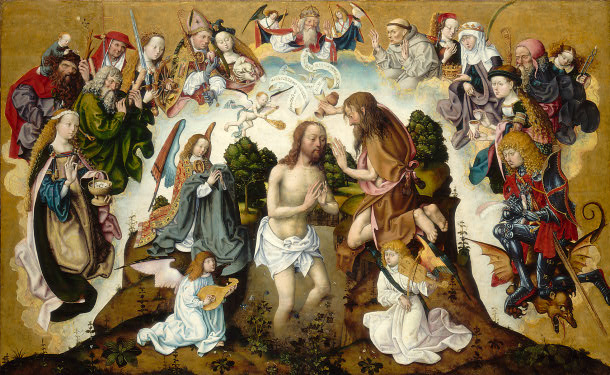
Baptism of Christ, the Master of the Saint Bartholomew Altar, c. 1485/1500Do you reject sin, so as to live in the freedom of God’s children?  (“I do.”)

Do you reject the glamour of evil, and refuse to be mastered by sin?

Do you reject Satan, father of sin and prince of darkness?

Do you believe in God, the Father almighty, creator of heaven and earth?

Do you believe in Jesus Christ, his only Son, our Lord, who was born of the Virgin Mary, was crucified, died, and was buried, rose from the dead, and is now seated at the right hand of the Father?

Do you believe in the Holy Spirit, the holy catholic Church, the communion of saints, the forgiveness of sins, the resurrection of the body, and life everlasting?

This is our faith. This is the faith of the Church. We are proud to profess it, in Christ Jesus our Lord. Amen.