Archive for the ‘Salvation History’ Category

The Two (Old & New) Arks of God

December 17, 2015

Remember Raiders of the Lost Ark? The Ark that Indiana Jones and the Nazis were pursued in that entertaining film was the most precious object in the entire Old Testament. But what is lost on many is how that holy artifact is related to the most important woman in the New Testament and its New Covenant.

The Old Testament Ark of the Covenant was a box built in the days of Moses according to God’s instructions at Mount Sinai. It was made of wood overlaid with pure gold, inside and out. No man was allowed to touch God’s Holy Ark—lest they die—so it was designed to be carried about using a pair of poles. The Ark was the throne for God’s presence on earth. The wings of two, golden Cherubim angel statues atop the Ark’s lid served as his “mercy-seat.” The Ark itself contained within several interesting items from the time of the Exodus: the two stone tablets of the 10 Commandments, the wooden staff of Aaron (which miraculously blossomed to confirm his divinely-ordained priesthood), and a gold container holding some of the Manna from heaven which God provided to feed his people on their desert pilgrimage.

Ark

About 450 years after its construction, around 1000 BC, King David reigned over all of Israel. He tried to bring the Ark up to his royal city, Jerusalem, until one of the priests (who should have known better) touched the Ark and fell down dead. David exclaimed, “How can the Ark of the Lord come to me?” He arranged for it to be kept at the house of Obed-edom in the Judean countryside. The Ark remained there for three months and manifestly blessed the whole household. When it was reported to the king how richly Obed-edom was being graced, King David decided to try transporting the Ark into Jerusalem once more. David himself led that procession, dancing and leaping before the Lord with joyful abandon.

The Ark would eventually reside in the Jerusalem Temple built by David’s son, King Solomon. It is written that before that Temple was destroyed by the Babylonians in 587 BC, Jeremiah the Prophet took the Ark and hid it in a secret cave, saying, “No one must know about this place until God gathers his people together again and shows them mercy.”Unlike in the 1981 film, the Lost Ark has never been found, but a new Ark of God did appear.

The Blessed Virgin Mary is the New Ark of the Covenant because she bears Jesus Christ, God’s fullest presence on earth. By God’s design, the first Ark was made of wood and covered with gold; Mary is a human being full with grace. The former Ark carried the word of God in stone; Mary’s womb carries the Word become flesh. Aaron’s dead staff miraculously flowered; Mary’s virgin womb blossomed with a bud from the stump of Jesse. The Ark held Manna from heaven; Mary bore the true bread from heaven. Mary’s womb holds Jesus Christ, our Prophet, Priest, and King.

The Visitation by Albertinelli, 1503.As the Gospel of Luke tells us, after she was visited by St. Gabriel the Archangel at the Annunciation, “Mary set out and traveled to the hill country in haste to a town of Judah, where she entered the house of Zechariah and greeted Elizabeth. When Elizabeth heard Mary’s greeting, the infant leaped in her womb, and Elizabeth, filled with the holy Spirit, cried out in a loud voice and said, ‘Most blessed are you among women, and blessed is the fruit of your womb. And how does this happen to me, that the mother of my Lord should come to me?’” And Mary would bless them with her help and companionship, staying at their house in the Judean hill country about three months.

Like King David, St. Elizabeth questions and St. John the Baptist leaps for joy before the Ark of the Lord. St. Joseph, regarding the inviolable sanctity of his wife with reverent fear, never touched her virginity. Mary would also go on to literally serve as God’s throne, his mercy-seat; “On entering the house [the Magi] saw the child with Mary his mother.”

In the Book of Revelation, St. John’s vision of heaven includes a sighting of the Lost Ark: “Then God’s temple in heaven was opened, and the Ark of his Covenant could be seen in the temple.” Then John beholds “in the sky, a woman clothed with the sun, with the moon under her feet, and on her head a crown of twelve stars.” We soon discover that this  glorious woman is pregnant with “a son, a male child, destined to rule all the nations….” This is the Christ, and she is his Holy Ark.

Now the Lord’s Ark is not meant to be worshiped. (Though among God’s most holy creations, an Ark of God is not divine.) Yet, as one draws nearer to the Holy Ark, one inevitably draws nearer to God’s presence. Just as the old Ark of the Covenant was of central (though secondary) importance in the Old Covenant, so God gives the Blessed Virgin Mary an essential role in his New Covenant. All who come to her are drawn nearer to her Son.

Imagine daring to enter the old Jewish Temple’s the Holy of Holies where the Ark of God was kept. What awe and reverence would you feel before the all-holy presence of God? Now consider drawing near to the even greater Ark, Mary the Mother of all Christians, who reaches out to each of us with love and takes away our fear. And now reflect upon the great privilege we have in approaching and even touching the Christmas Gift of God she bore, Jesus Christ himself. Mary is blessed among women and blessed is the fruit of her womb, Jesus. But blessed are we who would believe in all that the Lord has revealed to us.

Our Holy Conspiracy & the End of the World — 33rd Sunday of Ordinary Time—Year B

November 16, 2015

C.S. Lewis, 1898-1963A new liturgical Church year will begin in a couple of weeks with the first Sunday of Advent. As this Church year ends, our Mass readings (like today’s Sunday readings) focus on the Last Things and the end of the world as we know it. This weekend’s news reports, especially the terrible events in France, remind us that though the Kingdom of God is among us, we pray “thy Kingdom come” because it is not yet fully here in total, unveiled power. This weekend’s readings and news events remind me of passages from C.S. Lewis in excellent book Mere Christianity:

“Enemy-occupied territory—that is what this world is. Christianity is the story of how the rightful king has landed, you might say landed in disguise, and is calling us all to take part in a great campaign of sabotage. When you go to church you are really listening-in to the secret wireless [radio] from our friends: that is why the enemy is so anxious to prevent us from going.”

Why does Lewis say that our king has landed “in disguise?” Well, where would you expect a king to be born? The Magi sought the newborn king of the Jews in the palace at Jerusalem, but Jesus was born in a barn—a cave in Bethlehem—to a pair of poor parents. How would one expect the Jewish Messiah to enter into Jerusalem to claim his throne? Probably riding on a warhorse, but Jesus came meekly riding on a donkey, just as had been prophesied about him. Who would have thought that God would become a man, and then suffer and die as he did? After the vindication of the resurrection, one would have thought he would appear to the high priest and Governor Pilate, or to the Emperor Tiberius in Rome, to declare that he was indeed who he claimed to be. Instead, Jesus appeared discretely, to his disciples.

Lewis writes that God has landed in this enemy-occupied world in disguise and has started “a sort of secret society” to undermine the devil. This secret society he speaks of is the Church. But what is so secret about the Church? We have a sign in front with our Mass times. We don’t check ID’s at the door. And if anyone wants to know about what we do or what we believe, we will gladly inform them. But, in a sense, the Church is a secret society—for the world and even many Catholics do not recognize who and what we really are. We are a holy conspiracy. We are fighting the propaganda of the world and the devil with the truth of God. We are recruiting others to the side of the Lord. We are his special forces sabotaging evil with the weapons of love in preparation for the king’s arrival.

From where do we receive our power for this mission? The source of our power is the Holy Mass. Today’s second reading says that the Old Testament’s priests offered many sacrifices because those  could not truly achieve their purpose, but Jesus our High Priest offers his sacrifice once for all. At Mass we transcend space and time to personally encounter that sacrifice, and it’s power is applied to us here and now, providing all the graces we need to fulfill his will.

Lewis asks, “Why is [God] not [yet] landing in [total unveiled] force, invading [our world]? Is it that He is not strong enough? Well, Christians think He is going to land in force; [but] we do not know when.”

Indeed, as Jesus says in today’s Gospel, “of that day or hour, no one knows… but only the Father.”

We do not know when the Lord is going to land in force. “But,” Lewis continues, “we can guess why He is delaying. He wants to give us the chance of joining His side freely. I do not suppose you and I would have thought much of a Frenchman [during World War II] who waited till the Allies were marching into Germany and then announced he was on our side. God will invade.”

Why has God not yet invaded our world with his full, unveiled force? Why does he allow the wicked to use their freedom for evil, like the terrorism we saw in Paris?

Lewis writes, “I wonder whether people who ask God to interfere openly and directly in our world quite realize what it will be like when He does. When that happens, it is the end of the world. When the author walks on to the stage the play is over. God is going to invade, all right: but what is the good of saying you are on His side then, when you see the whole natural universe melting away like a dream and something else—something it never entered your head to conceive—comes crashing in; something so beautiful to some of us and so terrible to others that none of us will have any choice left?”

I think “the whole natural universe melting away” is an excellent reflection on today’s gospel. Jesus tells us that at the end:

“the sun will be darkened,
and the moon will not give its light,
and the stars will be falling from the sky,
and the powers in the heavens will be shaken…”

In the ancient world, the sun and moon, stars and planets, were considered the most stable and eternal things in the cosmos (and you can understand why.) But when even these things are passing, you know the universe as we know it is melting away. After this, the Lord Jesus comes with judgment. “And then they will see ‘the Son of Man coming in the clouds’ with great power and glory… (and his angels, like St. Michael from our first reading, along with him…)”

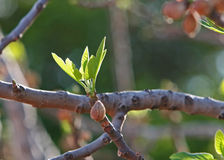
Sprouting Fig Tree in SpringtimePerhaps we may find it surprising that Jesus describes these events as a good thing to his disciples. He says:

“Learn a lesson from the fig tree. When its branch becomes tender and sprouts leaves, you know that summer is near. In the same way, when you see these things happening, know that [the Son of Man] is near, at the gates.”

We usually associate the end of things with the fall. Youth is called the springtime of life, while old age is the fall. In the Northern Hemisphere, every Church year ends in the fall. Yet Jesus presents an analogy for the end of the world as one of spring becoming summer: ‘When the tender branch sprouts leaves, you know that summer is near.’ A small thing, the branch, points to the arrival of a much greater reality, the summer. Why would we cling to the branch when the whole world is being renewed in glory? For friends of God, what is to come is better than what we see. The life we live now in this world is the winter. What is still to come for us is the spring and summer. Let us not hesitate to hope for it, envision it, and rejoice in it.

When the last day comes, “it will be God without disguise; something so overwhelming that it will strike either irresistible love or irresistible horror into every creature. It will be too late then to choose your side. … That will not be the time for choosing: it will be the time when we discover which side we really have chosen, whether we realized it before or not. Now, today, this moment, is our chance to choose the right side. God is holding back to give [people] that chance. [But it] will not last forever. We must take it or leave it.”

How long will it be until the Lord comes again? Jesus says in today’s gospel that, “This generation will not pass away until all these things have taken place.” But he said this a long time ago. Was Jesus wrong? No, for when you read these passages from Mark in full context, Jesus is responding to his disciples questions about two things side-by-side: the fall of Jerusalem and the end of the world. The Romans destroyed the great city and its temple in 70 A.D., during the lifespan of some of Jesus’ hearers, and to many Jews it felt like the end of the world. This event prefigured the passing away of all things. Like other prophesies in the Bible, Jesus’ prophesy has a near and distant fulfillment, one after a forty-year opportunity for conversion, and another at the end of time.

So when will the Lord come again? The answer for every generation before us has been “not yet.” If this world endures to the year 10,000 A.D., the Christians of that time will probably regard us as the early Christians. I personally think it will still be awhile before he comes, for it is still legal to be a Christian in too many places on earth. Yet, in a sense, it doesn’t matter when Jesus is coming, for the end of our individual lives is equivalent to the end of the world for us. If you’re ready for one, you’re ready for the other. But if you, or people that you know, are not ready for either, then now is the time for conversion.

The Lord our King has recruited us into his holy conspiracy, arming us with the weapons of truth and love. You and I are his advanced forces and, among other tasks, he is sending us on rescue missions to bring others to himself. Who do you know that is far from Christ? We are to draw on the power of this Mass for them. We are called to pray, fast, and sacrifice for them, and even to be so bold as to talk with them—inviting them to come to Jesus Christ and his Church. Seize this opportunity and do not let it pass away, for whether the Lord first comes to us or we go forth to him, each and all will encounter him soon, face-to-face, in his full, unveiled glory.

A Chalice Reflection

October 13, 2015

Virgin Mary by the Host by Jean Auguste Dominique Ingres, 1854.     How could we possibly celebrate the Holy Mass without the chalice? Without the chalice, how would we adore the Precious Blood? The chalice holds the Lord and it gives form to his presence. He is not lifted up in sacrifice without its close collaboration. Perhaps our Lord could have chosen another means but this is the one He chose. The chalice at Mass is not divine, but when our Lord is adored it shares in His glory.

The chalice at Mass is an icon of a person. The chalice of Jesus Christ is the Blessed Virgin Mary. She held the Lord within her and from her He received his human form. He was not lifted up in sacrifice without her close collaboration. Perhaps our Lord could have chosen another means, but she is the one He chose. Mary is not divine, but when our Lord is adored she shares in His glory.

A Holy Spirit Novena

May 14, 2015

All novenas are inspired by the nine days during which Mary, the apostles, and the other disciples prayed in the upper room for the coming of the Spirit with power. To pray a novena to the Holy Spirit preceding this Pentecost yourself, begin this Friday, May 15th. Many Pentecost novenas are available online, but your daily prayer could simply be this:

 “Come Holy Spirit, fill the hearts of your faithful and kindle in them the fire of your love. Send forth your Spirit & they shall be created. And You shall renew the face of the earth.

O, God, who by the light of the Holy Spirit, did instruct the hearts of the faithful, grant that by the same Holy Spirit we may be truly wise and ever enjoy His consolations, Through Christ Our Lord, Amen.”

Our Glorified Bodies Shall Be Like His

April 18, 2015

In inspired Scripture, St. Paul tells us:

“[The Lord Jesus Christ] will change our lowly body to conform with his glorified body by the power that enables him also to bring all things into subjection to himself.” 1

This means that we can glimpse what our own resurrected bodies will be like someday by studying the resurrected body of Jesus Christ.

The Resurrection by El Greco, Madrid, 1596-1600.•  Jesus’ Resurrected Body is the Same Body He Died In

        The tomb is empty on Easter morning because Jesus’ body is raised.2 On Easter evening, Jesus shows his disciples the wounds of his hands, feet, and side, which he received on the cross.3 His body retains its “flesh and bones” and can be touched and held.4 Our own dead bodies will similarly be reclaimed and resurrected, from the tomb, the sea, or the dust of the earth.5 St. Paul is so insistent on our own future resurrection he says, “If there is no resurrection of the dead, then neither has Christ been raised.” 6

•  Jesus Resurrected can do the Ordinary Things He did Before

        On Easter Sunday, Jesus walks and talks.7 He can breathe and eat.8 He knows who he is and he remembers his friends.9 (There is no reason to think that the dead will forget the lives they lived or their loved ones.)

•  Jesus’ Resurrected Body can also do Extraordinary Things

        Though he is no ghost, Jesus can appear suddenly within a locked room or vanish from another.10 He can make himself unrecognizable to those who know him.11 His body can ascend into heaven.12 And now, resurrected to life, he dies no more, for “death no longer has power over him.” 13

        The spiritual gifts granted to some saints on earth (such as bi-location, levitation, incorruptibility, etc.) suggest powers belonging to our future glorified bodies. For her various apparitions, the Blessed Virgin Mary may be modifying her glorified body’s physical appearance (for example, to be as a dark-haired native at Guadalupe in Mexico, but fair and blond-haired at Champion, Wisconsin.)

•  Our Conclusion

        The bodies in which we live and die will be same ones in which we rise. Our glorified bodies will be able to do the familiar things we know, yet we shall also possess new abilities which seem extraordinary to us now. St. Paul describes our future glorified bodies in this way:

“Someone may say, ‘How are the dead raised? With what kind of body will they come back?’

It is sown corruptible; it is raised incorruptible. It is sown dishonorable; it is raised glorious. It is sown weak; it is raised powerful. It is sown a natural body; it is raised a spiritual body.

That which is corruptible must clothe itself with incorruptibility, and that which is mortal must clothe itself with immortality.” 14

Endnotes:

  1. Philippians 3:21
  2. Matthew 28:6
  3. Luke 24:40, John 20:20
  4. Luke 24:39, John 20:17, Matthew 28:9
  5. John 5:28-29, Revelation 20:13
  6. 1 Corinthians 15:13
  7. Luke 24:15
  8. John 20:22, Luke 24:42-43
  9. Luke 24:39, John 20:16-17
  10. John 20:19 & 26, Luke 24:31
  11. Luke 24:16, John 21:12
  12. Acts 1:9, Mark 16:19; Luke 24:51
  13. Romans 6:9
  14. 1 Corinthians 15:35, 42-44 & 53

“One on His Right, the Other on His Left”

March 24, 2015

Revealing fascinating prophetic connections between Moses, Joshua, Samson, and Jesus Christ on the Cross; featuring the religious paintings of James Tissot (1836-1902.)

Reflections on The Passion of the Christ

February 26, 2015
  • Jesus Writing on the Ground from the Passion of the Christ with Jim CaviezelThe 2004 film begins quoting Isaiah 53, “He was wounded for our transgressions, crushed for our iniquities; by his wounds we are healed.” Isaiah foretold Christ’s sufferings seven centuries before they came to pass.
  • We see a full moon, for Passover was always celebrated upon a full moon (similar to how Easter is always the Sunday after the first full moon following spring equinox on March 20th.)
  • We find Jesus in the garden, praying the psalms to his Father: “Rise up, defend me” (Ps 94) “Save me from the traps they set for me” (Ps 141) “Shelter me, O Lord, I trust in you. In you I take my refuge.” (Ps 16)
  • Satan appears in the garden; androgynous, attractive, and deathly pale. He speaks doubts to Jesus: “Do you really believe that one man can bear the full burden of sin? No one can carry this burden… No one. Ever. No. Never. … Who is your Father? Who are you?” Jesus never speaks to the devil throughout the film, but here he stands, locks eyes with Satan, and crushes the snake’s head underfoot. This recalls God’s words to the ancient serpent in Genesis 3:15, “I will put enmity between you and the woman, and between your seed and hers; He will strike at your head, while you strike at his heel.”
  • Awoken from her sleep, the Virgin Mother senses something is awry. She asks Mary Magdalene, “Why is this night different from every other night?” She answers, “Because once we were slaves and we are slaves no longer.” This quotes the traditional dialogue of the Jewish Passover meal ritual.
  • Given the choice, the crowd calls for the unsavory prisoner Barabbas, a violent revolutionary, to be freed instead of Jesus. “Barabbas” means “Son of the Father.”
  • At the pillar, Jesus quotes Psalm 108: “My heart is ready, Father. My heart is ready.” In Hebrew, to say “very,” you repeat a word twice. To say something is so in the greatest measure, it is said thrice (e.g. “Holy, Holy, Holy.”) The Romans directing the flogging of Jesus say “Satis / Enough” three times.
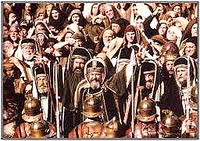
  • The angry crowd from the Passion of the ChristPilate presents the lacerated Jesus saying, “Ecce Homo / Behold (the) man!” The shot is from behind, emphasizing the angry, riotous mob in the background, for these words are a critique of fallen man/mankind.
  • Pilate asks, “Shall I crucify your king?” The high priest replies, “We have no king but Caesar,” denying the kingship of God.
  • The 14 Stations of the Cross make appearances throughout the film, including the three times Jesus falls.
  • Embracing his cross, Jesus alludes to Psalm 116: “I am your servant Father. Your servant and the son of your handmaid.
  • Mary, recalling when Jesus once fell as a child, rushes to his side. Jesus tells her, “See, Mother, I make all things new,” foreshadowing Revelation 21:5, “Behold, I make all things new.”
  • Veronica, who gives Jesus her veil to wipe his face, has a name which means “true image.”
  • Jesus’ experiences at Golgotha are paralleled with flashbacks to the Last Supper. Jesus is stripped, the bread is uncovered. The Host is lifted, his cross is raised.
  • The Virgin Mary at the foot of the cross calls Jesus, “Flesh of my flesh, heart of my heart…” echoing the words of Adam toward Eve.
  • On the cross, Jesus quotes Psalm 22: “My God, my God, why have you forsaken me?”

Renewing Your Baptismal Vows

January 11, 2015

On this feast day of our Lord’s baptism, let us renew the vows of our own baptisms:

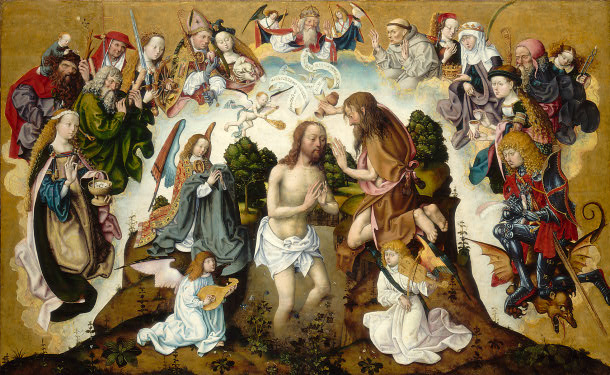
Baptism of Christ, the Master of the Saint Bartholomew Altar, c. 1485/1500Do you reject sin, so as to live in the freedom of God’s children?  (“I do.”)

Do you reject the glamour of evil, and refuse to be mastered by sin?

Do you reject Satan, father of sin and prince of darkness?

Do you believe in God, the Father almighty, creator of heaven and earth?

Do you believe in Jesus Christ, his only Son, our Lord, who was born of the Virgin Mary, was crucified, died, and was buried, rose from the dead, and is now seated at the right hand of the Father?

Do you believe in the Holy Spirit, the holy catholic Church, the communion of saints, the forgiveness of sins, the resurrection of the body, and life everlasting?

This is our faith. This is the faith of the Church. We are proud to profess it, in Christ Jesus our Lord. Amen.

Encountering Jesus at His Ministry’s Beginning & End

January 9, 2015

Comparing John 1:35-43 & 20:11-18

  • John the Baptist is with two of his disciples when he points out Jesus “the Lamb of God” passing by. Jesus turns, sees the two disciples following him, and asks, “What are you looking for?”
  • Mary of Magdala is with two angels at the empty tomb when Jesus comes by. She turns around and sees Jesus, but does not know it’s him. He asks her, “Whom are you looking for?”
  • John the Baptist’s two disciples answer Jesus, “Rabbi, (that is, Teacher) where are you staying?”
  • Mary, recognizing the risen Lord, says to him, “Rabbouni!” (which also means Teacher.)
  • Jesus tells the curious duo, (one of whom we are told is St. Andrew the Apostle) “Come, and you will see.”
  • Jesus tells the overjoyed Mary, “Go to my brothers and tell them, ‘I am going to my Father and your Father, to my God and your God.”

Points for Reflection:

St. Mary Magdalene Clings to Jesus□ We first come to Jesus looking for something. (“What are you looking for?”) But we are in fact looking for a Someone. (“Whom are you looking for?”)

□ Our search begins with curiosity, but grows finally into love.

□ Jesus is a Teacher to them all, but he more than a teacher to Mary of Magdela. (Similarly, in Matthew’s telling of the Last Supper, all the apostles call Jesus “Lord,” while Judas calls him merely, “Rabbi.”)

□ Jesus makes the first two apostles, but he makes Mary (as the Church Fathers call her) “the Apostle to the Apostles.”

□ Jesus draws us near (“Come and see,”) and then he sends us forth on mission (“Go to my brothers and tell them…”)

□ Jesus’ baptism leads to his tomb and resurrection.

□ Jesus, who dwelt on earth, now dwells with His Father in Our Father’s house. Jesus wills that we come to dwell with him, in Heaven, as it is on earth.

The Christmas Proclamation

December 23, 2014

This proclamation recalls the great events which set the stage for the birth of Jesus Christ within our human history. Its reading has traditionally preceded the Mass of Christmas Eve.

The 25th Day of December,
   when ages beyond number had run their course from the creation of the world, when God in the beginning created heaven and earth, and formed man in his own likeness;
   when century upon century had passed since the Almighty set his bow 1 in the clouds after the Great Flood, as a sign of covenant and peace;
   in the 21st century since Abraham, our father in faith, came out of Ur of the Chaldees 2;
   in the 13th century since the People of Israel were led by Moses in the Exodus from Egypt;
   around the thousandth year since David was anointed King;
   in the 65th week of the prophecy of Daniel 3;
   in the 194th Olympiad 4;
   in the year seven hundred and fifty-two since the foundation of the City of Rome;
   in the 42nd year of the reign of Caesar Octavian Augustus5,
   the whole world being at peace 6,
   JESUS CHRIST, eternal God and Son of the eternal Father, desiring to consecrate the world by his most loving presence, was conceived by the Holy Spirit, and when nine months had passed since his conception, was born of the Virgin Mary in Bethlehem of Judah, and was made man:
   The Nativity of Our Lord Jesus Christ according to the flesh.

* * * * * * *

  1. That is, the rainbow.
  2. The land of Chaldea would be modern-day Iraq.
  3. The Book of Daniel, chapter 9, foretold that “Seventy weeks are decreed for your people and your holy city: then transgression will stop and sin will end, guilt will be expiated, everlasting justice will be introduced…” Seventy times 7 years, equals 490 years, which corresponds with the time between Daniel’s prophesy and Christ’s crucifixion.
  4. The ancient Olympics were held every 4 years & attracted widespread attention, as sports do today.
  5. He was Julius Caesar’s immediate successor.
  6. Caesar Augustus’ reign began an era of relative peace in the empire lasting two centuries. This Roman Peace (or Pax Romana) allowed the Gospel message to spread quickly across the known world.

Was the Book of Revelation Written for Us?

November 17, 2014

Monday, 33rd Week in Ordinary Time—Year II
Readings: Revelation 1, Luke 18:35-43

     The revelation of Jesus Christ, which God gave to him, to show his servants what must happen soon. He made it known by sending his angel to his servant John, who gives witness to the word of God and to the testimony of Jesus Christ by reporting what he saw. Blessed is the one who reads aloud and blessed are those who listen to this prophetic message and heed what is written in it, for the appointed time is near.

Revelation’s island of Patmos and its seven churches in Asia Minor (or modern-day Turkey)

        So begins the most misunderstood book of the Bible. The Book of Revelation speaks of “what must happen soon” and of an appointed time which is “near,” but to whom is it speaking? Some answer this question historical-critically; it is addressing seven particular churches in Asia Minor during the first or second century. Others answer eschatologically; it is describing the wonders and travails awaiting the generation which will immediately precede Jesus’ return. But what about the many generations who come and go between those two bookend-eras of Christian history? Was the Book of Revelation addressed or applicable to them? In what sense was its prophetic message truly “near” or “soon” for all that time?

        The Book of Revelation involves specific historical contexts in the past and describes a historical climax (apparently) still to come, but it also speaks to Christians of every age. Consider today’s gospel: Jesus heals a blind man and declares the saving power of his faith or faithfulness (“pistis” in the Greek.) How narrowly should we interpret this gospel? Are the miracles and message of Jesus Christ intended only for the people of His time and place? Is the Gospel of Luke meant only for the first century Christians to whom it was written? Rather, the whole of Sacred Scripture, co-authored and inspired by the Holy Spirit who sees all of history simultaneously, speaks to the life and times of every Christian. Corruptions of the world, persecutions of the Church, manifestations of God’s power, and triumphs of His people belong to every age. The Book of Revelation truly tells “[God’s] servants what must happen soon” because these realities are always “near.”

Three Crosses Line Break

By Satan’s Power — Friday, 27th Week in Ordinary Time—Year II

October 10, 2014

Readings: Galatians 3:7-14; Luke 11:15-26

Some in the crowd said of Jesus, “By the power of Beelzebul, the prince of demons, he drives out demons.” In a certain sense, those people would be right.

Satan’s power in the world led to Jesus’ Passion. The devil probably thought he was winning by getting Jesus crucified, for ‘cursed is everyone who hangs on a tree.’ Yet Jesus surprised him by turning this curse into ‘a blessing for all nations.’ Jesus suffered Satan’s power, but brought good out of the evil. In this way, by the power of Beelzebul, the prince of demons, Jesus drove out demons from the world.

Originally posted on October 8, 2010

How God The Father Loves His Son

June 16, 2014

How does the Eternal Father love Jesus Christ his Son?
The Scriptures provide us insights into their relationship.


The Father gives his Son instruction and example

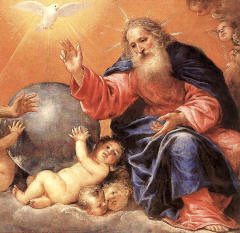
God the Father BlessingAs Jesus once said, “Amen, amen, I say to you, a son cannot do anything on his own, but only what he sees his father doing; for what he does, his son will also do,” adding, “I cannot do anything on my own.” The Father loves his Son and shows him everything that he does. Sometimes believers find it harder to relate to God the Father than Christ the Son. But what is the Father really like? He is just like his Son. Jesus “is the image of the invisible God.” As Jesus said, “Whoever has seen me has seen the Father.”  The Father offers his Son the perfect example, and his Son perfectly follows him.

The Father listens to his Son

Outside the tomb of Lazarus, Jesus said, “Father, I thank you for hearing me. I know that you always hear me…” Jesus shares his own attitude toward prayer when he tells us, “In praying, do not babble like the pagans, who think that they will be heard because of their many words. Do not be like them. Your Father knows what you need before you ask him. This is how you are to pray: Our Father…” Jesus knows that wordy, poetic prayers are not necessary because his Father is always listening.

The Father encourages his Son

At Jesus’ baptism in the Jordan River, the Father declared from heaven, “You are my beloved Son, in whom I am well pleased.” And on the summit of Mt. Tabor, at Jesus’ Transfiguration, the Father spoke from the cloud, “This is my beloved Son, listen to him.” The Father encourages his Son with reminders of his love.

The Father provides for his Son

Jesus said, “Everything that the Father has is mine.” Jesus’ Father is like the father in the parable of the Prodigal Son who told his first-born, “My son, you are here with me always; everything I have is yours.” Confident in his Father’s providence, Jesus tells us to be likewise unafraid concerning our basic needs, what we are to eat and drink, or what we are to wear: “Seek first the kingdom of God and his righteousness, and all these things will be given you besides.” The Father also provides his Son with gifts greater than material things. At the Last Supper, Jesus said of disciples, “Father, they are your gift to me.”

The Father welcomes closeness with his Son

It was a big deal when Jesus prayed, “Abba, Father.” As St. John Paul the Great observed, “An Israelite would not have used [“Abba” to address God] even in prayer. Only one who regarded himself as Son of God in the proper sense of the word could have spoken thus of him and to him as Father–Abba, or my Father, Daddy, Papa!” Because the Father welcomes intimate closeness with his Son, Jesus can say, “I and the Father are one.”

The Father loves his Son’s mother

At the Visitation, filled with the Holy Spirit, Elizabeth declared to Mary, “Most blessed are you among women,” and Mary rejoiced, “From this day all generations will call me blessed. The Almighty has done great things for me, and holy is his name.” By pouring his love and blessings into Mary, God the Father gave his Son a loving mother full of grace.

The Father fosters growth in his Son and sends him on mission

The Letter to the Hebrews says, “Son though he was, [Jesus] learned obedience from what he suffered; and when he was made perfect, he became the source of eternal salvation for all who obey him, declared by God high priest according to the order of Melchizedek.” But this raises a question: how can the divine Son grow in any way? Though perfect in heaven, the Son of God had no firsthand experience of weakness, suffering, or the trials of obedience, until his Incarnation. Through these things he was made complete so that he could be the savior of humanity. The Father prepares his Son and sends him on a mission to transform the world. “God did not send his Son into the world to condemn the world, but that the world might be saved through him.”

The Father as our model for Fatherhood

Whether we are biological or spiritual fathers, Jesus’ heavenly Father gives men a model for our fatherhood. We are to give our children instruction and good example. We should listen to them and encourage them, letting them know that they are well-beloved. We should provide for our children, according to our abilities, supplying their basic needs without neglecting the greater gifts. We are to welcome closeness with our children. We are to love our children by loving their mother, whether she be our spouse or the Church. We are to foster maturity and virtue in them so that they may go forth in mission to transform the world.  Which aspect of your fatherhood are you resolved to grow in with God the Father?

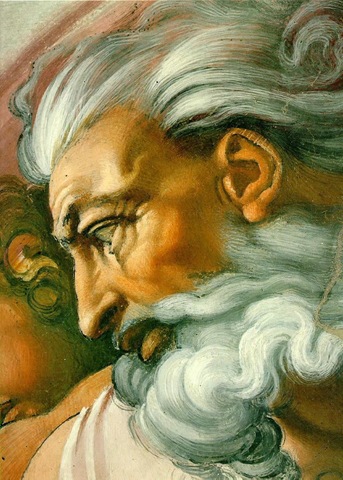
God the Father in the Creation of Man by Michelangelo, Sistine Chapel Ceiling, Vatican.Our Perfect Father

Some of us have had very good fathers, while some of our fathers were very far from perfect. But regardless of the quality of our earthly fathers, we all have a heavenly Father who loves us perfectly. As Jesus tells us, “the Father himself loves you, because you have loved me…” Our Father instructs us and shows us his example through his Word. He always listens, and we should not be surprised when he encourages us, speaking to us, in prayer. Our Father provides for our material needs and gives us the greater gifts. “For everyone who asks, receives…” Our Father welcomes intimacy with us, giving his children the spirit of his Son so that we too may cry, “Abba, Father!”  And he gives us Mary, the same perfectly loving mother he provided for his Son. Our Father would grow and mature us into greatness, into saints, into the likeness of his Son, and send us on mission for the transformation of the world.

Called by the Spirit — 3rd Sunday of Easter—Year A

May 5, 2014

Gospel: Luke 24:13-35

Let me tell you about the neatest thing that happened to me this week. Since Easter, our parish has been reading the book Rediscover Catholicism and discussing it on Thursday evenings in the rectory. In the latest chapter, Matthew Kelly writes that today’s Catholic Church will become all that she is meant to be only through the guidance of the Holy Spirit.

“[T]he ways of man will not get us from where we are today to where we are called to be. I also know that in every place and in every time since Pentecost the Holy Spirit has been present to guide you, me, and the whole Church. I am certain that the Church needs less and less of your ideas and mine, and more and more guidance from the Holy Spirit.”

Holy Spirit Dove - Sacred Heart Catholic Church -  Wauzeka WIMatthew Kelly then pauses in his text to invite the reader to pray the traditional prayer for the Holy Spirit to “renew the face of the earth.”

I was reflecting on these things while I was driving down the highway. Am I inviting the Holy Spirit to guide my everyday life? I try to do my best and make good choices, but my flesh is weak and my knowledge is limited. I work and hope for the best, but the Holy Spirit has power I ought to be open to and insight I should be more docile to. So I prayed to the Holy Spirit anew. And then a curious thing happened: the thought came mind to call my old friend, Colleen.

It was curious because I had not been previously thinking of her or thinking about calling anyone at all. Yet I wondered, “Is this coming from you, Lord, or is this just me?” I hesitated because I was aware of no reason to call. If she were to ask me what I was up to, or what I wanted to talk about, I would have nothing to say. So, to avoid embarrassment, I constructed some good reason for calling (to thank her and her husband for coming to a party I threw for old friends two weeks ago) before selecting her number on my cellphone.

She answered, and after greetings I asked, “So how are things going?”

“Great,” she replied, less than enthusiastically.

“Is that an actually-great, or a sarcastically-great?”

It was the second. That morning, Colleen had quit her job without giving two-weeks notice. She said she had been at the end of her rope at work for some time and had quit in a fashion which precluded her return. She was anxious at losing her health insurance and uncertain about what she would do next. Then I knew the reason for my call. I mentioned that even though these events had come unexpectedly to her, they were no surprise to God. I encouraged her to ask Him to show her–and to lead her–where to go next. By the end of our chat, Colleen’s spirits were noticeably better than before.

I share this story because I cannot tell anyone else’s first-person account as well as my own, and as Pope Paul VI said, “Modern man listens more willingly to witnesses than to teachers, and if he does listen to teachers, it is because they are witnesses.” I may be misrecalling a phrase or two, but I know that my story is true. It reconfirms for me that God intervenes in our world, working miracles big and small, and that God would personally speak to you and me (not just to long-ago saints, or crazy people.)

Encounter on the Road to Emmaus — Luke 24A personal relationship requires two-way communication. Since God desires a personal relationship with every person, we should not be surprised that he would speak to us. When He speaks it is usually subtly, perhaps by a thought or through a friend. He comes discretely, like Jesus came veiled to the disciples on the road to Emmaus, and He does not force Himself upon us, just as Jesus “gave the impression that he was going on farther.” God can speak to us through whatever we’re paying attention to if we’re open to listening to Him and welcoming Him.

The apostles and the first disciples were ordinary people, made of the same stuff that we are. They worshiped just like we do, opening God’s Word and encountering Jesus in the Breaking of the Bread, but they also had the expectation that they would see God work mighty deeds in their midst and actively sought to be led by the Holy Spirit. Wouldn’t God want the same for us today?

What sort of things would the Lord like to do through us? In today’s gospel, the two men walking their road away from the holy city were visited that first Easter evening by Jesus incognito. Their encounter with Him restored their Christian faith and brought them back to the early Church in Jerusalem. One thing Jesus would like to do today is to encounter those who are far from His Church using us as His subtle disguise. Let us ask the Holy Spirit to inspire and lead us to invite and draw others to our parish. At worst, they’ll decline, but very possibly their lives could be changed and it could be the neatest thing that happens to you all week.

Come Holy Spirit, fill the hearts of your faithful and kindle in us the fire of your love.

Send forth your Spirit and we shall be created. And You shall renew the face of the earth.

One Bible, Many Interpretations

April 29, 2014

Mormons teach that the Father, Son, and Holy Spirit are three Gods, and that we too can become Gods in our own right someday.

You may reply to them, for instance, with James 2:19, “You believe that God is one. You do well. Even the demons believe that and tremble,” but Mormons will have some explanation for that New Testament passage which fits their theology.

Oneness Pentecostals teach that the Father, Son, and Holy Spirit are not three persons but three manifestations of one divine person, God.

You may ask them who Jesus is praying to in Matthew 26:39 when he says in the Garden of Gethsemane, “My Father, if it is possible, let this cup pass from me; yet, not as I will, but as you will,” yet Oneness Pentecostals will offer some answer for why Jesus is not praying to another person.

Jehovah’s Witnesses teach that Jesus is not God, not divine, but God’s first and greatest creature and that the Holy Spirit is not a person but the active force of God the Father in the world.

You may answer with the beginning and end of the Gospel of John: with John’s prologue where we see “the Word was with God, and the Word was God. … And the Word became flesh,” and the gospel’s climax, John 20:28, “Thomas answered and said to [Jesus,] ‘My Lord and my God!'” However, Jehovah’s Witnesses will surely have some reply for these verses.

A diagram of the ancient, orthodox, Christian conception of the Holy Trinity

A diagram of the ancient, orthodox, Christian conception of the Most Holy Trinity: One God, Three Divine Persons

In my personal experience, advocates of Mormon polytheism, Oneness Pentecostal modalism, or Jehovah’s Witnesses Arianism-esque theology have all been sincere, friendly, rational, and not unintelligent people. They were all well-versed in the Bible, regarded it as God’s infallible Word, and used it to support their beliefs. They all proudly claimed the name of “Christian.” However, the undeniable fact that their theologies contradict each other proves that these admirable personal traits are not enough to guarantee a true understanding of the Christian Faith. The problem is that there seems to be more than one possible internally-coherent interpretation of the Bible. Just as texts out of context can suggest several defensible, though incorrect, meanings; interpreting biblical texts outside the context of Christ’s one, holy, catholic, and apostolic Church leads to many errors.

Last week, two very nice Jehovah’s Witnesses visited me at my rectory and we spoke for a couple of hours. I believe we were debating whether one of Jesus’ “I Am” statements in John’s Gospel was a profession of his divinity when one of my guests remarked, “We can’t really be certain what he meant.” I replied to the effect, “You’re right!–If your opinion and my opinion are all we have to go on, if there’s no visible authority on earth with power from Jesus Christ to infallibly answer biblical questions, then we can never be certain our interpretations are true–since many sincere, reasonable, and even scholarly Christians firmly disagree. Without a clear, external teaching authority within the Church, we would be left as sheep without a shepherd and inevitably scatter.” Most Christians revere the Holy Scriptures as God’s infallible Word, and this is right and good, but for some reason many of them reject the Catholic Church through which the Scriptures come.

Recall that Jesus wrote nothing in the Gospels (except perhaps something in the dust near the woman caught in adultery) but Jesus did establish a Church. Through this Church the New Testament was written, collected, canonized, and revered. However, this process was certainly not completed in the first century AD. In the early Church there was much debate over which New Testament writings were inspired and should be included in the canon. The Shepherd of Hermas? The Book of Revelation? The Didache? The Letter to the Hebrews? The Epistle of Clement? Some early Church Fathers included works such as these in their lists of Bible books, while others left them out. It was the Catholic Church that ultimately canonized the New Testament books which all Christians acknowledge today.

One teaching shared by Mormons and Jehovah’s Witnesses is the belief that a Great Apostasy occurred in the early Church. The New Testament contains verses which warn about false teachers arising who will mislead many. A great deception, those religions say, happened soon after the death of the apostles and explains why the majority of self-professed Christians in history have held core doctrines widely different from their own. I would agree that false teachers and heresies arise in every age, but was there a Great Apostasy soon after the apostles that devastated Christ’s Church and caused his central teachings (like the true nature of God) to be discarded and forgotten?

Christ Handing the Keys to St. Peter by Pietro Perugino (detail)

Jesus entrusting the keys of his Kingdom to St. Peter (Matthew 16:19)

All Christians will agree that Jesus was a wise man. Jesus was a wise man indeed, who built his house on rock. Jesus declared to Simon, “‘I say to you, you are Peter [that is, you are “Rock” in Greek] and upon this rock I will build my church, and the gates of the netherworld shall not prevail against it.'” (Matthew 16:18) If Jesus was a wise man who built his house on rock we can be assured that even though “the rain fell, the floods came, and the winds blew and buffeted the house–it did not collapse; [his Church] had been set solidly on rock.” (Matthew 7:24-25)

After building his Church on Peter for some forty years, did Jesus let it go into shambles and fail to repair it for about eighteen centuries, until Joseph Smith or The Watchtower came along? If so, Jesus really dropped the ball. If the Mormons or Jehovah’s Witnesses are right, then God managed to get all of the New Testament books infallibly written, correctly canonized, and faithfully preserved throughout millennia, but could not maintain the truth about himself in his Church on earth in the hearts and minds of believers much beyond the death of the apostles. More likely, our Lord Jesus Christ succeeded in preserving his teachings and the visible hierarchical authority he gave to his Church, from St. Peter (the first pope) and the apostles to Pope Francis and the bishops in communion with him today. A clear and necessary line of teaching authority runs though the centuries, through the laying of hands and apostolic succession.

You may encounter people who will present you with internally-consistent but very different interpretations of Scripture. Do not let your hearts be troubled. There are good reasons for everything we believe as Catholics. They may “know” the Bible, but we are blessed to know God’s Church from which the Bible comes. If you love Jesus Christ, love his Catholic Church. As even St. Joan of Arc, who personally experienced the complexities of the Church as a divine and human institution, said, “About Jesus Christ and the Church, I simply know they are just one thing and we shouldn’t complicate the matter.” If you love Jesus’ Church you will love him well. Jesus Christ is risen and his Catholic Church, though ancient, has never died. Christ’s Church, the Bride he protects and for whom he laid down his life, is very much alive.