Archive for the ‘Salvation History’ Category

A Veiled Beauty — The Assumption

September 2, 2010

Consider this reflection by the servant of God, Bishop Fulton Sheen:

“Just suppose that you could have pre-existed your own mother, in much the same way that an artist pre-exists his painting. Furthermore, suppose that you had the infinite power to make your mother anything that you pleased, just as a great artist like Raphael has the power of realizing his artistic ideas. Suppose you had this double power, what kind of mother would you have made for yourself?

Would you have made her of such a type that would make you blush because of her unwomanly and un-mother-like actions? Would you have made her exteriorly and interiorly of such a character as to make you ashamed of her? Or would you have made her, so far as human beauty goes; the most beautiful woman in the world; and so far as beauty of the soul goes, one who would radiate every virtue, every manner of kindness and charity and loveliness; one who by the purity of her life and her mind and her heart would be an inspiration not only to you but even to your fellow men, so that all would look up to her as the very incarnation of what is best in motherhood?”

Now if you who are an imperfect being and who have not the most delicate conception of all that is fine in life would have wished for the loveliest of mothers, do you think that our Blessed Lord, who not only pre-existed His own mother but who had an infinite power to make her just what He chose, would in virtue of all the infinite delicacy of His spirit make her any less pure and loving and beautiful than you would have made your own mother? If you who hate selfishness would have made her selfless and you who hate ugliness would have made her beautiful, do you not think that the Son of God, who hates sin, would have made His own mother sinless and He who hates moral ugliness would have made her immaculately beautiful?”

Fulton Sheen thought that Mary was, in every respect, the most beautiful woman who had ever lived. However, if we had been travelers walking through the small town of Nazareth during the reign of Emperor Tiberius, I’m not sure that we would have recognized God’s greatest creature as we passed by her. I imagine that her face may have looked quite ordinary, apart from her beautifully, loving smile. Her Son, was the all-beautiful God become man, yet it seems that Jesus was not the most handsome man alive. As the prophet Isaiah says of Him, “There was in him no stately bearing to make us look at him, nor appearance that would attract us to him.” (Is 53) Perhaps Jesus and Mary had ordinary physical features on earth because having extraordinary appearances would have impeded their missions.

Yet now, invested with heavenly glory, Jesus and Mary possess a beauty greater than anyone in history. The perfection of love, goodness, purity and virtue within them shines through their exterior in a way that captivates those who behold them. Jesus told St. Faustina to commission a painting of how He appeared to her. When Faustina saw the artist’s quality work she dissappointedly lamented, “[Jesus,] Who will paint You as beautiful as You are?” The young visionaries at Fatima and Lourdes we struck by how very beautiful the mysterious lady was. And when St. Bernadette visited the grotto for the last time she remarked, “I have never seen her so beautiful before.” There is more to a beauty of this kind than natural appearance.

Why does the Church celebrate Mary’s Assumption? Because this solemnity not only celebrates her, but points to Church’s future. Virgin Mary is the icon, the image, of our Church. Jesus Christ’s Church is Marian. What she did, we are called to do; and where she has gone, we are called to follow. What Christ has done for Mary, He shall do for His Church on the last day. My previous reflections on the ordinary, appearances of Jesus and Mary probably had on earth only goes to show that external appearances can veil the true reality of things. 

Men judge by appearances, and they often misjudge. Many will drive past this building this hour without realizing the wondrous beauty of what is happening here inside. Many fail to see the beauty of Christ’s one, Catholic Church, for which this world was made and through which this world is saved. Many people see the beauty of exterior flesh, but not the beauty of the soul. Yet after the Last Judgment, everyone will see the most homely saint become radiant with beauty, and the most attractive sinner become repellant.

Mary is the first and greatest member of Jesus Christ’s Church. At the end of her unassuming life on earth Jesus lifted up her up body and soul into Heaven and gave her a beauty unmatched in history. He will do the same thing for His Church someday, and He desires to do the same for each of us. You and I are called to follow Mary in following Christ; to imitate their love, goodness, purity and virtue. Despite any appearances to the contrary, in this veiling and deceptive world, we are called to share in a beauty and glory like theirs.

Saintly Vigilance — Thursday, 21st Week in Ordinary Time—Year II

August 26, 2010

The usual reading of today’s Gospel sees Jesus warning His followers to be ever watchful and prepared for the coming of the Lord. When we hear his image of a mud-brick house being broken into (or literally, dug through) we think of the devil as that thief, robbing us of the treasure in our souls. This interpretation is good and true. We should be vigilant in the keeping of our own immortal souls. But let me suggest that He teaches us another lesson as well, for Jesus words are autobiographical.

Jesus is that “master of the house.” He is the husband in His household, the Church. And Jesus did know the pivotal hour of night to “stay awake” and “keep watch” in the garden of Gethsemane. When His enemies arrived, Jesus did not allow His household be broken into and robbed. He said, “…If you are looking for me, let these men go.” He did not lose any of His own which the Father had given to Him.

“Who then is the faithful and prudent servant, whom the master has put in charge of his household to distribute to them their food at the proper time?” Jesus is that faithful and prudent servant, who feeds us our needed food. And seeing His suffering servant’s love, God the Father, who the master of all, has placed Jesus over all His property.

Yes, we should be vigilant in the keeping of our own immortal souls, but Jesus’ example suggests something more, to be have concern for the care of others’ souls as well. Who has God entrusted to you? Perhaps family members come first to mind, but think of your friends, co-workers, and others as well. Ask yourself in what ways you can be of good to their souls as well. God rewards those who love like this with a greater glory than just salvation alone.

Across the Waters — Tuesday, 18th Week in Ordinary Time—Year II

August 3, 2010

Today’s gospel follows from yesterday’s. In yesterday’s gospel, Jesus hears that his relative and friend, John the Baptist, has been murdered—for that is what it is to intentionally kill the innocent, even when kings and governments do it. Jesus tries to go to a deserted place, but insistent crowds meet his boat. John’s death turns Jesus’ thoughts to the events ahead of Him. He has the people sit, takes the bread, says the blessing, breaks it, and gives it to His disciples, that they may share this miraculous bread with the people.

When evening comes, He sends off the Twelve ahead of Him in the boat and He dismisses the crowds on their way. Jesus climbs the mountain and communes with His Father in that solitude He longed for. Imagine if you were there with Jesus, giving Him silent company on that hill overlooking the Sea of Galilee, as He contemplated the things that were before Him.

Perhaps Jesus would turn to you, and ask, “Do you see that boat captained by Peter, the likeness of my Church? Shall I walk through the darkness across the waters of this world’s chaos and death? Should I face the headwinds of spiritual evil for you and them?” Of course, Jesus knows what He is going to do, but He wants to hear you answer. Let Him hear how precious His sacrifice is, for you and all His own.

Gospel Movies

July 1, 2010

Below are five original shorts drawn from the Scriptures. Click the images to watch them.

Teddy Bear Annunciation


The Annunciation of the Archangel Gabriel to the Blessed Virgin Mary; the Gospel of Luke, chapter 1, with teddy bears.

Robot Jesus at the Watering Hole

 
Jesus meets the woman at the well; the Gosple of John, chapter 4, starring robots.

The Rich Young Rapper

 
A rich young rapper questions Jesus on the subway; a remix of Matthew, chapter 19 and Mark, chapter 10.  

Doubting Thomas

 The resurrected Christ appears to a skeptical disciple in the Gospel of John, chapter 20.

The Importance of the Resurrection


From St. Paul’s 1st Letter to the Corinthians, chapter 15.

Getting Slapped — Monday, 11th Week in Ordinary Time—Year II

June 16, 2010

Jesus taught:

“…Offer no resistance to one who is evil. When someone strikes you on your right cheek, turn the other one to him as well. If anyone wants to go to law with you over your tunic, hand him your cloak as well. Should anyone press you into service for one mile, go with him for two miles.”

Should we always offer no resistance to those who would do evil against us?

Notice that each of the examples Jesus gives are of injustices that do no real lasting harm. If you are slapped on the cheek, it stings awhile, but in a few minutes you’re fine. Even Jesus’ disciples owned spare clothes–we know because He told them to leave their second tunics behind when He sent them two by two. There is no lasting harm until your last tunic or cloak is taken. (cf. Exodus 22:25-26) In those days, Roman soldiers could force Jews to carry their gear for up to a mile down a road. Jesus teaches that one should go the extra mile for these enemies and occupiers.

In each example Jesus gives of offering no resistance to evil-doers, the affliction is felt in one’s pride more than anywhere else. Jesus is teaching us to be humble when people wrong us in small ways, so that they will be struck by our magnanimous patience and strength and be converted.

But what if the evil someone would do to us would do us grave and lasting harm? Should we offer no resistance then? Two incidents for Jesus’ life come to mind. When the money changers and animal sellers were doing business in the temple’s court of the Gentiles, profaning it and impeding the nations’ worship of the One True God, Jesus resisted. He made a whip out of cords and drove out the people who were doing what was evil. On the other hand, in the Passion, Jesus offered no resistence. He let His enemies slap Him, strip Him, and force Him to carry a cross.

It seems that there are times when we are called to resist evils for the sake of the common good, and times when we are called to accept evils, even grave injustices against us, in the pattern Jesus Christ. Let us trust the Holy Spirit to guide us to know when is the time for which.

Rejoice, Daughter Zion! — The Visitation

June 2, 2010

The Blessed Virgin Mary is the Icon of Israel and the Icon of the Church. Mary is the bridge between the Old and New Testaments and we can discover her in both. Whenever we encounter positive descriptions of “Jerusalem,” “Zion,” “Daughter Zion,” or “Israel” in the Old Testament, or praises of “Mother Church” today, these words often apply quite fittingly to Mary as well. Today’s first reading is a great example of this. But before returning there, let me share with you this interesting detail. Even though we traditionally pray, “Hail Mary, Full of Grace,” the Archangel Gabriel’s greeting to Mary at the Annunciation [“Chaire” in Greek] literally means , “Rejoice… Full of Grace!” Now hear again the words from the Book of Zephaniah:

Shout for joy, O daughter Zion!
Sing joyfully, O Israel!
Be glad and exult with all your heart,
O daughter Jerusalem!

In today’s Gospel, Mary fulfills these words, glad and exulting with all her heart:

My soul proclaims the greatness of the Lord
My spirit rejoices in God my savior

Zephaniah says:

The LORD has removed the judgment against you,
he has turned away your enemies;
The King of Israel, the LORD, is in your midst,
you have no further misfortune to fear.

And Mary agrees:

He has mercy on those who fear Him
In every generation.
He has shown the strength of his arm,
he has scattered the proud in their conceit.

Earlier, at the Annunciation, when the angel Gabriel came to Mary, He said to her:

“Hail, [Rejoice,] full of grace! The Lord is with you.” But she was greatly troubled at what was said and pondered what sort of greeting this might be.

As Zephaniah foretells,

On that day, it shall be said to Jerusalem:
Fear not, O Zion, be not discouraged!
The LORD, your God, is in your midst,
a mighty savior;

And the angel says to her, “Do not be afraid, Mary, for you have found favor with God. Behold, you will conceive in your womb and bear a son, and you shall name him Jesus,” a name which means, “God saves.”

Zephaniah foretold of the Lord’s pleasure in Mary,

He will rejoice over you with gladness,
and renew you in his love,
He will sing joyfully because of you,
as one sings at festivals.

The Lord rejoices over Mary, and Mary in her Lord. Let us always remember, that the Lord rejoices over us as well. Despite our sins and failings, we are the Church, the new Israel, and whatever one can say of Mary usually applies quite fittingly to us as well. Mary is the icon of the Church, the sign of who we are, and who we are called to be with Christ.

Fatima Rosary Reflections

May 31, 2010

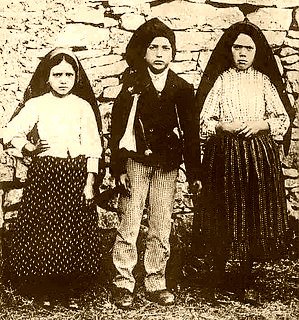
We celebrate May as the month of Mary, but we gather this particular day because 93 years ago Mary appeared to three children outside a small village in Portugal named Fatima. We will now pray the rosary and I will share with you just some of this story of Mary, Our Lady of Fatima.

[Pray the usual introductory Rosary Prayers]

In the year before Mary appeared to them, Lucia age 10, and her cousins Francisco and Jacinta, ages eight and seven, were grazing their sheep in a field. A dazzlingly beautiful young man, seemingly made of light, appeared to them and identified himself as the Angel of Peace. He invited them to pray with Him, and taught them a simple prayer.  I will pray this prayer three times and I invite you to join with me.

“My God, I believe, I adore, I trust and I love You! I beg pardon for all those who do not believe, do not adore, do not trust and do not love You. Amen.”

In the 1st Luminous Mystery we encounter “Jesus’ Baptism in the Jordan.” Jesus was not a sinner, He did not need baptism for himself, but He was baptized to become an advocate and intercessor for others. Likewise, let us pray as advocates and intercessors for all those who do not believe, do not adore, do not trust, or do not love God throughout the world.

[Pray the First Luminous Mystery]

On another occasion, the Angel of Peace appeared before them holding a chalice in his hands. Above it was suspended a host from which drops of blood were falling into the chalice. The Angel left the chalice suspended in the air, prostrated himself before it, and taught the children this prayer:

“O Most Holy Trinity, Father, Son and Holy Spirit, I adore Thee profoundly. I offer Thee the most precious Body, Blood, Soul and Divinity of Jesus Christ present in all the tabernacles of the world, in reparation for the outrages, sacrileges and indifferences by which He is offended. By the infinite merits of the Sacred Heart of Jesus and the Immaculate Heart of Mary I beg the conversion of poor sinners. Amen.”

In the 2nd Luminous Mystery we encounter “Jesus’ Miracle at the Wedding Feast of Cana.” For them, Jesus changed water into wine. For us, He changes wine into His blood. Are we indifferent to this miracle in our midst, or does it really matter to us? Let us pray that the Eucharist would transform us.

[Pray the Second Luminous Mystery]

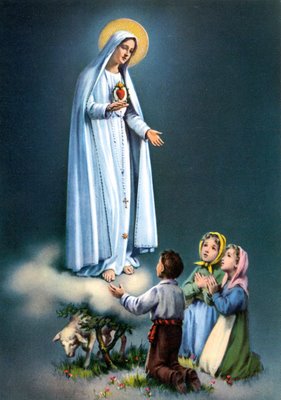
On May 13, 1917, after lunch on a clear blue day, the children were praying the rosary. Suddenly, they saw two bright flashes. They looked up and saw, in Lucia’s words, “a lady, clothed in white, brighter than the sun…”

The Lady smiled and said: “Do not be afraid, I will not harm you.” Lucia asked her where she came from. The Lady pointed to the sky and said: “I come from heaven.” Lucia asked what she wanted. She said, “I have come to ask you to come here for six months on the 13th day of the month, at this same hour.” They tried to keep it to themselves, word of the children’s encounter with the Heavenly Lady got out. Though they were met with the townspeople’s skepticism and mockery, the children would not deny what they had seen and heard.

In the 3rd Luminous Mystery we encounter “Jesus’ Proclamation of the Kingdom of God.” Let us pray to be irresistibly led to proclaim what we have experienced in Christ.

[Pray the Third Luminous Mystery]

On July 13th, the incredibly beautiful Lady appeared to them again. Lucia asked her who she was, and for a miracle so everyone would believe. She answered, “Continue to come here every month. In October, I will tell you who I am and what I want, and I will perform a miracle for all to see and believe.” And the Lady taught them this prayer:

“Oh my Jesus, forgive us our sins, save us from the fires of hell. Lead all souls to Heaven,  especially those in most need of Thy Mercy.”

In the 4th Luminous Mystery we encounter “Jesus’ Transfiguration.” Sometimes we look at other people and think that they can’t change what they are. The apostles thought like this, but Jesus opened their eyes with His Transfiguration. Let us pray for the grace of transformation; in our family members, in our friends, and especially among those in most need of God’s Mercy.

[Pray the Fourth Luminous Mystery]

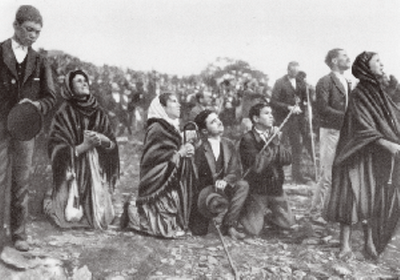
At noon on the 13th of October, 1917, some 70,000 people were gathered in the field. With a flash of light the Lady appeared to the children, and Lucia, for the last time, asked her what she wanted. The Lady answered, “I want to tell you that a chapel is to be built here in my honor. I am the Lady of the Rosary. Continue always to pray the Rosary every day. The war is going to end, and the soldiers will soon return to their homes.” And the Blessed Virgin Mary urged the conversion of hearts, as she had many times before, “Do not offend the Lord our God any more, because He is already so much offended.”

What happened next was reported at the time in an anti-religious Portuguese newspaper, by a reporter who had previously written dismissively about the goings-on at Fatima:

“…One could see the immense multitude turn towards the sun, which appeared free from clouds and at its zenith. It looked like a plaque of dull silver and it was possible to look at it without the least discomfort. It might have been an eclipse which was taking place. But at that moment a great shout went up and one could hear the spectators nearest at hand shouting: “A miracle! A miracle!” Before the astonished eyes of the crowd… the sun trembled, made sudden incredible movements outside all cosmic laws – the sun “danced” according to the typical expression of the people.”

In the 5th Luminous Mystery we encounter “Jesus’ Institution of the Eucharist.” What the masses saw in the heavens that day was a great miracle. But what we encounter at every Mass is an even greater wonder. Let us pray that we would always have the eyes to see it.

[Pray the Fifth Luminous Mystery, followed by the usual closing Rosary Prayers]

(Primary Source)
Relating to God Personally — Pentecost Sunday

May 23, 2010

In the Old Testament, the truth that God is a unity of three persons, that God is triune, that God is a Trinity, was only obscurely presented. The knowledge that God consists Father, Son, and Holy Spirit, only became clear to us through Jesus Christ. Our one true God has always been three persons: the Father, the Son, and the Holy Spirit.

Now the Father is not Jesus Christ. Jesus is not the Holy Spirit. And the Spirit is not our Father. They are distinct persons. Yet, at the same time, each possesses the fullness of divinity: perfect goodness, perfect beauty, perfect knowledge, and perfect power, perfect mercy, and perfect love. We do not worship three gods, but three eternal persons who comprise one God. There is no God apart from these divine persons.

Sometimes we say we are “praying to God,” and that is well and good. But when we are “praying to God” we should not imagine that we are speaking to some fourth person, to some divine abstraction above or beyond the three. If you don’t know which divine person you have been praying to at such times, you have been praying to the Father, through the Son, in the Holy Spirit. (Notice how the prayers in the Mass are always addressed to particular divine persons; usually the Father, but sometimes the Son.)

If you have been a Christian who has always directed your prayers some abstract Christian divinity, who is neither Father, Son, nor Spirit, I trust that your prayers have still been heard within the Trinity. And if you have never related to the Holy Spirit as a real person who knows and wills and loves, but only as some abstract force, I am confident that He has blessed you with His gifts and produced His fruits in you even without your asking. But Christianity is all about loving communion with  persons. Not forces, not abstractions, but persons: persons human, angelic, and divine.

Do you have a personal relationship with each of the persons of the Trinity; with Jesus Christ, with our heavenly Father, and with the Holy Spirit? If not, then it’s important that you begin to cultivate these relationships in prayer, for we are called to love God, and only persons can be truly loved.

On this Pentecost Sunday, we recall the gift of the person of the Holy Spirit to the Church. The Holy Spirit does not begrudge it when we ask Him for good things, for ourselves and for others; no, He is pleased when we ask and pleased to give. Gift is who the Holy Spirit is. But today and henceforth let us always speak to Him and the other divine persons in a personal way with a great personal love.

Farewell, and Farewell — Friday, 7th Week of Easter

May 23, 2010

When you were younger, your parents dressed you, and you were often led where you did not want to go. But now that you are older, you dress yourselves and more than ever you go where you wish.

As this school year ends, you take another step into the maturity of your youth. Soon you will be leaving school. Some of you will be leaving for the freedom of summer. You seniors will be leaving to begin the rest of your lives.

Your new freedom calls on you to make important choices about Christ. Now the question comes to you: Do you love Him? Do you want to respond like Simon Peter in the high priest’s courtyard, with a non-committed shrug as you walk away? Or will you choose to respond like St. Peter the Rock, who said, “Yes Lord, you know that I love you,” and then lived a life which proved that love.

Jesus asks you, “Do you love me?”  How are you going to answer Him?  Jesus asks you to do at least these things: to pray every day, to attend Mass every week, and strive to do His will every day.

Freely give your freedom to Jesus. He has given you everything good that you are. He has given you everything good that you have. Give it all to Him and stand in His will. His love and His grace are more than you know. He wants to give you more than you can ask. Jesus asks you, “Do you love me?” Follow Him.

Clearing Heaven’s Haziness — 4th Sunday in Easter—Year C

April 25, 2010

Today, St. John has a vision of a great multitude, which no one could count, from every nation, race, people, and language. They wear white robes and hold palm branches in their hands. They stand before the throne and before the Lamb (who is Jesus Christ,) and in His temple they worship Him day and night. St. John is glimpsing the worship in Heaven.

Heaven should be one of our great consolations in difficult times and we should really be excited about going there someday. But I think that we often have faulty ideas about Heaven that can get in the way of us being excited or consoled. For instance, maybe you heard the first reading today and thought, “The idea of standing night and day and holding a palm branch doesn’t seem that awesome to me; and going to Mass for an hour is well and good, but I don’t know how I could enjoy going to church forever in Heaven.” Concerns like these would understandably make us weary of Heaven.

We need to recognize that the Book of Revelation is symbolic.  Not everything we see in John’s vision is not literally what we’ll get in Heaven. For instance, St. John sees Jesus as a lamb who was slain and having seven horns and seven eyes. That’s one odd looking lamb, but this is symbolism. The image of the lamb recalls Jesus’ sacrifice, His horns imply perfect power and His eyes imply perfect wisdom. Likewise, the multitude’s white robes point to their dignity, their palms signify their victory, and they are standing because that is the traditional posture for worshiping God. The God who created the universe, and all of the good things we enjoy in it, surely has more to offer us than just palm branches, white robes, and boredom in Heaven.

You have heard it said that we will enjoy the “beatific vision” in Heaven, but you maybe wonder, “How could I enjoy staring at God forever?” But the phrase “beatific vision,” is also metaphor and the experience means more than mere gazing. The “beatific vision” is the immediate knowledge of God enjoyed by the angels and saints in Heaven. We call it “vision” because it is an experience of God which is direct, not mediated, and in the fullest depth and detail which our souls can receive. We call this vision “beatific” because intimately experiencing God, what the prophets call beholding Him “face to face,” gives perfect happiness.

The saints in heaven experience this beatific vision now, even though, (except for the Virgin Mary, and perhaps Enoch, Moses, and Elijah,) none of the saints have their bodies yet. Their flesh is still on earth awaiting the resurrection. But this raises the question of how can we experience anything without having our bodies?

Think of it this way: When I am asleep I see nothing with my eyes (for they are closed.) And in the silence, I’m not hearing anything with my ears. There’s nothing to taste nor smell, and even if I’m feeling the bed sheets they do not have my attention. Yet sometimes when I sleep, even as I’m dead to my senses, my soul can be alive and alert while I dream. If dreams of mere fantasies can be made vividly realistic to our souls, then I’m confident that God can engage our souls with the higher realities of truth and love, even as our bodies sleep in death.

Sometimes people ask, “Will my experience of Heaven only be between God and me? I mean will I be so overwhelmed by God that I won’t notice or care about the multitude around me?  Will I even remember the people that I knew on earth?” I would answer in this way: how could coming closer to the God who is Love make our love toward others colder, or how could being in the presence of Truth Himself make us stupider? In Heaven, we will never forget that our parents were our parents, or that our friends were our friends, or that our spouses were our spouses and we will remember the love we shared. And the fact that miracles have occurred through praying to the saints for their intercession before God shows that the holy dead are still aware of us and care about us still on earth.

So what exactly is heaven like now, and what will it be like after the resurrection when this entire universe is remade into a new heaven and new earth? We don’t exactly know. Like in the book of Revelation, Scripture speaks of it in images: life, light, peace, a wedding feast, wine of the kingdom, the Father’s house, the heavenly Jerusalem, and paradise. Though we don’t exactly know what Heaven will be like, we shouldn’t fear that it will disappoint us. When, by God’s grace, we all get arrive there we will look at everything that He has prepared for us and find it very good.  

Until we get there, let us realize and remember that every Mass gives us a foretaste of Heaven. Here we bring with us everything that has happened in our lives. We come here before the throne of the Lamb who was slain, and we praise Him. And here He gives us Himself along with every heavenly blessing which we are ready to receive. Though a veil remains, every Mass bring Heaven to earth.

Peter’s New Season — 3rd Sunday of Easter

April 20, 2010

Once, when Jesus was preaching as he stood on the shore of the Sea of Galilee, a large and eager crowd was pressing in on Him.  So Jesus got into a fisherman’s boat and asked him to put out aways so that He could sit and teach the crowds. The tired fisherman complied. And after Jesus had finished speaking, He said to this fisherman, “Put out into deep water and lower your nets for a catch.” The fisherman said, “We have worked hard all night and have caught nothing, but at your command I will lower the nets.” When they had done this, they caught an incredible number of fish such that their nets were tearing. And Jesus said to the startled man, “Do not be afraid. From now on you will be catching men.” As you probably remember, the fisherman was Simon Peter, and from that day on his life entered a new season. For the next few years Simon Peter would follow Jesus and evangelize towns on His behalf.

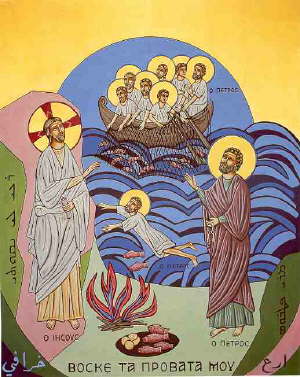
In today’s gospel, from the days after the resurrection, Peter is fishing again. And once again, Jesus is there on the shore. They have caught nothing, but Jesus says to try once more, and they catch an incredible number of fish. When Simon Peter realizes it is Jesus he eagerly comes to Him as fast as he can. He finds Jesus beside a charcoal fire. This should be familiar to Peter, too, calling to mind  another charcoal fire in the dark courtyard of the high priest.

After sharing a meal, Jesus says, “Simon, son of John, do you love me more than these? Do you love me?  Do you love me?” Simon Peter says, “Yes, Lord, you know that I love you. Yes, Lord, you know that I love you. Lord, you know everything; you know that I love you.” Jesus has given Peter the opportunity to undo his triple denial of Jesus with a triple confession of his love. And after each time, Jesus speaks of a new season for Peter’s life: “Feed my lambs. Tend my sheep. Feed my sheep.”

Now it is one thing to catch fish, but it is another thing to shepherd a flock. Up to now, Peter has been following Jesus and bringing others to Him. But now Jesus is asking Peter to do something new, to shepherd His flock for Him. Do you think Peter nervous? Is he concerned about whether he is up to the task? Is he worried about being led where he doesn’t want to go? I bet he is, but Jesus would have him ‘not be afraid,’ for he won’t be doing it alone. Jesus says to Peter, “Follow me.”

Our lives are often entering new seasons. Maybe you’re moving into a new town or a new school. Maybe you’re transitioning from engagement to marriage, welcoming new children, or living for the first time without children in the house. Maybe you have a new job, or don’t have a job for the first time. But whatever season of our life Jesus calls us into, His calling and our mission remain the same. Jesus said, ‘”I give you a new commandment; love one another as I have loved you,” and ” “There is no greater love than this, than to lay down your life for a friend.” Every new season of life offers us the unique opportunity to deepen our love for Christ and each other more than ever before.

Maybe you feel nervous? Maybe you’re concerned about whether you are up to the task? Maybe you’re worried about being led where you don’t want to go? But remember Simon Peter and don’t be afraid.  Jesus gives lots of second chances and He does not expect us to do it alone.

The Apostles’ Charge — Thursday, 2nd Week of Easter

April 16, 2010

 The high priest Caiaphas had once remarked to the Sanhedrin during the time of Jesus’ ministry:

“You know nothing, nor do you consider that it is better for you that one man should die instead of the people, so that the whole nation may not perish.” He did not say this on his own, but since he was high priest for that year, he prophesied that Jesus was going to die for the nation, and not only for the nation, but also to gather into one the dispersed children of God. (John 11:49-52)

The high priest, whom many Jews believed possessed the gift of prophesy, here spoke words truer than he realized. A similar episode happens in today’s first reading:

When the court officers had brought the Apostles in and made them stand before the Sanhedrin, the high priest questioned them, “We gave you strict orders did we not, to stop teaching in that name. Yet you have filled Jerusalem with your teaching and want to bring this man’s blood upon us.”

With their teaching, the apostles have indeed filled Jerusalem, the true and heavenly Jerusalem, with the souls of the saints. And the apostles did want to bring Jesus’ blood upon those who questioned them, for the blood of Christ cleanses us from sin. In his revelation, St. John “saw the holy city, a new Jerusalem, coming down out of heaven from God, prepared as a bride adorned for her husband.” (Rev 21:2) “They have washed their robes and made them white in the blood of the Lamb.” (Rev 7:14)

The Sanhedrin commanded the apostles to stop proclaiming Jesus, but the apostles replied, “We must obey God rather than men,” for as John’s Gospel says, “whoever disobeys the Son will not see life.” The Gospel teaches, “Whoever believes in the Son has eternal life, but whoever disobeys the Son will not see life, but the wrath of God remains upon him.” But who truly believes and shall be saved?  Who disobeys and shall be condemned? Thankfully, this final judgment is not ours to decide, but our mission from Jesus is clear. Like the apostles, with Jesus’ teachings we are to fill the heavenly Jerusalem  and bring Christ’s saving blood upon all people.

Faithful Despite Doubts — Divine Mercy Sunday—2nd Sunday in Easter—Year C

April 11, 2010

Thomas, called Didymus, one of the Twelve, was not with them when Jesus came. So the other disciples said to him, “We have seen the Lord.” But he said to them, “Unless I see the mark of the nails in his hands and put my finger into the nailmarks and put my hand into his side, I will not believe.”

Why is “Doubting” Thomas so slow to believe. Why is Thomas so reluctant to trust? A clue might be found in the gospel’s interesting inclusion of Thomas’ Greek nickname: Didymus. Didymus means “twin,” but in relation to whom was Thomas a twin? Some speculate that Thomas the Apostle bore a striking resemblance to Jesus Himself. This tradition is sometimes reflected in iconography where Thomas is the apostle who looks a lot like Jesus.

If this is why Thomas was the apostle called “the twin” then we can understand his rational skepticism. How many times during Jesus’ ministry had people come up to Thomas and said, “O Jesus, we’re so happy to see you! We’ve walked for miles to see you again!” Then, with some annoyance, Thomas might have answered, “We’ll you’ll have to walk a little bit further. Jesus is over there.” So now, when the other disciples come up to Thomas after Easter and say, “We have seen the Lord,” Thomas replies, ‘I’ll need more evidence than that.’

Thomas’ resistance to believing the good news about Jesus might not only be coming from his mind, but also from his heart. Jesus was Thomas’ hero, his teacher, and his close, beloved friend. Thomas thought that Jesus was going to be the savior and messianic king of Israel. But their close relationship and all of Thomas’ great hopes were destroyed for him at the crucifixion. Imagine how Thomas might have prayed then: “My God, why have you let this happen? How could you let Him be taken instead of me? Jesus was so good! He was completely innocent, and you let Him be die! Why?”

The unexpected death of Jesus broke Thomas’ heart, and having been so hurt once, Thomas was resolved not to let his heart be taken in again: “Unless I see the mark of the nails in his hands and put my finger into the nailmarks and put my hand into his side, I will not believe.”

Yet, though he doubts, notice where Thomas is one week after Easter. He is with the other apostles in the upper room in Jerusalem, gathered behind locked doors for fear of the authorities who killed Jesus. Now there are lots of other places Thomas could have chosen to be. There were safer places he could have gone, like back to his hometown and to the extended family and friends he had left behind to follow Jesus a few years before. Though Thomas doubts, he does not leave this house of faith. He struggles with his faith, but does not abandon it. He seeks within this house of faith, this Church, and because of it, Thomas finds sufficient evidence for his mind and healing for his heart.

The risen Lord appears in the upper room and how does Jesus respond to Thomas’ resistant unbelief? Not with anger.  Not with condemnation.  But with the divine mercy we celebrate today. Jesus appears in their midst and says, “Peace be with you.” Then he says to Thomas, “Put your finger here and see my hands, and bring your hand and put it into my side, and do not be unbelieving, but believe.”

In our lives we too will struggle with our faith and our doubts, with our emotions and with our thoughts, in our hearts and in our minds. Jesus does not condemn our honest struggles. But Jesus wants us to sincerely seek within this house of faith; this, His apostles’ Church, where the truth and healing is found by all those who seek Him.

Easter Endures — Easter Friday—Year C

April 11, 2010

For the rest of the world, today is the second friday of April. For us, today is Easter. The rest of the world has gone back to life as before, but we in the Church continues to remember and celebrate Easter.

In the Gospel we see Peter and some of the disciples going back to their old ways, back fishing in Galilee. And in the first reading we see the Jewish leaders, elders, and scribes operating just the same as before. But they all get reminded that Easter has changed everything.

So let’s not forget the graces we received this Triduum. And let us remember that in these “last days” every day is Easter and that our lives and our world will never be the same as before.

Jesus’ Resurrected Body — Easter

April 7, 2010


On Holy Thursday, we meditated on the disciples’ feet. On Good Friday, our Saviour’s hands.  Today, let us consider Jesus’ resurrected body.

Jesus’ resurrected body is the very same that died and was buried, but it is a very different body, too. The tomb was empty on Easter morning, not because Jesus’ body was vaporized, but because it was raised.

Jesus’ resurrected body has wounds, in his hands and feet and side, showing that this is the same body that suffered on the cross. It seems that the cuts and bruises on Jesus’ face and the lashes on His back are healed, but these five wounds remain. Why? These wounds are trophies and jewels.  They no longer cause Him pain, but they testify to Jesus’ greatness and love and He will have them forever.

So Jesus’ resurrected body is the very same body that died on the cross and was buried in the tomb, but it is a very different body. For instance, Jesus in His glorified body can cause others to see but not recognize Him, as He did on Easter evening with two disciples on the road to Emmaus. Only later, in the breaking of the bread, did they recognize Him. Then Jesus displayed another new power, disappearing from their sight. In His glorified body Jesus can move at the speed of thought and the walls and locked doors of the upper room do not prevent Him from appearing in the midst of the apostles.

In this there is a sign for the future of humanity. People often speak of “the end of the world” and imagine Heaven in strictly spiritual terms, but just as Jesus’ body was not annihilated but transformed, so our bodies and this universe will be remade. A glimpse into the future of the righteous is reflected in the resurrection of Christ.

Jesus’ body is not discarded, but gloriously transformed. In this there is a lesson for us. In (just about) every  life, there is a line that we have drawn in our relationship with God. It is a self-imposed limit on our trust, commitment, and self-gift towards Christ. “Lord, I will walk with you that far, (but no farther.)”

Perhaps we are unwilling to cross that line with us because we are too attached to the sins and mediocrity we have settled for, maybe we are afraid that we will lose who we are and become something that we are not, or maybe we are afraid that a total self-gift to God won’t truly make us happy. The devil likes this arbitrary line. He would like you to reach the end of your life and have to wonder with regret, “What would my life been if I had gone all-in for God?” The devil would have you fearful and repulsed of “the cross, the cross!” but the cross is not the end of our story.  Remember, as in Christ, God does not want to destroy you, but to transform you into who you truly are.

Do you believe Jesus suffered and died for you? Then He surely loves you. If He loves you, then how could He not desire your greatest happiness? Do you believe Jesus is divine and all-knowing? The surely He knows what will lead to your greatest good. Do you believe Jesus is all-powerful? Then surely He has the power the lead you to that good. Then what is standing in His way? There is only one thing standing in the way of His omnipotent power, preventing Him from transforming us into who (deep down) we truly want to be. That obstacle is our own freewill, the arbitrary line we draw in our relationship with Christ.

This Easter, let us be resolved to follow Christ without compromise. Let us entrust our whole selves to Him who has given us everything. Jesus does not want to destroy you, but to gloriously transform you into who you truly are.