Archive for the ‘Salvation History’ Category

The Savior’s Hands — Good Friday

April 7, 2010

This Good Friday, let us meditate on our Savior’s hands.

These hands held the scrolls of the Jewish Scriptures, from which He learned the Word of God. These hands held the hand of Joseph, and reassured him for his happy death. These hands fashioned the products of a carpenter to support His mother and Himself in their needs.

When the time came for His public ministry, these hands touched the ears and toungue of a deaf and mute man, allowing him to hear and speak. They smeared mud in the eyes of a blind man, who then washed and was able to see. They touched a leperous man and cured him of his affliction.

These hands formed a whip out of cords and drove out the moneychangers and salesmen out of the court of the Gentiles so that the temple could be a place for all peoples to worship the True God. These hands blessed and broke a few loaves of bread and multiplied them to feed thousands.

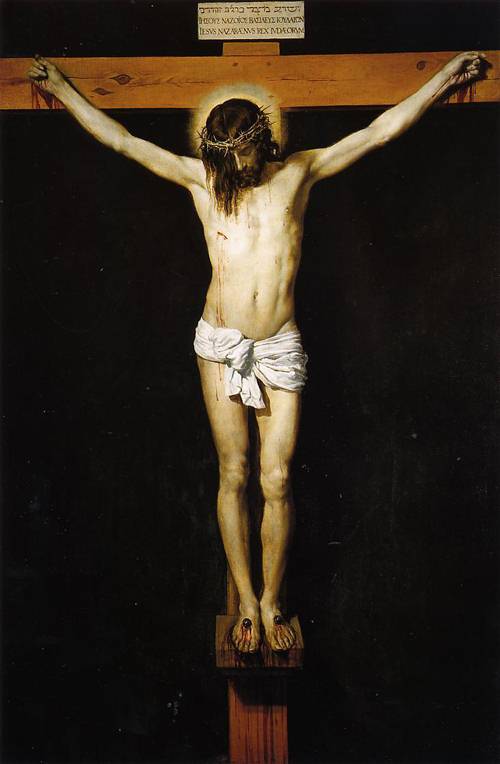
Today, these hands are nailed to the cross. Jesus’ crucified hands can do nothing, apart from perhaps twitching a couple fingers with excruciating pain. Yet of all the wonderful things that Jesus did with His hands, this was the greatest.

I offer two obeservations for us today.

First, that when Jesus could do nothing, He could still speak and pray. We can do the same we when faced with the things beyond our power (which is really nearly all things.)  We can bind our hands in prayer, a symbol and  acknowledgement of our own limitations, and pray.

Second, it was when Jesus was powerless he performed his greatest good. We worship a crucified God; who suffered, died, and rose from it triumphant. We should expect and understand that this mystery will be replayed within our own Christian lives. As St. Paul observed when he considered his own life, “when I am weak, it is then that I am strong.” The same applies for us.

Sometimes we suffer because of loved ones we cannot seem to help, or serious illnesses that befall ourselves or others. Our crosses take different forms, and can feel powerless with them. But we do more good through our crosses than we know.  Remember, that of all the things that Jesus did with His hands, the greatest was when He suffered them to be nailed to the cross for us today.

The Disciples’ Feet — Holy Thursday

April 4, 2010

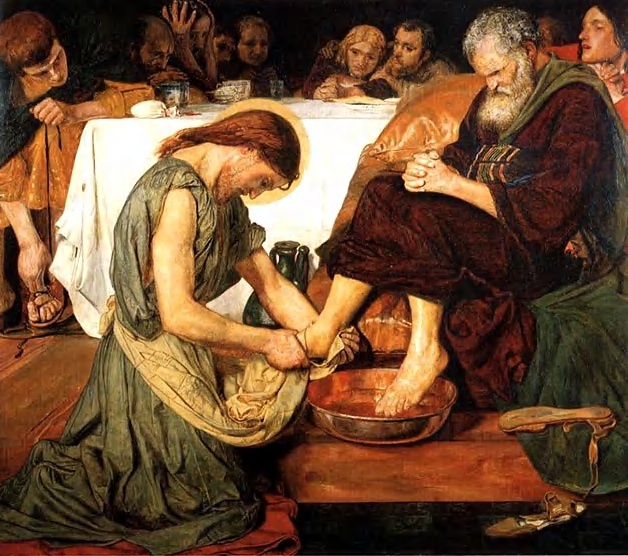
This Holy Thursday evening, I would like to talk about feet, the apostles’ feet and our own.

Feet are funny, awkward, and funky. They are lowly, odd, and unclean. This was true in the apostles’ day and it is still true today. Of all the parts of the body, the feet are the most lowly. They are humbly situated on the ground and they’re the only parts of our body which are regularly stepped-on.

Our feet are odd-looking things. They’re like clubs, with knobs and nubs all over. And feet are ackward too. Their range of motion is limited and they’re the only part of the body which we trip-over.

Feet are funky, that is, they’re unclean. Even though the apostles walked everywhere either sandled or barefoot, while we have shoes and socks and daily showers, we remain well-familiar with smelly feet.

We have feet, just like the apostles, so we still have some sense of what it means for Jesus to wash His disciples’ feet. I have been speaking up to now of physical feet, the feet of our legs, but one could say that we also have spiritual feet too, the feet of our souls. The imperfect apostles had these spiritual feet, and so do we.

Perhaps you feel worthless and low, unworthy of Christ’s love, friendship, or help. Perhaps you have been humbled and brought down to earth by others or by an awareness of your sins. Yet, no matter how low you may feel, know that just as He stooped down to the feet of His disiciples, so Jesus is willing to stoop down for you.

Perhaps you feel there are aspects of yourself which are too ackward or limited to be offered to God, parts which you think are of no use or value to Him. Yet, just are Jesus embraced the feet of His disiciples, so He wants to receive even our ackward and limited parts.

Perhaps you feel spiritually unclean because of sin. Know that just as Jesus washed His disciples feet, so He wants to wash you clean.

Jesus stooped down, embraced, and washed his apostles’ feet because He loved them, and He wants do the same for us. By giving Himself to His disciples in the Eucharist, Jesus shows us that He wants to share everything He is with us. By washing His disciples’ feet, Jesus shows us that He wants us to share everything we are with Him.

A Premature Passion? — Palm Sunday—Year C

March 28, 2010

So why did we just proclaim the Passion?  Isn’t the Passion a bit premature? It’s Palm Sunday, not Holy Thursday or Good Friday. Aren’t we jumping the gun? No, like the two disciples Jesus instructed in our opening Gospel, we’re being told what we are going to see. The Church has us recount the Passion on Palm Sunday to prepare us; to prepare us for encountering Christ’s Passover through the special ceremonies and symbols of this Holy Week.

Now the celebration of the Eucharist actually makes the events of the Pascal mystery present for us every time we come to Mass. Jesus’ Last Supper, His Passion and Death, His Resurrection and Ascension into glory, are all truly presented to us at each and every Mass; but during Holy Week, we unpack and encounter these events in unique and special ways.

Today you have waved palms, an ancient symbol of victory, to Christ, welcoming Him into our city. On Holy Thursday, you can go where the Blessed Sacrament is reserved and give company to Christ in his lonely solitude, with Him in His agony before His arrest and with Him as He spends the night awaiting His trial. On Good Friday, you can reverence the crucifix; you can kiss the wood of Jesus’ cross and kiss His body hanging upon it, as He dies for us. And at the Easter Vigil, you can see the sign of the light of Jesus Christ resurrecting out of darkness and death.

And so I invite you to encounter Jesus’ Pascal mystery, at this Mass, at every Mass, and through the special signs and ceremonies of this Holy Week.

11 Absent Students — March 25 — Annunciation

March 28, 2010

You have probably wondered why our school chapel’s icon, statues, and crucifixes are veiled with purple cloth. Covering of religious images is a tradition for the last two weeks of Lent, a period we call Passiontide. So why do we have this tradition?

One explanation recalls that Jesus’, when His enemies sought to kill Him, hid Himself prior to His final days: “Jesus left and hid from them.” (John 12:36) Others see in this veiling a symbol for how Jesus’ divinity was veiled within His humble and vulnerable humanity. He was God incarnate, but none of the rulers of His age knew, “for if they had known it, they would not have crucified the Lord of glory.” (1 Corinthians 2:8) But behind all of this I think there is a very human reason for why we veil the holy images of Jesus and the saints at Passiontide. “Absence makes the heart grow fonder.”

During Lent we deprive ourselves of luxuries and pleasures for our personal conversion and growth in holiness, but we also do this so that we can celebrate the Christ’ Easter triumph with an even greater feeling of joy. This is why we normally don’t sing as much (or say the Gloria or the “A”-word before the Gospel) during Lent—so that we can enjoy pulling out all the stops at Easter.

Veiling our statues of Mary and Joseph, our wall icon of Elizabeth Ann Seton, and our crucifixes causes a little pain of separation within us. But what if this chapel had never been furnished? What if our chapel had always been bare of religious art? Then their absence would not affect us at all because we would not know that we were missing them.

There are not as many students here today as there should be. Now I’m not saying that this should have been a whole school Mass, and I’m not begrudging anyone who may have stayed in study hall this hour to work on homework.  This is a great turn out and every seat is filled. But still, there are not as many students here as should be here today.

In the early nineties, when most of you were born, for every three live births in our country there was one boy or girl who was intentionally killed. (CDC) I counted roughly 33 students here today. That means we are missing 11 of your classmates who were not allowed to be born.

Today we recall the Annunciation, which some people call “Pro-Life Christmas,” for even though Jesus will be born nine months from now, today is the day of the Incarnation, when God became a human being like us in the womb of the Virgin Mary. After the angel Gabriel departed, Mary went in haste to see her relative. Elizabeth exclaimed, “Who am I that the mother of my Lord should come to me,” and John the Baptist leapt for joy in his mother’s womb in the presence of our microscopic Savior, Jesus Christ. (Luke 1:43-44)

Imagine if 11 of your classmates were to die in a bus accident. You would you feel terrible from the loss, and our whole school would be in mourning. But we have never known the 11 who are missing here today, so we do not feel our loss.

At this Mass and henceforth, let us keep the following things in mind regarding the past, present, and future. As to the past, remember these absent classmates and pray for them. They never received a name, they never had a funeral, and few people have ever prayed for them. Pray for their parents, too. 

In the present, perhaps you honestly find yourself not feeling much emotion one way or the other towards the reality of one million innocents being murdered in our country every year. If so, then ask God to give us His heart and His sight to love what He loves and to hate what He hates. God loves us all, but He hates our sins. He hates our sins because they are bad for us, and the worse they are for us the more He hates them. His love for us and His hatred for our sins are two sides of the same coin. Blessed Mother Teresa of Calcutta said “the greatest destroyer of peace today is abortion.” The Lord’s heart is certainly not indifferent to this evil, and neither should ours be.

And finally, for the future, keep hope that this evil of abortion will come to an end in our time. We can have this hope, for as the angel Gabriel said to Mary, “nothing will be impossible for God.”

Sin Means Death — 5th Sunday in Lent—Year C

March 21, 2010

The scribes and the Pharisees were jealous of Jesus. When He came to the temple all the people gathered round Him to listen to Him teach. His words were compelling; the truths of God taught with gentle mercy. All the people were flocking to Jesus and this made the scribes and the Pharisees deeply jealous. We ourselves must beware of jealousy, for it can lead us to hate the good and condemn the innocent.

The scribes and the Pharisees bring before Jesus an adulterous woman and say to him, “Teacher, this woman was caught in the very act of committing adultery. Now in the law, Moses commanded us to stone such women. So what do you say?”

This scene raises some questions. For instance, how did Jesus’ enemies know where to find an adulteress when they needed one? It’s unlikely this affair was discovered just that morning. It must have been known from days, weeks, months, or even years before.

This prompts another question: if this affair had occurred much earlier, then why had the Jews not executed judgment on this woman before now. There seems to be two reasons for this. First of all, under Roman rule, the Jews had no authority to impose the death penalty on anyone. We will see this come into play in the Passion, where the Jewish leaders must convince Pilate that Jesus is an enemy of the state if they are going to do away with this “blasphemer.”

But there is another reason, too. Even though the Law of Moses had commanded death for certain sins, based upon what I’ve read the actual use of capital punishment for sins was very, very rare among the people of Israel, even before the Romans came along. And, as we can see in this scene, not even the scribes and the Pharisees are really serious about applying the law in strict and absolute terms. If they had been, they would have brought along the adulterous man for judgment too. Where is he? He was just as guilty as her, if not more (considering their culture.)

So the penalty of death was very rarely employed for punishing sinners, but then why were these severe punishments in the Old Covenant at all?  It seems that the point of those rarely applied laws was to teach an important lesson, a lesson repeated over and over again in countless ways throughout the Old Testament, a lesson for the Jews and a lesson for us today:

Sin is serious stuff, because sin leads to death.
Sin brings us death in our bodies and our souls.
Sin means death.

The scribes and the Pharisees round up a known adulteress and set their trap against Jesus (which is the only thing this is really about for them.) Jesus’ enemies will try pitting justice against Jesus’ mercy. They’re thinking to themselves, “Surely he’s not going to tell us to stone her, that’s not his way. He says he ‘has come not to destroy, but to seek and to save what is lost.’ So when he tells us not to stone her, then we’ve got him. He’ll be telling us to disobey the Law of Moses, and then we’ll have a charge to bring against him.”

“So Jesus… what do you say?” Jesus says nothing. He stoops down and writes with His finger on the ground the only thing we have record of Him writing in the entire Gospels. What did Jesus write? We don’t know. The Greek verb used indicates that Jesus was writing letters or words, and not drawing disinterested doodles or drawing a line between the accused and her accusers.

A common explanation is that Jesus’ finger was writing on the ground the names of sins, sins which those in the crowd had committed, sins which the finger of God had written of long before, on the stones of the commandments atop Mount Sinai. Perhaps Jesus wrote the words: “Sacrilege, Rebellion, Adultery, Theft, Deception, Coveting.”

The accusers continue harassing Jesus, but He rises again, and gives his well-known reply. The crowd of evil doers slowly scatters, and Jesus is left there alone with the woman. The threatening mob is gone, and you think that the woman would flee, but the woman does not run away. She knows she has sinned. She knows that she cannot run away from her sins or from God. She stays there before Jesus.

Jesus rises again and says to her, “Woman, where are they? Has no one condemned you?”
She replies, “No one, sir.”
Jesus says, “Neither do I condemn you. Go, and from now on do not sin any more.”

Jesus condemns the sin, but not the sinner. Jesus is merciful, but He is not indifferent to the prospect of her continuing in sin, nor is he indifferent to us continuing in our old sins. He does not say, “Go, and live as you will: presume on my deliverance: for however great your sins may be, it doesn’t really matter one way or the other.”

Jesus does not say this, for sin means death, and Jesus died to free us from sin and death. So let us come before Jesus to receive His pardon, but then let us go forth seriously and, from now on, sin no more.

The Scales Myth — Friday, 1st Week of Lent

February 26, 2010

In ancient myths and modern imagination, the judgement of our lives will be done with a pair of scales, with our good deeds one one side and our bad on the other.  If our good deeds outwiegh the bad ones (so the story goes) then we’re in good shape.  If not, we’re toast. However, our first reading from the prophet Ezekiel shows that this not how God judges things.

If the wicked man turns away from all the sins he committed, if he keeps all my statutes and does what is right and just, he shall surely live, he shall not die. None of the crimes he committed shall be remembered against him; he shall live because of the virtue he has practiced.

And if the virtuous man turns from the path of virtue to do evil, the same kind of abominable things that the wicked man does, can he do this and still live? None of his virtuous deeds shall be remembered, because he has broken faith and committed sin; because of this, he shall die.

God is more interested in where we’re headed than where we’ve been. This is encouraging good news for the long-time sinner who needs to repent and it is a warning to us who have done well in the past.  It’s not what we’ve done in the past that matters, because each of us can make a definitive turn toward or away from the Lord today.

What advantage then do we who are faithful to the Lord have over those who have deathbed conversions, over those steal heaven like the good thief on his cross next to Jesus? Very much indeed, for our lives’ holiness and good deeds will be weighed and our personal degree of heavenly glory and reward will be measured out accordingly. In heaven we shall all be filled and satisfied, but those who love most in this life shall enjoy the most love in the next.

So whether you are far from God or serving Him faithfully, heed these holy words: “If today you hear His voice, harden not your hearts.”

Three Temptations — 1st Sunday in Lent—Year C

February 23, 2010

In today’s gospel Jesus is led into the desert by the Holy Spirit for forty days of prayer, penance, and preparation and there He is tempted by the devil.  We have been led to this season of Lent and we also find ourselves being tempted. This morning I would like to talk about how the devil’s three temptations present themselves to us and to let you know about an allowance in Lent that you will be happy to hear.

Most of us here have chosen to take on a penance during Lent.  You have probably resolved to abstain from something good, like cookies, candies, ice cream, TV or the internet, to grow in disciple and virtue, and to offer some sacrifice to God. The devil first said to Jesus, “command this stone to become bread,” and we will probably be tempted in a similar way; “Put down the rock of your penance for awhile and let it nourish you.” It is the way of demons to first entice and then condemn. The rationalization, “Go ahead, it’s just a little cookie,” will afterwards become the accusation, “You couldn’t even sacrifice one cookie for God.” Let us preserve in our Lenten penances, for the joy of having carried a cross for the Lord is far preferable to the discouragement of a moment’s compromise.

As a second temptation, the devil, in a vision, showed Jesus all the kingdoms of the world in a single instant and said, “I shall give to you all this power and glory; for it has been handed over to me, and I may give it to whomever I wish. All this will be yours, if you worship me.” Scripture calls Satan the Father of Lies, so we ought to be skeptical about whether he really had this authority over the nations, and even if he did we should disbelieve that he would give Jesus the world if He were to worship him. Instead, I suspect that the devil would have simply laughed and left Jesus with nothing for having fallen into sin.

We human beings are creatures of habit. The same sins which you have struggled with in the past are probably the same ones that challenge you today. When we are tempted by sins they promise us the world, great peace and satisfaction. Yet we can look back at our own experiences and see that these are lies. Our past sins show us that they only lead to disappointment and dissatisfaction. We should stop swallowing the bait. We should stop accepting the lie. This Lent is a perfect time for us to commit to crushing the habitual sins in our lives, for our sins will not make us happy, even if they promise us the world.

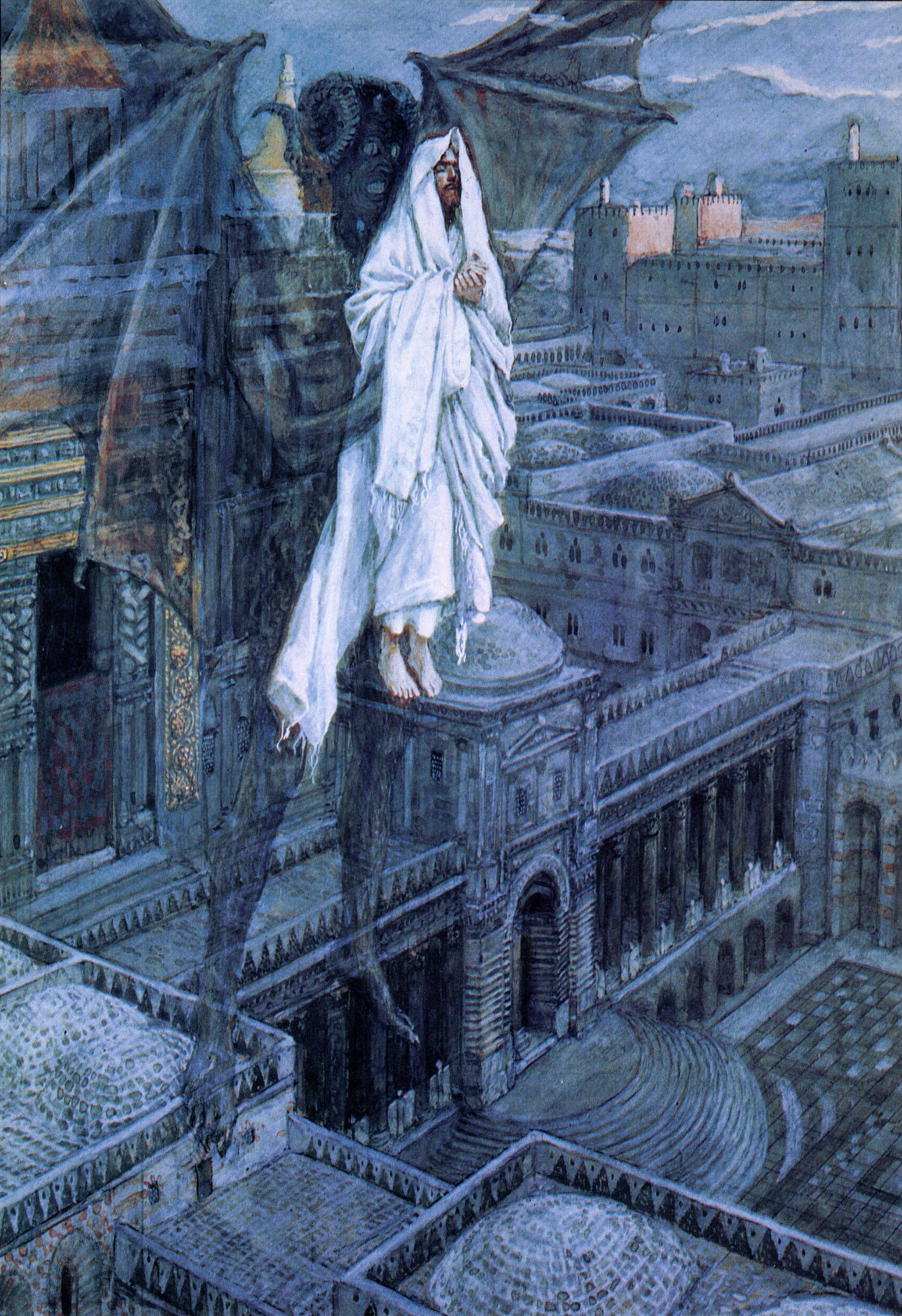
As a third temptation, the devil took Jesus up (in a vision or in the body we do not know) to the top of the temple in Jerusalem. He said to Him, “If you are the Son of God, throw yourself down from here, for it is written: He will command his angels concerning you, to guard you, and: With their hands they will support you, lest you dash your foot against a stone.” The temptation addressed to us sounds differently. “You are not the Son of God, you’re not even close to being saint! You should throw yourself down in shame for your sins and not dare to pray or present yourself to God!” On the contrary, as we heard in the second reading, “No one who believes in him will be put to shame.” Lent calls us to sorrow and conversion for our sins, not to shame and aversion from God.

We see the one-two combo of enticement and shame modeled in the case of Adam and Eve.  When they heard the sound of the Lord God moving about the garden they hid themselves among the trees, for they realized that they were naked before Him, and they were ashamed and afraid. Much later, in the case of Judas Iscariot, the devil led him to betray Jesus, one of the worst sins ever, and then after regretting it he was led to kill himself. If Judas had gone from the temple to Calvary, instead of to his tragic tree, Jesus would have forgiven him, because Jesus wanted to forgive him.

Jesus loves us. He doesn’t just love us because He’s God and He “has to” love everybody. Jesus loves us and He actually likes us for all the good things that we are and for all the good things He sees we can become. This is why He created us and died for us, because He loves us. So we should not be ashamed to come to Christ in the sacraments; in confession with our big sins, or at communion with our small ones. As Jesus told St. Faustina, the greater our sins the more entitled we are to his mercy. When it comes to God’s forgiveness, only we ourselves can get in His way.

Finally, I mentioned that there is an allowance during Lent which is a cause for consolation amidst our Lenten struggles. But first, did you know that there are more than forty days in Lent?  The season is longer than forty days because we don’t count the Sundays.  There are 40 days of penance, but every Sundays (from Saturday evening to Sunday night) we are released from our penances. At Sunday Mass the priest still wears the Lenten season’s purple, we might do less singing, and we don’t say the Gloria or say the “A”-word before the gospel, but we are freed from penances that day, for every Sunday is a “little Easter. ”

In the first reading, we heard how Moses commanded the Hebrews that once they came into the Promised Land they should come before God to present their first fruits and recount the story of how God had delivered them from slavery, brought them into the Promised Land, and filled them with blessings. Each Sunday we come before God and recall how His Son, Jesus Christ, delivered us from our slavery, brought us into His kingdom, and has filled us with His blessings, especially the gift of Himself in the Eucharist. Each Sunday gives us consolation, and this release from our penances encourages us to offer still more penance to God in the week ahead, for it is an easier thing abstain for just six days than to do it for forty in a row.

So in conclusion, be faithful to your penances, your faithfulness will have its reward. Commit to crushing your habitual sins, for sins cannot make us happy, even if they promise the world. Shame and fear are the devil’s traps, so whenever you sin, come to the Lord with trust and sorrow. And know that you are released from penances on Sundays in Lent.  May this gift be a cause for thanksgiving and joy and inspire us to make a still greater gift of ourselves to Christ in this Lenten season.

The Two Ways — Thursday, 6th Week in Ordinary Time—Year II

February 21, 2010

In the first reading Moses sets before the people ‘the two ways’: life and prosperity, or death and doom. In the gospel Jesus tells us to deny ourselves, take up our cross and to follow Him. From this we might think that one could choose to bypass the cross, to never take it up, and to avoid the burden of the cross, but the cross is unavoidable.

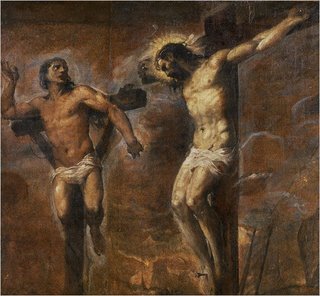
Jesus was crucified along with two others, one on His left and one on His right; one who rejected Him, and one who accepted Him. These two people represent us. We are all crucified with Christ, and He is crucified with us. The question is how we will respond to Him.

In life there is no avoiding the cross, but in which way will we respond to it?  Will we rage and despair, or embrace it and follow Christ? Today I have set before you life and prosperity, death and doom. Let us follow the Lord, ‘for whoever wishes to save their life will lose it, but whoever loses their life for Christ’s sake will save it.’

Mary and Pilate — 6th Sunday in Ordinary Time—Year C

February 14, 2010

In a few moments, after this homily, we will recite our creed, the summary of our faith. Every Sunday, we profess, in union with the Christians who came before us, our belief in these truths and our resolve to live our lives according to them. This morning we will look at just one rich aspect of our creed and consider its implications for our lives.

Have you ever noticed that in the entire creed, only two non-divine persons are mentioned by name? These are the Virgin Mary and Pontius Pilate.

“By the power of the Holy Spirit, He was born of the Virgin Mary and became man. For our sake He was crucified under Pontius Pilate; He suffered, died and was buried.”

Now many other figures from the Old and New Testaments could have justifiably been included in our creed; such as Adam and Eve, Abraham, Moses, David, Mary Magdalene, Peter, Paul, and many others. Yet, only Mary and Pilate get mentioned. So why is this? There seems to be two very good reasons. The first of these reasons I will give now—and the second I will save for the end.

The first reason why Mary and Pilate receive special mention is that they ground Jesus’ life, death, and resurrection in our real history. Jesus was ‘born of the Virgin Mary, suffered and died under Pontius Pilate, and on the third day, He rose again.’ Now other pre-Christian religions sometimes had stories about dying gods who came to life again, but those stories were always said to have happened ‘once upon a time,’ in some remote and mythic past. But with Jesus Christ, this ancient intuition and longing of humanity is actually realized. The inclusion of Mary and Pilate in the creed witness to this: that God became man, died, and rose for us, in this world and in real history.

Some people try to be too sophisticated by saying it doesn’t really matter if Jesus rose from the dead, or even if He lived at all, because His teachings are what’s important. But St. Paul blows this idea out of the water. “If Christ has not been raised, your faith is vain; you are still in your sins. Then those who have fallen asleep in Christ have perished” and “we are the most pitiable people of all.” Without Jesus Christ and His resurrection there is no Gospel, there is no Good News.

Just like Jesus Christ, Mary His Mother and Pontius Pilate His executioner are not fictional characters made up for some story. They are real people, from a time not that much different from our own. Our styles and technologies may have changed, but human beings themselves remain much the same. When we look at Mary and Pilate we can see ourselves in these two people whom Christ encountered twenty centuries ago.

Pilate is the secular Man of the World.
Mary is the devoted Disciple of Christ.

Pilate seeks the glory of men.
Mary seeks the glory of God.

Pilate knows worldly wisdom, he is clever and cunning.
But Mary knows God’s wisdom, and she is truly wise.

Pilate thinks he knows how the world works and the pragmatic way to get things done. For Pilate, our world is totally shaped by of power, money, and influence, with some blind luck thrown into the mix. When Jesus stands silent before him, Pilate says, “Do you not speak to me? Do you not know that I have the power to release you and I have the power to crucify you?” Jesus replies, “You would have no power over me if it had not been given you from above.”

Pilate is a very post-modern man.  He’s a moral relativist. When he asks Jesus, “What is truth,” he doesn’t bother to wait for an answer from Truth Himself. That’s because Pilate thinks that the ‘truth’ cannot be known except for the ‘truths’ which we choose for ourselves or impose upon others.

The Gospels show that Pilate knows Jesus is innocent, or at least that he poses no real threat to society, yet Pilate is willing to have this innocent man whipped and even crucified when that becomes the most expedient thing to do. The crowd threatens Pilate, “If you release him, you are not a friend of Caesar,” and he quickly caves and hands Jesus over.
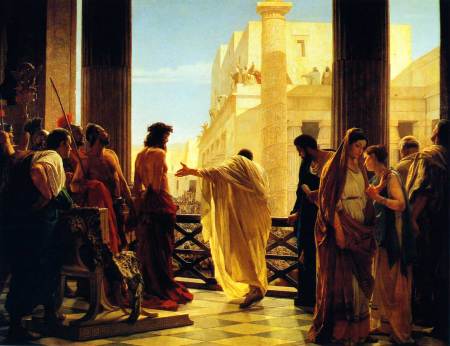
Pilate washes his hands of responsibility, and extends Christ’s arms on the cross. Mary had extended her arms declaring, “Let it be done to me according to your word,” and lovingly held the infant savior in her hands.

Pilate, despite all his power, is ruled by fear.
Mary, despite her weaknesses, is freed from it.

Governor Pilate is rich in wealth and power and yet he has no peace.
Mary, the poor widow, has peace and everything she needs from God.

Pilate has no faith in the God of Israel. He says, “I am not Jew, am I?” But for Mary, God is her rock and this makes all the difference in the world. Mary is defined by her faith, hope and love.

Mary never attends an academy, but she is profoundly wise because she reflects in her heart on the words and deeds of God and because she lives by her own advice: “Do whatever he tells you.” She knows that we do not manufacture the truth for ourselves, we receive it, ultimately from God. We love it, we defend it, and we share it with others. “Blessed [is she],” as Elizabeth said, “who believed that what was spoken to [her] by the Lord would be fulfilled.” Mary trusted and believed, for she saw the evidence through history that God “has mercy on those who fear Him in every generation,” that “He scatters the proud in their pride, and casts down the mighty from their throwns, but He lifts up the lowly.”

Mary’s life was full, but was not free from trials. When Mary consents to be found with child through the Holy Spirit she is uncertain of what will happen to her, but she trusts in God. She does not know how she and her husband will get by as poor immigrants in foreign country, but she continues to trust. Mary’s response to every trial in life, even to the death of her son, is to trust in God. Despite men’s sins, she trusts in God as the Lord of history, that He casts down the proud and mighty from their throwns and raises up the lowly.

Pilate is indifferent to Christ, and he consents to sending Him to the cross, but Mary is wholly devoted to Christ, and she consents to share in His Passion. Pilate’s heart is hardened despite Christ’s Passion, while Mary’s heart is pierced by it.

Governor Pilate was once the most powerful man in Judea, but where is he now? Mary, the poor widow, is now our glorious queen, the most beautiful and powerful woman in heaven or earth, and through her reign she draws millions to Christ our king.

She is the one who wept and now laughs.
He is the one who laughed and now weeps.

He was rich in the world and now he is poor.
She was poor in the world and now the kingdom is hers.

He took root in the desert, he was barren and uprooted.
But she was planted beside the flowing waters, she endured and bore much fruit.

So what do all of these reflections about Mary and Pilate have to do with us? I promised you at the beginning a second good reason why Mary and Pilate are mentioned in the creed; and here it is: Mary and Pilate represent us. They stand as archetypes, models or patterns, for every person.

The faithful one and the faithless one.

The one who serves God and the one who serves himself.

The one who gives Christ life and the one who puts him to death.

We live our daily lives as either Mary or Pilate, with shades of the other thrown in. As we come to the season of Lent, let us examine and discern who we are. “How am I Pilate, and how am I Mary?” And at this Eucharist, let us ask Jesus to exchange in us the ways of Pilate for the ways of Mary, for hers is the way of Christ.

Asking and Receiving — Friday, 4th Week in Ordinary Time—Year II

February 5, 2010

King Herod said to his daughter, “Ask of me whatever you wish and I will grant it to you.” He even swore many things to her, “I will grant you whatever you ask of me, even to half of my kingdom.” If Herod, who was wicked, could be moved to give his daughter gifts, how much more will our heavenly Father give us good things if we ask Him. Praying for good things is something Jesus commands us to do.

While many Christians fall into the mistake of only praying when they want something from God, there are other Christians, who pray every day, who make an opposite mistake. These Christians pray for good things for others, but they never ask anything for themselves, fearing that this would be a selfish prayer. But the danger in this, in never requesting and never expecting God’s gifts and consolations, is that we’ll become discouraged and gradually embittered.

If we never ask for a share in the Father’s gifts we risk becoming like the older brother in Luke’s parable of the prodigal son. Eventually we’ll say to God, “Look, all these years I served you and not once did I disobey your orders; yet you never even gave me something to feast on with my friends.” But our generous and forgiving Father would say to us, “My child, you are here with me always; everything I have is yours for the asking.”

Jesus said, “Whatever you ask in my name, I will do, so that the Father may be glorified in the Son.” So ask God to give you gifts—this is not a selfish prayer, for it will strengthen you in holiness and glorify God. I suggest that you try out a little experiment. Pray, “Lord, please treat me to something special today,” and then watch for his gift to come.

Our World’s Salvation — February 2 — Presentation of the Lord

February 2, 2010

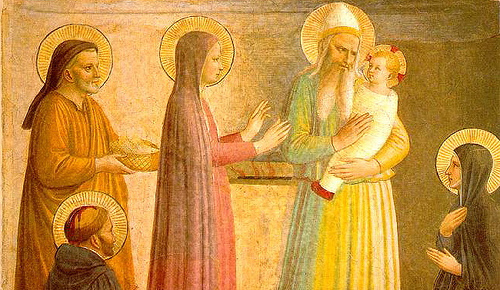
Simeon’s eyes looked upon a baby and foresaw our salvation in Him. When we look back today, at the centuries past, we can see that Jesus Christ has indeed been a light for all the nations.

Even if one were to look at Jesus of Nazareth without the eyes of faith, any fair assessment of history must name Him and the Church that He founded as the greatest cause for good in human history. Jesus Christ came and was the light for a darkened world.

For example, in the ancient world, women’s status ranked near that of slaves, but Jesus showed a reverence towards all women, even intimately involving them in His ministry. Christianity noted His example and began to acknowledge women’s dignity and equality as persons.

While the ancient world wielded total dominance over slaves, Christianity professed slaves’ equality as persons before Christ. (In fact, several early popes were former slaves themselves.) Christianity told masters that they would be held accountable at the Judgment for the good or bad treatment of their slaves, for Jesus had said, “Whatever you do to the least of my brothers you do to me.” The abolishment of slavery came gradually, but it finally came as the result of Christians’ efforts in light of Christ.

Infanticide was common in the ancient world. Sometimes the unwanted little one was physically disabled, or female, or merely inconvenient. But Jesus treasured all children, and He said, “Whoever receives one child such as this in my name receives me.” So Christianity renounced infanticide and would later establish orphanages and promote child adoption.

Jesus showed concern for sick persons and healed them. Jesus also feed hungry crowds. So Christianity has established hospitals and soup kitchens. Today, as throughout the centuries, the Catholic Church is the largest charitable organization on earth.

An eye for an eye was the ancient law, and hating one’s enemies comes naturally, but Jesus did not seek revenge.  Jesus said, “Love your enemies,” and He prayed for His enemies from the cross. Many Christians have followed His example, promoting peace and reconciliation.

Jesus taught his wisdom to great crowds of men and women, the poor and rich, the young and old, so Christianity established schools and universities. Today the Catholic Church educates more children than any other scholarly or religious institution and you are a part of this number.

Our Marshfield area Catholic schools exist today because of Jesus Christ, the greatest person who has ever lived. The public schools have Jesus to thank for their schools, too, but they are not allowed to speak His name. But we can speak His name, and we can thank Him like Simeon here today, for coming into our darkened world and shining His saving light.

(Recommended viewing:  “Epic” produced by Catholics Come Home )

Carrying Water — 2nd Sunday in Ordinary Time—Year C

January 20, 2010

Today’s Gospel, the miracle at the wedding fest of Cana, is a scene rich in symbolism and has many preachable parts. For example, the water of Old Covenant law is changed into New Covenant wine. It is the seventh day in John’s Gospel, according to the narration, pointing to a new Creation and rest. And the New Adam and the New Eve are at a wedding feast together, foreshadowing the marriage of Christ and His Church. But this morning, I would like to bring your attention to an extraordinary part of this Gospel which we disregard as being ordinary. I’m referring to the six stone water jars and the servers who carried them.

“Now there were six stone water jars there for Jewish ceremonial washings, each holding twenty to thirty gallons. Jesus told them, ‘Fill the jars with water.’ So they filled them to the brim.”

You’ve carried a gallon of milk before.   Imagine carrying 25 gallons of milk. I doubt you could do it all at once. Not only would they be too bulky, they would be awfully heavy too. Maybe you could put them on a pole and carry them with a partner. Maybe that’s what the servers in the Gospel had to do, or maybe they were doing laps between the well of Cana and the stone jars at the party. In either case, they we’re hauling an awful lot of water and weight.

Now a gallon of water weighs a little more than eight pounds. If each jar in the Gospel was at least 40 pounds of stone and held 20 to 30 gallons, then we are talking about six filled jars weighing 200 to 300 pounds apiece. And we know they were completely filled, for Mary had told them, “Do whatever he tells you,” and Jesus had told them, “Fill the jars with water.” “So they filled them to the brim.”

The saying “To carry water for (someone)” means to do a menial or difficult task for others.  That’s what these servers were doing and they definitely felt the burden.  Did they have any idea, as they carried those 1,500 pounds of stone and water, that they were a part of something remarkable? Did they know that they were playing an intimate role in one of Jesus’ most memorable miracles? No, they had no idea, not until later, and this reflects a encouraging truth for us to hold onto this week. We often don’t realize the extraordinary impact of our ordinary sacrifices.

You may feel burdened in your life, like your just scrapping or limping along; at work, at school, or at home; with your peers, your friends, or your family. But you do more good than you know. Sometimes we catch glimpses of this, like when someone takes your hand and says, “Thank you sooo much,” or when someone shares with you that they have always looked up to you, or when a child grows to realize and thank you for everything you did for them. After this life, one of our joys in heaven will be seeing how our ordinary sacrifices have touched and changed the lives of thousands, even millions, of people.

Like the servers with their six stone jars, we disregard our efforts as ordinary and do not realize their extraordinary impact. Maybe you don’t see it now, but your ordinary sacrifices do more good than you know. Let us be encouraged by recalling this truth in our daily lives, for if you’re carrying water for Jesus, you’re going to have a part in His miracles. So, “do whatever He tells you,” no matter how ordinary it may seem.

Encountering Jesus in Prayer — Baptism of the Lord—Year C

January 11, 2010

At Jesus’ baptism, the Father spoke to Him from heaven, “You are my beloved Son; with you I am well pleased.” Today, our Father wants you to hear Him say to you, “You are my beloved child and with you I am well pleased.”

This may be hard for us to hear. Maybe we think to ourselves, “I’m certainly not Jesus.   How could God be well pleased with me? Our past and present sins of come to mind and we feel pained by guilt. In times of prayer and in our daily life we are burdened by the thought that we are not the person God wants us to be. We think, “If only I were better, if only I could be perfect, then I could live and pray like the saints and God would love me.” If we think like this, our thinking has it backwards.

It’s not that God decides to love the saints, or us, only after we have achieved holiness by our own incredible feats of strength, endurance and personal sacrifice. Here’s the secret to the saints: the knowledge of God’s love and pleasure toward them came to them first, the saints’ great holiness only followed. Saints are not self-made men and women. It is by accepting God’s embracing love for us that we’re empowered to live incredible lives of love. We live like saints if we live in the truth that God loves us already.

To bear this point out, I would like you to try a thought experiment.  (You may close your eyes if you think it will help.) Imagine if you were a completely perfect person, totally free from sin, and free from guilt and fear before Him. Now pray to the Father in heaven imagining you’re this perfect version of yourself.

If you’re like me, imagining this makes it much easier to approach Him, to love Him, to praise Him, to thank Him and to feel His love for you.

And now, still imagining you’re this perfect person, consider the day or the week ahead of you.  What kind of attitude do you feel towards your life?

Again, if you’re like me, you find it much easier to see the future not so much as a burden, but with a certain eager calm. You view your life as an great opportunity to serve and to love from out of the abundance of love that you feel.

It’s not just your imagination that makes you feel this way.  It is the Holy Spirit confirming a truth in you. And the truth is that when the Father looks at you He doesn’t see the unlovable wretch of your fears, He sees something much closer to this perfect person.  By our baptism into Christ, we are loved as God’s daughters and sons, but maybe we not living like the saints we so admire because we’re tripped up by fear and self-doubts, thinking that for us intimacy with God remains a thousand miles away. The Father wants you to be confident, peaceful, and joyful in His love for you. In this way of His, He will lead you out of sins which history proves that your own efforts alone cannot conquer. Compared to the self-imposed yoke of our own anxious strivings to holy, the way of accepting God’s love for us is easy and light, and it actually works. We will live like saints when we accept the truth that God loves us already.

The saints became saints by overflowing with God’s love for them, by receiving His acceptance, approval and pleasure. These are gifts which He always wanted to give them, and He would do the same for us, if only we would let Him. So when you pray the Our Father today do it as the Father’s beloved son or daughter. And whenever you pray, or in whatever you do, do it in the liberating and empowering truth: “You are my beloved child; with you I am well pleased.”

Decoding the Ritual — Friday After Epiphany

January 9, 2010

Jesus stretched out his hand, touched the leper before Him, and said, “Be made clean.” The leprosy left him immediately and Jesus ordered Him, “Go, show yourself to the priest and offer for your cleansing what Moses prescribed…” What was Jesus asking this man to do? In the Book of Leviticus it says:

This is the law for the victim of leprosy at the time of his purification. He shall be brought to the priest, who is to go outside the camp to examine him. If the priest finds that the sore of leprosy has healed in the leper, he shall order the man who is to be purified, to get two live, clean birds, as well as some cedar wood, scarlet yarn, and hyssop. The priest shall then order him to slay one of the birds over an earthen vessel with spring water in it. Taking the living bird with the cedar wood, the scarlet yarn and the hyssop, the priest shall dip them all in the blood of the bird that was slain over the spring water, and then sprinkle seven times the man to be purified from his leprosy. When he has thus purified him, he shall let the living bird fly away over the countryside.  (Leviticus 14:2-7)

Hidden within this strange Old Covenant ritual, Jesus Christ is concealed. And through Jesus’ death for us on the cross the true symbolism of this ritual is revealed.

The scarlet, the wood and the hyssop all have their place in Christ’s Passion.  The scarlet yarn points to the robe they placed upon Him; the wood to the cross on which they nailed Him; and the hyssop to the branch they used to offer Him drink. One bird is slain and the other is spared, dipped in the water and the blood of its brother. This water points to the water of Christian baptism, which receives its grace through the blood of Jesus’ cross. In the ritual the priest would take all of these things and sprinkle the man to be purified seven (the perfect number of) times from his leprosy. In His Passion Jesus took all these things and used them to purify us from the leprosy of our sins.

In our wonder at these signs, let us make our faith in God firmer, and give Him our thanks.

The Old New Pattern — Thursday After Epiphany

January 8, 2010

In his first letter to his brothers and sisters in Christ, St. John says that the commandment he writes to them is not new, and yet new. (1 John 2) The commandment he is referring had been given to them years before, by Jesus Christ at His Last Supper. He told His disciples, “I give you a new commandment: love one another. As I have loved you, so you also should love one another.” (John 13:34)  Love sums up the moral law, and we know how to love from Christ.

Once when Jesus’ opponents were trying to trip Him up they asked Him what was the greatest commandment. He answered, “You shall love the Lord, your God, with all your heart, with all your soul, and with all your mind. This is the greatest and the first commandment.”  Then He added, “The second (commandment) is like it: You shall love your neighbor as yourself. The whole law and the prophets depend on these two commandments.” (Matt 22) Or, as St. Paul would later put it, “Love is the fulfillment of the law.” (Rom 13:10) Love sums up the moral law, and we know how to love through Christ.

It is intuitive for people to understand that we should do good and avoid evil, that we should love good and hate what is evil. Yet that does not mean that everyone agrees as to how we should live this out. Often we see the truths which Christians present in love angrily dismissed by the world as hate. (Frequently the throwing of this charge allows people to dismiss opposing viewpoints without ever giving them serious thought.) Even those in a post-Christian secular culture will agree that somehow “love is the answer,” but how exactly are we to love one another?

Jesus shows us how to love.  He says, “As I have loved you, so you also should love one another.” We can learn from His example especially here, as we witness His Passion, death, resurrection, and ascension in the Mass, but we can also learn from the entire life He lived.

Sometimes it can be hard understand example, or difficult to relate Jesus’ life to the particulars of our own. To help us He gives us the example of His saints, through whom He has continued to live His one, salvific way of life through thousands of different human expressions. The Spirit of the Lord was upon Jesus; He was anointed to bring glad tidings to the poor, to proclaim liberty to captives, to restore sight to the blind, to free the oppressed, and to proclaim a year acceptable to the Lord. Today this Scripture passage is still being fulfilled by Him through the lives of His saints.

“The love of God is this, that we keep his commandments.”  So let us learn what love is through the example of Jesus and His saints, for love sums up the law, and we know how to love through Christ.